Archives for category: Lies

Lisa Graves and Alyssa Bowen recently reviewed the tax returns of some well-known “parent” groups and discovered what we suspected to be true. They are funded by Dark Money, specifically by billionaire Charles Koch, who longs to eliminate public education.

They write in Truthout:

Right-wing operatives are increasing their attacks on U.S. public education with an expanding number of legal complaints to censor books and target teachers on an array of issues —preventing them from teaching U.S. history accurately, treating LGBTQ+ students with the respect they deserve, and forming support groups for kids and teachers of color. These attacks will likely continue to escalate through 2024 as wedge issues intended to feed the right-wing voting base and lay the groundwork for redirecting funds from public schools to private recipients.

One of the main players in these attacks is Parents Defending Education (PDE), a dark money nonprofit group launched in 2021 in the midst of the Virginia state election cycle. Over the past two years, PDE has become a central actor in the right-wing assault on public schools across the nation. The group has trained local agitators to grab media attention, sued school districts for supposed anti-white discrimination, and railed against the teaching of social emotional learning, accurate U.S. history, and even ethnic studiesin schools.

Lawyers affiliated with PDE filed at least four complaints in January with the U.S. Department of Education claiming affinity groups for kids or teachers are illegal. These are just a few of the many complaints the group has filed over the past two years.

As dark money in education expert Maurice Cunningham has written, PDE’s “real goal” in filing lawsuits and complaints appears to be to “create media attention and promote chaos and disruption.” Then groups like PDE can claim the solution to the chaos is increased right-wing “parental supervision” over school boards. That supervision appears to involve a minority of vocal, politically motivated parents dictating what other people’s kids are taught or what they can read, based on whether such lessons or books are consistent with their right-wing religious beliefs and political opinions.

Illustration of Leonard Leo and a rain of judge's gavels

Groups Connected With Leonard Leo Have Funneled $31 Million to State Court Races

PDE’s speakers are often portrayed in the media as simply “concerned parents,” despite the group’s ties to the network of oil billionaire Charles Koch, far right politicians and school privatization efforts. Due to the timetables for the filing of nonprofit IRS forms, the amount PDE had raised to mount these attacks was unknown — until now.

PDE’s 2021 990 nonprofit IRS form shows that the group raised more than $3.1 million in its first year, even though many genuinely local grassroots efforts take years to raise that much money. That form does not reveal how much money PDE raised in 2022, during the congressional midterm elections; the amount it received to fuel its operations last year is likely even higher than 2021. The $3.1 million disclosed for 2021 also does not include any money raised that year by PDE Action, its (c)(4) advocacy arm.

Please open the link and keep reading this deep dive into astroturf parent groups funded by the far right billionaires.
Heather Cox Richardson picks out the money quotes from the legal filing in the case of Dominion Voting Systems against the Fox Bew Coroiration. The pundits at Fox gave hours and hours of air time to election deniers, yet none of the Fox hosts believed the nonsense they broadcast to millions of people. Fox gave their viewers support for their misguided belief that the 2020 election was stolen. Yet, all of them said in emails that they were broadcasting lies.

A legal filing today in the case of Dominion Voting Systems against the Fox News Corporation provides a window into the role of disinformation and money in the movement to deny that President Joe Biden won the 2020 presidential election.

Dominion Voting Systems is suing FNC for defamation after FNC personalities repeatedly claimed that the company’s voting machines had corrupted the final tallies in the 2020 election. The filing today shows that those same personalities didn’t believe what they were telling their viewers, and suggests that they made those groundless accusations because they worried their viewers were abandoning them to go to channels that told them what they wanted to hear: that Trump had won the election.

The quotes in the filing are eye-popping:

On November 10, 2020, Trump advisor Steven Bannon wrote to FNC personality Maria Bartiromo: “71 million voters will never accept Biden. This process is to destroy his presidency before it even starts; IF it even starts…. We either close on Trumps [sic] victory or del[e]gitimize Biden…. THE PLAN.”

FNC’s internal fact checks on November 13 and November 20 called accusations of irregularities in the voting “Incorrect” and said there was “not evidence of widespread fraud.”

On November 15, Laura Ingraham wrote to Tucker Carlson and Sean Hannity: “Sidney Power is a bit nuts. Sorry, but she is.”

On November 16, Carlson wrote to his producer, Alex Pfeiffer, “Sidney Powell is lying.”

On November 19, FNC chair Rupert Murdoch wrote: “Really crazy stuff.”

Hannity later testified: “[T]hat whole narrative that Sidney was pushing. I did not believe it for one second.”

Fox Politics Editor Chris Stirewalt later testified, “[N]o reasonable person would have thought that,” when asked if it was true that Dominion rigged the election.

The filing claims that FNC peddled a false narrative of election fraud to its viewers because its pro-Trump audience had jumped ship after the network had been the first to call Arizona for Biden, and its ratings were plummeting as Trump loyalists jumped to Newsmax. “I’ve never seen a reaction like this, to any media company,” Carlson wrote to Suzanne Scott, chief executive officer of Fox News, on November 9. “Kills me to watch it.” On November 12, Hannity told Carlson and Ingraham, “In one week and one debate they destroyed a brand that took 25 years to build and the damage is incalculable.”

They went to “war footing” to “protect the brand.” For example, when FNC reporter Jacqui Heinrich accurately fact checked a Trump tweet, correcting him by saying that “top election infrastructure officials” said that “[t]here is no evidence that any voting system deleted or lost votes, changed votes, or was in any way compromised,” Carlson told Hannity: “Please get her fired. Seriously…. What the f*ck? I’m actually shocked…. It needs to stop immediately, like tonight. It’s measurably hurting the company. The stock price is down. Not a joke.”

Heinrich deleted her tweet.

The filing says that not a single witness from FNC testified they believed any of the allegations they were making about Dominion. An FNC spokesperson today said, “Dominion has mischaracterized the record, cherry-picked quotes stripped of key context and spilled considerable ink on facts that are irrelevant under black-letter principles of defamation law.”

Today, part of the report of the special purpose grand jury investigating possible criminal interference in the 2020 election in Georgia was released under court order. It explained that 26 Fulton County, Georgia, residents, three of whom were alternates, made up the grand jury, and 16 of them made up a quorum, enabling the jury to conduct business. Beginning on June 1, 2022, the grand jury heard testimony from or involving 75 witnesses, almost all of it in person and under oath. It also heard testimony from investigators and got digital and physical media.

The grand jury found “by a unanimous vote that no widespread fraud took place in the Georgia 2022 presidential election.” It also reported that “[a] majority of the Grand Jury believes that perjury may have been committed by one or more witnesses testifying before it,” and it asked the district attorney to “seek appropriate indictments for such crimes where the evidence is compelling.”

Also today, in the wake of the inauspicious first hearing of the House Select Subcommittee on the Weaponization of the Federal Government on November 9, a bipartisan group of 28 former officials who were part of the Church Committee wrote an open letter to Representative Jim Jordan (R-OH). Republicans have claimed Jordan’s new subcommittee is a modern version of the 1975–1976 committee, chaired by Senator Frank Church (D-ID), that discovered illegal wiretapping of U.S. citizens, CIA operations to assassinate foreign leaders, drug testing on government personnel, discrediting of civil rights and anti-war activists, and so on.

The letter’s authors reminded Jordan that while the chair of the committee had been a Democrat, its work had been carefully bipartisan, and its members investigated both Republican and Democratic administrations. They had rigorously reported facts in context, “resisting political temptations to assemble misleading mosaics from isolated tidbits.” They had also protected ongoing intelligence and law enforcement operations.

The committee’s 2,700 pages of exhaustive research were also bipartisan and resulted in the creation of Senate and House intelligence committees to provide congressional oversight of intelligence, as well as the establishment of the Foreign Intelligence Surveillance Court.

The former staffers of the Church Committee advised Jordan to follow the model he claimed, remaining objective, grounding the committee’s findings in relevant evidence and applicable laws.” They urged the subcommittee to “consider in good faith whether [Trump attorney general William] Barr and [John] Durham,” whom Barr appointed to discredit the investigation into the Trump campaign’s ties to Russian operatives, “themselves may have strayed into such weaponization.”

The Church Committee staffers warned Jordan that if he wanted to claim the mantle of that committee, he would need to move forward with the “same spirit of cooperation and bipartisanship.”

To see the sources, open the link.

Anyone who believes that Jim Jordan might run a bipartisan investigation believes in unicorns. He is one of the nastiest partisans in Congress.

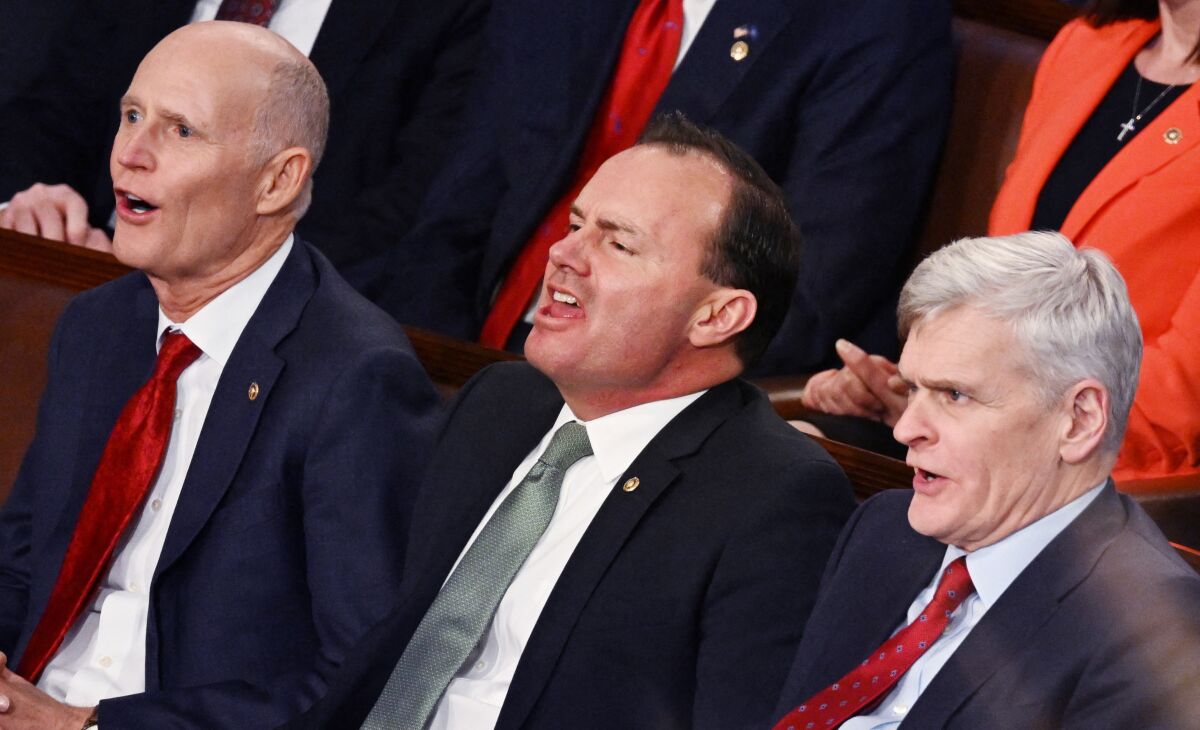
During President Biden’s State of the Union address, he said that Republicans want to cut Social Security and Medicare, and the Republican side of the chamber erupted in jeers and shouts of “liar!” Two of those loudly jeering—Senators Rick Scott of Florida and Mike Lee of Utah—had explicitly made those proposals. Biden then masterfully got the Republican caucuses in both Houses to declare their support for both big entitlement programs.

Michael Hiltzik, business columnist for the Los Angeles, sets the record straight about the Republican stance on Social Security.

From left, U.S. Sens. Rick Scott and Mike Lee jeer.

From left, GOP Sens. Rick Scott of Florida and Mike Lee of Utah jeer during the State of the Union address when President Biden accused Republicans of wanting to cut Social Security. Both senators have proposed exactly that.

(Andrew Caballero-Reynolds / AFP/Getty Images)

Hiltzik writes:

President Biden has congressional Republicans all asquirm as he conducts a post-State of the Union speech national tour.

Why? Because Biden has doubled down — or as Fox News has it, “tripled down” — on his assertion during the speech that the GOP has been planning to cut Social Security.

Not so, they say. Never happened. Sens. Mike Lee (R-Utah) and Rick Scott (R-Fla.) were even caught on camera during the speech wearing “Who, me?” expressions of injured innocence.

It will be my objective to phase out Social Security, to pull it out by the roots.

— Sen. Mike Lee (R-Utah), during his 2010 campaign for the Senate

Unfortunately for them, we have the evidence, as does Biden. Cutting Social Security along with Medicare has been part of the Republican platform for decades.

As I’ve reported before, they often hide their intentions behind a scrim of impenetrable jargon, plainly hoping that Americans won’t do the necessary math to penetrate their subterfuge.

Let’s take a jaunt through the GOP approach to Social Security and Medicare.

Start with their description of these programs as “entitlements,” which they’ve tried to turn into a dirty word. The truth is that they are entitlements, in the sense that most Americans have been paying into these programs for all their working lives, mostly through the payroll tax. So, yes, they’re “entitled” to receive benefits in return.

Republicans, including former Senate Majority Leader Mitch McConnell (R-Ky.), have consistently blamed the federal debt on “entitlements” — never mind that their 2017 tax cut for the wealthy has blown a multitrillion-dollar hole in the budget.

They know they’re on thin ice with the public when they talk about benefit cuts, which is why Sen. Joni Ernst (R-Iowa) once recommended discussing their ideas only “behind closed doors.”

Now we can turn to the specifics of Lee’s and Scott’s plans. In widely circulated videos from Lee’s first successful Senate campaign in 2010 he can be seen and heard stating as follows: “It will be my objective to phase out Social Security, to pull it out by the roots.” He said that was why he was running for the Senate, and added, “Medicare and Medicaid are of the same sort. They need to be pulled up.”

As for Scott, his 12-point “Rescue America” plan, issued last year, included a proposal to sunset all federal legislation after five years. “If a law is worth keeping, Congress can pass it again.” The implications for Social Security and Medicare, which were created by federal legislation, were unmistakable — so much so that the proposal made Republican officeholders’ skin crawl.

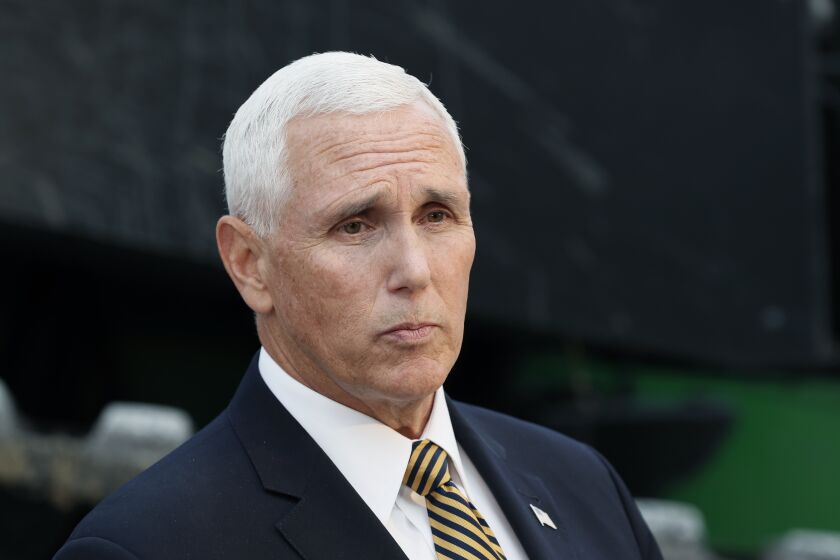
Vice President Mike Pence speaks to reporters during a visit to the Manning Farms, Wednesday, Oct. 9, 2019, in Waukee, Iowa. (AP Photo/Charlie Neibergall)

Column: Mike Pence, would-be president, has a plan to kill Social Security. It will cost you

McConnell disavowed the proposal on the spot and has continued to do so, telling a home-state radio host after the Biden speech that the sunset provision is “not a Republican plan.That was the Rick Scott plan.”

That said, it’s a priceless foil for Biden. When Republicans brayed during his speech that he was lying about it, he offered to make Scott’s manifesto available to anyone who called his office for it. At one of his subsequent appearances, a copy of Scott’s plan was placed on every seat.

The GOP can’t easily wriggle away from its intentions. Let’s examine the fiscal 2023 budget proposal issued by the Republican Study Committee, a key policy body, last June under the title “Blueprint to Save America.”

This plan would increase the Social Security full retirement age, which today is 66 or 67 (depending on one’s year of birth), to 70 by 2040. According to Kathleen Romig, the Social Security expert at the Center on Budget and Policy Priorities, this would translate into a 20% cut in lifetime benefits compared with current law.

As I’ve reported before, raising the full retirement age is a Trojan horse that would affect all retirees across the board, but harm Black workers, lower-income workers and those in physically demanding jobs the most.

It would create particular hardships for those choosing to retire early and collect their benefits prior to their full retirement age.

Doing so exacts a lifetime reduction in monthly benefits, based on a formula aimed at equalizing the lifetime benefit among those who retire early, those who wait until their full retirement age, and those who defer collecting until that age (they receive a bump-up in benefits for every year they delay, topping out at age 70).

Raising the full retirement age to 70, Romig calculates, would mean that retirees who start collecting at the minimum age of 62 would receive only 57% of their full benefit….

The Republican Study Committee also would make it harder for disabled workers to qualify for benefits, and would lengthen the period before those who are disabled and younger than 65 qualify for Medicare to five years from two. This falls into the category of balancing the budget on the backs of the most vulnerable members of society.


As for Medicare, the Republican Study Committee proposes raising the eligibility age, currently 65, so it matches the Social Security retirement age. It also would transfer many more Medicare accounts to private insurance. The committee claims this would save money.

The rest of his incisive analysis is behind a paywall, unfortunately. He demonstrates beyond doubt that Republicans have wanted for years to put these big programs on the chopping block, which are lifelines for senior citizens. They have no objections, however, to cutting the taxes of the wealthiest. That was Trump’s biggest accomplishment: tax cuts for those with the most.

The Texas Observer published a warning to the Texas legislature: Take a close look at the Arizona voucher programs. Don’t go there. Vouchers subsidize private school students while defunding the public schools that still enroll the vast majority of the state’s students.

Like many other typical teenagers, James’ favorite periods in school are P.E. and lunch. During our phone call, he turned the tables on me, politely asking about my children and work. A 15-year-old student who was born with a tumor and has autism, James actively seeks engagement with others, especially his peers. But for two years, he learned at home in isolation. Arizona’s voucher educational savings account program, called the Empowerment Scholarship Account (ESA), granted him $40,000 of public funds to pay private school tuition. But even with that money, private school after private school denied him admission.

“They first demanded all his files, his IEPs [Individualized Education Plan for students with special needs], but before they would grant an interview, they would give some excuse why his needs could not be met there,” James’ mom Pamela Lang said. “Some gave interviews and tours, and James would get excited. But then they would decline admittance saying they could not accommodate him.”

After every single Phoenix, Arizona Catholic school and a slew of secular private schools rejected James, Lang was finally able to find a school to address his needs. But now, she fears there won’t be enough state funds in the future to afford its costly tuition.

What started in Arizona in 2011 as a $2.5 million state voucher program for students with special needs has now ballooned to a universal voucher program for all of the state’s students, public or private.

“The state said the voucher was for kids with disabilities but it was just a way in to open the door,” Lang said. “Every single year since the state got the ESA, they just kept expanding it to more and more people, and now, it’s for everybody. We’re just hoping kids with disabilities aren’t going to have nothing left for them.”

In the first quarter of this school year, Arizona already blew through $300 million, awarding 80 percent of the funds predominantly to wealthy students already enrolled in private schools. This will leave a projected $4 million debt in the state’s education budget at the end of the 2022-2023 school year, a debt that public school advocates fear will deplete public school funds further.

Critics say Arizona used vouchers for special needs students as a trojan horse for school privateers to divest, divert, and dismantle the state’s public education system, which now ranks in the bottom three among all U.S. states for per-pupil spending, teacher retention, and teacher pay.

Texas lawmakers are now poised to follow Arizona’s lead. But parents in Arizona are warning Texans to take heed. Their stories are a cautionary tale for our state, which plans during this legislative session to use special needs students to usher in multiple voucher programs.

Arizona’s voucher programs—and the Texas proposals—include both a universal education savings account and a tax-credit scholarship program, both of which would divert public education money from state coffers to enrich private schools, corporations, and wealthy families.

DIVEST

The country’s first public school education savings account started in Arizona in 2011. The ESA directly appropriates public education money and deposits it into an individual savings account or debit card for parents to use for private school tuition, tutoring, homeschooling, or therapy.

In its first year, $2.5 million of Arizona’s ESA money was directed toward students with special needs. But in subsequent years, expenditures and eligibility for the ESA program expanded to include children attending public schools that received a D or F rating, children in military families, in foster care, and on Native American reservations. Then in 2017, legislators attempted to pass universal vouchers for all students. The proposal was beaten back twice by public school advocates but passed in 2022.

Since its inception, Arizona’s ESA program has stripped more than $963 million from public school funds.

Texas House Bill 557, filed by Representative Cody Vasut, is a universal voucher program from the get-go. It would enable an unlimited number of students to receive reimbursements for up to $10,000 in private school tuition, the full per-pupil allotment in Texas. If all 309,000 private school students in Texas decided to apply for a voucher under this bill, public schools could lose $3 billion in state funding after one year alone. The impact could bankrupt a system in Texas which already ranks in the bottom 10 states in per-pupil funding.

Beth Lewis, director of Save our Schools Arizona, warns Texans that such a voucher program never gives back as much as it robs from public education.

“They sell it under the guise that the money’s following the child,” Lewis said. “But if you were already in a private school or a homeschool situation, that money’s not following you. It’s never been allocated to you. So in reality, it’s a subtraction from a student in the public school. Then, you’re never going to have an equitable system where every kid can access quality education.”

Besides the education savings account program, Arizona has a second type of voucher program that directly funnels public money to private schools—the tax credit scholarship program.

Open the link and read the rest of this important article. Vouchers are a reverse Robin Hood program: they take from everyone to pay the tuition of students already enrolled in private schools. As Professor Josh Cowennof Michigan State University has shown, kids who leave public schools to use vouchers fall behind their peers who remained in public school.

Mimi Swartz, a writer for the Texas Monthly, explored the background, the funders, and the consequences of the well-coordinated campaign to privatize public schools—by defaming them and discrediting those who run for local school board seats. She focuses on the travails of one dedicated school board member, Joanna Day in Dripping Springs, Texas, who contended with insults and threats in her life.

The following is a small part of a long article, which I encourage you to read in full:

The motivations for these attacks are myriad and sometimes opaque, but many opponents of public education share a common goal: privatizing public schools, in the same way activists have pushed, with varying results, for privatization of public utilities and the prison system. Proponents of school privatization now speak of public schools as “dropout factories” and insist that “school choice” should be available to all. They profess a deep faith in vouchers, which would allow parents to send their children not just to the public schools of their choice but to religious and other private schools, at taxpayers’ expense.

But if privatizing public education is today cloaked in talk of expanded liberty, entrepreneurial competition, and improved schools for those who need them most, its history tells a different story. In 1956, two years after the U.S. Supreme Court handed down its landmark Brown v. Board of Education decision, a group of segregationist legislators in Texas, with support from retiring governor Allan Shivers, began concocting work-arounds for parents appalled by the prospect of racial integration of public schools. One idea: state-subsidized tuition at private schools. That never came to pass, but it was Texas’s first flirtation with vouchers.

Privatization proponents have since switched up their rhetoric, pitching vouchers as an opportunity for poor urban families to save their children from underperforming neighborhood schools. That hasn’t worked out either. In various experiments across the nation, funding for vouchers hasn’t come close to covering tuition costs at high-quality private schools, and many kids, deprived of the most basic tools, haven’t been able to meet the standards for admission.

School funding in Texas is based largely on attendance—as the saying goes, the money follows the child. Considerable evidence suggests that vouchers would siphon money from underfunded public schools and subsidize well-to-do parents who can already afford private tuition. Critics frequently cite a program in Milwaukee, where four out of ten private schools created for voucher students from 1991 to 2015 failed.

“I don’t think that vouchers serve any useful purpose at all,” said Scott McClelland, a retired president of H-E-B who now chairs Good Reason Houston, an education nonprofit. Ninety-one percent of Texas students attend public schools. “There isn’t enough capacity in the private school network to make a meaningful difference in their ability to serve economically disadvantaged students in any meaningful numbers, and it will divert funding away from public schools.”

In Texas, an unusual alliance of Democratic and rural Republican leaders has for decades held firm against voucher campaigns. The latter, of course, are all too aware that private schools aren’t available for most in their communities and that public schools employ many of their constituents. But the spread of far-right politics and the disruption of public schools during the pandemic created an opening for activists to sow discontent and, worse, chaos. “If they can make the public afraid of their public school, they will be more likely to support privatizing initiatives. Then that puts us back to where we used to be with segregation of public schools,” says former Granbury school board member Chris Tackett, who, with his wife Mendi, has become an outspoken advocate for public education and a relentless investigator of the attempts to undermine it.

They have their work cut out for them. In the past, just a few right-wing legislators pushed for privatization and were routinely ignored. After all, the state constitution spelled out “the duty of the Legislature of the State to establish and make suitable provision for the support and maintenance of an efficient system of public free schools.” But as times have changed, so has the interpretation of that guarantee.

Betsy DeVos, President Donald Trump’s former Education Secretary, set up shop in Dallas with her American Federation for Children to push against “government schools” in favor of “school choice.” Political PACs such as Patriot Mobile Action, an arm of a Christian wireless provider in North Texas, continue pouring millions into school board races and book bans to promote more religious education. Patriot has joined other recently formed PACs with inspirational names such as Defend Texas Liberty and Texans for Excellent Education, all of which supposedly support better public schools but are actually part of the privatization push. But by far the most powerful opponents of public schools in the state are West Texas oil billionaires Tim Dunn and the brothers Farris and Dan Wilks. Their vast political donations have made them the de facto owners of many Republican members of the Texas Legislature through organizations such as the now dissolved Empower Texans and the more recent Defend Texas Liberty, which the trio uses to promote restrictions on reproductive rights, voter access, and same-sex marriage. Almost as influential is the Texas Public Policy Foundation, where Dunn is vice board chair.

A November 2021 TPPF fund-raising letter, sent to supporters in advance of the Eighty-eighth Legislature convening, argued that “public education is GROUND ZERO” in the fight for freedom. “The policy team and board of the Texas Public Policy Foundation (TPPF) believe it is now or never,” it read, signaling that the long-standing and robust alliance against vouchers was unusually vulnerable. “The time is ripe to set Texas children free from enforced indoctrination and Big Government cronyism in our public schools.” The letter went on to herald a $1.2 million “Set the Captives Free” campaign to lobby legislators to save Texas schoolchildren from “Marxist and sexual indoctrination” funded by “far-Left elites for decades.”

Lieutenant Governor Dan Patrick, generously backed by Dunn, the Wilks brothers, and their organizations, has long been a proponent of privatizing public education (and of starving it through reductions in property taxes). He has made vouchers a primary legislative goal of the current session. Mayes Middleton, of Wallisville, a Republican state senator and former chair of the TPPF-aligned Texas House Freedom Caucus, filed a bill to create the “Texas Parental Empowerment Program,” proposing education savings accounts that are essentially a form of vouchers. Representative Matt Shaheen, of Plano, who is a member of the Texas Freedom Caucus, has introduced a measure that would guarantee state tax credits for those who donate to school-assistance programs—such as scholarships for kids wishing to go to private schools.

Governor Greg Abbott, knowing all too well the political headwinds that vouchers have faced, has long been wary of publicly supporting them, so he has undermined public schools in other ways. While campaigning early last year, he promised to amend the Texas constitution with a “parental bill of rights,” even though most, if not all, of those rights already existed. By then, “parental rights” had become a dog whistle to animate opponents of public education. (As the Texas Tribune put it: “Gov. Greg Abbott taps into parent anger to fuel reelection campaign.”)

During the recent intensifying crisis on the border, Abbott publicly floated a challenge to the state’s constitutional obligation to give all Texas children, including undocumented ones, a publicly funded education—a step his Republican predecessor, Rick Perry, had denounced years earlier as heartless. Then last spring, Abbott made headlines with his first full-throated public endorsement of a voucher program.

So here we are, with distrust in public schools advancing as fast as the latest COVID-19 variant. The forces behind the spread of this vitriol are no mystery. Those who would destroy public schools have learned to apply three simple stratagems: destabilize, divide, and, if that doesn’t work, open the floodgates of fear

In 2009, the Atlanta Journal-Constitution scrutinized test score gains in the city’s public schools and discovered a number of schools where the gains seemed improbable. The story triggered intense scrutiny by the Georgia Bureau of Investigation. Eventually nearly three dozed educators were charged with changing answers on the standardized tests from wrong to right in hopes of winning a bonus and pleasing their superintendent Dr. Beverly Hall, who put pressure on all teachers to raise scores or be humiliated.

During Beverly Hall’s tenure, the Atlanta district was celebrated for its miraculous test score gains, and she won recognition as Superintendent of the Year. She was the poster educator supposedly proving the “success” of No Child Left Behind. What she actually proved was that NCLB created perverse incentives and ruined education.

The facade of success came tumbling down with the cheating scandal.

After the investigation, Beverly Hall was indicted, along with 34 teachers, principals, and others. All but one of those charged is black. Many pleaded guilty. Ultimately, 12 went to trial. One was declared innocent, and the other 11 were convicted of racketeering and other charges. Beverly Hall died before her case went to trial.

The case was promoted by then-Governor Sonny Perdue. Ironically, the rise in Atlanta’s test scores was used by the state of Georgia to win a $400 million Race to the Top award.

One of those who was punished for maintaining her innocence was Shani Robinson, who was a first-grade teacher. She is the co-author with journalist Anna Simonton of None of The Above: The Untold Story of the Atlanta Public Schools Cheating Scandal, Corporate Greed, and the Criminalization of Educators.

I reviewed their book on the blog. While reading her book, I became convinced that Shani was innocent. As a first-grade teacher, she was not eligible for a bonus. Her students took practice tests, and their scores did not affect the school’s rating. Yet she was convicted under the federal racketeering statute for corrupt activities intended to produce financial gain. The Racketeer Influenced and Corrupt Organizations Act (RICO), was written to prosecute gangsters, not school teachers. Her conviction was a travesty.

Investigators offered Shani and other educators a deal: Plead guilty and you can go free. Or, accuse another teacher and you can go free. She refused to do either. She maintained that she was innocent and refused to accuse anyone else. Shani was accused by a teacher who won immunity. Despite the lack of any evidence that she changed scores, she was convicted.

Two Atlanta lawyers wrote a blog post in 2020 describing the Atlanta cheating trial as a legal outage:

The Atlanta Public Schools (APS) “cheating” scandal is a textbook example of overcriminalization and prosecutorial discretion gone amok, compounded by an unjust sentence of first-time offenders to serve years in prison. It is a glaring illustration of a scorched-earth prosecutorial mindset that has sparked a movement of reform-minded prosecutors nationwide — one which has yet to be embraced in Atlanta.

Just this past week, the six remaining educators who have insisted on their innocence went before the same judge who found them guilty. Their public defender asked to be excused from the case because he thought it was a conflict of interest to represent all six defendants. The original prosecutor, Fani Willis, continues to believe the six educators should be imprisoned. Willis is now prosecuting the case of whether former President Trump interfered in Georgia’s election in 2020.

The six educators who insist they are innocent have lived in a state of suspended animation for more than a decade. They have not gone to prison, yet. They have lost their reputations, their jobs, their teaching licenses.

They hoped that Judge Baxter might use the hearing to dismiss their case. Shani asked me to write a letter supporting her. I did.

It didn’t matter. Judge Baxter decided that the defendants should get a new public defender and return for another hearing. The case has already cost millions of dollars and is the longest-running trial in the history of the state.

The judge ordered them to return to court with their new lawyers or public defenders on March 16. At that time, the entire appeals process might start again and take years to conclude.

I contacted my friend Edward Johnson in Atlanta to ask him what he thought. Ed is a systems thinker and a sharp critic of the Atlanta Public Schools‘ leadership, which is controlled by corporate reformers who make the same mistakes again and again instead of learning from them.

Ed wrote me:

Prosecuting teachers and administers was morally wrong to begin with. Continuing to prosecute any of them is doubly morally wrong. Teachers and administers were the real victims of Beverly Hall. So prosecuting them means being willfully blind to ever wanting to learn truths about anything that would help Atlanta avoid doing a Beverly Hall all over again.

I agree.

Ron DeSantis is a dangerous ideologue and a wannabe Mussolini. He speaks of freedom but practices coercion and cancel culture. In Florida, you are free to echo his beliefs but not to disagree. He is a bully.

This frightening story by Kathryn Joyce in Vanity Fair is a MUST-READ. DeSantis engineered the right-wing takeover of New College, a small, progressive college by installing new board members and ousting the President of New College. The extremists are portraying their swift decapitation of a left wing college as a model for other red states. Their plan is to turn New College into its ideological opposite, the “Hillsdale of the South.” Public colleges and universities in other red states should be on high alert. Vanity Fair (to which I subscribe) is usually behind a paywall, but this article is a one-time freebie.

The article begins:

It took New College president Patricia Okker three attempts to deliver her farewell remarks. She kept being interrupted during last week’s board meeting in Sarasota, Florida, including once by a member of the school’s board of trustees, making a motion to terminate her without cause. Okker had been addressing the dozens of students, faculty, and parents who’d come to defend her record—and the hundreds more outside who weren’t admitted—saying she was sorry to disappoint them, but she couldn’t represent the mandate New College was being given through this “hostile takeover.” And she refused to support the claims of right-wing critics that the school had been indoctrinating its students.

In the audience, supporters hugged one another and students left in tears. The trustees moved on, voting to replace Okker with interim president Richard Corcoran, Florida’s recently departed education commissioner who, in a 2021 speech at Michigan’s right-wing Hillsdale College, came close to calling for the collapse of the public school system through student attrition and said the political war “will be won in education.” The trustees replaced the board chair too, made plans to replace the general counsel, and instructed administrators to start preparing to dismantle the college’s diversity offices. null

It was hard to imagine a starker change in leadership for New College, the small, nontraditional honors college of the Florida public university system, known for its lack of grades, individualized majors, and leftist student body, but which has also been eyed skeptically for years by Florida’s conservative-dominated legislature for its low enrollment and graduation rates. But that was exactly the transformation intended when Governor Ron DeSantis last month appointed six new trustees to the school’s 13-member board, in hopes they would remake New College into a right-leaning “classical college, more along the lines of a Hillsdale of the south,” as his education commissioner Manny Diaz put it.

After the Republican-controlled Board of Governors appointed a seventh trustee, the new majority represented a team uniquely qualified to carry out DeSantis’s scorched-earth, right-wing education wars. There was Manhattan Institute fellow and anti-critical race theory hype man Christopher Rufo, who has most recently turned his efforts to laying “siege” to diversity, equity, and inclusion programs; one of Hillsdale’s graduate school deans, Matthew Spalding, who also helped lead Donald Trump’s short-lived 1776 Commission; Charles Kesler of the right-wing Claremont Institute, which spent the Trump years retconning an intellectual platform for the MAGA movement; a senior editor at a religious right magazine; the Catholic author of a book accused of “fram[ing] LGBTQ+ identity as a mental illness”; and a private Christian school cofounder with a penchant for Covid disinformation.

Following his appointment, Rufo immediately began speaking in martial terms: that conservatives were “recapturing higher education,” mounting a “landing team” to survey the school as well as a “hostage rescue operation” to “liberate” it from “cultural hostage takers.” Another new trustee, the private Christian academy cofounder Jason “Eddie” Speir, started a Substack to chronicle the transformation, sparking further panic in late January with a post proposingthe board declare a financial emergency, firing the entire staff and rehiring only those professors aligned with the school’s new business model. (Speir also used his newsletter to propose banning USA Today affiliates from covering campus events over a reader comment suggesting people throw dog poop on the new trustees; to request the entire board be given his essay, “‘Florida, Where Woke Goes to Die’ What Does It Mean?” as “supporting material”; and to ask if any readers had a copy of Robert’s Rules of Order he could borrow.)

Students, faculty, and alumni from New College and far beyond decried the takeover as an attack on academic freedom with national implications. Multiple scholarly organizations, including the American Anthropological Association and the American Historical Association, denounced it as “an orchestrated attack on academic integrity.” The University of Florida graduate assistants’ union tweeted a message of “Solidarity with New College students, faculty, and staff as DeSantis appoints a card-carrying fascist to the presidency.” At a campus rally preceding last Tuesday’s meeting, former Democratic state representative Carlos Guillermo Smith warned, “New College is their first test, their first trial run.” Repeating a Twitter hashtag protesting students had used, Smith added, “your campus is next.”

As though to prove them right, on February 1, Florida Republican state representative Spencer Roach—who cosponsored a recent Florida law mandating ideological surveys of public university campuses to “stem the tide of Marxist indoctrination”—tweeted that Okker’s termination should be replicated “at every university of the state.” In a January essay published in the Manhattan Institute’s City Journal, Rufo touted the opportunities for emulation as well, writing that “If we are successful” in carrying out the mission of “institutional recapture,” what happens at New College “can serve as a model for other states.”

One horrified alum, Cayenne Linke, who attended New College in the 1990s, compared the takeover to a violent assault. “I feel like I’m standing at the precipice of the Fourth Reich, and I’m mostly powerless to fight back,” Linke said. “I weep for our nation if DeSantis wins a presidential bid and inevitably installs Rufo as education secretary.”

Please open the link and read the article in its entirety.

Ron DeSantis responds to critics of his campaign to stamp out “critical race theory” by saying that Florida mandates a high school course in Black history. What he doesn’t say is that the course is offered in only 11 of the state’s 67 districts.

It isn’t offered because the state has not funded the development of a curriculum and has ignored the “mandate.”

The unenforced mandate was passed in 1994 in an attempt to make amends for the atrocities that occurred in Rosewood, Florida, exactly 100 years ago.

In 1923, 200 white terrorists sacked and burned the all-black town of Rosewood, Florida. The town was burned to the ground, and some who resisted were lynched.

Mary Ellen Klas wrote in The Miami Herald:

The painful details of the unpunished lynchings and vigilante violence went from being family secrets to the foundation for legislation awarding the first reparations paid by a state in the nation’s history to survivors of racial violence. They also became the catalyst for the 1994 law requiring the teaching of Florida’s Black history in K-12 schools. The law requires that courses comprise five components: African beginnings, the passage to America, slavery, the Reconstruction period after the Civil War and the “contributions of African Americans to society.”

DeSantis and his education commissioner Manny Diaz, Jr. object to any mention of the state’s violent racist history, and they certainly don’t want people today to know that the state agreed to pay reparations to the few survivors of the Rosewood massacre. That may be why they objected vehemently to any mention of the reparations movement in the AP course. They have a guilty conscience.

As DeSantis defends against charges that he is “erasing the state’s Black history,” he cites the 1994 law as evidence that it is required to be taught, but he is confronted with contradictions:

▪ Budget records show that the implementation of the law that has been on the books for decades has been not only understaffed and barely enforced, but DeSantis and legislative leaders have rejected requests to beef up resources to expand the teaching of Black history in Florida.

▪ The word “reparation,” which is central to the Rosewood saga that spawned the Black history law, is now considered off-limits in Florida classrooms because state officials have determined that discussion of the reparation movement, which involves offering financial restitution to the descendants of enslaved people for the harms of slavery and racial discrimination, is an attempt at “indoctrination.”

“We proudly require the teaching of African American history. We do not accept woke indoctrination masquerading as education,’’ wrote Education Commissioner Manny Diaz on Twitter last month as he defended the Department of Education’s decision to reject the Advanced Placement course in African-American Studies because it “lacked educational value.”

Hypocrites. DeSantis is hoping to become President by appealing to racism and to white grievances and resentment towards Blacks. He has amplified false claims about critical race theory, which involves the study of racism. He wants to make open bigotry respectable by loudly proclaiming that anyone who wants factual history and wants to eliminate racism is “woke.”

Lincoln spoke to “the better angels of our nature.” DeSantis appeals to the worst instincts of our nature.

Read more at: https://www.miamiherald.com/news/politics-government/article271882322.html#storylink=cpy

We are living in a perilous that demonstrates the need for tenure and unions. With so many astroturf parent groups making spurious charges against public schools and their teachers, who will dare to stand up to bullies? In New Hampshire, it’s the president of the state AFTDeb Howes.

Contact:
Deb Howes
president@aft-nh.org
603-930-9248


AFT-NH Statement on Bill on ‘Obscene Materials’ in K-12 and Higher Education Classes, Public Libraries

CONCORD, N.H.—The following is a statement from AFT-New Hampshire President Deb Howes on HB 514, a bill to provide a procedure for people to complain about so-called obscene materials in K-12 and higher education classes and public libraries but that does not even clearly define what would be considered obscene:

“For all intents and purposes, this legislation about the dissemination of obscene materials is a book ban bill. Incredibly, the bill’s sponsors don’t even have the guts to clearly define what would be considered obscene, so it’s really meant to intimidate teachers and deprive students—both school-aged and adults—of books that one person who files a complaint deems objectionable. It practically begs parents or guardians to complain about a particular book to their local school board in the case of public schools, opening the way to a chaotic free-for-all. For public universities, public libraries and museums, it adds the Department of Education to the agencies that can initiate legal hearings to find material ‘obscene’ after receiving anonymous citizen complaints. Higher education faculty actually could be arrested, charged and indicted if they are found to be using a book that is judged to be obscene, whatever that means.

“This is disgusting and meant to censor students’ education and deprive them of quality books. Book bans have no place in New Hampshire K-12, public libraries or higher education classes. We will fight vigorously to ensure that our students have the books they need to receive a well-rounded, honest education. We also will stand firm for the right to access the whole world of ideas through public libraries and universities.”

# # #

Oklahoma Governor Kevin Stitt wants voters to believe that his push for vouchers comes from the “grassroots.” Not true. The last time vouchers came to a vote in the legislature, they were defeated by Republicans, especially rural Republicans who understand the importance of their public school.

Ben Felder of The Oklahoman got copies of internal correspondence and learned that the voucher campaign is funded by the Walton Family Foundation and organizations created by Charles Koch.

Is Governor Stitt believes that the people of Iklahoma want vouchers, why doesn’t he put it to a vote? Why let out-of-state billionaires defund the already underfunded public schools of Oklahoma. Take it to the people! Let them decide!