Archives for category: Libraries

Ron DeSantis wants to make America just like Florida, where the maximum leader (Ron DeSantis) has a docile legislature that lets him decide what everyone else is allowed to do and punishes those bold enough to ignore his orders.

That’s why he is running for President. He thinks the whole nation needs and wants a maximum leader with a reactionary view of behavior and morality.

Florida is where you are free to do whatever Ron DeSantis tells you to do and free to think what he believes. If you disagree, you are no longer free.

The Miami Herald editorial board says DeSantis has turned Florida into a mean state. No, you don’t want to make America Florida.

Florida, under Gov. Ron DeSantis and Republican Legislature, is increasingly hard to recognize. It’s an intolerant and repressive place that bears scant resemblance to the Sunshine State of just a few years ago.

The 2023 legislative session cemented those appalling setbacks. Florida is now a state where government intrusion into the personal lives of Floridians is commonplace. What will it take for citizens to push back on this unprecedented encroachment on their rights? And, more broadly, what if Desantis supporters get what they want, which is to “make America Florida”?

The latest round of laws makes Florida sound more and more dystopian — something voters in the rest of the nation should note if they are considering what a DeSantis presidency could look like. The state has new rules for who can use which bathroom, what pronouns can be used in schools, which books can be taught and when women can get an abortion (almost never.) There are measures to strip union protections from public employees, keep transgender children and their parents from choosing to seek medical treatment, prevent universities from discussing diversity or inclusion and ban talk of gender identity or sexuality in schools all the way through 12th grade.

The state legislature in Texas passed a bill that will place an expensive burden on the state’s 300 or so small small bookstores. The mandate is not only costly but almost impossible to comply with. The state wants every bookstore to rate every book they sell by its “sexual content” and to refuse to sell books with sexually explicit content to teachers, librarians, and school libraries. In addition, the bookstores are supposed to report whether they have ever in the past sold books with such content to teachers or schools.

Independent bookstores around Texas warn that a bill designed to rid school libraries of sexual content could have unintended consequences that devastate their businesses.

The bill, which received final passage in the Legislature this week and is awaiting Gov. Greg Abbott’s signature, requires booksellers to rate every book they sell to a school, librarian or teacher for use in their classroom. Books can be without a rating, “sexually relevant” or “sexually explicit,” and those with the explicit rating will be banned from schools entirely.

And by April of next year, every bookseller in the state is tasked with submitting to the Texas Education Agency a list of every book they’ve ever sold to a teacher, librarian or school that qualifies for a sexual rating and is in active use. The stores also are required to issue recalls for any sexually explicit books.

Many have expressed concerns that the bill is an effort to restrict books with LGBTQ themes or by Black authors. In addition, throughout the legislative process, independent bookstores repeatedly have warned that the bill misunderstands how book sales to schools work, is unworkable in its current form and could be harmful to small businesses.

“The First Amendment person in me says, ‘Why do we have to mark the books at all? ’ The business person in me says, ‘that’s going to be very hard to administer for the middle vendor,’ which we are,” said Valerie Koehler, owner of Blue Willow Book Shop in Houston.

Owners and employees of bookstores around the state have said they don’t have the staff or expertise to read and rate every single book they are selling to an educator, and they have no records to retroactively rate every book they’ve ever sold to a school. If the TEA finds that bookstores have been incorrectly rating books, they can be banned from doing business with charter schools or school districts, which might make up between 10 percent and a third of their business.

The bill was sponsored by Rep. Jared Patterson, R-Frisco. He dubbed it the Restricting Explicit and Adult-Designated Educational Resources act, or READER Act. The measure was born out of conservative fears in the last few years of sexual content in public schools. Many of the books that were subsequently identified as inappropriate were written for LGBTQ children and teenagers.

Patterson has said the bill was inspired by “Gender Queer,” a coming-of-age graphic novel that explores the author’s gender identity and personal sexuality.

“We’re not talking about a certain type of sexual activity. We’re talking about sexually explicit of any sort. It doesn’t belong in front of the eyes and in the minds of kids,” Sen. Angela Paxton, R-McKinney, said during a Senate debate Tuesday night. Paxton shepherded the measure through that chamber. [Senator Paxton is the wife of State Attorney General Ken Paxton, who was just impeached for multiple financial crimes by the Texas House.]

Paxton said the bill will mostly affect large vendors, as just 50 companies sell most books purchased by Texas public schools, and three giants are responsible for the bulk of titles in campus libraries.

“If vendors want to sell books in Texas, they certainly have a vested interest in making sure it’s done properly,” she added.

But while those large vendors may be able to more easily bear the extra costs associated with this bill if it becomes law, it will be more difficult for the roughly 300 independent bookstores in Texas that have much smaller profit margins overall than the giants.

It’s common for stores to offer discounts for teachers, librarians and schools, which means the margins on those sales are lower.

For example, a librarian might give the store a list of 150 books they want to buy, at an average of 200 pages each. If this bill becomes law, the store will need to pay someone to read and rate each of those books, and run the risk of being punished by the Texas Education Agency if they get it wrong.

This could either make it more expensive for schools to buy books or make such sales infeasible for small bookstores, said Elizabeth Jordan, general manager of Nowhere Bookshop in San Antonio. Her store had a goal of increasing its share of sales to schools to about 15 percent of its total business, she said, but that will no longer be possible.

“If I am selling a book to a school, I will have to have read the whole book to determine if it’s sexually relevant or sexually explicit. And both of those things, I think, are pretty subjective, and I might rate them differently than others might,” she said. “I don’t see why I would put myself at risk to do that. If all the onus is on me, all the liability is on me, and it’s not a job I’m trained to do or my employees are trained to do….

In addition, the bill requires stores to retroactively rate every book they’ve ever sold that is still “in active use by (a) district or school.”

“The way the bill is written right now is that not only can we get in trouble for what we sell to a school, we can get in trouble for something we sold 10 years ago to a school,” Koehler said.

When Ron DeSantis launched his candidacy on Twitter, he scoffed at the notion that schools were banning books in Florida. That alone should disqualify him, based on what we have seen, heard and read about the state’s encouragement of banning books that refer to gays or racism. A complaint by a single parent is sufficient to get a book removed from the school library. Most recently, a parent at an elementary school complained about Amanda Gorman’s poem “The Hill We Climb,” which she read at President Biden’s inauguration. The poem is now available to middle school children, but not to those in the elementary school.

The Miami Herald published this editorial about the phenomenon that DeSantis says is non-existent, a hoax.

Perhaps it’s because of how Amanda Gorman alluded to the Jan. 6 attack in her famous poem, finished the night after rioters stormed the U.S. Capitol: “We’ve seen a force that would shatter our nation rather than share it.”

Or maybe she wrote too bluntly about race and the legacy of slavery:

“We, the successors of a country and a time where a skinny Black girl descended from slaves and raised by a single mother can dream of becoming president, only to find herself reciting for one.”

Gorman, the youngest inaugural poet in U.S. history, read “The Hill We Climb” at President Joe Biden’s inauguration, watched by about 40 million people. She wrote the poem so “that all young people could see themselves in a historical moment,” she posted on Twitter Tuesday.

But Gorman’s poem is now deemed not age appropriate, one of four library titles Bob Graham Education Center banned, following a parent’s complaint, for elementary school students, the Herald reported. The books are now available only for middle-schoolers at the public school in Miami Lakes, even though some of them were written for younger children.

The school committee that reviewed the material didn’t offer an explanation for its decision. We’re left to wonder: What in the children’s illustrated book “The ABCs of Black History,” written for children ages 5 and up, made it so inappropriate?

Perhaps it was the mention of iconic author James Baldwin’s sexual orientation: “And he was a gay man who believed that when it comes to love, you should ‘go the way your blood beats.” Or the mention of the Little Rock Nine, the “first Black children in all-white schools,” or the Black Panther movement. Or were the colorful drawings of Black female icons like Michelle Obama and Toni Morrison — described as “ queens”— too much?

One thing is clear: Books by Black authors — and about the Black American experience — make up three of the four titles deemed inappropriate for young children at Bob Graham Education Center. The other one, “Cuban Kids,” uses photos to describe the lives of children in Cuba in the early 2000s and how different or similar they are to Americans, according to the author’s homepage. Learning about the lives of their counterparts in a socialist country — including how they got around paper shortages — is sure to turn our kids into communists.

We knew that the movement to “sanitize” school libraries that Gov. Ron DeSantis and the Legislature unleashed would eventually catch up with Miami-Dade. Our melting pot, after all, might not be so different from Escambia County in the Panhandle, whose school board has been sued for removing books about race and LGBTQ topics.

Florida’s laws have emboldened parents and activists like Moms for Liberty to challenge materials dealing with these topics. Most recently, DeSantis signed a bill that empowers one person to file a complaint and ban a book, at least temporarily, while a district reviews it. Parents not satisfied with how a district ruled on the challenge can appeal to the state. That is bound to make schools acquiesce to offended parents.

The result, as Gorman wrote on Twitter after her poem was restricted, is that “most of the forbidden works are by authors who have struggled for generations to get on bookshelves.”

Elementary students were not required to read Gorman’s work or any of the challenged titles. These were options at Bob Graham Education Center’s library. Those options also should be available for the children of all parents, not only those offended by certain content or groups skimming books to find any remote reference to race or LGBTQ issues.

“Love to Langston” was written at a second-grade reading level but no longer is accessible to second-graders at Bob Graham. The illustrated biography of Harlem Renaissancewriter Langston Hughes describes his own elementary school experience, tainted by racism, in the early 1900s:

“In Topeka, Kansas the teacher makes me sit in the corner; in the last row; far away; from the other kids.”

The parent who filed the complaint said “Love to Langston” contained critical race theory, “indirect hate messages,” gender ideology and indoctrination, the Herald reported. It’s unclear how.

It is curious, however, that “indoctrination” and “hate messages” seem to be flagged mostly when when Black authors write about being Black, or when LGBTQ authors write about being queer. The adults must ask themselves why that’s the case before making them inaccessible to children.

Three literacy experts—David Reinking, Peter Smagorinsky, and David B. Yaden—wrote in opposition to the current “science of reading” frenzy. Unfortunately, their article does not mention the journalist Emily Hanford, who has zealously promoted the idea that American students don’t learn to read because their teachers do not utilize the “science of reading.” Google her name and you will find numerous articles repeating this claim. I wish I had been as successful in alerting the public and the media to the dangers of privatization as she has been in building a public campaign for phonics-as-silver-bullet. She is truly the Rudolf Flesch of our day (he published the best-selling Why Johnny Can’t Read in 1955.)

As I have often written here, I strongly support phonics. I was persuaded long ago by Jeanne Chall in her book Learning to Read: The Great Debate that students need to learn the sounds of letters and letter-combinations so they can decode unfamiliar words without thinking about it. But I am not a believer in “the science of reading.” Different children learn different ways. Phonics adherents cite the report of the National Reading Panel (2000), which consisted of university-based scholars and only one practitioner, Joanne Yatvin, who wrote a dissent. The phonics cheerleaders ignore the ignominious fate of NCLB’s Reading First program, which doled out nearly $6 billion to promote the recommendations of the National Reading Panel but failed to achieve anything.

There is no “science of reading.” There is no “science of teaching math” or any other academic skill or study. If someone can identify a district where every single student reads at a proficient level on state tests, I will change my view. I await the evidence.

This post by Reinking, Smagorinsky, and Yaden appeared on Valerie Strauss’s Washington Post blog, “The Answer Sheet.”

Strauss introduced their article:

The “reading wars” have been around for longer than you might think. In the 1800s, Horace Mann, the “father of public education” who was the first state education secretary in the country (in Massachusetts), advocated that children learn to read whole words and learn to read for meaning before they are taught the explicit sounds of each letter. Noah Webster, the textbook pioneer whose “blue-back speller” taught children how to spell and read for generations, supported phonics. So it started.

In the last century and now again, we have gone in and out of debates about the best way to teach reading — as if there was a single best way for all children — with the arguments focusing on phonics, whole language and balanced literacy. We’re in another cycle: Just this week, New York City, the largest school district in the country, announced it would require all elementary schools to employ phonics programs in reading instruction.

This post — written by David Reinking, Peter Smagorinsky, and David B. Yaden — looks at the debate on phonics in a different way than is most often voiced these days. It notes, among other things, that the National Reading Panel report of 2000, which is often cited in arguments for putting phonics front and center in school reading curriculum, says many things about the importance of systematic phonics instruction but it also says this: “Phonics should not become the dominant component in a reading program, neither in the amount of time devoted to it nor in the significance attached.”

Reinking is a professor of education emeritus at Clemson University, a former editor of Reading Research Quarterly and the Journal of Literacy Research, a former president of the Literacy Research Association and an elected member of the Reading Hall of Fame.

Smagorinsky is a research professor emeritus at the University of Georgia, a visiting scholar at the University of Guadalajara, a former editor of the journal Research in the Teaching of English, and an elected member of the National Academy of Education.

Yaden is a literacy professor in the College of Education at the University of Arizona, a former editor of the Journal of Literacy Research, and a past president of the Literacy Research Association.

Reinking, Smagorinsky and

Reinking, Smagorinsky, and Yaden wrote:

Two of the nation’s most trustworthy news sources, the New York Times and The Washington Post, recently ran opinion pieces asserting that there is a national reading crisis and a single solution: more phonics instruction. The Times followed with a news article about how a “science of reading” movement is sweeping the United States in support of more phonics instruction.

These claims have clearly impressed many politicians, journalists, educational leaders and parents. Phonics has become political fodder with copycat legislation in state after state mandating more of it. There is now a firmly rooted popular narrative of a national crisis in reading achievement supposedly linked to inadequate phonics instruction and unequivocally supported by a science of reading. Those who question it and ask for more evidence are portrayed as unenlightened or even as science deniers, including many experienced, dedicated and successful teachers who contend daily with the complex, multifaceted challenges of teaching children how to read.

As researchers and teacher educators, we, like many of our colleagues, shake our heads in resigned frustration. We believe phonics plays an important role in teaching children to read. But, we see no justifiable support for its overwhelming dominance within the current narrative, nor reason to regard phonics as a panacea for improving reading achievement.

Specifically, we do not see convincing evidence for a reading crisis, and certainly none that points to phonics as the single cause or a solution. We are skeptical of any narrowly defined science that authoritatively dictates exactly how reading should be taught in every case. Most of all, we are concerned that ill-advised legislation will unnecessarily constrain teachers’ options for effective reading instruction.

As for a crisis (always useful for promoting favored causes), the National Assessment of Educational Progress (NAEP) has been tracking reading achievement in the United States since 1972. Until the coronavirus pandemic began in 2020, the scores were mostly flat for decades, even trending slightly upward before covid-19 shut down schools. The decline since the pandemic is a clear example of how societal factors influence reading achievement. Given the nation’s increasing linguistic and cultural diversity and widening economic disparities, that upward trend might even suggest encouraging progress.

Less absurd, but no less arbitrary, is using NAEP scores to argue that two-thirds of students are not proficient in reading. Diane Ravitch, a former member of the NAEP governing board, has equated scores at the proficient level with a solid A. Peggy Carr, commissioner of the National Center for Education Statistics, which administers NAEP, has said that basic level is generally seen as grade-level achievement. Adding students who achieve at a Basic level (interpreted as a B) or above, two-thirds of students have solid reading skills. In other words, the argument only holds if we expect every student to get an A. We can always do better, but there is neither no convincing evidence of a crisis nor magic that eliminates inevitable variation in achievement.

But crisis or not, is there evidence that more phonics instruction is the elixir guaranteed to induce higher reading achievement? The answer isn’t just no. There are decades of empirical evidence that it hasn’t and won’t.

In the mid-1960s, the federal government funded two landmark national studies of early reading instruction in the United States at 23 sites (districts or regions) carefully chosen to represent a cross section of the nation’s students. One purpose was to determine which of several approaches to teaching reading was most effective, including a strict phonics approach.

The conclusion? All approaches worked well at some sites and less so in others. Phonics worked best when it was integrated with other approaches and is most effective with beginning readers. The researchers leading these multiple studies concluded “that future research should focus on teacher and learning situation characteristics rather than method and materials.”

In the 1980s, Dolores Durkin, an iconic reading researcher, found that phonics lessons dominated reading instruction and that the problem is not phonics-or-not, but ineffective instruction that, as she concluded, “turns phonics instruction into an end in itself but also deprives children of the opportunity to experience the value of phonics.”

The subsequent National Reading Panel report of 2000, much cited today for its support of phonics instruction, actually reported that teaching phonics had only moderate effects, limited to first grade. The report also advocated for balanced reading instruction in which phonics was only one of many components. In Chapter 2, page 97, the report stated unequivocally, “Phonics should not become the dominant component in a reading program, neither in the amount of time devoted to it nor in the significance attached.” And it says this: “Finally, it is important to emphasize that systematic phonics instruction should be integrated with other reading instruction to create a balanced reading program. Phonics instruction is never a total reading program.”

In the early 2000s, there was the evaluation of the massive Reading First program implemented across six years in grades 1 through 3 in more than 5,000 schools across all 50 states and implemented with federal funding north of $5 billion. Teachers were carefully trained to deliver “scientific” reading instruction that included a numbing 1.5 to 3 hours of phonics instruction each day. Yet, students receiving this extensive phonics instruction scored no better on tests of reading comprehension than did students in schools providing more conventional instruction.

These findings do not mean that phonics is unnecessary or unimportant. They simply suggest that there is no basis for the conclusions that the absence of phonics is the cause for a reading crisis and that the sole solution to reading difficulties is intensive phonics instruction for all readers. Nor is there a reason to believe that more phonics is the linchpin to raising reading achievement.

Rather, the lack of evidence supporting an increase in phonics may indicate that there is already enough phonics being taught in schools. Despite nebulous claims that there is widespread neglect of phonics in classrooms, no recent data substantiate those claims. But, beyond phonics, what other factors might inhibit greater reading achievement — factors that could be addressed more appropriately through legislation? There are possibilities, grounded in data, that are at least as reliable and convincing as increasing phonics.

Here are a few examples. There is hard evidence that in schools with a good library and librarians, reading scores are relatively high. Unfortunately, in a growing number of states, libraries are defunded, sometimes for ideological reasons. The number of school nurses has declined during the ongoing assault on school budgets, which we know increases absenteeism, which in turn, decreases achievement. Kids can’t learn phonics or any other academic skill if they are not in school.

What about poverty and hunger? We know that kids who do poorly on standardized reading tests tend to come from the nation’s least affluent homes. And, there is considerable evidence that educational reforms focused only on classrooms and not broader social factors like poverty often fail. What does help is the availability of free meals, which are associated with enhanced academic performance, including reading and math test scores.

So, to boost reading achievement, why not legislate more funding for libraries, school nurses and programs to feed hungry children? The evidence that such legislation would increase achievement is no less, and arguably more, than increasing phonics. The recent declines in NAEP scores during the pandemic, which raise concerns, sharpen the point. Possible explanations include lack of internet connections, distractions inherent to home learning, and untrained and overworked teachers, not phonics.

When pressed on these points, inveterate phonics advocates play a final trump card: the science of reading. They cash in on the scientific cachet of esoteric cognitive and neurological research, often collectively referred to as “brain science.”

There are several reasons to discount that response. Many brain researchers concede that their work is in its infancy using marginally reliable methods with small samples, leading to debatable interpretations that are difficult to translate into classroom practice. They are only beginning to investigate how social factors influence brain activity.

Further, as our colleague Timothy Shanahan has argued, there is a difference between a basic science of reading and a science of how to teach reading. The two are not entirely in sync. He cites several examples of empirical research validating effective reading instruction that is inconsistent with brain studies. Just as hummingbirds fly, even when aeronautical science concludes they can’t, brain research doesn’t negate the reality of instructional practice that works.

But, like the snark, the nonexistent creature in Alice in Wonderland, the narrative about phonics persists, because enough people say so, over and over. For at least 70 years, demanding more phonics has become a shibboleth among those who see, or want to see, reading as essentially a readily taught technical skill. We’ve been fiddling with phonics ever since, while more consequential societal factors burn brightly in the background.
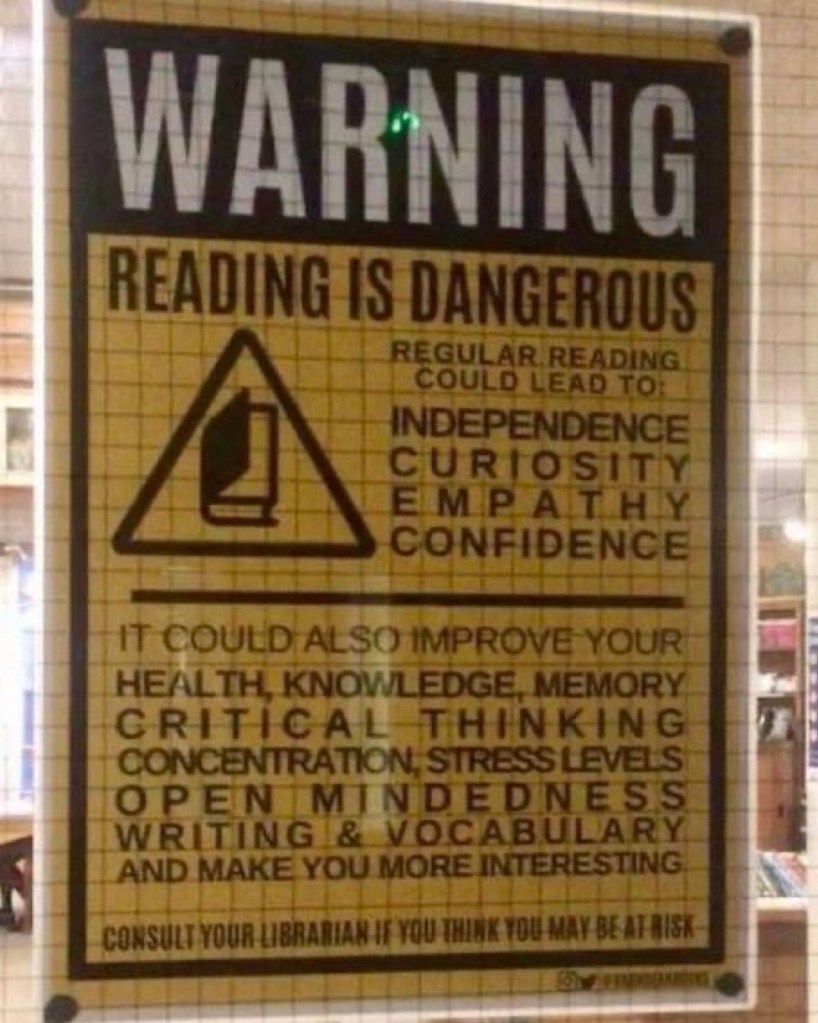
Read!

If you want to open your mind, read!

If you want to travel through time and space, read!

If you want to learn about other people and other cultures, read!

If you want to supercharge your creativity and imagination, read!

If you want to learn how other people see the world, read!

If you want to travel through time and space, read!

If you want to understand history, read!

Some people think these are dangerous activities. They want to control what students think. They censor books. They remove them from school libraries and public libraries. They forget that young people today have access to the Internet, which is not censored.

Live dangerously! Read books!

Good news! The legislature in Illinois has passed a law to withhold state funds from institutions that ban books. Governor J.B. Pritzker is expected to sign it.

Illinois Gov. JB Pritzker (D) is expected to sign a bill that would withhold state funds from institutions that ban books amid nationwide efforts to pull some titles from shelves.

“Illinois is one step closer to preventing book banning in Illinois libraries,” said Illinois Secretary of State Alexi Giannoulias.

“Under this bill, we can support our state’s libraries and librarians and protect them against attempts to ban, remove or restrict access to books and resources,” he said.

The state’s H.B. 2789 would require libraries to adopt the American Library Association’s Library Bill of Rights — which “indicates materials should not be proscribed or removed because of partisan or doctrinal disapproval,” according to the proposed text — or develop their own such statement against book banning in order to be eligible for state grants.

The bill has cleared the state legislature and now heads to the governor’s desk. Pritzker has previously said he supports the bill, according to the secretary of State’s office.

“Banning books is a devastating attempt to erase our history and the authentic stories of many. Students across this state deserve to see themselves reflected in the pages of stories that teach and entertain. I’m proud to support House Bill 2789 and ensure that Illinois’ libraries remain sources of knowledge, creativity, and fact,” Pritzker said in a March release….

“Our nation’s libraries have been under attack for too long—they are bastions of knowledge and proliferate the spread of ideas. That is why I am so proud that my measure to prevent the banning of books passed in the senate today,” said Illinois state Sen. Laura Murphy, one of the bill’s sponsors.

Paul Waldman and Greg Sergeant of the Washington Post described the social pressure within the community that cause dthe book censors in the county to back off.

It isn’t every day that the ruminations of local bureaucrats in a small rural Texas county become national news. But when commissioners in Llano County — population 21,000 — voted Thursday to keep its three-branch library system open, the moment was closely monitored by the biggest news organizations in the country.

That’s because Llano County has become a national symbol of local right-wing censorship efforts after officials threatened to close its libraries entirely rather than allow offending materials to remain on shelves. Under intense scrutiny, the commission blinked. Its leader acknowledged feeling pressure from “social media” and “news media.”

The commissioners’ apparent reluctance for Llano to be seen as a locus of censorship points to an unexpected development: Skirmishes emanating from book bans at schools and libraries in red states and counties, once localized affairs, are becoming viral national sensations. And the American mainstream appears to be paying attention.

Like many other similar conflicts, this one was triggered by a single Llano resident, Bonnie Wallace, who objected in 2021 to library books she pronounced “pornographic filth.” A bunch were removed, including unobjectionable materials such as Maurice Sendak’s “In the Night Kitchen” and Isabel Wilkerson’s “Caste: The Origins of Our Discontents.”

The county also dissolved its libraries’ advisory board and reconstituted it with advocates of book removal, including Wallace herself. After other residents sued for the books’ return, a judge ordered the books placed back on the shelf, prompting the county to consider shutting the libraries pending the suit’s resolution.

At Thursday’s hearing, several of Llano’s self-designated commissars of book purging read explicit sex scenes from young adult books, but they went further, advocating for closure. One said: “I am for closing the library until we get this filth off the shelves.”

When the national media paid attention, other residents of Llano County realized that extremists were taking the lead and giving their community a bad name. Shame is a strong motivator.

But one of the big surprises of these sagas has been outbreaks of resistance to book purges in the reddest places, and here again, some locals dissented. One said: “We have to be a community that values knowledge.” Another fretted: “We are all over the media, and this is making us look pretty bad as a community.”

It turns out that even in an overwhelmingly conservative place (Donald Trump won nearly 80 percent of Llano’s votes in 2020), plenty of people value free expression. Many Republicans aren’t on board with the right’s censorship agenda. And these folks can organize.

To be fair to Llano County’s conservatives, many insist they don’t want to burn or censor books. As they told one of us (Paul Waldman) in interviews in Llano last fall, they only wanted material to be age-appropriate.

But that doesn’t explain opposition to books about racism. And even if some conservative voters are more measured, these efforts are open to abuse. In places such as Florida, they have allowed lone conservative activists to remove dozens of books from schools based on flimsy or absurd objections.

The book-banning impulse is taking on a crazed life of its own. At a Llano County tea party meeting in November, Waldman witnessed Wallace passionately pleading that “I need more conservative friends” to help get “pornography out of the library,” adding: “We must, must, must keep fighting.” It was obvious that, for people like Wallace, the prospect of controlling which books their community can access has been a thrill.

Such right-wing activists thought they had good reason for confidence. After Republican Glenn Youngkin was elected Virginia governor in 2021 on a dishonestly termed “parental rights” platform, some censorship-minded activists imagined they had a national mandate. But arguably only the GOP base was paying attention to that issue at the time (swing voters were focused on school closures).

Now, the national media — and perhaps the mainstream of the country — are watching these local abuses unfold. “Every day it seems there’s a new book banned, an art exhibit canceled, or a drag performance under threat,” Jonathan Friedman of PEN America told us. “People are waking up to the fact that state and local governments are running rampant.”

National opinion isn’t cooperating with the censors. In the 2022 elections, many prominent culture-warring GOP candidates lost. (Florida Gov. Ron DeSantis is an exception.) Polls show large percentages of parents are concerned about schools banning books and that Americans overwhelmingly reject bans based on teachings about history and race.

Therein lies a trap for the GOP. The activist base is demanding increasingly reactionary censorship measures, and officials such as DeSantis are obliging for 2024 primary purposes. Yet as these local far-right lurches attract attention, they taint the national GOP as extreme.

Democrats should take heed. Some still appear skittish about culture-war issues, as evidenced when Education Secretary Miguel Cardona told TPM’s Hunter Walker that “we want to stay above” censorship controversies, as if ignoring them would make them go away or is good politics.

But when the national spotlight falls on censorship, the right is exposed, the left is energized and moderates balk at seeing their communities controlled by a small band of extremists.

Democrats must speak to those resisting these outbreaks of hysteria in deep-red places such as Llano. In some of them, fundamental liberal values still endure. The way to respond to this wave of censorship isn’t to hope it burns out, but to flush it into the light and confront it head on.

Overall, the story in Llano County is encouraging. It shows that civic leaders don’t want their community to be known for book banning.

But what’s really discouraging is the loud silence from the U.S. Department of Education. Why is Secretary Cardona silent? Why does he want to stay out of censorship controversies? Why isn’t he defending teachers and librarians? Why isn’t he standing up for the right to read?

This is a perilous time. American schools, teachers, and librarians need a champion not milquetoast. Teachers and librarians know that their jobs are at risk if they stand up to the vigilantes. What does Secretary Cardona have to lose? He should be speaking out against vouchers. He should be speaking out against censorship. He should be defending the accurate teaching of American history. He cannot float above the issues without appearing weak.

Democrats must speak out against censorship and privatization. That is a winning strategy.

The Indiana legislature is considering a bill that would empower parents to censor books they find objectionable and to criminalize librarians who allow such books in libraries. The story was originally reported on WYFI, the NPR station in Indiana.

Chalkbeat reported:

The House Education Committee heard hours of testimony Wednesday from school employees, librarians, and others across Indiana who expressed opposition to a proposed amendment to a bill that would strip these employees of a legal defense against charges they distributed material harmful to minors.

The hearing was the latest evolution in a months-long legislative process driven by concerns among some parents that pornography is rampant in schools. While lawmakers have drafted legislation to address these concerns, they’ve presented little evidence to suggest it’s a widespread problem. The latest iteration of the legislation also targets public libraries.

Rep. Becky Cash (R-Zionsville), who crafted the amendment, said she’s heard from “thousands” of parents who have lodged complaints with their schools over books they believed were objectionable.

“Parents have testified in school board meetings and come to me, and many members of this committee and assembly many, many times over the last couple of years saying that the system did not work for them,” Cash said.

She explained that the amendment mandates schools and public libraries lay out a transparent process for parents and residents to lodge complaints.

But several Democratic members of the committee expressed concern that the bill would empower some parents and disempower others by creating a system in which some parents could control access to books for all children. They also expressed opposition to a portion of the amendment that strips librarians and school employees from a legal defense.

“We are not the court of appeals from parents who are unhappy with school board decisions,” said Rep. Ed DeLaney (D-Indianapolis). “But if we were the Court of Appeals, we would want evidence. What parent? What school? What book? What hearing? What process? Not this vague discontent.”

These attacks on librarians and on the freedom to read are despicable. The red states are empowering ignorant censors who want to impose their values on people who don’t share them.

There is a popular stereotype of librarians: Mild-mannered, quiet, unassuming, and of course, bookish. But the Republicans in the Texas legislature seem to think that behind that compliant demeanor lies a sinister purveyor of dangerous ideas and books. What other explanation can there be for proposed legislation that would place book selection in the hands of a parent committee? And why strip away the legal protections accorded to librarians doing their job?

Sara Stevenson, a retired middle school librarian in Austin, wrote the following article, which was published in the Dallas Morning News.

As a former school librarian and mother, I have always believed parents have total control over what their children select to read from the school library.

However, Senate Bill 13 goes too far. Between July 2021 and June 2022, only 22 of 1,650 Texas school districts experienced formal book challenges in the past school year, less than 2%. All school districts already have formal challenge and reconsideration policies in place.

SB 13 transfers the decisions for acquiring library materials into the hands of a council of parents, the majority of whom do not work for the district but only have children attending. What possible experience or credentials or rights does this committee have to make decisions on what children can and can’t read in an entire school district? After a long, convoluted process spelled out in the bill, the school board must then approve the list of library books before they may be purchased.

First of all, it is clear the authors of this bill have a poor understanding of school library programs. In Austin ISD, there are 116 schools. This Local School Library Advisory Council, appointed by the school board, is required to meet only twice a year to decide on the library collections for all 116 schools. A single campus librarian purchases materials throughout the year. It’s not a one and done process.

This bill will greatly delay the timeline between ordering books and getting them into the hands of children. The additional 30-day waiting period further impedes the process. As a librarian, I had the freedom to pre-order the next book in a popular series so that I could add it to our collection the very day it was published. Kids clamoring for the next book in a beloved series will now have to wait for months if not all year.

The bill also invites parents to opt in to a program in which the librarian emails them each time their child checks out a book, including the book’s title and author. One elementary school in south Austin averages 196 checkouts per day. How is it possible for the librarian to send these emails while also running her library program? Instead, why not integrate the library catalog information into the parent portal, the website which parents already access to see their child’s grades? Parents can then look up their students’ library records. It would even help librarians with the bane of our existence: long overdue books.

The portion of the bill that enables anyone to prosecute individual librarians for distributing “harmful material” under the Texas penal code (Sec. 43.24) is the most shocking and destructive piece in this bill. It removes affirmative defenses for educational purposes. Does this also remove legal protections from members of the advisory council if a “bad” book slips through the cracks?

I can’t believe the state of Texas wants to allow frivolous lawsuits against librarians, school boards, principals, and teachers. We are already experiencing a teacher shortage, with at least 59 districts switching to four-day weeks.

If passed, this bill will bring a culture of fear and intimidation to our schools.

The men and women who choose to serve as school librarians are among the most intelligent and ethical people I know. They are not just serving the children of the five parents on the Local School Advisory Committee; they are representing the interests of all children and the parental rights of all families at their schools, upholding their First Amendment Rights to read.

If the Senate Public Education Committee had only consulted in good faith with the vast majority of school librarians whose patrons are extremely satisfied with the library collections they curate, this bill would have been able to find a balance between respecting parental rights and ensuring better oversight in purchasing materials without adding unwieldy, impractical layers of bureaucracy and red tape that will prevent children from having ready access to the books they want and need to read.

Sara Stevenson is a former school librarian in Austin ISD. She wrote this column for The Dallas Morning News.

Republicans have gone stark raving mad. They are terrified that their children might read a book that will turn them gay or transgender or might make them feel bad about racism. of course, their children have access to the internet, where they can see stuff far more sensational than anything in a book.

Somebody has to be punished for the racy books in the libraries.

In Idaho, parents will be able to sue libraries and school districts if they find an inappropriate book on their shelves. The fine would be $10,000 for each time a dangerous book is accessed.

A bill that would allow parents to sue libraries and school districts for allowing books containing material considered “obscene” on their shelves is one step closer to becoming law.

The “Children’s School and Library Protection Act” passed the Idaho House on a 40-30 vote Monday afternoon.

The bill lays out a proposed definition for what it calls material that is “harmful to minors,” including material that contains description or representation of nudity, sexual conduct, sexual excitement or “sado-masochistic abuse.”

The bill also specifically mentions representations of “intimate sexual acts, normal or perverted” along with descriptions of “masturbation, excretory functions, or lewd exhibition of the genitals or genital area.”…

One legislator made a good point:

A representative from Latah County says libraries are not the main place where kids are being exposed to mature content.

“This telephone and this computer has more damage than any library is ever going to have to our children,” Lori McCann (R), representative of Legislative District Six, said.

How many of those voting went home to watch porn on their phone or computer?