Archives for category: Librarians

The Texas Department of Education decided to take over Houston, one of the largest school districts in the nation, because one high school was not improving fast enough for state commissioner Mike Morath. The state ousted the elected school board and replaced a strong superintendent with military man Mike Miles, who had a rocky tenure when he led Dallas schools a decade ago.

Miles has launched a campaign of disruption—the signature move of “reformers,” especially Broadies, and he is offering what he calls a New Education System (NES). The details are not yet fully developed, but here is one aspect: 28 of the schools that are part of Miles’s NES will close their libraries and use them for other purposes. One such purpose is to serve as a “discipline center” for students who act out.

Houston Independent School District will be eliminating librarian positions at 28 schools this upcoming year and converting the libraries into ‘Team Centers” where kids with behavioral issues will be sent, the district announced.

This comes as part of the new superintendent Mike Miles reform program, New Education System (NES). Currently, there are a total of 85 schools that have joined Miles’ program, and of those, 28 campuses will lose their librarians. The district said they will have the opportunity to transition to other roles within the district.

The remaining 57 NES schools’ librarians will be assessed on a case-by-case basis, according to the district.

Retired HISD Teacher in Charge of Library, Lisa Robinson, believes the library is full of some of the greatest stories ever told.

“It was such a joy to help them find the perfect book,” said Robinson.

She said those stories are now ripped to shreds.

“My heart is just broken for these children that are in the NES schools that are losing their librarians,” said Robinson.

Librarian positions have been an ongoing debate in HISD. Robinson said the former superintendent, Millard House II, made efforts to keep library staff.

“The mandate for librarians had been put back in place. With one swipe of a pen that has been destroyed,” said Robinson.

Superintendent Mike Miles said students are behind on reading levels, especially in 4th grade.

Former HISD Librarian and Manager of Library Services, Janice Newsum believes eliminating librarian positions could hurt reading performance even more.

“When students engage in reading as an activity of choice, they are not only building that reading muscle, but they are also developing their vocabulary they are understanding a bit about the world that exists outside their block radius,” said Newsum.

Mayor Sylvester Turner believes the move is unacceptable.

“You don’t close libraries in some of the schools in your most underserved communities, and you’re keeping libraries open in other schools,” said Turner.

What’s the logic here? Many students are not reading well, therefore eliminate the librarians who might find books that interest them?

Mitchell Robinson is a professor of music education at Michigan State University who was recently elected to the Michigan State Board of Education. He shared a resolution that he introduced and that was passed by the State Board. Are there books that are not age-appropriate? Yes. Can we trust teachers and librarians to select the right books for the children in their care? The Michigan State Board of Education thinks we can. Michigan law already forbids pornography in schools.

Robinson sent the following to me:

Proud to introduce the “Freedom to Read” resolution yesterday. The State Board of Education respects the professional judgement of teachers and librarians when it comes to selecting learning materials that support the curriculum in their classrooms, and respects the rights of parents and caregivers to determine the developmental appropriateness of books and other materials for their children.

Teachers and parents are natural partners in the education of our children, and attempts to drive a wedge between schools and families by creating outrage over fabricated “crises” will simply not work.

“Board Of Ed Adopts Resolution Supporting ‘Freedom To Read'”

A resolution to support K-12 students reading whichever books they like as book bans continue to sweep the country was adopted by the State Board of Education Tuesday.

Board member Mitchell Robinson (D-Okemos) introduced the Freedom to Read Resolution. Robinson cited in the resolution that PEN America’s Index of School Book Bans listed 1,477 instances of individual books banned.

The resolution said in the first six months of 2023, 30 percent of the unique titles banned were books about race, racism, or feature characters of color and 26 percent of the unique titles banned had LGBTQ characters or themes.

On Monday, Illinois Governor J.B. Pritzker signed a law that deems Illinois public libraries ineligible for state funding if the library restricts or bans materials because of “partisan or doctrinal disapproval.”

“Closer to home, the Michigan Civil Rights Commission has asked the Attorney General for an official legal ruling on book banning as discrimination in respect to the Elliott Larsen Civil Rights Act that has expanded to include…LGBTQ+ communities,” Robinson said.

During public comment, several parents and organizations, including Moms for Liberty, spoke out against the resolution. They argued that none of their members were in favor of banning books but did not want their children to read what they deemed as inappropriate and pornographic content.

Board member Tiffany Tilley (D-West Bloomfield) introduced an amendment to the resolution supporting parents in their right to choose age appropriateness of material for their child and rights to make “critical decisions with their local schools.”

Tilley said as a child, she read several pieces of literature, including Shakespeare’s “Romeo and Juliet” that included content that some would say was “racy.”

“I got to a certain age, and I realized we were talking about a 16-year-old boy, 13-year-old girl and they both committed suicide,” Tilley said. “I’m not for banning books. My mom allowed me to read those things. I think that made my life richer, but for some parents, they may not be ready for their children to read about something.”

Tilley emphasized that her amendment would signal to parents that the state is not trying to make decisions for them, but also the state is not trying to ban certain books for everyone. If a parent reads a book and decides they do not want their child to read it, then they need to make that decision with their local school district, she added.

Superintendent of Public Instruction Michael Rice said this amendment was similar to resolutions the board supported previously. In February 2022, the Resolution on Sex Education included language that allowed for parents and legal guardians to opt-out of sex education classes without penalty.

Board member Tom McMillin (R-Oakland Township) wanted wording included that would make clear the board was stating pornography should not be allowed in schools. Board member Marshall Bullock (D-Detroit) jumped in, saying that there are already laws forbidding pornography in school. He asked McMillin how he defined pornography, saying his definition may lead to the banning of other subject matter such as the teaching of human anatomy in a biology course.

In the end, the board voted to approve the resolution 6-2, with McMillin and board member Nikki Snyder (R-Dexter) voting no.

In contrast to Florida, Texas, and other red states, Illinois has taken action to protect librarians and the right to read. The legislature passed a law promoting the banning of books for partisan and personal reasons. And Governor J.B. Pritzker signed it. No book banning in Illinois!

SPRINGFIELD, IL — Banned books will soon be a thing of the past at public libraries in Illinois now that the Library Freedom Act has been signed into law. Gov. J.B. Pritzker signed the bill Monday at the Harold Washington Library in Chicago.

Under the new law, public libraries must reject outside attempts at banning books for reasons that are partisan or doctrinal, to retain their eligibility for Illinois state grants.

The law allows Illinois to withhold state funding from public libraries and schools that remove books from their shelves and do not follow the American Library Association’s “Bill of Rights,” which states that books “should not be removed or restricted because of partisan or personal disapproval.”

“Here in Illinois, we don’t hide from the truth, we embrace it,” Gov. Pritzker said in a statement. “Young people shouldn’t be kept from learning about the realities of our world; I want them to become critical thinkers, exposed to ideas that they disagree with, proud of what our nation has overcome, and thoughtful about what comes next. Everyone deserves to see themselves reflected in the books they read, the art they see, the history they learn. In Illinois, we are showing the nation what it really looks like to stand up for liberty.”

NBC News reports that Arkansas librarians have filed suit to overturn a state law that puts them in jeopardy.

A group of public libraries and book publishers in Arkansas is pushing back against a growing movement to restrict what children are allowed to read.

Arkansas is one of four states that recently passed laws that make it easier to prosecute librarians over sexually explicit books, a designation conservatives often use to target books with descriptions of gender identity and sexuality. On Friday, a coalition led by the Central Arkansas Library System, based in Little Rock, filed a federal lawsuit it hopes will set a precedent about the constitutionality of such laws.

The Central Arkansas Library System argued in a filing in U.S. District Court for the Western District of Arkansas that Act 372 violates the First Amendment by making it a misdemeanor for libraries to give children access to materials that are “harmful to minors.” The term — which means any depiction of nudity or sexual conduct meant to appeal to a prurient interest that lacks serious artistic, medical or political value and which contemporary community standards would find inappropriate for minors — is too broad, the suit contends. For example, the law would prohibit 17-year-olds from viewing materials deemed too explicit for 7-year-olds.

The complaint also alleges that the law violates residents’ due process rights by allowing local elected officials to overrule librarians’ decisions about book challenges without providing explanations or permitting appeals from those who disagree.

“There’s enormous angst and anxiety on the part of librarians in the state,” said Nate Coulter, the executive director of the Central Arkansas Library System, which has 17 branches in seven cities. “Because not only do they feel like people in the state government don’t respect their integrity, but they’re seen as a hostile party. They’ve been called groomers. They’ve been accused of being pedophiles. They’re basically targeted by a very divisive, angry group of people who are vocal about believing that somehow the library is the problem in our community.”

It’s unclear how prosecutors or judges would handle such criminal cases, but violations of Act 372’s “harmful to minors” provision could result in maximum jail sentences of one year. The law also eliminates protections for librarians and teachers who distribute material “that is claimed to be obscene” as part of their job, a felony punishable by up to six years in prison; the lawsuit isn’t challenging that part of the law.

A reader who signs in as CarolMalaysia described the latest education-related laws passed in Indiana:

She writes:

These are some of the new Indiana laws that will take effect on Saturday. [Indiana is run by the GOP and they have NO respect for public schools or teachers.] Gary is a poverty area and they cannot vote for their school board members. 87% of Hoosier children attend public schools and they are continuously underfunded.

Book bans — Every public school board and charter school governing body is required to establish a procedure for the parent of any student, or any person residing in the school district, to request the removal of library materials deemed “obscene” or “harmful to minors.” School districts must also post a list of the complete holdings of its school libraries on each school’s website and provide a printed copy of the library catalogue to any individual upon request. (HEA 1447)

Charter schools — The proceeds of each new voter-approved school funding referendum in Lake County must be shared with local charter schools in proportion to the number of children living in the school district who attend charter schools. Beginning July 1, 2024, all incremental property tax revenue growth at Lake County school districts must be shared on a proportional basis with local charter schools. (SEA 391, HEA 1001)

Gary schools — A five-member, appointed school board is reestablished for the Gary Community School Corp. to eventually replace the Indiana Distressed Unit Appeals Board as the governing body for the formerly cash-strapped school district. Gary’s mayor and the Gary Common Council appoint one member each, and the three others are chosen by the Indiana secretary of education, including at least one Gary resident, one resident of Gary or Lake County, and a final member from anywhere. (SEA 327)

Ron DeSantis wants to make America just like Florida, where the maximum leader (Ron DeSantis) has a docile legislature that lets him decide what everyone else is allowed to do and punishes those bold enough to ignore his orders.

That’s why he is running for President. He thinks the whole nation needs and wants a maximum leader with a reactionary view of behavior and morality.

Florida is where you are free to do whatever Ron DeSantis tells you to do and free to think what he believes. If you disagree, you are no longer free.

The Miami Herald editorial board says DeSantis has turned Florida into a mean state. No, you don’t want to make America Florida.

Florida, under Gov. Ron DeSantis and Republican Legislature, is increasingly hard to recognize. It’s an intolerant and repressive place that bears scant resemblance to the Sunshine State of just a few years ago.

The 2023 legislative session cemented those appalling setbacks. Florida is now a state where government intrusion into the personal lives of Floridians is commonplace. What will it take for citizens to push back on this unprecedented encroachment on their rights? And, more broadly, what if Desantis supporters get what they want, which is to “make America Florida”?

The latest round of laws makes Florida sound more and more dystopian — something voters in the rest of the nation should note if they are considering what a DeSantis presidency could look like. The state has new rules for who can use which bathroom, what pronouns can be used in schools, which books can be taught and when women can get an abortion (almost never.) There are measures to strip union protections from public employees, keep transgender children and their parents from choosing to seek medical treatment, prevent universities from discussing diversity or inclusion and ban talk of gender identity or sexuality in schools all the way through 12th grade.

When Ron DeSantis launched his candidacy on Twitter, he scoffed at the notion that schools were banning books in Florida. That alone should disqualify him, based on what we have seen, heard and read about the state’s encouragement of banning books that refer to gays or racism. A complaint by a single parent is sufficient to get a book removed from the school library. Most recently, a parent at an elementary school complained about Amanda Gorman’s poem “The Hill We Climb,” which she read at President Biden’s inauguration. The poem is now available to middle school children, but not to those in the elementary school.

The Miami Herald published this editorial about the phenomenon that DeSantis says is non-existent, a hoax.

Perhaps it’s because of how Amanda Gorman alluded to the Jan. 6 attack in her famous poem, finished the night after rioters stormed the U.S. Capitol: “We’ve seen a force that would shatter our nation rather than share it.”

Or maybe she wrote too bluntly about race and the legacy of slavery:

“We, the successors of a country and a time where a skinny Black girl descended from slaves and raised by a single mother can dream of becoming president, only to find herself reciting for one.”

Gorman, the youngest inaugural poet in U.S. history, read “The Hill We Climb” at President Joe Biden’s inauguration, watched by about 40 million people. She wrote the poem so “that all young people could see themselves in a historical moment,” she posted on Twitter Tuesday.

But Gorman’s poem is now deemed not age appropriate, one of four library titles Bob Graham Education Center banned, following a parent’s complaint, for elementary school students, the Herald reported. The books are now available only for middle-schoolers at the public school in Miami Lakes, even though some of them were written for younger children.

The school committee that reviewed the material didn’t offer an explanation for its decision. We’re left to wonder: What in the children’s illustrated book “The ABCs of Black History,” written for children ages 5 and up, made it so inappropriate?

Perhaps it was the mention of iconic author James Baldwin’s sexual orientation: “And he was a gay man who believed that when it comes to love, you should ‘go the way your blood beats.” Or the mention of the Little Rock Nine, the “first Black children in all-white schools,” or the Black Panther movement. Or were the colorful drawings of Black female icons like Michelle Obama and Toni Morrison — described as “ queens”— too much?

One thing is clear: Books by Black authors — and about the Black American experience — make up three of the four titles deemed inappropriate for young children at Bob Graham Education Center. The other one, “Cuban Kids,” uses photos to describe the lives of children in Cuba in the early 2000s and how different or similar they are to Americans, according to the author’s homepage. Learning about the lives of their counterparts in a socialist country — including how they got around paper shortages — is sure to turn our kids into communists.

We knew that the movement to “sanitize” school libraries that Gov. Ron DeSantis and the Legislature unleashed would eventually catch up with Miami-Dade. Our melting pot, after all, might not be so different from Escambia County in the Panhandle, whose school board has been sued for removing books about race and LGBTQ topics.

Florida’s laws have emboldened parents and activists like Moms for Liberty to challenge materials dealing with these topics. Most recently, DeSantis signed a bill that empowers one person to file a complaint and ban a book, at least temporarily, while a district reviews it. Parents not satisfied with how a district ruled on the challenge can appeal to the state. That is bound to make schools acquiesce to offended parents.

The result, as Gorman wrote on Twitter after her poem was restricted, is that “most of the forbidden works are by authors who have struggled for generations to get on bookshelves.”

Elementary students were not required to read Gorman’s work or any of the challenged titles. These were options at Bob Graham Education Center’s library. Those options also should be available for the children of all parents, not only those offended by certain content or groups skimming books to find any remote reference to race or LGBTQ issues.

“Love to Langston” was written at a second-grade reading level but no longer is accessible to second-graders at Bob Graham. The illustrated biography of Harlem Renaissancewriter Langston Hughes describes his own elementary school experience, tainted by racism, in the early 1900s:

“In Topeka, Kansas the teacher makes me sit in the corner; in the last row; far away; from the other kids.”

The parent who filed the complaint said “Love to Langston” contained critical race theory, “indirect hate messages,” gender ideology and indoctrination, the Herald reported. It’s unclear how.

It is curious, however, that “indoctrination” and “hate messages” seem to be flagged mostly when when Black authors write about being Black, or when LGBTQ authors write about being queer. The adults must ask themselves why that’s the case before making them inaccessible to children.

Three literacy experts—David Reinking, Peter Smagorinsky, and David B. Yaden—wrote in opposition to the current “science of reading” frenzy. Unfortunately, their article does not mention the journalist Emily Hanford, who has zealously promoted the idea that American students don’t learn to read because their teachers do not utilize the “science of reading.” Google her name and you will find numerous articles repeating this claim. I wish I had been as successful in alerting the public and the media to the dangers of privatization as she has been in building a public campaign for phonics-as-silver-bullet. She is truly the Rudolf Flesch of our day (he published the best-selling Why Johnny Can’t Read in 1955.)

As I have often written here, I strongly support phonics. I was persuaded long ago by Jeanne Chall in her book Learning to Read: The Great Debate that students need to learn the sounds of letters and letter-combinations so they can decode unfamiliar words without thinking about it. But I am not a believer in “the science of reading.” Different children learn different ways. Phonics adherents cite the report of the National Reading Panel (2000), which consisted of university-based scholars and only one practitioner, Joanne Yatvin, who wrote a dissent. The phonics cheerleaders ignore the ignominious fate of NCLB’s Reading First program, which doled out nearly $6 billion to promote the recommendations of the National Reading Panel but failed to achieve anything.

There is no “science of reading.” There is no “science of teaching math” or any other academic skill or study. If someone can identify a district where every single student reads at a proficient level on state tests, I will change my view. I await the evidence.

This post by Reinking, Smagorinsky, and Yaden appeared on Valerie Strauss’s Washington Post blog, “The Answer Sheet.”

Strauss introduced their article:

The “reading wars” have been around for longer than you might think. In the 1800s, Horace Mann, the “father of public education” who was the first state education secretary in the country (in Massachusetts), advocated that children learn to read whole words and learn to read for meaning before they are taught the explicit sounds of each letter. Noah Webster, the textbook pioneer whose “blue-back speller” taught children how to spell and read for generations, supported phonics. So it started.

In the last century and now again, we have gone in and out of debates about the best way to teach reading — as if there was a single best way for all children — with the arguments focusing on phonics, whole language and balanced literacy. We’re in another cycle: Just this week, New York City, the largest school district in the country, announced it would require all elementary schools to employ phonics programs in reading instruction.

This post — written by David Reinking, Peter Smagorinsky, and David B. Yaden — looks at the debate on phonics in a different way than is most often voiced these days. It notes, among other things, that the National Reading Panel report of 2000, which is often cited in arguments for putting phonics front and center in school reading curriculum, says many things about the importance of systematic phonics instruction but it also says this: “Phonics should not become the dominant component in a reading program, neither in the amount of time devoted to it nor in the significance attached.”

Reinking is a professor of education emeritus at Clemson University, a former editor of Reading Research Quarterly and the Journal of Literacy Research, a former president of the Literacy Research Association and an elected member of the Reading Hall of Fame.

Smagorinsky is a research professor emeritus at the University of Georgia, a visiting scholar at the University of Guadalajara, a former editor of the journal Research in the Teaching of English, and an elected member of the National Academy of Education.

Yaden is a literacy professor in the College of Education at the University of Arizona, a former editor of the Journal of Literacy Research, and a past president of the Literacy Research Association.

Reinking, Smagorinsky and

Reinking, Smagorinsky, and Yaden wrote:

Two of the nation’s most trustworthy news sources, the New York Times and The Washington Post, recently ran opinion pieces asserting that there is a national reading crisis and a single solution: more phonics instruction. The Times followed with a news article about how a “science of reading” movement is sweeping the United States in support of more phonics instruction.

These claims have clearly impressed many politicians, journalists, educational leaders and parents. Phonics has become political fodder with copycat legislation in state after state mandating more of it. There is now a firmly rooted popular narrative of a national crisis in reading achievement supposedly linked to inadequate phonics instruction and unequivocally supported by a science of reading. Those who question it and ask for more evidence are portrayed as unenlightened or even as science deniers, including many experienced, dedicated and successful teachers who contend daily with the complex, multifaceted challenges of teaching children how to read.

As researchers and teacher educators, we, like many of our colleagues, shake our heads in resigned frustration. We believe phonics plays an important role in teaching children to read. But, we see no justifiable support for its overwhelming dominance within the current narrative, nor reason to regard phonics as a panacea for improving reading achievement.

Specifically, we do not see convincing evidence for a reading crisis, and certainly none that points to phonics as the single cause or a solution. We are skeptical of any narrowly defined science that authoritatively dictates exactly how reading should be taught in every case. Most of all, we are concerned that ill-advised legislation will unnecessarily constrain teachers’ options for effective reading instruction.

As for a crisis (always useful for promoting favored causes), the National Assessment of Educational Progress (NAEP) has been tracking reading achievement in the United States since 1972. Until the coronavirus pandemic began in 2020, the scores were mostly flat for decades, even trending slightly upward before covid-19 shut down schools. The decline since the pandemic is a clear example of how societal factors influence reading achievement. Given the nation’s increasing linguistic and cultural diversity and widening economic disparities, that upward trend might even suggest encouraging progress.

Less absurd, but no less arbitrary, is using NAEP scores to argue that two-thirds of students are not proficient in reading. Diane Ravitch, a former member of the NAEP governing board, has equated scores at the proficient level with a solid A. Peggy Carr, commissioner of the National Center for Education Statistics, which administers NAEP, has said that basic level is generally seen as grade-level achievement. Adding students who achieve at a Basic level (interpreted as a B) or above, two-thirds of students have solid reading skills. In other words, the argument only holds if we expect every student to get an A. We can always do better, but there is neither no convincing evidence of a crisis nor magic that eliminates inevitable variation in achievement.

But crisis or not, is there evidence that more phonics instruction is the elixir guaranteed to induce higher reading achievement? The answer isn’t just no. There are decades of empirical evidence that it hasn’t and won’t.

In the mid-1960s, the federal government funded two landmark national studies of early reading instruction in the United States at 23 sites (districts or regions) carefully chosen to represent a cross section of the nation’s students. One purpose was to determine which of several approaches to teaching reading was most effective, including a strict phonics approach.

The conclusion? All approaches worked well at some sites and less so in others. Phonics worked best when it was integrated with other approaches and is most effective with beginning readers. The researchers leading these multiple studies concluded “that future research should focus on teacher and learning situation characteristics rather than method and materials.”

In the 1980s, Dolores Durkin, an iconic reading researcher, found that phonics lessons dominated reading instruction and that the problem is not phonics-or-not, but ineffective instruction that, as she concluded, “turns phonics instruction into an end in itself but also deprives children of the opportunity to experience the value of phonics.”

The subsequent National Reading Panel report of 2000, much cited today for its support of phonics instruction, actually reported that teaching phonics had only moderate effects, limited to first grade. The report also advocated for balanced reading instruction in which phonics was only one of many components. In Chapter 2, page 97, the report stated unequivocally, “Phonics should not become the dominant component in a reading program, neither in the amount of time devoted to it nor in the significance attached.” And it says this: “Finally, it is important to emphasize that systematic phonics instruction should be integrated with other reading instruction to create a balanced reading program. Phonics instruction is never a total reading program.”

In the early 2000s, there was the evaluation of the massive Reading First program implemented across six years in grades 1 through 3 in more than 5,000 schools across all 50 states and implemented with federal funding north of $5 billion. Teachers were carefully trained to deliver “scientific” reading instruction that included a numbing 1.5 to 3 hours of phonics instruction each day. Yet, students receiving this extensive phonics instruction scored no better on tests of reading comprehension than did students in schools providing more conventional instruction.

These findings do not mean that phonics is unnecessary or unimportant. They simply suggest that there is no basis for the conclusions that the absence of phonics is the cause for a reading crisis and that the sole solution to reading difficulties is intensive phonics instruction for all readers. Nor is there a reason to believe that more phonics is the linchpin to raising reading achievement.

Rather, the lack of evidence supporting an increase in phonics may indicate that there is already enough phonics being taught in schools. Despite nebulous claims that there is widespread neglect of phonics in classrooms, no recent data substantiate those claims. But, beyond phonics, what other factors might inhibit greater reading achievement — factors that could be addressed more appropriately through legislation? There are possibilities, grounded in data, that are at least as reliable and convincing as increasing phonics.

Here are a few examples. There is hard evidence that in schools with a good library and librarians, reading scores are relatively high. Unfortunately, in a growing number of states, libraries are defunded, sometimes for ideological reasons. The number of school nurses has declined during the ongoing assault on school budgets, which we know increases absenteeism, which in turn, decreases achievement. Kids can’t learn phonics or any other academic skill if they are not in school.

What about poverty and hunger? We know that kids who do poorly on standardized reading tests tend to come from the nation’s least affluent homes. And, there is considerable evidence that educational reforms focused only on classrooms and not broader social factors like poverty often fail. What does help is the availability of free meals, which are associated with enhanced academic performance, including reading and math test scores.

So, to boost reading achievement, why not legislate more funding for libraries, school nurses and programs to feed hungry children? The evidence that such legislation would increase achievement is no less, and arguably more, than increasing phonics. The recent declines in NAEP scores during the pandemic, which raise concerns, sharpen the point. Possible explanations include lack of internet connections, distractions inherent to home learning, and untrained and overworked teachers, not phonics.

When pressed on these points, inveterate phonics advocates play a final trump card: the science of reading. They cash in on the scientific cachet of esoteric cognitive and neurological research, often collectively referred to as “brain science.”

There are several reasons to discount that response. Many brain researchers concede that their work is in its infancy using marginally reliable methods with small samples, leading to debatable interpretations that are difficult to translate into classroom practice. They are only beginning to investigate how social factors influence brain activity.

Further, as our colleague Timothy Shanahan has argued, there is a difference between a basic science of reading and a science of how to teach reading. The two are not entirely in sync. He cites several examples of empirical research validating effective reading instruction that is inconsistent with brain studies. Just as hummingbirds fly, even when aeronautical science concludes they can’t, brain research doesn’t negate the reality of instructional practice that works.

But, like the snark, the nonexistent creature in Alice in Wonderland, the narrative about phonics persists, because enough people say so, over and over. For at least 70 years, demanding more phonics has become a shibboleth among those who see, or want to see, reading as essentially a readily taught technical skill. We’ve been fiddling with phonics ever since, while more consequential societal factors burn brightly in the background.
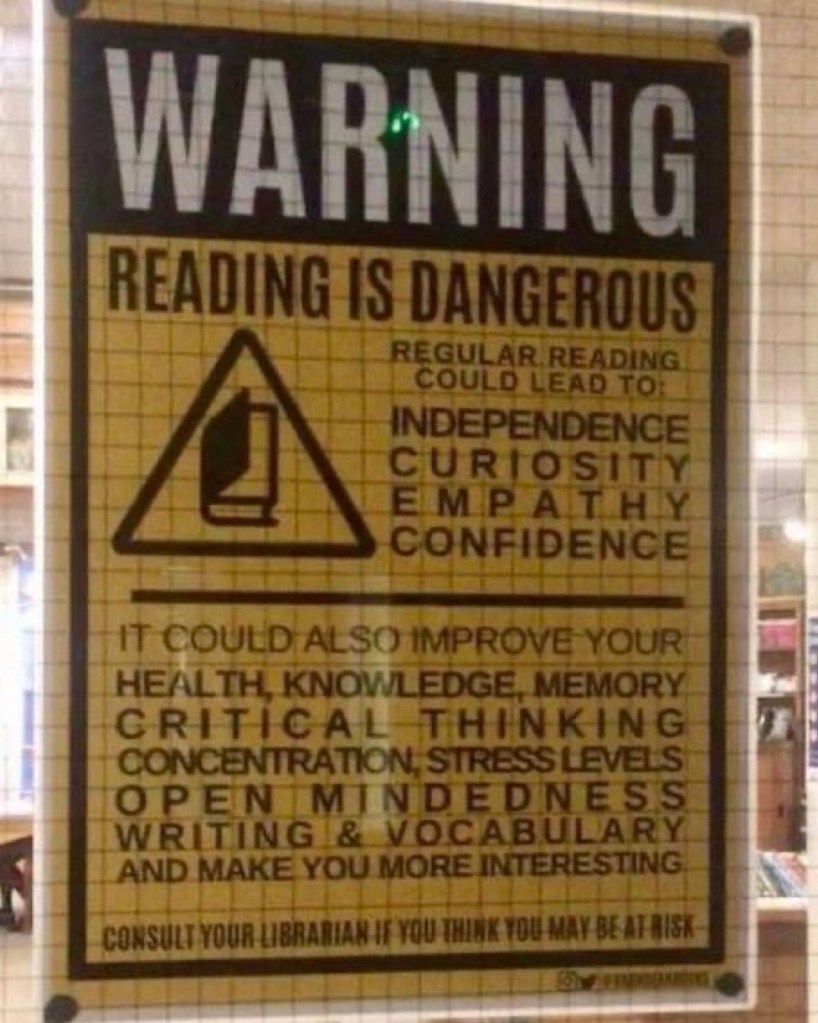
Read!

If you want to open your mind, read!

If you want to travel through time and space, read!

If you want to learn about other people and other cultures, read!

If you want to supercharge your creativity and imagination, read!

If you want to learn how other people see the world, read!

If you want to travel through time and space, read!

If you want to understand history, read!

Some people think these are dangerous activities. They want to control what students think. They censor books. They remove them from school libraries and public libraries. They forget that young people today have access to the Internet, which is not censored.

Live dangerously! Read books!

Good news! The legislature in Illinois has passed a law to withhold state funds from institutions that ban books. Governor J.B. Pritzker is expected to sign it.

Illinois Gov. JB Pritzker (D) is expected to sign a bill that would withhold state funds from institutions that ban books amid nationwide efforts to pull some titles from shelves.

“Illinois is one step closer to preventing book banning in Illinois libraries,” said Illinois Secretary of State Alexi Giannoulias.

“Under this bill, we can support our state’s libraries and librarians and protect them against attempts to ban, remove or restrict access to books and resources,” he said.

The state’s H.B. 2789 would require libraries to adopt the American Library Association’s Library Bill of Rights — which “indicates materials should not be proscribed or removed because of partisan or doctrinal disapproval,” according to the proposed text — or develop their own such statement against book banning in order to be eligible for state grants.

The bill has cleared the state legislature and now heads to the governor’s desk. Pritzker has previously said he supports the bill, according to the secretary of State’s office.

“Banning books is a devastating attempt to erase our history and the authentic stories of many. Students across this state deserve to see themselves reflected in the pages of stories that teach and entertain. I’m proud to support House Bill 2789 and ensure that Illinois’ libraries remain sources of knowledge, creativity, and fact,” Pritzker said in a March release….

“Our nation’s libraries have been under attack for too long—they are bastions of knowledge and proliferate the spread of ideas. That is why I am so proud that my measure to prevent the banning of books passed in the senate today,” said Illinois state Sen. Laura Murphy, one of the bill’s sponsors.