Republicans have grown frustrated by their inability to get their views represented on college campuses, so they have grown more assertive in passing laws to ban ideas they don’t like (such as “critical race theory” or gender studies or diversity/equity/inclusion or “divisive concepts).
Indiana is imposing a different approach. Instead of banning what it does not like, the Legislature is requiring professors to teach different points of view.
A new law in Indiana requires professors in public universities to foster a culture of “intellectual diversity” or face disciplinary actions, including termination for even those with tenure, the latest in an effort by Republicans to assert more control over what is taught in classrooms.
The law connects the job status of faculty members, regardless of whether they are tenured, to whether, in the eyes of a university’s board of trustees, they promote “free inquiry” and “free expression.” State Senator Spencer Deery, who sponsored the bill, made clear in a statement that this would entail the inclusion of more conservative viewpoints on campus.
The backlash to the legislation, which Gov. Eric Holcomb, a Republican, signed March 13, has been substantial. Hundreds wrote letters or testified at hearings, and faculty senates atmultiple institutions had urged the legislature to reject the bill, condemning it as government overreach and a blow to academic free speech.
“The whole point of tenure is to protect academic freedom,” said Irene Mulvey, the president of the American Association of University Professors, who described the law as “thought policing.”
Under the Indiana law, which goes into effect in July, university trustees may not grant tenure or a promotion to faculty members who are deemed “unlikely” to promote “intellectual diversity” or to expose students to works from a range of political views. Trustees also may withhold tenure or promotion from those who are found “likely” to bring unrelated political views into the courses they are teaching.
Faculty members who already have tenure would be subject to regular reviews to determine if they are meeting all of these criteria, and if the board concludes they are not, they could be demoted or fired. The law also requires colleges to set up a procedure for students or other employees to file complaints about faculty members considered to be falling short on these requirements.
Boards are not, under the law, allowed to penalize faculty for criticizing the institution or engaging in political activity outside of their teaching duties. The restrictions do not apply to private university faculty members.
Will professors of science be allowed to teach about climate change or evolution without giving equal time to “the other side?”
Will professors of American history be allowed to teach about the horrors of slavery and Jim Crow and institutional racism without introducing the Confederate point of view?
Guess what? Another massive scandal involving virtual charter schools. Not ho-hum because the money skimmed off is a lot: $44 million. The U.S. Attorney for the Southern District of Indiana said it was the biggest fraud case he had handled.
If you recall, the biggest virtual charter school fraud case ever happened in California, where the A3 charter chain skimmed off hundreds of millions of dollars. In Pennsylvania, Nick Trombetta, founder of the Pennsylvania Cyber Charter School, was sent to prison in 2018 for 20 months for fraud. Steven Ingersoll, the optometrist who founded four virtual charter schools in Bay City, Michigan, received a prison sentence of 40 months. And who can forget Ohio’s ECOT Man (Electronic Classroom of Tomorrow), who collected $1 billion from the state over 20 years, gave lots of campaign donations, but declared bankruptcy when the state auditor asked him to refund millions for phantom students?
We know all this. We know that students in virtual charter schools get low scores, have low graduation rates, collect generous public funding, but the money keeps flowing. Why?
New story: Indiana.
A federal grand jury returned indictments against the operators of two online charter schools in Indiana, the Indiana Virtual School (IVS) and the Indiana Virtual Pathways Academy (IVPA). The operators inflated their enrollments to collect state monies. Each defendant faces 10-20 years in federal prison for each count if convicted. The charges are conspiracy to commit wire fraud, wire fraud, and money laundering. The group received over $44 million from the state. Most of the students either never attended the schools or left but remained on the rolls.
INDIANAPOLIS — Officials with the U.S. Attorney’s Office for the Southern District of Indiana released more information about a recent indictment brought forward in a multi-million dollar education-related fraud scheme.
According to the office, three men were officially indicted in relation to the scheme, including:
Tom Stoughton, 74, a Carmel resident who was indicted on 16 counts of wire fraud, 57 counts of money laundering and one count of conspiracy to commit wire fraud
Phillip Holden, 62, a Middletown resident who was indicted on 16 counts of wire fraud and one count of conspiracy to commit wire fraud
Percy Clark, 81, a Carmel resident and the former superintendent of Lawrence Township schools, who was indicted on 16 counts of wire fraud, 11 counts of money laundering and one count of conspiracy to commit wire fraud.
In addition, officials said that 61-year-old Christopher King, a Green Fork resident, pleaded guilty to one count of conspiracy to commit wire fraud.
According to previous reports, officials allege that the individuals named in the indictment received more than $44 million in funding from the Indiana Department of Education to operate two online charter schools: the Indiana Virtual School and the Indiana Virtual Pathways Academy.
Officials said that IVPA was an offshoot of IVS that was created in 2017 so IVS could avoid losing its charter with Daleville Community Schools. This comes after IVS reportedly received an F grade from the Indiana Department of Education.
The individuals listed in the indictment reportedly used fraudulent enrollment reporting methods to receive funding from the state that they were not owed nor supposed to be eligible for.
Between 2016 through 2019, the defendants submitted false numbers for more than 4,500 students they knew were not attending either school in order to receive state tuition reimbursement.
”The members of the conspiracy falsely claimed thousands of students were enrolled even though those students were not attending classes or receiving services,” Zachary Myers, the U.S. Attorney for the Southern District of Indiana, said.
The court documents state that the school did not unenroll students even if they were inactive, and reportedly pushed incomplete student applications through the enrollment process, both of which increased the enrollment numbers. This included students who had dropped out or those who never completed their application process, as well as students who never logged in for classes. It also included students who never knew they were reenrolled….
The two schools reportedly paid the state funds to fraudulent for-profit companies, the U.S. Attorney’s Office for the Southern District of Indiana claims. The companies were reportedly controlled and/or operated by Stoughton and the money was funneled through the companies to pay millions of dollars to Stoughton, Clark, King and others.
Myers said the defendants used the funds to purchase vehicles and boats, as well as pay for private school tuition.
Herbert Stapleton, a special agent in charge with the FBI in Indianapolis, said that the cooperation with other agencies, including the State Board of Accounts in Indiana, was integral in starting this investigation and uncovering the potential fraud.
Stapleton said that this case was “extremely complex,” including hundreds of thousands of records potentially relevant to the case that were analyzed and categorized. This included hundreds of interviews with fraudulently enrolled students and their parents, including an interview with parents whose student died but was still fraudulently enrolled at the school.
Today, we honor Dr. King by paying attention to the well-being of children and the protection of working people. He strongly believed in unions. When he was murdered in Memphis, he was there to support the Black men who were sanitation workers in their fight for a living wage and their demand for a union.
Since his death, powerful politicians have rolled back collective bargaining in many industries and have sought to eviscerate unions altogether. Now these same red states that ban unions are abandoning their child labor laws. These laws were passed over the last century to protect children, to limit the age at which they are allowed to work, to keep them in school so that they could be educated, to prevent them from working in hazardous industries.
Republicans in many red states are looking at children as a source of low-wage workers. Many industries need workers—especially since some states don’t want migrant workers—and they care whether they are 14 or 15.
Our regular readers Christine Langhoff wrote Cc this comment about Indiana, where employers are eager to hire child labor.
On Monday, the opening day of Indiana’s legislative session, Republican Rep. Joanna King filed a bill that would allow kids as young as 14 to effectively drop out of school following 8th grade and go to work full-time on a farm. If the teenager “has been excused from compulsory school attendance after completing grade 8” and obtains their parents’ permission, they can work up to 40 hours a week all year round, including during school hours.
One of the big under-covered stories of 2023 was the rolling back of child labor laws.
The major restrictions on child labor were part of the Fair Labor Standards Act of 1938, and from there the states passed their own versions of protections for children. Many of these laws distinguish between agricultural labor and other sorts, in part so that junior could work on the family farm without getting Ma and Pa fined or arrested. But the idea was that maybe putting children in harm’s way or depriving them of the chance to get an education was a Bad Thing and maybe as a nation we should knock it off.
We didn’t get those laws easily. Lots of folks thought that child labor was double plus good. Opponents of the laws denied the existence of a problem, argued that work was good for the young ‘uns. “I am really tired of seeing so many big children ten years old playing in the streets,” was a real thing that a real “prominent lady citizen” said in opposition to child labor laws. And of course the ever-popular complaint– “How can we stay in business and remain profitable if you pass these rules?”
Camella Teoli went to work in a Lawrence, MA mill at the age of 11. Early on in her career, a machine used to twist cotton into thread caught her hair and ripped off part of her scalp. At the age of 14, she was standing in front of Congress in March 1912. The conditions in the mill were famously horrific; low wages and a life expectancy of 39.6 years, with one third of workers dying before age 25. If your workforce is going to die off in their twenties, of course you need to start them young.
Teoli was in front of Congress in March because in January, a new law had reduced the legal hours for women and children from 56 to 54 per week. The pissed off mill owners responded by speeding up the machines; so harder work, less pay. That kicked off the Great Lawrence Textile Strike, in which adults and children walked off the job.
The strike got ugly. Workers sent their children out of town, both for safety and as a publicity move, and the city officials decided to counter the bad publicity by deploying police and soldiers at the railroad station to keep children from getting in trains out of town, ultimately physically attacking the group of children. And Congress called a hearing, and Camella Teori, a 14 year old Italian immigrant testifying before First Lady Helen Taft, who invited Camella and other child laborers to lunch at the White House and contributed to the strike fund. Teoli became a national sensation, the face of our labor problem.
Massachusetts passed some child labor laws that were aimed not so much at the inhumane conditions of the work, but at the fact that child workers were being deprived of any chance for education. But the states (particularly the southern ones) dragged their feet hard, because for a huge part of US history, lots of people have been okay–even more than okay–with child labor, as long as it’s Those People’s Children.
Teoli went back to work in the mill. She was never promoted. She never told her own children about her role in labor history, even as her daughter had learned to help her arrange her hair to cover a large bald spot.
So here we are again
My point? The desire to use young bodies as part of the industrial machinery of our country is not particularly new, nor has it always been obvious that children should not be required to work in dangerous conditions or to the detriment of their own education.
In 2023, around a dozen states rolled their child labor protections back.
Some, like Arkansas, teamed up the gutting of child labor protections with laws set to kneecap public schools. Iowa removed protections that kept young workers out of more physically dangerous jobs while expanding the hours they could be asked to work. Missouri similarly shotfor increasing working hours for teens. Minnesota said yes to teens working in heavy construction.
Many off these rollbacks have especially troubling features. Arkansas removed the requirement for age verification. Many of the states have eliminated the requirement for a work permit. The work permit is dismissed as a piece of troublesome paperwork, but it is also the checkpoint at which the school or some other responsible adult can say, “I’m not sure this is such a great idea for this particular teen.”
In some cases like Arkansas, the permits had a requirement for parents to sign off, but now Arkansas doesn’t care to give parents a voice in this particular decision. Ohio’s Senator Bill Reineke expressed a similar concern over child labor, arguing that kids who really want to work shouldn’t be hampered because “they can’t get their parents to cooperate with them.” Parents–they only matter sometimes.
Please open the link and finish the rest of this excellent article.
Federal law bars anyone under 18 from roofing because it’s so dangerous. But across the U.S., migrant children do this work anyway.
They call themselves “ruferitos” on social media. In videos like these, they talk about being underage and pose on rooftops and ladders, often without the required safety gear.
One slip could be fatal.
The New York Times spoke with more than 100 child roofers in nearly two dozen states, including some who began at elementary-school age. They wake before dawn to be driven to distant job sites, sometimes crossing state lines. They carry heavy bundles of shingles that leave their arms shaking. They work through heat waves on black-tar rooftops that scorch their hands.
The rise of child roofers comes as young people are crossing the southern border alone in record numbers. Nearly 400,000 children have come to the United States since 2021 without their parents, and a majority have ended up working, The New York Times has reported in a series of articles this year.
The most common job for these children is under-the-table work in roofing and construction, according to teachers, social workers, labor organizers and federal investigators. Roofing is plentiful and pays better than many of the other jobs these children can get.
In New Orleans, Juan Nasario said he had been replacing roofs during 12-hour shifts nearly every day since he arrived from Guatemala four years ago, when he was 10. He would like to go to school or at least join a soccer team, but he needs to pay rent to his older cousin.
In Dallas, Diego Osbaldo Hernández started roofing at 15, after coming to the United States from Mexico last year to live with an older friend…
Children working on construction sites are six times as likely to be killed as minors doing other work, according to the National Institute for Occupational Safety and Health. Roofing is particularly risky; it is the most dangerous job for minors other than agricultural work, studies show.
Labor organizers and social workers say they are seeing more migrant children suffer serious injuries on roofing crews in recent years.
A 16-year-old fell off a roof in Arkansas and shattered his back. A 15-year-old in Florida was burned all over after he slipped from a roof and onto a vat of hot tar. A child in Illinois stepped through a skylight and fractured his spine….
Juan Ortiz, 15, was installing metal roofing at a plant in Alabama in 2019 when this patch of insulation gave way and he fell onto a concrete floor.
After his death, the federal Occupational Safety and Health Administration found that the employer had “nine laborers on the crew, but only six harnesses.”
Indiana blogger Steve Hinnefeld reviews the damage left behind when charter schools close, often mid-year. The possibility of a sudden closing is an unadvertised disadvantage of charters. If they don’t have enough students, if there’s a financial scandal, if lots of other things, the school abruptly closes, leaving students and parents to find another school. Charter school advocates think it’s commendable when the schools close, as that is the market at work. Not so good for the students.
He writes:
Regardless of what you think about charter schools, it’s bad news when one closes unexpectedly. It’s bad for the staff. It’s bad for the people who were committed to the project. It’s especially bad for the students, who will have to find a new school, learn their way around and make new friends.
And it’s not a rare occurrence here in Indiana. A list provided by the Indiana Department of Education includes 50 charter schools that have closed or merged since Indiana began allowing charters in 2002. An analysis by Chalkbeat Indiana found at least 29 charter schools in Marion County have closed.
The latest to fold was Vanguard Collegiate, an Indianapolis middle school that opened with big plans in 2018 but struggled to enroll students. It had only 71 students in grades 5-8 last year, according to Indiana Department of Education data, and was down to about 40 this fall.
Vanguard announced two weeks ago in a letter to parents that it would close Oct. 1. “Please know that we fought hard for you, our beloved school community,” executive director Robert Marshall wrote.
In January, another Indianapolis charter school, HIM by HER, closed abruptly, sending its 200 students scrambling with three months left in the school year. The school, which launched during the COVID-19 pandemic, was authorized by Ball State University and operated for 2½ years.
One charter-school supporter commented online that Vanguard Collegiate shouldn’t have been allowed to open in the first place, Ball State shouldn’t have extended its charter last year, and it shouldn’t have been allowed to close mid-semester. Certainly, the situation could have been handled better.
The fact that the school, over five years, never managed to enroll 100 students should have been a red flag. It reported good attendance rates for a high-poverty school, but its academic performance wasn’t stellar: Only two of 61 test-takers scored proficient on both the math and English/language arts ILEARN assessments in 2023. It’s not clear what the school’s board was doing about this; board minutes haven’t been posted to the school’s website since June 2022.
Then there was the school’s most recent posted audit, covering the 2020-21 school year and submitted to the State Board of Accounts in March 2022. The audit concluded that “substantial doubt continues to exist about the ability of the school to continue as a going concern.”
Nevertheless, the school’s authorizer, the Indiana Charter School Board, approved a 5-year extension of its charter late last year. If the board had rejected the renewal request, the school could have shut down in May in an orderly fashion and its students would have had the summer to find a new school. On the other hand, it might have gone shopping for a different authorizer. That’s what happened with HIM by HER: the Indiana Charter School Board rejected its initial application, but Ball State approved it.
What happens to students when their schools close unexpectedly? Research is mixed, but there’s strong evidence that switching schools has negative academic and behavioral impacts, especially on students of color and students from low-income families – like those at Vanguard and HIM by HER.
Indiana’s Republican-controlled General Assembly decreed this year in House Enrolled Act 1447 that every public school board and charter school governing body must establish a procedure for the parent of any student, or any person residing in the school district, to request the removal of library materials deemed “obscene” or “harmful to minors.”
The procedure may provide for an intermediate response by school personnel to a request to remove a library book, but it must include the school board reviewing, and possibly implementing, each removal request at its next public meeting.
The new law followed claims by Hoosier Republicans that Indiana school libraries are secretly loaded with books containing pornography and other content inappropriate for children.
Seven Oaks Classical School in Ellettsville received a 5-year extension to its operating charter recently. Well, not that recently. It happened in December 2022. Ellettsville and Monroe County residents may have missed it, though, because the extension was approved nearly 200 miles away.
It was approved by the three-member board of Grace Charters LLC, a nonprofit formed by Grace College and Theological Seminary to authorize charter schools, which are publicly funded and privately operated. The board met on the Grace College campus in Winona Lake, Indiana.
To meet legal requirements for public meetings, a notice was published in the local newspaper: the Warsaw Times-Union, which probably no one in Monroe County reads. One member of the public attended, according to minutes of the meeting: Seven Oaks headmaster Stephen Shipp.
The situation highlights the tension between public and private in Indiana charter schools. The Seven Oaks website says charter schools are “tuition-free, open-enrollment public schools.” But the school’s authorizer, which sets the terms of its operation and is supposed to hold it accountable, is a private, Christian college with no connection to the community where the school operates.
Seven Oaks is part of a network of charter schools aligned with Hillsdale College, a conservative and politically active private college in Michigan. The Hillsdale charter initiative once cast itself as part of a “war” to reclaim America from “100 years of progressivism” in education. Its president, Larry Arnn, led Donald Trump’s 1776 Commission and its promotion of “patriotic history.”
Grace College has also granted a charter to Valor Classical Academy, a Hillsdale-affiliated school that has stalled in its attempts to open in Hamilton or Marion County.
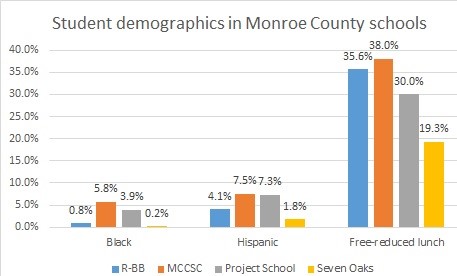
Along with the Hillsdale affiliation, there are other factors that distinguish Seven Oaks from public schools: for example, its demographic profile. Out of more than 500 students, one is Black and nine are Hispanic, according to state data. Fewer than 20% of students would qualify for free or reduced-price meals if they were provided. (The school doesn’t provide transportation or school lunches).
This chart shows the percentage of students who are Black, Hispanic and eligible for free or reduced-price meals in Monroe County public school districts (Monroe County and Richland-Bean Blossom community school corporations) and charter schools (Bloomington Project School and Seven Oaks Classical School).
The 24-page Seven Oaks charter extension reads like a standard agreement, with boilerplate language from state law and recommended practices for authorizing. It spells out the duties of each party, the expectations for the school, and the legal remedies if something goes wrong. An attached accountability plan includes out-of-date references to state assessments and, I’m told, is being revised.
The agreement says Grace College gets to keep 2.5% of the school’s state funding as an authorizer fee. That’s less than the 3% maximum that Indiana allows. In 2023-24, the college will net about $93,000.
Grace initially approved a charter for Seven Oaks in 2016 in one of Indiana’s first examples of what’s called authorizer shopping. The school’s founders applied to the Indiana Charter School Board, but it rejected their application. They reapplied but withdrew after a negative recommendation from the board’s staff. Then they took their plan to Grace College, which said yes to a 7-year charter.
At that time, private colleges could authorize charter schools in closed-door meetings with no public notice. Since 2017, they’ve had to use nonprofit authorizing agencies, such as Grace College’s Grace Charters LLC, that are subject to open-meetings and public-records laws. Even so, it can be hard to keep up. I started asking by email about the Seven Oaks charter extension in March; it took until late May to get copies of the December 2022 board minutes and the school’s extended charter agreement.
Transparency is one issue of having distant authorizers for charter schools, but there are others. The National Association Charter School Authorizers cautions against throwing the door wide open for higher education institutions, or HEIs, to authorize schools, as Indiana has done since 2011.
A reader who signs in as CarolMalaysia described the latest education-related laws passed in Indiana:
She writes:
These are some of the new Indiana laws that will take effect on Saturday. [Indiana is run by the GOP and they have NO respect for public schools or teachers.] Gary is a poverty area and they cannot vote for their school board members. 87% of Hoosier children attend public schools and they are continuously underfunded.
Book bans — Every public school board and charter school governing body is required to establish a procedure for the parent of any student, or any person residing in the school district, to request the removal of library materials deemed “obscene” or “harmful to minors.” School districts must also post a list of the complete holdings of its school libraries on each school’s website and provide a printed copy of the library catalogue to any individual upon request. (HEA 1447)
Charter schools — The proceeds of each new voter-approved school funding referendum in Lake County must be shared with local charter schools in proportion to the number of children living in the school district who attend charter schools. Beginning July 1, 2024, all incremental property tax revenue growth at Lake County school districts must be shared on a proportional basis with local charter schools. (SEA 391, HEA 1001)
Gary schools — A five-member, appointed school board is reestablished for the Gary Community School Corp. to eventually replace the Indiana Distressed Unit Appeals Board as the governing body for the formerly cash-strapped school district. Gary’s mayor and the Gary Common Council appoint one member each, and the three others are chosen by the Indiana secretary of education, including at least one Gary resident, one resident of Gary or Lake County, and a final member from anywhere. (SEA 327)
Indiana’s private school voucher system was the big winner in the 2023 legislative session, but charter schools came in a close second. They secured sizeable increases in state funding to pay for facilities and transportation, along with – for the first time – a share of local property taxes.
As Amelia Pak-Harvey of Chalkbeat Indiana explains, the success followed an all-out lobbying and PR effort in which charter supporters teamed with voucher proponents. Advocates insist charter schools are public schools, and private schools certainly aren’t. But the joint effort was effective.
The Republican supermajority in the General Assembly rewarded charter schools with:
An increase to $1,400 from $1,250 per pupil in “charter and innovation network school grants,” intended to make up for the fact that charter schools haven’t been able to levy property taxes.
A new law that says school districts in four counties, Lake, Marion, St. Joseph and Vanderburgh, must share increases in their local property-tax revenue with charter schools.
A requirement that districts in the same four counties share with charter schools if their voters pass a referendum to raise property taxes to pay for operating expenses.
$25 million in fiscal year 2024 for facilities grants for charter schools. That’s in addition to the “charter and innovation school network grants” listed above.
All told, the budget and student funding formula will provide about $671 million in state funds over the next two years for brick-and-mortar charter schools and another $112 million for virtual charter schools. That doesn’t include the local property tax funding that charter schools in four counties will receive.
House Speaker Todd Huston, R-Fishers, said at the start of the session that expanding school choice would be a priority. Growing the voucher program was on the table from the start, but it wasn’t until the last day of the session that charter school funding bills took their final shape.
As Chalkbeat reported, a $500,000 campaign by charter supporters, including catchy TV and Facebook ads attributed to the Indiana Student Funding Alliance, certainly helped. The Institute for Quality Education, an Indianapolis organization that promotes vouchers and charter schools, helped pay for the ads. Its political action committee, Hoosiers for Quality Education, gave over $1.3 million to Republican campaigns in 2020-22. Another pro-charter group, Hoosiers for Great Public Schools, gave over $1 million. Arguably no other special interest did more to keep the Statehouse in solid GOP control.
Both PACs are largely funded by out-of-state billionaires: the Walton family of Arkansas for Hoosiers for Quality Education and Netflix CEO Reed Hastings for Hoosiers for Great Public Schools.
The Student Funding Alliance campaign initially focused on getting a share of a planned property-tax operating referendum for Indianapolis Public Schools. IPS dropped plans for the referendum, and the call for “parity” in school funding shifted to the legislature, where it had a ready audience.
Charter schools get about the same per-pupil state funding as district schools. They get more federal money. But they haven’t been able to raise money with property taxes. That will now change for charter schools in the four designated counties, and that’s two-thirds of the charters in the state. By my count, 56 of Indiana’s nearly 100 brick-and-mortar charter schools are in Indianapolis (Marion County) and nine are in Lake County.
In almost every other instance, government entities that levy property taxes – school districts, cities, counties, townships, etc. – can be held accountable via elections. If you don’t like how the school district is spending your tax dollars, you can vote out the school board. That won’t be the case with charter schools, which are privately operated nonprofits with appointed boards.
Expanding school choice was a key part of GOP legislators’ education program, but it wasn’t the only part. The supermajority also passed what the ACLU referred to as a “slate of hate”: laws to ban gender-affirming care for trans youth, set the stage for banning books and prosecuting school librarians, ban teaching about sex in early grades, and force schools to out trans kids to their parents.
School administrators and school boards are canceling school plays that include LGBT characters. When this happened in Fort Wayne, Indiana, the students started a GoFundMe and raised the money to stage the play on their own. A professional stage director came back to Fort Wayne to help the students. This generation of young people is our hope for the future.
Students at an Indiana high school are moving ahead with an LGBTQ+ inclusive play after administrators canceled the production earlier this year.
Carroll High School in Fort Wayne, Indiana is just one of many schools across the country where student plays and musicals have been canceled or censored this year due to concerns over content. Howard Sherman, the managing director of the performing arts center at New York’s Baruch College, recently noted that the wave of opposition has been focused largely on productions with LGBTQ+ content.
As The Washington Post and other outlets have reported, students at Carroll High were informed two days into auditions for Marian, or the True Tale of Robin Hood that the play had been canceled due to complaints from parents about its LGBTQ+ characters. A re-telling of the Robin Hood story, the play features a nonbinary character and a same-sex couple.
“I know there were people who were upset that the play was being considered to be put on, I think there was worry about protests and things like that,” Northwest Allen County Schools superintendent Wayne Barker said at a school board meeting.
Almost immediately, students began talking about putting the play on themselves. They soon connected with Fort Wayne Pride, which organizes Pride events in the community, and launched a GoFundMe campaign on May 4.
As of this week, the campaign has raised over $79,000, well exceeding its $50,000 goal. The funds will go toward renting a venue, insurance, costumes, and set construction.
Fort Wayne native Blane Pressler, the artistic director of Ozark Actors Theatre, has returned to his hometown to help put on the play, which will run for one night only at the Foellinger Outdoor Theater on May 20.
The students are thrilled. The show is likely to be a huge success. The students demonstrated their independence and courage. Those who object to the play can stay home. The GoFundMe has already exceeded its goal and may produce enough money to fund future shows.


 Diane Ravitch's blog