Here is a conundrum: Policymakers and pundits insist that public school students and teachers must be held accountable or they won’t make any progress. Students must regularly tested to make sure they are learning prescribed curriculum.
So-called “education reformers” are all in favor of standards, tests, and accountability. Such a strategy, they insist, drives higher test scores.
But when it comes to voucher students, the “reformers” fall silent. Voucher students don’t need accountability, don’t need testing, don’t need state standards.
Why the double standards? Why should voucher students get public money and be exempt from state testing?
New Hampshire just concluded that debate. Democrats proposed that voucher students take the same tests as public school students. Republicans opposed the bill.
CONCORD — The House defeated a proposal to require Education Freedom Account students evaluation results be reported to the Department of Education.
House Bill 1716 would require the results of national standardized and state assessment testing for EFA students to be reported to the department, along with an assessment of a student’s portfolio by a certified teacher.
The bill would also require the department to develop guidelines for assessing the portfolios and what information is needed in order to progress to the next grade level.
The department would review all the data to determine academic proficiency rates for EFA students based on graduation rate, grade level, gender, race, and differentiated aid categories.
The prime sponsor of the bill Rep. Tracy Bricchi, D-Concord, told the House as a former educator for 35 years she does not agree with those who say public education is bad for the country and communities.
“You hear public education is failing and throwing money at it will not improve the outcome,” she said, while the state has spent millions of dollars on the EFA program with no consistent data to support claims it is widely successful.
This bill would provide the data needed to support those claims, Bricchi said, using the three assessment paths in the statute.
It would also tighten the portfolio requirements to ensure clear documentation of student progress, she said.
“If you spend taxpayer funds,” Bricchi said, “you owe it to taxpayers and people to produce clear data to ensure the money is spent (effectively).”
But Rep. Margaret Drye, R-Plainfield, argued state assessment testing is done for students in grades three through eight and one year of high school, while the bill would require testing of every grade level, every year for EFA students.
And she said in public schools parents may opt their child out of assessment testing, but there is no such provision in the HB 1716 for EFA students.
She said a very successful evaluation process has been in place for 40 years for homeschooled students, but is not available in the bill.
The legislation places a burden on 10,000 EFA students that is not on 160,000 public school students, Drye maintained.
But Peggy Balboni, D-Rye, said the success of public schools is determined by the statewide assessment scores, but EFA students do not have to provide that information or other assessments to the Department of Education.
This bill would allow the same public reporting of the results for EFA students, she said.
“All students who are taxpayer funded should be held to the same evaluation reporting standards,” Balboni said. “This will allow the reporting of EFA students’ academic data to determine if indeed the EFA program is widely successful.” The bill was killed on a 194-166 vote.
Stephen Dyer, former legislator and critic of school privatization in Ohio, explains here how a Republican-sponsored bill will hit Republican districts hardest.
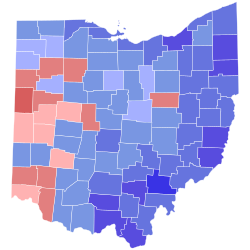
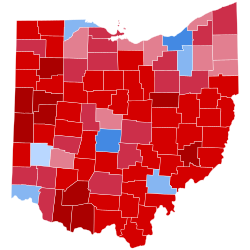
It’s no secret that over the last decade, Ohio has gone from a battleground state to a pretty red one, especially when Donald Trump is on the ballot. The major swing that occurred between 2006 when Democrat Ted Strickland won 70+ counties and 2024 has occurred in rural and urban counties, especially around the Mahoning Valley.
Gov. Ted Strickland’s 2006 victory map
President Donald Trump’s 2024 victory map
So what does the Ohio GOP do this year, which is shaping up to be a tough year for them anyway, to hold onto their Trump coalition?
10th Period is a reader-supported publication. To receive new posts and support my work, consider becoming a free or paid subscriber.
Try this: Introduce a bill that would, if passed, require folks living in Mahoning County to increase their property taxes by an average of $2,300 per $200,000 home and Trumbull County by $1,886, or close their kids’ schools.
During a year where everyone is so pissed about property taxes being high that they want to actually get rid of property taxes.
Yeah. Pretty stupid, right?
Why would they do something so stupid, you ask?
So they can maintain an unconstitutional private school tuition subsidy that lets Les Wexner — the guy who was best buddies with Jeffrey Epstein —get a taxpayer funded break on his private school tuition bill.
I can’t make up this shit, man.
These guys obviously think they’re politically invincible.
I ran some more analysis of the bill that Callender introduced (who was Ohio Charter Schools’ go to lawyer prior to returning to the House a few years ago), which would block state aid to any school district that’s suing the state over its private school tuition subsidy, which, again, has been found to violate the Ohio Constitution.
Needless to say, the results are not awesome.
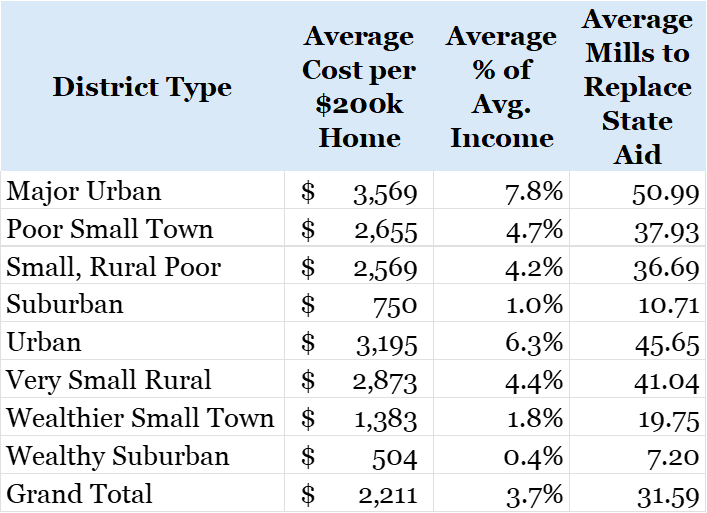
The average Ohio school district would have to go for a levy that runs about 32 mills and would cost a homeowner of a $200,000 home an additional $2,200 a year. And that’s only if they want to keep their kids’ schools open.
Because scores, if not hundreds, of school districts would cease operating under this bill
As you can see, the impact is worst for urban districts, but rurals are really hammered too.
This data is using the most recent Ohio Department of Education District Profile Report (for income and millage) and the most recent District Payment report for February 2026
I mean, you’re going to have poor, small town¹communities having to contemplate losing an additional 5% or more of their income to pay for Les Wexner’s private school tuition cut? That’s what you’re going with? This year?
Some other tidbits:
Trimble Local in Athens County would have to raise their property taxes by a staggering $11,355 per $200,000 home to replace the extorted money. That’s a 162.26-mill levy to raise what amounts to 23% of the average district resident’s income.
Steubenville — the home of Dean Martin and a famously Trump-y area — would need to go for a 119-mill levy, costing the $200,000 homeowner another $8,350 per year, which is 16% of the average family’s income there.
There are 56 Ohio school districts that would need to go for 50-mill levies or higher to replace the state aid Callender wants to cut. Or those kids — all 137,455 of them — will no longer have schools.
There are families in 22 Ohio school districts that would have to give up 10% or more of their average income to make up for Callender’s proposed cuts.
The average share of the cost in these districts that’s borne by the state is 47%. So the “you need to tighten your belt” argument ain’t working for these districts.
All so Les Wexner can get his private school tuition subsidized.
I could go on. I posted the spreadsheet here, in case you want to look at more of these just amazing consequences. Not every school district has joined the lawsuit. So these data only apply to those who have. But there are so many of them (@300, or half of all Ohio school districts) that you can extrapolate the results. If every district joined, the effect would be nearly identical to what’s happening in those that have already.
I will say that this bill is clearly unconstitutional. I don’t know how the state will argue that removing funding from 700,000 students is going to provide those same students with a thorough and efficient system of common schools, as the Ohio Constitution mandates.
So, in short, there is simply no way this bill survives even a modicum of legal scrutiny. So the chances of this happening are next to nothing.
Bu then if it’s clearly unconstitutional, as Callender must know it to be, then why do it? Scare local school districts form joining the lawsuit, or leaving it? Fat chance of that happening. I’ve been hearing districts and, more importantly, parents are more pissed now than they were before.
Like I said earlier, this is quite a play for Callender to make in an already tough political environment 9 months from an election that is expected to be focused on affordability and corruption.
But hey. It’s worked for these guys before and they keep winning in gerrymandered districts.
So why change now, right?
1. These district types are ones developed by the Ohio Department of Education, not me.
Denis Smith retired after spending years working for the Ohio Departmeny of Education. His last job was overseeing charter schools.
In this post, which appeared in the Ohio Capitol Journal, Smith reviews a proposal by Vivek Ramaswamy, a Republican candidate for Governor, that unintentionally reveals the hypocrisy of public funding for private schools. Ramaswamy wants to mandate the recitation of the Pledge of Allegiance daily in all public schools, but publicly-funded private schools would be exempt from this mandate.
Smith writes:
It’s hard for me to offer a thank you to Vivek Ramaswamy for anything, but he truly deserves our thanks for a recent statement.
Thank you, Vivek, in making the case for public education and demonstrating its true value to the nation.
For someone who reportedly wanted to “detox” from social media only a week ago, your post on X stating that you would make the oral recitation of the Pledge of Allegiance mandatory in the state’s schools has provided added layers of meaning for the public to discern that public education is a public good.
Unbeknownst to the Republican governor candidate, his tweet gives public school supporters added ammunition to hurl back at GOP efforts to fund private and religious schools though universal education vouchers that violate the Ohio Constitution.
“We’ll say the pledge of allegiance every day at every public school after I’m elected,” Vivek wrote.
He went on to say that, “We need more national unity, not less.”
When examined further, his brief post reveals the fatal flaws in Republican efforts to establish a parallel, non-public system of education that violates the Ohio Constitution.
Let’s look at a few flaws that Ramaswamy’s seemingly innocuous post brings to light.
According to the Ohio Revised Code, “The board of education of each city, local, exempted village, and joint vocational school district shall adopt a policy specifying whether or not oral recitation of the pledge of allegiance to the flag shall be a part of the school’s program …”
There is no requirement in that section of the ORC for private and religious schools to adopt policies that would place the oral recitation of the pledge as a regular part of the school program.
That sentence is revealing because it shows that non-public schools can receive state funds but not be encumbered by the many laws and regulations that govern public schools.
That’s having it both ways, an art that non-public schools practice so well. We’ll take your money, thanks, but don’t tell us that this or that law or regulation is mandatory in our (private or religious) schools.
Hmmm. I wonder how Ramaswamy and Republicans privately feel about how public funds might go to non-public schools that might care less about instilling patriotism than inculcating their own brand of ideology and history.
The idea or probability of a publicly funded religious school that teaches its students that the earth is only 6,000 years old readily comes to mind.
With the current devolution of our society, where Republicans achieve a twofer by eroding public education as a way of destroying public employee unions, that idea is not farfetched.
In addition to a possible future Pledge of Allegiance mandate for public schools, as called for in Ohio House Bill 117, where public and religious schools would be exempt from such requirements, there is another hidden structural flaw in Ramaswamy’s post that belies his words:
“We need more national unity, not less,” Ramaswamy wrote.
Huh? How does a parallel, unconstitutional yet publicly funded private and religious school system, funded by universal educational vouchers, contribute to national unity?
Vivek said that we need more national unity. Explain how $1 billion taken from state school aid and given to other, non-public schools that are exempt from so much law and regulation, adds to national unity.
Do these schools pledge allegiance to the state and embrace regulatory compliance in return for such cash? Hardly.
Two years ago on these pages, I offered the views of Dr. Kenneth Conklin, a philosopher who is concerned about “community cohesion and settled social bonds,” along with cultural fragmentation. Here are his considered views:
“If an educational system is altered, its transmission of culture will be distorted,” Conklin wrote. “The easiest way to break apart a society long-term without using violence is to establish separate educational systems for the groups to be broken apart.”(Emphasis mine.)
How do we get more national unity by establishing separate educational systems?
Dr. Conklin added some other thoughts that Ramaswamy and other Republicans such as Ohio Speaker Matt (“We can kind of do what we want”) Huffman and Senate Education Chair Andrew (“Public education in America is socialism”) Brenner might reflect on as our national unity continues to deteriorate.
“A society’s culture can survive far longer than the lifespan of any of its members, because its educational system passes down the folkways and knowledge of one generation to subsequent generations. A culture changes over time, but has a recognizable continuity of basic values and behavioral patterns that distinguishes it from other cultures. That continuity is provided by the educational system.”
Ramaswamy says that he is concerned about national unity. So am I. Indeed, that continuity is provided by a common school system.
If Ramaswamy is truly concerned about national unity, we should await his announcement about the corrosive effect of vouchers, their damage to community cohesion, settled social bonds, and cultural fragmentation.
All my life I have heard Republicans lecture about the importance of small government. They said that government should not try to control people, other than protecting their rights. A Republican named William Weld ran for Governor of Massachusetts on a pledge to get government out of our wallets and out of our bedrooms. For decades, Southern Republicans complained about the federal government intruding into “internal” issues like segregation.
How things have changed!
Under today’s Republican Party, the federal government assumes the power to snoop on you at all times.
A blogger who calls herself @JofromJerz posted the following sage observation on Substack:
Republicans want to decide what books you can read, what history your kids can learn, which medicines you’re allowed to take, what surgeries you can have, what gender you’re permitted to be, what sports you can play, which bathroom you can use, who you can love, and who you can marry.
They want to tell you how many dolls and pencils your kids can have and how much food they can eat.
They want to own your library, your classroom, your hospital bed, your bedroom, your remote control, your kitchen table, and your front door.
They want the right to break into your home, disappear your neighbor, take your children, beat you, execute you in the street, and then tell you—despite the evidence of your own eyes and ears—that what you saw is not what you have seen.
They want you afraid: afraid to record, to document, to criticize, to stand up, to speak out, to organize, to protest, to protect, to utter words they don’t like. They want to own the page, the pill, the joke, the chant, the kiss, the very pronoun in your mouth and the weapon on your waist. They want to decide where you can go, what you can say, and which of your rights they can take away.
They want the power to take your life and then lie about it.
They want to play judge, jury, and executioner and they want you to shut up about it or you’ll be next.
This is tyranny failing miserably to masquerade as order.
But sure—tell me how it’s the liberals who are “coming for your freedoms,” won’t you.
Foreign Policy, a distinguished publication for leading scholars of foreign affairs, published an article by staff writers Keith Johnson and Christina Lu asserting that Trump’s lust to control Greenland is just plain nuts.
They wrote;
Seeking additional barrels of oil in Venezuela or digging for rare earths in ice-covered Greenland makes no sense from an economic or security point of view. And yet U.S. President Donald Trump persists, even though the costs massively outweigh the benefits.
In reality, naked resource grabs explain a lot about Trump’s dizzying foreign policy, perhaps even more so than other explanations that have been proposed. It seems Trump may have reached back even further in time for his guiding light than tariff-happy William McKinley and big-stick imperialist Theodore Roosevelt to the British and Dutch quasi-state mercantilist corporations that introduced much of the world to rapacious capitalism starting in the 17th century. The British and Dutch East India Companies did grab much of the world, usually at gunpoint. At least they got pepper, spices, and tea. All we have here is sulfurous oil and neodymium.
Trump’s obsession with natural resources that the companies paid to extract them refuse to touch does raise several questions. Are these even the right resources to be grabbing? Is any of this legal? And most importantly, is any of this a remotely good way to promote the security of the United States?
WHEN IT COMES TO OIL, which has been a Trump obsession for decades, the answer is clearly no.
Oil demand is a tricky thing to project into the future. Some forecasters expect global demand for oil to peak within five years, while others reckon fast-growing developing economies will still be thirsty into the next decade, requiring more wells and more production. Either way, oil from Venezuela and Greenland is not the answer.
Venezuela’s oil woes have been amply demonstrated. It’s an expensive thing to produce in a place with little security and less rule of law, especially with oil languishing in the mid-$50s a barrel. The chairman and chief executive of ExxonMobil, Darren Woods, told Trump at a White House meeting last week that Venezuela was “uninvestible.” Trump then said he would ensure that Exxon was kept out of any U.S.-led Venezuela ventures—and Exxon’s stock rose on the news.
Greenland, too, is rumored to have oil: billions of barrels of it. It’s not clear if that is actually the case, because decades of exploration have hit only dry wells, but on paper, Greenland could have 8 billion barrels of oil hidden under the tundra and the whitecaps, or nearly 3 percent of Venezuela’s unattractive reserves.
But there are some daunting challenges. Most of those estimated oil resources are north of the Arctic Circle, and mostly offshore. That is not easy to access, even with climate change stretching summer on both ends. Even the oil on land is not easy to tap. There are fewer than 100 miles of paved road on an island the size of Mexico. Deep water ports, airports, pipelines, oil-export terminals, housing, clinics—all are on somebody’s to-do list to build, but not that of oil majors.
Also relevant: Since 2021, Greenland has banned further oil exploration due to environmental concerns. The only current play, a land-based oil-exploration operation on the island’s east coast with U.S. backing, relies on a grandfathered lease from years ago. That legal stricture, in the absence of a complete annexation, could complicate further U.S. efforts to tap Greenland’s possible oil.
BUT WHAT ABOUT GREENLAND’S rare earths, which Trump officials have suggested are one of the primary reasons the U.S. president is so interested in the island?
While those who focus on rare earths mining simply say the plan is “bonkers,” the real issue is that rare earths are not rare—processing facilities and magnet factories are. Which makes a race for ice-bound dodgy mining prospects in somebody else’s territory all the harder to understand.
“It certainly doesn’t make any sense as a rare-earth story,” Ian Lange, a professor in the mineral economics program at the Colorado School of Mines, recently told Foreign Policy.
Rare earths, or a set of 17 metallic elements with obscure names like neodymium and samarium, have catapulted in geopolitical importance because they power everything from F-35 fighter jets to Arleigh Burke-class destroyers. China overwhelmingly commands their global supply chains, giving it powerful leverage in its ongoing trade spat with the United States.
Sure, Greenland may have some sizable rare earth reserves, according to the U.S. Geological Survey—but so do many other countries. And a big economic question hangs over potential operations in Greenland, where no rare earth mining has ever taken place and mining itself remains a fraught and divisive issue.
The biggest problem with Trump’s resource grabs is not their lack of economic foundation, which is nil, or their legality, which is none, but with what they do for U.S. security, which is little or worse.
Also, the bulk of Greenland’s land—a whopping 80 percent—is estimated to be covered in ice. All of those factors are certain to make establishing crucial mining and processing infrastructure, already a difficult and hefty financial endeavor, even more costly and challenging.
In his pursuit of rare earths, industry experts say, Trump will likely have an easier time looking elsewhere.
AND THEN THERE’S THE QUESTION of the legality of how Trump is going about his resource grabs. Abducting heads of government to seize resources is not anywhere sanctioned in the U.N. Charter, nor is threatening to invade a NATO alliance partner to forcibly annex their territory. But rogue states are hard to red team.
Trump has waved aside centuries of international law, telling the New York Times “I don’t need international law,” because his own “morality” was the only check or balance required.
It’s not an abstruse debate. For centuries, the West has sought to paint a patina of law over the anarchy of the international system, and even today, tomes are written about revisionist powers seeking to pervert international law for their own ends. Until very recently, the United States was not among the revisionist powers.
But there’s little to be done on that front. Trump’s installed successor in Venezuela, Nicolas Maduro’s former vice president and now also acting president Delcy Rodriguez, who has been under U.S. sanctions since 2017 for human rights abuses, is according to Trump “a terrific person.” Also not entirely legal is storing the proceeds of Venezuelan oil sales the United States has carried out in an offshore account in Qatar.
THE BIGGEST PROBLEM with Trump’s resource grabs is not their lack of economic foundation, which is nil, or their legality, which is none, but with what they do for U.S. security, which is little or worse….
The great advantage the United States had, until recently, was its network of alliances: NATO, Japan, South Korea, and a multitude of others. That’s all gone now, or nearly. It is surely a sign of bungled foreign policy when Sweden dispatches troops against you.
Stephen Miller is a case study in himself. He is a paradox. His family came to the U.S. over a century ago, for the same reason millions of other immigrants arrived: to find freedom, safety, and opportunity. Like so many other families from Eastern Europe, his family was impoverished. They worked and succeeded.
They were immigrants.
Surely Stephen knows his family history, but he is nonetheless hostile to immigrants today. He wants to kick out those that are here and bar those who haven’t made it inside the nation’s gates.
He isn’t just hostile to immigrants. He hates them.
Trump’s Chief Bigot, Stephen Miller, said on Fox News this month that immigrants to the United States bring problems that extend through generations.
“With a lot of these immigrant groups, not only is the first generation unsuccessful,” Miller claimed. “You see persistent issues in every subsequent generation. So you see consistent high rates of welfare use, consistent high rates of criminal activity, consistent failures to assimilate.”
In fact, the data show just the opposite. The children and grand children and great grandchildren of most immigrants are models of upward mobility in America.
In a new paper, Princeton’s Leah Boustan, Stanford’s Ran Abramitzky, Elisa Jácome of Princeton, and Santiago Pérez of UC Davis, used millions of father-son pairs spanning more than a century of U.S. history to show that immigrants today are no slower to move into the middle class than immigrants were a century ago.
In fact, no matter when their parents came to the U.S. or what country they came from, children of immigrants have higher rates of upward mobility than their U.S.-born peers.
Stephen Miller’s great great grandfather, Wolf-Leib Glosser, was born in a dirt-floor shack in the village of Antopol, a shtetl in what is now Belarus.
For much the same reasons my great grandparents came to America — vicious pogroms that threatened his life — Wolf-Leib came to Ellis Island on January 7, 1903, with $8 in his pockets. Though fluent in Polish, Russian and Yiddish, he understood no English.
The family settled in Johnstown, Pennsylvania, a booming coal and steel town, where they rose from peddling goods to owning a haberdashery, and then owning a chain of supermarkets and discount department stores, run by Sam, and Sam’s son, Izzy (Stephen Miller’s maternal grandfather).
Two generations later, in 1985, came little Stephen — who developed such a visceral hate for immigrants that he makes up facts about them that have no bearing on reality.
In a little more than eleven months, Stephen and his boss have made sweeping changes to limit legal immigration to America.
On his first day back in office, Trump signed an executive order declaring that children born to undocumented immigrants and to some temporary foreign residents would no longer be granted citizenship automatically.
The executive order, which was paused by the courts, could throw into doubt the citizenship of hundreds of thousands of babies born each year. Miller and his boss want the Supreme Court to uphold that executive order.
After the horrific shooting of two National Guard members on August 26, by a gunman identified by the authorities as an Afghan national, Trump halted naturalizations for people from many African and the Middle Eastern countries.
Trump is also threatening to strip U.S. citizenship from naturalized migrants “who undermine domestic tranquillity.” He plans to deport foreigners deemed to be “non-compatible with Western Civilization” and aims to detain even more migrants in jail or in warehouses — in the U.S. or in other countries — without due process.
In addition to the unconstitutionality of such actions, they stir up the worst nativist and racist impulses in America — blaming and scapegoating entire groups of people.
As they make their case to crack down on illegal and legal immigration, Miller and Trump have targeted Minnesota’s Somali community — seizing on an investigation into fraud that took place in pockets of the Somali diaspora in the state, to denounce the entire community, which Trump has called “garbage.”
Let’s be clear. Apart from Native Americans, we are all immigrants — all descended from “foreigners.” Some of our ancestors came here eagerly; some came because they were no longer safe in their homelands; some came enslaved.
Almost all of us are mongrels — of mixed nationalities, mixed ethnicities, mixed races, mixed creeds. While we maintain our own traditions, we also embrace the ideals of this nation.
You can go to Japan to live, but you cannot become Japanese. You can go to France to live and not become a Frenchman. You can go to live in Germany or Turkey, and you won’t become a German or a Turk. But … anybody from any corner of the world can come to America to live and become an American. A person becomes an American by adopting America’s principles, especially those principles summarized in the “self-evident truths” of the Declaration of Independence, such as “life, liberty, and the pursuit of happiness.”
Reagan understood that America is a set of aspirations and ideals, more than it is a nationality.
Miller and Trump want to fuel bigotry. Like dictators before him, Trump’s road to tyranny is paved with stones hurled at “them.” His entire project depends on hate.
America is better than Trump or his chief bigot.
We won’t buy their hate. To the contrary, we’ll call out bigots. We won’t tolerate intolerance. We’ll protect hardworking members of our community. We’ll alert them when ICE is lurking.
We will not succumb to the ravings of a venomous president who wants us to hate each other — or his bigoted sidekick.
Trump’s military attack on Venezuela was unauthorized by Congress. It was lawless. His actions deserve condemnation by the UN and world leaders.
He mocks the very idea of a rules-based international order. He mocks the idea that Congress is a co-equal branch of the federal government.
But he achieved three goals by his audacious actions.
He completely changed the national discussion away from the Epstein files.
He showed Congress that they are irrelevant.
He played the one card that might lift his very low poll ratings: military action. The public usually rallies round the flag. Going to war–especially when no American life is risked–typically raises the President’s popularity. Will it work this time in the absence of a casus belli? (Reason for war?)
The great irony in the current situation was that he recently pardoned Juan Orlando Hernandez, the ex-President of Honduras, who had been sentenced to 45 years in federal prison for sending some 400 tons of cocaine into the U.S.
Maduro should have had a better lobbyist or helped underwrite the Trump ballroom and he would be a free man.
Meanwhile, the U.S. has returned to the days of gunboat diplomacy, where it ruled the hemisphere by force.
Perhaps he has made a deal with Putin and Xi. Trump gets his hemisphere. Putin gets Europe. Xi gets Asia.
In a late-night tweet that probably was supposed to be a private text message, Trump urged Attorney General Pam Bondi to pursue criminal charges against his political enemies–James Comey, Letitia James, and Adam Schiff–for various alleged crimes.
New York State Attorney General James was accused of mortgage fraud, of getting a mortgage on a home used as an investment property while claiming it would be her secondary residence, in order to lower the cost of borrowing. Trump wants Senator Schiff and Congressman Eric Swalwell prosecuted on the same charge of mortgage fraud; charges have not yet been brought against them.
Letitia James denies the charges. A grand jury indicted her but the case was tossed out by a judge because of errors made by Trump’s inexperienced, hand-picked prosecutor, Lindsey Halligan. Halligan was an insurance lawyer who had never prosecuted a case before. Trump had previously engaged her to review the holdings of the Smithsonian and identify exhibits that disparaged America or promoted DEI (diversity, equity, and inclusion).
Attorney General Bondi plans to reindict James.
Now, ProPublica carefully documents, Trump did exactly the same mortgage gambit that he calls criminal.
He bought Mar-a-Lago in 1985. In 1993, he purchased two neighboring homes. He took out a mortgage on both houses and declared at the time that each house would be his primary residence.
But he never lived in either house. They were advertised for rent or leasing, by the week or by the month.
“Given Trump’s position on situations like this, he’s going to either need to fire himself or refer himself to the Department of Justice,” said Kathleen Engel, a Suffolk University law professor and leading expert on mortgage finance. “Trump has deemed that this type of misrepresentation is sufficient to preclude someone from serving the country.”
Mortgages for a person’s main home tend to receive more favorable terms, like lower interest rates, than mortgages for a second home or an investment rental property. Legal experts said that having more than one primary-residence mortgage can sometimes be legitimate, like when someone has to move for a new job, and other times can be caused by clerical error. Determining ill intent on the part of the borrower is key to proving fraud, and the experts said lenders have significant discretion in what loans they offer clients. (In this case, Trump used the same lender to buy the two Florida homes.)
But in recent months, the Trump administration has asserted that merely having two primary-residence mortgages is evidence of criminality.
Bill Pulte, the Federal Housing Finance Agency director who has led the charge, said earlier this year: “If somebody is claiming two primary residences, that is not appropriate, and we will refer it for criminal investigation.”
Trump hung up on a ProPublica reporter after being asked whether his Florida mortgages were similar to those of others he had accused of fraud.
In response to questions, a White House spokesperson told ProPublica: “President Trump’s two mortgages you are referencing are from the same lender. There was no defraudation. It is illogical to believe that the same lender would agree to defraud itself.”
The spokesperson added, “this is yet another desperate attempt by the Left wing media to disparage President Trump with false allegations,” and said, “President Trump has never, or will ever, break the law…”
Each of the mortgagedocuments signed by Trump contain the standard occupancy requirement — that he must make the property his principal residence within 60 days and live there for at least a year, unless the lender agreed otherwise or there were extenuating circumstances.
But ProPublica could not find evidence Trump ever lived in either of the properties. Legal documents and federal election records from the period give his address as Trump Tower in Manhattan. (Trump would officially change his permanent residence to Florida only decades later, in 2019.) A Vanity Fair profile published in March 1994 describes Trump spending time in Manhattan and at Mar-a-Lago itself.
Trump is no longer at risk for mortgage fraud because the statute of limitations has rendered the issue moot.
Democrats suspect that the claims about mortgage fraud were based on confidential information acquired by Bill Pulte, who was appointed by Trump to lead the Federal Housing Finance Agency. Pulte denies it. Pulte, a wealthy private equity investor, contributed generously to Trump’s campaign.
ProPublica points out that Trump tried to fire Federal Reserve Board Governor Lisa Cook on a charge of mortgage fraud, so he could appoint his own choice and gain control of the Board. Cook denied the charges and sued in federal court, where the matter is still pending.
In September, ProPublica reported that three of Trump’s Cabinet members have called multiple homes their primary residences in mortgage agreements. Bloomberg also reported that Secretary of the Treasury Scott Bessent did something similar. (The Cabinet members have all denied wrongdoing.)
Pulte, the Federal Housing Finance Agency head, has denied his investigations are politically motivated. “If it’s a Republican who’s committing mortgage fraud, we’re going to look at it,” he has said. “If it’s a Democrat, we’re going to look at it.”
Thus far, Pulte has not made any publicly known criminal referrals against Republicans. He did not respond to questions from ProPublica about Trump’s Florida mortgages.
After reading this article, I wondered about Trump’s financing of Mar-a-Lago. It cost $7-10 million. He paid $300,000. He got a mortgage from Chase Manhattan for $8.5 million. At the time, his residence was New York City.
In the post at 9 a.m. today, two scholars of racism and equity explained that Trump’s scrubbing of museums, national parks, and other federal facilities is an attempt to capture control of the culture and erase the place of Blacks, women, and anyone else who is not a straight white male.
But, as scholar Julian Vasquez Heilig writes here, Trump and his commissariat cannot control the popular culture. In time, we can hope, his mean-spirited efforts to revise history will become a bad joke, a cruel joke, a stupid joke. He and all those who carry out his orders will become a public laughing stock.
Vasquez Heilig writes on his blog Cloaking Inequity:
The Super Bowl has always been more than football. It is a ritual, a spectacle, a national performance. It’s where America tells the world who it thinks it is, and who it wants to be. Which is why the announcement that Bad Bunny will host the halftime show is far more significant than a musical lineup change. It’s a cultural earthquake.
I remember the first time I heard Bad Bunny. It was December 6, 2019, at La Concha Hotel in San Juan. In the downstairs lounge, the beat of reggaetón was shaking the walls, and I pulled out Shazam to figure out what it was. The song was Vete. The room was electric, filled with Puerto Ricans singing every word in Spanish, unapologetically themselves. That night, it hit me: Bad Bunny was not just making music in San Juan, he was celebrating culture. He wasn’t crossing over into the mainstream by adapting; he was dragging the mainstream toward him. He refused to translate, refused to dilute, and now he is everywhere—on playlists, on charts, SNL, in crowded places from San Juan to New York to Madrid.
That’s why his Super Bowl moment matters so much. It is not just a performance, it is the culmination of a global movement that began in places like that basement lounge in Puerto Rico. What felt local then is now universal. Bad Bunny’s rise shows how culture flows upward, from the margins to the center, from overlooked communities to the biggest stage in the world. For millions of us, this is affirmation. For the right wing, it is destabilization. Because when the halftime show belongs to Bad Bunny, it proves that America is no longer just what they imagine it to be. It is bigger, louder, and more diverse than great again nostalgia can contain.
Jay-Z, Kendrick Lamar, and the New Halftime Era
The NFL’s halftime choices haven’t shifted by accident. When the league came under fire for its treatment of Colin Kaepernick and broader criticisms about racial injustice, it needed credibility. Enter Jay-Z and Roc Nation. The NFL tapped him to advise and help curate halftime shows.
The results have been undeniable. Kendrick Lamar’s halftime performance last year was a watershed moment—unapologetically Black, politically charged, and culturally defining. That performance sparked widespread discussion, and even a blog post I wrote about it entitled “TV Off”: What Kendrick Lamar Was Really Saying at the Super Bowl drew more than 100,000 readers in just a few days. Clearly, the hunger to talk about representation and ownership of the halftime stage is real.
Now with Bad Bunny taking the baton, the NFL is making another cultural statement, whether it fully realizes it or not (I think it does). The league’s biggest platform is no longer reserved for the safe, predictable acts of yesterday. It’s becoming a stage where hip hop, reggaeton, and the voices of communities once marginalized are front and center.
Bad Bunny and the Right’s Panic
For decades, the halftime show was dominated by choices that reinforced a narrow image of America: classic rock icons, country stars, or pop acts who wouldn’t ruffle feathers but had wardrobe malfunctions. Bad Bunny shatters that mold. His performance won’t be a side act, it is the show. Spanish won’t be a novelty; it will be central.
This is exactly why the right wing panics. To them, football Sundays and Super Bowls have long been “their” cultural territory. They’ve wrapped the game in patriotic rituals, military flyovers, and moments of silence for conservative heroes. When someone like Bad Bunny steps into the spotlight, it disrupts their monopoly. It forces a new definition of America—one that is multilingual, multicultural, and undeniably Latino. That’s what makes his halftime role so radical: after focusing on the Black experience with Kendrick, this year signals that Latino identity is no longer peripheral. It’s woven into the fabric of America’s biggest stage.
Why ICE Wants to Loom Over the Moment
It might sound absurd that ICE wants to connect itself to the Super Bowl halftime show, but immigration enforcement has always thrived in the shadows of visibility. When Latino joy and success are celebrated so publicly, ICE apparently feels the need to remind America of its terrorizing power.
Bad Bunny performing at the Super Bowl is a triumph of belonging. But ICE’s assaults, raids, arrests, kangaroo courts, and deportations are constant reminders that belonging is conditional on politics. While millions watch a Puerto Rican superstar, ICE agents are throwing mothers and journalists to the ground, spraying pepper liquid into the eyes of Americans who dare to ask questions, arresting elected politicians at the behest of Washington politicians after turning off their body cameras, and authorized by the Supreme Court to detain people simply for looking Latino and poor.
The contradiction is sharp: on the world’s stage, Latino identity is being widely celebrated; on America’s streets, it’s criminalized. ICE doesn’t need to show up at the stadium—it already shows up in our daily life. Its existence ensures that even at moments of cultural triumph, there’s a purposeful shadow of fear and terroristic threats.
Danica Patrick’s Tone-Deaf Criticism
And then, inevitably, a silly critic emerges from the sidelines. This time it’s Danica Patrick, who dismissed Bad Bunny’s hosting role. Her comments were more than unhelpful, they were stupid.
Patrick should know better. She carved her own career by getting along in a male-dominated sport, where every step forward was a battle for representation. She knows the symbolic weight of breaking barriers. For her to turn around and mock or diminish Bad Bunny’s presence is hypocritical at best, willfully ignorant at worst.
Bad Bunny isn’t there to tick a diversity box, he’s there because he is one of the most influential artists alive— maybe THE most. The incredible success of his shows that he did for his most recent album this past summer ONLY in Puerto Rico is proof that the center of American culture is shifting. Criticizing that isn’t just a matter of taste. It’s a refusal to accept reality.
The Lions, Charlie Kirk, and Who Gets Tribute
The battle over cultural ownership in America doesn’t stop at the Super Bowl. It plays out every Sunday on the NFL field. When conservative commentator Charlie Kirk was assassinated, the league encouraged teams to hold moments of silence in his honor. Most complied. But the Detroit Lions, along with a few other teams, did not.
That decision matters. It was a quiet but deliberate act of boundary-setting, a refusal to let every NFL broadcast become a political ritual sanctifying right-wing political ideology. By declining the tribute, the Lions reminded us that not every form of patriotism must come prepackaged with conservative allegiance. It wasn’t loud or defiant. It was subtle and deeply symbolic. Sometimes resistance isn’t what you do, it’s what you decline to perform and participate.
The Lions’ restraint connects to the same cultural realignment symbolized by Bad Bunny’s Super Bowl performance. Both moments reject the idea that American culture belongs to a single tribe. They push back against the notion that sports, music, or patriotism must orbit one political pole. They insist, instead, that culture belongs to everyone, not just the loudest or the angriest voices claiming to defend it.
The Double Standard of Protest
Of course, this tension between culture, power, and dissent has long been visible in the NFL. When Colin Kaepernick knelt during the national anthem to protest police brutality, he was branded a traitor by many of the same voices now demanding “respect” for Charlie Kirk. His silent, dignified act of conscience was recast as an attack on America itself.
The outrage was never really about the flag. It was about control. It was about who is allowed to define what counts as “patriotic.” Kaepernick’s kneeling was an act of moral courage, but it exposed how fragile America’s cultural gatekeepers truly are when confronted with truth. They could not tolerate a protest that revealed their own comfort with injustice and brutality.
Meanwhile, state violence continues daily without the same moral outrage from the right-wing. ICE officers violently throw mothers and journalists to the ground without cause. They pepper-spray citizens in their eyeballs for daring to ask questions in a conversation. They arrest and detain American citizens in raids not for crimes but for looking poor, brown, or foreign. These acts have not provoked right-wing primetime outrage or public boycotts. Their hypocrisy is staggering.
A man kneeling quietly for justice was vilified. Agents brutalizing families are ignored. The problem has never been the method of protest, it has always been their morality. Silence in the face of injustice is acceptable; silence against injustice is not. The Lions’ quiet refusal and Kaepernick’s quiet protest share something profound: both disrupted the script of cultural obedience. Both reminded us that resistance isn’t always loud. Sometimes it’s the refusal to play along.
The Supreme Court’s Enabling Role
And looming behind all of this is the judiciary. Recent Supreme Court rulings have expanded law enforcement’s power, narrowing protections under the Fourth Amendment and giving politicians more leeway to persecute immigrants using federal data. Justice Brett Kavanaugh has been the lead in the right-wing judicial majorities that have handed law enforcement broad authority to stop, question, and detain anyone with minimal cause. Its new rulings have created the legal cover that now makes racial profiling essentially legal.
Racial profiling has happen illegally before and the new legal result empowered by the Supreme Court is the same: citizens living under suspicion, families living in fear, communities targeted not for what they’ve done but for how they look. The Supreme Court has enabled ICE brutality in the same way NFL owners enabled the blackballing of dissent, by creating structures that justify exclusion and violence while insisting neutrality.
The Bigger Picture: Who Owns the Stage?
So what do Bad Bunny, Kendrick Lamar, Jay-Z, Danica Patrick, ICE, the Lions, Charlie Kirk, and Brett Kavanaugh all have in common? They are all part of the “fight, fight, fight” (see new Trump $1 coin) over who gets to define American culture.
The right wing has long claimed the NFL as its territory: its rituals, its tributes, its symbols of patriotism. But culture evolves. It cannot be contained. From Detroit to San Juan to Los Angeles, new voices are shaping the narrative. Bad Bunny’s halftime show, Kendrick’s explosive performance, and even the Lions’ silent refusal all tell the same story: football does not belong exclusively to one political ideology. Neither does America.
The real question is whether we are willing to see that America’s identity is bigger than its old rituals. Are we willing to admit that inclusion is not a threat but a fact? Because culture doesn’t wait for permission. It claims the stage. And this year, that stage will belong to Bad Bunny.
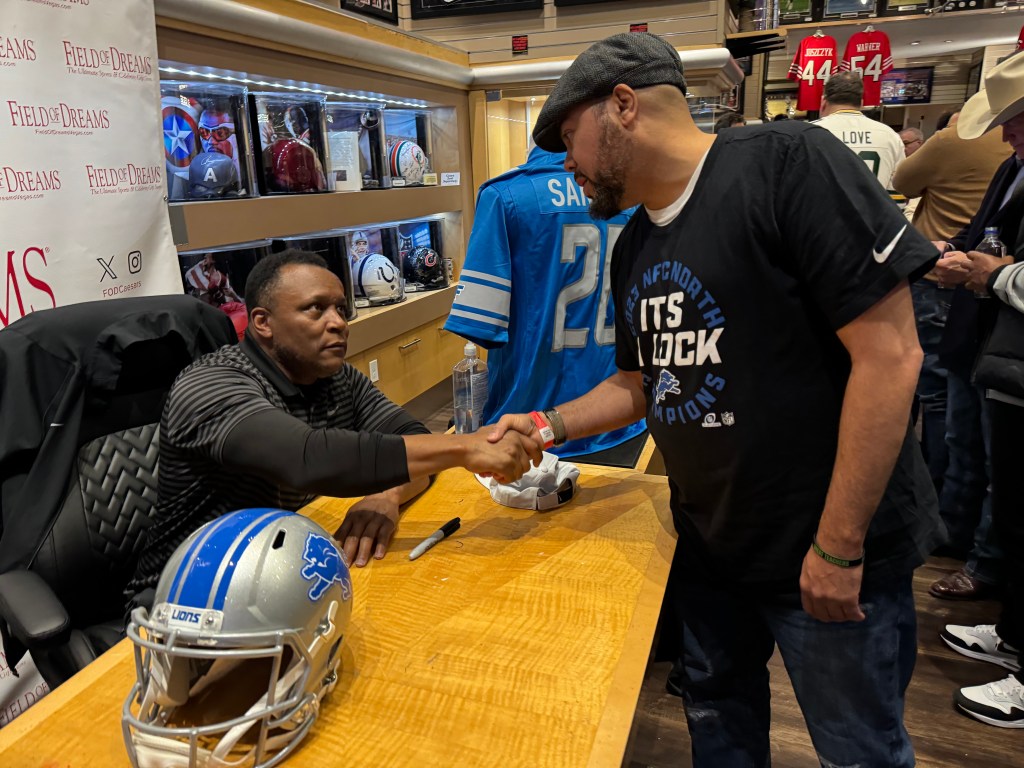
Julian Vasquez Heilig is a professor, writer, and a legit lifelong Detroit Lions fan since 1981. He attended the NFC Championship in San Jose two years ago to support his Cardiac Cats and last year’s playoff loss to the Washington Commanders at Ford Field. He was also at the official Lions partners party during the NFL Draft in Detroit, where he met Robert Porcher and Jason Hanson. Over the years he’s spotted Billy Sims in Times Square, endured the heartbreak of the Lions’ 0–16 season, and treasures his personally autographed Barry Sanders helmet. Beyond education and equity, Julian dabbles in writing about sports, culture, and society.
Wearing beards is a core religious tenet of some faiths, which has prompted the military to grant religious accommodations to Sikh, Muslim, Christian, and Norse Pagan service members for over a decade.
But those days may be ending.
This week’s overhaul of military grooming standards has raised fears of a coming crackdown on religious waivers for growing beards.
Shaving and beards were central topics in a speech Hegseth gave to hundreds of generals and admirals at Quantico, Virginia on Tuesday. Along with amplifying an earlier directive that troops with medical waivers for shaving could face separation, Hegseth indicated that he may be skeptical about at least some religious waivers that service members have received to wear beards.
Military.com noted this exceptional event authorized by Hegseth.
In a move that pushes the boundaries of Constitutional prohibition against a state religion, Defense Secretary Pete Hegseth hosted an evangelical prayer service in the middle of the day at the Pentagon in which a pastor praised President Donald Trump as “sovereignly appointed.”
A program for the event called it the “Secretary of Defense Christian Prayer and Worship Service.” It was held at the Pentagon’s auditorium and was broadcast throughout the building on its internal cable network.
The Constitution contains several phrases prohibiting state entanglement with religion but it says nothing about facial hair in the military. U.S. General Ulysses S. Grant had a large beard, as did Confederate General Robert E. Lee.
Now if only Secretary of Education would follow Hegseth’s lead and bar public funding of all religious schools.
Since almost the whole bunch of them are religious fanatics, that’s too much to hope for. Trump is an exception. He pretends to be a religious fanatic. He is merely transactional.

 Diane Ravitch's blog