Today is the fourth anniversary of the worst act of insurrection in our nation’s history. Urged on by President Donald Trump, who insisted that he actually won the election of 2020, a large mob stormed the United States Capitol in hopes of stopping the certification of the election of Joe Biden.
To be clear, Trump is a world-class liar and a very sore loser. He simply refused to admit that he lost the election, fair and square. Biden won the electoral vote and the popular vote. Trump’s lawyer challenged the voting results in multiple states. They filed more than 60 lawsuits, appealed twice to the U.S. Supreme Court, and lost every time. They lost in courts where the judge was appointed by Trump, as well as by other Presidents.
Still, he refused to concede his loss. He spent the past four years claiming that he had been cheated, even though he never produced a scintilla of evidence to support his lies. Several of his lawyers were disciplined or disbarred. His personal lawyer Rudy Giuliani was disbarred and also fined $148 million for defaming two election workers in Georgia. Although he had declared that he is bankrupt, Giuliani continues to turn over his assets to the women he defamed. Trump cannot pardon civil judgments, so Giuliani is likely to lose not only his law license but all of his assets.
Yet Trump survived, having persuaded his faithful base that he had been cheated in 2020, despite his lack of evidence and multiple indictments and convictions.
History will say this about Trump:
He was the first President who refused to participate in the peaceful transfer of power to the winner of the election.
He was the first President to inspire an insurrection against the government.
He will be the first convicted felon ever to serve as President.
His insurrection and his name will live forever in infamy.
Quite an ignominious legacy.
To read an excellent article by Robert Reich on the same topic, open this link.
Heather Cox Richardson recalls the days of bipartisan consensus around the goals of liberal democracy, in which government protected the rights of individuals. By today’s MAGA standards, President Dwight D. Eisenhower would be considered a dangerous leftwinger.
Cas Mudde, a political scientist who specializes in extremism and democracy, observed yesterday on Bluesky that “the fight against the far right is secondary to the fight to strengthen liberal democracy.” That’s a smart observation.
During World War II, when the United States led the defense of democracy against fascism, and after it, when the U.S. stood against communism, members of both major political parties celebrated American liberal democracy. Democratic presidents Franklin Delano Roosevelt and Harry Truman and Republican president Dwight D. Eisenhower made it a point to emphasize the importance of the rule of law and people’s right to choose their government, as well as how much more effectively democracies managed their economies and how much fairer those economies were than those in which authoritarians and their cronies pocketed most of a country’s wealth.
Those mid-twentieth-century presidents helped to construct a “liberal consensus” in which Americans rallied behind a democratic government that regulated business, provided a basic social safety net, promoted infrastructure, and protected civil rights. That government was so widely popular that political scientists in the 1960s posited that politicians should stop trying to court voters by defending its broadly accepted principles. Instead, they should put together coalitions of interest groups that could win elections.
As traditional Republicans and Democrats moved away from a defense of democracy, the power to define the U.S. government fell to a small faction of “Movement Conservatives” who were determined to undermine the liberal consensus. Big-business Republicans who hated regulations and taxes joined with racist former Democrats and patriarchal white evangelicals who wanted to reinforce traditional race and gender hierarchies to insist that the government had grown far too big and was crushing individual Americans.
In their telling, a government that prevented businessmen from abusing their workers, made sure widows and orphans didn’t have to eat from garbage cans, built the interstate highways, and enforced equal rights was destroying the individualism that made America great, and they argued that such a government was a small step from communism. They looked at government protection of equal rights for racial, ethnic, gender, and religious minorities, as well as women, and argued that those protections both cost tax dollars to pay for the bureaucrats who enforced equal rights and undermined a man’s ability to act as he wished in his place of business, in society, and in his home. The government of the liberal consensus was, they claimed, a redistribution of wealth from hardworking taxpayers—usually white and male—to undeserving marginalized Americans.
When voters elected Ronald Reagan in 1980, the Movement Conservatives’ image of the American government became more and more prevalent, although Americans never stopped liking the reality of the post–World War II government that served the needs of ordinary Americans. That image fed forty years of cuts to the post–World War II government, including sweeping cuts to regulations and to taxes on the wealthy and on corporations, always with the argument that a large government was destroying American individualism.
It was this image of government as a behemoth undermining individual Americans that Donald Trump rode to the presidency in 2016 with his promises to “drain the swamp” of Washington, D.C., and it is this image that is leading Trump voters to cheer on billionaires Elon Musk and Vivek Ramaswamy as they vow to cut services on which Americans depend in order to cut regulations and taxes once again for the very wealthy and corporations.
But that image of the American government is not the one on which the nation was founded.
Liberal democracy was the product of a moment in the 1600s in which European thinkers rethought old ideas about human society to emphasize the importance of the individual and his (it was almost always a “him” in those days) rights. Men like John Locke rejected the idea that God had appointed kings and noblemen to rule over subjects by virtue of their family lineage, and began to explore the idea that since government was a social compact to enable men to live together in peace, it should rest not on birth or wealth or religion, all of which were arbitrary, but on natural laws that men could figure out through their own experiences.
The Founders of what would become the United States rested their philosophy on an idea that came from Locke’s observations: that individuals had the right to freedom, or “liberty,” including the right to consent to the government under which they lived. “We hold these truths to be self-evident,” Thomas Jefferson wrote, “that all men are created equal, that they are endowed by their Creator with certain unalienable Rights, that among these are Life, Liberty and the pursuit of Happiness,” and that “to secure these rights, governments are instituted among men, deriving their just powers from the consent of the governed.”
In the early years of the American nation, defending the rights of individuals meant keeping the government small so that it could not crush a man through taxation or involuntary service to the government or arbitrary restrictions. The Bill of Rights—the first ten amendments to the Constitution—explicitly prohibited the government from engaging in actions that would hamper individual freedom.
But in the middle of the nineteenth century, Republican president Abraham Lincoln began the process of adjusting American liberalism to the conditions of the modern world. While the Founders had focused on protecting individual rights from an overreaching government, Lincoln realized that maintaining the rights of individuals required government action.
To protect individual opportunity, Lincoln argued, the government must work to guarantee that all men—not just rich white men—were equal before the law and had equal access to resources, including education. To keep the rich from taking over the nation, he said, the government must keep the economic playing field between rich and poor level, dramatically expand opportunity, and develop the economy.
Under Lincoln, Republicans reenvisioned liberalism. They reworked the Founders’ initial stand against a strong government, memorialized by the Framers in the Bill of Rights, into an active government designed to protect individuals by guaranteeing equal access to resources and equality before the law for white men and Black men alike. They enlisted the power of the federal government to turn the ideas of the Declaration of Independence into reality.
Under Republican president Theodore Roosevelt, progressives at the turn of the twentieth century would continue this reworking of American liberalism to address the extraordinary concentrations of wealth and power made possible by industrialization. In that era, corrupt industrialists increased their profits by abusing their workers, adulterating milk with formaldehyde and painting candies with lead paint, dumping toxic waste into neighborhoods, and paying legislators to let them do whatever they wished.
Those concerned about the survival of liberal democracy worried that individuals were not actually free when their lives were controlled by the corporations that poisoned their food and water while making it impossible for individuals to get an education or make enough money ever to become independent.
To restore the rights of individuals, progressives of both parties reversed the idea that liberalism required a small government. They insisted that individuals needed a big government to protect them from the excesses and powerful industrialists of the modern world. Under the new governmental system that Theodore Roosevelt pioneered, the government cleaned up the sewage systems and tenements in cities, protected public lands, invested in public health and education, raised taxes, and called for universal health insurance, all to protect the ability of individuals to live freely without being crushed by outside influences.
Reformers sought, as Roosevelt said, to return to “an economic system under which each man shall be guaranteed the opportunity to show the best that there is in him.”
It is that system of government’s protection of the individual in the face of the stresses of the modern world that Franklin Delano Roosevelt, Harry Truman, Dwight Eisenhower, and the presidents who followed them until 1981 embraced. The post–World War II liberal consensus was the American recognition that protecting the rights of individuals in the modern era required not a weak government but a strong one.
When Movement Conservatives convinced followers to redefine “liberal” as an epithet rather than a reflection of the nation’s quest to defend the rights of individuals—which was quite deliberate—they undermined the central principle of the United States of America. In its place, they resurrected the ideology of the world the American Founders rejected, a world in which an impoverished majority suffers under the rule of a powerful few.
Paul Cobaugh retired from the military after a 19-year career. He served in Special Operations and received multiple awards for his service. He focused on mitigating adversarial influence and advancing US objectives by way of influence. Throughout his career he has focused on the centrality of influence in modern conflict whether it be from extremist organisations or state actors employing influence against the US and our Allies. He writes at “Truth About Threats,” where this post appeared. He writes here about the dangers of ignoring history. To read the complete post, open the link.
Cobaugh writes:
As we get ready to transition into 2025 and a new Trump administration, let’s take a good look at the sheer, staggering idiocy of his campaign pledge to start a global tariff war. We’ve been here before and it was called the Smoot-Hawley Tariff Act. It was a primary factor that led us into a Great Depression, a World War and the most disruptive period in modern US and world history.
For those that pay attention, history is often painfully instructive if left unheeded. It wasn’t just Tariffs in the US of the 1930s that laid devastating economic pain onto the backs of America’s working classes. Unregulated and poorly regulated greed contributed their fair share as well. The 1930s all together have some pronounced parallels to the America we now live in. Tariff wars are but one of those parallels. All combined, those same parallels represent acute threats to not only working-class Americans but to our republic itself.
During the Roaring Twenties, post WW I, America was prosperous, hopeful and on the rise. The Stock Market crash of 1929 and the 1930 Smoot-Hawley Tariff Act brought all of this to an end, not only for the US but the globe. The Great Depression ushered in the 1940s , which saw the globe fully immersed in WW II and the beginning of the Cold War. Twenty years of intense global upheaval literally shook the world. Nothing would ever be the same again. If you consider the Great Depression as a precursor to WW II, then Smoot-Hawley was a primary cause of the Great Depression. Let that sink in.
The political landscape of the 1930s, was as diverse and active as at any time in our history. The Great Depression spawned a very large number of progressive movements and even a fairly strong socialist movement, both in pursuit of protecting the workers who had suffered badly from a lack of employment.
Today, diverse and contrary political movements include many as fascist as those of Nazi Germany, Italy and Japan, or as forward-leaning in support of American workers as today’s progressives. Unlike the 1930s, today’s political landscape does not include the record high 900,000 enrolled in Socialist movements that we saw up until 1932. By the late 1930s, the socialists were mostly gone but the American far-right movements lasted up until the day that America declared war on Germany, post Pearl Harbor. Today, the fascists still exist in the form of MAGA and related movements, while that socialism is still mostly absent from any significance on the American political landscape. Those on today’s political spectrum that work to protect workers almost always come from the political left, progressive or otherwise.
Smoot-Hawley was a bill designed in theory to protect American agriculture from foreign competitors. In the end, it hurt both deeply. This protectionist measure also played out against a backdrop of a deep American commitment to isolationism, as the rest of the world slowly but unstoppably marched towards a world war.
The Hawley- Smoot Tariff and
the Great Depression, 1928– 1932

In the 1920s, the focus of trade policy shifted from protecting manufacturing to protecting agriculture. Congress struggled to fi nd the right
way to assist farmers and relieve farm distress, turning to a tariff revision
after President Coolidge vetoed price- support legislation. The resulting
Hawley- Smoot tariff of 1930 proved to be the most controversial piece of
trade legislation since the Tariff of Abominations in 1828. The subject of
heated debate during its difficult passage through Congress, the legislation
helped push the average tariff on dutiable imports to near- record levels just
as the economy was sliding into the Great Depression. The early 1930s
saw an unprecedented contraction of world trade, during which time many
other countries retaliated against the United States and significantly increased their own trade barriers. The Hawley- Smoot tariff had far- reaching
consequences and it marked the last time that Congress ever set duties in
the entire tariff schedule.

- Clashing over Commerce: A History of U.S. Trade Policy
- This PDF is a selection from a published volume from the National Bureau
of Economic Research
- Volume Author/Editor: Douglas A. Irwin
- November 2017
The bottom line to Smoot-Hawley and presumably President-elect Trump’s threats against our neighbors and most other nations, is that tariffs start tariff wars, in which there are no winners. Also, it is working Americans that do the overwhelming majority of the suffering. At the moment, toxic oligarchy is keeping the prices of goods and services artificially inflated. No, not inflation, but just plain and simple, old-fashioned price-gouging.
There is legitimate fear of Trump’s approach to the economy. First of all, he’s inheriting President Biden’s hot, well-grounded economy, just like he did in 2016 from the Obama administration. He has already told us that he doesn’t think it will be easy to lower consumer prices and as we all have learned during his 2018 losing trade war with China, it is the American people who pay the cost of tariffs.
Introduction to the research from the National Bureau of Economic Research

“The ghost of Smoot-Hawley seems to haunt President Trump.”1 As fears of a trade war between the U.S. and China grew after the U.S. presidential election of 2016, many commentators drew precisely this link between the events of 1930 and today. And the consensus was that the trade wars of the 1930s were an ominous portent of what might await the world if Donald Trump’s protectionist impulses were not checked

The conclusion of the research from the National Bureau of Economic Research

President Trump’s recent use of tariffs as a “weapon” to cudgel other nations into changing their trade policies has renewed interest in understanding what trade wars are and how they affect flows of goods and services across borders. As our research indicates, the current trade war was by no means the first one initiated by the U.S. The passage of Smoot-Hawley led to direct retaliation by important U.S. trade partners. Countries responded to its passage by imposing tariffs 24 targeting U.S. exports. Although protectionism was on the rise in the 1930s, we collect novel data and design empirical tests which show that retaliation against Smoot-Hawley was distinctive: it involved policies specifically directed at the U.S., the initial provocateur.

Using a new data set on quarterly bilateral trade flows as well as detailed information on who filed official protests during the legislative debate over the Tariff Act of 1930 and who (later) retaliated, gravity model estimates demonstrate that U.S. exports were severely affected by the Smoot-Hawley trade war. Even after controlling for financial crises, the effects of the global decline in aggregate demand, and the overall decline in partner countries’ imports from all sources, U.S. exports fell substantially. If they had just fallen in line with the overall reduction in imports in each country, we would have found no effect: instead, they fell disproportionately, by between 15 and 33 percent, depending on the specification and the countries involved. By examining the effects for protestors as well as retaliators, we are able to more extensively assess the retaliation against Smoot-Hawley: this was not limited to those countries traditionally regarded as “retaliators”.

Product-level regression estimates confirm that retaliators were strategic in their response to Smoot-Hawley (as they have been in more recent trade wars), choosing to bludgeon key U.S. exports differentially. Fast-growing U.S. exports of automobiles appear to have been particularly targeted by U.S. trade partners. Our results suggest that MFN constraints did not prevent countries from effectively retaliating. In addition to strategically targeted tariffs, retaliation involved such non-tariff measures as quotas, boycotts and increased sales resistance to American goods. Our results show that this retaliation was extremely effective in reducing U.S. exports. In March 2018, Peter Navarro famously predicted that no country would retaliate against U.S. tariffs. 29 The evidence from the 1930s suggests it is a mistake, even for a country as wealthy and powerful as the United States, to assume that it can engage in a trade war with impunity.

- THE SMOOT-HAWLEY TRADE WAR- NATIONAL BUREAU OF ECONOMIC RESEARCH
- Kris James Mitchener
- Kirsten Wandschneider
- Kevin Hjortshøj O'Rourke
- March 2021
Most families do not have room in their budgets to fight trade wars that make the oligarchical elite, wealthier, while their budget becomes overburdened because of tariffs. This is why tariffs are often described as a “tax” on consumers.
Our dear friend Bob Shepherd gave us this gift of his writing for Christmas. It is overflowing with his wisdom and erudition.
He wrote:
He Sees You When You’re Sleeping and Other Weird and Wonderful Fun Facts about Santa Claus | Bob Shepherd
This is a piece I originally wrote for children. For them, I left out some of the stuff in paragraphs 5, 7, and 12, below. LOL. Sharing this again ’cause. . . . it’s almost Christmas. My little tribute to the Pole-ish peoples.
1 Every year, around Christmas, some newspaper runs a story saying that Santa Claus was invented by the Coca Cola Company. But there’s a problem with those stories. They aren’t true. Back in the 1931, the soft drink company did hire an artist named Haddon Sundblom to create Christmas ads. Those ads pictured a plump, jolly Santa with rosy cheeks, a red suit, and a white beard. The Santa ads were a big hit. Coca Cola created new Santa ads every year until the 1960s. A myth was born that Santa was created by Coca Cola.
2 However, long before the Coca Cola ads, Santa Claus had already appeared in other illustrations wearing a red suit and a beard. For example, Norman Rockwell painted a red-suited, white-bearded Santa for a 1921 magazine cover. That cover appeared ten years earlier than did the first of the Coca Cola Santas. So, Coca Cola didn’t invent Santa. It didn’t even create the image of him that most of us are familiar with. So, if Coke didn’t invent Santa, who did? The answer turns out to be odd and interesting.
3 About 1,800 years ago, people in Southern Europe were already giving gifts at Christmas. They were imitating the gift-giving Magi in the Bible (often referred to as the “three wise men,” though the number is not mentioned in the sole Biblical account, in Matthew. If you haven’t experienced Frankincense essence, btw, treat yourself; it’s wonderful). Some early Church leaders didn’t like this materialistic gift-giving frenzy. They thought that the gift-giving had gotten completely out of control. Lord knows what they would think if they lived today!
4 At the same time, in Northern Europe, there was a myth about the Norse God Odin. People said that every year, in the dead of winter, Odin would ride through the sky on his horse. He would bring gifts and punish the wicked. Odin wore a fur coat and had a big beard. In the same part of Europe, people told stories about little bearded elves, or gnomes, called tomtar. They wore green coats, played tricks on people, and brought presents.
5 About 1,700 years ago, there lived in Turkey a man named Nicholas. He became an important leader, a bishop in the Catholic Church. After Nicholas’s death, the Church made him a saint. This was a very high honor. They also created a holy day, on December 6, to celebrate him. It was called Saint Nicholas’s Day. Many stories were told about Saint Nicholas. Some told about how he protected children. People started telling stories about how Saint Nicholas would come on December 6 to bring presents to nice children and switches or coal to naughty children. In some of these stories, bad boys and girls would be carried away by a monster called the Krampus. (Depictions of the Dutch version of Krampus, Zwarte Piet, aka “Black Pete” or “Black Peter,” have been the subject, recently, of anti-racism demonstrations in the Netherlands). Later on, Saint Nicholas’s Day was moved to December 25, the same day as Christmas.
6 People continued to tell stories about Saint Nicholas bringing presents on Christmas, and in different countries, his name was slightly different. In England he was called Father Christmas. In France he was Pere Noel. In the Netherlands, Saint Nicholas was pronounced Sinterklaas. The old stories about Odin and the tomtar got combined with stories about Sinterklaas. Sinterklaas was imagined as a little elf man who would ride through the air and bring presents. He was often pictured as wearing a fur-lined coat and having a beard. So, Sinterklaas was a little like Saint Nicholas. He was a little like Odin. And he was a little like the elves.
7 When people from Northern Europe came to North America, they brought their ideas about Sinterklaas with them. By 1773, some people had already changed the name to Santa Claus. In 1809, a writer named Washington Irving wrote a book in which he told about a jolly Saint Nicholas. In Irving’s book, Nicholas had a big belly and wore a green coat. In 1821, a poem called “Old Santeclaus” was published in America. The poem pictured him riding in a sleigh pulled by reindeer. Where did the idea of the reindeer come from? Well, in Lapland, reindeer are used to pull sleds called pulks. Lapland is in the far northern part of Europe. The writer was telling a Northern European story and added this detail to it. The elderly, white-bearded Lapp shamans used to harness their reindeer and drive out over the snow to collect Amanita muscaria mushrooms (those red ones with the white dots). They would wear red coats in imitation of their sacred shroom. They would gather the shrooms into bags flung about their shoulders. They couldn’t eat the shrooms directly because they were highly toxic. So, they fed them to the reindeer. Then, they drank the reindeer piss (yes, you heard that right) and tripped and saw visions. Illustrations of the Lapp shamans and their Amanita mushrooms were commonly reproduced on 19th century winter postcards, and all the elements of later Santa iconography are there–the red coats, the white beard, the snow, the sack over the shoulder, the reindeer, and the pipe.
8 Modern ideas about Santa Claus were probably most influenced by a poem called “A Visit from St. Nicholas.” This poem, also known as “The Night before Christmas,” was published in 1823. The poem tells about Santa coming to a house on Christmas Eve. In the poem, a man is awakened by a noise. He runs to the window and looks out. There he sees a little sleigh pulled by “eight tiny reindeer.” The poem even gives names to the reindeer. They are called Dasher, Dancer, Prancer, Vixen, Comet, Cupid, Conner, and Blitzen. The sleigh lands on the roof. Then its “little” driver comes down the chimney. He is jolly and plump and dressed in fur. He has a pack full of toys. And he is said to be an “elf.” When he laughs, his tummy shakes “like a bowl full of jelly.” He fills the children’s stockings and disappears up the chimney again. In drawings made by the illustrator Thomas Nash in the late 1800s, Santa grew taller. He was no longer a little elf but the size of a full-grown man. Nash also gave Santa’s address as the North Pole. Another part of the Santa legend was born.
9 Many streams can run together to make one river. In the same way, many ideas from two thousand years of history ran together to create the story of Santa Claus.
10 In 1897, a little girl named Virginia O’Hanlon wrote a letter to a newspaper in New York. She said, “Please tell me the truth; is there a Santa Claus?” A newspaper editor named Frank Church wrote this famous reply:
11 “Yes, VIRGINIA, there is a Santa Claus. He exists as certainly as love and generosity and devotion exist. . . . How dreary would be the world if there were no Santa Claus. It would be as if there were no VIRGINIAS. There would be no childlike faith then, no poetry, no romance. . . . He lives, and he lives forever. A thousand years from now, Virginia . . . he will continue to make glad the heart of childhood.”
Copyright 2016. Robert D. Shepherd. All rights reserved.
Jamelle Bouie is a regular opinion columnist for The New York Times. He is an original thinker. He doesn’t run with the pundit crowd. I subscribe to his newsletter as part of my New York Times subscription.
I am grateful for his reminder that the party in power usually loses seats in the midterm. If that happens in 2026, Trump’s ability to do crazy things will be limited. But he does have time in the coming year to deliver another tax cut for billionaires.
He writes:
The annals of American political history are littered with the remains of once-great presidential mandates.
Franklin D. Roosevelt’s smashing 1936 re-election did not, to give a famous example, give him the leverage he needed to expand the Supreme Court, handing his White House a painful defeat. Lyndon Johnson’s Great Society generated immense conservative opposition, and his momentum could not survive the 1966 Republican wave. Ronald Reagan was stymied by Democratic gains in the first midterm elections of his presidency. Bill Clinton was famously cut down to size by the Newt Gingrich revolution of 1994. And Barack Obama was shellacked by Tea Party extremists in 2010.
“I earned capital in this campaign, political capital, and now I intend to spend it,” George W. Bush declared in 2004 after he became the first Republican to win re-election with a majority of the popular vote since Reagan. By the summer of 2005, Bush’s approval had crashed on the shoals of a failed effort to privatize Social Security. In the next year’s elections, Republicans lost control of Congress.
There is no evidence that Donald Trump is immune to this dynamic. Just the opposite: His first term was a case study in the perils of presidential ambition. Not only were his most expansive plans met with swift opposition, but also it is fair to say that he failed, flailed and faltered through the first two years of his administration, culminating in a disastrous midterm defeat.
Trump has even bigger plans for his second term: mass deportations, across-the-board tariffs and a campaign of terror and intimidation directed at his political enemies. To win election, however, he promised something a bit more modest: that he would substantially lower the cost of living. According to Sam Woodward in USA Today:
“Prices will come down,” Trump also told rallygoers during a speech in August. “You just watch. They’ll come down, and they’ll come down fast, not only with insurance, with everything.”
Now Trump says this might not be possible. Asked by Time magazine if he thinks his presidency would be a failure if the price of groceries did not come down, he said: “I don’t think so. Look, they got them up. I’d like to bring them down. It’s hard to bring things down once they’re up. You know, it’s very hard.”
At the same time that Trump won’t commit to a key promise of his campaign, he is gearing up to deliver on mass deportations, a policy position that many voters seem to treat as just blather.
When you take all of this together with policies — such as large tariffs on goods from Canada, Mexico and China — that are more likely to increase than lower the costs of most goods and services, you have a recipe for exactly the kind of backlash that eventually hobbles most occupants of the Oval Office.
The American public is exceptionally fickle and prone to sharp reactions against whoever occupies the White House. It wants change but continuity, for things to go in a new direction but to stay mostly the same. It does not always reward good policy, but it usually punishes broken promises and perceived radicalism from either party.
Ignore for a moment the high likelihood of chaos and dysfunction from a Trump administration staffed with dilettantes, ideologues and former TV personalities. It appears that what Trump intends to do, come January, is break his most popular promises and embrace the most radical parts of his agenda.
I can’t end this without conceding the real possibility that the basic feedback mechanisms of American politics are broken. It is possible that none of this matters and that voters will reward Trump — or at least not punish him — regardless of what he does. It’s a reasonable view, given the reality of the present situation.
And yet the 2024 presidential election was a close contest. The voting public is almost equally divided between the two parties, so Trump has little room for error if he hopes to impose his will on the federal government and make his plans reality.
If Americans are as fickle as they’ve been, then Trump’s second honeymoon might be over even before it really begins.
This is a beautiful essay on December 7, Pearl Harbor Day, and its meaning for us today. Please read it.
On the sunny Sunday morning of December 7, 1941, Messman Doris Miller had served breakfast aboard the USS West Virginia, stationed in Pearl Harbor, Hawaii, and was collecting laundry when the first of nine Japanese torpedoes hit the ship.
In the deadly confusion, Miller reported to an officer, who told him to help move the ship’s mortally wounded captain off the bridge. Unable to move him far, Miller pulled the captain to shelter. Then another officer ordered Miller to pass ammunition to him as he started up one of the two abandoned anti-aircraft guns in front of the conning tower.
Miller had not been trained to use the weapons because, as a Black man in the U.S. Navy, he was assigned to serve the white officers. But while the officer was distracted, Miller began to fire one of the guns. He fired it until he ran out of ammunition. Then he helped to move injured sailors to safety before he and the other survivors abandoned the West Virginia, which sank to the bottom of Pearl Harbor.
That night, the United States declared war on Japan. Japan declared war on America the next day, and four days later, on December 11, 1941, both Italy and Germany declared war on America. “The powers of the steel pact, Fascist Italy and National Socialist Germany, ever closely linked, participate from today on the side of heroic Japan against the United States of America,” Italian leader Benito Mussolini said. “We shall win.” Of course they would. Mussolini and Germany’s leader, Adolf Hitler, believed the Americans had been corrupted by Jews and Black Americans and could never conquer their own organized military machine.
The steel pact, as Mussolini called it, was the vanguard of his new political ideology. That ideology was called fascism, and he and Hitler thought it would destroy democracy once and for all.
Mussolini had been a socialist as a young man and had grown terribly frustrated at how hard it was to organize people. No matter how hard socialists tried, they seemed unable to convince ordinary people that they must rise up and take over the country’s means of production.
The efficiency of World War I inspired Mussolini. He gave up on socialism and developed a new political theory that rejected the equality that defined democracy. He came to believe that a few leaders must take a nation toward progress by directing the actions of the rest. These men must organize the people as they had been organized during wartime, ruthlessly suppressing all opposition and directing the economy so that businessmen and politicians worked together. And, logically, that select group of leaders would elevate a single man, who would become an all-powerful dictator. To weld their followers into an efficient machine, they demonized opponents into an “other” that their followers could hate.
Italy adopted fascism, and Mussolini inspired others, notably Germany’s Hitler. Those leaders came to believe that their system was the ideology of the future, and they set out to destroy the messy, inefficient democracy that stood in their way.
America fought World War II to defend democracy from fascism. And while fascism preserved hierarchies in society, democracy called on all men as equals. Of the more than 16 million Americans who served in the war, more than 1.2 million were African American men and women, 500,000 were Latinos, and more than 550,000 Jews were part of the military. Among the many ethnic groups who fought, Native Americans served at a higher percentage than any other ethnic group—more than a third of able-bodied men between the ages of 18 and 50 joined the service—and among those 25,000 soldiers were the men who developed the famous “Code Talk,” based in tribal languages, that codebreakers never cracked.
The American president at the time, Democrat Franklin Delano Roosevelt, hammered home that the war was about the survival of democracy. Fascists insisted that they were moving their country forward fast and efficiently—claiming the trains ran on time, for example, although in reality they didn’t—but FDR constantly noted that the people in Italy and Germany were begging for food and shelter from the soldiers of democratic countries.
Ultimately, the struggle between fascism and democracy was the question of equality. Were all men really created equal as the Declaration of Independence said, or were some born to lead the rest, whom they held subservient to their will?
Democracy, FDR reminded Americans again and again, was the best possible government. Thanks to armies made up of men and women from all races and ethnicities, the Allies won the war against fascism, and it seemed that democracy would dominate the world forever.
But as the impulse of WWII pushed Americans toward a more just and inclusive society after it, those determined not to share power warned their supporters that including people of color and women as equals in society would threaten their own liberty. Those reactionary leaders rode that fear into control of our government, and gradually they chipped away the laws that protected equality. Now, once again, democracy is under attack by those who believe some people are better than others.
Donald Trump and his cronies have vowed to replace the nonpartisan civil service with loyalists and to weaponize the Department of Justice and the military against those they perceive as enemies. They have promised to incarcerate and deport millions of immigrants, send federal troops into Democratic cities, silence LGBTQ+ Americans, prosecute journalists and their political opponents, and end abortion across the country. They want to put in place an autocracy in which a powerful leader and his chosen loyalists make the rules under which the rest of us must live.
Will we permit the destruction of American democracy on our watch?
When America came under attack before, people like Doris Miller refused to let that happen. For all that American democracy still discriminated against him, it gave him room to stand up for the concept of human equality—and he laid down his life for it. Promoted to cook after the Navy sent him on a publicity tour, Miller was assigned to a new ship, the USS Liscome Bay, which was struck by a Japanese torpedo on November 24, 1943. It sank within minutes, taking two thirds of the crew, including Miller, with it.
I hear a lot these days about how American democracy is doomed and the reactionaries will win. Maybe. But the beauty of our system is that it gives us people like Doris Miller.
Even better, it makes us people like Doris Miller.
Andy Borowitz has words of wisdom for Democrats and Never Trumpers. Do not despair. Prepare. Big electoral wins breed hubris, overconfidence, overreach. Or, pride goeth before a fall.
1. “How could Donald Trump have won 51 percent of the popular vote?”
2. “How hard is it to immigrate to New Zealand?”
3. “What the actual f..k?”
Fair questions.
Let’s try a thought experiment. Could Tuesday’s election results have been any worse?
Well, what if, instead of 51 percent, the Republican nominee had won 59 percent? Or 61 percent? And what if he had won 49 states?
Those aren’t hypotheticals. Those were the results of the 1972 and 1984 landslides that reelected Richard Nixon and Ronald Reagan.
With thumping victories like those, what could possibly go wrong for the winners?
If history’s any guide, some nasty surprises await Donald Trump.
In 1972, the Democratic presidential nominee, George McGovern, won just 37.5 percent of the vote, carrying only Massachusetts and the District of Columbia for a total of 17 Electoral College votes. He didn’t even win his home state, South Dakota.
In 1984, Democrat Walter Mondale did carry his native Minnesota, but that was as good as it got for him. In the Electoral College, he fared even worse than McGovern, with a whopping 13 votes.
In the aftermath of these thrashings, the Democratic Party lay in smoldering ruins, and Republicans looked like indestructible conquerors.
Now, some might argue that those GOP victories, though statistically more resounding than Trump’s, weren’t nearly as alarming, because he’s a criminal and wannabe autocrat.
But Trump’s heinousness shouldn’t make us nostalgic for Nixon and Reagan. They were also criminals—albeit unindicted ones. And they were up to all manner of autocratic shit—until they got caught.
The Watergate scandal was only one small part of the sprawling criminal enterprise that Nixon directed from the Oval Office in order to subvert democracy. For his part, Reagan’s contribution to the annals of presidential crime, Iran-Contra, broke myriad laws and violated Constitutional norms.
The hubris engendered by both men’s landslides propelled them to reckless behavior in their second terms—behavior that came back to haunt them. Nixon was forced to resign the presidency; Reagan was lucky to escape impeachment.
After the Watergate scandal forced Richard Nixon from office, this bumper sticker helped Massachusetts voters brag that they handed him his only Electoral College loss in 1972.
Of course, Trump would be justified in believing that no matter how reckless he becomes, he’ll never pay a price. He’s already been impeached—twice—only to be acquitted by his Republican toadies in the Senate. And now that the right-wing supermajority of the Supreme Court has adorned him with an immunity idol, he’ll likely feel free to commit crimes that Nixon and Reagan could only dream of. Who’ll stop him from using his vast power to persecute his voluminous list of enemies?
Well, the enemy most likely to thwart Trump in his second term might be one who isn’t on his list: himself. The seeds of Trump’s downfall may reside in two promises he made to win this election: the mass deportation of immigrants and the elimination of inflation.
Trump’s concept of a plan to deport 20 million immigrants is as destined for success as were two of his other brainchildren, Trump University and Trump Steaks. The US doesn’t have anything approaching the law-enforcement capacity to realize this xenophobic fever dream.
And as for Trump’s war on inflation, the skyrocketing prices caused by his proposed tariffs will make Americans nostalgic for pandemic-era price-gouging on Charmin.
It’s possible that Trump’s 24/7 disinformation machine, led by Batman villains Rupert Murdoch, Tucker Carlson, and Elon Musk, will prevent his MAGA followers from ever discovering that 20 million immigrants didn’t go anywhere. And it’s possible that if inflation spikes, he’ll find a scapegoat for that. (Nancy Pelosi? Dr. Fauci? Taylor Swift?)
And, yes, it’s possible that Trump will somehow accomplish his goal of becoming America’s Kim Jong Un, and our democracy will go belly-up like the Trump Taj Mahal casino in Atlantic City.
But I wouldn’t bet on it. I tend to agree with the British politician Enoch Powell (1912-1998), who observed that all political careers end in failure. I doubt that Trump, with his signature blend of inattention, impulsiveness, and incompetence, will avoid that fate.
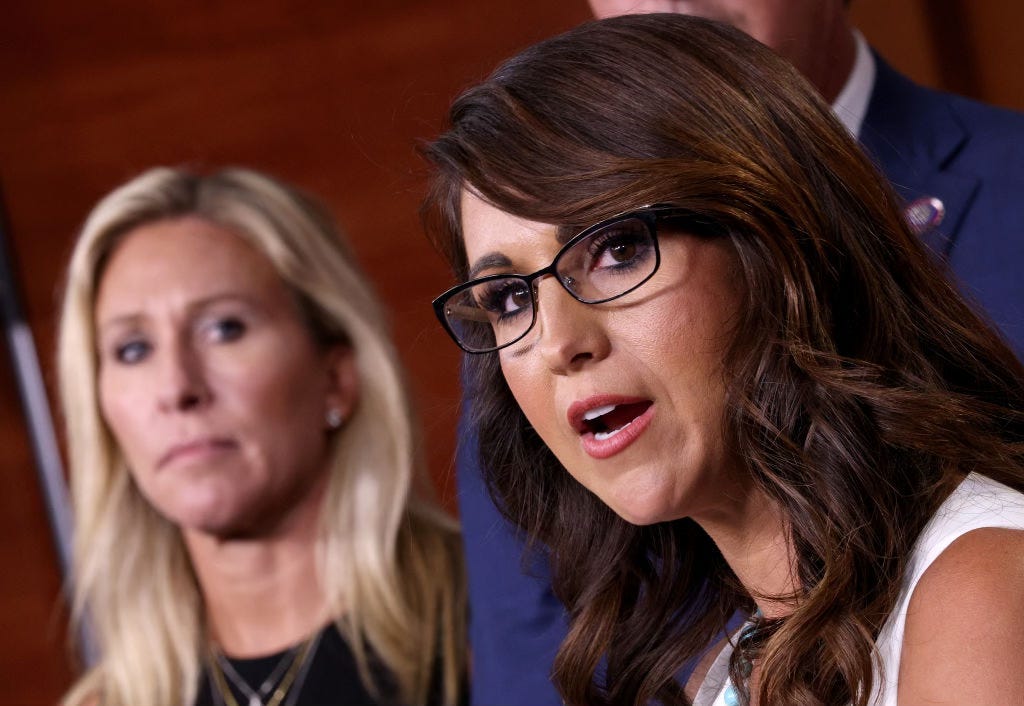
And when the ketchup hits the fan, the MAGA movement may suddenly appear far more fragmented and fractious than it does this week. You can already see the cracks. Two towering ignoramuses like Marjorie Taylor Greene and Lauren Boebert should be BFFs, but they despise each other—the only policy of theirs I agree with.
If things really go south, expect MAGA Republicans to devour each other as hungrily as the worm who feasted on RFK Jr.’s brain—and that, my friends, will be worth binge-watching. I’m stocking up on popcorn now before Trumpflation makes it unaffordable.
Marjorie Taylor Greene (L), wishing a space laser would strike Lauren Boebert (R). (Win McNamee/Getty Images)
One parting thought. Post-election, the mainstream media’s hyperbolic reassessment of Trump—apparently, he’s now a political genius in a league with Talleyrand and Metternich—has been nauseating. It’s also insanely short-sighted. Again, a look at the not-so-distant past is instructive.
In 1984, after Reagan romped to victory with 59 percent of the popular vote and 525 electoral votes, Reaganism was universally declared an unstoppable juggernaut. But only two years later, in the 1986 midterms, Democrats proved the pundits wrong: they regained control of both the House and Senate for the first time since 1980. Those majorities enabled them to slam the brakes on Ronnie’s right-wing agenda, block the Supreme Court nomination of Robert Bork, and investigate Iran-Contra.
The lesson of the 1986 midterms is clear: the game’s far from over and there’s everything to play for. If we want to stem the tide of autocracy and kleptocracy, restore women’s rights and protect the most vulnerable, we don’t have the luxury of despair. The work starts now.
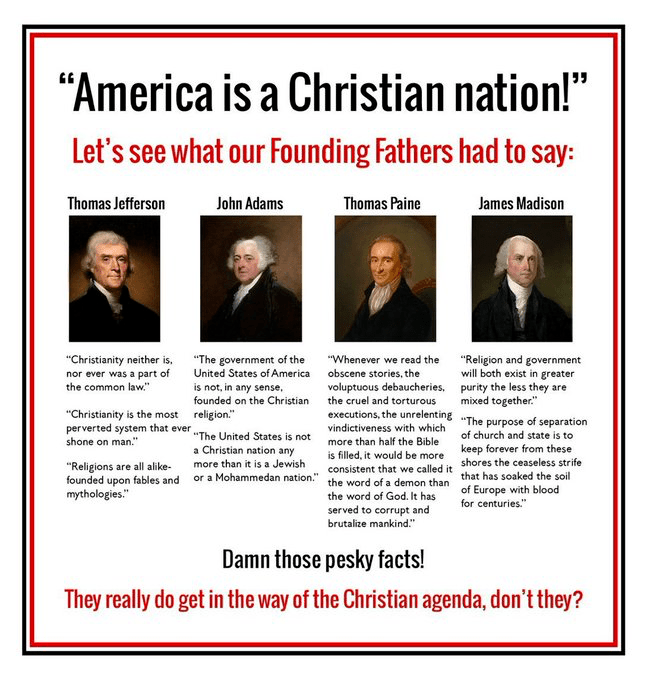
The Founding Fathers went to great lengths to separate church and state. They knew the history of religious wars in Europe, and they wanted the new nation to be free of such rivalries. They inserted into the Constitution the clear mandate that there would be no religious test to hold office. They added in the First Amendment to the institution that Congress was not allowed to establish a state religion and guaranteed freedom to practice one’s own religion.
Someone created this handy compilation of quotes from some of our most prominent men of the Founding era:
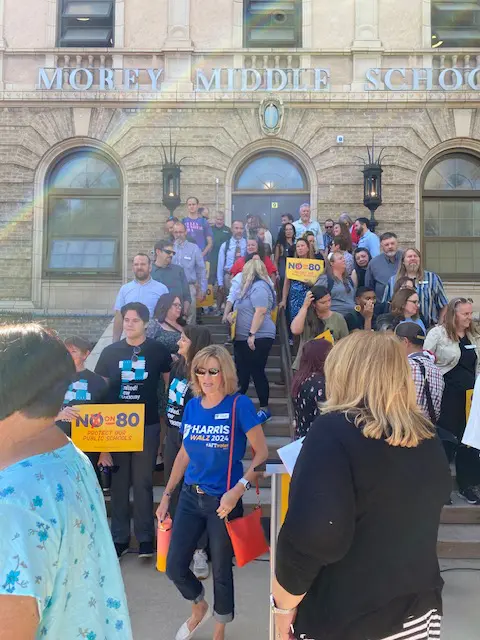
Colorado voters, beware! On the November 5 ballot: an amendment to the State Constitution to protect school choice.
If you want to support public schools and a raid on the state’s treasury by privatizers, defeat it!
This proposed amendment is weird. Ever since the founding of this nation, states have had explicit pledges in their constitution to protect public schools, open to all. Colorado’s state Constitution includes such language as well as language explicitly rejecting public funding for religious schools.
Article 9, Section 2 of the Constitution says:
Section 2. Establishment and maintenance of public schools. The general assembly shall, as soon as practicable, provide for the establishment and maintenance of a thorough and uniform system of free public schools throughout the state, wherein all residents of the state, between the ages of six and twenty-one years, may be educated gratuitously.
Article 8, Section 7 of the Constitution says:
Section 7. Aid to private schools, churches, sectarian purpose, forbidden. Neither the general assembly, nor any county, city, town, township, school district or other public corporation, shall ever make any appropriation, or pay from any public fund or moneys whatever, anything in aid of any church or sectarian society, or for any sectarian purpose, or to help support or sustain any school, academy, seminary, college, university or other literary or scientific institution, controlled by any church or sectarian denomination whatsoever; nor shall any grant or donation of land, money or other personal property, ever be made by the state, or any such public corporation to any church, or for any sectarian purpose.
Now, the privatizers want to cancel that language and replace it with language chartering what was previously forbidden.
On November 5, 2024, Colorado voters will weigh in on a hot topic in education today: school choice. Amendment 80 would make the concept of “school choice” a guaranteed right in the Colorado constitution. The text of the amendment reads as follows:
(1) PURPOSE AND FINDINGS. THE PEOPLE OF THE STATE OF COLORADO HEREBY FIND AND DECLARE THAT ALL CHILDREN HAVE THE RIGHT TO EQUAL OPPORTUNITY TO ACCESS A QUALITY EDUCATION; THAT PARENTS HAVE THE RIGHT TO DIRECT THE EDUCATION OF THEIR CHILDREN; AND THAT SCHOOL CHOICE INCLUDES NEIGHBORHOOD, CHARTER, PRIVATE, AND HOME SCHOOLS, OPEN ENROLLMENT OPTIONS, AND FUTURE INNOVATIONS IN EDUCATION. (2) EACH K-12 CHILD HAS THE RIGHT TO SCHOOL CHOICE.
According to University of Southern California Professor Guilbert Hentschke, “school choice has become a catch-all label describing many different programs that offer students and their families alternatives to publicly provided schools.” Since school choice covers many options, it can be confusing, and it is often the “subject of fierce debate in various state legislatures across the United States.” The critical distinction to make regarding school choice is often whether it affects public or private schools.
School choice has been the mantra for voucher-systems currently enacted in at least twenty states. School choice with voucher-type legislation entails using taxpayer dollars for education savings accounts, opportunity scholarships, tax credits, or actual vouchers so families can choose any type of schooling for their child — private, public or home schooling. This idea represents an emphasis on “funding students instead of funding school systems.”
The focus on school choice has resulted in increased enrollment in charter schools, private schools, and home schooling. At the same time, the school choice movement has also created instability, competition, ideological curricula, resource inequities, increased segregation, loss of community, and reduced funding for public neighborhood schools. In Colorado, of all eligible school-age children, about 76% attend public schools, 15% attend charter schools, 8 percent are in private schools, and 1% are homeschooled.
Advance Colorado is the conservative think tank organization that developed the language for Amendment 80, and they coordinated the expensive signature gathering to secure approval for the measure, originally titled Initiative 138. The backers acknowledge that parents already have the right in state statute to “send their kids to a neighborhood school, charter school, private school, home school, or across district lines.”
Advance Colorado’s solution to the “problem” of legislators promoting charter accountability is to put “the right to school choice in the Colorado Constitution” which they assert will give school choice “legal advantages a normal statute does not have.” Over fifty highly paid lobbyists were assigned to kill the charter accountability bill which was publicly opposed by Governor Polis, and was defeated in the House committee.
Even though Advance Colorado states its goal is to protect the charter schools from future legislative interference, Amendment 80 encompasses “private and home schooling” options. Including “private schools as a guaranteed right” is a plan promulgated by Americans for Prosperity and other conservative think tanks in several red states where voucher bills have been passed or expanded. Fields said he thinks “parents should be in charge of education,” adding “I think it’s easier when they have resources to send their kid to the school that they want to.”
Colorado State board of education members Lisa Escárcega and Kathy Plomer wrote in a September 11 op-ed that Amendment 80 is “not just about school choice.” They cautioned that “Amendment 80, brought by wealthy, in and out-of-state organizations, is part of a nationally coordinated master plan to go around voters in states where voucher proponents have been unsuccessful in passing state voucher laws.” They pointed out that in Colorado, “voters turned down three education voucher ballot initiatives in the 1990s.Voucher and private school proponents then tried the legislative route. The Colorado legislature has turned down any type of voucher or education savings account 18 times just since 2016.” While the amendment doesn’t mention vouchers, the state board members expressed their concern that “If parents have a right to send their children to private schools, then shouldn’t the state pay for it?”
Using public taxpayer dollars for children to attend private schools or for home schooling is not legal in Colorado, nor is it currently popular. (They can get some indirect support.) Kevin Welner of the National Education Policy Center stated that “it would be hard to persuade voters or politicians that Colorado should join the ranks of states that provide taxpayer subsidies for private schools or homeschooling.”
Even though Fields insists this amendment “is not paving the way for a voucher program in Colorado,” the far-right conservative groups providing the money to promote Amendment 80 have tried to enact vouchers in Colorado for years.
Vouchers are not necessarily an effective system to improve student learning and according to recent research, they can hinder state budgets significantly. Josh Cowen, senior fellow at the Education Law Center, pointed to decades of evidence showing private school vouchers have led to some of the steepest declines in student achievement on record. He added that measures similar to Amendment 80 passed in Arizona, Florida and Ohio have led to serious budget cuts.
Who is funding this effort to enshrine “school choice” in the state constitution?
In an op-ed about Advance Colorado last year, Colorado Newsline editor Quentin Young wrote that “Coloradans don’t know who’s supplying its money or their true motivations, because nonprofits don’t have to disclose their donors.” Advance Colorado is the same “dark money group” that gathered signatures for Initiative 108, which would have forced over $3 billion in cuts to services to citizens.
Advance Colorado started as “Unite for Colorado” in 2019, which bankrolled almost every major Republican effort in Colorado in 2020. Unite for Colorado spent over $17 million in 2020 on Republican candidates, and they have “become the most important fundraising entity for conservatives and for Republicans,” said Dick Wadhams, a former chairman of the Colorado GOP. Unite for Colorado changed its name to Advance Colorado Action in 2021 due to questionable conflicts over its spending practices, which are still in litigation.
As a “dark money group,” Advance Colorado receives grants from many sources, most of which are unknown, yet there is evidence that connects Advance Colorado to several conservative organizations. There are also reports that tie the group to Phillip Anschutz, Colorado’s richest billionaire. According to Cause IQ, between 2020-2023, over $28 million was funneled to Unite Colorado/Advance Colorado from the Colorado Stronger Alliance.
Colorado Dawn was formed in 2021 to “support organizations who further the efforts to educate the public about western values and economics,” and it has received over $3 million from Unite Colorado (Advance Colorado). Tax records from the Colorado Dawn’s 2022 990’s list state Board of Education member Steve Durham as chairman, Senator Paul Lundeen as Vice-chairman, and Michael Fields as Treasurer. Lundeen announced in 2022 his hopes that Colorado would enact a voucher program after the Supreme Court “cleared the way for public dollars in a Maine tuition assistance program to flow to private religious schools.” The Colorado Secretary of State’s office indicates that Colorado Dawn spent over $1.3 million to collect signatures for Amendment 80.
On Sept 13, 2024, the CEA announced its opposition to Amendment 80 at a press conference in Denver. A coalition of various representatives from across the state, the National Education Association, and the ACLU described their main reasons for opposing Amendment 80.
The speakers at the press conference emphasized that the amendment is unnecessary because school choice is already protected in law and has been for 30 years. In addition, they stated that the amendment opens the door to taking money from public schools to fund private schools. Speakers stressed that funding private schools would drain money away from rural public schools, private schools pose significant civil rights concerns, and they don’t belong in the Constitution.
In interviews with Chalkbeat, several education experts weighed in on the wording in Amendment 80, indicating it could create years of “litigation” order to interpret the amendment’s misleading language, which Kristi Burton Brown also acknowledged in her interview with KOA radio.
Currently, the following groups are opposing the measure: ACLU of Colorado, AFT Colorado, Colorado Fiscal Institute, CEA, The Colorado Association of School Executives (CASE), AFSCME, Advocates for Public Education Policy, Business and Professional Women of Colorado, Colorado Immigrant Rights Coalition, League of Women Voters Colorado, Soul 2 Soul Sisters, Bell Policy Center, Colorado PTA, One Colorado, United for a New Economy, Colorado Democratic Party, American Association of University Women, Colorado WINS, Colorado AFL-CIO, Stand for Children, and New Era Colorado Action Fund.
Colorado voters will need to decide which rationale they support regarding this school choice amendment. Will they agree with Advance Colorado that a constitutional amendment is necessary to ensure that the legislature will not update current charter school laws? Or will they believe that Colorado does not need to go the route of other states and create a pathway to use public funding for private and home schools?
************************************
Mike DeGuire, Ph.D., has been a teacher, district level reading coordinator, and a principal in the Denver metro area for most of his education career.
As a historian of forced population movements and as an American, I don’t think we are taking the consequences of the Trump-Vance deportation plan seriously enough. The reality will be much more personal and awful, and the politics more transformative and durable, than we might think.
I will write this up soon; but I was moved to do a recording by the urgency of this, and by the desire to catch the end of Hispanic Heritage Month.
Please listen and please share.
You might find it useful to read my thoughts about the thousands or tens of thousands of detention camps that would be needed in every state.