Archives for category: Higher Education

In his epic battle to punish the nation’s most prestigious university, Trump claimed that Harvard is teaching remedial math. That was his way of saying that its standards of admission are very low because Harvard wants to recruit unqualified nonwhite students.

Trump has refused to release his own academic record but his public statements indicate that he is in no position to tell Harvard whom to admit or what to teach.

Only 3.6% of the students who applied to Harvard last year were admitted.

The Boston Globe took a close look at the course that Trump–the stable genius–calls “remedial.”

A star student at her small Alabama high school, Kyra Richardson graduated confident in her academic prowess in all but one subject: math.

By the time she arrived at Harvard in the fall of 2024, it had been more than 12 months since Richardson‘s last math class. Even though she passed a college-level AP calculus course as a high school junior, Richardson said it felt more like she was memorizing formulas than truly understanding the concepts behind calculus.

So when it came time for her to begin fulfilling the math requirement associated with Harvard’s pre-medical track, the university recommended (and Richardson agreed) she should take an intro-level calculus course called Math MA.

Even with her previous calculus experience, she said, the Harvard course was far from an easy A. “I’m glad that I took a class that pushed me,” Richardson said.

In recent months, amid the White House’s ongoing battle with Harvard, the Trump administration has used that class to questionthe university’s academic rigor. In what has become a familiar refrain, Education Secretary Linda McMahonJosh Gruenbaum, a top US General Services Administration official, and President Trump himself have all labeled a modified version of the calculus course Richardson completed — known as MA5 — “remedial math.” 

“I want Harvard to be great again,” Trump said in the Oval Office last month. “Harvard announced two weeks ago that they’re going to teach remedial mathematics. Remedial, meaning they’re going to teach low grade mathematics like two plus two is four. How did these people get into Harvard if they can’t do basic mathematics?”

Richardson said she laughed when she heard the remedial math comment because “MA5 is the exact same class [as MA]. It just meets five times a week” as opposed to four. 

According to an online course description of MA5, the extra day of instruction time “will target foundational skills in algebra, geometry, and quantitative reasoning that will help you unlock success in Math MA.” The homework, exams, and grading structure of MA5 are the same as MA, a course Harvard has offered for decades. Even MA5’s format is not entirely new. Five days of instruction was previously required for all students taking Math MA in 2018.

“If you look at academic support and a college trying to help their students, and you think that’s unnecessary or it’s embarrassing that they have to provide that kind of support, then it’s coming from a place of ignorance,” said Richardson. “You have no understanding of how, not just college, but how learning works. You can’t learn without help.”

All Harvard freshmen take a placement exam in mathematics prior to their arrival on campus. Based on how they score, the university suggests which course they should be placed into. Math MA5, MA, and its companion course, MB, make up Harvard’s most basic introductory calculus courses known as the M series. MA5 was introduced last year by Harvard to combat pandemic learning losses, which saw students show up to campus with gaps in their math knowledge, especially in early high school courses like algebra, as a result of virtual learning. 

“When this first came out about us teaching remedial math, I was like, ‘Well, this is news to me and I wouldn’t even know how to do it,’” said Harvard’s director of introductory math Brendan Kelly. “Thinking about how to explain addition to somebody is an expertise that your elementary school teachers and middle school teachers have. … We focus on much more advanced mathematics.”

Only 20 students took MA5 this past academic year according to Kelly. The course was taught across two sections, each with 10 students, Kelly said, all of whom have declared majors like economics or biology that necessitate a strong foundation in calculus…

Remedial math courses in higher education are typically defined as “non credit bearing courses that cover middle school and high school content below that of college algebra,” said Chris Rasmussen, a professor of mathematics at San Diego State University. “So we’re talking fractions or some basic algebraic manipulation.” Rasmussen — who was part of a team of outside professors that recently conducted a full review of Harvard’s math department — said “in no way is MA5 a remedial math course. It’s a rigorous calculus course.”

The article includes a PDF with the course syllabus. How many members of Congress could pass it? Not many. Certainly not Trump or Secretary McMahon.

Governor Ron DeSantis has done everything possible to destroy education in Florida. He apparently hates public schools. He pushed through an expansion of vouchers that provides a subsidy to every student in the state, no matter if the family is rich or poor. Of course, most of those using the voucher never attended public schools. Most vouchers go to students in religious schools. Florida currently spends $4 billion annually on vouchers, a sum sure to increase.

Bad as public K-12 education is, the state’s public higher education system is in worse shape. DeSantis has placed political cronies in charge of every state university. He took charge of tiny New College (700 students) because he was offended that Florida had one progressive institution of higher education where students were encouraged not to conform. DeSantis replaced the board with conservatives who put a political extremist in President. What was once a haven for free-thinking students was transformed into a school for jocks and business majors.

The editorial board of the Sun-Sentinel summarized DeSantis’s record of using higher education as patronage for political cronies:

When Gov. Ron DeSantis won his landslide re-election in 2022, a half-fawning and half-fearful Florida Legislature gave him whatever he wanted.

The Harvard graduate could have used that power to burnish Florida’s celebrated universities. He could have chosen the best and brightest to lead schools already among the nation’s best. He could have been the education governor.

That — not a bellyflopping bid for the White House — could have cemented his legacy.

Instead, DeSantis has earned a doctorate in cronyism. He’ll be remembered as the governor who did everything in his power to erode higher education and independent thought. He puts politics above merit and qualifications, with sham “searches” and secret deals.

College and university campuses are now soft-landing patronage pads for Republican allies, at sky-high salaries.

Former House Speaker Richard Corcoran was installed as president of New College in Sarasota. Another politician, former House Majority Leader Adam Hasner, was handed the FAU presidency. A run-of-the-mill former legislator, Fred Hawkins, won the presidency of a state college in Avon Park despite lacking academic qualifications.

Former Lt. Gov. Jeanette Nuñez is now president of Florida International University. Former U.S. Sen. Ben Sasse of Nebraska was given the prestigious UF presidency, then flamed out amid reports of over-the-top spending.

It’s no surprise, then, that Education Commissioner Manny Diaz, a former Republican legislator from Hialeah who oversees state colleges and K-12 education, will slide into the presidency of the University of West Florida in Pensacola.

For DeSantis and Diaz, no university is too big and no kindergarten picture book is too small to escape being recast in the governor’s philosophy.

Step 1: Stack the board

First, DeSantis stacked UWF’s board of trustees. Then, newly appointed trustee Zach Smith quickly made clear that UWF president Martha Saunders was unwelcome.

Smith, a Heritage Foundation fellow, had to reach back to six years ago to find even a speck of mud to throw: Two student-organized drag shows in 2019; social media messaging about a Black Lives Matter co-founder and a book, “How to be an Antiracist,” once recommended by university librarians.

It’s true that best-seller is full of provocative opinions. But so is Smith’s book, “Rogue Prosecutors,” which pushes dark conspiracies about prosecutors corrupted by a wealthy Jew.

That did not stop his nomination to the UWF board by DeSantis, who only last year declared war on campus antisemitism amid great fanfare.

The widely popular Saunders saw the writing on the wall, and she resigned.

A farcical scene

That board meeting was an ambush, said trustee Alonzie Scott. The next one was a farce.

Without a job posting or a search, Diaz’s name alone surfaced as a replacement. Just as quickly, a special meeting was called by UWF trustees. There would be no search for a temporary president and no effort to pick an interim leader from the university.

There was only a perfunctory vote to install Diaz. Then, farce upon farce, the board voted with a straight face to begin looking for a permanent replacement for Diaz.

Barring a political earthquake, that will be Diaz. As former Pensacola mayor and UWF alum Jerry Maygarden said at the meeting, what serious candidate would apply for a job that smacks of a done deal?

Even Diaz’s roots defy all logic.

UWF’s strength is its strong community support among residents and businesses, including Republican leaders. Diaz’s Miami-Dade home is a 10-hour drive, 700 miles and culturally worlds apart from Escambia County in “Lower Alabama.”

None of this is about rescuing students who feel intimidated and indoctrinated.

After all, a state-mandated 2022 Intellectual Freedom and Viewpoint Diversity report found that a majority of UWF students surveyed felt the school provided them the freedom to express their own opinions. Half said they had no idea if their professors were liberal or conservative.

New College 2.0

Never mind. In April, DeSantis told UWF to “buckle up,” announcing he would do for them what he did for New College.

It’s hard to see the success story in New College since the governor declared war on it. DeSantis’ hostile takeover of the tiny liberal arts college has devolved into a money pit: The state’s cost for each New College student shot to more than $90,000. Other state universities average roughly $8,000.

Last month, New College and the University of South Florida were found to be secretly working on a deal to “transfer” USF’s Sarasota-Manatee campus to New College. It’s dead for the moment. Community leaders, kept in the dark as usual, demand answers.

Meanwhile, USF has become the latest fertile field for DeSantis to reward his friends. USF’s president said she will resign, creating yet another job opportunity for a like-minded crony.

The Sun Sentinel Editorial Board consists of Opinion Editor Steve Bousquet, Deputy Opinion Editor Dan Sweeney, editorial writers Pat Beall and Martin Dyckman, and Executive Editor Gretchen Day-Bryant. To contact us, email at letters@sun-sentinel.com.

Trump is a petty man who is filled with rage, grievance, and a passion for retribution. His current target is Harvard University because the nation’s most prestigious university told him no. Harvard’s President Alan Garber said it would not allow the federal government to control its curriculum, its admissions, and its hiring policies. No.

Every Cabinet department has pulled research grants to Harvard. Now he warns he might turn the billions that were going to medical and scientific research and hand it over to trade schools.

He would rather stop researchers who are trying to find cures for cancer, tuberculosis, Alzheimer’s, multiple sclerosis, and other diseases than back down on his efforts to stifle academic freedom and his vendetta against Harvard.

I don’t know about you, but I would rather see the federal government fund the search for a cure for MS than withdraw the funding. If he wants to fund trade schools, why should he do so at the expense of crucial research?

He wrote on Truth Social yesterday:

“I am considering taking Three Billion Dollars of Grant Money away from a very antisemitic Harvard, and giving it to TRADE SCHOOLS all across our land,” Trump said in a post on social media. “What a great investment that would be for the USA, and so badly needed!!!”

Meanwhile, Trump dreamed up another way to harass Harvard during the hours when he couldn’t get to sleep. He demanded that Harvard give him a list containing the names and countries of origin of all its foreign students. Harvard has nearly 7,000 foreign students. Why? What will he do with those names? Will he say they are spies and try again to expel them? Funny thing is he already has all their names and countries. They were registered when they applied for a visa. It’s all a campaign of endless vengeance by a petty, bitter man.

The American Academy of Arts and Sciences is the most distinguished scholarly organization in the nation. It is dedicated to the advancement of the arts and sciences. It is decidedly nonpartisan. I was elected to membership many years ago. AAAS rarely issues a statement. Its board did so in April because of unprecedented attacks on higher education, scholarly independence, and the rule of law.

A statement from the Board of Directors of the American Academy of Arts & Sciences. 
Approved April 2025. 

Since its founding in 1780, the AmericanAcademy of Arts and Sciences has sought “to cultivate every art and science which may tend to advance the interest, honor, dignity, and happiness of a free, independent, and virtuouspeople.” We do this by celebrating excellence in every field of human endeavor and by supporting the unfettered pursuit of knowledge and its application to the common good.

The Academy fosters nonpartisan, deliberative discourse on pressing issues facing our communities in the United States and the world.Our founders were also the founders of our nation. From them, we inherit a deep commitment to the practice of democratic self-governance. Our constitutional democracy has been imperfect, but almost 250 years since its inception, it remains an inspiration to peoplenear and far. Ours is a great nation because ofour system of checks and balances, separation of powers, individual rights, and an independent judiciary — as the Academy’s founder JohnAdams put it, “a government of laws, not of men.” And we are a great nation because we haveinvested in the arts and sciences while protecting the freedom that enables them to flourish.

These values are under serious threat today.Every president of the United States has the prerogative to set new priorities and agendas; nopublic or private institution is above criticism or calls for reform; and no reasoned arguments, from the left or the right, should be silenced. But current developments, in their pace, scale, and hostility toward institutions dedicated to knowledge and the pursuit of truth, have little precedent in our modern history.

We oppose reckless funding cuts and restrictions that imperil the research enterprise of our universities, hospitals, and laboratories, which contribute enormously to our prosperity, health, and national security. We condemn efforts to censor our scholarly and cultural institutions, to curtail freedom of the press, and to purge inquiry or ideas that challenge prevailing policies. We vigorously support the independence of the judiciary and the legal profession, and opposeactions and threats intended to erode thatindependence and, in turn, the rule of law.

In this time of challenge, we cherish theseprinciples and stand resilient against efforts to undermine them. The Academy will continue to urge public support for the arts and sciences, and also work to safeguard the conditions of freedom necessary for novel discoveries, creative expression, and truth-seeking in all its forms. We join a rising chorus of organizations and individuals determined to invigorate the democratic ideals of our republic and its constitutional values, and prevent our nation from sliding toward autocracy. 

In the coming months and years, the Academy will rededicate itself to studying, building, and amplifying the practices of constitutional democracy in their local and national forms, with particular focus on its pillars of freedom of expression and the rule of law. We call on all citizens to help fortify a civic culture unwavering in its commitment to our founding principles.

I spent this past weekend at my sixty-fifth reunion at Wellesley College. Since I graduated in 1960, I have never missed one. Part of my faithfulness is grounded in nostalgia, in a chance to relive a wonderful part of my life. The four years at Wellesley were transformative, and today my closest friends are classmates.

The high point of the weekend is the parade of alumnae on the last day. The youngest cohort goes first, marching about 3/4 of a mile from one end of the campus to the center, called Alumnae Hall. As each group reaches its destination, it stops and lines the road. Then along comes the next group of graduates, five years older. Eventually the road is lined with alumnae from different cohorts, with the oldest ones marching last. That was my group, about 50 women in their mid-80s. The group behind us was the class of 1955, mostly 92 years old, riding in antique Fords, Model A.

1931 Model A Ford
1931 Model A Ford
1931 Model A Ford
1931 Model A Ford

Since we were the last grads standing, we marched past all the younger groups, and they cheered us vigorously, while we applauded them.

What was striking was to see the demographic changes over time. Our class was all white, though we did have a few Asian students. We did have one Puerto Rican in our class; her father was the governor of the island.

The classes of 1965 and 1970 had a few nonwhite faces.

Starting with the graduates of 1975, the numbers of African American, Hispanic, and Asian students noticeably increased. Every class from that point was markedly diverse.

I have to say it filled me with pride to see how my Alma Mater had changed.

An example: when I arrived at our lodgings, there were students to help us settle in. A beautiful and vibrant young woman brought my luggage to the room. I asked her where she was from. “Rwanda,” she said. “Do you like Wellesley?” She replied, “I love it!” She is majoring in biochemistry and plans to be a medical doctor and to return to Rwanda. Again, I was proud of how my college was changing the world for the better.

But there is another personal note that I wanted to share with you.

In late February, I went for my annual mammogram. The test spotted an anomaly. Several mammograms and a sonogram later, the doctor told me I had breast cancer. In April, I had surgery and the cancer was removed. But the surgeon reported that she didn’t get it all, so I had a second surgery. The pathologist decided that it was all out. None of it was painful.

But that’s not the end of the story. I start radiation on June 2, which will be five treatments in five days. Then a daily pill, all for the purpose of ensuring that the cancer doesn’t return.

I am not worried or frightened. I’m taking it all a day at a time, knowing that my case was caught early and that I have excellent doctors.

Frankly, I am truly worried about my beloved dog Mitzi. She was diagnosed with cancer in 2023, we took her to an oncologist, he put her on a drug that worked, and in June 2024, he declared her cancer-free. But a few weeks ago, we noticed that something bad was happening to her skull. The oncologist said she apparently has a trigeminal nerve sheath tumor. Her head, on the right side, is noticeably recessed. That is, it’s caved in above her eye.

I am much more worried about Mitzi than about myself. I will be fine. She won’t be. There is no treatment for her medical problem. So we intend to love her, spoil her, make every day a good day for her.

I love this sweet dog
When Mitzi met Martha Stewart in Greenport. Mitzi was unimpressed.
A beauty

William Kristol was a leading figure in the conservative movement. His father Irving Kristol was renowned as the godfather of neoconservatism. Bill was the editor of the Weekly Standard for many years. But because he is a principled conservative, he loathes what Trump is doing to our nation. He writes at The Bulwark, my favorite Never-Trump blog.

What’s happening is not normal, he writes:

If the Trump administration’s sudden assault on thousands of foreign students legally studying at Harvard seems unprecedented, it’s because it is. If the abrupt abrogation of temporary protected status for hundreds of thousands of Venezuelans legally living and working in the United States seems unprecedented, it’s because it is. If the sudden arrests and deportations of law-abiding immigrants checking in as ordered at government offices seems unprecedented, it’s because it is. If the deportations of other immigrants without anything like due process and basically in defiance of court orders to prisons in third countries seems unprecedented, it’s because it is.

And if it all seems utterly stupid and terribly cruel and amazingly damaging to this country, it’s because it is.

But it turns out nativism is one hell of a drug. The Trump administration has ingested it in a big way, and it’s driving its dealers and users in the administration into a fanatical frenzy of destructive activity. And the Republican party and much of Conservatism Inc.—and too much of the country as a whole—is just watching it happen.

The United States has many problems. No one seriously thinks that Harvard’s certification to participate in the Student and Exchange Visitor Program is one of them. And the Department of Homeland Security’s announcement of the action against Harvard makes clear this isn’t just about Harvard: “Let this serve as a warning to all universities and academic institutions across the country.” Are our other institutions of higher education suffering from their ability to attract and enroll students from abroad, if they chose to do so? Are the rest of us?

No. And to the degree there are some discrete problems, nothing justifies this kind of action against Harvard. As Andrea Flores, a former DHS official, told the New York Times, “D.H.S. has never tried to reshape the student body of a university by revoking access to its vetting systems, and it is unique to target one institution over hundreds that it certifies every year.”

Similarly, what’s the justification for the Trump administration’s unprecedented sudden and early abrogation of temporary protected status for 350,000 Venezuelans who fled tyranny and are now living peacefully and working productively in this country? There is no broad unhappiness at their presence, no serious case that they are causing more harm than doing good. Nor for that matter is there a real argument that the presence of 20,000 Haitians living and working in Springfield, Ohio, is a problem that required first lies to denigrate them and now attempts to deport them.

And this week, the nominee to head U.S. Citizenship and Immigration Services said the Trump administration intends to end the well-established Optional Practical Training Program, which is the single largest channel for highly skilled immigrants to stay and work in the United States after finishing their education here. A study by a leading immigration scholar, Michael Clemens of George Mason University, finds that slashing that program would cause permanent losses to U.S. innovation, productivity, economic growth, and even job opportunities for native workers.

But here we are, with an administration where fantasy trumps reality, ideology trumps evidence, and demagoguery trumps decency. As the economist Dani Rodrik puts it, “Three things made the US a rich and powerful nation: the rule of law, its science & innovation system, and openness to foreign talent. Remarkable how Trump has taken a sledgehammer to all three. No enemy of this country could do more.”

Foreigners studying and working here are not damaging the United States. A virulently nativist administration is what’s damaging the United States. It’s doing so in ways from which it will be difficult to recover. Just as important, it’s doing so in ways that will be a permanent stain on this nation’s history.

The Trump administration upped the stakes in its vindictive campaign against Harvard University. It has canceled Harvard’s enrollment of international students.

Harvard refused to cave to the Trump administration’s demands to monitor its curriculum and its admissions and hiring policies. In response, the administration has suspended billions of federal dollars for medical and scientific research.

The New York Times reported:

The Trump administration on Thursday halted Harvard University’s ability to enroll international students, taking aim at a crucial funding source for the nation’s oldest and wealthiest college in a major escalation in the administration’s efforts to pressure the elite school to fall in line with the president’s agenda.

The administration notified Harvard about the decision after a back-and-forth in recent days over the legality of a sprawling records request as part of the Department of Homeland Security’s investigation, according to three people with knowledge of the negotiations. The people spoke on the condition of anonymity because they were not authorized to discuss the matter publicly.

The latest move is likely to prompt a second legal challenge from Harvard, according to one person familiar with the school’s thinking who insisted on anonymity to discuss private deliberations. The university sued the administration last month over the government’s attempt to impose changes to its curriculum, admissions policies and hiring practices.

“I am writing to inform you that effective immediately, Harvard University’s Student and Exchange Visitor Program certification is revoked,” according to a letter sent to the university by Kristi Noem, the homeland security secretary. A copy of the letter was obtained by The New York Times.

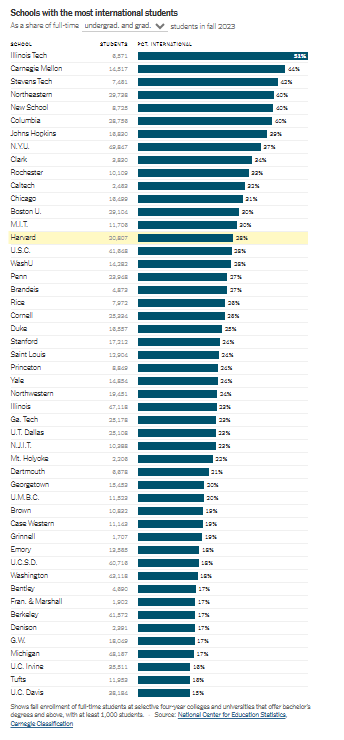
About 6,800 international students attended Harvard this year, or roughly 27 percent of the student body, according to university enrollment data. That is up from 19.7 percent in 2010.

The move is likely to have a significant effect on the university’s bottom line…

In a news release confirming the administration’s action, the Department of Homeland Security sent a stark message to Harvard’s international students: “This means Harvard can no longer enroll foreign students, and existing foreign students must transfer or lose their legal status.”

This message came from a Cabinet member who was asked in a hearing to define “habeas corpus,” and she said it meant that the President can deport anyone he wants to.

This action is a demonstration of Presidential tyranny. It should be swiftly reversed by the courts.

The Trump administration is determined to punish Harvard University for defiance of its efforts to take control of Harvard’s curriculum, admissions, and faculty hiring policies. Having already suspended $2.2 billion in research grants, the Trump administration expanded its attack on Harvard.

This level of petty vengefulness is unprecedented. Trump is turning his wrath upon Harvard and weaponizing the entire federal government to force the nation’s most prestigious institution of higher education to surrender.

The headline of the story: “A Bloodbath.”

Chris Serres at the Boston Globe reported this story:

In yet another escalation of its fight against higher education, the Trump administration has moved to terminate scores of research grants at Harvard University and its medical school, imperiling scores of research projects and potentially upending the futures of dozens of young scientists.

Harvard researchers who rely on federal grants to study cancer, infectious diseases and a range of other topics began receiving termination notices en masse on Thursday from a number of federal agencies, including the National Institutes of Health, the US Department of Defense and the US Department of Energy, according to emails shared with the Globe.

The termination notices threaten tens of millions of dollars in research funding for Harvard and affect a broad swath of the university’s scientific community, including graduate students and postdoctoral researchers who are dependent on federal funding for income.

While not unexpected, the wave of termination letters has roiled the Harvard campus in Cambridge and has left many young scientists anxious about their futures, while others are scrambling to find ways to replace the anticipated loss of federal funding.

Republicans are looking for ways to subsidize tax cuts for billionaires, and one likely target is endowments of colleges and universities. This move is an extension of Trump’s war against elite higher education, especially Harvard.

In Trump’s 2017 tax bill, he levied a tax of 1.4% on institutions of higher education with large endowments, relative to their enrollments. Current Republican thinking is a huge increase in that tax.

Be it noted that endowments fund scholarships for low-income students. The proposed taxes are mean-spirited and short-sighted.

Politico reported:

Endowments valued at $750,000 or less per student would be taxed at the current 1.4 percent rate, according to two of those people. Endowments valued between $750,000 to $1million per student would be taxed at a 10 percent rate and those greater than $1 million per student would be taxed at a 20 percent rate…

Under Trump’s 2017 tax bill, only universities with more than 500 students and endowment assets surpassing $500,000 per student face the current 1.4 percent tax. Ways and Means Republicans have considered both bumping up that tax rate significantly and applying it to a broader mix of U.S. colleges.

A menu of policies prepared by the House Budget Committee and obtained by POLITICO in January suggested bumping up the endowment tax to 14 percent. That would raise $10 billion over 10 years, according to the document.

One bill, introduced by Rep. Troy Nehls (R-Texas), would raise the excise tax on endowment profits up to 21 percent.

A colleague said recently to me that the abandonment of vocational education was one of the great errors in American education in the past generation. I recall when New York City had successful high schools that prepared students for vocations and careers that paid well. The concept of “college for all” undermined support for such schools, and most of them closed.

A few days ago, Randi Weingarten wrote an article in the New York Times endorsing CTE–career and technical education--a cause she has been supporting for years. CTE is an updated term for vocational education. One of the r big complaints about vocational education was that students were being trained to service obsolete machinery. CTE incorporates the latest technology into its curricula.

Isn’t it time to recognize that electricians, plumbers, nurses, computer technicians, auto mechanics, and other skilled occupations are needed as much and often paid more than those with a Ph.D.? To be clear, I admire those who spend years to acquire a doctorate in the liberal arts, but the reality today is that most college professors are underpaid adjuncts.

We should recognize that education is a lifelong endeavor. Everyone needs a strong foundation from K-12 in the skills of reading, writing, thinking, and using technology, as well as a solid grounding in mathematics, civics, history, the sciences, and the arts. Students should graduate high school ready for college or careers. They should be ready to make choices and able to change course, which many adults do.

Randi writes:

For years, America’s approach to education has been guided by an overly simplistic formula: 4+4 — the idea that students need four years of high school and four years of college to succeed in life.

Even with this prevailing emphasis on college, around 40 percent of high schoolers do not enroll in college upon graduating, and only 60 percent of students who enroll in college earn a degree or credential within eight years of high school graduation.

While college completion has positive effects — on health, lifetime earnings, civic engagement and even happiness — it’s increasingly clear that college for all should no longer be our North Star. It’s time to scale up successful programs that create multiple pathways for students so high school is a gateway to both college and career.

More than 80 percent of America’s young people attend public schools, and the challenges many students and their families face are well known. Chronic absenteeismworsened during the pandemic. For many reasons, the country’s lowest-performing students are being left behind. Cellphones and social media have helped fuel an epidemic of bullying, loneliness and mental health struggles among youth. Educators, who have less and less authority in their classrooms, are valiantly fighting those headwinds, too often with insufficient resources.

So far, President Trump’s response has been to order the dismantling of the Department of Education and to propose billions of dollars of cuts to K-12 education that will push our system of public schools closer to the breaking point.

Republican-led states are increasingly embracing school vouchers, which let parents spend public funds on private schools, despite evidence of the negative effect of vouchers on student achievement: Evaluations of vouchers in IndianaLouisianaOhio and Washington, D.C., show that these programs can cause drops in test scores. And vouchers divert vital funding that could and should go to public schools. Arizona is spending millions of dollars on vouchers for kids already attending private schools. Students in Cleveland’s public schools may lose up to $927 per pupil in education spending to vouchers each year.

I propose a different strategy: aligning high school to both college prep and in-demand vocational career pathways. Just as students who plan to go to college can get a head start through Advanced Placement programs, high schools, colleges and employers should work together to provide the relevant coursework to engage students in promising career opportunities.

I’m not suggesting reviving the old shop class, although there is value in aspects of that approach, including hands-on learning. We’ve got to shed the misperception some may still have of technical education as a dumping ground for students headed for low-skill, low-paying jobs.

I taught social studies and A.P. government in a career and technical education, or C.T.E., school. My students not only prepared for careers in health care such as nursing; they also had robust discussions about the Constitution and won national debate competitions. I have seen innovative programs throughout the country, which show that high schools — with work force partners — can prepare all students for a variety of careers and fulfilling lives whether they go on to four-year or two-year college or training for a variety of skilled trades and technical careers.

In April, I attended the opening of a C.T.E. high school, RioTECH, in Rio Rancho, N.M. RioTECH is a partnership between the public schools and a local community college, with support from industry partners and the local teachers union — an affiliate of the organization I lead, the American Federation of Teachers — giving students the opportunity to earn stackable credentials in high-demand skilled trades as well as tuition-free, dual-credit classes that count for both high school and college credit.

The Brooklyn STEAM Center is a public school at the Navy Yard that partners with businesses, public high schools and the local union, the United Federation of Teachers. Students there have access to internships and apprenticeships and the potential of full-time jobs with more than 500 businesses on site. Career pathways include cybersecurity, construction technology and computer-aided design and engineering.

In Newark, students at the Red Hawks Rising Teacher Academy can enter a no-cost, dual-enrollment program in partnership with Montclair State University, Newark Public Schools and the A.F.T. This high school experience with a high-quality teacher preparation program helps create a pipeline to educate, train and retain future teachers, and to diversify the teacher work force.

Last year, the A.F.T. and two affiliates began an advanced technology framework with Micron and the state of New York in 10 school districts, now expanding to districts in Michigan and Minnesota, with federal funding. In this program, high school students acquire technical and foundational skills, creating pathways to middle-class jobs in the microchip sector that often won’t require a four-year college degree.

More than 90 percent of students who concentrate in career and technical education graduate from high school, and about three-quarters of them continue their education after high schoolResearch shows that career and technical education has positive effects on students’ academic achievement, high school completion and college readiness…

Ensuring all students get a great public education takes resources, which is why Mr. Trump’s planned cuts are just plain wrong. The Senate passed a resolution this year “supporting the goals and ideals of ‘Career and Technical Education Month’”; a similar resolution is pending in the House. Now it’s time for Congress and the administration to offer tangible support for those goals in the federal budget.

Rather than undercutting the Education Department, or using the challenges that public schools face as a rationale to cut vital federal funding under the pretext of sending more authority to the states (which already have most of the authority for schools), why not support and scale practices, policies and programs that will make our schools more engaging and relevant to more students?