Archives for category: Funding

The federal government has to raise the ceiling on the debt or face a default on its bonds, which would set off a national and international crisis. Congress has raised the debt ceiling many times in the past, including three times during Trump’s term.

An extraordinary part of the national debt was generated during Trump’s four years in office, according to ProPublica, especially his 2017 tax cut for the 1% and corporations:

One of President Donald Trump’s lesser known but profoundly damaging legacies will be the explosive rise in the national debt that occurred on his watch. The financial burden that he’s inflicted on our government will wreak havoc for decades, saddling our kids and grandkids with debt….The growth in the annual deficit under Trump ranks as the third-biggest increase, relative to the size of the economy, of any U.S. presidential administration, according to a calculation by a leading Washington budget maven, Eugene Steuerle, co-founder of the Urban-Brookings Tax Policy Center. And unlike George W. Bush and Abraham Lincoln, who oversaw the larger relative increases in deficits, Trump did not launch two foreign conflicts or have to pay for a civil war.

Republicans do not want to raise the debt ceiling. President Biden challenged them to come up with their own plan. They did. It involves cuts of 22% to everything but Social Security, Medicare, and defense spending.

Dana Milbank wrote in the Washington Post:

Jen Kiggans had the haunted look of a woman about to walk the plank.

The first-term Republican from Virginia barely took her eyes off her text Wednesday as she read it aloud on the House floor. She tripped over words and used her fingers to keep her place on the page.
The anxiety was understandable. Like about 30 other House Republicans from vulnerable districts, she was about to vote in favor of the GOP’s plan to force spending cuts of about $4.8 trillion as the ransom to be paid for avoiding a default on the federal debt.

“I do have serious concerns with the provision of this legislation that repeals clean-energy investment tax credits, particularly for wind energy,” she read. “These credits have been very beneficial to my constituents, attracting significant investment and new manufacturing jobs for businesses in southeast Virginia.”

Directing a question to the Republicans’ chief deputy whip, Guy Reschenthaler (Pa.), she asked for “the gentleman’s assurance that I will be able to address these concerns as we move forward in these negotiations and advocate for the interests of my district.”

The gentleman offered no such assurance. “I support repealing these tax credits,” he replied, offering only the noncommittal promise to “continue to work with the gentlewoman from Virginia, just like we will with all members.”

Kiggans then cast her vote to abolish the clean-energy credits her constituents find so “beneficial.”
House GOP leaders are celebrating their ability to pass their debt plan, even though it has no chance of surviving the Senate nor President Biden’s veto pen. But the bill’s passage has achieved one thing that cannot be undone: It has put 217 House Republicans on record in favor of demolishing popular government services enjoyed by their constituents.

In Kiggans’s Virginia, the legislation she just backed would strip tax incentives that go to the likes of Dominion Energy, which is building a $9.8 billion offshore wind project in her district. She also voted to ax solar and electric-vehicle incentives for hundreds of thousands of Virginians, and tax breaks projected to bring $11.6 billion in clean-power investment to the commonwealth.

In addition, the bill she supported sets spending targets that require an immediate 22 percent cut to all “non-defense discretionary spending” — that’s border security, the FBI, airport security, air traffic control, highways, agriculture programs, veterans’ health programs, food stamps, Medicaid, medical research, national parks and much more. If they want to cut less than 22 percent in some of those areas, they’ll have to cut more than 22 percent in others.

According to an administration analysis of what the 22 percent cuts translate to, Kiggans is now on record supporting:


Shutting down at least two air traffic control towers in Virginia.


Jeopardizing outpatient medical care for 162,300 Virginia veterans.


Throwing up to 175,000 Virginians off food stamps and ending food assistance for another 25,000 through the Special Supplemental Nutrition Program Women, Infants and Children.


Cutting or ending Pell Grants for 162,900 Virginia college students.


Eliminating Head Start for 3,600 Virginia children and child care for another 1,300 children.


Adding at least two months to wait times for Virginia seniors seeking assistance with Social Security and Medicare.


Denying opioid treatment for more than 600 Virginians.


Ending 180 days of rail inspections per year and 1,350 fewer miles of track inspected.


Kicking 13,400 Virginia families off rental assistance.


Similar calculations can be made for the other 30 House Republicans targeted by Democrats in the 2024 elections who joined Kiggans in walking the plank. Since enactment of the clean-energy credits Republicans have now voted to repeal, for example, clean-energy projects worth some $198 billion and 77,261 jobs have moved forward in districts represented by Republicans, according to the advocacy group Climate Power…

Trump’s huge deficits funded tax cuts for the rich. Biden’s deficits are investments in the future and lifelines for struggling people.

The Republicans’ draconian plan with its deep cuts passed by one vote.

But this week, they jammed their giant, secretly negotiated debt-limit bill through the Rules Committee on a party-line vote — at 2:19 a.m. And they did it with a “deem-and-pass” rule.


Even then, after all the reversals and surrenders, the bill came within one vote of failing. The lawmaker who cast the final, deciding vote? Rep. George Santos (R-N.Y.).


How apt that this legislation, built on one broken promise after another, should be carried over the finish line by the world’s most famous liar.
Donna Ladd, a native Mississippian, founded the Mississippi Free Press three years ago to shine a bright light on the state’s politics, history, and culture. The MFP has grown into a journalistic force. I am excited to join its advisory board, because the force of sunlight can be so powerful. I want to share Donna Ladd’s last newsletter, introducing a new reporter—Torsheta Jackson—and describing some of their exciting plans for the future. This team wants to free Mississippi from the dead hand of the past. Read Donna’s letter and I think you will understand why I am so enthusiastic about the Mississippi Free Press.

Read our latest stories from mfp.ms. And please support our work: mfp.ms/donate. Thank you! Meet Torsheta Jackson!

Donna writes:

One of my favorite reporting trips ever was touring around Noxubee County with then-freelance writer Torsheta Jackson in the thick of the COVID-19 pandemic. Because she grew up in the East Mississippi county, over on the Alabama border, Torsheta was the tour guide, driving us around in her big truck I had to lift myself into. First, she pointed out where she grew up in Shuqualak (locally pronounced “Sugar-lock”), the child of educators. Along the way, she pointed out slabs where industry, grocery stores and schools used to stand before her hometown became a shell of its former self over the decades after forced integration in 1970.

We walked around the ruins that now dominate the little downtown and talked about poverty, neglect, white-flight cycles and disinvestment in the county settled by rich white planters—including Mississippi State University founder Stephen D. Lee’s family—and built by enslaved people. The county has always been majority-Black, but usually under white control, from newspapers, to industry, to local education decisions and resources. It was also the site of vicious white terrorism to keep it that way.

Click now to support MFP’s Mapping Mississippi systemic-reporting strategy covering the 82 counties of Mississippi.

In the county seat of Macon, Torsheta showed me the county’s only remaining grocery store—white-owned and too expensive in a region where hunger is far too rampant, she said. She then took me to see the library, which still has its gallows, where they used to hang people in front of crowds on the front lawn, now marketed as a tourist attraction. We looked straight out the front window of the library at the tall Confederate statue standing in front of the courthouse across the street in a town that is 82% Black. The Board of Supervisors voted in July 2020 to remove it; last I checked, it was still there as post-George Floyd anti-racism enthusiasm wanes.

Torsheta showed me the abandoned Central Academy, which the superintendent of the county public schools helped open in the 1960s, supported by state vouchers, becoming the seg academy’s headmaster. She drove me to all the now-boarded-up, or disappeared or repurposed, public schools that used to be in Noxubee (locally pronounced “Nock-shu-bee”) County before most white families fled either to C.A. or to the local Mennonite school, which also opened in 1970.

Torsheta and I spent hours in the “new” Noxubee County public school just north of Macon, talking to the principal and the school psychologist—both women she knew growing up there. We learned about the perpetual state of crisis that faces the district and its one remaining public-school system covering the entire county; district leadership was changing again that day, in fact. And, of course, we learned about the systemic challenges that face Black women and their families, in particular, in Noxubee County, from no broadband, to hunger, to mental health and more. Their honesty with us informed Torsheta’s award-winning installment of our “(In)equity and Resilience: Black Women, Systemic Barriers and COVID-19” cause-solutions journalism project. It is now the prototype of our statewide county-level Mapping Mississippi systemic-reporting strategy that we’re amping up by summer with Torsheta’s help and inspiration.

Not to mention, a new area of research opened up for me when I heard the school psychologist’s story about a mob of local white men killing a Black woman school principal to stop the education and advancement of Black children: white terrorism specifically deployed to keep Black children uneducated and, thus, inequity and white control in place for generations to come. They said what they were doing for white-supremacy perpetuity right in the local newspaper. It wasn’t a secret. They bragged about ugly mob race violence by county leaders.Make a recurring donation now monthly, quarterly or annually to support the systemic journalism of Torsheta Jackson and our other reporters. Become an MFP VIP Club member.

It was an eye-opening and powerful journey for us both. Torsheta would later say on MFP Live that, before that reporting experience, she had not understood fully how intentional barriers and discrimination caused the decline of her home county over the decades. After this journey into the past, she did.

It was also on that tour of Noxubee County that I decided that I wanted Torsheta as a full-time reporter to take her systemic journalism across the state and help me build our Education Equity Solutions Lab. This is a very different kind of education reporting than the partisan griping about schools and funding that we usually see in Mississippi. For me, what I called Project Torsheta started on that trip. With her years of teaching experience (19 as of now), her brilliance, her curiosity, her wit and her stunning work ethic, I knew Torsheta was the kind of reporter Mississippi needs and deserves covering education. She can show us like no one else how education’s use as a political tool hurts families, children and whole communities.

Fast forward a couple of years, and it’s happening. Report for America announced Wednesday that it is supporting Torsheta as our lead education-equity reporter to do this work, paying a chunk of her salary for the next two to three years. After two years of working together to figure out timing and resources, Torsheta and I—and our whole team—are ecstatic that our vision is happening. I cannot wait to develop this work with Torsheta, and it doesn’t hurt that we recently hired fantastic Business Manager Jared Norton to free me up for more journalism. Torsheta and I (and others) will soon be traveling the state together again, doing the systemic journalism we know can help improve this state for all of our people.

I’ll talk more soon about our second new reporter we announced this week. Heather Harrison of Copiah County is the vivacious and dogged outgoing editor of The Reflector at Mississippi State. I knew in our first conversation (and then confirmed in a team solution circle) that she is bringing the energy, passion and curiosity that it takes to succeed and thrive at the Mississippi Free Press. She’ll be our first regional full-time bureau reporter, remaining in Starkville to largely cover that region of the state and help us collaborate with the Starkville Daily News.

Needless to say, you readers are making all of this growth happen. We started with $50,000 and one full-time reporter just three years ago. You have helped create 17 good-paying jobs and pay for myriad freelancers, contractors and interns—most of them brilliant and engaged Mississippi natives staying in their home state to do the work. Our resources are mostly from readers. You get it, and you are intentionally helping us grow our team and our reach to more counties.

Please help keep us growing by giving what you can now at mfp.ms/donate. Remember, your recurring donations are paying for at least one reporter already, so every amount matters.

Donna Ladd, Editor and CEO

Helen Gym is a brilliant, eloquent progressive candidate for Mayor of Philadelphia. She is an activist and a member of the City Council. I enthusiastically endorse her candidacy. I have known her for a dozen years and am repeatedly impressed by her values, her energy, and her passion for justice. Philadelphia schools have suffered grievously due to budget cuts imposed by the state. A decade ago, two young children died because their schools had no nurse. Helen thinks that every school should have a nurse and counselors. In the suburbs, such services are taken for granted. But not in Philadelphia, where public schools and their students have been shortchanged for years.

Will Bunch is a columnist for the Philadelphia Inquirer, who has followed the mayoral race closely. He sums up the reasons why she is the right person at the right time. Her election would bring hope to Philadelphia. This election could be a turning point for this great but neglected city.

He writes:

Philly needs a bullhorn mayor to slice through decades of status quo baloney

In a crowded Philly mayoral race, Helen Gym is fighting for the city’s poor and neglected. No wonder status quo elites are so desperate to stop her.

Philadelphia City Councilmembers Helen Gym, Jamie Gauthier, and Kendra Brooks walk with protesters following the U.S. Supreme Court decision to overturn Roe v. Wade in June 2022. Steven M. Falk / MCT

It was one of those raw late April afternoons in Philadelphia where the weather in the far corner of Love Park — unrelentingly grey, windy, occasional drizzle — seemed to match the grim civic mood looming over the City Hall tower in the background. At the supposed 12:45 p.m. start time for this Helen-Gym-for-mayor campaign rally, just a few folks milled around and chatted with the candidate in her bright red coat, carrying a reusable Target shopping bag, and you briefly wonder if you got the time or place wrong.

Then, seemingly out of nowhere, a blue-clad army of about 50 supporters — young and old, Black, brown and white, including members of the teachers’ union that has endorsed Gym, carrying signs that read “The Wealth To Fix Our City Exists!” — crossed JFK Boulevard all at once, and it was showtime. Over the next half-hour, speakers from the various Jenga blocks of Philly’s shaky civil society reimagined the city as it could be. A librarian from South Philly spoke about the dream of reopening on the weekends as a community refuge. An instructor and union leader from the Community College of Philadelphia imagined the benefits of free tuition.

“When I say, “Moral!,” chanted emcee Elisa King, a minister and counselor at CCP, “you say, “Budget!’” — driving home the rally’s theme that City Hall needs to focus on restoring vital services, not more incremental tax cuts.

When the 55-year-old former city council member finally got the microphone, the spring sun had seared through the layer of clouds. Gym declared her idea of a moral budget “is not defined by the corporate-backed interests, the developers and the status-quo electeds, bureaucrats and wealthy individuals who have long tried to buy this campaign with their tired ideas and their technocratic solutions.” The crowd whooped. “Those candidates have played it safe all their lives.”

The only remaining progressive in a May 16 primary field whittled down to five or six major candidates defined her rivals’ ideas as “just too small for this moment. They’re talking about safety that’s only defined by policing. They’re talking about development only in terms defined by the tax cuts and those people who get to benefit. They manage crisis — we’re here to end them!” Almost on cue, a passing dump truck on the boulevard tooted its horn loudly in support.

It’s fitting that the race to pick the 100th mayor of America’s founding city is also arguably its most consequential in decades, perhaps since the divisive Frank Rizzo era. That’s because the coronavirus also attacked the civic immune system that had allowed the city’s leaders to ignore the warning symptoms of the nation’s highest rate of deep poverty and unacceptable schools housed in unsafe buildings while touting the surface glitz of Philadelphia’s comeback … for tourists, and handful of gentrifying neighborhoods. Now, a spike in gun violence and related dysfunction has put the nation’s sixth-biggest city at a crossroads.

I might be The Inquirer’s national columnist but I’ve watched this local election closely — not just because I work and pay taxes and ride the troubled subways here (or because my two adult offspring live here) but also because what Philadelphia voters decide in little more than two weeks will say a lot about how America is going to solve its urban problems, especially persistent poverty. In this (sort of) post-pandemic era, comparable cities such as Boston, Chicago, and L.A. have rejected old-school police-union fearmongering for young, progressive mayors who see how issues like attacking climate change or youth unemployment can bring real change.

It’s not at all clear yet whether Philadelphia has the courage or boldness to follow its sister cities down that fresh pathway. I’ve watched both televised debates and have been somewhat taken aback with how most of the major candidates have crafted a message around not new ideas but “leadership.” What they are really offering, in essence, is a pledge to restore some presence and personality to City Hall that’s been missing during the shockingly absent Jim Kenney administration, but with little evidence they’d change the status quo policies of minor tax cuts or FOP-endorsed policing that coincided with decline.

In the debates and on the campaign trail, Gym has set herself apart as the only candidate who fully grasps the root problems in the most desperate neighborhoods — and who wants to go big to actually address them. How many times can we hire more cops or return to “stop-and-frisk” policing with the same tired results? That’s why Gym is the leader in pushing for trained responders to replace cops on mental-health calls — hugely successful where it’s been tried — and is the only candidate who agrees with the majority of Philadelphians who twice elected Larry Krasner as DA, that some criminal-justice reforms were long overdue.

Elite critics of some of Gym’s bigger and bolder ideas — going all-out in fixing unsafe school buildings, or guaranteed employment for adults under 30 — call them unrealistic pie in the sky. Most everyday voters know what matters most about a political leaders is less about the budgetary small print and more about who and what they are willing to fight for. And in her seven years as an at-large city council member, Gym has fought for what cynics had written off as lost causes, and won a strikingly high percentage of the time.

A ”fair workweek” ordinance that mandates essential workers have predictable schedules. Long-overdue eviction protections for the city’s beleaguered tenants. A return to local control of the Philadelphia School District while fighting to restore school nurses and counselors. A push to get lead out of school drinking water. No wonder that after her first term on council, The Inquirer Editorial Board hailed her as “a savvy, passionate and progressive leader.”

Things are a lot different now that Gym is running for mayor. While she’s been endorsed by the influential Philadelphia Federation of Teachers and a panoply of other unions and progressive groups, many of the city’s elites — even some who’ve been somewhat supportive of her council work — seem dead-set on preventing her from running Philly. Some of that is with a budgetary magnifying glass, but much of it centers on attacking her personality and blocking her ideas. Yes, she changed her mind on charter schools after founding one — but who wouldn’t after watching them become a negative drain on public education? Of course it was a mistake to protest the Union League and go there just days later, but is that a big-enough reason to punish Gym — and the city — by voting for someone who doesn’t share your values?

“I think it’s about making things about individuals and reducing it to isolated incidences rather than looking at a track record that holds steady over time,” Gym told me Wednesday after her rally. “The way to marginalize real movements for change is to hyper-individualize faults within imperfect people. I mean, I’m not perfect — I make mistakes and all of that — but I think the difference with me is I have a 20-year-plus track record of standing alongside communities.”

One truism about politics is that a lot of times you can gauge a candidate by the enemies they make. The Chamber of Commerce crowd and their handmaidens aren’t fighting Gym because of her mistakes but because of the things that she gets right. There’s a reason that many of Philadelphia’s most essential yet underheard folks — the teachers and librarians and social workers — don’t just think that Gym is the best among a large field of candidates, but truly believe that her election in 2023 is a matter of civic life-or-death.

“She is rising to the moment, which is a moment of crisis for our city,” Stan Shapiro, vice-chair of Philly Neighborhood Networksand a former City Council staffer, told me before the rally. “It’s not a time for the status quo, for business as usual, for just keeping the lights on. There aren’t enough lights. There aren’t enough rec centers. There aren’t enough health centers.”

One of the other straw-man arguments from Gym’s critics centers on how she’s carried a bullhorn to protest in the streets on behalf of Philly’s kids, or its underserved people, or the moment when — the horror! — she was willing to get detained in Harrisburg to dramatize how state Republicans won’t invest in education. We’ve had decades of “conveners” and glad-handers on the second floor of City Hall with too little to show for it. It’s time to try a bullhorn mayor, a real fighter. In a race with many candidates, there is only one that truly matters.

Gary Rayno of InDepth NH is a reliable guide to education politics in New Hampshire. In this post, he describes the decisions that legislators must grapple with starting this week. New Hampshire public schools and public colleges have never been adequately funded, and the state has the misfortune of having a state commissioner who doesn’t care. He homeschooled his own children, and he doesn’t understand why the state pays for public schools.

He begins:

In New Hampshire, public education is a moving target.

It is a hodgepodge of activities and systems from pre-Kindergarten to its colleges and universities.

But the one unifying force along the spectrum is the state’s minuscule financial commitment.

The state’s contributions to public education puts it in line with states like Mississippi and Louisiana although its per capita wealth averages among the highest in the country.

One district has challenged the state in court, claiming that the state does not provide enough funding for an adequate education. State Commissioner Frank Edelblut doesn’t want any new money for public schools, but he’s quite willing to spend more on vouchers (so-called “education freedom accounts”.) The state contends that only the legislature—not the court—can determine funding for the schools.

To date the program is far more expensive than Edelblut advised lawmakers it would be, about $3.3 million this biennium, when the costs to date are well north of $20 million, much of that money paying tuition subsidies to parents whose children were in private and religious schools and homeschooling programs before the EFA program began.

The program was sold as allowing low-to-moderate income parents to find the best educational environment for their child if he or she did not adapt well to the public school setting.

Tuesday the Senate Education Committee will hear three bills that would allow more students to be eligible for the program, which Edelblut told lawmakers would cost $30 million in each year of the biennium.

House Bill 367 would increase the income threshold for a child to be eligible for the program by about $9,000 for a family of four by increasing the cut from 300 percent of the federal poverty level to 350 percent.

House Bill 464 would allow children to automatically qualify if they are in foster care, military families, homeless, and transients. The cost of the change has not been determined although the bill passed the House.

And House Bill 446 would require the organization administering the program to inform parents they will lose their federal special education rights under the Individuals with Disabilities Education Act if they participate in the program.

This is part of the voucher hoax. Children with special needs lose federal right to services if they switch to a voucher school, but most of these parents don’t know it.

The Senate Finance Committee will also have to decide if the House gave the University System of New Hampshire and the Community College System of New Hampshire, too much money, too little money or enough money.

The university system had hoped to finally return to the level of funding it had more than a decade ago, before the 2011-12 legislature cut it in half.

The House approved almost the $200 million the system received before the slashing, and added a little more so tuition could remain frozen and the Whittemore Center could be upgraded.

The community college system successfully fought off a plan by the governor to merge with the university system a biennium ago but continues to face the challenge of providing education in more technical fields while enrollment decreases particularly in the more traditional areas of instruction.

But the system has continued to freeze tuition like the university system in a state where the students have the highest college debt in the country.

New Hampshire’s education system is jumbled and in flux. One thing that could make things a little easier is additional money, but the only program with open-ended funding is the EFA and that could cost the state nearly $70 million a year if all the students in private and religious schools and homeschools decide to participate.

That is almost as much money a year the university system receives and more than the community college system receives.

Paul Bonner, retired career educator, debunks the “science of reading” prattle;

Then the New York Times published this…https://www.nytimes.com/2023/04/16/us/science-of-reading-literacy-parents.html

Ignorance about the circumstances that hinder student learning is pervasive among the national media. They report again and again on failed “one size fits all” remedies without understanding that these fail because they do not address the root cause of public school challenges: Poverty.

Advocacy for “The science of reading”, Lucy Caulkins, or whole language all miss the point. Until we are willing to change the instructional delivery system that allows for K-12 class sizes of 20-30+ students per class, a teaching professional day that does not allow meaningful classroom preparation except beyond the school day, equal high quality resources and facilities for all students, and an understanding that this hyper focus on reading fluency actually demonstrates low expectations for our students.

Perhaps the greatest inaccuracy on the NYTimes report is that somehow schools have not been engaged in this “Science of reading” rabbit hole.

The two large districts I served in were all in with massive resources given to administrative and teacher professional development for the purpose of institutionalizing the practice. Yet, scores never moved despite efforts to show improvement through numerous changes in the standardized tests being implemented.

The confirmation bias so prevalent in this ongoing reporting has been troubling since the Clinton Administration introduced the “Standards Movement.” Any challenges to such bias continue to be ignored and often attacked.

The fact that Emily Hanford, Arne Duncan, Bill Gates, Margaret Spellings continue to act as “go to” interviews when their profession experience as practicing educators is woeful at best, demonstrates the little regard reporters have for the professionalism required to teach and administer instructional outcomes.

It is in fact these arbiters of “data” who use anecdotal reporting to misinform politicians and institutions such as the NAACP to continue this malpractice.

Perhaps the one method we have been reticent to use should be to support teaching, adequately resource school facilities everywhere, and get the hell out of the way for the educators who actually know their craft.

If anyone can explain this weird decision about St. Louis schools, please help me out. I posted about it earlier today.

St. Louis Public Radio reported:

An opinion affecting funding for city schools came out of Missouri’s 8th Circuit Court of Appeals on Thursday. It is related to the decades-old school desegregation case, Liddell v. Board of Education.

The court was considering whether sales tax revenue meant for desegregation programs in St. Louis Public Schools should continue to go to charter schools. Plaintiffs had argued that more than $80 million in revenue had been improperly diverted to charters.

The court found charter schools are entitled to that money. This upholds a federal judge’s earlier decision. Because the charters are already receiving the funding, this won’t change anything.

The court also found that charter schools are not required to provide desegregation programs with this funding. St. Louis Public Schools is supposed to use the money for those programs, which can include magnet schools, all-day kindergarten and summer school.

Charter school advocates are happy with the court’s opinion.

So the money is a special tax meant to promote desegregation. The public schools share the proceeds with charter schools. The public schools must use the money to promote desegregation. The charter schools are not required to spend the tax money to promote desegregation.

I don’t understand this decision. Do you?

This is a curious decision. A federal appeals court ruled that sales taxes intended to fund desegregation programs in the St. Louis public schools must be shared with charter schools, but the charter schools are not required to use the money for desegregation programs.

ST. LOUIS — Charter schools are entitled to sales tax dollars that were intended for desegregation programs in St. Louis Public Schools, according to an appeals court ruling Thursday.

The ruling from the Eighth Circuit Court of Appeals follows a 50-year-old school desegregation lawsuit that resulted in a settlement in 1999. As part of the settlement, SLPS received a portion of a special sales tax to fund desegregation programs including full-day kindergarten, magnet schools and busing students to county districts.

The first charter schools, which are publicly funded but privately run, opened in St. Louis in 2000. A change to the state’s education funding formula in 2006 has diverted more than $50 million from SLPS to charter schools, district lawyers argued.

The school district filed a motion in 2016 seeking to force the state to send all the sales tax revenue to SLPS. A federal judge ruled in favor of the state in 2020, as long as charter schools were offering desegregation programs. The district appealed, leading to Thursday’s decision, which also removed charter schools’ requirement to use the tax dollars for desegregation programs.

For years, it has been obvious that school funding is unfair. Reliance on the local property tax widens inequities and assures that the students in the most affluent districts attend well-funded schools, while students in low-wealth districts attend under resourced schools. This arrangement assures that the poorest kids attend schools with the fewest resources.

Scholars at the National Education Policy Center have proposed a plan to wipe out funding inequities and assure that all students have the same opportunity to attend a well/resourced school. Ironically, the representatives in Congress least likely to support such a proposal are those who live in the districts that would benefit most.

School finance is unfair. Politicians should provide child’s school with the resources needed to support that child’s education. But some children live in areas that can (and do) adequately fund their schools, and others do not.

A recent report published by the Albert Shanker Institute explains this problem and proposes a plan to help fix it with a strategic use of federal funding. The report is authored by NEPC Fellow Bruce Baker of the University of Miami, Matthew Di Carlo of the Albert Shanker Institute, and NEPC Fellow Mark Weber of Rutgers University.

“This proposal, with full funding and compliance, would provide every school district with the estimated revenues necessary to reach the goal of average national outcomes in mathemat­ics and reading,” the authors write.

The goal is intentionally very modest. The price tag? $52 billion per year—or roughly double what the federal government currently provides to K-12 schools, which are funded overwhelmingly by state and local revenue. (About eight percent of K-12 funding is currently provided by the federal government.)

In return, state and local governments would be required, in order to participate in the program and receive the additional funding, to increase their contributions to K-12 funding by about 13 percent, or about $80 billion. But this 13 percent increase would not be required of all states and localities. The increases would be concentrated in areas that currently have the ability to contribute additional revenue to K-12 education (based on aggregate income and/or gross domestic product) but choose not to do so.

This approach to incentivizing contributions differs from current federal K-12 education spending policy. Federal funding presently takes student needs into account but does not consider the “fiscal effort” that local and/or state governments are willing to spend on meeting these needs.

Baker, Di Carlo, and Weber write:

Effort (and capacity) is an important piece of the school funding puzzle because some states’ economies are so small relative to their students’ needs that they are essentially unable to raise enough revenue to fund their schools adequately, whereas other states simply refuse to provide sufficient resources despite having the option to do so.

They continue, “California, Colorado, Florida, and North Carolina currently exhibit severe and widespread funding gaps despite having the means to rectify them.”

Other states, including New York and New Jersey, also have high aggregate incomes and gross domestic products, but they choose to use a relatively high share of those resources to fund education.

Unlike the new state and local funds, the new federal funding would, under the proposal, be concentrated in districts in 34 states where small economies and/or high expense levels (due to factors such as labor costs and/or higher student needs) make it very difficult to adequately fund education. States in this category include Arkansas, Kentucky, Maine, Mississippi, South Carolina, and West Virginia.

Participation in the new funding program would be voluntary. States with the capacity to increase funding could choose to opt out rather than to boost K-12 budgets to adequate levels. However, if every state in the nation chose to participate, the share of students in inadequately funded districts would decline from 55 percent (about 26 million students) to 0 percent. In addition, the program would reduce the funding gap between the highest and lowest poverty districts in each state by more than 60 percent.

“While a handful of states’ finance systems do a reasonably good job of providing adequate funding for all students, most do not,” Baker, Di Carlo, and Weber write, continuing:

Insofar as roughly 90 percent of all K-12 revenue comes from state and local sources, any serious effort to improve this situation will require substantial addi­tional investment from states and districts. The federal government cannot compel such investment directly, but it can play a crucial role in helping the students most in need, while also incentivizing new state and local investment by rewarding states that contrib­ute a reasonable fair share of their resources to public schools.

The Network for Public Education has its own blog, where it posts timely articles about the attacks on public schools and ongoing strife over privatization. This is an important article by Maurice Cunningham about the continuing interest of the Walton Family Foundation in Massachusetts. Walton (and other billionaires) tried but failed to win a state referendum to allow unlimited expansion of charter schools in 2016; Maurice Cunningham played an important role by exposing the Dark Money behind the referendum, which was pitched as “saving poor minority kids from failing public schools.” When school boards, civil rights groups, teachers’ unions, parent associations and other friends of public schools saw who was paying the bills, they overwhelmingly defeated the referendum. It would have been quite a coup to plant the flag for privatization in Massachusetts, the birthplace of Horace Mann.

Maurice Cunningham: Banned in Boston (Globe): the Walton Family’s 2021 Political Team

Maurice Cunningham is a retired professor and experienced tracker of dark and murky money in education politics. Periodically he rolls out some of the information that some media outlets never quite get around to publishing.

We all love us some Market Basket so imagine if the Walton family of Arkansas (d/b/a WalMart) bankrolled a takeover of our local grocer! News coverage would be constant—the Globe, the two NPR radio stations, local TV descending on shoppers to ask about their favorite possum pie recipes (it’s an Arkansas delicacy).  But the Waltons spend millions to privatize Massachusetts public schools and what do we get for coverage? Bupkis.

So read on if you dare, you’ll see this information nowhere else, the super-secret 2021 WALTON POLITICAL TEAM!

What is the 2021 Walton political team? It is America’s wealthiest family underwriting fronts that seek to influence government to achieve the policy goal of school privatization. As political scientists Kristin A. Goss and Jeffrey M. Berry teach us philanthropies sometimes act as interest groups. This political spending constitutes, as Robert Reich has written in Just Giving: Why Philanthropy Is Failing and How It Can Do Better, a little recognized and unaccountable form of oligarchic power.

The National Parents Union is one of his favorite groups to track, and he’s adding another to the mix.

Mea culpa, mea culpa, mea maxima culpa! Because I’ve been leaving Educators for Excellence out of these equations. E4E is a billionaire funded “teacher” house operation intended to undermine real democratic unions. Diane Ravitch explains E4E here: “It is funded by the reactionary anti-union Walton Family Foundation, the Rightwing William E. Simon Foundation, the anti-union Bodman Foundation, and the Arnold Foundation, which wants to eliminate pensions.” From 2017-2021 E4E took in $5,495,000 from the Waltons, some of which probably found its way to Boston.

As to that asterisk in 2020 the Waltons sent $400,000 to Massachusetts Parents United to establish National Parents Union, installing MPU  president Keri Rodrigues as co-founder (the other co-founder mysteriously disappeared, to be replaced as treasurer my Rodrigues’s husband). In 2021 the Waltons duked NPU another $1,200,000.

I did a search for “Walton Family Foundation” from 2017-present in the Boston Globe archives and found only five references[1] for Walton Family Foundation. None covered Massachusetts WFF’s political largess but for one letter to the editor (in response to a letter from NPU/MPU/Walton agent Keri Rodrigues) and a snippet from AP. Except . . .

For a 2021 op-ed by free-lance journalist Amy Crawford titled Do-it-yourself education is on the rise. Crawford offers a big plug for Rodrigues and wrote that WFF “channeled $700,000 into direct grants (to NPU) for technology, training, and supplies for homeschooling families, cooperatives, and learning pods, in which families pool resources to hire a private teacher.” But what I think Crawford meant was the $700,000 invested in NPU by the Vela Fund, a joint venture of the Waltons and Charles Koch. Both the Waltons and Koch seek the privatization of public schools.

The post is filled with detail and specifics of particular interest to folks who follow education in Massachusetts.

Bottom line: The Waltons spend millions to influence education policy in Massachusetts and the Globe not only keeps its readers in the dark about that but promotes DFER and Rodrigues/National Parents Union/Massachusetts Parents United as authentic voices of Democrats and parents.

Read the full post here. 

You can view the post at this link : https://networkforpubliceducation.org/blog-content/maurice-cunningham-banned-in-boston-globe-the-walton-familys-2021-political-team/

———-

ProPublica, in conjunction with the Idaho Statesman, took a close at schools in Idaho, which spends less on education than any other state. Conditions for teaching and learning are terrible, in large part because the state requires a 2/3 majority to pass a bond issue. Does Idaho care about the rising generation? Does it care about its future?

Jan Bayer sank into the couch in the family room of her Bonners Ferry, Idaho, home and stared at her phone, nervously awaiting a call. Her twin teenage daughters were nearby, equally anxious.

It was election night in March 2022, and Bayer, the superintendent of the Boundary County School District in a remote part of Idaho on the Canadian border, had spent months educating voters about a bond that would raise property taxes to replace one of her district’s oldest and most dangerous buildings: Valley View Elementary School. Built just after World War II, the school was falling apart.

The walls were cracked. The pipes were disintegrating. The ceilings were water-stained. The electrical system was maxed out and the insulation was nearly nonexistent. Classrooms froze in the winter and baked in the summer. The roof, part of which had already collapsed once, was nearing the end of its lifespan. Outside, potholes pocked the parking lot and deep splits formed in warped sidewalks. The kindergarten playground, weathered from decades of brutal winters, had turned hazardous; at times, sharp screws protruded from some of the equipment, and kids routinely got splinters from the wooden crossbeams.

Most worrisome to Bayer and her staff: Kindergarten students had to cross a street multiple times a day just to navigate the sprawling six-building campus, a piecemeal attempt to add much-needed classroom space.

The bond promised to fix all that — if voters approved it.

“You’re just honestly praying for a miracle,” Bayer said. “I said a lot of prayers all day long, saying, ‘OK, we can do this. We can do this.’”

At about 8:30 p.m., a call came in from the county clerk. More than 2,000 people voted, and about 54% of them supported the bond, the clerk said. Bayer’s heart sank and she broke into tears. In Idaho, a majority wasn’t enough. The state is one of just two in the nation that require support from two-thirds of voters to pass a bond.

Bayer shared the results with the school board, school staff and the facilities committee. Over the next several hours, she received calls and messages from community members. They told her to keep fighting. So she did. The district put another bond on the ballot in August, and students rallied to support it. On Election Day, the high school football team even stood on the bridge over the Kootenai River and held yellow signs that read “Vote Yes for Kids,” hoping to persuade voters as they drove to the Boundary County Fairgrounds to cast their votes. But the second bond fared worse. Just over 40% of voters backed the new measure, which hit the ballot as residents received a notice that their property assessments were going to rise and voters were worried about tax increases. “It went down in a ball of flames,” Bayer wrote to the school board.

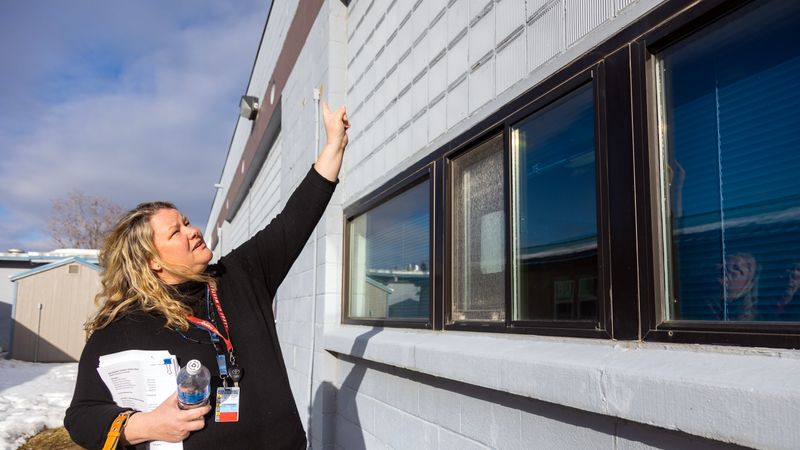
Boundary County School District Superintendent Jan Bayer points out that part of an exterior wall of a school building is made of glass blocks painted blue, which are not efficient for heating and cooling. The rest of the building is made of cinder blocks that came from a naval training station that was decommissioned in the 1940s.

No other state spends less on education per student than Idaho, according to a recent report from the U.S. Census Bureau, which surveys and ranks school finance systems. It also ranks last in the nation in terms of school infrastructure spending per pupil, a state report shows. So over the past several decades, rural districts across the state have faced the same challenge as Bayer: To improve or replace aging — and sometimes dangerous — facilities, they must appeal to local taxpayers and clear some of the nation’s most restrictive thresholds for school funding. Despite urgent needs, most of these efforts fail, an investigation by the Idaho Statesman and ProPublica has found. As a result, students across the state must learn amid dire conditions.

In one Idaho school, the foundation is crumbling. In another, so few bathrooms serve hundreds of kids that students have soiled themselves, according to school officials and local media. And in yet another, a portion of a roof recently failed during off-hours, sending water flooding into a classroom and bathrooms, destroying books and temporarily limiting learning space.

Since 2006, districts have mounted 217 bond attempts to remedy these types of problems and accommodate growing student populations. Had Idaho required only a majority of voters to support the measures — the threshold in most states — 83% of them would have passed. Instead, just 44% were approved, according to an analysis of bond measures and election data by the news organizations.

Please open the link and read this story. It makes you wonder whether the public cares about education and students. People complain about test scores but all too often they are unwilling to pay for an up-to-date school system. Charters and vouchers are a pointless diversion. They guarantee that the public schools attended by most students will be impoverished and under-resources.