Archives for category: Freedom

Our nation is experiencing a resurgence of censorship and gag laws that take us back to the 1950s, to the era of McCarthyism, and even to the 1930s and 1940s, when teachers were suspected of subversive activities if they offended rightwing sensibilities. Alan Singer writes here about the upsurge in restrictions on academic freedom in Florida. Undoubtedly, there are other states where Know-Nothings have taken control but Florida stands out because it’s governor is a leading contender for the Republican nomination for the Presidency in 2024.

Florida Governor Ron DeSantis wants to control what children learn, what teachers can speak about in and out of the classroom, and ultimately what people think. Lawyers for the State of Florida argued in a recent court filing that professors at the state’s public colleges and universities have no right to freedom of speech when they teach. Florida is defending the state’s Individual Freedom Act, more commonly known as the “Stop WOKE Act.” The law bars teachers at public institutions from introducing discussion of race, racism, and sex. The big danger is that the rightwing majority on the United States Supreme Court may give him his wish. With DeSantis a leading candidate for the 2024 Republican Party Presidential nomination, this would be another step towards suppressing democracy in the United States.

The out-of-control rightwing majority on the Supreme Court is likely to approve the DeSantis ban on free speech and academic freedom. In 2006, in the case of Garcetti v. Ceballos, a 5-4 rightwing majority of the Supreme Court already ruled that first amendment protection does not apply to employee speech and protect them “from discipline based on speech made pursuant to the employee’s official duties.” At the time the Court did not rule on whether the ban included teachers. But today, an even more rightwing Court majority could rule that teachers, K-12 and college, as government employees in Florida, are subject to discipline including being fired if they exercise speech in their official capacities that violates Florida laws including its notorious “Don’t Say Gay” bill and banning any language that might make a student feel uncomfortable such as recognition that Florida was a slave state and attempted to cede from the United States during the Civil War. Since many teacher contracts have a public behavior clause, saying gay or discussing racism outside the classroom but in in public setting could be construed as a violation of professional responsibility and the Florida law.

Florida is not the only state trying to silence teacher and students. According to a June 2021 article in Education Week, in the previous six months bills were introduced in 42 states to restrict teaching about racism and sexism. Anti-CRT laws went into effect in Alabama, Florida, Georgia, Idaho, Iowa, Kentucky, Mississippi, Montana, New Hampshire, North Dakota, Oklahoma, South Carolina, South Dakota, Tennessee, Texas, Utah, and Virginia. The Alabama law forbids teachers from teaching “concepts that impute fault, blame, a tendency to oppress others, or the need to feel guilt or anguish to persons solely because of their race or sex.” A problem that the Alabama and Florida legislators may not have understood is that slavery in the Americas was race-based. Florida’s law adds that teaching that “people are privileged or oppressed due to their race or sex” effectively wipes out any discussion of Jim Crow segregation, limits on the rights of women, and Florida’s long history of voter suppression.

This is not the first time the fundamental rights of teachers have been under attack in the United States because of their beliefs or speech. In the 1930s and 1940s teachers were made to sign loyalty oaths and fired if they held unpopular political beliefs. In the 1940s, New York State prevented the City College of New York from hiring the noted philosopher and mathematician Bertrand Russell condemning Russell’s views on premarital sex as “immoral and salacious.” In 1941, the New York State Legislature established the Rapp-Coudert Committee to investigate teachers in the state’s educational system. Sixty faculty and staff members at City College were dismissed because they were unwilling to testify before the committee.

In New York City, 1,150 teachers were investigated and 378 teachers were either fired of forced to take early retirement in the 1950s because they were suspected of being current or past members of the Communist Party or had invoked the Fifth Amendment when subpoenaed to testify about their activities. During the Cold War Red Scare teachers were also investigated in other major U.S. cities. At a Congressional sub-committee hearing accusations were made that 1,500 of the country’s one million teachers were “card-carrying Communists.”

In 1954, the school committee in Wayland, Massachusetts removed a second-grade teacher accused of being “[unfit] to teach” because she had been a member of the Communist Party. It accused the teacher of lacking “perception, understanding, and judgment necessary in one who is to be entrusted with the responsibility for teaching the children of the Town.”

The witch-hunts not only impacted the teachers who were fired. Other teachers were frightened into silence and students were denied exposure to ideas that needed to consider, and could potentially reject, about the nature of American society. An earlier version of the Supreme Court recognized this and in Sweezy v. New Hampshire (1957), Keyishian v. Board of Regents (1967) and Pickering v. Board of Education (1968) the Supreme Court, led by Chief Justice Earl Warren, recognized the importance of freedom of speech for teachers. In his majority opinion for the Court in Sweezy, Warren argued, “The essentiality of freedom in the community of American universities . . . Scholarship cannot flourish in an atmosphere of suspicion and distrust. Teachers and students must always remain free to inquire, to study and to evaluate, to gain new maturity and understanding; otherwise, our civilization will stagnate and die.”

Unfortunately Florida Republicans and current Supreme Court seem committed to overturning these rulings and the right of teachers to teach.
Oklahoma, like many other conservative states, passed a law to restrict teaching about racism and other controversial subjects. John Thompson, a historian and retired teacher in Oklahoma, thinks that high school students should learn about and debate historical events. He wrote this post for the blog.

After Part I of Ken Burns’ The United States and the Holocaust was shown on PBS, I wrote a review calling for the documentary and its website to be taught in high school. As the three-part series progressed, I became more stunned by the information I had never been taught. Afterwards, conversing with neighbors and strangers, and ten lawyers, the virtually unanimous response I heard was a) The United States and the Holocaust must be taught in every Oklahoma high school, and b) because of HB 1775, educators won’t dare to do so.

I also tried to communicate with ten school systems and education institutions, but received no responses. In fairness, it is unlikely that districts would take a stand before studying the legal and political issues regarding the use of Burns’ work in the classroom.

Of course, I had known that Adolf Hitler patterned his crimes against humanity after America’s eugenics movement. But I hadn’t realized how much Hitler had studied its false claims that people of color were biologically inferior, as well as borrowed lessons from the genocide of Native Americans, the Ku Klux Klan, and Jim Crow. Similarly, I had read Anne Frank’s The Diary of a Young Girl and it seems unlikely that an Oklahoma teacher would be fired for violating HB 1775 by teaching about her the way it has normally been taught. But Burns tells the long story that has not been recognized. Even though the wording of HB 1775 doesn’t seem to ban The United States and the Holocaust from high school classrooms, it is widely assumed that teaching it would be too risky.

Burns tells how the United States State Department repeatedly tightened regulations designed to prevent Jews from escaping to the United States. The Frank family, like hundreds of thousands of Jews, was murdered after years of being excluded from the U.S.

A subsequent review by Diane Ravitch of Part II, explained how a million Jews were murdered by December, 1941 when the U.S. entered the war. She concluded, I believe correctly, that “This series should be shown to high school students in every school in the U.S.” In my first review, I concentrated on why and how Oklahoma educators and supporters of public schools should unite in teaching Burns’ film, and his standards-driven lessons. Part III further convinced me that the stakes are too high to allow Burns’ work to be pushed out of high schools. We must find a way to take a stand. All I know for sure, however, is that it will require careful planning and conversations between teachers and administrators; patrons; and political and community leaders.

We must make it clear that Burns affirms that there is plenty that is great about our democracy, and we must also focus on the heroism of anti-Nazi volunteers and key governmental leaders. He appropriately praises the military and other Americans for winning World War II, and thus putting an end to the Holocaust. Burns explains the logistics and technological limitations that would have made it hard to bomb the railroads to the concentration camps. But he also discusses the extreme anti-Semitism and how, in 1938, 2/3rds of Americans wanted to keep German, Austrian, and “other political refugees” out of the U.S., thus undermining President Franklin Roosevelt’s efforts to rescue as many as possible.

This piece will focus on two narratives that Burns uses to illustrate why this complicated history must be taught. And then it summarizes his belief that today it is doubly important that students are taught uncomfortable truths about the genocide of six million Jews.

First, Burns reviews the U.S State Department’s history of racism and its opposition to admitting Jews and Southern European immigrants, as opposed to the Northern Europeans they welcomed. For instance, in1939, Secretary of State Cordell Hull, who would later be awarded the Nobel Prize, led the infamous effort to block the St. Louis, a German ocean liner trying to transport 936 Jews seeking asylum to America.

In 1940, Asst. Secretary of State Breckinridge Long “wrote that consular officers should “put every obstacle in the way [to] “postpone and postpone and postpone the granting of visas.” As it was later learned, Long tried to stop intelligence about mass murder from reaching the United States.

After the U.S. had been at war with Nazis for two years, and a grass roots effort by Americans putting their lives at risk when saving tens of thousands from genocide, the truth was clear. Treasury Secretary Henry Morgenthau, Jr. finally was able to prove to President Roosevelt that the State Department was lying, and Long had been hiding the facts and the plans for rescuing refugees through southeastern and southwestern Europe.

Long resigned and FDR created the Wartime Refugee Board (WRB). The hero of the rescues that the State Department had undermined, John Pehle, was named the WRB director. The WRB helped to save up to 200,000 Jews, but Pehle said their effort was “little and late.”

The second story was about the initiative General Dwight Eisenhower started in order to inform the world about what happened in the concentration camps. First, he required soldiers and German civilians to walk through the concentration camps and see the piles of bodies. He then asked General George Marshall to bring members of Congress and journalists to the newly liberated camps “so that they could convey the horrible truth about Nazi atrocities to the American public.” Within days, they began to bear witness to Nazi crimes in the camps.”

And that leads to the question that Burns’ website recommends, “Although the images and videos shown in the last clip are very challenging to watch, why do you think U.S. Army leaders said they needed to be shown to people in the United States and across the world?”

In the last five minutes, The United States and the Holocaust returns to the reason why Burns and his team started to make this film in 2015. This was before Charlottesville, the shootings at the Tree of Life synagogue in Pittsburgh and at the supermarket in Buffalo, and before the January 6th insurrection. But they saw a similarity to “fragility of civilized behavior” that had existed in Germany. For instance, in the late 1920’s, Berlin was perhaps “the most open and cosmopolitan city in Europe” but only four years later, the Nazis were in charge.

This propelled Burns to reveal the full range of Americans’ actions and inactions. His research showed how quickly societies can spin out of control. Burns concluded that we must learn from the past in order to better deal with today’s “fragility of democratic civilization all over the world, not just here.”

Today, supporters of HB 1775 seem to argue that discussing today’s conflicts in the context of the dark chapters of American history is politicizing classroom instruction. Burns, however, rejects the practice of keeping students in the dark about past and present threats to democracy. Cross-generational conversations about The United States and the Holocaust could be a significant step towards bringing America together.

John Thompson, historian and retired teacher in Oklahoma, posts his reaction to the first episode of the new series by Ken Burns, Sarah Botstein, and Lynn Novick: “The U.S. and the Holocaust.”

I just watched the second episode, and it is very powerful. Burns has said that this is the most important documentary he has ever made.

The U.S. made almost no effort to open its doors to Jews trying to escape Hitler’s killing machine. Why? For one thing, the American public was deeply anti-Semitic. For another, the leaders of the U.S. State Department were anti-Semites.

The Ku Klux Klan sprang back to life. The heroic aviator Charles Lindbergh, who admired Hitler, was a leader of the infamous “America First” movement, which opposed our entry into the war and was certain that Hitler would conquer all of Europe. Henry Ford was a virulent anti-Semite, whose publication printed the notorious “Protocols of the Elders of Zion.”

This series is MUST viewing. It clears away the cobwebs of lies propagated by rightwingers who want to cleanse the schools of the dark side of U.S. history. Hate, bigotry, racism, and anti-Semitism are woven into our history.

Thompson writes:

Ken Burns’ The U.S and the Holocaust is being shown on PBS. It begins with a jolt: telling how Anne Frank and her family were denied entry to the U.S. As our country denied entry to the vast majority of Jews threatened by Adolf Hitler, 1 million were murdered. Episode One helps us understand why President Franklin Roosevelt and other leaders were unable to persuade the American public to support assistance to Jews fleeing Nazism.

Of course, there is plenty that is great about our democracy, but our histories of the genocide of Native Americans and Slavery, as well as eugenics and its false claims that people of color were biologically inferior, contributed to our failure to respond appropriately. In fact, Hitler patterned his crimes against humanity after America’s eugenics movement, the genocide of Native Americans, the Ku Klux Klan, and Jim Crow. During the Great Depression, more than 1 million people of Mexican ancestry were expelled even though more than 60 percent of them were born in the U.S. And, even before American Fascists like Father Coughlin and Henry Ford ramped up hatred of Jews and advocated for pro-Nazi policies, the U.S. had a long history of violent anti-Semitism.

Ken Burns and his team started to make this film in 2015, before Charlottesville, the shootings at the Tree of Life synagogue in Pittsburgh and at the supermarket in Buffalo, and before the January 6th insurrection. A similar “fragility of civilized behavior” was also on display in Berlin under Hitler. In the late 1920’s it was one of “the most open and cosmopolitan city in Europe” but four years later, the Nazis were in charge. What lessons can we learn from that past which could inform today’s “fragility of democratic civilization all over the world, not just here?”

The U.S. and the Holocaust also raises questions such as “what are the responsibilities of our leaders to shape public opinion rather than follow it?” and “what does this history tell us about the role of individuals to act when governments fail to intervene?” It also raises tough questions about the role of the media in spreading hate, as well as constructive information.

The film’s website also links to Oklahoma’s and other states’ Academic Standards. They call for high school students to “examine the causes, series of events and effects of the Holocaust through eyewitnesses such as inmates, survivors, liberators, and perpetrators,” and examine the “rise of totalitarian regimes in the Soviet Union, Germany, Italy, and Japan.” Such Standards also call for an examination of “how the media we consume shapes our beliefs, opinions, and actions both historically and in modern contexts in this media.”

These Standards are very consistent with the concepts that Burns explored. If I were still teaching high school, I’d be carefully building a unit that follows the Standards and instructional techniques that were carefully prepared by state and national experts. For instance, I would begin with the recommended, first question, “Why do you think many people did not question or push back against the harmful ideas presented by people who believed in eugenics?”

As also recommended, as students watched video clips, and read and analyzed the primary source materials in The U.S. and the Holocaust website, I’d ask them to share their “feelings or thoughts after each clip as some of the content covered is very heavy and may be emotional for students.” Students would take notes and engage in classroom discussions. I’d end with the recommended question, “Although the images and videos shown in the last clip are very challenging to watch, why do you think U.S. Army leaders said they needed to be shown to people in the United States and across the world?”

I would try to repeat the previously successful practice of inviting legislators, state officials, business and political leaders to the lessons so they could witness the dignity and wisdom of my students at John Marshall, Centennial, and other high-challenge schools. As recently as four years ago when I guest-taught and/or engaged with very conservative Republicans, I knew the discussions would be civil and enlightening. Now, I know such communications would be different, and that I might get fired for violating HB1775.

But the consequences for teachers are nothing like the suffering of victims of the Holocaust or the potential destruction due to the failure to stand up for democratic and educational principles. So, I would also ask what would happen if thousands of educators would stand for our students and teach Ken Burns’ film and website. They would need to thoughtfully plan the process, hopefully working with school system administrators. Many or most of whom would have a long history of opposing censorships of books such as Anne Frank’s “The Diary of a Young Girl,” but who are intimidated by bills like HB 1775 and similar censorship laws in other states. Educators would almost certainly have to seek the backing of parents and community leaders.

Educators who are too frightened to use Burns’ work, could at least borrow from SummerBoismier, whose teacher certification is being threatened for linking to the Brooklyn Library, and post links to his and PBS’s websites. Or they could organize off-campus community films or read-aloud events (such as the “Banned Book Read Out” at OKC’s First Unitarian Church) for students and/or provide information on The U.S. and the Holocaust to students when they enter the building.

Such efforts would be terrifying if done alone. But would legislators who voted for censorship of school curriculums want to admit out loud that they want Anne Frank’s story banned? And would even the most extreme legislators follow through with mass firings at a time of teacher shortages? We must wrestle with Burn’s question about whether so many millions of people from all nations would have quickly abandoned democracy and humanity if there had been more resistance to Hitler in the U.S. and across the world before Nazism took control in so many places?


As Ms. Boismeir concluded, “you have a choice to make for the future of our state and the state of our public schools: a politics of inclusion or exclusion. So what’s your story? What side are you on?”

Summer Boismier took a stand against censorship of books in her classroom. A teacher in the high school of Norman, she had been ordered to remove from her classroom any books that might violate state law HB 775. That law declares that if any educator makes part of their curriculum teachings that “an individual, by virtue of his or her race or sex, bears responsibility for actions committed in the past by other members of the same race or sex” or that “an individual, by virtue of his or her race or sex, is inherently racist, sexist or oppressive, whether consciously or unconsciously,” they could be suspended or have their license removed. She said teachers were instructed to remove such books or cover them with butcher paper. She did cover them up and posted a warning not to read banned books but posted the QR code of the Brooklyn Public Library, where students can gain access to banned books. The state superintendent Ryan Walters moved to suspend her teaching license. He said, “There is no place for a teacher with a liberal political agenda in the classroom.”

Boissier wrote the following opinion article in The Oklahoman to explain her opposition to censorship and book banning:

May 2, 2004, was a Monday. How do I know, you ask? Well, I was 15 at the time, and like most 15-year-olds, I was at school. I know, shocking! But what you might not know is that a mere 24 hours before, I had lost my father to suicide. I went to school the following day because that is where I wanted to be. That is where, in the worst moments of my life to date, I believed I’d be safe. School — specifically public school — had always been the place where I felt seen and heard and valued for who I was and, most importantly, for who I was becoming as a result. As both an educator and a public school proud Oklahoman, I want something similar for all — and I mean ALL — of my students, including the many amazing learners who often look, think, love, live and/or pray differently than I do. Every single child who walks through the doors of a public school in this state should have the opportunity to feel centered, to feel valued, to feel celebrated, to feel affirmed and sustained for who they are and for the lived experiences and diverse communities they bring to class.

Education is political, and the classroom — by extension — is a political space. Let me say it louder: Education is inherently political, but it is not automatically partisan. That would be, to use the word of the day, indoctrination. Politics encompasses the ideologies supporting a person’s daily choices, or lack thereof. Politics is power — who has it and who wants it. If knowledge is also power, then it would stand to reason that the classroom is indeed political. Who gets to learn what, from whom, and how is steeped in a political reality that Oklahomans would be foolish at best and reprehensible at worst to ignore. Laws such as House Bill 1775 fail to account for the fact that some pre-K-12 students are rarely afforded the luxury of experiencing “discomfort” only at school. When skin color and/or gender presentation is weaponized, discomfort isn’t just a poor word choice in some poorly worded legislation. It is a matter of survival.

Actions can sometimes speak louder than words; however, inaction can often speak just as loudly. Silence can even scream. There is power in what we say, but there is also power in what we don’t. What does it communicate when adults in leadership positions repeatedly and loudly target books by and about the 2SLGBTQ+ and BIPOC communities, among others? Make no mistake, when students — some of whom are also members of these communities — walk into public schools, they’ll get the message loud and clear that the state sees such stories as smut and such lives as less than.

Mother of multicultural children’s literature, Dr. Rudine Sims Bishop, argued that stories are mirrors, windows and sliding glass doors. Stories are also telescopes and prisms and ladders. Stories are safety. Stories are possibility. Stories are connection and validation. Stories are power. And stories are political. Empathy is dangerous precisely because it takes a sledgehammer to fear. If we don’t “other” differences and hold them at arm’s length, then those driving division by justifying censorship in our schools lose the power they’ve amassed keeping Oklahomans apart.

This is not a zero-sum game. What a student gains when teachers prioritize inclusive stories in the classroom is not another’s loss. Privilege is not a euphemism for guilt; it is a means to better understand the power a person has and the ways they can use that power to uplift others. In a perfect world, we wouldn’t need to defend a student’s right to read, to be represented and — by extension — to simply exist. But alas, this world is as far from perfect as I am from retirement. This incessant debate over (insert whatever term best reflects your particular belief system) books is evidence enough of that.

The lives of historically marginalized people should not be up for debate, but as Michael Brown, Ariyanna Mitchell, Sandra Bland, Breonna Taylor, David Kato and George Floyd prove, they frequently are. Their stories cannot and should not be separated from the context of their lived experiences. No story — including the ones we teach and thereby validate in our public schools — exists in a vacuum. In the same way charges of indoctrination are an insult to their critical thinking skills, Oklahoma’s students are certainly capable of speaking for themselves. For instance, one student stated, “Being an openly gay student myself, who is witnessing LGBTQ+ characters for the first time emerging in our own curriculum, gives other LGBTQ+ students and I a more elevated self-worth and pride towards our own respective identities.”

It is time to come together as Oklahomans and side with a politics of critical thinking and compassion. This November you have a choice to make for the future of our state and the state of our public schools: a politics of inclusion or exclusion. So what’s your story? What side are you on?

This is a startling article about a strange alliance between a theocratic cult and Trump’s friends Michael Flynn and Roger Stone. Jennifer Cohn, an expert on election integrity, digs deep into the world of Christian Dominionism and explores its philosophy. Its ambitions are vast, and it poses a threat to our secular democracy.

It begins:

On July 1, 2022, inside a packed Georgia arena, four religious leaders stood on stage as they recited a blood chilling Prayer Declaration called the “Watchman Decree”:

Whereas, we have been given legal power from heaven and now exercise our authority, Whereas, we are God’s ambassadors and spokespeople over the earth. Whereas, through the power of God we are the world influencers. Whereas, because of our covenant with God, we are equipped and delegated by him to destroy every attempted advance of the enemy, we make our declarations: … 3. We decree that our judicial system will issue rulings that are biblical and constitutional. 4. We declare that we stand against wokeness, the occult, and every evil attempt against our nation. 5. We declare that we now take back our God-given freedoms, according to our Constitution. 6. We decree that we take back and permanently control positions of influence and leadership in each of the “Seven Mountains.”

[Video]

A video of the recitation (shown above) was viewed more than 3 million times on Twitter. In the replies, many people expressed horror at what they had seen. Although few were aware, they had just witnessed the fruits of the New Apostolic Reformation (NAR). The NAR is a rapidly accelerating and dangerously under-reported worldwide Christian authoritarian movement. It practices faith healing and exorcism and promotes dominionism, a belief that Christians must take control of government, business and culture in order for Jesus to return to earth. The men on stage included NAR apostles Dutch Sheets (who wrote the decree) and Lance Wallhau, along with two close colleagues, pastors Mario Murillo and Hank Kunneman. The fifth man, pastor Gene Bailey, hosted the event for his showFlashpoint on Victory TV, a Christian network that platforms the NAR and pro-Trump Make America Great (MAGA) influencers.

Please open the link and learn about the religious extremists who want to control everything. Learn about their ties to MAGA world figures like Flynn and Stone.

Axios Dallas writes about a new phenomenon in the battle by religious extremists to take control of public schools. A conservative Christian wireless provider is funding the school board campaigns of like-minded religious zealots. It recently won control of four school boards.

It’s bizarre to think of businesses branding themselves by religion. The imagination runs wild: buy your gasoline at a Catholic service station or a Methodist one? Buy your coffee at a Baptist coffee shop or a Muslim one? Buy groceries at a fundamentalist grocery store? The possibilities are endless.

Given the reverence that the current Supreme Court has for religious expression, it would be unlikely to object to evangelical Christians imposing their views on others in public schools.

Patriot Mobile, a North Texas-based cell phone service reseller that markets itself as “America’s only Christian conservative wireless provider” was the driving financial force behind the election of 11 new school board members in four suburban North Texas districts.

Driving the news: Patriot Mobile helped elect the majority of members in Grapevine-Colleyville ISD, which recently passed a controversial new set of conservative policies dubbed “Don’t Say Trans.”

Why it matters: The policies, which include prohibitions on teachers discussing anything related to critical race theory or “gender fluidity,” are part of a major push from both Patriot Mobile’s political arm — Patriot Mobile Action — and the state GOP.

  • “Ultimately we want to expand to other counties, other states and be in every state across the nation,” Leigh Wambsganss, executive director of Patriot Mobile Action and vice president of government and media affairs at Patriot Mobile, told conservative talk show host Mark Davisearlier this summer.

The big picture: Former Trump adviser Steve Bannon has told conservatives that to “save the nation,” they need to target school boards, repeatedly spotlighting Patriot Mobile.

  • “The school boards are the key that picks the lock,” Bannon said during an interview with Patriot Mobile’s president, Glenn Story, at the Conservative Political Action Conference in Dallas earlier this month, according to NBC News.

Between the lines: School districts are the front line in the political battle for Texas. Democratic gubernatorial candidate Beto O’Rourke has rooted his campaign on school funding and safety, while Gov. Greg Abbott has made fears of conservative parents a cornerstone of his bid for re-election.

What happened: Earlier this year, Patriot Mobile Action hired two national GOP consulting firms — Vanguard Field Strategies and Axiom Strategies — to help target school board races in the suburbs of Tarrant County, the largest conservative county in the country.

  • The PAC spent more than $600,000 backing 11 school board candidates running in Southlake, Grapevine-Colleyville, Keller and Mansfield — all of whom won their races.
  • The group sent out thousands of political mailers warning that sitting school board members were endangering students with “woke” ideologies. One ad featured a photo of a child and the words, “They’re not after you, they’re after me.”

What we’re watching: Last week the Republican Party of Texas made a fundraising appeal praising GCISD’s new policies, saying the party is “working to bring this conservative policy” to every school district in the state.

John Merrow’s title is sarcastic. Of course he wants you to read banned books, and he is deeply concerned about the large number of eligible voters—especially young people—who don’t bother to vote.

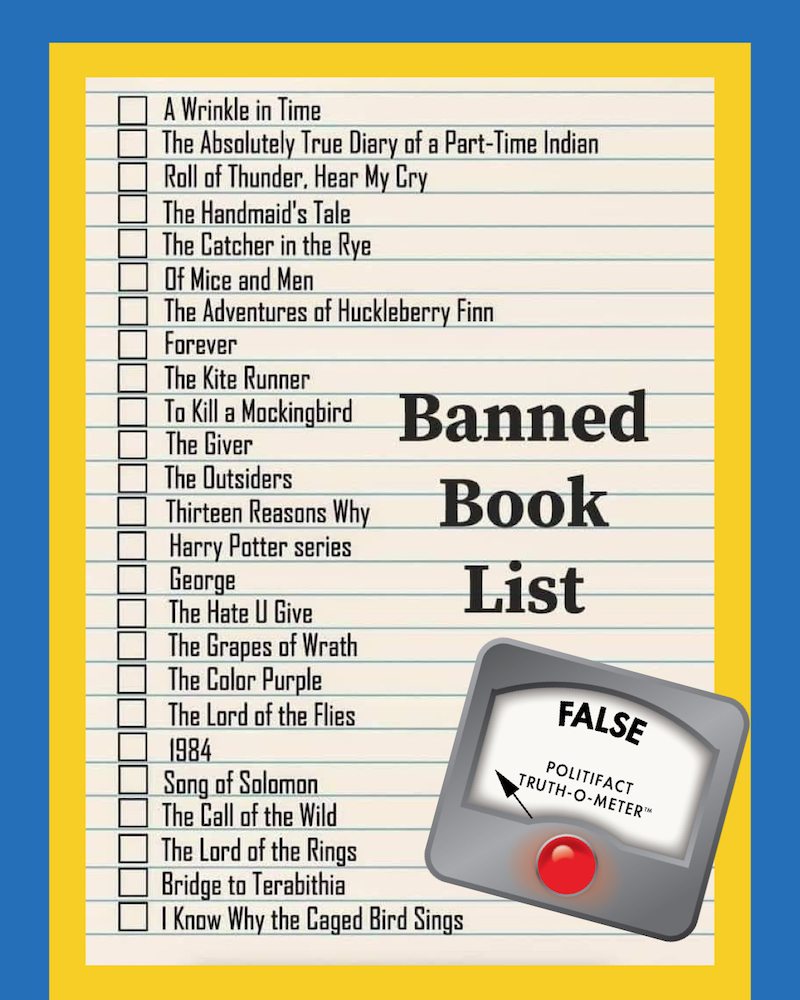
When someone on Twitter posted a list of 25 popular books that Florida Governor Ron DeSantis had supposedly banned from the state’s public schools, people went crazy. The list included Harper Lee’s “To Kill a Mockingbird,” Alice Walker’s “The Color Purple” and Madeleine L’Engle’s “A Wrinkle in Time.”

Below is a screenshot of the list. How many of these books have you read? Have your children read most of them? What on earth is going on in Florida?

People familiar with DeSantis’s efforts to restrict classroom discussion of controversial topics had no trouble believing that he would try to prevent young people from reading controversial or challenging books. If DeSantis did draw up a list, these books might well be on it.

But the list is a fake, a clever satire.

Many people were fooled, including teacher union President Randi Weingarten and “Star Wars” actor Mark Hamill. Hamill’s screenshot of the list amassed more than 100,000 likes and 24,000 retweets.

(Add my name to the list of those who were taken in.)

Like all good satire, that fake list of banned books is rooted in truth, because book banning is real and growing. Florida school districts have banned around 200 books, according to a report published by PEN America, a nonprofit that tracks book banning in the U.S. Pen America ranks Florida third among US states for banning books, trailing only Texas and Pennsylvania.

We are in the midst of a pandemic of book banning, so it’s hard to imagine any title that would never be banned by some zealous or timid school board or ignorant legislator.

One way to stop this outbreak of censorship is to get active, vote, attend school board meetings, run for school board. Passivity and complaining is a losing strategy.

Time to turn back the rising tide of incipient fascism.

The Lincoln Project draws a historical parallel.

Watch it and worry.

Allison Fine wrote a passionate column in defense of reproductive rights in which she quoted the civil rights icon Fannie Lou Hamer: “Nobody’s Free Until Everybody Is Free.”

No one is free in America today because millions of people have lost the national guarantee of the power to control if and when they have children.

But the barbaric treatment of pregnant people, and the ongoing harassment and death threats against clinicians, isn’t the end of our story, it is the beginning of a new chapter. Our job is to keep getting up, and to keep showing up, just like Fannie Lou.

Fine describes a growing ecosystem that is growing up to provide help to women who seek abortion services, including take health consultations and abortion pills by mail.

She writes that the nation is in a state of “legal chaos” as a result of the Supreme Court decision that overturned Roe V. Wade, reversing a Court-guaranteed right for the first time in US history.

I am raising this issue to emphasize that we are in a totally chaotic period legally right now. It is actually a really profound moment for our country in terms of national versus states’ rights. Can I mail abortion pills to Mississippi, a banned state, today? No one knows the answer. The State of Mississippi says no, but BioGenPro, one of the two U.S. manufacturers of mifepristone, the abortion medication, with the force of the FDA and national postal service behind it, says yes, and they brought suit against MississippI to force them to allow it. We need to watch how this suit unfolds very closely over the next few months.

Please remember that just because states are passing crazy-ass laws doesn’t mean those laws will stand. They will all be challenged in court.

Sadly, the Supreme Court is sure to overturn any laws that conflict with their Dobbs’ decision.

But think about reality. Can a state actually ban the mailing of abortion pills? Will they open every package delivered to every woman in their state? How can Mississippi or Texas or any other state stop women from receiving the pills?

Ruth Ben-Ghiat writes a post on her blog about threats to democracy. One of this is described in this post: the threats to libraries and librarians by extremists who want to ban books.

This essay is dedicated to librarians and library staff across America, and to a family member who worked as a library clerk in an elementary school for many years.

“It felt like a knife in my heart,” said Audrey Wilson-Youngblood, a Texas library services coordinator, of the flood of accusations from parents that she and other library staff in the Keller Independent School District harmed students by having books on LGBTQ themes in their collections.

Across the country, librarians in school and municipal libraries feel that knife being turned. Activist parents, sometimes working in conjunction with GOP politicians or right-wing groups such as Moms for Liberty, are waging an authoritarian-style assault on libraries and librarians.

When illiberal forces are on the march, the education system and any public institution that encourages independent thinking and pluralism become targets. In Texas and elsewhere, the spread of censorship, and harassment meant to silence library workers –including by labeling them as pedophiles — models the authoritarian culture the right is trying to install in America school by school and town by town.

It’s not surprising that libraries and librarians trigger the enemies of our democracy. Public libraries are places where community members of all backgrounds, political beliefs, and economic situations gather, and where elderly and lonely people can find a sense of companionship. This is why social scientists single out libraries as antidotes to the conditions that harm civic life and ultimately degrade democracy: political polarization, disinformation, economic inequality, and isolation.

School and public libraries also have long provided refuge to people of all ages with difficult home situations, and librarians can become trusted mentors and guides.

My weekly visits as a child to my own town library set me on a path of learning. The library also became a personal anchor for me when I went through a difficult period as a teenager, to the point where I took a job there as a messenger clerk, as did a close friend (who is now a member of the Lucid community).

Shelving and straightening the books, and seeing how they were treated with such care, instilled a lifelong respect for the craft of writing and a commitment to intellectual freedom that sustain me today. As my friend notes, the library was “a safe space to think and dream.”

Of course, thinking and dreaming are activities that run counter to authoritarianism: “Believe, Obey, and Fight” was the Fascist slogan. Books become threatening objects, as centuries of bookburnings by repressive political and religious entities attest.

In the US, myriad state laws and book bans seek to remove the history of White racism, slavery, and Fascist genocides from view, along with writings about LGBTQ identities and experiences. In the Keller, Texas, school system alone, as of March almost three dozen books had been sent for review by a district-formed book committee on the grounds that they are “pornographic” or will create “emotional distress.”

Florida Governor Ron DeSantis, an expert in authoritarian double-speak, calls his version of such censorship “curriculum transparency.” Yet there is nothing transparent about the process by which books are removed. As Carolyn Foote, a retired Texas librarian and co-founder of the advocacy group FReadom Fighters notes, these aggressions are about “breaking that contract of trust” between librarians and the public and degrading professional ethics.

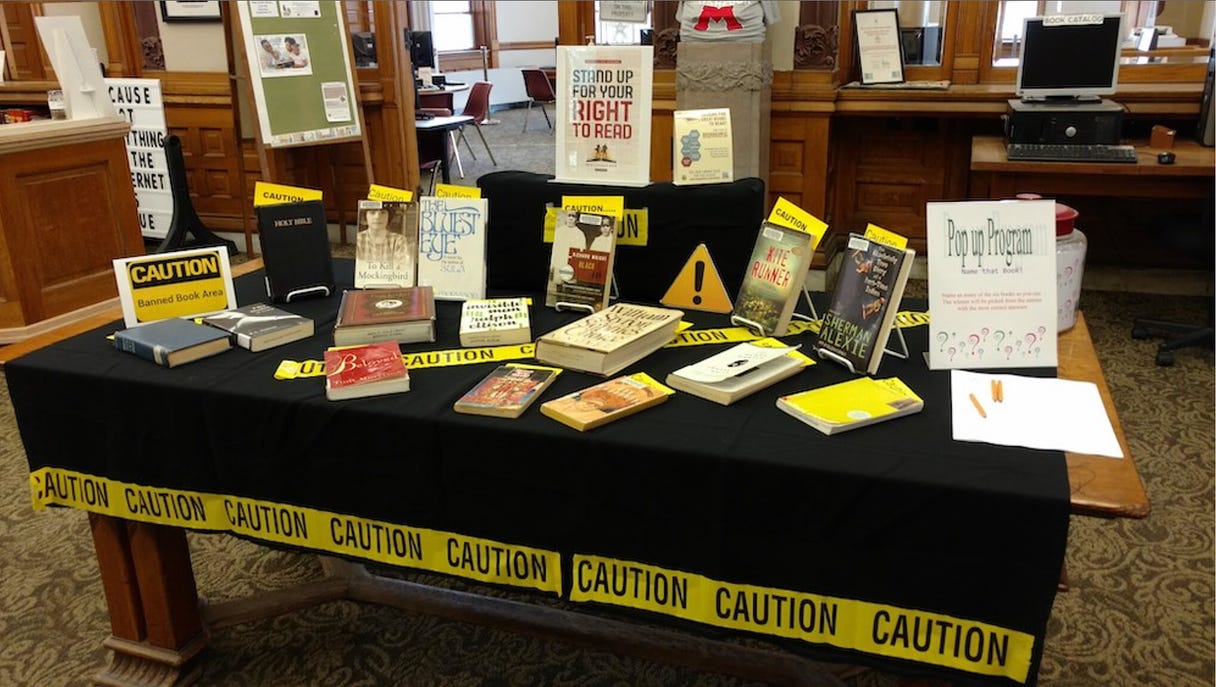
A display protesting book bans and restrictions at a local library. Charles Hickley/CC BY 2.0

The goal is not just to create a hostile work environment for library staff, but also to pressure administrators to submit to corrupt tactics such as banning books on spurious grounds and accepting slanderous speech used against their colleagues.

For right-wing parents and politicians aren’t just going after books. They are also personally attacking library employees as “groomers” who encourage inappropriate behaviors and relationships with children.

Associating LGBTQ individuals and their allies with pedophilia is an established strategy among the global right, including in Viktor Orban’s Hungary. And Vladimir Putin uses fake sex-crime charges to imprison researchers who are writing about things he wants buried.

Ideological fanaticism spurs attempts to dig into librarians’ private lives and harass them so they will resign. In Virginia Beach, GOP state representative Tim Anderson filed a FOIA Act request in May 2022 to learn the identities of librarians at schools that had materials some parents saw as sexually explicit.

It also lies behind attempts to criminalizelibrarians. In Clinton Township, NJ, the police department received a request for criminal charges to be made against librarians whose institutions had books with “obscene” content. And some states are challenging laws that shield teachers, researchers and librarians from prosecution. An Oklahoma law removed exemptions for teachers and librarians “from prosecution for willful violations of state law prohibiting indecent exposure to obscene material or child pornography.”

Unsurprisingly, many librarians have left their jobs. Some have resigned, others have been fired for refusing to remove books from their collections. Wilson-Youngblood, a 19-year veteran of the Keller school district, resigned due to the stress of working in a hostile environment. In small towns such as Vinton, Iowa, the library itself has had to close for lack of staffing.

Vinton’s fate may portend the future, since the number of groups targeted for censorship is bound to expand. In Vinton, right-wing activists not only objected to the presence of LGBTQ staff and LGBTQ-themed books, but displays of books by Vice President Kamala Harris and First Lady Jill Biden. For radicalized Republicans, Democrats are not just people with different opinions, but political enemies whose ideas should be banned.

Luckily, the digitization of books makes it hard for total bans on content for children to stick. The Brooklyn Public Library’s Books UnBannedprogram offers a free library card to people aged 13 to 21 across the U.S. so they can check out books digitally.

Yet libraries and librarians urgently need our support. Contacting your town or school administration to express solidarity and approval with current policies is one way you can push back. Another is to step up as a volunteer or even run for office on a town or school board that has oversight on library issues.

What Amanda Litman, executive director and co-founder of Run For Something, said about school boards in our interview is also true of libraries. They play “a foundational role in determining the kinds of citizens that kids ultimately become.” Libraries, and librarians, are essential to a healthy democratic society.