Archives for category: Freedom

The Lincoln Project draws a historical parallel.

Watch it and worry.

Allison Fine wrote a passionate column in defense of reproductive rights in which she quoted the civil rights icon Fannie Lou Hamer: “Nobody’s Free Until Everybody Is Free.”

No one is free in America today because millions of people have lost the national guarantee of the power to control if and when they have children.

But the barbaric treatment of pregnant people, and the ongoing harassment and death threats against clinicians, isn’t the end of our story, it is the beginning of a new chapter. Our job is to keep getting up, and to keep showing up, just like Fannie Lou.

Fine describes a growing ecosystem that is growing up to provide help to women who seek abortion services, including take health consultations and abortion pills by mail.

She writes that the nation is in a state of “legal chaos” as a result of the Supreme Court decision that overturned Roe V. Wade, reversing a Court-guaranteed right for the first time in US history.

I am raising this issue to emphasize that we are in a totally chaotic period legally right now. It is actually a really profound moment for our country in terms of national versus states’ rights. Can I mail abortion pills to Mississippi, a banned state, today? No one knows the answer. The State of Mississippi says no, but BioGenPro, one of the two U.S. manufacturers of mifepristone, the abortion medication, with the force of the FDA and national postal service behind it, says yes, and they brought suit against MississippI to force them to allow it. We need to watch how this suit unfolds very closely over the next few months.

Please remember that just because states are passing crazy-ass laws doesn’t mean those laws will stand. They will all be challenged in court.

Sadly, the Supreme Court is sure to overturn any laws that conflict with their Dobbs’ decision.

But think about reality. Can a state actually ban the mailing of abortion pills? Will they open every package delivered to every woman in their state? How can Mississippi or Texas or any other state stop women from receiving the pills?

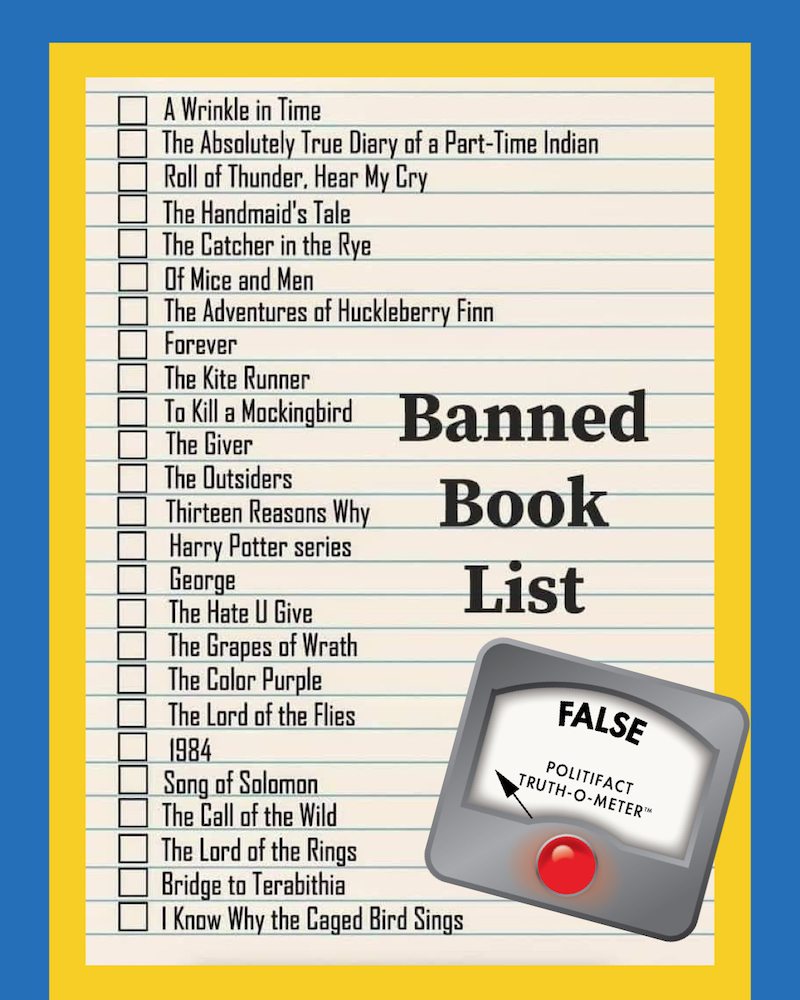
Ruth Ben-Ghiat writes a post on her blog about threats to democracy. One of this is described in this post: the threats to libraries and librarians by extremists who want to ban books.

This essay is dedicated to librarians and library staff across America, and to a family member who worked as a library clerk in an elementary school for many years.

“It felt like a knife in my heart,” said Audrey Wilson-Youngblood, a Texas library services coordinator, of the flood of accusations from parents that she and other library staff in the Keller Independent School District harmed students by having books on LGBTQ themes in their collections.

Across the country, librarians in school and municipal libraries feel that knife being turned. Activist parents, sometimes working in conjunction with GOP politicians or right-wing groups such as Moms for Liberty, are waging an authoritarian-style assault on libraries and librarians.

When illiberal forces are on the march, the education system and any public institution that encourages independent thinking and pluralism become targets. In Texas and elsewhere, the spread of censorship, and harassment meant to silence library workers –including by labeling them as pedophiles — models the authoritarian culture the right is trying to install in America school by school and town by town.

It’s not surprising that libraries and librarians trigger the enemies of our democracy. Public libraries are places where community members of all backgrounds, political beliefs, and economic situations gather, and where elderly and lonely people can find a sense of companionship. This is why social scientists single out libraries as antidotes to the conditions that harm civic life and ultimately degrade democracy: political polarization, disinformation, economic inequality, and isolation.

School and public libraries also have long provided refuge to people of all ages with difficult home situations, and librarians can become trusted mentors and guides.

My weekly visits as a child to my own town library set me on a path of learning. The library also became a personal anchor for me when I went through a difficult period as a teenager, to the point where I took a job there as a messenger clerk, as did a close friend (who is now a member of the Lucid community).

Shelving and straightening the books, and seeing how they were treated with such care, instilled a lifelong respect for the craft of writing and a commitment to intellectual freedom that sustain me today. As my friend notes, the library was “a safe space to think and dream.”

Of course, thinking and dreaming are activities that run counter to authoritarianism: “Believe, Obey, and Fight” was the Fascist slogan. Books become threatening objects, as centuries of bookburnings by repressive political and religious entities attest.

In the US, myriad state laws and book bans seek to remove the history of White racism, slavery, and Fascist genocides from view, along with writings about LGBTQ identities and experiences. In the Keller, Texas, school system alone, as of March almost three dozen books had been sent for review by a district-formed book committee on the grounds that they are “pornographic” or will create “emotional distress.”

Florida Governor Ron DeSantis, an expert in authoritarian double-speak, calls his version of such censorship “curriculum transparency.” Yet there is nothing transparent about the process by which books are removed. As Carolyn Foote, a retired Texas librarian and co-founder of the advocacy group FReadom Fighters notes, these aggressions are about “breaking that contract of trust” between librarians and the public and degrading professional ethics.

A display protesting book bans and restrictions at a local library. Charles Hickley/CC BY 2.0

The goal is not just to create a hostile work environment for library staff, but also to pressure administrators to submit to corrupt tactics such as banning books on spurious grounds and accepting slanderous speech used against their colleagues.

For right-wing parents and politicians aren’t just going after books. They are also personally attacking library employees as “groomers” who encourage inappropriate behaviors and relationships with children.

Associating LGBTQ individuals and their allies with pedophilia is an established strategy among the global right, including in Viktor Orban’s Hungary. And Vladimir Putin uses fake sex-crime charges to imprison researchers who are writing about things he wants buried.

Ideological fanaticism spurs attempts to dig into librarians’ private lives and harass them so they will resign. In Virginia Beach, GOP state representative Tim Anderson filed a FOIA Act request in May 2022 to learn the identities of librarians at schools that had materials some parents saw as sexually explicit.

It also lies behind attempts to criminalizelibrarians. In Clinton Township, NJ, the police department received a request for criminal charges to be made against librarians whose institutions had books with “obscene” content. And some states are challenging laws that shield teachers, researchers and librarians from prosecution. An Oklahoma law removed exemptions for teachers and librarians “from prosecution for willful violations of state law prohibiting indecent exposure to obscene material or child pornography.”

Unsurprisingly, many librarians have left their jobs. Some have resigned, others have been fired for refusing to remove books from their collections. Wilson-Youngblood, a 19-year veteran of the Keller school district, resigned due to the stress of working in a hostile environment. In small towns such as Vinton, Iowa, the library itself has had to close for lack of staffing.

Vinton’s fate may portend the future, since the number of groups targeted for censorship is bound to expand. In Vinton, right-wing activists not only objected to the presence of LGBTQ staff and LGBTQ-themed books, but displays of books by Vice President Kamala Harris and First Lady Jill Biden. For radicalized Republicans, Democrats are not just people with different opinions, but political enemies whose ideas should be banned.

Luckily, the digitization of books makes it hard for total bans on content for children to stick. The Brooklyn Public Library’s Books UnBannedprogram offers a free library card to people aged 13 to 21 across the U.S. so they can check out books digitally.

Yet libraries and librarians urgently need our support. Contacting your town or school administration to express solidarity and approval with current policies is one way you can push back. Another is to step up as a volunteer or even run for office on a town or school board that has oversight on library issues.

What Amanda Litman, executive director and co-founder of Run For Something, said about school boards in our interview is also true of libraries. They play “a foundational role in determining the kinds of citizens that kids ultimately become.” Libraries, and librarians, are essential to a healthy democratic society.

Lloyd Lofthouse, author, former Marine, and former teacher, explains what it means to be woke. Some Republican politicians—notably Ron DeSantis— are trying to suppress “wokeness.”

Lloyd writes:

Anyone that attacks what’s known as “woke ideology” is supporting zombie thinking and belongs to a fascist cult of ignorance.

Wokeness means someone that is highly literate, well educated, well read, is a life long learner, questions claims and uses critical thinking, problem solving and rational logic to find out if there is any truth to what these fascist zombies are shouting.

Question: Are you woke?

A reader who calls him/herself Quickwrit explains why the Supreme Court’s recent decision on abortion is wrong.

The Bible is silent on abortion:

The 9th Amendment gives Clarence Thomas the constitutional right to live in an interracial marriage and gives women the constitutional right to abortion: The 9th Amendment says that rights do not have to be stated in the Constitution in order to be rights: “The enumeration in the Constitution of certain rights shall not be construed to deny or disparage others retained by the people.”

Americans have long claimed to right to and the practice of abortion. Benjamin Franklin, key Founding Father of America, shaper and signer of our Constitution, published a handbook titled “The American Instructor” that featured a long, detailed section on do-it-yourself abortion and conception prevention. The book was very popular throughout America and the prevention of and termination of pregnancies was widely practiced throughout America, especially in rural areas where an unwanted pregnancy could mean financial ruin in those days.

The current Supreme Court ruling on abortion not only violates the 9th Amendment, it violates the religious rights of many citizens: The Bible gives commandments on a very, very long list of more than 600 laws on everything from divorce to gluttony — yet the Bible says nothing about abortion. Why is that? If abortion was even as important as gluttony, it would have been mentioned in the Bible.

But,the Bible is silent on abortion: Out of more than 600 laws of Moses, which includes the 10 Commandments, NONE — not one — comments on abortion. In fact, the Mosaic law in Exodus 21:22-25 clearly shows that causing the abortion of a fetus is NOT MURDER. Exodus 21:22-25 says that if a woman has a miscarriage as the result of an altercation with a man, the man who caused miscarriage should only pay a fine that is to be determined by the woman’s husband, but if the woman dies, the man is to be executed: “If a man strives with a woman with child, so that her fruit depart from her, and yet there is no harm to the woman, he shall be punished according to what the woman’s husband determines and he shall pay as the judges determine. And if the woman dies, then it shall be life for life, Eye for eye, tooth for tooth.” Ex. 21:22-25. So, the Bible orders the death penalty for murder of a human being — the mother — but not for the death of a fetus, indicating that the fetus is not yet a human being.

There are Christian denominations that allow abortion in most instances; these denominations include the United Church of Christ and the Presbyterian Church USA. The United Methodist Church and Episcopal churches allow abortion in cases of medical necessity, and the United Universalist Association also allows abortion.

Most of the opposition to abortion comes from fundamentalist and evangelical Christians who believe that a full-fledged human being is created at the instant of conception. In short — it is a religious BELIEF and religious beliefs cannot be recognized by the government under the Establishment Clause of the First Amendment of our Constitution. Moreover, the belief that a fetus is a human person, complete with a soul, is a Christian interpretation of the Jewish Bible — the Old Testament. But, Jewish scholars whose ancestors wrote the Old Testament and who know best what the words mean say that is a wrong interpretation of their writings.

Christians largely base their view that a fetus is a complete human being and that abortion is murder on the Jewish Bible’s Psalm 139: “You knit me together in my mother’s womb…You watched me as I was being formed in utter seclusion as I was woven together in the dark of the womb. You saw me before I was born.”

Who better to translate the meaning of Psalm 139 than the Jews who wrote it? And Jewish scholars point out that Psalm 139 merely describes the development of a fetus and does not mean that the fetus has a soul and is a person. In fact, the Jewish Talmud explains that for the first 40 days of a woman’s pregnancy, the fetus is considered “mere fluid” and is just part of the mother’s body, like an appendix or liver. Only after the fetus’s head emerges from the womb at birth is the baby considered a “nefesh” – Hebrew for “soul” or “spirit” – a human person.

I am not pro-abortion — I am PRO-CONSTITUTIONAL RIGHTS, and until a fetus is in its 24th week of development the mother has the unquestionable constitutional right to decide what happens to the fetus. After the 24th week, society may have a legitimate legal interest in the fetus. What that interest is, to what extent it reaches, and how to encode that interest into law isn’t easy and will require a great deal of debate in society in general and in Congress, not the states, because it is a national constitutional right that is being dealt with.

THE COURT BENDS THE FACTS: The University of London scientist whose research is cited by the Supreme Court in its ruling to take away abortion rights says that his research has been misinterpreted by Justice Alito and the Supreme Court’s activist conservative majority. Neuroscientist Dr. Giandomenico Iannetti says that the Court is ABSOLUTELY WRONG to say that his research shows that a fetus can feel pain when it is less than 24 weeks of development. “My results by no means imply that,” Dr. Iannetti declares. “I feel they were used in a clever way to make a point.” And Dr. John Wood, molecular neurobiologist at the University, points out that all serious scientists agree that a fetus can NOT feel pain until at least 24 weeks “and perhaps not even then.” Dr. Vania Apkarian, head of the Center for Transitional Pain Research at Chicago’s Feinberg School of Medicine, says that the medical evidence on a fetus not feeling pain before 24 weeks or longer has not changed in 50 years and remains “irrefutable”.

LIFE OF WOE: In its 1973 Roe v. Wade ruling upholding abortion rights, the Supreme Court set “viability” — the point at which a fetus can survive outside of the womb — as the dividing line after which some restrictions can be imposed on abortion rights. The pending ruling by current activist conservative majority on the Court will do away with the concept of viability, yet even with all of today’s medical miracles to keep a prematurely born or aborted fetus alive, of all the tens of thousands of cases, 90% OF FETUSES BORN AT 22 WEEKS DO NOT SURVIVE, and data shows that the majority of those that manage to be kept alive live the rest of their lives with a combination of BIRTH DEFECTS that include mental impairment, cerebral palsy, breathing problems, blindness, deafness, and other disorders that often require frequent hospitalizations during their lifetimes.

After a consistent flow of decisions tearing down the wall of separation between church and state, readers have proposed that the U.S. Supreme Court should henceforth be known as the Supreme Christian Court of the United States. Others call it the Supreme Christian Taliban Court.

In every decision involving religion, the Christian Court makes no effort to balance freedom of religion and the Constitutional prohibition against establishment of religion.

This Court agreed that a baker open to the public may refuse to bake a cake for a gay couple because gay marriage violates his religious beliefs.

This Court requires Maine to fund two evangelical schools in Maine that openly discriminates against those who do not share their beliefs. The state is thus compelled to subsidize discrimination that federal and state law forbid.

This Court supports a school coach’s right to pray in public while he is working and influencing students to follow his lead. Will they next support teachers who are moved to pray in their classrooms?

What next, a revival of school prayer?

This Court, in true Taliban style, allows states to revoke women’s reproductive rights, the decision to control their own bodies.

The Court is drunk with its unchecked power. With a certain majority of 5 hard-core extremists, and the likely vote of a powerless Chief Justice, this Court is set to remake American society, to roll back the rights and freedoms that most Americans take for granted.

Do they want to take us back to 1868, as Justice Thomas wrote, when people of color and women could not vote?

Or do they want to transport us to an imaginary world where father knows best, women know their place, Black people quietly acquiesce to indignities, and everyone is forced to pray the same prayers?

Blogger Robert Hubbell brings clarity and reason to the abortion debate. The Court’s decision overturns a precedent that had been in place for 49 years. Both Justices Gorsuch and Kavanaugh pledged to Senators that they would not overturn roe. They lied. What now?

Hubbell writes:

There is much to discuss after the Supreme Court’s brutal ruling in Dobbs v Jackson Women’s Health, but the most important question is, “What are we going to do about it?” We have several effective paths forward and must pursue all simultaneously.

First, Alito claims he is returning the decision of reproductive freedom “to the people and their state representatives.” Let’s ignore (for the moment) Alito’s smoldering bad faith and thinly veiled contempt for the rights of women. We need to flip state legislatures to repeal antiabortion legislation and capture statewide executive offices that can veto legislation abortion bans. While this path is not an answer in every state, it can make a difference in states where the GOP margin of control is thin.

Second, we must demand that Congress pass legislation codifying Roe. That means gaining a 54-seat majority in the Senate, carving out an exception to the filibuster, and retaining control of the House. Will national legislation be challenged? Sure! Will the Supreme Court invalidate it? Possibly, but it is worth the effort.

Will national legislation be challenged? Sure! Will the Supreme Court invalidate it? Possibly, but it is worth the effort.

Third, we must break the Supreme Court. Democrats should expand the Court to thirteen justices. This path also requires holding the House, gaining a 54-seat majority in the Senate, and carving out an exception to the filibuster. Expanding the Court requires only a majority vote in both chambers of Congress and signing of the bill by the president. Will Republicans expand the Court to nineteen? Maybe. But what Republicans might do in the future shouldn’t deter us now. Will tit-for-tat expansions of the Court undermine its legitimacy? It is far too late for that.

Fourth, reproductive choice must be on the ballot in every race. Republicans have finally achieved what they wanted—no right to abortion and no exceptions for rape or incest. We must make every Republican running for every office in the land own the GOP position on abortion in its ugliest manifestation. The outcome in Dobbs is opposed by a strong majority of Americans and should provide a basis for a sweeping Democratic victory in 2022.

Finally, the right to same-sex marriage, same-sex relations, contraception, and other privacy-based rights must be on the ballot in every race. Justice Clarence Thomas’s concurrence declared war on those rights and invited reactionary legislatures to pass laws to serve as test cases. We would be foolish to assume that the other members of the reactionary majority will not follow his lead, given a chance.

None of these approaches will be easy or provide a complete answer. Readers have already sent emails that preemptively identify the problems with some of these approaches and dismiss their chances of success. But these are the paths available to us. We can choose to pursue them or do nothing. We must pursue them relentlessly until we have regained control of every branch of government, including the Supreme Court. Only then can we reverse the ruling in Dobbs and preserve other liberties grounded in the same right to privacy that supported reproductive rights for a half-century.

We are the majority, and American democracy presumes majority rule while protecting the rights of the minority. Republicans are attempting to reverse that presumption by seeking to impose permanent minority rule with no protection for the rights of the majority. That cannot stand. It will not stand. But it is up to us to restore the natural balance to democracy. It is not enough that we vote with greater passion or conviction. We must motivate those who did not believe this day would not come or who were not paying attention. We can do that—if we act with greater passion, conviction, and urgency.

The ruling.

Alito’s final decision is a judicial insult. In a single blow, he has demoted American women to second-class citizens. It is filled with venom and contempt in addressing a contentious issue on which people of good faith can disagree. He refers to physicians as abortionists when they seek to save a woman’s life or terminate a pregnancy forced on a teenager by a rapist. He misrepresents, minimizes, and dismisses the burdens and risks of pregnancy. He substitutes his Catholic dogma for judicial analysis.

Alito’s final version of his opinion changed little from the draft leaked last month. As such, it retains the dishonesty and intellectual sophistry of the “deeply rooted tradition” analysis contained in the draft—an analysis that deliberately misrepresents the American tradition relating to abortion. See Aaron Tang in The Los Angeles Times, Op-Ed: The Supreme Court flunks abortion history.

But most ominously, Alito’s “deeply rooted” analysis signals Alito’s intent to attack other privacy-based rights, such as same-sex marriage. Alito dissented in the Court’s decision recognizing same-sex marriage, Obergefell v. Hodges. Alito wrote in Obergefell, as follows:

          To prevent five unelected Justices from imposing their personal vision of liberty upon the American people, the Court has held that “liberty” under the Due Process Clause should be understood to protect only those rights that are ‘deeply rooted in this Nation’ s history and tradition.’ And it is beyond dispute that the right to same-sex marriage is not among those rights.

There it is: Alito’s analysis in overruling Roe v. Wade does not stop with reproductive rights. It reaches to same-sex marriage. He said so in his dissent in Obergefell. And Justice Thomas made that explicit in his concurrence in Dobbs:

          In future cases, we should reconsider all of this Court’s substantive due process precedents, including Griswold, Lawrence, and Obergefell.

Griswold recognized the right to use contraceptives of choice; Lawrence recognized the right to enter into a same-sex relationships; and Obergefell recognized the right of same-sex couples to marry. Justice Thomas notably omitted a right based on “substantive due process precedents”—the right of members of different “races” to marry, a right first granted in Loving v. Virginia in 1967. If the Court reverses Loving v. Virginia, Thomas’s marriage to Ginny Thomas would be illegal in some states.

For a longer discussion of the threat to other rights, see Mark Joseph Stern in Slate, The Supreme Court decision overruling Roe v. Wade puts marriage equality in immediate jeopardy.

It will take weeks to understand the implications of Justice Alito’s decision, but a good place to start is with Ian Millhiser’s analysis in Vox, The Roe v. Wade abortion decision, explained.

Finally, for a discussion of self-inflicted damage to the Court’s legitimacy, see Dahlia Lithwick, in Slate, Roe v. Wade overturned: The Supreme Court will pay for abortion decision.

The corruption and illegitimacy of the Supreme Court.

As currently constituted, the Supreme Court is illegitimate and corrupt. It is illegitimate because two justices appointed by Trump resulted from norm-busting “rules” made up by Mitch McConnell on the fly. Gorsuch sits in a seat stolen from an Obama appointee, and Barrett sits in a seat that belonged to the incoming president.

The Court is corrupt because Gorsuch, Kavanaugh, and Barrett lied to the Senate about their pre-determined intent to overrule Roe v. Wade. And it is corrupt because Justice Thomas has refused to recuse himself from cases in which his wife assisted in an attempted coup.

The trust of the American public in the Court has plummeted to an all-time low of 25%. It will decline further if the January 6th Committee proves that Ginny Thomas funneled information about Court deliberations to John Eastman. It will fall further if the Committee demonstrates that Justice Thomas knew of and condoned his wife’s insurrectionist activities.

Jennifer Rubin succinctly summarizes the death blow to the Court’s legitimacy in her column in WaPo, The Supreme Court eviscerates abortion rights and its own legitimacy. Per Rubin,

The hypocrisy and intellectual dishonesty of the court’s right-wing justices lead to the conclusion that they have simply appointed themselves super-legislators free to impose a view of the United States as a White, Christian and male-dominated society despite the values, beliefs and choices of a majority of 330 million modern Americans.

The court’s decision may result in women’s deaths. But it has certainly killed off what is left of the court’s credibility. And for that, there is no solution in sight.

Concluding Thoughts.

On a day like today, it does not feel right to end on an optimistic note. Rather, we should acknowledge the anger, frustration, fear, and grief that tens of millions of women in America are feeling after the ruling. There will be a time to rally and rejoin the fight for the dignity and equality of women—a fight we will win.

But today, we should acknowledge what women have lost and give them the time and space to absorb and recover from a once-in-a-generation shock. As they do, everyone in their lives should let them know we are at their side every step of the way. Walk along in silence and listen. Nothing can be “fixed” today, but we can begin the long journey back in the coming days.

A synagogue in Florida has sued the state of Florida to overturn the recently passed abortion law because it violates the freedom of religion of the members of its synagogue.

The law bans abortion after 15 weeks of pregnancy.

ST. PETERSBURG, Fla. — A new Florida law prohibiting abortion after 15 weeks with some exceptions violates religious freedom rights of Jews in addition to the state constitution’s privacy protections, a synagogue claims in a lawsuit.

The lawsuit filed by the Congregation L’Dor Va-Dor of Boynton Beach contends the law that takes effect July 1 violates Jewish teachings, which state abortion “is required if necessary to protect the health, mental or physical well-being of the woman” and for other reasons.

“As such, the act prohibits Jewish women from practicing their faith free of government intrusion and this violates their privacy rights and religious freedom,” says the lawsuit, filed Friday in Leon County Circuit Court.

The lawsuit adds that people who “do not share the religious views reflected in the act will suffer” and that it “threatens the Jewish people by imposing the laws of other religions upon Jews.”

The case is likely to be consolidated with a court challenge filed by Planned Patenthood, which seems like a mistake. The current SCOTUS is unlikely to be persuaded by Planned Parenthood, but would likely to be sympathetic to a case about denial of religious freedom.

Why should Jews be compelled to obey a state law that violates their religious principles?

O

Now that conservative justices have a solid five votes on the Supreme Court (assuming that Chief Justice John Roberts will not join them on the most divisive issues), no prior decision is safe. American women had abortion rights for 49 years, and that right is on the verge of being nullified by Justices Alito, Thomas, Gorsuch, Kavanaugh, and Barrett.

Milton J. Valencia of The Boston Globe warns that the anti-abortion movement will not be satisfied until all abortions are ended, in every state.

The strongly worded legal language used in the draft Supreme Court opinion that appears to overturn nearly 50-year-old abortion-rights protections could provoke conservative efforts to enact a universal, nationwide abortion ban, according to legal and policy analysts on both sides of the political debate. They say the case has already galvanized advocates who want a federal law criminalizing abortion.

The Supreme Court, based on the draft opinion, appears set to not only uphold a controversial Mississippi law banning abortions after 15 weeks of pregnancy but also overturn the landmark 1973 Roe v. Wade decision that protected a person’s right to abortion. The court opinion suggests the question over abortion restrictions should be legislated at the state level.


The draft opinion was written by conservative Justice Samuel Alito and leaked to Politico, and legal analysts say it remains unclear whether the language will survive in a final court opinion. Even if it does, the ruling itself would not necessarily affect liberal states such as Massachusetts, which have built what are known as Roe protections of abortion rights into state law.

But the legal arguments cited in Alito’s opinion could give political momentum to efforts to enact a federal abortion ban similar to what Mississippi enacted — or, potentially, even more restrictive — on the grounds the fetus is an unborn human being with its own rights. Attempts to pass a federal ban have been proposed before but always failed under the protections of Roe v. Wade.

In his ruling, Alito argues a woman has no constitutional rights to an abortion and suggests that fetuses deserve protection. A federal ban based on the ruling could set up legal challenges of state laws that protect an individual’s right to decide. Massachusetts’ Constitution grants far broader legal rights than the federal Constitution allows, say legal observers, who point out the state was the first to legalize same-sex marriage. But federal law trumps state law.

“The court ruling signals to those in Congress that it’s providing a blueprint for those who want to take away the reproductive rights of all people,” said Carol Rose, legal director of the American Civil Liberties Union chapter in Massachusetts. “It suggests Justice Alito is providing something of a legal road map for people trying to criminalize abortion.”

Priscilla Smith, a former litigator in reproductive rights issues who now runs Yale Law School’s Reproductive Rights and Justice Project, said Alito appears to be “putting all the bread crumbs on the trail,” for what she called the decades-long conservative effort to ban abortion.

“This opinion is as outrageously conservative and extreme as it could get,” she said.

Here, according to Rose and Smith and other analysts, are the key concerns among abortion rights advocates with Alito’s draft opinion:

— The justice, and others who appear to be joining in on a majority decision, argue that there is no right to abortion spelled out in the Constitution, rejecting the argument — granted in Roe v. Wade — that a woman’s right to choose is an inherent, fundamental right built into broad due process rights to liberty. Alito’s determination, legal analysts say, undercuts the same legal principles that have affirmed other rights, such as the rights of people to choose whom they marry, or have sex with. Smith accused the court and antiabortion advocates of “cherry-picking” which fundamental rights they want to challenge, arguing that many rights are widely accepted even though they are not built into the Constitution.


Harvard legal scholar Laurence Tribe wrote on Twitter: “If the Alito opinion savaging [the Roe decision and similar cases] ends up being the opinion of the court, it will unravel many basic rights beyond abortion and will go further than returning the issue to the states: It will enable a GOP Congress to enact a nationwide ban on abortion and contraception.” Tribe added, “Predictable next steps after the Alito opinion becomes law: a nationwide abortion ban, followed by a push to roll back rights to contraception, same-sex marriage, sexual privacy, and the full array of textually un-enumerated rights long taken for granted.”

— Alito appears to refer to fetuses as human beings as a matter of traditional and common law and refers to a fetus as an “unborn human being,” which could give constitutional rights and protections to the fetus and set up legal challenges of state laws that do protect abortions. He refers to a fetus as being destroyed by abortion rights. Rose said the opinion fails to discuss the viability of a fetus. “They don’t distinguish whether you’re pregnant for one day or 24 weeks,” she said.

— The judge also appears to follow the originalist legal theory that matters not involving federal constitutional law should be decided by the states, writing, “It is time to heed the Constitution and return the issue of abortion to the people’s elected representatives.” But legal analysts say that reference to elected representatives, rather than state officials, opens the door for a Republican-controlled Congress to get involved. “This is not an originalist document, it’s an ideological document,” Rose said.

— The opinion would effectively call for what is legally known as a “rational basis for review” of future abortion restrictions, which is considered the lowest level of legal scrutiny, and it allows for little consideration of a person’s reproductive rights and factors an individual must consider in choosing whether to have an abortion. “It never talks about pregnant people’s bodily integrity, or autonomy, or forcing somebody to go to term. That’s really the huge shift,” Rose said.

Elizabeth Smith, director of state policy and advocacy of the Center for Reproductive Rights, an advocacy organization, said in a statement that, “Any scenario in which Roe v. Wade is overturned would open the door to a national ban — and we know that is the ultimate goal of the anti-abortion movement. For them, overturning Roe is just the beginning. They are determined to ban abortion in every state in the US.”

Robert Hubbell is a wonderful, sensible blogger. I enjoy reading his posts. Here is one that ties together our current “gloom and doom” about the politics at home with the defiance and courage of Ukrainians who are standing up to a brutal invasion.

He wrote:

The media doomsday machine is in overdrive.

Readers are again filling my inbox with stories that predict disaster for Democrats in the midterms. All I can say is that we should be thankful that the journalists declaring defeat are not in charge of defending Ukraine. The current narrative is that the only issue that matters to voters is the economy. Of course, except for inflation, the economy is strong—a fact universally ignored by the media. But in the “short-attention-span” media, the criminalization of abortion is a story that has run its course and is baked into the outcome of the midterms. Such a view denigrates the role of voters in the political process and ignores the possibility that the attitudes of voters can change over the course of an election.

So, let’s reset where we are at this moment in time. Most primaries for midterms have not yet occurred, so Democrats don’t know who they will be facing. But we have strong signals that Republican candidates will be more extreme, less qualified, and more vulnerable than the GOP had hoped. The surge of activism that should follow the criminalization of abortion is just getting off the ground. The final opinion was expected in late June; the leak in early May caught many grass-roots groups by surprise. Republicans and the mainstream media want to create a narrative that says, “Nothing to see here, move along. The fight over abortion won’t motivate Democrats or persuadable Independents.”

I believe the above narrative badly mis-reads what is about to happen. We are no longer arguing over abstract legal principles. We are facing a situation in which abortion will be a crime, and teenage girls raped by family members will be ordered by the state to bear children forced on them by violent attackers. The narrative ignores that a strong majority of Americans supported the Roe / Casey paradigm for balancing individual liberty and societal interests. And it ignores the fact abortion is far more common than many believe. Per the NYTimes, “25 percent of women will have an abortion by the end of their childbearing years.” Telling those women, even retroactively, that they are “felons” or “criminals” will surely have some effect on their view of their Republican accusers.

So, what should we do? First, we need an attitude adjustment. If you see a story predicting disaster, you must summon the fighting spirit to say that pundits and “conventional wisdom” do not control your actions or your destiny. The fighting spirit of the Ukrainian people is instructive. The “conventional wisdom” predicted their defeat in two weeks. Our first clue that the Ukrainians would not allow conventional wisdom to determine their destiny was Zelensky’s statement, “I need ammunition, I don’t need a ride.” The second indication came from the defenders of Snake Island who were ordered by a “Russian warship” to “surrender” before being shelled. The reply, “Russian warship, go f**k yourself” will live in legend. [Note: The “warship” in question was later sunk by Ukrainian missiles.]

We all need a bit of the “in-your-face” confidence to tell the doomsayers what they can do with their predictions. In that regard, I recommend the video in a tweet by MeidasTouch, “Hey, Republican Party. Go f—k yourselves.” Fair warning—the video includes about a dozen profanities, which are usually unproductive and distracting. But the sentiment expressed in the video captures the fighting spirit that all Democrats need at this moment. Republicans are busy telling the mainstream media that the 2022 midterms are over and that Democrats should surrender. As the Ukrainian defenders on Snake Island said, “Russian warship, . . . .”