Archives for category: Freedom to Learn

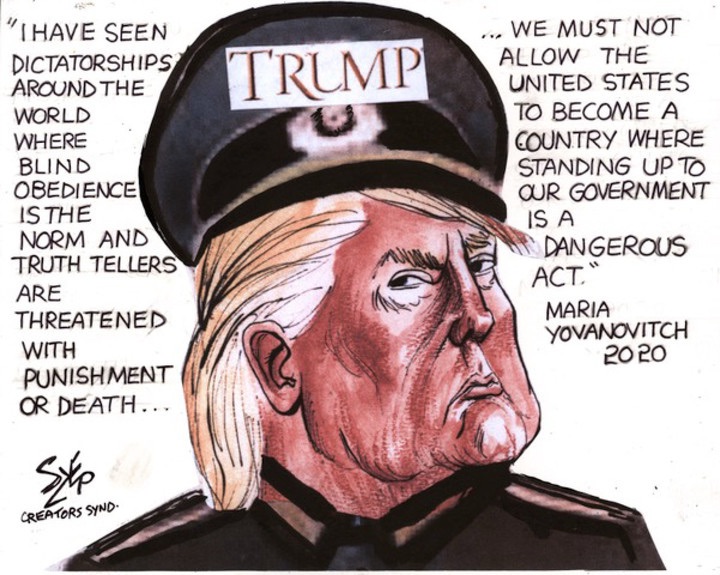
Trump’s war on higher education is similar to his war on every other major institution. He wants everyone to be afraid of him. He wants no critics to escape his wrath. He wants dissident voices silenced. He wants to be our king, our emperor, our dictator.

He has threatened to punish law firms that have represented his opponents, such as his 2016 challenger Hillary Clinton and Special Counsel Jack Smith, who gathered evidence of Trump’s crimes but was ultimately defeated by Trump’s delaying tactics.

He has threatened the news media, hitting CBS News “60 Minutes” with a $10 billion lawsuit for editing its interview with Kamala Harris (which is standard practice) and suing ABC News for a remark by George Stephanopoulos that he didn’t like. Both of these are frivolous lawsuits, but CBS is negotiating a settlement and ABC paid out $15 million to end the lawsuit. In a pre-emptive conciliatory move, Amazon (Jeff Bezos) bought the rights to a documentary about Melania Trump for $40 million, which will be produced by Melania. Bezos owns The Washington Post, where he has told the editorial board to go easy on Trump. The Post lost some of its best journalists after Bezos groveled to Trump.

He has threatened to cut off federal funding to universities if they don’t meet his demands. The ostensible reason for targeting universities is to compel them to combat anti-Semitism on their campuses, but it’s hard to credit Trump’s sincerity. He has defended anti-Semites, dined with them, and received their support. His best friend Elon Musk supported Germany’s far-right AfD party in the recent elections. A man who cares so little about civil rights, who attacks academic freedom, who defunds education and social services, who belittles minorities, who threatens democracy, and who is so utterly lacking in compassion–is no friend of Jews.

Last Friday, Trump said on his “Truth Social” account:

“We are going to be taking away Harvard’s Tax Exempt Status,” Trump wrote in a social media post. “It’s what they deserve!”

The President of the United States cannot take away the tax-exempt status of any individual or organization. That is a decision made by the IRS, and it is illegal for the President or Vice-President or any other government official to interfere in that decision. Such a decision is made by the IRS, must be made for cause, and the institution has the right to defend itself. The process can take years.

If the President could order the IRS to audit or investigate his enemies, it would be a very dangerous policy. He can’t. With Trump, the law is a minor inconvenience, so who knows what he will do. The Supreme Court told him he has absolute immunity so maybe he can disregard the law.

The Trump administration is blasting away at Harvard on multiple fronts. The Department of Homeland Security has threatened to revoke Harvard’s ability to enroll international students, who are 27 percent of Harvard’s enrollments.

The Education Department has demanded that Harvard supply the names and email addresses of all foreign students who were expelled since 2016. The Department also wants the names of all scholars, researchers, students and faculty associated with any foreign government. Just a few days ago, Secretary McMahon informed Harvard that it is no longer eligible for new funding so long as it continues to oppose the president’s agenda. That would mean allowing Trump’s agents to take control of admissions, hiring, and curriculum. The nation’s most prestigious university would have to abandon its independence to Trump.

The Department of Health and Human Services and the National Science Foundation have suspended over $2 billion in grants to Harvard for medical and scientific research. Studies that are focused on causes and cures for tuberculosis and ALS, for example, have come to a halt. Another $7 billion in research funding could be suspended. This could damage the research and work of hospitals across the Boston metro area, and the economy of Massachusetts as well. Since Massachusetts is a blue state, Trump doesn’t care.

If this looks like harassment, that’s because it is.

Trump is certainly no libertarian. He is using every federal source of funding to compel universities, colleges, schools, cities, and states to follow his commands.

That’s not democracy. That’s dictatorship.

Yesterday was World Press Freedom Day.

Press Freedom is at risk in every authoritarian regime, but also in the U.S. Trump has filed frivolous lawsuits against ABC and other news outlets. ABC paid him $15 million to make peace.

Trump sued CBS for $10 billion for editing a “60 Minutes” interview with Kamala Harris and is now in settlement talks. Editing a pre-taped interview is standard practice. The interview may last for an hour, but only 20 minutes is aired. Since Trump won the election, how was he damaged? It is hard to imagine he would win anything in court.

But Trump’s FCC chairman, Brendan Carr, has the power to destroy CBS. And the owner of CBS–Shari Redstone– is currently negotiating a lucrative deal that needs FCC approval. What will CBS pay Trump?

Given Trump’s legendary vindictiveness, will he succeed in eviscerating press freedom? Will the media dare criticize him as they have criticized every other president?

See CNN’s Brian Stelter on the state of press freedom today.

Now comes Trump’s puzzling vendetta against the Voice of America. In March, he issued an executive order to shut it down, although Republicans have traditionally supported it. On April 22, a federal district court judge overturned Trump’s executive order and demanded the rehiring of VOA staff. They were told they would be back at work in days. But yesterday, a three judge appeals court stayed the lower court’s ruling and VOA’s future is again in doubt. Two of the three appeals court judges were appointed by Trump.

The Voice of America has a unique responsibility. It brings objective, factual, unbiased news to people around the globe. For millions of people, the Voice of America is their only alternative to either government propaganda or no news at all.

Why does Donald Trump want to kill the Voice of America.

He has never explained.

He has called VOA “radical,” “leftwing,” and “woke,” but there is no factual basis for those attacks. They are talking points, not facts.

He appointed his devoted friend, Kari Lake, who ran for office in Arizona and lost both times, as the agent of VOA’s demise. She was an on-air commentator, so she knows something about media.

VOA seems to be in a death spiral, like USAID and the Department of Education.

The Washington Post reported on the Appeals Court’s ruling. Kari Lake described the decision as a “huge victory for President Trump.”

Trump has never explained why the Voice of America should be silenced.

Apparently no one at the VOA understands. I found this interview by Nick Schifrin of PBS (also on Trump’s chopping block), Lisa Curtis, and Michael Abramowitz, Director of VOA:

  • Nick Schifrin: Lisa Curtis is the chair of the board of Radio Free Europe/Radio Liberty and a former senior director on President Trump’s first National Security Council staff.
  • Lisa Curtis: While it’s understandable that President Trump wants to cut down on government waste and fraud, I think this is the wrong organization to be attacking. Russia, Iran, China, these countries are spending billions in their own propaganda, their own anti-American propaganda. So I think it’s critical that the U.S. government is supporting organizations like RFE/RL that are pushing back against that disinformation, misinformation.
  • Nick Schifrin: And she says RFE/RL’s content reaches more than 10 percent of Iranians, many of whom have protested the regime.
  • Lisa Curtis:So I think it really is part of U.S. soft power, but they actually call it the hard edge of soft power because it is so effective in getting out the truth about America, about what’s happening in their local environments. And this is absolutely critical.
  • Nick Schifrin:Curtis said she considers the freeze and their funding illegal because the money is congressionally appropriated and RFE/RL’s mission is congressionally mandated. And they will sue the Trump administration to get it restored.To discuss this, I turn to Michael Abramowitz, who since last year has been the president of Voice of America and before that was the president of Freedom House.Michael Abramowitz, thanks very much. Welcome back to the “News Hour.”As you heard, President Trump in his statement on Friday night referred to VOA as a radical propaganda with a liberal bias. Is it?Michael Abramowitz, Director, Voice of America: I don’t think so.I do think that people at many different news organizations have been accused of bias on both right and left, like many different news organizations. VOA is not perfect, but we’re unusual among news organizations because we are one of the few news organizations that by law has to be fair and balanced.Every year, we look at each of our language services, review it for fairness, for balance. I have been a journalist in this field for a long time, and I think the journalists at VOA stand up very well against people from CNN, FOX, New York Times, et cetera, in terms of the commitment to balance.When we do talk shows, for instance, broadcasting into Iran, we will have Republicans, we will have Democrats. We are presenting the full spectrum of American political opinion, which is required by our charter.
  • Nick Schifrin:You have heard from other administration officials or allies of the president. Ric Grenell, who is a special envoy, called it — quote — “a relic of the past. We don’t need government-paid media outlets.”
  • Elon Musk says:“Shut them down. Nobody listens to them anymore.”Fundamentally, why do you believe taxpayers should pay for VOA journalism?
  • Michael Abramowitz:You know, the media is changing, the world is changing, and the Cold War doesn’t exist anymore.But what is happening around the world is that there is a huge, really, battle over information. The world is awash in propaganda and lies, and our adversaries like Russia and China, Iran are really spreading narratives that directly undermine accurate views about America.And we have to fight back. And VOA in particular has been an incredible asset for fighting back by providing objective news and information in the languages, in 48 languages that people in the local markets we serve. No other news organization does that.
  • Nick Schifrin:Let me ask a little bit about the status of the agency. You and every employee were put on leave over the weekend. Today, all contractors have been terminated. Do you have any notion of what the goal is from the administration? Is it to reform VOA, or is it simply to destroy it?
  • Michael Abramowitz:Candidly, I don’t know.Ms. Kari Lake, who is supposed to be my successor at some point she’s given some interviews, and I think she clearly recognizes in those interviews that VOA serves an important purpose. I think there are a lot of Republicans, in particular, especially on the Hill, who recognize the value of Voice of America, who recognize that, if we shut down, for instance, our program on Iran, which is really an incredible newsroom — we have 100 journalists, most of whom speak Farsi, has a huge audience inside Iran.When the president of Iran, when his helicopter went down over the summer, there was a huge spike in traffic on the VOA Web site because the people of Iran knew that they could not get accurate information about what was going on, so they came to VOA to get it. That’s the kind of thing that we can do.
  • Nick Schifrin:I want to point out, we heard from Lisa Curtis, the chair of the board of Radio Free Europe/Radio Liberty.Voice of America and the Cuba Broadcasting, previously known as Radio Marti — we have got a graphic to show this — those are fully federal networks.(Crosstalk)
  • Nick Schifrin:What RFE/RL is talking about, they are a grantee. They get a grant from the U.S. government. RFE/RL will sue. Does VOA have any recourse today?
  • Michael Abramowitz:Well, I think we are — I mean, there’s a lot of discussion about some lawsuits that different parties are making. I know that the employees may be thinking about that.I think — I’m not sure that litigation in the end is going to be the most productive way. Maybe — I mean, you have to see what happens. But I think what would be really great is if Congress and the administration get together, recognize that this is a very important service, recognize that it’s sorely needed in a world in which our adversaries are spending billions of dollars, like Lisa said, and reformulate VOA to be effective for the modern age.
  • Nick Schifrin:And, finally, how — what’s the impact of this decision and the language that we have heard from the Trump administration on the very idea that information, that journalism sponsored by the U.S. government can support freedom and democracy?
  • Michael Abramowitz:We have been on the air essentially for 83 years through war, 9/11, government shutdown. VOA has kept — has kept its — has kept the lights on, has not been silent.So we’re silenced for the first time in 83 years. That’s devastating to me personally. It’s devastating to the staff. It’s devastating to all the thousands of people who used to work at VOA. I mean, this is a very special and unique news organization. It deserves to live. It doesn’t mean we can’t reform, but it deserves to survive.

I still don’t understand why Trump wants to close down America’s voice to the world.

I ask myself, who benefits if the Voice of America is stifled.

The obvious culprits: America’s enemies, especially Russia.

During the decades of the Cold War, VOA beamed information to dissenters behind the Iron Curtain. It kept hope alive.

No one would be happier to see VOA shut down than Putin.

The Constitution says Congress has the power of the purse, not the president. The president executes the funding decisions of Congress.

Yesterday Trump called on the Corporation for Public Broadcasting to stop funding public radio and public television. Never mind that National Public Radio brings news to listeners in areas totally saturated by rightwing Sinclair stations. Never mind that PBS is the best source of documentaries about science, history, nature, medicine, other nations, and global affairs. PBS is educational television at its best.

The Washington Post reported:

President Donald Trump signed an executive order on Thursday evening seeking to prohibit federal funding for NPR and the Public Broadcasting Service (PBS). The order, which could be subject to legal challenge, called the broadcasters’ news coverage “biased and partisan.”

It instructs the Corporation for Public Broadcasting to cease providing direct funds to either broadcaster. It also orders CPB to cease indirect funding of the services through grants to local public radio and television stations.

CPB is the main distributor of federal funds to public media. It receives about $535 million in federal funds per fiscal year, which it mostly spends on grants to hundreds of stations nationwide. The stations spend the grants on making their own programming or on buying programming from services such as NPR and PBS.

CPB, created by an act of Congress in 1967, also sometimes provides direct grants to NPR and PBS to produce national programs.
Thursday’s order instructs the CPB board to ensure that stations receiving its grants “do not use Federal funds for NPR and PBS.”

Jamelle Bouie, one of the most insightful columnists for The New York Times, observes that Trump has no interest in governing. He is interested in ruling. He thinks he has a mandate, even though he did not win 50% of the popular vote. He thinks his will is as powerful as law. He does not share power with Congress, and he’s testing how far he can go to diminish the courts.

Bouie reflects on Trump’s indifference to the other branches of Govenment in this newsletter:

I think it’s obvious that neither President Trump nor his coterie of agents and apparatchiks has any practical interest in governing the nation. It’s one reason (among many) they are so eager to destroy the federal bureaucracy; in their minds, you don’t have to worry about something, like monitoring the nation’s dairy supply for disease and infection, if the capacity for doing so no longer exists.

But there is another, less obvious way in which this observation is true. American governance is a collaborative venture. At minimum, to successfully govern the United States, a president must work with Congress, heed the courts and respect the authority of the states, whose Constitutions are also imbued with the sovereignty of the people. And in this arrangement, the president can’t claim rank. He’s not the boss of Congress or the courts or the states; he’s an equal.

The president is also not the boss of the American people. He cannot order them to embrace his priorities, nor is he supposed to punish them for disagreement with him. His powers are largely rhetorical, and even the most skilled presidents cannot shape an unwilling public.

Trump rejects all of this. He rejects the equal status of Congress and the courts. He rejects the authority of the states. He does not see himself as a representative working with others to lead the nation; he sees himself as a boss, whose will ought to be law. And in turn, he sees the American people as employees, each of us obligated to obey his commands.

Trump is not interested in governing a republic of equal citizens. To the extent that he’s even dimly aware of the traditions of American democracy, he holds them in contempt. What Trump wants is to lord over a country whose people have no choice but to show fealty and pledge allegiance not to the nation but to him.

What was it Trump said about Kim Jong-un, the North Korean dictator, during his first term in office? “Hey, he’s the head of a country. And I mean he is the strong head. Don’t let anyone think anything different,” Trump said in 2018. “He speaks, and his people sit up at attention. I want my people to do the same.”

He wants his people to do the same.

Ad

Jill Underly was recently te-elected as State Superintendent of Schools in Wisconsin. She is an active member of the Netwotk for Public Education and attended its last two meetings. She released the following statement after two courts hacked away at Trump’s threat to withhold funds from schools that taught diversity, equity, and inclusion

MADISON, Wis. (WISCONSIN DEPARTMENT OF PUBLIC INSTRUCTION PRESS RELEASE) – State Superintendent Dr. Jill Underly today issued a statement following two federal court rulings that limit the Trump administration’s ability to withhold critical school funding over an unclear certification form and process.

“Our top priority in Wisconsin is our kids and making sure every student has the support they need to succeed. The past few weeks, school leaders have been scrambling to understand what the impact of the U.S. Department of Education’s order could be for their federal funds, forcing them to take their eye off what matters most.

“Today, two separate courts reached a similar conclusion: the USDE’s new certification process is likely unlawful and unconstitutionally vague. That is a welcome development for our schools and communities who, working in partnership with parents and families, are best positioned to make decisions for their communities – not Washington, D.C.

“We are closely reviewing today’s rulings and will continue to stand up for Wisconsin schools, and most importantly, our kids.”

The Trump administration claims that it wants to reduce federal intervention into the nation’s public and private institutions. But it intervenes forcefully in both public and private sectors to punish anyone with different views. It has threatened to withhold federal funding for research from universities unless the targeted universities allow the federal government to supervise its curriculum, its hiring policies, and its admissions policies. And he threatened to stop the funding of any K12 school that continues DEI programs.

The Trump regime has created a nanny state.

From Day 1, Trump made clear that he would ban practices and policies intended to diversity, equity, and inclusion. He threatened to withhold federal funding of schools that ignored his order to eliminate DEI. He has taken complete control of the Kennedy Center, so as to block DEI programming, and he has appointed a woman with no credentials to remove DEI from the Smithsonian museums.

Who knows how the African American Museum will survive Trump’s DEI purge.

ABC News reported that a federal district judge has halted the DEI ban, at least in schools associated with one of the lawsuit’s plaintiffs, the NEA.

ABC News reported:

The Trump administration’s attempt to make federal funding to schools conditional on them eliminating any DEI policies erodes the “foundational principles” that separates the United States from totalitarian regimes, a federal judge said on Thursday.

In an 82-page order, U.S. District Judge Landya McCafferty partially blocked the Department of Education from enforcing a memo issued earlier this year that directed any institution that receives federal funding to end discrimination on the basis of race or face funding cuts.

“Ours is a nation deeply committed to safeguarding academic freedom, which is of transcendent value to all of us and not merely to the teachers concerned,” Judge McCafferty wrote, adding the “right to speak freely and to promote diversity of ideas and programs is…one of the chief distinctions that sets us apart from totalitarian regimes.”

“In this case, the court reviews action by the executive branch that threatens to erode these foundational principles,” she wrote.

The judge stopped short of issuing the nationwide injunction, instead limiting the relief to any entity that employs or contacts with the groups that filed the lawsuit, including the National Education Association and the Center for Black Educator Development.

Under the misguided policies of Trump and Hegseth, censorship and book banning have been widespread, especially by the Defense Department. Hegseth is eager to please Trump and has stripped recognition from anyone of distinction who is female and/or non-white. Even a photograph of the Enola Gay, the plane that dropped the first atomic bomb, was taken down–because of its name. The Navajo Code Talkers were put into storage. The first women to achieve military feats and honors were mothballed. The U.S. Naval Academy removed almost 400 books from its library because of DEI (diversity, equity, inclusion) themes.

Ryan Holiday was invited to lecture at the Naval Academy a few weeks ago, as he had in the past. Shortly before he was to speak, he was asked not to mention the books that had been removed from the Academy’s library. When he refused, his speech was canceled.

Question: if the men and women of the U.S. Navy are brave enough to risk their lives, aren’t they brave enough to read a book about race and gender?

Holiday wrote in The New York Times:

For the past four years, I have been delivering a series of lectures on the virtues of Stoicism to midshipmen at the U.S. Naval Academy in Annapolis, Md., and I was supposed to continue this on April 14 to the entire sophomore class on the theme of wisdom.

Roughly an hour before my talk was to begin, I received a call: Would I refrain from any mention in my remarks of the recent removal of 381 supposedly controversial books from the Nimitz library on campus? My slides had been sent up the chain of command at the school, which was now, as it was explained to me, extremely worried about reprisals if my talk appeared to flout Executive Order 14151(“Ending Radical and Wasteful Government D.E.I. Programs and Preferencing”).

When I declined, my lecture — as well as a planned speech before the Navy football team, with which my books on Stoicism are popular — was canceled. (The academy “made a schedule change that aligns with its mission of preparing midshipmen for careers of service,” a Navy spokesperson told Times Opinion. “The Naval Academy is an apolitical institution.”)

Had I been allowed to go ahead, this is the story I was going to tell the class:

In the fall of 1961, a young naval officer named James Stockdale, a graduate of the Naval Academy and future Medal of Honor recipient who went on to be a vice admiral, began a course at Stanford he had eagerly anticipated on Marxist theory. “We read no criticisms of Marxism,” he recounted later, “only primary sources. All year we read the works of Marx and Lenin.”

It might seem unusual that the Navy would send Stockdale, then a 36-year-old fighter pilot, to get a master’s degree in the social sciences, but he knew why he was there. Writing home to his parents that year, he reminded them of a lesson they had instilled in him, “You really can’t do well competing against something you don’t understand as well as something you can.”

At the time, Marxism was not just an abstract academic subject, but the ideological foundation of America’s greatest geopolitical enemy. The stakes were high. The Soviets were pushing a vision of global Communism and the conflict in Vietnam was flashing hot, the North Vietnamese fueled by a ruthless mix of dogma and revolutionary zeal. “Marxism” was, like today, also a culture war boogeyman used by politicians and demagogues.

Just a few short years after completing his studies, in September 1965, Stockdale was shot down over Thanh Hoa in North Vietnam, and as he parachuted into what he knew would be imprisonment and possibly death, his mind turned to the philosophy of Epictetus, which he had been introduced to by a professor at Stanford.

He would spend the next seven years in various states of solitary confinement and enduring brutal torture. His captors, sensing perhaps his knowledge as a pilot of the “Gulf of Tonkin incident,” a manufactured confrontation with North Vietnamese forces that led to greater U.S. involvement in Vietnam, sought desperately to break him. Stockdale drew on the Stoicism of Epictetus, but he also leveraged his knowledge of the practices and the mind-set of his oppressors.

“In Hanoi, I understood more about Marxist theory than my interrogator did,” Stockdale explained. “I was able to say to that interrogator, ‘That’s not what Lenin said; you’re a deviationist.’”

In his writings and speeches after his return from the prison known as the Hanoi Hilton, Stockdale often referred to what he called “extortion environments,” which he used to describe his experience as a captive. He and his fellow P.O.W.s were asked to answer simple questions or perform seemingly innocuous tasks, like appear in videos, and if they declined, there would be consequences.

No one at the Naval Academy intimated any consequences for me, of course, but it felt extortionary all the same. I had to choose between my message or my continued welcome at an institution it has been one of the honors of my life to speak at.

As an author, I believe deeply in the power of books. As a bookstore owner in Texas, I have spoken up about book banning many timesalready. More important was the topic of my address: the virtue of wisdom.

As I explained repeatedly to my hosts, I had no interest in embarrassing anyone or discussing politics directly. I understand the immense pressures they are under, especially the military employees, and I did not want to cause them trouble. I did, however, feel it was essential to make the point that the pursuit of wisdom is impossible without engaging with (and challenging) uncomfortable ideas.

Seneca, the Stoic philosopher, used a military metaphor to make this very argument. We ought to read, he said, “like a spy in the enemy’s camp.” This is what Stockdale was doing when he studied Marxism on the Navy’s dime. It is what Seneca was doing when he read and liberally quoted from Epicurus, the head of a rival philosophical school.

The current administration is by no means unique in its desire to suppress ideas it doesn’t like or thinks dangerous. As I intended to explain to the midshipmen, there was considerable political pressure in the 1950s over what books were carried in the libraries of federal installations. Asked if he would ban communist books from American embassies, Eisenhower resisted.

“Generally speaking,” he told a reporter from The New York Herald Tribune at a news conference shortly after his inauguration, “my idea is that censorship and hiding solves nothing.” He explained that he wished more Americans had read Hitler and Stalin in the previous years, because it might have helped anticipate the oncoming threats. He concluded, “Let’s educate ourselves if we are going to run a free government.”

ADVERTISEMENT

SKIP ADVERTISEMENT

The men and women at the Naval Academy will go on to lead combat missions, to command aircraft carriers, to pilot nuclear-armed submarines and run enormous organizations. We will soon entrust them with incredible responsibilities and power. But we fear they’ll be hoodwinked or brainwashed by certain books?

Hitler’s “Mein Kampf” was not one of the books removed from the Naval Academy library, and as heinous as that book is, it should be accessible to scholars and students of history. However, this makes the removal of Maya Angelou’s “I Know Why the Caged Bird Sings” inexplicable. Whatever one thinks of D.E.I., we are not talking about the writings of external enemies here, but in many cases, art, serious scholarship and legitimate criticism of America’s past. One of the removed books is about Black soldiers in World War II, another is about how women killed in the Holocaust are portrayed, another is a reimagining of Kafka called “The Last White Man.” No one at any public institution should have to fear losing their job for pushing back on such an obvious overreach, let alone those tasked with defending our freedom. Yet here we are.

The decision by the academy’s leaders to not protest the original order — which I believe flies in the face of basic academic freedoms and common sense — has put them in the now even stickier position of trying to suppress criticism of that decision. “Compromises pile up when you’re in a pressure situation in the hands of a skilled extortionist,” Stockdale reminds us. I felt I could not, in good conscience, lecture these future leaders and warriors on the virtue of courage and doing the right thing, as I did in 2023 and 2024, and fold when asked not to mention such an egregious and fundamentally anti-wisdom course of action.

In many moments, many understandable moments, Stockdale had an opportunity to do the expedient thing as a P.O.W. He could have compromised. He could have obeyed. It would have saved him considerable pain, prevented the injuries that deprived him of full use of his leg for the rest of his life and perhaps even returned him home sooner to his family. He chose not to do that. He rejected the extortionary choice and stood on principle.

More than 100 universities joined forces to oppose the Trump administration’s efforts to control their curriculum, their hiring policies, and their admissions policies. The initial statement was released this morning and almost another 100 universities signed on.

The Trump administration’s threat to academic freedom by suspending federal funding and threatening the universities’ tax-exempt status alarmed the universities and spurred them to resist the administration’s unprecedented effort to stifle academic freedom.

CBS News reported:

Washington — More than 100 U.S. universities and colleges, including Harvard, Princeton, Penn, Brown, MIT, Cornell and Tufts issued a joint letter Tuesday condemning President Trump’s “political interference” in the nation’s education system. 

The move comes a day after Harvard University sued the Trump administration, which announced an initial funding freeze of $2.2 billion and later signaled its intention to suspend an additional $1 billion in grants. The moves came after weeks of escalation between the administration and Harvard, which had rejected the administration’s demands to change many of the school’s policies and leadership, including auditing the student body and faculty for “viewpoint diversity.”

“We speak with one voice against the unprecedented government overreach and political interference now endangering American higher education,” Tuesday’s letter read. 

“We are open to constructive reform and do not oppose legitimate government oversight. However, we must oppose undue government intrusion,” it said, adding: “We must reject the coercive use of public research funding.” 

Mr. Trump has sought to bring several prestigious universities to heel over claims they tolerated campus antisemitism, threatening their budgets and tax-exempt status and the enrollment of foreign students.

The letter said the universities and colleges were committed to serving as centers where “faculty, students, and staff are free to exchange ideas and opinions across a full range of viewpoints without fear of retribution, censorship, or deportation.”

“Most fundamentally,” the letter reads, “America’s colleges and universities prepare an educated citizenry to sustain our democracy.

“The price of abridging the defining freedoms of American higher education will be paid by our students and our society. On behalf of our current and future students, and all who work at and benefit from our institutions, we call for constructive engagement that improves our institutions and serves our republic.”

Reuters reported that other higher education institutions added their names to the statement, which now has nearly 200 signatories.

The New York Times reported today that some of Harvard’s major donors were urging it to settle with the administration. Eventually, the government’s threats to take control of the university made a settlement impossible.

Jason Garcia is an investigative reporter in Florida who has had plenty to investigate during the regime of Ron DeSantis. His blog is called “Seeking Rents.” This is a post you should not miss.

The governor acts like a dictator, and the Republican-dominated legislature doesn’t stop him. Remember the takeover of New College? It was the only innovative, free-thinking public institution of higher education in the state. It was tiny, only 700 students. But DeSantis took control of the college’s board, hired a new president (a crony) and set about destroying everything that made it unique. He issued one executive order after another for the entire state to crush DEI and assure the only permissible thought mirrored his own. He attacked drag queens and threatened to punish bars and hotels that allowed them to perform. He created a private army, subject only to his control. He selected politicians to run major universities. He imposed thought control on the state. Fascism thrives in Florida.

Thus far, he has gotten away with his gambits. But Garcia doesn’t think he will get away with this one.

He writes:

A simmering scandal erupted Friday afternoon when the Tampa Bay TimesMiami Herald and Politico Florida revealed that the administration of Gov. Ron DeSantis orchestrated a $10 million payment last fall to a charity founded by the governor’s wife — which then turned around and gave the money to groups that helped finance the governor’s campaign against a proposed constitutional amendment to legalize marijuana in Florida.

In a nutshell: The DeSantis administration pressured a major state contractor to make a $10 million donation to the Hope Florida Foundation, the controversial charity spearheaded by First Lady Casey DeSantis. It was part of a settlement negotiated with Centene Corp., after the state’s largest Medicaid contractor overbilled the state by at least $67 million.

Days later, Hope Florida transferred that $10 million to a pair of dark-money nonprofits. The state-backed charity gave $5 million each to “Save Our Society From Drugs,” an anti-marijuana group founded by a late Republican megadonor, and “Secure Florida’s Future,” a political vehicle controlled by executives at the Florida Chamber of Commerce, the Big Business lobbying group.

And days after that, Save Our Society From Drugs and Secure Florida’s Future gave a combined $8.5 million to “Keep Florida Clean,” a political committee — chaired by Ron DeSantis’ then-chief of staff — created to oppose Amendment 3, the amendment on last year’s ballot that would have allowed Floridians to use marijuana recreationally rather than solely for medicinal reasons.

It’s a daisy chain that may have transformed $10 million of public money — money meant to pay for health insurance for poor, elderly and disabled Floridians — into funding for anti-marijuana campaign ads.

DeSantis, of course, has repeatedly insisted that he did nothing wrong while also lashing out in increasingly vitriolic ways at everyone from the Republican speaker of the state House to the newspaper reporters digging into the story.

But at least one prominent GOP lawmaker — Rep. Alex Andrade, a Pensacola Republican who has been presiding over hearings into Hope Florida — told the Times and Herald that the transaction chain “looks like criminal fraud by some of those involved.”

Clearly, this looks very bad. But it is also by no means an isolated incident. 

In fact, this is part of a larger pattern of potential abuses that Ron DeSantis committed last fall when he chose to turn the power of state government against two citizen-led constitutional amendments that appeared on the November ballot: Amendment 3 and Amendment 4, which would have ended Florida’s statewide abortion ban.

Consider what we already know about how DeSantis financed his campaigns against the two amendments using public money taken from taxpayers — and private money taken from donors who got public favors from the governor.

  • Five state agencies directly funded television commercials meant to weaken support for the marijuana and abortion-rights ballot measures. We still don’t know the full extent of their spending, although Seeking Rents has estimated the total taxpayer tab at nearly $20 million. We also know that the DeSantis administration commandeered money for anti-marijuana advertising from Florida’s share of a nationwide legal settlement with the opioid industry — money that was supposed to be spent combatting the opioid addiction crisis.
  • At the same time, another nonprofit funded by Florida taxpayers poured at least $5 million into television ads attempting to soften Florida’s image on women’s healthcare at a time when Florida’s near-total abortion was under intense attack. It was the Florida Pregnancy Care Networks’ first-ever TV ad campaign. And its commercials, which were overseen by DeSantis administration staffers, complemented the state agency ads against the abortion-rights amendment — right down to using the same slogan.
  • Last June, after DeSantis vetoed legislation that would have strictly regulated the state’s hemp industry, CBS News Miami revealedthat industry executives and lobbyists promised to raise $5 million in exchange for the veto for the governor to spend on his campaign against Amendment 3. “Our lobby team made promises to rally some serious funding to stand with him on this,” a hemp industry representative wrote in one message that included a bank routing number for the Republican Party of Florida. “We have to pay $5 million to keep our end of the veto,” a hemp executive wrote in another message.
  • In the closing weeks of the campaign, records show that the Big Tobacco giant Philip Morris International gave $500,000 to DeSantis’ personal political committee — which was also chaired by the governor’s then-chief of staff and which DeSantis was using to campaign against both Amendment 3 and Amendment 4. Shortly after the election, the DeSantis administration handed Philip Morris a lucrative tax break, ruling that the company could sell a new line of electronically heated tobacco sticks free of state tobacco taxes.

There were other abuses of power, too. DeSantis and his team threatened to criminally prosecute television stations that aired ads supporting Amendment 4. They sent state police to the homes of Florida voters who signed Amendment 4 petitions. And they hijacked the ballot-writing process for Amendment 4.

There’s a reason why the DeSantis administration made sure to extract a promise of legal immunityfrom the organization that sponsored Amendment 4 as part of a legal settlement negotiated after the election.

DeSantis’ tactics worked. Though Amendments 3 and 4 each won majority support from Florida voters — 55.9 percent for recreational marijuana, 57.2 percent for abortion rights — both fell short of the 60 percent support needed to amend the state constitution.

But, suddenly, it looks like this may not be over — at least not for Ron DeSantis.

House Republicans are seeking troves of records from the DeSantis administration, including text messages and emails related to Hope Florida. The chamber has also scheduled another hearing on the Casey DeSantis charity next week.

What’s more, the House also unveiled a sweeping ethics reform package last week that would, among other things, explicitly expose senior government officials to criminal penalties if they interfere with elections.

That particular legislation would also prohibit state employees from soliciting money for political campaigns — an idea that emerged after DeSantis aides got caught squeezing lobbyistsfor more donations to their boss’ political committee ahead of a possible Casey DeSantis campaign for governor….

Ron DeSantis bet his political future on beating the marijuana and abortion-rights amendments. And he won both of those battles.

But it may turn out that he ultimately lost the war.

Wishful thinking? I hope not.

To give you an idea of how far/right the legislature is, Garcia lists some of the bills that are currently moving through the legislative process:

  • House Bill 549: Requires all new public school textbooks to refer to the Gulf of Mexico as the “Gulf of America.” Passed the Senate by a 28-9 vote. (See votes) Previously passed the House of Representatives by a 78-29 vote. (See votes) Goes to the governor.
  • House Bill 575: Replaces Gulf of Mexico with “Gulf of America” in state law. Passed the Senate by a 28-9 vote. (See votes) Previously passed the House of Representatives by a 78-27 vote. (See votes) Goes to the governor….
  • House Bill 1517: Allows someone to file a wrongful death lawsuit seeking lost wages on behalf of an embryo or fetus. Passed the House of Representatives by a 79-32 vote. (See votes)…
  • House Bill 7031: Cuts the state sales tax rate from 6 percent to 5.25 percent. Passed the House of Representatives by a 112-0 vote. (See votes)
  • House Bill 123: Allows a traditional public school to be converted into a charter school without the consent of the teachers who work at the school. Passed the House Education & Employment Committee by an 11-4 vote. (See votes)

Denis Smith retired from his position at the Ohio Department of Education, where he oversaw charter schools (which are called “community schools” in Ohio). In this post, he describes what he saw at the Network for Public Education Conference in Columbus, Ohio, in early April.

He wrote:

When It’s About Hands Off! That Also Applies to Public Schools

The Hands Off! demonstrations at the Ohio Statehouse that drew thousands of protestors wasn’t the only gathering of activists last weekend in downtown Columbus. Just a short distance away at the Hyatt Regency Hotel, a smaller but equally passionate gathering of concerned citizens from across the nation came to Ohio’s capital city to attend the Network for Public Education’s National Conference and affirm their support for the common school, the very symbol of democracy in this increasingly divided nation.

That disunion is driven in part by the rapid growth of universal educational vouchers and charter schools, where public funds flow to private and religious schools as well as privately operated charter schools and where public accountability and oversight of taxpayer funds is limited or even absent. In many states, including Ohio, those public funds in the form of vouchers are drawn from the very state budget line item that is earmarked for public schools.

Of particular concern to the conference attendees is the division in communities fueled by vouchers, which have been shown in some states to subsidize private and religious school tuition exceeding 80% of those enrolled. In Ohio, according to research conducted by former Ohio legislator Stephen Dyer, the figure is 91%.Several speakers referred to this situation as “welfare for the rich” and “an entitlement for the wealthy.” 

The research shared at the conference also confirmed the findings of the National Coalition for Public Education that “most recipients of private school vouchers in universal programs are wealthy families whose children never attended public schools in the first place.” So much for the tired Republican rhetoric of vouchers being a lifeline of escape from “failing schools” for poor inner-city children.

Another strong area of concern shared at the NPE event was the growing intrusion of religious organizations like Life Wise Academy which recruit students for release time Bible study during the school day. While attendees were told that school guidelines direct that such activities are to be scheduled during electives and lunch, the programs still conflict with the normal school routine and put a burden on school resources, where time is needed for separating release time students and adjusting the instructional routine because of the arrival and departure of a group within the classroom.

One presenter, concerned about students receiving conflicting information, said that his experience as a science teacher found situations where there was a disconnect between what he termed “Biblical stories and objective facts.” In addition, he shared that a group of LifeWise students missed a solar eclipse because of their time in religious instruction.  

Some Ohio school districts, including Westerville and Worthington in Franklin County, had to amend their policies in the wake of HB 8, which mandated that districts have religious instruction release time policies in place. The district policies had been written as an attempt to lessen the possibility of other religious programs wanting access to students and the further disruption that would cause to the school routine. 

The recent legislative activity about accommodating religious groups like Life Wise is at variance with history, as conference chair and Network for Public Education founder Dr. Diane Ravitch pointed out in her remarks about the founding of Ohio. As part of the Northwest Territory, she noted that Ohio was originally divided into 32 plots, with plot 16, being reserved for a public school. No plot was set aside for a religious school.

Ohio became the first state to be formed from the Northwest Territory, and its provision for public education would become a prototype for the young republic. The common school, an idea central to the founders of the state, would be located such “that local schools would have an income and that the community schoolhouses would be centrally located for all children.”

Unfortunately, the idea of the common school being centrally located in every community is an idea not centrally located within the minds of right-wing Republican legislators. From the information exchanged at the conference, that is the case in the great majority of statehouses, and a matter of great concern for continuing national cohesiveness.

The theme of the NPE National Conference, Public Schools – Where All Students Are Welcome, stands in marked contrast with the exclusionary practices of private and religious schools where, unlike public schools, there are no requirements to accept and enroll every student interested in attending. While these schools are reluctant to accept students who may need additional instructional support, they show no reluctance in accepting state voucher payments.

Texas Rep. Gina Hinojosa. Photo: Texas House of Representatives

Texas State Representative Gina Hinojosa, one of the keynote speakers, told the audience about her experience in fighting Gov. Greg Abbott’s voucher scheme and the double meaning of the term school choice. “School choice is also the school’s choice,” she told the audience, as she estimated that 80% or more of state funds will go to kids who are already enrolled in private and religious schools.

Her battle with the Texas governor, who has defined the passage of voucher legislation in the Lone Star State as his “urgent priority,” is a tale of his alliance with Jeff Yass, a pro-voucher Pennsylvania billionaire who has donated $12 million so far to Abbott’s voucher crusade. 

Hinojosa was scathing in her criticism of Abbott and his fellow Republicans and of a party that once “worshipped at the altar of accountability.” Now, she told the attendees, “they want free cash money, with no strings attached.” 

“Grift, graft, and greed” is the narrative of appropriating public funds for private purposes, Hinojosa believes, a tale of supporting “free taxpayer money with no accountability.”

Minnesota Gov. Tim Walz. Photo: Denis Smith

The NPE conference ended with an address by Minnesota Gov. Tim Walz, the 2024 Democratic Vice-Presidential nominee. With his background as a former teacher and coach, Walz had a strong connect with an audience comprised mostly of educators and public school advocates. His folksy language and sense of humor further endeared him to the conference attendees.

Based on the continuing bad behavior of Jeff Yass and other affluent actors in the voucher and charter wars, greedy bastards is a better descriptor than oligarchs, he observed. From the reaction of the audience and what they heard previously from Gina Hinojosa and other presenters, the language offered by Walz was a more accurate definition of welfare for the wealthy. 

At the end of his remarks, Walz encouraged educators not to despair but to accept their key place in society. “There is a sense that servant leadership comes out of serving in public education.”

Attendees at the NPE conference included educators, school board members, attorneys, legislators, clergy, and policy makers – a cross-section of America. Their presence affirmed a core belief that the public school, open to all, represents the very essence of a democratic society. And there is no debate about whether or notthose schools are under attack by right-wing legislatures intent on rewarding higher-income constituents with tuition support to schools that choose their students as they exercise the “school’s choice.”(As a devotee of the Apostrophe Protection Society, I applaud this distinction.)

So what are we going to do about this? Attendees left the conference with some strong themes.

The choir needs to sing louder.

Hope over fear. Aspiration over despair.

The road to totalitarianism is littered with people who say you’re overreacting.

Who are the leaders of the Democratic Party? They’re out there. On the streets.

It’s not just don’t give up. Be an activist.

As the loudness about the subject of what is more aptly described as “the school’s choice” gets louder,” you can bet that servant leaders like Diane Ravitch, Gina Hinojosa, Tim Walz and others are making a difference in responding to the challenge of servant leadership to ensure that the common school, so central to 19th century communities in the Northwest Territory and beyond, continues to be the choice of every community for defining America and the democracy it represents.