Archives for category: Fascism

Veteran prosecutor Joyce Vance shared some good news: the nomination of Ed Martin to be U.S. Attorney in DC is hanging by a thread and may be dead. Senator Thom Tillis of North Carolina interviewed Martin and said he would vote no in the Senate Judiciary Committee because Martin supported the January 6 insurrectionists, even those who assaulted police officers. Since the split on the committee is 12 Republicans and 10 Democrats, Martin’s nomination would not get to the Senate floor. If you live in North Carolina, please call Senator Tillis and thank him.

Vance writes:

Last night, I wrote to you about Ed Martin, Trump’s nominee to be the United States Attorney in Washington, D.C.. Martin, until quite recently, used the handle “Eagle Ed Martin” on Twitter, a reference to his days working for Phyllis Schlafly’s Eagle Forum. Apparently, someone mentioned to him during the last month that the handle wasn’t appropriate for a U.S. Attorney hopeful.

But no whisper in the ear could fix Martin’s other flaws, from utter lack of qualifications and knowledge about how to do the job to flagrant ties to people known for their open antisemitism. Last night, I suggested we all needed to be in touch with our senators on the Martin nomination. Although we still need to do that, the message is different now. That’s because North Carolina Senator Thom Tillis, a Republican who sits on the Senate Judiciary Committee, made it known that he won’t support Martin. 

Before Martin goes to the floor of the Senate for a confirmation vote, he has to make it out of committee. And that’s unlikely to happen now. The Senate Judiciary Committee is made up of 12 Republicans and 10 Democrats. All of the Democrats oppose Martin. With Tillis abandoning him, the best Martin could do is 11-11, and a nominee who receives a tie vote doesn’t advance. For all practical purposes, the outcome of that vote will be a death knell for his nomination.

Martin may end up rewarded for his loyal service to Trump and Musk with another plum job, one that doesn’t require Senate confirmation. But that doesn’t mean we shouldn’t celebrate the moment and the fact that it looks like he won’t be the top law enforcement officer in the District of Columbia. Defeating Martin’s nomination wasn’t a foregone conclusion—far from it. It took lots of research, lots of conversation, and lots of hard work by a lot of people. You never know which issue, or even which call or letter, is going to be the last straw. What matters is that Trump and his plans are not inevitable, and it makes a difference when all of us push back against the horrible as hard as we can.

Tillis told reporters this morning that he is unable to support Martin because of Martin’s support for defendants convicted of committing crimes in connection with January 6. He is certain to face a sustained backlash from MAGA’s inner circle, so if he’s your senator, make sure you thank him, and if your senator is on the Judiciary Committee (that’s Grassley, Graham, Cornyn, Lee, Cruz, Hawley, Tillis, Kennedy, Blackburn, Schmitt, Britt, and Moody on the Republican side and Durbin, Whitehouse, Klobuchar, Coons, Blumenthal, Hirono, Booker, Padilla, Welch, and Schiff for the Democrats) this is a good time to reach out and either thank them for opposing or encourage them to show a little backbone and follow Tillis’ lead. Martin, after all, supports the people who overran the Capitol, threatening these folks and their staff. He is the least qualified selection I can recall seeing to lead a U.S. Attorney’s office, even edging out Trump’s former attorney Alina Habba, the New Jersey nominee, who should be rejected as well. This is a very big win for pro-democracy forces.

There was also a win on a very different front, one that didn’t get a lot of national attention. Trump’s efforts to cut staff and funding at national parks have garnered a lot of attention in the protests that have cropped up across the country. Many protests have taken place at the parks themselves, notably at Yosemite, where staff unfurled an upside-down American flag atop El Capitan to signal distress. On March 1, people protested at all 433 sites in the national park system—the 63 national parks and additional sites like monuments and historic places. Americans, it turns out, love their national parks.

Despite that, the Trump administration continues to keep them on the chopping block. Last week, the Washington Post reported that the Trump administration had suspended all air-quality monitoring at national parks, stating that “The Interior Department, which includes the National Park Service, issued stop-work orders last week to the two contractors running the program, the email shows.”

The reporting provided detail that makes it clear this is a serious matter:

  • Data was being collected on ozone and particulate matter and being used in connection with requests to grant permits to industrial facilities like power plants and oil refineries in close proximity to the parks.
  • The pollutants data was being collected on are “linked to a range of adverse health effects,” including “heart attacks, strokes, asthma attacks and premature death.”
  • One goal of the program is “to curb regional haze,” which has “reduced visibility at scenic viewpoints in parks nationwide” over the past few decades.

Park Service employees pushed back and demanded that monitoring continue. They pointed out that states lack the equipment and resources to monitor and that without federal monitoring, they would be flying blind. It’s part and parcel of discontinuing environmental justice work at the Justice Department. Data makes it possible to protect the environment and the people who live in it. Trump is creating a permissive environment for business—when you can’t document the consequences of a new plant permit, for instance, it’s hard to oppose it.

But today, Washington Post reporter Teddy Amenabar posted on social media that “After The Post’s article was published, a Park Service spokesperson said the stop-work orders would be reversed and that ‘contractors will be notified immediately.’” Whether it’s traditional media, new media, protests, or our communications with our elected officials, it’s clear that none of what Trump wants to do is inevitable. Sunlight continues to act as a disinfectant. Government employees need public support right now, especially as many of them continue to bravely do the right thing, whether it’s federal prosecutors or park rangers. They richly deserve our support.

So if you’ve been questioning whether what you’re doing matters, it does. The signs you make, the protests you go to, the letters and calls you make to elected officials, your efforts to share information (like this newsletter) with people—all of these efforts matter. It all adds up, small victories and large ones.

Speaking of big ones, Donald Trump appears to have knowingly lied when he invoked the Alien Enemies Act (AEA) in order to deport alleged members of the Venezuelan Tren de Aragua gang. In his proclamation, he said, “TdA operates in conjunction with Cártel de los Soles, the Nicolas Maduro regime-sponsored, narco-terrorism enterprise based in Venezuela, and commits brutal crimes, including murders, kidnappings, extortions, and human, drug, and weapons trafficking. TdA has engaged in and continues to engage in mass illegal migration to the United States to further its objectives of harming United States citizens, undermining public safety, and supporting the Maduro regime’s goal of destabilizing democratic nations in the Americas, including the United States.”

Not so fast. An intelligence community memo was partially declassified yesterday, two weeks after a FOIA request was made for it—that’s lightning speed in the world of FOIA, where requests can drag on for years. The memo contradicts Trump’s claimed basis for invoking the AEA. Hat tip to my friend Ryan Goodman, whose new Substack is great if you haven’t seen it already, for highlighting the parts of the memo that contradict Trump’s claim that TdA is mounting an invasion of the U.S. on behalf of Venezuela’s government.

Someone involved in responding to FOIA requestsseems to have been highly motivated to make sure the American people have access to the truth. Win.

It’s not clear how or whether this will impact ongoing litigation. Judges largely defer to presidential assessments of this nature under the political questions doctrine. We don’t know if this revelation will have any impact in court, although there should be some ambit, even if it’s small, for courts to reject presidential assessments that run entirely contrary to the facts. But in the court of public opinion, where facts still matter, here are some facts, from the people who know the subject best.

Finally for tonight, the North Carolina Supreme Court race that we’ve been following so carefully since last November seems to finally be over, and Allison Riggs, the Democrat who won the race, will now be declared the winner per an order issued by a federal judge who is a Trump appointee. Two recounts confirmed Riggs’ victory, but the disgruntled loser challenged it nonetheless. He tried to convince courts to disallow ballots cast by North Carolina voters who complied with all of the rules for voting by changing the rules about what ballots could be counted after the fact. He could still appeal this ruling, but it is a solid decision and unlikely to be reversed on appeal. The bottom line democratic principle is that you don’t get to move the goal posts to secure a victory. Didn’t work for Trump, and it didn’t work in North Carolina. Chalk another one up for the rule of law.

Whether it’s lawsuits or your letters, engaged citizens get results. We have a long way to go, but take heart; we are making progress. We can get there. Every little step forward adds to the tally in favor of democracy.

We’re in this together,

Joyce

Thom Hartmann sums up what Trump is: a malignant narcissist intent on destroying every shred of our democracy and our ideals. we knew from his first term that he was a liar and a fraud. Yet here he is, acting with even more rage, vengeance, and destruction than before.

Let us not forget that Trump is enabled by the Republican Party. By their slim majorities in Congress. They have meekly watched as he terminated departments and agencies authorized by Congress. They have quietly given the power of the purse to Trump and Musk. They have watched as he turned himself into an emperor and made them useless. They could stop him. But they haven and they won’t.

He writes:

The Trump administration just gutted Meals on Wheels.

Seriously. Meals on Wheels!

Donald Trump didn’t just “disrupt” America; he detonated it. Like a political Chernobyl, he poisoned the very soil of our democratic republic, leaving behind a toxic cloud of cruelty, corruption, and chaos that will radiate through generations if we don’t contain it now.

He didn’t merely bring darkness; he cultivated it. He made it fashionable. He turned cruelty into currency and made ignorance a political virtue.

This man, a grotesque cocktail of malignant narcissism and petty vengeance, ripped the mask off American decency and showed the world our ugliest face. He caged children. Caged. Children. He laughed off their cries while his ghoulish acolytes used “Where are the children?” as a punchline for their next QAnon rally.

He welcomed white supremacists with winks and dog whistles, calling them “very fine people,” while spitting venom at Black athletes who dared kneel in peaceful protest.

He invited fascism to dinner and served it on gold-plated Trump steaks. He made lying the lingua franca of the right, burning truth to the ground like a carnival barker selling snake oil from a flaming soapbox.

And let’s not forget the blood on his hands: 1,193,165 dead from COVID by the time he left office, 400,000 of them unnecessarily, dismissed as nothing more than “a flu,” while he admitted — on tape — that he knew it was airborne and knew it was lethal. His apathy was homicidal, his incompetence catastrophic.

He tried to overthrow a fair election. He summoned a violent mob. He watched them beat cops with American flags and screamed “Fight like hell!” while cowering in the White House, delighting in the destruction like Nero fiddling as Rome burned.

And now, like some grotesque twist on historical fascism, Trump’s regime is quietly disappearing even legal U.S. residents — snatched off the streets by ICE and dumped into El Salvador’s CECOT mega-prison, a dystopian nightmare of concrete and cruelty.

One such man, Kilmar Ábrego García, had legal status and a home in Maryland. But Trump’s agents defied a federal court order and deported him anyway, vanishing him into a foreign hellhole so brutal it defies comprehension.

This isn’t policy: it’s a purge. A test run for authoritarian exile. And if Trump’s not stopped by Congress, the courts, or We The People in the streets, it won’t end there.

But somehow, he’s still here, waddling across the political stage like the Stay Puft Marshmallow Man of authoritarianism, bloated with power, empty of soul, and reeking of spray tan and sulfur.

Donald Trump didn’t just bring darkness: he’s a goddamn black hole, a gravity-well of cruelty sucking the light out of everything he touches.
This is a man who desecrates everything good.
Empathy? He mocks it. Truth? He slanders it. Democracy? He’d bulldoze it for a golf course.
And if we let him continue, he won’t just end democracy — he’ll make damn sure it never rises again.

So the question is: are we awake yet?

Or will we let this orange-faced death-cult leader finish the job he started, grinning over the corpse of the America we once believed in?

Now is not the time to kneel: it’s the time to rise. Stay loud, stay vigilant, and show up. Every protest, every march, every call to DC, every raised voice chips away at the darkness.

Democracy isn’t a spectator sport: it’s a fight, and we damn well better show up for it.

The Trump administration has declared war on Harvard University, for what is now–in the Trump era–the usual reasons: allegedly, that Harvard is not doing enough to stop anti-Semitism (a claim that is opposed by many Jews, who don’t want to be the favorite cause of a hateful, bigoted President); that Harvard engages in the policies of diversity, equity, and inclusion, which have been banned by the Trump administration; and that Harvard engages in “racism” by admitting and hiring nonwhite students and professors. The Trump administration has demanded the power to monitor Harvard’s curriculum, admissions, and hiring. Such a federal takeover is obviously unacceptable to Harvard, as it should be unacceptable to any private institution.

To Harvard and other universities, such a government intrusion would compromise academic freedom and their independence. Frankly, the best characterization of this government takeover of independent private institutions is fascist.

The Trump administration is currently withholding $2.2 billion that is dedicated to medical and scientific research. Does it make sense to punish Harvard’s alleged DEI transgressions by stopping funding for projects seeking cures for tuberculosis and ALS?

Secretary of Education Linda McMahon wrote a condescending, insulting letter to Harvard, warning that it would no longer receive any funding until it accepted Trump’s demands. She posted it on Twitter.

Page 1
Page 2
Page 3

She accused Harvard of “disastrous mismanagement,” snd she warned, “This letter is to inform you that Harvard should no longer seek grants from the federal government, since none will be provided.” Her biggest grievance appears to be that Harvard continues to practice affirmative action despite the Supreme Court banning it. The Trump administration considers any effort to admit or hire people of color to be racism. So the very presence of Black students and professors is evidence that Harvard engages in “ugly racism.”

In her letter, Secretary McMahon rants about Harvard’s abandonment of “merit” and of the excellence for which it was once known.

This stance is ironic, coming from a member of the most unqualified, incompetent Cabinet in modern American history. Was McMahon the best qualified person to be Secretary of Education? Did her experience in the world of wrestling entertainment qualify her to lecture Harvard about academic excellence? Was there no Republican State Commissioner of Education or university president available?

Was Robert F. Kennedy Jr. the best person to run the department of Health and Human Services? Did Pete Hegseth become Secretary of Defense because of his merit?

Various Twitter accounts have posted a copy of her letter with her grammatical errors marked in red pencil. They claim this was Harvard’s response, but it was not.

Harvard responded with a dignified letter to McMahon that restated their intention not to be cowed by her threats, rudeness, and bluster.

The New York Times reported,

In a statement on Monday night, a Harvard spokesperson said the letter showed the administration “doubling down on demands that would impose unprecedented and improper control over Harvard University and would have chilling implications for higher education.”

The statement suggested it would be illegal to withhold funds in the manner Ms. McMahon described.

“Harvard will continue to comply with the law, promote and encourage respect for viewpoint diversity, and combat antisemitism in our community,” the statement said. “Harvard will also continue to defend against illegal government overreach aimed at stifling research and innovation that make Americans safer and more secure.”

I’m betting on Harvard. They are fighting for academic freedom and for freedom from government control of a private institution. They will have the best legal talent. They will be represented by lawyers with sterling conservative credentials.

Harvard will be here long after the Trump administration is a memory, a very bad memory, like the McCarthy era.

Trump’s war on higher education is similar to his war on every other major institution. He wants everyone to be afraid of him. He wants no critics to escape his wrath. He wants dissident voices silenced. He wants to be our king, our emperor, our dictator.

He has threatened to punish law firms that have represented his opponents, such as his 2016 challenger Hillary Clinton and Special Counsel Jack Smith, who gathered evidence of Trump’s crimes but was ultimately defeated by Trump’s delaying tactics.

He has threatened the news media, hitting CBS News “60 Minutes” with a $10 billion lawsuit for editing its interview with Kamala Harris (which is standard practice) and suing ABC News for a remark by George Stephanopoulos that he didn’t like. Both of these are frivolous lawsuits, but CBS is negotiating a settlement and ABC paid out $15 million to end the lawsuit. In a pre-emptive conciliatory move, Amazon (Jeff Bezos) bought the rights to a documentary about Melania Trump for $40 million, which will be produced by Melania. Bezos owns The Washington Post, where he has told the editorial board to go easy on Trump. The Post lost some of its best journalists after Bezos groveled to Trump.

He has threatened to cut off federal funding to universities if they don’t meet his demands. The ostensible reason for targeting universities is to compel them to combat anti-Semitism on their campuses, but it’s hard to credit Trump’s sincerity. He has defended anti-Semites, dined with them, and received their support. His best friend Elon Musk supported Germany’s far-right AfD party in the recent elections. A man who cares so little about civil rights, who attacks academic freedom, who defunds education and social services, who belittles minorities, who threatens democracy, and who is so utterly lacking in compassion–is no friend of Jews.

Last Friday, Trump said on his “Truth Social” account:

“We are going to be taking away Harvard’s Tax Exempt Status,” Trump wrote in a social media post. “It’s what they deserve!”

The President of the United States cannot take away the tax-exempt status of any individual or organization. That is a decision made by the IRS, and it is illegal for the President or Vice-President or any other government official to interfere in that decision. Such a decision is made by the IRS, must be made for cause, and the institution has the right to defend itself. The process can take years.

If the President could order the IRS to audit or investigate his enemies, it would be a very dangerous policy. He can’t. With Trump, the law is a minor inconvenience, so who knows what he will do. The Supreme Court told him he has absolute immunity so maybe he can disregard the law.

The Trump administration is blasting away at Harvard on multiple fronts. The Department of Homeland Security has threatened to revoke Harvard’s ability to enroll international students, who are 27 percent of Harvard’s enrollments.

The Education Department has demanded that Harvard supply the names and email addresses of all foreign students who were expelled since 2016. The Department also wants the names of all scholars, researchers, students and faculty associated with any foreign government. Just a few days ago, Secretary McMahon informed Harvard that it is no longer eligible for new funding so long as it continues to oppose the president’s agenda. That would mean allowing Trump’s agents to take control of admissions, hiring, and curriculum. The nation’s most prestigious university would have to abandon its independence to Trump.

The Department of Health and Human Services and the National Science Foundation have suspended over $2 billion in grants to Harvard for medical and scientific research. Studies that are focused on causes and cures for tuberculosis and ALS, for example, have come to a halt. Another $7 billion in research funding could be suspended. This could damage the research and work of hospitals across the Boston metro area, and the economy of Massachusetts as well. Since Massachusetts is a blue state, Trump doesn’t care.

If this looks like harassment, that’s because it is.

Trump is certainly no libertarian. He is using every federal source of funding to compel universities, colleges, schools, cities, and states to follow his commands.

That’s not democracy. That’s dictatorship.

On March 27, Trump issued an executive order authorizing the cleansing of the Smithsonian Museums and other federal sites of anything that detracts from American greatness and patriotism.

Trump makes clear that he doesn’t want anything displayed that implies that racism exists. He specifically targets the 21 museums of Smithsonian Institute. He wants all exhibits to remind the public of America’s greatness. Any exhibits that don’t, he says, should be removed.

The executive order says, in part:

It is the policy of my Administration to restore Federal sites dedicated to history, including parks and museums, to solemn and uplifting public monuments that remind Americans of our extraordinary heritage, consistent progress toward becoming a more perfect Union, and unmatched record of advancing liberty, prosperity, and human flourishing.  Museums in our Nation’s capital should be places where individuals go to learn — not to be subjected to ideological indoctrination or divisive narratives that distort our shared history.

The executive order assigns to Vice-President JD Vance the job of cleansing the Smithsonian museums and all federal parks and cultural institutions of all derogatory content about our history. In doing this, Vance will be assisted by one Lindsey Halligan, Esq.

Who is Lindsey Halligan, the woman who will determine which parts of the nation’s story should be told? If you open the link, you will see that she is a beautiful woman with long blond hair. But that’s not all.

The Washington Post explained:

The first question is: What is improper ideology, exactly?

The second: Who is Lindsey Halligan, Esq.?

We have her on the phone, actually. She’s calling from the White House.

“I would say that improper ideology would be weaponizing history,” Halligan says. “We don’t need to overemphasize the negative to teach people that certain aspects of our nation’s history may have been bad.” That overemphasis “just makes us grow further and further apart.”

As for the second question: Halligan, 35, is a Trump attorney who seems to have tasked herself as a sort of commissioner — or expurgator, according to critics — of a premier cultural institution.

After moving to D.C. just before the inauguration to continue working for Trump as a special assistant and senior associate staff secretary, Halligan visited local cultural institutions, including the Smithsonian museums of Natural History, American History and American Art. She didn’t like everything she saw. Some exhibits, in her view, did not reflect the America she knows and loves.

“And so I talked to the president about it,” Halligan says, “and suggested an executive order, and he gave me his blessing, and here we are.”

Here we are: A former Fox News host is leading the Pentagon. A vaccine skeptic is running the Department of Health and Human Services. A former professional wrestling executive is head of the Department of Education.

And Lindsey Halligan, Esq., could turn a major cultural institution upside down.

How did she arrive at this point? Halligan grew up in Broomfield, Colorado, and went to a private Catholic high school, Holy Family, where she excelled at softball and basketball. Her parents worked in the audiology industry. Halligan’s sister, Gavin, a family-law attorney in Colorado, ran for a state House seat as a Republican in 2016 in a blue district and lost.

Halligan attended Regis University, a Jesuit university in Denver, where she studied politics and broadcast journalism. She was always interested in history, she says — particularly the Civil War and the westward expansion of the country.

She competed in the Miss Colorado USA pageant, making the semifinals in 2009 and earning third runner-up in 2010, according to photos and records of the events. This was back when Trump co-owned the organization that puts on the Miss Universe pageant, for which Miss Colorado USA is a preliminary event.

The Constitution says Congress has the power of the purse, not the president. The president executes the funding decisions of Congress.

Yesterday Trump called on the Corporation for Public Broadcasting to stop funding public radio and public television. Never mind that National Public Radio brings news to listeners in areas totally saturated by rightwing Sinclair stations. Never mind that PBS is the best source of documentaries about science, history, nature, medicine, other nations, and global affairs. PBS is educational television at its best.

The Washington Post reported:

President Donald Trump signed an executive order on Thursday evening seeking to prohibit federal funding for NPR and the Public Broadcasting Service (PBS). The order, which could be subject to legal challenge, called the broadcasters’ news coverage “biased and partisan.”

It instructs the Corporation for Public Broadcasting to cease providing direct funds to either broadcaster. It also orders CPB to cease indirect funding of the services through grants to local public radio and television stations.

CPB is the main distributor of federal funds to public media. It receives about $535 million in federal funds per fiscal year, which it mostly spends on grants to hundreds of stations nationwide. The stations spend the grants on making their own programming or on buying programming from services such as NPR and PBS.

CPB, created by an act of Congress in 1967, also sometimes provides direct grants to NPR and PBS to produce national programs.
Thursday’s order instructs the CPB board to ensure that stations receiving its grants “do not use Federal funds for NPR and PBS.”

The second Trump administration may well go down in history as the most corrupt presidency in our history. We learned yesterday that the Trump family crytocurrency just received an investment of $2 billion from a fund in Abu Dhabi; this is a sure way to gain access to the patriarch in the White House. Not only is he enriching himself and his family, but has also allowed Elon Musk to violate every ethical rule in the federal government while shackling his competitors.

Steven Rattner, a columnist for The New York Times, details some of the ways that Trump enriches himself during his Presidency. We should not be surprised. Throughout his adult life, Trump has been a hustler, a con man, a performer, and a man who loves money.

He wrote:

No presidential administration is completely free from questionable ethics practices, but Donald Trump has pushed us to a new low. He has accomplished that by breaking every norm of good government, often while enriching himself, whether by pardoning a felon who, together with his wife, donated $1.8 million to the Trump campaign; promoting Teslas on the White House driveway; or holding a private dinner for speculators who purchase his new cryptocurrency.

Mr. Trump’s blatant transgressions have swamped those of any modern president and even those of his first term. Remember the outrage when he refused to divest his financial holdings or when he used a Washington hotel he owned as a kind of White House waiting room? Those moves seem quaint in comparison.

In his trampling of historically appropriate behavior, Mr. Trump appears to be pursuing several agendas. Personal enrichment stands out: Imagine any other president collecting a cut of sales from a cryptocurrency marketed with his likeness. There is the way he is expanding his powers: He has ignored or eliminated large swaths of rules that would have inhibited his freedom of action and his ability to put trusted acolytes in key roles. And then there’s rewarding donors, whether through pardons or favors for their clients.

I was working in the Washington bureau of The Times when Richard Nixon resigned, and even he — taken down by his efforts to cover up his misdeeds — did not engage in such a vast array of sordid practices.

The corruption of Trump 2.0 has not gotten the attention it deserves amid the barrage of news about Mr. Trump’s tariff wars, his attack on scientific research and his senior appointees’ Signal text chains. But self-dealing is such a defining theme of this administration that it needs to be called out. Like much that Mr. Trump has done in other areas, it announces to the world that America’s leaders can no longer be trusted to follow its laws and that influence is up for sale.

Just as in the post-Nixon era, when guardrails were established to prevent transgressions, the next president could decide to restore some of the sound government practices that Mr. Trump has trampled on. But the damage he has inflicted by, say, pardoning his donors or lining his own pockets is irreversible.

The below represents just a sampling of what’s transpired these past 100 days.

  • He turned a legitimate federal employee designation into a loophole. By giving senior officials such as Elon Musk the title “special government employee,” Mr. Trump avoided requirements that they publicly disclose their financial holdings and divest any that present conflicts before taking jobs in the administration.
  • He ended bans that stopped executive branch employees from accepting gifts from lobbyists or seeking lobbying jobs themselves for at least two years.
  • He loosened the enforcement of laws that curb foreign lobbying and bribery.
  • He dismissed the head of the office that polices conflicts of interest among senior officials.
  • He jettisoned the head of the office that, among other things, protects whistle-blowers and ensures political neutrality in federal workplaces.
  • He purged nearly 20 nonpartisan inspectors general who were entrusted with rooting out corruption within the government.

Rewarding donors is part of any presidential administration. Every president in my memory appointed supporters to ambassadorships. But again, Mr. Trump has gone much further.

  • Jared Isaacman, a billionaire with deep tentacles into SpaceX, gave $2 million to the inaugural committee and was nominated to head NASA — SpaceX’s largest customer.
  • The convicted felon Trevor Milton and his wife donated $1.8 million to the campaign and Mr. Milton received a pardon, which also spared him from paying restitution.
  • The lobbyist Brian Ballard raised over $50 million for Mr. Trump’s campaign, and Mr. Trump handed major victories to two Ballard clients. He delayed a U.S. ban on China-owned TikTok his first day in office and killed an effort to ban menthol cigarettes, a major priority of tobacco company R.J. Reynolds, on his second.

Mr. Musk, the Tesla and SpaceX billionaire who spent $277 million to back Mr. Trump and other Republican candidates, requires his own category.

As a special government employee, Mr. Musk is supposed to perform limited services to the government for no more than 130 days a year. By law, no government official — even a special government employee — can participate in any government matter that has a direct effect on his or her financial interests. That criminal statute hasn’t stopped Mr. Musk and his so-called Department of Government Efficiency from interacting with at least 10 of the agencies that oversee his business interests.

  • He installed a SpaceX engineer at the Federal Aviation Administration to review its air traffic control system. The F.A.A. is reportedly considering canceling Verizon’s $2.4 billion contract to update its aging telecommunications infrastructure in favor of a SpaceX’s Starlink product. (SpaceX has denied it is taking over the contract.)
  • SpaceX is a leading contender to secure a large share of Mr. Trump’s “Golden Dome” missile defense project, an effort that could involve billions of revenue for the winner.
  • X, Mr. Musk’s social media outlet, has become an official source of government news. The White House welcomed a reporter from the platform at a recent briefing, and at least a dozen government agencies started DOGE-focused X accounts.
  • As Mr. Musk’s political activities started to repel many potential customers of Tesla, his electric vehicle company, Mr. Trump lined Tesla vehicles up on the White House driveway and extolled their benefits. Then Commerce Secretary Howard Lutnick urged Fox News viewers to buy Tesla shares.
  • DOGE nearly halved the team at the National Highway Traffic Safety Administration that regulates autonomous vehicles. The agency has been investigating whether Tesla’s self-driving technology played a role in the death of a pedestrian in Arizona.

Critics of crypto argue that it has demonstrated little value beyond enabling criminal activity. Despite this, Mr. Trump has wasted no time eliminating regulatory oversight of the industry at the Securities and Exchange Commission and the Justice Department, even as his family grows ever more invested in it.

By enabling money to be delivered anonymously and without any bank participation, crypto offers the possibility for any individual or foreign state to funnel money to Mr. Trump and his family secretly. Moreover, Bloomberg News recently estimated that the Trump family crypto fortune is nearing $1 billion.

  • On the eve of his inauguration he released $TRUMP and $MELANIA memecoins — a type of crypto derived from internet jokes or mascots. Next, the S.E.C. announced it would not regulate memecoins. Then last week, Mr. Trump offered a private dinner at his golf club and a separate “Special VIP Tour” to the top 25 investors in $TRUMP, causing the price of the currency to surge and enriching the family. (That tour was initially advertised as being at the White House. Then the words “White House” disappeared, but the rest of that prize remained.)
  • The S.E.C. eliminated its crypto-enforcement program, ending or pausing nearly every crypto-related lawsuit, appeal and investigation. That includes the civil suit against Justin Sun, a crypto entrepreneur who had separately purchased $75 million worth of tokens tied to Mr. Trump’s family after the election.
  • The S.E.C. also suspended its civil fraud case against Binance, the huge crypto exchange that pleaded guilty to money-laundering violations and allowed terrorist financing, hacking and drug trafficking to proliferate on its platform. Soon after, the company met with Treasury officials to seek looser oversight while also negotiating a business deal with Mr. Trump’s family.
  • World Liberty Financial, a crypto company that Mr. Trump and his sons helped launch, said it had sold $550 million worth of digital coins. A business entity linked to him gets 75 percent of the sales.
  • The Trump family has said it will partner with the Singapore-based crypto exchange Crypto.com to introduce a series of funds comprising crypto and securities with a made-in-America focus.
  • The federal government’s “crypto czar,” David Sacks, Mr. Lutnick and Mr. Musk all have connections to the market. (Mr. Musk named DOGE after a memecoin.)
  • Mr. Trump is reportedly on his way to raising $500 million for his political action committees — highly unusual for a president who cannot run for re-election.
  • A new Trump Tower is underway in Jeddah, Saudi Arabia’s second largest city, with plans for two more projects for the kingdom announced after Mr. Trump’s November election victory, all in partnership with a Saudi company with close ties to the Saudi government.
  • Mr. Trump’s team asked about bringing the signature British Open golf tournament to his Turnberry resort in Scotland during a visit of the British prime minister, Keir Starmer, to the White House.
  • He posts news-making announcements on Truth Social, the company in which his family owns a significant stake.

It’s all a sorry and sordid picture, a president who had already set a new standard for egregious and potentially illegal behavior hitting new lows with metronomic regularity.

Thom Hartmann sees the pattern on the rug. Trump and Musk are stifling democratic institutions and rushing headlong towards the tyranny they both admire. Trump thinks that he can make himself dictator for life, Like his buddies in Russia and North Korea. Will the public defend the Constitution?

He wrote:

When Harvard, one of America’s oldest and most revered institutions of higher learning, stands defiant as the federal government freezes billions in funding simply because it refuses to knuckle under to authoritarian demands — like gutting DEI programs and turning faculty into immigration informants — we’re no longer playing the usual game of politics.


This is the open throttling of academic freedom, part of a larger, deliberate campaign to silence dissent, centralize power, and erase democratic norms.


We’ve seen this playbook before in other countries — but now it’s being run right here, in the land that once proudly called itself the world’s beacon of liberty.


Democracy doesn’t die in darkness, as the saying goes; it suffocates in broad daylight.


Americans are witnessing an unprecedented assault on the very foundations of our democratic experiment, orchestrated with a precision that would make authoritarian strongmen worldwide nod in approval.


Senator Chris Murphy has raised alarm bells about what he describes as a methodical attack on American institutions that are supposed to keep government accountable to its citizens. By his account, the strategy isn’t dramatic coups or burning parliaments; that’s not how modern democracies perish. Instead, they’re slowly dismantled through the calculated erosion of accountability mechanisms.


History provides a disturbing playbook, and we’re watching it unfold right now here in America. Putin, Orbán, and Erdoğan didn’t need tanks in the streets. They understood that the process is multi-part but straightforward:


— Legitimize political violence,
— Capture the media,
— Intimidate lawyers,
— Install corrupt leaders within regulatory and police agencies,
— Disappear first minorities and later opposition leaders,
— Silence universities, and
— Starve opposition movements by denying their nonprofit status and funding.


Consider what we’re seeing unfold. The recent January 6 pardons sent an unmistakable message about the acceptability of political violence. When legislators openly express fears of “retaliation” — as Senator Lisa Murkowski just did — we’re already several steps down a dangerous path.


Meanwhile, the concentration of media power in the hands of billionaires who increasingly bend to political pressure isn’t accidental. Whether through ownership, lawsuits, or regulatory threats, the ability to speak truth to power is being systematically constrained.


Universities, traditionally bastions of free thought and youth activism, face unprecedented pressure to conform or lose federal support.

Legal professionals, our front-line defenders of constitutional rights, are being asked to choose between principles and practice.


The economic dimension of this strategy can’t be ignored. Targeted tariffs and funding cuts effectively create a corporate compliance regime where business survival depends on political loyalty. When small-dollar online giving platforms become targets, it’s clear this is about drying up resources for political opposition.


Senator Murphy’s warning carries particular weight: “I still believe we can stop it,” he says. His prescription includes institutional solidarity, mass mobilization, and political courage. These steps aren’t just wishful thinking: history shows they work when deployed with determination.


The challenges are clear, but so is the path forward. Democrats and defenders of democracy must recognize this isn’t politics as usual. The systematic undermining of accountability mechanisms isn’t merely partisan: it’s anti-democratic in the most fundamental sense.


It’s the first stages of outright tyranny, the first American dictatorship.


If conventional resistance proves insufficient, Murphy suggests civil disobedience may become necessary. That’s not a suggestion to be taken lightly, especially from a sitting US senator.

The coming months will test America’s democratic resolve. The institutions being targeted aren’t merely political; they’re the scaffolding of self-governance itself. As Murphy warns, “We still have the power, but we probably have less time than most think.”


For those wondering where the line exists between alarmism and appropriate warning, consider this: When elected officials speak openly about fear of retaliation, when media owners preemptively capitulate, when universities face unprecedented political pressure, and when legal professionals must toe ideological lines, we’re no longer discussing hypotheticals.


The American experiment has faced threats before, but, outside of the Confederacy, rarely have they been so comprehensively designed or so methodically executed.


Recognition of this reality isn’t partisan, it’s patriotic. The future of American democracy depends on understanding what’s at stake and acting accordingly.


The assault on Harvard is just one chapter in a larger story — one where the villains aren’t hiding in shadows, but are operating in full view with chilling precision.


The question isn’t whether this is happening. It’s whether enough Americans will recognize the danger in time to stop it.

Since Trump invited Elon Musk and his DOGE team to cut the federal budget, the federal government has been subject to a bloodbath of firings, layoffs, and closed agencies. Some of the most shocking budget cuts have focused on scientific research. Reckless cuts have been imposed on the National Science Foundation and on every part of the Department of Health and Human Services, where the Secretary–conspiracy theorist Robert F. Kennedy Jr.–is crushing genuine research and prioritizing his obsession with vaccines as the cause of autism, which has been debunked.

Trump has blocked the payment of millions of dollars to universities that fund basic science research. He is using those blocks to force universities to stop DEI programs.

We can understand why Kennedy wants to destroy science: it has an annoying tendency to undercut his pet conspiracy theories. No matter what science says, he will continue to warn the public that vaccines are dangerous, that fluoridating water is dangerous, and anything that contradicts his ideology is fake, regardless of how many scientists disagree. WHO you gonna believe? The addled RFK Jr. or the world’s top scientists? Or Ghostbusters?

But we do not know why Trump put the nation’s public health agencies into the hands of a man who does not respect science.

Why does Trump want more children to die of measles? Why does he allow Elon Musk to shut down agencies like USAID that have saved millions of lives? Why he is cancelling grants to universities for basic scientific research? Why does he want to stop the work of scientists who are seeking cures for cancer, tuberculosis, AIDS, and other lethal diseases? I don’t know.

Frankly, the cuts are coming so fast that I can’t keep track of them all. I hope soon to find a comprehensive summary of the destruction of federally-funded scientific research.

In the meanwhile, this is the best overview I have seen.

Alan Burdick of the New York Times wrote this story about Trump’s rampage against scientific research:

Late yesterday, Sethuraman Panchanathan, whom President Trump hired to run the National Science Foundation five years ago, quit. He didn’t say why, but it was clear enough: Last weekend, Trump cut more than 400 active research awards from the N.S.F., and he is pressing Congress to halve the agency’s $9 billion budget.

The Trump administration has targeted the American scientific enterprise, an engine of research and innovation that has thrummed for decades. It has slashed or frozen budgets at the National Institutes of Health, the National Science Foundation, the Centers for Disease Control and Prevention and NASA. It has fired or defunded thousands of researchers.

The chaos is confusing: Isn’t science a force for good? Hasn’t it contained disease? Won’t it help us in the competition with China? Doesn’t it attract the kind of immigrants the president says he wants? In this edition of the newsletter, we break out our macroscope to make sense of the turmoil.

American research thrives under a patronage system that funnels congressionally approved dollars to universities, national labs and institutes. This knowledge factory employs tens of thousands of researchers, draws talent from around the world and generates scientific breakthroughs and Nobel Prizes.

It’s a slow-moving system, because science moves slowly. Discoveries are often indirect and iterative, involving collaboration among researchers who need years of subsidized education to become expert. Startups and corporations, which need quick returns on their investment, typically can’t wait as long or risk as much money.

Science is capital. By some measures, every dollar spent on research returns at least $5 to the economy.

President Trump is less patient. He has defunded university studies on AIDS, pediatric cancer and solar physics. (Two prominent researchers are compiling lists of lost N.I.H. grants and N.S.F. awards.) The administration has also laid off thousands of federal scientists, including meteorologists at the National Weather Service; pandemic-preparedness experts at the C.D.C.; black-lung researchers at the National Institute for Occupational Safety and Health. A next-generation space observatory, already built with $3.5 billion over a decade, awaits a launch that now may never happen.

Administration officials offer various reasons for the crackdown: cost-cutting, government efficiency, “defending women from gender ideology extremism.” Many grants were eliminated because they contain words, including climate, diversity, disability, trans or women. Some drew the administration’s ire because the applications included D.E.I. statements required by the previous administration.

It doesn’t take a telescope to see where this leads. American leaders have historically seen science as an investment in the future. Will this administration foreclose it? One-third of America’s Nobel Prize winners have been foreign-born, but an immigration crackdown has swept up scientists like Kseniia Petrova, a Russian who studied aging at Harvard and now sits in a Louisiana detention center. Australian academics have stopped attending conferences in the U.S. for fear of being detained, The Guardian has reported.

Now some American scientists are looking for the exits. France, Canada and other countries are courting our researchers. In a recent poll by the journal Nature, more than 1,200 American scientists said they were considering working abroad. The journal’s job-search platform saw 32 percent more applications for positions overseas between January and March 2025 than during the same period a year earlier.

These are mechanical threats to science — who gets money, what they work on. But there is a more existential worry. The Trump administration is trying to change what counts as science.

One effort aims at what science should show — and at achieving results agreeable to the administration. The health secretary, Robert F. Kennedy Jr., wants to reopen research into a long-debunked link between vaccines and autism. He doesn’t want to study vaccine hesitancy. The National Science Foundation says it will no longer fund “research with the goal of combating ‘misinformation,’ ‘disinformation,’ and ‘malinformation’ that could be used to infringe on the constitutionally protected speech rights of American citizens.” A Justice Department official has accused prominent medical journals of political bias for not airing “competing viewpoints.”

Another gambit is to suppress or avoid politically off-message results, even if the message isn’t yet clear. The government has expunged public data sets on air quality, earthquake intensity and seabed geology. Why cut the budget by erasing records? Perhaps the data would point toward efforts (pollution reduction? seabed mining limits?) that officials might one day need to undertake. We pursue knowledge in order to act: to prevent things, to improve things. But action is expensive, at a moment when the Trump administration wants the government to do as little as possible. Perhaps it’s best to not even know.

One sure way to shut down knowledge is to question who can gather it. The administration is painting scientists with the same liberal brush it has applied to academics more broadly — what Project 2025 describes as “the ‘enlightened,’ highly educated managerial elite.” The N.I.H. is controlled by “a small group of highly paid and unaccountable insiders,” the Project 2025 authors write. The regulatory work of the Environmental Protection Agency “should embrace so-called citizen science” and be left “for the public to identify scientific flaws and research misconduct.”

In science, as in a democracy, there’s plenty of room for skepticism and debate. That’s what makes it work. But at some point, calls for “further research” become disingenuous efforts to obscure inconvenient facts. It’s an old playbook, exploited in the 1960s by the tobacco industry and more recently by fossil-fuel companies.

Now it’s being weaponized by the government against science generally. Facts are elite, facts are fungible, facts are false. And once nothing is true, anything can be true.

Joyce Vance was the U.S. Attorney for the Northern District of Alabama. She writes a smart blog called Civil Discourse, in which she writes about court cases and the law, in language accessible to non-lawyers. In this post, she explains how massive protests can change the course of history.

She writes:

This coming Tuesday marks Donald Trump’s 100th day in office, a tenure that has led to a steady decline in the economy. If we use that measure, which many voters said led them to vote for Trump, these first 100 days have been a failure. Even as Trump has successfully seized power from Congress and some organizations have bent the knee to his every request, lawyers are winning in court, and some law firms, businesses, universities, and individuals are standing up to the president who would rather be a king. Trump may not have lost the first 100 days, but he hasn’t exactly won them either. Our democracy has been weakened, but it can still be saved.

Thursday is May Day, May 1st. There will be renewed protest marches across the country, many of them focused on Americans’ increasing awareness that the fundamentals of democracy, which we’ve taken for granted for so long, are in danger. It’s not just due process concerns, although that is an enormous part of it, as the deportations continue. Last week we learned that included some involved American citizen children and children with cancer, with Secretary Rubio offering a sorry rejoinder on Meet the Press this morning, blaming the mothers who took young children back to their countries of origin with them, rather than being forced to abandon them. There are plenty of reasons to march.

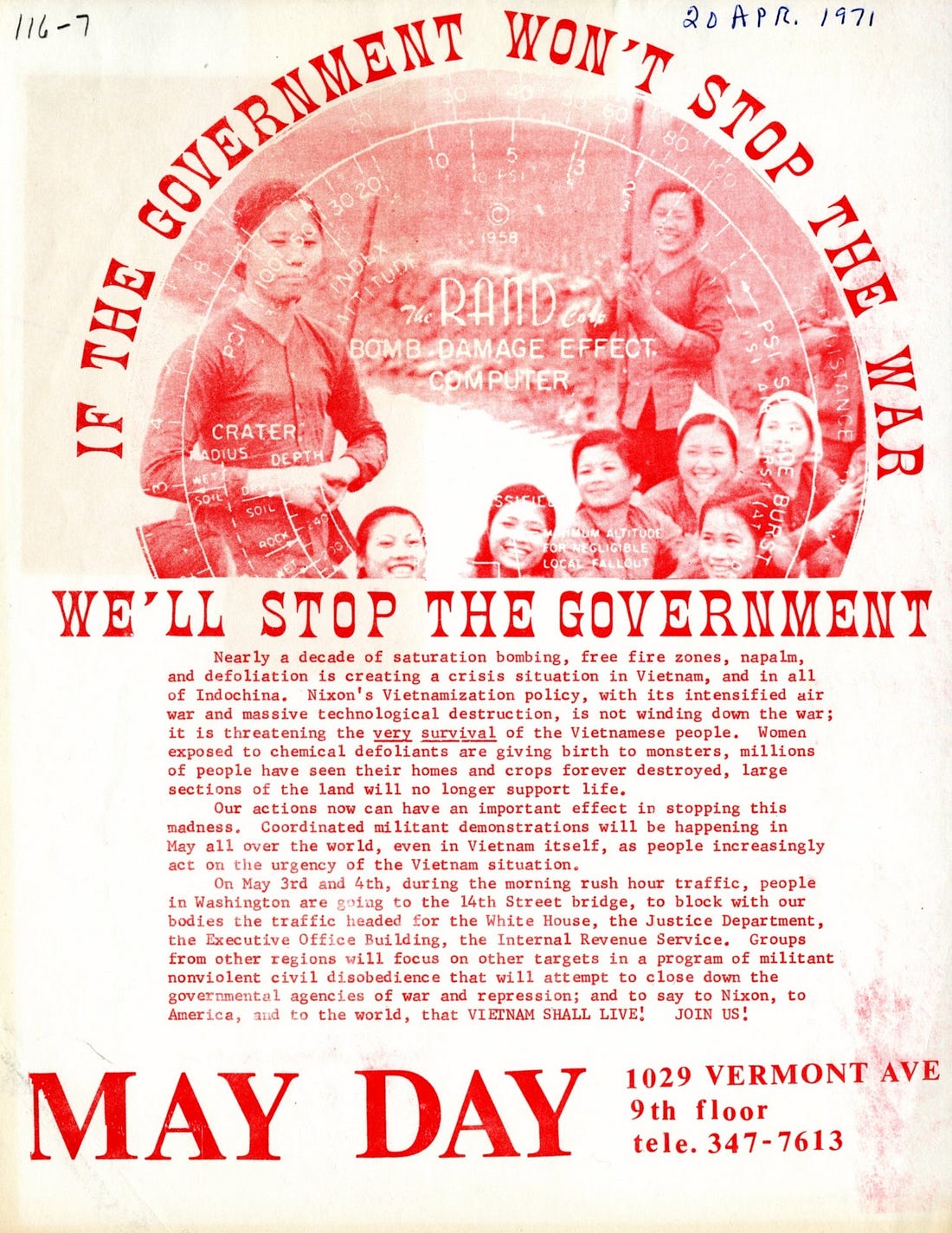
This will not be the first time Americans have engaged in mass protests on May Day. In 1971, tens of thousands of people took to the streets in Washington, D.C., to protest the Vietnam War. They began on May 3 and continued for two more days. By the time the protest ended, more than 12,000 protestors had been arrested. The protesters’ goal was to cause a traffic jam that would keep government employees from getting to work; their slogan was “If the government won’t stop the war, we’ll stop the government.”

Mass protests that are large and sustained have an impact on even an entrenched presidency. They did with Nixon. The White House Historical Association’s official version of events concludes that “the enormity of the protest pushed Nixon to accelerate the nation’s exit from Vietnam.” 

Even though it’s a different era, protests are bound to get to the thin-skinned president whose staffers, during his first term in office, had to prepare folders of positive stories about Trump for him to review twice each day. Imagine having thousands of people protesting within earshot of the White House. It must be even more galling because these protests are nonviolent and aim to support democracy through a legitimate exercise of First Amendment rights. They make a powerful statement, in contrast to a president who has abandoned the rule of law. 

In 1970, two-thirds of Americans had come to believe U.S. involvement in the Vietnam War was a mistake. We are not quite there yet when it comes to people’s view of the Trump administration. The most recent NBC News Stay Tuned Poll shows only 45% of Americans approve of the job Trump is doing. But, when asked about how strongly they hold their beliefs about the president, “the vehemence of the opposition outweighs the intensity of support from the president’s MAGA base.” Twenty-three percent of Americans said they were “furious” about what Trump is doing.

Thursday is also Law Day, an annual celebration of the rule of law. Although it has been in effect since 1958, it doesn’t usually receive much attention. This year, lawyers across the country have big plans for the day—make sure you look to see what’s going on in your area. President Dwight Eisenhower established Law Day as a day of national dedication to the principles of government under law. State Bar Associations hold essay competitions for school children, and there are state and national dinners most years. In 2025, Law Day takes on special significance as Americans’ concerns about due process come to the forefront. How fitting that the May Day protests sync with the Law Day commemoration. 

I’ve been doing a lot of research and writing about the origins of Law Day for my book (Giving Up Is Unforgivable, due out October 21), so I’ll leave that for another time, but I want to make sure everyone knows about Law Day. This year, many lawyers across the country will retake their oath to show their support for the rule of law. There is no reason the rest of the country can’t participate too!

The president issues a proclamation every year for Law Day. Trump did during his first term in office, too. In 2019, the proclamation began, “On Law Day, we renew our commitment to the rule of law and our Constitution. The rule of law requires that no one be above the obligations of the law or beneath its protections, and it stands as a bulwark against the arbitrary use of government power.” Unfortunately, he never lived up to those sentiments. On Thursday, we can look for the proclamation and point out the inconsistencies between what we expect from our presidents and how this one is behaving. The hypocrisy is always full force, and we shouldn’t shy away from pointing it out.

Due process is the sleeper issue of the second Trump presidency. No one really expected democracy issues, let alone concepts like the rule of law and due process to animate a country’s protests. But it’s increasingly clear that Americans are smart, and when we are well-informed, we have no difficulty assessing what matters and what is true. We see more and more of that as Americans carry signs that say “No Kings” and “Due Process” at local rallies. All of us can be advocates for democracy, not just the lawyers among us.

Here at Civil Discourse, we all understand the importance of this. We need to make sure the rest of the country does too. Until the Trump administration is over, it has to be Law Day every day. 

In 2024, the Law Day theme was “Voices of Democracy,” recognizing that the people are the rulers in a democracy. Americans express their views without fear of retribution because of the First Amendment and vote in elections to select their leaders. It’s up to us to make sure it stays that way.

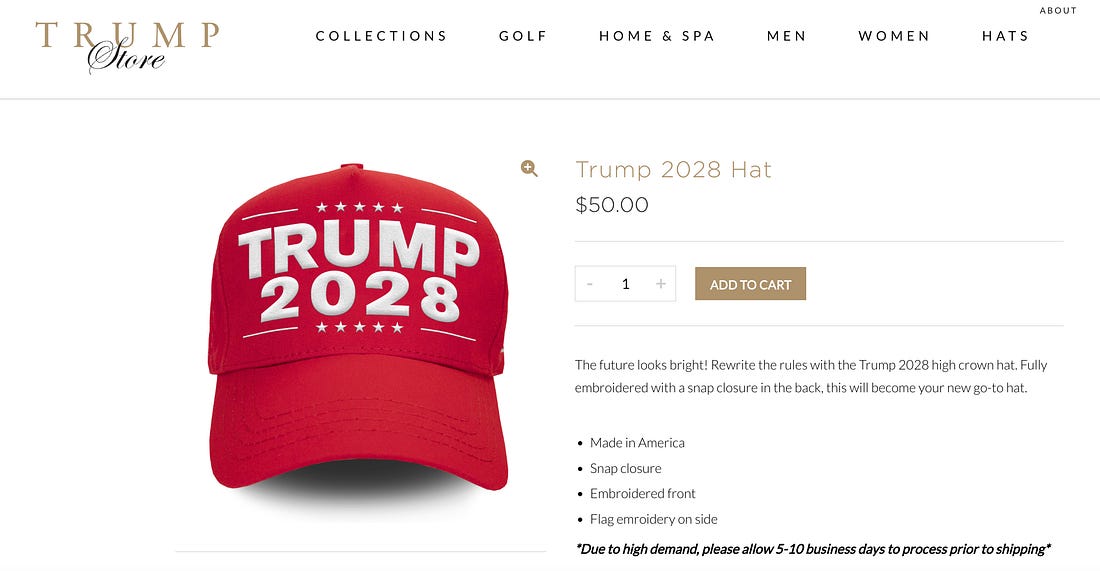
This week will bring more briefings in the Abrego-Garcia case and others. There will be outrages, like the fact that Trump has a website hawking merchandise, literally selling the presidency. It’s not just the $50 price tag on the hat; there’s also the slogan, “Trump 2028,” a reference to Trump’s not-so-subtle hints that he’d like to serve a Constitution-busting third term in office. It’s not a joke. It never is with him.

So, make sure you take some time this week to celebrate Law Day. Invite people over. Go for a walk with friends or neighbors and share your views. Talk with your kids. Democracy is not automatic; it’s a participatory sport we must all play in together, one with critically important outcomes. Democracy is important. Let’s make sure we play for keeps.

We’re in this together,

Joyce