Ruth Ben-Ghiat is a professor of history at New York University and a specialist in autocracy.
She wrote recently on her blog Lucid about some of the ways that Trump is helping Putin achieved his goal of reassembling the whole USSR. Many years ago, Putin said that the collapse of the USSR was “the greatest geopolitical disaster of the 20th century.” some might have said it was World War I or Wotkd War II. Not Putin, veteran KGB agent.
Ben-Ghiat wrote:
To understand the nature and scope of this momentous shift, it helps to think like an autocrat. For this kind of leader, democratic America, with its robust economy, far-reaching infrastructure of foreign aid, immensely powerful military, and checks on foreign malign influence and corruption initiatives, is a huge problem.
Trump’s path back to power so he could take care of this distressing situation was eased by Chinese, Iranian, and Russian disinformation campaigns, which, together with U.S. Republican propaganda, helped to discredit and weaken American democracy in the eyes of the American public. Trump’s ceaseless efforts to praise foreign strongmen and his delegitimization of democratic institutions, from elections to the free press to the judiciary, also had this aim.
Trump had long ago internalized a view of geopolitics that sees democracies, and American democracy in particular, as hostile actors who deny the rights of autocracies to expand their influence in the world. When Trump suggests that President Joe Biden’s support of Ukraine’s bid to join NATO provoked Russia’s invasion, he justifies the Kremlin’s aggressions as a legitimate response to democratic meddling.
Now that Trump is back in the White House, focused on the destruction of American democracy, we can expect public collaboration with Russia to take several forms. Trump and his enablers in and outside of the GOP will produce a steady stream of performances and propaganda meant for two audiences: autocrats, especially Putin, and the millions of Americans who still need to be indoctrinated to see the world in ways that benefit Trump and his Kremlin ally.
The novel co-presidency of Trump and Elon Musk has provided a one-two punch approach to quickly launch the other two ways the U.S. will collaborate with Russia. First, by erasing or dialing back America’s global soft and hard power footprint in the world. This could mean reducing military spaces abroad that are now deterrents to autocratic aggression, or using such spaces as launching pads for pro-autocratic military engagements that the US may one day participate in.
It also means ending or scaling back humanitarian assistance programs that have created goodwill for America among global populations. Musk has jump-started this latter action by destroying USAID. The goal is to create a vacuum of American power and influence in the world that China, Russia, Turkey and other autocracies can fill.
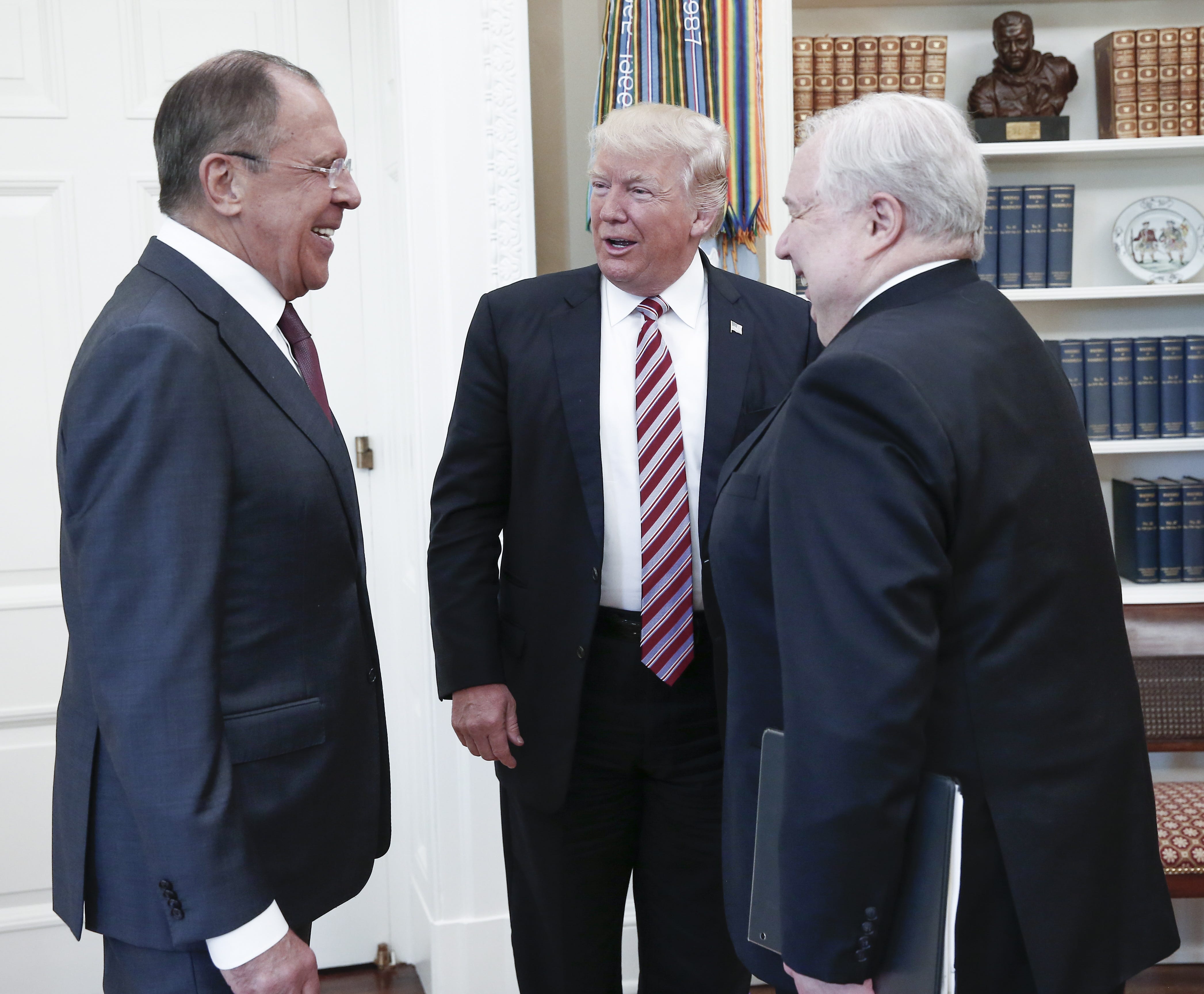
The second form of collaboration entails the removal of barriers to the free flow of Russian influence inside America. This was supposed to be a priority of Trump’s first administration. Just months after his inauguration, Trump hosted Russian Foreign Minister Sergey Lavrov and Russian Ambassador to the U.S. Sergei Kislyak in the Oval Office, with only a Russian state photographer from TASS present. This told the world that the White House would be a Russian-friendly space with Trump in power, with Kremlin views of politics and the world amplified by Washington.
President Trump with Russian Foreign Minister Sergei Lavrov and Russian Ambassador to the U.S. Sergey Kislyak in the Oval Office, May 10, 2017. Alexander Shcherbak/TASS/via Getty Images.
Then came the Russia investigation —a supreme annoyance made possible by the existence of democracy in America. During the recent meeting with Zelensky, Trump evoked the difficulties this investigation created for Russian capture of the United States, tellingly mentioning the toll it took on Putin–and just as tellingly, alluding to the pressures this obstruction of Putin’s plans placed on him as an ally with responsibilities to fulfill. His statement resembles the “self-criticism” Communist operatives were required to engage in when they displeased the regime.
“Let me tell you. Putin went through a hell of a lot with me,” Trump said. “He had to suffer through the Russia hoax…He went through a hell of a lot with me. He went through a phony witch hunt…It was a phony Democrat scam. He had to go through it. And he did go through it.”
This false start, and the heightened expectations for Trump to perform this time, are likely why Trump & Co. have acted so aggressively. In his first weeks in power, Trump signed orders to disband TaskForce KleptoCapture, which targeted Russian oligarchs, disband the FBI’s Foreign Influence Taskforce, and relax enforcement of the Foreign Agents Registration Act. Meanwhile, Defense Secretary Pete Hegseth has ordered U.S. Cyber Command to stand down from all planning against Russia, including digital actions.
The appointment of Tulsi Gabbard, who has a history of taking positions that defend Russian interests, as Director of National Intelligence, is another indication of the will to dismantle obstructions to Russian influence inside America. The walls of the national security fortress are coming down.
In 2018, before the Trump-Putin summit in Helsinki, Trump said that he saw Russia as more of a “competitor” than an “enemy.” Seven years later, that competitor has become an ally. Whatever forms Russia-U.S. collaboration will take, more Americans will come to understand that the man they elected to “save the country” is far more interested in solving Putin’s problems than in governing America. That means wrecking American democracy at home and dismantling American power abroad.
Julian Vasquez Heilig is a scholar of diversity, equity and inclusion. His blog is called Cloaking Inequity. He was Provost at Western Michigan State University. He recently stepped down to further his scholarship and advocacy as a professor. Julian is a founding member of the board of the Network for Public Education.
In yet another attempt to weaponize the federal government against diversity, equity, and inclusion (DEI) efforts in education, the U.S. Department of Education—at the urging of Moms for Liberty and other far-right extremist groups—has launched the “Stop DEI Portal” (https://enddei.ed.gov).
This taxpayer-funded snitch line is designed to invite anonymous complaints against public schools, colleges, and universities that are actively working to create inclusive and equitable environments for all students. Their goal? To stoke fear, intimidate educators, and dismantle efforts to address racial, gender, and socioeconomic inequities in education.
Let’s be clear: this is not about stopping discrimination—it’s about silencing efforts to eliminate it.
But here’s the thing: if this portal is truly meant to address discrimination, then let’s make sure it serves that purpose.
Let’s Turn the Tables: Report REAL Discrimination
If the Department of Education wants reports of discrimination, let’s give them exactly that. But let’s report real, documented cases of discrimination—the kind that actually harms students and families every single day, especially in underregulated charter and voucher-funded schools.
Here’s what they don’t want reported, but what we should be flooding their portal with:
1. Discrimination Against Students with Disabilities
• Many charter and voucher schools systematically exclude students with disabilities, either by refusing to provide necessary accommodations or pushing them out with discriminatory discipline policies.
• Special education students in voucher programs often lose their federal protections under the Individuals with Disabilities Education Act (IDEA) when they transfer to private schools.
• Some schools refuse to admit students who require additional supports, effectively segregating students with disabilities from their peers.
📌 If you or someone you know has experienced this, report it here: https://enddei.ed.gov
2. Discrimination Against LGBTQ+ Students
• In some states, charter and private schools receiving taxpayer-funded vouchers have explicit policies that allow them to deny admission to LGBTQ+ students or expel them for their identity.
• LGBTQ+ students often face harassment, deadnaming, misgendering, and bullying—sometimes by school officials—without intervention.
• Books and curriculum that acknowledge LGBTQ+ history and experiences are being banned, erasing the existence of LGBTQ+ students and families from the classroom.
📌 If you’ve seen LGBTQ+ students being targeted or erased, report it here: https://enddei.ed.gov
3. Racial Discrimination and Segregation in Schools
• Many charter and private schools resegregate students by race and income, creating de facto segregation that mirrors the Jim Crow era.
• Black and Brown students face harsher disciplinary actions than their white peers for the same behaviors.
• AP African American Studies, ethnic studies courses, and other curriculum that acknowledges systemic racism are being banned or watered down, denying students an accurate understanding of history.
📌 If you have evidence of racial discrimination in schools, report it here: https://enddei.ed.gov
4. Discrimination Against Low-Income Students
• Voucher programs siphon public dollars away from neighborhood schools, making it harder for low-income students to access well-funded, high-quality education.
• Private voucher schools are not required to provide free or reduced-price lunch programs, effectively shutting out students who rely on school meals.
• School choice programs increase economic segregation, allowing affluent families to access better resources while leaving lower-income students in underfunded public schools.
📌 If you know of schools pushing out or underfunding low-income students, report it here: https://enddei.ed.gov
Weaponizing the Portal Against Its Own Purpose
The Stop DEI Portal is not about protecting students—it’s about political theater and furthering a radical agenda to dismantle public education.
Conservative groups like Moms for Liberty, the Heritage Foundation, and other well-funded organizations have pushed for Project 2025, a policy plan designed to eliminate federal civil rights protections, dismantle DEI initiatives, and privatize public education.
They want to create a parallel education system where only privileged, wealthy families benefit—while marginalized students are left behind.
What You Can Do Right Now
✅ Step 1: Submit REAL complaints to the Stop DEI Portal
Visit https://enddei.ed.gov and report discrimination against students with disabilities, LGBTQ+ students, students of color, and low-income students.
✅ Step 2: Share this far and wide
Encourage educators, parents, and students to flood the portal with real discrimination complaints.
✅ Step 3: Support organizations fighting back
Groups like Our Schools Our Democracy (OSOD) and the Network for Public Education (NPE) are exposing the harms of privatization and the discriminatory practices of charter and voucher schools.
✅ Step 4: Stay engaged in the fight to protect public education
The NPE/NPE Action Conference on April 5-6 in Columbus, Ohio is bringing together educators, advocates, and policymakers to discuss how to defend public schools and stop the Project 2025 playbook. I’ll be there.
There’s no time to sit on the sidelines. The Stop DEI Portal is just the beginning of a much larger battle. If we don’t fight back now, the next generation will inherit an education system built on exclusion, discrimination, and privatization.
Let’s make sure the truth is louder than deception.
I didn’t watch Trump last night. The combination of his face, his voice, and his lies is intolerable. I get nausea and a headache. And my soul hurts. I have always loved this country. I am a patriot. And he is destroying it.
With a modesty we have come to expect of him, President Donald Trump informed Congress on Tuesday night that he had already ushered in “the greatest and most successful era in the history of our country.” He told the assembled lawmakers that he “accomplished more in 43 days than most administrations accomplished in four or eight years.”
Armed with a portfolio of fabricated statistics, Trump judged that “the first month of our presidency is the most successful in the history of our nation — and what makes it even more impressive is that you know who No. 2 is? George Washington.”
Republican lawmakers laughed, whooped and cheered.
Usually, such talk from Trump is just bravado. But let us give credit where it is due: Trump has made history. In fact, it’s not much of an exaggeration to say that, over the course of the last five days, he has set the United States back 100 years.
Trump on Monday implemented the largest tariff increase since 1930, abruptly reversing an era of liberalized trade that has prevailed since the end of the Second World War. He launched this trade war just three days after dealing an equally severe blow to the postwar security order that has maintained prosperity and freedom for 80 years. Trump’s ambush of Ukrainian President Volodymyr Zelensky in the Oval Office, followed by the cessation of U.S. military aid to the outgunned ally, has left allies reeling and Moscow exulting. The Kremlin’s spokesman proclaimed that Trump is “rapidly changing all foreign policy configurations” in a way that “largely aligns with our vision.”
And our erstwhile friends? “The United States launched a trade war against Canada, its closest partner and ally, their closest friend,” Canadian Prime Minister Justin Trudeau said on Tuesday. “At the same time, they’re talking about working positively with Russia, appeasing Vladimir Putin: a lying, murderous dictator. Make that make sense.”
It only makes sense if, against all evidence, you believe, as Trump apparently does, that Americans were better off 95 years ago than they are today.
We’re apparently going to have to re-learn that lesson the hard way. The blizzard of executive orders that Trump has issued, though constitutionally alarming, can be rescinded by a future president. Elon Musk’s wanton sabotage of federal agencies and the federal workforce, though hugely damaging, can be repaired over time. But there is no easy fix for Trump’s smashing of the security and trade arrangements that have kept us safe and free for generations. “We’re certainly not in the postwar world anymore,” Douglas Irwin, a Dartmouth College economist and fellow at the Peterson Institute for International Economics, tells me. He calculates that Trump’s hike in tariffs is the largest since the Smoot-Hawley Tariff Act of 1930 accelerated the nation’s slide into the Great Depression. And Trump’s current tariffs, which in Irwin’s calculation affect imports worth about 4.8 percent of gross domestic product, will have an even greater impact on the economy than did Smoot-Hawley, which affected imports worth 1.4 percent of GDP, and the McKinley administration’s tariffs during the 1890s, which affected imports worth 2.7 percent of GDP (and which also were followed by a prolonged depression).
Irwin figures the current tariffs “are likely to be much more disruptive” than those historical cases because the U.S. economy is much more dependent now on “intermediate goods” — meaning materials such as auto parts, needed by American businesses to make finished goods. Trump has brought the average tariff on total imports to 10 percent, a level not seen since 1943, in Irwin’s analysis.
Late Tuesday, after stocks plunged for a second day, Commerce Secretary Howard Lutnick appeared to signal a retreat, saying the administration would “probably” announce Wednesday that it was meeting Canada and Mexico “in the middle some way.” Yet even if Trump were quickly to abandon the trade war he just launched, the effects will probably be long-lasting, because he has upended the gradual liberalization of trade that has been underway since 1932.
Trump, in imposing 25 percent tariffs on Canada and Mexico, has violated the spirit, if not the letter, of the U.S.-Mexico-Canada Agreement he negotiated during his first term. “So, going forward, what country would ever sign a trade agreement with the United States knowing that we can find some sort of excuse that’s outside the agreement to raise the tariffs?” Irwin asks. Instead, he expects a return of the “corrupt process” that existed before the 1930s in which tariffs remain on the books and businesses try to curry favor (in this case, with Trump) to win exemptions.
Inevitably, the retaliation has already begun. Canada is imposing 25 percent tariffs on $155 billion of American goods — and the premier of Ontario, vowing to “go back twice as hard” at the United States, is slapping a 25 percent tariff on electricity going to the United States, while threatening to cut the lights off entirely. China is imposing tariffs of up to 15 percent on U.S. imports and banning some exports. Mexican President Claudia Sheinbaum, calling Trump’s justification for the tariffs “offensive, defamatory and groundless,” has said she would announce her country’s retaliation plans this weekend.
And Trump keeps escalating. After Trudeau said on Tuesday that Trump wants “a total collapse of the Canadian economy, because that will make it easier to annex us,” Trump mocked “Governor Trudeau” on social media and vowed that “when he puts on a Retaliatory Tariff on the U.S., our Reciprocal Tariff will immediately increase by a like amount!”
The Dow Jones Industrial Average shed more than 1,300 points. Inflation forecasts are increasing (the free-trading Peterson Institute says Trump’s tariffs will cost the typical American household $1,200 per year). Retailers such as Target and Best Buy are warning about higher prices. The Atlanta Fed’s model of real GDP growth, which a month ago saw 2.3 percent growth in the first quarter, now sees a contraction in the first quarter of 2.8 percent. And Trump is threatening to hit more countries with more tariffs, on metals, cars, farm products and more, in the coming weeks.
During his first term, Trump tweeted that “trade wars are good, and easy to win” — but he had the good sense not to test this in a major way. Now, we all get to experience what actually happens when we launch one.
Trump’s moves to dismantle the trade architecture of the last century is all the more destabilizing because he is simultaneously moving to knock down the alliances that maintained security for most of that same period. As The Post’s Francesca Ebel reported from Moscow, Putin’s government sees Trump’s humiliation of Zelensky as a “huge gift” that furthered Russia’s ambitions of dividing the West. Former Russian president Dmitry Medvedev called it a “proper slap down” of “the insolent pig” Zelensky. Hungary’s repressive leader, Viktor Orban, also celebrated: “Thank you, Mr. President!”
And while Trump blames the victim for Russia’s full-scale invasion of Ukraine, China is growing bolder in its desire to take Taiwan. Hong Kong’s South China Morning Post quoted analysts calling the Trump-Zelensky rift part of a “systemic reordering” of geopolitics in which “Beijing was positioned to capitalize on the ‘rapid disintegration of the West’ that legitimizes ‘Beijing’s vision for a post-American world order.’”
As the authoritarians celebrate, freedom’s defenders weep. Lech Walesa, the celebrated champion of Polish democracy, joined other former political prisoners in a letter to Trump expressing “horror and disgust” at the American president’s treatment of Zelensky, saying they were “terrified by the fact that the atmosphere in the Oval Office during this conversation reminded us of the one we remember well from interrogations by the Security Service and from courtrooms in communist courts.”
Democratic leaders across Europe, and across the world, spoke up in defense of Ukraine. “We must never confuse aggressor and victim in this terrible war,” wrote incoming German chancellor Friedrich Merz. Now, these democratic leaders must contemplate rebuilding what Trump has destroyed. “Today,” European Commission Vice President Kaja Kallas wrote on the day of Trump’s betrayal of Ukraine, “it became clear that the free world needs a new leader.” In the House chamber on Tuesday night, there was little sign of the United States that until now has led the free world.
Republicans, once the party of free trade, applauded Trump’s vows to impose tariffs — or additional tariffs — on Canada, Mexico, the European Union, China, India, Brazil and South Korea. “We’ve been ripped off by nearly every country on Earth, and we will not let that happen any longer,” he said. As for the pain his trade policies are already causing, he said: “There’ll be a little disturbance, but we’re okay with that. It won’t be much.” Trump spoke — repeatedly — about his election victory, about the “radical left lunatics” who prosecuted him, and about his culture-war battles against transgender Americans and against “diversity, equity and inclusion.” With taunts and nonsense claims (more than 1 million people over age 150 receiving Social Security!), he goaded the Democrats, who answered him with messages (“False,” “No Kings Live Here”) on signs and on T-shirts. When Al Green, a 77-year-old Democratic lawmaker from Texas, waved his walking cane and shouted at Trump that he had “no mandate to cut Medicaid,” Republican leaders, who allowed members of their party to shout “bulls—” at President Joe Biden from the House floor, called in the sergeant at arms to evict him. It took nearly an hour for Trump to talk about trade. He didn’t get to Ukraine until nearly an hour and 20 minutes into his speech, and then it was to level the false claim that Ukraine had taken $350 billion from the United States, “like taking candy from a baby,” while Europe spent only $100 billion on Ukraine — dramatically overstating the U.S. contribution and understating Europe’s. “Do you want to keep it going for another five years?” he said, looking at the Democrats. “Pocahontas says yes,” Trump added, referring contemptuously to Sen. Elizabeth Warren (D-Massachusetts). At this, Vice President JD Vance chortled — and the Republican side, once the home of proud internationalists, responded with derision, cheers and applause. And so collapses the architecture of freedom and prosperity: with a lie, a taunt and a guffaw.
The Americans claim that their attempt to humiliate the Ukrainian president in the White House yesterday was about peace. On that premise, nothing they said makes any sense.
The attempted mugging of a visiting president was about the world war that Elon Musk, Donald Trump, and JD Vance have chosen. If we attend to what Vance and Trump said yesterday, we can work our way to the unreason of American policy, and to the chaos that will follow.
JD Vance opened hostilities against Volodymr Zelens’kyi with a claim about negotiations with Russia, treating them as a formula that will magically end the war. Zelens’kyi had said, calmly and correctly, that negotiations with Russia have been tried before and have not worked. The Russians have betrayed every truce and every ceasefire since their first invasion in 2014. And that first invasion of course violated a number of treaties between Ukraine and Russia, as well as the basic principles of international law. Zelens’kyi ran for president in 2019 as the peace candidate, promising to negotiate with Putin to end what was then a war that had been ongoing for five years. Russia did not respond to these overtures, except with contempt, and then with the full-scale Russian invasion of Ukraine in February 2022.
During and after the Oval Office meeting yesterday, Americans suggested that all that had happen was a unilateral Ukrainian ceasefire, and that then the end of the war would automatically follow. Americans indicated that Zelens’kyi was too stupid to understand this. Zelens’kyi’s quite reasonable point was that a ceasefire would have to be followed by efforts to strengthen Ukraine, or the war would simply start again. The evidence is on his side. Even during Trump’s ostensible peace campaign these last six weeks, Russian authorities have never said that they would end the war. The Russians keep committing war crimes every day. Yesterday Russia was attacking hospitals in Kharkiv. The Russians have only said that they would talk to Americans, which is not the same thing as agreeing to take part in a peace process. From the Russian perspective, a ceasefire is an opportunity to halt external support for Ukraine and demobilize the Ukrainian army, preparatory to the next attack. Even were this not obvious from Russian statements and actions, no responsible Ukrainian leader could simply accept the American premise that a ceasefire itself is all that is necessary, or simply take Americans at their word that all would be well afterwards.
After yesterday’s confrontation in the Oval Office, Trump made clear just how unstrategic the American approach had been. He claimed that the real problem had been that Zelens’kyi had wanted to speak about Putin. Russia, of course, is the aggressor. It does not make sense to demand that the country under attack cease to defend itself, and to pretend that this in itself will bring peace. Had the United States under Trump been interested in peace in Ukraine, American power would have been engaged to deter Russia from continuing the war. There was never any meaningful sign of a willingness to do this, and certainly no new American policy, under Trump, to do this. On the contrary, the United States lifted Russia from its international isolation and accepted in advance most Russian demands. But even had that not been the case, the American position would have been illogical. During an ongoing war of aggression, the aggressor cannot simply be humored, as Trump proposes, during a process that aims at peace.
In the emotion of the White House, however, it was evident that the situation was psychological rather than strategic. In Zelens’kyi’s presence, Trump confessed his fundamental sympathy for Putin. In Trump’s view, he and Putin “had gone through a lot together.” The grievance on display here was so capacious that not everyone could grasp what Trump meant. Trump said that he had been the victim of a “hoax,” because people thought that Putin assisted Trump’s presidential campaigns. But Putin, Trump claimed, rather extraordinarily, was also the victim of the “hoax.” And indeed, according to Trump, this had been a very meaningful bonding experience between the two men. This casts some light on the one of the regular conversations between Putin and Trump these last few years. It reflects, though, an emotional commitment based upon a carefully curated unreality. There was, of course, no hoax. Putin supported Trump in all three of his presidential campaigns, right down to Russian bomb threats against predominantly Democratic districts last election day. But the emotional connection between the two men, as Trump revealed, real. For Trump, the imagined wound of ego to his friend Putin was the pertinent reality. The real wounds that real Russians have inflicted on real Ukrainians are not.
In the White House, Zelens’kyi asked Vance whether he had ever been to Ukraine, which is a reasonable question. Vance had issued one of his typically ex cathedra pronouncements. He speaks with great confidence about the war, telling security experts and Ukrainians alike that he is “right” and they are “wrong.” Indeed, one of the most striking moments yesterday was Vance yelling at Zelens’kyi that Zelens’kyi is “wrong.” Vance makes judgements on the basis of numbers, without any knowledge of how the battlefield looks or works. He also ignores the human factor, treating war as a math problem in which big numbers always win — which, as a historical matter, is mistaken. Did the numerically stronger side win the Revolutionary War? Since 1945, it has been normal for the smaller, colonized country to defeat the larger, colonizing power. Vance’s analysis also evades responsibility, as though it does not matter which side the United States took. Where his arrogance leads is the path he has in fact taken: the country that he personally thinks is stronger should win the war because that is what he thinks; if this is not happening, American power should be added to the side that he believes should be winning: Russia. His actions yesterday certainly furthered such a goal.
Also telling was the way Vance responded to Zelens’kyi’s question. Vance took the position that it was better to look at the internet than to learn things in person. He started with the weird idea that Zelens’kyi was to blame for Vance’s failure to visit Ukraine, because Zelens’kyi just took people on “propaganda tours.” This is very illogical. It is true that Ukrainian governments accompany foreign visitors to killing sites, especially Bucha. No doubt those visits have an effect on people. But the mass killing at Bucha did in fact take place. When Vance attaches “propaganda” to the custom of visiting it, he falls painfully close to the Russian claim that the mass killing did not happen at all, and that the signs of it were staged. Because Bucha is a Kyiv suburb, and so relatively accessible for foreign delegations, it serves as a representative example of what are, sadly, many similar cases of the mass shootings of civilians. And that war crime, the mass killing of civilians, has in its turn to stand for many others, including torture, rape, and the kidnaping of children. Had Vance decided to go to Ukraine, he could have visited Bucha with or without Ukrainians, as he preferred. He could also have talked to people in Kyiv, or indeed ventured beyond, to other cities. He could have spoken to soldiers and officers in the Ukrainian armed forces. Nothing stopped him from doing so. He was, after all, a United States Senator, and then the Vice-President of the United States. He could have planned the journey as he liked, and others would have made the arrangements for him.
There is a reason that Vance will not go to Ukraine. He is an online person. Last year at the Munich Security Conference, he refused to meet Zelens’kyi, on the justification that he knew everything he needed to know already. Then he spent time on the internet in his hotel room and posted about certain adolescent concerns. This year at the Munich Security Conference it was made known that Vance would only see Zelens’kyi if the Ukrainians first signed a deed ceding much of the Ukrainian economy to the United States in exchange for nothing. When did meet Zelens’kyi, he did so surrounded by others. In the White House, yesterday, he broadcast the same fear of confronting something real. Yelling across the room to a visiting guest that “you’re wrong, you’re wrong” is not a sign of confidence or wisdom. Vance takes the safe course of dismissing other people rather than admitting that he might have something to learn. More important than visiting Ukraine, said Vance in the White House, was “seeing stories.” It is better to take in information, as he has said, from his own “sources,” those that confirm what he already thinks, than actually engaging with another country or with its people. Vance’s “sources” have led him to repeat claims that originated very specifically as Russian propaganda and have been documented as such, for example the an entirely untrue claim that American aid goes to pay for yachts. Vance helped to spread this lie.
Kharkiv under Russian bombing, March 2022.
Perhaps sensing the awkwardness of his position, Vance then shifted to yelling at Zelens’kyi that he needed to thank President Trump. Zelens’kyi obsessively thanks American and other foreign leaders for their support of Ukraine. He did so during this visit to the United States as well. What Vance seemed to mean is that Zelens’kyi needed to express his thanks then and there, whenever Vance wanted, indeed right at the moment when Vance was yelling at him, and because Vance was yelling at him. Vance was demanding that Zelens’kyi thank Trump for aid that the Biden administration gave to Ukraine, and which the Trump people were threatening to take away — and indeed at that point had almost certainly already decided to take away. The Trump policy to Ukraine, as of yesterday, was something like the following: meet with Russia without Ukraine; concede to every significant Russian demand in advance of any Russian concession and without asking Ukrainians; claim that Russia and Ukraine were jointly responsible for the war; refer to Zelens’kyi as a dictator without condemning Putin; vastly overstate the extend of previous American aid; claim Ukrainian resources as compensation for that aid. In this setting, the compulsive demand for ceaseless gratitude on demand is not only unreasonable: it shifts into the abuser’s need to be portrayed by the victim as the great benefactor.
Even the press mockery of Zelens’kyi’s clothing, perhaps the depths of yesterday’s grotesquerie, reveals a similar disconnect from what is actually happening in the world. The implicit notion is that the people who wear suits and ties are the real heroes, because heroism consists, somehow, in always knowing how to adapt to the larger power structure and to blend it. But in history there do arrive moments when unexpected things happen and behaviors, including symbolic ones, must be adjusted. Zelens’kyi decided three years ago not to wear suits not, as was insultingly suggested yesterday, because he does not own one; and not, as was ridiculously suggested, because he does not understand protocol. Three years ago he decided that he would dress as appropriate to register solidarity with a people at war, his own people at war. This is, frankly, something that Americans should already know, rather than an appropriate subject for a question at the White House, let alone a mocking one. But it is the mockery itself that reveals an American illogic, or worse. Some Americans want to think that the most important thing is conformity, that sneering at human difference shows our own courage. Once we knew better. When Ben Franklin went to the French to ask for support during the Revolutionary War, he wore a coonskin cap, which was not comme il fallait. When Winston Churchill visited the White House during the Second World War, he wore a wartime outfit that not unlike the one that Zelens’kyi wore yesterday.
Trump similarly derided human courage when he demanded that Zelens’kyi accept that Ukraine would have immediately collapsed without American arms. That makes the Americans the heroes and Ukrainians the ones who must thank Americans on demand. It is true, of course, that American weapons have been very important, and that Ukrainians will now suffer from Trump’s decision to shift American power to the Russian side of the war. But all the weapons that had been delivered by February 2022, by both the first Trump and then the Biden administrations, were obviously insufficient for the kind of full-scale land invasion that Russia mounted. The Ukrainians got weapons after February 2022 precisely because they resisted anyway.
Almost all Americans believed when the full-scale invasion began that Ukraine would immediately collapse under Russian might, and that Zelens’kyi would flee the country. But he did not. His physical courage in remaining in Kyiv, an echo of the physical courage shown by millions of Ukrainians, changed the overall situation. Because Ukrainians resisted, western arms began to flow. The courage of Ukrainians made possible an American and European policy to hold back Russian aggression. That same Zelens’kyi, the man who was brave enough to stay and lead his country when the Russians were approaching the capital and the assassination squads were already there, was yesterday made the subject of a public attempt at humiliation by Americans. No doubt Ukrainians should express their thanks to Americans. As they do. But it is illogical, to say the least, for Americans not to thank Ukrainians, or to treat their courageous president as an object of contempt. The coercive ritual of gratitude hides from Americans the basic reality of what has happened these last three years.
During this war, Ukraine has delivered to the United States strategic gains that the United States could not have achieved on its own. Ukrainian resistance gave hope to people defending democracies around the world. Ukrainian soldiers were defending the basic principle of international law, which is that states are sovereign and that borders should not be changed by aggression. Ukraine in effect fulfilled the entire NATO mission, absorbing a full-scale Russian attack essentially on its own. It has deterred Chinese aggression over Taiwan, by showing how difficult offensive operations can be. It has slowed the spread of nuclear weapons, by proving that a conventional power can resist a nuclear power in a conventional war. Throughout the war, Russia has threatened to use nuclear weapons against Ukraine, and the Ukrainians have resisted the nuclear bluff. Should they be allowed to be defeated, nuclear weapons will spread around the world, both to those who wish to bluff with them, and those who will need them to resist the bluff.
Yesterday Vance and Trump repeated familiar Russian propaganda. One example was Trump’s claim that it was the Ukrainians who, by resisting Russia, were risking “World War Three.” The truth is exactly the opposite. By abandoning Ukraine, Trump is risking a terrible escalation and, indeed, a world war. Everything that Ukraine has done these last three years can be reversed. Now that the Trump administration has chosen to throw American power to Russia’s side, Russia could indeed win the war. (This was always Russia’s only chance, as the Russians themselves well knew, and openly said.) In this scenario of an American-backed Russian victory, opened yesterday by American choices in the American capital, the horrible losses extend far beyond Ukraine. Zelens’kyi quite sensibly made the point that the consequences of the war could extend to Americans. This was, in a sense, overly modest: Ukrainian resistance has thus far spared Americans such consequences. He said so very gently, and was yelled at for it — which is itself quite telling. The Americans have a sense of what they are unleashing upon the world by allying with Russia, and they made noise to disguise that.
The expansion of Russian power in Ukraine would mean more killing, more rape, more torture, more kidnaping of children inside Ukraine. But it would also mean that all of the strategic gains become strategic losses. Russia, rather than being prevented by Ukraine from fighting other wars, is encouraged to start new ones. China, rather than seeing an effective coalition to halt aggression, is emboldened to start wars. American endorsement of wars of aggression leads to global chaos. And everyone who can builds nuclear weapons. That is an actual scenario for a third world war, authored by the people who scripted yesterday’s attempted mugging in the White House.
If one starts from the premise that the United States was engaged in a peace process, then what we saw Americans do yesterday makes no sense. The same goes if we begin from the assumption that present American leadership is concerned about peace generally, or cares about American interests as such. But it is not hard to see another logic in which yesterday’s outrages do come into focus.
It would go like this: It has been the policy of Musk-Trump from the beginning to build an alliance with Russia. The notion that there should be a peace process regarding Ukraine was simply a pretext to begin relations with Russia. That would be consistent with all of the publicly available facts. Blaming Ukraine for the failure of a process that never existed then becomes the pretext to extend the American relationship with Russia. The Trump administration, in other words, ukrainewashed a rapprochement with Russia that was always its main goal. It climbed over the backs of a bloodied but hopeful people to reach the man that ordered their suffering. Yelling at the Ukrainian president was most likely the theatrical climax to a Putinist maneuver that was in the works all along.
This, of course, might also seem illogical, and at an even higher level. The current American alliance system is based upon eighty years of trust and a network of reliable relationships, including friendships. Supporting Russia against Ukraine is an element of trading those alliances for an alliance with Russia. The main way that Russia engages the United States is through constant attempts to destabilize American society, for example through unceasing cyberwar. (It is telling that yesterday the news also broke that the United States has lowered its guard against Russian cyber attacks.) Russian television is full of fantasies of the destruction of the United States. Why would one turn friends into rivals and pretend that a rival is a friend? The economies of American’s present allies are at least twenty times larger than the Russian economy. And Russian trade was never very important to the United States. Why would one fight trade wars with the prosperous friends in exchange for access to an essentially irrelevant market? The answer might be that the alliance with Russia is preferred for reasons that have nothing to do with American interests.
In the White House yesterday, those who wished to be seen as strong tried to intimidate those they regarded as weak. Human courage in defense of freedom was demeaned in the service of a Russian fascist regime. American state power was shifted from the defense of the victim to the support of the aggressor. All of this took place in a climate of unreason, in which actual people and their experiences were cast aside, in favor of a world in which he who attacks is always right. Knowledge of war was replaced by internet tropes, internalized to the point that they feel like knowledge, a feeling that has to be reinforced by yelling at those who have actually lived a life beyond social media. A friendship between Donald Trump and Vladimir Putin, a masculine bond of insecurity arising from things that never happened, became more important than the lives of Ukrainians or the stature of America.
There was a logic to what happened yesterday, but it was the logic of throwing away all reason, yielding to all impulse, betraying all decency, and embracing the worst in oneself on order to bring out the worst in the world. Perhaps Musk, Trump, and Vance will personally feel better amidst American decline, Russian violence, and global chaos. Perhaps they will find it profitable. This is not much consolation for the rest of us.
Thinking about… is a reader-supported publication. To receive new posts and support my work, consider becoming a free or paid subscriber.
If you are thinking today about how to help Ukrainians, here are some possibilities: Come Back Alive, a Ukrainian NGO that supports soldiers on the battlefield and veterans; United 24, the Ukrainian state platform for donations, with many excellent projects); RAZOM, an American NGO, tax-deductible for US citizens, which cooperates with Ukrainian NGOS to support civilians; and BlueCheck Ukraine, which aims for efficient cooperation with Ukrainian groups and is also tax-deductible.
Erin Reed is a transgender activist who tracks the attacks on people like her on her blog “Erin in the Morning.” Erin has a lot of ground to cover, as Trump launches a firestorm of hate towards transgender people, joined by extremist state legislatures, occasionally slowed down by court rulings. Do trans people have any rights? As American citizens, shouldn’t they be able to live the life they choose? Why does Trump try to erase their existence? Why are Republicans so fearful of this tiny minority of people?
Trans people are a perfect scapegoat.
As long as Republicans can keep their base focused on the nonexistent danger of trans people, they won’t notice that Trump is undermining healthcare and chopping up social programs that benefit his base, while cutting the taxes of billionaires and corporations.
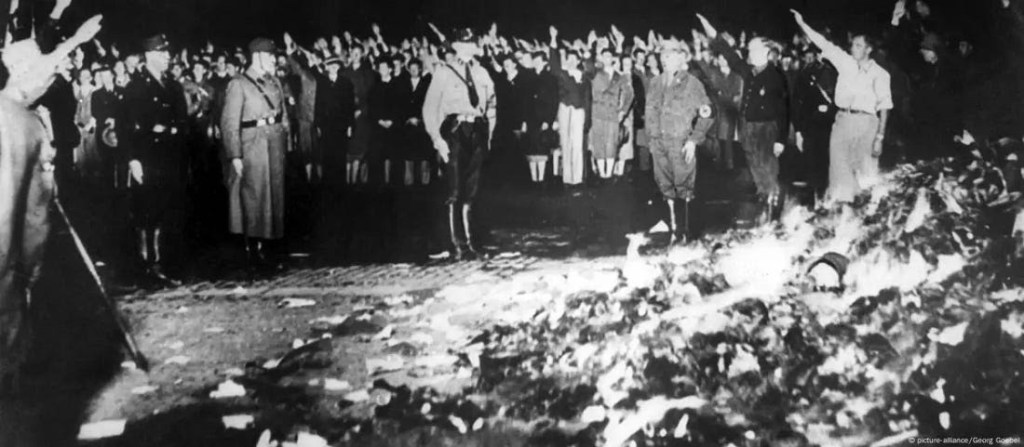
Nazi Book-Burning
Erin Reed writes:
Nearly a century ago, Nazis raided the Institut für Sexualwissenschaft—the Institute of Sexology—a pioneering research institution and clinic founded by Magnus Hirschfeld, a forefather of transgender research. The institute housed tens of thousands of books, research notes, and data documenting the first decades of scientific study on transgender and queer people. Long before the labor camps and mass killings, the Nazis identified Hirschfeld as a primary enemy, targeting his work in the early rise of fascism. That night, in Berlin’s Bebelplatz Square, they burned his institute’s collection in a now-infamous spectacle, immortalized in history books yet often stripped of the context of who, exactly, was targeted. Now, President Trump is doing the same—digitally burning records of transgender people and pressuring nonprofits to follow suit.
And those digital fires have spread. Within days of Trump’s anti-trans executive orders, the word “transgender” was erased from nearly every government website where it once appeared. CDC data on transgender health was stripped from its pages. The Stonewall National Monument—dedicated to the LGBTQ+ people who fought back against oppression, led by transgender activists—was purged of any mention of transgender people online. Even institutions and nonprofits serving LGBTQ+ communities, particularly those receiving federal funding, have been pressured into scrubbing “transgender” and “gender identity” from their materials. The Nazis would envy the speed and efficiency with which it was done.
As a transgender journalist dedicated to documenting these events and helping people grasp the broader context of attacks on queer and trans communities, I feel the weight of this moment. The sacking of the institute was not met with uproar; there was little popular resistance. At the time, no journalists spoke with sympathy about those who sought care there—much less transgender journalists who might have needed that care themselves. If only alarm had spread then, or even earlier, when the very people receiving treatment at the institute were first being demonized.
And like today’s digital fires, those flames were not lit without years of prior hate. Four years before the book burnings, one of the earliest editions of Der Stürmer—the Nazi propaganda publication that fueled fascism’s rise—accused Hirschfeld of “grooming” youth, echoing today’s attacks on LGBTQ+ people. Hitler notoriously called Hirschfeld “the world’s most dangerous Jew.” Trans and queer people were the canaries in the coalmine of atrocity. Similarly, just a few years ago, the “groomer” slur ignited online, feeding a growing trans panic that has only escalated since.
Early edition of Der Stürmer accusing Hirschfeld of grooming youth.
I don’t know where we are heading as a country, or what future you see when you stare into today’s fires. But I do know that the transgender and queer readers I write for every day see the signs—and fear the worst. Trans people, in mass numbers, have rushed to secure passports—some too late, as the administration has tightened restrictions on gender marker changes, in some cases even confiscating documents. Anyone active in this space knows people who have already left. And yet, despite this fear, so many cisgender people I speak to—including journalists covering stories that implicate our rights—seem unaware of the full scope of what is happening. I even had one reporter recently express surprise and dismay at hearing trans people were removed from Stonewall, something widely reported on in recent weeks.
People should pay attention. Court battles are already raging, with rulings blocking the administration from stripping funding from hospitals that provide transgender care. In another case, a judge appears poised to halt Trump’s attempt to expel trans service members from the military. As Trump and his allies openly float the idea of ignoring court rulings, the risk of a brazen defiance of judicial authority looms, and transgender rights could be an early test case. The way this administration treats transgender people may foreshadow how it treats all those it seeks to silence—a potential step toward consolidating totalitarian power.
Trump’s digital erasure of transgender people is more than policy—it is a declaration that the very existence of certain human beings is unwelcome in the official record. This is not a hallmark of a democratic leader respecting courts and laws; it is the move of someone intent on atrocity. When you eliminate all traces of a people’s identity, it surpasses mere ideology and becomes an act of “salting the earth,” ensuring their name and their history cannot be seen. Such an action must be recognized and resisted by every voice capable of protest. We are witnessing the dark echo of “first they came for…” in our own time, and we must understand that after they come for us transgender people, they will not simply stop with us.
Thom Hartmann, independent journalist, finds it curious that the Republican Party so frequently displays Nazi symbolism. And why does the major media ignore usually overlook the fondness for Nazi iconography by Trump, Musk, and their allies? Is it their youth? Their historical ignorance? Their caution?
He writes:
Is it a shout-out to the hardcore racists and haters that make up the GOP’s base, all just a performance to get enough votes to win elections? Or a proclamation that the end-goal of Republican governance is the destruction of American democracy, perhaps in deference to Vladimir Putin? How about it’s being a bizarre attempt at trolling people old or well-educated enough to remember or know what Nazism inevitably leads to?
One of the enduring mysteries in today’s American political life is why so many Republican politicians and their friends are adopting or promoting openly Nazi symbols, iconography, and slogans.
And why are America’s mainstream media so unwilling to even report on, much less discuss, all the Nazi and neo-Nazi references surrounding Trump and today’s captive Republicans?
Elon Musk, Trump’s #1 campaign donor and co-president, threw two Nazi “Sieg Heil” salutes following Trump’s inauguration, causing the media to fall all over itself trying to make excuses for his behavior. Actual, declared Nazis and white supremacists were thrown into an ecstatic tizzy, however, with the Ohio Proud Boys posting the clip with the words, “Heil Trump!”
The neo-Nazi group Blood Tribe posted the Musk clip with the Waffen SS lightning-bolt emoji; their leader, Christopher Pohlhaus, wrote: “I don’t care if this was a mistake. I’m going to enjoy the tears over it.” Other neo-Nazi, Nazi, and white supremacist groups across the web jumped in to celebrate the salute, as Rolling Stone extensively documented.
It all seems to have really picked up steam after young neo-Nazis marched in Charlottesville in 2017, chanting Nazi slogans, murdering a young woman protestor, and giving Hitler salutes.
Our media completely failed to identify them as Nazis, even though they were proclaiming that themselves.
Since Trump’s endorsement of their behavior with his “good people on both sides” comment, which he continues to defend, such behavior has been emulated across the nation.
Poke anything associated with Trump and odds are Nazi memes will pop out.
The “America First” slogan was the name of an openly pro-Nazi movement in America in the 1930s, a fact that seems to have been lost down the memory hole. And Trump told his former Chief of Staff, Marine General John Kelly, that “Hitler did some good things…” along with referring to American soldiers as “suckers” and “losers.”
And then there are Trump’s attacks on the media, echoing Joe Stalin and Adolf Hitler with their “enemy of the people” rhetoric. He’s suing media outlets left and right, just like Putin and Orbán did in their early years to intimidate reporters and bankrupt opposition publications and websites.
Elon Musk just called for reporters for CBS’s 60 Minutes program — “the biggest liars in the world” — to receive “a long prison sentence.”
In an echo of Hitler’s “denunciations,” his “border czar” is even calling for the police at the Department of Justice to investigate Alexandria Ocasio-Cortez for telling immigrants about their constitutional rights.
After pointing out at a rally that Hitler said that Jews were “poisoning the blood” of Germany (yes, he pointed it out himself), Trump then said of nonwhites in America:
“It’s true. They’re destroying the blood of the country, they’re destroying the fabric of our country, and we’re going to have to get them out.”
The 2021 CPAC meeting featured a stage resembling the Odal Rune, a potent Nazi symbol, that drew a rebuke from the hotel hosting the conference.
In 2022, Trump dined with Nick Fuentes, a prominent and out Holocaust denier. Trump later posted a 30-second video that twice references a “unified Reich.” Trump’s buddy Steve Bannon has repeatedly endorsed the notoriously antisemitic and racist novel The Camp of the Saints” which characterizes Black Americans, “dirty Arabs,” and “feces-eating Hindu rapists” as engaging in a conspiracy to destroy white people and civilization.
His son, Don Jr., retweeted a message by a white supremacist who attacks interracial dating and queer people, “liked” tweets by another account that postspictures of Jews with exaggerated noses, made a “joke” about gas chambers and our media, and participated in an interview with a talk show host who said slavery was the best thing to have ever happened to Black people.
When Vice President Vance visited Germany this past week, instead of meeting with that nation’s chancellor or his peer, he hung out with the leader of the Nazi-adjacent AfD party, while giving a speech in which he extensively quoted Putin’s sentiments. Proud to be known by the company he keeps…
And then there’s DOGE, the official title of the iron-fisted, massively rich oligarchs who ruled Venice for ten centuries that’s been reclaimed by billionaire Musk for himself and his work. The logo is arguably explicit, as Jim Stewartson points out at his excellent mind-war.com newsletter/website:
“On the DOGE logo there are 8 stars above the cartoon, and 8 stars on the flag inside the gear. This is another National Socialist signal. It means Heil Hitler. Musk has used this signal numerous times, in addition to quite literally doing two Hitler salutes at the inauguration.”
There are also 14 teeth on the gear that makes up the O in DOGE in the logo, a direct rip-off from Hitler’s Nazi labor movement of the 1930s, reflecting the famous “14 words” memorized by every white supremacist: “We must secure the existence of our people and a future for white children….”
Following that theme, Trump, Vance, and multiple Republican politicians and media figures have, for years, promoted the Naziesque “Great Replacement Theory” that posits American Jews are paying their agents in business, government, and society to hire Black, brown, and queer people and women to replace white men.
Additionally, when Trump tweeted out his Anders Breivik quote about saving the country and thus violating no laws, Musk retweeted it with 14 American flag emojis. These guys aren’t subtle because they don’t have to be; they know any American media that calls them out will either be attacked as paranoid or they’ll simply say it was a joke or misunderstanding.
But their followers know exactly what they’re saying, and why. Just like they understood that Trump’s birther crap was really his way of saying, “Hey, white people, have you noticed that guy in the White House is Black? We can’t tolerate that!”
And they also clearly heard the dog whistle when he came down the escalator and attacked brown-skinned immigrants. Or when he claimed the Potomac crash was because the helicopter pilot was a woman hired “because of DEI.”
Or when Trump offered refugee status to white South Africans, but not to Black or Indian South Africans.
There’s so much evidence of Trump’s and Musk’s apartheid leanings, it’s pretty much impossible to deny any longer. Which raises the question: Is our media in with the Nazis, or just committed to Not-Seeing them?
The New York Times reported on Elon Musk’s takeover of the federal government. Trump has given Musk the power to close down agencies authorized by Congress, like the USAID and the Consumer Financial Control Board. Not a peep from the Republican-dominated Congress, as the world’s richest man flaunts his power to redesign the government and Trump meekly accedes to his every demand.
Who ever dreamed that the election of Trump would lead to Elon Musk terrorizing every agency, a Cabinet whose members are dedicated to the destruction of the agencies they lead (possible exception: Rubio), and a foreign policy aligned with Russia against Europe? A domestic team determined to stamp out civil rights, defend bigotry, take away access to Medicaid, and privatize as much of the government as they can?
The DOGE plan is a coup. The richest man in the world has taken ownership of the federal government, with the consent of an eccentric, ignorant dotard in the Oval Office who was probably elected thanks to rigging and suppressing of votes by Musk and Putin.
Here are excerpts from the article in The New York Times about Elon Musk’s biggest acquisition. The federal government. His motive: he was angry about being regulated by the federal government. This is the government that funded Musk’s empire; he has received some $38 billion in federal subsidies since 2008, when he took charge of a near-bankrupt Tesla company. He loved the subsidies but hated the regulatuon. How could he stop the oversight of his business empire by the feds? Give almost $300 million to Trump and get the promise that Trump would give him free reign to wipe out the bureaucracy and replace it with AI.
From The New York Times:
It started as Elon Musk’s musings at a 2023 dinner party about how he would gut the federal bureaucracy. It evolved into an operation that has given him a singular position of influence over the government.
The plan for his Department of Government Efficiency was mapped out in a series of closely held meetings in Palm Beach, Fla., and through early intelligence-gathering efforts in Washingto
Without ceding control of his companies, the richest man in the world has embedded his engineers and aides inside the government’s critical digital infrastructure, moving with a swiftness that has stunned civil servants.
The story begins:
On the last Friday of September 2023, Elon Musk dropped in about an hour late to a dinner party at the Silicon Valley mansion of the technology investor Chamath Palihapitiya.
Mr. Musk’s visit was meant to be discreet. Still skittish about getting involved publicly in politics, he told the guests he had to be careful about supporting anyone in the Republican nomination fight. And yet here he was — joined by Claire Boucher, the singer known as Grimes and the mother of three of his children — at a $50,000-a-head dinner in honor of the presidential candidate Vivek Ramaswamy, who was running as an entrepreneur who would shake up the status quo.
As the night wore on, Mr. Musk held forth on the patio on a variety of topics, according to four people with knowledge of the conversation: his visit that week to the U.S.-Mexico border; the war in Ukraine; his frustrations with government regulations hindering his rocket company, SpaceX; and Mr. Ramaswamy’s highest priority, the dismantling of the federal bureaucracy.
Mr. Musk made clear that he saw the gutting of that bureaucracy as primarily a technology challenge. He told the party of around 20 that when he overhauled Twitter, the social media company that he bought in 2022 and later renamed X, the key was gaining access to the company’s servers.
Wouldn’t it be great, Mr. Musk offered, if he could have access to the computers of the federal government?
Just give him the passwords, he said jocularly, and he would make the government fit and trim.
What started as musings at a dinner party evolved into a radical takeover of the federal bureaucracy. It was driven with a frenetic focus by Mr. Musk, who channeled his libertarian impulses and resentment of regulatory oversight of his vast business holdings into a singular position of influence.
Without ceding control of his companies, the richest man in the world has embedded his engineers and aides inside the government’s critical digital infrastructure. Already, his Department of Government Efficiency, or DOGE, has inserted itself into more than 20 agencies, The New York Times has found.
Mr. Musk’s strategy has been twofold. His team grabbed control of the government’s human resources agency, the Office of Personnel Management, commandeering email systems to pressure civil servants to quit so he could cull the work force. And it burrowed into computer systems across the bureaucracy, tracing how money was flowing so the administration could choke it off. So far, Musk staff members have sought accessto at least seven sensitive government databases, including internal systems of the Social Security Administration and the Internal Revenue Service.
Mr. Musk’s transformation of DOGE from a casual notion into a powerful weapon is something possible only in the Trump era. It involves wild experimentation and an embrace of severe cost-cutting that Mr. Musk previously used to upend Twitter — as well as an appetite for political risk and impulsive decision-making that he shares with President Trump and makes others in the administration deeply uncomfortable.
In reporting how Mr. Musk and his allies executed their plan, The New York Times interviewed more than 60 people, including DOGE workers, friends of Mr. Musk’s, White House aides and administration officials who are dealing with the operation from the inside. Speaking on the condition of anonymity, many described a culture of secrecy that has made them afraid to speak publicly because of potential retaliation.
Mr. Musk’s stealth approach stunned both Democrats and civil servants. Failing to imagine an incursion from inside the bureaucracy, they were caught essentially defenseless.
The Times has learned new details about how the operation came together after the election, mapped out in a series of closely held meetings in Palm Beach, Fla., and through early intelligence-gathering efforts in Washington.
Seasoned conservative operatives like Stephen Miller and Russell Vought helped educate Mr. Musk about the workings of the bureaucracy. Soon, he stumbled on an opening. It was a little-known unit with reach across the government: the U.S. Digital Service, which President Barack Obama created in 2014 after the botched rollout of healthcare.gov.
Mr. Musk and his advisers — including Steve Davis, a cost cutter who worked with him at X and other companies — did not want to create a commission, as past budget hawks had done. They wanted direct, insider access to government systems. They realized they could use the digital office, whose staff had been focused on helping agencies fix technology problems, to quickly penetrate the federal government — and then decipher how to break it apart.
Since this is a gift article, please open the link and read the rest of it.
Never before in American history has there been subversion of the U.S. government that was so well planned and executed.
What will be left? How many agencies will Musk close down? How many highly skilled and knowledgeable civil servants will be fired? Which agencies will be irredeemably crippled by the loss of their best leaders?
Trump’s MAGA base was happy with his beatdown of Zelensky, and Russia too was thrilled. His Cabinet members each dutifully thanked him for offending Zelensky and “putting America First.” ((I doubt they realized that the “America First” crowd in the 1930s was opposed to helping Europe fight Hitler.)
With the exception of the Fascist leader of Hungary, who consolidated power by undermining the press and the judiciary and demonizing LGBT people, our allies cheered on Zelensky.
One hopes that Europe will unify to protect their border from Putin. Maybe the U.S. will be ejected from NATO.
European leaders quickly pledged their continued support for Ukraine on Friday after President Trump’s blistering criticism of Ukraine’s president, Volodymyr Zelensky, in a meeting at the White House.
Leaders lined up behind Ukraine and praised its embattled president, the statements coming one after the other: from France, Germany, Poland, Spain, Denmark, the Netherlands, Portugal, the Czech Republic, Norway, Finland, Croatia, Estonia, Latvia, Slovenia, Belgium, Lithuania, Luxembourg and Ireland. Canadian, Australian and New Zealand leaders added their voices to the Europeans’.
Even as Western leaders generally shied away from explicitly criticizing Mr. Trump, who had told Mr. Zelensky he was “not in a good position” and angrily threatened to pull American support for Ukraine unless he agreed to a cease-fire deal with Russia, many in Europe addressed their statements of encouragement directly to Mr. Zelensky.
“Your dignity honors the bravery of the Ukrainian people,” Ursula von der Leyen, the president of the European Commission, said on social media, referring to Mr. Zelensky. “Be strong, be brave, be fearless. You are never alone, dear President.”
President Emmanuel Macron of France, who had put on a display of friendship with Mr. Trump during a chummy visit to the White House on Monday, said the United States and Europe had been justified in aiding Ukraine and imposing sanctions on Russia after its full-scale invasion of Ukraine three years ago.
In a statement, Mr. Macron urged America to remain on the side of the Ukrainians, who he said were “fighting for their dignity, their independence, their children, and the security of Europe.”
Friedrich Merz, who is on track to become Germany’s next chancellor after the country’s election this week, said in a statement addressed to “Dear Volodymyr” that his country would stand behind Ukraine “in good and in testing times.”
“We must never confuse aggressor and victim in this terrible war,” Mr. Merz added, apparently referring to Mr. Trump, who has called Mr. Zelensky a dictator and blamed him for the invasion. The departing German leader, Chancellor Olaf Scholz, said that Ukraine could rely on Germany and the rest of Europe.
Daniel Fried, a career diplomat under American presidents of both parties who had just returned from a trip to Brussels, said the Oval Office clash had jolted Europe’s capitals, generated a wave of sympathy for Mr. Zelensky and upended a peace process that appeared to be gaining traction.
“The Europeans are horrified and dismayed,” Mr. Fried said, adding that Europeans see the United States shifting to a great-power strategy in which large countries carve up the world. “They’re watching the America they know and respect change in a matter of a couple of weeks.”
Prime Minister Keir Starmer of Britain, a center-left leader who carefully avoided any major disagreements with Mr. Trump during a visit to the White House on Thursday, spoke with Mr. Trump and Mr. Zelensky on Friday, according to the prime minister’s office. Mr. Starmer “retains his unwavering support for Ukraine and is playing his part to find a path forward to a lasting peace,” the office said in a statement.
Mr. Starmer is scheduled to host in London an international meeting on Ukraine on Sunday with Mr. Zelensky and other leaders from across Europe.
Prime Minister Viktor Orban of Hungary, a right-wing nationalist who has long been at odds with much of Europe, appeared to side with Mr. Trump, saying on social media, “Strong men make peace, weak men make war.” He did not mention Ukraine or Mr. Zelensky in his post.
Mr. Trump’s upbraiding of Mr. Zelensky also predictably won praise in Russia. Dmitri Medvedev, a former Russian president who is deputy chairman of Russia’s Security Council, said on Telegram that Mr. Trump had told “the truth.”
The Canadian foreign minister, Mélanie Joly, joined the European leaders in offering words of support for Ukraine, telling reporters that Ukrainians were “fighting for their own freedoms, but also fighting for ours.”
Ms. Joly, whose country’s relationship with Mr. Trump has been deeply strained by the American president’s threats to annex Canada and plans to impose tariffs, stressed the importance of maintaining Western unity over the war in Ukraine. She said that the Russians were watching.
On Saturday morning in Australia, Prime Minister Anthony Albanese echoed the messages of support from Europe. Mr. Albanese said his country was proud to help Ukraine defend itself against “the brutality of Russian aggression.”
Mr. Zelensky responded to each European leader on social media, writing, “Thank you for your support.”
But he offered his most ample statement of gratitude to Mr. Trump, who had said in the Oval Office earlier on Friday that Mr. Zelensky was not “acting at all thankful” for American aid.
“Thank you America, thank you for your support, thank you for this visit,” wrote Mr. Zelensky, also thanking Mr. Trump, and adding, “Ukraine needs just and lasting peace, and we are working exactly for that.”
James Pintell of The Boston Globe wrote yesterday, after the fractious meeting in the Oval Office in which Vance and Trump insulted Zelensky, as the beginning of a “new world order.”
He wrote:
The blow-up set the stage for an entirely new world order, should future presidents choose to accept its premise. Or they could, of course, go in a different direction.
Following World War II, the global order was clear. There were two major powers, two teams, and nearly every event was viewed through the lens of which side it benefited or which it cost.
Then the Soviet Union collapsed, leaving the United States as the world’s sole superpower…
Then Russia invaded Ukraine three years ago.
The early international response to that war fell into three broad camps. At first, Russia was isolated, sanctioned by developed nations that also provided support to Ukraine. Eventually, Russia found allies: China gave it money, Iran gave it drones, and North Korea gave it troops. Meanwhile, much of the Global South remained neutral, sitting out the conflict altogether.
But the Oval Office meeting Friday may have formalized something that has been brewing since Trump’s reelection in November: a new era of neocolonialism, where a handful of powerful nations dictate global affairs.
Is this what Trump voters wanted?
Did Americans realize when they voted last November that they were voting to abandon NATO and our European allies? Did they realize that they were voting for an alliance with Putin and Russia? Did they know they were voting to abandon Ukraine in its fight to be free of Russian domination?
The two big issues were immigration (“out of control,” said Trump) and inflation (Trump said inflation would fall as soon as he was insulated.
I don’t recall any promises to create a new world order in which we voted with Russia, North Korea, and Iran against condemning the Russian invasion of Ukraine.
I don’t remember Trump promising to create chaos in every federal agency. Or pledging to stop all foreign aid. Or making Elon Musk the co-President.
Yet the meeting in the Oval Office in which Trump and Vance berated Zelensky clarified that the U.S. position in the world has changed.
We are now in Putin’s camp. we do not defend democracy, freedom, and Western values. We do not defend nations that are struggling against authoritarian regimes. If it were 1939, we would be allied with Hitler.
The meeting was a set-up. Zelensky undertook an arduous journey from his war-torn country, assuming that he was going to sign a deal to give the U.S. half of Ukraine’s natural resources, in exchange for our continued support. The deal was written.
But Trump wanted Zelensky to agree that Putin could keep all the Ukrainian land he had seized.
Zelensky wanted security assurances to guarantee that Putin would not invade Ukraine again.
The meeting began with Zelensky thanking Trump for inviting him to the White House. Almost immediately, Vance attacked Zelensky for not showing sufficient gratitude. Note that as a Senator from Ohio, Vance voted against every aid to Ukraine bill.
Vance and Trump insulted Zelensky repeatedly. Zelensky didn’t show enough respect to Trump, Zelensky was not sufficiently grateful.
Zelensky left or was thrown out, I’m not sure which.
Trump immediately crowed about his strength and power.
Every single cabinet member tweeted how proud they were of Trump for “putting America first.” So did MAGA members of Congress.
Dimitri Medvedev, the Prime Mjnister of Russia, tweeted that he was pleased that “the insolent pig” (Zelensky) was ousted from the White House.
This is not the country I grew up in. This is not the country to which I recited the Pledge of Allegiance every school day.
All of those wonderful songs I sang about liberty, freedom, justice, equality. All the stories about standing up against tyranny so that people could live in freedom. All dashed.
We must have the courage, the strength, the fortitude to recover our country, its values, its ideals.
Friends with a murderous tyrant? This is not who we are. Or were.
Veteran newsman Dan Rather described his reaction to the fiasco in the Oval Office, when Trump and Vance berated our ally, Volodymyr Zelensky, while praising Vladimir Putin.
You must watch the video of the encounter, which is linked at the end. I cringed as I watched. Trump and Vance bullied Zelensky. They pounded him with attacks and questions but never let him respond.
When you watch it, you see that they came into the meeting intending to humiliate Zelensky.
Trump even talked about how Putin had suffered alongside him because of the allegations that Russia interfered in the 2016 election. A bipartisan Senate committee, led by Republicans, concluded that Putin did interfere in that election, specifically to help Trump.
Here is Dan Rather:
We try not to react to every White House event involving the new president, as we like to take a little time to digest what has happened and provide thoughtful analysis. But there’s not much to analyze about the president’s shocking behavior on Friday.
It was a new low for American diplomacy in my lifetime. There are few words that are family-friendly enough to describe what happened. Embarrassing. Horrifying. Mortifying.
People who witnessed or have watched Trump and JD Vance’s behavior toward a visiting head of state have said it made them everything from appalled to nauseous.
Here’s what happened: Ukraine’s President Volodymyr Zelenskyy was scheduled to meet with Trump and Vance at the White House before a joint news conference and then a signing ceremony for a minerals-for-money deal. It never got past a one-sided shouting match in the Oval Office.
In what looked like a rehearsed and choreographed tag-team effort, Trump berated and lectured Zelenskyy while Vance egged him on. In front of cameras, Trump harangued Zelenskyy for supposedly not being grateful for U.S. aid and not acceding to American demands to end the war.
According to CNN’s fact checkers, Zelenskyy has thanked presidents Biden and Trump, and the American people, 33 times since the war began three years ago.
The whole thing today appeared to be a setup, a trap sprung on a wounded ally. Whatever it was, it will remain, through history, a stain on America’s reputation.
This reporter has covered hundreds of photo opportunities in the Oval Office over many administrations. Such are almost always dignified occasions. Today this tradition was sullied for the benefit of the MAGA faithful and the Kremlin.
Peter Baker of The New York Times described the meeting in shocked terms. “I have covered the White House since 1996. There has never been an Oval Office meeting in front of cameras like this one in all that time. Never has an American president lectured the leader of an ally in public like this, much less a leader that is fighting off invaders.”
If the point was for Trump’s friends in Russia to see his performance, message received. Cheers erupted in Moscow. A former Russian president praised Trump for his treatment of Zelenskyy.
At one point, Trump openly threatened the Ukrainian president. “You’re either going to make a deal or you’re out,” Trump yelled. A short time later, Zelenskyy left the White House.
The absurdity of the moment concluded with Trump, a former reality TV actor, saying, “This is going to make great television.”
To think the world’s security rests on this man’s judgment.
Even if you’ve seen the exchange or pieces of it, you may want to watch it again. And ponder anew what kind of country we are becoming.




 Diane Ravitch's blog