Archives for category: Failure

Tom Ultican, retired teacher of physics and mathematics, writes here about the recent decision by local officials to open a PUBLIC SCHOOL in New Orleans. This is a symptom of the failure of the “all-charter” idea.

He writes:

New Orleans Public Schools, aka Orleans Parish School District (OPSD), became America’s first and only all charter school district in 2017. After hurricane Katrina, the state took over all but five schools in the city. When management was transferred to charter organizations in 2017, OPSD officially became an all charter district. This August, the city will open district-operated Leah Chase K-8 School, ending the all charter legacy.

According to Superintendent Avis Williams, the infrastructure required for the district to run Leah Chase will make it easier to open future district-run schools. OPSD will become both a charter school authorizer and regular school district. There is hope that New Orleans, Louisiana (NOLA) is pulling out of an abyss and tending towards a healthy public school system….

All-Charter NOLA Doomed from the Beginning

Public investment in education is widely viewed as the key to America’s success. Since the 19thcentury, communities have developed around local public schools. This opportunity was taken from NOLA neighborhoods…

Louisiana’s state takeover law required schools scoring below average to be closed. If this were real, half of the schools in the state would be closed every year. Instead, arbitrary state performance scores based on testing data, attendance, dropout rates and graduation rates were established. Similar ratings are used to evaluate NOLA charter schools. The nature of privatized schools and testing results led to almost half of the charter schools created being closed.

The NOLA school enrollment system allows parents to research the 100 schools and apply for up to eight of them. The algorithm selects the school from one of the eight if space is available. It is not uncommon for students to ride a bus past schools within walking distance of their homes. This complicated system is driving segregation.

For many education professionals, this system looked like a sure failure from the beginning. Communities could not develop around their schools and the schools would not be stable; important aspects of quality public education….

The All Charter District is a Failure
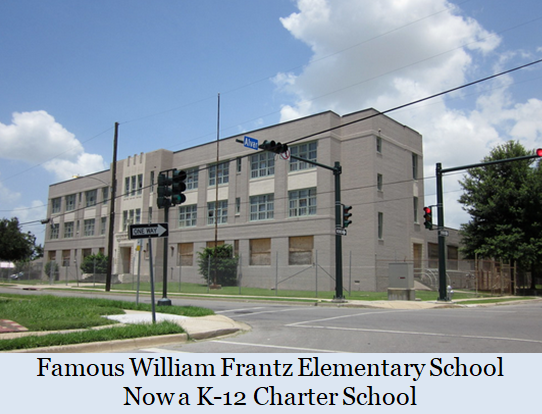
In 2021, Secretary of Education Miguel Cardona visited OPSD. He heard first-hand the growing disillusionment with the all charter system. Four of the six parents told him they wanted to go back to neighborhood schools. Parents complained about Teach for America, placing unqualified teachers in schools and the One App process for not offering school choice.

Senator Bouie wrote a two-page paper, A Moral Imperative and Case For Action”, stating: After spending 6 Billion dollars of tax payers’ money to become the only all-Charter system in the State, a staggering 73% of our children are not functioning at grade level, compared to 63% in 2005, when the State took control of over 100 of our schools.”

He also shared:

“In other words, fellow citizens, this 15-year flawed experiment has yielded no best practices identified to improve student and school performance, no State protocol for Charter Law Compliance, and no student performance improvement. It has, however, yielded other devastating consequences for our children and our community.”

He mentioned the 26,000 students between the ages of 16 and 24 who went missing. The privatized charter school system was unable to account for them which is expected and natural for a public school district.

Bouieu They are transported past a neighborhood school to attend a failing school across town” and eliminating the ineffective One App central enrollment system claiming,It has created inequities by Race and Class and admissions by chance (lottery) and not choice.”

Raynard Sanders who has over forty years of experience in teaching, education administration and community development, said the charter experiment has “been a total disaster in every area.”He asserted NOLA had “the worst test scores since 2006, the lowest ACT scores, and the lowest NAEP (National Assessment of Educational Progress) scores.”

Based on a 2015 study by the Center for Popular Democracy, Sanders declared, “Charter schools have no accountability and, fiscally, charter schools in New Orleans have more fraud than existed in the OPSD (Orleans Parish School District).” The fraud claim was used by the state in 2003 against OPSD to begin taking schools.

Loyola University Law Professor Bill Quigley stated“NOLA reforms have created a set of schools that are highly stratified by race, class, and educational advantage; this impacts the assignment to schools and discipline in the schools to which students are assigned.”

He contended, “There is also growing evidence that the reforms have come at the expense of the city’s most disadvantaged children, who often disappear from school entirely and, thus, are no longer included in the data.”

Professor of Economics, Doug Harris, and his team at Tulane University are contracted to study school performance in New Orleans. Harris claims schools have improved since Hurricane Katrina. However Professor Bruce Baker of Rutgers University disagrees. He noted that the school system is not only smaller but less impoverished. Many of the poorest families left and never returned. So the slightly improved testing results are not real evidence of school improvement.

The latest testing data from 2023 saw NOLA public schools receive failing grades but based on Louisiana’s new progress indicator, the district received a C, meaning an F for assessments and an A in growth.

In a letter to the editor, former OPSD superintendent, Barbara Ferguson, stated:

“The state took over 107 of New Orleans’ 120 public schools and turned them into charter schools. Last year, 56 of New Orleans’ 68 public schools had scores below the state average. Thus, after nearly 20 years, over 80% of New Orleans schools remain below the state average. This charter school experiment has been a failure.”

Final Words

In 2006, with the school board out of the road and RSD in charge, philanthropists Bill Gates, Eli Broad and others were ready to help.

Naomi Klein’s 2007 book, The Shock Doctrine, labeled these school reforms, a prime example of “disaster capitalism”, which she described as “orchestrated raids on the public sphere in the wake of catastrophic events, combined with the treatment of disasters as exciting market opportunities.” She also observed, “In sharp contrast to the glacial pace with which the levees were repaired and the electricity grid brought back online, the auctioning-off of New Orleans’ school system took place with military speed and precision.”

Desires of New Orleans residents were ignored. Neoliberal billionaires were in charge. In all the excitement, few noticed that these oligarchs had no understanding of how public education functions. They threw away 200 years of public school development and replaced it with an experiment. The mostly black residents in the city were stripped of their rights.

Thousands of experienced black educators were fired and replaced by mostly white Teach For America teachers with 5 weeks of training. Instead of stable public schools, people were forced into unstable charter schools. Instead of professional administration, market forces drove the bus!

Clearly, the all charter school system is a failure.

I have written it again and again: The war in Gaza is complicated. There is no simple “right side” and “wrong side.” The war should end as soon as possible. Both sides have committed terrible atrocities and crimes against humanity. The only way out is through negotiation. All the hostages must be returned, alive and dead. The end result must include plans for a Palestinian state.

Nicholas Kristof said it best in yesterday’s New York Times:

I’ve been on a book tour for the last few weeks, speaking around the country, and one of the questions I get asked most often isn’t about my book at all but along the lines of: What should I think of the war in Gaza?

The toxic public debate is dominated by people with passionate views on both sides, but most people I meet are torn and unsure how to process the tragedy that is unfolding. That makes sense to me given how exquisitely complex real-world ethics are, as much as we may yearn for black-and-white morality tales.

With that in mind, I’d like to offer this highly personal road map for thinking about the war. Here’s a set of morally complicated, sometimes contradictory principles for a nuanced approach to sort out the issues.

1. We think of moral issues as involving conflicts between right and wrong, but this is a collision of right versus right. Israelis have built a remarkable economy and society and should have the right to raise their children without fear of terror attacks, while Palestinians should enjoy the same freedoms and be able to raise their children safely in their own state.

2. All lives have equal value, and all children must be presumed innocent. So while there is no moral equivalence between Hamas and Israel, there is a moral equivalence between Israeli civilians and Palestinian civilians. If you champion the human rights of onlyIsraelis or only Palestinians, you don’t actually care about human rights.

3. Good for President Biden for pushing a proposal on Friday for a temporary cease-fire that could lead to a permanent end to the war and a release of hostages; as he said, “It’s time for this war to end.” Let’s hope he uses his leverage to achieve that end. It’s also true that Biden’s failure to apply enough leverage over the last seven months has made the United States complicit in human rights abuses in Gaza, because it has provided weapons used in the mass killing of civilians, and because it has gone too far in protecting Israel at the United Nations.

4. We can identify as pro-Israeli or pro-Palestinian, but priority should go to being anti-massacre, anti-starvation and anti-rape.

5. Hamas is an oppressive, misogynistic and homophobic organization whose misrule has hurt Palestinians and Israelis alike. But not all Palestinians are members of Hamas, and civilians should not be subject to collective punishment. In the words of a 16-year-old Gaza girl: “It’s like we are overpaying the price for a sin we didn’t commit.”

6. There was no excuse for Hamas attacking Israel on Oct. 7 and murdering, torturing and raping Israeli civilians. And there is no excuse for Israel’s reckless use of 2,000-pound bombs and other munitions that have destroyed entire city blocks and killed vast numbers of innocent people, including more than 200 aid workers.

7. When Israel began military operations after Oct. 7, it was a just war.

8. What starts as a just war can be waged unjustly.

9. Israel was entitled to strike Gaza after the Oct. 7 attack, but not to do whatever it wanted. In particular, there should be no argument about Israel’s practice of throttling food aid. Using starvation as a weapon of waragainst civilians, as the prosecutor of the International Criminal Court alleges Israel has done, is a violation of the laws of war.

10. Each side justifies its own brutality by pointing to earlier cruelty by the other side. Israelis see Oct. 7. Palestinians see the “open-air prison” imposed on Gaza before that. This goes all the way back to the displacement of Palestinians at Israel’s founding in 1948, the 1929 massacre of Jews at Hebron, and so on. Enough obsession with the past! Let’s focus instead on saving lives in the coming months and years.

11. Hamas’s brutality toward Israeli hostages, such as credible reports of sexual assault and starvation, is unconscionable. So is Israeli brutality toward Palestinian prisoners, such as CNN accounts that some Palestinians have had limbs amputated because of constant handcuffing.

12. War nurtures dehumanization that produces more war. I’ve heard too many Palestinians dehumanize Jews and too many Jews dehumanize Palestinians. When we dehumanize others, we lose our own humanity.

13. Zionism is not a form of racism. And criticism of Israel is not antisemitism. Both sides are too quick to fire such epithets.

14. Each side sees itself as a victim, which is true — but each side is also a perpetrator.

15. “Apartheid” isn’t the right word for Israel today, where Palestinians are treated like second-class citizens but can still vote, serve in the Knesset and enjoy more political freedoms than in most of the Arab world. But “apartheid” is a rough approximation of Israeli rule in the West Bank, where Arabs have long been oppressed under a system that is separate and unequal.

16. “From the river to the sea” refers to the dream of a single state from the Jordan River to the Mediterranean Sea, encompassing what is now Israel and the Palestinian territories. The slogan as used by protesters can mean many different things, some peaceful and some the militaristic vision of the Hamas charter, while a parallel vision is in the original platform of Prime Minister Benjamin Netanyahu’s Likud party. Hamas imagines a Palestinian state with no room for Israel, and Netanyahu wants perpetual Israeli sovereignty from the river to the sea to deny a place for a Palestinian state. I think that instead of either version of a one-state solution, a two-state solution is infinitely preferable.

17. Pro-Palestinian demonstrations have too often tolerated strains of antisemitism, which in recent months has shown itself to be stronger than many imagined. How can a movement that claims the moral high ground make excuses for any kind of bigotry?

18. Campus protesters would do more good raising money for suffering Gazans rather than using it to buy tents for themselves.

19. We probably know what an eventual Israeli-Palestinian peace deal would look like. The plan was outlined in the Clinton parameters of 2000 and in the Geneva Accord of 2003. The only question is how many innocent people on both sides will die before we get there.

20. To establish peace, both Israel and the Palestinian Authority will need new leaders with vision and courage. This won’t be achieved tomorrow. But there are peacemakers on each side. To understand how a path toward peace may emerge, consider the words of the Chinese writer Lu Xun more than a century ago: “Hope is like a path in the countryside. Originally, there is nothing — but as people walk this way again and again, a path appears.”

A wise Palestinian from Jenin, Mohamed Abu Jafar, whose 16-year-old brother had been shot dead by Israeli forces, told me last year: “They can’t kill us all, and we can’t kill them all.” That leaves, he said, one practical option for all of us: working for peace.

Let’s get to it.

In Ohio, as in every other state, most children go to public schools. You would think that their elected officials would work hard to ensure that their district’s public schools are well-funded. In red states like Ohio, you would be wrong. Safe in their gerrymandered districts, Republicans are shoveling money to charters and vouchers, not public schools. Their generosity to nonpublic schools ignores the long list of scandals associated with charters, as well as their poor performance. Nor are Republicans concerned by the lack of accountability of voucher schools, not to mention their discriminatory practices.

Jan Resseger wonders whether Republicans care about the education of the state’s children. Answer: No. They have higher priorities, religious and political.

She writes:

On Tuesday, the Ohio Capital Journal’Susan Tebben reported: “Ohio House Democrats have laid out a plethora of bills targeting the education system in the state, impacting everything from teacher pay to oversight of private school vouchers and the overall funding of the public school system…’Our principles are pretty clear on that front,’ said House Minority Whip Dani Isaacsohn, D-Cincinnati. ‘There is no better investment we can make in the future of our state than investing in the education of our students, and that every kid, no matter which corner of the state they grow up in, deserves a world class education.’

There is a problem, however, blocking most pro-public school legislation. Only 32 of 99 Ohio House members are Democrats, and in the Ohio Senate, only 7 Democrats serve in a body of 33 members. Due to gerrymandering, the Ohio Supreme Court rejected the district maps that are being used today, but the Court did not enforce its ruling. This means that, except in the state budget where compromises sometimes are demanded, most of the Democratic priorities languish.  In the recent budget, the legislature enacted a second stage of the three-budget, phase-in of a new public school funding formula, but it was accompanied by a universal private school tuition voucher expansion.

Here, according to Tebben, is what has happened to a bill to prioritize and protect the new public school funding formula:

“At the top of the (Democrats’) list is House Bill 10, which seeks to hold legislators to the six year phase-in plan that was assigned to the Fair School Funding Plan, legislation that funds public schools based less on property values and more on the needs of individual school districts.  HB 10 is a bipartisan bill which simply ‘expresses the intent of the General Assembly to continue phasing in the school financing system,’ which was inserted in the 2021 budget bill, ‘until that system is fully implemented and funded,’ according to the language of the bill.  The bill was introduced in February 2023 and quickly referred to the House Finance Committee, but has not seen activity since.”

Ohio’s gerrymandered Republican supermajority won’t commit to the eventual full funding of the state’s public school system because, they say, revenue projections are unsure in the context of growing privatization and years of cutting taxes in budget after budget.

Ohio’s gerrymandered Republican legislators instead operate ideologically and far to the right.  After Governor Mike DeWine vetoed a bill to deny medical care for transgender youths last winter, legislators immediately overrode the veto.  Far-right bills from the American Legislative Exchange Council and other bill mills, and bills endorsed by the extremist but powerful Columbus lobby, the Center for Christian Virtue, now housed in the building it purchased across the street from the Statehouse, dominate legislative deliberation and get lots of press.

Please open the rest of this important post.

After Spectrum News reported that millions of dollars had been sent from Texas charter schools founded by Mike Miles to Colorado charter schools in the same chain, parents and students demanded Miles’ resignation as superintendent of Houston Independent School Disttrict. Elected officials have called for an investigation but recognize that neither the State Commissioner (Mike Morath) nor Governor Abbott are likely to criticize Miles, whom they appointed.

HOUSTON — U.S. Rep. Sylvia Garcia formally requested that the U.S. Department of Education investigate the issues at Houston ISD and the financing of schools in the area, according to a letter obtained by KHOU 11 News.

In the letter dated May 15, the Congresswoman refers to recent news stories that reported Ector ISD near Midland, Texas allegedly sent state funds from Texas to Third Future Schools, a charter school operated in Colorado. She requested that an audit be conducted on Ector ISD.

Spectrum News Texas report highlighted a pair of million-dollar-plus checks allegedly sent from Third Future Schools in Texas to its campuses in Colorado. The report accused Houston ISD Superintendent Mike Milesof sending Texas tax dollars out of state.

Miles has issued a statement responding to the report, saying the report “either intentionally or through gross incompetence, mischaracterized commonplace financial arrangements between charter schools and the charter management organizations that support them.” 

RELATED: HISD Superintendent Mike Miles responds to report he funneled TX taxpayer money to Colorado | TEA commissioner, Third Future Schools also respond

Garcia expressed concerns over the financial stability of HISD following last year’s takeover by the state of Texas. This comes after widespread layoffs were announced leading to protests from those affected and HISD families.

RELATED: More Houston ISD parents protest over principals reportedly being forced out

RELATED: She was principal of the year in 2023. A year later, she said HISD forced her to resign

Texas Education Commissioner Mick Morath has confirmed that the TEA complaints team will look into allegations against Miles

The congresswoman also requested the issuance of federal funds by the state from the pandemic that were to be used to supplement public education at HISD be audited.

“It pains me that my home school district has been taken over and is seemingly being intentionally run into the ground and (I) request any additional assistance you can provide to protect our schools and our students,” Garcia said in the letter.

Garcia went on to claim that the state is punishing HISD.

“Houston is a vibrant and diverse community, and our state government is punishing us for that; we need your help,” she said in the letter.

Tom Ultican has noticed a strange phenomenon on billionaire-funded websites, particularly The 74: Praise for the justly-reviled No Child Left Behind.

Teachers hated it because of its warped emphasis on standardized test scores. Students hated it because they were cheated of a real education, they lost civics, the arts, and recess, and the tests assumed more importance than they deserved.

But Ultican writes, Chad Aldeman of The 74 is nostalgic for the good old days of NCLB.

Neoliberals joined with libertarians to “reform”public education. Their tools were big money and propaganda distributed by media outlets like The 74, support by The Walton family (EIN 13-3441466) and Bill Gates (EIN 56-2618866). This year, regular columnist for The 74, Chad Aldeman, is trying to claim that lifting No Child Left Behind (NCLB) school accountability sanctions is responsible for the public school testing “data decline”.

In a recent article in The 74, Aldeman complained of widening achievement gaps in Indiana, but Ultican can’t find the source of Aldeman’s data.

Ultican notes that NCLB interrupted a long period of academic improvement.

From 1970 to 1992, America’s schools showed slow but steady improvement in education-testing outcomes but since the era of standards, testing and accountability, improvement basically stopped. Education, run by billionaires and politicians instead of educators, failed to improve testing outcomes.

Alderman stated in his latest article that it is not just an Indiana problem but that “49 of 50 states, the District of Columbia and 17 out of 20 of the large cities that participated in NAEP … saw a widening of their achievement gap over the last decade.” He did not share which tests showed widened achievement gaps nor which cohorts were compared. NAEP reports on reading scores for 4th and 8th grade do not show a significant change in scoring gaps between Black and White students and comparisons in other ethnic groups also were steady.

After asking what has caused this (non-existent) achievement gap increase, Alderman posited several possible reasons: Common Core state standards (CCSS), per-pupil spending, technology and social media. He said the timing for CCSS fit but did not explain why states where CCSS was never adopted had the same problem. For per-pupil spending, he claimed that more money was getting to classrooms, which defies education-spending reports, making his claim a little shady. For technology and social media, he said other countries with similar problems, did not see testing declines … a declaration made with no evidence cited.

If this decline were real, wouldn’t the privatization of public education be the most likely culprit? Charter schools came first followed by vouchers and more charter schools. Data clearly shows that vouchers harm student-testing performance. Furthermore both charter schools and voucher schools leech money from public education budgets.

He finally made his real point, “I argue that the weakening of school accountability pressures after the No Child Left Behind Act was passed is responsible for a large portion of the drop.” Those of us, who were in classrooms and witnessed the test-and-punish philosophy damage to public education, disagree. How many great public schools were labeled “failures and closed” because they existed in low income zip codes?…

Ultican concludes:

The 74 was founded in 2015 by former CNN news anchor, Campbell Brown, along with Michael Bloomberg’s education advisor, Romy Drucker. Its original funding came from the Dick and Betsy DeVos Family Foundation Walton Family FoundationDoris and Donald Fisher Fund and Bloomberg Philanthropies. Since then, it has been the vehicle for spreading the billionaire message of privatization and undermining public schools.

Some billionaires see the non-sectarian nature of public education as a threat to their dreams of a Christian theocracy. Others are libertarians that oppose free universal public education, believing everyone should pay one’s own way and not steal people’s private properties using taxation. The Neoliberals are convinced that education should be run like a business and react to market forces.

Responding to the mission of The 74, Chad Aldeman’s series of articles, like those of many of his colleagues, are pure propaganda, shaping data to support his neoliberal ideology instead of honestly reporting facts. Unfortunately this kind of fake “journalism” is flooding email boxes and web pages throughout America every day.

The founding myth of the corporate reform movement is the rebirth and transformation of the public schools of New Orleans after Hurricane Katrina in 2005. Most of the city’s public schools suffered physical damage because of the horrendous storm. Large numbers of the students and teachers were scattered after the storm. The state of Louisiana moved in aggressively: it lowered the bar at which a school was deemed to be failing. It took control of most of the public schools and turned them over to charter operators. It fired all of the teachers, most of whom were African-American, disbanding the teachers’ union. The charter operators hired large numbers of Teach for America recruits. The media hailed the experiment in privatization as a success story. Numerous states followed the lead of New Orleans, turning over their lowest-performing schools to charter operators. Michigan created the Education Achievement Authority. Tennessee created the Achievement School District. North Carolina and Nevada launched similar but smaller experimental districts. All of them failed.

Now comes a report that the nearly all-charter New Orleans district did not live up to its hype.

Dr. Barbara Ferguson 
Research on Reforms, Inc. 

April 2024

Following Hurricane Katrina, a newly enacted state law identified schools that scored below the state average as failing and subject to take-over. The state then took-over 107 of New Orleans’ 120 public schools and turned them into charter schools. Last year’s scores showed that 56 of New Orleans’ 68 public schools had scores below the state average.*

Thus, after nearly twenty years, over 80% of New Orleans schools are still below the state average. This charter school experiment has been a failure.

Of the five worst performing high schools taken-over, only one now scores above the state average. Two are still below the state average. Another was closed and then reopened as a campus to expand the Willow selective admission charter school. The status of the other, Walter Cohen, is unclear. Recall that the New Orleans College Prep Charter took-over Cohen High School, operating its selective charter school on one floor, while leaving the failing Cohen students on the other floors. Thus, we learned that the take-over of a failing school simply meant taking-over the building, not the failing students in the building.

Of the five highest performing high schools taken-over, they continue to be the highest performing except for one, McDonogh #35, which is now below the state average. These schools, except for McDonogh #35, collectively received over $5 million in Charter School Grant Funds. The five worst performing high schools received nothing in Charter School Grant Funds following the takeover.The Louisiana law, which termed charter schools “an experiment,” also stated that they were to “serve the best interests of at-risk” children and youth.

But the legislative auditor found in 2022 that for the past six years, more than 1 in 5 charter schools failed to meet requirements on enrollment of children from low-income families.

Louisiana’s “state takeover” law required schools below the state average to be taken-over. Thus, half of the schools should have been taken-over because half are below the state average and half are above. Yet, only the New Orleans’ schools below the state average were taken-over. Targeting New Orleans seems to again be popular with our new governor.

Research on Reforms, Inc. consistently reported on the status of the state-takeover through its website and a published book, “Outcomes of the State Takeover of the New Orleans Schools.” This will be the final of its outreach, which ends with hope that our legislature will one day enact laws that provide equity and excellence in education for our New Orleans children and youth.

Barbara Ferguson, Attorney and Co-founder 
Charles Hatfield, Co-founder 
Research on Reforms, Inc.

Comments to 

bferguson@researchonreforms.org

Research On Reforms Website

Governor Bill Lee of Tennessee made school vouchers his top priority but the issue died in the Legislature despite its Republican supermajority. He will bring the issue back next year. He’s hoping for universal vouchers, where every student in the state is eligible for a voucher but opponents call his plan a subsidy for the wealthy who already are attending private schools.

In eastern Tennessee, and very likely across the entire state, parents and educators heaved a huge sigh of relief.

Dustin Park is a parent of kids who go to school in Maryville. He’s opposed to the universal school voucher plan because he said it excludes students with disabilities.

“The only thing that protects kids with disabilities is that federal law,” Parks said. “A bedrock of our public schools is that they accept everybody.”

The school district he sends his children to supports his stance. 

“We continue to maintain our belief that public funds should not be diverted to private entities, and taxpayers should not be required to subsidize private schools that are not held to the same standards of accountability and inclusivity as public schools,” said Mike Winstead, Director of Maryville City Schools. “If the Education Freedom Scholarship Act passed, it would have been harmful to the very students and vulnerable populations it maintained to assist.”

Dave Gorman is a teacher at Knox County Schools and also said he’s not sure lawmakers will listen to their constituents.

“We also have seen enough dirty dealings,” Gorman said. “We’ll never forget when Jason Zachary was the deciding vote to bring vouchers to a couple of cities in the state a few years ago — when it looked like it was about to die and he changed his vote.”

Knox County Schools provided the following statement about the proposal failing.

“As we have stated before, our attention has and will continue to stay focused on our students and providing them with a high-quality education. We are confident that our families will continue to choose KCS regardless of what happens at the state level.” 

Several school districts across East Tennessee also said they also are pleased a school voucher plan would not pass this session…

Kelly Johnson, Director of Clinton City Schools

“Elected officials are responsible for listening to their constituents, not answering to outside special interest groups. We know Governor Lee plans to bring it back next year. It is my hope that the citizens of TN remain vigilant in celebrating the many successes of public schools.”

The billionaire funded outside special interest groups will be back next year. Parents and educators should vote to replace those who want to undermine public schools.

Indiana blogger Steve Hinnefeld writes about what happens when charter schools go shopping for an authorizer. He tells the story of a charter school that has been dropped by a series of authorizers, but picked up by a new one each time. Why would a new authorizer step in to take responsibility for a charter school that has been dropped by others? I’m not sure about how it works in Indiana, but in most states the authorizer gets a set percentage—typically 3%— of state tuition for each student. That adds up to a lot of money.

Hinnefeld writes:

Trine University came to the rescue eight years ago when Thea Bowman Leadership Academy was in danger of losing its charter and being shut down.

Now Trine has revoked the Gary, Indiana, school’s charter, citing academic and governance issues. But another private institution, Calumet College of St. Joseph, has stepped up.

“It’s funny how things have come full circle,” said Lindsay Omlor, executive director of Education One, Trine’s charter-school-authorizing office.

Today’s topic is authorizer shopping, what happens when charter schools jump from one authorizer to another to stay open or find a better deal. Thea Bowman looks to be taking the practice to a new level. It now has its third authorizer in less than a decade.

Back in 2016, the school’s original authorizer, Ball State University, declined to renew its charter, citing management and fiscal issues. The school turned first to the Indiana Charter School Board, which said no. But it found a willing partner in Trine University.

Now Trine has decided it’s done with the school. Its Education One board voted in December to revoke Thea Bowman’s charter. But school officials, perhaps expecting trouble, had already approached Calumet College. The board of CCSJ Charter Authority, the Calumet authorizing entity, approved a new charter in January.

Under a 2015 law intended to discourage authorizer-shopping, the new charter had to be approved by the State Board of Education. That happened Wednesday.

Thea Bowman is an established school that once served over 1,200 students in grades K-12. It now enrolls 840: Over 90% are Black and 75% qualify for free or reduced-price meals. Its proficiency rates on ILEARN, Indiana’s math and English/language arts test, are well below state averages. A 2022-23 review by Education One found it met standards for fiscal matters and school climate but not for academic and organizational performance.

The state board vote followed a hearing at which the executive directors of Education One and CCSJ Charter presented their findings. Two young women, both committed to school choice, charter schools and their view of high-quality authorizing, described Thea Bowman Leadership Academy in starkly different terms.

CCSJ’s Carrie Hutton took issue with Trine’s conclusion that the school was deficient in academics. Its test scores are improving, she said, and they are as good as or better than those at nearby charter schools and the Gary Community Schools district. She said the college will work with school staff to improve curriculum and add internships and college credit opportunities for students.

Her strongest point may have been that the charter school and the college are part of the same northwestern Indiana urban community. Calumet is in Hammond, next door to Gary, while Trine is in Angola, a two-hour drive to the east.

“They are our neighbors, and their graduates are our co-workers and students in our college,” Hutton said.

But Education One’s Omlor said the school has failed to meet performance targets, and governance issues have persisted. “I can confidently say that the school board lacks the capacity to govern a high-quality school that meets our standards,” she said.

She said the school has a 40% teacher turnover rate, and half its teachers are not fully licensed. She also took aim at CCSJ Charter, saying the authority “made many missteps” and failed to communicate and share information.

Open the link to see what happened.

Tom Ultican, retired teacher in California, smells a scam in the making. The science behind “the Science of Reading” movement is not very scientific, he writes. Publishers and vendors are preparing to cash in on legislative mandates that force reading teachers to use only one method to teach reading despite the lack of evidence for its efficacy. Ultican zeroes in on the role of billionaire Laurene Powell Jobs as one of the key players in promoting SofR.

He writes:

Laurene Powell Jobs controls Amplify, a kids-at-screens education enterprise. In 2011, she became one of the wealthiest women in the world when her husband, Steve, died. This former Silicon Valley housewife displays the arrogance of wealth, infecting all billionaires. She is now a “philanthropist”, in pursuit of both her concerns and biases. Her care for the environment and climate change are admiral but her anti-public school thinking is a threat to America. Her company, Amplify, sells the antithesis of good education.

I am on Amplify’s mailing list. April third’s new message said,

“What if I told you there’s a way for 95% of your students to read at or near grade level? Maybe you’ve heard the term Science of Reading before, and have wondered what it is and why it matters.”

Spokesperson, Susan Lambert, goes on to disingenuously explain how the Science of Reading (SoR) “refers to the abundance of research illustrating the best way students learn to read.”

This whopper is followed by a bigger one, stating:

“A shift to a Science of Reading-based curriculum can help give every teacher and student what they need and guarantee literacy success in your school. Tennessee school districts did just that and they are seeing an abundant amount of success from their efforts.”

A shift to SoR-based curriculum is as likely to cause harm as it is to bring literacy success. This was just a used-car salesman style claim. On the other hand, the “abundance of success” in Tennessee is an unadulterated lie. National Assessment of Education Progress (NAEP) tracks testing over time and is respected for education testing integrity. Tennessee’s NAEP data shows no success “from their efforts.” Their reading scores since 2013 have been down, not a lot but do not demonstrate an “abundance of success”.

NAEP Data Plot 2005 to 2022

Amplify’s Genesis

Larry Berger and Greg Dunn founded Wireless Generation in 2000 to create the software for lessons presented on screens. Ten years later, they sold it to Rupert Murdoch and his News Corporation for $360 million. Berger pocketed $40 million and agreed to stay on as head of curriculum. Wireless Generation was rebranded Amplify and Joel Klein was hired to run it.

Murdoch proposed buying a million I-pads to deliver classroom instruction. However, the Apple operating system was not flexible enough to run the software. The android system developed at Google met their needs. They purchased the Taiwanese-made Asus Tablets, well regarded in the market place but not designed for the rigors of school use. Another issue was that Wireless Generation had not developed curriculum but Murdoch wanted to beat Pearson and Houghton Mifflin to the digital education market place … so they forged ahead.

In 2012, the corporate plan was rolling along until the wheels came off. In Guilford County, North Carolina, the school district won a Race to the Top grant of $30 million dollars which it used to experiment with digital learning. The district’s plancalled for nearly 17,000 students in 20 middle schools to receive Amplify tablets. When a charger for one of the tablets overheated, the plan was halted. Only two months into the experiment, they found not only had a charger malfunctioned but another 175 chargers had issues and 1500 screens were kid-damaged.

This was the beginning of the end.

By August of 2015, News Corporation announced it was exiting the education business. The corporation took a $371 million dollar write-off. The next month, they announced selling Amplify to members of its staff. In the deal orchestrated by Joel Klein, who remained a board member, Larry Berger assumed leadership of the company.

Three months later, Reuters reported that the real buyer was Laurene Powell Jobs. She purchased Amplify through her LLC, the Emerson Collective. In typical Powell Jobs style, no information was available for how much of the company she would personally control.

Because Emerson Collective is an LLC, it can purchase private companies and is not required to make money details public. However, the Waverley Street Foundation, also known as the Emerson Collective Foundation, is a 501 C3 (EIN: 81-3242506) that must make money transactions public. Waverly Street received their tax exempt status November 9, 2016.

SoR A Sales Scam

The Amplify email gave me a link to two documents that were supposed to explain SoR: (Navigating the shift to evidence-based literacy instruction 6 takeaways from Amplify’s Science of Reading: The Symposium) and (Change Management Playbook Navigating and sustaining change when implementing a Science of Reading curriculum). Let’s call them Symposium and Navigating.

Navigating tells readers that it helps teachers move away from ineffective legacy practices and start making shifts to evidence-based practices. The claim that “legacy practices” are “ineffective” is not evidence-based. The other assertion that SoR is evidence-based has no peer-reviewed research backing it.

Sally Riordan is a Senior Research Fellow at the University College London. In Britain, they have many of the same issues with reading instruction. In her recent research, she noted:

“In 2023, however, researchers at the University of Warwick pointed out something that should have been obvious for some time but has been very much overlooked – that following the evidence is not resulting in the progress we might expect.

“A series of randomised controlled trials, including one looking at how to improve literacy through evidence, have suggested that schools that use methods based on research are not performing better than schools that do not.”

In Symposium, we see quotes from Kareem Weaver who co-founded Fulcrum in Oakland, California and is its executive director. Weaver also was managing director of the New School Venture Fund, where Powell Jobs served on the board. He works for mostly white billionaires to the detriment of his community. (Page 15)

Both Symposium and Navigating have the same quote, “Our friends at the Reading League say that instruction based on the Science of Reading ‘will elevate and transform every community, every nation, through the power of literacy.”

Who is the Reading League and where did they come from?

Dr. Maria Murray is the founder and CEO of The Reading League. It seems to have been hatched at the University of Syracuse and State University of New York at Oswego by Murray and Professor Jorene Finn in 2017. That year, they took in $11,044 in contributions (EIN: 81-0820021) and in 2018, another $109,652. Then in 2019, their revenues jumped 20 times to $2,240,707!

Jorene Finn worked for Cambria Learning Group and was a LETRS facilitator at Lexia. That means the group had serious connections to the corporate SoR initiative before they began.

With Amplify’s multiple citations of The Reading League, I speculated that the source of that big money in 2019 might have been Powell Jobs. Her Waverly Street Foundation (AKA Emerson Collective Foundation) only shows one large donation of $95,000,000 in 2019. It went to the Silicon Valley Community Foundation (EIN: 20-5205488), a donor-directed dark money fund.

There is no way of following that $95 million.

The Reading League Brain Scan Proving What?

Professor Paul Thomas of Furman University noted the League’s over-reliance on brain scans and shared:

“Many researchers in neurobiology (e.g., Elliott et al., 2020; Hickok, 2014; Lyon, 2017) have voiced alarming concerns about the validity and preciseness of brain imaging techniques such as functional magnetic resonance imaging (fMRI) to detect reliable biomarkers in processes such as reading and in the diagnosis of other mental activity….

“And Mark Seidenberg, a key neuroscientist cited by the “science of reading” movement, offers a serious wcaution about the value of brain research: “Our concern is that although reading science is highly relevant to learning in the classroom setting, it does not yet speak to what to teach, when, how, and for whom at a level that is useful for teachers.”

“Beware The Reading League because it is an advocacy movement that is too often little more than cherry-picking, oversimplification, and a thin veneer for commercial interests in the teaching of reading.”

The push to implement SoR is a new way to sell what Amplify originally called “personalized learning.”This corporate movement conned legislators, many are co-conspirators, into passing laws forcing schools and teachers to use the SoR-related programs, equipment and testing.

SoR is about economic gain for its purveyors and not science based.

When politicians and corporations control education, children and America lose.

To read an earlier post by Tom Ultican on this topic, see this.

Forgive me for posting two reviews of my last book, which was published on January 20, 2020.

As I explained in the previous post, I did not see either of these reviews until long after they appeared in print. Slaying Goliath appeared just as COVID was beginning to make its mark, only a few weeks before it was recognized as a global pandemic. In writing the book, I wanted to celebrate the individuals and groups that demonstrated bravery in standing up to the powerful, richly endowed forces that were determined to privatize their public schools through charters or vouchers.

America’s public schools had educated generations of young people who created the most powerful, most culturally creative, most dynamic nation on earth. Yet there arose a cabal of billionaires and their functionaries who were determined to destroy public schools and turn them into privately-managed schools and to turn their funding over to private and religious schools.

Having worked for many years inside the conservative movement, I knew what was happening. I saw where the money was coming from, and I knew that politicians had been won over (bought) by campaign contributions.

Publishing a book at the same time as a global pandemic terrifies the world and endangers millions of people is bad timing, for sure.

But the most hurtful blow to me and the book was a mean-spirited review in The New York Times Book Review. The NYTBR is unquestionably the most important review that a book is likely to get. Its readership is huge. A bad review is a death knell. That’s the review I got. The reviewer, not an educator or education journalist, hated the book. Hated it. I found her review hard to read because she seemed to reviewing a different book.

I was completely unaware that Bob Shepherd reviewed the review. I didn’t see it until two or three years after it appeared. He wrote what I felt, but I, as the author, knew that it was very bad form to complain, and I did not.

So I happily post Bob Shepherd’s review of the review here.