Archives for category: Extremism

Thomas L. Friedman is the foreign affairs opinion writer for The New York Times. In this post, he excoriates Trump for his arrogance and stupidity in handling the tariffs issue, and especially for his arrogance and stupidity in dealing with China. First, he insisted that he would “hang tough” on his plan to impose draconian tariffs. When the stock and bond markets crashed, he decided to put a 90-day pause on tariffs, exempting China.

He has alienated our allies and outraged China. His arrogance has isolated us in the world as a faithless bully. It seems that Trump’s “art of the deal” consists of bullying, threatening, insulting, and humiliating the other party. It doesn’t work in the international stage. Trump dissipated long-standing alliances and has made us look foolish in the eyes of the world. In less than three months, he has squandered good will, scorned close relationships, and thrown away our reputation as “leader of the free world.” The emperor has no clothes. He stands naked before the world as a stupid and reckless man.

It’s important to remember that Trump was never a successful businessman. He went bankrupt six times. No American bank would extend loans to him because of his abysmal record. Yet his MAGA cult believes in his business acumen because he played a successful businessman on TV. He is a performer who knows nothing about foreign trade, economics, or history.

How will we survive four years of Trump’s demented whims?

Friedman wrote:

I have many reactions to President Trump’s largely caving on his harebrained plan to tariff the world, but overall, one reaction just keeps coming back to me: If you hire clowns, you should expect a circus. And my fellow Americans, we have hired a group of clowns.

Think of what Trump; his chief knucklehead, Howard Lutnick (the commerce secretary); his assistant chief knucklehead, Scott Bessent (the Treasury secretary); and his deputy assistant chief knucklehead, Peter Navarro (the top trade adviser), have told us repeatedly for the past weeks: Trump won’t back off on these tariffs because — take your choice — he needs them to keep fentanyl from killing our kids, he needs them to raise revenue to pay for future tax cuts, and he needs them to pressure the world to buy more stuff from us. And he couldn’t care less what his rich pals on Wall Street say about their stock market losses.

After creating havoc in the markets standing on these steadfast “principles” — undoubtedly prompting many Americans to sell low out of fear — Trump reversed much of it on Wednesday, announcing a 90-day pause on certain tariffs to most countries, excluding China.

Message to the world — and to the Chinese: “I couldn’t take the heat.” If it were a book it would be called “The Art of the Squeal.”

But don’t think for a second that all that’s been lost is money. A whole pile of invaluable trust just went up in smoke as well. In the last few weeks, we have told our closest friends in the world — countries that stood shoulder to shoulder with us after Sept. 11, in Iraq and in Afghanistan — that none of them were any different from China or Russia. They were all going to get tariffed under the same formula — no friends-and-family discounts allowed.

Do you think these former close U.S. allies are ever going to trust getting into a trench with this administration again?

This was the trade equivalent of the Biden administration’s botched exit from Afghanistan, from which it never quite recovered. But at least Joe Biden got us out of a costly no-win war for which America, in my opinion, is now much better off.

Trump just put us into a no-win war.

How so? We do have a trade imbalance with China that does need to be addressed. Trump is right about that. China now controls one-third of global manufacturing and has the industrial engines to pretty much make everything for everyone one day if it is allowed to. That is not good for us, for Europe or for many developing countries. It is not even good for China, given the fact that by putting so many resources into export industries it is ignoring the meager social safety net it offers its people and its even more threadbare public health care system.

But when you have a country as big as China — 1.4 billion people — with the talent, infrastructure and savings it has, the only way to negotiate is with leverage on our side of the table. And the best way to get leverage would have been for Trump to enlist our allies in the European Union, Japan, South Korea, Singapore, Brazil, Vietnam, Canada, Mexico, India, Australia and Indonesia into a united front. Make it a negotiation of the whole world versus China.

Then you say to Beijing: All of us will gradually raise our tariffs on your exports over the next two years to pressure you to shift from your export economy to a more domestic-oriented one. But we will also invite you to build factories and supply chains in our countries — 50-50 joint ventures — to transfer your expertise back to us the way you compelled us to do for you. We don’t want a bifurcated world. It will be less prosperous for all and less stable.

But instead of making it the whole industrial world against China, Trump made it America against the whole industrial world and China.

Now, Beijing knows that Trump not only blinked, but he so alienated our allies, so demonstrated that his word cannot be trusted for a second, that many of them may never align with us against China in the same way. They may, instead, see China as a better, more stable long-term partner than us.

What a pathetic, shameful performance. Happy Liberation Day.
Petula Dvorak of the Washington Post wrote about the efforts by the Trump administration to rewrite American history. Trump wants “patriotic history,” in which evil things never happened and non-white people and women were seldom noticed. In other words, he wants to control historical memory, sanitize it, and restore history as it was taught when he was in school about 65 years ago (1960), before the civil rights movement, the women’s movement, and other actions that changed what historians know and teach.

Dvorak writes:

A section of Arlington National Cemetery’s website highlighting African American military heroes is gone.

Maj. Lisa Jaster was the first woman to graduate from Army Ranger school. But that fact has been scrubbed from the U.S. Army Reserve [usar.army.mil] and Department of Defense websites. [search.usa.gov]

The participation of transgender and queer protesters during the LGBTQ+ uprising at New York’s Stonewall Inn was deleted from the National Park Service’s website [nps.gov] about the federal monument.

And the Smithsonian museum in Washington, which attracts millions of visitors who enter free each year, will be instructed by Vice President JD Vance to remove “improper ideology.”

In a series of executive orders, President Donald Trump is reshaping the way America’s history is presented in places that people around the world visit.

In one order, he declared that diversity, equity and inclusion efforts “undermine our national unity,” and more pointedly, that highlighting the country’s most difficult chapters diminishes pride in America and produces “a sense of national shame.”

The president’s orders have left historians scrambling to collect and preserve aspects of the public record, as stories of Black, Brown, female or LGBTQ+ Americans are blanched from some public spaces. In some cases, the historical mentions initially removed have been replaced, but are more difficult to find online.

That rationale has galvanized historians to rebuke the idea that glossing over the nation’s traumas — instead of grappling with them — will foster pride, rather than shame.

Focusing on the shame, they say, misses a key point: Contending with the uglier parts of U.S. history is necessary for an honest and inclusive telling of the American story. Americans can feel pride in the nation’s accomplishments while acknowledging that some of the shameful actions in the past reverberate today.

“The past has no duty to our feelings,” said Chandra Manning, a history professor at Georgetown University.

“History does not exist to sing us lullabies or shower us with accolades. The past has no obligations to us at all,” Manning said. “We, however, do have an obligation to the past, and that is to strive to understand it in all its complexity, as experienced by all who lived through it, not just a select few.”

That is not to say that the uncomfortable weight of difficult truths isn’t a valid emotion.

Postwar Germans were so crushed by the burden of their people’s past, from the horrors of the Nazi regime to the protection of war criminals in the decades after the war, that they have a lengthy word for processing it: vergangenheitsbewältigung, which means the “work of coping with the past.” It has informed huge swaths of German literature and film and has shaped the physical way European cities create memorials and museums.

America’s version of vergangenheitsbewältigung can be found across the cultural landscape. From films to books to classrooms and museums, Americans are learning more details about slavery in the South, the way racism has affected everything from baseball to health care, and how sexism shaped the military.

Trump, however, looks at the U.S. version of vergangenheitsbewältigung differently.
“Over the past decade, Americans have witnessed a concerted and widespread effort to rewrite our Nation’s history, replacing objective facts with a distorted narrative driven by ideology rather than truth,” said the executive order targeting museums, called “Restoring Truth and Sanity to American History.”

That is what “fosters a sense of national shame,” he says in his order.

Historians take exception to that. “I would argue that it’s actually weird to feel shame about what people in the past did,” Georgetown history professor Katherine Benton-Cohen said.
“As I like to tell my students, ‘I’m not talking about you. We will not use ‘we’ when we refer to Americans in the past, because it wasn’t us and we don’t have to feel responsible for their actions. You can divest yourself of this feeling,’” she said.

Germans also have a phrase for enabling a critical look at their nation’s past: die Gnade der spät-geborenen, “the grace of being born too late” to be held responsible for the horror of the Nazi years.

Benton-Cohen said she honed her approach to this during her first teaching job in the Deep South in 2003, when she emphasized the generational gap between her students and the history they were studying.

“They could speak freely of the past — even the recent past, like the 1950s and 1960s, because they weren’t there,” she said. “They were free to make their own conclusions. It was exciting, and it worked. Many told me it was the first time they had learned the history of the 1960s because their high schools — both public and private — had skipped it to avoid controversy. We did fine.”

Trump hasn’t limited his attempt to control how history is presented in museums or memorials. Among the first executive orders he issued was “Ending Radical Indoctrination in K-12 Schooling.” Another one sought to eliminate diversity, equity and inclusion in the nation’s workplaces, classrooms and museums. His version of American history tracks with how it was taught decades ago, before academics began bringing more diverse voices and viewpoints into their scholarship.

Maurice Jackson, a history professor at Georgetown University who specializes in jazz and Black history, said Black Americans have fought hard to tell their full story.

Black history was first published as “The Journal of Negro History” in 1916, in a townhouse in Washington when academic Carter G. Woodson began searching for the full story of his roots. A decade later, he introduced “Negro History Week” to schools across the United States, a history lesson that was widely cheered by White teachers and students alongside Black Americans who finally felt seen.

“Black history is America’s history,” Jackson said. And leaving the specifics of the Black experience out because it makes some people ashamed gives an incomplete picture of our nation, he said.

After Trump issued his executive orders, federal workers scrambled to interpret and obey them, which in some cases led to historical milestones being removed, or covered up and then replaced.

Federal workers removed a commemoration of the Tuskegee Airmen from the Pentagon website, then restored it. They taped butcher paper over the National Cryptologic Museum’s display honoring women and people of color, then uncovered the display.

Mentions of Harriet Tubman in a National Park Service display about the Underground Railroad were removed, then put back. The story of legendary baseball player Jackie Robinson’s military career was deleted from the Department of Defense website, then restored several days later.

Women known as WASPs risked their lives in military service — training and test pilots during World War II for a nation that didn’t allow them to open a bank account — is no longer a prominent part of the Pentagon’s digital story.

George Washington University historian Angela Zimmerman calls all the activity. which happened with a few keystrokes and in a matter of days, the digital equivalent of “Nazi book burnings.”

In response, historians — some professional, some amateur — are scrambling to preserve information before it is erased and forgotten.

The Organization of American Historians created the Records at Risk Data Collection Initiative, which is a callout for content that is in danger of being obliterated

This joins the decades-long work of preserving information by the Internet Archive, a California nonprofit started in 1996 that also runs the Wayback Machine, which stores digital records.

Craig Campbell, a digital map specialist in Seattle, replicated and stored the U.S. Geological Service’s entire historical catalogue. His work was crowdfunded by supporters.

“Historical maps are critical for a huge range of industries ranging from environmental science, conservation, real estate, urban planning, and even oil and gas exploration,” said Campbell, whose mapping company is called Pastmaps. “Losing access to the data and these maps not only destroys our ability to access and learn from history, but limits our ability to build upon it in so many ways as a country.”

After astronomer Rose Ferreira’s profile was scrubbed from, then returned, to NASA’s website, she posted about it on social media. In response, an online reader created a blog, Women in STEM, to preserve stories such as Ferreira’s.

“Programs that memorialize painful truths help ensure past wrongs are never revived to harm again,” Rep. Steven Horsford (D-Nevada), said on X, noting that presidents are elected to “run our government — not rewrite our history.”

Authoritarian leaders have long made the whitewashing of history a tool in their regimes. Joseph Stalin expunged rivals from historic photographs. Adolf Hitler purged museums of modernist art and works created by Jewish artists, which he labeled “degenerate.” Museums in Mao Zedong’s China glorified his ideology.

While this may be unfamiliar to Americans, Georgetown University history professor Adam Rothman says that in the scope of human history, “these are precedented times.”

It’s not yet clear what the real-world effect of Trump’s Smithsonian order will be or exactly how it will be carried out. Who will determine what exhibits cause shame and need to be removed? What will the criteria be? Will exhibits that discuss slavery, for instance, be eliminated or altered?

“Our nation is an ongoing experiment,” says Manning, the Georgetown history professor, who has written books about the Civil War. “And what helps us do that now in 2024 compared to 1776 is that we do have a shared past.

“Every single human culture depends upon, grows out of, and is shaped by its past,” she said. “It is the past that has shaped all of us, it is our past that contains the bonds that can really hold us together.”

It’s what makes the study — and threat to — American history unique among nations. Benton-Cohen said that is what she sees happen with her students.

“The American striving to realize the democratic faith and all the difficulties it entailed and challenges overcome should inspire pride, not shame,” she said. “If you feel shame, as the kids would say, that’s a ‘you’ problem. That’s why I still fly the flag at my house; I’m not afraid of the American past, I’m alive with the possibilities — of finding common cause, of fighting for equality, of appreciating our shared humanity, of upholding our freedoms.”

Joyce Vance was US Attorney for Northern Alabama and a steady voice of reason. She wonders in this post what it will take to awaken Republicans to Trump’s erosion of the Constitution and our rights.

She writes:

Why doesn’t any of this break through? Why do Republicans still support Trump?

The reporting in The Atlantic on the Signal chain? The voter suppression executive order Trump issued…? The foul-ups in deporting supposed gang members who turn out not to be? Why aren’t Americans out on the streets protesting in massive numbers like we have seen people in other countries doing—Israel, Georgia, Turkey, South Korea, and others? In part, it’s because a large number of people who are Trump supporters just don’t care. Their guy can do anything, and they don’t care. They’ll believe any lie, and they’ll ignore any horrible; they’re all in for Trump for reasons the rest of us still struggle to understand.

The question is, how many of the rest of us are there? By that I mean Americans who, regardless of party affiliation, still care about truth and democracy. Those words are no longer just philosophical notions to be bandied about, an elite construct. They are the reality of what we are fighting a rearguard action to try and save.

Statistics from the last election provide reason for some optimism. Donald Trump won with 49.9% of the popular vote. Although he has claimed he has a mandate for a radical transformation of government, the numbers just don’t back that up. And they don’t suggest there’s a mandate for putting out military information on a Signal chain being used on personal phones, rather than on secured government systems. If there ever truly was a mandate for Trump, the reality is, it’s evaporating day by day as egg prices stay high and people lose their jobs. And now, there’s this, a cavalier disregard for the safety of our troops, lax security with one member of the Signal group apparently in Russia while communications were ongoing, what looks like an effort to do an end run around government records retention procedures.

Will the Atlantic story break through? It should. Trump’s Vice President, his Secretary of Defense, his CIA director, his DNI, all put American pilots in harm’s way. If that’s not enough for Senate Republicans to break ranks with Trump, especially those on subcommittees that have oversight into military and intelligence community operations, it’s hard to imagine what would be.

Why use Signal in the first place when American leaders have some of the most secure communications technology in the world available to them? Is it just for convenience? If so, that’s sloppy, and they should be committing to do better, not arguing over whether the information was classified or not. (But if it looks like a duck…) 

The truth is that by going to Signal, they avoided leaving a paper trail. No annoying records that could be unearthed down the road. Remember Trump’s first impeachment? It came about in large part because after the call where he threatened Ukraine’s president with withholding security aid if he wouldn’t announce his country was investigating Joe Biden for financial misconduct, records of the call were buried inside a classified information system where they didn’t belong. That was what got the ball rolling. It was about trying to hide records of an official call that everyone knew was wrong. 

As far as we know at this point, there was nothing improper about the attack on the Houthis. So why were high-ranking members of the Trump administration communicating off the books? How pervasive is the practice, and who knows/authorizes it? We are a government of the people. Transparency isn’t optional. There are rules about public records that have to be followed, and this president who likes to operate in secret and at the margins of our laws has frequently tried to skirt them.

It’s hard to imagine that the Signal chain for the Houthi attack was just a one-off, that they only went to Signal for this moment. Is this how this new government is operating routinely—off the books, in a hidden fashion designed to avoid scrutiny and accountability? 

It may seem like a minor point with everything else that’s going on, but this is how autocrats work, not how a democracy operates. That’s the danger we are now facing, and this is another marker on the path to tyranny.

Calls are mounting for Hegseth and others to resign. Anyone who would engage in this kind of behavior and then argue that it was not improper rather than apologizing and promising to do better should leave government, whether voluntarily or not. But they should never have been confirmed in the first place. There is a cancer on the heart of the presidency, to quote from the Watergate era, and it’s infecting all of us.

We’re in this together,

Joyce

Trump is following through on his frequent threats to punish anyone who crossed him in the past. He recently ordered his compliant Attorney General to investigate two men who were critical of him during his first term. Elie Honig, a former federal prosecutor, wrote about the tyrannical nature of this action and about Pam Bondi’s willingness to do whatever he wants.

Honig writes at the website Cafe, a hub for legal experts:

Donald Trump’s presidential payback tour rages on, and now it’s personal. It’s one thing to target multi-billion dollar law firmsuniversities, and media outlets for organizational retribution; those efforts, aimed at stifling and punishing any criticism or dissent, are reprehensible in their own right. But now Trump is going after individual private citizens, using the might of the Executive Branch to potentially throw his detractors in prison.

In a pair of official proclamations – rendered no less unhinged by the use of official fonts and White House letterhead – Trump identifies two targets who worked in the federal government during his first tenure and dared to speak out publicly against him. First: Chris Krebs, who led the Cybersecurity and Infrastructure Security Agency from 2018 to 2020 and made headlines when he publicly contradicted Trump’s false claim that the 2020 presidential election was stolen. For this act of heretical truth-telling, Trump labels Krebs “a significant bad-faith actor” – whatever the hell that means – who poses grave “risks” to the American public. 

And then there’s Miles Taylor, a former Department of Homeland Security official who publicly criticized the President in an anonymous book and various media appearances. Taylor, like Krebs, purportedly poses “risks” to the United States, is a “bad-faith actor” (though apparently not a significant one like Krebs) and “stoked dissension” with his public commentary. 

Are you scared? Don’t you fear the “risks” posed by these two monsters?

 True to the form he has displayed when going after disfavored law firms, Trump hits below the belt. The President orders security clearances stripped not only from Krebs and Taylor but also from everyone who works with them (Krebs at a private cybersecurity firm, Taylor at the University of Pennsylvania). He’s punishing his targets – plus their employers and colleagues, First Amendment freedom of association be darned. 

It gets worse. In a separate set of orders, Trump directed the Attorney General to open criminal investigations of Krebs and Taylor. Notably absent from the orders is any plausible notion that either might have committed a federal crime. This hardly needs to be said, but it’s not a federal crime to be a “bad-faith actor,” to “stoke dissension,” or even to be a “wise guy,” as Trump called Krebs from the Oval Office.

The next move is Pam Bondi’s – and we know how this will go. 

Any reasonable, ethical attorney general would follow the bedrock principle that a prosecutor must have “predication” – some kernel of fact on which to believe a crime might have been committed – to open a criminal investigation. The bar is low, but it serves the vital purpose of preventing precisely the baseless retributive inquests that Trump has now ordered up. In observance of this foundational precept, even Bill Barr – the subject of sharp criticism in my first book, Hatchet Man – generally ignored Trump’s public pleas for the arrests of Barack Obama, Joe Biden, and others. Like the exhausted parent of an unruly toddler, Barr would mostly sit back and let the tantrum pass. 

Don’t count on Bondi taking the same course of passive resistance to the President. She has already shown her true colors, and they’re whatever shade Trump pleases. For example, despite the distinct possibility of criminality by top administration officials around the Signal scandal, the AG refused even to investigate. Instead, she decreed – after zero inquiry, with zero evidence – that information about military attack plans was somehow not classified, and that nobody had acted recklessly. Case closed, no inquiry needed. 

Bondi no longer deserves the benefit of the doubt. She’s in the bag for Trump. The question now is whether she’ll cross the line that even Barr, her crooked predecessor, would not, and use the Justice Department’s staggering investigative power as an offensive weapon. 

Even if DOJ investigates but concludes it cannot bring a criminal charge, the threat to Krebs and Taylor is real. Any criminal inquiry takes an enormous toll on its subject; subpoenas fly, friends and colleagues get pulled into the grand jury, phones get seized and searched, legal costs mount, professional reputations suffer, personal ties fray. Ask anyone who has been investigated by the Justice Department but not indicted. They’ll tell you it’s a nightmare. 

If Bondi does somehow convince a grand jury to indict somebody for something, Trump has unwittingly handed both Krebs and Taylor a potent defense: selective prosecution, which applies where an individual has been singled out for improper purposes. Exhibit A (for the defense): Trump’s own grand proclamations, which openly confess to his personal and political motives for ordering a Justice Department inquiry. Selective prosecution defenses rarely succeed, often because prosecutors typically don’t commit their improper motives to paper. But this would be the rare case where the evidence is so plain – it’s on White House letterhead, signed by the President – that a judge could hardly overlook it.

Trump has long made a habit of threatening his opponents with criminal prosecution through social media posts and by spontaneous outbursts from the lectern. Until now, it was mostly bluster, a public form of scream therapy for the capricious commander-in-chief. But now it’s in writing, from the president to the attorney general, who typically jumps to attention to serve whatever suits the boss, prosecutorial standards be darned. Trump’s dark fantasies are coming to life. 

Elie Honig served as an Assistant U.S. Attorney in the Southern District of New York for 8.5 years and as the Director of the Division of Criminal Justice at the Office of Attorney General for the State of New Jersey for 5.5 years. He is currently a legal Analyst for CNN and Executive Director at Rutgers Institute for Secure Communities

David Sanger wrote an article in the New York Times about Trump’s “Experiment in Recklessness.” His plan is no plan at all. His approach is no more than “burn-it-down-first,” figure what to do later. His article appeared on Wednesday, before Trump announced a 90-day pause in his incomprehensible plan to tax every nation–even uninhabited islands–but exempt Russia, Belarus, North Korea, and Cuba. Even desperately impoverished Lesotho–where the average pay is $5 a day–was subject to Trump’s tariffs.

Our government is run by a cabal of people who are either evil or stupid or both. Probably both. People will die and are dying now because of their actions. Government agencies are being ripped apart. A generation of scientists has been ousted from important jobs in the government and in universities, where their federal grants have been terminated. All federal efforts to address climate change have been cancelled.

Where Trump goes, chaos , destruction and death go with him.

Sanger writes:

As the breadth of the Trump revolution has spread across Washington in recent weeks, its most defining feature is a burn-it-down-first, figure-out-the-consequences-later recklessness. The costs of that approach are now becoming clear.

Administration officials knew the markets would dive and other nations would retaliate when President Trump announced his long-promised “reciprocal” tariffs. But when pressed, several senior officials conceded that they had spent only a few days considering how the economic earthquake might have second-order effects.

And officials have yet to describe the strategy for managing a global system of astounding complexity after the initial shock wears off, other than endless threats and negotiations between the leader of the world’s largest economy and everyone else.

Take the seemingly unmanaged escalation with China, the world’s second largest economy, and the only superpower capable of challenging the United States economically, technologically and militarily. By American and Chinese accounts, there was no substantive conversation between Mr. Trump and China’s top leader, Xi Jinping, or engagement among their senior aides, before the countries plunged toward a trade war.

Last Wednesday, Mr. Trump’s hastily devised formula for figuring out country-by-country tariffs came up with a 34 percent tax on all Chinese goods, everything from car parts to iPhones to much of what is on the shelves at Walmart and on Amazon’s app.

When Mr. Xi, predictably, matched that figure, Mr. Trump issued an ultimatum for him to reverse the decision in 24 hours — waving a red flag in front of a leader who would never want to appear to be backing down to Washington. On Wednesday, the tariff went to 104 percent, with no visible strategy for de-escalation.

If Mr. Trump does get into a trade war with China, he shouldn’t look for much help from America’s traditional allies — Japan, South Korea or the European Union — who together with the United States account for nearly half of the world economy. All of them were equally shocked, and while each is negotiating with Mr. Trump, they seem in no mood to help him manage China.

“Donald Trump has launched a global economic war without any allies,” the economist Josh Lipsky of the Atlantic Council wrote on Tuesday. “That is why — unlike previous economic crises in this century — there is no one coming to save the global economy if the situation starts to unravel.”

The global trading system is only one example of the Trump administration tearing something apart, only to reveal it has no plan for how to replace it.

State Department officials knew that eliminating the U.S. Agency for International Development, the nation’s premier aid agency, would inevitably cost lives. But when a devastating earthquake struck central Myanmar late last month and took down buildings as far away as Bangkok, officials scrambled to provide even a modicum of help — only to discover that the network of positioned aid, and the people and aircraft to distribute it, had been dismantled.

Having dismantled a system that had responded to major calamities before, they settled on sending a survey team of three employees to examine the wreckage and make recommendations. All three were terminated from their jobs even while they stood amid the ruins in the ancient city of Mandalay, Myanmar, trying to revive an American capability that the Department of Government Efficiency — really no department at all — had crippled.

Secretary of State Marco Rubio was unapologetic about the paltry American response when he talked to reporters on Friday: “There are a lot of other rich countries, they should also pitch in and help,” he said. “We’re going to continue to do our part, but it’s going to be balanced with all of the other interests we have as a country.”

Similarly, there was no plan for retrieving a Maryland man who was wrongfully deported to a notoriously dangerous Salvadoran prison, a move a judge called “wholly lawless” and an issue the Supreme Court is expected to take up in the next few days. A Justice Department lawyer in the case was placed on administrative leave, apparently for conceding that the man never should have been sent to the prison.

Mr. Trump has appeared mostly unmoved as the knock-on effects of his policies take shape. He has shrugged off the loss of $5 trillion in the value of the American markets in recent days. Aboard Air Force One on Sunday night, he said: “Sometimes you have to take medicine to fix something.”

To finish reading the article, click here. It should be a gift article.

Friends, we are in a whole lot of trouble. Trump is not a businessman. He played one on TV. He is a performer. He is in way over his head. He called Elon Musk a “genius.” Musk called Trump’s trade advisor Peter Navarro “a moron.” Trump allowed Musk to tear almost every federal agency apart, destroying vital programs and firing essential personnel.

We have to push back as hard as we can. Trump and his minions have retreated on some of their stupid actions (like purging Harriet Tubman and the Jnderground Railroad of its role in helping slaves escape). Little victories like this should encourage wider protests against the chaos that Trump has unleashed. Is he doing it for Putin’s benefit? Does he suffer from dementia?

RESIST! PROTEST! STAND UP AND BE COUNTED!

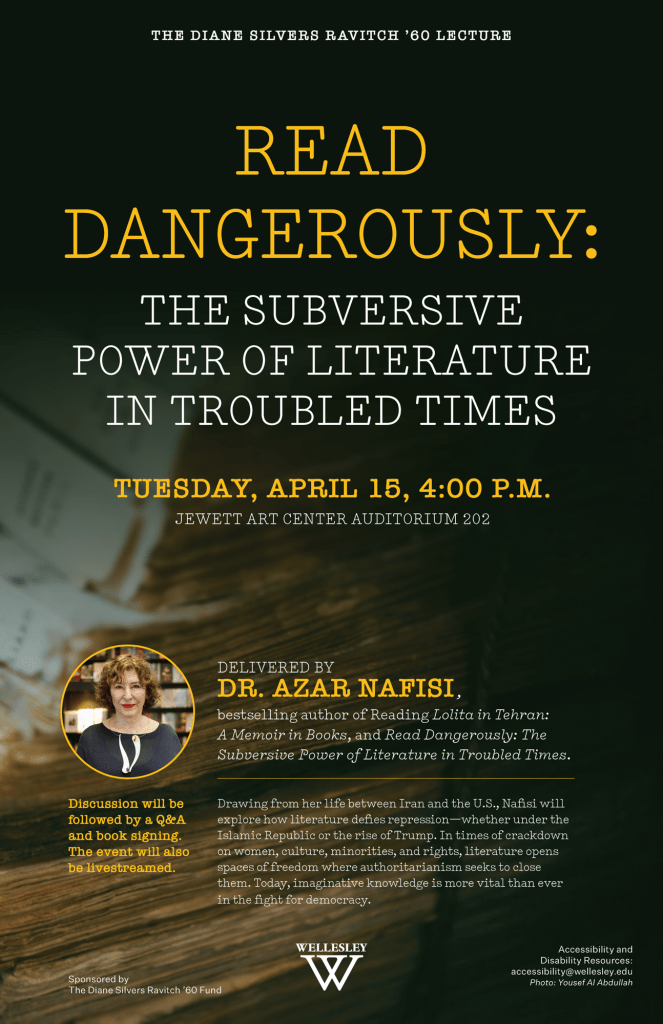
Dr. Azar Nafisi, author of the mega-bestseller Reading Lolita in Tehran, will speak at Wellesley College on April 15 at Wellesley College at 4 p.m. in the Jewett Arts Center. Admission is free.

Please mark the date on your calendar. She is speaking in a lecture series that I endowed several years ago. The lecture will be available eventually on the archive website of the College.

The book, which was a sensation upon its publication for its depiction of life under the mullahs, has recently been made into a film.

This review of the film was published by The Atlantic and written by Arash Azizi. At present, the film can be seen only at film festivals.

He wrote:

The past few years may well be remembered as the nadir of Iranian-Israeli relations, and the first occasion when the two countries attacked each other directly. But they were also a golden period for Iranian-Israeli collaboration in cinema. In 2023, Tatami was the first-ever film to be co-directed by an Israeli (Guy Nattiv) and an Iranian (Zar Amir). And in 2024 came Reading Lolita in Tehran, directed by Eran Riklis, who is Israeli, and adapted from a book by an Iranian author, with an almost entirely Iranian cast. The film premiered at the Rome Film Fest last year and is now starting to tour the United States.

Anyone old enough to remember cultural life at the beginning of this century will know the book. Azar Nafisi’s memoir came out in 2003, spent 36 weeks on the New York Times best-seller list, and quickly developed a cult following. A reviewer for The Nation confessed to missing a dental appointment, a business lunch, and a deadline just because she couldn’t put the book aside.

Literary scholars—Nafisi is an English professor—are not known for their page-turning thrillers. But Nafisi’s story and prose are captivating. She’d gone to Iran shortly after the 1979 revolution in the hope of putting her American education to use by teaching English at a university. Instead, she was hounded out of the classroom by authorities hostile to Western literature. She wound up holding clandestine seminars for young women in her living room, delving into the masterpieces that the Islamic Republic forbade: the Vladimir Nabokov novel that gives the memoir its name, alongside the works of Henry James and Jane Austen, as well as one of Nafisi’s favorites, F. Scott Fitzgerald’s The Great Gatsby. Nafisi brings these classics into dialogue with the real-life stories of young Iranians in the heady decades following the 1979 revolution. Her book isn’t just about reading and teaching literature under a repressive regime, but about how literature in and of itself could serve as an antidote to all that the regime stood for.

Despite its global fame and translation into 32 languages, Reading Lolita in Tehran was never turned into a film before now, mostly because Nafisi didn’t like the proposals she’d received. Then, seven years ago, Riklis came around, as he recounted to a New York audience on January 13, after a special screening of the film. The Israeli director managed to convince Nafisi of his vision—and then to secure the funding, assemble a suitable Iranian cast, and settle on Rome as the shooting location, given that Tehran was not an option.

When the book was initially released in 2003, the American zeitgeist, shaped by 9/11 and the Bush administration’s global War on Terror, was rife with debates about the representations of Muslim women and life in the Middle East. Nafisi’s was one of several popular memoirs by Iranian women published during this period, including Firoozeh Dumas’s Funny in Farsi (2003) and Marjane Satrapi’s Persepolis series (2000–03). And perhaps inevitably, given its success, Nafisi’s book became the subject of political scrutiny, much of it bearing little relation to the book’s content. Although Nafisi opposed the Iraq War, some critics lumped her in with neoconservatives because she portrayed the travails of Iranians under an anti-American regime. One scholar even proclaimed that he saw no difference between her and American soldiers convicted of abusing prisoners in Iraq.

More than 20 years later, Riklis’s loyal adaptation has opponents just as the book did, and even more so because of the nationality of its director. In Tehran, the regime media have denounced the film as furnishing a “pretext for attacking Iran” and called its Iranian actors “traitors working with Zionists.” One outlet claimed that the film peddled a “violent, anti-culture, anti-art, and anti-human view of Iran and Iranians.”

The idea that Reading Lolita in Tehran is anti-Iranian because of its portrayal of the Islamic Republic, and of the life of women under its rule, was always patently ridiculous. The claim bears up particularly poorly in 2024, two years after women-centered protests rocked Iran under the slogan “Women, Life, Freedom.” What Nafisi does best, and the reason her work has endured, is precisely to refuse cartoonish portrayals and basic morality plays.

In Riklis, known for his empathetic depiction of Israelis and Palestinians in films such as Lemon Tree and Dancing Arabs, her book finds an able interpreter who has stayed true to its ethos. The film isn’t neutral. It vividly tells the story of how puritanical Islamist goons attacked universities in the early years after 1979, imposed mandatory veiling on women, and banned books they didn’t like. But neither is it a simple story of scary Islamists versus heroic women resisters.

The film captures the atmosphere of Iran in the 1980s and ’90s remarkably well for having been shot in Italy and directed by an Israeli who has never set foot in the country. The dialogue is mostly in Persian, a language Riklis doesn’t speak; he was able to pull this off with the help of a carefully chosen cast of diasporic Iranians. Golshifteh Farahani, perhaps the best-known Iranian actor outside the country, is at her height as Nafisi, whom she plays as confident but humane, by turns brazen and vulnerable.

The young women of the clandestine class include Sanaz (Zar Amir), who has survived imprisonment and torture; Mahshid (Bahar Beihaghi, in one of the film’s most delightful performances), who, unlike most of her classmates, wore the Islamic veil even before the revolution and defends an ideal of modesty as virtue; and Azin (Lara Wolf), whose multiple divorces make her an object of fascination to the less experienced students, but who turns out to be suffering from domestic abuse.

In Nafisi’s apartment, the students are far from the prying eyes of the regime and also of men (even the professor’s husband is barred from their meetings). They construct for themselves, in that all-female room, a little literary republic that survives the years of war and revolution. In one memorable scene, Nafisi has the students practice a Jane Austen–era dance as part of their study of Pride and Prejudice, drawing parallels between the stifling rules of courtship in Victorian England and those of some contemporary families in Iran.

The film also ventures beyond that cloistered space. Bahri (Reza Diako), a devout 1979 revolutionary, is nevertheless an avid student in Nafisi’s class at the university before it is shut down. Despite their diametrically opposed politics, Nafisi and Bahri form a bond. Early in the story, she tells him his essay on Huckleberry Finn is the best she’s ever received from a student, even in America. The two reconnect when Bahri returns from the Iran-Iraq War of 1980–88, having lost an arm. He has used his family connections to the regime to obtain a surprise gift for his old professor: two tickets to The Sacrifice, by Andrei Tarkovsky, showing at the Tehran film festival. The connection between Nafisi and Bahri is presented with complexity and without sentimentality, neither papering over political differences nor caricaturing Bahri as a generic revolutionary.

In this way, both film and book avoid didacticism. And in doing so, they demonstrate exactly the point Nafisi explores with her students, which is the power of literature to stir empathy across seemingly unbridgeable divides. When the group discusses The Great Gatsby, Nafisi insists on understanding the forbidden love that Daisy Buchanan, the married socialite, has for Jay Gatsby as a true human feeling, not a symbol of Western perfidy, as some of her more revolutionary students claim it to be. The latter advocate banning the book. Nafisi organizes a mock trial for the novel in her class, with students divided into teams for and against.

Nafisi calls on students on both sides of the political divide to treat each other with humanity. When she catches some in her class expressing glee at the wartime deaths of pro-regime peers, she enjoins them not to become like their oppressors. And she is no dogmatic opponent of Islam, only of religiously inspired repressive government: At one point Nafisi tells Bahri, “My grandmother was the most devout Muslim I knew. She never missed a prayer. But she wore her scarf because she was devout, not because she was a symbol.” (I am not the only critic with a Muslim background who found this line powerful.)

The point here isn’t just to repeat the liberal platitude that “the problem isn’t with Islam but with its repressive enforcement.” Rather, Nafisi is rejecting the revolutionaries’ tendency to treat all that surrounds them as a field of symbols. People are worth more than that, she tells them and us, as though echoing the Kantian dictum to treat one another “as an end, never merely as a means.”

This message about the humane power of literature makes Reading Lolita in Tehran a work of art rather than an exercise in sloganeering. And the fact that now, more than two decades after the book’s release, and at a time of regional tension, an Israeli filmmaker has worked with Iranians to adapt Nafisi’s book to the screen gives the film a special power.

The audience at the screening I attended, at a Jewish community center on the Upper West Side, included American Jews, Israelis, and Iranians. What we had in common was the experience of being gripped by a story about the capacity of literature to reveal us to one another as ends rather than as means. The setup might sound mawkish. But I recommend avoiding the temptation of cynicism and embracing the film as truly one for these times.

ABOUT THE AUTHOR

Arash Azizi is a contributing writer at The Atlantic. His new book, What Iranians Want: Women, Life, Freedom, was published in January 2024.

Trump signed an executive order declaring all state laws that address climate change to be null and void. He claims that efforts to protect the environment are a hindrance to energy production. So ignoring climate change is important to national security because we need oil and gas more than we need clean air and water.

Remember when Trump said he was eliminating the Departnent of Education because states should manage their own schools and the federal government should get out of the way? Why can’t states make decisions about clean air, clean water, and auto efficiency?

Trump’s tariffs are getting blowback from some of his rightwing allies. Elon Musk called tariff-lover Peter Navarro “a moron.” Several Republican Senators expressed their opposition to tariffs at a Senate hearing. The National Review tore into Trump’s tariffs and his imperial behavior:

It wrote:

If it seems preposterous that a single person could enjoy this much power over the American economy — and, with it, the global economy — rest assured that it is. In Article I, the Constitution vests the “power To lay and collect Taxes, Duties, Imposts and Excises” in Congress, not in the president. As a result, the president has no power to impose tariffs that he has not been accorded by an act of the legislature. If it desires, Congress can choose to take back as much of that power as it sees fit. It ought to do so — and do so now.

That the Founders placed the power to tax, tariff, and legislate in the hands of the legislature, instead of the executive, was not an accident. On the contrary: This allocation sat at the very core of the system that they designed. Because legislatures play host to a diverse cast of characters — characters who have different views, are elected by different groups, and come from different regions — they are less prone to dogmatism, caprice, and flightiness than are monarchs, presidents, or emperors. Especially within the United States, where the Senate often checks the passions of the House, the procedural challenges that result from this tend to ensure that only those proposals that enjoy broad purchase among the citizenry’s representatives are able to become law. This arrangement has two chief benefits. First, it guarantees that the ideas under consideration will be subject to serious criticism and debate. Second, it makes it difficult to alter the status quo on a whim — which, in turn, makes it easier for the people to understand the laws under which they live.

This predictability is useful in all areas of civic life. But it is especially beneficial in the financial realm, where stability is imperative. Businesses, investors, workers, and families are all aided enormously by a reliable comprehension of what their tax rates, operating rules, regulatory liabilities, and tariff exposures are likely to be for the foreseeable future. When those variables are determined by Congress, the debates that inform them are transparent and the laws that result are built to endure. When those variables are determined by the president, the debates that inform them are opaque and the law is liable to change radically from day to day. In essence, the case for Congress fulfilling its responsibilities is the same as the case for written law per se: No free man wants to be at the mercy of a king.

In his vendetta against law firms who represented his opponents, universities whose high standards offend him, and anyone who dared to stand up to his lies, Trump has selected two former government employees for retribution. These actions are typical of dictators. Trump is wannabe dictator. He certainly aspires to be a full-fledged fascist. He has a compliant Departnent of Justice. Attorney General Pam Bondi thinks she works for Trump, not the people of the United States.

The blog SpyTalk is written by Jeff Stein.

He writes:

President Trump on Wednesday signed an executive ordering the Justice Department to investigate two prominent former senior Homeland Security officials, saying they could be guilty of “treason” because of their criticism of him. 

Trump also stripped Miles Taylor and Chris Krebs of their security clearances, although it was not clear if they maintained any. The order “also suspends any active security clearance held by individuals at entities associated with Taylor, including the University of Pennsylvania,” where Taylor is an adjunct professor, “pending a review of whether such clearances are consistent with the national interest.”

Likewise, the order also suspends security clearances held by associates of Krebs at SentinelOne, a California-based cyber security firm, where he is currently employed as the company’s chief intelligence and public policy officer.

Taylor, who served as the chief of staff to Homeland Security Secretary John Kelly during the first Trump administration, drew Trump’s wrath for writing a blistering, New York Times Op-ed, titled, “I Am Part of the Resistance Inside the Trump Administration“, and later a book, A Warning, both under the pen name “Anonymous,” detailing his concerns about the president’s policies. The Op-ed unleashed a furious media campaign to identify him. After he surfaced in October 2020, he became a prominent TV critic of Trump 

“You can’t have that happen,” Trump said as he signed the executive order, adding, “I think he’s guilty of treason if you want to know the truth, but we’ll find out.” 

The executive order called Taylor “a bad-faith actor who weaponized and abused his government position, prioritizing his own ambition, personal notoriety, and monetary gain over fidelity to his constitutional oath.”

Taylor responded on X (formerly Twitter): “I said this would happen. Dissent isn’t unlawful. It certainly isn’t treasonous. America is headed down a dark path. Never has a man so inelegantly proved another man’s point.”…

It’s almost funny to see Trump criticize anyone for failure to be faithful to their “constitutional oath,” since he has violated his own constitutional oath on a daily basis.

What is Elon Musk’s agenda? His DOGE teams are wreaking havoc across the federal government. His claims of saving “billions” are making government inefficient. Thousands of researchers, scientists, and essential personnel have been fired. Is he working to destroy our government? Or is he settting up a scenario of failure as a prelude to privatization?

The Washington Post reported on chaos at the Social Security Administratuin:

Retirees and disabled people are facing chronic website outages and other access problems as they attempt to log in to their online Social Security accounts, even as they are being directed to do more of their business with the agency online.

The website has crashed repeatedly in recent weeks, with outages lasting anywhere from 20 minutes to almost a day, according to six current and former officials with knowledge of the issues. Even when the site is back online, many customers have not been able to sign in to their accounts — or have logged in only to find information missing. For others, access to the system has been slow, requiring repeated tries to get in.

The problems come as the Trump administration’s cost-cutting team, led by Elon Musk, has imposed a downsizing that’s led to7,000 job cuts and is preparing to push out thousands more employees at an agency that serves 73 million Americans. The new demands from Musk’s U.S. DOGE Service include a 50 percent cut to the technology division responsible for the website and other electronic access.

Many of the network outages appear to be caused by an expanded fraud check system imposed by the DOGE team, current and former officials said. The technology staff did not test the new software against a high volume of users to see if the servers could handle the rush, these officials said.

The technology issues have been particularly alarming for some of the most vulnerable Social Security customers. For almost two days last week, for example, many of the 7.4 million adults and children receiving monthly benefits under the anti-poverty program known as Supplemental Security Income, or SSI, confronted a jarring message that claimed they were “currently not receiving payments,” agency officials acknowledged in an internal email to staff.

The error messages set off widespread panic until recipients discovered that their monthly checks had still been deposited in their bank accounts. Another breakdown disabled the SSI system for much of the day on Friday, prompting claims staff to cancel appointments because they could not enter new disability claims in the system and blocking some already receiving benefits from gaining access to their accounts.

“Social Security’s response has been, ‘Oops,’” said Darcy Milburn, director of Social Security and health-care policy at the Arc, a national nonprofit that advocates for people with disabilities. The group fielded dozens of calls last week from nervous clients who saw the inaccurate message and assumed their monthly check, usually paid on the first of the month, would not arrive.

“It’s woefully insufficient when we’re talking about a government agency that’s holding someone’s lifeline in their hands,” Milburn said.

The disruptions are occurring as acting commissioner Leland Dudek and the DOGE team move to lay off large swaths of the workforce in a new phase of downsizing. Thousands of employees already have been pushed out — many in customer-facing roles, others with expertise in the agency’s cumbersome technology systems. At least 800 of the 3,000 employees left in the division that manages all of the Social Security databases face layoffs, a senior official said on Friday. The newly named chief information officer, Scott Coulter, a Musk-aligned private equity analyst, has demanded a cut of 50 percent, the official said.

The network outages are one in a cascade of blows to customer service that also have hobbled phone systems and field office operations as the workforce shrinks.

A surge in visitors to the website is overwhelming the computer system as customers — nervous that the rapid changes at the agency will compromise their benefits — download their benefit and earnings statements and attempt to file claims. President Donald Trump has said that his administration will not reduce Social Security benefits.

The chaos could accelerate starting April 14, when new identification measures are set to take effect that will require millions of customers applying for benefits to authenticate their identity online, part of the administration’s campaign to root out allegedly fraudulent claims.

“We’re just spiking like crazy,” said one senior official, who, like others in this article, spoke on the condition of anonymity because they were not authorized to speak publicly about agency operations. “It’s people who are terrified that DOGE is messing with our systems. It’s the sheer massive volume of freaked-out people.”

The Social Security press office said in a statement that officials are “actively investigating the root cause” of the incidents, which they called “brief disruptions” averaging about 20 minutes each with the exception of the SSI error message. But on several occasions, including during an outage last Monday, customers were shut out of the website for hours. The system was back online last Monday after two hours, but lingering issues lasted through the afternoon while all backlogged queries were processed, current and former officials said. And a system upgrade on a Saturday in late March took several hours longer than anticipated and knocked out the network.

Three times in a recent 10-day stretch, the online systems the field office staff rely on to serve the public have crashed, said one employee in an Indiana office.

The downed programs included tools employees use to schedule visits, to see who has booked an appointment and to check who has arrived, the employee said. It is unheard-of for the system to fail this often, and each outage has led to chaos, they said.

Suddenly forced offline as they were taking claims, the staff members scribbled down clients’ information, then had to wait until later to load it into the computer, doubling or tripling the amount of time and work involved, the employee said.

In other instances, managers or security guards improvised a solution after the online scheduling system failed, the employee said. They walked out to the reception area, wrote down numbers on paper slips and started handing them out to people waiting in line.

The network crashes appear to be caused by an expansion initiated by the Trump team of an existing contract with a credit-reporting agency that tracks names, addresses and other personal information to verify customers’ identities. The enhanced fraud checks are now done earlier in the claims process and have resulted in a boost to the volume of customers who must pass the checks.

But the technology staff did not test the software against a high volume of users to see if the servers could handle the rush, current and former officials said. Connectivity issues and bugs with the expanded system have caused the portal that manages log-ins and authentication for many Social Security applications to go down, officials said.

At a weekly operations meeting on March 28 that was made public last week, Wayne Lemon, deputy chief information officer for infrastructure and IT operations, acknowledged the network crashes and said, “While they’ve been brief, we prefer no outages.” He said the outages were under investigation and may involve “challenges we’ve experienced with a number of partners.” Part of the problem may be that the outages have occurred during “high volume use of the network.”

“Is there a spike in demand or something in the environment causing the issues?” Lemon said.

Customers, meanwhile, are growing more frustrated.………..

What readers are saying

The comments express strong concerns about the recent IT staff cuts and website outages at the Social Security Administration, suggesting these actions are deliberate attempts to undermine the system. Many commenters believe this is part of a broader strategy to privatize Social Security.