An 18-year-old young woman asked ChatGPT about violence. The bot gave her information instead of questioning and discouraging her violent urges. Months later, she killed her mother and stepbrother, then went to the local school and killed students and a teacher. The families of the victims are suing OpenAI for helping the shooter and failing to warn officials to stop her.
OpenAI is facing 30 new lawsuits from victims of the devastating school shooting in Tumbler Ridge, British Columbia, who accuse the company of providing “substantial assistance and encouragement” to the shooter and failing to alert police about her alarming ChatGPT interactions during the run-up to the mass killing.
The AI company’s legal peril is growing: it’s now fighting more than 50 lawsuits alleging that extensive use of its flagship chatbot, ChatGPT, wrought psychological harm, physical injury, or even death on users or those around them.
The new lawsuits weee brought against OpenAI by teachers and students who survived the Tumbler Ridge Massacre in February, in which eight adults and children were killed and 27 more were wounded in a rural Canadian mining town. The shooter, 18-year-old Jesse Van Rootselaar, fatally shot her mother and younger stepbrother at their home before attacking the school with a modified rifle and long gun, where she murdered five students — all aged between 12 and 13 — and a teacher.
OpenAI flagged her account. Months before the shooting, they debated whether to alert local officials. They decided not to do so, but deactivated her account. She quickly got a new account using a different name.
The lawsuits accuse OpenAI of negligence and “aiding and abetting a mass shooting,” alleging that ChatGPT stoked Van Rootselaar’s violent fantasies. The shooter’s chat logs have not yet been made public.
OpenAI is also being sued by victims of other mass shootings, where the chat logs showed their interest in killing others.
This is a helpful turn of events. AI providers should have key words that raise red flags and invite human oversight and intervention. ChatGPT could be programmed to alert human review and to discourage violence. It should be programmed with values: respect for others; kindness; the joy of giving and helping; and love of life.
Should states permit parents to trust “faith healers” for their children’s medical care? Should the state do so when the child is seriously ill? Should the state stand by idly when children tested by “faith healers” die?
That is what happens in Idaho. Under the protection of freedom of religion, parents may trust their sick children to “faith healers,” even at the cost of their lives.
With the growth and political clout of old-time religions, this dangerous practice may spread to other states. When does freedom of religion become deadly?
Dutton writes:
In Idaho, parents who say their faith prohibits lifesaving medical care for their children can’t be charged with child neglect or manslaughter. Supporters of this protection over the years have included lawmakers who voiced support for “traditional” Idaho values.
But from at least the 1880s through the early 1970s, it was illegal for parents in Idaho to choose prayer over medical care when a child’s life was at stake, newspaper archives and historical documents show.
“Every parent of any child who willfully omits, without lawful excuse, to furnish necessary food, clothing, shelter, or medical attendance for such child, is guilty of a misdemeanor,” reads the 1887 edition of Idaho territory statutes, published before statehood.
The statutes included no mention of spiritual belief as a “lawful excuse.” Three years later, the state constitution explicitly put limits on Idaho’s freedom of religion. It would not excuse “acts of licentiousness,” polygamy or other practices “inconsistent with morality or the peace or safety of the state.”
It wasn’t long before the law came down on members of the Followers of Christ, a faith-healing sect that arrived in Idaho in 1899 and remains active in the state. From 2015 to 2025, the sect’s congregations in Idaho experienced 15 preventable deaths of children, according to ProPublica’s reporting.
Pearl Annis was a 13-year-old girl whose parents had moved from Oklahoma to Idaho’s Magic Valley in the spring of 1915 with at least one other Followers family. The Annises and their 13 children shared “a two-room shack,” a local newspaper reported. An officer and a doctor visited the home after neighbors voiced concern. They found Pearl in bed, fully dressed and on the cusp of death.
Her father, Lurid P. “Lewis” Annis, was arrested on a misdemeanor charge of refusing to provide medical attention. Pearl was taken to the hospital, according to the news story, and died there with what today would be described as septic shock from a bowel blockage. The newspaper, which didn’t appear to follow up on Annis’ criminal charge, called the Followers church “a religious cult” and Pearl’s death a consequence of “religious mania.”
News archives and historic records don’t say how many times Idaho acted on similar cases in the decades after.
But one legal battle over lifesaving care drew attention in the 1960s, as sickness made its way through a Followers family in a Boise suburb. The mother died in December 1965. Her 4-year-old daughter died the following June.
Days after the girl’s death, a judge ordered the state to take custody of her 10-year-old brother under Idaho’s child protection law. The boy was admitted to a local hospital with pneumonia, a complication of the measles. He spent days in critical condition but survived. The judge told the father that to regain custody, he would have to be willing to give the boy medical care as the law required.
A doctor testified that without the hospitalization, the child “almost certainly would have died,” a newspaper report said.
The father’s lawyer told the judge that his sect was rooted in “faith that God will heal the sick.” The law in the 1960s was clear, though: a parent had a duty to protect their child’s health, no exceptions. The judge told Samuel’s father: “The law governs conduct. Religion governs opinion.”
But the legal landscape was about to shift. It came with little public attention.
During a full-on rewrite of Idaho’s criminal code in 1971, the Legislature added a section that said the state could not bring endangerment charges against someone “who chooses for his child treatment by prayer or spiritual means alone.” Legislative records don’t make clear how the wording originated. The passage of another law one year later, affirming the “spiritual means” language and applying it to other crimes, has been credited to the Christian Science church, another Christian denomination with Idaho members.
(The Christian Science website says the church’s practice of “healing in the way Christ Jesus taught” is not “faith healing” and that members are free to choose any form of healthcare. The church also supported Oregon’s full removal of its faith-healing exemption in 2011.)
Faith-healing exemptions soon became widespread nationally. The trigger was the federal Child Abuse Prevention and Treatment Act of 1974, which set out to standardize the nation’s child welfare system by giving states grants to more effectively investigate reports of child abuse.
The Department of Health, Education and Welfare interpreted the law as requiring states to have a faith-healing exemption to qualify for the grants — an interpretation that records from the time don’t explain.
Open the link and keep reading to learn how federal law changed to deal with “faith healing.”
Jeff Bryant, prolific education journalist, writes in The Progressive about the efforts by educators to fight back against the failed and punitive policies of No Child Left Behind and Race to the Top. It’s a valuable summary of the past 15 years. Teachers rallied. Teachers sounded alarms about the bipartisan attack is on teachers, teaching and public schools.
Did it make a difference?
Now, 15 years later, there are thousands of charters, and they are no better than the public schools, contrary to their promises. Now, most states have vouchers, and the public is funding religious schools, which was unthinkable in 2011.
But we can’t give up! At last, there are candidates running to fight for public schools. Gina Hinojosa is the most prominent of them. If she defeats Greg Abbott in Texas, expect major changes.
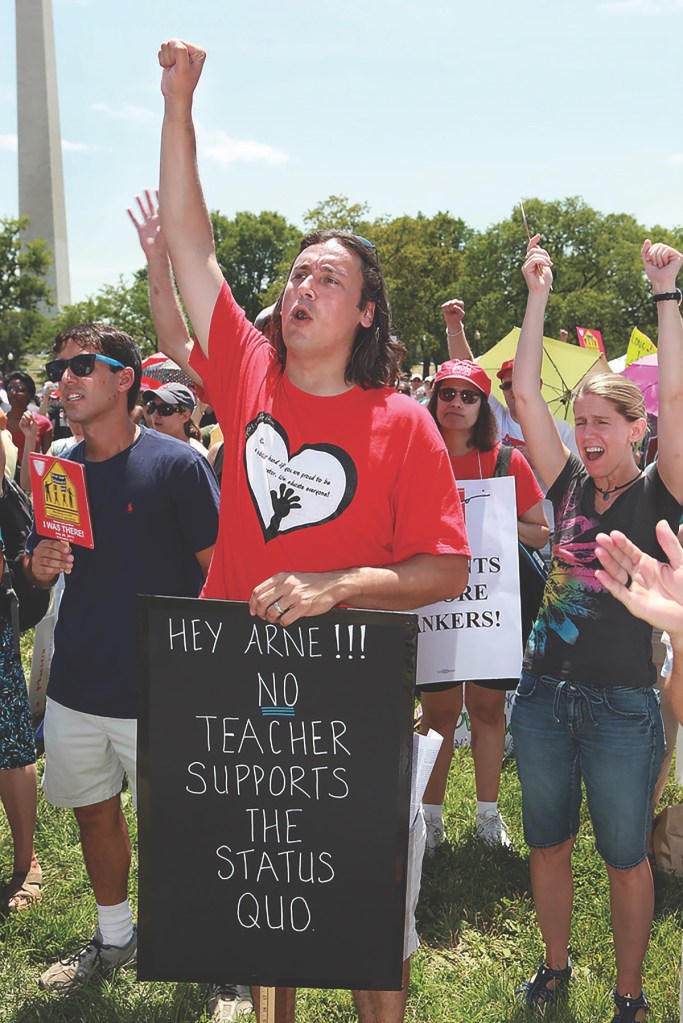
It was a sunny July day in Washington, D.C., the temperature was forecasted to hit 97 degrees Fahrenheit, and when I arrived at the Ellipse on the National Mall for the Save Our Schools march I realized I would need a hat. Among the vendors that lined Constitution Avenue, the least expensive hat I could find was a gaudy, red-white-and-blue affair with an embossed rendering of fireworks going off over the Lincoln Memorial and Washington Monument. “Some hat,” Anne Thompson, my videographer for the day, said when she arrived…
At the time, I was working on a project, partnered with the National Education Association, called “Starving America’s Schools: How Budget Cuts and Policy Mandates Are Hurting Our Nation’s Students.” The project documented how state governments, following the Great Recession, cut funding for schools and rolled out efforts to privatize them with charter schools and voucher programs.
I had read multiple analyses by the Center on Budget and Policy Priorities (CBPP) that found at least thirty-seven states responded to the economic downturn that started in 2007 and extended into 2009 by slashing their education budgets back to pre-recession levels. My Starving America’s Schools project would examine how the cuts caused districts to fire teachers, cancel art and music programs, close libraries and science labs, and cut extracurriculars like athletic programs, field trips, and drama performances.
Teachers turned out to denounce high-stakes testing, NCLB, Race to the Top, budget cuts, privatization, and the attacks on their profession, funded by Bill Gates, Eli Broad, and other billionaires.
….The estimated crowd of 3,000 to 5,000 roared in approval at an array of speakers that included the actor Matt Damon (whose mother is a professor of education), Ravitch, best-selling author Jonathan Kozol, renowned educator Deborah Meier, and policy experts Linda Darling-Hammond and Pedro Noguera. When the speeches were over and we marched to the White House, the line of people stretched for blocks and blocks…
The range of themes the speakers addressed included lack of pay and respect for teachers; the harms caused by poverty and privatization; the continuing racial discrimination and segregation in schools and glaring inequities in their funding; the unbearable class sizes teachers endure, and the injustices that result from using test scores to sanction schools and evaluate teachers.
What also animated the crowd, Anthony Cody tells The Progressive in a text message, was a sense of betrayal on education by the Democratic Party’s leadership. Cody, a fulltime classroom teacher at the time—he’s now retired—was one of the principal organizers of the march. “The great majority of teachers supported the election of Barack Obama in 2008,” he says. “[But] RTTT reinforced the worst elements of NCLB by encouraging states to link teacher pay and evaluations to standardized test scores.”
“A theme that ran through the rally was ‘how could a Democratic administration be so hostile to public schools?’ ” says Ravitch in an email to The Progressive.
“The speakers, me included, hated RTTT and saw it for what it was: encouragement for charters, high-stakes standardized testing, teacher evaluation based on student test scores, and other dreadful policies,” Ravitch continues. “We predicted [the policies] would fail, and they did.”
A particular target for invective at the rally was Obama’s Secretary of Education, Arne Duncan, Ravitch recalls. “He regularly assailed public schools as failing. He attacked public school teachers. He constantly praised charter schools, and whenever national test scores came out, he gleefully pointed to results and made them sound worse than they were.”
“Duncan could have fit in a Republican cabinet,” Ravitch adds.
Fifteen years later, did that outpouring in July 2011 matter?…
The sad truth is that the grievances that motivated people to board buses and gather on the Mall on a hot July day in 2011 continue to dominate the K-12 school landscape today.
For instance, one of NPE’s reports that Cody references, published in 2026, found that states that have been the most aggressive about redirecting public funds for schools to private education operators have been the most neglectful of funding and supporting their public schools.
Although No Child Left Behind was repealed in 2015, it was replaced that year by the Every Student Succeeds Act that still enforces standardized testing. And the legacy of the funding cuts enacted during the Great Recession continues to harm schools.
“In the decade following the Great Recession, students across the United States lost nearly $600 billion from the states’ disinvestment in their public schools,” an analysis by the Education Law Center reported in 2021. Calling the time, from 2008 to 2018, a “lost decade,” the organization noted that while states’ economic activity as measured by gross domestic product increased by 17 percent, state and local revenues for public schools lagged, increasing by only 6 percent.
A 2025 Education Law Center report, “Making the Grade,” assessed states on how they fund public schools and found that not a single state earned an A grade on three crucial measures of funding: whether state and local revenues are adequate, whether funding is fairly distributed, and whether funding lags a state’s economic capacity.
In the meantime, the charter school industry continues to expand, with thirty-nine out of forty-three states experiencing growth in charters in 2025, according to charter industry data. And voucher programs also continue to grow, as fifteen states now operate twenty-three programs, and the Trump Administration is set to roll out a nationwide federal voucher program in 2027. As the right wing’s “long game” to end public education continues apace, prominent centrist Democrats call for a return to the education policies of the Bush and Obama years.
“Democrats [have] walked away from standards and accountability [for schools], and our kids are falling through the cracks,” former Chicago mayor and Obama’s Chief of Staff Rahm Emanuel is telling anyone who will listen. And Arne Duncan is back in the media spotlight, encouraging Democratic governors to embrace the Trump Administration’s voucher program. That the politics of education in 2026 seem so similar to those of 2011 is evidence that a left-right binary over education policy doesn’t really exist.
As I observed all those years ago on the cusp of the march in D.C., there was no middle ground in education debates. Factions on the right wanted to get rid of public schools. Business interests represented by testing companies, charter schools, and tech firms wanted to make money off schools. And a “reform” community led by wealthy foundations and technocrats wanted to mold public schools to their ideological, and often political, agendas.
As I wrote at the time, “Faced with this array of antagonists toward public education, where does the ‘middle ground’ lie? When people openly admit they want to get rid of you, where should the bargaining start? When people have shown you they are more apt to use you for their own profit, and then walk away when the ‘market changes,’ why should you trust them? And when people say they are willing to align with your cause but only when you say and do things how they want you to do them—even when your ideals inform you to do otherwise—why should you simply bend to their will?”
Those questions are still relevant today. They will remain so until a progressive left faction adopts a robust message on education and articulates it repeatedly in advocacy documents and political stump speeches.
“Our battle for public schools is steeper now than it was when the Save Our Schools rally was held,” Ravitch says. “It will be a battle for many years to come.”
But in 2011, for at least a day, it seemed that public school advocates had the power to, as Ravitch put it in her email, “push back and give people a modicum of hope.”
The battle continues, and it’s not over. America needs a strong public school system, not a hodge-podge of pop-up schools.
We need well-prepared teachers who can knowledgeably teach history, science, mathematics, literature, and foreign languages. We need well-funded schools and respected, well-paid professionals. We need equality of opportunity for all children, and we need excellence.
We need the strong public schools that built the Aunited States into a great nation. We need education for democracy, where children are judged by the content of their character, not the color of their skin.
We need an education system that produces engineers, scientists, artists, musicians, athletes, mechanics, lawyers, doctors, pharmacists, teachers, social workers, idealists, scholars, young people eager to use their hands, their brains, and their hearts to make our society better for everyone.
We are now in a period of disruption and dissolution. That way lies disaster. It is the road to elitism, segregation, indoctrination, and decay.
We need to raise our sights and build better public schools that offer a goood education for all children.
Scott Dworkin has a terrific blog on Substack, where he often has news that you can’t find anywhere else. The following is one of those wonderful stories:
The state of Texas spent three years trying to turn drag performer Brigitte Bandit into a criminal. Senate Bill 12 threatened any bar that booked performers like Bandit with a $10,000 fine, with performers possibly facing a year in jail.
In March of 2023 Bandit testified against that bill inside the state’s Capitol, wearing a dress that listed names of children killed in the Uvalde mass shooting. Lawmakers were arguing about drag queens, she said later, while kids were being killed in Texas schools.
After her testimony, Bandit sued—along with other Pride groups and businesses—Ken Paxton, three cities, and three district attorneys. A few months later, the whole thing went to trial in a Houston federal courtroom. For three years, Texas had said this law was about protecting children. Now it had to prove a child had been harmed.
It couldn’t. Attorney General Ken Paxton called an expert witness, a doctor brought in to talk about what explicit material does to kids. Under oath, that doctor said he had never seen anyone seriously hurt by a drag show. Not one of the seven government offices that were sued over this law offered any other evidence.
That December, Bandit was sent a package from Nashville, Tennessee—a gift from the one and only Dolly Parton. It was a custom guitar covered in rhinestones, signed by Dolly to Brigitte.
Texas appealed and won, and this spring the ban came back to life. Bandit was right back where she started.
But on Tuesday, Judge David Hittner struck the law down again and barred Paxton from enforcing it. A judge put on the bench by Ronald Reagan.
This Saturday night in Austin, Bandit brings out the guitar.
This story appeared last week, so Brigitte Bandit has already performed.
In his ruling striking down the 2023 law for the second time, Judge Hittner said that the ban was overly broad and clearly unconstitutional:
The ruling described SB 12 as overly broad in its definitions of performance and nudity, stating that provocative cosplay at conventions, swimming athletes or Dolly Parton and Elvis impersonators could potentially be penalized under the law.
“The vast majority of the law’s numerous applications violate the First Amendment because all the performances that it has an actual impact on are constitutionally protected and are targeted for prohibition based on content and viewpoint,” Hittner wrote…
“Finally, for those who find such activities as described in this case offensive, the solution is relatively simple … just don’t go,” he wrote.
It’s reassuring to know that Texas has some rational Republican justices. Hurrah for Judge David Hittner!
SB 12 as adopted in law contains no language explicitly referencing drag performances, however a previous version while in the Legislature specifically included references to drag. Hittner noted in today’s ruling that opponents of drag performances are not obligated to attend them.
Mary Trump, niece of Donald Trump, notes that Trump behavior in increasingly unhinged, narcissistic, and frankly, ridiculous. Yet no one in his inner circle will tell him the truth. No one will tell him that he has humiliated America in the eyes of the world. Mary is a psychologist and the son of Trump’s older brother. She judges him by his actions and his words, not his braggadocio’
Donald rushed the White House press corps into the Oval Office saying he had a big announcement, which is that, effective immediately, he is going to be changing the name of Lake Ontario to Lake America.
One of his flunkies, when asked, “Do you have anything to say about it, Ben?” said, “Yes, sir,” before explaining that this was a straightforward but important executive order. It directs Secretary Burgum and the Department of the Interior to update the Geographic Names Information System to reflect that the lake once known as Lake Ontario will from this time forward be known as Lake America. According to him, this is a lake that has most of its volume in the United States and the deepest parts of the lake sit in United States territory, so this will reflect that this is an American lake. Thankfully, all of the necessary papers and documents were filed to make this official.
In case you were thinking, “Oh, well, okay, maybe he’s finally done renaming bodies of water,” you would be wrong.
This is what Donald said:
The lake change, Lake of America, was something I’ve been thinking about for a long time, actually. As you know, we took something called the Gulf of Mexico. We changed it, and now it’s very routinely the Gulf of America. So if you think about it, we have a Gulf and we have a lake. Now all we need is an ocean. So maybe we’ll have to change the name of the Atlantic and/or the Pacific. Maybe we’ll change them both.
That’s the President of the United States of America who currently has us involved in an illegal, unconstitutional war of choice, who is currently engaged in an unprovoked trade war with our closest ally and second largest trading partner, which will wreak havoc on both the economies of Canada and the United States of America, creating even more hardship for Americans given the fact that the economy, thanks to Donald’s completely stupid economic policies and the aforementioned war of choice, is in shambles.
American farmers are going bankrupt by the score, up to 77 per day. America is divided. America’s reputation across the world is cratering. America is a shadow of its once relatively respectable self, all because of that man and the fascist Republican Party that continues to enable him.
And it’s not because they don’t know what’s going on. They can see clearly that he is in serious, serious cognitive decline. There is overwhelming evidence of this.
They see clearly his toddler like levels of self involvement, his delusions of godhood, and his grasping need for attention. They see that his only priority is his wealth, his power, his megalomania, and yet Republicans continue to go along with his demands, which are increasingly insane, detached from reality, and utterly humiliating.
It’s not an accident, or maybe it is an accident, but it’s a convenient one, that by renaming Lake Ontario to Lake America, the acronym for the Great Lakes, Superior, Huron, America, Michigan, and Erie, is now SHAME.
And I have begun to wonder if America will ever, ever be able to get out from under the weight of the shame Donald Trump and the Republicans have heaped upon us.
It is clear to any sentient being who isn’t lying to him or herself that Donald is increasingly unfit, increasingly just a prisoner to his psychopathologies. And now so too are we because not only has there been no pushback, he continues to be enabled. He continues to be told that he can do whatever he wants, whenever he wants to, because he’s him.
As you may have heard, Donald had wanted to close the Kennedy Center for two years because it needed such extensive renovations, according to him. Howard Lutnick is claiming that Donald is the only person in the world great enough to renovate the Kennedy Center. He also said that when the renovation project started, Donald, the great master builder, should be the project manager because being President is just another part time job.
We’ve also learned recently that Donald wants to make the midterms about himself. So here’s what holier than thou, sick of it Speaker of the House Mike Johnson had to say about it.
This is what Mike Johnson said:
The president is going to look right into the camera and say, I am on the ballot, okay? Because even though his name isn’t, it’s his administration, his legacy.
No, that isn’t how any of this works.
By continuing to enable him, by continuing to spread the wild, unhinged, untethered from reality narratives, Donald is trapped with it. They continue to act as if it is normal for a president at war to spend his time giving tours of the White House construction projects, to spend millions of dollars renovating a reflecting pool and then arresting people because the job was done so incompetently it made him look bad.
This is the President of the United States spending his time changing the names of bodies of water. First the Gulf of Mexico becomes the Gulf of America. Now Lake Ontario becomes Lake America. And apparently, having secured a gulf and a lake, Donald is considering moving on to the Atlantic and Pacific oceans because, as he explained, “Now all we need is an ocean.”
This is happening while America is at war. It is happening while farmers are going bankrupt. It is happening while we are engaged in a trade war with Canada. It is happening while the economy is in shambles and America’s reputation around the world continues to crater.
Yet the people surrounding Donald continue to treat his increasingly bizarre demands as if they are perfectly normal acts of presidential leadership. Nobody apparently has the courage to tell him that changing the name of Lake Ontario is not an important presidential accomplishment, just as nobody seems willing to tell him that being President of the United States is not a part time job that leaves plenty of room for managing the renovation of the Kennedy Center.
Instead, they flatter him. They indulge him. They tell him that he is the only person in the world capable of doing things that have absolutely nothing to do with the job the American people elected him to perform.
As long as we have people like Mike Johnson and everybody else in Donald’s inner circle trying to normalize this deviance, we are all part of this psychopathological system that will lead inevitably to our destruction.
To which I say, is there not one sane adult who knows where this is going to lead? Is there not one person in the Trump regime who can send up the signal flare to the rest of us that some of them are willing to start speaking out against this insanity?
Because this isn’t simply about renaming Lake Ontario. It isn’t simply about whether Donald decides tomorrow that the Atlantic or Pacific Ocean needs to have America stamped across its name, too. It is about the fact that there seems to be nobody around him willing to say no. There is nobody willing to stop indulging his grasping need for attention, his delusions of godhood, his megalomania, and his increasingly insane demands.
The Republican Party sees what the rest of us see. They know what is happening. They see the same behavior. They hear the same words. They watch him make the same increasingly detached demands, and rather than push back, they continue enabling him. They continue pretending that this is normal because Donald is Donald and therefore, apparently, he gets to do whatever he wants whenever he wants.
And that is how we get here. We have a President of the United States involved in an illegal and unconstitutional war of choice, an unprovoked trade war with one of our closest allies, and an economy that is creating extraordinary hardship for Americans, while he summons the White House press corps to announce that Lake Ontario is now Lake America.
And everybody around him plays along.
Donald said that now that America has a gulf and a lake, all we need is an ocean. Maybe he’ll change the Atlantic. Maybe he’ll change the Pacific. Maybe he’ll change both.
Meanwhile, the Great Lakes are now, conveniently enough, Superior, Huron, America, Michigan, and Erie.
SHAME.
That may be the most appropriate thing Donald has named yet.
This is unsustainable. He is unsustainable. And the sooner somebody is willing to stand up against the depredations that continue to be made against the American people by Donald and those who are perpetuating this, the better.
Paul Krugman is the Nobel-Prize winning economist who was a columnist for The New York Times for many years. He here captures brilliantly the MAGA refusal to accept reality and evidence. How was the mainstream of the Republican Party either captured or cowed by this delusional mindset?
Climate change is a hoax. Wind power caused a massive TV blackout during the Trump-Biden debate. Solar power is useless because the sun doesn’t shine at night, and batteries don’t exist. Smoke blanketed North America, not because of climate change, but because Canada didn’t rakeits 2 million square miles of boreal forest.
We’ve destroyed Iran’s military, and the Iranian regime is begging for a deal. Also, the U.S. isn’t running out of precision weapons as a result of the Iran war, and furthermore the shortage is Joe Biden’s fault.
The modern American right is very good at hating. MAGA hates immigrants (unless they’re white South Africans); it hates liberals; it hates scientists.
What the ongoing show trial of Fauci — which motivated this post — has really driven home, however, is that what Trump and his supporters hate most of all is reality. They know what they want to believe. They fly into paroxysms of rage whenever someone points out that the world isn’t what they want it to be. And they always want to shoot the messenger.
Of course, motivated reasoning isn’t confined to the right. Some people on the left insist that zoning restrictions have no role in causing high housing prices, that it’s all about Wall Street greed. Many centrists insist that being in the middle on a left-right scale — which isn’t even how most voters think about politics — is the secret to electoral victory. And so on.
I’m not immune to the temptation to believe what I want to be true. I try to fight it, but don’t always succeed. Still, I try to acknowledge and admit it when I have let wishful thinking warp my judgement.
But what we’re seeing now isn’t run-of-the-mill motivated reasoning. It’s something far more extreme.
If believing something suits MAGA’s prejudices and interests, they don’t hesitate: they simply insist that it’s true. They routinely dismiss scientific and statistical evidence, but they don’t stop there. They’re perfectly willing to deny reality even if the truth is staring them in the face.
Thus, Trump urged Americans to remember that 2024 TV blackout, which nobody remembers because it didn’t happen. He insists that California has “blackouts and brownouts every weekend,” when the state’s 39 million residents can tell you it doesn’t. He says that you must show ID to buy groceries, which everyone who buys their own food knows isn’t so.
Do Trump and his followers actually believe these things? As I see it, that’s a category error, starting from the presumption that they even accept that objective facts exist. All the evidence (Hah! “Evidence!”) says that they don’t.
George Orwell, whose work seems more relevant by the day, knew all about this mindset. In his essay “Looking back on the Spanish war” he wrote about how the rise of totalitarianism had changed the rules:
In the past people deliberately lied, or they unconsciously coloured what they wrote, or they struggled after the truth, well knowing that they must make many mistakes; but in each case they believed that ‘the facts’ existed and were more or less discoverable. And in practice there was always a considerable body of fact which would have been agreed to by almost everyone.
Totalitarians, however, denied that objective facts existed. Furthermore, reality is mutable, changing with the leader’s whims:
If the Leader says of such and such an event, ‘It never happened’ – well, it never happened. If he says that two and two are five – well, two and two are five.
If you find the assertion that MAGA has a totalitarian mindset over the top, all I can ask is, have you been following the news?
What’s remarkable is the extent to which Republican politicians act as if they are living in a totalitarian state, when they aren’t — not yet, anyway. ICE would clearly like to be an American Stasi, policing any deviation from the party line, but it’s not able, so far, to arrest members of Congress who express skepticism about the president’s claims. And many Republican politicians still, I believe, know the difference between fantasy and reality.
But they behave as if they were courtiers to Kim Jong Un. Trump speeches are sometimes followed by “endless applause moments,” because none of Trump’s loyalists wants to be seen as the first person to stop clapping.
The susceptibility of the GOP to this totalitarian mindset has come as a surprise even to cynics. I have some idea of how this happened: It involves a confluence of big-money corruption, crony capitalism, religious fanaticism, and the ever-present forces of racism and sexism. But that’s a subject to be delved into another day.
What’s clear is that the war on reality is exacting a high price on America as a whole.
Remember, 1.2 million Americans died from Covid — a number that would have been much lower if MAGA misinformation hadn’t caused so many people to refuse vaccination. Now we’re seeing a frightening rise in measles and other infectious diseases, and God help us if another pandemic strikes with Trump or his successor still in charge.
Climate denial and hostility to renewable energy will mean more pollution even as it consigns the U.S. to energy and economic backwardness.
And the Iran war — which Trump started and now refuses to end because he won’t accept reality — has destroyed America’s credibility and depleted our weapon stocks with stunning speed.
But anyone pointing out the obvious is, of course, a Communist.
Today, The New York Times published an astonishing article about Putin’s attempt to destabilize NATO and the EU by driving tiny Moldova back into Russia’s orbit.
Moldova shares a border with Ukraine. Putin hopes to thwart the West by persuading Moldova to oust its pro-Western government.
Putin created an elaborate pro-Russian organization inside Moldova, spending millions of dollars to pay collaborators, agitators, and priests.
The Times‘ articleis a gift article with no pay wall. It begins:
It resembled in many ways a summer camp. Barbecues and beach volleyball games were on offer. A wellness spa was called “Relax and Have Fun.”
The men and women who attended the program at a resort complex in a remote part of Serbia also took part in more sinister activities, like learning to break through police cordons and set buildings on fire. They donned flak jackets and trained with assault rifles.
Their counselors, it turned out, were operatives with ties to Russia’s military intelligence service, known as the GRU. Their purpose, according to intelligence officials from three countries who described the activities, was to build a cadre of disciplined shock troops trained in election interference.
The target was tiny Moldova, a country of about three million people that carries outsize importance for President Vladimir V. Putin of Russia.
The Kremlin’s campaign included methods familiar elsewhere in the West, like hacking and disinformation. But in Moldova, its intervention went further than perhaps anywhere else outside Ukraine, and stands as one of the most extensive and audacious plots to date in Mr. Putin’s effort to destabilize the West, the three Western intelligence officials say.
Besides the camp in Serbia, Russian agents ran training programs in Bosnia and Moscow that were designed to turn pro-Russian Moldovans into foot soldiers. Moscow paid hundreds of Orthodox Moldovan priests to recruit voters and to push Russian narratives from the pulpit. And it spent hundreds of millions of dollars on a sophisticated vote-buying scheme financed by a Moldovan billionaire in exile and conceived and operated from Skolkovo, the Kremlin’s knockoff Silicon Valley outside Moscow.
Moscow’s campaign has not stopped. This spring, Russian missiles targeted energy infrastructure that provided service to Moldova, polluting waterways and disrupting electricity flows.
This article is based on interviews with activists who took part in the Russian effort; senior Moldovan law enforcement and security officials; and more than half a dozen European and American intelligence officials. The New York Times also reviewed thousands of documents related to Russia’s attempts to interfere in Moldova’s elections.
Many of those interviewed insisted on speaking anonymously, either to discuss sensitive security operations or because they feared retribution.
Details about Russian efforts in Moldova have emerged in court cases and local reporting, but the scope and extent of the campaign, including the vote-buying scheme and role of Russia’s intelligence services, has not been previously reported.
Publicly, Russian officials have denied interfering in Moldova’s affairs, and have dismissed accusations that Moscow is trying to undermine the West. Last December, Mr. Putin, in an address to military commanders, castigated European leaders for “stoking hysteria” over the threat from Russia.
Soon afterward, though, he gathered the leaders for a secret briefing to deliver the exact opposite message, according to officials from two countries with knowledge of the episode. Their goal for 2026, Mr. Putin told them, is “the collapse of NATO and the E.U. from within,” the people said.
The pro-Western government of President Maia Sandu has set European Union membership as a priority, making it a Kremlin target.Credit…Daniel Mihailescu/Agence France-Presse — Getty Images
Indiana once took pride in its public schools. Not any more. Since the Republican Party took charge of state government, public schools have been neglected and underfunded.
Sixteen years ago, Republicans assumed full control of Indiana’s state government, holding the governor’s office and winning majorities in the House and the Senate. Since achieving this trifecta, the Republican supermajority has systematically cut funding and programs that made this state work for the people who live here.
Nowhere has this been more apparent than the state’s complete neglect of public schools for nearly two decades. Since taking power, the Republican supermajority has done everything in its power to undermine public education, and Indiana’s children are worse off for it.
Let me explain where years of Republican education policy have gotten us. Last month, the Network for Public Education released a report revealing Indiana ranks 45th out of 50 states in support of public education. Last year, only 31.2% of students showed proficiency on both the math and ELA sections of the ILEARN test. More than half of fourth graders can’t read proficiently, and nearly seven-in-ten eighth graders aren’t proficient in math.
A record number of school districts across the state — nearly 40 — have turned to ballot referenda to secure the money they need this year because the state won’t properly fund them and has cut their local funding sources. These are the results of Republicans chipping away at Indiana’s public school funding for years.
Consider where their priorities lie. More than 87% of Hoosier children attend traditional public schools. Yet year after year, the supermajority pours its energy and political capital into expanding charter schools and private school vouchers for the children of families who were, in most cases, never going to need the state’s help in the first place. The legislature has made it clear: they have no issue abandoning working-class Hoosiers in favor of giving an extra leg up to the most fortunate among us.
When Indiana first opened the door to charter schools and voucher programs, lawmakers sold it as a lifeline for children of color and children in poverty whose assigned schools were failing them. But once the door was propped open, my Republican colleagues expanded it year after year, extending vouchers to families making well over six figures. If this were truly about rescuing kids who’d been failed by the system, it would have stayed targeted at the kids who needed rescuing. Instead, it grew into a subsidy for everyone but the working-class families the program was designed to serve.
None of this is by accident. The supermajority was warned by Democrats, education professionals and concerned Hoosiers of the consequences that their policies would inflict on our schools. It is the direct, foreseeable and self-inflicted result of almost two decades of choices made by men and women who have mistaken their own supermajority for a mandate to neglect the children they were elected to serve.
Districts across the state are being forced to ask voters to approve referenda to raise their own local property taxes just so schools can keep the lights on and pay their teachers. Let’s not pretend this educational belt-tightening is born of necessity. Indiana has nearly $4 billion in surplus and reserve funds, which is more than enough to return to our previous, robust support of public education. Our schools and the children attending them are being asked to make do with less while the state sits on more money than it knows what to do with.
null
I do not say this lightly, and I do not say it out of partisan loyalty. I say it as a man who spent nearly 20 years as a school principal and six years as a teacher before I ever spent a day in the Statehouse. I have seen firsthand what happens when a school has what it needs, and I have seen what happens when it doesn’t.
I am telling you, plainly: Indiana’s Republican supermajority has had 16 years to prove it knows the difference too. It does not. If it did, we would not rank 45th in the nation for public school support. We would not be watching our children fall further behind their peers in other states while the people entrusted with fixing it offer nothing but superficial, special-interest-backed policies that don’t address the underlying issues.
This is where years of unchecked Republican domination have gotten us: two decades of failure and of backs turned on the generation that makes up the future of this state, this nation and the world beyond.
For 16 years, they have stood before us and promised that this would finally be the year public education in Indiana gets fixed. And for 16 years, they have failed to deliver on that promise. The only question left is how much longer Hoosiers are willing to take their word for it and allow more children to fail academically
Thom Hartmann is a diligent journalist who digs deep into the corruption of this regime.
On the deregulation of public lands: Trump is allowing destruction of parts of Big Bend National Park, to make way for its exploitation. No complaints from Texas Governor Greg Abbott.
— Trump has figured out a way to grift off the plight of immigrant kids. A Texas law firm with virtually no immigration experience, but multiple people close to Trump or accused of being open racists, just got a $150 million sole-source contract to replace the public defenders defending kids being held in Trump’s concentration camps for brown-skinned people. Meanwhile, ICE says that, sure, they’ll wear body cameras when they beat up and murder people, but they’ll only share those videos when they make them look good. Don’t expect to see any released that actually show criminal activity by armed, masked ICE thugs. Sounds over the top? Here’s their exact language: they’ll only release body camera footage when “it is in the best interests of the agency.” Trump has built his SA/SS force of violent, unaccountable modern-day Klan members to intimidate and even kill anybody who dares defy this regime, and it’s not about to start following the law or even behaving morally any time soon.
— Trumponomics is even worse than Hoovernomics or Reaganomics. Since he fired his statistics person at the Bureau of Labor Statistics and replaced her with a hand-picked toady, the numbers have been looking weird. For example, the regime reported 57,000 new jobs in May, then later quietly revised that down to 20,000 (although the headlines of 57,000 are still out there); they reported 129,000 new jobs for June, then quietly revised that down to 63,000 (ditto on the headlines). And this week we found that instead of the anticipated creation of 80,000 new jobs, the American economy actually lost 23,000 jobs last month (and expect that number to get worse when they “revise” it in 2 months). No matter how hard they try, they can’t keep Americans from noticing that housing, groceries, gas, transportation, drugs, medicine, and pretty much everything else are more expensive while billionaires and the Trump Crime Family get richer and Republicans continue to refuse to allow an increase in the minimum wage or the right to unionize. Eventually, reality catches up with politics, no matter how fast and furious Trump and his lickspittles try to keep us distracted or hating on each other, and hopefully it’s going to catch up in a big way this November.
— Over at Montana Dispatch, Ryan Busse lays out the five Big Lies Republicans are using to steal our public lands. Utah’s Republican Senator Mike Lee, for example, recently lied to his constituents that the Bear’s Ears and Grand Staircase Escalante national monuments President Obama designated were brought into being no public comment or input when, in fact, over 2.7 million people weighed in during the comment period. Another Big Lie is that we must let drilling companies exploit our public lands to become “energy independent,” a designation we reached during the Obama years. They’re also trying to tell us that the way to prevent forest fires isn’t to cut back on climate-change-causing CO2 from burning fossil fuels but, instead, to log those trees and leave behind nude wastelands (which actually catch on fire even more easily, because all the wood debris there is dead). Trump — who’s probably never walked through an old-growth forest in his life — tried pitching the lie that people can’t and don’t use our public lands for recreation like camping and fishing. And they try to tell us that we’re not subsidizing the oil and cattle industries with our public lands when in fact we’re handing them the equivalent of billions of dollars every year. Hopefully one of these days there’ll be a cost to these Republicans for the continuous streams of lies they keep pouring out on dozens of topics.
— Trump has figured out a new grift to let his oil company donors profit from his drawing down the National Oil Reserve. Here’s how it works. Normally, when we release oil from the strategic reserve we sell it on the open market at market prices. That would mean that the oil Trump’s releasing would go for around $100 a barrel, paid by the oil companies. When the oil shortage is over, the government would go onto the public market and buy the oil back for, say, $50 a barrel and refill the reserve. It actually makes a profit for the government. But what Trump’s doing is “loaning” our oil to the oil companies at no charge. They then sell it for $100 barrel and when it’s time to “return” the oil to the reserve they’ll buy it on the market at $50 a barrel (or however low it goes when the crisis is over). The entire profit — quite literally hundreds of millions of dollars — instead of going to us taxpayers, goes to the oil companies who funded Trump’s campaign for president. Lever News has the entire sordid story broken down on their site in an article by Freddy Brewster.
The confirmation of Todd Blanche as Attorney General of the United States has been kabuki theater of sorts. We were hopeful that three Republicans had the backbone to turn down this man who has broken the Department of Justice. Surely, the Senate would not confirm a man who is so subservient to Trump. The DOJ is supposed to be at arms’-length from the President. Blanche is under Trump’s thumb.
Blanche is the one who negotiated a deal to create a $1.776 billion slush fund for insurrectionists and Trump allies as well as a sweet deal for Trump, his sons, and their business NOT to be audited by the IRS, a gift to them of at least $100 million, probably more.
I imagined that there would be outrage towards the man who refused to release the Epstein files. The guy who spent two days interviewing sexual predator Ghislaine Maxwell, then arranged for her transfer to a minimum security prison where she received special treatment, as if she were a privileged guest, not a convicted pedophile.
Senators Susan Collins and Lisa Murkowski will vote against confirming Blanche. In Collins’ case, this is a pattern. She votes against her party only when her vote is not needed.
Most shocking are the “yes” votes of Senator Thom Tillis of North Carolina, John Cornyn of Texas, and–today–Bill Cassidy of Louisiana. All three were driven out of the senate by Trump. Till is resigned because Trump threatened to primary him. The other two were primaried by Trump choices and lost.
They had reason to stand against Trump, and they had reason to have a spine. But in the end, all three caved.
And Todd Blanche will head the nation’s Justice Department, where he will continue Trump’s agenda and his vendettas.



 Diane Ravitch's blog