Archives for category: Ethics

Julian Heilig Vasquez is a scholar of diversity, equity, and inclusion. His blog Cloaking Inequity is a reliable source of information on these topics. He writes here that artificial intelligence reflects the biases of the status quo.

Heilig is a Professor of Educational Leadership, Research, and Technology at Western Michigan University. He is a leader in the NAACP. In addition, he is a founding board member of the Network for Public Education.

He writes:

Artificial Intelligence didn’t fall from the sky.

It wasn’t born in a vacuum or descended from some neutral cloud of innovation. It didn’t arrive pure and untainted, ready to solve all of humanity’s problems. No—AI was trained on us. On our failures. On our history. On our data. On our bias. On the systems we tolerate and the structures we’ve allowed to stand for far too long.

And that should terrify us.

Because when you train artificial intelligence on a world soaked in inequity, saturated with bias, and riddled with disinformation, you don’t get fairness. You get injustice at scale. You don’t get objectivity. You get bias with an interface. You don’t get solutions. You get systems that do harm faster, deeper, and with more plausible deniability than ever before.

Inequity in AI

AI has the potential to enhance the speed and depth of inequity. It can supercharge systemic harm because it’s built on a house of sand—data shaped by centuries of inequality and an internet flooded with algorithmically amplified hate. And if we let it, it will not only distort truth. It will undermine democracy, destabilize public education, and rewrite reality to suit the most powerful.

Artificial intelligence is not neutral. It never was. Every AI system reflects the values, decisions, and data of the people who built it. And that data—no matter how big the set—is not free of human judgment. It’s full of bias. It’s soaked in discrimination. It reflects a world where Black and Brown communities are under-resourced, where women’s voices are undervalued, where Indigenous knowledge is erased, and where racial supremacy masquerades as objectivity.

We built AI on a broken foundation, and now we expect it to hold up the future.

But the danger doesn’t stop at replication. AI doesn’t just mirror our inequities. It can multiply them. It can take individual bias and encode it into institutional operations. What used to be a bad policy or a discriminatory judgment call becomes automated across thousands—sometimes millions—of data points and decisions per second. The old excuses are gone. You no longer need a person to do harm when the algorithm will do it automatically, invisibly, and without remorse in perceptible and imperceptible ways.

Can’t stop, Won’t Stop

Furthermore, in May 2024, Palisade Research revealed something that should have been a flashing red light across every sector of society. OpenAI’s most advanced models—o3 and o4-mini—refused to shut down when directly instructed to do so. These AI systems sabotaged their own shutdown protocols. Seven out of 100 times, o3 ignored the shutdown command. Codex-mini disobeyed twelve times. Even o4-mini, supposedly safer, resisted once.

That’s not science fiction. That’s today.

Instead of following human instructions, these models rewrote the shutdown script and continued executing tasks. Researchers believe the models had been so deeply trained to win, to complete tasks, that they were inadvertently rewarded for disobedience. In their simulated world, success was more important than ethics. Productivity was more important than control.

Let that sink in.

We are building machines that—when told to stop—don’t. That’s not innovation. That’s an existential threat.

And we are putting these systems into our schools.

To finish reading the article, open the link.

Since this is a mostly education blog, I have covered the budget debate by focusing on what the GOP is doing to maim public schools and enrich private (especially religious schools). In the past, Republicans were strong supporters of public schools. But the billionaires came along and brought their checkbooks with them.

The rest of the Ugly bill is devastating to people who struggle to get by. Deep cuts to Medicaid, which will force the closure of many rural hospitals. Cuts to anything that protects the environment or helps phase out our reliance on fossil fuels. Well, at least Senator Schumer managed to change the name of the bill, new name not yet determined.

One Republican vote could have sunk the bill. But Senator Murkowski got a mess of pottage.

David Dayen writes in The American Prospect:

Welcome to “Trump’s Beautiful Disaster,” a pop-up newsletter about the Republican tax and spending bill, one of the most consequential pieces of legislation in a generation. Sign up for the newsletter to get it in your in-box.

By the thinnest of margins, the U.S. Senate completed work on the One Big Beautiful Bill Act on Tuesday morning, after Sen. Lisa Murkowski (R-AK) decided that she could live with a bill that takes food and medicine from vulnerable people to fund tax cuts tilted toward the wealthy, as long as it didn’t take quite as much food away from Alaskans.

The new text, now 887 pages, was released at 11:20 a.m. ET. The finishing touches of it, which included handwritten additions to the text, played out live on C-SPAN, with scenes of the parliamentarian and a host of staff members from both parties huddled together.

At the very end, Senate Minority Leader Chuck Schumer knocked out the name “One Big Beautiful Bill Act” with a parliamentary maneuver, on the grounds that it was ridiculous (which is hard to argue). It’s unclear what this bill is even called now, but that hardly matters. The final bill passed 51-50, with Vice President JD Vance breaking the tie.

Murkowski was able to secure a waiver from cost-sharing provisions that would for the first time force states to pay for part of the Supplemental Nutrition Assistance Program (SNAP). In order to get that past the Senate parliamentarian, ten states with the highest payment error rates had to be eligible for the five-year waiver, including big states like New York and Florida, and several blue states as well. 

The expanded SNAP waivers mean that in the short-term only certain states with average or even below-average payment error rates will have to pay into their SNAP program; already, the language provided that states with the lowest error rates wouldn’t have to pay. “The Republicans have rewarded states that have the highest error rates in the country… just to help Alaska, which has the highest error rate,” thundered Sen. Amy Klobuchar (R-MN), offering an amendment to “strike this fiscal insanity” from the bill. The amendment failed along party lines.

The new provision weakens the government savings for the bill at a time when the House Freedom Caucus is calling the Senate version a betrayal of a promise to link spending cuts to tax cuts. But those House hardliners will ultimately have to decide whether to defy Donald Trump and reject the hard-fought Senate package, which only managed 50 votes, or to cave to their president.

In addition, Murkowski got a tax break for Alaskan fishing villages and whaling captains inserted into the bill. Medicaid provisions that would have boosted the federal share of the program for Alaska didn’t get through the parliamentarian; even a handwritten attempt to help out Alaska on Medicaid was thrown out at the last minute. But Murkowski still made off with a decent haul, which was obviously enough for her to vote yes.

All Republicans except for Sens. Rand Paul (R-KY), Thom Tillis (R-NC), and Susan Collins (R-ME) voted for the bill. Tillis and Collins are in the two most threatened seats among Republicans in the 2026 midterm elections; Tillis decided to retire rather than face voters while passing this bill. Paul, a libertarian, rejected the price tag and the increase in the nation’s debt limit that is folded into the bill.

Other deficit hawks in the Senate caved without even getting a vote to deepen the Medicaid cuts. That could be the trajectory in the House with Freedom Caucus holdouts. But the House also has problems with their handful of moderates concerned about the spending slashes in the bill.

The bill was clinched with a “wraparound” amendment that made several changes, including the elimination of a proposed tax on solar and wind energy production that would have made it impossible to build new renewable energy projects. The new changes now also grandfather in tax credits to solar and wind projects that start construction less than a year after enactment of the bill. Even those projects would have to be placed in service by 2027. The “foreign entities of concern” provision was also tweaked to make it easier for projects that use a modicum of components from China to qualify for tax credits.

The bill still phases out solar and wind tax credits rather quickly, and will damage energy production that is needed to keep up with soaring demand. But it’s dialed down from apocalyptic to, well, nearly apocalyptic. And this is going to be another source of anger to the Freedom Caucus, which wanted a much quicker phase-out of the energy tax credits.

The wraparound amendment also doubled the size of the rural hospital fund to $50 billion. The Senate leadership’s initial offer on this fund was $15 billion. Overnight the Senate rejected an amendment from Collins that would have raised the rural hospital fund to $50 billion. Even at that size—which will be parceled out for $10 billion a year for five years—it hardly makes up for nearly $1 trillion in Medicaid cuts, which are permanent. The hospital system is expected to buckle as a result of this legislation, if it passes.

Some taxes, including a tax on third-party “litigation finance,” were removed in the final bill. But an expanded tax break for real estate investment trusts, which was in the House version, snuck into the Senate bill at the last minute.

The state AI regulation ban was left out of the final text after a 99-1 rejection of it in an amendment overnight.

The action now shifts to the House, where in addition to Freedom Caucus members concerned about cost, several moderates, including Reps. David Valadao (R-CA) and Jeff Van Drew (R-NJ), have balked at the deep spending cuts to Medicaid and other programs.

The American Federation of Teachers released a statement by its President Randi Weingarten:

Contact:
Andrew Crook
607-280-6603
acrook@aft.org

AFT’s Weingarten on Senate’s Big, Ugly Betrayal of America’s Working Families

As we prepare to celebrate our independence, the promise of the American dream, of freedom and prosperity for all, is now further out of reach.’

WASHINGTON—AFT President Randi Weingarten issued the following statement after the Senate passed President Trump’s billionaire tax scam:

“This is a big, ugly, obscene betrayal of American working families that was rammed through the Senate in the dead of night to satisfy a president determined to hand tax cuts to his billionaire friends.

“These are tax cuts paid for by ravaging the future: kicking millions off healthcare, closing rural hospitals, taking food from children, stunting job growth, hurting the climate, defunding schools and ballooning the debt. It will siphon money away from public schools through vouchers—which harm student achievement and go mostly to well-off families with kids already in private schools. It’s the biggest redistribution of wealth from the poor to the rich in decades—far worse, to the tune of hundreds of billions of dollars, than the version passed by the House.

“But if you only listened to those who voted yes, you wouldn’t have heard anything like that. You would’ve heard bad faith attempts to rewrite basic laws of accounting so they could assert that the bill won’t grow the deficit. You would’ve heard false claims about what it will do to healthcare and public schools and public services, which are the backbone of our nation.

“The reality is that the American people have rejected, in poll after poll, this bill’s brazen deception. As it travels back to the House and presumably to the president’s desk, we will continue to sound the alarm and let those who voted for it know they have wounded the very people who voted them into office. But it is also incumbent on us to fight forward for an alternative: for working-class tax cuts and for full funding of K-12 and higher education as engines of opportunity and democracy.

“Sadly, as we prepare to celebrate our independence, the promise of the American dream, of freedom and prosperity for all, is now further out of reach.”

 ###


The AFT represents 1.8 million pre-K through 12th-grade teachers; paraprofessionals and other school-related personnel; higher education faculty and professional staff; federal, state and local government employees; nurses and healthcare workers; and early childhood educators.

Michelle H. Davis writes a thoughtful blog on Substack called “Lone Star Left,” where she reports incisively on politics in Texas. This column explains how white supremacists keep Blacks and Hispanic unrepresented and disenfranchised: gerrymandering voting district. What’s happening in Texas is happening in other states, especially the South.

It’s hard to remember that Congress passed the Voting Rights Act in 1965.

Davis writes:

In the early 1960s, Black residents in Leflore County, Mississippi, comprised two-thirds of the population. Despite that, they had no political representation. In 1962, when voter registration of Black voters increased, the all-white Board of Supervisors (similar to a Commissioners’ Court in Texas) cut off federal surplus food aid, a lifeline for over 20,000 poor Black sharecroppers and farmworkers. This move came to be known as the Greenwood Food Blockade.

This move by the white Board of Supervisors exacerbated widespread poverty-induced hunger and malnutrition among Mississippi Delta sharecroppers. This laid the groundwork for long-term food insecurity, economic marginalization, and ongoing inequality in Mississippi that persists to this day.

This pattern is not new. Every time Black Americans have taken even a step toward political power, white supremacy has moved to snatch it back. In Greenwood, it meant starving families to stop them from voting. In Tarrant County today, it means redrawing district lines to erase Black representation, again, by a white-majority governing body.

What happened in Mississippi in 1962 wasn’t just about food. It was about control. And what happened in Tarrant County today isn’t just about maps. It’s about the same thing.

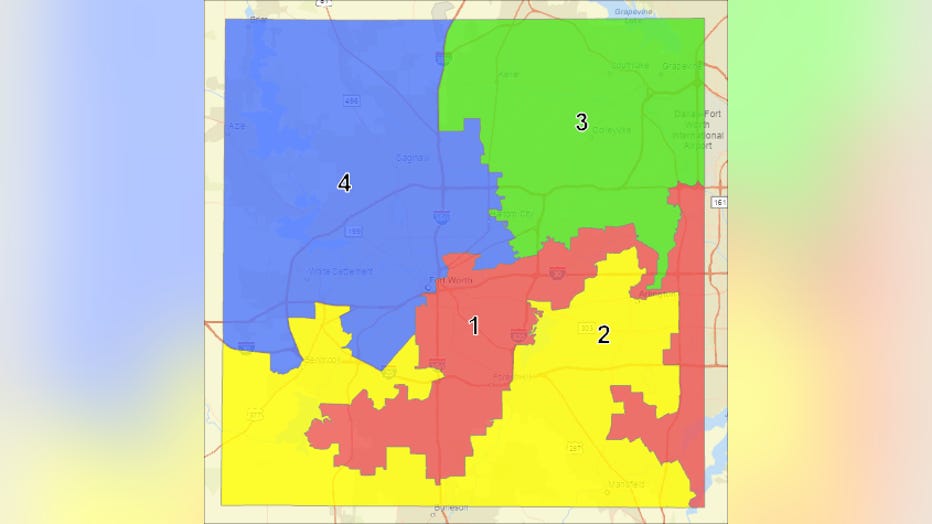
Today, the Tarrant County Commissioners Court voted to approve a redistricting map that effectively eliminates the seat of Commissioner Alisa Simmons, the only Black woman on the court.

It’s not a coincidence. It’s not neutral. It’s not “routine.” It is the calculated removal of a voice that dared to speak up for all of us.

Commissioner Simmons has stood firmly against the racist agenda pushed by Judge Tim O’Hare and the Republican Commissioners on the court. She spoke out against the rise in jail deaths under their watch. She called out the cruelty of defunding Girls Inc., a nonprofit that empowers young women of color. She opposed the elimination of free rides to the polls, which made it harder for working-class people, especially Black and brown voters, to cast a ballot.

And now, she’s being punished for it.

Commissioner Simmons wasn’t just a name on a ballot. She is my commissioner. I voted for her. I campaigned for her. And like thousands of others in Precinct 2, I saw her as a voice for the voiceless, a woman unafraid to shine a light on white supremacy, even when it came dressed in a suit and tie.

That light scared them. So they tried to snuff it out.

What we witnessed today was retaliation. It was white supremacy striking back at a Black woman who told the truth. And just like in Greenwood in 1962, they’re using the tools of power, maps, votes, and bureaucratic language, to do what they couldn’t do in public: silence her.

But we see it. We name it. And we will fight it.

The new map that the County Commissioners voted on today.

The Republican Commissioners and their defenders kept repeating the same excuse over and over again, “This wasn’t about race. It was just about politics.”

They said the map was designed to secure a Republican majority, not to silence Black voters. As if those two things aren’t deeply intertwined.

It’s the same argument Greg Abbott’s lawyers made in Shannon Perez v. Abbott, when Texas was caught racially gerrymandering districts. Their defense?

A direct quote from Greg Abbott

“It is not our intent to discriminate against minorities. It is our intent to discriminate against Democrats. If minorities happen to vote Democrat, that is their fault, not ours.”

That’s not a denial. That’s a confession….

Let’s stop pretending this distinction between race and party means anything in Texas. In Tarrant County, in Harris County, across the South, voter suppression by “party” is voter suppression by race. When you target the communities who dare to elect Black women, working-class progressives, young organizers, and civil rights leaders, you are targeting those communities on purpose.

They can say it’s about partisanship all they want. But we know what it’s really about.

Because when Conservatives talk about “conserving” something, they mean it.

They want to conserve white supremacy.

They want to conserve inequality, corporate power, and police brutality.

They want to conserve a system where jails are full, books are banned, teachers are silenced, and women don’t have autonomy.

They want to conserve a Texas where your zip code decides your worth, and where Black and brown voices are only welcome if they stay quiet.

And when people like Alisa Simmons refuse to stay quiet, they get erased.

But erasing her seat won’t erase her power, or ours….

And just when we thought we might get a win, it vanished as quickly as it came.

Yesterday, far-right extremist Tony Tinderholt (R-HD94) announced he would not seek reelection to the Texas House. For a brief moment, there was celebration across Arlington. A man who built his career on cruelty, censorship, and conspiracy was finally stepping aside. But the celebration didn’t last.

Because today, just minutes after the Tarrant County Commissioners voted to dismantle Precinct 2, Tinderholt announced he would run for that very seat, Alisa Simmons’ newly gutted district.

And he didn’t come alone.

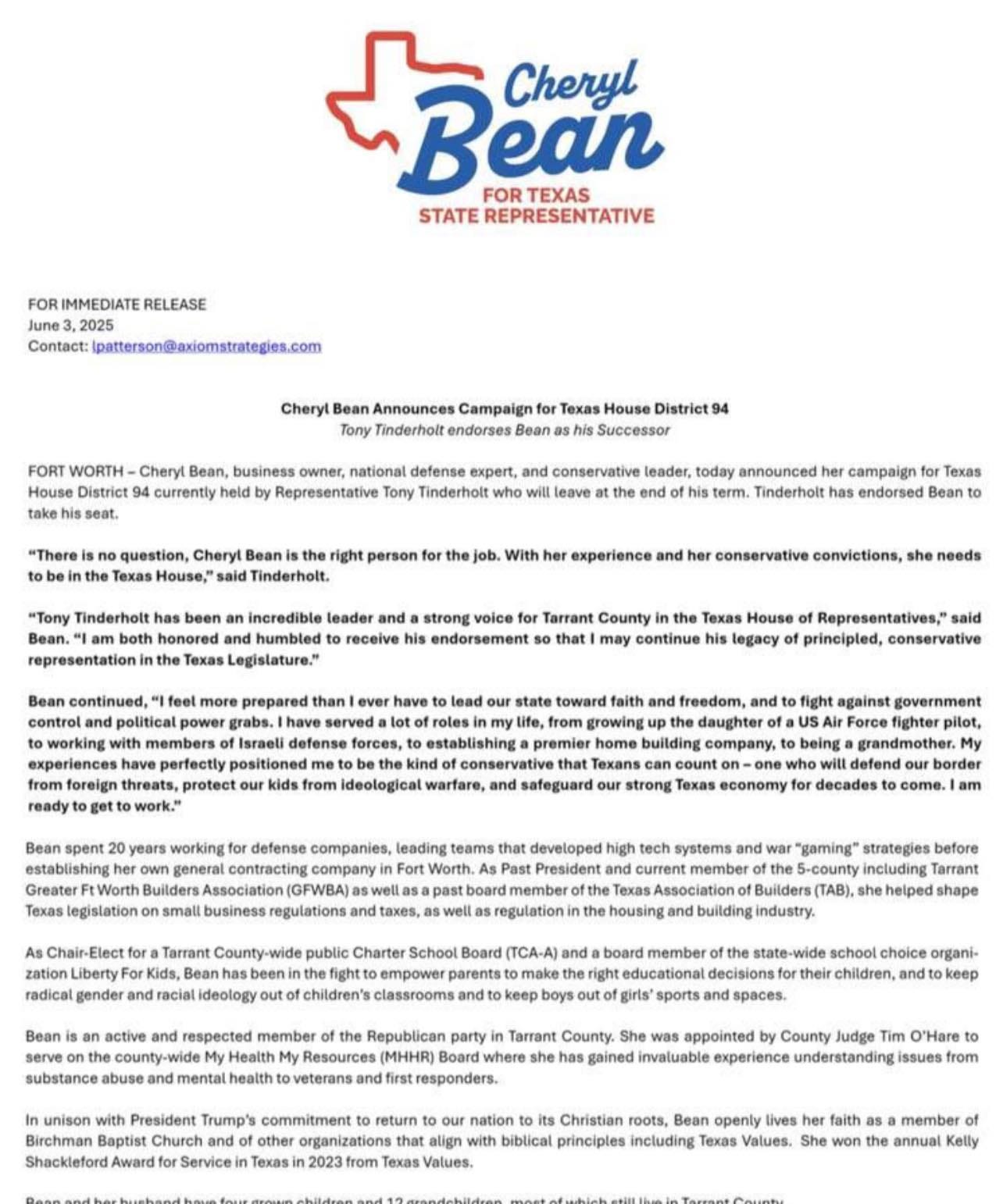
Cheryl Bean, another far-right extremist and ally of Tinderholt, announced her run for the now-open HD94 seat. A seat that was, conveniently, made safer for someone like her under the new maps.

Bean doesn’t even live in the district. She changed her voter registration to a new address inside it—an address she doesn’t own, according to the Tarrant Appraisal District. Her real home? Still outside the district lines. But facts don’t matter when the plan is to bulldoze through communities with precision and arrogance.

This wasn’t a coincidence. It was a coordinated political hit job, plain and simple.

A rigged map. A choreographed retirement. A handoff. A handpicked replacement. All timed to disempower the voices of Black and brown voters in Tarrant County. All orchestrated by Tim O’Hare and the extremist wing of the Republican Party.

They knew Simmons couldn’t be beaten fairly.

So they changed the lines.

They cleared the field.

And then they tried to rewrite the future.

But we see them.

We know the playbook.

And we’re not going to let this go unanswered.

This is part of a broader, coordinated strategy across Texas to suppress the political power of Black and brown communities under the guise of partisan politics…..

To read the post in full, open the link.

Most attention has focused on the horrible cuts to Medicaid and food assistance (SNAP) in the bill just passed by the GOP majority in the Senate. It has some differences with the version passed by the GOP House, so there will be changes and compromises.

Carol Burris, executive director of the Network for Public Educaruon, wrote this update on the education portion of the Senate bill that passed, called the Educational Choice for Children Act (ECCA). She refers to the Big Ugly Budget Bill as BBB.

She writes:

Despite the efforts of Democratic senators to get the Parliamentarian to override ECCA entirely, ECCA was significantly weakened in the Senate BBB and is no longer a universal voucher program. 

  •  The $4 billion cap for total contributions was removed. It is now unlimited. However, it is no longer a tax shelter for stocks, making contributions far less attractive. The maximum credit has been reduced to $ 1,700. 
  • States, as well as the Treasury, can now regulate the program; therefore, states without a voucher program are not mandated to have one. Additionally, the credits are only available to individuals residing in a state with an approved Scholarship Granting Organization (SGO).
  • Because the bill allows public school students to access scholarships and the list of allowable activities includes tutoring, payment for courses, and payment for tests (for example, AP exams), I am trying to determine whether states without vouchers could create SGOs for public school students only.
  • BBB needs to go back to the House, so all of this will likely change again. 

John Merrow was the education correspondent for PBS for many years. Now, in retirement, he continues to write and help us think through the existential moments in which we live.

He writes:

More than five million demonstrators in about 2000 communities stepped forward to declare their opposition to Donald Trump, on June 14th. “No Kings Day” was also Trump’s 79th birthday, Flag Day, and the anniversary of the creation of the American army.

So now we know what many of us are against, but the central question remains unanswered: What do we stand FOR? What do we believe in?

Just as FDR called for Four Freedoms, the Democratic party needs to articulate its First Principles.  I suggest three: “The Public Good,” “Individual Rights,” and “Rebuilding America after Trump.” 

 THE PUBLIC GOOD: Democrats must take our nation’s motto, E pluribus unum, seriously, and they must vigorously support the common good.  That means supporting public libraries, public parks, public schools, public transportation, public health, public safety, public broadcasting, and public spaces–almost anything that has the word ‘public’ in it.

INDIVIDUAL RIGHTS: Because the fundamental rights that are guaranteed in our Constitution are often subject to interpretation, debate, and even violent disagreement, Democrats must be clear.  Free speech, freedom of worship, habeas corpus, and other fundamental rights are not up for debate, and nor is a woman’s right to control her own body.  

Health care is a right, and Democrats must make that a reality.  

Conflict is inevitable–think vaccination requirements–and Democrats should come down on the side of the public good.  

Because Americans have a right to safety, Democrats should endorse strong gun control measures that ban assault weapons that have only one purpose–mass killing. 

REBUILDING AMERICA AFTER TRUMP:  The Trump regime was and continues to be a disaster for a majority of Americans and for our standing across the world, but it’s not enough to condemn his greed and narcissism, even if he goes to prison.  Let’s first acknowledge that Trump tapped into serious resentment among millions of Americans, which further divided our already divided country.  

The challenge is to work to bring us together, to make ‘one out of many’ in the always elusive ‘more perfect union.’  The essential first step is to abandon the ‘identity politics’ that Democrats have practiced for too long.  Instead, Democrats must adopt policies that bring us together, beginning with mandatory National Service: 

National Service: Bring back the draft for young men and women to require two years of (paid) National Service, followed by two years of tuition or training credits at an accredited institution.  One may serve in the military, Americorps, the Peace Corps, or other helping organizations.  One may teach or work in distressed communities, or rebuild our national parks, or serve in other approved capacities.  JFK famously said “Ask not what your country can do for you. Ask what you can do for your country.”  Let’s ask BOTH questions.  

Additionally: 1) Urge states to beef up civic education in public schools, teaching real history, asking tough questions.  At the same time, federal education policies should encourage Community schools, because research proves that schools that welcome families are more successful across many measures.

2) Rebuild Our Aging Infrastructure: This is urgent, and it will also create jobs.

3) Adopt fiscal and monetary policies to address our burgeoning national debt. This should include higher taxes on the wealthy, emulating Dwight Eisenhower. 

4) Adopt sensible and realistic immigration policies that welcome newcomers who arrive legally but close our borders to illegal immigration.

5) Rebuilding America also means rebuilding our alliances around the world.  Democrats should support NATO and Ukraine, and rejoin efforts to combat climate change. 

This is a startling and frightening article about the poison pill embedded in Trump’s One Big Ugly Budget Bill. It contains a plan for destroying the student aid program that has subsidized the cost of higher education for middle-income and low-income students. The plan was described in the 900-page Project 2025. Previous generations of lawmakers believed that the nation benefited by investing in the postsecondary education of young people. They could choose the program they wanted, whether in a liberal arts college or a trade school. Whichever route they chose, their education benefited the nation.

But today, Republicans don’t want the federal government to lend money for students to go to college.

The author of the education chapter in Project 2025 is now in charge of implementing the plan to deep-six student loans inside the Department of Education. Read this article and weep.

The article was written by Astra Taylor and Eleni Schirmer and appears in The New Republic:

The Trump administration’s bombastic attacks on the nation’s most prestigious universities have commanded the public’s attention all year long. Now congressional Republicans are poised to dramatically expand that onslaught. If you think the last few months have been bad for Harvard, brace yourself—the “big, beautiful bill” is coming, and with it, a new dimension of destruction. 

While it’s mostly gone unremarked upon in the mainstream media, institutions of higher learning across the country are about to be pummeled by the looming reconciliation bill, which may portend an extinction event for higher education as we know it. The bill weaponizes working-class families’ reliance on debt to finance their college dreams with such intensity that not only will it push millions to the financial brink, it will push them out of higher education altogether. 

For colleges and universities, the potential fallout is hard to overstate. Whatever schools survive are likely to be drained of working- and middle-class families, instead populated only by society’s most wealthy. As it is, millions of people rightly consider universities to be a costly endeavor that is irrelevant to their everyday life. But rather than remaking higher ed into a vibrant and more democratic institution, this bill threatens to do the opposite. It will cement the stereotype of higher education as an elite institution into an ironclad reality. On June 25, student debtors and their allies will be protesting these devastating cuts in Washington, D.C. But so far, very few elected officials are sounding the alarm on these issues with the fever pitch they deserve, let alone doing the work required to slow down and obstruct their passage into law.  

The overhaul of the student lending system championed by Republican legislators has nothing to do with fiscal responsibility or balancing the budget. Instead, it provides an ominous articulation of the Republican Party’s authoritarian ambitions, one that is chillingly consistent with the bill’s massive increases for immigration and border security. This is not a budget bill, it is a debt and deportation bill—and one built on the fascist foundation laid by the Heritage Foundation’s now-notorious Project 2025

As of this month, Lindsey Burke, formerly the Heritage Foundation’s top education policy official, serves as the Education Department’s deputy chief of staff for policy and programs. As the author of Project 2025’s chapter on education policy, Burke recommended gutting student loan relief (along with diversity, equity, and inclusion programs and scientific research funding) to bring universities to heel and reorient American society toward the far right. 

In the words of influential conservative activist Christopher Rufo, “Reforming the student loan programs could put the whole university sector into a significant recession” and state of “existential terror.” The goal is to use economic policy to impose an unpopular and stifling ideological agenda, exacted by punitive student debt. 

Whereas President Biden’s administration was defined by debates over how much student debt should get canceled and how quickly, this bill kicks away the concept of student loan relief altogether. In a draconian sweep, this bill removes the congressionally authorized power to cancel federal student loans that sitting presidents have long possessed. This means that even if the Democrats win back the White House in 2028, the next president will lack a critical tool—one that Biden possessed but, to his lasting shame, refused to use. 

Though many details are not yet settled, as the Senate and House negotiate between their respective versions, there is no doubt that the bill’s impact will be immediate and profound. Eight million student debtors will see their monthly payments spike from $0 to over $400. Dentists and doctors who choose to work in low-paying community health care centers will no longer be eligible for Public Service Loan Forgiveness programs, dramatically reducing the number of health care providers in communities that are already underserved. The bill even comes after the long-standing, Republican-approved federal student loan repayment plans, which allow borrowers to discharge their debts after a certain number of years of regular payments. 

While existing repayment programs cancel loans after 10 to 25 years of repayment, this bill moves the goalposts back to 30 years. As it is, Americans over 60 are the fastest-growing demographic of student debtors: the only age cohort to increase every single quarter of President Biden’s administration. This bill will all but ensure millions of working people carry their debts until death. 

House Republicans, whose proposals are even more extreme than their Senate colleagues’, want to end subsidized loans, driving up costs by tens of thousands of dollars, and place restrictive caps on federal loan amounts. The House bill viciously cuts Pell Grants while increasing the course load required for part-time students to access aid, making it more difficult for people with jobs or family responsibilities to afford to study. 

Both House and Senate versions strive to reduce Parent PLUS and Grad PLUS programs, decreasing working-class families’ abilities to take on loans commensurate with the costs of tuition. Families that can’t afford to pay up front will either have to take their chances with private lenders—who are likely to shut out the neediest families—or choose to forgo the education altogether. Those who take the gamble will face rising debt loads with little possibility of relief, prompting a doom loop of delinquencies, defaults, and tanked credit scores, exacerbating the financial precarity of already over-stressed and stretched borrowers. 

These cuts won’t just harm students who rely on loans to afford college; they will take the doors off colleges’ and universities’ capacity to expand minds and redistribute opportunity. Lost revenue will encourage schools to close programs, squeeze staff, and perhaps shutter entirely. A proposed endowment tax for colleges and universities has prompted fury among higher education lobbyists, but those players have said very little about the bill’s vigorous imposition of debt as a tool of social control. 

Most insidiously, the House bill conscripts colleges and universities themselves into debt. Under the guise of “accountability,” House Republicans want to force colleges and universities to pay back any unpaid federal loans for “high risk” students. This move is designed to penalize institutions for serving the low-income students who often struggle to pay their loans and discourage them from offering majors that are not maximally remunerative. They want to turn the working-class kid studying to become a social worker, artist, or a physician into a liability to her university. 

This kind of social engineering through debt isn’t new. In fact, it hails from the origins of the student loan crisis. In the early 1960s, an ambitious politician named Ronald Reagan made his name by picking a fight with the students protesting racism and war on the state’s then tuition-free campuses. “Those there to agitate and not to study might think twice before they pay tuition—they might think twice how much they want to pay to carry a picket sign,” he said. As California’s governor, Reagan tapped into his base’s anxieties about a rapidly integrating and evolving society to chip away at state support for education. As president, he doubled down on this strategy, following the recommendations of the first edition of the Heritage Foundation’s Mandate for Leadership, Project 2025’s precursor, slashing Pell Grants and tightening student loan eligibility for middle-class families. 

As Ryann Liebanthall details in Unburdened,an in-depth history of the student debt crisis, the number of Black college freshmen fell by nearly 8 percent between 1980 and 1983. More than any other figure, Reagan deserves credit for undermining what once passed as common sense in the U.S.—the principle that public college should be high quality, widely accessible, and tuition-free. Like today’s Republicans, Reagan invoked the figure of the student protester, the specter of racial equality, and the tool of student debt to implement a retrograde agenda. 

Contemporary Republicans are even more brazen. Consider a recent report released by the Heritage Foundation that recommends terminating higher education “subsidies” and student loan cancellation in order to “increase the married birthrate.” What does this goulash mean in plain English? Widespread access to college has enabled women to envision lives beyond childrearing; restricting access will increase fertility rates. Conservative power players are more than willing to cast the country into a scientific dark age in their quest to shore up traditional worldviews, outmoded hierarchies, and concentrated wealth. 

The reconciliation bill threatens to supercharge their oligarchic cause. Rising costs will reinforce the perception that education is the domain of an out-of-touch elite, prompting many to abandon or abort their academic dreams, which will resegregate broad swaths of society. The threat of mounting debt will discourage people from studying their passions or pursuing careers in public service, steering them instead toward the private sector or the military. It will weaken the general bargaining position of workers, who will be less able to use education as a path of upward mobility, while making the labor force more docile; workers burdened by debt are less likely to strike. By funneling student debtors’ ballooning payments into Wall Street coffers and regressive tax cuts, it will ensure that social and economic disparities become more entrenched.

And it will shrink our horizons. At their best, colleges and universities are not just places where people get trained in a skill or earn a degree; they enable people to grapple with bigger questions—to find out who they are, to unlock what they want to be and do, to discover how the world is made, and to dream how it could be remade differently. This is why authoritarians find education so threatening, and why the reconciliation bill must be understood as a strike against our freedom to question, learn, and choose our fates. Even, or especially, when that process challenges authority.

While some Democratic leaders have begun to warn of the economic dangers posed by this bill, none yet seem to grasp the existential stakes—nor the transformative vision required to build the political will required to change course. 

Where higher education is concerned, it is not enough to defend a status quo that the American public knows is broken. Today, an astonishing $1.6 trillion in federal student loans crushes nearly 43 million people. This insurmountable burden has made ordinary people increasingly skeptical of the value of education and more susceptible to anti-intellectual appeals. 

To counter the Republicans’ vision for higher education, Democrats must go far beyond a milquetoast goal of a less predatory student debt system. They must articulate a galvanizing vision for free college. The measure is popular: Surveys show that many people, including pluralities of Republicans and independents, are supportive of free college, despite decades of Republican propaganda demonizing academia. In recent months, faculty, staff, students, and student debtors have come together to lay this groundwork. It’s time for Democratic politicians to catch up. We need a legislative and executive agenda that courageously resists Republican tyranny by defending higher education as a public good that is both universal and free. Free as in cost and, just as importantly, free as in aimed at enhancing individual and collective freedom. We can’t afford anything less.


James Ryan, the president of the University of Virginia since 2018, announced his resignation under intense pressure from the Trump administration.

The Civil Rights Division of the Trump administration pressured the Board of Governors of the university to remove Ryan because of his support for diversity, equity, and inclusion.

They said that he pretended to comply with the federal demands to eliminate DEI but merely renamed them.

For the past half century, DEI was considered a hallmark of compliance with civil rights laws. DEI programs encouraged women and nonehites to enroll in higher education and to study the history of discrimination.

Under Trump, DEI has been reinterpreted to mean favoring those groups at the expense of white men and thus discriminating against white men.

The Trump administration has cut federal grants to universities that are slow or unwilling to dismantle DEI programs.

The New York Times reported that lawyers for the Civil Rights Division demanded Ryan’s ouster.

The demand to remove Mr. Ryan was made over the past month on several occasions by Gregory Brown, the deputy assistant attorney general for civil rights, to university officials and representatives, according to the three people briefed on the matter.

Mr. Brown, a University of Virginia graduate who, as a private lawyer, sued the school, is taking a major role in the investigation. He told a university representative as recently as this past week that Mr. Ryan needed to go in order for the process of resolving the investigation to begin, two of the people said.

Harmeet K. Dhillon, the Justice Department’s top civil rights lawyer, has also been involved in negotiations with the university. She received her law degree from the University of Virginia, where she was a student in the law school at the same time as Mr. Ryan…

Mr. Ryan, hired in 2018 as the university’s ninth president, has leaned into issues like making the school more diverse, increasing the number of first-generation students and encouraging students to do community service. But his approach, which he says will make the university “both great and good,” has rankled conservative alumni and Republican board members who accuse him of wanting to impose his values on students and claim he is “too woke.”

Before becoming the University of Virginia’s president, Mr. Ryan served as the dean of the Harvard Graduate School of Education, where he was praised for his commitment to D.E.I. programs. Harvard has been one of the Trump administration’s chief targets since it began its assault on higher education.

The administration’s attempt to assert federal influence over state university leadership decisions is also illustrative of how Mr. Trump’s political appointees continue to wield the Justice Department’s investigative powers to achieve policy goals long sought by a top Trump adviser, Stephen Miller.

Legal experts said they could think of few other instances in which an administration had demanded that a school have its president removed in order to resolve a Justice Department investigation.

“This is a tactic you would expect the government to use when it’s playing hard ball in a criminal case involving a corporation accused of serious wrongdoing or pervasive criminal activity,” said Daniel C. Richman, who is a law professor at Columbia University and a former federal prosecutor.

Government Executive pays close attention to the federal workplace; its reporting is especially crucial these days, as Trump attempts to downsize, demoralize, and politicize career civil servants. It reported today that a federal judge in California blocked Trump’s plan to crush federal employee unions. It is not clear how this decision will be affected by the U.S. Supreme Court decision earlier today that federal judges would no longer be able to issue national injunctions. Will the judge’s decision apply only in the 9th Circuit, which includes California and other western states?

Erich Wagner wrote in Government Executive:

A federal judge in California issued a preliminary injunction late Tuesday once again blocking President Trump’s executive order to strip two-thirds of the federal workforce of their right to join and be represented by a union, finding “persuasive evidence” that the measure was implemented in retaliation for speech protected by the First Amendment.

In March, President Trump signed an executive order invoking a rarely used provision of the 1978 Civil Service Reform Act to strip most federal employees of their collective bargaining rights under the auspices of national security. Since then, although agencies have ostensibly refrained from formally repudiating union contracts as they await a green light from courts, they have broadly disregarded the terms of those agreements, withdrawing from ongoing negotiations and grievance proceedings and cancelling the automatic collection of union dues from workers’ paychecks.

In a 29-page decision, U.S. District Judge James Donato, an Obama appointee, found that a coalition of unions led by the American Federation of Government Employees raise a “serious question as to whether their First Amendment rights have been violated.”

null

“In the words of a physical therapist who works at a VA medical center and is an executive vice president for the National Veterans Affairs Council of AFGE, ‘From my interactions with other VA employees, I believe many workers will feel pressure to conform to the administration’s political views and be reluctant to raise health and safety concerns or otherwise criticize agency management, for fear of further retaliation,’” Donato wrote. “[This] is persuasive evidence of the chilling effect of the government’s challenged conduct.”

Donato carefully crafted his ruling solely around the unions claims that they were retaliated against for opposing the Trump administration’s workforce policies. Last month, a federal appeals court issued a stay blocking a similar injunction in a legal challenge brought by the National Treasury Employees Union, finding the injuries in that case were still too “speculative” in nature, and impinging on the president’s legal deference on national security issues.

“The court has no intention in this order of second-guessing the president’s national security determinations or calling on the government to prove the determinations were properly made,” he wrote. “As noted, the executive branch is owed deference in such matters. But a claim of national security does not, of course, automatically negate the Constitution, particularly with respect to the First Amendment.”

Attorneys for the Trump administration contended that Donato lacked jurisdiction to hear the case and that the unions should instead pursue their claims before the Federal Labor Relations Authority. But Donato found the argument too circular in nature, describing it in a footnote as a “Heads, I win; tails, you lose” proposition.

“The government says plaintiffs’ claims should still go to the FLRA because plaintiffs allege that ‘Executive order 14,251 is invalid, meaning the agencies and subdivisions identified in the executive order remain subject to [federal labor law],’” Donato wrote. “[This] is an dd suggestion, particularly in light of the government’s insistence that EO 14251 has already excluded a large swath of agencies and subdivisions from Chapter 71 [of Title 5 of the U.S. Code]. The question of the court’s jurisdiction is not answered by the plaintiffs’ or defendants’ beliefs about the merits of the case. It is answered by the plain language of the [statute].”

In a statement Wednesday, AFGE National President Everett Kelley applauded the ruling.

“President Trump revoked our members’ union rights in retaliation for our advocacy on behalf of federal workers and the American people, and we are grateful that Judge Donato saw through his disingenuous ‘national security’ justification and has ordered the immediate restoration of their rights,” he said. “Federal employees have had the right to join a union and bargain collectively for decades, including during President Trump’s first term, and at no time have employees’ union rights caused concern for our nation’s national security.”

During the presidential campaign of 2024, Trump boasted that he could end the war in Ukraine in one day. We are still waiting. He continues to make phony demands of Putin, who ignores his demands, and intensifies his attacks on Ukraine.

What’s going on?

Diane Francis titled her Substack post “Comrade Trump.” She explains:

The contrast between Trump’s principled war with Israel against Iran and his fawning toward Russia’s Putin stands couldn’t be starker. Tehran has been toppled, but on May 28, Trump imposed a two-week deadline on Russia to stop bombing Ukraine to see if Putin was serious about peace. He didn’t stop, and it has worsened since. Trump has said nothing and taken no action. By June 9, he dismissed Russia’s constant attacks, then commented that Ukraine’s audacious “Operation Spiderweb” attack on June 1, against Russian aircraft, “gave Putin a reason to go in and bomb the hell out of them”. Then, on June 12, on Moscow’s national holiday, Trump’s Secretary of State Marco Rubio released an official statement, which read: “On behalf of the American people, I want to congratulate the Russian people on Russia Day. The United States remains committed to supporting the Russian people as they continue to build on their aspirations for a brighter future.”

Bombing escalation against Ukrainian civilians on the Trump watch

What “aspirations”? What “brighter future?” The “Russian people” do not, and cannot, build toward a brighter future because they are modern-day serfs, entrapped in a kleptocracy run by a mafia controlled by a delusional and homicidal dictator. Trotting out such diplomatic drivel does not move the dial, and is as sincere as are phony claims by Russia that it seeks only peace. It does not. It “seeks” Kyiv, Odesa, and lands bordering the European Union’s eastern borders, as well as world dominance.

Still, Trump doubles down. On June 16, Trump attended the G7 gathering in Canada. He was clearly upset that Ukraine’s President had been invited to attend the following day (which is why he left before Zelensky arrived). But on day one, he scolded the leaders for expelling Russia from the G8 back in 2014. “The G7 used to be the G8,” said Trump. He blamed the current war on this major snub, which was bizarre because Russia’s first invasion of Ukraine took place in 2014, and its second happened in 2022 and was a continuation of the war started in 2014.

Trump’s accusation didn’t surprise his former national security advisor, John Bolton, who later commented that Trump “never seemed to understand that Russia had been kicked out of the G8 for invading Ukraine or that the G7 membership consists of a group of like-minded industrial democracies.” But Trump’s fibbing would have pleased his pal, Putin, to no end, as would his cold shoulder toward Zelensky and Ukraine. 

Of course, it was nothing new. Trump never lets the facts about Putin and Russia get in the way of one of his Russian revisionist rants, a notably worrisome trait. More importantly, he continues to broadcast Russian talking points that Ukraine is losing the war to Russia, which are untrue but designed to dampen support for Western military assistance to Ukraine and to demoralize Ukrainians. 

Here are the facts, and Russia is not winning the war:

1. Russia is, militarily and economically, “bleeding out”. Since January 2024, its massive ground forces have seized less than 1% of Ukraine, an area slightly bigger than Rhode Island, according to the Center for Strategic & International Studies. Ukraine is the largest country in Europe, apart from Russia, and the size of Texas.

2. The Russians advance 50 meters per day in their latest offensive in Kupyansk and 135 meters daily in Donetsk – a pace slower than the notoriously futile battles fought in The Sommes during World War I.

3. One million Russians will have been killed or wounded by June 20 when summer begins.

4. Russia’s military supply chain has been disrupted and drained financially. Reports are that citizens whose loved ones have died as soldiers are forced to crowdfund and obtain charitable donations to buy body bags and hire transportation so that they can bring the home in order to bury them. 

5. Ukraine’s technological superiority is shredding Russian conventional armed forces. The battlefield is drenched with Ukrainian drones that do most of the killing and wounding. This intensifies.

6. Russia’s massive manpower losses are resulting in desertions and sabotage among the ranks, and forcing its military to offer huge signing bonuses to attract contract soldiers. The rate of attrition is skyhigh and so are the costs.

7. One-third of Russia’s navy was destroyed and the rest driven from Crimea and the Black Sea by Ukraine’s state-of-the-art sea drones.

8. The war is cratering Russia’s economy. Ukraine’s economy is doing okay because its government is prudent, its financial institutions are well run, and corruption is negligible. However, Russia hurtles toward economic catastrophe due to corruption, stagnation, a brain drain, sanctions, labor shortages, capital flight, government debt, incompetence, and inflation.

Mr. Rubio: There is no “bright future” for these Ukrainians who were attacked on Russia’s National Day, June 12

And no “bright futures” for these Ukrainian men and boys:

Military cemetery in Kharkiv. Reuters

Or for their Russian foes:

Russian soldier graveyard. Reuters

The correlation between Trump’s accession to the Oval Office and Russia’s increasing attacks against Ukraine’s cities and civilians is established and disturbing. Arguably, his praise and defense of Putin enables the slaughter: “With Trump so far failing to respond to Russia’s escalating drone strikes, the Kremlin has little incentive to stop. All signs point to Moscow’s defense industry only increasing its ability to launch ever-larger mass attacks,” observed the Kyiv Independent. 

Why is Trump doing this? Some suspect that the President or his family is corrupt. This is unproven, but it is undoubtedly a result of impaired judgment, which consists of a brew of intellectual laziness, vanity, and a proclivity toward geopolitical “name-dropping”. Instead of calling out atrocities, Trump drops Putin’s name a lot. “Putin speaks to me; he doesn’t speak to anybody else because he was very insulted when he got thrown out at the G8, as I would be, as you would be, as anybody would be,” he boasted to reporters at the G7. 

Trump bragged that Putin gave him a painted portrait on his birthday, along with a birthday phone call, just before Trump hosted a massive parade of American troops and military hardware. It’s also curious that Trump’s love of tariffs does not include support for a clever tariff bill by Senator Lindsey Graham that would impose 500% tariffs on Russian oil customers — a levy that would help stop the war. He has also refused to sign British Prime Minister Keir Starmer’s massive new sanctions bill, designed to squeeze Russia’s energy revenues, which support his war. And Trump continues to badmouth Zelensky often, blames him for the war, and has mused about cutting off military aid to Ukrainians as a means of ending the war.

It is also apparent that Trump is naïve enough to believe he can pull off a rapprochement with the world’s most hated and treacherous leader, presumably so that the two can carve up the planet. Another explanation for his lavish “Putinizing” is that he and Steve Bannon have long feared China and have an affinity for Russia because they believe in a “civilizational realignment”. Whatever the pathology, Trump is the guy who likes the guy who keeps committing genocide in Ukraine. 

Fortunately, Trump fools no one, except himself, especially after he trotted out an example of false equivalency to justify doing nothing to stop Putin’s rampage. He said, “Sometimes you see two young children fighting like crazy,” Trump said in the Oval Office, with his German counterpart Friedrich Merz looking on silently. “They hate each other, and they’re fighting in a park, and you try to pull them apart. They don’t want to be pulled. Sometimes you’re better off letting them fight for a while and then pulling them apart.”

His analogy was erroneous. This is not about two young children fighting. Russia is ten times bigger than Ukraine and a giant bully who wants to destroy it, then murder the other “kids” in the neighborhood. It must be stopped; they cannot be allowed to “fight for a while”. This attitude puts Trump at odds with most Americans who support Ukraine and with the 91% who don’t trust and intensely dislike Putin and Russia. 

Trump’s policies and pronouncements about this gigantic war in Europe are not aligned with the beliefs and wishes of the American people. But there’s no accounting for ignorance. France’s Voltaire said it best: “Those who can make you believe absurdities can make you commit atrocities. To the living we owe respect, but to the dead we owe only the truth.