You probably never heard of a U.S. Supreme Court decision called Plyler v. Doe (1977). But you should learn about it, because immigrant-haters are doing their best to overturn it right now.
In this post, Peter Greene explains what Plyler v. Doe said and why it’s now in the red-hot center of American politics right now.
You’re going to see the Supreme Court casePlyler v. Doecoming up a bunch these days, and if you are not up on your SCOTUS cases, let me provide you with the basic info about what the case was, why its decision matters, and why some folks are looking to get it overturned. This is about immigrants and education and, as is often the case these, a whole lot more.
Why did the case happen in the first place?
Texas. In 1975, they passed a law prohibiting “the use of state funds for the education of children who had not been legally admitted to the U.S.” In 1977, Tyler Independent School District adopted a policy requiring students who were not “legally admitted” to pay tuition (”legally admitted” included having documents saying they were legally present or in the process of getting such documents).
A group of students who couldn’t produce such documents sued the district. The district court ruled the policy (and therefor the state law on which it rested) was unconstitutional. The federal appeals court agreed, and the district pursued appeals all the way to the Supremes, who handed down a decision in June of 1982.
What did SCOTUS say?
SCOTUS was 5-4 against the policy.
The majority opinion, written by Justice William J. Brenan. found that the law was aimed squarely at children and discriminated against them for a characteristic that they could not control. The ruling also asserted that there is a state and national interest in educating these children, regardless of immigration status, because denying them an education would lead to “the creation and perpetuation of a subclass of illiterates within our boundaries, surely adding to the problems and costs of unemployment, welfare, and crime.”
The majority argument also rested heavily on the Fourteenth Amendment, which should ring a bell because that is also the amendment that establishes birthright citizenship, which Donald Trump would very much like to get rid of. The arguments in Plyler rested on the Equal Protection Clause. Justice Lewis Powell (a Nixon appointee) argued in his concurring opinion that the children were being kept from schools because their parents broke the law. “A legislative classification that threatens the creation of an underclass of future citizens and residents cannot be reconciled with one of the fundamental purposes of the Fourteenth Amendment.”
Even the dissent, written by Chief Justice Warren Berger, actually agreed with the majority that it would be a bad idea to “tolerate creation of a segment of society made up of illiterate persons.” But they asserted that this was an issue to be settled by lawmakers and not the court.
One notable argument raised by Texas officials was that the phrase “within the jurisdiction” in the Equal Protection Clause did not cover illegal aliens. Both the majority opinion and the dissent disagreed, arguing that illegal aliens are, in fact, persons, and they are here.
Why do we care?
Many pieces of this case have re-emerged in recent years, in part because conservatives have a bone to pick with the Fourteenth Amendment. The Equal Protection Clause was, for instance, instrumental in Obergefell v. Hodges, the decision that established same-gender marriage as Constitutional.
Texas Governor Greg Abbott has been itching to revive that 1975 anti-child law since SCOTUS struck down Roe, arguing that the Dobbs decision draft opinion from Justice Samuel Alito (the one that was leaked) was based on the idea that abortion rights are not specifically protected by the Constitution and neither does it mention education rights for undocumented immigrants.
And if SCOTUS can be convinced to take another look at that “within the jurisdiction” language, so that the court no longer recognizes being a person and being here as enough, we could be looking the wholesale creation of all sorts of second-class tiers in America, people who are not protected by the Equal Protection Clause.
The Trump administration has been pushing back against Plyler for a while, But in just the last week, hateful homunculus Steven Miller has pushed Texas to kick those undocumented immigrant kids out of school. Earlier this month the House held a whole hearing on “the adverse effects of Plyler v. Doe.“ The underlying argument is part bullshit, part chilling prediction of where these guys are headed, the argument being basically “Why spend money on anyone who is not One Of Us,” an argument that is sociopathic baloney, but also alarming in how easily it can extended to anybody We Don’t Like. Witness also this tweet from the official White House twitter account:
Get that? Not the worst of the worst. Not illegal or undocumented immigration. The promise made and kept is to chase all immigrants away. And if scaring them away from schools with ICE, or chasing them out of schools entirely– well, if that gets a few more of those immigrants out of the country, then the administration thinks that’s just fine.
The GOP in Tennessee has obligingly advanced a bill that would allow schools to deny, or charge tuition for, education to any children without legal immigration status. They did amend the bill so that children thrown out of school for immigrant status will not be in trouble under the state truancy laws. What big hearts! The bill exists to allow legal challenges to carry it all the way to the Supremes so they can, if so inclined, undo Plyler.
Just imagine if SCOTUS also undoes the Fourteenth Amendment’s birthright citizen language. America gets a large, uneducated generation of young humans who can either be deported or put to work as good old fashioned hard laborers (thank all the states that have rolled back child labor laws).
There’s an extra layer of irony here. As we learn from Adam Laats in his book Mr. Lancaster’s System, one of the forces behind the invention of the U.S. public school system was a concern about the number of illiterate and unschooled youths who were out on the street causing trouble and worrying their elders.
So pay attention to what happens to Plyler next under the regime. It could spell trouble not just for undocumented immigrants, but for all of us. If leaders agree that only Certain People are entitled to an education, we’d better pay attention to who qualifies as Certain People, and who does not.
Harold Meyerson, editor-at-large of The American Prospect, has advised Texas Republicans to deny access to public schooling to undocumented children. The Supreme Court decided the issue more than four decades ago; maybe today’s conservative Court might overturn that ruling.
The Don’s consigliere tells Texas Republicans to end undocumented children’s access to public schools.
Last week, Stephen Miller—Don Trump’s wartime consigliere—met with Texas’s Republican legislators and asked them why they hadn’t passed a bill that banned undocumented children from public schools.
At first glance, the answer to that question might be that in 1982, the Supreme Court ruled in Plyler v. Doe that states were legally required to pay for the elementary school education of children regardless of their immigration status. But, as Tom Oliverson, the chairman of the Texas House Republican Caucus, told The New York Times yesterday, “There’s a lot of people that believe that that ruling has some pretty faulty logic associated with it.”
Well, sure. The Supreme Court clearly had a bias in favor of a generally well-educated public, able to perform the range of jobs and tasks that a functioning nation tends to require. That a bias in favor of a well-educated public has seldom infected Texas Republicans, Fox News, the MAGA movement, or Stephen Miller and his Don goes without saying. Indeed, a well-educated public inherently poses a long-term threat to authoritarians and authoritarian wannabes, inasmuch as such a public may wish to have a say in many public policies.
Miller’s current offensive against immigrant children should come as no surprise. He was the force behind the separation of small immigrant children from their parents during the Don’s first term. As well, one Miller biographer has documented how the teenage Miller once cut off his friendship with a Latino pal because, he told said pal, he’d realized he didn’t want to be friends with a Latino. (I know this goes beyond mere immigrant hatred, but it seems illustrative of Miller’s larger mindset.)
This war on immigrant children is not without precedent. In 1994, California voters enacted Proposition 187, which denied public services—including the right to attend K-12 schools—to undocumented children. Plyler v. Doe was one reason why federal courts almost immediately struck down 187 as unconstitutional, but Miller and many Texas Republicans seem bent on trying it again.
In the weeks before 1994’s Election Day, Los Angeles high school students, both documented and undocumented, foreign-born and U.S.-born, began demonstrating against 187 and in favor of—O, the horror—continuing their education. At first, a few demonstrated on their campuses, and as the movement grew, they began amassing by the thousands across Southern California. Some politically sentient unions, disproportionately Latino-led, began offering those students the chance to work phone banks and walk precincts against 187 in the closing days of the campaign; many jumped at the chance. For some, this was their entry into politics: Two of the march’s organizers became, years later, Speakers of the California Assembly. (I covered all this for the L.A. Weekly.)
One question that 187’s supporters never answered was what the undocumented children and teens would be doing during the hours when schools were in session. Hanging at home, compelling their moms and dads to miss work? Roaming the streets? Expressing the normal reactions of young people whom the state had effectively told to go fuck themselves?
Thanks to Plyler v. Doe, these were questions that nobody had to answer. But Texas Republicans routinely act in ways every bit as sociopathic as Miller. They may be hoping that if they codify Miller’s war on the school-aged, they can at least find some Trump-appointed judge who’ll rule that Plyler was decided in error. Until or unless some higher court overrules that decision, they’d then be able to answer those questions in a distinctly Texas Republican way: They’d be empowered to loose the Rangers, or ICE, the Border Patrol, or any gun-carrying white Texan, on Latino kids on the streets or in stores or at home during school days. Not only would rough beasts be deploying to Bethlehem, but, to Miller’s particular delight, entire children’s ceremonies of innocence would be drowned. Look for those particulars in the next Republican platform.
I subscribe to Marc Elias’ blog called “Democracy Docket.” Marc is a veteran prosecutor who is actively pursing lawsuits against the crimes of the Trump administration and winning many of them.
Together they discuss how the Trump regime has corrupted the rule of law; how grand juries have usually stood firm in defending it; why Trump and his cronies must be held accountable for their efforts to destroy our democracy; why Merrick Garland was weak but Jack Smith was strong; why the Department of Justice must always be apolitical and hold members of both parties accountable; how Pam Bondi has repeatedly broken the law; and why the Epstein Files will eventually reveal a massive coverup.
All that is to say that I found the discussion to be enlightening and informative. These two—Elias and Kirschner–are truly experts, not just someone fulminating at the latest outage.
Since the content of the blog is for subscribers only, I can’t post it in full. It is definitely worth your while to subscribe.
Here is Marc Elias’ introduction to the dialogue:
For decades, the American justice system has operated on a “presumption of regularity” — the idea that the government acts in good faith. But as we enter the second year of this administration, that presumption has become a dangerous fantasy. Glenn Kirschner spent 30 years as a federal prosecutor, and he knows that when the rule of law is hanging by a thread, there’s no such thing as “business as usual.”
Glenn joined me to explain why we need a “scorched earth” mission to investigate the criminal enterprise currently occupying the White House. We also dive deep into the Epstein files cover-up and discuss what it takes to hold the Trump administration accountable when we take back the White House in 2029.
And here is a brief snippet from Kirschner’s remarks:
Glenn: I think accountability doesn’t look like “you’ve got to throw them all in prison, they all need to be in orange jumpsuits.” That’s not accountability. My version of accountability, my definition of accountability, is if we fairly, impartially, aggressively — and I mean scorched earth — investigate in an apolitical fashion every crime that we see with our own eyes. The President and his cabinet, basically this is a criminal enterprise. I prosecuted lengthy RICO cases in federal district court in Washington, D.C. I don’t say that flippantly. This is a criminal enterprise.
So what we need to do is make sure every crime gets fully investigated through an apolitical investigation whereby we give all of the evidence to the grand jury and we let them serve as the first check on our instincts with respect to who should be prosecuted. Do we have enough evidence to make out, one, probable cause, and two, beyond that, do we prosecutors believe we have a reasonable likelihood of success on the merits, which looks like a conviction at trial? That’s some of the language taken from the U.S. Attorney’s Manual. That is our procedural Bible at the Department of Justice. Once we secure indictments against everybody who has been victimizing the American people and violating our nation’s laws, then we move into the courtroom. We try the case as best we can. We deliver it to the jury and they begin to deliberate.
Accountability is done at that point. That may sound counterintuitive coming from a prosecutor who liked winning convictions. I enjoyed holding perpetrators accountable, vindicating the rights of victims, and protecting the community. But the result is not as important as the process. Justice is a process. And once we deliver it to the second check on our instincts—the trial jury sitting as the conscience of the community, just as grand jurors do—we live with the result, win, lose, or draw: conviction, acquittal, or mistrial because it’s a hung jury where the jurors couldn’t agree unanimously on a verdict. That’s what accountability looks like: putting everybody fairly and apolitically through the criminal justice system and let first the grand jurors decide and then we let the trial jurors decide.
The Department of Political Science at the University of Gothenburg in Gothenburg, Sweden, publishes an annual report on the state of democracy around the world. In the recently published report, the authors made clear that democracy in the world is in retreat. Nowhere has it declined as dramatically as in the United States.
A special section of the report is focused on the United States. Under Trump, democracy in the USA is under attack. The President has centralized power in his office. The Republican-dominated Congress has ceded almost all of its Constitutional powers to Trump. The word “almost” may be an overstatement, as it’s difficult to remember an issue when Congress said no to a Presidential power grab.
The V-DEM report begins its special section about the “autocratization” of power in the United States:
*Under Trump’s presidency, the level of democracy in the USA has fallen back to the same level as in 1965.
Yet the situation is fundamentally different than during the Civil Rights era. In 2025, the derailment of democracy is marked by executive overreach undermining the rule of law, along with far-reaching suppression and intimidation of media and dissenting voices.
*The speed with which American democracy is currently dismantled is unprecedented in modern history.
*Legislative Constraints – the worst affected aspect of democracy – is losing one-third of its value in 2025 and reaching its lowest point in over 100 years.
*Civil Rights and Equality before the Law are also rapidly declining, falling to late 1960s levels.
*Freedom of Expression is now at its lowest level since the end of WWII.
*Electoral components of democracy remain stable. Election-specific indicators are re-assessed only in electoral years, and the 2025 scores are based on the quality of the 2024 elections.
The scale and speed of autocratization under the Trump administration are unprecedented in modern times. Within one year, the USA’s LDI score has declined by 24%; its world rank dropped from 20th to 51st place out of 179 nations. The level of democracy on the LDI is dwindling to 1965 level – the year that most regard as the start of a real, modern democracy in the USA.
Yet the deficiencies of American democracy today are fundamentally different from that of the Civil Rights era. As the V-Dem data and other evidence below show, the autocratization now is marked by executive overreach, alongside attacks on the press, academia, civilliberties, and dissenting voices.
The Most Dramatic Decline in American History
In 2023, the USA scored 0.79 on the LDI – shortly before the 2024 election year when first deteriorations were registered. The scores plummeted to 0.57 in 2025 (Figure 22). With such a sharp drop on the LDI, the level of democracy at the end of 2025 is back to the 1965 level. Symbolically, that is the year that most analysts consider the USA began its transition to a real democracy.
Democracy in the USA is now at its worst in 60 years. We are not alone in this assessment. Professor Steven Levitsky at Harvard University says the regime in the USA is now some type of authoritarianism. The Century Foundation argues that “American democracy is already collapsing…”
By magnitude of decline on the LDI, the 2025 plunge is the largest one-year drop in American history going back to 1789 – that is, in the entire period covered by V-Dem data. Only Trump 1.0 compares, when the LDI in the USA fell from 0.85 to 0.73 in four years, bringing the country back to its 1976 level and far below the regional average (Figure 22). American democracy survived Trump 1.0 but did not recover fully.
One notable shift is the transformation of the Republican Party to endorsing a far-right, nationalist, and anti-pluralist agenda. Nationalist, anti-liberal, far-right parties and leaders have largely driven the “third waveof autocratization.” Yet the USA stands out as the only case where such movement seized control over one party in a rigid two-party system.
Please open the link and read the report to review the sources and to understand how dramatically democracy has been undercut during the first year of Trump’s second term.
The Founding Fathers thought they had written a Constitution that would prevent the rise of tyranny. They were wrong.
A reader who calls himself “Gitapik” shares his experience with the introduction of new technology into the special education programs for which he was responsible in New York City public schools.
He wrote:
As a former tech guy for our five District 75 special education sites in Brooklyn, I had quite a ride on this tech roller coaster. I was in on it from the beginning.
I applied for and received multiple very large state grants in technology. Once the money was received, I would choose, order, and facilitate installation of what technology went where in all the sites. From classroom computers, iPads, laptops, Attainment Stations, and Smartboards to full scale labs. It was a very big undertaking.
This also included conducting professional development classes and individual training session sessions…very often to an unappreciative audience.
My sales pitch was always the same: this is a wonderful tool for you to incorporate into your standard every day teaching methods. You can turn it on and off in order to create interest and spur on new ideas. I would even give examples of how I, a teacher, would do a class, using the different devices.
This would’ve been all well and good if it hadn’t been so naïve on my part. I witnessed firsthand how the technology went from being a tool for the teacher to the teacher being the tool of the technology. Might sound like a catchy phrase, but looking back on it I can’t help but see it for what it was. A planned takeover of the school systems.
I could go into specifics, but this is getting pretty lengthy as it is.
Michael Mulgrew, the president of the United Federation of Teachers in New York City recently endorsed the use of AI in the classroom. He said he had met with top officials who had assured him that teachers and administrators would have a voice in how the technology would be applied. I would like to have his ear, knowing what I know. It’s the same sales pitch as was given to me. They just want to get their foot in the door
Jennifer Rubin was a columnist for The Washington Post who departed when publisher Jeff Bezos bent his knee to Trump. Rubin, a journalist and lawyer, knows that Trump is a dangerous demagogue. She says in this piece that Republicans complain privately about Trump but refuse to stand up to him. They will pay for their cowardice in November, as they have in every special election since Trump returned.
Republicans made a calculated bet that by indulging Donald Trump’s ill-conceived and cruel schemes (e.g., unleashing ICE on cities, tariffs, wars with Venezuela and Iran, slashing healthcare to pay for tax cuts for the rich), the country would somehow stumble through. They figured congressional Republicans would share in any successes but somehow avoid any blame when things (inevitably) went haywire. Politics rarely works out that way.
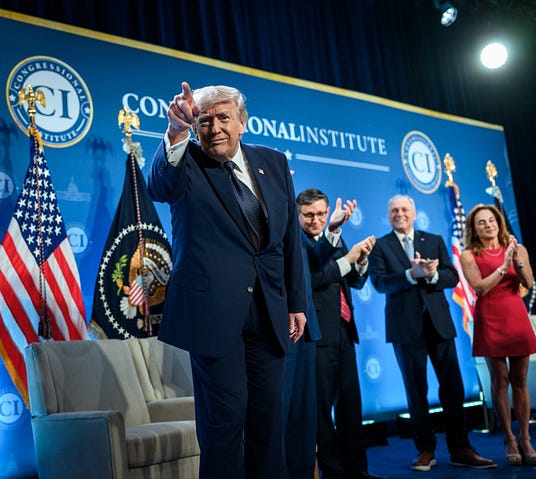
(Credit: Office of Speaker Mike Johnson)
Through Trump’s Iran War, shutdown of the Department of Homeland Security, futile effort to pass a Jim Crow-style voter suppression act (the so-called SAVE Act), and inflation-aggravating tariff scheme, Republicans are discovering they are tied at the hip with Trump. Refusing to deviate from his dictates, they will bear the brunt of his serial failures.
Whether the Iran War ends this month or months from now, Republicans cannot escape responsibility for the massive expenditure of taxpayer dollars, loss of life, rise in energy costs, regional instability, and damage to alliances Trump has wrought. Congressional Republicans refused to invoke the War Powers Act — or even to conduct meaningful oversight hearings — and applauded a senseless, unconstitutional war. Now they seem prepared to rubber-stamp a preposterous demand for $200B more in war spending. Republicans will have no place to hide come November when voters come looking for politicians to blame.
The latest CBS/You Gov poll has nothing but horrendous news for the Iran war cheerleaders: 90 percent say the war will make gas prices higher in the short term, 58 percent over the long term; 63 percent predict it will weaken the economy (a plurality assume we will be in a recession); a plurality of 49 percent think the war makes us less safe; and 57 percent say the war is going badly. Some 62 percent disapprove of how Trump is handling the war. Perhaps Republicans should have fulfilled their constitutional obligations rather than contenting themselves with sitting on the sidelines.
Meanwhile, Trump’s web of lies about immigrants and voting fraud have entangled him and Republicans in a political knot. Trump’s lie about mass voting fraud drove him to insist on the unpassable voter suppression SAVE Act. He then made that a precondition for any deal to resume DHS funding. Even to Republicans, this made no sense.
When Senator John Thune (R-SD) initially recommended that Trump agree to Democrats’ proposal to pass a DHS funding bill that would pay for TSA, FEMA, and the Coast Guard (leaving ICE funding for later negotiations), Trump rebuffed him. By Monday night, however, Trump was considering a deal to do just that, namely to fund the rest of DHS and handle funding for ICE in reconciliation.
What happened between his refusal to relent on funding and his capitulation? Trump trotted out another senseless and entirely performative maneuver: deploying ICE to airports. ICE agents, untrained for any TSA duties, stood around with virtually nothing to do (reminding one of the National Guard deployed to D.C., who largely loiter around metro stations). This underscores Republicans’ responsibility for bollixing up air travel, Trump’s feebleness in resolving messes of his own making, and the dangerous transformation of ICE into a roving street militia Trump deploys to intimidate and harass Americans.
All the ICE/airport stunt accomplished was to trigger a robust blowback from Democrats and civil society groups, demonstrating once again Trump’s talent in supercharging the Resistance. Deploring Trump’s use of ICE as his “personal dystopian police force,” Public Citizen observed: “The confluence of authoritarian overreach of this moment is striking.” The ACLU likewise condemned using ICE at airports “despite their lack of training for airport security and interactions, and their clear track record of abusing their power, including through using excessive force against citizens and immigrants alike.” (Unsurprisingly, this venture, the ACLU noted, was the first time a president “sent armed ICE agents to airports to replace trained security agents and instill fear in families and other travelers.”)
Trump’s compounding calamities have fractured Republicans internally. Cultists demand perfect fidelity to Trump on the war abroad and bullying at home; others fret that a war betrays their America First ideology and the SAVE Act is a legislative cul-de-sac that now compounds the DHS shutdown disaster. (MAGA provocateur Sen. Mike Lee of Utah has become a chief enabler of Trump’s destructive schemes, “sparking a wave of mostly private animosity from GOP colleagues who believe his plan to push through legislation overhauling how federal elections are conducted is ill-conceived and potentially harmful to the party’s chances in the midterms,” Politico reports.)
Republicans fret privately that the Trump reign of chaos, coupled with the highly unpopular war, spells doom for them in November. One is tempted to ask about the private Republican hand-wringing:
What did Republicans think would happen when they fully empowered a delusional narcissist, one who is so clearly ignorant of government and keen to pursue his own wealth and power, the country be damned?
Some dim-witted MAGA Republicans remain true believers and actually think Trump’s antics will pay off. Others know Trump is nuts and recognize the party is headed for disaster, but lack the courage to say so. They are banking that they will survive the blue wave coming in November to fight another day. Their lack of patriotism may be galling, but their self-preservation strategy looks increasingly daft.
The damage Trump and his flunkies have inflicted on our democracy will reverberate for years to come. American families may take years to recover from the economic hits. It is a small consolation that MAGA lawmakers and right-wing media stooges, who have chosen the route of cowardly compliance over constitutional duty and self-serving propaganda over truth-telling, will shoulder much of the blame. History in the long run and voters in the near term will hold Republicans fully accountable for the blunders they countenanced.
The Contrarian is reader-supported. To receive new posts, enable our work, help with litigation, and keep this opposition movement engaged, please join the fight by becoming a paid subscriber.
Thank you for being part of The Contrarian. Share this piece to help spread the word.
The Pitt is an award-winning series on cable about daily life in an emergency room in Pittsburgh. Each episode represents the traumas and rhythm of one hour in one day. It’s gripping and sometimes so gory in its realism that I divert my eyes.
Two articles recently gave the program the highest praise. One, which appeared in Fortune, said that The Pitt exemplifies DEI in action and demonstrates how it saves lives. Patients in extremis often need someone who looks like them to communicate candidly.
But race, color, ethnicity, gender are beside the point. What matters most is saving lives, expressing empathy for people who are in pain and often terrified.
The cast is white, Black, Indian, Hispanic, Filipino, Christian, Jewish, Muslim, male, female, and even includes a staff member in a wheelchair. It is the quintessence of DEI, and none of it is frivolous. It’s just who they are: trained doctors, nurses, psychologists, social workers: people who have chosen to work in a high-pressure emergency room.
As diversity, equity, and inclusion programs are under relentless attack, HBO’s medical drama The Pitt offers a masterclass in what DEI truly looks like when these values are woven into the fabric of an institution and put into practice. And how DEI benefits all of us.
There is nothing artificial about “The Pitt.” It is a gripping drama of everyday life in an urban emergency room.
“It’s an empathy exam. It’s a civics lesson. Above all, it’s a study of people under intense pressure — as they are when a pulse is fading, or when a nation is fraying — and the importance of muddling through and making things better, no matter the odds, no matter the obstacles…”
It makes an argument for diversity that’s smart and true, looking beyond the usual dividing lines — race, religion, gender — to less politically charged differences. A brand-new doctor who grew up on a farm in rural America draws on a sensibility that peers lack. A medical student suggests a way to lessen an uninsured patient’s financial distress that her co-workers didn’t think of. It occurred to her not because she’s Asian American but because she grew up in a family with limited means and daunting medical bills, so she was schooled in impediments and options…
There’s a war in America between erudition and improvisation, science and superstition, head and heart. The Pitt might be expected to come down unconditionally on the side of expertise. But it doesn’t, not exactly. While it routinely and rightly exalts medicine’s wondrous advances, it also suggests that experts can be hidebound, timid. And it understands that the wiring of people and of societies demands room for both proper procedure and imagination.
One of the great things about The Pitt is that the executive producer–Dr. Joe Sachs– is an emergency room doctor who also has a degree in cinema. Every episode is overseen by medical specialists and expert nurses. Every word, every procedure is medically accurate.
The Trump administration began in its earliest days to try to erase what it calls DEI (diversity, equity, and inclusion), which, in practice, means eliminating federal grants that acknowledge the existence of race, ethnicity, or gender, except for straight white men. Straight white women are usually okay, but recognizing the history, struggles and achievements of others is unacceptable in the Age of Trump.
Trump’s concept of “Make America Great Again” apparently means erasing those who deviate from his white straight ideal of the best days of America (think John Wayne).
An Underground Railroad museum in upstate New York alleged in a lawsuit Friday that the Trump administration unlawfully terminated its federal grant on the basis of race, pointing to President Donald Trump’s efforts to dismantle diversity-focused initiatives.
The Underground Railroad Education Center in Albany, New York, alleges that the National Endowment for the Humanities’cancelation of a $250,000 grant amounted to viewpoint and racial discrimination, violating the First and Fifth Amendments, respectively.
The lawsuit, filed in the U.S. District Court for the Northern District of New York, calls for the funds to be reinstated.
The suit cited Trump’s January 2025 executive orderthat required federal agencies to eliminate any operations supporting diversity, equity and inclusion (DEI) initiatives within 60 days. The 40-page brief outlined 1,400 grants that were terminated in early April 2025 “for their conflict with President Trump’s EOs and the new agency priorities adopted in their wake.”
Nina Loewenstein, a lawyer for the museum, told NBC News that there is “just no legitimate basis” for the grant’s cancellation, adding that it is “just explicitly erasing things associated with the Black race.”
Loewenstein and the team of lawyers volunteering on the case through Lawyers for Good Government, an organization that provides free legal services for civil and human rights cases, argued that the Underground Railroad Education Center is just one of thousands of organizations that have been unlawfully targeted by the Trump administration.
An article by Patrick Wintour in The Guardian describes Iranian responses to Trump’s threat to bomb Iran’s power grid unless Iran opens the Strait of Hormuz.
This comment stood out:
One well-known Iranian reformist writer Ahmad Zeidabadi likened what could lie ahead to the post-apocalyptic novel Blindness by José Saramago in which the whole world gradually becomes blind. The normally constrained Zeidabadi described Trump’s attack as “the greatest threat posed against our country or any other country in the world throughout history”.
He said: “If electricity to 90 million people were to stop, homes and streets would be plunged into darkness, the elderly and the disabled would be trapped in residential towers and water, gas, gasoline and diesel would become scarce, followed soon by no food, no hygiene and no transportation.
He went on: “If the people of America or other countries do not stop this savage being, the Middle East will instantly become an unimaginable hell and then a barren and uninhabitable land.” He described Trump as a mad individual who was nonetheless “the main decision-maker of the world’s greatest military power”. The sense that the US is in the grip of a deranged figure is quite common among Iranians.


 Diane Ravitch's blog