Linda Darling-Hammond is a prominent professor at Stanford and president of The Learning Policy Institute. She has been a public school teacher, a researcher, and president of the California State Board of Education. In this essay, she explains why the community school model may be the best path forward for school reform.
She writes:
“Kasserian ingera”—the traditional greeting of Masai warriors—asks: “And how are the children?” It is still a greeting among the Masai, acknowledging the high value they place on their children’s well-being. The traditional answer, “All the children are well,” means that the safety and welfare of the young are protected by their communities.
Unfortunately, in the United States, we know that all of our children are not well. Indeed, by any measure, children and youth in the United States are struggling. The aftermath of the pandemic has brought with it an epidemic of mental health issues, from anxiety and depression to suicidal ideation. A Centers for Disease Control and Prevention report from 2022 found that 44% of adolescents said they felt sad or hopeless most of the time during the spring of 2021, and 20% seriously considered suicide. During that time, 29% had an adult in their household lose a job and 24% went hungry; 55% said they were exposed to harsh verbal or physical treatment at home.
Many report continuing to feel disconnected from school. Among high school students from 95 districts surveyed by Youth Truth in 2021–22, a minority (40%) reported feeling like part of their school community or enjoying coming to school, and just 39% reported having an adult at school they could talk with when they feel “upset, stressed, or having problems.” (See figure below.) These proportions are even lower for students of color, LGBTQ+ students, and students in large schools.
It is in this context that a diverse and growing chorus of educators, students, families, and policymakers are calling for a reimagining of our schools. They are highlighting the need to center relationships, belonging, and community; to create structures and practices to support relevant and engaging learning; and to organize resources, supports, and opportunities in ways that mitigate the pernicious effects of structural racism and decades of disinvestment in low-income communities of color.
As Learning Policy Institute Senior Fellow in Residence Jeannie Oakes noted recently, “We need to have schools really change the way they operate to compensate for deficiencies, not in the kids, but in our social safety net.”
Responding to the uniquely challenging moment we’re in, many districts and states are making big bets on community schools—both to address the tattered social safety net Oakes refers to, as well as to provide a catalyst for the deeper cultural and practice changes needed to better serve students and adults alike.
These initiatives are underway in large urban districts like Albuquerque, Baltimore, Chicago, Los Angeles, New York City, and Oakland, as well as in smaller rural communities in California, Kentucky, New Mexico, New York, and Vermont. A number of states have also established funding and supports for community schools. Maryland established the Concentration of Poverty grant program to provide annual community school personnel grants to eligible schools, along with additional per-pupil grant funding for each eligible student. New York created a community schools set-aside in its school funding formula for high-need districts and funded three regional technical assistance centers for community schools. California, for its part, has leveraged multiyear budget surpluses in 2021 and 2022 to make a historic $4.1 billion investment in planning, implementation, and coordination grants—as well as technical assistance—for the state-funded California Community Schools Partnership Program. This investment is intended to provide sufficient resources for every high-poverty school in California to become a community school within the next 5 to 7 years.
Community schools are a place-based strategy deeply rooted in their local context—the needs, assets, hopes, and dreams of students, families, educators, and community partners. They leverage a complex web of partnerships and relationships, like those at Mendez High School in East Los Angeles, to support and engage students and families. By integrating access to services—from medical care to housing and other supports—and making them available to students and families on school campuses, community schools provide a much-needed alternative to the fragmented and bureaucratic social services gauntlet that families in need are typically required to navigate. As we have seen time and again during the COVID-19 pandemic, these services and supports—provided in the context of trusting and caring relationships—can be life changing and can mean the difference between academic success and struggling students and families.
At Mendez, because of the infrastructure created through its community schools approach, the school and its partners were able to provide vital services to students and families as soon as schools shut down in 2020. A mobile clinic that already served the school began COVID-19 testing for the community; mental health providers already in place conducted regular mental health check-ins with students via devices or at a safe physical distance. Other partners created care packages with food, toilet paper, electronic benefit transfer cards, and other essentials, and teachers organized to provide Wi-Fi hot spots to families before the district had the capacity to do so.
But to achieve the transformation our students need and the times demand, community schools must be about much more than providing an efficient structure for integrated student supports (or wraparound services, as they are sometimes called). Transformation requires that we also address the structural barriers to student well-being and academic success that are encompassed by the other foundational elements of community schools: a culture of belonging, safety, and care; community-connected classroom instruction; expanded and enriched learning opportunities; empowered student and family engagement; and collaborative leadership. Foundational to all of this is a grounding in whole childeducation.
When implemented well, community schools are guided by principles for equitable whole child practices that are grounded in the science of learning and development. This whole child framework is at the center of the community schools initiative in California, where the State Board of Education has thus far approved $1.5 billion in planning and implementation grants from a larger initiative that is intended to reach one third of the state’s schools in high-need communities.
The key elements of a whole child framework should be foundational to our vision of transformational community schools:
Structures and practices to foster positive developmental relationships and ensure that students are known and supported. Examples include looping in the elementary grades, where a teacher stays with the class for more than one year, and utilizing advisory systems in middle and high school, which create small family units that offer personal attention, space for sharing needs and feelings, and family connections that support each student.
Rich learning experiences that support inquiry, motivation, competence, self-efficacy, and self-directed learning.
Integrated student supports that remove academic and non-academic barriers to learning by providing health and social services as needed, tutoring and other academic supports, and a focus on children’s individual talents and needs.
Move at the “Speed of Trust”
Just as we need to rethink how students are engaged and supported in schools, we also need to reimagine adult interactions—among families and educators, as well as among school staff. That means treating families as trusted partners in their students’ well-being and academic success and intentionally supporting their capacity building and leadership development.
As importantly, it also means investing in educators and school staff, so they have the necessary tools, agency, and support—including support for their mental health and emotional well-being—to shift practices in ways that expand the capacities of students and adults alike. This includes enabling new teachers’ success with strong induction and mentoring, while providing leadership opportunities for more experienced teachers. It means providing the collaboration time essential to advancing meaningful and engaging instruction and supporting teacher-led professional development. And, just as with students and families, it means nurturing trust and collaborative leadership among staff and with school and district leaders.
Open the link to read the rest of this article and to see the graphs.
Jan Resseger writes frequently about education in Ohio. Her major concern has always been the common good. She describes the latest state budget as “opportunity hoarding.” It includes a welcome increase for public schools, but an even bigger increase for private schools.
She writes:
This blog has focused recently on the fraught political debate about public school finance as part of Ohio’s budget—passed on June 30 and signed into law on the 4th of July. Two years ago, the Ohio Legislature failed to implement a long-awaited Fair School Funding Plan in a stand-alone law. Although a new formula must be fully enacted for the state to allocate adequate school funding and distribute it equitably, the legislature chose to phase in the formula in three steps—making its full implementation dependent on the will of the legislature across three biennial budgets.
Despite efforts this year by the Ohio Senate to undermine school finance equity, the second step of the Fair School Funding Plan was, thanks to House Speaker Jason Stephens and his coalition, enacted fully in the new budget.
Ohio’s new budget and the political fight that led up to it has epitomized what Princeton University sociologist and acclaimed author of Evicted, Matthew Desmond defines as a fight about “opportunity hoarding.” Desmond devotes a chapter of his new book, Poverty, by America, to “How We Buy Opportunity”:
“Among advanced democracies, America stands out for its embrace of class extremities… What happens to a country when fortunes diverge so sharply, when millions of poor people live alongside millions of rich ones? In a country with such vast inequality, the poor increasingly come to depend on public services and the rich increasingly seek to divest from them. This leads to ‘private opulence and public squalor’…. As our incomes have grown, we’ve chosen to spend more on personal consumption and less on public works. Our vacations are more lavish, but school teachers must now buy their own school supplies. We put more money into savings to fuel intergenerational wealth creation but collectively spend less on expanding opportunity to all children… By 2021, government spending on all public goods… made up just 17.6 percent of GDP… Equal opportunity is possible only if everyone can access childcare centers, good schools, and safe neighborhoods—all of which serve as engines of social mobility… Opportunity can be hoarded… not only by abandoning public goods for private ones, but also by leveraging individual fortunes to acquire access to exclusive public goods, (like) buying yourself into an upscale community.” (Poverty, by America, pp. 106-112)
Policy Matters Ohio’s press release about the new Ohio budget might have been copied right out of Desmond’s chapter on opportunity hoarding: “Years of underfunding in our public sector have taken a toll which has been compounded by stagnant wages for many workers… Ohio tax revenues consistently beat estimates, in large part due to rising incomes spurred by federal support for COVID recovery, and a tight labor market. Instead of putting those dollars to work strengthening programs that ensure Ohioans share in the prosperity they help create, lawmakers once again prioritized giveaways to private interests, as well as tax cuts for the wealthy and big business.”
Policy Matters Ohio summarizes some of the details: “The operating budget includes a $1-billion-per-year income-tax cut that disproportionately benefits the wealthy, does nothing for Ohioans in the lowest-income 20%, and temporarily increases taxes for some middle-income households. According to modeling provided by the Institute on Taxation and Economic Policy… 85.4% of the value of this billion-dollar cut will go to the richest 20% in Ohio… The budget also reduces the state’s main business tax, the Commercial Activity tax… The governor signed off on a $2-billion giveaway to private schools through voucher expansion… Kids will have continuous Medicaid coverage through age 3, greatly reducing gaps in care and supporting healthy kids and babies. However, the conference committee removed provisions that would have extended health insurance coverage for kids and pregnant people to those with incomes up to 300% of poverty…. The bill that made it to Governor DeWine’s desk raised wages for the direct care workforce to $18 over the biennium. The mandate was removed by the governor and replaced with only a promise to work toward implementing an increase. Child care workers did not even receive that… The elements of this budget that benefit the majority of Ohioans pale in comparison to the great need.”
Likewise, the private school tuition voucher expansion shifts the entitlement to wealthy families. Making students in families with income at 450% of the federal poverty level ($135,000) eligible for a full voucher, and students in families with even higher incomes eligible for a 50% or 25% or a minimal 10% voucher as family income gets higher—only exacerbates a current trend that tilts Ohio voucher use to middle and upper income families. These are families who were previously ineligible because their incomes are too high.
Please open the link to read the rest of her post.
Peter Greene discovered that Ryan Walters, the State Superintendent of Education in Oklahoma, attempted to define “Woke” on a far-right website. WOKE is one of those new terms of opprobrium, like “critical race theory,” that Republicans despise but can’t define. Peter eagerly read Walters’ effort to defund Woke, but came away disappointed. It seems that Woke is whatever you don’t like. You may have seen the stories recently about Walters insisting that the Tulsa race massacre of 2021 had nothing to do with skin color, although as the Daily Beast reported, “white mobs killed as many as 300 Black residents and burned some 1,600 homes and businesses in what was known as Black Wall Street.”
Peter Greene writes:
Oklahoma’s head education honcho decided to pop up in The Daily Caller (hyperpartisan and wide variation in reliability onthe media bias chart) with his own take on the Big Question–what the heck does “woke” mean? (I’ll link here, because anyone who wants to should be able to check my work, but I don’t recommend clicking through).
Walters tries to lay out the premise and the problem:
Inherent to the nature of having a language is that the words within it have to mean something. If they do not, then they are just noises thrown into a conversation without any hope of leading it anywhere. And when the meaning is fuzzy, it becomes necessary to define the terms of discussion. To wit, the word “woke” has gained a lot of popularity among those of us who want to restore American education back to its foundations and reclaim it from the radical left.
I’m a retired English teacher and I generally avoid being That Guy, particularly since this blog contains roughly sixty gabillion examples of my typo issues, but if your whole premise is that you are all for precise language, maybe skip the “to wit” and remember that “restore back” is more clearly “restore.”
But he’s right. The term “woke” does often seem like mouth noises being thrown into conversations like tiny little bombs meant to scare audiences into running to the right. However, “restore American education back to its foundation” is doing a hell of empty noising as well. Which foundation is that? The foundation of Don’t Teach Black Folks How To Read? The foundation of Nobody Needs To Stay In School Past Eighth Grade? Anyone who wants to talk about a return to some Golden Age of US Education needs to get specific about A) when they think that was and B) what was so golden about it.
But since he doesn’t. Walters is also making mouth noises when he points the finger at “opponents of this movement.” If we don’t know what the movement is, we don’t know exactly what its opposition is, either. Just, you know, those wokes over there. But let’s press on:
Knowing that many such complaints are made in completely bad faith because they do not want us to succeed, it would still be beneficial to provide some clarity as to what it means and — in the process — illustrate both the current pitiful state of American education and what we as parents, educators, and citizens can do about it.
Personally, I find it beneficial to assume that people who disagree with me do so sincerely and in good faith until they convince me otherwise. And I believe that lots of folks out on the christianist nationalist right really do think they’re terribly oppressed and that they are surrounded by evil and/or stupid people Out To Get Them. It’s a stance that justifies a lot of crappy behavior (can probably make you think that it’s okay to commandeer government funds and sneakily redirect them to the Right People).
But I agree that it would be beneficial for someone in the Woke Panic crowd to explain what “woke” actually means. Will Walters be that person? Well….
In recent years, liberal elites from government officials to union bosses to big businesses have worked to co-opt concepts like justice and morality for their own agendas that are contrary to our founding principles and our way of life.
I don’t even know how one co-opts a concept like justice or morality, but maybe if he explains what agenda he’s talking about and how, exactly, they are contrary to founding principles or our way of life, whatever that is.
But he’s not going to do that. He’s going to follow that sentence with another that says the same thing with the same degree of vaguery, then point out that “naturally, this faction of individuals” is after schools to spread their “radical propaganda.” Still no definition of woke in sight. No–wait. This next start looks promising–
Put simply, “woke” education is the forced projection of inaccurately-held, anti-education values onto our students. Further, to go after wokeness in education means that we are going after the forced indoctrination of our students and our school systems as a whole.
Nope. That’s not helping, either. “Projection” is an odd choice–when I project an image onto a screen, the screen doesn’t change. There’s “projection” when I see in someone else what is really going on in me, which might have some application here (“I assume that everyone else also wants to indoctrinate students into one preferred way of seeing the world”) but that’s probably not what he has in mind. I have no idea how one “forces” projection. “Inaccurately-held” is also a puzzler. The values are accurate, but they’re being held the wrong way? What does this construction get us that a simple “inaccurate” would not? And does Walters really believe that schools are rife with people who are “anti-education,” because that makes me imagine teachers simply refusing to teach and giving nap time all day every day, except for pauses to explain to students that learning things is bad. I suspect “education” means something specific to him, and this piece (aimed at a hyperpartisan audience) does seem to assume a lot of “nudge nudge wink wink we real Americans know what this word really means” which would be fine if the whole premise was not that he was going to explain what certain words actually mean.
A blog reader who identifies as “Democracy” argues that today’s Republican Party, which prizes individualism over the common good has abandoned the vision of the Founding Fathers.
It appears that Ron DeSantis and the entirety of the Republican Party is in direct opposition to American history and the United States Constitution.
The Founders envisioned a democratic society “in which the common good was the chief end of government.” They agreed with John Locke’s view that the main purpose of government –– the main reason people create government –– is to protect their persons through –– as historian R. Freeman Butts put it –– a social contract that placed “the public good above private desires.” The goal was “a commonwealth, a democratic corporate society in which the common good was the chief end of government.”
The Preamble – the stated purposes – of the Constitution, reads
“We the People of the United States, in Order to form a more perfect Union, establish Justice, insure domestic Tranquility, provide for the common defense, promote the general Welfare, and secure the Blessings of Liberty to ourselves and our Posterity, do ordain and establish this Constitution for the United States of America.”
In Article I, Section 8 of that document, the legislative branch is given broad, specific powers (among them taxing, borrowing money, regulating commerce, coining money and regulating its value, etc.). Indeed, Article I, Clause 1 gives Congress the power to tax for “the common defence and general Welfare of the United States.” Clause 18 of Section 8 stipulates that Congress had the power “To make all Laws which shall be necessary and proper for carrying into Execution the foregoing Powers.”
Two Supreme Court decisions early in the republic’s history –– both unanimous –– supported and cemented a broad – liberal – interpretation of the implied powers of Congress.
Republicans call them “socialism.”
In 1819 (McCullough v. Maryland) the Supreme Court reaffirmed that the U.S. government was “a Government of the people. In form and in substance, it emanates from them. Its powers are granted by them, and are to be exercised directly on them, and for their benefit.”
The Court explicitly reaffirmed that one of the critical purposes of government under the U.S. Constitution is to promote the general welfare “of the people.”
In that case, Chief Justice Marshall wrote this about the necessary and proper clause:
“the clause is placed among the powers of Congress, not among the limitations on those powers.” And he added this: “Its terms purport to enlarge, not to diminish, the powers vested in the Government. It purports to be an additional power, not a restriction.”
In Gibbons v. Ogden (1824) Chief Justice Marshall wrote this about the Congressional commerce power:
“This power, like all others vested in Congress, is complete in itself, may be exercised to its utmost extent, and acknowledges no limitations other than are prescribed in the Constitution.”
The history of the United States, and the Constitution, over time, reflect progressive changes. The American Revolution was a progressive movement inspired by the ideas of Enlightenment thinkers; conservatives opposed it. The early expansion of voting rights to those who didn’t own land was progressive, and conservatives of the day fought against it. The purchase of the Louisiana Territory, a purchase that doubled the size of the fledgling United States, rested on a liberal interpretation of constitutional authority. U.S. government funding of roads and canals relied on a liberal perspective of Congressional commerce power. Those roads and canals were instrumental to economic growth and prosperity, not unlike federal funding of interstate highways, the Internet, medical research, and health care.
And yet, the Republican Party is filled with people who basically reject all of this in favor of sedition.
As David Blight, Yale professor of American history put it,
“Changing demographics and 15 million new voters drawn into the electorate by Obama in 2008 have scared Republicans—now largely the white people’s party—into fearing for their existence. With voter ID laws, reduced polling places and days, voter roll purges, restrictions on mail-in voting, an evisceration of the Voting Rights Act of 1965, and a constant rant about ‘voter fraud’ without evidence, Republicans have soiled our electoral system with undemocratic skullduggery…The Republican Party has become a new kind of Confederacy.
Obviously, public education has a central – critical – role to play here. Here’s how Will and Ariel Durant explained it in ‘The Lessons of History’ (1968):
“Civilization is not inherited; it has to be learned and earned by each generation anew; if the transmission should be interrupted for one century, civilization would die, and we should be savages again.”
Michigan is in track to make record investments in the quality of life for children and schools.
My friend Mitchell Robinson, a member of the State board of education, shared the following good news:
The State of Michigan passed a third consecutive historic education budget last night—and did so with bipartisan support, meaning the changes included in this budget can go into effect immediately.
It’s amazing to see what a state education budget can look like when you have pro-education legislators in charge–and teachers chairing the House and Senate Education Committees and the Senate Appropriations Subcommittee on PreK-12.
The budget includes:
•universal school meals
•foundation allowance increase of 5% — the largest in state history
•fully funded special education programs
•expanded Pre-K programs
•student teacher stipends for K-12
The budget also appropriates $11 million to a K-5 Music Education Pilot Program that provides funding to school districts that currently do not have elementary music instruction to hire certified music teachers.
Budgets are about more than dollars—they are moral documents; and in Michigan we are showing that we value our children, our families, and our future by directing funding to programs and initiatives that strengthen our schools and communities.
If you read only one article today, read this one. It’s powerful and poignant. The article was written by Forrest Wilder and appears in the Texas Monthly, a terrific publication.
To understand why Republican legislators from rural districts helped to defeat vouchers in Texas, read this article about the schools of Fort Davis in Jeff Davis County in rural West Texas. The superintendent is a bedrock conservative who is dead set against vouchers. His schools are on the verge of bankruptcy due to the state’s Byzantine school-finance system. The state government doesn’t care. At the end, you will understand Governor Abbott’s long-term goal: to eliminate property taxes and completely privatize education.
Texas doesn’t have a mile-high city, but Fort Davis comes close at 4,892 feet. The tiny unincorporated town is nestled in the foothills of the Davis Mountains, where bears and mountain lions and elk stalk among pine-forested sky islands. Fort Davis is the seat of Jeff Davis County, whose population of 1,900 is spread among 2,265 square miles, 50 percent bigger than Rhode Island. The sparsely populated desert country of Mongolia has nearly seven times the population density of Jeff Davis County. Odessa, the nearest city to Fort Davis, is two and a half hours away. The state Capitol is six and a half.
For Graydon Hicks III, the far-flunged-ness of Fort Davis is part of its appeal. He likes the high and lonesome feel of his hometown—the “prettiest in Texas,” he says. But these days, it has never felt further from the state’s political center of gravity.
For years, Hicks, the superintendent of Fort Davis ISD, has been watching, helplessly, as a slow-motion disaster has unfolded, the result of a flawed and resource-starved public-school finance system. Over the last decade, funding for his little district, which serves just 184 K–12 students, has sagged even as costs, driven by inflation and ever-increasing state mandates, have soared. The math is stark. His austere budget has hovered around $3.1 million a year for the past six years. But the state’s notoriously complex school finance system only allows him to bring in about $2.5 million a year through property taxes.
Hicks has hacked away at all but the most essential elements of his budget. More than three-quarters of Fort Davis’s costs come in the form of payroll, and the starting salary for teachers is the state minimum, just $33,660 a year. There are no signing bonuses or stipends for additional teacher certifications. Fort Davis has no art teacher. No cafeteria. No librarian. No bus routes. The track team doesn’t have a track to train on.
But Hicks can’t cut his way out of this financial crisis. This school year, Fort Davis ISD has a $622,000 funding gap. To make up the difference, Hicks is tapping into savings. Doug Karr, a Lubbock school-finance consultant who reviewed the district’s finances, said Fort Davis ISD was “wore down to the nub and the nub’s all gone. And that pretty much describes small school districts.”
“I am squeezing every nickel and dime out of every budget item,” Hicks said. “I don’t have excess of anything.” When I joked that it sounded like he was holding things together with duct tape and baling wire, he didn’t laugh. He said: “I literally have baling wire holding some fences up, holding some doors up.”
The district’s crisis comes at a time when the state is flush with an unprecedented $33 billion budget surplus. Hicks is a self-described conservative, but he thinks the far right is trying to destroy public education. For years, the state has starved public schools of funding: Texas ranks forty-second in per-pupil spending. And yet Governor Greg Abbott is spending enormous political capital on promoting a school voucher plan, which would divert taxpayer funds to private schools. Public education, Abbott has repeatedly said, will remain “fully funded,” though public-education spending is lower now than when he took office in 2015, and the Legislature recently passed a $321.3 billion budget with no pay raise for teachers and very little new funding for schools. Unable to get his voucher plan through the regular legislative session, Abbott is threatening to call lawmakers back to Austin until he gets his way.
Lieutenant Governor Dan Patrick, long a champion of vouchers, is backing legislation that would attempt to appease rural Republican legislators—a bloc long wary of vouchers—by offering $10,000 to districts that lose students to private schools. Hicks can barely contain his anger when he hears such talk. He has been lobbying state leaders for years to fix the crippling financial shortages that plague districts like his. “Take your assurances and shove ’em up your ass,” he says, before softening a bit. “I’m so tired. I’m so frustrated. We have tried. I have fought and fought and fought.”
With each passing month, his rural district inches closer to financial ruin. If nothing changes by next summer or fall, Fort Davis will have depleted its savings. He doesn’t know the exact day that his school district will go broke, but he can see it coming.
It’s easy enough to grasp the basic problem in Fort Davis. But what’s going on beneath the surface is another story.
During my twenty years of reporting on Texas politics, I’ve often heard that only a handful of people in the state understand the school-finance system, with its complicated formulas, allotments, maximum compressed tax rates, guaranteed yields, and “golden pennies.” A former colleague of mine, who once spent months trying to make sense of the topic, warned me against writing about it. Karr, the school finance consultant, compares the process of making sense of our public education funding to encountering a fire at a roadside cotton gin on some lonely West Texas highway. “You drive off into that smoke and you might never drive out,” he said. “You might end up getting killed.”
A thorough explanation of the system is the stuff of graduate theses, but the broad strokes are straightforward enough. How a school district is funded begins with two key questions: How much money is the district eligible for? And who pays for it?
Here it’s helpful to use a venerable school finance analogy: buckets of water. The size of a school district’s bucket—how much money it’s entitled to—is largely determined by the number of students in attendance. Every district receives at least $6,160 per pupil, an amount known as the basic allotment, an arbitrary number dreamed up by the Legislature and changed according to lawmakers’ whims.
At this point in the article, Wilder goes into the intricacies of school finance in Texas. Very few people understand it. All you need to know is that some districts are lavishly funded while others, like Fort Davis, are barely scraping by and may go bankrupt.
Hicks is not alone in thinking the opaqueness is intentional. “They make it just as complicated as they can,” he said of state officials. “Because how do you explain something so complicated to the average voter?” In other words, if constituents can’t easily grasp the perplexing and unnecessarily knotty framework, it’s tougher to hold officials accountable for budget decisions.
Though the spreadsheets may be head-spinning, they tell a story. In a state where some wealthy suburban communities build $80 million high school football stadiums, Fort Davis ISD is one of many rural communities literally struggling to keep the lights on.
I first heard from Hicks in March 2021, when he emailed state officials and journalists with a dire message: “What, exactly, does the state expect us to do? What more can we do? What more do our children need to be deprived of? At what point does our community break?” Hicks has received few answers, even as his situation has grown more desperate.
When I visited him in April, we met in his office, where he keeps a book on Texas gun laws, a photo of his West Point 1986 graduating class (which included Donald Trump’s secretary of state Mike Pompeo), and a list of quotes from General George Patton (“Genius comes from the ability to pay attention to the smallest details”). Hicks, who’s stout and serious and talks in a sort of shout-twang because of partial hearing loss, wore a cross decorated in the colors of the American flag. He was eager to show me the fine line he walks between fiscal prudence and dilapidation. The first lesson came as he stood from his desk and I noticed the holstered handgun on his hip. The district, he explained, can’t afford to hire a school security officer, so he and eleven other district employees carry firearms.
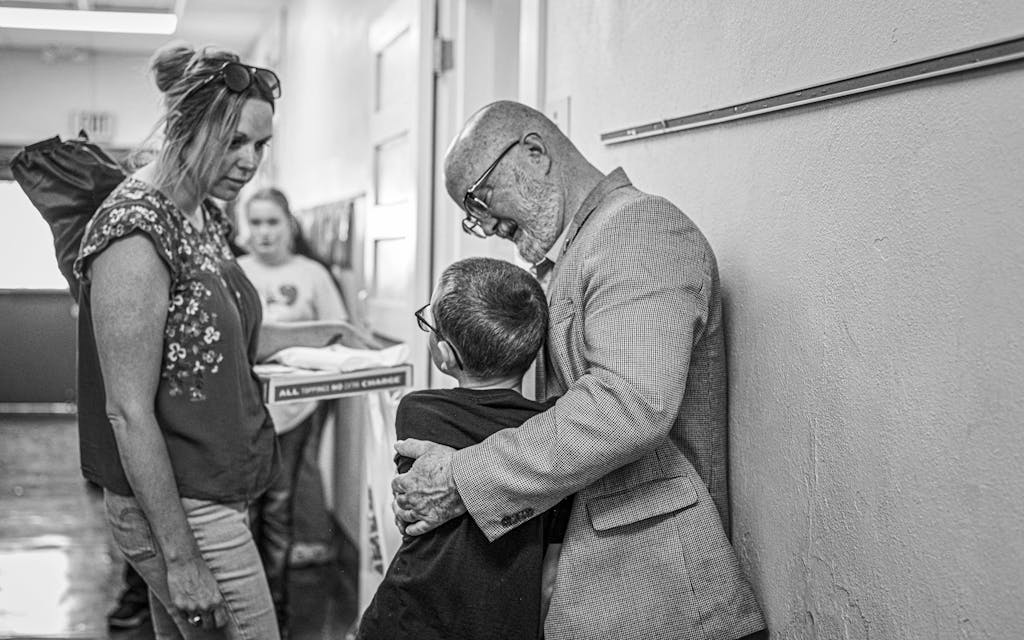
His family has been in the area since the 1870s, when federal soldiers still pursued Comanche and Apache from the town’s namesake garrison. His great uncle was one of the first superintendents of Fort Davis ISD. (At one point, Hicks showed me a copy of his great-uncle’s 1942 master’s thesis, “The Early Ranch Schools of the Fort Davis Area.”) Later, as we were walking around campus, Hicks’s ten-year-old grandson, a thin fourth-grader wearing blue-rimmed glasses and blue jeans tucked into a pair of cowboy boots, ran up to Hicks and gave him a hug.
Superintendent Hicks hugs his grandson in the hallway at Dirks-Anderson Elementary School in Fort Davis.Photograph by Maisie Crow
Both the elementary school and the high school—where Hicks graduated in 1982—were built in 1929, Hicks explained. Walking through their timeworn hallways is to step back in time. In places, the plaster is flaking off the original adobe walls. The elementary school gym floor is bubbling up because of a leak under the foundation. The wooden seats in the high school auditorium have never been replaced. The urinals in the elementary school are original too. The newest instructional facility, a science lab, was built in 1973. In the summer, Hicks mows the football field, the same one he played on five decades ago. “Every bit helps,” he said.
The funding challenges create all manner of ripple effects. Hicks has trouble recruiting and retaining teachers, and some students drift away from school without extracurriculars to hold their interest. “You lose teachers, then you start losing kids, and then your funding gets worse,” he said. “It’s a circle-the-drain kinda thing. And it’s really speeding up for Fort Davis.”
The first problem is the size of the district’s bucket. For the last decade, TEA has calculated that Fort Davis’s Tier I annual allotment is between $2 million and $2.5 million, well short of its already spartan $3.1 million budget.
And then there’s the matter of how that bucket is filled. In the 2011–2012 school year, the state covered two-thirds of Fort Davis’ entitlement, about $2.1 million. Today, it chips in about $150,000, a 93 percent decrease. How to explain that change?…
In June 2019, the Big Three figures in state government—Abbott, Patrick, and then–House Speaker Dennis Bonnen—gathered at an elementary school in Austin for an almost giddy bill-signing ceremony. As a bipartisan group of lawmakers watched, Abbott signed into law House Bill 3, an $11.6 billion package of property tax cuts and education funding that had received near-unanimous support in both the House and Senate, a rarity in the highly polarized Legislature. “This one law does more to advance education in the state of Texas than any law that I have seen in my adult lifetime,” said Abbott.
For almost a year, an appointed commission of experts had met to discuss how to overhaul the school-finance system, issuing a report in December 2018 that called on the Lege to “redesign the entirety of our state’s funding system to reflect the needs of the 21st century.” HB 3 was the by-product of that prompt. Lawmakers rejiggered many of the system’s outdated formulas, offered pay raises to teachers, fixed some of the most glaring inequities, and reduced the amount of money recaptured by the state from property-wealthy districts. Most important, HB 3 represented a much-needed infusion of cash for struggling schools. The basic allotment was raised from $5,140 to $6,120 per student.
But HB 3 also exacerbated disparities among property-wealthy and property-poor districts. Because of changes to the way Tier II enrichment funding works, some communities were able to cut tax rates and generate significant new revenues from their tax base. For others, a minority of districts, HB 3 actually created new problems. Around 10 percent of districts saw a decrease in formula funding. This year, Alpine has $220,000 less than it would have had under the old system, even as some of the richest districts in the state—tiny West Texas communities with lots of oil wealth—saw their funding explode. Rinehart contrasts Alpine, which has almost no mineral wealth, with Rankin ISD, 130 miles northeast in the Permian Basin oil patch. While Alpine’s funding went down 2 percent, Rankin’s went up 339 percent. Even though Rankin is projected to return close to $100 million in recapture payments to the state this year, the district is fabulously wealthy. “Alpine’s budget is $10 million,” Rinehart points out. “Rankin’s is $14 million. We educate a thousand kids and they educate three hundred kids. So they are a third of our size and have a budget 40 percent larger than ours.”
Rinehart doesn’t begrudge Rankin’s wealth—she recently served as assistant superintendent there—but uses the Alpine–Rankin comparison as a “wild” example of how HB 3 exacerbated inequities, making the rich richer and the poor poorer.
Hicks, too, has noticed. “Rankin just built a whole new school,” he told me. “They got a new fieldhouse, a new gym. Two new science labs. A turf practice field, a turf game field. A new track, a new stadium. And my buildings were built in 1929.” Rankin is planning to build ten new “teacherages”—district-funded housing for teachers, important to attracting and retaining talent in areas with scant or affordable residences.
Jeff Davis County, on the other hand, has no oil and gas and very little industry; any school debt would thus be borne by homeowners through bonds. Hicks’s district has never issued a bond, in part because it would be unlikely to pass; the voters wouldn’t support a tax increase. The school’s ag barn was built in 2019 with local donations. The band program, suspended for nine years as a cost-saving measure, was only revived in 2023 after a philanthropist left his estate to the school.
To be sure, Alpine and Fort Davis are outliers. Most districts saw an immediate boost to their finances from HB 3, and advocates celebrated a meaningful investment in public education after $5.4 billion in devastating cuts in 2013. But even for those districts, the sugar rush from HB 3 didn’t last long. According to Chandra Villanueva, the director of policy and advocacy at the progressive nonprofit Every Texan, the $1,000 increase in the basic allotment was “roughly enough to cover one year of inflation….”
The property tax system and the school finance system are inextricably linked, Rube Goldberg–style. Twist a dial here and a light will come on over there. Slip a gear here and spring a leak there. As state lawmakers have prioritized tax cuts over public education funding, the trade-offs have grown clearer. This year represents a potential turning point. But rather than trying to solve the problem using the $33 billion budget surplus—a generational bonanza—Abbott and Patrick have overwhelmingly focused their attention on property tax cuts and a school-voucher plan loathed by almost everyone in public education, in part because it would threaten to strip even more funding from school districts.
The just-completed regular session was a bloodbath. The 88th Legislature began in January with the governor and lieutenant governor promising to pass a transformative voucher program and a record-setting $17 billion in property-tax cuts. Funding for public education, often a banner issue, was scarcely discussed. Even the House, the friendlier chamber toward public education, only proposed raising the basic allotment by $140, from $6,160 to $6,300 per student—far less than the $1,500 increase needed to keep up with inflation since 2019, according to the Texas American Federation of Teachers. But in the end, teachers and public schools got virtually nothing.
Teachers and administrators were stunned. Zeph Capo, the president of Texas AFT, called it a “joke.” HD Chambers, the executive director of the Texas School Alliance, accused Patrick and Abbott of playing a “hostage game” with Texas’s teachers and public school students by tying education funding to vouchers. “It’s pretty simple. The governor and Senate says, ‘If you don’t give us the kind of vouchers we want, we’re not giving you any money.’” The House refused to budge, and the regular session concluded without a deal on property tax relief, vouchers, and other GOP priorities.
Now, the governor has promised to convene multiple special sessions to take up the unresolved issues. The first special session began three hours after the regular one ended, and effectively wrapped up less than 24 hours later, with the House rejecting the Senate property-tax plan, passing its own program consisting solely of property-tax compression, and then abruptly adjourning. Abbott threw his support behind the House plan. The message to the Senate was clear: take it or leave it. If the Senate yields, the House version would push some school districts down to as low as $0.60 per $100, with no new source of revenue to backfill for the reduced funding in case of a bad economy.
Abbott has said his goal is to completely eliminate the main school property tax. In such a scenario, Texas’s thousand-plus school districts would be at the mercy of the Legislature for funding—a troubling scenario, says Villanueva. She suspects vouchers would then become inevitable. “At that point, it’s like, ‘You know what, we don’t have the money to fund schools. Everyone take five thousand bucks, figure it out for yourselves.’”
That day, if it ever comes, may still be far off. But the education system is in crisis right now, and unlike previous hard times, the state is flush with cash. The pain, Chambers says, is being intentionally inflicted by Abbott and Patrick. “Because of this one pet project that the governor has”—vouchers—“they are purposely creating a financial environment where every school district in Texas is being set up to fail.”
The result is that Texas schools, already operating on “shoestring budgets,” will have a harder time attracting and retaining educators, said Josh Sanderson, the deputy executive director of the Equity Center, a nonprofit that represents six hundred Texas school districts. They will run up deficits. They may have to cut extracurriculars and athletic programs. Some, like Fort Davis, may become insolvent and be forced to consolidate with another district, an often painful process.
As we were sitting in his red pickup with the engine idling outside his office, Hicks told me that he’d given up on lobbying the Legislature. He mentioned again that Patrick and other GOP lawmakers are trying to destroy public education by using vouchers to privatize schools, and he said that most other politicians “don’t give a shit about West Texas.” But for the time being he was still fighting: writing op-eds, firing off plaintive missives, asking concerned citizens to contact their legislators.
Toward the end of our visit, I asked Hicks what’s going to happen to his schools. “I don’t know,” he said. “I’m not patient enough to spend time with assholes in Austin, and I’m not rich enough to buy any votes.” TEA has suggested consolidating with another district—most likely nearby Valentine ISD—but Hicks said this would harm both Fort Davis and the other district.
He seemed resigned to his role as a Cassandra warning of impending doom, destined to be ignored. He reminded me that his grandson goes to school here, and that the painful road ahead feels both personal and existential. “If you don’t have a school,” he said, “you don’t have a community.”
Two months later, Hicks called me with some news. He’d decided to resign this summer, joining the mass exodus of school leaders that have fled the profession in the past few years. To anyone who closely follows public education in Texas, his reasoning was tragically familiar: He said he was too tired to fight anymore.
Harold Meyerson of The American Prospectwrites here about the sharp divergence between red states and blue states. Their elected officials have very different ideas about how to build their state and serve the needs of the public. There is one issue that he overlooked: vouchers. Red states are busy handing out tax dollars to families whose children are already enrolled in private and religious schools and tearing down the wall of separation between church and state.
Which side are you on?
He writes:
Two Prospect pieces on red and blue trifecta states make clear we really are two separate nations.
If there’s anyone who’s still mystified about why congressional Democrats and Republicans can’t come to an agreement on anything so basic as honoring the debts they’ve incurred, may I gently suggest they take a look at what Democrats and Republicans are doing in the particular states they each completely control.
Yesterday, we posted a piece by my colleague Ryan Cooper on how Minnesota, where Democrats now control both houses of the legislature and the governor’s office, has just enacted its own (to be sure, scaled-back) version of Scandinavian social democracy—including paid sick leave for all, paid family leave, a minimum wage for Uber and Lyft drivers, sector-wide collective bargaining in key industries, and the outlawing of “captive audience” meetings, in which management compels employees to attend anti-union rants. A new law also strengthens women’s right to an abortion. Similar laws have been enacted or are under consideration in other Democratic “trifecta” states, though none quite so pro-worker as some of Minnesota’s.
Also yesterday, we posted one of my pieces, this one on everything that Texas’s Republican legislature and governor are enacting to strip power from their large cities, almost all of which are solidly Democratic. One new bill says the state can declare elections to be invalid and compel new ones to be held under state supervision in the state’s largest county, Harris County, which is home to reliably Democratic Houston. And the state Senate has also passed a bill that would strip from cities the ability to pass any regulations on wages, workplace safety, business and financial practices, the environment, and the extent of property rights that exceed the standards set by the state. Which leaves cities with the power to do essentially nothing. No other Republican trifecta states have gone quite as far as Texas, but Tennessee’s legislature did effectively abolish Nashville’s congressional district and expel its assemblymember; Alabama’s legislature revoked Birmingham’s minimum-wage law; and Florida’s governor suspended Tampa’s elected DA because he wouldn’t prosecute women and doctors for violating the state’s new anti-abortion statutes. Beyond their war on cities, Republican trifecta states have long refused to expand Medicaid coverage, have recently also begun to re-legalize child labor and legislate prison terms for librarians whose shelves hold banned books, and in the wake of the Dobbsdecision, criminalized abortions.
Just as cosmic inflation propels the stars away from each other with ever-expanding speed, so Democratic and Republican states are also moving away from each other at an accelerating pace—the Democrats toward a more humane future; the Republicans borne back ceaselessly into a nightmare version of the past. Any dispassionate view of America today has to conclude that the differences between these two Americas are almost as large and intractable as those that split the nation in 1860 and ’61. (The South’s opposition to fairly paid and nondiscriminatory labor was the central issue then and remains a central issue now.)
That said, when confronted with the choice between those two Americas, voters in those red states have frequently backed the blue-state versions of economic rights and personal freedoms, as is clear from their many initiative and referendum votes to raise the minimum wage, expand Medicaid, and preserve the right to an abortion. Likewise, the polling on unions shows their national favorability rating now exceeds 70 percent of the public, including roughly half of self-declared Republicans. Only by their relentless demagoguery on culture-war issues and immigration, their adept gerrymandering, and the disproportionate power that the composition of the Senate vests in barely inhabited states can the Republicans enforce their biases against a rising public tide—but enforce them they do wherever they have the power.
All right, as John Dos Passos wrote in his USA Trilogy, we are two nations—and becoming more so with each passing day.
Postscript: In his Washington Post column…, Perry Bacon noted that while a number of news publications have gone under recently, a few, in his words, “are reimagining political journalism in smart ways.” He cited seven such publications, and his list was headed by—ahem—The American Prospect.
The New York Times reported on the annual competition for admission to New York City’s most selective high schools, where about 26,000 eighth-grade students competed for some 4,000 openings. Admission is based on a single standardized test, offered only once. Although two-thirds of the city’s students are Black or Latino, about 10% of offers went to students from these groups. More than half the acceptance offers (53%) went to Asian-American students.
Admission to the selective high schools is considered a ticket to the best colleges (but students have to work hard in high school to earn that ticket).
It should be noted that New York City has dozens of excellent high schools that do not require students to take the Specialized High School Admissions Test that is required by the elite high schools.
Former Mayor Bill de Blasio tried to change the admissions criteria to increase the proportion of Black and Latino students to 40%, but any change in the testing requirement must be approved by the State Legislature. That body includes graduates of the elite schools, who protect the status quo. Also, Asian-Americans fiercely oppose any change in the admissions process. All proposals for change have failed.
At Stuyvesant High School in Manhattan, the most selective of the city’s so-called specialized schools, seven of the 762 offers made went to Black students, down from 11 last year and eight in 2021. Twenty Latino students were offered spots at Stuyvesant, as were 489 Asian students and 158 white students. The rest went to multiracial students and students whose race was unknown.
Gaps at many of the other schools were also stark: Out of 287 offers made at Staten Island Technical High School, for example, two Black students were accepted — up from zero last year — along with seven Latino students….
The schools also represent perhaps the highest-profile symbol of segregation across the system, where over the last decade, Black and Latino students have never received more than 12 percent of offers.
Decades ago, the specialized schools tended to serve much larger proportions of Black and Latino students. And a handful of elite schools, like the Brooklyn Latin School — where 73 Black and Latino teenagers were accepted in a class of 388 this year — are somewhat more reflective of the city’s demographics….
The Adams administration has not made school integration a top priority, quieting the public and political attention on the issue after years of intense fights.
The system’s chancellor, David C. Banks, has argued that many Black and Latino families care more about school quality than who their children’s classmates are.
This may be the best article about education that you will read all year. It is as good an explanation as you will find of “the Finnish miracle.”
As Chaltain explains, the success of the schools is only one part of the picture. For the sixth year in a row, Finland has been named “the happiest country in the world,” based on these metrics: “healthy life expectancy, GDP per capita, social support, low corruption, generosity in a community where people look after each other and freedom to make key life decisions.”
The secret to happiness: “Taking a holistic view of the well-being of all the components of a society and its members makes for better life evaluations and happier countries.”
Sam Chaltain writes:
I spent last week in Finland, the small Scandinavian country that, for educators, has become a Mecca of sorts. And while I was there, a surprising thing happened:
I came for the schools.
I stayed for the library.
It’s hard not to be aware of the schools, which have experienced a dramatic metamorphosis over the past half-century.
For much of the early 20th century, Finland was agrarian and underdeveloped, with a GDP per capita trailing other Nordic countries by 30 to 40 percent in 1900. But in 1917, Finland declared its independence from Russia, and insisted that women be heavily represented in its first parliament.
As a result, the new nation prioritized a whole slate of policies that have helped support the development over time of a society that values and protects children. Free preschool programs enroll 98 percent of children in the country. Compulsory education begins at the age of seven, and after nine years of comprehensive schooling, during which there is no tracking by ability, students choose whether to enroll in an academic or a vocational high school. The graduation rate is nearly 95 percent.
Finland’s deep investments in the welfare of all people impact every aspect of public life. “It seems to me that people in Finland are more secure and less anxious than Americans because there is a threshold below which they won’t fall,” said Linda Cook, a political scientist at Brown University who has studied European welfare states. “Even if they face unemployment or illness, Finns will have some payments from the state, public health care and education.”
On our tour of schools in Helsinki and Turku (the current and former capitals), we saw evidence of both the “Finnish Miracle,” and features far less miraculous.
In every location, the atmosphere in the rooms and hallways were marked by an orderly, active hum, the kind that emerges only when everyone knows one’s role, responsibility and contribution. Classes are just four or five hours a day, and as many as one-third of the courses Finnish students take are non-academic.
Lest a visitor decide that any one of these solutions would solve their country’s own problems, our host for the week — Ari Koski of Turku University — warned us that “a Finnish system doesn’t work in any school outside Finland. Everything influences everything else — and if you take one piece out, it doesn’t work anymore.”
Of those influences, Koski believes Finland’s teacher preparation program is the most important. Only eight universities are permitted to prepare teachers, and admission to these programs is highly competitive: less than one of every ten applicants is accepted.
You can imagine my surprise, then, when almost every classroom lesson I observed was . . . OK. As one of my traveling colleagues said, “I feel like I’ve seen this movie before.” And that’s because we have seen it before — teacher-driven, content-heavy, “sit and get” instruction.
Where’s the miracle in that?
Then I remembered that the goal of the Finnish system is equity — as in, choose any school, anywhere, and it will be of a certain quality — and that they have actually achieved it.
In other words, Finland’s goal is not to spark the creation of spectacular schools — it’s to ensure an entire country of good ones.
Its miracle, therefore, flows from its integration, not its innovation.
Whereas its schools may not be hotbeds of innovative teaching, the newest public library in its capital city may be the most spectacular model for the future of learning that I have ever seen.
It’s known simply as Oodi. It opened in 2018 — a gift to the Finnish people to honor a century of independence. And it is a beautiful, vibrant, multigenerational civic hub for creativity and connection.
“Oodi is what you want it to be,” explains its website. “Meet friends, search for information, immerse yourself in a book or work. Create something new in a studio or an Urban Workshop — seven days a week, from early in the morning till late in the evening.
“Oodi is a meeting place, a house of reading and a diverse urban experience. Oodi provides its visitors with knowledge, new skills and stories, and is an easy place to access for learning, relaxation and work.”
It is, in other words, the ideal “school” of the future — a living meeting place of discovery that is open to all….
Please open the link and read the rest of this wonderful post. The secret of Finland’s success is not its schools; nor even its wonderful new library. It’s the nation’s determination to ensure that everyone does well.
Compare the Finnish approach to what is happening here:
In education: competition, standardization, winners and losers, privatization, state-funded religious schools, charters and vouchers; schools without nurses. The search for silver bullets, innovation, miracles.
In society: high income inequality, high wealth inequality, many people in poverty, many people without healthcare, many homeless people.
What are our politicians talking about: critical race theory, drag queens, trans kids, book banning, censorship, making people work for any government assistance.