Archives for category: Elections

Jason Garcia is an investigative reporter in Florida who has had plenty to investigate during the regime of Ron DeSantis. His blog is called “Seeking Rents.” This is a post you should not miss.

The governor acts like a dictator, and the Republican-dominated legislature doesn’t stop him. Remember the takeover of New College? It was the only innovative, free-thinking public institution of higher education in the state. It was tiny, only 700 students. But DeSantis took control of the college’s board, hired a new president (a crony) and set about destroying everything that made it unique. He issued one executive order after another for the entire state to crush DEI and assure the only permissible thought mirrored his own. He attacked drag queens and threatened to punish bars and hotels that allowed them to perform. He created a private army, subject only to his control. He selected politicians to run major universities. He imposed thought control on the state. Fascism thrives in Florida.

Thus far, he has gotten away with his gambits. But Garcia doesn’t think he will get away with this one.

He writes:

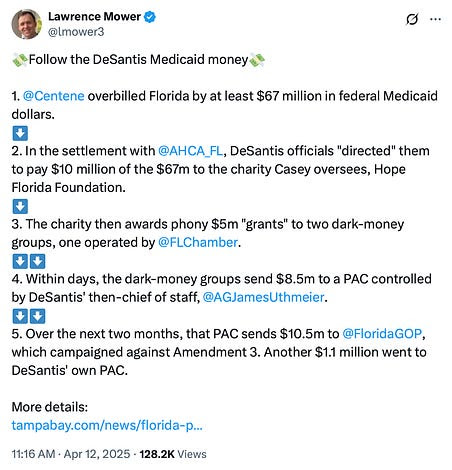
A simmering scandal erupted Friday afternoon when the Tampa Bay TimesMiami Herald and Politico Florida revealed that the administration of Gov. Ron DeSantis orchestrated a $10 million payment last fall to a charity founded by the governor’s wife — which then turned around and gave the money to groups that helped finance the governor’s campaign against a proposed constitutional amendment to legalize marijuana in Florida.

In a nutshell: The DeSantis administration pressured a major state contractor to make a $10 million donation to the Hope Florida Foundation, the controversial charity spearheaded by First Lady Casey DeSantis. It was part of a settlement negotiated with Centene Corp., after the state’s largest Medicaid contractor overbilled the state by at least $67 million.

Days later, Hope Florida transferred that $10 million to a pair of dark-money nonprofits. The state-backed charity gave $5 million each to “Save Our Society From Drugs,” an anti-marijuana group founded by a late Republican megadonor, and “Secure Florida’s Future,” a political vehicle controlled by executives at the Florida Chamber of Commerce, the Big Business lobbying group.

And days after that, Save Our Society From Drugs and Secure Florida’s Future gave a combined $8.5 million to “Keep Florida Clean,” a political committee — chaired by Ron DeSantis’ then-chief of staff — created to oppose Amendment 3, the amendment on last year’s ballot that would have allowed Floridians to use marijuana recreationally rather than solely for medicinal reasons.

It’s a daisy chain that may have transformed $10 million of public money — money meant to pay for health insurance for poor, elderly and disabled Floridians — into funding for anti-marijuana campaign ads.

DeSantis, of course, has repeatedly insisted that he did nothing wrong while also lashing out in increasingly vitriolic ways at everyone from the Republican speaker of the state House to the newspaper reporters digging into the story.

But at least one prominent GOP lawmaker — Rep. Alex Andrade, a Pensacola Republican who has been presiding over hearings into Hope Florida — told the Times and Herald that the transaction chain “looks like criminal fraud by some of those involved.”

Clearly, this looks very bad. But it is also by no means an isolated incident. 

In fact, this is part of a larger pattern of potential abuses that Ron DeSantis committed last fall when he chose to turn the power of state government against two citizen-led constitutional amendments that appeared on the November ballot: Amendment 3 and Amendment 4, which would have ended Florida’s statewide abortion ban.

Consider what we already know about how DeSantis financed his campaigns against the two amendments using public money taken from taxpayers — and private money taken from donors who got public favors from the governor.

  • Five state agencies directly funded television commercials meant to weaken support for the marijuana and abortion-rights ballot measures. We still don’t know the full extent of their spending, although Seeking Rents has estimated the total taxpayer tab at nearly $20 million. We also know that the DeSantis administration commandeered money for anti-marijuana advertising from Florida’s share of a nationwide legal settlement with the opioid industry — money that was supposed to be spent combatting the opioid addiction crisis.
  • At the same time, another nonprofit funded by Florida taxpayers poured at least $5 million into television ads attempting to soften Florida’s image on women’s healthcare at a time when Florida’s near-total abortion was under intense attack. It was the Florida Pregnancy Care Networks’ first-ever TV ad campaign. And its commercials, which were overseen by DeSantis administration staffers, complemented the state agency ads against the abortion-rights amendment — right down to using the same slogan.
  • Last June, after DeSantis vetoed legislation that would have strictly regulated the state’s hemp industry, CBS News Miami revealedthat industry executives and lobbyists promised to raise $5 million in exchange for the veto for the governor to spend on his campaign against Amendment 3. “Our lobby team made promises to rally some serious funding to stand with him on this,” a hemp industry representative wrote in one message that included a bank routing number for the Republican Party of Florida. “We have to pay $5 million to keep our end of the veto,” a hemp executive wrote in another message.
  • In the closing weeks of the campaign, records show that the Big Tobacco giant Philip Morris International gave $500,000 to DeSantis’ personal political committee — which was also chaired by the governor’s then-chief of staff and which DeSantis was using to campaign against both Amendment 3 and Amendment 4. Shortly after the election, the DeSantis administration handed Philip Morris a lucrative tax break, ruling that the company could sell a new line of electronically heated tobacco sticks free of state tobacco taxes.

There were other abuses of power, too. DeSantis and his team threatened to criminally prosecute television stations that aired ads supporting Amendment 4. They sent state police to the homes of Florida voters who signed Amendment 4 petitions. And they hijacked the ballot-writing process for Amendment 4.

There’s a reason why the DeSantis administration made sure to extract a promise of legal immunityfrom the organization that sponsored Amendment 4 as part of a legal settlement negotiated after the election.

DeSantis’ tactics worked. Though Amendments 3 and 4 each won majority support from Florida voters — 55.9 percent for recreational marijuana, 57.2 percent for abortion rights — both fell short of the 60 percent support needed to amend the state constitution.

But, suddenly, it looks like this may not be over — at least not for Ron DeSantis.

House Republicans are seeking troves of records from the DeSantis administration, including text messages and emails related to Hope Florida. The chamber has also scheduled another hearing on the Casey DeSantis charity next week.

What’s more, the House also unveiled a sweeping ethics reform package last week that would, among other things, explicitly expose senior government officials to criminal penalties if they interfere with elections.

That particular legislation would also prohibit state employees from soliciting money for political campaigns — an idea that emerged after DeSantis aides got caught squeezing lobbyistsfor more donations to their boss’ political committee ahead of a possible Casey DeSantis campaign for governor….

Ron DeSantis bet his political future on beating the marijuana and abortion-rights amendments. And he won both of those battles.

But it may turn out that he ultimately lost the war.

Wishful thinking? I hope not.

To give you an idea of how far/right the legislature is, Garcia lists some of the bills that are currently moving through the legislative process:

  • House Bill 549: Requires all new public school textbooks to refer to the Gulf of Mexico as the “Gulf of America.” Passed the Senate by a 28-9 vote. (See votes) Previously passed the House of Representatives by a 78-29 vote. (See votes) Goes to the governor.
  • House Bill 575: Replaces Gulf of Mexico with “Gulf of America” in state law. Passed the Senate by a 28-9 vote. (See votes) Previously passed the House of Representatives by a 78-27 vote. (See votes) Goes to the governor….
  • House Bill 1517: Allows someone to file a wrongful death lawsuit seeking lost wages on behalf of an embryo or fetus. Passed the House of Representatives by a 79-32 vote. (See votes)…
  • House Bill 7031: Cuts the state sales tax rate from 6 percent to 5.25 percent. Passed the House of Representatives by a 112-0 vote. (See votes)
  • House Bill 123: Allows a traditional public school to be converted into a charter school without the consent of the teachers who work at the school. Passed the House Education & Employment Committee by an 11-4 vote. (See votes)

It was no secret that Governor Abbott was intent on passing voucher legislation by any means necessary. In 2024, he called four special sessions to demand a voucher law, offering a big increase in public school funding as a sweetener. A coalition of rural Republicans and Democrats voted them down again and again. Rural Republicans know that their schools are the most important institution in their community. They know the teachers and the principal. They and everyone else in the community support the school and its activities. In rural areas, the public school is not only the hub of community life, but the largest contributor to the economy.

With the help of out-of-state billionaires and home-grown evangelical billionaires, Abbott succeeded in defeating most of the Republicans who opposed vouchers. He blatantly lied about them, claiming they opposed his tough tactics at the border (they didn’t), he claimed they didn’t support increased funding for their local schools because they voted against his bribe. He blanketed their districts with lies.

The Houston Chronicle tells a straightforward account of how the voucher vote went down, based on Abbott’s strong arm tactics. Fear won.

Benjamin Wermund and Edward McKinley of The Houston Chronicle wrote the back story:

Pearland Republican Jeff Barry has long been skeptical of school vouchers, but on Thursday morning he voted to create what could become the largest voucher program in the nation. 

Barry, a freshman House lawmaker, said it felt like he had no choice. 

“If I voted against it I would have had every statewide and national political…figure against me – not to mention all of my bills vetoed,” Barry wrote in a post responding to one user who called his support for the measure a “betrayal.”

He added: “The consequences were dire with no upside at all.” 

Barry wasn’t the only Republican House member who felt cornered after an unprecedented, years-long pressure campaign by Gov. Greg Abbott to bend the chamber to his will. 

Only two GOP members joined Democrats in opposing the measure on Thursday, a remarkable turnaround from their widespread opposition to vouchers just a few years ago. It was a major vindication of Abbott’s governing approach of strong-arming lawmakers into submission. 

Where his predecessors, including Gov. Rick Perry, often cozied up to members of the Legislature, Abbott has looked to exploit their weaknesses. His success on what was once seen as an impossible issue marks a potentially major power shift in state leadership, where lieutenant governors have long been seen to hold as much or more power than the governor, because of their control over the Senate. 

“What Perry got by finesse, Abbott gets by force — and that definitely matters for the power structure,” said Brandon Rottinghaus, a political scientist at the University of Houston. “He, through expending a tremendous amount of political capital and money, was able to reshape the Republican party in his image. That’s something very few governors have been able to do.”

Abbott spent months on the road advocating for vouchers and poured nearly $12 million into unseating fellow Republicans who opposed the same legislation in 2023. Ahead of the vote this month, he met privately with GOP lawmakers on the fence, and on Wednesday morning he gathered the caucus for a call from President Donald Trump, who not-so-subtly reminded them of his success rate in Texas GOP primaries. 

Just four years ago, before Abbott began seriously campaigning for vouchers, four out of five House members publicly opposed the thought of using taxpayer dollars for private education. That included House Speaker Dustin Burrows and state Rep. Brad Buckley, the education committee chairman who carried the bill this year in the House. 

Just one of the remaining Republican holdouts voted the same way early Thursday morningas they did in 2021: state Rep. Gary VanDeaver of New Boston, who narrowly survived a primary runoff election last year against an Abbott-backed challenger.

State Rep. Drew Darby, R-San Angelo, also defeated one of Abbott’s primary challengers last year. He voted for vouchers this time, calling it a pragmatic move to retain at least some modicum of leverage.

“We made this decision with a clear understanding: the bill would pass with or without our support,” Darby wrote on social media shortly after the vote. “Rather than stand by, we chose to stay in the fight, negotiating critical amendments to reduce the impact on our communities.”

Those concessions included annual public audits of the voucher program and its contractors, clarified residency requirements for participants, a requirement that private schools be accredited for at least two years before participating and a permanent one-fifth cap of slots going to students from families that make more than 500% of the federal poverty line — or $160,750 for a family of four. 

One of the aims, Darby and others said, was to block unproven private schools from popping up in areas with few other options, just to access the new state dollars. And critics hoped to prevent existing private school students with wealthy families from taking up a bulk of the voucher slots, as has happened in other states.

Darby’s wife, Clarisa Darby, also posted online that not backing vouchers would have jeopardized billions of dollars in new public school funding for teacher raises and special education.

“School funding would be cut by the Senate in retribution and bills affecting our west Texas economy had a high chance of being vetoed if they voted against the bill,”  she wrote. “Bills affecting school funding, oil, gas, water, jobs, ASU, Howard College, are too important to be vetoed.”

Ahead of the vote Wednesday night, state Rep. James Talarico, an Austin Democrat, accused Abbott of intimidating Republican colleagues with the threat of a primary “bloodbath.” 

“No one including the governor should ever threaten a lawmaker,” Talarico said. “We do not serve the governor, we serve our constituents.” 

Abbott’s office denied the claim. But whether threats were real or implied, House Republicans were clearly feeling the heat after Abbott’s all-out offensive in last year’s primaries. 

“He’s working behind the scenes to make sure he’s got the vote. There’s no question about that,” state Rep. Sam Harless, a Spring Republican, said Wednesday as the voucher debate was beginning. 

Trump’s call Wednesday morning helped quash any lingering doubts among Republicans.

“Many of you I’ve endorsed, and I’ll be endorsing,” Trump told the members. “I won Texas in a landslide. Everybody who was with me got carried.” 

State Rep. Wes Virdell, who campaigned on supporting school vouchers, said earlier this week it was “no secret that the governor is pressuring a lot of people” to support the proposal. 

Steve Allison, a former Republican state lawmaker from San Antonio who lost his seat to an Abbott-backed challenger after opposing vouchers last session, said he liked the changes fought for by Darby and others but would have still voted against the bill.

“I think that members need to prioritize their districts… and I think that was interfered with here, not just in (my) district but elsewhere,” he said, adding that he’d spoken with several current lawmakers who’d been threatened by Abbott. He declined to say who. “It’s just unfortunate what the governor did,” Allison said.

The House GOP shift on vouchers stretched all the way to its top leadership. Even as he has helped block voucher legislation in the past, newly-elected Speaker Dustin Burrows was a vocal champion of the bill this year, appearing at multiple events with Abbott. 

“Speaker Burrows was the real X factor in the debate,” said John Colyandro, a former Abbott adviser who lobbied for the legislation. 

Burrows took the gavel from state Rep. Dade Phelan, one of only two Republicans to vote against the bill. 

As speaker, Phelan had not openly opposed the legislation. And heading into the speaker’s race he said he would prioritize it. 

But before the vote, he explained he was planning to vote against it because he felt voters in his Beaumont district did not support vouchers. He wanted to put it on the ballot in November, a failed proposal offered by Talarico. 

Phelan, who narrowly fended off a Trump-backed primary challenger last year, shrugged off the fear of political threats — real or implied. He brought up the Trump call in an interview ahead of the vote, saying he wasn’t in the room but heard audio of it. 

Trump noted only one of his endorsed candidates lost, apparently referencing David Covey’s failed bid to unseat Phelan, though the president did not name either candidate. 

“He said he went 42 and 0,” Phelan said. “And then he remembers he lost one.”
Governor Greg Abbott finally got the voucher legislation he wanted, after years of defeats. His goal was frustrated by a coalition of Democrats and rural Republicans. The latter were defending their hometown schools, which are staffed by friends and relatives and are the community’s hub.

In last year’s elections, Abbott ran hard-right Republicans against the rural Republicans who stood in his way and disposed of most of them. He attacked them with a campaign of lies, saying they opposed border control, never mentioning vouchers. His efforts to oust anti-voucher Republicans were funded by out- of-state billionaires, including Jeff Yass, the richest man in Pennsylvania, Betsy DeVos, and Charles Koch, as well as home-grown Texas billionaires. Even Trump intervened to encourage the passage of vouchers.

The article says that the legislators refused to permit a referendum because such votes “generally” reject vouchers. Fact-checking would have changed the word “generally” to “always.” In more than 20 state referenda over the years, the public has always voted against vouchers. The article does not mention that the vast majority of vouchers in every state that have adopted them are used by students already in private schools, mostly religious schools. Nor does it note that the academic results of vouchers are strikingly negative (see Josh Cowen’s book The Privateers). Typically the students at private schools are exempt from state testing requirements (which conservatives contend is absolutely necessary for students in public schools).

Most important, it is not the students or the parents who have choice. It is the schools that choose their students. Voucher schools are not bound by anti-discrimination laws. They may exclude students for any reason, including their race, religion, disability, gender or sexual orientation. Some religious schools accept only children of their own sect.

Gregg Abbott campaigned exclusively at private Christian schools. He attacked public schools for “indoctrinating” students, but the best schools for indoctrination are the evangelical schools that will benefit from this legislation.

The following article is a gift, meaning no pay wall.

The New York Times reported:

The Texas House of Representatives voted early Thursday morning to create one of the largest taxpayer-funded school voucher programs, a hard-fought victory for private school choice activists as they turn their attention to a nationwide voucher push.

The measure still has some legislative hurdles to clear before Gov. Greg Abbott signs it into law, but the House vote — 85 to 63 — secured a win that was decades in the making, propelled by the governor’s hardball politics last year. It was also a significant defeat for Democrats, teachers’ unions and some rural conservatives who had long worried that taxpayer-funded private-school vouchers would strain public school budgets.

The program would be capped at $1 billion in its first year, but could grow quickly, potentially reaching an estimated $4.5 billion a year by 2030. The funds can be used for private school tuition and for costs associated with home-schooling, including curriculum materials and virtual learning programs.

The bill was championed by an ascendant wing of the Republican Party, closely allied with President Trump and important conservative donors, including Betsy DeVos, Mr. Trump’s wealthy former education secretary, and Jeff Yass, a billionaire financier from Pennsylvania and a Republican megadonor.

Dr. Azar Nafisi, author of the mega-bestseller Reading Lolita in Tehran, will speak at Wellesley College on April 15 at Wellesley College at 4 p.m. in the Jewett Arts Center. Admission is free.

Please mark the date on your calendar. She is speaking in a lecture series that I endowed several years ago. The lecture will be available eventually on the archive website of the College.

The book, which was a sensation upon its publication for its depiction of life under the mullahs, has recently been made into a film.

This review of the film was published by The Atlantic and written by Arash Azizi. At present, the film can be seen only at film festivals.

He wrote:

The past few years may well be remembered as the nadir of Iranian-Israeli relations, and the first occasion when the two countries attacked each other directly. But they were also a golden period for Iranian-Israeli collaboration in cinema. In 2023, Tatami was the first-ever film to be co-directed by an Israeli (Guy Nattiv) and an Iranian (Zar Amir). And in 2024 came Reading Lolita in Tehran, directed by Eran Riklis, who is Israeli, and adapted from a book by an Iranian author, with an almost entirely Iranian cast. The film premiered at the Rome Film Fest last year and is now starting to tour the United States.

Anyone old enough to remember cultural life at the beginning of this century will know the book. Azar Nafisi’s memoir came out in 2003, spent 36 weeks on the New York Times best-seller list, and quickly developed a cult following. A reviewer for The Nation confessed to missing a dental appointment, a business lunch, and a deadline just because she couldn’t put the book aside.

Literary scholars—Nafisi is an English professor—are not known for their page-turning thrillers. But Nafisi’s story and prose are captivating. She’d gone to Iran shortly after the 1979 revolution in the hope of putting her American education to use by teaching English at a university. Instead, she was hounded out of the classroom by authorities hostile to Western literature. She wound up holding clandestine seminars for young women in her living room, delving into the masterpieces that the Islamic Republic forbade: the Vladimir Nabokov novel that gives the memoir its name, alongside the works of Henry James and Jane Austen, as well as one of Nafisi’s favorites, F. Scott Fitzgerald’s The Great Gatsby. Nafisi brings these classics into dialogue with the real-life stories of young Iranians in the heady decades following the 1979 revolution. Her book isn’t just about reading and teaching literature under a repressive regime, but about how literature in and of itself could serve as an antidote to all that the regime stood for.

Despite its global fame and translation into 32 languages, Reading Lolita in Tehran was never turned into a film before now, mostly because Nafisi didn’t like the proposals she’d received. Then, seven years ago, Riklis came around, as he recounted to a New York audience on January 13, after a special screening of the film. The Israeli director managed to convince Nafisi of his vision—and then to secure the funding, assemble a suitable Iranian cast, and settle on Rome as the shooting location, given that Tehran was not an option.

When the book was initially released in 2003, the American zeitgeist, shaped by 9/11 and the Bush administration’s global War on Terror, was rife with debates about the representations of Muslim women and life in the Middle East. Nafisi’s was one of several popular memoirs by Iranian women published during this period, including Firoozeh Dumas’s Funny in Farsi (2003) and Marjane Satrapi’s Persepolis series (2000–03). And perhaps inevitably, given its success, Nafisi’s book became the subject of political scrutiny, much of it bearing little relation to the book’s content. Although Nafisi opposed the Iraq War, some critics lumped her in with neoconservatives because she portrayed the travails of Iranians under an anti-American regime. One scholar even proclaimed that he saw no difference between her and American soldiers convicted of abusing prisoners in Iraq.

More than 20 years later, Riklis’s loyal adaptation has opponents just as the book did, and even more so because of the nationality of its director. In Tehran, the regime media have denounced the film as furnishing a “pretext for attacking Iran” and called its Iranian actors “traitors working with Zionists.” One outlet claimed that the film peddled a “violent, anti-culture, anti-art, and anti-human view of Iran and Iranians.”

The idea that Reading Lolita in Tehran is anti-Iranian because of its portrayal of the Islamic Republic, and of the life of women under its rule, was always patently ridiculous. The claim bears up particularly poorly in 2024, two years after women-centered protests rocked Iran under the slogan “Women, Life, Freedom.” What Nafisi does best, and the reason her work has endured, is precisely to refuse cartoonish portrayals and basic morality plays.

In Riklis, known for his empathetic depiction of Israelis and Palestinians in films such as Lemon Tree and Dancing Arabs, her book finds an able interpreter who has stayed true to its ethos. The film isn’t neutral. It vividly tells the story of how puritanical Islamist goons attacked universities in the early years after 1979, imposed mandatory veiling on women, and banned books they didn’t like. But neither is it a simple story of scary Islamists versus heroic women resisters.

The film captures the atmosphere of Iran in the 1980s and ’90s remarkably well for having been shot in Italy and directed by an Israeli who has never set foot in the country. The dialogue is mostly in Persian, a language Riklis doesn’t speak; he was able to pull this off with the help of a carefully chosen cast of diasporic Iranians. Golshifteh Farahani, perhaps the best-known Iranian actor outside the country, is at her height as Nafisi, whom she plays as confident but humane, by turns brazen and vulnerable.

The young women of the clandestine class include Sanaz (Zar Amir), who has survived imprisonment and torture; Mahshid (Bahar Beihaghi, in one of the film’s most delightful performances), who, unlike most of her classmates, wore the Islamic veil even before the revolution and defends an ideal of modesty as virtue; and Azin (Lara Wolf), whose multiple divorces make her an object of fascination to the less experienced students, but who turns out to be suffering from domestic abuse.

In Nafisi’s apartment, the students are far from the prying eyes of the regime and also of men (even the professor’s husband is barred from their meetings). They construct for themselves, in that all-female room, a little literary republic that survives the years of war and revolution. In one memorable scene, Nafisi has the students practice a Jane Austen–era dance as part of their study of Pride and Prejudice, drawing parallels between the stifling rules of courtship in Victorian England and those of some contemporary families in Iran.

The film also ventures beyond that cloistered space. Bahri (Reza Diako), a devout 1979 revolutionary, is nevertheless an avid student in Nafisi’s class at the university before it is shut down. Despite their diametrically opposed politics, Nafisi and Bahri form a bond. Early in the story, she tells him his essay on Huckleberry Finn is the best she’s ever received from a student, even in America. The two reconnect when Bahri returns from the Iran-Iraq War of 1980–88, having lost an arm. He has used his family connections to the regime to obtain a surprise gift for his old professor: two tickets to The Sacrifice, by Andrei Tarkovsky, showing at the Tehran film festival. The connection between Nafisi and Bahri is presented with complexity and without sentimentality, neither papering over political differences nor caricaturing Bahri as a generic revolutionary.

In this way, both film and book avoid didacticism. And in doing so, they demonstrate exactly the point Nafisi explores with her students, which is the power of literature to stir empathy across seemingly unbridgeable divides. When the group discusses The Great Gatsby, Nafisi insists on understanding the forbidden love that Daisy Buchanan, the married socialite, has for Jay Gatsby as a true human feeling, not a symbol of Western perfidy, as some of her more revolutionary students claim it to be. The latter advocate banning the book. Nafisi organizes a mock trial for the novel in her class, with students divided into teams for and against.

Nafisi calls on students on both sides of the political divide to treat each other with humanity. When she catches some in her class expressing glee at the wartime deaths of pro-regime peers, she enjoins them not to become like their oppressors. And she is no dogmatic opponent of Islam, only of religiously inspired repressive government: At one point Nafisi tells Bahri, “My grandmother was the most devout Muslim I knew. She never missed a prayer. But she wore her scarf because she was devout, not because she was a symbol.” (I am not the only critic with a Muslim background who found this line powerful.)

The point here isn’t just to repeat the liberal platitude that “the problem isn’t with Islam but with its repressive enforcement.” Rather, Nafisi is rejecting the revolutionaries’ tendency to treat all that surrounds them as a field of symbols. People are worth more than that, she tells them and us, as though echoing the Kantian dictum to treat one another “as an end, never merely as a means.”

This message about the humane power of literature makes Reading Lolita in Tehran a work of art rather than an exercise in sloganeering. And the fact that now, more than two decades after the book’s release, and at a time of regional tension, an Israeli filmmaker has worked with Iranians to adapt Nafisi’s book to the screen gives the film a special power.

The audience at the screening I attended, at a Jewish community center on the Upper West Side, included American Jews, Israelis, and Iranians. What we had in common was the experience of being gripped by a story about the capacity of literature to reveal us to one another as ends rather than as means. The setup might sound mawkish. But I recommend avoiding the temptation of cynicism and embracing the film as truly one for these times.

ABOUT THE AUTHOR

Arash Azizi is a contributing writer at The Atlantic. His new book, What Iranians Want: Women, Life, Freedom, was published in January 2024.

Jennifer Berkshire has been writing about the politics of education for many years. She has written two books with education historian Jack Schneider, A Wolf at the Schoolhouse Door and The Education Wars. This is the second installment in her excellent series called “Connecting the Dots.” Her Substack blog is called “The Education Wars.”

She writes:

BAs are out, babies are in

The Trump world’s obsession with the declining birthrate doesn’t quite rank with rooting out “DEI,” tariff-ing, or expelling immigrants but it’s up there. In a recent interview, Elon Musk confessed that a fear of the shrinking number of babies keeps him up at night. What does this have to do with education? Everything. Last year, two of the big education ‘thinkers’ at Heritage released a guide to how changes in education policy could increase “the married birthrate”:

Expensive and misguided government interventions in education are, whether intended or not, pushing young people away from getting married and starting families—to the long-term detriment of American society.

What are those government interventions? Things like subsidizing student loans, thereby encouraging young women to go to college. Or requiring teachers, who are mostly women, to have bachelor degrees, thereby encouraging young women to go to college. Of course there is a voucher angle—there always is with these folks. But the key here is that a chorus of influential Trump thinkers like this guy keep telling us that there are too many women on campus, and that policy shifts could get them back into the home where they belong. 

If the administration succeeds in privatizing the government-run Student Loan Program, college will become much more expensive, significantly shrinkign the number of kids who’ll be able to attend. And that seems to be the point, as conservative activist Chris Rufo explained in an interview a few weeks ago.

By spinning off, privatizing and then reforming the student loan programs, I think that you could put the university sector as a whole into a significant recession. And I think that would be a very salutary thing.

So when you hear the rising chorus coming from Trump world that there are too many of the wrong people on the nation’s campuses, recall that an awful lot of these self-styled ‘nationalists’ believe this: “If we want a great nation, we should be preparing young women to become mothers.”

Some people are more equal than others 

I’ve been making the case that both the Department of Education and public education more broadly are especially vulnerable because of the equalizing roles that they play. Of course, education is not our only equalizer. Indeed, all of the institutions and policy mechanisms intended to smooth out the vast chasms between rich and poor are on the chopping block right now. While you were clicking on another bad news story, Trump eviscerated collective bargaining rights for thousands of federal workers. While teachers weren’t affected, a number of red states have been rushing to remedy that, including Utah which just banned collective bargaining for public employees. 

Writer John Ganz describes the unifying thread that connects so much of Trump world as ‘bosses on top,’ the belief that “the authority and power of certain people is the natural order, unquestionable, good.” We got a vivid demonstration of what this looks like in Florida this week as legislators debated whether to roll back (more) child labor protections, allowing kids as young as 14 to work over night. 

Governor Ron DeSantis is busily spinning the bill as about parents rights, but what it’s really about is expanding the power of the boss. The ‘right’ to work overnight while still in school is actually the boss’ right to demand that young employees keep working. Nor is it hard to imagine the long-term consequences of this policy change. Teen workers who labor through the night end up dropping out of school, their futures constrained in every possible way. Here’s how Marilynn Robinson described the rollback of child labor laws in her adopted home state of Iowa: “If these worker-children do not manage to finish high school, they will always be poorer for it in income and status and mobility of every kind.”

Go back one hundred years when the country was in the midst of a fierce debate over child labor, and you’ll hear the same arguments for ‘bosses on top’ that are shaping policy today. At a time when public education was becoming compulsory, conservative industry groups like the National Association of Manufacturers cast their opposition to both child labor laws and universal public education in explicitly bossist terms, as Naomi Oreskes and Erik Conway recount in The Big Myth: How American Business Taught Us to Loathe Government and Love the Free Market:

“They believed that men were inherently unequal: it was right and just for workers to be paid far less than managers and managers far less than owners. They also believed that in a free society some children would naturally enter the workforce. Child labor laws wer (to their minds) socialistic because they enforced erroneous assumptions of equality—for example, that all children should go to school—rather than accepting that some children should work in factories.”

Back to the states

Did you hear the one about how we’re returning education to the states? Back-to-the-states has become a mantra for the Trump Administration on all kinds of favored policy issues, as the New York Times recently pointed out. Of course, education is already a state ‘thing,’ which means that we can look at the states Trump keeps pointing to as models and see how they’re faring. So how are they faring? Not so well, as the education reform group EdTrust lays out here, reviewing both NAEP scores and the track records of these states in supporting low-income students and students of color.

But there are plenty of warning signs beyond test scores. Ohio seems poised to slash funding for public education, even as the state’s voucher program balloons. (And let’s not even get into the just-enacted Senate Bill 1, which limits class discussions of any ‘controversial’ topic and goes hard at campus unions.) But for a glimpse of the future that awaits us, pay attention to another state in my beloved Heartland, and which Trump has repeatedly showered with praise: Indiana.

Now, Indiana happens to be home to one of my favorite economists, Ball State’s Michael Hicks, who has been warning relentlessly that the state’s decision to essentially stop investing in K-12 and public higher education has been an economic disaster. Hoosiers, he pointed out recently, earn less than the typical Californian or New Yorker did in 2005. As the number of kids going to college in Indiana has plummeted, the state now spends more and more money trying to lure bad employers to the state. Here’s how Hicks describes the economic and education policies that Indiana has embraced:

“If a diabolical Bond villain were to craft a set of policies that ensured long-term economic decline in a developed country, it would come in two parts. First, spend enormous sums of money on business incentives that offer a false narrative of economic vibrancy, then cut education spending.”

As for Indiana’s 25-year-long school choice experiment, Hicks concludes that it has been a failure. Why? Because the expansion of school vouchers and charter schools was used to justify spending less on public schools—precisely the policy course that we’re hurtling towards now. Today, Indiana spend less money per student on both K-12 and public higher education than it did in 2008.

GOP-run states have already begun to petition what’s left of the Department of Education for ‘funding flexibility’—the ability to spend Title 1 dollars, which now go to public schools serving low-income and rural students, on private religious education. We shouldn’t be surprised. This is precisely the vision laid out in Project 2025. (Fun fact: the same Heritage thinker who penned the education section of Project 2025 also co-authored the above referenced guide to getting young married ladies to have more babies.)

And just like in Indiana, school privatization will be used to justify reducing the investment in K-12 public education. So when an economist tells us that school choice “risks being Indiana’s single most damaging economic policy of the 21st century,” we should probably listen.

Fintan O’Toole is an opinion writer for The Irish Times. My friend Carol Burris shared this brilliant column with me.

He writes:

Sixty years ago, Bob Dylan chanted that “even

the president of the United States/ Sometimes

must have to stand naked”. But now there is

no “sometimes” about it. The president of the

United States is full frontal all the time.

Donald Trump has stripped away all the

niceties that allowed too many people to

remain in denial about his intentions.

The last two months have been a radically

revised version of Hans Christian Andersen’s

fable “The Emperor’s New Clothes.” In the

original, the emperor is duped by two

swindlers into parading naked and everyone

goes along with the illusion until an innocent

child cries out “But he hasn’t got anything on”.

The new twist is that it is Trump himself who

insists on exposing the bare truth of his

objectives.

The real shock of recent weeks is that anyone

is shocked. Most European leaders seem to be

genuinely astounded by Trump’s bullying,

boorishness and blatant aggression. They had

fooled themselves into believing what they

wanted to believe – the emperor has a very

fine new suit. As in Andersen’s parable,

“Nobody would confess that he couldn’t see

anything, for that would prove him either

unfit for his position, or a fool”.

Wishful thinking spun three layers of

imaginary cover. The first was an idea that

comes naturally to professional politicians –

that there is a great gap between campaign

rhetoric and actual governing. With Trump,

there is no such distinction. He is always on

the campaign trail. Everything is one big rally.

What you see on stage – the freewheeling

megalomania, the gleeful malignity – is what

you get in the Oval Office.

The second fig leaf is the literally/seriously

dichotomy. This idea started with a column in

The Atlantic by Salena Zito: “the press takes

him literally, but not seriously; his supporters

take him seriously, but not literally.” It was a

smart thing to say but it has long since

coagulated into cliche. The purpose of cliche

is to save everyone the bother of thinking.

Taking Trump seriously but not literally

became a way of avoiding the hard task of

preparing for his all too literal

destructiveness.

Any excuse for clinging on to the illusion that

Trump’s supporters do not take him literally

vanished on January 6th, 2021, when many of

them heard exactly what he was saying and

attempted to stage a violent coup on his

behalf. Yet much of Europe’s political

establishment continued to reassure itself

that Trump’s imperialist demands were

bluster and braggadocio. He couldn’t really

mean that stuff, could he?

What has to be understood about Trump is

his use of trial runs. He puts things out there,

tests the water, pulls back, goes again. Ideas

appear first as half-serious, still wrapped in a

coating of deniability. But they become

normalised. The unthinkable becomes

thinkable and, when he has the power, the

thinkable becomes doable.

The literally/seriously cliche obscures this

whole process. It sustains the belief that if, for

example, Trump demands that Denmark give

him Greenland and then goes silent on the

subject, he never really meant it in the first

place. But he did mean it and he will come

back to it.

The third layer of illusion is that Trump is a

supreme dealmaker. This is still the comfort

blanket for many of those who want to believe

that he can’t truly be as monstrous as he

seems. It relates, however, not to a real person

but to “Donald Trump”, a fictional mogul

created in a book, The Art of the Deal, that he

did not write, and a show, The Apprentice,

that was as real as reality TV ever is.

The real Trump is a more a breaker than a

maker of deals. In power, he is much more

interested in flouting bargains than in making

them. He despises all existing treaties: the

Paris climate accords, the Iran nuclear

agreement, the arms control agreements with

Russia. A genuine deal is based on mutuality

– a concept that Trump does not recognise.

For him, there are only the “suckers and

losers” being screwed and the superior types

who are doing the screwing.

And when he has made deals, they’ve all

failed. The Abraham Accords normalising

relations between Israel and United Arab

Emirates, Bahrain, Morocco, and Sudan was

his big success story – but it has, to put it

mildly, done nothing to bring peace to the

Middle East.

Trump’s love-hate soap opera with North

Korea’s Kim Jong-un was, in the end, a farce.

His deal with the Taliban simply handed

Afghanistan over to them in return for

nothing. His supposedly grand trade deal

with China produced nothing at all for

the US.

Trump has said repeatedly that “many people” have urged him to run for a third term. Who does he talk to other than sycophants?

He made clear in a recent interview that his people are looking for ways to circumvent the 22nd Amendment, which says “No person shall be elected to the office of the President more than twice…” Could that be any clearer?

One of Trump’s first executive orders attempts to eliminate birthright citizenship, which is explicitly guaranteed in the first sentence of the 14th Amendment, so it’s obvious that Trump has no respect for the Constitution despite having taken an oath to support and defend it. I would say that his failure to put his hand on the Bible explains his indifference to the Constitution but he is also indifferent to the Bible (unless he is selling it).

Of course, Trump wants a third term! What a great job he has! He can punish, insult, even prosecute his enemies. He can force powerful law firms to cower before him, he can threaten universities unless they abolish courses that he doesn’t like, he has the powers of a king because the U.S. Supreme Court said he has “absolute immunity” for anything he does as President. He could order the military to murder his critics and say it was for “national security.” Absolute immunity!

Better still, he doesn’t have to work! He flies home to Mar-a-Lago every weekend to golf. He signs a few executive orders every day. His crew of mean-spirited, hateful people does the heavy lifting; they write the executive orders. They think of new ways to diminish federal programs that help people in need. They are hard at work thinking up ways to reduce the number of people who get Medicare orcSocial Security.

Really, what Trump have to do other than sign executive orders? Not much. His staff knows not to bore him with intelligence briefings.

It’s true that he has to tolerate Little X, Elon’s snot-nosed kid, who put a booger on the Resolute Desk. (Trump was not content to order the cleaning of the historic desk, he sent it out to be completely refinished, all because of a booger.)

Great job! All expenses paid. Full-time security for Trump and all his family, and he “works” fifteen minutes a day signing executive orders that his mean team wrote.

The USA was a great country while it lasted. Will he name it Trumplandia after he has taken Canada and Greenland?

Politico analyzed four ways he could try for a third term:

  1. Repeal or revise the 22nd Amendment. But that seems highly unlikely since it would require 3/4 of the states to ratify any change in the Constitutuon.
  2. Sidestep the Constitution by having JD Vance run for President and Trump as Vice President, with Vance pledging to resign if elected so Trump can be President again.
  3. Ignore the Constitution. Trump could run again, a subservient Republican national Committee would endorse him, and a supplicant Supreme Court would comply.
  4. Defy the Constitution. Refuse to leave office. Call a national emergency and suspend another election.

All the stuff of Fascism. But none of it beyond Trump’s egotism.

Every once in a while, I read an article that is so important and so powerful that I want to give it as much attention as possible. This is such an article. Please read it and share it. Post the link on every social media site. Send it to school board members and journalists.

The article was written by Dr. Maurice Cunningham, a retired Professor of Political Science at the University of Massachusetts. Cunningham has been studying “dark money” in education for years. It was published by “Our Schools” and “Independent Media Institute.”

If you want to understand the attacks on public schools, on teachers, and on teachers’ unions, read this article. If you want to understand how the organized groups that smear public schools got started, read this article. If you read a story about two or three “moms” sitting around their kitchen table and worrying whether the teachers at the local public school are indoctrinating their children, read this article. If those “moms” raised over $1 million in their first year, read this article.

They have fooled many journalists. Don’t let them fool you!

Cunningham warns:

“These groups are the creation of deep-pocketed conservative networks, not “grassroots” advocates.

By Maurice Cunningham

“If your mother says she loves you, check it out” is a bromide drilled into every journalist. So it is baffling why, if an interest group includes the words “moms” or “parents,” it is just taken at its word, especially when a little digging can reveal that many of these groups are the creations of billionaires out to destroy public education.

As the author of Dark Money and the Politics of School Privatization, I have been following billionaire-backed education interest groups for more than a decade. Since big money lacks public credibility, it often masquerades as organizations claiming to represent the interests of “parents,” “moms,” “educators,” and “families.” The concocted stories about how these groups were created are often repeated by an incurious press, which misses the opportunity to tell its readers a more interesting story: how billionaires and right-wing activists pour money into upbeat-sounding organizations to further their aim of privateering our public school system.

These astroturf operations have been proliferating resulting in serious negative impacts. Consider the havoc wreaked on some school boards by Moms for Liberty (M4L). M4L even got into presidential politics in 2024, boosting Donald Trump, at the behest of the donors, who co-founder Tina Descovich termed as M4L’s “investors.”

Consider a November 2024 Washington Post story on Linda McMahon’s nomination to be secretary of education. The article contrasted remarks from National Education Association (NEA) President Becky Pringle with an alternative view from Keri Rodrigues, founding president of the National Parents Union (NPU), which the reporter Laura Meckler called “a grassroots group,” thus giving the impression that NEA and NPU are similar organizations.

They are not. NEA is a well-established teachers’ union that credibly claims 3 million members and is governed by a democratic structure. NPU appeared on the scene in 2020, surfing in on millions of dollars from the foundations of American oligarchs, including the Walton family, Mark Zuckerberg, and Charles Koch.

In 2024, Rodrigues, a fixture at education privateering groups, told the Boston Globe that NPU could get its message to “250,000 families to vote against” a ballot question sponsored by the teachers’ union and would “put that network to work.”

There is zero evidence that this extensive network exists or that it did anything on the ballot question. There is also no proof to validate Rodrigues’s claimthat the organization has 1.7 million members nationally.

A 2021 Washington Post article introducing Moms for Liberty chronicled its claimed rapid rise without raising questions about how it grew so fast. The story simply provided the M4L narrative of its creation story, centered around former Florida school board members Descovich and Tiffany Justice. It omitted M4L’s third co-founder Bridget Ziegler, though it did quote her husband, Christian Ziegler, about the group’s political potency.

Bridget Ziegler served briefly on the M4L board and was replaced by GOP campaign consultant Marie Rogerson. Christian Ziegler was then the powerful vice-chair of the Florida Republican Party and a key Trump supporter. (In 2023, the Zieglers became famous for a threesome scandal. She quickly resigned from her executive position with the Leadership Institute, an established training institution for right-wing activists. Christian was removed from his perch as chair of the Florida Republican Party.)

The Post October 2021 story featured a photo of Descovich pulling aside, Superman style, a white jacket to reveal the group’s logo t-shirt while posing next to an American flag. The questions about the group’s ties to the Republican Party and suspicious financing were laughed off by the founders of M4L. The Post followed up a month later by printing an op-ed by Descovich and Justice.

NPU, M4L, and similar groups organize as nonprofit corporations under sections 501(c)(3) and 501(c)(4) of the Internal Revenue Service Code. As nonprofits, their Form 990 tax returns are made public but only in November, following the tax year. The information is skimpy but valuable. Journalists can access the Form 990s by requesting them directly from the nonprofits or from the ProPublica Nonprofit Explorer, which helps trace donors as well.

These groups leave clues that no reporter can miss:

  1. Don’t buy the phony origin stories: These organizations all claim to be about moms joining together to improve education. But in no time, they have access to millions of dollars in donations and have the services of elite law firms, pollsters, media consultants, and often, ties to the Republican Party.
  2. Follow the money: It isn’t easy in the first two years of a nonprofit’s existence, but there are signs: easy access to right-wing media, hiring expensive consultants, and big-budget conferences.
  3. Watch how these groups work: The founding leadership usually consists of veteran right-wing operatives or communications professionals with years of experience in privateering organizations.
  4. Get the big picture: Right from the beginning, M4L had obvious ties to Republican and right-wing organizations that often went unreported.
  5. Keep following the money: When nonprofit tax forms finally become public, they’ll reveal how much was donated and can help identify the top contractors and how much they were paid.

Let us expand on these insights to show how these secretive operations can be exposed right from the beginning by using Form 990.

Don’t Buy the Phony Origin Stories

The typical “moms” or “parents” creation story goes something like this: outraged by some aspect of their children’s public school education, two or three “moms” band together to attract other like-minded parents to cure the deficiencies of the system, which are always the fault of the teachers’ unions. In truth, the “moms” are agents of far-right billionaires often tied—like M4L and Parents Defending Education (PDE)—to the secretive Council for National Policy, which seeksto privateer K-12 for profit, expand Christian education, and promote homeschooling.

According to the billionaire-funded online publication the 74, NPU “is the brainchild of two Latina mothers,” Keri Rodrigues and Alma Marquez, who “had disappointing experiences with education, both as parents and students, and with advocacy groups.”

To its credit, the 74 was candid about the funding of NPU: the foundations of billionaires, including Bill Gates, the Walton family, the late Eli Broad, and Michael and Susan Dell, and organizations like the City Fund, which gets its money from Reed Hastings, John Arnold, and Walton family members, inheritors of the Walmart fortune.

Nonetheless, the tenor of the story was of a grassroots moms’ start-up. Other news outlets ignored the 74’s detailing of billionaire funding. An online search through the New York Times website supplemented with a library search through Gale OneFile showed 13 NYT stories or columns that mention the National Parents Union since the group’s public launch on January 1, 2021. Only one column by Michelle Goldberg noted that “The National Parents Union is funded by the pro-privatization Walton Family Foundation.” The Waltons are, however, the only funders Goldberg mentioned.

The New Yorker came closest to the truth in a June 2021 piece: “The Walton foundation set up the National Parents Union in January 2020, with Rodrigues as the founding president.” A review of Form 990s for NPU and the Walton Family Foundation from 2020 through 2023 that I reviewed shows that NPU accepted more than $11 million in contributions. The Walton Family Foundation donated around $3 million of that amount.

The media is failing to cover the single most important fact the public needs to know about “parents” and “moms” groups: who is supplying them with millions of dollars in funding.

As for M4L, although a few media outlets wrote it had three founders, most followed the practice of CNN, which in December 2021 omitted Bridget Ziegler and described “the two women behind Moms for Liberty, a group of conservatives that came together in January,” downplaying the fact that at that time, the state GOP vice-chair’s wife was also one of the co-founders. By January 9, 2021, soon after its incorporation, M4L’s online store was offering magnets, t-shirts, and hats, and a “Madison Meetup” package of right-wing materials.

While mainstream media was valorizing M4L’s origin story, right-wing outlets produced a steady stream of propaganda about the organization. Later in January 2021, Descovich appeared on the Rush Limbaugh Show (guest-hosted by Todd Herman). Media Matters for America found that, by July 2022, M4L “representatives have been regulars on right-wing media, appearing on Fox News at least 16 times and Steve Bannon’s “War Room” at least 14 times.”

Another supposedly grassroots parents’ group that has an origin story grounded in deception is PDE. In lodging a civil rights complaint against the Columbus, Ohio, public schools in May 2021, PDE President Nicole Neily told the Columbus (Ohio) Dispatch, “We just all work from home… We’re all working moms.”

In fact, Neily is a well-compensated political operativein the Koch network. According to the Koch-connected Speech First’s Form 990 for 2019, which was available after November 2020 and thus before PDE was founded in 2021, Neily was paid $150,000 in 2019.

Follow the Money

Due to the barriers to tracing the funding of such groups, it can be hard to follow the money, especially in the first two years of operation. But in 2021, an article in the New Yorker described how the VELA Education Fund, a partnership of the Walton Family Foundation and the Charles Koch Institute, had given NPU $700,000 in 2020 to “help people with fewer resources,” including promoting homeschooling during COVID-19. This is despite the fact that NPU was not familiar with homeschooling.

Press outlets have also overlooked funding sources of M4L. In 2021, co-founder Descovich told CNN that M4L had raised more than $300,000 through t-shirt sales, small donors, and fundraising events. However, one such event was a gala featuring former Fox News personality Megyn Kelly in June 2021, six months into M4L’s first year. The top tickets went for $20,000. The Celebrity Speakers Bureau pegged Kelly’s speaking fee as between $50,000 and $100,000. The event raised at least $57,000.

In July 2021, Descovich appeared at a Heritage Foundation virtual town hall on “Preserving American History in Schools.” By October 29, 2021, M4L was referring members to the Leadership Institute for training and sending members to the Heritage Foundation for events and other resources. Both these organizations have been part of the right-wing political firmament since the 1970s. A bit of digging showedthat M4L was deeply embedded in far-right politics. But most press accounts ignored that evidence and the public remained largely in the dark.

In April 2021, PDE headed by Neily, brought on Elizabeth Schultz as a “senior fellow,” who had worked under Trump’s Education Secretary Betsy DeVos during his first term and was a vocal anti-LGBTQ activist.

Watch How These Groups Work

These groups can be intertwined. PDE, M4L, and another faux-grassroots group, No Left Turn in Education (NLTE), all came on the scene around the same time, with NLTE being founded in 2020. PDE’s website includes a map called “IndoctriNation” with lists of affiliates across the nation. The April 15, 2021, listings (the website appears to have gone live only in March 2021) showed that most of its allies were chapters of M4L and NLTE with few actual members, according to my research in 2021.

Media reports seemed content to accept the “moms working from home” creation story despite the obvious early support from well-resourced groups.

NPU held its organizing meeting, which it claims drew representatives from all 50 states, in New Orleans in January 2020. To promote the event, NPU employedMercury Public Affairs, an international public relations firm. To draw press attention, NPU also commissioned polling from Echelon Insights, a Republican pollster that has also worked for the Walton family.

In the same year of its founding, in 2021, PDE published detailed plans, such as “How to Create ‘Woke At’ Pages,” that instruct parents on how to use secrecy to attack “woke activists” in the education system. PDE also began initiating lawsuits against local school boards, represented by the Republican law firm of Consovoy McCarthy.

William Consovoy, who passed in 2023, was in the Federalist Society, the nationwide network of conservative lawyers that helped form Trump’s picks for the U.S. Supreme Court. Consovoy had been a law clerk to Justice Clarence Thomas and represented Donald Trump during a congressional investigation. The firm also represented Trump in 2020 as he tried to intervene before the Supreme Court to stop the vote count in Pennsylvania. When PDE’s 2021 Form 990became available, it showed PDE paid Consovoy McCarthy $800,000 in legal fees.

Get the Big Picture

The clues kept coming, only to be ignored by the press.

In 2022, M4L held its first national summit in Tampa, Florida. In its reporting of the event, NBC portrayedthe group as a political powerhouse, reporting that attendees “browsed booths set up by conservative groups, including Turning Point USA, the Leadership Institute and Heritage Action, and the evangelical Liberty University” without describing these organizations for what they are—the critical infrastructure of Christian nationalism.

Media reports on the event generally ignored who the sponsors of the summit were or the amounts of their donations. The Leadership Institute donated $50,000. The Heritage Foundation and Heritage Action for America provided $10,000 each. And PDE chipped in $10,000. Meanwhile, Descovich was still peddling the story that M4L was getting by on t-shirt sales, even though an aide to Leadership Institute’s Morton Blackwell bragged about how the institute had provided the relevant training to help the group “become a national force.”

When there were questions raised about how M4L could fund such a lavish event with t-shirt sales, M4L denied any connections to deep-pocketed right-wing groups, and most news reporters presented a simple “he said, she said” account and moved on. Reporters generally missed the bigger story that the institutional right was creating and passing off phony “moms” and “parents” operations.

Keep Following the Money

Once Form 990s were filed, the deception became obvious, but that didn’t mean it got covered by big media outlets.

The 2022 Form 990 for NPU showed that Keri Rodrigues was paid $410,000 from NPU and a sister organization. She paid her husband, the chief operating officer of both organizations, $278,529. Yet, in August 2024, CBS Morning News presented Rodrigues as a typical parent worried about back-to-school shopping.

PDE’s Form 990 for 2021 was even more revealing, as exposed by True North Research’s Lisa Graves and Alyssa Bowen for Truthout in 2023. Graves and Bowen showed that PDE is deeply tied with far-right Supreme Court fixer Leonard Leo, even paying $106,938 to his for-profit consulting firm.

PDE, a brand-new operation, raised $3,178,272 in its first year in 2021. It paid Neily, who is also on the board, a total compensation of $195,688 for her 40-hour work week.

According to Speech First’s Form 990 for 2021, Neily put in an additional 20-hour week for Speech First, earning another $86,117 and a total of $281,805 from both Koch- and Leo-funded operations combined. In 2023, PDE pushed Neily’s base salary and other compensation up to $341,400. This is quite an income for a stay-at-home working mom.

The trail from NPU leads back to the Walton family and billionaire allies who have been working to undermine teachers’ unions and siphon public money to charter schools for years.

Scratch the surface of groups like M4L and PDE, and you find the Heritage Foundation, the Leadership Institute, and Leonard Leo—the elite of far-right politics who work to replace public schools with for-profit schools, religious schools, and homeschooling. These details make for a very important story that most journalists have overlooked.

Stop Being Fooled

Reporters should not be fooled by the techniques used by these fake “mom” and “parent” groups on behalf of their extremist overseers. As Naomi Oreskes and Erik M. Conway show in Merchants of Doubt: How a Handful of Scientists Obscured the Truth on Issues from Tobacco Smoke to Global Warming, these techniques have been used by “scientific” nonprofits created by the same conservative groups, including the Heritage Foundation, to contest climate change.

Many have tracked the origin of these techniques back to the tobacco industry’s fight to protect their profits from the growing body of research linking their products to cancer and other health problems.

In 1994, tobacco giant RJ Reynolds created the industry front group Get Government Off Our Back to advance a “smokers’ rights” campaign to fight against the tsunami of scientific evidence exposing the health risks of tobacco. Reynolds kept its backing a secret while promoting it as a movement of “grassroots” smokers.

Meanwhile, in his farewell address, former President Joseph R. Biden warned about how the wealthy are a big threat to democracy:

“Today, an oligarchy is taking shape in America of extreme wealth, power, and influence that literally threatens our entire democracy, our basic rights and freedoms, and a fair shot for everyone to get ahead.”

For years, the same oligarchy that threatens basic rights has been threatening our freedom to have access to a high-quality system of public education. There is no reason they should be aided by credulous reporters from trusted news sources. If we can question our moms on whether they really love us, we can question the authenticity of these moms and parent groups.

Maurice Cunningham PhD, JD, retired in 2021 as an associate professor of political science at the College of Liberal Arts, University of Massachusetts, Boston, and is the author of Dark Money and the Politics of School Privatization.

Dan Balz of The Washington Post writes about Trump’s executive order seeking control of elections. Trump has complained about election fraud since he won in 2016; he couldn’t believe that Hillary Clinton won the popular vote, so he insisted that millions of undocumented immigrants had illegally voted. Although he set up a commission to find election fraud, it found none. When he lost in 2020, he shrieked again about a “stolen” election, but no one ever found any evidence of fraud that would change the outcome, and even his close associates disagreed with him. But after four years of lying about 2020, he recently issued an executive order to change state election laws, which are embedded in the Constitution.

Balz wrote:

Almost no part of government is immune from President Donald Trump’s thirst for power and control. Last week he signed executive orders aimed at the Smithsonian Institution, the District of Columbia and the administration of elections. No president has sought more change in more institutions more rapidly, through executive orders than Trump.

The order on elections is more than 2,500 words and at times densely written. It may have received less attention than warranted as it was issued amid the controversy over how sensitive military operational details were shared in a Signal chat group that accidentally included Jeffrey Goldberg, the editor in chief of the Atlantic.

The order is illustrative of how the president is attempting to govern, largely through dictates rather than legislation. It is rooted in Trump’s long-standing, though false, claims that the election system is rife with fraud. Its legal foundations are questionable. But like other executive orders the president has signed, it could produce chaos and change before it is fully litigated.

Trump’s reach for power overrides any ideological consistency, though there is nothing new in that. He is dismantling the Department of Education, arguing that states and local governments should run the nation’s schools (which they already do). Now he is attempting to order state and local election administrators to adopt his rules for running future elections.

The Constitution grants most power over elections to the states. When Democrats were pushing a multifaceted voting rights bill known as H.R. 1 during the administration of President Joe Biden, conservative opponents decried the measure as a federal takeover. So far, there’s been no notable public outcry on the right over the federal takeover that Trump is seeking.

“This is clearly an attempt to federalize election administration to a historic degree, as was H.R. 1,” said Charles Stewart III, a political science professor at the Massachusetts Institute of Technology. “Certainly liberals and Democrats are going to press the federalism button really hard. And you will get probably some Republican secretaries not pressing it quite as hard, but privately, many of them are going to be pushing back.”

Another election analyst who spoke on the condition of anonymity to offer a candid opinion described what he saw as the goal of the order: “It is to reduce turnout by people he thinks won’t vote for him,” the analyst said.

As we can see, billionaire publisher Jeff Bezos has interfered on the opinion pages, but not the news coverage.

Remember how Trump ridiculed Hillary Clinton for using a private email server to conduct State Department business? His crowds chanted “Lock her up!” at his rallies. The FBI reopened an investigation 10 days before the election, based on allegations about her emails, closed the investigation a few days later, and she lost the election. No classified information was found on her private server.

The New York Daily News reports on her reaction to the latest scandal, in which a prominent journalist was accidentally invited to join a top-secret briefing.

Hillary Clinton was baffled by reports of top U.S. officials unwittingly sharing war plans with a reporterduring an unsecure group chat that allegedly took place on the Signal messaging app.

“You have got to be kidding me,” the former Secretary of State wrote next to a wide-eyed emoticon on X.

Clinton’s post included a link to a bombshell Atlantic magazine story about Secretary of Defense Pete Hegseth, Vice President JD Vance, Secretary of State Marco Rubio and national security director Tulsi Gabbard sharing what appeared to be highly sensitive information about military strikes in Yemen with Atlantic’s editor-in-chief Jeffrey Goldberg.

Goldberg wrote Monday he withheld information that could’ve put U.S. troops in danger due to the “shocking recklessness of this Signal conversation.”

But he shared portions of the conversation that included Vance claiming “I am not sure the president is aware how inconsistent this is with his message on Europe right now.”

Goldberg said the plan being discussed “included precise information about weapons packages, targets, and timing.”

Throughout her failed 2016 presidential campaign, Clinton was dogged by criticism for using a private server located in her Chappaqua home to conduct official business white serving in President Obama’s cabinet. She lost to Trump, whose crowds regularly chanted “Lock her up” at his rallies.

An FBI investigation called Clinton’s conduct “extremely careless,” but found that no classified information was shared and no harm appeared to have been done.

Hegseth — a Fox News personality prior to being tapped by President Trump to manage national defense — called Goldberg a “deceitful and highly discredited so-called journalist who’s made a profession of peddling hoaxes time and time again” during a brief interview on a Hawaiian airport tarmac.

Nobody was texting war plans!” he claimed before ending that discussion.

National Security Council Spokesman Brian Hughes confirmed the messages inadvertently shared with The Atlantic “appeared to be an authentic message chain” that’s inclusion of a journalist merited further review.

He also argued the success of the strikes that occurred over the weekend proved the alleged leak was no threat to U.S. troops.

President Trump claimed at a Monday afternoon press conference that he knew nothing about the security breach, adding “I’m not a big fan of The Atlantic.”