Archives for category: Elections

Michael Podhorzer is a keen political analyst who the assistant to the president for strategic research for the AFL-CIO, a federation of 55 labor unions representing 12.5 million members. His observations in this post are well worth reading.

His insightful article begins:

When, in the Dobbs decision, Samuel Alito declared that Roe v. Wade had been “wrongly decided,” he succinctly stated the credo of a resurgent revanchist coalition that believes the Twentieth Century was wrongly decided. Over the last two decades, the Supreme Court has been instrumental in advancing this coalition’s agenda, which is to dismantle the New Deal order and reverse the civil and social rights gains made since the postwar period.

The execution of this agenda has been nothing short of a slow-motion coup against our freedoms. The Supreme Court has not only transformed itself into a democratically unaccountable lawmaking body; it has used this illegitimate power to create a one-way ratchet that makes the rest of our system less democratically accountable. Yet no matter how many times the Court tightens this ratchet, our political and opinion leaders keep asking whether the Court risks losing its legitimacy if it keeps this up – not what we should do now that legitimacy is a distant memory at best.

We hear of “conservative” judges, yet not one of the six Republican-appointed justices demonstrate fealty to any consistent set of principles beyond giving more power to the gatekeepers who put them on the Court. Instead, we must call them the Federalist Society justices. All six are current or former members of the Federalist Society, an enterprise sponsored by right wing billionaires and corporations whose intention was capture of the legal system – and capture it they did. They knew this capture would be necessary in order to implement their agenda, since they couldn’t count on the majority of Americans to vote against their own rights and freedoms.

The campaign to repeal and replace the 20th century is an extremely well-funded enterprise, organized by people who have never made any secret of their plans. None of this is happening by accident.

Yet for the most part, media coverage of SCOTUS continues to focus on the details of the individual cases on the docket: the arguments each side is putting forth, the likelihood that certain justices will find those arguments persuasive, and what a “win” for either side could look like. In the context of our current crisis, however, doing this is like narrating each segment of a bullet’s trajectory without naming the assassin or his target.

In this post, we’ll take a few steps back from that “what did the bullet do today” perspective.

  1. The Coalition Against the Twentieth Century – This section identifies the antagonists, outlines how they came together through the Southern Strategy, and shows how two historical accidents – the 2000 presidential elections and the 2010 midterms – enabled the massive power grabs that have brought us to our current crisis.
  2. The Originalist Con – This section reveals just how blatant and unprincipled the Federalist Society Majority has been in its execution of the coalition’s agenda.
  3. The Federalist Society Majority Juggernaut – This section lays out the enormous progress the Federalist Society Majority has already made to overturn the “wrongly decided” 20th century. This has included giving MAGA state legislatures new license to curtail voting rights and gerrymander themselves impregnable majorities that closely resemble the region’s one-party authoritarian rule during the Jim Crow era.
  4. No Longer Legitimate? We conclude with a look at how the Court’s “crisis of legitimacy” is actually a crisis for American democracy as a whole.

The Coalition Against the Twentieth Century

This revanchist coalition has two factions, which have come together through the Federalist Society to capture the nation’s legal system. One faction, which I call the MAGA industrial complex, is a symbiotic combination of white grievance media (e.g. Fox, Breitbart), white Evangelical churches and their political expressions dedicated to white Christian nationalism, as well as supremacist militias and the NRA.

When most of us hear “Make America Great Again,” we think of voters in their MAGA caps being stoked on by white grievance entrepreneurs like Trump and Tucker Carlson. We should instead be thinking of the elites and institutions that helped make MAGA one of America’s most successful political movementsto date. We know, for instance, that the white Christian nationalist movement was built not around a moral concern for fetal life, but around panic over the court-ordered revocation of tax-exempt status for religious schools—particularly Bob Jones University, as well as the private religious “segregation academies” that were founded in response to Brown v. Board of Education.¹

The other faction in the coalition against the 20th century consists of the plutocrats and rapacious capitalists whose efforts long predate Trump and MAGA. Their efforts were largely unsuccessful until the 1960’s. Until then, the Republican Party, which was the party of business, nonetheless acquiesced to the New Deal order. This sentiment was famously expressed by President Eisenhower:

Should any political party attempt to abolish social security, unemployment insurance, and eliminate labor laws and farm programs, you would not hear of that party again in our political history. There is a tiny splinter group, of course, that believes you can do these things. Among them are H. L. Hunt (you possibly know his background), a few other Texas oil millionaires, and an occasional politician or businessman from other areas. Their number is negligible and they are stupid.

The Southern Strategy

And then … in 1964 that “splinter” of “Texas oil millionaires” and “conservative” activists wrested the Republican presidential nomination for Barry Goldwater. Goldwater was trounced by 23 points. But rather than dispatching the Goldwater forces to the dustbin of history, this defeat simply convinced many that they would have to give ground on their ambition of electing anyone as “pure” as Goldwater. They were ready when, in 1968, Nixon reversed his position on civil rights, becoming the candidate that fused segregationists’ racist agenda with the traditional Republican business agenda. Nixon’s narrow victory in 1968 was deceptive. George Wallace siphoned off 14 percent of the most extremist voters, and combining Wallace’s and Nixon’s vote share reveals that there was a substantial majority consisting of Democrats (the backlash to the Civil and Voting Rights Acts) and traditional Republican voters. Kevin Phillips best laid out this blueprint in his book The Emerging Republican Majority.

We generally think of the success of the Southern Strategy depending on the direct appeals of national Republicans to southern segregationist Democrats, with those voters changing their party affiliation without changing any of their values. The following map makes vivid something that has gone remarkably unnoticed. As Robert Jones and others have documented, from even before the Civil War, Christian churches played a critical role providing the “moral” basis for white supremacy. In this period, southern Evangelical and Fundamentalist churches continued to provide essential organizational scaffolding for preserving those attitudes and the salience of “social” issues in the region.
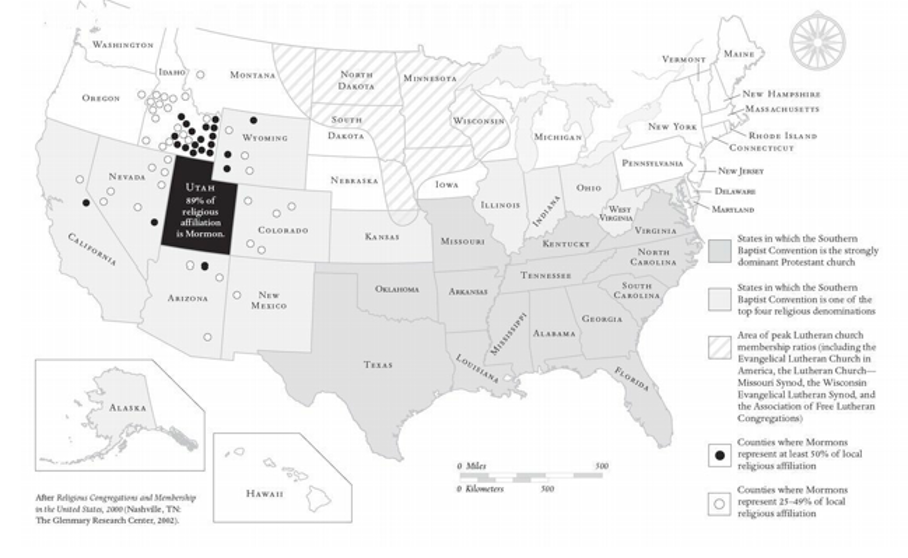
Map of U.S. showing regions shaded by religious denomination

Source: American Theocracy, Kevin Phillips

The Tea Party & the Takeover of the Republican Party

Until the election of Barack Obama, Republican presidential candidates and congressional leaders placated the reactionary, nativist, white Christian faction of the party by nominating right-wing judges and embracing the dog whistles and symbolism of white Christian identity, while making little or no progress reversing the civil rights gains of the 1960’s. Indeed, as late as 2006, the Voting Rights Act was reauthorized with nearly unanimous congressional support, with Bush claiming credit. This White House press releaseannouncing Bush’s signing would be unimaginable coming from any MAGA Republican now.

We very much remember the 2000 election for its razor thin margin and the Supreme Court brazenly intervening to stop the count and select Bush. But we have all but forgotten that the reason the race was as close as it was can be attributed to Bush’s consolidation of the white Evangelical establishment, and with it, Bible Belt voters that made the race that close in the first place.² While Clinton won the Bible Belt by a hair in 1996, Gore lost it by 12 points – and more consequentially, he lost the electoral votes in 7 Bible Belt states Clinton had won.³ And Kerry would lose the region by an even larger margin, 16 points. Bush stressed his own born again experience and did much for the white Christian establishment, including his “faith based” initiatives.

In response to Obama’s victory – and McCain and the Republican establishment’s immediate acceptance of his legitimacy – the nativist faction formed the Tea Party and focused on developing a political strategy to purge the Republican Party of “RINOs.” The last straw for this faction was Romney’s nomination and defeat. They revolted against the business wing’s “Autopsy” report, which in 2013 urged the GOP to moderate on immigration policies and dampen its racial rhetoric to stay competitive in an increasingly diverse electorate. Trump rushed into that political vacuum, smearing Mexicans as rapists and drug dealers. Crucially, unlike Goldwater, who faced a uniformly hostile and demeaning national media, Trump now had the advantage of the extensive right-wing media system that had since been established, which proved essential to his nomination and victory.

Please continue reading this deeply informed post about the underlying trends that have shaped the present moment in American politics.
Linda Lyon, former president of the Arizona School Boards Association, writes in her blog “Restore Reason” about the newly elected State Superintendent of Public Instruction Tom Horne, who held the same office from 2003 to 2013.

He intends, she says, to stop “critical race theory” and “social-emotional learning.” He seems to think that “diversity, equity, and inclusion” are nothing more than left wing propganda. He’s a get-tough guy who will crack down on students and teachers.

She writes:

You’ve heard it said that an old dog can’t learn new tricks. AZ Superintendent of Public Instruction Tom Horne is the living embodiment of this saying. His campaign gave us a preview that he was not going to change his ways. After all, he didn’t tout plans to improve our public schools (he was vying for the position overseeing “public” instruction after all), but rather, posted countless campaign signs shouting, “STOP CRITICAL RACE THEORY”. Never mind that actual CRT, (which rests on the premise that racial bias – intentional or not – is baked into U.S. laws and institutions), is not taught in elementary or secondary schools, but at the university level, most often in law schools. For Republicans, however, the term became synonymous with being “woke” and their focus on “owning the libs” carried Horne back to his old office.

This isn’t a new fight for Horne. After his recent election, MSNBC called him,

a pioneer in the right-wing crusade against school teachings centered on nonwhite people and social inequality.

As evidence, MSNBC cited his fight against “ethnic studies” which led to a ban on such instruction in Arizona schools in 2010. He also banned bilingual education services that same year which the Justice Department found illegal. The ban on ethnic studies held until 2017, when a federal judge overturned it, finding that it had an,

invidious discriminatory racial purpose, and a politically partisan purpose.

At 77, it is no surprise Horne hasn’t changed his spots. After all, it mostly works for him as evidenced by his previous elections to serve as State Superintendent from 2003 to 2011, as well as his election to a term as AZ Attorney General. Now, he’s swept into office on his STOP CRT broom, promising to,

eradicate teaching on diversity and equity and eliminate the use of social emotional learning in Arizona schools.

He’s off to a running start, canceling previously approved diversity presentations at the education conference hosted by his department and wrapping up today. Michaela Rose Classen, an education consultant originally scheduled to speak, expressed worry to the AZ Daily Star about excising social-emotional learning from schools saying,

When students enter the classroom, I think the assumption by some folks is that they just enter ready to learn. But there are different levels of experiences and often trauma that students are bringing into the classroom with them,’ Claussen said. ‘And they’re not quite developed yet emotionally, like we are as adults, to leave it at the door. So we have to really be cautious about how are we paying attention to student needs.

Horne doesn’t believe this type of learning has any place in the classroom. A 2022 Pew Research Poll, however, showed that about two-thirds of parents believe it is important their children’s school teaches social-emotional skills. These skills, in a nutshell, are:

  • Self-Management – managing emotions and behaviors to achieve one’s goals
  • Self-Awareness – recognizing one’s emotions and values as well as one’s strengths and challenges
  • Responsible Decision Making – making ethical, constructive choices about personal and social behavior
  • Relationship Skills – forming positive relationships, working in teams, dealing effectively with conflict
  • Social Awareness – Showing understanding and empathy

As a school board member in my 11th year of service, I can unequivocally say that many of our students need help with social-emotional skills. Should parents and communities teach these skills? YES, ABSOLUTELY!! But, in many cases, this isn’t happening and the global pandemic exacerbated difficulties with students trying to learn and interact with friends remotely. In fact, I’m guessing most would agree that our society in general needs help with these skills more than ever.

Horne, no doubt, thinks our kids just need to “man up” and stick to learning “readin’, writin’, and ‘rithmatic” with his stated focus on improving academics and increasing test scores. Unfortunately, the narrowing of curriculum and “teaching to the test” are making our students less prepared for the real world. And speaking of that, I noted he allowed presentations on suicide prevention at the education conference. Does he not understand the relationship social-emotional learning has on student mental health relating to not only suicide prevention but also the mass shootings plaguing our schools?

Another of Horne’s first acts was to eliminate the Diversity, Equity, and Inclusion Department at ADE, stating that in the context of CRT “equity has come to mean equal outcomes by racial groups”. That may be how sees it, but Google’s Dictionary defines equity as “the quality of being fair and impartial”. Doesn’t this mean we recognize not every child is born with the same opportunities to succeed and we should do what we can to make the opportunities available for those who are willing to apply themselves?

There will no doubt be many battles to fight with Horne, (with his “politically partisan purpose”), leading Arizona’s public schools. The inefficiency of jerking our teachers and students around with policy reversals is frustrating. But it is the potential for setting back another generation of our students that really worries me. As the slogan for the United Negro College Fund states, “A mind is a terrible thing to waste.”

Michael Podhorzer is a keen political analyst who works as political director of the AFL-CIO. His observations in this post are well worth reading.

Andy Beshear was elected Governor of Kentucky in 2019 against Matt Bevin, a hard-right Republican who supported charters and vouchers and fought to reorganize teachers’ pension fund. Beshear, who was State Attorney General, successfully blocked Bevin’s efforts to harm teachers’ pensions.

Andy Beshear is the son of a Kentucky Governor, Steve Beshear (Governor from 2007-2015), and a graduate of Henry Clay High School in Lexington. Andy ran on a program championing public schools. He chose a teacher, Jacqueline Coleman, as his running mate.

Beshear narrowly beat Bevin, and he and Coleman are the only elected Democrats at the state level (remember, Mitch McConnell and Rand Paul are Kentucky’s Senators).

He is running for re-election this year. He leads the polls over all his GOP competitors. His favorability rating is about 60%.

Last year, the legislature passed a bill to authorize charter schools. Governor Beshear vetoed it.

Please listen to his message when he vetoed it.

This is how Democrats win election. By speaking to the 85-90% of people whose children are in public schools and to the 90% who graduated public schools. They want better schools. They like their schools and their teachers. Andy Beshear knows it.

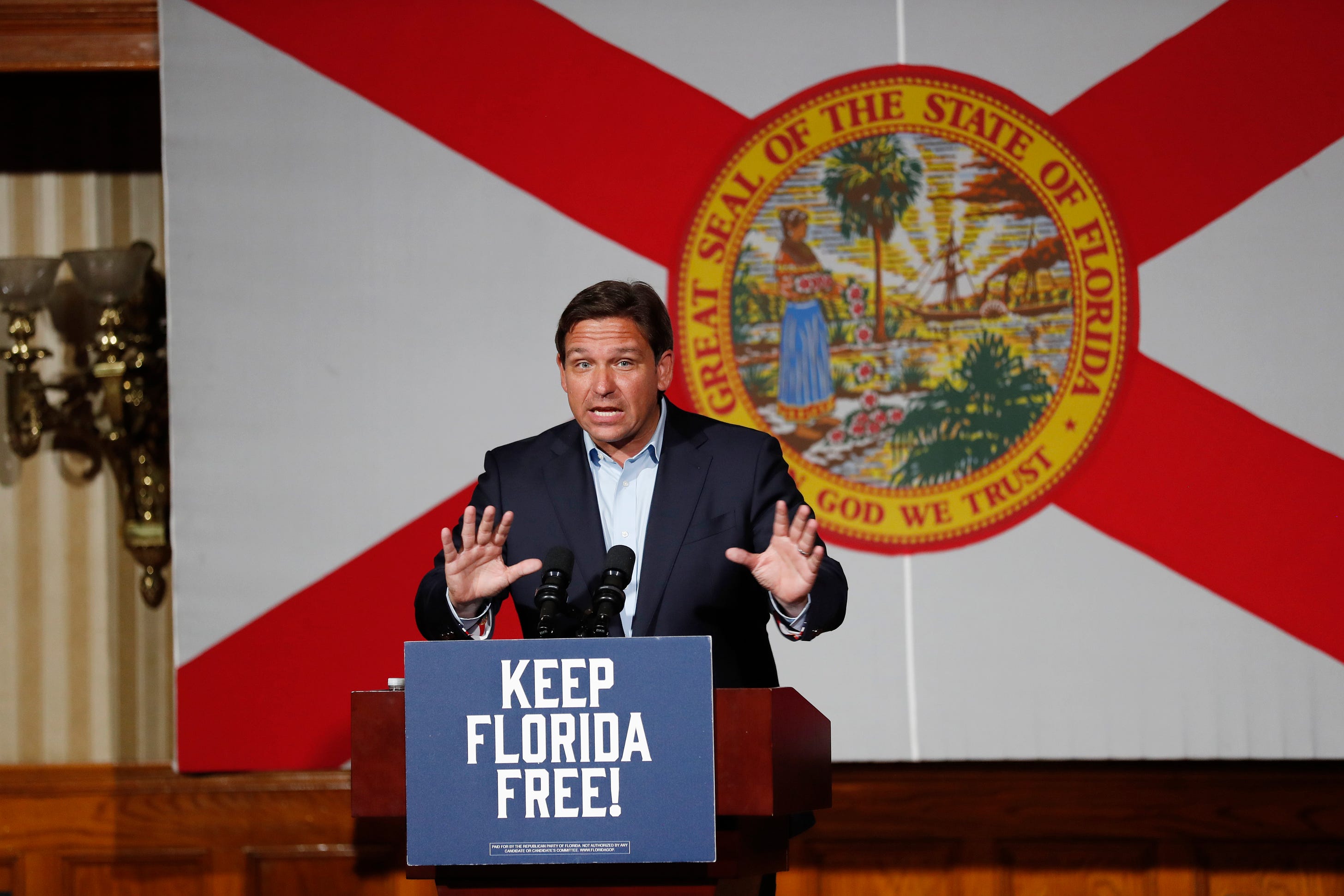
Florida has become a Petri dish for potential fascism. DeSantis has made war on African Americans, on gays, on transgender people, on drag queens, on public schools, on higher education, even on private corporations (Disney). He likes to stand behind signs that declare Florida is “free,” but no one is free to disagree with him. That’s not freedom.

Now DeSantis has proposed to create a military force that answers only to him. To call out the National Guard, he must get federal permission. That’s not good enough for him. He wants a Florida state guard. Some other states have them, but they are not in the hands of a would-be dictator whose vanity knows no limits.

CNN reports:

St, Petersburg, Florida (CNN) — Florida Gov. Ron DeSantis wants to reestablish a World War II-era civilian military force that he, not the Pentagon, would control.

DeSantis pitched the idea Thursday as a way to further support the Florida National Guard during emergencies, like hurricanes. The Florida National Guard has also played a vital role during the pandemic in administering Covid-19 tests and distributing vaccines.

But in a nod to the growing tension between Republican states and the Biden administration over the National Guard, DeSantis also said this unit, called the Florida State Guard, would be “not encumbered by the federal government.” He said this force would give him “the flexibility and the ability needed to respond to events in our state in the most effective way possible.” DeSantis is proposing bringing it back with a volunteer force of 200 civilians, and he is seeking $3.5 million from the state legislature in startup costs to train and equip them.

States have the power to create defense forces separate from the national guard, though not all of them use it. If Florida moves ahead with DeSantis’ plan to reestablish the civilian force, it would become the 23rd active state guard in the country, DeSantis’ office said in a press release, joining California, Texas and New York. These guards are little-known auxiliary forces with origins dating back to the advent of state militias in the 18th century. While states and the Department of Defense share control of the National Guard, state guards are solely in the power of a governor.

Will DeSantis use his state guard to break up peaceful demonstrations? Will he send it to drag shows to close them down? Will he it to harass teachers accused of being woke? The possibilities are frightening.

Paul Vallas is running for mayor of Chicago again. Mercedes Schneider warns the voters of the Windy City to beware.

When Vallas ran before, he garnered only 5% of the vote. But this time, he is a contender. Vallas has a long record in education. He has imposed privatization wherever he went, or in the case of New Orleans, happily advanced the privatization agenda.

She begins her post:

In January 2018, I posted about Paul Vallas, who was at the time dropping hints about becoming Chicago’s next mayor. Vallas ran and lost, winning only 5.4 percent of the vote in the February 2019 general election.

Four years later, in January 2023, Vallas is considered a real possibility (see also hereand here) for at least landing in a mayoral-race runoff following Chicago’s February 28, 2023, general election.

Vallas as mayor would be bad news for Chicago. Full stop. On January 24, 2023, the Chicago Tribune posted this benign candidate bio for Vallas, but don’t be fooled, Chicago. Vallas is anything but benign.

Chicago voters need to be informed about what they would be getting should Vallas become mayor. Therefore, I am reposting some of the Vallas history I posted four years ago, in 2018.

Vallas is terrible with budgets and with fulfilling promises, but through it all, he has managed to serve and protect his own interests.

Please open the link and read her summary of Vallas’ career.

Christopher Lubienski is Professor of Education Policy and director of the Center for Evaluation and Policy Analysis at Indiana University. Among his publications is The Public School Advantage: Why Public Schools Outperform Private Schools. In this article, which appeared in The Tennessean, he points out that vouchers are unpopular as well as ineffective. So unpopular are they that they are usually sold another another name, like “education scholarships.”

He writes:

Recently, a panel of judges dismissed lawsuits against Tennessee’s private school voucher program passed by the General Assembly back in 2019. A month before that decision, the West Virginia Supreme Court ruled in favor of its legislature’s efforts to implement a universal voucher program. These types of legal victories may seem like good news for parents’ rights, but they are also a reminder that the school choice movement is missing a key source of support: the voters.

School choice is continuing to expand across the United States. New Hampshire implemented a statewide voucher program in 2021, and this year Arizona legislators also adopted a universal voucher program.

But these successes often come in spite of overwhelming voter opposition to school choice programs. Arizona lawmakers had passed a similar measure in 2018, only to see the initiative soundly rejected by a 2-to-1 margin at the ballot box. This time around, policymakers successfully undercut an effort to put their initiative back before the electorate.

In Michigan, school choice advocates appeared to have ignored a deadline to place their proposal for a voucher program on the ballot. Since such measures had been overwhelmingly rejected by Michigan voters twice before, voucher proponents instead exploited a quirk in state law that allowed them to put the issue directly before the GOP-run legislature while preempting any veto from the Democratic governor. (Unfortunately for their plan, Michigan voters then flipped the legislature to Democratic control.)

This voter-avoidance strategy is clear with school choice programs across the U.S. According to the pro-voucher organization EdChoice.org, the U.S. has over 75 publicly funded private school choice programs, including vouchers and education savings accounts, as well as another 45 charter school programs. But all of these programs have been implemented by legislators, not the electorate. Following these legislative actions, judges, not voters, can get their say.

In fact, voters have been allowed to weigh in on school choice programs only nine times since 2000, and they almost always reject them, often by overwhelming margins. Only twice did school choice programs pass through the ballot box. In 2012 Georgia voters empowered their legislature with the ability to create charter schools. That same year, although they had clearly rejected it twice before, Washington voters passed a charter school referendum by the slimmest of margins following financial support from Bill Gates and associates for the measure.

This reflects an interesting conflict. Parents seem to like choice programs. Perhaps that’s not surprising, since people are often happy to receive public subsidies. But when asked, voters consistently and overwhelmingly reject these programs.

Policymakers and choice advocates have largely come down on the side of parent rights in endorsing school choice. Since this puts them in opposition to voters, they largely avoid the electorate on the issue.

But policymakers would do well to remember that this is not just a question of who controls education decision-making. After all, they are entrusted with the wise use of taxpayers’ dollars. And recent research is repeatedly showing that the voters may be on to something: that vouchers are not a good investment. Although publicly funded vouchers may be propping up some private schools that might otherwise go out of business, they are not really helping the people they purport to help. In fact, despite parent satisfaction, study after study shows that students using vouchers are falling behind where they would have been if they had remained in public schools. Thus, policymakers might think twice about defying voters on initiatives that actually cause harm to children.

It’s a curious approach for a movement that claims to be working for the grass roots.

You can view the post at this link : https://networkforpubliceducation.org/blog-content/christopher-lubienski-the-school-choice-movement-has-a-voter-problem/

Two of the reddest states in the nation had the largest numbers of people signing up for Obamacare. This reflects the size of their population but also their needs. Their governors may rant against the federal government and its programs, but actions speak louder than words. The public wants what the politicians deride. Yet the public elects the people who deny their basic needs.

Florida led the way with the highest number of people in the country who signed up for health insurance under the Affordable Care Act, with more than 3.2 million people enrolling, or 20 percent of the country’s totals.

A record 16.3 million people nationwide signed up for plans on the federal health insurance exchange during the open enrollment period, which began Nov. 1 and ended on Jan. 15, the Centers for Medicare & Medicaid Services reported Wednesday.

In Florida, enrollment ballooned to 3.2 million, a 19% jump over last year’s open enrollment period under the health law, commonly known as Obamacare.

The 3.2 million represents 20 percent of all enrollees nationwide, even though Florida, the third most populous state in the country with 22 million people, accounts for only about 7 percent of the U.S. population…

For University of Miami professor Dr. Olveen Carrasquillo, an expert on the Affordable Care Act, Florida’s enrollment spike is likely an indication ofoutreach efforts, a lack of jobs that provide health coverage, and that Florida is one of 11 states that did not expand Medicaid eligibility through the Affordable Care Act (ACA).

About 425,000 adults in Florida don’t have health insurance because they are too poor to qualify for coverage under the ACA and the state hasn’t expanded Medicaid, according to the Center on Budget and Policy Priorities. More than half of those adults are Hispanic or Black.

“It shows that there’s a major need for health insurance in our state,” said Carrasquillo, who serves as UM’s dean for Clinical and Translational Research and is also co-director of the Clinical Translational Science Institute.

Almost a million Floridians could lose their Medicaid coverage starting in April once the federal COVID-19 emergency comes to an end, and because Florida didn’t expand its Medicaid eligibility.

Floridians fall into this coverage gap because their incomes fall above the state’s eligibility for Medicaid but below the federal poverty line, making them ineligible for Medicaid, a health insurance program run jointly by the federal government and states.

They would also be ineligible for coverage within the Affordable Care Act marketplace. To qualify for Medicaid in Florida, parents must earn less than 31 percent of the federal poverty line, or less than $6,807 for a family of three, the Center on Budget and Policy Priorities estimates.

Texas has the second-highest enrollment in Affordable Care Act plans among states that used the federal marketplace, with 2.4 million enrollees, according to the Centers for Medicare & Medicaid Services.

Read more at: https://www.miamiherald.com/news/health-care/article271638107.html#storylink=cpy

Dan Rather and Elliott Kirschner write a blog called Steady. Their voice is always thoughtful, reasonable, informed, and…steady. I think that they, like me, are old enough to remember when we believed that overt racism was ebbing and that white supremacy was dead. Our hopes have been shattered since 2016. It takes the use of critical race theory to understand why we were so naive. Here is their take on the big Education story of the day:

Photo credit: Octavio Jones

Editor’s note: this is an ironic banner in front of DeSantis. Florida is not free for those who don’t share his ideology. If you think racism exists today in Florida, you are not free to discuss it in school or college. You are free to agree with him.

Rather and Kirschner write:

Much of American history is entangled with racism and white supremacy. That is the reality of our beloved nation, no matter how much we wish it were not.

As we sit here nearly a quarter of the way through the 21st century, it is obvious that we need to have the maturity to look back to our past as well as ahead to the future. Can we do this with our eyes wide open? Will we study and learn from the lessons of history?

You can’t grapple with the truth if you hide it from view. Yes, our national narrative is an inspiring one — of freedom, rights, and new opportunities. But it is also a narrative of pain — of the bondage, rape, and murder of enslaved people. It is a story of mass death, broken treaties, and land stolen from Native people. And it is a story of persecution of the “other,” time and again.

The chasm between the noble promises of our founding documents and our historical realities continues to obstruct our national journey toward a more perfect union.

Yes, ours is a country that has facilitated exploration, innovation, and growth, but it is also one built upon families torn apart at the auction block, bodies whipped, and police dogs and fire hoses set against children.

Cities were redlined. Public schools were segregated. And despite our carefully cultivated national image as a meritocracy, throughout our history we have seen talent overlooked and our common humanity diminished on account of people’s race, religion, and sexual orientation.

The ripples of injustice continue to destabilize our society.

It shouldn’t be controversial to say any of this. But acknowledging these truths today is a political act, because it threatens the privileged narratives of those who seek to sugarcoat our past. These are men and women who serve their own ambitions by fortifying their cynical holds on power, delighting in division, feeding off fear, and applauding anger.

And that brings us to Florida’s Governor Ron DeSantis.

Listing all of his efforts to leverage the power of his office to attack equity, empathy, and justice would stretch this post immeasurably. But doing so would also jeopardize the central point: DeSantis is an opportunist. He is not weighing the merits of any one campaign. Rather, he wants headlines as a culture warrior standing up to “wokeness,” a term he has eagerly redefined to suit his own purposes. It allows him to sneer at and dismiss any attempt to reckon with American injustice.

DeSantis has focused his assaults on two of our society’s most traditionally marginalized groups: Black Americans and the LGBTQ community. While these populations have thus far felt the brunt of his targeting, we need to see clearly that his rhetoric is a threat to all who care about a democratic, peaceful, empathetic, and just America. Those of us with the greatest privilege should bear a special burden in rejecting this hate.

DeSantis’s pugilism has enabled him to consolidate power in Florida. Any opposition to his toxic initiatives must contend with the uncomfortable truth that voters validated his message and style via his landslide win in November. Now DeSantis thinks he can take his show on the road with a presidential bid. That remains to be seen. Florida has been trending Republican in recent years, and success there might not translate to the current battleground states, many of which saw big Democratic wins in the midterms.

All that being said, there is a great danger to framing this struggle primarily through the lens of electoral politics. This normalizes a discourse that should be rejected by society’s mainstream. Just as the outright bigotry of the past became socially unacceptable, so too should these latest attempts at divisiveness.

It should not surprise us that DeSantis is making schools — both K-12 and college — a central target. He wants to teach a distorted view of America. He wants to make dissenting speech not only suspect but even criminal. He wants to silence the voices of his critics and of critical thinking more generally. This is a playbook that has been followed by demagogues before to very dangerous ends.

It is essential that DeSantis not be covered by the press through a false equivalence paradigm. We can debate what we should teach and how to teach it. But we can’t replace the truth, as unsavory as it may be, with sanitized narratives that suit those already in power. This is a battle for the minds of the voters of the future. This is about what kind of nation we will become.

But DeSantis primarily cares about what kind of country we are now. He wants to appeal to fear because he thinks he can mine that fear for votes. That is his game plan. And he’s not hiding it. There can be no appeasement. DeSantis has already shown that he isn’t interested in deliberations or good faith compromise. Those would disrupt his approach of means to an end.

History illustrates that hatred can be taught, but so can empathy and justice. We are on a winding journey as a nation. And we have much farther to go. But we have made progress in the face of bigots and autocrats because people had the courage to forge the inequities of our past into a more equitable future.

This history, this truth, is what scares people like DeSantis the most. But it is one that can give us hope if we are determined not to look away.

Robert Hubbell writes a thoughtful, informative blog. I’m posting this as part of my personal project to understand the new face of white supremacy. White supremacy has always been there, simmering below the surface. Trump invited them to show their faces and step into the daylight. They did, and DeSantis is sending them signals that he wants to be their champion.

Florida Governor Ron DeSantis has set his anti-education sites on Florida’s state colleges. Through a series of political and legal maneuvers, he has ceded control over Florida’s state colleges to ultra-conservative culture warriors like Christopher Rufo. In short order, DeSantis has announced that he will rid Florida state colleges and universities of curricula not “rooted in Western tradition” or that “compels belief in critical race theory or related concepts such as intersectionality.”

Amid the torrent of reporting on Ron DeSantis’s attack on critical race theory and intersectionality, the quiet part is often left unsaid. So let me say it: DeSantis’s educational agenda is code for racism and white supremacy. (Other parts of his agenda seek to erase the dignity and humanity of LGBTQ people.) DeSantis’s invocation of “Western tradition” is meant to suppress knowledge regarding the people (and contributions) of Asia, Africa, South America, Oceania, and the Indigenous Peoples of the Americas. See Talking Points Memo, DeSantis Makes 2024 Ambitions Clear As He Pours Gasoline On His ‘Woke’ Education Fire.

Given DeSantis’s generalized ignorance, his call to focus on “Western tradition” is a slippery slope that will inevitably lead to the discussion of unpleasant truths about America. For example, the enslavement of Black people was a “tradition” in North America for 246 years—and the abolition of that evil practice is relatively recent (155 years ago). So, a college course that honestly addresses the Western “traditions” of North America should include an examination that the role of slavery played in the economic, social, and political development of America.

But DeSantis isn’t stopping at converting Florida’s colleges and universities into re-education camps in the worst traditions of the USSR. He is seeking to up-end centuries of “Western tradition” embodied in the Constitution and the English common law: the requirement of a unanimous jury to impose capital punishment. DeSantis has floated the idea that a less-than-unanimous jury verdict can impose a sentence of death—an unconstitutional proposal designed to inflict the death penalty on more Black and Latino Americans. See Vox, Ron DeSantis wants to make it much easier for the state to kill people.

DeSantis is willing to do all this because he wants to capture Trump’s loyal base—which is the only hope that DeSantis has of becoming a credible candidate. As Trump becomes mired in criminal prosecutions, DeSantis will become emboldened and radicalized beyond his already extremist views. Doing so ignores the lessons of the 2022 midterms: persuadable Americans are done with Trump and his MAGA extremism. Like all military generals, Ron DeSantis is fighting the last war (the presidential election of 2020) and has failed to heed the tectonic shift that occurred in the midterms.