Archives for category: Education Industry

Recently, Republicans in Pennsylvania lambasted public schools for wasting money by setting up reserve funds for a rainy day. Meanwhile the State throws away hundreds of millions every year to pay for low-performing, unaccountable, profitable cyber charters.

Two Democratic legislators—Rep. Ismail “Izzy” Smith-Wade-El and Rep. Mike Sturla—wrote a rebuttal to the Republicans:

Republicans have criticized 12 school districts — including the School District of Lancaster, Penn Manor and Hempfield — for following normal procedures by making sure their general funds are healthy and able to support the many projects and upgrades all districts must contend with, especially in these difficult times.

The attack was inspired by an audit conducted by Pennsylvania Auditor General Timothy DeFoor….

In an interview with WITF, Auditor DeFoor questioned the need for school districts to maintain reserves at all, stating, “As far as putting money away for a rainy day, that’s great for a private individual such as ourselves, but not necessarily for a governmental entity.”

To embrace this view would be highly irresponsible. Fund balances are not recurring, so it would be inappropriate to use them for recurring expenses like salaries. This would lead many school districts to quickly go into the red. Additionally, any school district chief financial officer would attest to how one-time expenses come up all the time — and school districts must always be prepared for the worst. To suggest that districts should only be able to raise taxes if they have no fund balance goes against any solid financial principles.

The commonwealth itself, with the assistance of the GOP, recently added money into its rainy day fund, which at nearly $5 billion is the largest in state history. To turn around and criticize our local schools for saving for rainy days is simply hypocritical…

Currently, 447 out of 500 school districts have signed a resolution demanding commonsense charter school funding reform to ease some of the burden, yet none of the proposed bills to address the situation were ever brought up for a vote in the last legislative session when our colleagues across the aisle controlled the state House.

In the 2020-21 school year, Pennsylvanians spent more than $1 billion on students enrolled in cybercharter schools.

Tuition for an independent cybercharter is considerably higher than for an online education program offered by a school district. And these cybercharter schools charge highly inflated tuition rates for students who have special needs — allowing them to profit from students with disabilities at the cost of local taxpayers. What are these cybercharter companies doing with that extra taxpayer money? Research suggests that the money is spent on advertising, executive salaries, other administrative costs — and, according to Research for Action, a Philadelphia-based education research group, carrying high fund balances. This all comes at the expense of our friends and neighbors struggling to afford their homes. This is wrong.

We encourage our fellow state House members to join us in fighting for more accountability from our state’s charter and cybercharter schools by ensuring that there is a single statewide tuition rate for regular and special education students that matches tuition to the actual costs of educating students at home on a computer. We need to ensure that cyberschools — which do not have the same operating costs of our local brick-and-mortar public schools — are especially held accountable when it comes to matching tuition fees with the actual cost of educating their students.

The 74 Million—a news site funded by charter supporters and billionaires—reports that Rep. Hakeem Jeffries will downplay his support for charter schools now that he is Minority Leader of House Democrats. Charters have lost ground among Democrats, and Jeffries wants to unite the party. Importantly, he doesn’t want to alienate the teachers’ unions, which are an important part of the Democratic Party’s base.

Most Democratic members of Congress realized that charters were a step towards vouchers, and that both were deeply embedded in the Trump MAGA agenda.

For a time, during the Obama years, Obama and his Secretary of Education Arne Duncan sold charters as a “progressive” idea that would nurture innovation. After thirty years, the charter claims dimmed. Too many scandals, too little innovation. Too many charter chains making profits or paying outlandish salaries. Too many charters that opened and closed within three years. Too many charters that believed harsh discipline was “innovative.”

The charter lobby considered Hakeem Jeffries one of its best friends, but that was before Trump chose Betsy DeVos as Secretary of Education. She was an outspoken friend of School choice, including charter schools. In recent years, red states have embraced charters and vouchers in their frenzy to privatize public schools and transfer public funding to private organizations.

Now, it’s clear to most Democrats that Republicans own the issue of charters and vouchers, not Democrats.

When Biden’s Secretary of Education Miguel Cardona proposed modest rules to clean up the federal Charter Schools Program, which hands out $440 million a year to start new charter schools, the charter lobby made wild claims about how any accountability would irreparably harm new charters, but Democrats didn’t go along. The usual charter supporters in the Senate—Booker, Bennett, and Feinstein—complained about the new rules, but when the Senate voted on a motion to overturn them, not a single Democrat voted for the motion.

Today, the strongest allies of charter schools in Congress are conservative Republicans, like Virginia Foxx (NC), chair of the House Education Committee.

Peter Greene takes a hard look at the real goals of the voucher crowd: to kill public education. Not by offering better choices but by defunding it, step by step.

Doug Mastriano was not out of step with the movement; he was just a bit early.

Mastriano ran for governor of Pennsylvania with the idea that he could end real estate taxes entirely and cut state funding for public schools to $0.00. Just give everyone a tiny voucher and send them on their way. The idea was far enough out there that the campaigntried to back away from it (without entirely disowning it) and even other GOP politicians raised eyebrows and said, “No, not that.”You slice them off at the knees, right here–

The thing is, this is not a new idea. It has been the fondest dream of some choicers all along. Nancy MacLean, professor of history and public policy at Duke University, offered a succinct digest in the Washington Post of what Milton Friedman, granddaddy of the not-overtly-racist wing of the school choice movement, thought about the movement and its ultimate goals.Friedman, too, was interested in far more than school choice. He and his libertarian allies saw vouchers as a temporary first step on the path to school privatization. He didn’t intend for governments to subsidize private education forever. Rather, once the public schools were gone, Friedman envisioned parents eventually shouldering the full cost of private schooling without support from taxpayers. Only in some “charity” cases might governments still provide funding for tuition.

Friedman first articulated this outlook in his 1955 manifesto, but he clung to it for half a century, explaining in 2004, “In my ideal world, government would not be responsible for providing education any more than it is for providing food and clothing.” Four months before his death in 2006, when he spoke to a meeting of the conservative American Legislative Exchange Council (ALEC), he was especially frank. Addressing how to give parents control of their children’s education, Friedman said, “The ideal way would be to abolish the public school system and eliminate all the taxes that pay for it.

You don’t have to set the wayback machine to find folks saying this quiet part out loud. Utah is one of several red states racing to ram through a voucher bill. Here’s Allison Sorenson, executive director of Utah Fits For All, an outfit marketing the voucher plan like crazy; in this clip, she’s explaining that the folks who back Utah’s plan can’t come right out and say they’re going to defund public education entirely, that admitting the goal is to destroy public education would be too politically touchy.

Vouchers are not about choice. Just look at Florida, which has worked to disrupt, defund and dismantle public schools for years, while simultaneously shutting down and limiting what choices schools are allowed to offer. Look at every state’s voucher law; they all enshrine a private “education provider’s” right to deny and discriminate as they wish, thereby denying choice to any students they wish to deny choice to. One of the biggest limiters of school choice is not the public system, but the private system’s unwillingness to open their doors to all these students who, we hear, are just thirsting for choices.

We know what a free market education system looks like–it looks like the US post-secondary education system. Occasional attempts at free-to-all schools are beaten down by racist and classist arguments, along with charges of socialist indoctrination. You get as much choice as you can afford, the private schools only accept (and keep) the students they want, and those who aspire to certain levels of schooling have to sink themselves in debt to get it. Meanwhile, state’s slowly but surely withdraw financial support from the few “public” universities left.

Please open the link and finish his article.

Lisa Graves and Alyssa Bowen recently reviewed the tax returns of some well-known “parent” groups and discovered what we suspected to be true. They are funded by Dark Money, specifically by billionaire Charles Koch, who longs to eliminate public education.

They write in Truthout:

Right-wing operatives are increasing their attacks on U.S. public education with an expanding number of legal complaints to censor books and target teachers on an array of issues —preventing them from teaching U.S. history accurately, treating LGBTQ+ students with the respect they deserve, and forming support groups for kids and teachers of color. These attacks will likely continue to escalate through 2024 as wedge issues intended to feed the right-wing voting base and lay the groundwork for redirecting funds from public schools to private recipients.

One of the main players in these attacks is Parents Defending Education (PDE), a dark money nonprofit group launched in 2021 in the midst of the Virginia state election cycle. Over the past two years, PDE has become a central actor in the right-wing assault on public schools across the nation. The group has trained local agitators to grab media attention, sued school districts for supposed anti-white discrimination, and railed against the teaching of social emotional learning, accurate U.S. history, and even ethnic studiesin schools.

Lawyers affiliated with PDE filed at least four complaints in January with the U.S. Department of Education claiming affinity groups for kids or teachers are illegal. These are just a few of the many complaints the group has filed over the past two years.

As dark money in education expert Maurice Cunningham has written, PDE’s “real goal” in filing lawsuits and complaints appears to be to “create media attention and promote chaos and disruption.” Then groups like PDE can claim the solution to the chaos is increased right-wing “parental supervision” over school boards. That supervision appears to involve a minority of vocal, politically motivated parents dictating what other people’s kids are taught or what they can read, based on whether such lessons or books are consistent with their right-wing religious beliefs and political opinions.

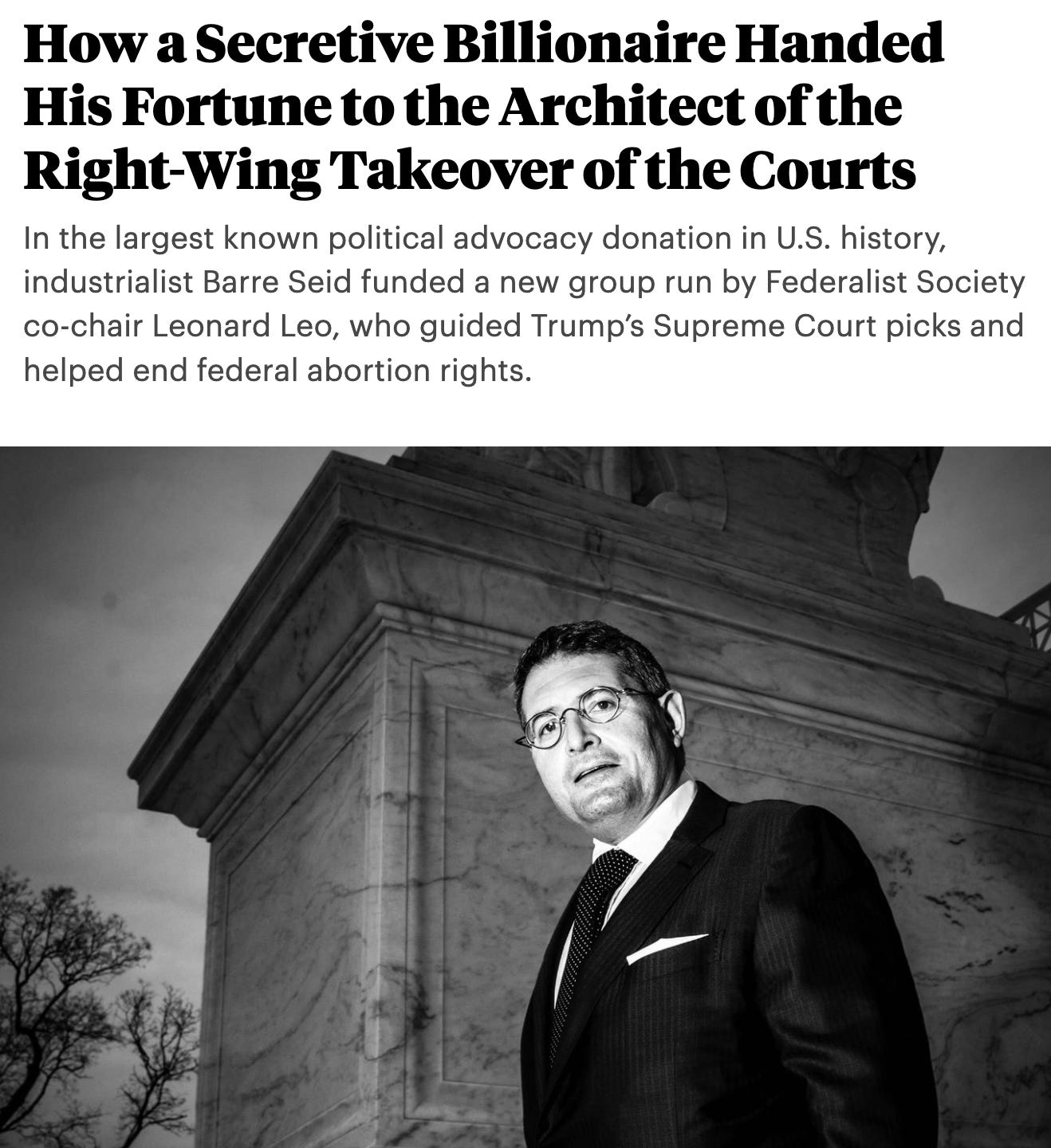
Illustration of Leonard Leo and a rain of judge's gavels

Groups Connected With Leonard Leo Have Funneled $31 Million to State Court Races

PDE’s speakers are often portrayed in the media as simply “concerned parents,” despite the group’s ties to the network of oil billionaire Charles Koch, far right politicians and school privatization efforts. Due to the timetables for the filing of nonprofit IRS forms, the amount PDE had raised to mount these attacks was unknown — until now.

PDE’s 2021 990 nonprofit IRS form shows that the group raised more than $3.1 million in its first year, even though many genuinely local grassroots efforts take years to raise that much money. That form does not reveal how much money PDE raised in 2022, during the congressional midterm elections; the amount it received to fuel its operations last year is likely even higher than 2021. The $3.1 million disclosed for 2021 also does not include any money raised that year by PDE Action, its (c)(4) advocacy arm.

Please open the link and keep reading this deep dive into astroturf parent groups funded by the far right billionaires.

Jacob Goodwin is a sixth-grade teacher in New Hampshire, where the State Commissioner (who home-schooled his own children) is pushing a vastly expanded voucher plan. Parents should be aware that federal anti-discrimination statutes do not apply to private and religious schools. You may think you are exercising your “choice,” but it’s the school that chooses its students.

Goodwin writes in The Progressive:

A new lawsuit is challenging the voucher scheme of Frank Edelblut, New Hampshire’s commissioner of education. Edelblut, formerly an accountant, lacks meaningful experience in the field of education outside his politically appointed post. He is being sued by the American Federation of Teachers for allegedly misusing funds that were meant solely for public schools in the state.

The statutory requirement for the disbursement of public money prohibits all other financial transactions, which the plaintiffs argue extends to providing public money to private and religious schools—something that the voucher law has done.

The current voucher expenditures have ballooned to over $20 million, despite the commissioner having promised that the cost of the program would be nearly one-tenth the current taxpayer obligation. Funneling dollars to the voucher program is detrimental to public schools and the students they serve.

This diversion of public money away from public schools came at a time when schools in New Hampshire—and across the country—were having difficulty retaining staff, especially support staff who work with children with special needs. While there are education support professionals making less than $15 per hour, the commissioner has spent lavishly on schools that are not even required to fulfill Individualized Education Plans, which are designed to meet students’ special needs and backed by Federal law. In other words, the ill-devised voucher scheme both makes it more difficult for public districts to fill the positions to help students currently qualifying for legally mandated services and gives that money away to places that can ignore documented disabilities…

Students deserve our support, and vouchers aimed at helping the well-to-do at the cost of providing support to the most vulnerable is simply unjustifiable. This includes regressive voucher laws that send public money to schools with no public accountability and with no requirement to aid special needs students. Still, states like New Hampshire are considering expanding such programs, effectively defunding established and regulated professional public services for special education. The thought of this is a travesty. The impact: a devastating blow to disability rights.

David DeMatthews of the University of Texas and David S. Knight of the University of Washington wrote this article, which appeared in The Hill, a D.C. site. It’s by now well-established that students who take vouchers suffer academically; that vouchers will sudsidize the students already enrolled in private and religious schools; and that states will pay huge sums to underwrite affluent families. The Texas Observer, for example, estimated that if the 309,000 students currently in private schools get vouchers, the state’s public schools will lose $3 billion in the first year alone. What is more, voucher schools are free to discriminate on any basis, and they are exempt from any accountability.

They write:

School vouchers are a taxpayer swindle that fails to raise achievement while eroding public schools and the principle of equal protection under the law outlined in the U.S. Constitution. If more states adopt school voucher systems, most parents will find their top choice — a neighborhood public school — largely defunded and unable to recruit and retain high-quality teachers due to a transfer of funds into unregulated private schools.

Americans from all backgrounds have fought to gain access to public schools, including freed slaves, immigrants and people with disabilities. These struggles have led to a free universal public education system that propels each child into our democracy, communities and economy. Public schools also serve as community hubs where neighborhoods gather to vote, watch sports, participate in townhalls, among many other public events.

Vouchers jeopardize all of this because they transfer money from public schools to individual parents through grants, savings accounts or scholarships to pay private school tuition. It is a system where self-interest replaces the common good, culminating in separate education systems for children living on the same street in the same community.

Voucher supporters say parents know what is best for their children, but that is not necessarily the case. As education researchers, we know that voucher systems have led to significant declines in student achievement for voucher users in Louisiana, Indiana, New York City and Washington, D.C., especially for low-income students. In a study on the effects of the Louisiana Scholarship Program — a large voucher program established in 2008 and expanded in 2012 — researchers found that students participating in the voucher program were significantly behind their peers in reading and mathematics after four years.

There should also be concern that despite these well-documented failures, billionaires such as Betsy DeVos of Michigan and Charles Koch of Kansas use their fortunes to reportedly subvert state elections from thousands of miles away. This is not about parent choice or student achievement. It is political. null

Sadly, some state policymakers adopt equally hypocritical policy positions as they support vouchers. For example, Texas Gov. Greg Abbott (R) has become a vocal voucher supporter, yet he’s also a supporter of high-stakes accountability. Texas battled in court for years to take control of the Houston Independent School District due to low performance. So, on one hand, the state is supporting accountability for public school performance, and on the other hand, there is support for vouchers — a policy where taxpayer dollars are transferred to private schools that do not follow state accountability standards and where the state has virtually no oversight.

Florida Gov. Ron DeSantis (R) is also a voucher supporter. In 2022, DeSantis signed legislation dubbed the “Don’t Say Gay” bill that banned classroom instruction on sexual orientation and gender identity — yet, his state’s voucher program has no oversight over private school curricula. This means a private school receiving taxpayer dollars can teach about sexual orientation and gender identity without any legal recourse from the state.

In Arizona, former Gov. Doug Ducey (R) supported voucher legislation based on his belief that it would “offer all families the option to choose the school setting that works best for them.” Nevertheless, Arizona’s voucher system has been overwhelmingly used by wealthy families that were already sending their children to private schools before voucher legislation. Few low-income families could afford private school tuition and transportation with the voucher — a predictable policy shortcoming.

To make matters worse, current and pending voucher legislation could even reportedly fund racist curricula. Recently, a Nazi homeschooling group in Ohio stated they were creating “Nazi-approved homeschool material.” Under Ohio state law and many current and proposed voucher laws, states would be left powerless to intervene if a private school adopted such a curriculum.

Vouchers just do not make sense, and we should recognize that vouchers offer a false choice. What parent wants the choice to defund public education while transferring taxpayer money to unaccountable private schools that do not improve student achievement but can deny admission, discriminate against children and develop ineffective or harmful curriculum without any recourse?

David DeMatthews is an associate professor in the Department of Educational Leadership and Policy at The University of Texas at Austin.

David S. Knight is an associate professor of education finance and policy at the University of Washington.

A recap: The College Board is the owner of the Advanced Placement program, which provides a syllabus and an examination based on that syllabus. The organization is officially nonprofit, but it is a business that pays large salaries ($1 million+) to its top executives and relies on its revenue stream from the SAT and AP.

The College Board has engaged with leading scholars over the past two years. As the course grew closer to completion, it held meetings with state officials to collect feedback.

Florida has sought to be in the forefront of states banning a vague concept called “critical race theory,” which many teachers see as censorship of any discussion of racism in the past or present.

Florida officials denounced the early draft of the College Board syllabus. When the final draft was released on February 1, all of the topics and names that Florida singled out were either eliminated or made optional.

The College Board insisted that it did not cave to political pressure but stood its ground.

Unpersuaded, more than 1,000 scholars and supporters of African American studies signed a letter of protest to the College Board.

More than 1000 African American studies faculty members, administrators and supporters in higher education condemned the College Board’s capitulation to the Florida Department of Education in the creation of the Advanced Placement African American studies course.

In a letter addressed to College Board CEO David Coleman, the collective called for the current curriculum to be rescinded, resources be made available for students “confronting censored AP content,” to stop making false claims that the current class properly teaches African American studies and to fight “widespread efforts by states to censor anti-racist thought.”

“African American Studies is the study of the persistence of anti-Blackness and the connections between historical and contemporary efforts to resist structural racism,” the letter read. “It is an interdisciplinary engagement with the ways in which people of African descent remade and re-envisioned the world through ideas, art, politics and social movements despite the enduring character of white supremacy.”

The letter said the College Board did not uphold its “commitments against politically-motivated meddling” and specifically took issue with the removal of terms like systemic racism and intersectionality at Florida’s request, which “demean, malign and caricature Black life and the study of it.”

Signees contend that the current curriculum now lacks the fundamental aspects of African American studies and if not rescinded, some faculty will advise their institutions against accepting the AP credit.

“As a result, students may take the course without ever encountering key words and related concepts in the field including intersectionality, Black feminism, racial color blindness, institutional racism, and Black Lives Matter,” the letter read.

“Students and educators cannot engage these topics and ideas if the terms themselves are censored, as the terms themselves convey critical insights that are central to African American Studies. African American Studies is more than the study of the Black past.’”

Read more at: https://www.miamiherald.com/news/politics-government/article272531681.html#storylink=cpy

Here is the most important election of 2023: Control of the Wisconsin Supreme Court. The election is April 4, 2023.

The current Court is 4-3, with a Republican majority. A win by Democrats will reverse the balance and be crucial on issues of abortion, gerrymandering, and schools. It is also a chance to reverse the damage done by Republican Scott Walker.

Charlie Sykes writes in The Bulwark, a site established by Never-Trumpers:

The election that the media has dubbed “the most important election nobody’s ever heard of,” is just weeks away, and has already drawn international attention.

The “Stakes are monstrous,” declared Britain’s Guardian. “Wisconsin judicial race is 2023’s key election.”

Voting is under way in an under-the-radar race that could wind up being the most important election in America this year.

The NYT headlined: “2023’s Biggest, Most Unusual Race Centers on Abortion and Democracy.” Within weeks, the Times reported, “Wisconsin will hold an election that carries bigger policy stakes than any other contest in America in 2023.”

The state’s high court now has a 4-3 conservative majority, but one of the conservative members is retiring, which has created an opening for progressives to flip the high court for the first time in decades.

And everything is on the line: from Act 10, which limited public employee collective bargaining rights, to gerrymandering, abortion, and the way presidential elections are decided.

“If you change control of the Supreme Court from relatively conservative to fairly liberal, that will be a big, big change and that would last for quite a while,” said David T. Prosser Jr., a conservative former justice who retired from the court in 2016.

The contest will almost certainly shatter spending records for a judicial election in any state, and could even double the current most expensive race. Wisconsinites are set to be inundated by a barrage of advertising, turning a typically sleepy spring election into the latest marker in the state’s nonstop political season.

The Wapo reports that the election “will have sweeping consequences, as the court in the coming years is likely to decide whether to uphold the state’s near-total ban on abortion. It also could wade into disputes over gerrymandering and the outcome of the next presidential election.”

The Bulwark’s headline also captured the stakes “Wisconsin Supreme Court Race a Test for Democracy.”

On paper, the contest is non-partisan, but nobody even bothers to pretend anymore. Next Tuesday’s free-for-all primary includes four candidates: two progressives: Janet Protasiewicz and Everett Mitchell; and two conservatives: Dan Kelly and Jennifer Dorow.

The conventional wisdom (which is likely correct) is that the primary will set up a contest between left and right. The same conventional wisdom (on both sides of aisle) thinks that Protasiewicz is the strongest progressive candidate, while Dorow — who achieved a sort of media stardom for presiding over a high-profile criminal case — is the most electable conservative. Kelly, who was named to the Court by former Governor Scott Walker at the urging of the Federalist Society, has already lost a statewide election — a rare defeat for an incumbent justice.

**

But now we get to the strangest twist in this high-stakes story: After decades of ignoring or downplaying crucial judicial elections like this one, Democrats and their allies are very much focused on the Wisconsin contest.

Meanwhile, Wisconsin conservatives have chosen this moment to crack up.

While progressive dollars pour into the state, Republicans have launched a bitter, high-stakes, and often quite personal, civil war that seems designed to take out the candidate who may give them the best chance to hold onto control of the state’s high court…

To finish the article, subscribe to The Bulwark.

The Chicago mayoral election is February 28. Nine candidates are running. If no candidate wins a majority, there will be a runoff on April 4. You can read about the candidates here.

One of the candidates who is faring well in the polls is Paul Vallas. He is of interest to parents and educators because most of his professional career has been spent as a leader of school districts, although he is not an educator. He introduced a bold experiment in privatization in Philadelphia, which failed. After Vallas left Philly, the district was taken over by the state. He lost his position as superintendent in Bridgeport, Connecticut, because of his lack of credentials. If Vallas should win, the charter crowd would descend on Chicago to reap their rewards.

Julie Vassilatos is the parent of two students who graduated from the Chicago Public Schools in 2017 and 2021. She was outraged that the Chicago Tribune endorsed Vallas. (The tribune is behind a paywall.) She wrote a response to the editorial. The Tribune was impressed by Vallas’ long resume, but Julie writes that he left behind chaos and budget deficits wherever he was in charge of a school district.

She writes:

It’s unclear to me exactly what motivated the members of the Chicago Tribune editorial board to endorse Paul Vallas for mayor in our upcoming election.

Vallas has run for mayor before. In 2018 I wrote about why he was not a good candidate, and these reasons all hold true today. I could simply re-run that piece today on its own and that would be nearly sufficient as a response to the Tribune’s endorsement. (Notably, they didn’t endorse him last time around.) But there are specifics in Sunday’s editorial that require a response, so I will do that here, with the former piece, from my now-disappeared blog “Chicago Public Fools,” appended below.


The Tribune editorial board gave their reasons. But they’re poor reasons at best, and at worst, wrong or disingenuous. Let’s go through their claims.

I. First, the Tribune editorial highlights Vallas’s “expertise in city financing, policing, and public education.” Expertise can mean, I suppose, “someone did a thing, maybe a lot.” But doing it well and successfully should be inherent in the word. “Expertise” in this case is absurdly unsupported by facts. Cities he’s worked in—rapidly, and left rapidly—were left with complicated budget problems, vast deficits, and controversy. He was superintendent of schools in Philadelphia for 5 years (ousted after causing ballooning budget deficits, OR he resigned in order to gallop to New Orleans, you pick), New Orleans for 4 (he left in order to run unsuccessfully for Cook County Board President), and Bridgeport, CT for 2 (ousted because he did not meet the job qualification of being an educator, OR he resigned to run unsuccessfully with IL gubernatorial candidate Pat Quinn, you pick). A quick recap of each stint:

In Philadelphia

Vallas’s record here is complicated. From The Notebook in 2007:

One thing is certain – Paul Vallas certainly shook up the Philadelphia School District.

Full of energy and confident that he could solve any problem, Vallas’s five-year tenure was a whirlwind of bold initiatives and dramatic changes in policy.

At the same time, he is leaving a district in tumult, with the same deep financial problems that he inherited – running a large deficit, and still without stable, reliable funding that meets the extraordinary needs of the city’s students.

His legacy here has much to do with the Broad Institute’s brand of “reformers.” Recapping the history of “reform” in Philadelphia, Thomas Ultican writes of Vallas in 2018’s “Philadelphia Story: Another School Choice Failure”:

He also opened the door for billionaire Eli Broad to infest Philadelphia with administrators trained at his unaccredited Broad Academy.

Broad believes that leaders of school district need financial and business management skills but require little or no experience in education. He also says that the best way to reform education is through competition and market forces.

Vallas is an example of the kind of school leader Broad sought to foster. He was someone who had little to no experience in education but understood finance.

We have some experience of the Broad Academy here in Chicago. You remember. Barbara Byrd-Bennett was a Broadie. [She was convicted of taking kickbacks and sent to prison.]

In New Orleans:

Even those who accept the rising test scores narrative know there are vast problems in New Orleans post Vallas, as recounted in a 2015 New York Times article. “The rhetoric of reform often fails to match reality.” Privatization here, as elsewhere, hurts the most disadvantaged students.

“We don’t want to replicate a lot of the things that took place to get here,” said Andre Perry, who was one of the few black charter-school leaders in the city. “There were some pretty nefarious things done in the pursuit of academic gain,” Mr. Perry acknowledged, including “suspensions, pushouts, skimming, counseling out, and not handling special needs kids well.”

Privatization, writes teacher, scholar, and author Mercedes Schneider, was not a better way to run schools. Schneider has researched and written substantially on this topic, speaking of expertise; if you have any interest in the long-term effects of school privatization, do yourself a favor and learn from her.

Has Vallas’s brand of reform been sustainable in New Orleans? In a 2008 piece in nola.com, a principal presciently considered this question:

Cheryllyn Branche, the principal of Bannecker Elementary School, wonders about sustainability. ‘I have a vested interest in this community. No matter what, it will always be home,’ she said. ‘If we don’t have people who have a commitment to this place in the long term, it won’t come back.’

‘Sometimes I want to ask him, “What happens when you are gone?”’


In Bridgeport CT:

Vallas was hired shortly after the state takeover of Bridgeport, CT public schools, subject to his fulfilling CT law that he be trained as an educator. A special condition was created just for him, non-trained-educator that he was: that he complete an educational leadership program. Instead of doing this he took a single independent study course that was later deemed not to fulfill the special condition. The whole thing ended in a tangled lawsuit, explained in this 2013 piece in the Stamford (CT) Advocate:

[I]t is a case study about the arrogance and abuse of power that have become the hallmark of the so-called reform movement.

The Vallas saga is the story of how an infamous reformer broke the law — a law written expressly for him — and how senior officials put personal and political connections above the law and welfare of Bridgeport’s children.

The court ruled against Vallas, but later reversed the decision in an appeal; Vallas had already left to join Pat Quinn’s IL campaign for governor. His short tenure in Bridgeport was largely colored by this controversy.

It’s clear that the expertise the Tribune touts, based largely on his school district leadership, is fraught with complications and possibly wildly overrated. The parts that worry me in this history include the rapid fire breaking and destruction coupled with simultaneous rapid spending and rapid budget slashing. The failure to listen to constituents. The repeated disadvantaging of already-disadvantaged children.

I know reformers like Vallas do not see that the upshot of their work turns out to be racist. But oddly, districts subjected to the Vallas type of reform somehow get a whole lot whiter—from administrators, through teachers, and on down to students. Saying “choice is the civil rights issue of our time” over and over like a magic spell does not make it true. School choice has never, and will never, increase equity in a school district. School choice originates in the racist response to Brown v. Board of Education and the creation of schools not subject to federal oversight. Today choice is instrumental in breaking down democracy in our communities. [These claims were the subject of my blog that ran for 7 years; though I want to go on and on about this, we’ve got to keep moving or I’ll never get through this post!]

Just on a practical level, Vallas’s plans for keeping schools open on nights and weekends baffle me. How does he propose to pay for all that staffing? Our schools don’t even have libraries. They have hardly any extracurriculars. Some of them are lacking in utter basics. What is he talking about? I can’t even imagine the epic Godzilla versus Mothra battles that would ensue between him and the CTU over this.

No, Chicago Tribune. No. No to someone who is a serial privatizer. No to someone who set corporate ed reform in motion in Chicago decades ago. No to someone who blows things up and leaves. No to someone who’s left increased racial inequity in his wake. We don’t need a mayor who has this kind of proven track record on education.

II. Next, the Tribune loves that Vallas “has the ear of rank and file police officers on the street.”What they mean by this is that he is very cozy—one could say uncomfortably cozy—with FOP president and disgraced cop John Catanzara. Last month the FOP endorsed Vallas; this week Vallas spoke at an FOP event for retired police officers alongside Catanzara; and he recently accepted a $5K donation from a retired policeman involved in the Laquan McDonald murder. When WBEZ reported on that connection, his campaign acknowledged that, and rather than returning the money, they gave $10K to Parents for Peace and Justice.

His public safety plan is full of dog whistles, like so: “Our city has been surrendered to a rogue element who act with seeming impunity in treating unsuspecting, innocent people as prey.” Kicking CPD Superintendent David Brown to the curb is Job One. Bypassing Kim Foxx when necessary is key. And adding thousands of police officers is a priority, so that CPD is staffed “like it was under Rahm Emanuel.” Said new cops would be recruited from military bases (?!), the fire department, retirees, and private security forces; residency requirements would be waived (but wait, didn’t he say having cops from the local community was best?). Every CTA station would be staffed with cops. In a just and good world, these are not inherently problematic proposals. In the world we live in, with out of control, hostile, already overly militarized cops, these ideas would implement a semi-privatized dystopian police state with watchful cops on every corner trying to snatch the city back from the rogue element. Of course rank and file cops like these ideas.

The Tribune is hopeful that Vallas would use the trust of the police “to improve police conduct.” Again with the saying it/wishing it connection. I think the next mayor needs more concrete proposals about improving police conduct than we see in Vallas’s plan.


III. In discussing some of Vallas’s challengers, the Tribune is “troubled by [their] associations”
(in this case, Chuy Garcia’s connection to Madigan). But how can the editorial board overlook Vallas’s own troubling associations? Let me detail a few.

He spoke at an Awake IL event this past summer. Days later, after he was roundly criticized for joining forces with the group, he walked back his connection with them, assuring folks that he, himself, is not in any way homophobic or racist. It would have taken a 5 second internet search to see that Awake IL has a history of being unhinged about covid restrictions, threatens trans people regularly, refers to the governor as a “groomer,” was instrumental in the vandalism of UpRising Bakery, and is connected to the Proud Boys. But Vallas didn’t make a 5 second internet search when he was invited to serve on a panel that Awake IL leader Shannon Adcock called “the Continental Congress of school choice.”

He received a $7.5K donation from disgraced former CPS Board of Ed member Deborah Quazzo, whose notoriety derives chiefly but not solely from the large profits she secured as a result of contracts obtained while serving on the Board of Ed. Her husband threw in another $10K for good measure. Interestingly, in his last at-bat for mayor, Vallas received a much smaller donation from Quazzo, then returned it after he was asked about it by WBEZ. Time heals all wounds, apparently. Vallas now says, 4 years ago there were allegations being made about her that didn’t seem great, and his campaign was wary. Now he thinks “nothing came of those investigations” into what Quazzo did on the Board, and besides, “She has a reputation for being very active in school reform.” (Again, a 5 second internet search would yield the CPS Inspector General’s report on all matters Quazzo. Allegations sustained.)

I’ve already mentioned the deeply problematic John Catenzara. At least the $5K donation of the Laquan McDonald-involved cop, Richard Hagen, did cause a twinge of conscience.

Disgraced Barbara Byrd-Bennett partner in crime Gary Solomon was also an associate of Vallas’s—for years. Solomon went with Vallas to Philadelphia, then New Orleans. “In a series of letters to Louisiana officials who oversaw the New Orleans district, Vallas vouched for Synesi Associates,” Gary Solomon’s education consulting firm. “Synesi landed two no-bid contracts worth nearly $893,000 in New Orleans during Vallas’ time running the Recovery School District from 2007 to 2011, records obtained by the Chicago Sun-Times show.” Solomon’s prison term for his involvement in the Barbara Byrd-Bennett kickback scandal ended early because of covid. He’ll be released from home confinement in October.

Vallas owes one of his jobs to yet another shady connection, former governor Bruce Rauner, who set him up as Chief Administrative Officer of Chicago State University, in hopes of turning it around. This scenario didn’t end well—CSU cut ties with Vallas when he announced his run for mayor in the middle of his tenure. “I find it unfortunate that he would attempt to use Chicago State University as a platform to run for the mayor of the city of Chicago,” [Board Vice President Nicholas] Gowen said. “It is not the role of Mr. Vallas to try to use Chicago State University to try to bolster his bona fides to the black community.”


IV. The Tribune touts the need for “turnaround specialists” like Vallas and hopes others join him. But what is this? Do we want this? What does a turnaround actually do beyond slash-and-burn destruction of communities and gentrification outcomes that turn out looking quite racist? Educator and author Larry Cuban asks if turnaround “experts” are what struggling school districts (and presumably by extension, cities) really require.

Vallas is (or was) the premier “turnaround specialist.” Whether, indeed, Vallas turned around Chicago, Philadelphia, and New Orleans is contested. Supporters point to more charter schools, fresh faces in the classroom, new buildings, and slowly rising test scores; critics point to abysmal graduation rates for black and Latino students, enormous budget deficits, and implementation failures.

“Turnarounds” as a school strategy have been notorious, and notoriously ineffective. On the school level, a turnaround means every staff member of a school is fired, down to the last lunch lady, and replaced with new staff members. These supposedly higher quality (and perplexingly, usually way whiter) staff members are supposed to fix everything. Break it all fast. Rebuild it fast. Voila! It is fixed. On the district level, it means replacing traditional public schools with charters, lots of firing, much slashing of budgets. Poof! District is fixed, and it is a miracle! Until said turnaround experts leave town with the district and city holding the bag—and the bag is usually empty.

What in the world does a “turnaround expert” do in charge of a whole city? What parts are going to be dismantled? What parts remade? What parts gentrified? What budgets slashed and burned?

I can’t picture it. More significantly, Vallas hasn’t really articulated it.

The Tribune lauds Vallas for his expertise in education—which is questionable—and his rapport with CPD—which is dubious. It overlooks some super sketchy connections and wants to bring down the cursed turnaround upon Chicago. You know, and I know, that Paul Vallas is not the mayor we Chicagoans need—not in 2019 and not now.

If you want to read the author’s appraisal of Vallas in 2018, when he captured a little more than 5% of the vote, open the link. It follows this post.

John Thompson sees some hopeful signs that educators and legistors—especially Republican legislators—are willing to speak out against the attacks on public schools. Perhaps they saw the recent poll that showed that 75% of the public is opposed to vouchers. Perhaps they read in one of my books that merit pay has repeatedly failed and that it discourages collaboration and teamwork.

He writes:

Oklahoma schools have faced a long history of ideology-driven attacks that produced a “culture of compliance” where educators learned to keep their heads low, and avoid being targets. The two biggest exceptions were the1990 teacher rally at the Capitol and the passage of HB 1017’s funding increases, and the 2018 teacher walkout. But today’s MAGA-driven assaults have put previous threats on steroids, seeking to cripple or destroy public education and other public services. After this year’s reelection of Gov. Kevin Stitt and State Superintendent Ryan Walters, a worst case scenario seemed to be unfolding. It now looks like brazen falsehoods being spread by corporate powers such as the Koch brothers and ALEC, and local MAGAs have energized a diverse, bipartisan coalition of truth tellers.

Frankly, I’ve never seen so many education supporters opening up like they have this February. And as the legislature convened, more and more allies of public education have begun to say what’s on their minds.

In his latest tantrum, Ryan Walters further spurred the pushback by threating the accreditation of the Oklahoma City and Putnam City school systems for making “a pornographic book called ‘Let’s Talk About It’” available to students. Both districts deny they have the book. Walters’ source was a rightwing social media account, “Libs of TikTok.”

The Tulsa World’s Ginnie Graham challenged Walters’ attacks on diversity, equity, and inclusion (DEI), writing, “DEI is not a euphemism for race, affirmative action or critical race theory. It is not a liberal indoctrination to make white people feel shame. It is neither Marxism nor socialism.” Graham also explains that only 26% of Oklahomans have a bachelors degree, but within five years, “two-thirds of the top 100 critical professions will require a college degree.” And as Chancellor Allison Garrett explains, DEI is an essential tool for meeting that challenge.

The head of the Oklahoma City Public School Foundation, Mary Melon-Tully, editorialized in the Oklahoman, “A lot of the headlines and media attention have been focused on these divisive bills.” She then wrote in support of pro-education Republicans’ bills, like those of Sen. Adam Pugh and Rep. Rhonda Baker who have focused on “a multi-level pay raise,” paid maternity leave, creation of an Oklahoma Teacher Corps, mentoring, changes to the A-F report card, STEM preparedness, updating the funding formula, and better accountability for virtual and in-person charter schools, as well as “funding literacy instructional teams,” career-readiness, modernizing state graduation requirements, modifying the computer science curriculum, and “adding definition for English Language Learners.”

Similarly, Dr. Pam Deering wrote in the Oklahoman that it’s time to stop being “dominated by divisive culture war talking points,” [and] “focus on the true issues at hand.” Dr. Deering gave an overview of successes in schools, such as Lawton’s Life Ready Center, northwest Oklahoma’s High Plains Technology Center and Technical Applications Programs, Oklahoma City’s STEM academy, Norman’s Oklahoma Aviation Academy, and Sand Spring’s hybrid and virtual programs.”

Then the Stillwater News Press editorialized:

It would be nice to see the focus go to pumping more of that money into public schools, the ones that can’t refuse a child based on disability or who their parents are or how bad they are at basketball.

It would be good if the money wasn’t eventually going to be funneled to a for-profit lobbyist.

It would be great if the focus was on hiring and retention of dedicated teachers and staff.

As Walters pushes for pay-for-performance, the press has displayed a candor that previously would have usually been seen as too risky to articulate bluntly. For instance, the Enid News reported on the thoughts of Erika Wright, founder of the Oklahoma Rural Schools Coalition, who said, that the “politicizing a pay scale and a pay raise for teachers that are college-educated that are educating our children is ridiculous.” … “That is just an effort to add more divisiveness and inflammatory rhetoric.”

Bixby’s School Superintendent Rob Miller’s Tulsa World editorial was even blunter. He described teacher merit pay as “one of the more persistent and seemingly indestructible zombie ideas related to education.” It’s been “tried again and again since the 1920s.” And it’s only been 12 years since “the $12 billion merit pay experiment failed once more.” He also cited W. Edwards Deming, who “argued that merit pay ‘nourishes short-term performance, annihilates long-term planning, builds fear, demolishes teamwork, and nourishes rivalry and politics.’”

Our last pay-for-performance experiment, as was predicted, started by corrupting school data. Now, Miller adds, the teachers “who are supposed to reap the rewards” … “know that merit pay undermines collaboration and teamwork. They understand that it would corrupt the culture of their school.”

And it is especially encouraging that bipartisan collection of legislators, and Republicans like Sen. Dave Rader, chairman of the Senate Finance Committee and Rep. Jeff Boatman, are making such thoughtful arguments against Walters’ and Stitt’s plans. The Tulsa World reports, Sen. Rader says “the state’s tax structure is being reviewed but that he feels no great urgency to make sudden, drastic changes. The state “is in a good position,” he said, with “a nice surplus and a relatively low tax burden.”

Moreover, Rep. Boatman “said there are ways to return value to taxpayers besides just cutting taxes.” He said, “Sure, there’s going to be some tax cuts,” but “there’s going to be some things we invest in through agencies and through services we do as a state. We can give money back that way.” Then Boatman suggested using some of the reserves to fund “some pretty incredible” community projects.

Finally, the Tulsa World’s Carmen Foreman reports, “House Speaker Charles McCall, R-Atoka, recently reiterated his opposition to school vouchers.” But she also reports, “House Republicans are expected to unveil an education plan that would expand school choice options in Oklahoma without vouchers.”

And, as Oklahoma Watch’s Jennifer Palmer explains, the Statewide Virtual Charter School Board “is set to consider a Catholic charter school this week in what is viewed as a national test case for publicly-funded religious education.”

Given Oklahoma’s Republican majority, and the unconscionable number of Republicans who have remained largely silent regarding the assaults on democracy and public institutions during the Trump era, our future requires more conservatives and Republicans to embrace the wisdom and values of their colleagues and other supporters who are making a stand for our schools. The future remains uncertain, it’s looking more likely that the legislature will come together and at least stop the most destructive rightwing campaigns.