Archives for category: Education Industry

The Miami Herald editorial board wonders why the state’s leaders devote all their time fighting WOKE but ignoring the dramatic rise in insurance rates.

Ron DeSantis and the Republicans in the legislature have spent an entire session battling drag queens, gays, trans kids, public schools, Black history, librarians, and academic freedom. They have given each other high fives, but homeowners will get hikes in their insurance, which was not on the political agenda.

We know all too well that Florida property insurance costs have been skyrocketing, with no end in sight. Now there’s a new study that shows just how bad it’s gotten, and it’s even worse than we thought.

According to the data analysis company LexisNexis Risk Solutions, the state’s property insurance costs are up by an incredible 57% since 2015 — nearly triple the national average of 21%, as the Miami Herald reported.

If that weren’t enough misery, Florida distinguished itself in another way: Insurance costs have been rising faster in Florida than in any other state.

Given all of that, you might expect to see the governor and Legislature running around as though their hair was on fire, trying to come up with fixes for our crippled insurance market before regular, non-rich Floridians are forced out and lawmakers get blamed for destroying the middle class.

Lawmakers distracted

But that’s the kind of logic that worked in saner times. In 2023, Florida’s leaders are so busy trying to get Gov. Ron DeSantis into the White House — with a legislative session tailored to his agenda, no matter the cost — that they can’t be bothered to spend much time on insurance, even though it’s a complicated and important issue that affects regular people.

No, in Florida, the long-running and worsening property insurance crisis has been buried under an avalanche of anti-woke measures, the ones DeSantis seems to think will carry him to Washington.

That’s a dangerous strategy. As the Florida governor hits the campaign trail in places like Iowa, he leaves himself vulnerable to charges that he’s not taking care of business at home.

For example, on Wednesday, the governor was set to visit the U.S. southern border. It’s a clear attempt to generate more headlines on immigration, following another taxpayer-financed stunt in which Florida flew migrants from Texas to California. Meanwhile, Floridians back home will be facing record hikes in flood insurance — an average hike of 131%. Where’s the governor’s outrage on that?…

The state is facing a property insurance crisis. Where are our leaders?
Rev. Clark Frailey is the chair of Pastors for Oklahoma Kids and a strong supporter of public schools, open to all children. He wrote in the Oklahoman against the decision by a state board to authorize a religious charter school. The original title of this article is: “Pastor: We’ve heard much about ‘indoctrination.’ What do you call Catholic charter school?”

It is important to preserve the separation of church and state as enunciated by Thomas Jefferson.

Before the Oklahoma Statewide Virtual Charter School Board, I recently testified that authorizing a religious private school as a public charter school would be an egregious violation of our state constitution, the First Amendment, and religious liberty.

Plainly stated: Church and state should be separate.

While I believe the virtual charter board has the right intentions at heart ― to expand educational choices to Oklahoma students ― the consequences of their recent decision will be far-reaching and harmful.

The First Amendment to the U.S. Constitution states, “Congress shall make no law respecting an establishment of religion, or prohibiting the free exercise thereof.” This means that the government cannot endorse or promote any particular religion, nor can it interfere with the free exercise of religion.The Oklahoma Constitution further states, “Provisions shall be made for the establishment and maintenance of a system of public schools, which shall be open to all the children of the state and free from sectarian control.”

The state is endorsing a particular religion by funding a sectarian public charter school with taxpayer dollars. Title 70 (§70-3-136) of Oklahoma’s Charter School Act could not be more precise in stating this is not allowed: “A charter school shall be nonsectarian in its programs, admission policies, employment practices, and all other operations. A sponsor may not authorize a charter school or program that is affiliated with a nonpublic sectarian school or religious institution.”

Why board members Brian Bobek, Nellie Sanders and Scott Strawn chose to violate historic precedent and plainly written laws is not clear. What is clear is that these board members voted to break charter school law as activists radically opposed to our current understanding of public education, which welcomes all students, regardless of religious preference.

We have heard much about the supposed “indoctrination” in public schools, which makes it incredibly ironic that an organization that makes its indoctrination aims clear is being authorized by a state agency with Gov. Kevin Stitt’s and state schools Superintendent Ryan Walters’ blessing.The separation of church and state is one of the most essential principles of our nation. The church should not resort to the civil power to carry on its work. Separation protects religious liberty and ensures that the government cannot interfere with our religious beliefs.We must protect the separation of church and state by opposing any attempt to use public funds to support religious schools.

The Rev. Clark Frailey

The Rev. Clark Frailey is pastor of Coffee Creek Church, Edmond, and the executive director of Pastors for Oklahoma Kids, a nondenominational coalition of pastors from across Oklahoma that advocates for excellent public schools for all kids

The Network for Public Education released a new report today that should concern everyone who cares about public schools and the use of public resources. The report shows that a growing segment of the charter industry is controlled by Christian nationalists, who indoctrinate their students, using taxpayer dollars.

Contact: Carol Burris

cburris@networkforpubliceducation.org

(646) 678-4477

NEW REPORT DOCUMENTS HOW FAR-RIGHT CHARTER SCHOOLS ARE FUELING THE CULTURE WARS

Right-wing Republicans involved in the creation and governance of charter schools

American taxpayers across the country are funding the recent explosion of growth in far-right, Christian nationalist charter schools, including those affiliated with Hillsdale College, according to a new report, A Sharp Right Turn: A New Breed of Charter Schools Delivers the Conservative Agenda, released by the Network for Public Education (NPE) today.

NPE identified hundreds of charter schools, predominantly in red states, that use the classical brand or other conservative clues in marketing to attract white Christian families. From featured religious music videos to statements that claim they offer a faith-friendly environment, these charter schools are opening at an accelerated rate, with at least 66 schools in the pipeline to open by 2024. While some of these schools, such as the Roger Bacon Academies, are long-standing, nearly half of the schools we identified opened after the inauguration of Donald Trump–representing a 90% increase.

The report exposes how right-wing Republican politicians, including Congressman Byron Donalds of Florida and failed Colorado gubernatorial candidate Heidi Ganahl, have embroiled themselves in creating and governing these schools, with some benefiting financially. In fact, NPE found that right-wing charters are nearly twice as likely to be run by for-profit management companies than the entire charter sector.

According to NPE Executive Director Carol Burris, who co-authored the report with journalist Karen Francisco, “Sectarian extremists and the radical right are capitalizing on tragically loose controls and oversight in the charter school sector to create schools that seek to turn back the clock on civil rights and education progress. These schools teach their own brand of CRT–Christian Right Theory–capitalizing on and fueling the culture wars. As a taxpayer, I am appalled that my tax dollars are seeding such schools.”

Since 2006, the U.S. Department of Education’s Charter School Programs (CSP) has funneled more than one hundred million dollars to begin or expand right-wing charter schools.

NPE President and education historian Diane Ravitch commented, “Few doubt that the religious right has decided to stake its claim on the next generation of hearts and minds with its unrelenting push for vouchers and book and curricular bans. This report exposes the lesser-known third part of the strategy—the proliferation of right-wing charter schools. It should be a wake-up call to those with progressive ideals who have embraced charter schools. A movement you support is now taking a sharp turn right to destroy the values you cherish.”

To learn more about the rapid growth of right-wing charter schools and their connections with right-wing politicians and the religious right, you can read the full report here.

The Network for Public Education is a national advocacy group whose mission is to preserve, promote, improve, and strengthen public schools for current and future generations of students.

###

The board that cast a 3-2 vote to authorize a Catholic virtual charter school in Oklahoma may have been invalid because a new appointee was not supposed to be seated until November 1 and was not eligible to cast a vote.

Monday’s national headline-making vote to give state sanctioning and Oklahoma taxpayer dollars to a Catholic school may have been invalid.

It turns out the state Attorney General’s Office believes that Oklahoma City businessman Brian Bobek is ineligible to serve on the Statewide Virtual Charter School Board until November.

But an email to that effect was not received by the board’s chairman and executive director until after Bobek cast the deciding vote Monday to approve state sponsorship for St. Isidore of Seville Catholic Virtual School.

Long-serving member Barry Beauchamp, a retired school superintendent from Lawton who had been allowed to continue serving after his term expired some months ago, was replaced abruptly on Friday by Oklahoma House Speaker Charles McCall.

Less than half an hour before Monday’s special board meeting began at noon, Deputy Attorney General Niki Batt sent an email to board Chairman Robert Franklin and Executive Director Rebecca Wilkinson saying that because Beauchamp had not vacated his seat, the law that created the Statewide Virtual Charter School Board doesn’t allow Bobek to take over the seat until November.

Franklin said that if Bobek was ineligible, his vote was invalid.

He is also concerned that a lengthy, written statement that Bobek read during Monday’s meeting, which included numerous legal citations, could have influenced the votes of other board members, including Scott Strawn, who was recently appointed to the board by Gov. Kevin Stitt.

An obscure board appointed by Oklahoma Governor Kevin Stitt voted 3-2 to approve funding a virtual charter school operated by the Archdiocese of Oklahoma City abd the Diocese of Tulsa. This violates the state constitution, as well as the First Amendment to the Constitution. Randi Weingarten, who is a lawyer, decried this action. The state will end up spending many more millions in legal fees, as it battles for its decision in the courts. If the decision is upheld, Oklahoma and other states can expect to fund yeshivas, madrassas, fundamentalist schools, even Satanic schools. We don’t need schools that indoctrinate; we need public schools that educate children to think for themselves and to respect others.

AFT’s Weingarten on Oklahoma Religious Charter School Approval
 

WASHINGTON—American Federation of Teachers President Randi Weingarten issued the following statement after Oklahoma approved a taxpayer-funded religious charter school:

“This decision not only threatens to siphon millions of dollars in public money into private hands, it strikes at the heart of our nation’s very foundations. The framers never intended to require public funding of religious institutions or religious schools.

“The combination of the Constitution’s free exercise clause and the concept of separation of church and state is what ensures religious freedom in the United States. This decision turns that idea on its head.

“It also turns on its head the concept that charter schools were supposed to be public schools run in a different way. And it vitiates the distinction between public and nonpublic religious schools in the eyes of Oklahoma.

“It is telling that a bipartisan coalition was opposed to the approval, and that only an obscure, hand-picked board of the governor’s own choosing was able to force it through.

“This ruling will no doubt end up at the Supreme Court. It is a clear and present danger, not only to ensuring public schools are open and accessible to all, but to religious liberty and freedom in our democracy writ large.”

Please join me and your many allies in D.C. on October 28-29 for our 10th anniversary conference. It promises to be our best ever!

Sign up now.

You will have a wonderful time!

And you will meet your favorite bloggers, hear great speakers, and meet people who are fighting against privatization across the nation.

Indiana blogger Steve Hinnefeld reveals a new charter scam: remote renewal of controversial charter schools. in this case, the charter is affiliated with the Christian rightwing Hillsdale College. Please open the link to finish the post.

Seven Oaks Classical School in Ellettsville received a 5-year extension to its operating charter recently. Well, not that recently. It happened in December 2022. Ellettsville and Monroe County residents may have missed it, though, because the extension was approved nearly 200 miles away.

It was approved by the three-member board of Grace Charters LLC, a nonprofit formed by Grace College and Theological Seminary to authorize charter schools, which are publicly funded and privately operated. The board met on the Grace College campus in Winona Lake, Indiana.

To meet legal requirements for public meetings, a notice was published in the local newspaper: the Warsaw Times-Union, which probably no one in Monroe County reads. One member of the public attended, according to minutes of the meeting: Seven Oaks headmaster Stephen Shipp.

The situation highlights the tension between public and private in Indiana charter schools. The Seven Oaks website says charter schools are “tuition-free, open-enrollment public schools.” But the school’s authorizer, which sets the terms of its operation and is supposed to hold it accountable, is a private, Christian college with no connection to the community where the school operates.

Seven Oaks is part of a network of charter schools aligned with Hillsdale College, a conservative and politically active private college in Michigan. The Hillsdale charter initiative once cast itself as part of a “war” to reclaim America from “100 years of progressivism” in education. Its president, Larry Arnn, led Donald Trump’s 1776 Commission and its promotion of “patriotic history.”

Grace College has also granted a charter to Valor Classical Academy, a Hillsdale-affiliated school that has stalled in its attempts to open in Hamilton or Marion County.

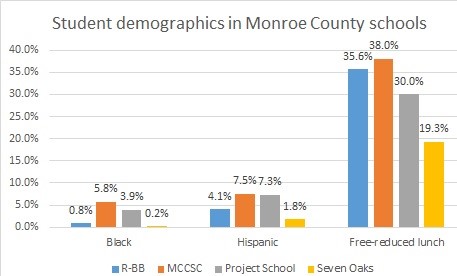
Along with the Hillsdale affiliation, there are other factors that distinguish Seven Oaks from public schools: for example, its demographic profile. Out of more than 500 students, one is Black and nine are Hispanic, according to state data. Fewer than 20% of students would qualify for free or reduced-price meals if they were provided. (The school doesn’t provide transportation or school lunches).

Bar chart showing percentage of Black, Hispanic and free-reduced lunch students in Monroe County schools.

This chart shows the percentage of students who are Black, Hispanic and eligible for free or reduced-price meals in Monroe County public school districts (Monroe County and Richland-Bean Blossom community school corporations) and charter schools (Bloomington Project School and Seven Oaks Classical School).

Nine of its 38 teachers are Hillsdale College alumni, according to profiles on the school’s website. In 2021-22, the most recent year for which a state teacher statistics report is posted, nearly 40% of its teachers had emergency licenses, compared with 4.6% in local public school districts.

The 24-page Seven Oaks charter extension reads like a standard agreement, with boilerplate language from state law and recommended practices for authorizing. It spells out the duties of each party, the expectations for the school, and the legal remedies if something goes wrong. An attached accountability plan includes out-of-date references to state assessments and, I’m told, is being revised.

The agreement says Grace College gets to keep 2.5% of the school’s state funding as an authorizer fee. That’s less than the 3% maximum that Indiana allows. In 2023-24, the college will net about $93,000.

Grace initially approved a charter for Seven Oaks in 2016 in one of Indiana’s first examples of what’s called authorizer shopping. The school’s founders applied to the Indiana Charter School Board, but it rejected their application. They reapplied but withdrew after a negative recommendation from the board’s staff. Then they took their plan to Grace College, which said yes to a 7-year charter.

At that time, private colleges could authorize charter schools in closed-door meetings with no public notice. Since 2017, they’ve had to use nonprofit authorizing agencies, such as Grace College’s Grace Charters LLC, that are subject to open-meetings and public-records laws. Even so, it can be hard to keep up. I started asking by email about the Seven Oaks charter extension in March; it took until late May to get copies of the December 2022 board minutes and the school’s extended charter agreement.

Transparency is one issue of having distant authorizers for charter schools, but there are others. The National Association Charter School Authorizers cautions against throwing the door wide open for higher education institutions, or HEIs, to authorize schools, as Indiana has done since 2011.

Lizette Alvarez, a journalist in Miami, wrote an opinion piece for The Washington Post, explaining the outrageousness of Florida’s universal voucher program.

What I find outrageous is that this story is not being covered by the Washington Post, the New York Times, or any of the other major media outlets. Nor is it reported as news by any of the network or cable stations.

Why are these stories not in the news every day?

CONSERVATIVE REPUBLICANS ARE WIPING OUT THE LONG-HONORED TRADITION OF SEPARATION OF CHURCH AND STATE!!

CONSERVATIVE REPUBLICANS IN EVERY RED STATE ARE DESTROYING THEIR PUBLIC SCHOOLS DESPITE PUBLIC OPPOSITION!!

Well, at least, the Washington Post printed an opinion piece telling of the greatest theft of the public good in our lifetimes:

Florida public schools are having an awful year. Record numbers of teachers have left their jobs, and those who remain face a minefield of ambiguous culture-war dictates about what they can say and how they teach.

And it’s about to get worse for Florida’s beleaguered public schools.

Florida Gov. Ron DeSantis (R) recently signed legislation that might radically undermine the state’s education system by making Florida’s already robust school voucher program the largest and most expensive in the country.

Beginning in July, the state will make it possible for every Florida K-12 student to receive a taxpayer-funded voucher or savings account worth $8,648. And for the first time in Florida, the vouchers will be available to children from wealthy families, even those who are home-schooled or who already attend private or religious schools. The money can go to tuition and educational expenses.

At least five other states have passed so-called universal choice programs — Arizona, Arkansas, Iowa, Utah and West Virginia — but Florida’s is, by far, the biggest. Other Republican-led states are considering similar bills.

The new policy is a revolutionary (and expensive) expansion. The original state voucher program, which began in 1999, was designed exclusively for a small number of children in F-rated, or failing, public schools and, later, special-needs students. The program grew to more than 177,000 students, from households earning up to $100,000.

About 2,300 private schools in Florida accept vouchers; 69 percent of them are unaccredited, 58 percent are religious and 30 percent are for-profit, according to the Hechinger Report.
In a state infamous as a magnet for schemers and grifters, there’s plenty of reason to worry as millions of dollars in new spending will soon pour into schools that have little accountability. When DeSantis celebrated passage of his vouchers-for-all gambit as a victory for school choice, he was no doubt being cheered on by those with no ideology other than diving into any trough freshly filled with public money.

But, as of July 1, even the child of a private-jet-flying tycoon will be eligible for a voucher. As state Rep. Marie Woodson (D) said, “This bill is an $8,000 gift card to the millionaires and billionaires who are being gifted with a state-sponsored coupon for something they can already afford.” The rich might not need it, but who passes up free money?

Estimates of the cost range from $209 million to $4 billion a year. About 2,300 private schools in Florida accept vouchers; 69 percent of them are unaccredited, 58 percent are religious and 30 percent are for-profit, according to the Hechinger Report….

In a state infamous as a magnet for schemers and grifters, there’s plenty of reason to worry as millions of dollars in new spending will soon pour into schools that have little accountability.

When DeSantis celebrated passage of his vouchers-for-all gambit as a victory for school choice, he was no doubt being cheered on by those with no ideology other than diving into any trough freshly filled with public money.

Edward B. Fiske was the education editor of the New York Times and editor of the Fiske Guide to Colleges. Helen F. Ladd is a nationally prominent economist of education and professor emeritus at Duke University. They are married, a power couple of American education. This article appeared on the website of WRAL in North Carolina.

Forty years ago this spring a national commission charged with evaluating the quality of American education issued a blistering report entitled “A Nation at Risk.” It cited a “rising tide of mediocrity” in the country’s schools and declared that the country’s failure to provide high quality education “threatens our very future as a Nation and a people.”

North Carolina leaders took this warning to heart. They began investing heavily in public education and even became a model for other states in areas such as early childhood education. Significantly, the state was making progress toward fulfilling its obligation under the North Carolina Constitution to provide a sound, basic education for all students.

The situation started to change, however, in 2012 when Republicans came to power and began an assault on public education that continues to this day.

When it comes to public education, North Carolina is now “A State at Risk.”

The Republican assault has taken multiple forms, starting with inadequate funding. North Carolina now ranks 50th in the country in school funding effort and 48th in overall funding. Despite widespread teacher shortages, the Republicans have kept teacher salaries low — $12,000 below the national average – and they have failed to provide adequate funding for the additional support staff that schools need.

In addition, they have permitted significant growth in the number of charter schools. Such schools divert much-needed funds from traditional public schools and make it difficult for local boards of education to operate coherent education systems.

The Republican-controlled Legislature is currently working hard to weaken public education by politicizing the process. Pending legislation would regulate how history and racism are taught, give a commission appointed mainly by lawmakers the job of recommending standards in K-12 subjects, and transfer authority to create new charter schools from the State Board of Education to a board appointed by the General Assembly.

The problem is about to get even worse. The Legislature is now poised to expand the earlier Opportunity Scholarship program, which had provided public funds for low income children to attend private schools, into a much larger universal voucher program that would make all children eligible regardless of family income – at an estimated cost of more than $2 billion over the next 10 years.

Given that private schools are operated by private entities typically with no public oversight and no obligation to serve all children, why in the world would it ever make sense to use taxpayer dollars to support private schools?

A common argument has been that voucher systems raise achievement levels of the children who used them. While some early studies of small scale means-tested voucher programs in places like Milwaukee showed small achievement gains in some cases, recent studies of larger voucher programs in places such as Ohio, Louisiana and Indiana consistently show large declines in average achievement — often because of the low quality of the private schools that accept vouchers.

Supporters also argue that vouchers provide more schooling options for children and that having more choices is a good thing. But in the context of education policy that need not be the case. Americans support public education – and make schooling mandatory – not only for the benefits it generates for individual children but also for collective benefits such as the creation of capable workers and informed citizens. What matters is the quality of education for all the state’s children.

An expanded voucher program would lead to a substantial outflow of funds from traditional public schools to privately operated schools, with the potential for a significant loss in the quality of our public schools, and subsequent vitality in the state’s economy.

A strong public education system – from elementary and secondary schools to the nation’s first public university, the University of North Carolina – has long been pivotal to our state’s cultural, political and economic success. We must stop the current assaults on public education and reaffirm our commitment to one of North Carolina’s great strengths.

Back in 1983 when the education system of the nation was “at risk,” President Ronald Reagan – who had earlier been lukewarm in his support of public education — took the warning seriously and began touring the country to talk about the problem. His successors from both parties then took up the cause and continued to make the case that a strong public education system is essential for a vibrant economy, and importantly, to make the policy changes needed to strengthen it.

Let’s hope that our current Republican leaders in this state can muster the wisdom and courage to follow the example of President Reagan and other leaders from both parties in pushing for strong public education. In the absence of such wisdom, we will indeed continue to be “A State at Risk.”

It’s not often that I have the opportunity to repost something written years ago. John Thompson, teacher and historian, summarized Mike Miles’s disastrous three years in Dallas. At the time I posted John’s analysis, I didn’t know how to embed links. His commentary starts in the second paragraph of the linked post.

Miles is a military veteran. He has no experience as a teacher or principal. Yet somehow he thinks he knows how to reform schools. That conceit is a hallmark of the Broad Academy.

Miles was recently selected by the Texas Commissioner of Education Mike Morath—also not an educator—to be the superintendent of schools in Houston, one of the nation’s largest school districts. The state took control of The Houston Independent School District because one school—Wheatley High School—received failing scores for several years in a row. This past year, its state score rose to a C, but the state didn’t care. These are Republicans who don’t believe in local control or democracy.

Mike Miles arrived in Dallas after a stint as superintendent of a tiny district in Colorado. He’s a know-it-all. He arrived with an attempt at a Broadway show performance in which he was the star (the video was deleted).

He quickly set numerical goals that everyone was expected to meet. He alienated teachers, who left DISD in record numbers. He had no appreciation for words like “trust,” “respect,” “collaboration,” “teamwork.” It was his way or the highway.

It was not surprising that Miles’s first action as superintendent in Houston under the state takeover was to fire every member of the staff at 29 schools and invite them to reapply for their jobs. So what if this creates instability for students? Miles doesn’t care. He also plans to evaluate teachers in part by test scores, a well-discredited method.

He is a razzle-dazzle guy who likes to take bold actions, no matter who he hurts or what chaos he creates for the students and the professionals.

One of Mike Miles’ worst actions in Dallas was the time he called the police to arrest a school board member who was visiting a school in her district. That tells you the kind of guy he is: arrogant, insensitive, tough, mean.

Soon after he arrived in Dallas, his family moved back to Colorado because Mike was such a toxic guy. Hopefully, this time they stayed in Colorado.

Education doesn’t need military leaders. It doesn’t need people who don’t give a hoot for the morale of the teachers.

Miles was booted out of Dallas after three years of failure.

The question now is why Mike Morath, who was on the Dallas school board when Miles wreaked his damage on the district, decided to install him in Houston. Was it to punish Houston? Houston public schools today are performing better than Dallas. Why didn’t Morath take control of Dallas and give Miles another chance to ruin that district?

Broadies have a very bad track record. They were taught to be top-down, decisive, arrogant, indifferent to others. This is not an approach that blends well with students, teachers, teaching and learning.

Great educational leaders have experience in the classroom. They attract dedicated teachers and protect them. They understand that every child is precious to someone, whatever their test scores. They care about education more than test scores. They listen.

Mike Miles is not that guy.

Here are a few other commentaries about Niles while he was in Dallas:

Miles arrives: https://dianeravitch.net/2012/05/20/enter-the-new-dallas-superintendent/

Teachers flee Dallas, and Miles urges other districts not to hire them: https://dianeravitch.net/2013/08/06/dallas-teachers-flee-superintendent-mike-miles-under-investigation-his-family-moves-back-to-colorado/

Miles calls police to arrest a school board member visiting a school in her district: https://dianeravitch.net/2014/10/13/breaking-news-dallas-superintendent-miles-calls-police-to-remove-school-board-member-from-school/

At the end of his stormy three years, Miles compares his time in Dallas to “Camelot”:https://dianeravitch.net/2015/06/24/mike-miles-compares-his-three-year-tenure-in-dallas-to-camelot-starring-him-as-king-arthur/

PS: I take this state invasion of HISD personally. I graduated from HISD in 1956.