I have been puzzling over this question since the Democratic National Convention.
Like most people, I didn’t know much about Kamala Harris when she became Vice President. Now that I have seen her speak, now that I saw her debate Trump, I feel very energized to support her campaign for the Presidency.
She is smart, well informed, experienced, committed to the U.S. Constitution and the rule of law. She is thoughtful and composed. She laughs, she smiles, she seems like a kind and thoughtful person. She is well prepared for the presidency, having won election as the District Attorney of San Francisco, as Attorney General of the State of California, as U.S. Senator from California, and as Vice-President of the United States since Joe Biden and she were elected in 2020.
Her opponent is a bundle of equal parts narcissism and hatred. He likes men. He likes white men. He likes to play tough guy. He looks on women as sex objects and feather heads. He doesn’t respect women.
He is crude, vulgar, without a shred of the dignity we expect from a president. The language he uses to ridicule and insult others is vile.
He is a racist, a misogynist, a xenophobe, and a Christian nationalist (without being a practicing Christian).
He is a sexual predator. He is known for not paying people to whom he owes money for services rendered. He has gone through six bankruptcies.
He is ignorant. His former aides say he has never read the Constitution. He is driven by his massive ego. He wants everyone to say he’s the best, the greatest, and there’s never been anyone as great as him.
He is a convicted felon, convicted on 34 counts of business fraud in New York. He was found guilty by a jury in New York of defaming E. Jean Carroll, who accused him of sexually assaulting her many years ago. He was ordered to pay her more than $90 million for continuing to defame her. That judgment is on appeal.
Other trials are pending.
When he lost the 2020 election, he refused to accept his defeat. He schemed to overturn the election by various ploys. He summoned a mob of his fans to Washington on January 6, 2021, the day that Congress gathered for the ceremonial certification of the election. Trump encouraged them to march on the U.S. Capitol, “peaceably….(but) fight like hell.” They did fight like hell. They battered their way into the Capitol, smashing windows and doors, beating law officers, vandalizing the building and its offices, while hunting for Vice President Mike Pence and Speaker Nancy Pelosi. The outnumbered law officers held them off to protect the members of Congress. Many of them were brutally beaten. Some later died. What if the mob had reached the members of Congress? What if they had captured Pence and Pelosi?
It was the most shameful day of our national history. A President encouraging a mob to sack the Capitol and overturn the Constitution.
Ever since that disgraceful day, Trump has reiterated that the election was stolen from him, even though it wasn’t close. He has undermined faith in the electoral process, faith in the judiciary, faith in the law.
These are the two candidates: Kamala Harris and Donald Trump.
It’s clear that billionaire Jeff Bezos told the editorial board not to publish its editorial endorsing Kamala Harris. The editorial was already written, and Bezos stopped it. The order came down through Will Lewis, whom Bezos hired away from Rupert Murdoch’s rightwing publishing empire.
No one knows Bezos’s reason or reasons. He has said nothing. Lewis released a statement pretending that the censorship of the editorial board by the owner was an act of high principle. As editor Ruth Marcus wrote, had the decision been announced a year ago, it would have had at least the patina of principle. Coming as it did only days before the election, the decision seems craven and unethical.
The Washington Post’s decision not to make an endorsement in the presidential campaign is a terrible mistake. It represents an abandonment of the fundamental editorial convictions of the newspaper that we love. This is a moment for the institution to be making clear its commitment to democratic values, the rule of law and international alliances, and the threat that Donald Trump poses to them — the precise points The Post made in endorsing Trump’s opponents in 2016 and 2020. There is no contradiction between The Post’s important role as an independent newspaper and its practice of making political endorsements, both as a matter of guidance to readers and as a statement of core beliefs. That has never been more true than in the current campaign. An independent newspaper might someday choose to back away from making presidential endorsements. But this isn’t the right moment, when one candidate is advocating positions that directly threaten freedom of the press and the values of the Constitution.
Karen Attiah Perry Bacon Jr. Matt Bai Max Boot
Kate Cohen E.J. Dionne Jr. Lee Hockstader David Ignatius Heather Long Ruth Marcus Dana Milbank Alexandra Petri Catherine Rampell Eugene Robinson Jennifer Rubin Karen Tumulty Erik Wemple
Will Saletan writes for The Bulwark that Trump is openly, blatantly running as a fascist. In recent days, Trump has babbled on about his intention to break all the norms of American leadership. He will use his power to punish people who have challenged him. They are not his “opponents,” they are his “enemies.”
He begins:
DONALD TRUMP IS RUNNING THE MOST openly fascist campaign ever undertaken by a major-party nominee for president of the United States.
That’s not hype; it’s a textbook application of the term. In 2021, Trump used violence to try to overturn an election; in 2022, he called for terminating the Constitution. Now, on the brink of returning to power, Trump is reaffirming his intent to take America deeper into autocracy.
Here are some of the threats and declarations he has issued in the past three months.
1. He says he’s legally immune to all current charges against him.
Four grand juries have indicted Trump on felony charges, and one jury has convicted him. But on August 15, Trump boasted that “the Supreme Court ruled recently on immunity, and I’m immune from all of the stuff that they charge me with.”
2. He claims the right to do whatever he wants as president.
On August 21, Trump asserted (falsely) that the criminal case against him for obstructing recovery of classified documents was invalid because “I had the Presidential Records Act. I had a right to do whatever I wanted to do.”
3. He advocates “one really violent day” of police action.
On September 29, Trump called for police violence against people who appear to be stealing from drug stores or department stores. He proposed an “extraordinarily rough” response: “One real rough, nasty day, with the drugstores as an example,” in which police would take on people who “start walking out with” merchandise. “If you had one really violent day,” said Trump, “one rough hour, and I mean real rough—the word will get out, and it will end immediately.”
4. He vows to indemnify police against “any prosecutions” for doing what he wants.
On October 11, Trump pledged to “indemnify” police officers against any prosecutions” for actions undertaken as part of his planned mass deportations. The next day, he added that when officers confront people walking out of department stores with what appear to be stolen goods, “we’re going to indemnify them against any problems they have.”
The fascists win by dividing the opposition. So join the best pro-democracy community on the internet by becoming a Bulwark+ member.
5. He threatens to use the military against “the enemy within.”
On October 10, in a Fox News interview, Maria Bartiromo asked Trump whether criminals or terrorists from abroad might pose a threat to the United States on Election Day. Trump told her that “the bigger problem is the enemy from within,” not foreigners. “We have some sick people, radical-left lunatics,” said Trump. “And it should be very easily handled by—if necessary—by National Guard. Or, if really necessary, by the military.”
Later in the interview, Trump made it clear that the “lunatics” he was talking about included Democratic politicians. Bartiromo asked Trump how, as president, he would “guard against the bureaucrats undermining you.” Trump repliedthat “the enemy from within,” including “lunatics that we have inside like Adam Schiff,” was “more dangerous than China [or] Russia.”
Last Wednesday, another Fox News host, Harris Faulkner, invited Trump to clarify his meaning. He responded by adding former House Speaker Nancy Pelosi to the list. “It is the enemy from within, and they’re very dangerous. They’re Marxists and communists and fascists, and they’re sick,” said Trump. “The Pelosis, these people—they’re so sick, and they’re so evil.”
6. He says some of his political opponents shouldn’t be allowed to run for office.
On August 23, Trump said that Ruben Gallego, the Democratic nominee for U.S. Senate in Arizona, “shouldn’t be allowed to even run in this election.” On September 27, he added, “Anybody that wants to defund the police is not qualified and shouldn’t be allowed to even run for president.” On September 28, he declared that due to Kamala Harris’s border policies, “she shouldn’t even be allowed to run.”
7. He says he could have jailed Hillary Clinton.
On August 8, Trump boasted, “With Hillary Clinton, I could have done things to her that would have made your head spin.” On August 15, he said he could have jailed Clinton “very easily.” On August 21, he repeated, “I could have put her in jail.”
In an interview that aired on September 3, podcaster Lex Fridman asked Trump about the temptations of the presidency. “If you become leader again, you’ll have unprecedented power,” said Fridman. “What does that power do to you? Is there any threat of it corrupting how you see the world?”
Trump responded by bragging that he could have jailed Clinton but had spared her. “I could have done a big number on Hillary Clinton,” he said. “She’s so lucky I didn’t do anything. She’s so lucky. . . . I could have done something very bad.”
Donald Trump is an ignorant, narcissistic sociopath.
Marta W. Aldrich reported in Chalkbeat that Governor Bill Lee will make universal vouchers his top priority in education this coming year. Tennessee currently has a voucher program that is limited to three urban districts and is not fully enrolled. The Governor, who is a graduate of public schools, wants all students, rich and poor alike, to have a public subsidy to pay for private and religious schooling.
Republicans have made universal vouchers a high priority, knowing that it will drain students and funding from their local public schools.
Governor Lee’s effort to pass universal vouchers failed last year because of opposition by urban Democrats and rural Republicans. However, some of the Republican opponents were defeated with the help of out-of-state money spent to elect voucher-friendly Republicans who were willing to undercut their local public schools.
From what we already know about vouchers, we can predict that the great majority of them will be used by affluent families whose children are already enrolled in nonpublic schools. In his recently published book, The Privateers, Josh Cowen of Michigan State University has shown that the low-income students who transfer to nonpublic schools do not make academic gains and frequently experience “catastrophic” declines in their outcomes.
A new universal school voucher proposal will be the first bill filed for Tennessee’s upcoming legislative session, signaling that Gov. Bill Lee intends to make the plan his No. 1 education priority for a second straight year.
Senate Majority Leader Jack Johnson said this week that he’ll file his chamber’s legislation on the morning of Nov. 6, the day after Election Day. He expects House Majority Leader William Lamberth will do the same.
The big question is whether House and Senate Republican leaders will be able to agree on the details in 2025. The 114th Tennessee General Assembly convenes on Jan. 14 as Lee begins his last two years in office.
During the 2024 session, the governor’s Education Freedom Scholarship proposal stalled in finance committees over disagreements about testing and funding, despite a GOP supermajority, and even as universal voucher programs sprang up in several other states….
Similar to last year’s proposal, the new bill would provide about $7,000 in taxpayer funds to each of up to 20,000 students to attend a private school beginning next fall, with half of the slots going to students who are considered economically disadvantaged. By 2026, all of Tennessee’s K-12 students, regardless of family income, would be eligible for vouchers, though the number of recipients would depend on how much money is budgeted for the program.
“This story was originally published by Chalkbeat. Sign up for their newsletters at ckbe.at/newsletters”.
The state’s so-called Education Savings Accounts (or Empowerment Scholarship Accounts) were enacted by the Legislature in 2011. Whatever they are called, they are vouchers, which violate Arizona’s Constitutional ban on public funds for religious schools. They initially contained restrictions as to which students qualified to receive a voucher. The usual claim for vouchers was that they would “save poor kids from failing public schools.” However, that never happened.
From the start, the Republicans in control wanted vouchers for all students, not just those from low-income families. Even though there was a state referendum in which voters overwhelmingly rejected voucher expansion in 2018, the Legislature ignored the vote and passed universal vouchers in 2022. Any student, whatever their family income, is entitled to use public money for tuition in a private or religious school or for home schooling.
The result: few students from low-income families use vouchers.
The article in ProPublica explains why.
Vouchers don’t cover the cost of most private schools.
Most private schools are not located in low-income neighborhoods.
Low-income families can’t afford the cost of transportation to and from private schools.
In Arizona, as in other states, most students who take vouchers were already enrolled in no public schools. Their parents can afford to pay the tuition. Now the state subsidizes them. And in many cases, the schools raise their tuition in response to the state subsidy.
As we have seen over the past two years, Trump has used his legal team to delay, delay, delay, with the hope of eventually getting a sympathetic judge who will dismiss the case against him. That is what happened in Florida, where Trump-appointed District Court Judge Aileen Cannon threw out the entire case about Trump’s theft of documents. The reason: She believes that Special Counsel Jack Smith’s appointment was unconstitutional. She is the first federal judge to reach this conclusion. Many other judges and legal scholars have reached the opposite conclusion and found the appointment of special counsels to be constitutional. Her decision has been appealed by prosecutors.
Yesterday, Obama-appointed District Court Judge Tanya Chutkan dismissed most of Trump’s requests to “discover” more government documents that might show that his actions on January 6, 2021, were necessary.
In a significant legal setback for Donald Trump, U.S. District Judge Tanya Chutkan issued a detailed ruling on his latest discovery requests in the 2020 election subversion case, dismissing most of his demands as speculative and unsupported by law. Trump had sought to compel the federal government to search for and produce a broad array of documents related to election interference, cybersecurity threats, and law enforcement actions connected to the January 6th attack on the U.S. Capitol.
In this article, we will succinctly analyze Judge Chutkan’s latest ruling and its implications on Trump’s election interference case. To read our full analysis below, please join as a paid subscriber to support our work.
Let’s get into it:
The ruling, issued today (October 16, 2024), addressed two key motions filed by Trump’s defense team: a Motion to Compel Discovery and a Motion for an Order Regarding the Scope of the Prosecution Team. In these motions, Trump’s lawyers asked the court to force the federal government to search nine government agencies for information across 14 categories, including classified intelligence assessments and communications about foreign election interference. Trump’s defense argued that this information would support his claim that his actions were based on legitimate concerns about election security.
Judge Chutkan, however, found that Trump’s requests were largely unsupported by the law. She pointed out that under both Brady v. Maryland and Federal Rule of Criminal Procedure 16, defendants bear the burden of demonstrating that the requested materials are material to their defense. “Speculation” that the government might possess favorable evidence is not enough to justify an expansive search, Chutkan noted, and Trump had failed to show that the requested documents were likely to yield new, non-cumulative evidence.
For example, Trump sought all drafts and communications related to the 2020 Election Intelligence Community Assessment (ICA), claiming that these documents would help demonstrate his “good faith” concerns about foreign interference. But Chutkan rejected this request, noting that Trump did not claim to have been aware of these drafts at the time of his indicted actions. Without showing that this information could have influenced his state of mind, Trump could not meet the standard of materiality required for discovery.
Judge Chutkan also denied Trump’s request for communications and drafts of the Cybersecurity and Infrastructure Security Agency (CISA) statement, which had described the 2020 election as “the most secure in American history.” Trump argued that earlier versions of the statement might show narrower language that would support his defense, but the court found this request speculative and irrelevant to Trump’s intent at the time.
Trump did win a limited victory in his request for certain “discrete, identified” documents, which Judge Chutkan ruled the government must produce. However, these documents represented only a small portion of Trump’s overall requests. The ruling emphasizes that Trump’s legal strategy cannot rely on vague or speculative claims of what might be found in government records.
Chutkan’s ruling further solidifies the challenges Trump faces as he prepares his defense in the federal criminal case. Trump’s argument that his state of mind was shaped by legitimate concerns about election integrity appears increasingly difficult to substantiate, as the court continues to limit the scope of discovery to concrete and relevant evidence.
Judge Chutkan’s Conclusion and Order
This ruling follows a pattern in which courts have resisted attempts by Trump’s legal team to broaden the scope of discovery in various legal challenges. Chutkan’s decision reiterates the principle that discovery is not an unlimited right and must be grounded in specific, demonstrable need.
With the court setting an October 30 deadline for any further motions to compel discovery, the Trump defense team will need to reconsider their approach as the case moves toward trial. Judge Chutkan’s decision is another indication that Trump’s claims, both inside and outside the courtroom, face serious judicial scrutiny.
But we have a candidate for President who constantly encourages violence against enemies and disparages the federal government that he wants to lead.
And we have a political party that wants no restrictions on guns. And here we are.
LAKE LURE, N.C. — Federal emergency response personnel on Saturday had employees operating in hard-hit Rutherford County, N.C., stop working and move to a different area because of concerns over “armed militia” threatening government workers in the region, according to an email sent to federal agencies helping with response in the state.
Around 1 p.m. Saturday, an official with the U.S. Forest Service, which is supporting recovery efforts after Hurricane Helene along with the Federal Emergency Management Agency, sent an urgent message to numerous federal agencies warning that “FEMA has advised all federal responders Rutherford County, NC, to stand down and evacuate the county immediately. The message stated that National Guard troops ‘had come across x2 trucks of armed militia saying there were out hunting FEMA.’”
“The IMTs [incident management teams] have been notified and are coordinating the evacuation of all assigned personnel in that county,” the email added.
Two federal officials confirmed the authenticity of the email, though it was unclear whether the quoted threat was seen as credible. The National Guard referred questions to FEMA when asked about the incident. One Forest Service official coordinating the Helene recovery said responders moved to a “safe area” and at least some work in that area — which included clearing trees off dozens of damaged and blocked roads to help search-and-rescue crews, as well as groups delivering supplies — was paused.
By Sunday afternoon, personnel were back in place, said the official, who spoke on the condition of anonymity.
The setback is one of the latest examples of growing concerns about safety and security in western North Carolina, where many towns were almost wiped off the map after the historic hurricane made landfall two weeks ago. In the weeks since, misinformation and rumors have made the recovery more difficult, targeting multiple federal agencies operating as part of the recovery. Federal officials such as the secretary for the Department of Homeland Security and FEMA’s director of public affairs have been the target of antisemitic attacks.
Chimney Rock, in Rutherford County, has become one of the centers of tension and conflict after a rumor spread on social media that government officials planned to seize the decimated village and bulldoze bodies under the rubble. Authorities and news outlets debunked the assertion, but people still took to social media imploring militias to go after FEMA.
A person familiar with FEMA operations, who spoke on the condition of anonymity, said the agency was working out of an abundance of caution and its teams were operating at fixed locations and secure areas instead of the usual practice of going door to door.
In an opinion piece in Scientific American, Cecilia Menjívar of UCLA and Deisy Del Real of the University of Southern California contend that the United States and other nations are sliding toward autocracy. They believe we can learn from the experience of other nations.
They write:
An autocratic wave has crept up on us in the U.S. and over the world in the last decade. Democracy and autocracy were once seen as two separate and distant worlds with little in common, and that the triumph of one weakened the other. Now, however, autocrats across the globe, in poor and wealthy nations, in established and nascent democracies, and from the right and left, are using the same tactics to dismantle democracies from within.
With the upcoming U.S. presidential election in November, questions about the future of American democracy take on urgency. As the American public seems increasingly receptive to autocratic tactics, these questions become even more pressing. Will the U.S. slide into autocracy, faced with a presidential candidate in Donald Trump who promises to be a dictator on his first day in office? Can lessons from autocracies elsewhere help us detect democratic backsliding in the U.S.?
To answer these questions, we first need to identify how the new breed of autocrats attains and retains power: their hallmark strategy is deception. How does a roll call of modern autocrats, and wannabe autocrats, like Hungary’s Viktor Orbán, Russia’s Vladimir Putin, El Salvador’s Nayib Bukele, India’s Narendra Modi, Turkey’s Recep Tayyip Erdoğan, and Venezuela’s Nicolás Maduro implement this modus operandi for the latest model of autocracy? They twist information and create confusion within a façade of democracy as they seize power. They do not overthrow democracy through military coups d’état but by undoing core democratic principles, weakening the rule of law, and eliminating checks and balances between branches of government.
Rather than eradicating democratic institutions as leaders like Chile’s Augusto Pinochet or Zaire’s Mobutu Sese Seko did in the past, today’s established and emergent autocrats (as is the case of Maduro or Orbán, for instance) corrupt the courts, sabotage elections and distort information to attain and remain in power. They are elected through ostensibly free elections and connect with a public already primed to be fearful of a fabricated enemy. Critically, they use these democratic tools to attain power; once there, they dismantle those processes. Autocratic tactics creep into the political life of a country slowly and embed themselves deeply in the democratic apparatus they corrupt. Modern autocracy, one may say, is a tyranny of gaslighting.
We gathered a group of scholars who have looked at successful and failed autocracies worldwide in a special issue of the American Behavioral Scientist, to identify common denominators of autocratic rulers worldwide. This research shows that modern autocrats uniformly apply key building blocks to cement their illiberal agenda and undermine democracies before taking them over. Those include manipulating the legal system, rewriting electoral laws and constitutions, and dividing the population into “us” versus “them” blocs. Autocrats routinely present themselves as the only presumed savior of the country while silencing, criminalizing and disparaging critics or any oppositional voice. They distort information and fabricate “facts” through the media, claim fraud if they lose an election, persuade the population that they can “cleanse” the country of crime and, finally, empower a repressive nationalistic diaspora and fund satellite political movements and hate groups that amplify the autocrats’ illiberal agenda to distort democracy.
In February, Bukele, the popular Salvadoran autocrat and self-described “world’s coolest dictator,” spoke at the 2024 Conservative Political Action Conference (CPAC), an annual convention for U.S. right-wing elected officials and activists. There he received a standing ovation after he flaunted his crackdown on crime in his country and suggested the U.S. should follow his tactics. His speech demonstrates how, regardless of political history and ideology, or their nation’s wealth and place on the global stage, autocrats today deploy a similar “toolbox of tricks” aimed at legalizing their rule. That’s because they copy from one another and learn from one another’s successes and failures. Vast interconnected networks enable autocrats to cooperate, share strategies and know-how, and visit one another in public shows of friendship and solidarity to create an international united front. Just ask Orbán, the Hungarian prime minister and autocrat, who received a warm reception when he spoke at the CPAC in 2022, reminding the crowd of the reason for his visit: “I’m here to tell you that we should unite our forces.”
Global networks of autocratic regimes also provide economic resources to other autocrats and invest in their economies, share security services to squash popular dissent, and sometimes interfere in each other’s elections.
Modern autocrats do not act alone; their connections with one another are complemented and sustained by a varied cadre of legal specialists, political strategists and academics who tend to be economically secure, well-educated and cosmopolitan. These individuals, like Michael Anton and those tied to the Trump-defending Claremont Institute, the over 400 scholars and policy experts who collaborated on Project 2025— the extreme-right game plan for a Trump presidency—and Stephen K. Bannon, who called for the “deconstruction of the administrative state” by filling government jobs with partisans and loyalists, move in and out of government positions and the limelight. They are nimble and, moreover, fundamental to the autocrats’ strategies, as they create videos and podcasts and write books to fabricate good images of the autocrats, write detailed blueprints for an autocratic form of government, and consult aspiring autocrats on best practices.
Evidence indicates that we are in a critical moment in U.S. democracy. Will the U.S. inevitably descend into autocracy? No, not with an alert and well-informed electorate. Recognizing the strategies that autocrats use and share, veiled behind a façade of democratic elections and wrapped in fearmongering, equips us to understand the harmful consequences of these strategies for democracy, and perhaps to stop the wave in time.
Juan Sebastián Chamorro, a Nicaraguan opposition politician and prospective presidential candidate, was accused of treason, arrested and banished simply for running as an opposition candidate by the regime of President Daniel Ortega and Vice President Rosario Murillo (who is also first lady). In exile, Chamorro has described a danger countries face: autocrats who come to power through democratic systems are “like a silent disease—the early symptoms of this silent disease are usually dismissed, but once it begins to consume the body, it is usually too late to stop it.”
This is an opinion and analysis article, and the views expressed by the author or authors are not necessarily those of Scientific American.
When Donald Trump appeared recently in Milwaukee, he described his plan for the future of the Department of Education. It’s not quite the same as the scenario in Project 2025, which envisions the total elimination of the U.S. Department of Education. Trump imagines it as a “department” with only two employees: A Cabinet Secretary and a secretary.
The severely shrunken Department would focus solely on the three Rs and would somehow mysteriously have the power and personnel to prevent public schools across the nation from teaching anything connected to “woke.” That is, anything related to race, gender, or social justice. How this fictional Department would impose bans on curriculum when federal law prohibits any federal interference in curriculum is not explained. Actually, it’s nonsense.
Donald Trump has fleshed out his Project 2025–inspired Department of Education plan, and it involves handing the reins and lofty responsibilities of public school administration over to a group of people with all the time in the world: parents.
“I figure we’ll have like one person plus a secretary,” the Republican presidential nominee told a crowd in Milwaukee Tuesday night. “You’ll have a secretary to a secretary. We’ll have one person plus a secretary, and all the person has to do is, ‘Are you teaching English? Are you teaching arithmetic? What are you doing? Reading, writing, and arithmetic. And are you not teaching woke?’
“Not teaching woke is a big factor,” Trump continued. “We’ll have a very small staff. We can occupy that staff right in this room, actually I think this room is too large. And all they’re going to do is they’re going to see that the basics are taken care of. You know, we don’t want someone to get crazy and start teaching a language that we don’t want them to teach.”
Not only do parents already have enough on their plates without trying to run the public school system, it’s likely that Trump has a specific group of parents in mind to direct education policy.
The goals he lays out are startlingly akin to the policy points of the far-right “parents’ rights” group Moms for Liberty, who hosted Trump as the keynote speaker at their annual conference in September. Moms for Liberty has recently ingratiated itself significantly into national politics and was listed as a member of Project 2025’s advisory board.
In the same speech, Trump also drew attention to the amount of real estate occupied in D.C. by Department of Education buildings, plotting that the dissolution of the federal agency would allow “somebody else to move in.”
“They’re run by the state, and run by the parents, because in Washington—you know half of the buildings, such a large number, every building you pass in Washington says Department of Education,” Trump said. “You’re gonna have a lot of vacant space. Now we can have maybe somebody else move in.”
Trump’s proposal to dismantle the Department of Education wholesale is nearly identical to Project 2025, despite his campaign spending months trying to distance itself from the 920-page Christian nationalist manifesto.
Fact check: Trump exaggerated the size and physical space occupied by ED. The U.S. Department of Education is smaller than any other Cabinet department; it has 4,400 employees. It occupies a building at 400 Maryland Avenue, SW, Washington, DC. It rents space at 555 New Jersey Avenue, NW. it does not occupy all or most or many buildings in DC.
At the recent Vice-Presidential debate, JD Vance engaged in sanewashing and normalizing Trump, falsely claiming that Trump tried to improve or salvage Obamacare. He lied, as LA Times’ Pulitzer-Prize winning columnist Michael Hiltzik shows. In fact, Trump and most other Republicans tried to kill Obamacare. Trump was also responsible for incompetent management of the federal response to COVID, which increased the death toll.
Every newspaper should either have its own Michael Hiltzik or repost his columns.
I love it more today than ever, because it applies so perfectly to how we must respond to the campaign claims of Donald Trump and JD Vance. Especially Trump’s assertions about his role — heroic, in his vision — in “saving” the Affordable Care Act and fighting the COVID pandemic.
I’ve written before about the firehouse of fabrication and grift emanating from the Trump campaign like a political miasma. On these topics, he has moved beyond his habit of merely concocting a false reality about, say, immigration and crime to deliberately concocting a false reality about himself.
Donald Trump could have destroyed [Obamacare]. Instead, he worked in a bipartisan way to ensure that Americans had access to affordable care.
— JD Vance, flagrantly lying about Trump’s management of the Affordable Care Act
To start by summarizing: Trump did everything in his power to destroy the Affordable Care Act, starting on the very first day of his term in 2017. On COVID, he did everything in his power to make America defenseless against the spreading pandemic.
Let’s take them in order.
Here’s what Trump said about the Affordable Care Act during his Sept. 10 debate with Kamala Harris: “I had a choice to make when I was president, do I save it and make it as good as it can be? Never going to be great. Or do I let it rot? … And I saved it. I did the right thing.”
This was the prelude to his head-scratching assertion that he has “concepts of a plan” to reform healthcare in the U.S. I examined what that might mean in a recent column, in which I explained that it would turn the U.S. healthcare system to the deadly dark ages when people with preexisting medical conditions would be either denied coverage or charged monstrous markups.
“Donald Trump has said that if we allow states to experiment a little bit on how to cover both the chronically ill, but the non-chronically ill … He actually implemented some of these regulations when he was president of the United States. And I think you can make a really good argument that it salvaged Obamacare. … Donald Trump could have destroyed the program. Instead, he worked in a bipartisan way to ensure that Americans had access to affordable care.”
Here’s what Trump actually did to the Affordable Care Act during his presidency. He had made repealing the ACA a core promise of his 2016 presidential campaign, stating on his website, “On day one of the Trump Administration, we will ask Congress to immediately deliver a full repeal of Obamacare.” (Thanks are due to the indispensable Jonathan Cohn of Huffpost for excavating the quote.)
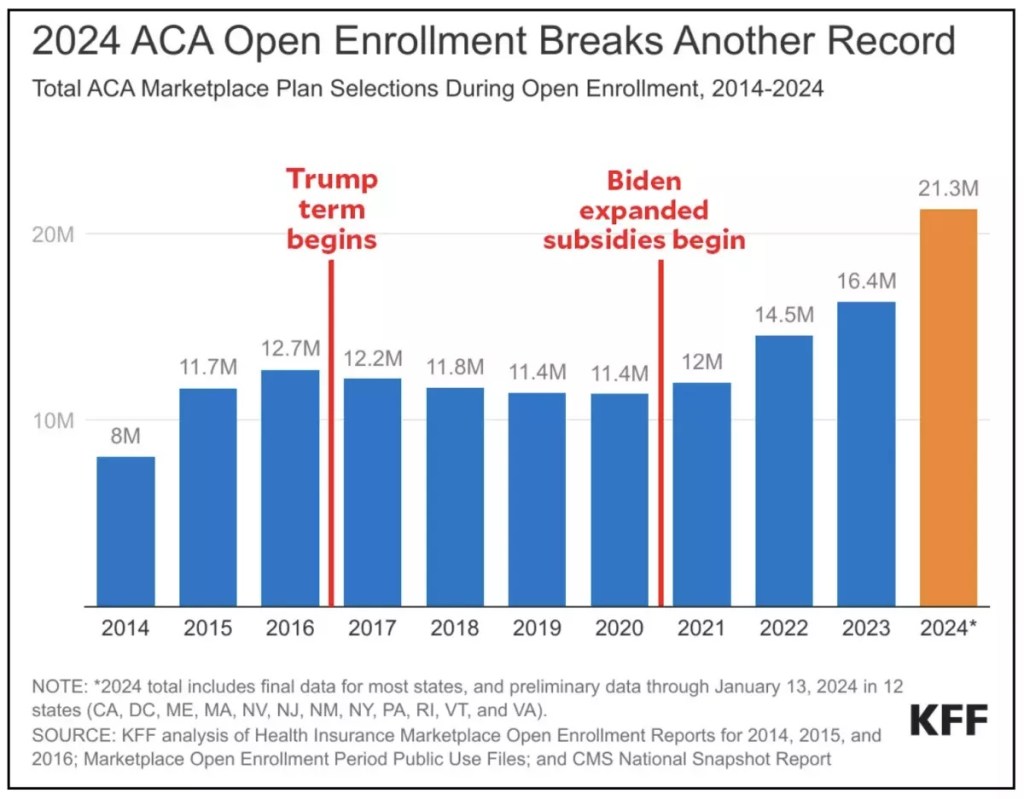
Trump drove down Obamacare enrollment every year he was in office; when Biden removed Trump’s obstacles, enrollment soared.
(KFF / Kevin Drum)
On Inauguration Day, Trump issued an executive order instructing the entire executive branch to find ways to “waive, defer, grant exemptions from, or delay the implementation of any provision or requirement” of the ACA.
During his presidency, he never abandoned the Republican dream of repealing Obamacare, even after July 28, 2017, when the late Sen. John McCain (R-Ariz.) strode to the Senate well and delivered a thumbs-down coup de grace to a GOP repeal bill.
Trump never ceased slandering the ACA as a “disaster.” He returned to the theme during last month’s debate: “Obamacare was lousy healthcare,” he said. “Always was. It’s not very good today.” As president, he threatened to make it “implode,” and used every tool he could get his fingers on to do so.
In September 2017 he slashed the advertising budget for the upcoming open enrollment period for individual insurance policies by a stunning 90%, to $10 million from the previous year’s $100 million. He also cut funds for nonprofit groups that employ “navigators,” those who help people in the individual market understand their options and sign up, by roughly 40%, to $36.8 million from $62.5 million.
Just after taking office, he abruptly canceled the customary last-minute advertising blitz to encourage enrollments in Obamacare plans before open enrollment ended on Jan. 31. The last minute surge in enrollments, which had occurred every previous year, vanished. The drop-off was particularly devastating because it was concentrated among the healthiest potential enrollees — those who often wait until the last minute to sign up and whose premiums generally subsidize older, less healthy patients.
The impact these policies had on enrollment was inescapable. In the three years before Trump took office, ACA marketplace plans experienced annual enrollment increases, to 12.7 million enrollees in 2016 from 8 million in 2014. During every year of the Trump administration, enrollment declined, falling to 11.4 million in 2020.
Every year since Joseph Biden took office, enrollment has increased, reaching a record 21.3 million this year — an 86% increase over Trump’s last year.
As for Vance’s fatuous claim that Trump “worked in a bipartisan way to ensure that Americans had access to affordable care,” you have the right to ask what Vance has been smoking.
The only bipartisanship on the ACA during the Trump years, Cohn observes, were the actions of GOP senators such as McCain and Lisa Murkowski of Alaska to cooperate with Democrats to stave off their fellow Republicans’ anti-ACA vandalism.
Now onto Trump’s fantasy vision of his role in fighting the COVID pandemic. Speaking in a low-energy, exhausted monotone at a speech Tuesday in Milwaukee and reading at times from a binder, he praised himself for instituting Operation Warp Speed, which funded COVID vaccine development in record time and got them rolled out in January 2021.
“We did a great job with the pandemic. Never got the credit we deserved,” he said. He then veered into blaming China for the pandemic, a familiar topic. He said bluntly that the pandemic was “caused by the Wuhan lab. I said that from the beginning, came from Wuhan. And the Wuhan lab, it wasn’t from bats in a cave that was 2,000 miles away. … It’s really the China virus.”
As for the rest of his COVID performance, he said this: “We did a great job with the ventilators, the masks and the gowns and everything. … When we got here the cupboards, our cupboards, I used to say our cupboards were bare. … No president put anything in for a pandemic.” Then he segued into praising himself for a big tax cut, and COVID was forgotten.
A few points about this spiel:
Trump is correct that Operation Warp Speed was a significant achievement. But he didn’t follow up by advocating for its product, the COVID vaccine. Instead, he has thrown in his lot with fanatical anti-vaccine agitators such as Robert F. Kennedy. He has repeated an anti-vax mantra, promising, “I will not give one penny to any school that has a vaccine mandate or a mask mandate.” This is a formula for exposing children to vaccine-preventable diseases such as measles and even polio.
Trump’s reference to the Wuhan Institute of Virology as the source of SARS-CoV-2, the virus that causes COVID, underscores how closely the so-called lab-leak theory of COVID’s origins is tied to right-wing partisan politics. The theory originated with Trump acolytes at the State Department, who saw the accusation as a convenient weapon in Trump’s economic war with China.
To this day, not a speck of evidence has been produced to validate this claim; scientists versed in the relevant disciplines of virology and epidemiology say the evidence overwhelmingly supports the hypothesis that the virus reached humans via the wildlife trade, and that its journey may well have started with bats thousands of miles from Wuhan, China.
Trump is lying when he says his predecessors in the White House left him without resources. The truth is that Trump himself hobbled pandemic response from the start.
In 2016, in the wake of the Ebola epidemic in Africa, President Obama had established the the Directorate for Global Health Security and Biodefense at the National Security Council “to prepare for and, if possible, prevent the next outbreak from becoming an epidemic or pandemic,” in the words of its senior director, Beth Campbell. Trump dissolved it in 2018.
Due to these steps, the U.S. was fated to sleepwalk into the pandemic. The COVID death toll in the U.S. stands at more than 1.2 million, and its reported death rate from COVID of 341.1 per 100,000 population is the highest in the developed world.
Ventilators, masks and gowns? Trump placed the procurement of this essential personal protective equipment in the hands of his son-in-law, Jared Kushner, who handled the task incompetently. Kushner turned away urgent appeals from state and local officials for those supplies.
“The notion of the federal stockpile was it’s supposed to be our stockpile, it’s not supposed to be states’ stockpiles that they then use,” Kushner said at a briefing.
Following his remarks, the website of the government’s national strategic stockpile of medicines and supplies was changed from asserting that its purpose was to “support” the emergency efforts of state, local and tribal authorities by ensuring that “the right medicines and supplies get to those who need them most.” The new language redefined the stockpile’s role as “to supplement state and local supplies … as a short-term stopgap.”
Supplies of ventilators, masks and gowns remained scarce through the first months of the pandemic. A procurement official at a Massachusetts hospital system told me of having had to cut a deal with a shadowy broker offering 250,000 Chinese-made masks at an inflated price, completing the transaction for $1 million at a darkened warehouse five hours from home.
Trump made anti-science incompetence and disregard for the welfare of Americans part of our history. The same thing, or worse, looms on the horizon in a second Trump term.
My comment: who can forget that dramatic moment in 2017 when the late Senator John McCain strode down to the well of the Senate to cast the deciding vote not to repeal Obamacare by dramatically extending his good arm and showing a thumb’s down gesture? Trump forgot.
As to COVID, why didn’t Trump take credit for the vaccines produced by Iperatuon Warp Speed? If the scientists had called it “the TRUMP vaccine, he probably would have boasted about it. Instead, he threw his support to the anti-VAXX conspiracy theorists, which surely contributed to the death toll.