Democrats: your best strategy for the fall elections is to campaign aggressively for public schools.
Berkshire and Schneider write that Democrats were panicked by Glenn Youngkin’s election as Governor in Virginia, which they attributed to his attacks on “critical race theory” in the schools and his pandering to far-right fake parents’ groups. Steve Bannon (and Chris Rufo) claimed that the road to a takeover was by seizing control of local school boards and destroying public schools.
Berkshire and Schneider say that their campaign is failing. Even in Trump territory, voters are supporting their public schools and rejecting the crazies.
They write:
As it turns out, GOP candidates running on scorched-earth education platforms have fared quite poorly in school board elections. In places like Georgia, Montana, New Hampshire and New York, voters have rejected culture warriors running for school board, often doing so by wide margins. A recent Ballotpedia review of more than 400 school board contests in Missouri, Oklahoma and Wisconsin found that race, gender and COVID were indeed influential in determining election outcomes, but not in the way one might expect. As they found, candidates who ran in opposition to a “conflict issue” — sexual education curricula, for instance, or a focus on race in the district — were more likely to lose their races.
Cherokee County, Ga., a rural county northwest of Atlanta, offers an instructive example. The county’s schools made national headlines recently after ProPublica reported on a group of white parents protesting the hiring of a Black educator brought on to serve as the first Diversity, Equity and Inclusion officer. Yet voters in the county, which Trump won by nearly 70 percent in 2020, overwhelmingly rejected hardline candidates for school board. A self-proclaimed family values slate, backed by the national 1776 Project PAC, and which ran in opposition to critical race theory and school district equity plans, failed to pick up a single seat.
Voters in Coweta County, Ga., sent a similar message to another slate of candidates endorsed by the 1776 Project. All four challengers were bested by board incumbents in the May primary, while a fifth — a controversial incumbent who participated in the Jan. 6 insurrection and claimed that students were being indoctrinated with critical race theory through district-provided Chromebooks — was unseated by a landslide in a runoff election in June.
It isn’t that these deep red countries have suddenly begun to turn blue. Instead, the culture war approach is falling short because Americans have direct experiences that contradict what they’re hearing from candidates.
Please open the link and read the good news for yourself.
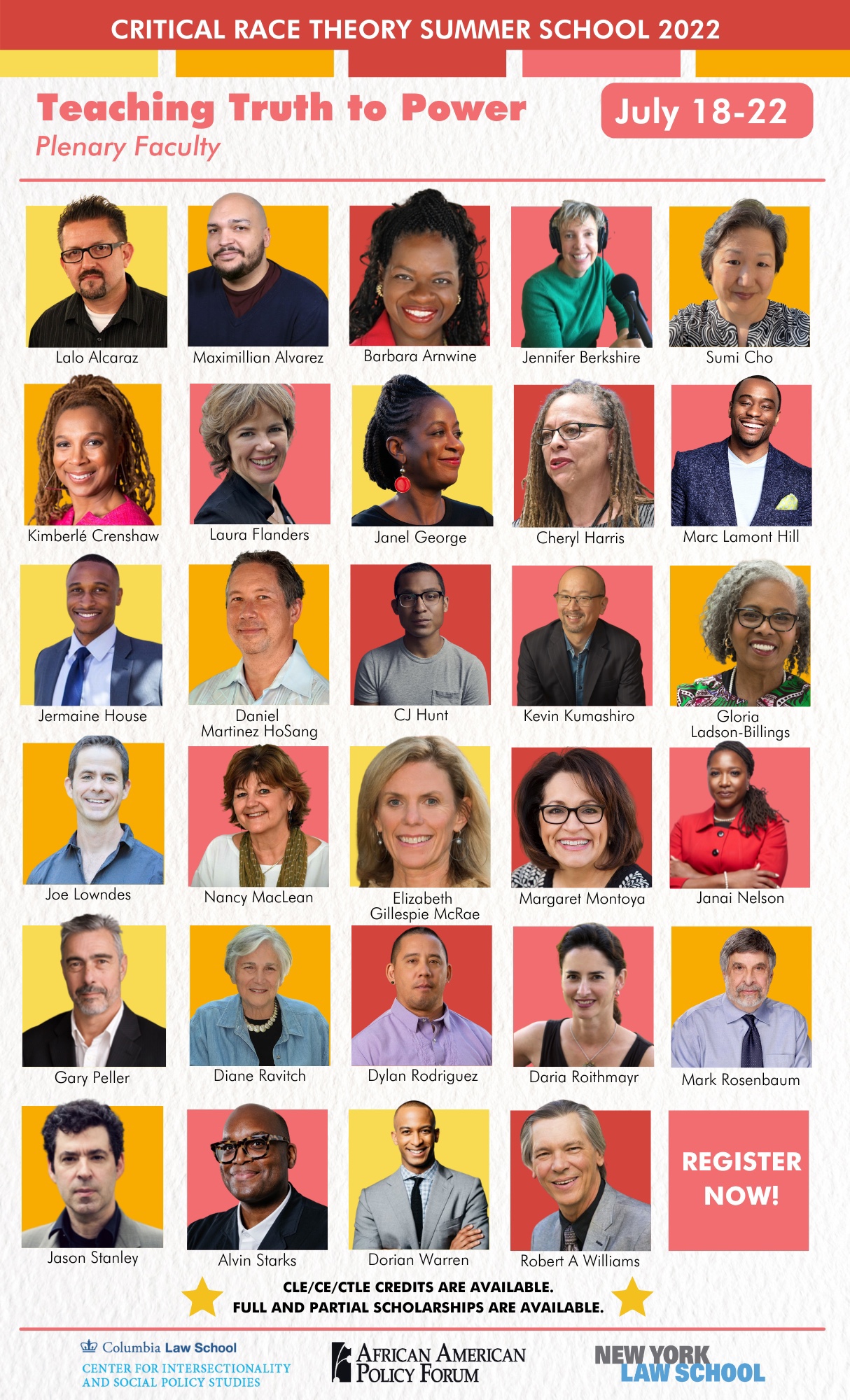
I will be a participant in a summer school program on Critical Race Theory. You are invited to sign up. I am part of the panel on July 20.
Greetings Friends and Colleagues,
The African American Policy Forum is so excited to be Teaching Truth to Power this year at Critical Race Theory Summer School! It is crucial that we prepare racial justice advocates to defend the right to teach truth in classrooms. This powerful and urgent program runs July 18 to July 22, 2022.
Seats are limited, so register here today! Events will be held daily between 1 p.m. to 6 p.m. ET throughout the week. Be sure to sign up for our listserv so that you don’t miss any updates.
CRT Summer School 2022 will include a variety of plenaries, breakout sessions, and networking opportunities aimed to inform, activate, and inspire. We’re inviting parents, educators, students, social workers, legal practitioners, media professionals and concerned community members from all walks of life, because there is something for anyone to learn from the sheer breadth of options available this year!
Daily Plenary Sessions
July 18 – Everyday CRT: A Commonsense Framework for Racial Liberation
July 19 – Public Schools, Private Agendas: How the Assault on Racial Justice Undermines Education
July 20 – Strange Bedfellows: The Left/Right Convergence that Enabled the Normalization of White Nationalism
July 21 – Define, Do Not Defend: How to Resist the Disinformation Campaign Against CRT
July 22 – Transforming a Moment to a Movement: Building A New Coalition to Secure our Multiracial Democracy
Discounts and Purchase Orders
Group sales (registration in increments of ten and five) are available and yield a 25% discount. For Purchase Orders please contact crt@aapf.org for more information.
Individual recipients of this email are eligible for a 10% discount using the following code during check-out: TSICAF-992000-IWANJ.
Full and partial scholarships are available. For more information visit our website: www.aapf.org/crtsummerschool.
On Demand Content
Great news! This year, all CRT Summer School content will be available to all registrants after the close of the event until Labor Day. You can watch anything you missed or revisit your favorites to ensure that you are a prepared racial justice advocate ready to defend the right to teach truth in schools.
We hope to see you at CRT-SS 2022! Please also share this email with your network – friends, colleagues, and constituents.
Bill Press, a former correspondent at CNN, argues that there is no way to fix the Second Amendnent. Despite the obvious political roadblocks, he believes that the only remedy for the damage caused by the Second Amendment is to repeal it. it was written, he says, to protect Southern slaveholders, who wanted to protect their right to use deadly force to suppress slave rebellions. Two Supreme Court Justices, both appointed by Republican presidents, have urged its repeal. It is now a license for civilians to own deadly military weapons. Is it politically possible now? No. If the massacres continue, public opinion may change.
He writes:
After Columbine, Aurora, Sandy Hook, Orlando, Virginia Tech, Margery Stoneman Douglas, El Paso, Buffalo, Uvalde and so many others, it’s always the same.
First, shock. Then, grief. Then, a demand for action. Then, the phony claim: Too bad, but we can’t do anything about guns because of the Second Amendment. And then, nothing is done to prevent the next attack.
This time, could things be different? After the senseless assassination of 19 elementary school students and two teachers in Uvalde, Texas, senators of both parties are actually talking about a compromise on guns.
But don’t hold your breath. No matter what they come up with, chances are still slim that there will be 10 Republicans willing to override the filibuster. (A total of 60 votes are needed to end a filibuster in the evenly-divided US Senate.)
Anything they agree on will probably just nibble around the edges of the gun issue. Sen. John Cornyn, the lead Republican negotiator, has already vetoed one of the most sensible proposals: raising the legal age for buying an assault weapon from 18 to 21 years…
Let’s face it. The way many judges and conservatives interpret the Second Amendment is a total con job. And, as wildly misinterpreted today, it is, for all intents and purposes, a license to kill as many people as you want with as many guns as you want.
The only effective way to deal with the Second Amendment is to repeal it — and then replace it with something that makes sense in a civilized society.
I’m hardly the first person to say that the Second Amendment has been a disaster for this country. In fact, two Supreme Court justices — justices appointed by Republican presidents — have said as much.
In a March 2018 opinion piece for the New York Times, former Justice John Paul Stevens, who was appointed by then-President Gerald Ford, wrote that Americans protesting the massacre of 17 people at Marjory Stoneman Douglas High School “should demand a repeal of the Second Amendment…”
And decades earlier, in 1991, former Chief Justice Warren Burger, appointed by President Richard Nixon, told the PBS Newshour: “If I were writing the Bill of Rights now, there wouldn’t be any such thing as the Second Amendment.
Burger called the Second Amendment “one of the greatest pieces of fraud — I repeat the word ‘fraud’ — on the American people by special interest groups that I have ever seen in my lifetime.”
Indeed, you only have to read the Second Amendment to see what a fraud it’s become. Here it is, all 27 words: “A well regulated Militia, being necessary to the security of a free State, the right of the people to keep and bear Arms, shall not be infringed.”
Read it again. There’s no way you can logically leap from those 27 words about the existence of a state militia to the unfettered right of any citizen to buy as many guns — and any kind of gun — that they want, without the government being able to do anything about it.
It’s clear from the wording of the Second Amendment itself that it has nothing to do with individual gun ownership; nothing to do with self-defense; and nothing to do with assault weapons. The amendment speaks, not to the rights of well-armed individual citizens, but only to citizens as members of a group, a “well regulated militia.”
And its history is well-known. The founders saw no need to mention guns in the original Constitution. As many constitutional scholars and American historians have shown, the Second Amendment was added later by James Madison as part of a deal to secure the support of Patrick Henry and other White racist Virginians for confirmation of the Constitution. Noted academic Carol Anderson, for one, describes the “anti-Blackness” that lies at the heart of the Second Amendment in her book “The Second,” as well as its “architecture of repression.”
As such, it was not about self-defense. It was, in the opinion of these historians, about reassuring White plantation owners that the new federal government would not interfere with their practice of forming White militias to patrol the South, ready to put down rebellion by disgruntled Black slaves or chase down slaves who tried to flee.
And again, the amendment has nothing to do with self-defense or allowing ownership of any kind of gun. As Stevens noted in his New York Times op-ed: “For over 200 years after the adoption of the Second Amendment, it was uniformly understood as not placing any limit on either federal or state authority to enact gun control legislation.”
Two things changed that. First, a band of gun extremists took over the NRA at its 1977 annual convention in Cincinnati and changed its mission from championing the Second Amendment as the right of hunters to giving every American the right to own a gun for self-defense. The NRA proceeded, successfully, to sell that unfounded idea of self-defense to politicians and the general public.
Second, in 2008, former Justice Antonin Scalia wrote the majority opinion in District of Columbia v. Heller, which — again for the first time in over 200 years — established the right of every American under the Second Amendment to own a gun for self-defense. And he rounded up four other votes.
However, it’s important to note that even in Heller, Scalia took pains to argue that as with other rights, those granted under the Second Amendment are not unlimited — and that governments retain the power to regulate what kind of guns, or how many, people may own.
Of course, those provisions of Heller are conveniently ignored by gun worshippers like Republican Sen. Ted Cruz of Texas, who uphold the Second Amendment as reinterpreted by Scalia. That flawed reasoning allowed a Texas teenager to buy two AR-15’s on his 18th birthday, walk into an elementary school and mow down 19 students and two teachers.
We are a sick nation indeed, if we allow that idiocy to stand.
Jan Resseger has established a reputation for writing well-researched, fearless articles about unjust education policies. In this post, she reviews a new book about the roots of corporate education reform. I have already ordered it.
She writes:
I remember my gratitude when, back in 2010, I sat down to read Diane Ravitch’s The Death and Life of the Great American School System, which connected the dots across what I had been watching for nearly a decade: the standards movement, annual standardized testing, the operation of No Child Left Behind’s test-and-punish, Mayor Bloomberg’s promotion of charter schools in New York City, and the role of venture philanthropy in all this.
Now over a decade later, many of us have spent the past couple of months worried about pushback from the charter school sector as the the U.S. Department of Education has proposed strengthening sensible regulation of the federal Charter Schools Program. We have been reminded that this program was launched in 1994, and we may have been puzzled that a federal program paying for the startup of privately operated charter schools originated during a Democratic administration.
Lily Geismer, a historian at Claremont McKenna College, has just published a wonderful book which explains how the New Democrats—Bill Clinton, Al Gore, and the Democratic Leadership Council—brought a political and economic philosophy that sought to end welfare with a 1996 bill called the “Personal Responsibility and Work Opportunity Reconciliation Act” and envisioned privately operated charter schools to expand competition and innovation in the public schools as a way to close school achievement gaps. Geismer’s book is Left Behind: The Democrats’ Failed Attempt to Solve Inequality. The book is a great read, and it fills in the public policy landscape of the 1990s, a decade we may never have fully understood.
In the introduction, Geismer explains where she is headed: “Since the New Deal, liberals had advocated for doing well and doing good. However, the form of political economy enacted during the new Deal and, later, the New Frontier and Great Society understood these as distinct goals. The architects of mid-twentieth century liberalism believed that stimulating capital markets was the best path to creating economic growth and security (doing well). The job of the federal government, as they saw it, was to fill in the holes left by capitalism with compensatory programs to help the poor, like cash assistance and Head Start, and to enact laws that ended racial and gender discrimination (doing good). In contrast, the New Democrats sought to merge those functions and thus do well bydoing good. This vision contended that the forces of banking, entrepreneurialism, trade, and technology… could substitute for traditional forms of welfare and aid and better address structural problems of racial and economic segregation. In this vision, government did not recede but served as a bridge connecting the public and private sectors.” (p. 8)
Geismer devotes an entire chapter, “Public Schools Are Our Most Important Business,” to the Clinton administration’s new education policy. She begins by telling us about Vice President Al Gore’s meetings with “leading executives and entrepreneurs from Silicon Valley. The so-called Gore-Tech sessions often took place over pizza and beer, and Gore hoped for them to be a chance for the administration to learn from innovators of the New Economy…. One of these meetings focused on the problems of public education and the growing achievement gap between affluent white suburbanites and students of color in the inner city…. The challenge gave venture capitalist John Doerr, who had become Gore’s closest tech advisor, an idea… The tools of venture capital, Doerr thought, might offer a way to build new and better schools based on Silicon Valley’s principles of accountability, choice, and competition… Doerr decided to pool money from several other Silicon valley icons to start the NewSchools Venture Fund. NewSchools sat at the forefront of the concepts of venture philanthropy. Often known by the neologism philanthrocapitalism, venture or strategic philanthropy focused on taking tools from the private sector, especially entrepreneurialism, venture capitalism, and management consulting—the key ingredients in the 1990s tech boom—and applying them to philanthropic work… Doerr and the NewSchools Fund became especially focused on charter schools, which the Clinton administration and the Democratic Leadership Council were similarly encouraging in the 1990s.” (pp. 233-234)
As she explains, the Clinton administration bought the idea that charter schools would be an effective way to end poverty. It encouraged the growth of the charter sector, not realizing that it was creating an industry that would fight accountability, lobby for more federal funding, and ignore frequent scandals and frauds.
It is a cautionary tale that reminds us that the best way to fight poverty is to raise incomes, create jobs, and support labor unions that will defend the rights of working people and advocate for higher wages and benefits.
I watched the hearings from start to finish. They were gripping. The first fact that was established was that the people closest to Trump told him that he had lost the election. His Attorney General William Barr told Trump in no uncertain terms that his claims that the election was stolen were “bullshit.” The outcome was not affected by election fraud, Barr said. Barr said his refusal to accept the result was hurting the country. Ivanka testified that she believed Bill Barr.
But unlike every other American president, Trump refused to admit he lost. He listened to Rudy Guiliani, Sidney Powell, and Michael Flynn, who encouraged his fantasy that he could overturn the election. His advisors tried to separate him from the loonies, but they were unsuccessful.
He and his lawyers filed 60+ lawsuits alleging fraud, but all of them failed because of lack of evidence.
Trump encouraged his zealous MAGA followers to believe that the election was rigged and stolen. His extremist followers—the Proud Boys and the Oath Keepers—were eager to help. On December 19, after meeting with Guiliani, Powell, and Flynn, he tweeted to his followers to come to DC on January 6, the day the election results were to be certified. He predicted “it will be wild.” On January 5, Steve Bannon said that on the following day, “All hell will break loose.”
The Proud Boys and the Oath keepers were there, as were thousands of other MAGA zealots. Trump encouraged his followers to March on the Capitol. He said that everything hinges on Mike Pence “doing the right thing,” I.e. refusing to accept the results from states where the votes were close.
When the mob attacked the Capitol, they chanted “Hang Mike Pence.” They sought Nancy Pelosi. No one knows what they would have done had they broken into the chambers while members of Congress were present.
The committee showed video of the insurrection that had not been seen before. It was a violent and wild scene, with men beating police officers repeatedly, using clubs and even flag poles as weapons. It was a scene of carnage. The video was powerful and shocking. As the video ended, Trump’s voice was superimposed, saying something like “There was a lot of love that day.” But the scene of his MAGA buddies pummeling and brutalizing cops was not loving.
Through the hours in which the mob stormed the Capitol, Trump refused to call for help. He did not call out the National Guard or the Secretary of Defense or Homeland Security. Mike Pence, from his secret location, called desperately for help. So did other Republican members of Congress. But it was hours before reinforcements arrived.
Just for the hell of it, when the hearing was over, I turned on FOX News. It was sickening. Laura Ingraham ridiculed Liz Cheney and said she was interminable and boring. No mention of the evidence of Trump’s lies and inaction. Most outrageous was Ingraham’s spin: Our democracy was never at risk. The Democrats and traitor Cheney exaggerated, she lied. No, democracy was never at risk. So what if hundreds and thousands of violent insurrectionists tried to stop the peaceful transfer of power, a tradition that began with George Washington. So what if the Trump mob beat up the law officers. So what if one of the police died of a stroke and four committed suicide.
What if the cops had not held the mob out as long as they did? What if they had seized Pence, Pelosi, Schiff, Raskin and others they hated?
No threat to our democracy? How could Laura Ingraham lie so egregiously with a straight face?
Trump issued a statement about the blood assault on the seat of the US government:
“January 6th was not simply a protest, it represented the greatest movement in the history of our Country to Make America Great Again,” he wrote in a statement.
Liz Cheney was addressing her fellow Republicans. But more than that, she was speaking to posterity. “I say this to my Republican colleagues who are defending the indefensible,” she said at Thursday night’s opening hearing of the Jan. 6 House select committee. “There will come a day when Donald Trump is gone, but your dishonor will remain.”
The Wyoming congresswoman, daughter of the former vice president, and vice chair of the committee, outlined for the country, and for history, two contrasting stories about the bloody insurrection.
One was a tale of honor and duty. Officials in the Justice Department and White House, to a greater extent than was previously known, confronted Trump about his election lies and repeatedly threatened to resign if he followed through with his darkest impulses.
The other was a tale of brutality and deceit by Trump and a small band of loyalists. They knew he had lost, and yet, as Cheney put it, “Trump oversaw and coordinated a sophisticated, seven-part plan to overturn the presidential election and prevent the transfer of presidential power.”
In perhaps the most chilling moment of the hearing, Cheney spoke of former White House officials’ testimony about Trump’s bloodthirstiness toward his own vice president. “Aware of the rioters’ chants to hang Mike Pence, the president responded with this sentiment, quote, ‘Maybe our supporters have the right idea.’ Mike Pence, quote, ‘deserves it.’ ”
I never thought I would say this but it’s true: Mike Pence saved our democracy by refusing to follow Trump’s demand to hand him the election that he lost. Pence followed the Constitution and foiled the coup.
And after watching the hearings, I sent $100 to Liz Cheney’s re-election campaign.
Michael Hiltzik is a brilliant columnist for The Los Angeles Times. This article is the single best analysis of gun control that I have read anywhere. In it, Hiltzik demonstrates the fallacies of those who oppose gun control. The Second Amendment does not give unlimited rights to own guns. Gun control is supported by majorities. Effective gun control saves lives. Why should the right to own a gun be more sacred than the right to life?
Hiltzik writes:
Another massacre, another outpouring of political balderdash, flat-out lies about gun control and cynical offers of “thoughts and prayers” for the victims.
I haven’t commented on the slaughter of 19 children and two adults in Uvalde, Texas, by an assault rifle-wielding 18-year-old before now, hoping that perhaps the passage of time would allow the event to become clarified, even a bit more explicable.
But in the week since the May 24 massacre, none of that has happened. The news has only gotten worse. It’s not merely the emerging timelines that point to the inexcusable cowardice of local law enforcement at the scene, but the ever-growing toll of firearm deaths across the country.
The right secured by the Second Amendment is not unlimited.
— Justice Antonin Scalia, District of Columbia vs Heller
There have been 17 mass shootings nationwide since Uvalde, including 12 on Memorial Day weekend alone. A mass shooting is defined by the Gun Violence Archive as one in which four people or more are killed or wounded, not including the shooter.
What is most dispiriting about this toll is the presumption that campaigning to legislate gun safety is fruitless, because gun control is unconstitutional, politically unpopular, and useless in preventing mass death.
These arguments have turned the American public into cowards about gun control. Voters seem to fear that pressing for tighter gun laws will awaken a ferocious far-right backlash, and who wants that?
Yet not a single one of these assertions is true, and repeating them, as is done after every act of mass bloodshed, doesn’t make them true. The first challenge for those of us concerned about the tide of deaths by firearms in America is to wean the public and public officials from their attitude of resignation.
We’ll skip lightly over a few of the more ludicrously stupid claims made by politicians and gun advocates about Uvalde.
For example, that the disaster could have been averted if the school had only one door, says Sen. Ted Cruz (R-Texas); apparently Cruz is ignorant of the Triangle Shirtwaist Factory disaster, in which 146 garment workers died, many because they could not escape the factory through its locked doors.
But that happened in 1911, and who can expect a Senator to remain that au courant?
Or the assertion by Texas Gov. Greg Abbott and many others that the problem leading to Uvalde isn’t the epidemic of assault weapons, but mental illness. This is nothing but an attempt to distract from the real problem.
“Little population-level evidence supports the notion that individuals diagnosed with mental illness are more likely than anyone else to commit gun crimes,” a team from Vanderbilt University reported in 2015.
Finally, there’s the argument that the aftermath of horrific killings is not the time for “politics.” In fact, it’s exactly the time for politics. Mass death by firearm is the quintessential political issue, and there’s no better time to bring it forward than when the murders of children and other innocents is still fresh in the public mind.
Let’s examine some of the other common canards about gun violence and gun laws, and start thinking about how to move the needle.
The 2nd Amendment
For 217 years after the drafting of the Bill of Rights, which included the 2nd Amendment, courts spent little effort parsing its proscription that “A well regulated militia, being necessary to the security of a free state, the right of the people to keep and bear arms, shall not be infringed.”
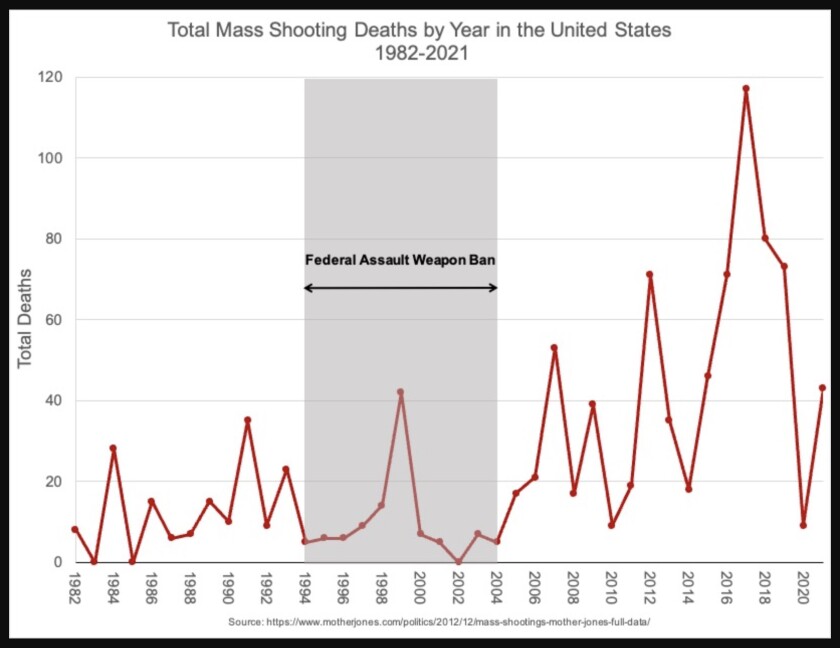
Since the federal ban on assault weapons expired in 2004, mass shootings with those weapons has climbed. An assault weapon was used in the Uvalde massacre of May 24. (Mother Jones)
That changed in 2008, with the Supreme Court’s ruling in the so-called Heller case overturning the District of Columbia’s ban on possession of handguns in the home. Since then, the impression has grown — fostered by the National Rifle Assn. and other elements of the gun lobby — that Heller rendered virtually any gun regulation unconstitutional.
But Justice Antonin Scalia’s 5-4 majority opinion said nothing of the kind. Indeed, Scalia explicitly disavowed such an interpretation. “The right secured by the Second Amendment is not unlimited,” he wrote. The Constitution does not confer “a right to keep and carry any weapon whatsoever in any manner whatsoever and for whatever purpose.”
There was, and is, no constitutional prohibition against laws prohibiting the carrying of concealed weapons, he found. Nothing in his ruling, he wrote, should “cast doubt on longstanding prohibitions on the possession of firearms by felons and the mentally ill, or … the carrying of firearms in sensitive places such as schools and government buildings,” or conditions on gun sales.
The problem with the D.C. law, Scalia wrote, was that it went too far by reaching into the home and covering handguns, which were popular weapons of defense in the home. “The Constitution leaves the District of Columbia a variety of tools” for regulating handguns, as well as other firearms, he wrote.
The federal assault weapons ban, which was enacted in 1994 and expired in 2004, repeatedly came under attack in federal courts, and prevailed in every case. Not a single one of those challenges was based on the 2nd Amendment. Since the expiration of the ban, mass shooting deaths in the United States have climbed steadily.
“Heller has been misused in important policy debates about our nation’s gun laws,” wrote former Supreme Court clerks Kate Shaw and John Bash in a recent op-ed. “Most of the obstacles to gun regulations are political and policy based, not legal.” Shaw and Bash worked on the Heller decision as clerks to Scalia and John Paul Stevens, the author of the leading dissent to the ruling, respectively.
So let’s discard the myth that gun control laws are unconstitutional.
The NRA
By any conventional accounting, the NRA is a shadow of its former self. Its leadership has been racked with internal dissension, its resources have been shrinking and it has faced a serious legal assault by New York state. Attendance at its annual convention last week in Houston drew only a few thousand members, even with former President Trump on hand to speak.
Yet the organization still carries major political weight. To some extent that’s an artifact of its political spending. Even in its straitened circumstances it’s a major political contributor, having handed out more than $29 million in the 2020 election cycle. Some of the politicians taking resolute pro-gun stands are beneficiaries of this largess, mouthing “thoughts and prayers” for the victims of gun massacres while pocketing millions from the NRA.
The NRA also has played a lasting role in blocking funds for research into gun violenceby federal agencies such as the Centers for Disease Control and Prevention, an obstacle that remained in place for some two decades until Congress restored funding in 2019. But the gap in research still hampers gun policymaking. It’s long since time to curb this organization’s blood-soaked influence on our politics.
Debate? What debate?
Part of the knee-jerk news coverage of the aftermath of gun massacres is the notion that the American public is deeply divided over gun regulations. This is a corollary of the traditional claim that American society is “polarized,” which I showed last year to be absolutely false. The truth is that large majorities of Americans favor abortion rights, more COVID-related restrictions and, yes, gun regulations.
More than 80% of Americans favor instituting universal background checks on gun buyers and barring people with mental illness from owning guns, according to a Pew Research Center poll. More than 60% favor banning assault weapons and high-capacity ammo magazines.
The poll was taken last September; it’s a reasonable bet that the majorities would be larger now. To put it another way, the “debate” is over — most Americans want to bring gun sales and ownership under greater control.
Gun regulations work
One claim popular among pro-gun politicians is that gun regulations don’t serve to quell gun violence. (A common version of this trope is that proposed regulations wouldn’t have stopped the latest newsworthy massacre.)
This is a lie, as statistics from the CDC show. States with stricter gun laws have much lower rates of firearm deaths than those with lax laws. The first category includes California (8.4 deaths per 100,000 population) and Massachusetts (3.7). The second group includes Louisiana (26.3) and Texas (14.2, and the highest total gun-related mortality in the country, at 4,164 in 2020).
Texas even loosened its gun regulations just months before the Uvalde massacre. When Missouri repealed its permit regulations for gun ownership in 2007, gun-related homicides jumped by 25% and gun-related suicides by more than 16.1%. When Connecticut enacted a licensing law in 1995, its firearm homicide rate declined by 40% and firearm suicides by 15.4%.
Make them vote
Perhaps the most inexplicable argument justifying congressional inaction over gun laws is that tough laws have no chance of passage, so it’s pointless even to try. Defeatism in the face of urgent need is inexcusable.
The resistance of Republicans to voting for gun laws is precisely the very best reason for bringing those bills to the floor. There’s no reason to give Republican obstructionists a free pass — make them stand up and take a vote.
Make them explain what it is about making Americans safer in schools and workplaces that they find objectionable, and why they think that voting against measures supported by 80% of the public is proper. Bring the fight to them, and show voters the character of the people they’ve placed in high office.
Show the pictures
Americans have become inured to gun violence in part because our culture minimizes its horrors. We’re awash in the most visceral depictions of shootings in movies and television, but at their core those depictions are unthreatening — indeed, in most cases they’re meant for entertainment.
Even our news programs revel in gore — the classic dictum of local news broadcasting has long been “If it bleeds, it leads.”
These conditions have inoculated us against the horror of firearm injuries as they occur in real life — especially those caused by assault weapons such as the AR-15. There’s a big difference between hearing the words “gunshot wound” and learning what actually happens to the organs of victims of AR-15 assaults. They don’t look anything like what we see on TV, and we need to have a true, visceral sense of the difference.
“These weapons are often employed on the battlefield to exact the maximum amount of damage possible with the strike of each bullet,” radiologist Laveil M. Allen wrote last week for the Brookings Institution. “Witnessing their devastating impact on unsuspecting school children, grocery shoppers, and churchgoers is unfathomable. The level of destruction, disfigurement, and disregard for life that a high-powered assault rifle inflicts on the human body cannot be understated. Placed into perspective, many of the tiny Uvalde victims’ bodies were so tattered and dismembered from their ballistic injuries, DNA matching was required for identification because physical/visual identification was not possible.”
You’ll hear the argument that showing photographs of real victims or the scenes of massacres will only be more traumatizing. For some people, including the victims’ families, that may be true. But that only underscores my point — we have not been sufficiently traumatized, and the creation of a truly effective mass movement for gun laws requires that we be traumatized.
Because we experience the horror of gun massacres at a remove, they tend to drift out of public consciousness in a distressingly short time span. Even after the Sandy Hook killings, which took the lives of 20 children ages 6 and 7 less than 10 years ago, there was something distancing about reportage of the event. Photos of some of the murdered children have been made public, but they are photos from life, showing the children smiling at birthday parties or gamboling about the playground.
Let’s face it — few Americans were thinking about the Sandy Hook killings until May 24, when the Uvalde massacre brought them bubbling back to public consciousness. Would our reaction be different had we seen photographs of classrooms slathered in blood, of children’s bodies ripped to pieces by Adam Lanza’s assault rifle?
You bet it would. Those images would not easily be forgotten. Every time a GOP senator or representative stood up to declare that the right to own assault weapons trumped the right of those children to live their lives, someone should have produced one of those photographs and said, “Justify this.”
Our risk is that Uvalde will be just another Sandy Hook. Soon to move off the front burner, or soon buried under the choruses of “We can’t pass this” or “This won’t work” or “This is the path we’ve chosen.” We need to change the terms of discussion, or Uvalde will just be the latest massacre of a long line, not the last massacre of its kind.
So back in September the BLS [the federal Bureau of Labor Statistics] released the monthly Jobs number. A terribly disappointing 234,000 Jobs +- . It was disappointing because the same economic analysts who could not see a Housing Bubble bigger than the Stay Puff Marshmallow man had predicted 300,000 + . The fact that it was as high or higher than all but a handful of the previous 120 months never seemed to dawn on the talking heads. In October there were 677,000 Jobs added. And at the same time the number for October was adjusted 200,000 higher. It took the media all of 10 seconds to shift the narrative to “oh but inflation” As stated by some CNBC talking head that day, inflation is an expectations game. If workers expect inflation they will ask for higher wages. If employers expect inflation they will charge more for goods and services. Inflation in September was all of 4.4 ,% high but not earth shaking. Then the (respectable) media ran stories of almost $6 dollar a gallon gas as if that was the norm. Of a Tex-ass couple who goes through 9 gallons of milk a week and was bankrupted by the cost (don’t ask about birth control). Of a Station owner in NJ who spends $1000s a week on gas for his 1970 muscle car and his 2000 Escalade.
Well the message was received, the expectation of inflation was created. Wages now contribute 8.5% of the inflationary spike. Raw materials and supply chain issues 27% of the inflation we see. And excess profits contribute 53% of the price hikes we are seeing. (EPI). It would seem the right people got the right message but it was not the American worker who in spite of all the hype does not have the power to demand wage increases on a broad based scale as they did in the past. In previous inflationary spikes inflation was driven 70% by wage increases . The media hype on inflation prior to the Ukraine war enabled corporations to profit vastly. The expectation was there. Corporate America hopped right on the band wagon. Don’t expect the corporate media to hop on board calling for an excess profits tax, or even to harp on those excess profits. Instead we will hear nonsense about low wage workers holding out for a living wage.
Was it a conscious conspiracy ? Probably not . Is it a combination of of group think and inferior reporting (IMHO) absolutely.
Moving on to Crime in NYC . In a nut shell if NYC was the safest big city in America in 2010 (according to Bloomberg) than how did it get unsafe in 2021 when every Crime Stat released by the NYPD is lower than 2010, when people felt the City was safe.
My favorite NYC crime category is rape. In 2021 there were 1491 reported rapes in NYC up from 1427 in 2020. Women be afraid be very afraid!!!. But wait there were 1755 in 2019 and 1791 rapes in 2018, when everyone thought the City was very safe.
The Right wing media generates a narrative and instead of countering it, the supposedly Liberal MSM run with the story. . Cowardly Democratic politicians who call themselves moderates hop right on board not wanting to seem like they are ignoring an issue.
If Trump was President every Republican would be calling inflation fake news and their Ivermectin downing base would be swallowing it hook line and sinker.
In New York State, a court determined that the state’s congressional districts were gerrymandered in favor of Democrats. The special master appointed by the court drew new districts that dilutes the black vote and negatively affects Congressman Jamaal Bowman, one of the state’s most progressive members of Congress. The redistricting might lead to a primary between Bowman and Rep. Mondaire Jones, who is also Black. That would mean the loss of a Black member of Congress. The redistricting is weighted towards helping Republican candidates.
The new lines even cast the future of several long-tenured, powerful Democratic incumbents in doubt, forcing several to potentially run against one another.
The most striking example came from New York City, where Mr. Cervas’s proposal pushed Representatives Jerrold Nadler, a stalwart Upper West Side liberal, and Carolyn Maloney of the Upper East Side into the same district, setting up a potentially explosive primary fight in the heart of Manhattan. Both lawmakers are in their 70s, have been in Congress for close to 30 years and lead powerful House committees.
Representative Hakeem Jeffries, the chairman of the House Democratic Caucus and a favorite to become the party’s next leader, was one of a handful of incumbent lawmakers who, under the new map, would no longer reside in the districts they represent. In one case, the new lines put Representative Brian Higgins mere steps outside his greater Buffalo district.
Taken together, the proposed changes have broad national implications, effectively handing Republicans the upper hand in a national fight for control of the House, and rattling the top echelons of House Democratic leadership…
In a blistering statement, Mr. Jeffries accused the court of ignoring the input of communities of color, diluting the power of Black voters and pitting Black incumbents against each other in “a tactic that would make Jim Crow blush.”
One of my friends, Jamaal Bowman, has been imperiled by the redistricting. His office issued this statement:
STATEMENT: Rep. Jamaal Bowman Responds to Proposed District Map that Decreases the NY-16 Black Voter Population by 17%
YONKERS, NY – Yesterday a court filing unveiled the newly redrawn congressional districts in New York City. The new maps, which were drawn by court-appointed Special Master Jonathan Cervas but are not yet final, change the 16th Congressional District to remove much of the Bronx, decreasing the Black voter population by about 17%. In response, Congressman Jamaal Bowman (NY-16) released this statement:
“The whole point of redistricting is to create congressional districts that keep communities of interest together. Unfortunately, the map created by the special master splits NY-16’s historically low-income Bronx communities into three congressional districts and decreases the Black voter population by 17%. This occurred despite an outpouring of testimony urging redistricting officials to protect the Black vote by keeping the northeast Bronx with lower Westchester together. The proposal shows that Co-Op City is mapped into NY-14, Williamsbridge and Baychester into NY-15 and Edenwald kept in NY-16. The map data shows that this directly resulted in the Black voter population declining by 17%. Co-Op City, Williamsbrige, and Edenwald are strong communities of interest that must remain together as a unity and connected to lower Westchester. The Black voting power in NY-16 cannot be diluted in favor of more compact but less fair maps.
“Edenwald in the Bronx is home to the third-largest public housing community in New York State and one of the largest in the country. The Edenwald community is a vulnerable community that is separated in this proposed map from the other densely populated majority Black communities like Co-Op City, Williamsbridge, and Baychester, whose voting power helps protect these communities’ specific needs around housing, public safety, and poverty alleviation. Similarly, Co-Op city is the largest naturally occurring retirement community in the country predominantly populated by lower-income and Black seniors. By splitting these communities, the map further alienates them and perpetuates the opportunity for further historical neglect by the electoral system. These are communities who have been kept together in maps for decades for good reason and with good intention. Their voting power is directly tied to their lives and they deserve a fair chance at electing representatives that take their unique needs into full consideration.
“Now, I only have one message for NY-16: I will continue fighting for you, and I will fight to continue to represent you. I also hope that voters continue to have their voices heard in every elected official that represents them as I intend to continue and advocate for their needs and the needs of every person in NY-16.”
About Jamaal Bowman Congressman Jamaal Bowman was an educator and advocate for public schools for over 20 years and previously served as principal for the Cornerstone Academy for Social Action (CASA), a public middle school he founded in 2009 in the Baychester neighborhood of The Bronx. Rep. Bowman is a life-long New Yorker who lives in Yonkers with his wife and children.
Robert Hubbell is a wonderful, sensible blogger. I enjoy reading his posts. Here is one that ties together our current “gloom and doom” about the politics at home with the defiance and courage of Ukrainians who are standing up to a brutal invasion.
He wrote:
The media doomsday machine is in overdrive.
Readers are again filling my inbox with stories that predict disaster for Democrats in the midterms. All I can say is that we should be thankful that the journalists declaring defeat are not in charge of defending Ukraine. The current narrative is that the only issue that matters to voters is the economy. Of course, except for inflation, the economy is strong—a fact universally ignored by the media. But in the “short-attention-span” media, the criminalization of abortion is a story that has run its course and is baked into the outcome of the midterms. Such a view denigrates the role of voters in the political process and ignores the possibility that the attitudes of voters can change over the course of an election.
So, let’s reset where we are at this moment in time. Most primaries for midterms have not yet occurred, so Democrats don’t know who they will be facing. But we have strong signals that Republican candidates will be more extreme, less qualified, and more vulnerable than the GOP had hoped. The surge of activism that should follow the criminalization of abortion is just getting off the ground. The final opinion was expected in late June; the leak in early May caught many grass-roots groups by surprise. Republicans and the mainstream media want to create a narrative that says, “Nothing to see here, move along. The fight over abortion won’t motivate Democrats or persuadable Independents.”
I believe the above narrative badly mis-reads what is about to happen. We are no longer arguing over abstract legal principles. We are facing a situation in which abortion will be a crime, and teenage girls raped by family members will be ordered by the state to bear children forced on them by violent attackers. The narrative ignores that a strong majority of Americans supported the Roe / Casey paradigm for balancing individual liberty and societal interests. And it ignores the fact abortion is far more common than many believe. Per the NYTimes, “25 percent of women will have an abortion by the end of their childbearing years.” Telling those women, even retroactively, that they are “felons” or “criminals” will surely have some effect on their view of their Republican accusers.
So, what should we do? First, we need an attitude adjustment. If you see a story predicting disaster, you must summon the fighting spirit to say that pundits and “conventional wisdom” do not control your actions or your destiny. The fighting spirit of the Ukrainian people is instructive. The “conventional wisdom” predicted their defeat in two weeks. Our first clue that the Ukrainians would not allow conventional wisdom to determine their destiny was Zelensky’s statement, “I need ammunition, I don’t need a ride.” The second indication came from the defenders of Snake Island who were ordered by a “Russian warship” to “surrender” before being shelled. The reply, “Russian warship, go f**k yourself” will live in legend. [Note: The “warship” in question was later sunk by Ukrainian missiles.]
We all need a bit of the “in-your-face” confidence to tell the doomsayers what they can do with their predictions. In that regard, I recommend the video in a tweet by MeidasTouch, “Hey, Republican Party. Go f—k yourselves.” Fair warning—the video includes about a dozen profanities, which are usually unproductive and distracting. But the sentiment expressed in the video captures the fighting spirit that all Democrats need at this moment. Republicans are busy telling the mainstream media that the 2022 midterms are over and that Democrats should surrender. As the Ukrainian defenders on Snake Island said, “Russian warship, . . . .”
Greg Brozeit notes here an alarming aspect implicit in the Alito draft decision overturning Roe v. Wade. His comment appeared on the blog. Alito and four other radical conservatives demonstrated that precedent and stare decisis mean nothing to them. Despite their assurances under oath to the Senators who interviewed them, the radical justices intend to overturn a right declared by the Supreme Court 49 years earlier. Never in the history of the Supreme Court has a right granted by the Court been overturned. This radical, reckless decision will set off more demonstrations and protests. Recent polls show that only about 20% of the nation believes that abortion should be banned under all circumstances. The rest believe that it should be safe and legal, with certain conditions, such as rape, incest, the life of the mother. The sweep of this unprecedented revocation will leave many people wondering what other prior decisions will be overturned.
Greg Brozeit writes:
Just as CRT is not about education, the Alito Roe draft is not about abortion. It is much bigger. Some of you come oh so close to crossing the rhetorical goal line. The real question is not if or why, but how this becomes a legal mallet that makes no decision “safe.”
If the wording “Roe was egregiously wrong from the start” remains intact in the final opinion, it basically creates a precedent that precedent no longer exists. It would effectively be the first mortal wound in the legal doctrine of stare decisis as a check on judicial power. Its goal is to make a mockery out of the idea of judicial review as to render it meaningless. It’s “reasoning” could seep into and dominate all law from civil to maritime to military. And it fits perfectly with ALEC’s strategy to marginalize judicial review with packaged, ready-to-go legislation for lazy, partisan, or stupid (or all of the above) statewide elected legislature or governor.
This was not a legal shot over the bow. It was a direct hit on democracy and left no doubt that the only thing this court wants more is a tailor-made case that will give them stronger legal “reasoning” to be even more draconian. That would be the only reason this language might not be in the final decision handed down. It would be a short-lived “victory” that would be a prelude to something even worse for average and poor Americans.
This is the typical drivel the DNC-driven agenda gives us, focusing on individual policies rather than the real existential threat to democracy the Republican Party poses from local government through the office of the presidency. Now as correct as we may be about the fate of women’s rights and as big as that issue is, this is about much, much basic stakes. The radical right and their few partners on the looney left understand this. Hardly anyone else, it seems, does. Or at the very least, they can’t identify the true threat this enemy is posing. If they do not win now or in the next elections, they will continue to poison and cripple the system until they do. That, it seems, is the best we can hope for now. A slow death with faint hope for a miracle recovery rather than an immediate plunge into fascism.