Archives for category: Democrats

Republicans like to complain about “cancel culture,” but they are its biggest practitioners. If it were up to them, Democrats would be completely silenced, as would gay students and teachers who want to teach honestly about racism.

Beto O’Rourke is running against Republican Governor Gregg Abbott, and he’s discovering that many venues in red districts won’t allow him to speak because he is a Democrat.

The Texas Monthly describes what happened to Beto in Comal County, a deep red district.

When Democratic candidates for statewide office tour Texas, an atmosphere of doom and despair typically haunts their campaigns, like a pack of wolves shadowing a wounded elk. In 2014, I rode on state senator Leticia Van de Putte’s campaign bus as she embarked on a multiday expedition to South Texas toward the end of her race for lieutenant governor. The bus, which departed from San Antonio, ran for two hours before breaking down around Falfurrias. A few weeks later, she lost by nearly twenty points.

Beto O’Rourke’s first statewide campaign, when he challenged Ted Cruz for a U.S. Senate seat, by contrast, felt enchanted—the political equivalent of a Disney-animated romp with singing woodland creatures. For a year and a half, O’Rourke roamed the state, putting thousands of miles on a truck and a minivan that did not break down, visiting towns other statewide politicians of both parties wouldn’t waste time in. He played with dogs, livestreamed even the smallest events, and had (sometimes awkward) meetings with local elected officials in conservative parts of Texas, trying to find areas of agreement. He spoke often, and in a pretty idealistic manner, about his hope that Democrats he fired up in small red towns would be empowered to create lasting change in their communities.

It felt wrong, somehow. I chatted with O’Rourke about how smoothly things seemed to be going after a picture-perfect event at the hip tent-hotel El Cosmico in 2017, in the decidedly not red town of Marfa, on one of those summer nights in West Texas when the sun sets in a peach-colored sky a little after nine. When I asked him what he would do if protesters—anti-abortion, pro-gun, whatever—started actively disrupting his events, denying him space in the public square and threatening the premise of his campaign, he said he would engage them in dialogue. That struck me as naive, but to my surprise those protests never materialized in the 2018 election. He seemed, in all things, charmed. Of course, he still lost, but by an unexpectedly small margin, all the while boosting down-ballot candidates in suburban districts he helped to flip.

Since then, O’Rourke has had an eventful few years, as has the nation, and his second campaign for statewide office has been more difficult. Gun-rights protesters and open carriers have been showing up at his events since well before he launched his bid for governor, drawn by O’Rourke’s rash proclamation, during his brief 2020 presidential campaign, that he favored confiscation of semiautomatic weapons. And this past weekend, in a small community an hour north of San Antonio, the O’Rourke campaign, hoping to hold a town hall, tried and failed to secure the use of four different event venues and was effectively run out of town.

This debacle took place in Comal County, the southernmost of the two counties in the Interstate 35 corridor between San Antonio and Austin, which ranks as one of the most Republican areas of the state. But there’s still reason for Democrats to think they can do better here. In 2016, Trump won Comal by fifty points; in 2020, he won by a little more than forty. The county’s major population center, New Braunfels, is one of the fastest-growing cities in the nation.

When O’Rourke’s gubernatorial campaign set out to hold a town hall in Comal County, it aimed not for New Braunfels but for Canyon Lake, population around 30,000. That community, remote and deeply conservative, was the kind O’Rourke had made a special effort to visit in 2018. This time, however, news that O’Rourke would be coming set off agitation in Canyon Lake, especially on social media.

The campaign first announced that O’Rourke would speak at Maven’s Inn & Grill. Some locals threatened to boycott the restaurant if it hosted the event, according to the local news website My Canyon Lake. On Facebook, the restaurant’s patrons made clear their displeasure. “So I heard y’all are hosting Texas’s most famous drunk driver on Saturday,” one wrote, referencing O’Rourke’s 1998 arrest for driving while intoxicated. Maven’s soon canceled the event. Another woman, voicing what clearly was a minority view, objected. “Knuckling under to bullies,” she wrote. “This is how democracy dies and autocrats rise.”

The campaign then announced that it would hold the town hall at Canyon Lake High School. (It’s not uncommon for politicians to rent out school gyms and auditoriums to hold events.) Shortly thereafter, officials with the Comal Independent School District quickly reassured county residents that the event had not been “fully and properly vetted internally,” that the campaign had prematurely announced the town hall, and that the district did not, as a rule, allow rallies to take place on school grounds. Facebook commenters believed they now had Beto on the run. “DON’T BE SURPRISED TJAT BETO WON’T STEAL SOMETHING OUT OF COMAL CTY. OR BIRGLARIZE SOME BUSINESS,” wrote one man, with the tone that’s typical among users of the social network.

The campaign looked for a third venue. It believed it had found one in the Canyon Lake Resource and Recreation Center. But the center, too, backtracked. The head of the nonprofit group that runs it said his team was worried about “safety” at the event and that O’Rourke was polarizing. The campaign then briefly planned to hold an event at the nearby Whitewater Amphitheater, but that offer was rescinded too

Read on to see how closed-minded people did their best to shut down O’Rourke.

Journalist Jennifer Berkshire and historian Jack Schneider wrote a warning in the New York Times to the Democratic Party about education. Democrats, they say, used to have a big advantage over Republicans on the education issue, but that advantage has almost disappeared. They say that Democrats have erred in celebrating education as the most important, if not the only, route to economic success. Meanwhile, they ignored trade unions, which dwindled under red state assaults and corporate attacks, and tax policy, which favored the rich.

While I don’t disagree with their analysis, I have a different take on why Democrats lost the education issue. Not only did they ignore growing economic inequality, but Democrats abandoned their historic devotion to public schools (attended by 90% of American students) and adopted the Republicans’ long-standing belief in choice, competition, testing, and accountability.

Thirty years later, it is indisputably clear that those policies do not improve education, do not increase opportunity for those who are at the bottom, and do not reduce economic inequality.

Under Bill Clinton in the early 1990s, the Democratic platform sounded remarkably like the Republican Party on education. Clinton and Gore pledged to create a national system of standards and tests. Their Goals 2000 legislation of 1994 laid the groundwork for George W. Bush’s No Child Left Behind, which had bipartisan support. The Clinton administration created the federal Charter Schools Program in 1994, which allocated a few million dollars to help start new charters; it has now grown into a charter slush fund of $440 million annually, which is strongly supported by Republicans and for which there is no need, given the many billionaires who subsidize charters.

Race to the Top was the culmination of the Democrats’ complete merger with Republicans on education policy.

The Democrats lost their primacy as the party of public schools because they embraced Republican ideology, and they ignored the causes of economic inequality, which testing, standards, and choice could not fix.

Berkshire and Schneider write:

The warning signs are everywhere. For 30 years, polls showed that Americans trusted Democrats over Republicans to invest in public education and strengthen schools. Within the past year, however, Republicans have closed the gap; a recent poll shows the two parties separated on the issue by less than the margin of error.

Since the Republican Glenn Youngkin scored an upset win in Virginia’s race for governor by making education a central campaign issue, Republicans in state after state have capitalized on anger over mask mandates, parental rights and teaching about race, and their strategy seems to be working. The culture wars now threatening to consume American schools have produced an unlikely coalition — one that includes populists on the right and a growing number of affluent, educated white parents on the left. Both groups are increasingly at odds with the Democratic Party.

For the party leaders tasked with crafting a midterm strategy, this development should set off alarms. Voters who feel looked down on by elites are now finding common cause with those elites, forming an alliance that could not only cost the Democrats the midterm elections but also fundamentally realign American politics.

The Democrats know they have a problem. One recent analysis conducted by the Democratic Governors Association put it bluntly: “We need to retake education as a winning issue.” But reclaiming their trustworthiness on education will require more than just savvier messaging. Democrats are going to need to rethink a core assumption: that education is the key to addressing economic inequality.

The party’s current education problem reflects a misguided policy shift made decades ago. Eager to reclaim the political center, Democratic politicians increasingly framed education, rather than labor unions or a progressive tax code, as the answer to many of our economic problems, embracing what Barack Obama would later call “ladders of opportunity,” such as “good” public schools and college degrees, which would offer a “hand up” rather than a handout. Bill Clinton famously pronounced, “What you earn depends on what you learn.”

But this message has proved to be deeply alienating to the people who once made up the core of the party. As the philosopher Michael Sandel wrote in his recent book “The Tyranny of Merit,” Democrats often seemed to imply that people whose living standards were declining had only themselves to blame. Meanwhile, more affluent voters were congratulated for their smarts and hard work. Tired of being told to pick themselves up and go to college, working people increasingly turned against the Democrats.

Today, as the middle class falls further behind the wealthy, the belief in education as the sole remedy for economic inequality appears more and more misguided. And yet, because Democrats have spent the past 30 years framing schooling as the surest route to the good life, any attempt to make our education system fairer is met with fierce resistance from affluent liberals worried that Democratic reforms might threaten their carefully laid plans to help their children get ahead.

Please read the rest of their article.

Writing in Slate, Dahlia Lithwick calls out Senate Democrats on the Judiciary Committee (excepting Senator Booker) for failing to support Judge Ketanji Brown Jackson as Republicans pummeled her, berated her, distorted her record.

She writes:

I wrote earlier this week about the utter failure on the part of Senate Judiciary Committee Democrats to connect this hearing to what is going to be a catastrophic series of progressive losses at the Supreme Court this term, and the almost staggering inability to lay out any kind of theory for progressive jurisprudence, or even a coherent theory for the role of an unelected judiciary in a constitutional democracy. My colleague Mark Joseph Stern wrote today about a broadside attack on the whole idea of unenumerated rights, substantive due process, and the entire line of cases that protect Americans from forced sterilization, indoctrination of their children, and penalties for using birth control, and afford them the right to marry whom they want. More mysterious than this coordinated GOP project to undermine LGBTQ rights, marriage equality, contraception, and abortion—again, none of this is new or shocking—was the almost complete silence from Senate Democrats on these issues of substantive due process, privacy, and bodily autonomy. On the simplest level, the hearing might have been an opportunity to explain why Roe v. Wade is in fact the tip of the constitutional iceberg; that the same doctrinal underpinnings at risk in this term’s looming catastrophe of Dobbs v. Jackson Women’s Health Organization could lead to existential losses of countless other freedoms. But the hearings were framed as if Republicans stand to lose the court and the midterms, while the Democrats behaved as if the future of the courts, the Senate, and democracy itself has no bearing on what happened inside the Senate chamber.

I understand that the decision was taken to just get the nominee confirmed. Take the win. But for those of us watching and waiting to see Democrats support and back the nominee, there was an immense sense of underreaction. Jackson looked alone fending off the QAnon smear brigade for much of these hearings because she was alone, at least until Sen. Cory Booker took it upon himself in his last colloquy to offer up a powerful corrective to the hatred being leveled at her, and to remind us why love can be an equal and opposite reaction to fear.

If we can all agree that the purpose of this charade for Graham is to try to flip Sens. Susan Collins or Lisa Murkowski, and that for Sen. Ted Cruz the purpose of this charade is to goose his own Twitter mentions, and that for Sen. Josh Hawley the purpose is to take what was a fringe “endangering our children” smear campaign last week and push it to the GOP mainstream today, it’s manifestly clear who the real pornographers are this week. But if we can all agree what the GOP agenda has been, I remain utterly mystified by the Democrats. They have the votes to confirm. They are about to irrevocably alter the course of American history. So what are they afraid of?

Chairman Dick Durbin’s inability to control some of the most shocking bullying and abuse from Cruz, Graham, Tom Cotton, and Hawley left observers speechless. At some point, you need to just start gaveling. But there was also a pervasive sense of Democratic senators’ almost chilling unwillingness to go to the mat for their nominee, who was being savaged by Cotton, who called her “not credible,” and Graham, who berated her with the claim that he was sparing her from being bullied like Justice Amy Coney Barrett.

Take my word for this one thing: If you have been subject to abuse, bullying, and intimidation, what you really don’t need to hear from people in power is that they think you are “brave,” or that you’re modeling perseverance and grace. What you really want is for someone to stand beside you and take a punch—or throw one. Yet beyond a handful of such moments, and notably Booker’s final speech, virtually everything Democrats did felt insufficient to the moment. More than that, it felt inexplicable.

Sara Roos, a blogger who writes under the name “Red Queen in LA,” reports on a dangerous development in California. Charter school insiders took charge of writing the California Democratic Party’s education platform and made changes that undercut longstanding Democratic Party opposition to charter schools. Suddenly, charter schools are referred to not as privatization but as “public charter schools,” the preferred language of the charter lobby. The new language dropped the Democratic Party’s insistence that the boards of charter schools must be elected and replaced it with the requirement only that they be authorized by local school boards. A big change, among others that put the Democratic Party platform in the pocket of the charter billionaires.

Roos wrote:

What actually happened with the CA Democratic Party’s (CADEM) platform adopted Sunday (3/6/22) at its convention?

At the eleventh hour, following an eleven-hour meeting finalizing draft proposalsfor updating the 2022 CADEM platform, it came to light that one of its 23 platform “planks”, that of Education, had been tampered with by charter school (CS) industry insiders.

As a consequence, CADEM delegate and California Federation of Teachers legislative advocate, Tristan Brown, urged from the floor that fellow delegates vote “no” on the entirety of the proposed platform changes, since the rules forbade focusing on specifics to excise.

It was argued that the new language altered the hard-won, former mandate that charter school boards must be elected, because democracy demands public, elected accountability. The platform’s new language morphed this fundamental demand, requiring instead that charter schools simply be authorized and monitored by a school board. The language of conditional support was removed altogether.

On the strength of the Union recommendation by the statewide federation of teachers, and the leadership of several key caucus chairs and leaders, the final floor vote passing the platform was far shy of consensus at 57% aye (691 votes), 43% nay (510 votes). [The absolute numbers are extracted from the meeting transcript and are a little different from the poll result percentages shown to delegates via zoom].

From a convention of 3,037 elected delegates + 80 proxies, that translates to passage by just 22% (=691/3117) of total eligible voters at the convention. But the total number of delegates voting for the platform was not presented. If quorum were just reached for the vote with its 1559 members, then a bare minimum of 358, or nearly one-quarter of delegates (23% of the eligible quorum (=358/1559)), abstained from the platform vote altogether. The sum total of those failing to vote for the platform {“nay”+abstain} far outstrips those who did.

As it happens, the reality of the platform language change is far worse than what was hastily presented on the floor. And befitting their shepherding by charter school operators (including the board chair of the charter school lobbying association), these changes do very much advantage charter school operations.

The former language of bullet 23 in the K-12 Education plank conditioned circumstances for the Party’s support of charter schools on five contingencies [emphasis mine]:

  • Support only those charter schools that are managed by public and elected boards, not-for-profit, and transparent in governance; have equitable admissions; adopt fair labor practices and respect labor neutrality; and, supplement rather than supplant public education programs.

The draft language posted in advance of the convention eliminates rules for conditional support altogether. Instead conditions are replaced by definitions. The term “charter school” is redefined through use of the modifying adjective, “public”. A list of characteristics is simply inserted, absent any conditioning on support. And the long-standing federal exhortation acknowledging and specifying the fungibility of money to ‘supplement not supplant’ (ie, do not rob Peter to pay Paul), is lost:

  • Support public charter schools that are governed by not-for-profit, elected, public boards with transparent governance, have equitable admissions, adopt fair labor practices, respect labor neutrality, and supplement public education programs for students in historically low performing subgroups such as low income, English learners, Black, American Indian, and Alaskan Native students, foster children and students with disabilities

The real problem came from a change inserted after the posted draft platform. Support is urged for these entities now defined not by their governance but by the circumstance of their chartering: authorization and monitoring [emphasis mine]:

  • Support public charter schools that are authorized and monitored by public and elected boards, not-for-profit, and transparent in governance; have equitable admissions; adopt fair labor practices and respect labor neutrality; and, supplement public education programs for students in historically low performing subgroups such as low income, English learners, Black or African American, American Indian, and Alaskan Native students, foster children and students with disabilities

The change amounts to saying “I exist therefore I am”. It asserts support of charter schools no matter what, and defines them as “public”, a characteristic denied by the courts. Reversing the stringent conditional acceptance terms delineated formerly, this incarnation accepts charter schools as the choice of the Democratic Party.

Another change instigated by the charter school lobbyist who volunteered their services to the platform committee, softens the field for two competing ballot initiatives to privatize our public schools through the use of vouchers.

Under cover of redundancy, bullet 14 that unequivocally and expressly “opposes voucher systems for schools,” is eliminated. Its declaration is diluted by sending it lower in the long list of bullet points, and combining it with Education Savings Accounts. The real problem comes in conditioning this opposition to their effect. Since charter schools are defined in the platform now as “public”, vouchers would not be found to “take away from public school funding”.

  • Oppose K-12 Education Savings Accounts, school vouchers, or any programs that would take away from public school funding;

This change was not a mere correction of duplication, it substantively prepares the field for a statewide fight about “school choice,” launched and led from the left. The platform now states that because we define charter schools as “public”, vouchers are a system we no longer oppose because they do not take money away from the public-charter entity. Just as this new platform accepts charter schools de facto, we also now fail to oppose voucher systems.

Trickiness gonna be tricky. Voters gotta be vigilant. Special, monied-interests are persistent and focused; the rest of us are harried volunteers.

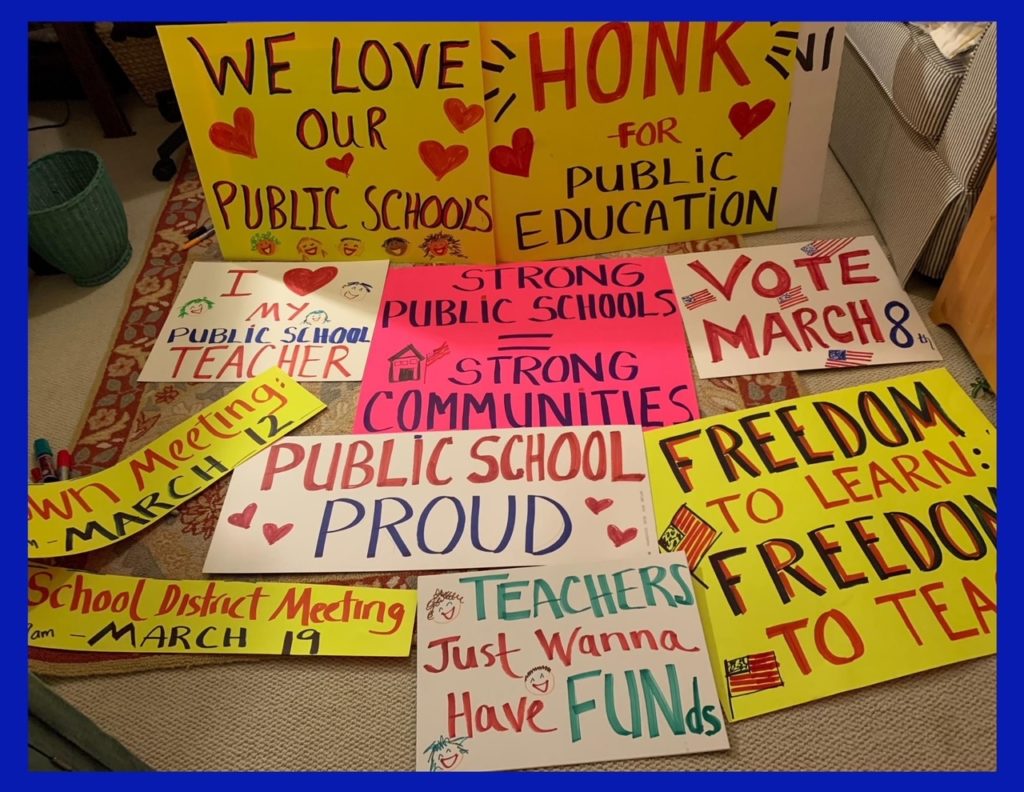
Tuesday’s school board election in New Hampshire was a triumph for parents and citizens who love their public schools!

This must have shocked Republican Governor Chris Sununu, the Republican-controlled legislature, and State Commissioner Frank Edelblut, who home-schooled his own children and is pushing a sweeping voucher plan for the state.

AfterGlenn Youngkin was elected Governor of Virginia by pandering to parents angry about “critical race theory,” mask mandates, and eager to control what children learned and what books they read, the media bombarded us with stories predicting that Republicans would win next November by running against public schools.

New Hampshire families and citizens said on Election Day, “Not so fast! We love our public schools.”

I Love Public Education Sign Visibility

In first town elections since onslaught of attacks on public education and a honest, accurate education, voters send clear message that they support strong public schools and a honest, accurate education

CONCORD, NH – In race after race across New Hampshire on Town Meeting Day, concerned parents and community members in communities large and small successfully organized to elect pro-public education candidates and reject those seeking to dismantle public education and censor history.

“These results should raise serious doubts about any Republican 2022 election strategy that is built around pitting parents against local public schools and educators,” said Zandra Rice Hawkins, Executive Director of Granite State Progress. “In nearly every school board race, Granite State voters chose out-spoken champions for public education and an honest, accurate, inclusive education. This is a big win for public schools and for our future. These leaders are committed to keeping our public schools strong and making sure every student’s history and experience is valued.”

The results from the election are all the more astounding for record-shattering voter turnout, and for the blatant differences between the candidates on everything from public education, COVID public health measures, and attempts to whitewash American history and censor educators. A priority list of school board results can be found here.

Key examples from around the state:

  • Merrimack Valley School District, home to some of the state’s most vocal anti-vaccine, anti-mask, and classroom censorship activists, experienced a 56% increase in voter turnout from 2019, and supported public education candidates while also defeating a classroom censorship/anti-equity warrant resolution.
  • Bedford experienced a 36% increase in voter turnout and elected pro-public education candidate and teacher Andrea Campbell with 2832 votes, compared to 1293 votes for Sean Monroe, a candidate supported by right-wing organization Defend Our Kids, and 856 for incumbent John Schneller; both of whom supported efforts to censor teachers and ban conversations about race and racism in public schools.
  • Londonderry elected pro-public education candidates Amanda Butcher and Kevin Gray, defeating vocal anti-masker Rachel Killian (seen here harassing school board members during a public meeting). Voters also rejected a warrant resolution to make masks completely optional and the sole decision of parents instead of school leaders and public health experts; a significant decision given Gov. Sununu’s recent decision to ban schools from enacting COVID public health measures like masks.
  • Governor Wentworth School District elected Republican State Rep. Brodie Deschaies over far-right activist Jessica Williams, who believes public schools are indoctrinating students and was arrested at a GWSD school board meeting on September 13, 2021.
  • Weare elected pro-public education candidates William “Bill” Politt and Alyssa Small, and passed full-day kindergarten; and Hollis elected pro-public education candidates Carryl Roy, Krista Whalan, and Holly Babcock.
  • Exeter and SAU 16 elected a full slate of pro-public education and honest education candidates, despite a nearly $20,000 effort by the opposition and months of voter mailings from those who oppose diversity, equity, and inclusion justice efforts in the school districts.

“We are in awe of how our communities have come together to protect and support public education,” said Sarah Robinson, Education Justice Campaign Director for Granite State Progress. “Parents, students, educators, and community leaders have been working for months to organize, recruit strong candidates, and support pro-public education campaigns. Watching the results come in and knowing that so many public education champions are going to be serving in these roles gives us all hope. Our schools have been under constant attack from privatization schemes, neo-Nazi’s, and of course Governor Sununu’s statewide ban on a honest education. We all know that serving on a school board right now is challenging, and we thank these leaders for stepping up for our students. We hope the folks at the State House are paying attention, because this showdown will play out again in November unless they stop the attacks on our public schools.”

Last week, I reported a poll in Educatuon Week, which found that half the public thinks that schools should not teach about racism today. With opinion polls, the results are influenced by many factors, including how the questions are worded. A poll by CBS got very different results.

Greg Sergeant writes in the Washington Post that Democrats should take heart from a CBS News poll: Most Americans oppose book banning. Democrats should stop being defensive.

He writes:

As Democrats debate the GOP’s all-culture-war-all-the-time campaign strategy, here’s a maxim worth remembering: If you’re wasting political bandwidth denying lies about yourselves, you’re losing.

A new CBS News poll offers data that should prod Democrats into rethinking these culture-war battles. It finds that surprisingly large majorities oppose banning books on history or race — and importantly, this is partly because teaching about our racial past makes students more understanding of others’ historical experiences.

The poll finds that 83 percent of Americans say books should never be banned for criticizing U.S. history; 85 percent oppose banning them for airing ideas you disagree with; and 87 percent oppose banning them for discussing race or depicting slavery.

What’s more, 76 percent of Americans say schools should be allowed to teach ideas and historical events that “might make some students uncomfortable.” And 68 percent say such teachings make people more understanding of what others went through, while 58 percent believe racism is still a serious problem today.

Finally, 66 percent say public schools either teach too little about the history of Black Americans (42 percent) or teach the right amount (24 percent). Yet 59 percent say we’ve made “a lot of real progress getting rid of racial discrimination” since the 1960s.

This hints at a way forward for Democrats. Notably, large majorities think both that we’ve made a good deal of racial progress and that we should be forthrightly confronting hard racial truths about our past and present, even if it makes students uncomfortable.

Culture warriors in the Republican Party want to ban all teaching about racism, in the past or present. They pass vague laws that are meant to intimidate teachers.

Their rhetorical game works this way: If you focus too much on the persistence of racial disparities in the present, you’re denying the racial progress that has taken place. You’re telling children that race still matters. You’re not telling a positive or uplifting story about our country. You’re saying America is irredeemable. You’re trying to make children hate our country, each other and themselves.

But this polling suggests many Americans doesn’t necessarily see things this way. Place proper emphasis on the idea that racial progress has been made, and it’s fine to highlight the problems that remain, even if it creates feelings of discomfort. It’s possible to tell a story that is in some ways about progress but also doesn’t whitewash our past.

Jennifer Berkshire, expert education journalist and co-author of A Wolf at the Schoolhouse Door, writes in The Nation about the forces driving teachers out of the schools.

She interviewed many teachers who explained why they were leaving. Some cited ”the bad teacher” narrative promulgated by Arne Duncan and his insistence that teachers be evaluated, based on their students’ test scores, which is both ineffective and inaccurate. His and Obama’s “Race to the Top” was deeply demoralizing to teachers, and it accomplished nothing positive.

She begins:

Neal Patel survived teaching in the pandemic. It was the culture wars that did him in.

In the fall of 2020, Patel added two flags to the wall of his science classroom in Johnston, Iowa. Now, alongside images of energy waves and the electromagnetic spectrum were the Gay Pride rainbow flag and a proclamation that Black Lives Matter. The flags, says Patel, represented the kind of inclusive space he was committed to creating, sending a signal to all students that even in this conservative suburb of Des Moines, there was a place for them.

School administrators supported him—on one condition. “They’re just there as decoration,” Patel says. “The only time I discuss the flags is when a student asks me about them.”

Patel assumes it was a student who snapped a picture of the display. Somehow it ended up on the Facebook page of a conservative state legislator. Representative Steve Holt, who lives 100 miles from Johnston, pointed to the flags as evidence of creeping left-wing indoctrination in Iowa’s schools and encouraged his constituents to take a stand. Patel says he was shocked by the attention, then upset: “Holt thinks it’s a political issue to try to create an inclusive environment, and he’s using that to try to further divide our community.”Johnston has grown only more divided since Patel became Facebook fodder. At a school board meeting last fall, members debated whether to ban two books on race, including one by the Native American writer Sherman Alexie, after parents complained. The president of the Iowa State Senate, who represents a neighboring county, took the mic during the public comment period, calling for teachers who assigned “obscene” material to be prosecuted. Patel was in the crowd that night, to lend support to minority and LGBTQ students who’d come to speak out against banning the books. And he had an announcement of his own to make: This year would be his last as a teacher in Johnston.

The Obama administration made matters much worse for teachers when it imposed test-based evaluation as the heart of its “reforms.”

The thinking went something like this: Make teacher evaluations tougher, and teaching would get better, which would mean higher student achievement, more students graduating from college, and ultimately a country better able to outsmart China et al. “Tougher” meant holding teachers accountable for how their students fared on standardized tests…

In 2010, Colorado became one of the first states to enact a high-stakes teacher evaluation law; by 2017, nearly every state had one on the books. While the pandemic may have disrupted everything about schooling, policies like Colorado’s Senate Bill 10, with its 18-page evaluation rubric and 345-page user guide aimed at weeding out bad teachers, remain in place.

For Shannon Peterson, an English language acquisition teacher in Aurora, that meant leading her students through a writing exercise last fall as her principal observed. Peterson’s students, many of them immigrants who live in poverty, bore the pandemic heavily, she says: “The kids are stressed, all of their writing is about anxiety, and attendance is way down.”

To her delight, the students responded enthusiastically to the writing prompt she’d come up with: comparing and contrasting the Harlem Renaissance and Black Lives Matter, and how the entertainment industries in their respective eras related to both. In a year of stress and struggle for teachers and students alike, here was something to celebrate. “Excellent writing came out of this,” Peterson says.

Her principal wasn’t convinced. Peterson, he felt, hadn’t done enough actual teaching during the observation. “I just don’t feel comfortable checking off these boxes,” he told her.

The previous year, when the cash-strapped school district had offered teachers buyouts to leave, Peterson turned it down: “I felt an enormous obligation to go back for the kids and my colleagues.” After her evaluation, though, Peterson had reached a breaking point. She quit a week later, walking away from a career that spanned 23 years, 18½ of them in Aurora. “I’m not a box,” Peterson says.

Two weeks after Peterson resigned, a major study came out: The decade-long push to weed out bad teachers had come to naught. The billions of dollars spent, the wars with teachers’ unions, and the collapse in teacher morale had produced “null effects” on student test scores and educational attainment.

Please open the link and read the study. Billions of dollars wasted on ineffective and demoralizing teacher evaluations that produced tons of data but nothing else.

Paul Waldman is an opinion columnist for The Washington Post. In this article, he criticizes Democrats for failing to stand up to Republican slanders and lies about public schools. He raises an important point: Why aren’t Democrats fighting Republican lies about the schools? Why aren’t the billionaires who claim to be liberal speaking out against this vicious campaign to destroy our public schools? One reason for the silence of the Democrats: Arne Duncan derided and insulted public schools and their teachers as often as Republicans.

Waldman wrote recently:

For the last year or so, Republicans have used the “issue” of education as a cudgel against Democrats, whipping up fear and anger to motivate their voters and seize power at all levels of government.

Isn’t it about time Democrats fought back?
Republicans have moved from hyping the boogeyman of critical race theory to taking practical steps to criminalize honest classroom discussions and ban books, turning their manufactured race and sex panic into profound political and educational change. Meanwhile, Democrats have done almost nothing about it, watching it all with a kind of paralyzed confusion.

Look no further than Florida Gov. Ron DeSantis, who is pushing legislation with the colorful name of the Stop Woke Act. As the Republican governor told Fox News this weekend, we need to allow people to sue schools over their curriculums, not only because of CRT but also because “there’s a lot of other inappropriate content that can be smuggled in by public schools.”

If you liked the Texas bill that effectively banned abortion in the state, you’re in luck. Republicans apparently want to use a version of that bill’s tactic — putting enforcement in the hands of private vigilantes — to make teachers and school administrators live under the same fear as abortion providers.

It’s happening elsewhere, too. A bill in Indiana allows the same kind of lawsuits. And last week, during a hearing on the bill, a GOP state senator got in trouble for saying that “I believe that we’ve gone too far when we take a position” on things like Nazism, because in the classroom, “we need to be impartial.” The state senator, Scott Baldwin, previously attracted attention when it was revealed that he made a contribution to the far-right Oath Keepers (though he claims he has no real connection to the extremist group).

Everywhere you look, Republicans are trying to outdo one another with state laws forcing teachers to parrot far-right propaganda to students. A Republican bill in Oklahoma would ban teachers from saying that “one race is the unique oppressor” or “victim” when teaching the history of slavery in America; its sponsor says that would bring the appropriate “balance” to the subject.

So ask yourself: What are Democrats telling the public about schools? If you vote for Democrats, what are you supposed to be achieving on this issue? If any voters know, it would be a surprise.
We’re seeing another iteration of a common Republican strategy: Wait for some liberal somewhere to voice an idea that will sound too extreme to many voters if presented without context and in the most inflammatory way possible, inflate that idea way beyond its actual importance, claim it constitutes the entirety of the Democratic agenda and play on people’s fears to gin up a backlash.

That was the model on “defund the police.” Now it’s being used on schools, which Republicans have decided is the issue that can generate sufficient rage to bring victory at the polls.
Devoted as they are to facts and rational argumentation, liberals can’t help themselves from responding to Republican attacks first and foremost with refutation, which allows Republicans to set the terms of debate. So their response to the charge that critical race theory is infecting our schools is something like this: “No, no, that has nothing to do with public education. It’s a scholarly theory taught mostly to graduate students.”

But that doesn’t allow for this response: “Republicans want to subject our kids to fascist indoctrination. Why do they want to teach our kids that slavery wasn’t bad? Why are they trying to ban books? Who’s writing their education policy, David Duke? Don’t let them destroy your schools!”


That, of course, would be an unfair exaggeration of what most Republicans actually want. Is a state senator who worries that public school teachers might be biased against Nazism really representative of the whole Republican Party? Let’s try to be reasonable here.

Or maybe being reasonable isn’t the best place to start when you’re being overrun. Maybe Democrats need to begin not with a response to Republican lies about what happens in the classroom, but an attack on what Republicans are trying to do to American education.

After Glenn Youngkin won the Virginia governorship with a campaign largely focused on schools, Republicans everywhere decided that nurturing a CRT-based White backlash is the path to victory. That is their plan, whether Democrats like it or not.

This isn’t just coming from national Republicans. At the state and local level, far-right extremists are taking over education policy, leaving teachers terrified that if they communicate the wrong idea to students — like, apparently, being too critical of Nazis — they might get sued.

The implications of the GOP war on schools and teachers are horrifying, and with some exceptions, Democrats are watching it happen without anything resembling a plan to do anything about it. It might be time for all the party’s clever strategists to give it some thought.

Last week, I posted my thoughts on “Who Demoralized the Nation’s Teachers?” I sought to identify the people and organizations that spread the lie that America’s public schools were “broken” and that public school teachers were the cause. The critics slandered teachers repeatedly, claiming that teachers were dragging down student test scores. They said that today’s teachers were not bright enough; they said teachers had low SAT scores; and they were no longer “the best and the brightest.”

The “corporate reform” movement (the disruption movement) was driven in large part by the “reformers'” belief that public schools were obsolete and their teachers were the bottom of the barrel. So the “reformers” promoted school choice, especially charter schools, and Teach for America, to provide the labor supply for charter schools. TFA promised to bring smart college graduates for at least two years to staff public schools and charter schools, replacing the public school teachers whom TFA believed had low expectations. TFA would have high expectations, and these newcomers with their high SAT scores would turn around the nation’s schools. The “reformers” also promoted the spurious, ineffective and harmful idea that teachers could be evaluated by the test scores of their students, although this method repeatedly, consistently showed that those who taught affluent children were excellent, while those who taught children with special needs or limited-English proficiency or high poverty were unsatisfactory. “Value-added” methodology ranked teachers by the income and background of their students’ families, not by the teachers’ effectiveness.

All of these claims were propaganda that was skillfully utilized by people who wanted to privatize the funding of public education, eliminate unions, and crush the teaching profession.

The response to the post was immediate and sizable. Some thought the list of names and groups I posted was dated, others thought it needed additions. The comments of readers were so interesting that I present them here as a supplement to my original post. My list identified No Child Left Behind, Race to the Top, and Common Core as causes of demoralization that tied teachers to a standards-and-testing regime that reduced their autonomy as professionals. One reader said that the real beginning of the war on teachers was the Reagan-era report called “A Nation at Risk,” which asserted that American public schools were mired in mediocrity and needed dramatic changes. I agree that the “Nation at Risk” report launched the era of public-school bashing. But it was NCLB and the other “solutions” that launched teacher-bashing, blaming teachers for low test scores and judging teachers by their test scores. It should be noted that the crest of “reform” was 2010, when “Waiting for Superman” was released, Common Core was put into place, value-added test scores for teachers were published, and “reformers” like Arne Duncan, Bill Gates, Michelle Rhee, Joel Klein, and other became media stars, with their constant teacher-bashing. For what it’s worth, the National Assessment of Educational Progress flatlined from 2010 onwards. Test score gains, which were supposedly the point of all this “reform” activity, were non-existent on the nation’s most consequential test (no stakes attached).

Readers also blamed demoralization on teachers’ loss of autonomy, caused by federal laws and the testing imposed by them, and by the weakness of principals and administrators who did not protect teachers from the anti-education climate caused by NCLB, RTTT, ESSA, and the test-and-punish mindset that gripped the minds of the nation’s legislators and school leaders.

Readers said that my list left off important names of those responsible for demoralizing the nation’s teachers.

Here are readers’ additions, paraphrased by me:

Michelle Rhee, who was pictured on the cover of TIME magazine as the person who knew “How to Fix American Education” and lionized in a story by Amanda Ripley. Rhee was shown holding a broom, preparing to sweep “bad teachers” and “bad principals” out of the schools. During her brief tenure as Chancellor of D.C., she fired scores of teachers and added to her ruthless reputation by firing a principal on national television. For doing so, she was the Queen of “education reform” in the eyes of the national media until USA Today broke a major cheating scandal in the D.C. schools.

Joel Klein, antitrust lawyer who was chosen by Mayor Bloomberg to become the Chancellor of the New York City public schools, where he closed scores of schools because of their low test scores, embraced test-based evaluation of schools and teachers, and opened hundreds of small specialized schools and charter schools. He frequently derided teachers and blamed them for lagging test scores. He frequently reorganized the entire, vast school system, surrounding himself with aides with Business School graduates and Wall Street credentials. Under his leadership, NYC was the epitome of corporate reform, which inherently disrespected career educators.

Michael Bloomberg, former Mayor of New York City, billionaire funder of charter schools and of candidates running for state or local offices who supported privatization of public schools. He claimed that under his leadership, the test-score gap between different racial gaps had been cut in half or even closed, but it wasn’t true. He stated his desire to fire teachers who couldn’t “produce” high test scores, while doubling the size of the classes of teachers who could. His huge public relations staff circulated the story of a “New York City Miracle,” but it didn’t exist and evaporated as soon as he left office.

Reed Hastings, billionaire funder of charter schools and founder of Netflix. He expressed the wish that all school boards would be eliminated. The charter school was his ideal, managed privately without public oversight.

John King, charter school leader who was appointed New York Commissioner of Education. He was a cheerleader for the Common Core and high-stakes testing. He made parents so angry by his policies that he stopped appearing at public events. He was named U.S. Secretary of Education, following Arne Duncan, in the last year of the Obama administration and continued to advocate for the same ill-fated policies as Duncan.

Betsy DeVos, Trump’s Secretary of Education despised public schools, unions, and teachers. She never had a good word to say about public schools. She wanted every student to attend religious schools at public expense.

Eli Broad and the “academy” he created to train superintendents with his ideas about top-down management and the alleged value of closing schools with low test scores

ALEC (the American Legislative Exchange Council), which writes model legislation for privatizing public schools by opening charters and vouchers and lowering standards for teachers and crushing unions. More than 2,000 rightwing state legislators belong to ALEC and get their ideas directly from ALEC about privatization and other ways to crush public schools and their teachers.

Rupert Murdoch, the media, Time, Newsweek, NY Times, Washington Post for their hostility towards public schools and their warm, breathless reporting about charter schools and Teach for America. The Washington Post editorialist is a devotee of charter schools and loved Michelle Rhee’s cut-throat style. TIME ran two cover stories endorsing the “reform” movement; the one featuring Michelle Rhee, and the other referring to one of every four public school teachers as a “rotten apple.” The second cover lauded the idea that teachers were the cause of low test scores, and one of every four should be weeded out. Newsweek also had a Rhee cover, and another that declared in a sentence repeated on a chalkboard, “We Must Fire Bad Teachers,” as though the public schools were overrun with miscreant teachers.

David Coleman, the architect of the Common Core, which undermined the autonomy of teachers and ironically removed teachers’ focus on content and replaced it with empty skills. The Common Core valued “informational text” over literature and urged teachers to reduce time spent teaching literature.

Margaret Raymond, of the Walton-funded CREDO, which evaluates charter schools.

Hanna Skandera, who was Secretary of Education in New Mexico and tried to import the Florida model of testing, accountability, and choice to New Mexico. That state has one of the highest rates of child poverty in the nation, and the Florida model didn’t make any difference.

Governors who bashed teachers and public schools, like Chris Christie of New Jersey, Andrew Cuomo of New York, and Gregg Abbott of Texas

“Researchers” like those from the Fordham Institute, who saw nothing good in public schools or their teaching

Senator Michael Bennet of Colorado, who turned Denver into a model of “reform,” with everything DFER wanted: charter schools and high-stakes testing.

Poorly behaving students and parents who won’t hold kids accountable for bad behavior

Campbell Brown and the 74

The U.S. Department of Education, for foisting terrible ideas on the nation’s schools and teachers, and state education departments and state superintendents for going along with these bad ideas. Not one state chief stood up and said, “We won’t do what is clearly wrong for our students and their teachers.”

The two big national unions, for going along with these bad ideas instead of fighting them tooth and nail.

And now I will quote readers’ comments exactly as they wrote them, without identifying their authors (they know who they are):

*Rightwing organizations like the American Enterprise Institute, (AEI), the Thomas B. Fordham Institute, the Heritage Foundation, even the allegedly Democratic-leaning Center for American Progress (CAP) for publishing white papers masquerading as education research that promotes privatization.

*Wall St moguls who invented Social Impact Bonds (SIBs) to gamble on & profit from preK student test scores.

*Rogues Gallery. One body blow after another. A systematic 💦 water boarding with no respite. And then we add the Broad Foundation who sent Broad-trained “leadership” so drunk on arrogance and ignorance that the term “School Yard Bully” just doesn’t capture it.
Operating with the Imprimatur and thin veneer of venture capital, plutocratic philanthropy, these haughty thugs devastated every good program they laid eyes on. Sinking their claws instinctively into the intelligent, effective and cultured faculty FIRST.A well orchestrated, heavily scripted Saturday Night Massacre.

*Congress and the Presidents set the stage, but the US Department of Education was instrumental in making it all happen. They effectively implemented a coherent program to attack, smear and otherwise demoralize teachers. And make no mistake, it was quite purposeful

*This list is incomplete without members of Democrats for Education Reform. Add in Senator Ted Kennedy, whose role in the passage of No Child Left Behind was critical. Same for then Congressman and future Speaker of the House, John Boehner, who noted (bragged!) in his recent autobiography that he was essential in keeping President George W. Bush on track with NCLB.

*Let’s not forget Senate Chair Patty Murray. She has been an important player in keeping the worse of Ed Reform legislation alive.

*You have presented a rogue’s gallery of failed “reformers” that have worked against the common good. In addition to those mentioned, there has also been an ancillary group of promoters and enablers that have undermined public education including billionaire think tanks, foundations and members of both political parties. These people continue to spread lies and misinformation, and no amount of facts or research is able to diminish the drive to privatize. While so called reformers often hide behind an ideological shield, they are mostly about the greedy pursuit of appropriating the education that belongs to the people and transferring its billions in value into the pockets of the already wealthy. So called education reform is class warfare.

*The Clintons, whose 1994 reauthorization of ESEA set the stage for NCLB

*Don’t forget the so called ‘liberal’ media, publications such as the New York Times and the Boston Globe who have published pro charter piece after pro charter piece, while simultaneously dumping all over public schools

*I’d like to include a cast of editorialists like George Will, Bill Rhoden, and many others, who have parroted the plutocratic-backed Ed Reform line. Armstrong Williams would certainly be part of this.

*Going back even further into the origins of this madness, I would add to Diane’s excellent rogues gallery those unknown bureaucrats in state departments of education who replaced broad, general frameworks/overall strategic objectives with bullet lists of almost entirely content-free “standards” that served as the archetype of the Common [sic] Core [sic] based on the absurd theory that we should “teach skills” independent of content, all of which led, ironically, to trivialization of and aimlessnessness in ELA pedagogy and curricula and to a whole generation of young English teachers who themselves NOW KNOW NEXT TO NOTHING OF THE CONTENT OF THEIR SUBJECT, typified by the English teacher who told one of the parents who regularly contributes comments to this blog, “I’m an English teacher, so I don’t teach content.” So, today, instead of teaching, say, Robert Frost’s “Stopping by Woods on a Snowy Evening” as part of a coherent and cumulative unit on common structures and techniques and genres of poetry, one gets idiotic test-practice exercises on “inferencing” and “finding the main idea,” with any random piece of writing as the “text.”

*It’s driven by how teachers have been treated the past 4-5 years, especially during the pandemic. Teachers are first responders. We should have been on the list of first-to-be-vaccinated. Schools should have strict mask and vaccine mandates. Teachers are professional educators. We should not be told what and how to teach by ignorant, conspiracy-driven MAGA parents. Public education is a cornerstone of democracy, and we teachers are motivated by a sense of civic duty. We are demoralized by attempts to destroy public education, led by anti-education bible-thumping “leaders” like Betsy DeVos and (in my home state) Frank Edelblut. Public education is being dismantled by gleeful right-wingers, while naive, well-intentioned moderates wring their hands and do little to defend it. It’s tiring to be under constant attack on the front lines, with no support. That’s why teachers are leaving today.

*One tiny example of a routine phenomenon. Teachers got the message pretty clearly: They were at the bottom of the pecking order. The absolute bottom. Micromanaged and undercut at every turn.Excellent points. The heavy handed top-down, bureaucratic demands for “data,” basically serve one goal, to justify the existence of administration.Don’t forget the voracious appetite of publishing companies…We had a district administrator prance around in our “professional; development days” tell use could not read novels or other picture books to the students…ONLY USE PEARSON.”And then 7 or so years later, the district made us THROW OUT every book from Pearson, and they bought new crap curriculum…that program was written by testing industry, not educators, I think it was “Benchmark,” real junk.

*I’d like to mention how I often lose my student teachers when they see the edTPA requirement. They switch majors, and the teaching pool gets even smaller.

*After Skamdera in NM came the TFA VAM sweetheart Christopher Ruszkowski. At least he had 3 years in a classroom, Skammy had none, but the Florida model, you know?

*Children’s behavior is in large part in response to the drill and kill curriculum and endless testing and teaching to the test that has been driving public education since NCLB and the back-to-basics movement that ushered it in. No room for creativity, no room for self expression, no room for innovation. Highly scripted Curriculum like Open Court turned children into little automatons, barking their answers like well trained dogs and turned teachers into task masters. It was a drive to dummy down the curriculum for fear of teaching too much free thinking. And a drive to turn teachers into testing machines and teacher technicians, easily replaced by anyone who can walk in a classroom and pick up the manual. Only it doesn’t work. It was and is developmentally inappropriate and the resulting rebellion in the classrooms if proof of that. No wonder teachers are leaving in droves!

*Under threat of closure of the MA school board in the mid 1800s, Horace Mann turned to the cheapest labor he could find, literate northern females, and deployed the Protestant ethic “teacher as a calling” trope to institute state free-riding on teachers (as opposed to the free-riding of which teachers are accused). Everything in this piece is correct except for the “almost” in the final paragraph. There’s no “almost” about it … free-riding on teachers is an operational feature of a system imported from Prussia, designed to produce cheap, obedient labor by underpaying women. As of 2012, teachers would need to make around 1/3 higher salaries to be paid on the same level as their professional peers. Everyone mentioned in the article is simply this generation’s enactment of the long-standing, systemic class war that preys on gender and race to continue and exacerbate inequity. While naming the current situation is very important, we also need to discuss, address, and shift these deep issues.

*It’s the boiled frog effect over the last 50 years that began as a response to mini-courses, sixties curriculum, obsession over college attendance, professors and teachers walking out to protest with their students, Viet Nam… and the Civil Rights Act. Since 1964, Intentional segregation influenced Local, state, and federal decision making on transportation, health care, insurance, zoning, housing, education funding, hiring, and more. When whites fled the cities and insured two sides of the tracks in towns and two systems evolved, quick fixes became that accumulation of bad decisions and leadership – and slowly, slowly, deterioration became acceptable.

*The list is not dated. It’s illustrative of the accumulation of negativity, quick-fix seeking, acronym-filled, snake-oil salesmen, desperate mayors and governors, obsession with rankings, publisher fixation on common core, NCLB votes hidden under the shadow of 9/11, and keep-everyone-happy state and national professional organizations.

*At the end of 2021 it is far right and left of politics and their rhetoric like CRT and homophobic slurs. So much for especially the “Christian Right.” In their god’s (yes lower case since not The Lord Jesus Christ’s New Testament words of love) name they exclude instead of include to share the good news/word.

*Data, data, data. Yesterday, I commented that I feel sympathetic toward the anti-CRT petitioners. I do. They’re not bad people. They’re just afraid of changing social rules. Their actions are demoralizing, but not dehumanizing. Wealthy corporations and individuals on the other hand , through their untaxed foundations, gave carrots to governments the world over to give the stick to education so that greater profits could be made through privatization and data monetizing. I was once called a 2. I was once labeled the color grey. I was numbered, dehumanized by test score data in an attempt to make education like Uber or Yelp. Not just demoralized, dehumanized. It’s not just who but what dehumanized teachers. It was the wrongheaded idea that education can be measured and sold by the unit. That idea was insidious. The marketing ploy to make my students into consumers who consider their efforts junk unless they are labeled with the right number or dashboard color was insidious. I have no sympathy for the investor class. They are not people with whom I disagree about social issues; they are hostile, corporate takeover wolves out to tear the flesh of the formerly middle and deeply impoverished classes for profit. Not one of the investors in education “reform” or any of their revolving door bureaucrats is any friend of mine. The list of who is long. The list of what is short.

*Jonah Edelman (Founder, Stand on Children); brother Josh Edelman (Gates Foundation: Empowering-?!–Effective Teaching; SEED Charter Schools); Charles & David Koch. Pear$on Publishing monopoly&, of course, ALEC (interfering in our business for FIFTY long years!)
Heather Cox Richardson is an American historian at Boston College. I enjoy reading her views, which are always well-informed.

She writes:

December 30, 2021

Heather Cox RichardsonDec 31

On January 6, insurrectionists trying to overturn the results of the 2020 presidential election stormed the U.S. Capitol and sent our lawmakers into hiding. Since President Joe Biden took office on January 20, just two weeks after the attack, we have been engaged in a great struggle between those trying to restore our democracy and those determined to undermine it. 

Biden committed to restoring our democracy after the strains it had endured. When he took office, we were in the midst of a global pandemic whose official death toll in the U.S. was at 407,000. Our economy was in tatters, our foreign alliances weakened, and our government under siege by insurrectionists, some of whom were lawmakers themselves.

In his inaugural address, Biden implored Americans to come together to face these crises. He recalled the Civil War, the Great Depression, the World Wars, and the attacks of 9/11, noting that “[i]n each of these moments, enough of us came together to carry all of us forward.” “It’s time for boldness, for there is so much to do,” he said. He asked Americans to “write an American story of hope, not fear… [a] story that tells ages yet to come that we answered the call of history…. That democracy and hope, truth and justice, did not die on our watch but thrived.”

Later that day, he headed to the Oval Office. “I thought there’s no time to wait. Get to work immediately,” he said.

Rather than permitting the Trump Republicans who were still insisting Trump had won the election to frame the national conversation, Biden and Vice President Kamala Harris, as well as the Democrats in Congress, ignored them and set out to prove that our government can work for ordinary Americans.

Biden vowed to overcome Covid, trying to rally Republicans to join Democrats behind a “war” on the global pandemic. The Trump team had refused to confer during the transition period with the Biden team, who discovered that the previous administration had never had a plan for federal delivery of covid vaccines, simply planning to give them to the states and then let the cash-strapped states figure out how to get them into arms. “What we’re inheriting is so much worse than we could have imagined,” Biden’s coronavirus response coordinator, Jeff Zients, said to reporters on January 21.

Biden immediately invoked the Defense Production Act, bought more vaccines, worked with states to establish vaccine sites and transportation to them, and established vaccine centers in pharmacies across the country. As vaccination rates climbed, he vowed to make sure that 70% of the U.S. adult population would have one vaccine shot and 160 million U.S. adults would be fully vaccinated by July 4th.

At the same time, the Democrats undertook to repair the economy, badly damaged by the pandemic. In March, without a single Republican vote, they passed the $1.9 trillion American Rescue Plan to jump-start the economy by putting money into the pockets of ordinary Americans. It worked. The new law cut child poverty in half by putting $66 billion into 36 million households. It expanded access to the Affordable Care Act, enabling more than 4.6 million Americans who were not previously insured to get healthcare coverage, bringing the total covered to a record 13.6 million.

As vaccinated people started to venture out again, this support for consumers bolstered U.S. companies, which by the end of the year were showing profit margins higher than they have been since 1950, at 15%. Companies reduced their debt, which translated to a strong stock market. In February, Biden’s first month in office, the jobless rate was 6.2%; by December it had dropped to 4.2%. This means that 4.1 million jobs were created in the Biden administration’s first year, more than were created in the 12 years of the Trump and George W. Bush administrations combined.

In November, Congress passed a $1.2 trillion infrastructure bill that will repair bridges and roads and get broadband to places that still don’t have it, and negotiations continue on a larger infrastructure package that will support child care and elder care, as well as education and measures to address climate change.

Bloomberg and the Wall Street Journal report that U.S. economic output jumped more than 7% in the last three months of 2021. Overall growth for 2021 should be about 6%, and economists predict growth of around 4% in 2022—the highest numbers the U.S. has seen in decades. China’s growth in the same period will be 4%, and the eurozone (the member countries of the European Union that use the euro) will grow at 2%. The U.S. is “outperforming the world by the biggest margin in the 21st century,” wrote Matthew A. Winkler in Bloomberg, “and with good reason: America’s economy improved more in Joe Biden’s first 12 months than any president during the past 50 years….”

With more experience in foreign affairs than any president since George H. W. Bush, Biden set out to rebuild our strained alliances and modernize the war on terror. On January 20, he took steps to rejoin the World Health Organization and the Paris Climate Accords, which his predecessor had rejected. Secretary of State Antony Blinken emphasized that Biden’s leadership team believed foreign and domestic policy to be profoundly linked. They promised to support democracy at home and abroad to combat the authoritarianism rising around the world.

“The more we and other democracies can show the world that we can deliver, not only for our people, but also for each other, the more we can refute the lie that authoritarian countries love to tell, that theirs is the better way to meet people’s fundamental needs and hopes. It’s on us to prove them wrong,” Blinken said.

Biden and Blinken increased the use of sanctions against those suspected of funding terrorism. Declaring it vital to national security to stop corruption in order to prevent illicit money from undermining democracies, Biden convened a Summit for Democracy, where leaders from more than 110 countries discussed how best to combat authoritarianism and corruption, and to protect human rights.

Biden began to shift American foreign policy most noticeably by withdrawing from the nation’s twenty-year war in Afghanistan. He inherited the previous president’s February 2020 deal with the Taliban to withdraw U.S. forces from Afghanistan by May 1, 2021, so long as the Taliban did not kill any more Americans. By the time Biden took office, the U.S. had withdrawn all but 2500 troops from the country.

He could either go back on Trump’s agreement—meaning the Taliban would again begin attacking U.S. service people, forcing the U.S. to pour in troops and sustain casualties—or get out of what had become a meandering, expensive, unpopular war, one that Biden himself had wanted to leave since the Obama administration.

In April, Biden said he would honor the agreement he had inherited from Trump, beginning, not ending, the troop withdrawal on May 1. He said he would have everyone out by September 11, the 20th anniversary of the al-Qaeda attacks that took us there in the first place. (He later adjusted that to August 31.) He promised to evacuate the country “responsibly, deliberately, and safely” and assured Americans that the U.S. had “trained and equipped a standing force of over 300,000 Afghan personnel” who would “continue to fight valiantly, on behalf of the Afghans, at great cost.”

Instead, the Afghan army crumbled as the U.S began to pull its remaining troops out in July. By mid-August, the Taliban had taken control of the capital, Kabul, and the leaders of the Afghan government fled, abandoning the country to chaos. People rushed to the airport to escape and seven Afghans died, either crushed in the crowds or killed when they fell from planes to which they had clung in hopes of getting out. Then, on August 26, two explosions outside the Kabul airport killed at least 60 Afghan civilians and 13 U.S. troops. More than 100 Afghans and 15 U.S. service members were wounded.

In the aftermath, the U.S. military conducted the largest human airlift in U.S. history, moving more than 100,000 people without further casualties, and on August 30, Major General Chris Donahue, commander of the U.S. Army 82nd Airborne Division, boarded a cargo plane at Kabul airport, and the U.S. war in Afghanistan was over. (Evacuations have continued on planes chartered by other countries.)

With the end of that war, Biden has focused on using financial pressure and alliances rather than military might to achieve foreign policy goals. He has worked with North Atlantic Treaty Organization (NATO) allies to counter increasing aggression from Russian president Vladimir Putin, strengthening NATO, while suggesting publicly that further Russian incursions into Ukraine will have serious financial repercussions.

In any ordinary time, Biden’s demonstration that democracy can work for ordinary people in three major areas would have been an astonishing success.

But these are not ordinary times.

Biden and the Democrats have had to face an opposition that is working to undermine the government. Even after the January 6 attack on the Capitol, 147 Republican members of Congress voted to challenge at least one of the certified state electoral votes, propping up the Big Lie that Trump won the 2020 presidential election. Many of them continue to plug that lie, convincing 68% of Republicans that Biden is an illegitimate president.

This lie has justified the passage in 19 Republican-dominated states of 33 new laws to suppress voting or to take the counting of votes out of the hands of non-partisan officials altogether and turn that process over to Republicans.

Republicans have stoked opposition to the Democrats by feeding the culture wars, skipping negotiations on the American Rescue Plan, for example, to complain that the toymaker Hasbro was introducing a gender-neutral Potato Head toy, and that the estate of Dr. Seuss was ceasing publication of some of his lesser-known books that bore racist pictures or themes. They created a firestorm over Critical Race Theory, an advanced legal theory, insisting that it, and the teaching of issues of race in the schools, was teaching white children to hate themselves.

Most notably, though, as Biden’s coronavirus vaccination program appeared to be meeting his ambitious goals, Republicans suggested that government vaccine outreach was overreach, pushing the government into people’s lives. Vaccination rates began to drop off, and Biden’s July 4 goal went unmet just as the more contagious Delta variant began to rage across the country.

In July, Biden required federal workers and contractors to be vaccinated; in November, the administration said that workers at businesses with more than 100 employees and health care workers must be vaccinated or frequently tested.

Rejecting the vaccine became a badge of opposition to the Biden administration. By early December, fewer than 10% of adult Democrats were unvaccinated, compared with 40% of Republicans. This means that Republicans are three times more likely than Democrats to die of Covid, and as the new Omicron variant rages across the country, Republicans are blaming Biden for not stopping the pandemic. Covid has now killed more than 800,000 Americans.

While Biden and the Democrats have made many missteps this year—missing that the Afghan government would collapse, hitting an Afghan family in a drone strike, underplaying Covid testing, prioritizing infrastructure over voting rights—the Democrats’ biggest miscalculation might well be refusing to address the disinformation of the Republicans directly in order to promote bipartisanship and move the country forward together.

With the lies of Trump Republicans largely unchallenged by Democratic lawmakers or the media, Republicans have swung almost entirely into the Trump camp. The former president has worked to purge from the state and national party anyone he considers insufficiently loyal to him, and his closest supporters have become so extreme that they are openly supporting authoritarianism and talking of Democrats as “vermin.”

Some are talking about a “national divorce,” which observers have interpreted as a call for secession, like the Confederates tried in 1860. But in fact, Trump Republicans do not want to form their own country. Rather, they want to cement minority rule in this one, keeping themselves in power over the will of the majority.

It seems that in some ways we are ending 2021 as we began it. Although Biden and the Democrats have indeed demonstrated that our government, properly run, can work for the people to combat a deadly pandemic, create a booming economy, and stop unpopular wars, that same authoritarian minority that tried to overturn the 2020 election on January 6 is more deeply entrenched than it was a year ago.

And yet, as we move into 2022, the ground is shifting. The House Select Committee to Investigate the January 6th Attack on the U.S. Capitol is starting to show what it has learned from the testimony of more than 300 witnesses and a review of more than 35,000 documents. The fact that those closest to Trump are refusing to testify suggests that the hearings in the new year will be compelling and will help people to understand just how close we came to an authoritarian takeover last January.

And then, as soon as the Senate resumes work in the new year, it will take up measures to restore the voting rights and election integrity Republican legislatures have stripped away, giving back to the people the power to guard against such an authoritarian coup happening again.

It looks like 2022 is going to be a choppy ride, but its outcome is in our hands. As Congressman John Lewis (D-GA), who was beaten almost to death in his quest to protect the right to vote, wrote to us when he passed: “Democracy is not a state. It is an act, and each generation must do its part.”

—

Notes:

https://khn.org/morning-breakout/covid-deaths-skew-higher-than-ever-in-red-states/

The “vermin” and “national divorce” quotations are tweets from Representative Marjorie Taylor Greene (R-GA) but I didn’t want to spread them on social media. They were retweeted by several other Republicans.