Archives for category: Democrats

Senator Joe Manchin of West Virginia and Senator Krysten Sinema held the power to block the Democrats’s ambitious bill to reduce carbon emissions and improve healthcare. Each of them extracted a hefty price in exchange for their vote, one that benefited either their state, their campaign donors, or themselves personally.

This analysis by the New York Times shows that Manchin got a trifecta: a win for the coal industry (big in his state), a win for his campaign donors, and a win for himself. Sinema demanded the removal of taxes on private equity firms..

Plenty of West Virginians are angry at Manchin. They are environmentalists. Senator Manchin takes care of the fossil fuel industry, not them.

BLACKSBURG, Va. — After years of spirited opposition from environmental activists, the Mountain Valley Pipeline — a 304-mile gas pipeline cutting through the Appalachian Mountains — was behind schedule, over budget and beset with lawsuits. As recently as February, one of its developers, NextEra Energy, warned that the many legal and regulatory obstacles meant there was “a very low probability of pipeline completion.”

Then came Senator Joe Manchin III of West Virginia and his hold on the Democrats’ climate agenda.

Mr. Manchin’s recent surprise agreement to back the Biden administration’s historic climate legislation came about in part because the senator was promised something in return: not only support for the pipeline in his home state, but also expedited approval for pipelines and other infrastructure nationwide, as part of a wider set of concessions to fossil fuels.

It was a big win for a pipeline industry that, in recent years, has quietly become one of Mr. Manchin’s biggest financial supporters.

Natural gas pipeline companies have dramatically increased their contributions to Mr. Manchin, from just $20,000 in 2020 to more than $331,000 so far this election cycle, according to campaign finance disclosures filed with the Federal Election Commission and tallied by the Center for Responsive Politics. Mr. Manchin has been by far Congress’s largest recipient of money from natural gas pipeline companies this cycle, raising three times as much from the industry than any other lawmaker.

NextEra Energy, a utility giant and stakeholder in the Mountain Valley Pipeline, is a top donor to both Mr. Manchinand Senator Chuck Schumer, Democrat of New York, who negotiated the pipeline side deal with Mr. Manchin. Mr. Schumer has received more than $281,000 from NextEra this election cycle, the data shows. Equitrans Midstream, which owns the largest stake in the pipeline, has given more than $10,000 to Mr. Manchin. The pipeline and its owners have also spent heavily to lobby Congress.

The disclosures point to the extraordinary behind-the-scenes spending and deal-making by the fossil fuel industry that have shaped a climate bill that nevertheless stands to be transformational. The final reconciliation package, which cleared the Senate on Sunday, would allocate almost $400 billion to climate and energy policies, including support for cleaner technologies like wind turbines, solar panels and electric vehicles, and put the United States on track to reduce its emissions of planet-warming gases by roughly 40 percent below 2005 levels by the decade’s end.

Read the rest of the story in the New York Times.

President Biden proposed a $2.2 trillion investment in stopping climate change, expanding health care, and other ambitious goals. But Democrats hold only 50 seats in the Senate, and the defection of only one vote would kill any bill. As it happened, the Democrats had two Senators who blocked Biden’s plans: Joe Manchin of West Virginia and Kyrsten Sinema of Arizona. Both demanded and won concessions. The bill that passed over the weekend is still a dramatic improvement over doing nothing, but the holdouts watered it down.

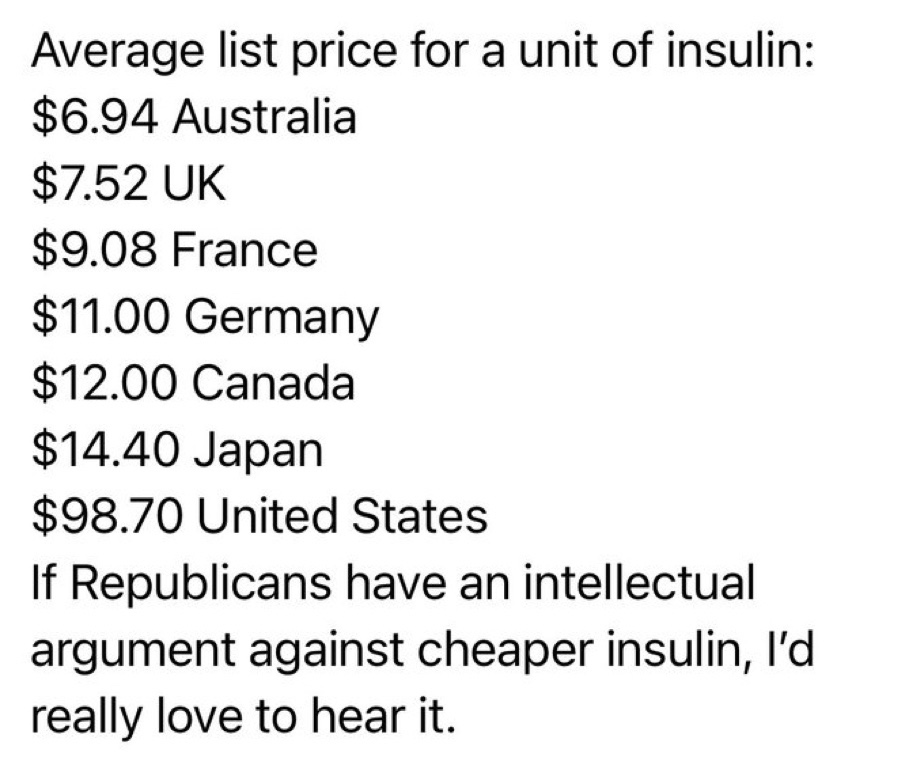
Except for Manchin and Sinema, every Democrat supported the bill; the two holdouts required concessions. Every single Republican opposed every part of the bill, except for the part lowering the monthly cost of insulin, supported by 7 Republicans, not enough to save the proposal.

As a general proposition, the vote on the bill shows that Republicans are staunchly opposed to any legislation to slow the devastating effects of climate change and overwhelmingly opposed to lowering the cost of prescription drugs. The seven Republicans who voted with the Democrats were probably given permission by Leader McConnell to break ranks, since their seven votes were insufficient to pass the provision.

WASHINGTON — After months of painstaking negotiations, Democrats are set to push through a climate, tax and health care package that would salvage key elements of President Biden’s domestic agenda.

The legislation, while falling far short of the ambitious $2.2 trillion Build Back Better Act that the House passed in November, fulfills multiple longstanding Democratic goals, including countering the toll of climate change on a rapidly warming planet, taking steps to lower the cost of prescription drugs and to revamping portions of the tax code in a bid to make it more equitable.

Here’s what’s in the final package:

It is the largest single American investment to slow global warming.

The bill includes the largest expenditures ever made by the federal government to slow global warming and to reduce demand for the fossil fuels that are primarily responsible for causing climate change.

Energy experts said the measure would help the United States to cut greenhouse gas emissions about 40 percent below 2005 levels by the end of this decade. That puts the Biden administration in striking distance of meeting its goal of cutting emissions roughly in half by 2030. Far more will be needed to help keep the planet from warming to dangerously high global temperatures, scientists said, but Democrats considered it a momentous first step after decades of inaction.

It would invest nearly $400 billion over 10 years in tax credits aimed at steering consumers to electric vehicles and prodding electric utilities toward renewable energy sources like wind or solar power.

A number of fossil fuel and drilling provisions as concessions to Senator Joe Manchin III of West Virginia, a holdout from a conservative state that is heavily dependent on coal and gas.

The measure would assure new oil drilling leases in the Gulf of Mexico and Alaska’s Cook Inlet. It would expand tax credits for carbon capture technology that could allow coal or gas-burning power plants to keep operating with lower emissions. And it would mandate that the Interior Department continue to hold auctions for fossil fuel leases if it plans to approve new wind or solar projects on federal lands.

The tax credits include $30 billion to speed the production of solar panels, wind turbines, batteries and critical minerals processing; $10 billion to build facilities to manufacture things like electric vehicles and solar panels; and $500 million through the Defense Production Act for heat pumps and critical minerals processing.

There is $60 billion to help disadvantaged areas that are disproportionately affected by climate change, including $27 billion for the creation of what would be the first national “green bank” to help drive investments in clean energy projects — particularly in poor communities. The bill would also force oil and gas companies to pay fees as high as $1,500 a ton to address excess leaks of methane, a powerful greenhouse gas, and it would undo a 10-year moratorium on offshore wind leasing established by President Donald J. Trump.

Medicare could directly negotiate the price of prescription drugs, pushing down costs.

For the first time, Medicare would be allowed to negotiate with drugmakers on the price of prescription medicines, a proposal projected to save the federal government billions of dollars. That would apply to 10 drugs initially, beginning in 2026, and then expand to include more drugs in the following years.

Opponents argue that the plan would stifle innovation and the development of new treatments by cutting into the profits that drug companies can plow into their business, while some liberals expressed frustration that the policy would be too slow to take hold. Should the package become law, as expected, it would be the largest expansion of federal health policy since passage of the Affordable Care Act.

The package would cap the out-of-pocket costs that seniors pay annually for prescription drugs at $2,000, and would ensure that seniors have access to free vaccines. Lawmakers also included a rebate should price increases outpace the rate of inflation. (Top Senate rules officials, however, said that penalty could apply only to Medicare, not private insurers.)

Republicans successfully challenged the inclusion of a $35 price cap on insulin for patients on private insurance during a rapid-fire series of amendment votes early Sunday morning, forcing its removal. But a separate proposal that caps the price of insulin at $35 per month for Medicare patients remained intact….

The tax proposals were shaped by Senator Kyrsten Sinema, Democrat of Arizona, who resisted her party’s push to increase tax rates on the country’s wealthiest corporations and individuals.

To avoid the rate increase Ms. Sinema opposed, Democrats instead settled on a far more complex change to the tax code: a new 15 percent corporate minimum tax on the profits companies report to shareholders. It would apply to companies that report more than $1 billion in annual income on their financial statements but that are also able to use credits, deductions and other tax treatments to lower their effective tax rates.

Ms. Sinema did protect a deduction that would benefit manufacturers, a change she successfully demanded before committing on Thursday to moving forward with the legislation. And she joined six other Democrats and all Republicans in narrowing the scope of that corporate minimum tax by backing an amendment in the final hours of the vote-a-rama Sunday afternoon.

Democrats, to make up for the loss of revenue forced by that amendment, extended a limit on tax deductions for business losses that was enacted as part of the Trump tax cuts in 2017.

She also forced the removal of a proposalsupported by Democrats and Republicans that would have narrowed a tax break used by both hedge fund and private equity industries to secure lower tax rates than their entry-level employees. And she committed to pursuing separate legislation outside of the budget package, but that would require at least 10 Republicans to support it.
Robert Hubbell blogs about the frightening new face of the GOP and an important reason for the surprising victory of reproductive rights forces in Kansas.

He writes:

The GOP is rapidly embracing autocracy and white Christian nationalism as its rallying cry. That rightward drift is anxiety-producing and creates the understandable urge to look away. We cannot do so. However painful or revolting it is to watch the descent of the GOP into madness and hate, if we hope to defeat the anti-democratic forces animating the Republican Party, we must be clear-eyed about the threat the party poses to American democracy.

We must be explicit in naming and describing the threat. We must identify and defeat every foot-solider and sympathizer who promotes or excuses tyranny and white nationalism. If we do so, we will preserve democracy. We can win. We will win. But only if we fight from a position firmly rooted in reality. From that vantage, let’s look at the GOP’s latest flirtations with white nationalism and despotism.

The influential and ultraconservative Conservative Political Action Conference is holding its latest meeting in Dallas, Texas. (Where else?) CPAC’s two keynote speakers are Hungarian Prime Minister Viktor Orbán and Donald Trump. Both are wannabe dictators, though Orbán has made more progress towards that goal than Trump.

Orbán promotes an ugly brand of politics based on hate and racial superiority (for whites, of course). He has recently saidthat Hungarians “do not want to become peoples of mixed race,” causing one of his cabinet members to resign, saying Orbán’s remarks were “a pure Nazi speech worthy of Goebbels.” He blames much of the world’s troubles on George Soros—an attack line that is a dog-whistle for antisemites. Indeed, he went so far at the CPAC conference to claim that “a Christian politician cannot be racist” because . . . well, because they are Christian. And like the Nazis, Orbán has led a national crusade of discrimination against LGBTQ people.

In most of the world, an audience would recoil in horror at remarks that explicitly invoked the Nazi ideologies of antisemitism, racial superiority, and discrimination against LGBTQ people. Not at the CPAC convention in Texas. Orbán received multiple standing ovations as he delivered remarks that could have easily been delivered in Nazi Germany in 1935. See The Independent, Fresh from furor over ‘Nazi’ speech, Hungarian PM Viktor Orban welcomed by American conservatives.

Notably, no Republican politician has condemned Orbán’s remarks. Instead, they are lining up to speak at CPAC. Other speakers comfortable sharing the podium with a “Nazi-curious” dictator include Trump, Ted Cruz, Marjorie Taylor Greene, Jim Jordan, and Sean Hannity. No surprises there.

The despotic yearnings of CPAC are not an aberration. They have become part of the GOP DNA. Charles M. Blow addresses this trend in his column in the NYTimes on Thursday: Opinion | The Republican Party Is the Anti-Democracy Party. Blow notes that The Heritage Foundation (self-described as “the most influential conservative group in America) is actively promoting the idea that “America is not a democracy,” but a “republic.”

While that statement is a truism (there are no pure democracies in the world), The Heritage Foundation uses the term “republic” to mean “white nationalist patriarchy.” Strong words, I know, but here is what The Heritage Foundation wrote in 2020:

America is threatened by an egalitarianism that undermines the social, familial, religious, and economic distinctions and inequalities that undergird our political liberty.

That passage deserves re-reading. The Heritage Foundation claims that America is threatened by “egalitarianism.” What?! Egalitarianism is defined as “the doctrine that all people are equal and deserve equal rights and opportunities.” So, the Heritage Foundation is against “equal rights and opportunities for all??

Yes, it is! The Heritage Foundation goes on to say that “inequalities undergird ourpolitical liberty.” Re-read the preceding phrase—twice! It is breathtaking. In that phrase, “our” can only refer to the privileged, white elite that has ruled America since its founding. For The Heritage Foundation, “our political liberty” is based on “inequality.” Unbelievable.

So, the two leading Republican advocacy groups are actively promoting a white, Christian nationalism that is antithetical to the declaration that created America: We hold these truths to be self-evident, that all men are created equal . . . .

If we can get past the grievance mentality that Trump manipulates to his advantage, the positions embraced by CPAC and The Heritage Foundation are repugnant to most Americans. We need only articulate that truth in a way that resonates with their inherent belief in the American promise of equality. If we can do that, we have a fighting chance to turn the GOP’s message of hate against its most ardent promoters. The victory in Kansas points the way. Read on!

Messaging in Kansas.

With the benefit of 48 hours hindsight, it is becoming clear that a critical component of the victory in Kansas was messaging (a fact noted by dozens of readers in Comments and emails today). Charlie Sykes does an excellent job of reviewing the commentary on this issue in his Morning Shots newsletter. From WaPo,

Abortion rights supporters used conservative-sounding language about government mandates and personal freedom in their pitch to voters, and made a point of reaching out to independents, Libertarians and moderate Republicans.

And check out this television ad that describes the anti-abortion effort as an attempt to impose “a strict government mandate” that was “a slippery slope that would put more of your individual rights at risk.”

Messaging wasn’t the only reason that reproductive choice won in Kansas on Tuesday, but it was undoubtedly one of the reasons that a majority of persuadable Independents and some Republicans voted “No” on the anti-choice measure.

It will not require an advertising genius to draft ads demonstrating that the ugly ideologies of CPAC and The Heritage Group are antithetical to America’s founding ideals.

We can do that. We did it. In Kansas.

The Washington Post reports that Arizona Senator Kyrsten Sinema signed on to the “Inflation Reduction Act”—which provides funding for climate change/health care. Her demand? She blocked taxes on the wealthiest and on corporations that pay nothing. Why is she a Democrat?

Sen. Kyrsten Sinema (D-Ariz.) said she would “move forward” on a revised version of Senate Democrats’ health care, climate and deficit-reduction package, after party leaders agreed to scale back some of their original tax proposals.
The new approach — along with other changes to the proposal known as the Inflation Reduction Act of 2022 — satisfied Sinema’s chief concerns and helped set in motion a plan to approve it as soon as this weekend.

In a statement, Sinema said Democrats had “agreed to remove” a key tax targeting wealthy investors and had made changes to a second provision that aims to impose a new minimum tax on corporations that currently pay nothing to the U.S. government. From here, Sinema said she would await a final review from the chamber’s parliamentarian — a critical step in the process that allows Democrats to move their spending bill — at which point she would “move forward.”

Jennifer Berkshire inquires into why so many Democratic leaders and pundits have refused to defend public schools, even though most parents are satisfied with their public schools. As the public schools are blamed for all the evils of modern life by extremists like Chris Rufo, Democrats refuse to stand up for the public schools. She explores why in this article.

Parents are not abandoning the public schools, but Democratic politicians are.

She begins:

Last spring, taking a break from waging conspiratorial campaigns against the republic, an assortment of luminaries associated with the Claremont Institute gathered to lay out a plan to foment a culture war against the nation’s schools. The Clubhouse event, entitled “Building A New Right: Red States vs. Wokeness,” featured a grab bag of Claremont fellows and friends. The star attraction was Manhattan Institute agitprop specialist Christopher Rufo, chief sower of the panics against critical race theory (CRT) and “grooming.”

In a now familiar exercise, Rufo sketched out his campaign to make CRT toxic as part of a larger propaganda war against public institutions. The ultimate goal, he explained, was essentially to do away with those institutions and redirect school funding to families and individuals based on their “values.” Rufo waxed apocalyptic about the scourge of “wokeness,” and yet he struck a hopeful note. After all, he reminded listeners, it had only taken the country a few years to go from the Black Panthers to Nixon.

In the ensuing months, Rufo’s propaganda campaign would grow increasingly lurid, but on this occasion, he urged his audience to raise the discussion to a higher level. Focus on “excellence,” he admonished them, and attack public schools for failing to meet that standard. Conservative communications guru David Reaboi, who helped seed a previous moral panic on the right against the sinister spread of Sharia law, weighed in with some messaging advice of his own: Go full bore against the teachers unions. Do damage.

Today, this coordinated plan to wage a public relations war against the nation’s public schools is an undeniable success. Forty-two states have moved to restrict teaching about oppression, race or gender. According to one estimate, more than one third of students in the country attend school in a state where educators are now subject to some kind of classroom gag order.

The achievement of Rufo and his allies is all the more astonishing, given the deep unpopularity of the policies they champion. Polls consistently show that voters across party lines are repelled by the GOP’s education extremism. Across the chasm of our current political divide, bipartisan majorities are largely in agreement that banning books and gagging teachers is bad.

And for all of the insurgent right’s bold rhetoric about mining parent outrage for electoral gold, the polls that matter most have shown remarkably poor results for candidates running on scorched-earth education platforms. In New Hampshire, New York, Montana, Georgia, Wisconsin and beyond, voters are rejectingright-wing culture warriors, often by wide margins—a movement that might be summed up as “keeping the crazy away from the kids.”

There’s just one problem, though: The leadership of the Democratic party doesn’t seem to have gotten the memo.

Arthur Camins is a lifelong educator and social justice activist. In this post, he explains why Democrats are wrong to pursue Republican voters with Republican themes instead of promoting policies that uplift the common good. Centrism has not helped the Democratic Party.

He writes:

Republicans lead. Democrats follow. And that makes all the difference. Libertarian and wealth-protecting Republican ideologues invest to influence and change most people’s normative ideas and values, whereas Democrats seek to discern and appeal to what voters already think. That has been the case for decades. It has been a triumph for conservatism and the protection of privilege. For Democrats, it remains a losing strategy to win elections, a disaster for a more equitable nation, or any hope of avoiding the worst effects of climate change.

The Republican’s route to power has been to shift public thinking toward several big ideas and implied values: Resources are scarce and therefore competition and inequity are natural and inevitable. Therefore, the pursuit of personal advancement is the only reasonable course of action. In that context, the advance of underrepresented minorities has been understood as coming at the expense of White people. The values message has been, “Look out for yourself because no one else will.” That dystopian message is designed to enable Republicans’ core idea: Financial regulation and taxes on wealth are a counterproductive limitation.

Responding to Republican inroads with white working class and lower-middle class voters in the Nixon and Reagan years, Democratic leadership, led in particular by Bill Clinton, pursued a different approach. They attempted to gain or retain political office by discerning how people already think and crafting appeals and policies to meet them. In pursuit of votes of the elusive undecided voters, Democrats picked up on conservative themes, ceding the war of ideas to Republicans.

For example, upon signing the Personal Responsibility and Work Opportunity Reconciliation Act of 1996 and in an exchange with reporters on August 22, 1996, President Bill Clinton said, “The new bill restores America’s basic bargain of providing opportunity and demanding, in return, responsibility.”

Clinton was responding to Ronald Reagan’s characterization of minority welfare recipients as con artists eating steak and driving Cadillacs living off the tax contributions of hardworking, law-abiding white workers.

The theme was still very much in play in 2013 when in an economics speech at Knox College, President Obama declared:

“Here in America, we’ve never guaranteed success — that’s not what we do. More than in some other countries, we expect people to be self-reliant. Nobody is going to do something for you. We’ve tolerated a little more inequality for the sake of a more dynamic, more adaptable economy. That’s all for the good. But that idea has always been combined with a commitment to equality of opportunity to upward mobility — the idea that no matter how poor you started, if you’re willing to work hard and discipline yourself and defer gratification, you can make it, too. That’s the American idea.”

So, we have Democrats at the highest level parroting the conservative shibboleth that poverty is a problem of the failure of personal responsibility and self-discipline rather than racism and inequity built into the structure of our socio-economic system.

Mainstream Democratic response to the push for charter schools is yet another example of their acceptance of deeply conservative language and with it, its underlying ideology. Publicly supported alternatives to democratically governed public education have several roots: getting tax dollars for religiously based schools; support for schools to skirt the Supreme Court rulings against the segregationist separate-but-equal doctrine; acceptance of the idea that government-led bureaucracies cannot be reformed democratically; attempts to squeeze profit from K-12 schools at taxpayers’ expense; and last but not least, undermining the influence of strong public-sector unions. The tagline du-jour for all of this is the right to parental choice, the core of which is the idea that education is a personal consumer good rather than a shared society necessity.

The bipartisan education policy of the last forty years has been a response to insecurity. American schools predictably fail to live up to the absurd disingenuous or naïve promise that education can provide equity in a systemically inequitable society. For Republicans, such insecurity is an opportunity to sew fear and division while promoting their everyone-out-for-yourself dogma. Unfortunately, Democrats rather than challenge that core ideology, have settled for, “You can’t save everyone, so let’s save a few.”

Keep reading.

Hello, Democrats! Wake up!

Journalist Jennifer Berkshire and historian Jack Schneider report that voters in school board elections are not falling for rightwing slanders of their public schools and teachers!

Democrats: your best strategy for the fall elections is to campaign aggressively for public schools.

Berkshire and Schneider write that Democrats were panicked by Glenn Youngkin’s election as Governor in Virginia, which they attributed to his attacks on “critical race theory” in the schools and his pandering to far-right fake parents’ groups. Steve Bannon (and Chris Rufo) claimed that the road to a takeover was by seizing control of local school boards and destroying public schools.

Berkshire and Schneider say that their campaign is failing. Even in Trump territory, voters are supporting their public schools and rejecting the crazies.

They write:

As it turns out, GOP candidates running on scorched-earth education platforms have fared quite poorly in school board elections. In places like Georgia, Montana, New Hampshire and New York, voters have rejected culture warriors running for school board, often doing so by wide margins. A recent Ballotpedia review of more than 400 school board contests in Missouri, Oklahoma and Wisconsin found that race, gender and COVID were indeed influential in determining election outcomes, but not in the way one might expect. As they found, candidates who ran in opposition to a “conflict issue” — sexual education curricula, for instance, or a focus on race in the district — were more likely to lose their races.

Cherokee County, Ga., a rural county northwest of Atlanta, offers an instructive example. The county’s schools made national headlines recently after ProPublica reported on a group of white parents protesting the hiring of a Black educator brought on to serve as the first Diversity, Equity and Inclusion officer. Yet voters in the county, which Trump won by nearly 70 percent in 2020, overwhelmingly rejected hardline candidates for school board. A self-proclaimed family values slate, backed by the national 1776 Project PAC, and which ran in opposition to critical race theory and school district equity plans, failed to pick up a single seat.

Voters in Coweta County, Ga., sent a similar message to another slate of candidates endorsed by the 1776 Project. All four challengers were bested by board incumbents in the May primary, while a fifth — a controversial incumbent who participated in the Jan. 6 insurrection and claimed that students were being indoctrinated with critical race theory through district-provided Chromebooks — was unseated by a landslide in a runoff election in June.

It isn’t that these deep red countries have suddenly begun to turn blue. Instead, the culture war approach is falling short because Americans have direct experiences that contradict what they’re hearing from candidates.

Please open the link and read the good news for yourself.

I will be a participant in a summer school program on Critical Race Theory. You are invited to sign up. I am part of the panel on July 20.

Greetings Friends and Colleagues, 

The African American Policy Forum is so excited to be Teaching Truth to Power this year at Critical Race Theory Summer School! It is crucial that we prepare racial justice advocates to defend the right to teach truth in classrooms. This powerful and urgent program runs July 18 to July 22, 2022. 

Seats are limited, so register here today! Events will be held daily between 1 p.m. to 6 p.m. ET throughout the week. Be sure to sign up for our listserv so that you don’t miss any updates. 

CRT Summer School 2022 will include a variety of plenaries, breakout sessions, and networking opportunities aimed to inform, activate, and inspire. We’re inviting parents, educators, students, social workers, legal practitioners, media professionals and concerned community members from all walks of life, because there is something for anyone to learn from the sheer breadth of options available this year! 

Daily Plenary Sessions

July 18 – Everyday CRT: A Commonsense Framework for Racial Liberation

July 19 – Public Schools, Private Agendas: How the Assault on Racial Justice Undermines Education

July 20 – Strange Bedfellows: The Left/Right Convergence that Enabled the Normalization of White Nationalism

July 21 – Define, Do Not Defend: How to Resist the Disinformation Campaign Against CRT

July 22 – Transforming a Moment to a Movement: Building A New Coalition to Secure our Multiracial Democracy

Discounts and Purchase Orders

Group sales (registration in increments of ten and five) are available and yield a 25% discount. For Purchase Orders please contact crt@aapf.org for more information.

Individual recipients of this email are eligible for a 10% discount using the following code during check-out: TSICAF-992000-IWANJ.

Full and partial scholarships are available. For more information visit our website: www.aapf.org/crtsummerschool.

On Demand Content

Great news! This year, all CRT Summer School content will be available to all registrants after the close of the event until Labor Day. You can watch anything you missed or revisit your favorites to ensure that you are a prepared racial justice advocate ready to defend the right to teach truth in schools.

We hope to see you at CRT-SS 2022! Please also share this email with your network – friends, colleagues, and constituents.

Onward,

African American Policy Forum

#TruthBeTold

Bill Press, a former correspondent at CNN, argues that there is no way to fix the Second Amendnent. Despite the obvious political roadblocks, he believes that the only remedy for the damage caused by the Second Amendment is to repeal it. it was written, he says, to protect Southern slaveholders, who wanted to protect their right to use deadly force to suppress slave rebellions. Two Supreme Court Justices, both appointed by Republican presidents, have urged its repeal. It is now a license for civilians to own deadly military weapons. Is it politically possible now? No. If the massacres continue, public opinion may change.

He writes:

After Columbine, Aurora, Sandy Hook, Orlando, Virginia Tech, Margery Stoneman Douglas, El Paso, Buffalo, Uvalde and so many others, it’s always the same.

First, shock. Then, grief. Then, a demand for action. Then, the phony claim: Too bad, but we can’t do anything about guns because of the Second Amendment. And then, nothing is done to prevent the next attack.

This time, could things be different? After the senseless assassination of 19 elementary school students and two teachers in Uvalde, Texas, senators of both parties are actually talking about a compromise on guns.

But don’t hold your breath. No matter what they come up with, chances are still slim that there will be 10 Republicans willing to override the filibuster. (A total of 60 votes are needed to end a filibuster in the evenly-divided US Senate.)

Anything they agree on will probably just nibble around the edges of the gun issue. Sen. John Cornyn, the lead Republican negotiator, has already vetoed one of the most sensible proposals: raising the legal age for buying an assault weapon from 18 to 21 years…

Let’s face it. The way many judges and conservatives interpret the Second Amendment is a total con job. And, as wildly misinterpreted today, it is, for all intents and purposes, a license to kill as many people as you want with as many guns as you want.

The only effective way to deal with the Second Amendment is to repeal it — and then replace it with something that makes sense in a civilized society.

I’m hardly the first person to say that the Second Amendment has been a disaster for this country. In fact, two Supreme Court justices — justices appointed by Republican presidents — have said as much.

In a March 2018 opinion piece for the New York Times, former Justice John Paul Stevens, who was appointed by then-President Gerald Ford, wrote that Americans protesting the massacre of 17 people at Marjory Stoneman Douglas High School “should demand a repeal of the Second Amendment…”

And decades earlier, in 1991, former Chief Justice Warren Burger, appointed by President Richard Nixon, told the PBS Newshour: “If I were writing the Bill of Rights now, there wouldn’t be any such thing as the Second Amendment.

Burger called the Second Amendment “one of the greatest pieces of fraud — I repeat the word ‘fraud’ — on the American people by special interest groups that I have ever seen in my lifetime.”

Indeed, you only have to read the Second Amendment to see what a fraud it’s become. Here it is, all 27 words: “A well regulated Militia, being necessary to the security of a free State, the right of the people to keep and bear Arms, shall not be infringed.”

Read it again. There’s no way you can logically leap from those 27 words about the existence of a state militia to the unfettered right of any citizen to buy as many guns — and any kind of gun — that they want, without the government being able to do anything about it.

It’s clear from the wording of the Second Amendment itself that it has nothing to do with individual gun ownership; nothing to do with self-defense; and nothing to do with assault weapons. The amendment speaks, not to the rights of well-armed individual citizens, but only to citizens as members of a group, a “well regulated militia.”

And its history is well-known. The founders saw no need to mention guns in the original Constitution. As many constitutional scholars and American historians have shown, the Second Amendment was added later by James Madison as part of a deal to secure the support of Patrick Henry and other White racist Virginians for confirmation of the Constitution. Noted academic Carol Anderson, for one, describes the “anti-Blackness” that lies at the heart of the Second Amendment in her book “The Second,” as well as its “architecture of repression.”

As such, it was not about self-defense. It was, in the opinion of these historians, about reassuring White plantation owners that the new federal government would not interfere with their practice of forming White militias to patrol the South, ready to put down rebellion by disgruntled Black slaves or chase down slaves who tried to flee.

And again, the amendment has nothing to do with self-defense or allowing ownership of any kind of gun. As Stevens noted in his New York Times op-ed: “For over 200 years after the adoption of the Second Amendment, it was uniformly understood as not placing any limit on either federal or state authority to enact gun control legislation.”

Two things changed that. First, a band of gun extremists took over the NRA at its 1977 annual convention in Cincinnati and changed its mission from championing the Second Amendment as the right of hunters to giving every American the right to own a gun for self-defense. The NRA proceeded, successfully, to sell that unfounded idea of self-defense to politicians and the general public.

Second, in 2008, former Justice Antonin Scalia wrote the majority opinion in District of Columbia v. Heller, which — again for the first time in over 200 years — established the right of every American under the Second Amendment to own a gun for self-defense. And he rounded up four other votes.

However, it’s important to note that even in Heller, Scalia took pains to argue that as with other rights, those granted under the Second Amendment are not unlimited — and that governments retain the power to regulate what kind of guns, or how many, people may own.

Of course, those provisions of Heller are conveniently ignored by gun worshippers like Republican Sen. Ted Cruz of Texas, who uphold the Second Amendment as reinterpreted by Scalia. That flawed reasoning allowed a Texas teenager to buy two AR-15’s on his 18th birthday, walk into an elementary school and mow down 19 students and two teachers.

We are a sick nation indeed, if we allow that idiocy to stand.

Jan Resseger has established a reputation for writing well-researched, fearless articles about unjust education policies. In this post, she reviews a new book about the roots of corporate education reform. I have already ordered it.

She writes:

I remember my gratitude when, back in 2010, I sat down to read Diane Ravitch’s The Death and Life of the Great American School System, which connected the dots across what I had been watching for nearly a decade: the standards movement, annual standardized testing, the operation of No Child Left Behind’s test-and-punish, Mayor Bloomberg’s promotion of charter schools in New York City, and the role of venture philanthropy in all this.

Now over a decade later, many of us have spent the past couple of months worried about pushback from the charter school sector as the the U.S. Department of Education has proposed strengthening sensible regulation of the federal Charter Schools Program. We have been reminded that this program was launched in 1994, and we may have been puzzled that a federal program paying for the startup of privately operated charter schools originated during a Democratic administration.

Lily Geismer, a historian at Claremont McKenna College, has just published a wonderful book which explains how the New Democrats—Bill Clinton, Al Gore, and the Democratic Leadership Council—brought a political and economic philosophy that sought to end welfare with a 1996 bill called the “Personal Responsibility and Work Opportunity Reconciliation Act” and envisioned privately operated charter schools to expand competition and innovation in the public schools as a way to close school achievement gaps. Geismer’s book is Left Behind: The Democrats’ Failed Attempt to Solve Inequality. The book is a great read, and it fills in the public policy landscape of the 1990s, a decade we may never have fully understood.

In the introduction, Geismer explains where she is headed: “Since the New Deal, liberals had advocated for doing well and doing good. However, the form of political economy enacted during the new Deal and, later, the New Frontier and Great Society understood these as distinct goals. The architects of mid-twentieth century liberalism believed that stimulating capital markets was the best path to creating economic growth and security (doing well). The job of the federal government, as they saw it, was to fill in the holes left by capitalism with compensatory programs to help the poor, like cash assistance and Head Start, and to enact laws that ended racial and gender discrimination (doing good). In contrast, the New Democrats sought to merge those functions and thus do well bydoing good. This vision contended that the forces of banking, entrepreneurialism, trade, and technology… could substitute for traditional forms of welfare and aid and better address structural problems of racial and economic segregation. In this vision, government did not recede but served as a bridge connecting the public and private sectors.” (p. 8)

Geismer devotes an entire chapter, “Public Schools Are Our Most Important Business,” to the Clinton administration’s new education policy. She begins by telling us about Vice President Al Gore’s meetings with “leading executives and entrepreneurs from Silicon Valley. The so-called Gore-Tech sessions often took place over pizza and beer, and Gore hoped for them to be a chance for the administration to learn from innovators of the New Economy…. One of these meetings focused on the problems of public education and the growing achievement gap between affluent white suburbanites and students of color in the inner city…. The challenge gave venture capitalist John Doerr, who had become Gore’s closest tech advisor, an idea… The tools of venture capital, Doerr thought, might offer a way to build new and better schools based on Silicon Valley’s principles of accountability, choice, and competition… Doerr decided to pool money from several other Silicon valley icons to start the NewSchools Venture Fund. NewSchools sat at the forefront of the concepts of venture philanthropy. Often known by the neologism philanthrocapitalism, venture or strategic philanthropy focused on taking tools from the private sector, especially entrepreneurialism, venture capitalism, and management consulting—the key ingredients in the 1990s tech boom—and applying them to philanthropic work… Doerr and the NewSchools Fund became especially focused on charter schools, which the Clinton administration and the Democratic Leadership Council were similarly encouraging in the 1990s.” (pp. 233-234)

As she explains, the Clinton administration bought the idea that charter schools would be an effective way to end poverty. It encouraged the growth of the charter sector, not realizing that it was creating an industry that would fight accountability, lobby for more federal funding, and ignore frequent scandals and frauds.

It is a cautionary tale that reminds us that the best way to fight poverty is to raise incomes, create jobs, and support labor unions that will defend the rights of working people and advocate for higher wages and benefits.