Michelle H. Davis writes a gutsy blog called LoneStarLeft. She watched the state GOP conventions we didn’t have to. The party is the extreme edge of the white Christian nationalist movement. Thanks, Michelle.
If you aren’t already following me on Twitter (I’ll never call it X), that’s where I’ve been posting all of the bat-shit crazy video clips I’m seeing at the 2024 Republican Party of Texas (RPT) Convention. For some reason, I thought their convention didn’t start until this weekend, but I forgot it’s an entire week long, and their committees are meeting for 15 hours a day. My week is committed. I’ll listen for all the juicy tidbits and report all the crazy back to you. Get ready because some of this stuff is full-blown bananas….
I’ve been mainly watching their Legislative Priorities Committee and their Platform Committee, but their Rules Committee has also been meeting. I have to catch up on it later.
The Legislative Committee will make 15 planks the highest priority of the RPT. These are the 15 items they expect the Republicans in the legislature to pass and vote in favor of. If the GOP officials do not pass these “legislative priorities,” they risk being censured by the Republican Party of Texas, which, personally, I love. They bully their own, and it’s pure entertainment for the rest of us.
The Legislative Priorities Committee lets their delegates argue about which planks stay and which go. These speeches are giving us little gems like this one, where a woman discusses enacting MORE abortion restrictions on Texas women. (More on that later.)…
Why am I watching the RPT Convention?
I likely have spent more time watching Republican conventions, hearings, debates, and town halls than any other Democrat in Texas. I find them extremely entertaining, but I also watch the Legislature and Congress. Maybe I’m just that type of nerd. …😉
Women have a lot of reasons to be concerned in Texas right now.
The “abolish abortion” issue seems to be a big topic at this convention, even more so than the 2022 convention. You’re thinking, but hasn’t abortion already been abolished in Texas? It sure has, but when Republicans say “abolish abortions,” they don’t just mean abortions.
Two months ago, Lone Star Left was the first to break the story of the emerging Abolish Abortion movement in Texas, which we learned about through a leaked video at a True Texas Project meeting.
In March, Michelle wrote this about the “Abolish Abortion” issue.
The abolish abortion movement seeks to ban IVF and certain forms of birth control in Texas; they also are seeking legislation to give the death penalty to women who have abortions, even if they are minors, even if they are a rape victim….
There was also discussion about preventing women from traveling out of state to get an abortion. Some women objected by the men shut them down.
Davis believes that Democrats have an opportunity to capitalize on divisions within the Republican Party in Texas. The big issues in their 2024 debates were centered on “God and Jesus, putting more Christian values in our government, and persecuting the LGBTQ community. Every single one of them was a carbon copy of the other. The RPT is in shatters, and there is no one out there who can fix them.”
What kind of lawmakers are they? Don’t they take an oath to defend the U.S. Constitution? Did they want the mob to seize the Capitol and take hostages? Did they want the mob to hang Mike Pence? Does the oath allow disgruntled people to try to overthrow the government?
No, this is what the Pennsylvania Constiturion says:
 "I do solemnly swear (or affirm) that I will support, obey
     and defend the Constitution of the United States and the
     Constitution of this Commonwealth and that I will discharge the
     duties of my office with fidelity."
The Washington Post reported:
Two former law enforcement officers who defended the U.S. Capitol from rioters during the Jan. 6, 2021, insurrection were jeered by state GOP lawmakers as they visited Pennsylvania’s House of Representatives on Wednesday, according to several Democratic lawmakers present.
Former U.S. Capitol Police officer Harry Dunn and former sergeant Aquilino Gonell were introduced on the floor Wednesday as “heroes” by House Speaker Joanna McClinton (D) for having “bravely defended democracy in the United States Capitol against rioters and insurrection on January 6.” As the two men — both of whom were injured by rioters on Jan. 6 — were introduced, the House floor descended into chaos. According to Democratic lawmakers, several GOP lawmakers hissed and booed, with a number of Republicans walking out of the chamber in protest.
“I heard some hissing and I saw about eight to 10 of my Republican colleagues walk out angrily as they were announced as police officers from the U.S. Capitol on January 6,” state Rep. Arvind Venkat (D) said in a phone interview Thursday. “I was shocked and appalled,” he added. According to Venkat, the commotion lasted about five minutes. Fewer than 100 lawmakers, evenly divided between Republicans and Democrats, were present in the chamber before the chaotic scene unfolded, he said.
The filmmaker and historian Ken Burns has produced some of the best documentaries ever shown on American television. He has brought history to life with gripping stories of people and momentous events. He is the master of the voice of ordinary people, many of whom are extraordinary.
He recently gave the Commencement speech at Brandeis University. It’s one of the best I have ever read or heard. Here is the link. Read it or listen to it. It’s magnificent.
A memorable paragraph about the current moment:
There is no real choice this November. There is only the perpetuation, however flawed and feeble you might perceive it, of our fragile 249-year-old experiment or the entropy that will engulf and destroy us if we take the other route. When, as Mercy Otis Warren would say, “The checks of conscience are thrown aside and a deformed picture of the soul is revealed.” The presumptive Republican nominee is the opioid of all opioids, an easy cure for what some believe is the solution to our myriad pains and problems. When in fact with him, you end up re-enslaved with an even bigger problem, a worse affliction and addiction, “a bigger delusion”, James Baldwin would say, the author and finisher of our national existence, our national suicide as Mr. Lincoln prophesies. Do not be seduced by easy equalization. There is nothing equal about this equation. We are at an existential crossroads in our political and civic lives. This is a choice that could not be clearer.
Former President Trump will be sentenced by Judge Juan Marchan on July 11. What should be his punishment for the 34 counts on which the jury found him guilty?
Please offer your idea.
Here are a few suggestions.
My partner—a retired history teacher— thinks he should be required to spend 1,000 hours studying the Constitution, civics, and American history. She thinks the course should be taught by Liz Cheney and Jamie Raskin. Since neither has 500 hours to spare, their teaching could be supplemented by noted scholars and high school teachers. Trump would be tested periodically to measure his progress.
I think he should be sentenced to 1,000 hours of community service, working in facilities that serve the poorest and neediest in society. He might serve meals to the homeless. He might assist in places that care for the most severely disabled children and adults. He could change their diapers, clean up after them, do whatever staff asks him to do to ease their days. Maybe he would learn empathy.
What ideas do you have?
The winner will be announced before the actual sentencing on July 11.
A high school student in Idaho peaceably performed a quiet but powerful protest against censorship at her graduation ceremonies. For her courage, her commitment to freedom to read, and her sheer chutzpah, I add the name of Annabelle Jenkins to the honor roll of this blog.
An Idaho high school graduate staged an unusual form of protest at her graduation when she offered a book to the school district’s superintendent, who had banned it months earlier.
After she shook hands with administrators on the stage, Jenkins paused in front of West Ada School District Superintendent Derek Bub and pulled out “The Handmaid’s Tale” from the sleeve of her graduation gown.
Bub stood firm with his arms crossed and declined the book, leaving Jenkins to drop it at his feet as she moved across the stage.
The graphic novel version, written by Margaret Atwood and Renee Nault, was one of 10 the school district banned from its libraries earlier in the academic year over its graphic imagery, deemed unsuitable for the student body.
I hope that Annabelle read the full text version of the book, in addition to the banned graphic novel.
In October, 2018, on the night of a high-school homecoming dance in Southlake, Texas, a group of white students gathered at a friend’s house for an after-party. At some point, about eight of them piled together on a bed and, with a phone, filmed themselves chanting the N-word. The blurry, seesawing video went viral, and, days later, a special meeting was called by the board of the Carroll Independent School District—“Home of the Dragons”—one of the wealthiest and highest-rated districts in the state. At the meeting, parents of Black children shared painful stories of racist taunts and harassment that their kids had endured in school. Carroll eventually convened a diversity council made up of students, parents, and district staffers to address an evident pattern of racism in Southlake, although it took nearly two years for the group to present its plan of action. It recommended, among other things, hiring more teachers of color, requiring cultural-sensitivity training for all students and teachers, and imposing clearer consequences for racist conduct.
As the NBC reporters Mike Hixenbaugh and Antonia Hylton recounted in the acclaimed podcast “Southlake,” and as Hixenbaugh writes in his new book, “They Came for the Schools: One Town’s Fight Over Race and Identity, and the New War for America’s Classrooms,” Southlake’s long-awaited diversity plan happened to emerge in July, 2020, shortly after the murder of George Floyd by a Minneapolis police officer sparked Black Lives Matter protests against racism and police brutality across the United States. It was also the same month that a journalist named Christopher Rufo published an article in City Journal headlined “Cult Programming in Seattle,” which launched his campaign to make “critical race theory”—an academic discipline that examines how racism is embedded in our legal frameworks and institutions—into a right-wing panic button. A political-action committee called Southlake Families pac sprang up to oppose the Carroll diversity plan; the claim was that it would instill guilt and shame in white children and convince them that they are irredeemably racist. The following year, candidates endorsed by Southlake Families pac swept the local elections for school board, city council, and mayor, with about seventy per cent of the vote—“an even bigger share than the 63 percent of Southlake residents who’d backed Trump in 2020,” Hixenbaugh notes in his book. Some nine hundred other school districts nationwide saw similar anti-C.R.T. campaigns. Southlake, where the anti-woke insurgency had won lavish praise from National Review and Laura Ingraham, was the blueprint.
“Rufo tapped into a particular moment in which white Americans realized that they were white, that whiteness carried heavy historical baggage,” the education journalist Laura Pappano writes in her recent book “School Moms: Parent Activism, Partisan Politics, and the Battle for Public Education,” which also digs into the Southlake controversy. Whiteness could feel like a neutral default mode in many communities because of decades of organized resistance to high-density housing and other zoning measures—the bureaucratic backhoes of suburbanization and white flight. Today, the Carroll school district, though still majority white, has significant numbers of Latino and Asian families, but less than two per cent of the district’s students are Black.
In this last regard, Southlake is not an outlier, owing largely to persistent residential segregation across the U.S. Even in highly diverse metro areas, the average Black student is enrolled in a school that is about seventy-five per cent Black, and white students attend schools with significantly lower levels of poverty. These statistics are dispiriting not least because of ample data showing the educational gains that desegregation makes possible for Black kids. A 2015 analysis of standardized-test scores, for instance, identified a strong connection between school segregation and academic-achievement gaps, owing to concentrated poverty in predominantly Black and Hispanic schools. A well-known longitudinal study found that Black students who attended desegregated schools from kindergarten to high school were more likely to graduate and earn higher wages, and less likely to be incarcerated or experience poverty. Their schools also received twenty per cent more funding and had smaller classroom sizes. As the education reporter Justin Murphy writes in “Your Children Are Very Greatly in Danger: School Segregation in Rochester, New York,” this bevy of findings “lends support to the popular adage among desegregation supporters that ‘green follows white.’ ”
These numbers, of course, don’t necessarily reflect the emotional and psychological toll of being one of a relatively few Black kids in a predominantly white school. Other recent books, including Cara Fitzpatrick’s “The Death of Public School: How Conservatives Won the War Over Education in America” and Laura Meckler’s “Dream Town: Shaker Heights and the Quest for Racial Equity,” have also considered how those costs have been weighed against the moral imperative of desegregation. This is the axial force of a lineage that runs from the monstrous chaos that followed court-ordered integration in the nineteen-fifties and sixties and the busing debacles of the seventies to the racist slurs thrown around at Southlake. As my colleague Louis Menand wrote last year in his review of Rachel Louise Martin’s “A Most Tolerant Little Town: The Explosive Beginning of School Desegregation,” “It was insane to send nine Black teen-agers into Central High School in Little Rock with eighteen hundred white students and no Black teachers. . . . Desegregation was a war. We sent children off to fight it.” To Rufo and his comrades, there was no such war left to be fought; there were only the bitter-enders who hallucinate microaggressions in the wallpaper and whose books need to be banned from school libraries. A mordant irony of Rufo’s imaginary version of critical race theory is that Derrick Bell, the civil-rights attorney and legal scholar who was most closely associated with C.R.T., eventually came to be skeptical about school-integration efforts—not because racism was effectively over or because legally enforced desegregation represented government overreach, as the anti-C.R.T. warriors would hold today, but because it could not be eradicated. In a famous Yale Law Journal article, “Serving Two Masters,” from 1976, Bell cited a coalition of Black community groups in Boston who resisted busing: “We think it neither necessary, nor proper to endure the dislocations of desegregation without reasonable assurances that our children will instructionally profit…”
In the years before Brown v. Board of Education was decided, the N.A.A.C.P.—through the brave and innovative work of young lawyers such as Derrick Bell—had brought enough lawsuits against various segregated school districts that some states were moving to privatize their educational systems. As Fitzpatrick notes in “The Death of Public School,” an influential Georgia newspaper owner and former speaker of the state’s House declared, in 1950, “that it would be better to abolish the public schools than to desegregate them.” South Carolina, in 1952, voted 2–1 in a referendum to revoke the right to public education from its state constitution. Around the same time, the Chicago School economist Milton Friedman began making a case for school vouchers, or public money that parents could spend as they pleased in the educational marketplace. White leaders in the South seized on the idea as a means of funding so-called segregation academies. In 1959, a county in Virginia simply closed down its public schools entirely rather than integrate; two years later, it began distributing vouchers—but only to white students, as Black families had refused to set up their own segregated schools.
Despite these disgraceful origins, vouchers remain the handmaiden of conservative calls for “school choice” or “education freedom.” In the run-up to the 2022 midterms, Rufo expanded his triumphant crusade against C.R.T. into a frontal assault on public education itself, which he believed could be replaced with a largely unregulated voucher system. “To get universal school choice, you really need to operate from a premise of universal public-school distrust,” Rufo explained. He had been doing his best to sow that distrust during the previous two years.
Twenty states currently have voucher programs; five states launched universal voucher programs in 2023 alone. But reams of evidence show that vouchers negatively impact educational outcomes, and the money a voucher represents—around eight thousand dollars in Florida, sixty-five hundred in Georgia—is often not nearly enough to cover private-school tuition. In practice, then, vouchers typically act as subsidies for wealthy families who already send their children to private schools; or they pay for sketchy for-profit “microschools,” which have no oversight and where teachers often have few qualifications; or they flow toward homeschooling families. Wherever they end up, they drain the coffers of the public schools. Arizona’s voucher system, which is less than two years old, is projected to cost close to a billion dollars next year. The governor, Katie Hobbs, a Democrat and former social worker, has said that the program “will likely bankrupt the state.”
Back in Texas, Governor Greg Abbott has become the Captain Ahab of school choice—he fanatically pursued a voucher program through multiple special sessions of the state legislature, failed every time to sink the harpoon, and then tried to use the rope to strangle the rest of the education budget, seemingly out of spite. Abbott’s problem is not only that Democrats don’t support vouchers but that they’ve also been rejected by Republican representatives in rural areas, where private options are scarce and where public schools are major local employers and serve as community hubs. (Southlake’s state representative, a Republican with a background in private equity, supports Abbott’s voucher scheme—a bizarre stance to take on behalf of a district that derives much of its prestige, property values, and chauvinism from the élite reputation of its public schools.) White conservatives in Texas and elsewhere were roused to anger and action by Rufo-style hysteria. But many of them may have realized by now that these invented controversies were just the battering ram for a full-scale sacking and looting of public education.
Good news in New Hampshire! Federal Judge Paul Barbadoro threw out the state’s “divisive concepts” law, which banned the teaching of anything that might be “divisive.” The same kind of law has been used in other states to ban the teaching of historical facts and literature about Blacks and gays. The judge declared it was too vague to be Constitutional and created confusion about what was and was not allowed in the classroom. In an ironic twist, the law that censors teaching and curriculum is titled “The Law Against Discrimination.”
Nancy West of InDepthNH.com wrote about the decision, which certainly must have upset State Commissioner Frank Edelblut and Governor Chris Sununu, as well as the state’s busybody Moms for Liberty.
West writes:
CONCORD – A federal judge on Tuesday struck down the state’s controversial ‘divisive concepts’ law, which had its roots in an executive order by former President Trump, that limited how teachers can discuss issues such as race, sexual orientation and gender identity with students.
The law, passed in a budget rider in 2021, created a chilling atmosphere in classrooms around the state with teachers unsure of what they could discuss about those issues without fear of being suspended or even banned from teaching altogether in the state.
The four banned concepts include: That one’s age, sex, gender identity, sexual orientation, race, creed, or color is inherently superior or inferior; that an individual, by virtue of age, sex, gender identity, sexual orientation, race, creed, color…is inherently racist, sexist, or oppressive, whether consciously or unconsciously; that an individual should be discriminated against because of his or her age, sex, gender identity, sexual orientation, race, creed, color; and that people of one age, sex, gender identity, sexual orientation, race, creed, color…cannot and should not attempt to treat others without regard to age, sex, gender identity, sexual orientation, race, creed, color…., according to the judge’s ruling.
In New Hampshire it’s called the Law Against Discrimination and makes it unlawful for a public employer to “teach, advocate, instruct, or train” the banned concepts to “any employee, student, service recipient, contractor, staff member, inmate, or any other individual or group.”
U.S. District Court Judge Paul Barbadoro ruled the law is unconstitutional under the 14th Amendment because it is too vague.
In the suit filed against Education Commissioner Frank Edelblut and the Department of Education by the National Education Association of New Hampshire and the American Federation of Teachers of New Hampshire, Barbadoro sided with the teachers and granted their motion for summary judgment.
“The Amendments are viewpoint-based restrictions on speech that do not provide either fair warning to educators of what they prohibit or sufficient standards for law enforcement to prevent arbitrary and discriminatory enforcement. Thus, the Amendments violate the Fourteenth Amendment to the U.S. Constitution,” Barbadoro wrote…
The controversy escalated after Edelblut posted a page of the Department of Education website to file complaints against teachers for allegedly discriminating and a group called Moms for Liberty offered a $500 reward “for the person that first successfully catches a public school teacher breaking this law.”
Barbadoro wrote: “RSA § 193:40, IV provides that a “[v]iolation of this section by an educator shall be considered a violation of the educator code of conduct that justifies disciplinary sanction by the state board of education.
“An ‘educator’ is defined as ‘a professional employee of any school district whose position requires certification by the state board [of education].’ RSA § 193:40, V. Potential disciplinary sanctions include reprimand, suspension, and revocation of the educator’s certification.
“In other words, an educator who is found to have taught or advocated a banned concept may lose not only his or her job, but also the ability to teach anywhere in the state,” Barbadoro wrote…
Barbadoro was critical of Edelblut’s two op-ed pieces in the New Hampshire Union Leader.
“Despite the fact that the articles offer minimal interpretive guidance, Department of Education officials have referred educators to them as a reference point. For example, after showing two music videos to her class as part of a unit on the Harlem Renaissance, Alison O’Brien, a social studies teacher at Windham High School, was called into a meeting with her principal and informed that she was being investigated by the Department of Education in response to a parent’s complaint.
“Department of Education Investigator Richard Farrell recommended that Windham’s administrators consult Edelblut’s April 2022 opinion article to understand the context of the investigation against O’Brien, without otherwise explaining why O’Brien’s lesson warranted investigation. After witnessing her experience, O’Brien’s colleagues grew anxious about facing similar actions,” Barbadoro wrote.
What did she do wrong? She doesn’t know.
Edelblut, the state’s top education official, homeschooled his children. He was appointed by Governor Sununu. The governor likes to pretend he is a Republican moderate. Don’t be fooled.
Judge Barbadoro was appointed by President George H.W. Bush.
Politico reporters Liz Crampton and Andrew Atterbury report on Governor Greg Abbott’s determination to purge the Republican Party in Texas of any elected official who opposes vouchers. He managed to defeat some rural Republicans who put the needs of their communities over the demands of the governors. He has driven the state party to the extremist right by targeting moderate Republicans. He is fighting for a voucher program that will cost the state $2 billion a year by 2028 and serve mainly students already in private schools. In effect, the state would transfer billions to the mostly white, affluent kids in private schools while underfunding the public schools that enroll five million children, mostly black and brown.
Today are the runoffs that will determine whether Abbott has enough votes to pass a voucher bill. If he wins, he can deliver a plum to his wealthy and upper-middle-class supporters who send their kids to private schools.
Crampton and Atterbury write:
When nearly two dozen Republican state lawmakers defied Texas Gov. Greg Abbott to oppose a centerpiece of his agenda — the creation of a school voucher program — they knew they’d face political payback.
But Abbott’s vengeance has been ferocious, even by Texas standards.
He helped knock off seven incumbents in the Republican primary in March and is targeting a handful more contests at the end of the month by handpicking conservative challengers and collecting millions of dollars from donors in Texas and beyond. Another two anti-voucher incumbents lost even though they weren’t specifically blacklisted by Abbott.
The enormous amount of money pouring into Texas Republican primaries from national pro-school-choice groups sets a new precedent as national interests become increasingly intertwined in state legislatures. Abbott’s targeting of former allies has escalated a Republican civil war that is defining Texas politics today, all in pursuit of enacting a voucher law that stands to remake K-12 education in the nation’s second biggest state.
“It’s just so unusual for an incumbent governor to campaign against members of his own party,” John Colyandro, a Texas lobbyist and former top aide to Abbott, said in an interview. “He was the pivot around which everything turned here.”
Gov. Greg Abbott’s targeting of former allies has escalated a Republican civil war that is defining Texas politics today. | Ricardo B. Brazziell/Austin American-Statesman via AP
Backed by deep-pocketed conservative figures like former Education Secretary Betsy DeVos, and Republican megadonor Jeff Yass, the school-choice movement has leveraged Republican majorities in state legislatures across the country to pass laws that provide families with lump sums to spend on private school tuition. The efforts, according to supporters, are meant to bolster parental rights by giving families the financial freedom to choose a different option for schooling their children.
Anti-voucher Republicans “thought they had a stronghold,” said Hillary Hickland, a candidate who was backed by Abbott and won her race in March. “They had this elitist air, that they know better for a community than the taxpayers, or the parents. And they were wrong.”
[Of course, it’s the height of irony to refer to the supporters of public schools as “elitists.” Abbott could not have knocked off his critics without the millions sent by out-of-state billionaires DeVos and Yass and in-state billionaires Dunn and Wilks.]
Ten states passed or expanded school-choice laws in 2023 alone. There are now 18 states that have education savings accounts, which allow parents to spend state funding on a variety of choices including private schools. Students are flocking to these programs, yet data shows that the majority of scholarships or vouchers are going to wealthier families already enrolled in private schools — not students leaving their traditional public schools.
But despite all the momentum across the country, voucher bills have repeatedly failed in Texas. That’s why Abbott and pro-school-choice advocates are continuing their big money push as early voting is underway for the primary runoffs next week. Even after knocking out a number of party defectors in March, Abbott and aligned Republicans are teetering on securing enough votes to pass school-choice when the Legislature returns with a new class in January 2025.
“We’re not counting our chickens, not stopping, not laying off,” said David Carney, a consultant with Abbott’s campaign, in an interview.
Abbott’s vendetta comes as other GOP figures are also going after fellow Republicans for perceived crimes against the party, notably Attorney General Ken Paxton’s targeting of incumbents for voting to impeach him. House Speaker Dade Phelan is among those under siege as he fights to defend his own hold on power in the runoffs next Tuesday.
In prior years, state legislature races in Texas typically cost about $250,000. But spending in some of these primaries has been upwards of $1 million, thanks to the involvement of pro-voucher interests attacking Republicans.
“We are outgunned here big time,” said Rep. DeWayne Burns, a Republican lawmaker fighting to keep in his seat representing a district encompassing Cleburne, Texas, a town on the outskirts of Dallas-Fort Worth. “This is a true David v. Goliath situation and I’m the David here.”
The negative attacks on anti-voucher Republicans financed by PACs have gone beyond school-choice and targeted the incumbents for lacking conservative bona fides on issues like guns and the border — often in false or misleading mailers, texts and advertisements.
In one example, residents of Mineral Wells, Texas received mailers paid for by Libertarian PAC Make Liberty Win going after incumbent Rep. Glenn Rogers, who lost his primary in March to an Abbott-backed challenger. That mailer accused him of being “anti-gun” and warned that “if we don’t vote Rogers out, he will only drift further left.”
Rogers, a fifth-generation rancher and veterinarian who was first elected in 2021, said that he was also accused of being soft on the border, an attack line he believes Abbott chose because that issue resonates more with voters than vouchers.
“If you tell a lie often enough, it becomes truth to a low-information voter,” Rogers said. “Unfortunately we have a lot of low-information voters. That doesn’t have anything to do with their mental ability, it has to do with them keeping up. Eventually it becomes truth in their minds.”
Although Republicans boast big majorities in both chambers and control the governorship, school-choice proposals were repeatedly swatted down in 2023, even after Abbott made them a top priority and called special sessions to address the issue. The latest proposal would have given around 40,000 students access to about $10,500 in vouchers for private schooling or $1,000 toward homeschooling.
Republicans, many from rural areas, who have long been opposed to vouchers over concerns that it would jeopardize public education funding, banded with Democrats for an unlikely alliance that proved to be a thorn in Abbott’s side. Those lawmakers were spooked by an estimate that the vouchers program would cost the state more than $2 billion annually by 2028.
“I voted for my district and I have no regrets,” said San Antonio Rep. Steve Allison, who lost his primary. “What the governor did is extremely wrong. Me and the others that he came after have been with him 100 percent of the time on every issue except this one.”
Abbott has major money on his side. Among the constellation of PACs and donations from wealthy political players dumping money into Texas elections this year, there’s Pennsylvania billionaire Yass. A major school-choice supporter, Yass personally cut a check to Abbott for $6 million last year, which the governor called the largest single donation in Texas history.
Yass has also given to PACs backing pro-voucher candidates, like the School Freedom Fund, which is affiliated with the Club for Growth and has run multi-million-dollar TV blitzes.
DeVos’ PAC, the American Federation for Children Victory Fund, has pumped $4.5 million into the races — nearly half of what the PAC has promised to spend nationwide this cycle. Of the 13 anti-school-choice lawmakers zeroed in on by the PAC, 10 candidates either lost their race or were forced into an upcoming runoff.
“If you’re a candidate or lawmaker who opposes school-choice and freedom in education — you’re a target,” Tommy Schultz, CEO of AFC, said when the fundraising organization was createdin 2023. “If you’re a champion for parents — we’ll be your shield.”
Another group, the Family Empowerment Coalition PAC, launched in June 2023 with the singular goal of defending incumbents from both parties who voted for school-choice. But the organization expanded its mission a few months later to include supporting primary challengers to incumbents who voted against the measure — and has spent at least $1.4 million this election cycle, according to data from Transparency USA, a political spending database.
Texas is just one state where the groups are getting involved. Make Liberty Win is also singling out anti-voucher Republicans in Tennessee and Ohio.
All that outside money comes on top of typical spending from big-name conservative donors in Texas, like Tim Dunn and Farris Wilks who each have donated at least $1.7 million to various lawmakers since July 2023, according to data from the Texas Ethics Commission compiled by Chrisopher Tackett, a campaign finance watchdog.
Abbott’s own PAC has donated hundreds of thousands of dollars this cycle to candidates seeking to unseat incumbents who opposed vouchers. He has handed out endorsements to challengers and shown up for appearances to back them on the campaign trail.
The Abbott campaign is projected to spend some $11 million during the primary races, including $4 million on the runoffs alone, Carney said. That’s a massive jump from the $500,000 he would typically spend for primaries, he said.
The governor touts school-choice as a means for parents to leave struggling campuses, often using districts in Houston and Dallas as punching bags. He recently pointed to Dallas schools having a resource guide about students identifying with a different gender and a Lewisville teacher dressing in drag as examples of why vouchers are needed — demonstrating how Republicans are leveraging the culture war to bolster support for vouchers.
“If you’re a parent in that situation, should you be trapped within a school district that’s focusing on issues like that?” Abbott said during a keynote address to the Texas Public Policy Foundation in March. “Of course not.”
By Abbott’s math, the Texas House is sitting at 74 votes in favor of school-choice considering who won their primary race and the candidates that reached a runoff. That count, though, would still put the House two votes shy of passing the landmark policy — upping the stakes for the runoffs.
“I came out with no ambiguity about where I stood or what I expected,” Abbott said. “If the governor puts something on the emergency item list, that means this is something that must pass. And if it doesn’t pass, there’s going to be challenges to deal with.”
Today is a day to remember and honor those who gave their lives and suffered for the sake of our nation. Young men and women enlist in the military to serve their country, and we owe them our gratitude.
We honor their sacrifice but not war itself. War represents a failure of reason, a failure of negotiations. In the face of aggression, war becomes necessary to preserve life and liberty. In the face of greedy and power-hungry fascists like Hitler and Putin, democracies go to war to avoid being conquered and subdued by them.
We have fought just wars, and we have fought unjust wars. It’s usually easier to know which is which when it’s over. Hindsight is 20/20 vision.
In honoring those who fought for our country, we honor them, not war.
I am tired and sick of war. Its glory is all moonshine. It is only those who have neither fired a shot nor heard the shrieks and groans of the wounded who cry aloud for blood, for vengeance, for desolation. War is hell.
Go to the parades, fly the flag of our nation (not the flag of insurrectionists), read the Constitution and its amendments. Do your part as a citizen to strengthen our democracy and protect our freedoms in your community, your city, your state, and our nation.
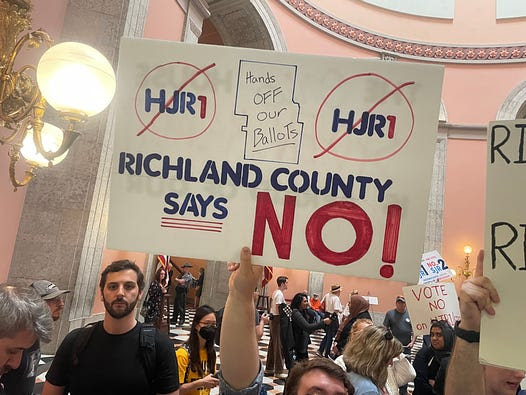
David Pepper describes a stunning victory for democracy in Missouri for outnumbered Democrats. Remember how the Republican-controlled Ohio legislature promoted a referendum called Issue 1 to require all future referenda to get 60% of the vote to pass? They were trying to defeat a referendum on abortion by raising the bar. Voters got wise and defeated the measure. Voters then protected abortion rights with 58% of the vote. Democracy means majority rule, not tampering with the process to defeat majority rule.
Yesterday proved once again why you never stop fighting for democracy.
Anywhere. Ever!
For months, Missouri Republicans have been scheming to bring an Issue 1-style attack on direct democracy to their state, where voters have a tradition of using ballot initiatives to exercise their will—including recently expanding Medicaid and legalizing marijuana. And the GOP plan was to sneak the attack through this August, right before a November referendum on reproductive freedom.
You remember Issue 1, right? Where they tried to raise the threshold for constitutional amendments in Ohio to 60%?
Our amazing campaign to crush that monstrosity heated up about a year ago. (Yes, time flies):
Well, as I wrote in “Laboratories of Autocracy,”GOP statehouses always learn from their failures. And adjust.
And in Missouri, the GOP response was a more sneaky version of Issue 1—where they would’ve required that in addition to a simple up or down vote across the state, a majority of voters in 50% of House districts (you know, highly gerrymandered districts) would have been required for any referendum to gain approval. And that essentially would have locked in a severe form of minority rule even more onerous than a 60% threshold. One study found that as few as 20% of Missouri voters could block an effort under such rules.
Still, the GOP would’ve falsely insisted that majority rule was still protected. They even tried to add “ballot candy”—such as a ban on non-citizens voting even though they already can’t vote in Missouri—to fool voters into supporting an attack on their own rights. And this could’ve been voted on in August, months before Missouri voters would be voting on an amendment on reproductive freedom in November.
Overall, it felt like stopping this would be an uphill battle. Downright scary.
But…
…Democrats, although outnumbered in Missouri, resisted at every turn. Many more are running this year, bringing accountability to far more sitting incumbents. And current Democratic state senators held the Senate floor in a more than two-day filibuster (the longest in state history) earlier this week.
And yesterday? The Missouri GOP ran out of time.
The awful, anti-democracy bill died.
As my friend Jess Piper told me:
“The Freedom Caucus was dead set on stealing one person, one vote. They were beaten by a 50 hour filibuster by Senate Dems and by reading the room. This is the first in their defeats…we’ll also win on the abortion question in November.”



 Diane Ravitch's blog