Curtis Yarvin is the guru for a number of major political figures on the right, including Vice President Vance and tech billionaire Peter Thiel. He is hostile to democracy and holds racist views. Yarvin’s anti-democratic views demonstrate how extremist key members of the Republican Party have become.
Yale is demonstrating its commitment to free speech.
A far-right political blogger who has espoused anti-democratic views is set to debate at Yale on Tuesday and Wednesday.
Curtis Yarvin — who has sparked controversy for advocating for a form of American monarchy and for his writings on race, slavery and apartheid — is set to participate in two debates this week, one hosted by the Yale Political Union and the other by the Yale Federalist Society.
“A smart critic like Yarvin can force people to sharpen the case for their views, especially when those views have gotten sloppy over time,” Garett Jones, a professor at George Mason University who will debate Yarvin Wednesday on “for-profit governance” at the Federalist Society’s event, wrote to the News. “And the case for democracy has certainly gotten sloppy over time. Democracy’s defenders, which I count myself among, need to do a better job.”
At the YPU debate Tuesday evening, Yarvin will argue for the resolution “end the democratic experiment” against Jed Rubenfeld, a professor at Yale Law School.
Jones wrote that he believes the debate will be a helpful way to draw out distinctions between his position, which he describes as “10% less democracy” in reference to the title of his published book, and Yarvin’s, which he calls “100% less democracy.”
Neither Rubenfeld nor YPU President Brennan Columbia-Walsh ’26 responded to the News’ request for comment.
Both debate topics land on familiar turf for Yarvin, who has consistently expressed anti-democratic beliefs. Yarvin, who is also known by his pen name Mencius Moldbug, has written about his distrust of the federal bureaucracy and his desire to institute a program called RAGE — retire all government employees.
Ilani Nurick LAW ’27 and Elizabeth Bailey LAW ’27, co-presidents of the Yale Law Democrats, criticized the Yale Federalist Society for sponsoring the event. Yarvin could not be reached for comment.
“We all believe strongly in free speech, but what is the Federalist Society hoping to learn from someone who thinks white people are genetically predisposed to be smarter than other races?” Nurick and Bailey wrote in a joint statement to the News. “Yale Law students are smart enough to know that for-profit governance is not the solution to the problems facing our country without hearing from Curtis Yarvin on the subject.”
Yarvin asserts that American democracy is a failed experiment and that America should instead run like a company with a chief executive officer, which The New York Times characterized as “his friendlier term for a dictator.”
In Yarvin’s view, the U.S. government should be run by a CEO-esque figure. In his 2008 articletitled “An Open Letter to Open-Minded Progressives,” Yarvin proposed the “liquidation of democracy, the Constitution and the rule of law, and the transfer of absolute power” to that CEO-esque figure.
Yarvin’s 2008 article furthered that this process would end the press, dismantle universities and transform the nation’s capital into a “heavily armed” version of a “corporation.”
Additionally, Yarvin has sought to downplay the outcome of the American Civil War. The Times noted that he has previously written, “It is very difficult to argue that the War of Succession made anyone’s life more pleasant, including that of freed slaves.”
The new conditions for federal funding the Trump administrationoffered to MIT put the school in a no-win situation, people on the Cambridge campus and throughout academia said Friday: Agree to the federal government’s terms and surrender some academic freedom, or refuse and risk further punishment.
The White House’s proposed “Compact for Academic Excellence in Higher Education” — sent to MIT and eight other top-tier universitiesthis week — ties access to federal moneyto a string of conditions that, if agreed to,would effectuate the most substantial changes MIT has seen to dateand fundamentally transform an economic powerhouse of Greater Boston.
The 10-point document asks the list of schools — which also includes Brown and Dartmouth — to cap international student enrollment, freeze domestic tuition rates for five years, and commit to strict definitions of gender.Some of those requests, such as reducing tuition and the number of international students, are popular with many Americans. But others, including one to limit the speech of university employees, strike at the heart of freedom and independence that universities have long prized.
While MIT declined to comment, on campus and in academia, there doesn’t appear to be much inclination to make a deal with the White House.
The offer amounts to “a loyalty oath to the federal government,” said Catherine D’Ignazio, an MIT professor of urban studies and planning.
“They’re asking us to sacrifice science. They’re asking us to sacrifice international students. They’re asking us to sacrifice our trans students. They’re asking us to sacrifice our whole idea of shared governance,” D’Ignazio said. “No amount of money is worth that great long list.”
The mandate also says that universities should transform or abolish “institutional units that purposefully punish, belittle, and even spark violence against conservative ideas.” That’s troubling, said Tyler Coward lead counsel for government affairs at the Foundation for Individual Rights and Expression, because it conflates allowing speech with condoning violence.
“This mandate basically forces these institutions to remain silent in order to secure some government benefit,” Coward said. “I think that is a problem, a First Amendment problem.”
MIT is the birthplace for countless startup companies, forms the backbone of Kendall Square, and serves as a first landing place for many students — roughly 30 percent of whom come from abroad — who stay and build careers in Massachusetts.
Federal money plays a key role in seeding all that. Last year, MIT collected $648 million in government funding for sponsored activities, including research, which federal agenciescould simply choose to award elsewhere.
The provisions in the compact, said Sandy Baum, a higher education finance expert with the think tank The Urban Institute, amount to “dramatic requests” of MIT from a dollars-and-cents perspective.
MIT is already bracing for a $300 million reduction in its central budget from the newfound 8 percent tax on its endowment and potential losses of federal science funding that powers much of its massive research arm, university administrators said in a September staff forum. (A recording of the meeting was reviewed by the Globe.)
In the spring, MIT saved roughly $100 million by freezing hiring and instituting a 5 percent cut to department budgets. It plans to close the remaining $200 million gap by terminating some real estate leases and seeking outside private funding for some academic priorities, including climate change, life sciences, and artificial intelligence, according to details shared at the staff forum. Administrators said that they may also withhold merit raises for employees next year.
“We do need to treat the $300 million amount as a permanent burden on the central budget that requires a permanent budgetary solution,” Glen Shor, MIT’s executive vice president and treasurer said at the September meeting. “Even if power at some point changes hands in Washington, we can’t count on these policies being reversed.”
Meanwhile, signing onto the compact could impact the number of international students at MIT, who make up around 10 percent of its undergraduate population — less than the limit set in the agreement. (Around 40 percent of MIT graduate students are from abroad.) Many international students pay full price to attend MIT, which can cost nearly $90,000 between tuition, housing, and other expenses. MIT would also pledge to cover the cost of attendance for all students studying hard sciences, such as physics, chemistry, and biology.
“If [MIT] had to freeze tuition and limit [the] number of international students, that would be a huge hit,” said Baum, the university finance expert.
Multiple MIT student organizations signed a letter Friday asking MIT to “firmly refuse” to sign the document, claiming that “accepting such a compact would effectively destroy the institutional culture of MIT as we know it.”
Nadia Zaragova, a material sciences PhD student and vice president of the graduate student union, said it would give the federal government “undue oversight over what we do here at the university, including our classrooms, what we study, what we research.”
And Governor Maura Healey, who has proposed $400 million in state funding to help make up for lost federal funds to Massachusetts universities, urged MIT to stand strong, describing the White House offer as “yet another attempt by President Trump to silence speech.”
MIT supporters note the university has already taken up some measures pushed by the Trump administration, including winding down its Institute Community and Equity Office and taking disciplinary actions against students — including a commencement speaker — who participate in pro-Palestinian protests.
Indeed, MIT was chosen among the schools who received the compact because they are seen as “good actors,” according to May Mailman, senior adviser for special projects at the White House.
“They have a president who is a reformer or a board that has really indicated they are committed to a higher-quality education,” she said to The Wall Street Journal.
But Ian Hutchinson, an MIT emeritus professor and co-president of its Council of Academic Freedom, said that even those in favor of those moves have sour feelings about the new offer from the administration.
“Many of us on the council think that the modern academy needs to reform and [is] beginning to do so and that the compact has the risk of alienating a large fraction of the faculty,” he said.
Others fear that some professors could leave entirely, should the school sign onto the compact.
A better approach, Hutchinson added, would be if “the government makes clear what it is interested in funding in the way of research and what it is not interested in funding.”
The compact also frames preserving “single-sex spaces” such as bathrooms and locker rooms as necessary for “women’s equality” and stipulates institutions must commit to defining gender “according to reproductive function and biological processes.”
Mila Halgren, an MIT postdoctoral associate, said including such language is an affront to what the values of American higher education should be.
“In a personal capacity, every moment MIT even considers this compact is a betrayal of every marginalized group on campus,” she said. “That MIT did not immediately reject a proposal which defines trans people out of existence is shameful.”
In the post at 9 a.m. today, two scholars of racism and equity explained that Trump’s scrubbing of museums, national parks, and other federal facilities is an attempt to capture control of the culture and erase the place of Blacks, women, and anyone else who is not a straight white male.
But, as scholar Julian Vasquez Heilig writes here, Trump and his commissariat cannot control the popular culture. In time, we can hope, his mean-spirited efforts to revise history will become a bad joke, a cruel joke, a stupid joke. He and all those who carry out his orders will become a public laughing stock.
Vasquez Heilig writes on his blog Cloaking Inequity:
The Super Bowl has always been more than football. It is a ritual, a spectacle, a national performance. It’s where America tells the world who it thinks it is, and who it wants to be. Which is why the announcement that Bad Bunny will host the halftime show is far more significant than a musical lineup change. It’s a cultural earthquake.
I remember the first time I heard Bad Bunny. It was December 6, 2019, at La Concha Hotel in San Juan. In the downstairs lounge, the beat of reggaetón was shaking the walls, and I pulled out Shazam to figure out what it was. The song was Vete. The room was electric, filled with Puerto Ricans singing every word in Spanish, unapologetically themselves. That night, it hit me: Bad Bunny was not just making music in San Juan, he was celebrating culture. He wasn’t crossing over into the mainstream by adapting; he was dragging the mainstream toward him. He refused to translate, refused to dilute, and now he is everywhere—on playlists, on charts, SNL, in crowded places from San Juan to New York to Madrid.
That’s why his Super Bowl moment matters so much. It is not just a performance, it is the culmination of a global movement that began in places like that basement lounge in Puerto Rico. What felt local then is now universal. Bad Bunny’s rise shows how culture flows upward, from the margins to the center, from overlooked communities to the biggest stage in the world. For millions of us, this is affirmation. For the right wing, it is destabilization. Because when the halftime show belongs to Bad Bunny, it proves that America is no longer just what they imagine it to be. It is bigger, louder, and more diverse than great again nostalgia can contain.
Jay-Z, Kendrick Lamar, and the New Halftime Era
The NFL’s halftime choices haven’t shifted by accident. When the league came under fire for its treatment of Colin Kaepernick and broader criticisms about racial injustice, it needed credibility. Enter Jay-Z and Roc Nation. The NFL tapped him to advise and help curate halftime shows.
The results have been undeniable. Kendrick Lamar’s halftime performance last year was a watershed moment—unapologetically Black, politically charged, and culturally defining. That performance sparked widespread discussion, and even a blog post I wrote about it entitled “TV Off”: What Kendrick Lamar Was Really Saying at the Super Bowl drew more than 100,000 readers in just a few days. Clearly, the hunger to talk about representation and ownership of the halftime stage is real.
Now with Bad Bunny taking the baton, the NFL is making another cultural statement, whether it fully realizes it or not (I think it does). The league’s biggest platform is no longer reserved for the safe, predictable acts of yesterday. It’s becoming a stage where hip hop, reggaeton, and the voices of communities once marginalized are front and center.
Bad Bunny and the Right’s Panic
For decades, the halftime show was dominated by choices that reinforced a narrow image of America: classic rock icons, country stars, or pop acts who wouldn’t ruffle feathers but had wardrobe malfunctions. Bad Bunny shatters that mold. His performance won’t be a side act, it is the show. Spanish won’t be a novelty; it will be central.
This is exactly why the right wing panics. To them, football Sundays and Super Bowls have long been “their” cultural territory. They’ve wrapped the game in patriotic rituals, military flyovers, and moments of silence for conservative heroes. When someone like Bad Bunny steps into the spotlight, it disrupts their monopoly. It forces a new definition of America—one that is multilingual, multicultural, and undeniably Latino. That’s what makes his halftime role so radical: after focusing on the Black experience with Kendrick, this year signals that Latino identity is no longer peripheral. It’s woven into the fabric of America’s biggest stage.
Why ICE Wants to Loom Over the Moment
It might sound absurd that ICE wants to connect itself to the Super Bowl halftime show, but immigration enforcement has always thrived in the shadows of visibility. When Latino joy and success are celebrated so publicly, ICE apparently feels the need to remind America of its terrorizing power.
Bad Bunny performing at the Super Bowl is a triumph of belonging. But ICE’s assaults, raids, arrests, kangaroo courts, and deportations are constant reminders that belonging is conditional on politics. While millions watch a Puerto Rican superstar, ICE agents are throwing mothers and journalists to the ground, spraying pepper liquid into the eyes of Americans who dare to ask questions, arresting elected politicians at the behest of Washington politicians after turning off their body cameras, and authorized by the Supreme Court to detain people simply for looking Latino and poor.
The contradiction is sharp: on the world’s stage, Latino identity is being widely celebrated; on America’s streets, it’s criminalized. ICE doesn’t need to show up at the stadium—it already shows up in our daily life. Its existence ensures that even at moments of cultural triumph, there’s a purposeful shadow of fear and terroristic threats.
Danica Patrick’s Tone-Deaf Criticism
And then, inevitably, a silly critic emerges from the sidelines. This time it’s Danica Patrick, who dismissed Bad Bunny’s hosting role. Her comments were more than unhelpful, they were stupid.
Patrick should know better. She carved her own career by getting along in a male-dominated sport, where every step forward was a battle for representation. She knows the symbolic weight of breaking barriers. For her to turn around and mock or diminish Bad Bunny’s presence is hypocritical at best, willfully ignorant at worst.
Bad Bunny isn’t there to tick a diversity box, he’s there because he is one of the most influential artists alive— maybe THE most. The incredible success of his shows that he did for his most recent album this past summer ONLY in Puerto Rico is proof that the center of American culture is shifting. Criticizing that isn’t just a matter of taste. It’s a refusal to accept reality.
The Lions, Charlie Kirk, and Who Gets Tribute
The battle over cultural ownership in America doesn’t stop at the Super Bowl. It plays out every Sunday on the NFL field. When conservative commentator Charlie Kirk was assassinated, the league encouraged teams to hold moments of silence in his honor. Most complied. But the Detroit Lions, along with a few other teams, did not.
That decision matters. It was a quiet but deliberate act of boundary-setting, a refusal to let every NFL broadcast become a political ritual sanctifying right-wing political ideology. By declining the tribute, the Lions reminded us that not every form of patriotism must come prepackaged with conservative allegiance. It wasn’t loud or defiant. It was subtle and deeply symbolic. Sometimes resistance isn’t what you do, it’s what you decline to perform and participate.
The Lions’ restraint connects to the same cultural realignment symbolized by Bad Bunny’s Super Bowl performance. Both moments reject the idea that American culture belongs to a single tribe. They push back against the notion that sports, music, or patriotism must orbit one political pole. They insist, instead, that culture belongs to everyone, not just the loudest or the angriest voices claiming to defend it.
The Double Standard of Protest
Of course, this tension between culture, power, and dissent has long been visible in the NFL. When Colin Kaepernick knelt during the national anthem to protest police brutality, he was branded a traitor by many of the same voices now demanding “respect” for Charlie Kirk. His silent, dignified act of conscience was recast as an attack on America itself.
The outrage was never really about the flag. It was about control. It was about who is allowed to define what counts as “patriotic.” Kaepernick’s kneeling was an act of moral courage, but it exposed how fragile America’s cultural gatekeepers truly are when confronted with truth. They could not tolerate a protest that revealed their own comfort with injustice and brutality.
Meanwhile, state violence continues daily without the same moral outrage from the right-wing. ICE officers violently throw mothers and journalists to the ground without cause. They pepper-spray citizens in their eyeballs for daring to ask questions in a conversation. They arrest and detain American citizens in raids not for crimes but for looking poor, brown, or foreign. These acts have not provoked right-wing primetime outrage or public boycotts. Their hypocrisy is staggering.
A man kneeling quietly for justice was vilified. Agents brutalizing families are ignored. The problem has never been the method of protest, it has always been their morality. Silence in the face of injustice is acceptable; silence against injustice is not. The Lions’ quiet refusal and Kaepernick’s quiet protest share something profound: both disrupted the script of cultural obedience. Both reminded us that resistance isn’t always loud. Sometimes it’s the refusal to play along.
The Supreme Court’s Enabling Role
And looming behind all of this is the judiciary. Recent Supreme Court rulings have expanded law enforcement’s power, narrowing protections under the Fourth Amendment and giving politicians more leeway to persecute immigrants using federal data. Justice Brett Kavanaugh has been the lead in the right-wing judicial majorities that have handed law enforcement broad authority to stop, question, and detain anyone with minimal cause. Its new rulings have created the legal cover that now makes racial profiling essentially legal.
Racial profiling has happen illegally before and the new legal result empowered by the Supreme Court is the same: citizens living under suspicion, families living in fear, communities targeted not for what they’ve done but for how they look. The Supreme Court has enabled ICE brutality in the same way NFL owners enabled the blackballing of dissent, by creating structures that justify exclusion and violence while insisting neutrality.
The Bigger Picture: Who Owns the Stage?
So what do Bad Bunny, Kendrick Lamar, Jay-Z, Danica Patrick, ICE, the Lions, Charlie Kirk, and Brett Kavanaugh all have in common? They are all part of the “fight, fight, fight” (see new Trump $1 coin) over who gets to define American culture.
The right wing has long claimed the NFL as its territory: its rituals, its tributes, its symbols of patriotism. But culture evolves. It cannot be contained. From Detroit to San Juan to Los Angeles, new voices are shaping the narrative. Bad Bunny’s halftime show, Kendrick’s explosive performance, and even the Lions’ silent refusal all tell the same story: football does not belong exclusively to one political ideology. Neither does America.
The real question is whether we are willing to see that America’s identity is bigger than its old rituals. Are we willing to admit that inclusion is not a threat but a fact? Because culture doesn’t wait for permission. It claims the stage. And this year, that stage will belong to Bad Bunny.
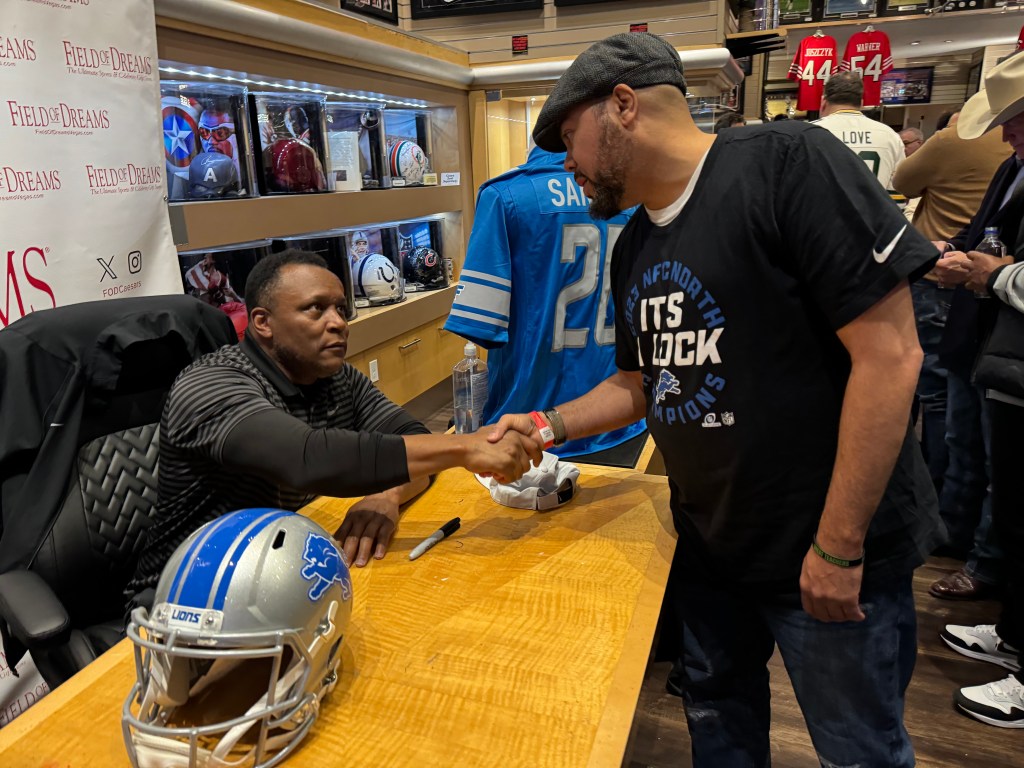
Julian Vasquez Heilig is a professor, writer, and a legit lifelong Detroit Lions fan since 1981. He attended the NFC Championship in San Jose two years ago to support his Cardiac Cats and last year’s playoff loss to the Washington Commanders at Ford Field. He was also at the official Lions partners party during the NFL Draft in Detroit, where he met Robert Porcher and Jason Hanson. Over the years he’s spotted Billy Sims in Times Square, endured the heartbreak of the Lions’ 0–16 season, and treasures his personally autographed Barry Sanders helmet. Beyond education and equity, Julian dabbles in writing about sports, culture, and society.
Two scholars–Kimberlé Crenshaw and Jason Stanley–explain why Trump is censoring exhibits at the Smithsonian. He has also imposed censorship of signage and exhibits at other federal sites, including national parks. He has enlisted the U.S. Department of Educatuon to organize rightwing groups to create a “patriotic” civics course.
Kimberlé Crenshaw is an American civil rights advocate and a scholar of critical race theory. She is a professor at the UCLA School of Law and Columbia Law School, where she specializes in race and gender issues
Jason Stanley is the Bissell-Heyd Chair in American Studies in the Munk School of Global Affairs & Public Policy at the University of Toronto and the author of Erasing History: How Fascists Rewrite the Past to Control the Future
Trump and his far-right cabal are l trying to revise history and memory. Unless he abolishes or rigs future elections, all this tinhorn fascist censorship will be swept away by his successors. He will rightly be judged, when that day comes, as the closest thing this country has ever seen to having a dictator. He will be portrayed in the Smithsonian and the textbooks as a buffoon and a tyrant.
In a letter sent to Smithsonian secretary, Lonnie G Bunch III, on 12 August, the Trump administration announced its plan to replace all Smithsonian exhibits deemed as “divisive” or “ideological” with descriptions deemed as “historical” and “constructive”. On 21 August, just nine days later, the White House published a list of said offending fixtures – the majority of which include exhibits, programming and artwork that highlight the Black, Latino and LGBTQ+ perspectives on the American project. Included in his bill of particulars was an exhibit that rightly depicts Benjamin Franklin as an enslaver, an art installation that acknowledges race as a social construct and a display that highlights racist voter suppression measures, among others.
The assault on the Smithsonian comes wrapped, as it were, as part of a broader attack on democracy, scenes of which we see playing out every day. The federal occupation of Washington DC, the crackdown on free speech on campus, the targeting of Trump’s political opponents, the gerrymandering of democracy – these are interwoven elements of the same structural assault. So with many fires burning across the nation, concerned citizens who are answering the call to fight the destruction of democracy may regard his attack on history and memory as a mere skirmish, a distraction from the herculean struggle against fascism unfolding in the US. But this is a mistake. Trump’s attack on American museums, education and memory, along with his weaponization of racialized resentment to package his authoritarian sympathies as mere patriotism, is a critical dimension of his fascist aims. The fight for democracy cannot avoid it, nor its racial conditions of possibility.
Fascism always has a central cultural component, because it relies on the construction of a mythic past. The mythic past is central to fascism because it enables and empowers a sense of grievance by a dominant racial or ethnic group whose consent is crucial to the sustainability of the project. In Maga world, the mythic past was pure, innocent and unsullied by women or Black leaders. In this kind of politics, the nation was once great, a byproduct of the great achievements of the men in the dominant racial group. In short, the assault on the Smithsonian and, more broadly, against truthful history and critical reflection is part of the broader fascist attack on democracy.
From this vantage point, racial equality is a threat to the story of the nation’s greatness because only the men of the dominant group can be great. To represent the nation’s founding figures as flawed, as any accurate history would do, is perceived, in this politics, as a kind of treason.
The success of the fascist dismantling of democracy is predicated on the widespread systematic failure to see the larger picture. The anti-woke assault that is a key pillar of Trumpism is part of that failure, partly due to the racial blinders and enduring ambivalence of too many in positions of leadership in the media and elsewhere. Those who sign on to the attack on “wokeness” but regard themselves as opponents of the other elements of the fascist assault are under the mistaken assumption that these projects can be disaggregated. In fact, the dismantling of democracy and of racial justice are symbiotically entangled. To support one is to give cover for the others.
It is no coincidence that this ‘proper’ ideology Trump exposes is constitutive of a more well-known strand of fascism – nazism
It is clear that the Trump administration understands this relationship and fully weaponizes racist appeals as a foundational piece of its fascist agenda. And if this was once the quiet part, it is now pronounced out loud in official government documents. In an executive order issued on 27 March 2025 titled “Restoring Truth and Sanity to American History”, Trump reveals that his mandate to ban “improper ideologies” targets core commitments repudiating a scientific racism that historically naturalized racial hierarchy thereby neutralizing resistance. According to Trump, the problem with the Smithsonian American Art Museum’s exhibit The Shape of Power: Stories of Race and American Sculpture was that it promoted the idea that “race is a human invention”.
The understanding that race is a social construct as opposed to a biological fact is perhaps the most fundamental advance in repudiating enslavement, genocide and segregation. Rejecting the idea that racial inequality is natural or pre-ordained – a claim that grounded enslavement and dispossession in America – forms the cornerstone of the modern commitment to a fully inclusive democracy. Trump’s declaration that this cornerstone is “improper” is an effort to turn the clock back, upending the entire American postwar project. It is no coincidence that this “proper” ideology Trump exposes is constitutive of a more well-known strand of fascism – nazism. How else can we understand why Maya Angelou was purged from the Naval Academy library while Adolf Hitler remains?
The fight against fascism in the US must be as robust in its embrace of racial equality as Trump’s embrace of outdated ideas about race and racism. The defense of memory, of truthful history, of telling the whole American story rather than ascribing agency in history to the deeds of “great men” is vital to the American democratic project. A pro-democratic education fosters the agency of its citizens by teaching about social movements that overturned entrenched hierarchies which blocked democratic equality and imposed racial tyranny. The story of how ordinary Americans lived and struggled and remade America is essential knowledge in developing and sustaining a multiracial democracy. The Smithsonian has been a vital institution in making this knowledge accessible to the masses. The National Museum of the American Latino and the National Museum of the American Indian, for example, provide artifacts and perspectives about the nation’s westward expansion that challenge the myth of unoccupied territory and manifest destiny. The National Museum of African American History and Culture brings forward the global scale of enslavement as well as its infusion across national institutions, culture and politics.
Someday, somehow, there will be another President of the United States, and his name won’t be Trump. That future President might well be a Democrat. That President might be in a position to exercise unchecked power, thanks to the acquiescence of the current Congress and Supreme Court, which are allowing Trump to exercise the powers of a dictator. The second and third branches of our government have willingly wiped out the separation of powers and ceded their authority to the President.
Congress has voted to give its power of the purse to King Donald. The Supreme Court (the Supine Court) has stood aside and approved of whatever the King wants, regardless of precedent. Justice Thomas said recently that precedent was irrelevant; he is no longer an originalist.
Now comes what might be considered the most important question. May the President send in troops–either the state’s National Guard, the National Guard of other states, or even the regular military–to cities that he believes need to be suppressed?
A Trump-appointed federal judge ruled that he could not. Justice Karin Immergut, appointed by Trump, ruled that Trump could not send troops to Portland, because it is not “war-ravaged,” as he claimed, or in a state of rebellion. In other words, you can’t just make sh-t up to do whatever you want, even if you are the President.
Constitutional lawyer Steve Vladeck, a scholar at the Georgetown University Law Center, noted that Trump’s advisors are claiming that the President doesn’t need approval of the courts before using the troops on American soil. He explains here why the President can’t ignore the judiciary.
Welcome back to “One First,” an (increasingly frequent) newsletter that aims to make the U.S. Supreme Court more accessible to all of us. If you’re not already a subscriber, I hope you’ll consider becoming one (and, if you already are, I hope you’ll consider upgrading to a paid subscription if your circumstances permit):
I wanted to put out a quick issue this morning in light of Judge Karin Immergut’s remarkable ruling yesterday, granting a temporary restraining order against President Trump’s federalization of members of the Oregon National Guard to quell the “violence” in “war-ravaged Portland.” That ruling has prompted a slew of claims this morning from the President’s advisers and outside supporters that federal courts, in general, lack the power to halt domestic deployments of the military.
Before this claim makes it too far, it seems worth helping to educate folks about a key early precedent that, in my view, cuts entirely in the other direction—and that provides powerful evidence, to those who care about such things, that the Founding-era understanding not only tolerated a robust judicial role in such cases, but, for a time, actually required one. That’s not to say Judge Immergut’s specific analysis in this case is correct (although I’m sympathetic); it’s to say that there is nothing categorically inappropriate about federal courts reviewing—and, where necessary, halting—domestic uses of the military while they are ongoing. Indeed, it would be striking if it were otherwise.
***
The modern-day Insurrection Act traces its lineage all the way back to a statute Congress enacted on May 2, 1792—which has often been referred to as the Calling Forth Act or First Militia Act. That statute was designed to carry into effect the Constitution’s grant of power to Congress, in Article I, Section 8, Clause 15, “[t]o provide for calling forth the Militia to execute the Laws of the Union, suppress Insurrections and repel Invasions.”
The idea was that Congress would identify the circumstances in which military power could be used domestically—and would thence delegate that power to the President. As Justice (Robert) Jackson would remind us in his concurring opinion in Youngstown, the Clause’s “limitation on the command power, written at a time when the militia rather than a standing army was contemplated as the military weapon of the Republic, underscores the Constitution’s policy that Congress, not the Executive, should control utilization of the war power as an instrument of domestic policy.”
But how, exactly, should that delegation work? This question was the subject of a rich debate in the Second Congress—one that culminated with the 1792 statute. I’ve summarized that debate elsewhere; for present purposes, the key point is that Congress’s principal concern was not with the last two circumstances in which it was to delegate power to the President (“to suppress Insurrections and repel Invasions”), but with the first circumstance (“to execute the Laws of the Union”). And the way Congress addressed its concerns was to delegate the authority to use the military, but with meaningful procedural checks.
Here’s the full text of section 2 of the act, image first; block quote second, with the key provisions highlighted:
[W]henever the laws of the United States shall be opposed, or the execution thereof obstructed, in any state, by combinations too powerful to be suppressed by the ordinary course of judicial proceedings, or by the powers vested in the marshals by this act, the same being notified to the President of the United States, by an associate justice or the district judge, it shall be lawful for the President of the United States to call forth the militia of such state to suppress such combinations, and to cause the laws to be duly executed. And if the militia of a state, where such combinations may happen, shall refuse, or be insufficient to suppress the same, it shall be lawful for the President, if the legislature of the United States be not in session, to call forth and employ such numbers of the militia of any other state or states most convenient thereto, as may be necessary, and the use of militia, so to be called forth, may be continued, if necessary, until the expiration of thirty days after the commencement of the ensuing session.
In other words, unlike section 1 (which dealt with insurrections and invasions), section 2 imposed two procedural requirements on domestic use of the military to carry out the laws of the union: a district judge or Supreme Court justice had to make the requisite factual findings before the President could do anything;¹ and, if out-of-state militia were used, there was a baked-in sunset.
The 1792 act was written as a temporary experiment. Congress decided to delegate comparable authority on a permanent basis in 1795—and, alas, removed the ex ante judicial review requirement. But there was no suggestion at the time, and I’m unaware of any since, that the provision was eliminated for constitutional reasons—as opposed to Congress’s broader (if, alas, myopic) view that the checks weren’t needed in light of how responsibly President Washington had behaved during the Whiskey Rebellion.
Thus, although there are later examples of courts issuing injunctions against domestic uses of the military (Youngstown itself stands out as a fairly prominent example), the relevant point for present purposes is that there was no Founding-era aversion to a robust judicial role in these cases. The first statute Congress ever enacted on the subject required such a role, and there was no contemporaneous suggestion that the Constitution forbade it.
I am, as regular readers of this newsletter likely know, no great fan of “originalism” as a conclusive methodological approach to constitutional interpretation. Thus, the way that I tend to think about these things, the existence of the judicial review provision in the Calling Forth Act of 1792 is useful evidence of how the Constitution was understood at the time, but nothing more. Rather, the argument for judicial review being available to halt, where necessary, unlawful domestic uses of the military rests on a lot more, in my view, than what some folks believed more than 230 years ago.
But for those who ascribe to the view that we are, today, bound by how the Constitution was understood then, I do not see how one can reconcile the 1792 precedent with any claim that prospective judicial review is categorically precluded when it comes to domestic use of the military. And given current and recent events, such review, if anything, seems more important than ever—whatever its outcome.
Nikole Hannah-Jones has had her share of controversy. Born in Iowa to a mixed-race couple, she attended desegregated public schools, graduated from Notre Dame and received a masters in journalism from the University of North Carolina. In her career as an investigative journalist, she covered education, civil rights, and healthcare. She worked at newspapers in North Carolina and Oregon, then for ProPublica. In 2015, she joined the staff of The New York Times.
In 2019, The Times published The 1619 Project, a group of essays that Hannah-Jones assembled, to commemorate the arrival of the first Blacks to the land that would later become the USA. In the lead essay, which Hannah-Jones wrote, she maintained that the arrival of that ship bringing enslaved Blacks marked the true origin of the nation. She recast the history of the U.S. from a Black perspective. Some historians criticized aspects of her thesis, others defended it.
The 1619 Project was widely celebrated and widely condemned, even banned. Trump responded by creating a 1776 Commission, whose purpose was to celebrate US history patriotically (that is, to leave out the shameful parts).
Hannah-Jones won the Pulitzer Prize for The 1619 Project in 2020.
In 2021, the UNC-Chapel Hill’s Hussman School of Journalism and Media announced that Hannah-Jones would join the Hussman faculty as Knight Chair in Race and Investigative Journalism. The faculty and administration urged the UNC Board to give her tenure, as was customary with previous holders of the chair. However, the Board of the university refused to take action on this tenure recommendation. After a public uproar, the board of trustees offered her tenure, but Hannah-Jones rejected the offer, choosing instead to accept the offer of a chair at Howard University.
She wrote in the New York Times about the mainstreaming of Charlie Kirk’s bigoted views after his tragic assassination. This is an except from her excellent commentary.
Last year, The Washington Examiner, a conservative news outlet, published a column calling the organization Kirk co-founded, Turning Point USA, “one of the most destructive forces in Republican politics.” It said that “a healthy conservative movement cannot tolerate conspiracy theorists being presented as serious political figures” and called the organization’s leadership “toxic.” But the period since Kirk’s death has revealed a deeply unsettling cultural shift. Eight months into President Trump’s second term, it is clear that Kirk’s ideas are no longer considered on the extremist periphery but are embraced by Republican leadership.
The mainstreaming of Charlie Kirk demonstrates that espousing open and explicit bigotry no longer relegates one to the fringe of political discourse.
When Representative Jasmine Crockett, Democrat of Texas, bemoaned that only two of the 58 Democrats who refused to sign the resolution honoring Kirk were white, Laura Loomer responded on X by railing against “ghetto Black bitches who hate America serving in Congress.” Loomer is not merely some right-wing provocateur. She has the ear of the president of the United States and understood that such an explicitly racist comment in 2025 America would bring no political consequence.
And while Trump has surrounded himself with people who have said racist things and maintained ties to white and Christian nationalists, the number of Democrats and esteemed American institutions that have engaged in the mainstreaming of Charlie Kirk demonstrates that espousing open and explicit bigotry no longer relegates one to the fringe of political discourse, a phenomenon we have not witnessed since the civil rights era.
In some parts of polite society, it now holds that if many of Kirk’s views were repugnant, his willingness to calmly argue about them and his insistence that people hash out their disagreements through discourse at a time of such division made him a free-speech advocate, and an exemplar of how we should engage politically across difference. But for those who were directly targeted by Kirk’s rhetoric, this thinking seems to place the civility of Kirk’s style of argument over the incivility of what he argued. Through gossamer tributes, Kirk’s cruel condemnation of transgender people and his racist throwback views about Black Americans were no longer anathema but instead are being treated as just another political view to be respectfully debated — like a position on tax rates or health care policy.
Using Kirk’s knack for vigorous argument to excuse the re-emergence of unabashed bigotry in mainstream politics feels both frightening and perilous.
As the Trump administration wages the broadest attack on civil rights in a century, and the shared societal values of multiculturalism and tolerance recede, using Kirk’s knack for vigorous argument to excuse the re-emergence of unabashed bigotry in mainstream politics feels both frightening and perilous. Kirk certainly produced viral moments by showing up on college campuses and inviting students a decade his junior to “prove” him wrong about a range of controversial topics such as Black crime rates and the pitfalls of feminism. But his rise to fame was predicated on the organization for which he served as executive director, Turning Point USA, and its Professor Watchlist. The website invited college students not to engage in robust discussions with others with different ideologies, but to report professors who “advance leftist propaganda in the classroom.”
The site includes photos of professors, along with often highly misleading summaries of the thought crimes that landed them on the list. It provides the telephone numbers of the universities that employ them for students and parents to register their complaints. While the site claims the organization supports free speech, many professors have recounted enduring campaigns of harassment after being put on the list. (I was placed on it in 2021 because of my work on the 1619 Project, after it was announced that I would be a professor at Howard University.)
A couple of years ago, Angel Jones, now a professor at a university in Maryland whose work focuses on educational inequality, joined the hundreds of professors across the country who found themselves on the list.
Jones landed on it under the tag “racial ideology” when she published an article citing research about how distressing it is for Black people to go to work after witnessing news coverage of police killings. She told me someone had sent her a picture of a house thought to be hers, but it turned out to belong to another Angel Jones. Someone else had threatened to hang her from a tree and burn her alive. The scholar changed her classroom and removed her name plate from her office door. The university where she was working at the time installed a safety alarm button under her desk.
“I would cry. I was very fearful. I was anxious,” Jones told me. “I was afraid to go to class sometimes. I was just scared all of the time.
“I love teaching — it makes my heart go pitter patter — so to be in a space where I am afraid of my students, like that rocks me in a way I can’t even articulate,” she added.
When Jones learned of Kirk’s killing, she remembers that there was a sense of disbelief shared by many Americans who were shocked by the gruesome video. But soon, that disbelief was replaced by another feeling. In the immediate hours after his death, she watched as pundits and politicians eulogized Kirk as that rare example of someone who practiced a willingness to hear opposing ideas because he saw it as thesalve for political violence. After all she’d gone through, and the stories she’d heard of other professors similarly harassed, the tributes pouring in for Kirk both infuriated and saddened her.
The next day, Jones went to the class she taught on misinformation and disinformation and showed her students a short Instagram video she had made in response. In the video, she says that while she does not celebrate Kirk’s death, she also refuses to mourn him. “I cannot have empathy for him losing his life when he put mine at risk and the lives of so many other educators just because we dared to advocate for social justice,” she says in the video, “because we dared to do our jobs.”
After she showed the video, a white male student in her class asked Jones if she thought her lack of empathy for Kirk might radicalize students. After a short, tense exchange, the student took his backpack and left. Jones said it had made her nervous. There’s a Turning Point USA chapter on her campus, and Kirk’s followers and even some politicians had been posting about revenge on social media. Jones switched her classes to virtual for the week.
The past few weeks have filled Ash Lazarus Orr with a similar sense of foreboding. Orr has been at the forefront of resisting efforts to target transgender Americans, including as a plaintiff in a federal lawsuit brought by the A.C.L.U. against a Trump administration policy that would prevent transgender people from having their chosen gender on their passports.
While Orr was never named by Kirk, they say Kirk’s rhetoric helped fuel an environment that makes transgender Americans vulnerable to violence and that has paved the way for the removal of their civil rights; in February, Iowa became the first state in the country to take away legal civil rights protections for transgender residents.
“I firmly believe that no one should be killed for their beliefs, no matter how harmful those beliefs might be,” Orr told me. “But we are watching our rights being stripped away. We are having our friends’ lives cut short, and then we are told to stay quiet while those responsible are celebrated.”
In just a few short years, Orr has watched as the momentum toward recognizing the full humanity and rights of transgender people has collapsed. Orr recently left their home state of West Virginia, finding it no longer safe after being threatened and assaulted.
Kirk’s rhetoric of “Christian white nationalism, anti-transgender, quote anti-woke culture-war framing, this isn’t on the edge anymore,” Orr told me. “It has moved into what many consider the center of Republican identity.” They said they were deeply concerned about how few people seemed willing to point out the consequences of this shift: “Who is actually fighting for us?”
Robin D.G. Kelley, a historian at U.C.L.A. whose scholarship on racial injustice also landed him on the Professor Watchlist, is struck by how rapidly our society has changed since Trump took office a second time.
Kelley pointed to the fact that Trump was widely condemned during his first term when he called the white supremacists who rallied in Charlottesville, Va., “very fine people.” Now, Democrats and political centrists were lining up to honor a man who promoted the same Great Replacement Theory that served as the rallying cry for that march. At a time when the president of the United States is using his power to go after diversity efforts and engaging in a mass deportation project, some progressives are arguing that people of color, immigrants and members of other marginalized groups who felt dehumanized by Kirk’s commentary, podcasts and debates have to find a way to locate common ground with his followers.
“There has been an extreme shift,” Kelley told me. “This treatment is authorizing the idea that white supremacy and racism is not just a conservative idea, but a legitimate one.”
This is nuts. With federal funding, Harvard scientists have produced major breakthroughs in medicine, engineering, and science. To break Harvard, as the administration wants to do, would cripple American innovation.
The Boston Globe reported:
The Department of Health and Human Services’ Office of Civil Rights on Monday formally recommended barring Harvard University from receiving federal funding, three months after it accused the university of violating civil rights laws by failing to protect Jewish and Israeli students on campus.
In a news release, the office said it would refer Harvard to the office that is responsible for “suspension and debarment decisions” and that it notified Harvard of its right to an administrative hearing. The university has 20 days to notify the office of its decision.…
The 57-page notice relied heavily upon Harvard’s own report on antisemitism and anti-Israeli bias that it released earlier this year, which followed high-profile protests at Harvard and other campuses against the war in Gaza in 2023 and 2024.
The Trump administration’s move this week to choke off Harvard University’s access to future federal funding came after a scathing letter from the college accusing the administration of distorting evidence to show that the school violated civil rights laws by allowing antisemitism to persist on campus.
The brewing feud represents an escalation of tensions between Harvard and the administration, which just weeks ago seemed on the verge of agreeing on a deal to keep federal funds flowing to the university.
In a strongly worded, 163-page letter with attachments on Sept. 19, which has not been previously reported, Harvard assailed the government’s findings. The university accused investigators at the Health and Human Services Department of relying on “inaccurate and incomplete facts,” failing to meet a single legal requirement to prove discrimination and drawing sweeping conclusions from a survey of one-half of 1 percent of the student body.
Harvard painted a picture of a chaotic Trump administration rushing to leverage federal power against the university. For instance, it noted that the health department had chided the college for failing to produce certain records. But Harvard’s documents showed that the records in question had been provided in response to a request from the Education Department. Harvard said the health department never asked for those records.
Harvard said the health department’s decision to refer its findings to the Justice Department was “based on a fabricated and distorted interpretation of the record.”
The stark language was a departure from months of mostly measured tones from Harvard as the university has resisted the administration’s pressure campaign to impose President Trump’s political agenda on the nation’s elite colleges.
Mr. Trump and his administration have sought to exert control over who universities can hire, which students they should admit and what subjects should be taught by leveraging huge sums of federal research money. Those moves, which Harvard has maintained violate the college’s First Amendment rights and infringe on the nation’s long-held ideals of academic freedom, are aimed at shifting the ideological tilt of the higher education system, which the administration sees as hostile to conservatives and intent on perpetuating liberalism.
The administration’s reply to Harvard’s letter came on Monday, when the health department initiated a process to cut off Harvard from future federal research funding, which has increasingly become the lifeblood for the nation’s largest private and public colleges. In 2022, the health department accounted for nearly 81 percentof $41.6 billion in federal funding for research into agricultural science, environmental science, public health and other life sciences, according to government records.
President Trump said Tuesday that his administration was close to reaching a multimillion-dollar agreement with Harvard University, which would end a monthslong standoff that had come to symbolize the resistance to the White House’s efforts to reshape higher education.
Harvard, which would become the latest university to strike a deal with the Trump administration, has been seeking an end to a thicket of investigations that the government opened as part of its wide-ranging efforts to bring the university in line with Mr. Trump’s agenda.
“We are in the process of getting very close,” President Trump said in an appearance from the Oval Office. He added that the details were being finalized and said, “They would be paying about $500 million.”
Mr. Trump said that the education secretary, Linda McMahon, was “finishing up the final details.” He added that the plan was for Harvard to operate trade schools.
“They are going be teaching people to do A.I. and a lot of other things — engines, lots of things,” he said. “We need people in trade schools.”
There is no end to the Trump administration’s assault on academic freedom. Particularly poisonous is its withdrawal of billions of dollars for scientific research to punish universities that defy his policies. Trump is determined to obliterate any sign of “diversity, equity, and inclusion” or any tolerance of anti-Semitism.
Speaking for myself, I wholeheartedly support diversity, equity, and inclusion. Speaking as a Jew, I resent Trump’s hypocritical, duplicitous use of anti-Semitism, an issue he has never cared about and that he cynically exploits.
Until now, research grants were awarded based on scientific merit and peer review. In the proposed changes, the universities that adhere to Trump policies and values would have a competitive advantage.
The Trump cabal is prepared to withhold funding from the nation’s top researchers if they are suspected of including nonwhite, non-male researchers in order to increase D or E or I. They assume that “merit” is found only in white males.
They are willing to deny research grants to Harvard and UCLA and give them to No-Name State Agricultural University, just to make a point.
They are willing to sacrifice research into pediatric cancer, heart disease, Alzheimer’s and other afflictions just because they include researchers who are not white men.
The White House is developing a plan that could change how universities are awarded research grants, giving a competitive advantage to schools that pledge to adhere to the values and policies of the Trump administration on admissions, hiring and other matters.
The new system, described by two White House officials, would represent a shift away from the unprecedented wave of investigations and punishments being delivered to individual schools and toward an effort to bring large swaths of colleges into compliance with Trump priorities all at once.
Universities could be asked to affirm that admissions and hiring decisions are based on merit rather than racial or ethnic background or other factors, that specific factors are taken into account when considering foreign student applications, and that college costs are not out of line with the value students receive.
“Now it’s time to effect change nationwide, not on a one-off basis,” said a senior White House official, who like the other official described the plan on the condition of anonymity because it is still being developed.
Under the current system, the federal government’s vast research funding operation awards billions of dollars’ worth of grants based on peer reviews and scientific merit.
The administration says it is working to enforce civil rights laws, which it contends many universities have violated by embracing diversity, equity and inclusion programs or failing to adequately protect Jewish students or staff from antisemitism. But the effort is almost certain to add to criticism from outside experts who say the administration is already overstepping its authority to try to impose its values on higher education.
Ted Mitchell, president of the American Council on Education, said the outlines of the proposal amounted to an “assault … on institutional autonomy, on ideological diversity, on freedom of expression and academic freedom.”
“Suddenly, to get a grant, you need to not demonstrate merit, but ideological fealty to a particular set of political viewpoints. That’s not merit,” he said. “I can’t imagine a university in America that would be supportive of this…”
Since President Donald Trump returned to office in January, his administration has launched investigations of and pulled research funding from universities including Columbia, Harvard and UCLA, and then worked to extract concessions in exchange for restoring the money. Officials say the punishments are an effort to enforce federal laws that bar funding for schools that discriminate on the basis of sex, race or national origin.
The White House has faced setbacks in court — including a big loss this month in its high-profile fight with Harvard and another setback this week in California — and has not reached as many settlement agreements as Trump officials had hoped for. The senior White House official described the new system as an opportunity for schools to show they are in compliance, as interpreted by the administration. Those that do so, the official said, would be rewarded with a “competitive advantage” in applying for federal grants…
Erwin Chemerinsky, dean of the University of California at Berkeley’s law school, said “no one will object” if the White House simply requires universities to pledge compliance with existing law. But Chemerinsky, one of the attorneys representing UC researchers in a lawsuit challenging terminated federal research funding, also said the administration’s view of what the law requires could be at odds with other interpretations: “It all depends on what the conditions are, and whether those conditions are constitutional.” Chemerinsky said it would be a First Amendment violation to put schools at a disadvantage in competing for funding if they profess a belief in diversity, for example, because government is not allowed to discriminate based on viewpoint. He said it “would be very troubling” if the White House proposal deviates from the standards that have been used in awarding grants based on the quality and importance of the science, peer review and merit, and uses ideology as the judgment standard instead.
A reader who uses the name Quickwrit parses the Constitutionnand finds that Trump is doing today exactly what King George did to the colonists.
Quickwrit writes:
WHAT TRUMP IS DOING TODAY is the very same thing that our Declaration of Independence lists as the violations of liberty that triggered our Declaration of Independence. Take a look:
The King used armed forces to control American cities and towns, without first asking permission from the legislatures; quoting the Declaration, it says: “He has kept among us, in times of peace, Standing Armies without the Consent of our legislatures.” Just like King Trump sending armed National Guard units into our cities today.
The King replaced local police with his armed forces. The Declaration says: “He has affected to render the Military independent of and superior to the Civil Power.
The King’s armed forces were protected from killing civilians: “For protecting them, by a mock Trial from punishment for any Murders which they should commit on the Inhabitants of these States.” People die today in ICE custody, and nothing happens.
The King ignores civil courts: “He has obstructed the Administration of Justice by refusing his Assent to Laws for establishing Judiciary Powers.”
“He has made Judges dependent on his Will alone for the tenure of their offices.”
“He has erected a multitude of New Offices, and sent hither swarms of Officers to harass our people.”
“He has forbidden his Governors to pass Laws of immediate and pressing importance, unless suspended in their operation till his Assent should be obtained.” Today, not only do governors of Red States do nothing without Trump’s approval, neither does Congress.
The Declaration also says that we also declare our independence from the King for his:
“cutting off our Trade with all parts of the world’ (just like Trump’s tariffs);
“depriving us in many cases of the benefit of Trial by Jury” and “transporting us beyond Seas to be tried for pretended offences” (just like Trump deporting people without trial to be imprisoned in foreign nations).
The Declaration says Americans are breaking away because the King has opposed immigration that is vital to America’s economic growth, by “obstructing the Laws for Naturalization of Foreigners; refusing to pass others to encourage their migrations hither.” Already in 1740, laws had been passed to grant “natural born” citizenship status to immigrants who lived there for seven consecutive years.
The King has also been “redistricting” Americans out of their right to representation: “He has refused to pass Laws for the accommodation of large districts of people, unless those people would relinquish the right of Representation in the Legislature, a right inestimable to them and formidable to tyrants only.” Just like the redistricting going on today.
Americans today truly need to read the history of our Revolution and what went into and is actually in our Declaration of Independence and our Constitution. Read the ACTUAL WRITINGS of our Founding Fathers, not just listen to or read the “analyses” of political talking heads on today’s TV and social media.
That kind of reading takes time, and too few Americans today are willing to spend the time.
Trump announced on Saturday that he intends to send the military to Portland to restore safety and to protect ICE agents.
The Mayor of Portland says the city is safe. He doesn’t want troops. The Governor of Oregon agrees. But Trump has a fixation with that city. He hates Portland because there was a protest and riot there against him a few days after Trump won the election of 2016. The riot went on for days; stores were vandalized, windows smashed. Over 100 people were arrested. Almost nine years later, Trump still wants to punish Portland, and no one can stop him.
President Donald Trump said Saturday that he will send troops to Portland, Oregon, and to immigration detention facilities around the country, authorizing “Full Force, if necessary” and escalating a campaign to use the U.S. military against Americans that has little modern precedent.
Trump said in a social media post that he was directing Defense Secretary Pete Hegseth to provide troops to what he dubbed “War ravaged Portland” as well as “any of our ICE Facilities under siege from attack by Antifa, and other domestic terrorists.”
Saturday’s announcement appeared likely to set up a first test for a White House effort targeting left-wing protest groups. It came just days after Trump signed an executive order directing the nation’s full counterterrorism apparatus against domestic political opponents despite long precedent restricting such a move.
Right-wing politicians have long criticized Portland for the way it has handled racial-justice protests as well as its homeless population, tolerating encampments in the central part of the city. But Trump will again encounter the dynamic he faced when he deployed the National Guard in Los Angeles — a military activation in a state run by a Democratic governor who objects to the decision and could have grounds to fight it in court.
Trump’s announcement, which was posted on Truth Social while the president was at his private golf club in Northern Virginia, appeared to have come as a surprise to the Pentagon, with several officials saying they know little more than what the president included in his post.
One official familiar with the discussion Saturday said defense officials were seeking clarity on what Trump desires. The official, like others in this article, spoke on the condition of anonymity to speak frankly about private planning. The Pentagon released a statement a few hours later, saying defense officials “stand ready to mobilize U.S. military personnel in support of DHS operations in Portland at the President’s direction.”
The statement, by spokesman Sean Parnell, said the “Department will provide information and updates as they become available.”
Another person familiar with ongoing discussions said midday Saturday that some Pentagon officials had discussed troops being sent to Portland at some point but were scrambling to make sense of what’s next.
“You know what I know,” that person said, alluding to the president’s announcement on social media.
Among the uncertainties, it was not immediately clear whether Trump plans to deploy active-duty troops or National Guard members, or both, to Portland. As is the case in similar discussions with other cities, there are legal limits to how he can do so.
There was also no clarity about the timing of any potential deployment.
Asked for more details about the potential deployment, the White House did not answer questions but responded with a list of incidents that had recently taken place outside Portland’s ICE field office, including federal charges of arson, assaulting a police officer and resisting arrest.
“Despite the crime and neighborhood pushback caused by the months-long protest, Oregon Democrats still refuse to do anything about it,” the White House said in a statement.
Protesters have been demonstrating for weeks at an ICE processing center in the city in objection to Trump’s immigration enforcement efforts. The Department of Homeland Security on Friday said that “rioters in Portland, Oregon have repeatedly attacked and laid siege” to the facility.
Protests outside the facility reignited this June, with the Portland Police Bureau declaring a riot after demonstrators blocked the driveway and threw objects like rocks and bricks at the facility and federal agents, according to local news media accounts and social media videos. Portland police arrested more than 20 people connected to the protests after multiple federal officers were injured.
But on Saturday, the streets outside the Portland ICE facility remained largely empty in the hours after Trump made his announcement. Two homeless men slept on the sidewalk. A handful of passersby took photographs of the building, and a few talked to each other about how their experiences felt nothing like the “war-ravaged” city described….
Oregon Gov. Tina Kotek (D) was one of 19 Democratic governors who signed a letter to Trump last month opposing his deployment of the National Guard over governors’ objections. At a Saturday afternoon news conference, Kotek said she learned of Trump’s plan to deploy troops from social media and spoke to the president afterward.
“Portland’s doing just fine, and I made that very clear to the president this morning,” Kotek said. “Our city is a far cry from the war-ravaged community that he has posted about on social media, and I conveyed that directly to him.” Kotek said she doesn’t believe Trump has the authority to deploy federal troops on state soil: “I’m coordinating with Attorney General Dan Rayfield to see if any response is necessary, and we will be prepared to respond if we have to.”
Both local and state-elected Oregon officials rejected Trump’s plan.
“The number of necessary troops is zero, in Portland and any other American city. Our nation has a long memory for acts of oppression, and the president will not find lawlessness or violence here unless he plans to perpetrate it,” Portland Mayor Keith Wilson (D) said in a statement. Wilson was elected last year on a platform of moving homeless Portland residents into a temporary shelter.
Wilson said at a news conference Friday evening that the city had seen a “sudden influx” of federal agents in recent hours, including armored vehicles, which Wilson called a “big show.” Wilson was flanked by other city and state officials, who said it wasn’t clear which agency the federal authorities were from but urged the public stay calm and refuse to “take the bait.”
U.S. Sen. Jeff Merkley (D-Oregon), who has criticized Trump’s domestic military deployments, said Saturday on X that the president “wants to stoke fear and chaos and trigger violent interactions and riots to justify expanded authoritarian control. Let’s not take the bait! Portland is peaceful and strong and we will take care of each other.”


 Diane Ravitch's blog