This is the YouTube version, showing Trump as a fighter pilot, literally dropping tons of excrement on #NoKings rallies. Note that Trump portrays himself wearing a crown.
The Trump administration, enabled by complicit Republicans in Congress, has betrayed our Constitution repeatedly.
Such as, sending troops to peaceful cities, against the wishes of their elected officials.
Allowing masked ICE agents to snatch people from their homes, their workplaces, and the streets without a warrant.
Allowing ICE agents to use unnecessary force.
Taking “the power of the purse” away from Congress, whose Republican majority has willingly abandoned its Constitutional role.
Establishing tariffs based on Trump’s whims, not only disrupting the global economic order, but hurting American farmers and increasing inflation for all Americans.
Enriching himself and his family by making real estate deals with foreign powers, selling crypto to receive tribute of billions of dollars, selling Trump merchandise, and accepting a gift of a $400 million jet plane from a foreign power (an act forbidden as an emolument by the Constitution).
Politicizing the Justice Departnent as a personal Trump vendetta campaign against those his enemies.
Purging veteran career civil servants who won’t bend their knee to Trump.
Twisting civil rights enforcement to be the opposite of the law’s intent. Instead of protecting people of color and other minorities who have suffered from generations of discrimination, civil rights protection now applies to whites, who allegedly suffer whenever any institution tries to help minorities advance (DEI).
Firing any government lawyers who were assigned to investigate his criminal activities.
The list goes on and on.
Trump acts as if he is a king. The U.S. Supreme Court, dominated by six conservatives, have granted him “absolute immunity” from prosecution for anything he does as President. Nothing in the U.S. Constitution allows this grant of royal power.
And that is why we must show to express the wishes of the people: NO KINGS!
Secretary of Education Linda McMahon took advantage of the federal government shutdown to impose additional cuts to the Department of Education. The deepest cuts were imposed on the Office for Civil Rights. Another office that was hard hit was the Office of Special Education and Rehabilitative Services.
During the draconian budget-cutting days of Elon Musk and DOGE, the Education Department’s personnel was almost cut in half, from 4,000 to 2,400. DOE is one of the smallest Departments in the federal government. The latest reduction-in-force cuts terminated the jobs of 466 employees of the Department, including the remaining 20 or so employees overseeing special education programs.
Project 2025 called for all funding streams–especially Title I and special education–to be turned over to the states as block grants, which the states could spend as they choose. Eliminating federal oversight is a significant step towards that goal.
The Education Law Center of Pennsylvania released this statement:
Widespread layoffs in the Office of Special Education and Rehabilitative Services (OSERS) have effectively eviscerated federal enforcement of the Individuals with Disabilities Education Act (IDEA), which requires that the U.S. Department of Education bear the ultimate responsibility for ensuring that local school districts and charter schools comply with special education laws.
OSERS, which includes the Office of Special Education Programs (OSEP), provides essential guidance, reviews and monitors state compliance with federal special education laws, and issues corrective action to states. The impact of its dismantling cannot be overstated: without staff to oversee legal compliance and equitably distribute federal funds, children with disabilities will lack critical federal protections, and become more likely to be excluded and left behind. The Department currently administers more than $15 billion in IDEA funds for special education programs nationwide; OSERS provided essential guidance to ensure effective and equitable use of those funds.
The deep slashing of OSERS’ staff is part of a broad effort by this administration to dismantle the Department of Education (“ED”) and unlawfully flout Congress’ authority; in this case, by abandoning enforcement required under IDEA, a law enacted 50 years ago next month. The IDEA guarantees all children with disabilities access to a free and appropriate education and importantly, this landmark legislation remains the law of the land, requiring continued compliance by states, school districts, and charter schools.
Schools remain legally mandated to follow both federal and state special education laws. This includes identifying and serving children with disabilities, protecting them from discrimination, and ensuring that they are educated in the least restrictive environment alongside their non-disabled peers. Importantly, Pennsylvania’s Department of Education must continue to ensure schools’ compliance with federal and state special education laws, which may now require increased oversight.
ELC-PA urges federal legislators to push back against this unlawful dismantling of OSERS and ED. Federal enforcement and oversight is needed to sustain key civil rights protections for children with disabilities. Under our Constitution, only Congress has the authority to create or eliminate federal agencies. These unlawful mass layoffs and dismantling of the Department undertaken by the executive branch will substantially diminish federal enforcement of disability laws and is a devasting setback for students with disabilities who thrive in supportive, inclusive classrooms. Without ED’s enforcement authority, state agencies that fail to meet their legal obligations could face fewer consequences and be less likely to undertake systemic reforms. However, parents will continue to bring administrative complaints and federal court actions against schools and the state to uphold the rights of their children.
We look to Congress and the courts to reject the administration’s efforts to undermine the rights of students with disabilities, restore robust federal oversight, and reaffirm the nation’s commitment to educational equity and to all students with disabilities. The time to push back is now.
*****************************************
The Education Law Center-PA (ELC-PA) is a nonprofit, legal advocacy organization with offices in Philadelphia and Pittsburgh, dedicated to ensuring that all children in Pennsylvania have access to a quality public education. Through legal representation, impact litigation, community engagement, and policy advocacy, ELC advances the rights of underserved children, including children living in poverty, children of color, children in the foster care and juvenile justice systems, children with disabilities, English learners, LGBTQ+ students, and children experiencing homelessness. For more information, visit elc-pa.org.
This is an extraordinary video, showing ICE-DHS employees turning away a Catholic priest who wanted to hold communion for ICE detainees. These are people suffering a cruel fate. Why not allow them the comfort of their religion?
Consider that the Supreme Court has been using the freedom of religion guarantee of the First Amendment to tear down the “wall of separation” between church and state and to legalize discrimination against gays.
Why then is is legal or acceptable for ICE to refuse to allow religious freedom to detainees?
Russia has a recurring mystery: very rich and prominent men keep falling to their deaths, with no explanation. Just recently, the publisher of Pravda suffered the same unfortunate fate.
Vyacheslav Leontyev, 87, had been the publisher of Pravda since 1984. It is believed that he jumped from the window of his fifth-floor apartment. Police officials think he had a “nervous breakdown.”
There have been around two dozen mysterious deaths of Russian top businessmen and other officials since the Kremlin launched its full-scale invasion of Ukraine in 2022.
Pravda, which means Truth, was the official newspaper of the ruling Communist Party until the collapse of the Soviet Union in December 1991
In July, Roman Starovoit, a transport minister, was found dead in a reported suicide just hours after the Kremlin had announced his dismissal. Police said he shot himself with a handgun. Unconfirmed Russian media reports say that he was under investigation over the theft of at least one billion roubles (£9.3 million), which was allocated for the construction of defences on the border with Ukraine.
Last month, a former Russian state property and customs official who was facing years in prison over corruption charges is said to have killed himself after escaping a courtroom in St Petersburg. Boris Avakyan, who held an Armenian passport, fled to the Armenian consulate and was discovered dead in a lavatory there, police said.
Also last month, the headless body of Alexey Sinitsyn, a leading Russian business manager, was found under a bridge in Kaliningrad, Russia’s Baltic exclave. A car tow rope was reportedly attached to his body and a police source told Vedomosti, a Russian newspaper, that he may have committed suicide. The source did not clarify how.
If you read only one article about what happened to the students, teachers and schools in the aftermath of Hurricane Katrina, this is the one. Ashana Bigard is a parent of students in New Orleans. Elizabeth K. Jeffers taught in the NOLA district.
Turning New Orleans into an all-charter district may have raised test scores–although New Orleans is still a low-performing district in one of the nation’s lowest performing states–but as you will learn by reading this article, the transformation was a disaster for students, their families, their communities, and their teachers.
This article was produced by Our Schools. Ashana Bigard is the director of Amplify Justice, an educational advocate, and author of Beyond Resilience: Katrina 20. A dedicated mother of three, she serves as an education fellow for the Progressive magazine’s Public Schools Advocate project and is a director-producer of numerous video and audio productions. Follow her on Bluesky @AshanaBigard. Elizabeth K. Jeffers, PhD, is an assistant professor at the University of New Orleans who began teaching in pre-Katrina New Orleans public schools. Her scholarship focuses on school choice and community-based inquiry. Her research has been published in Educational Evaluation and Policy Analysis, Educational Policy, the International Journal of Qualitative Studies in Education, and other scholarly journals. Follow her on Bluesky @ekjeffersphd.
To mark the 20th anniversary of Hurricane Katrina’s devastation of New Orleans, numerous articles and opinion pieces have appeared in prominent media outlets touting the supposed improvement of the city’s public school system since the storm.
Katrina’s immediate aftermath saw the state of Louisiana disempower the democratically elected school board by taking over the management of 107 out of 128 schools. This led to the termination of 7,600—mainly Black and women—teachers, paraprofessionals, cafeteria workers, clerical workers, principals, and other permanent employees, and the eventual conversion of all of the city’s public schools into privately managed charters.
A Washington Post column, “‘Never Seen Before:’ How Katrina Set off an Education Revolution,” by British journalist Ian Birrell, proclaimed the transformation a “miracle.” Another opinion piece in The 74, “The Inconvenient Success of New Orleans Schools” by Ravi Gupta, the founder and former CEOof a charter school network, stated that the New Orleans school system shaped by Katrina was “a model that should theoretically appeal to both sides of America’s education debates. It delivered the academic results that reformers promised while addressing the equity and community concerns that critics raised.”
As proof of their arguments, both authors pointed to a June 2025 report, “The New Orleans Post-Katrina School Reforms: 20 Years of Lessons” by Douglas N. Harris and Jamie M. Carroll of the Education Research Alliance for New Orleans. Pulling from the data presented in that study, Birrell said the case for declaring New Orleans-style education reform a “remarkable success” is “pretty definitive,” and Gupta called this supposed success an “unequivocal conclusion.” As a longtime youth advocate and community leader and an assistant professor at the University of New Orleans, who was a public school teacher in the city, we invite you to consider whether this data alone proves that New Orleans public schools and the families they serve are better off after 20 years of “reform.”
Although Gupta warns against “[falling] into the tyranny of the anecdote when reporting on fraught education debates like those over the meaning of the New Orleans reforms,” we’d like to tell you about Rio, whose last name has been withheld for privacy reasons. Rio attended 12 different schools in New Orleans, many of which were shut down suddenly, before he finally graduated from a school that is now also closed. Rio’s story is not atypical of the human costs of the New Orleans school system, where closures are a defining feature and evidence that the disaster Katrina wrought on the schools is still happening.
Forced to traverse the fragmented charter system that has replaced the public system of neighborhood schools, New Orleans students are often traumatized bymultiple school closures. Decades of researchattest to the academic, emotional, and economic harms that result from severing social connections that families, faculty, and staff have had with schools and with one another.
For instance, obtaining a job reference letter from a former teacher should be simple for students to do, but that task becomes an obstacle course for many young adults from New Orleans, like Rio. Black Man Rising, a national group providing outreach and mentorship for Black youth, had to intervene to help him obtain the letter that made the difference between him being able to financially support himself and being just another addition to the statistics of Black youth who are unemployed and incarcerated.
Rio’s story illustrates a central paradox of the New Orleans system: Black families and communities continue to be severed and displaced as a result of failed leadership at the federal, local, and state levels. While the storm may be over, the disaster continues. On the other hand, white children in New Orleans rarely experience school closures.
The near obliteration of democratic public schooling
In addition to severing families from their neighborhood schools and educators, Katrina reforms have nearly obliterated democratic participation in ways that would shock most Americans.
New York University professor Domingo Morel contends in his bookTakeover: Race, Education, and American Democracy that state takeovers do not generally improve test scores or graduation rates; instead, they are about removing political power, as Black school boards have historically functioned as entryways for Black political leaders.
In a similar vein, Louisiana legislators, in the immediate aftermath of Katrina, passed Act 35 in November 2005, which expanded the state-run Recovery School District’s (RSD) jurisdiction over New Orleans public schools during an emergency session when voters were dispersed across the country and many were still searching for their loved ones. The new laws removed the parent and teacher approvals required for charter conversions.
State legislation also enabled the termination of the majority Black teaching force, gutting the teachers’ collective bargaining unit, United Teachers of New Orleans (American Federation of Teachers, Local 527), and further removing obstacles for top-down reform. Research conducted by University of Wisconsin-Madison professor Kevin L. Henry and his co-author has shown how the “charter school authorization and application process” used in post-Katrina New Orleans “reproduces white dominance.” While another study published in the journal Urban Education points to how charter schools consolidate power “in ways that limit local Black political power.”
Consider the example of Kira Orange Jones, whose case perfectly illustrates how educational democracy has been dismantled. In 2011, Jones raised $478,000for her Board of Elementary and Secondary Education campaign—much of it from out-of-state donors connected to Democrats for Education Reform and charter school advocacy groups. Her opponent raised just $19,000, creating a 25-to-1 spending disadvantage. But the campaign money was just the beginning. Jones simultaneously served as executive director of Teach For America’s (TFA) Greater New Orleans chapter while sitting on the board that approved TFA’s $1 million state contract with Louisiana. When ethics complaints were filed in 2012, the Louisiana Ethics Board overruled its own staff’s recommendation that Jones choose between her TFA position and her board seat.
While NOLA Public Schools mandates charter school governance boards to include an alumnus or a parent, legal guardian, or grandparent, who is either elected or appointed, Katrina school reforms have nearly obliterated democratic participation. Parents often don’t find out when school board meetings are happening, let alone have access to board members’ email addresses or phone numbers to voice concerns. Even local reporters who tried to obtain basic contact information for charter school board members have been stonewalled. There is no state requirement that charter school boards meet at times that are convenient for working parents to attend.
The absence of neighborhood schools is an additional obstacle for parents who rely on public transportation. And although charter schools seemingly returned to an elected school board in 2018, the public has virtually no control over individual charter schools, which maintain complete autonomy over curricula, calendars, certification requirements, contracts, and daily operations.
Shadow suspensions and ‘behavior problems’
Louisiana has long been among the states with the highest rates of student suspensions and expulsions, and Black students are more than twice as likely to be suspended compared to white students and receive longer suspensions for identical infractions, according to an analysis of 2001to 2014 figures by Education Research Alliance for New Orleans. In New Orleans, suspension and expulsion rates rose sharply after the storm but then stabilized. Nevertheless, some charter schools continued to suspend and expel high percentages of students.
But that’s just the official data. More recently, several parents have reported that their children are being sent home from school without receiving official suspension papers. Elizabeth’s field notes attest to students’ reports of one charter school network sending students to “the RC room” (restorative center) where they are forced to sit in cubicles, complete detention assignments, and write apology letters in a secluded room. This shadow suspension system allows schools to push out Black students without creating the paper trail that might trigger oversight or intervention. Children lose days or weeks of education in bureaucratic limbo, with no formal process and no recourse. And large numbers of students, often labeled as “behavior problems,” remain enrolled in alternative schools, rather than mainstream degree programs, according to state data.
Community-rooted educators replaced by managers
New Orleans teachers once lived in their communities. Most were career educators who taught generations of children, creating lasting bonds that extended far beyond the classroom.
Ashana experienced this personally at a small school called New Orleans Free School. As someone who is extremely dyslexic, she felt inadequate throughout most of her educational life until she encountered teachers like Woody, Janice, Jeanette, and Jim—two of whom, Jeanette and Jim, have since passed away. Woody still leaves encouraging comments under articles she has published, telling her he is proud of her. He, along with the others, encouraged her and insisted she could be brilliant despite her spelling difficulties. They told her she could be a writer. They emphasized that we all have different skill sets that we can develop, and that none of us is perfect, but that we can practice and grow.
This encouragement didn’t end when Ashana left Free School. The advice and support continue today. That’s what it means to have authentic relationships with your teachers. That’s what it means to be rooted in your community. Unfortunately, Ashana didn’t have the opportunity to send her children to that school to be educated by those incredible educators. The school that gave her a love of learning shut down.
The structure of charter schools severs critical bonds between schools and families. For instance, in her book Beyond Resilience: Katrina 20 Ashana recounts a teacher reaching out to her for resources to help with one of her students years before the storm. The child’s mother, who worked two jobs as a housekeeper and restaurant server, struggled to care for her seven children.
Her nine-year-old son often arrived at school dirty and disheveled because their washing machine had broken, and despite the mother’s instructions, the children didn’t wash their uniforms in the tub while she worked overnight shifts. Although the mother worked tirelessly, her extremely low reading level meant she was unaware of how to apply for assistance programs that could have helped her family. Most importantly, she probably didn’t believe she qualified for help. This teacher understood the family’s circumstances and worked to connect them with resources rather than simply reporting the situation to authorities.
This kind of close relationship between educators and families has become increasingly rare in the Katrina experiment. For instance, Ashana encountered a similar situation that ended differently. A family facing tough times was reported to the Office of Children and Family Services (OCFS) multiple times for neglect. When OCFS attempted to provide services, the mother, terrified that her children would be taken and placed in foster care as she had been, and having suffered abuse in that system, fled Orleans Parish with her children. She moved them to a motel in St. Bernard Parish, leaving everything behind. The children weren’t enrolled in school for almost a year until someone tracked them down and helped them return to the city and reintegrate into the school.
Somehow, punitive measures for Black parents and children have been equated with success—which raises the question: What exactly is the reform proponents’ definition of success, and what was the goal from the outset?
The current system has replaced community-based educators with a top-heavy administrative structure. New Orleans charter schools spend significantly more money on administration, even as teacher shortages remain high. For instance, InspireNola Charter Schools, which only manages seven schools, paid three executives a total of $667,000 for the fiscal year 2023.
Meanwhile, the constant “churning” of schools and the absence of a collective bargaining agreement have led to a larger system that dehumanizes teachers. In fact, the RSD required certified teachers who chose to return to their pre-Katrina schools to complete a “basic skills test” (akin to a literacy test).
But that was only the beginning of the disaster for New Orleans educators. One Black veteran explained to Elizabeth: “The RSD was bouncing teachers around like balls.” That is, the state takeover district issued letters labeling numerous experienced teachers as “surplus” when their schools transformed into charters. Many of these schools recruited inexperienced teachers who were expendable, accepted lower salaries, and could be programmed to adhere to the ideology of reform. The absence of collective bargaining power, arbitrary closures, and charter takeovers eventually led many career teachers to “choose” between commuting several hours a day to schools in outlying parishes and changing careers. Twenty years after the district’s purging of its unionized teachers (the United Teachers of New Orleans), only five of the city’s 90 charter schools are unionized.
In another example, Ashana recounts in her book about how a teacher whom she advocated for brought a doctor’s note to her school’s chief financial officer to document a urinary tract infection and request restroom breaks. The administrators emailed her to offer reimbursement for adult diapers. This example of denying teachers basic respect and humanity illustrates what is seen as a continual disaster. If educators are treated this way, imagine the conditions students face.
The cruel reality of ‘choice’
The current “choice” system has created impossible decisions for families. Consider the mother in New Orleans East who must choose each morning which of her two children to accompany to their bus stop, because the system doesn’t allow siblings to attend the same school. She would have to explain to her young daughter, who is clutching a bright orange whistle for safety, “Today I’m going to stand with your brother, but tomorrow it’ll be your turn.” The little girl, frightened at the prospect of standing alone, pleads with her mother, but is told, “I’m sorry, you know this is just the way it is for right now.”
This mother, with tears in her eyes as her children clung to her legs, captured the cruel reality. With this new choice system, she doesn’t get to choose to have both of her children sent to the same school. She gets to choose which one she can stand with every morning. That’s no choice at all.
Greg Olear implores us not to allow Trump’s militarized violence against our fellow citizens to become normalized. Trump and Kristi Noem have organized a lawless army of thugs to terrorize us on the streets, in our workplaces, in our homes. This is not normal!
I’m excerpting his long article. Open the link and read it.
He writes:
I. #FTK, Origin Story: The ICE Gestapo Invades Chicago
I first heard about the ICE Gestapo’s military-style raid on the five-story apartment building on Chicago’s South Shore at 9:21 am on October 2, the morning after it happened. A concerned Chicago resident was kind enough to send me an email, alerting me to this disturbing development. He wrote:
ICE Agents Rappel From Black Hawk Helicopters Into Chicago for Major Raid
Trump has officially started “using” our own cities as “training grounds for the US Military.”
Federal agents rappelled from a Black Hawk helicopter onto the rooftops of Chicago residential buildings, launching a sweeping immigration enforcement operation targeting suspected Tren de Aragua gang members, according to NewsNation.
The FBI confirmed on Tuesday morning that they were helping U.S. Border Patrol, under the direction of Attorney General Pam Bondi.
It was hardly a “surprise raid”. This was for show—for intimidation—for TERROR. A large helicopter makes a LOT of noise—and many people ran. But those who stayed, because they had no reason to fear authorities, were given the criminal treatment instead.
My first instinct was to not believe it. I mean, Black Hawk helicopters? Over Chicago? In the middle of the night? Surely this must be one of those “fake news” stories designed to “trigger” the libs—a prank originating from some troll farm in Minsk. It can’tbe authentic, I assured myself. No no no.
Even after I searched the headline he’d sent, and found the story in Newsweek, I remained skeptical; that magazine is not what it used to be. But the second part of the email contained a lot more detail—way too much to invent. I verified the story, which came from ABC7, the local news affiliate in Chicago:
“My building is shaking. So, I’m like, ‘What is that?’ Then I look out the window, it’s a Blackhawk helicopter,” witness Dr. Alii Muhammad told ABC7 News.
Building resident Alicia Brooks said, “As I got to my unit to stick my key in the door, I was grabbed by an officer. And, I said, ‘What’s going on? What’s going on?’ He never actually told me. He said I was being detained.”
Neighbors like Eboni Watson say they ducked for cover as they heard several flash bangs.
“They was terrified. The kids was crying. People was screaming. They looked very distraught. I was out there crying when I seen the little girl come around the corner, because they was bringing the kids down, too, had them zip tied to each other,” Watson said. “That’s all I kept asking. What is the morality? Where’s the human? One of them literally laughed. He was standing right here. He said, ‘f*** them kids.’”
I sat at my laptop, dumbfounded, as both my blood and my coffee went cold. I knew it was real, but couldn’t quite believe it was real. So many horrific things have happened since January 20th that I’ve lost count, but nothing so far has affected me quite like this. I mean, “Fuck them kids?”
Watson said trucks and military-style vans were used to separate parents from their children. Other neighbors said agents destroyed property to get in the building.
Marlee Sanders said, “They had the Black people in one van, and the immigrants in another van.” Her boyfriend was taken in the raid. Officials have not released the number of arrests there were made, but witnesses estimate 30 to 40 people were taken.
ABC7 spoke to Pertissue Fisher, a woman who lives in the building. She said ICE agents took everyone in the building, including her, and asked questions later.
“They just treated us like we were nothing,” Fisher said.
Fisher said she came out to the hallway of her apartment complex on the corner of 75th and South Shore Drive in her nightgown around 10 p.m. Monday only to find armed ICE agents yelling “Police.”
“It was scary, because I had never had a gun in my face,” Fisher said. “They asked my name and my date of birth and asked me, did I have any warrants? And I told them, ‘No,’ I didn’t.”
Fisher said she was handcuffed before being released around 3 a.m., and she was told that if anyone had any kind of warrant out for them, even if it was unrelated to immigration, they would not be released.
Destruction was left behind inside the apartment complex, with doors blown off their hinges and holes left in the wall.
“They had a big, 15-inch chainsaw with round blade on it, cutting this fence down,” said witness Darrell Ballard. “We’re under siege. We’re being invaded by our own military.”
When I ran a Google search,1 I found that no one else seemed to have picked up the story. The big legacy-media outlets were yammering about God knows what, none of it remotely as important as this illegal operation.
Make no mistake: The ICE Gestapo raid was nothing less than an act of state-sanctioned terror—a loud-and-clear announcement that democracy, as we knew it, was officially over.
And still—still—I didn’t want to believe it.
But it really happened. Not only did it really happen, the Department of Homeland Security, which oversees ICE, didn’t even have the common decency to deny it. On the contrary, DHS produced a slick video clip bragging about it, making it seem cinematic, heroic, cool—like a video game come to life. Dog-killing fascist Kristi Noem, who tweeted out the abominable thing, was clearly proud of this. Her post was ominous:
“Chicago,” she wrote, “we’re here for you.”
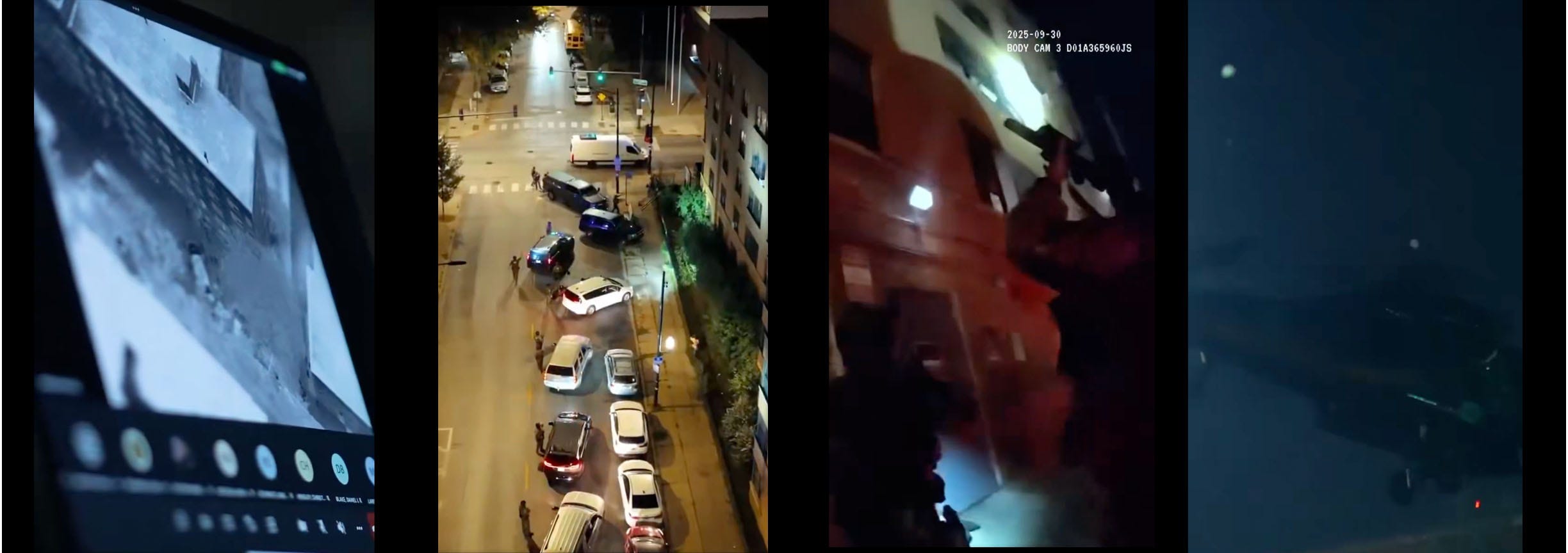
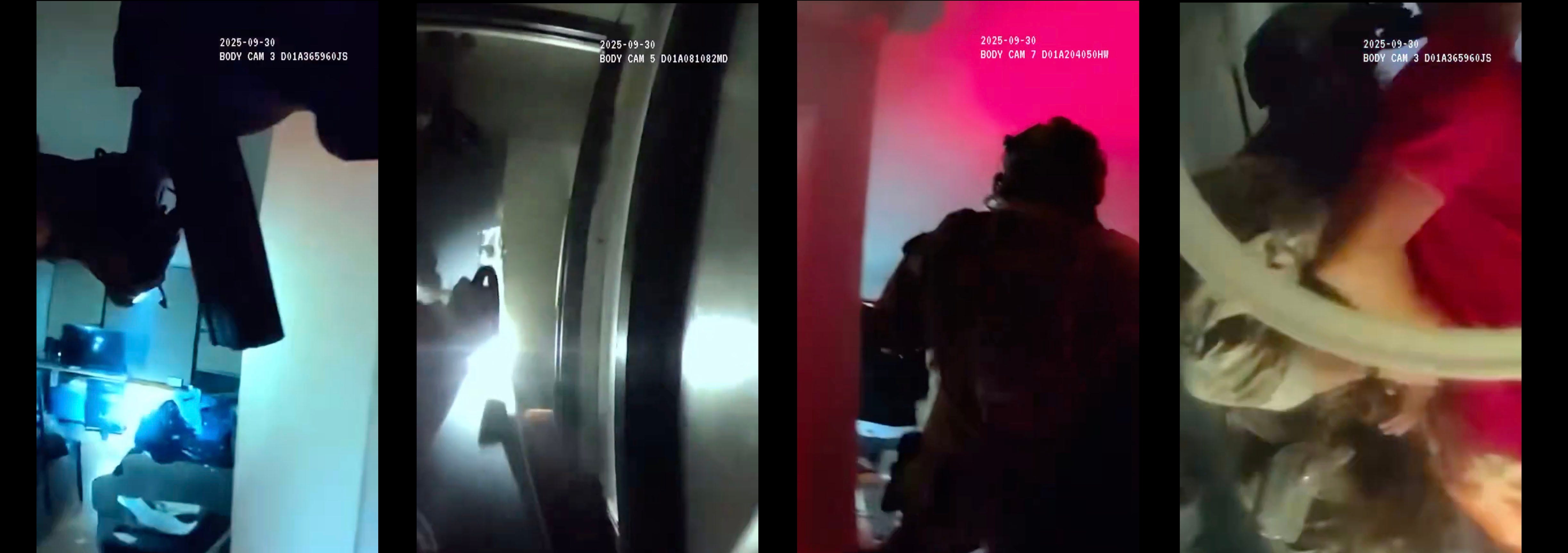
Here are some screenshots of the raid, which I encourage you to look at carefully:
It was all true: the Black Hawk helicopters, the dudes in military gear rappelling down, the mass arrests, the doors being broken down, the zip-ties, the public humiliation. In the video, DHS shows the faces of the men the ICE agents arrested, which no doubt will help their defense attorneys (assuming they are granted access to defense attorneys—no longer a safe assumption with Stephen Miller in charge).
But the damage has already been done.
I mean, little children were among those herded out of the apartments. Some of those children had theirhands zip-tied, too—by grown men decked out in enough military gear to occupy Fallujah.
And when a woman—an American citizen, not in any way affiliated with a gang, guilty of nothing more than living in Chicago, a city Trump hates because Obama’s from there—called out the ICE agents on their egregious lack of humanity, she was given the dismissive three-word response:
Fuck them kids.
The Trump regime has crossed yet another Rubicon. Now, the government can break down the front door of your house, drag you out of bed, zip-tie your hands behind your back, herd you into a van, and leave you there for hours and hours, without cause, without Miranda rights, without charge.
This is not fear-mongering. This is not speculation about what the Trump regime might do. This is happening. This has already happened. Here, in America. Nine months into the Trump Redux, and right on schedule, the fascist baby has been born.
Reading about this expression of brutal state tyranny, I was reminded of a passage in Defying Hitler, the Sebastian Haffner memoir about 1933 Germany:
The internal process was repressive terror: cold, calculated, official orders, directed by the state and carried out under the full protection of the police and the armed forces. It did not take place in the excitement following a victorious battle or danger successfully overcome — nothing of the kind had happened. Nor was it an act of revenge for atrocities committed by the other side — there had been none. What happened was a nightmarish reversal of normal circumstances: robbers and murderers acting as the police force, enjoying the full panoply of state power, their victims treated as criminals, proscribed and condemned to death in advance.
What we are seeing in Chicago the past 24 hours is a mere prelude. The official numbers of agents is nothing compared to the prisoners private contractors are releasing to kidnap, disappear and kill their fellow Americans. This suggests the covered faces are less about protecting the contractors and more about hiding from the public that prisoners are being used for this. Armed and set loose upon their fellow denizens on our streets.
This has yet to be confirmed by other news sources—but are other news sources, all of them owned by MAGA oligarchs, even interested at this point?
Plus, I mean, does it seem implausible? It’s clear ICE is staffed by poorly-trained, undisciplined, out-of-shape dipshits who barely know how to use their weapons. These losers have to come from somewhere.
But back to 1933 Germany. Haffner continues:
An example that became public knowledge because of its scale occurred some months later in the Cöpenick area of Berlin, where a Social Democratic trade unionist defended himself, with the help of his sons, against an SA patrol that broke into his home at night to “arrest” him. In obvious self-defense he shot two SA men. As a result, he and his sons were overcome by a larger troop of SA men and hanged in a shed in the yard that same night. The next day, the SA patrols appeared in Cöpenick, in disciplined order, entered the homes of every known Social Democrat, and killed them on the spot. The exact number of deaths was never made public.
Reading about masked men breaking down doors in the middle of the night and terrorizing an entire apartment complex, the Nazi-executed Social Democratic trade unionist is what sprung to mind.
Then they came for the trade unionists And I did not speak out Because I was not a trade unionist
This is the path we’re headed down—and it is paved with the skulls of the dead.
Fuck them kids.
It occurred to me that those three words perfectly sum up the priorities of Donald Trump and the soulless ghouls running his administration: RFK, Jr., Stephen Miller, Kristi Noem, Russ Vought, and so on. Indeed, FUCK THEM KIDS might as well be Trump’s 2028 campaign slogan.
Those three words will, I hope, be (figuratively) seared onto the forehead of every member of this MAGA Nazi administration, like Aldo Raine carving up swastikas in Inglorious Basterds.
Herd immunity means that enough people in a group or area have achieved immunity (protection) against a virus or other infectious agent to make it very difficult for the infection to spread. Immunity happens in multiple ways: through natural infection, vaccination or passive transfer. Vaccination is the best way.
Every person who has immunity makes it harder for the infection to spread to other people. If you’re vaccinated, it’ll be harder for the virus to use you to infect other people or to mutate into a new variant. Higher numbers of immune people are needed to stop the spread if a virus is very infectious.
To achieve herd immunity, studies show, 95 percent of a given population must be vaccinated. But since Trump’s first term, vax rates have been declining.
“During the 2024-2025 school year, vaccination coverage among kindergartners in the U.S. decreased for all reported vaccines from the year before,” reads a report by the CDC, “ranging from 92.1% for diphtheria, tetanus, and acellular pertussis vaccine (DTaP) to 92.5% for measles, mumps, and rubella vaccine (MMR) and polio vaccine.”
Ninety-two seems like a high number—but it’s not high enough for herd immunity. In many communities, especially in rural areas and in red states, where MAGA disinformation is most effective, communities are no longer protected from the scourge of long-conquered childhood diseases.
And that was before Trump put the deranged, whale-beheading gourd husk known as RFK, Jr. in charge of the country’s public health policy.
Bobby is an antivaxxer. He’s already contributed to the 2019 measles outbreak in Samoa, where 83 people, most of them young children, died (in a country with a population of 200,000 people), when he traveled there and stoked antivax hysteria, with his prestigious Kennedy name and his noxious Kremlin talking points.
In a related story, Donald and Bobby have Made Measles Great Again. Per the CDC:
As of September 30, 2025, there have been a total of 1,544 confirmed measles cases reported in the United States. Among these, 1,523 measles cases were reported by 42 jurisdictions: Alabama, Alaska, Arizona, Arkansas, California, Colorado, Florida, Georgia, Hawaii, Idaho, Illinois, Indiana, Iowa, Kansas, Kentucky, Louisiana, Maryland, Michigan, Minnesota, Missouri, Montana, Nebraska, New Jersey, New Mexico, New York City, New York State, North Dakota, Ohio, Oklahoma, Oregon, Pennsylvania, Rhode Island, South Carolina, South Dakota, Tennessee, Texas, Utah, Vermont, Virginia, Washington, Wisconsin, and Wyoming. A total of 21 measles cases were reported among international visitors to the U.S.
There have been 42 outbreaks reported in 2025, and 86% of confirmed cases (1,333 of 1,544) are outbreak-associated. For comparison, 16 outbreaks were reported during 2024 and 69% of cases (198 of 285) were outbreak-associated.
These outbreaks will only get worse, as the federal government continues to adopt antivax positions. South Carolina is only the latest state to have a measles outbreak.
This is a lot of data, I realize. A lot of statistics and numbers. But all you really need to know is this: In 2000, the World Health Organization declared that measles was eliminated in the United States—because of the success of the vaccines. Twenty-five years later, little children are once again dying of it.
In the post at 9 a.m. today, two scholars of racism and equity explained that Trump’s scrubbing of museums, national parks, and other federal facilities is an attempt to capture control of the culture and erase the place of Blacks, women, and anyone else who is not a straight white male.
But, as scholar Julian Vasquez Heilig writes here, Trump and his commissariat cannot control the popular culture. In time, we can hope, his mean-spirited efforts to revise history will become a bad joke, a cruel joke, a stupid joke. He and all those who carry out his orders will become a public laughing stock.
Vasquez Heilig writes on his blog Cloaking Inequity:
The Super Bowl has always been more than football. It is a ritual, a spectacle, a national performance. It’s where America tells the world who it thinks it is, and who it wants to be. Which is why the announcement that Bad Bunny will host the halftime show is far more significant than a musical lineup change. It’s a cultural earthquake.
I remember the first time I heard Bad Bunny. It was December 6, 2019, at La Concha Hotel in San Juan. In the downstairs lounge, the beat of reggaetón was shaking the walls, and I pulled out Shazam to figure out what it was. The song was Vete. The room was electric, filled with Puerto Ricans singing every word in Spanish, unapologetically themselves. That night, it hit me: Bad Bunny was not just making music in San Juan, he was celebrating culture. He wasn’t crossing over into the mainstream by adapting; he was dragging the mainstream toward him. He refused to translate, refused to dilute, and now he is everywhere—on playlists, on charts, SNL, in crowded places from San Juan to New York to Madrid.
That’s why his Super Bowl moment matters so much. It is not just a performance, it is the culmination of a global movement that began in places like that basement lounge in Puerto Rico. What felt local then is now universal. Bad Bunny’s rise shows how culture flows upward, from the margins to the center, from overlooked communities to the biggest stage in the world. For millions of us, this is affirmation. For the right wing, it is destabilization. Because when the halftime show belongs to Bad Bunny, it proves that America is no longer just what they imagine it to be. It is bigger, louder, and more diverse than great again nostalgia can contain.
Jay-Z, Kendrick Lamar, and the New Halftime Era
The NFL’s halftime choices haven’t shifted by accident. When the league came under fire for its treatment of Colin Kaepernick and broader criticisms about racial injustice, it needed credibility. Enter Jay-Z and Roc Nation. The NFL tapped him to advise and help curate halftime shows.
The results have been undeniable. Kendrick Lamar’s halftime performance last year was a watershed moment—unapologetically Black, politically charged, and culturally defining. That performance sparked widespread discussion, and even a blog post I wrote about it entitled “TV Off”: What Kendrick Lamar Was Really Saying at the Super Bowl drew more than 100,000 readers in just a few days. Clearly, the hunger to talk about representation and ownership of the halftime stage is real.
Now with Bad Bunny taking the baton, the NFL is making another cultural statement, whether it fully realizes it or not (I think it does). The league’s biggest platform is no longer reserved for the safe, predictable acts of yesterday. It’s becoming a stage where hip hop, reggaeton, and the voices of communities once marginalized are front and center.
Bad Bunny and the Right’s Panic
For decades, the halftime show was dominated by choices that reinforced a narrow image of America: classic rock icons, country stars, or pop acts who wouldn’t ruffle feathers but had wardrobe malfunctions. Bad Bunny shatters that mold. His performance won’t be a side act, it is the show. Spanish won’t be a novelty; it will be central.
This is exactly why the right wing panics. To them, football Sundays and Super Bowls have long been “their” cultural territory. They’ve wrapped the game in patriotic rituals, military flyovers, and moments of silence for conservative heroes. When someone like Bad Bunny steps into the spotlight, it disrupts their monopoly. It forces a new definition of America—one that is multilingual, multicultural, and undeniably Latino. That’s what makes his halftime role so radical: after focusing on the Black experience with Kendrick, this year signals that Latino identity is no longer peripheral. It’s woven into the fabric of America’s biggest stage.
Why ICE Wants to Loom Over the Moment
It might sound absurd that ICE wants to connect itself to the Super Bowl halftime show, but immigration enforcement has always thrived in the shadows of visibility. When Latino joy and success are celebrated so publicly, ICE apparently feels the need to remind America of its terrorizing power.
Bad Bunny performing at the Super Bowl is a triumph of belonging. But ICE’s assaults, raids, arrests, kangaroo courts, and deportations are constant reminders that belonging is conditional on politics. While millions watch a Puerto Rican superstar, ICE agents are throwing mothers and journalists to the ground, spraying pepper liquid into the eyes of Americans who dare to ask questions, arresting elected politicians at the behest of Washington politicians after turning off their body cameras, and authorized by the Supreme Court to detain people simply for looking Latino and poor.
The contradiction is sharp: on the world’s stage, Latino identity is being widely celebrated; on America’s streets, it’s criminalized. ICE doesn’t need to show up at the stadium—it already shows up in our daily life. Its existence ensures that even at moments of cultural triumph, there’s a purposeful shadow of fear and terroristic threats.
Danica Patrick’s Tone-Deaf Criticism
And then, inevitably, a silly critic emerges from the sidelines. This time it’s Danica Patrick, who dismissed Bad Bunny’s hosting role. Her comments were more than unhelpful, they were stupid.
Patrick should know better. She carved her own career by getting along in a male-dominated sport, where every step forward was a battle for representation. She knows the symbolic weight of breaking barriers. For her to turn around and mock or diminish Bad Bunny’s presence is hypocritical at best, willfully ignorant at worst.
Bad Bunny isn’t there to tick a diversity box, he’s there because he is one of the most influential artists alive— maybe THE most. The incredible success of his shows that he did for his most recent album this past summer ONLY in Puerto Rico is proof that the center of American culture is shifting. Criticizing that isn’t just a matter of taste. It’s a refusal to accept reality.
The Lions, Charlie Kirk, and Who Gets Tribute
The battle over cultural ownership in America doesn’t stop at the Super Bowl. It plays out every Sunday on the NFL field. When conservative commentator Charlie Kirk was assassinated, the league encouraged teams to hold moments of silence in his honor. Most complied. But the Detroit Lions, along with a few other teams, did not.
That decision matters. It was a quiet but deliberate act of boundary-setting, a refusal to let every NFL broadcast become a political ritual sanctifying right-wing political ideology. By declining the tribute, the Lions reminded us that not every form of patriotism must come prepackaged with conservative allegiance. It wasn’t loud or defiant. It was subtle and deeply symbolic. Sometimes resistance isn’t what you do, it’s what you decline to perform and participate.
The Lions’ restraint connects to the same cultural realignment symbolized by Bad Bunny’s Super Bowl performance. Both moments reject the idea that American culture belongs to a single tribe. They push back against the notion that sports, music, or patriotism must orbit one political pole. They insist, instead, that culture belongs to everyone, not just the loudest or the angriest voices claiming to defend it.
The Double Standard of Protest
Of course, this tension between culture, power, and dissent has long been visible in the NFL. When Colin Kaepernick knelt during the national anthem to protest police brutality, he was branded a traitor by many of the same voices now demanding “respect” for Charlie Kirk. His silent, dignified act of conscience was recast as an attack on America itself.
The outrage was never really about the flag. It was about control. It was about who is allowed to define what counts as “patriotic.” Kaepernick’s kneeling was an act of moral courage, but it exposed how fragile America’s cultural gatekeepers truly are when confronted with truth. They could not tolerate a protest that revealed their own comfort with injustice and brutality.
Meanwhile, state violence continues daily without the same moral outrage from the right-wing. ICE officers violently throw mothers and journalists to the ground without cause. They pepper-spray citizens in their eyeballs for daring to ask questions in a conversation. They arrest and detain American citizens in raids not for crimes but for looking poor, brown, or foreign. These acts have not provoked right-wing primetime outrage or public boycotts. Their hypocrisy is staggering.
A man kneeling quietly for justice was vilified. Agents brutalizing families are ignored. The problem has never been the method of protest, it has always been their morality. Silence in the face of injustice is acceptable; silence against injustice is not. The Lions’ quiet refusal and Kaepernick’s quiet protest share something profound: both disrupted the script of cultural obedience. Both reminded us that resistance isn’t always loud. Sometimes it’s the refusal to play along.
The Supreme Court’s Enabling Role
And looming behind all of this is the judiciary. Recent Supreme Court rulings have expanded law enforcement’s power, narrowing protections under the Fourth Amendment and giving politicians more leeway to persecute immigrants using federal data. Justice Brett Kavanaugh has been the lead in the right-wing judicial majorities that have handed law enforcement broad authority to stop, question, and detain anyone with minimal cause. Its new rulings have created the legal cover that now makes racial profiling essentially legal.
Racial profiling has happen illegally before and the new legal result empowered by the Supreme Court is the same: citizens living under suspicion, families living in fear, communities targeted not for what they’ve done but for how they look. The Supreme Court has enabled ICE brutality in the same way NFL owners enabled the blackballing of dissent, by creating structures that justify exclusion and violence while insisting neutrality.
The Bigger Picture: Who Owns the Stage?
So what do Bad Bunny, Kendrick Lamar, Jay-Z, Danica Patrick, ICE, the Lions, Charlie Kirk, and Brett Kavanaugh all have in common? They are all part of the “fight, fight, fight” (see new Trump $1 coin) over who gets to define American culture.
The right wing has long claimed the NFL as its territory: its rituals, its tributes, its symbols of patriotism. But culture evolves. It cannot be contained. From Detroit to San Juan to Los Angeles, new voices are shaping the narrative. Bad Bunny’s halftime show, Kendrick’s explosive performance, and even the Lions’ silent refusal all tell the same story: football does not belong exclusively to one political ideology. Neither does America.
The real question is whether we are willing to see that America’s identity is bigger than its old rituals. Are we willing to admit that inclusion is not a threat but a fact? Because culture doesn’t wait for permission. It claims the stage. And this year, that stage will belong to Bad Bunny.
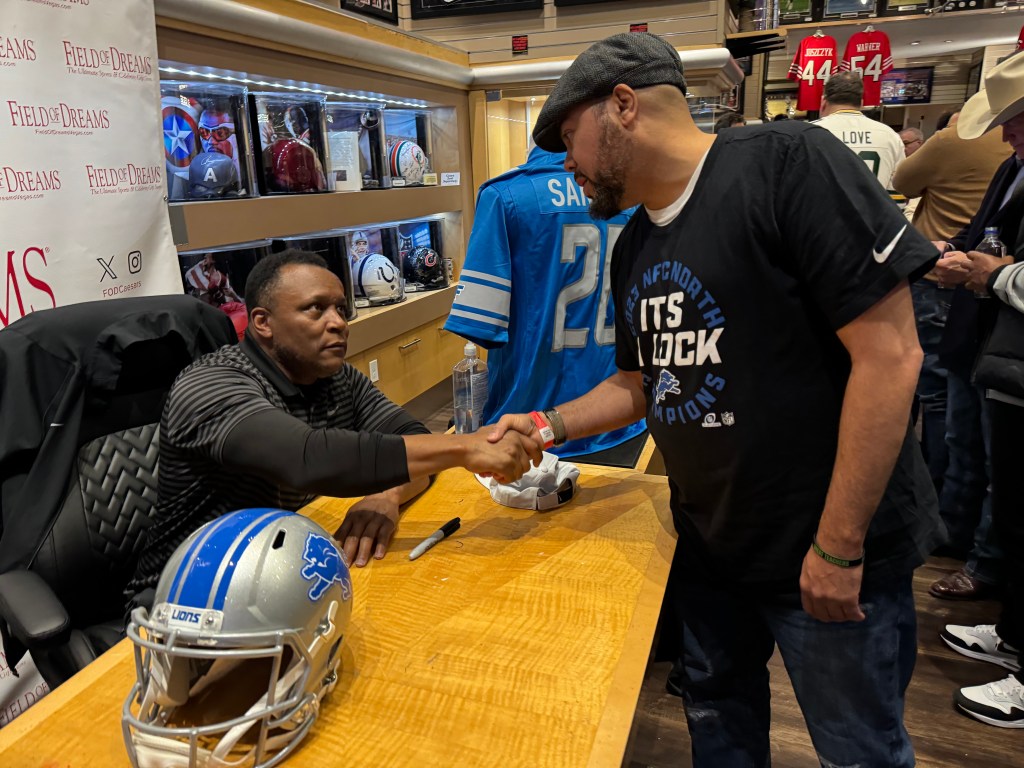
Julian Vasquez Heilig is a professor, writer, and a legit lifelong Detroit Lions fan since 1981. He attended the NFC Championship in San Jose two years ago to support his Cardiac Cats and last year’s playoff loss to the Washington Commanders at Ford Field. He was also at the official Lions partners party during the NFL Draft in Detroit, where he met Robert Porcher and Jason Hanson. Over the years he’s spotted Billy Sims in Times Square, endured the heartbreak of the Lions’ 0–16 season, and treasures his personally autographed Barry Sanders helmet. Beyond education and equity, Julian dabbles in writing about sports, culture, and society.
Nikole Hannah-Jones has had her share of controversy. Born in Iowa to a mixed-race couple, she attended desegregated public schools, graduated from Notre Dame and received a masters in journalism from the University of North Carolina. In her career as an investigative journalist, she covered education, civil rights, and healthcare. She worked at newspapers in North Carolina and Oregon, then for ProPublica. In 2015, she joined the staff of The New York Times.
In 2019, The Times published The 1619 Project, a group of essays that Hannah-Jones assembled, to commemorate the arrival of the first Blacks to the land that would later become the USA. In the lead essay, which Hannah-Jones wrote, she maintained that the arrival of that ship bringing enslaved Blacks marked the true origin of the nation. She recast the history of the U.S. from a Black perspective. Some historians criticized aspects of her thesis, others defended it.
The 1619 Project was widely celebrated and widely condemned, even banned. Trump responded by creating a 1776 Commission, whose purpose was to celebrate US history patriotically (that is, to leave out the shameful parts).
Hannah-Jones won the Pulitzer Prize for The 1619 Project in 2020.
In 2021, the UNC-Chapel Hill’s Hussman School of Journalism and Media announced that Hannah-Jones would join the Hussman faculty as Knight Chair in Race and Investigative Journalism. The faculty and administration urged the UNC Board to give her tenure, as was customary with previous holders of the chair. However, the Board of the university refused to take action on this tenure recommendation. After a public uproar, the board of trustees offered her tenure, but Hannah-Jones rejected the offer, choosing instead to accept the offer of a chair at Howard University.
She wrote in the New York Times about the mainstreaming of Charlie Kirk’s bigoted views after his tragic assassination. This is an except from her excellent commentary.
Last year, The Washington Examiner, a conservative news outlet, published a column calling the organization Kirk co-founded, Turning Point USA, “one of the most destructive forces in Republican politics.” It said that “a healthy conservative movement cannot tolerate conspiracy theorists being presented as serious political figures” and called the organization’s leadership “toxic.” But the period since Kirk’s death has revealed a deeply unsettling cultural shift. Eight months into President Trump’s second term, it is clear that Kirk’s ideas are no longer considered on the extremist periphery but are embraced by Republican leadership.
The mainstreaming of Charlie Kirk demonstrates that espousing open and explicit bigotry no longer relegates one to the fringe of political discourse.
When Representative Jasmine Crockett, Democrat of Texas, bemoaned that only two of the 58 Democrats who refused to sign the resolution honoring Kirk were white, Laura Loomer responded on X by railing against “ghetto Black bitches who hate America serving in Congress.” Loomer is not merely some right-wing provocateur. She has the ear of the president of the United States and understood that such an explicitly racist comment in 2025 America would bring no political consequence.
And while Trump has surrounded himself with people who have said racist things and maintained ties to white and Christian nationalists, the number of Democrats and esteemed American institutions that have engaged in the mainstreaming of Charlie Kirk demonstrates that espousing open and explicit bigotry no longer relegates one to the fringe of political discourse, a phenomenon we have not witnessed since the civil rights era.
In some parts of polite society, it now holds that if many of Kirk’s views were repugnant, his willingness to calmly argue about them and his insistence that people hash out their disagreements through discourse at a time of such division made him a free-speech advocate, and an exemplar of how we should engage politically across difference. But for those who were directly targeted by Kirk’s rhetoric, this thinking seems to place the civility of Kirk’s style of argument over the incivility of what he argued. Through gossamer tributes, Kirk’s cruel condemnation of transgender people and his racist throwback views about Black Americans were no longer anathema but instead are being treated as just another political view to be respectfully debated — like a position on tax rates or health care policy.
Using Kirk’s knack for vigorous argument to excuse the re-emergence of unabashed bigotry in mainstream politics feels both frightening and perilous.
As the Trump administration wages the broadest attack on civil rights in a century, and the shared societal values of multiculturalism and tolerance recede, using Kirk’s knack for vigorous argument to excuse the re-emergence of unabashed bigotry in mainstream politics feels both frightening and perilous. Kirk certainly produced viral moments by showing up on college campuses and inviting students a decade his junior to “prove” him wrong about a range of controversial topics such as Black crime rates and the pitfalls of feminism. But his rise to fame was predicated on the organization for which he served as executive director, Turning Point USA, and its Professor Watchlist. The website invited college students not to engage in robust discussions with others with different ideologies, but to report professors who “advance leftist propaganda in the classroom.”
The site includes photos of professors, along with often highly misleading summaries of the thought crimes that landed them on the list. It provides the telephone numbers of the universities that employ them for students and parents to register their complaints. While the site claims the organization supports free speech, many professors have recounted enduring campaigns of harassment after being put on the list. (I was placed on it in 2021 because of my work on the 1619 Project, after it was announced that I would be a professor at Howard University.)
A couple of years ago, Angel Jones, now a professor at a university in Maryland whose work focuses on educational inequality, joined the hundreds of professors across the country who found themselves on the list.
Jones landed on it under the tag “racial ideology” when she published an article citing research about how distressing it is for Black people to go to work after witnessing news coverage of police killings. She told me someone had sent her a picture of a house thought to be hers, but it turned out to belong to another Angel Jones. Someone else had threatened to hang her from a tree and burn her alive. The scholar changed her classroom and removed her name plate from her office door. The university where she was working at the time installed a safety alarm button under her desk.
“I would cry. I was very fearful. I was anxious,” Jones told me. “I was afraid to go to class sometimes. I was just scared all of the time.
“I love teaching — it makes my heart go pitter patter — so to be in a space where I am afraid of my students, like that rocks me in a way I can’t even articulate,” she added.
When Jones learned of Kirk’s killing, she remembers that there was a sense of disbelief shared by many Americans who were shocked by the gruesome video. But soon, that disbelief was replaced by another feeling. In the immediate hours after his death, she watched as pundits and politicians eulogized Kirk as that rare example of someone who practiced a willingness to hear opposing ideas because he saw it as thesalve for political violence. After all she’d gone through, and the stories she’d heard of other professors similarly harassed, the tributes pouring in for Kirk both infuriated and saddened her.
The next day, Jones went to the class she taught on misinformation and disinformation and showed her students a short Instagram video she had made in response. In the video, she says that while she does not celebrate Kirk’s death, she also refuses to mourn him. “I cannot have empathy for him losing his life when he put mine at risk and the lives of so many other educators just because we dared to advocate for social justice,” she says in the video, “because we dared to do our jobs.”
After she showed the video, a white male student in her class asked Jones if she thought her lack of empathy for Kirk might radicalize students. After a short, tense exchange, the student took his backpack and left. Jones said it had made her nervous. There’s a Turning Point USA chapter on her campus, and Kirk’s followers and even some politicians had been posting about revenge on social media. Jones switched her classes to virtual for the week.
The past few weeks have filled Ash Lazarus Orr with a similar sense of foreboding. Orr has been at the forefront of resisting efforts to target transgender Americans, including as a plaintiff in a federal lawsuit brought by the A.C.L.U. against a Trump administration policy that would prevent transgender people from having their chosen gender on their passports.
While Orr was never named by Kirk, they say Kirk’s rhetoric helped fuel an environment that makes transgender Americans vulnerable to violence and that has paved the way for the removal of their civil rights; in February, Iowa became the first state in the country to take away legal civil rights protections for transgender residents.
“I firmly believe that no one should be killed for their beliefs, no matter how harmful those beliefs might be,” Orr told me. “But we are watching our rights being stripped away. We are having our friends’ lives cut short, and then we are told to stay quiet while those responsible are celebrated.”
In just a few short years, Orr has watched as the momentum toward recognizing the full humanity and rights of transgender people has collapsed. Orr recently left their home state of West Virginia, finding it no longer safe after being threatened and assaulted.
Kirk’s rhetoric of “Christian white nationalism, anti-transgender, quote anti-woke culture-war framing, this isn’t on the edge anymore,” Orr told me. “It has moved into what many consider the center of Republican identity.” They said they were deeply concerned about how few people seemed willing to point out the consequences of this shift: “Who is actually fighting for us?”
Robin D.G. Kelley, a historian at U.C.L.A. whose scholarship on racial injustice also landed him on the Professor Watchlist, is struck by how rapidly our society has changed since Trump took office a second time.
Kelley pointed to the fact that Trump was widely condemned during his first term when he called the white supremacists who rallied in Charlottesville, Va., “very fine people.” Now, Democrats and political centrists were lining up to honor a man who promoted the same Great Replacement Theory that served as the rallying cry for that march. At a time when the president of the United States is using his power to go after diversity efforts and engaging in a mass deportation project, some progressives are arguing that people of color, immigrants and members of other marginalized groups who felt dehumanized by Kirk’s commentary, podcasts and debates have to find a way to locate common ground with his followers.
“There has been an extreme shift,” Kelley told me. “This treatment is authorizing the idea that white supremacy and racism is not just a conservative idea, but a legitimate one.”
This is nuts. With federal funding, Harvard scientists have produced major breakthroughs in medicine, engineering, and science. To break Harvard, as the administration wants to do, would cripple American innovation.
The Boston Globe reported:
The Department of Health and Human Services’ Office of Civil Rights on Monday formally recommended barring Harvard University from receiving federal funding, three months after it accused the university of violating civil rights laws by failing to protect Jewish and Israeli students on campus.
In a news release, the office said it would refer Harvard to the office that is responsible for “suspension and debarment decisions” and that it notified Harvard of its right to an administrative hearing. The university has 20 days to notify the office of its decision.…
The 57-page notice relied heavily upon Harvard’s own report on antisemitism and anti-Israeli bias that it released earlier this year, which followed high-profile protests at Harvard and other campuses against the war in Gaza in 2023 and 2024.
The Trump administration’s move this week to choke off Harvard University’s access to future federal funding came after a scathing letter from the college accusing the administration of distorting evidence to show that the school violated civil rights laws by allowing antisemitism to persist on campus.
The brewing feud represents an escalation of tensions between Harvard and the administration, which just weeks ago seemed on the verge of agreeing on a deal to keep federal funds flowing to the university.
In a strongly worded, 163-page letter with attachments on Sept. 19, which has not been previously reported, Harvard assailed the government’s findings. The university accused investigators at the Health and Human Services Department of relying on “inaccurate and incomplete facts,” failing to meet a single legal requirement to prove discrimination and drawing sweeping conclusions from a survey of one-half of 1 percent of the student body.
Harvard painted a picture of a chaotic Trump administration rushing to leverage federal power against the university. For instance, it noted that the health department had chided the college for failing to produce certain records. But Harvard’s documents showed that the records in question had been provided in response to a request from the Education Department. Harvard said the health department never asked for those records.
Harvard said the health department’s decision to refer its findings to the Justice Department was “based on a fabricated and distorted interpretation of the record.”
The stark language was a departure from months of mostly measured tones from Harvard as the university has resisted the administration’s pressure campaign to impose President Trump’s political agenda on the nation’s elite colleges.
Mr. Trump and his administration have sought to exert control over who universities can hire, which students they should admit and what subjects should be taught by leveraging huge sums of federal research money. Those moves, which Harvard has maintained violate the college’s First Amendment rights and infringe on the nation’s long-held ideals of academic freedom, are aimed at shifting the ideological tilt of the higher education system, which the administration sees as hostile to conservatives and intent on perpetuating liberalism.
The administration’s reply to Harvard’s letter came on Monday, when the health department initiated a process to cut off Harvard from future federal research funding, which has increasingly become the lifeblood for the nation’s largest private and public colleges. In 2022, the health department accounted for nearly 81 percentof $41.6 billion in federal funding for research into agricultural science, environmental science, public health and other life sciences, according to government records.
President Trump said Tuesday that his administration was close to reaching a multimillion-dollar agreement with Harvard University, which would end a monthslong standoff that had come to symbolize the resistance to the White House’s efforts to reshape higher education.
Harvard, which would become the latest university to strike a deal with the Trump administration, has been seeking an end to a thicket of investigations that the government opened as part of its wide-ranging efforts to bring the university in line with Mr. Trump’s agenda.
“We are in the process of getting very close,” President Trump said in an appearance from the Oval Office. He added that the details were being finalized and said, “They would be paying about $500 million.”
Mr. Trump said that the education secretary, Linda McMahon, was “finishing up the final details.” He added that the plan was for Harvard to operate trade schools.
“They are going be teaching people to do A.I. and a lot of other things — engines, lots of things,” he said. “We need people in trade schools.”



 Diane Ravitch's blog