Archives for category: Censorship

Vermont, a traditionally liberal state, has a moderate (non-MAGA) Republican governor, Phil Scott, and a Democratic-controlled legislature. Governor Scott appointed Zoie Saunders as Education Secretary. When the U.S. Department of Education recently directed every state to certify that it had banned DEI programs (diversity, equity, and inclusion) programs, Saunders asked the state’s districts to comply. Instead, she faced a widespread revolt by the state’s education organizations, and she issued a new directive, revoking her earlier request for compliance.

Ethan Weinstein of the VtDigger reported:

But just three days later, after initially defending and clarifying the decision in the face of public backlash, Education Secretary Zoie Saunders backtracked late Monday afternoon, informing superintendents the state would instead send a single statewide certification. 

“To be clear, the Agency of Education and the Attorney General’s Office continue to support diversity, equity, and inclusion practices in our schools. Our communication on Friday was intended to make you aware of the directive from the U.S. Department of Education regarding Title VI,” Saunders wrote Monday afternoon, “and to reinforce that diversity, equity, and inclusion practices are lawful and supported in Vermont. In no way, did AOE direct schools to ban DEI.”

So why all the confusion? 

On Friday, Saunders told school district leaders they had 10 days to submit their certification, but also said the agency believed certification required only that districts “reaffirm … compliance with existing law.”

That communication came in response to President Donald Trump and his administration, who have threatened to withhold funding to public schools that fail to comply with the expansive directive. 

A letter dated April 3 from the U.S. Department of Education said noncompliance with the diversity programming ban could result in schools losing a crucial stream of money meant to support economically disadvantaged students, known as Title I, among other sources of federal dollars. The letter cited Title VI of the Civil Rights Act of 1964, which prohibits discrimination in schools based on “race, color or national origin,” and also cited a 2023 U.S. Supreme Court Case against Harvard University and the University of North Carolina that restricted affirmative action. 

Saunders, in the letter to district leaders, wrote that the federal restriction includes “policies or programs under any name that treat students differently based on race, engage in racial stereotyping, or create hostile environments for students of particular races.”

Programs highlighting specific cultures or heritages “would not in and of themselves” violate federal regulations, the letter said. “We do not view this Certification to be announcing any new interpretation of Title VI,” Saunders wrote, adding that the agency’s “initial legal review” determined the federal letter only required the state to “reaffirm our compliance with existing law.”

But guidance from the federal education department cited by Saunders seems to restrict a variety of practices, arguing that school districts have “veil(ed) discriminatory policies” under initiatives like diversity programming, “social-emotional learning” and “culturally responsive” teaching. 

Following news of the agency’s letter to districts, Saunders released an initial public statement around 3 p.m. on Monday saying the federal demands would not require Vermont’s schools to change practices. And in that communication, Vermont’s top education official gave no indication the agency would alter its request for districts to confirm their compliance with Trump’s directive.

“The political rhetoric around this federal directive is designed to create outrage in our communities, confusion in our schools, and self-censorship in our policy making. But we are not going to allow the chaos to control how we feel, or how we respond,” Saunders said in the statement. “Our priority is to protect Vermont’s values, preserve essential federal funding, and support schools in creating positive school environments free from the type of bullying and manipulation we see in our national politics today.” 

In the same press release, Vermont Attorney General Charity Clark said Vermont was in compliance with federal law.

“We will continue to protect Vermonters against any unlawful actions by the federal government,” Clark said.

One neighboring state, meanwhile, took a different tack. Soon after the Trump administration sent states last week’s letter, New York announced it would not comply. 

Vermont and other states’ responses to the federal government are due April 14, and the state agency said last week that its response was supposed to include school districts’ “compliance issues” and “the Agency’s proposed enforcement plans” for those districts. 

Before Saunders, in consultation with Clark, decided to rescind the state’s request for districts’ certifications, the Agency of Education’s actions drew criticism from the public education community. 

Representatives from the Vermont School Boards Association, Vermont Principals’ Association, Vermont Superintendents Association and Vermont-NEA, the state teachers’ union, met with state leaders Monday. They later penned a letter to Saunders and Clark calling Vermont’s approach to the federal directive “not workable.”

“Expecting individual superintendents to certify compliance based on a cover letter (that they have not yet seen) that clarifies the legal boundaries of their certification will lead to a patchwork of responses that could put Vermont and local school districts at risk,” the organizations wrote. 

The coalition urged Vermont to follow New York’s lead and reject the certification process. That strong approach, they wrote, “would also send a powerful message to students and families across the state.”

Hours later, the Agency of Education appeared to heed their advice. In her late afternoon message to superintendents, Saunders wrote that “AOE has received feedback throughout the day regarding the need for clarity on the intent of the certification and the state’s specific response.”

“We understand that many in the community are concerned because of the political rhetoric surrounding DEI,” she added. 

News of Saunders’ initial Friday letter spread quickly on social media over the weekend. Already, plans for a Wednesday protest had circulated online.  

At least one district, Winooski, said it wouldn’t comply with the certification.

“I notified the Secretary that I will not be signing anything,” Wilmer Chavarria, the district’s superintendent, wrote in an email to staff shared with VTDigger. “I also requested that the state grow some courage and stop complying so quickly and without hesitation to the politically-driven threats of the executive.”

Winooski’s school board will address the compliance certification at a regularly scheduled board meeting Wednesday, according to Chavarria’s message. 

In Vermont, ethnic studies have been a larger part of the education landscape since the passage of Act 1 in 2019. The law, which the Legislature approved unanimously and Gov. Phil Scott signed, required public schools to incorporate ethnic studies into their curricula. The legislation charged a panel with making suggestions for better including the history and contributions of underrepresented groups in Vermont’s classrooms.

Correction: A previous version of this story attributed a quote directly to Charity Clark that was in fact a statement released by the Vermont Agency of Education and Vermont Attorney General’s Office.

Following a federal directive that schools ban “illegal” diversity, equity and inclusion-related programs, the Vermont Agency of Education last Friday asked school districts to submit compliance certifications. 

Neal Goswami, Acting Editor-in-Chief, VTDigger

Ethan Weinstein

VTDigger’s state government and politics reporter. More by Ethan Weinstein

Jennifer Berkshire has been writing insightfully about the rightwing attacks on public schools and on education for many years. She has written for national magazines and collaborated with education historian Jack Schneider to create a podcast “Have You Heard?”) and to write two excellent books: A Wolf at the Schoolhouse Door and The Education Wars (which is also the title of her blog).

This post is the first of two that “connects the dots.” I am posting them together as they provide an excellent critique of the logic of today’s education policy changes. She explains the Republican animus towards public schools and education and their desire to eliminate the U.S. Departnent of Education.

She writes:

If you read the coverage regarding this week’s ‘bloodbath’ at the Deparment of Education, there is little sense to be made of the savage layoffs and shuttering of whole units. In reports like this one, this one, and this particularly half-baked take, the general tone is a sort of ‘how could this be happening?’ bafflement. But there is a brutal logic to rendering much of the Department inoperable. Since Trump’s first term, the intellectual architects of Trumpism have been laying the groundwork for what is essentially a roll-back of the modern civil rights era. In other words, we don’t have to speculate wildly about what these folks are up to because they’ve been telling us non-stop for the past six years. We need to pay attention.

They’re kneecapping the knowledge agencies

If it feels like DOGE is devoting a disproportionate amount of effort to dismantling agencies and departments that create, distribute, and legitimize knowledge, that’s because it’s true. A fascinating new analysis of DOGE layoffs finds that so-called knowledge agencies have borne the brunt of the chainsaw. This has nothing to do with ‘efficiency’ but instead reflects the belief of influential thinkers in the Trump-o-sphere that these are precisely the agencies and departments that have been captured by the woke mind virus and require elimination.

If you’ve managed to make it this far without encountering the ‘insights’ of Curtis Yarvin aka Mencious Moldbug, congratulations. But Yarvin’s argument that democracy is over, and that we’d be better served by a technocratic monarch, has found favor with the likes of JD Vance; its Yarvin’s case for demolishing ‘the cathedral,’ the knowledge institutions at the heart of modern life, that we’re living through right now.

The goal is to send fewer kids to college.

The AP posted a panicked story this week about the student loan website crashing in the wake of the ED layoffs. Make it too onerous for students to access information about paying for college, the story implied, and they just might give up and stay home. To which some high-profile Trump ‘intellectuals’ might respond: ‘good!’ In an interview with the Wall Street Journal last year, activist Christopher Rufo stated that his goal is reduce the number of students who attend college by half. Scott Yenor, an influential advisor to Ron DeSantis, wants to see the number reduced to less than 10 percent, and has argued repeatedly that too many women attend college. Various GOP proposals, meanwhile, could reduce the volume of student loans by one third.
The idea that we’d make it harder and more expensive for kids to attend college after a few decades of ‘college for all’ thinking may be hard to wrap your head around. But the likes of Rufo and Yenor view this experiment as a collosal failure. In their view, college campuses are filled with students who don’t belong there, representing the sort of social engineering that they’re now determined to unwind. The anti-DEI purges currently remaking campuses reflect the general sentiment on the right these days that colleges, entirely captured by the ‘woke,’ are indoctrinating youngsters. But at the heart of these efforts is an even more retrograde cause: making college elite again.

They believe in natural hierarchies and race science.

The creepiest story I read this week had nothing to do with education but with the effort to rebuild the US semiconductor industry known as the CHIPS program. Employees in the CHIPS program office have been undergoing a now-familiar ritual: demonstrating their intellectual worth and abilities to Trump officials.

In late February, Michael Grimes, a senior official at the Department of Commerce and former investment banker at Morgan Stanley, conducted brief interviews with employees of the CHIPS Program Office, which oversees the grants.

In interactions some described as “demeaning,” Mr. Grimes asked employees to justify their intellect by providing test results from the SAT or an IQ test, said four people familiar with the evaluations. Some were asked to do math problems, like calculate the value of four to the fourth power or long division.

What does demanding IQ or SAT test results from engineers have to do with the dismantling of the Departmet of Education? Everything. If you start from the assumption that IQ is, not just fixed, but genetically determined, as many Trump intellectuals do, there is little case to be made for public schools that try to equalize outcomes—it can’t be done. Far better to shovel cash at the would-be ‘cognitive elite’ (an apt description of vouchers for the well-to-do, when you think about it) than to redistribute resources to the ‘lessers.’ It’s a bleak and brutal view of the world and one that holds increasing sway on the right.

They believe that race-based data powers the ‘civil rights regime’

In his fantastic new book, Dangerous Learning: the South’s Long War on Black Literacy, legal scholar Derek Black argues that a vision of racial equality is woven through education policy. Writes Black: “Education bureaucracy disaggregates every aspect of education by race–from basic attendance, test scores, and graduation rates to suspensions, expulsions, advanced placement opportunities, access to qualified teachers, and more.” But this is precisely why the data collectors have borne the brunt of the DOGE-ing of the Department of Education. 

Read the likes of Richard Hanania, whose argument that ‘woke’ is essentially just civil rights law, inspired Trump’s early executive order rolling back affirmative action in federal hiring, and you get a much clearer picture of what’s happening right now. As Hanania argues, “[g]overnment should not be into the race, sex, and LGBT bean counting business.” His colleague, the afforementioned Scott Yenor, goes even farther. Yenor wants to see states criminalize the collection of data on the basis of race or sex as a challenge to what he describes as “the country’s corrupting ‘civil rights’ regime.” 

So while federally-funded education research may have just been decimated, at least the researchers themselves aren’t being rounded up—yet.

They’re rolling back civil rights

At the heart of the Trumpist intellectual project is a relatively straight-forward argument. The civil rights revolution in this country went too far and it’s time to start rolling it back. As Jack Schneider and I argue in our recent book, The Education Wars, the role that public schools have historically played in advancing civil rights makes them particuarly vulnerable in this moment of intense backlash. It’s why the administration has moved with such ferocity against the most recent effort to extend civil rights through the schools—to transgender students. And it’s why the cuts to the Department of Education have fallen so heavily on its civil rights enforcement role. Of the agency’s civil rights offices across the country, only five are still open.

The OCR is one of the federal government’s largest enforcers of the Civil Rights Act of 1964, investigating thousands of allegations of discrimination each year. That includes discrimination based on disability, race and gender.

Not anymore…

Michael Elsen-Rooney of Chalkbeat reported that New York will not comply with Trump’s demand to ban Diversity, Equity and Inclusion. The Trump Department of Education warned states that refusal to comply might lead to a suspension of federal funding.

The Department’s demand is illegal. Federal law explicitly forbids any interference by federal officials with the curriculum or program of any public school.

Elsen-Rooney wrote:

New York will not comply with an order from President Donald Trump’s administration to certify that school districts are eliminating diversity, equity and inclusion initiatives, state Education Department officials said in a Friday letter obtained by Chalkbeat.

The letter represents some of the earliest and most forceful pushback to Thursday’s threat that gave state education agencies 10 days to guarantee that no public schools in their states have DEI programs the Trump administration deems illegal — or lose billions of dollars in federal education funding.

Federal officials cited the 2023 Supreme Court decision banning race-based affirmative action in college admissions in arguing that any school DEI program used to “advantage one’s race over another” violates federal Title VI of the Civil Rights Act.

But New York officials countered that the state has already certified on multiple occasions that it follows federal anti-discrimination law, and that the U.S. Education Department has no legal right to threaten to withhold federal funding over its own interpretation of the law.

The state Education Department “is unaware of any authority that USDOE has to demand that a State Education Agency … agree to its interpretation of a judicial decision or change the terms and conditions of [New York State Education Department]’s award without formal administrative process,” wrote Counsel and Deputy Commissioner Daniel Morton-Bentley.

“We understand that the current administration seeks to censor anything it deems ‘diversity, equity & inclusion. … But there are no federal or State laws prohibiting the principles of DEI,” Morton-Bentley continued. “And USDOE has yet to define what practices it believes violate Title VI.”

The state will not send any “further certification” of compliance with federal law, the letter concluded.

A spokesperson for the U.S. Department of Education did not immediately respond to a request for comment.

As you know, Trump took control of The Kennedy Center and named himself chairman of the board. He kicked all Democrats off the board and named Trumpers to replace them.

Some artists cancelled, some continued to perform. Trump’s new director, Richard Grennel, canceled the national tour of a children’s show called “Finn,” because it promoted love, kindness, and tolerance.

A band called Guster was performing at The Kennedy Center on March 29, and the band leader talked about the cancellation of “Finn.” Then he invited the cast of “Finn” to join him onstage and the audience went wild.

You have to see this.

I almost cried: tears of joy.

Michael C. Bender reports in The New York Times that the Trump administration is threatening to cancel funding from schools that refuse to eliminate programs or courses that teach DEI. The administration has turned civil rights enforcement upside down and inside out. For decades, civil rights law meant protection of racial minorities and women, who were often targets of discrimination, exclusion, or unfair treatment. This administration worries most about the rights of white students.

Secretary of Education Linda McMahon clearly doesn’t know that federal law prohibits any federal official from interfering with or trying to influence curriculum.

“20 USC 1232a: Prohibition against Federal control of education. Text contains those laws in effect on April 2, 2025

§1232a. Prohibition against Federal control of education

No provision of any applicable program shall be construed to authorize any department, agency, officer, or employee of the United States to exercise any direction, supervision, or control over the curriculum, program of instruction, administration, or personnel of any educational institution, school, or school system, or over the selection of library resources, textbooks, or other printed or published instructional materials by any educational institution or school system, or to require the assignment or transportation of students or teachers in order to overcome racial imbalance.

What Secretary McMahon proposes is illegal.

Bender writes:

The Trump administration threatened on Thursday to withhold federal funding from public schools unless state education officials verified the elimination of all programs that it said unfairly promoted diversity, equity and inclusion.

In a memo sent to top public education officials across the country, the Education Department said that funding for schools with high percentages of low-income students, known as Title I funding, was at risk pending compliance with the administration’s directive.

The memo included a certification letter that state and local school officials must sign and return to the department within 10 days, even as the administration has struggled to define which programs would violate its interpretation of civil rights laws. The move is the latest in a series of Education Department directives aimed at carrying out President Trump’s political agenda in the nation’s schools.

At her confirmation hearing in February, Education Secretary Linda McMahon said schools should be allowed to celebrate the Rev. Dr. Martin Luther King Jr. But she was more circumspect when asked whether classes that focused on Black history ran afoul of Mr. Trump’s agenda and should be banned.

“I’m not quite certain,” Ms. McMahon said, “and I’d like to look into it further.”

More recently, the Education Department said that an “assessment of school policies and programs depends on the facts and circumstances of each case.”

Programs aimed at recognizing historical events and contributions and promoting awareness would not violate the law “so long as they do not engage in racial exclusion or discrimination,” the department wrote.

“However, schools must consider whether any school programming discourages members of all races from attending, either by excluding or discouraging students of a particular race or races, or by creating hostile environments based on race for students who do participate,” the Education Department said.

It also noted that the Justice Department could sue for breach of contract if it found that federal funds were spent while violating civil rights laws.

The federal government accounts for about 8 percent of local school funding, but the amounts vary widely. In Mississippi, for example, about 23 percent of school funding comes from federal sources, while just 7 percent of school funding in New York comes from Washington, according to the Pew Research Center.

“Federal financial assistance is a privilege, not a right,” Craig Trainor, the acting assistant education secretary for civil rights, said in a statement. “When state education commissioners accept federal funds, they agree to abide by federal anti-discrimination requirements.”

When Trump took control of the Smithsonian Institution and its multiple museums yesterday, his executive order pledged to purge the museums of unpatriotic exhibits (WOKE ideology and DEI), the targets of Trump’s rage. Trump gave the job to Vance, who will presumably clean up the nation’s history and make it as inspiring (to white males) as it was before the 1960s.

Remember the halcyon days before the civil rights movement, the women’s rights movement, and other “blemishes” on our national history? Trump does. That’s the story he wants in The Smithsonian: heroes, accomplishments, triumphs! When men were men, and everyone else was in the background.

The Washington Post reported:

President Donald Trump issued an executive order Thursday evening promising to eliminate “divisive narratives” from the Smithsonian Institution’s museums and restore “monuments, memorials, statues, markers” that have been removed over the past five years.

The “Restoring Truth and Sanity to American History” order directs Vice President JD Vance to eliminate what he finds “improper” from the Smithsonian Institution, including its museums, education and research centers, and the National Zoo. The White House fact sheet describing the order said it will focus on removing “anti-American ideology.”

The institution, the official keeper of the American story, has operated independently as a public-private partnership created by an act of Congress in 1846. The order is an unprecedented act to edit an institution that has been expanding over many decades to include a wider, richer and more diverse telling of the nation’s history.

“Over the past decade, Americans have witnessed a concerted and widespread effort to rewrite our Nation’s history, replacing objective facts with a distorted narrative driven by ideology rather than truth,” the executive order says. “This revisionist movement seeks to undermine the remarkable achievements of the United States by casting its founding principles and historical milestones in a negative light.”

Trump’s order calls the museum’s evolving approach a reconstruction of history that is “inherently racist, sexist, oppressive, or otherwise irredeemably flawed.”

Historians were immediately dismayed.
“Attacking the idea that telling the whole story of the United States is an ideological plot to cast the United States in a negative light testifies to a stunningly brittle insecurity about our nation and its past,” said Chandra Manning, a professor of American history at Georgetown University.

“It seems to suggest that if we allow anyone to hear the whole story of challenges that Americans have overcome, our nation will shatter. The American people are not so fragile as all that,” Manning said.

Trump’s executive order demands an “ideological purity test” and “restores neither truth nor sanity,” said Adam Rothman, an American history professor at Georgetown University. “The president’s proclamation disrespects the thousands of sincere and dedicated researchers, curators, scientists, guides, interpreters, docents and countless other people who work hard every day to preserve and tell the nation’s story truthfully, and in ways that educate and inspire the American public.”

Three noted scholars of history, philosophy, and fascism at Yale University announced that they are moving to a university in Canada. One, Jason Stanley, made clear that he was leaving because of his fear that the U.S. was dangerously close to becoming fascist under Trump.

The Yale Daily News reported:

Three prominent critics of President Donald Trump are leaving Yale’s faculty — and the United States — amid attacks on higher education to take up positions at the University of Toronto in fall 2025.

Philosophy professor Jason Stanley announced this week that he will leave Yale, while history professors Timothy Snyder and Marci Shore, who are married, decided to leave around the November elections. The three professors will work at Toronto’s Munk School of Global Affairs and Public Policy. 

Stanley wrote to the Daily Nous that his decision to leave was “entirely because of the political climate in the United States.” On Wednesday, he told the Guardian that he chose to move after seeing how Columbia University handled political attacks from Trump. 

After the Trump administration threatened to deport two student protesters at Columbia and revoked $400 million in research funding from the school, Columbia agreed on Friday to concede to a series of demands from the Trump administration that included overhauling its protest policies and imposing external oversight on the school’s Middle Eastern studies department.

“When I saw Columbia completely capitulate, and I saw this vocabulary of, well, we’re going to work behind the scenes because we’re not going to get targeted — that whole way of thinking presupposes that some universities will get targeted, and you don’t want to be one of those universities, and that’s just a losing strategy,” Stanley told the Guardian…

Yale has not released a statement addressing the revocation of Columbia’s funding. Yale College Dean Pericles Lewis has told the News that he does not anticipate any changes in Yale’s free expression and protest policies. University President Maurie McInnis previously said that she is prioritizing lobbying for Yale’s interests in Washington over issuing public pronouncements.

Shore wrote that the Munk School had long attempted to recruit her and Snyder and that the couple had seriously considered the offers “for the past two years.” Shore wrote that the couple decided to take the positions after the November 2024 elections. However, a spokesperson for Snyder told Inside Higher Ed that Snyder’s decision was made before the elections, was largely personal and came amid “difficult family matters.” The spokesperson also said that he had “no desire” to leave the United States. 

Shore wrote that her and Snyder’s children were factors in the couple’s decision.

Snyder and Shore both specialize in Eastern European history and each has drawn parallels between the fascist regimes they have studied and the current Trump administration. Stanley, a philosopher, has also published books on fascism and propaganda, including the popular book “How Fascism Works.”  

In 2021, Stanley and Snyder co-taught a course at Yale titled “Mass Incarceration in the Soviet Union and the United States.” Earlier this week, Stanley and Shore joined nearly 3,000 Jewish faculty across the U.S. to sign a letter denouncing the arrest of a Columbia student protester and urging their respective institutions to resist the Trump administration’s policies targeting colleges.

The Daily Nous wrote about Jason Stanley’s decision:

In an email, he writes that “the decision was entirely because of the political climate in the United States.” He had had an offer from Toronto, and decided to accept it last Friday night after Columbia’s capitulation to the Trump administration’s demands…

Stanley writes that he has been “very happy at Yale, with the department and the university,” but that he wants “to raise my kids in a country that is not tilting towards a fascist dictatorship.”

Jason Stanley was even more outspoken in an interview with The Guardian:

A Yale professor who studies fascism is leaving the US to work at a Canadian university because of the current US political climate, which he worries is putting the US at risk of becoming a “fascist dictatorship…”

He said in an interview that Columbia University’s recent actions moved him to accept the offer. Last Friday, Columbia gave in to the Trump administration by agreeing to a series of demands in order to restore $400m in federal funding. These changes include crackdowns on protests, increased security power and “internal reviews” of some academic programs, like the Middle Eastern studies department.

“When I saw Columbia completely capitulate, and I saw this vocabulary of, well, we’re going to work behind the scenes because we’re not going to get targeted – that whole way of thinking pre-supposes that some universities will get targeted, and you don’t want to be one of those universities, and that’s just a losing strategy,” he said.

Stanley added: “You’ve got to just band together and say an attack on one university is an attack on all universities. And maybe you lose that fight, but you’re certainly going to lose this one if you give up before you fight.

“Columbia was just such a warning,” he said. “I just became very worried because I didn’t see a strong enough reaction in other universities to side with Columbia. I see Yale trying not to be a target. And as I said, that’s a losing strategy.”

Stanley said he wasn’t concerned about his ability to continue his scholarship at Yale, but the broader climate against universities played a role. He praised other faculty at Yale for standing up against the attacks on their profession and said he wished he could stay and fight with them.

“But how could you speak out loudly if you’re not an American citizen?” he questioned. “And if you can’t speak out loudly if you’re not an American citizen, when will they come for the American citizens? It’s inevitable.”

Social media posts spread on Wednesday, noting the alarm sounded by a scholar of fascism leaving the country over its political climate. Nikole Hannah-Jones, the journalist and creator of the 1619 Project, wrote on the social media platform Bluesky: “When scholars of authoritarianism and fascism leave US universities because of the deteriorating political situation here, we should really worry.”

In a statement, Yale said it remains a “home to world-class faculty members who are dedicated to excellence in scholarship and teaching”.

“Yale is proud of its global faculty community which includes faculty who may no longer work at the institution, or whose contributions to academia may continue at a different home institution,” the university said. “Faculty members make decisions about their careers for a variety of reasons and the university respects all such decisions.”skip past newsletter promotion

He said he considered leaving the US in 2017, but that the second Trump administration has “definitely” proved worse than the first. Stanley’s profile has also risen since then after the publication of several books on propaganda and fascism. The Munk school is building a program with the view that there’s an “international struggle against democracy” and provides a “very exciting intellectual opportunity”, he said.

“I don’t see it as fleeing at all,” he said. “I see it as joining Canada, which is a target of Trump, just like Yale is a target of Trump.”

What does it say that a scholar of fascism is leaving the US right now? Said Stanley: “Part of it is you’re leaving because ultimately, it is like leaving Germany in 1932, 33, 34. There’s resonance: my grandmother left Berlin with my father in 1939. So it’s a family tradition.”

Dana Milbank warns about Trump’s determination to stamp out a free press. The most salient fact about Trump is his narcissism. He demands obeisance, praise, respect, admiration, even groveling. He despises criticism. That’s why he is determined to intimidate journalists and media moguls.

If he can’t intimidate them, he sues them, expecting to intimidate them with financial disaster (he sued CBS for $10 billion for allegedly editing an interview on “60 Minutes”to help Kamala Harris in the election, even though he can’t demonstrate any harm he suffered since he won the election). Milbank does not mention his publisher Jeff Bezos’ obsequious attempts to please Trump by spiking the Washington Post’s editorial endorsement of Kamala Harris and by clamping down on the content of opinion columns, limiting them to praise of “personal liberties” and “free markets.”

The appearance of Milbank’s column is proof that Milbank has not kowtowed to Bezos’ edict, although he does fail to mention that Amazon, also owned by Bezos, paid Melania Trump $40 million to produce a film about her life.

Maybe his last line is a pleas to his boss Bezos, the second richest man in the world.

Milbank writes:

President Donald Trump’s Oval Office ambush of Ukraine’s Volodymyr Zelensky last week was rightly seen as a disaster for freedom in the world. But it also showcased a disaster for freedom at home: the administration’s attempts to extinguish the free press.

Barred by the White House from entering the room that day were the Associated Press and Reuters, venerable news agencies that have covered American presidents for decades. In their place: a correspondent from Russian state media, Tass’s Dmitry Kirsanov. The White House removed Kirsanov from the event in progress, claiming he was not “approved” to be there — asking us to believe that, in an astonishing security lapse, a Russian government propagandist had infiltrated the Oval Office without its knowledge.

Also brought into the room by the White House (which reversed more than a century of practice by seizing from journalists the authority to decide which reporters will be in the press “pool” that has access to Trump): Brian Glenn, correspondent for the MAGA outlet Real America’s Voice and boyfriend of Rep. Marjorie Taylor Greene (R-Georgia). He accused Zelensky of “not respecting the office,” asking: “Why don’t you wear a suit?”

Then there was the correspondent from another MAGA outlet, One America News. He told Trump that foreign leaders had “praised your courage and conviction” and asked him “what gave you the moral courage” to start talks with Russian dictator Vladimir Putin about Ukraine, “something that previous leaders lacked the conviction to do.”

“I love this guy,” Trump replied. Upon learning he was from One America News, Trump said: “Well, that’s why I like him. One America News does a great job. That’s very — I like the question. I think it’s a very good question.”

This is the result when the government decides who can cover the president: a sycophantic circus.

The First Amendment tells us that “Congress shall make no law … abridging the freedom of speech, or of the press.”


But Trump tells us otherwise. “Who knows, maybe we will create some NICE NEW LAW!!!” he posted on Truth Social last week, suggesting he wanted to make it illegal for journalists to use anonymous or off-the-record sources, an essential part of newsgathering because it protects people from retaliation. “They are made up, defamatory fiction, and a big price should be paid for this blatant dishonesty,” Trump wrote.
Thomas Jefferson wrote, “Our liberty depends on the freedom of the press, and that cannot be limited without being lost.” But Trump has launched a multipronged attack on our most essential freedom, with precious little pushback:

• His ferociously partisan chairman of the Federal Communications Commission has launched or threatened investigations into ABC, NBC, CBS, PBS, NPR, a website that rates media credibility and radio stations with ties to progressive billionaire George Soros.
• Trump’s acting U.S. attorney for the District of Columbia has threatened to prosecute “anyone who impedes” the work of Elon Musk and his team — a threat widely understood to include journalists.
• Trump himself has kept up a barrage of lawsuits against ABC, CBS, the Des Moines Register (over an inaccurate poll), the Pulitzer Prize board and others, and corporate owners have felt pressured to settle lawsuits they would otherwise win to avoid Trump’s retribution.
• The administration has cut off funds to pro-democracy media outlets in places such as Cuba, Iran and Ukraine, and it is cutting off the editorial independence of Voice of America.
• The president has spread lies about American news organizations, such as Politico and the New York Times receiving USAID funds as a “‘PAYOFF’ FOR CREATING GOOD STORIES ABOUT THE DEMOCRATS” in “THE BIGGEST SCANDAL OF THEM ALL,” and he has ordered government agencies to cancel subscriptions to news outlets.
• Trump on Feb. 23 called NBC and “MSDNC” “an illegal arm of the Democrat Party” that “should be forced to pay vast sums of money for the damage they’ve done to our Country.” He also called for my colleague Eugene Robinson to be “fired immediately” because he didn’t like one of Robinson’s columns that was critical of Republicans.
• Musk last month called for journalists at “60 Minutes” to be given “a long prison sentence” because of their (routine) editing of a Kamala Harris interview during the election. He also said a Wall Street Journal reporter who exposed racist rants by one of Musk’s employees should be “fired immediately.”
• And, of course, there’s the aforementioned White House takeover of the press pool and its banishment of the AP from the Oval Office, Air Force One and similar settings because it still refers to the Gulf of Mexico as the Gulf of Mexico. Trump wants to call it the Gulf of America, but the gulf doesn’t belong exclusively, or even mostly, to the United States, and the rest of the world still uses its traditional name — which is why the AP (and The Post) still uses its traditional name. Posters in the White House briefing room declared “VICTORY” over the AP, which Musk now calls “Associated Propaganda.”

As Rebecca Hamilton, an American University law professor, put it in Just Security last month, it all amounts to “a wholesale effort by Trump and his allies to eviscerate the free press in order to construct an information ecosystem dominated and controlled by those who espouse his views.”

Among Trump’s possible next steps: prosecuting journalists, as some in the administration have threatened. “It is essential that we understand how serious this threat is, because it is much harder to bring things back after they’ve already been finished,” Hamilton tells me. “And so it is worth fighting every single attack on press freedom, even if each attack individually seems like it could be a minor issue.”

The systematic assault on the press is part of a broader crackdown on the civil liberties of those who disagree with Trump. FBI Director Kash Patel has vowed to prosecute Trump’s opponents and critics, and Ed Martin, the D.C. prosecutor, has sent “letters of inquiry” to Rep. Robert Garcia (D-California) and Senate Minority Leader Chuck Schumer, suggesting they were “threatening” Musk (in Garcia’s case) and Supreme Court justices (in Schumer’s case, based on five-year-old remarks he said at the time were not intended as threats). Trump’s border adviser, Tom Homan, has asked the Justice Department to investigate Rep. Alexandria Ocasio-Cortez (D-New York) over her advice to migrants.

More broadly, the administration’s attempts to ban anything that it considers to be “diversity, equity and inclusion” were blocked by a federal judge on First Amendment grounds, because the executive orders force grant recipients to certify that they do not promote DEI. Other agencies have cracked down on expression, including the Pentagon and Veterans Affairs, where the display of gay pride flags has been banned in offices and cubicles.

The efforts are at times clumsy: The day after Wired published an article titled “The Young, Inexperienced Engineers Aiding Elon Musk’s Government Takeover,” Martin sent a public letter to Musk that read like a phishing email from a non-native English speaker. “Anyone imperiling others violating our laws,” proclaimed one sentence in its entirety. “Any threats, confrontations, or other actions in any way that impact their work may break numerous laws,” read another. “We will not act like the previous administration who looked the other way as the Antifa and BLM rioters as well as thugs with guns trashed our capital city. We will protect DOGE and other workers no matter what.”

That’s not the sort of language one typically sees coming from the Justice Department — but these are not normal times. ABC News’s parent company, Disney, paid $15 million to Trump in December to settle a defamation lawsuit — a decision that appeared to be based not on the legal merits but on fear of Trump’s vengeance. Meta in January agreed to pay Trump $25 million to settle a 2021 lawsuit over Trump’s suspended Facebook and Instagram accounts. CBS News parent Paramount Global is now in settlement talks over the “60 Minutes” editing. Even so, FCC Chairman Brendan Carr, a Project 2025 author, joined the attack on CBS, demanding that it hand over the “full, unedited transcript and camera feeds.” Hanging over Paramount if it doesn’t settle Trump’s (frivolous) lawsuit: The FCC could block its planned merger with Skydance.

This is on top of Carr’s probes of NBC parent Comcast (for its supposed DEI practices) and NPR and PBS (for their underwriting practices). Upon arriving, he reinstated complaints of political bias against ABC, CBS and NBC affiliates while declining to reinstate a similar complaint against a Fox affiliate. And he’s probing KCBS radio in San Francisco for its coverage of an immigration enforcement operation. (Not to be outdone, Georgia’s Greene is using her House Oversight subcommittee chairmanship to call the head of NPR to testify about its “blatantly ideological and partisan coverage.”)

Trump’s choice to run Voice of America, failed Arizona gubernatorial and Senate candidate Kari Lake, has vowed to purge the organization of “Trump derangement syndrome.” Last week, VOA suspended veteran journalist Steven Herman over his social media activity, the New York Times reported. A few weeks ago, Trump adviser Richard Grenell called Herman “treasonous” for quoting on social media the president of a democracy advocacy group saying the elimination of the U.S. Agency for International Development “makes Americans less safe at home and abroad.”

The attempted elimination of USAID by the administration has unquestionably hurt efforts to establish a free press in repressive countries. Reporters Without Borders said the sudden freeze of foreign aid programs “has left media organizations around the world in chaos, gravely hampering access to reliable news in zones of serious interest to the United States.” For example, Cubanet, a thorn in the side of Cuba’s regime and an ally of dissidents, was informed that its $1.8 million, three-year grant had been canceled.

So it goes across the Gulf of America, as Trump has decreed it must be called. Unlike, say, restoring the name Mount McKinley in Denali National Park, this is not something Trump can do on his own. Yet the White House said the AP was “lying” by using the name the rest of the world uses. The AP, in its lawsuit seeking reinstatement at the White House, argued that “the Constitution does not allow the government to control speech” and that Americans “have the right to choose their own words and not be retaliated against by the government.” But so far, a judge has rejected the AP’s request.

The gulf tempest may be just an excuse to punish news organizations. The White House is moving to evict some outlets from their seats in the briefing room to make room for MAGA-friendly ones. The Pentagon seized office space that had gone to outlets such as the Times, NPR, NBC and Politico, giving the space to right-wing outlets such as Breitbart, One America News and the New York Post. (It also gave space to liberal HuffPost, which had not requested it.)

This comes on top of the White House’s more egregious move to take control of the press pool, the rotating group of reporters allowed to be in the room with the president. As the White House Correspondents’ Association protested, this means “the government will choose the journalists who cover the president.”

Much of this was proposed in the Project 2025 blueprint, which, despite Trump’s denials during the campaign, has turned out to be a road map for the new administration. It suggested the White House find an “alternative” to the WHCA, take away some of the media’s space in the White House, seize editorial control over VOA and defund public broadcasting, among other things — and variations of all of these policies are underway.

Ominously, Project 2025 also called for rescinding guidance issued by the Biden administration that prevented prosecutors from seizing journalists’ records during leak investigations. The Justice Department “should use all of the tools at its disposal to investigate leaks,” Project 2025 proposed. This, First Amendment advocates fear, implies use of the 1917 Espionage Act to prosecute reporters if they don’t reveal their sources — in effect criminalizing journalism.

Complicating the response by the press to these assaults: Much of American media is owned by corporations and billionaires whose interests are not always aligned with those of a free press. Hamilton, the law professor, calls for “strategic litigation” by media outlets against the administration to push back against the assaults. She says journalists need to “continue to write without self-censoring.” And she says “the public also needs to understand the true value to democracy of having a free press, because if you lose that, then you lose one of the key foundations of accountability in a democracy.”

That’s a lot to ask. But it’s going to take all three — courageous media ownership, fearless journalism and an engaged readership — if the free press is going to survive the Trump presidency.

A protest letter is circulating among Jewish faculty and students in response to the Trump administration’s attacks on American universities. The specific complaint is that the attacks are cloaked as an effort to “fight anti-Semitism.” The first assault was the federal government’s suspension of $400 million in research grants to Columbia Unicersity on the grounds that the university has failed to root out and punish anti-Semitism. More than 500 Jewish academics have signed a petition denouncing this action as a fraud.

Trump’s war on higher education is not intended to curb anti-Semitism. If anything, it will encourage anti-Semitism by making Jews responsible for the hostile behavior of the Trump administration. Make no mistake: this president responded to an anti-Semitic riot in Charlottesville by saying that there were “very fine people on both sides.” The marchers chanted “Jews will not replace us.” Trump rallies have attracted people wearing swastikas and festooned with Nazi paraphernalia. Trump has attracted the allegiance of Nazis and neo-Nazis. His co-president, Elon Musk, gave the Nazi salute at Trump’s inauguration–not once but twice; right hand on heart, then arm thrust out. Musk has encouraged the rise of car-right and neo-Nazi parties in Europe.

Most Jewish scholars support everything Trump opposes: freedom of the press, academic freedom, freedom to teach, freedom to learn, freedom of speech, and freedom to study diversity, equity, and inclusion in all its forms.

I gladly signed the petition #398). The Trump administration is boldly trying to control the curriculum of higher education and boldly asserting control of intellectual freedom at both public and private universities. Not in my name.

If Trump wants to tamp down anti-Semitism, he could start by denouncing the Nazis and neo-Nazis who are in his MAGA movement. Clean his own Augean stables.

If you wish to add your name, use this link.

Open letter in response to federal funding cuts at Columbia

On March 7th, the Trump administration announced the immediate cancellation of approximately $400 million in federal grants and contracts to Columbia University. This includes funding from the Department of Justice, the Department of Education, and the Department of Health and Human Services, which suggests cuts to funding for scholarship and research in law, education, and healthcare. The university was told that these funds were being withheld because they had not done enough to suppress antisemitism, and the same rationale has been since used to propose further cuts to other universities and colleges across the U.S. In other words, the federal government claims it is taking these extraordinary measures in order to protect Jewish students from discrimination.

We are Jewish faculty, scholars, and students at U.S. universities — representative of the community that this administration purports to be protecting from antisemitism on campuses. Let us be clear: These actions do not protect us.

There are many issues on which we, as a group, disagree. We have diverse views on Israel and Gaza, on American politics, and on the Trump administration. We have diverse views on the administration of Columbia University, and on the way it has responded to protests. What unites us is that we refuse to let our Jewish identities be used as a pretext for destroying institutions that have long made America great – American universities and the research and knowledge they produce.

Together, we say: Not on our behalf. Harming U.S. Universities does not protect Jewish people. Cutting funding for research does not protect Jewish people. Punishing researchers and scholars does not protect Jewish people. These actions do, however, limit opportunities for students and scholars – within the Jewish community and beyond – to receive training, conduct research, and engage in free expression.

In fact, harming universities makes everyone less safe, including Jews. History teaches us that the loss of individual rights and freedoms for any group often begins with silencing scientists and scholars, people who devote their lives to the pursuit of knowledge — a pursuit that is core to Jewish culture. Moreover, destroying universities in the name of Jews risks making Jews in particular less safe by setting them up to be scapegoats. Once it becomes clear how much knowledge, and how much human potential, has been lost in the name of combating antisemitism, Jews may be blamed.

U.S. universities have partnered with the U.S. government since 1941, when university research began receiving federal funding and was integral to winning the Second World War. By expanding this partnership after the war, the U.S. has created the best research infrastructure in the world, which has, in turn, enabled the most scientific and technological progress in human history. Do not dismantle this partnership, especially not on the pretense of protecting Jewish people.

The following statement was drafted and signed by faculty at Teachers College, Columbia University.

The Trump administration is cynically using the pretext of “fighting anti-Semitism” to attack universities and control them. It has withheld $400 million from Columbia University and demanded changes to its curriculum and other policies.

This is outrageous. It is fascistic. It is an attack on academic freedom. Columbia University is a private university, one of the best in the nation. It should rebuff this repellent effort to strip it of its independence and academic freedom.

A Statement by Teachers College, Columbia University Faculty

The Attack on American Education, from our Perspective as Teachers College Faculty

March 19, 2025

We are a group of Teachers College faculty with expertise in the areas of education, health, and psychology. We write in response to the attacks by the federal government on Columbia University, and education. Teachers College is an independent institution, with its own charter, president, board of trustees, and regulations, yet we are also affiliated with Columbia University and are thus deeply affected by the current moment. We emphasize that this statement is not an official response by Teachers College, and represents only the views of its authors.  

As researchers and teachers, we share with our colleagues in higher education a deep concern about the many ways that higher education is under threat at this moment. But as scholars at a graduate school of education, whose work covers the lifespan, from infants to elders, we have a distinct perspective. We see the attack on Columbia as part of a larger offensive by the Trump administration and the Republican party against education at all levels. An attack on academic freedom and the First Amendment is taking place on multiple fronts, all of which impact the basic human activity of learning in all of its forms and meanings. 

Efforts to dismantle Diversity, Equity, and Inclusion (DEI) initiatives, erase curricular content that speaks to our nation’s true and difficult past and its ongoing inequities, and intrude into the processes by which educational institutions from local school districts to universities make decisions on what and how to teach: all are connected to a desire to stifle critical thinking and prevent us from actively participating in our democracy. The intention of the Trump administration is clear. By gutting important systems of education, they can shape our thoughts and words, creating a new generation without the skills required to actively participate in our democracy and push back against oppression.

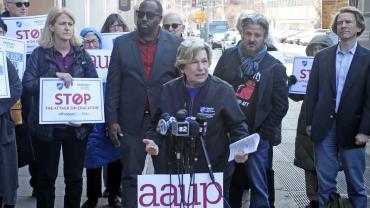
 At Columbia University specifically, the Trump administration has cancelled over $400 million in research and intervention funding and is threatening further action unless the university caves to a series of demands that would radically transform the institution and undermine its fundamental role in a democracy, as our colleagues in the Columbia chapter of the AAUP detail in this letter. Such actions also violate the constitutional law and the substance and process of TItle VI, as detailed by several of our colleagues in the Columbia Law School.

The broad strategies of the administration’s attack on higher education were outlined earlier in Project 2025, but the particular tactics have been shaped by both world and local events since the October 7, 2023 Hamas attack on Israel and the Israeli war on Gaza that followed and continues. The accusation that Columbia is unable and unwilling to protect its Jewish students is being used to strip it of funding, especially for research in its medical school, as well as other areas of the institution. Several funded projects in education, health, and psychology at Teachers College have already been cancelled, affecting research and programs ranging from higher education access, graduate training for much-needed school psychologists, social services  for students, and more.

We recognize that Columbia, like many institutions, has much ongoing work to do to ensure campus is a place that can foster and support everyone’s learning, by actively addressing antisemitism, Islamophobia, and all forms of discrimination and hatred. Yet the disproportionate response to anti-war protest on our campus must be acknowledged. We take note of the “Palestine exception,” which blocks discourse by treating Palestine and Palestinians as topics beyond First Amendment and academic freedom protections. Such a pattern has barred necessary speech and difficult dialogues on our campuses, causing division and fear amongst students, staff, and faculty members. To be sure, maintaining space for anti-war protest and other forms of political dissent within a community needs to be done with sensitivity and care, alongside respect for the rights of students to challenge one another and express ideas, including deeply controversial ones.

While this week’s education news has been dominated by Columbia, previous weeks focused on the K-12 landscape. Developments included the appointment of a Secretary of Education with no education expertise, unable even to correctly identify the IDEA (Individuals with Disabilities Education Act) – one of our nation’s largest pieces of federal education and civil rights legislation, which she is charged by Congress to administer. The administration laid off half of the Department of Education’s workforce. The firings have all but shuttered the more than 150 year old National Center for Education Statistics, on which countless areas of education research, including “The Nation’s Report Card” via the National Assessment of Educational Progress and studies that focus on measuring equity, rely. These are the staffpeople who ensure that Congressionally-approved funds for Title I of the Elementary and Secondary Education Act (for children living in poverty), the IDEA and Section 504 of the Rehabilitation Act for disabled students, and federal financial aid to higher education make their way to their intended students, families, and communities. Major staff reductions at the Department of Education’s Office of Civil Rights intentionally impede this division from ensuring equitable treatment of children in our nation’s schools. 

As in higher education, the Trump administration not only seeks to usurp the Congressional power of the purse but does so in the name of false and misleading representations of the state of our educational institutions. Whatever claims to the contrary, American public education is governed chiefly by state constitutions and local school districts. They decide what students learn, how teachers teach, and how student success is measured. When, for example, executive orders seek to disregard that law and tradition, we applaud leaders who, like Maine Governor Janet Mills, respond with “See you in court!”.

As experts on teaching and learning, we know that the most profound moments of learning are usually uncomfortable, as they may lead people to question taken-for-granted assumptions about themselves and the society they inhabit. The goal of good teaching is not to eliminate that discomfort, but to give it a productive use. The barrage of Executive Orders, threats to the Department of Education, and mandates such as the March 13 letter are aimed at restricting discourse and generating fear in teachers and students, especially those most vulnerable: non-US citizens, racially or ethnically minoritized populations, gender and sexually diverse and expansive people, and disabled people. Teaching and learning are much more difficult when one is afraid, and pedagogy can easily turn to rote memorization and repetition in order to avoid controversy.

While the White House accuses elementary and secondary schools as well as higher education of indoctrinating students, against the evidence, what we see is an attack on the capacity for criticism — paving the way for authoritarianism and fascism. The idea that directing criticism at the US or its geopolitical allies is un-American runs counter to much of the history of this nation. As James Baldwin once stated, “I love America more than any other country in the world and, exactly for this reason, I insist on the right to criticize her perpetually.” It is extremely hard, if not impossible, for people of any age to do the difficult work of learning, of understanding multiple perspectives on an issue, of offering counterpoints to commonly assumed views, when people are scared of losing their livelihoods and/or their visas, being arrested or deported, or being deemed enemies of the state by the highest office in the land.

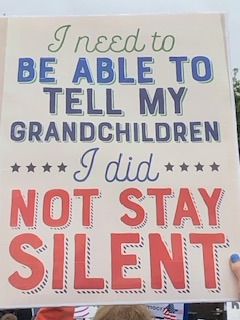
As educators and researchers concerned with justice and equity, we cannot stay silent.  What becomes of the University if it succumbs to the demands of a political party or leader and cedes its rights of free speech, free expression, and free inquiry? What becomes of research if its pursuit of truth is shaped by what faculty are not allowed to say, and the topics they cannot investigate? What becomes of our students if they are only permitted to think, speak, and be in ways that follow the political winds? 

We call on university leaders, on our campus and beyond, to use all of the tools at their disposal, including collective efforts across the sector and litigation, to stand for academic freedom, and for First Amendment rights of free speech, inquiry, and debate, and thus to stand for our democracy.

And we pledge, as faculty members in an institution of higher education, to recognize that the challenges facing us are not unique to our institution or to higher education. They are shared challenges that at this moment link us to all those devoted to education and to learning at all stages across the life span. We celebrate the efforts such as the suit filed by the National Education Association and the American Civil Liberties Union to stop Trump administration efforts to curtail diversity, equity, and inclusion in education. We must find ways to work with one another for our students, our communities, and our still-developing democracy. 

Daniel Friedrich, PhD, Associate Professor of Curriculum, Department of Curriculum and Teaching

Ansley Erickson, PhD, Associate Professor of History and Education Policy, Department of Education Policy and Social Analysis

Melanie Brewster, PhD, Professor of Counseling Psychology, Department of Counseling and Clinical Psychology

Ezekiel Dixon-Román, PhD, Professor of Critical Race, Media, and Educational Studies Director, Edmund W. Gordon Institute for Advanced Study. 

Kay James, PhD, Associate Professor of Neuroscience & Education, Department of Biobehavioral Sciences

Additional signatures, added at 6pm daily. 

Anonymous (11)

Jennifer Lena, PhD, Associate Professor of Arts Administration, Department of Arts and Humanities

Brandon Velez, PhD, Associate Professor of Counseling Psychology, Department of Counseling and Clinical Psychology

Luis A. Huerta, PhD, Professor of Education and Public Policy; Chair, Department of Education Policy and Social Analysis

James Borland, PhD, Professor of Education, Department of Curriculum and Teaching

Nathan Holbert, PhD, Associate Professor of Communication, Media, and Learning Technologies Design

Sonali Rajan, EdD, Professor of Health Promotion and Education, Department of Health Studies and Applied Educational Psychology

Carolyn Riehl, PhD, Associate Professor of Sociology and Education Policy 

Beth Rubin, PhD, Professor of Education, Department of Arts & Humanities

Lucy Calkins, PhD, Robinson Professor of Children’s Literature, Department of Curriculum & Teaching

Gita Steiner-Khamsi, PhD, William H. Kilpatrick Professor of Comparative Education, Department of International and Comparative Education

Mark Anthony Gooden, PhD, Christian Johnson Endeavor Professor of Education Leadership, Department of Organization & Leadership

Sandra Schmidt, PhD, Associate Professor of Social Studies Education, Department of Arts & Humanities  

Haeny Yoon, PhD, Associate Professor of Early Childhood Education, Department of Curriculum and Teaching

Judith Scott-Clayton, PhD, Professor of Economics & Education, Department of Education Policy & Social Analysis

Alex Eble, PhD, Associate Professor of Economics & Education, Department of Education Policy & Social Analysis

Prerna Arora, PhD, Associate Professor of Psychology and Education, Department of Health Studies & Applied Educational Psychology

Megan Laverty, PhD, Professor of Philosophy and Education, Department of Arts and Humanities 

Ioana Literat, PhD, Associate Professor of Communication, Media and Learning Technologies Design, Department of Math, Science, and Technology

Yolanda Sealey-Ruiz, Ph.D, Professor of English Education, Department of Arts and Humanities