Archives for category: Censorship

Judge Colleen McMahon of the Southern Districy of New York issued a ruling restoring $100 million in grants from the National Endowment for the Humanities that were canceled by Elon Musk’s DOGE team. The judge said the cancellations violated the First Amendment and the Fifth Amendment, and furthermore that DOGE lacked the statutory authority to act. Judge McMahon ordered the reinstatement of every grant to writers, scholars, and researchers. The DOGE censors did not actually review the grants but used ChatGPT to identify words that the Trump administration had banned, especially those associated with DEI (diversity, equity, and inclusion).

Perhaps the most gratifying aspect of the decision was the judge’s ruling that DOGE had no authority to cancel these grants. In fact, DOGE had no authority to fire thousands of civil servants or to terminate entire agencies, like USAID.

She wrote:

On the central ultra vires question, Judge McMahon was unequivocal: “It is not that DOGE misconstrued a statutory provision conferring authority on it; it is that Congress conferred no authority on DOGE at all with respect to the awarding, continuation, or termination of NEH grants.”  

The Authors Guild, one of the plaintiffs, reported on the decision;

May 7, 2026—A New York federal court in a 143-page decision today held for the Authors Guild plaintiffs on every count in its case on behalf of individual writers and scholars against DOGE and the NEH for DOGE’s April 2025 mass cancellation at the National Endowment for the Humanities. It ordered the reinstatement of every grant terminated, delivering a complete victory to the Authors Guild and more than 1,400 writers, scholars, and researchers whose awards were abruptly eliminated.  

Judge Colleen McMahon of the Southern District of New York granted summary judgment to the plaintiffs on all three of their claims, finding the terminations violated the First Amendment and the equal protection component of the Fifth Amendment and were carried out by DOGE without any statutory authority to act.  

The court issued a permanent injunction enjoining the administration from giving effect to the mass terminations and requiring the government to rescind every termination notice and restore all affected grants and certified the Authors Guild’s lawsuit as a class action covering all approximately 1,400 affected grantees. 

“Today’s ruling makes clear that no administration—regardless of its priorities—is free to defy the statutory purposes of federal agencies and that or to cancel grants based on viewpoint discrimination,” said Mary Rasenberger, CEO of the Authors Guild. “Not only did DOGE have no authority to cancel the grants, it used an AI chatbot to invent pretextual reasons to do it anyway. Writers and scholars had structured their lives around these awards—taking leaves of absence, giving up other income, making commitments—because the government had entered into a legally binding obligation. That obligation must be honored. We are gratified that justice was done, grateful to our amazing legal team at Fairmark Partners, and we will be watching closely to make sure every one of these grants is restored.”  

Background 

In early April 2025, DOGE officials terminated more than 1,400 NEH grants awarded to scholars, writers, research institutions, and other humanities organizations totaling over $100 million in congressionally appropriated funds—the largest mass cancellation of previously awarded grants in the agency’s nearly 60-year history—with no individualized review, no notice, and no opportunity to appeal.  

Discovery revealed that a DOGE official had used ChatGPT to generate “DEI rationales” for termination, submitting thousands of grant descriptions to the AI tool with a single standardized prompt, without defining the term or understanding how the tool interpreted it. They didn’t take any steps to ensure that the system wouldn’t discriminate on the basis of race, sex, or other protected categories. DOGE also searched for grants containing keywords like “gay,” “BIPOC” (Black, Indigenous, People of Color), “indigenous,” “tribal,” “melting pot,” “equality,” and similar terms. It did not search for analogous terms like “white,” “heterosexual,” or “Caucasian.” 

The results were, in the court’s account, irrational: Studies of ancient Jewish texts, the persecution of Uyghurs in China, the plastics industry, and American women in Paris in the early 1900s were all flagged as DEI. The NEH’s own acting chair told DOGE many of the rationales “mischaracterized” the grants but was overruled. His own email to DOGE acknowledged: “Either way, as you’ve made clear, it’s your decision on whether to discontinue funding any of the projects.”

Two Consolidated Cases

The result of this landmark ruling was actually two separate lawsuits that were quickly consolidated into one. On May 1, 2025, the Modern Language Association, the American Council of Learned Societies, and the American Historical Association filed the initial suit, ACLS v. McDonald, challenging DOGE’s mass terminations. Eleven days later, the Authors Guild filed its own suit, The Authors Guild v. NEH, in the Southern District of New York — structured as a class action on behalf of all approximately 1,400 affected grantees. On May 14, Judge Colleen McMahon consolidated the two cases, noting they were “substantially identical,” and the litigation proceeded jointly from there.

Because the Authors Guild’s suit was structured as a class action, Judge McMahon’s order applies not just to named plaintiffs but to all 1,400-plus writers, scholars, and researchers whose awards were canceled, making yesterday’s ruling a victory for everyone DOGE targeted. 

Ruling 

On the central ultra vires question, Judge McMahon was unequivocal: “It is not that DOGE misconstrued a statutory provision conferring authority on it; it is that Congress conferred no authority on DOGE at all with respect to the awarding, continuation, or termination of NEH grants.”  

On the ChatGPT-driven process, she wrote that it “would hardly be surprising if ChatGPT inferred, from DOGE’s repeated requests, that Fox and Cavanaugh were looking for reasons why grants could be characterized as DEI—and therefore terminable—and supplied ‘rationales’ simply in order to satisfy the user’s perceived demand. The utter lack of reasoning behind so many of its ‘rationales’ certainly suggests as much.” 

“We are extremely pleased with Judge McMahon’s ruling reinstating the more than $100 million in NEH grants that were cancelled by DOGE last April.,” said Jamie Crooks, Managing Partner of Fairmark Partners, LLP  “While we are still evaluating her detailed, 143-page opinion, the bottom line is clear: Judge McMahon agreed with the Authors Guild and the other plaintiffs that these ‘DEI’-based cancellations violated the First Amendment and Equal Protection, and that DOGE did not have the authority to order these grants terminated.  The Court’s order that the grants be reinstated will allow our clients and the hundreds of other scholars and institutions in the class to continue performing their important scholarly work, and it’s also a vindication for the rule of law and basic principles of constitutional law.”  

NEH award recipient Bill Goldstein said, “I am—and all of the plaintiffs will be— forever grateful for your brilliant, tireless, and effective work on our behalf. And on behalf of the First Amendment and what remains and must endure of the rule of law. The stakes are that high, and you made our rights and that right clear. Congratulations on your victory, and thank you for ours.” 

Given that the administration has ignored other judicial orders, including the preliminary injunction in this case, we cannot say whether NEH will in fact reinstate the grants and pay out the money owed under those grants. The court emphasized that its decision addresses only “the legality of the Government’s decision to terminate” the grants and that it is requiring the government to “rescind the termination notices,” but clarified that it does not “require[] the immediate payment of grant funds” or “adjudicate[] any contractual entitlement to money.” The reason for that it that claims seeking payment of money owed by the federal government must be brought in a separate court—the Court of Federal Claims. Here, Judge McMahon noted that securing payment of the grant funds “might well require a separate suit in the Court of Federal Claims”—though she did not outline a specific process. For now, we are reviewing the decision with our attorneys to determine next steps, including any possible action in the Court of Federal Claims. As always, our goal is to ensure that grantees receive the payments they are owed as promptly as possible.
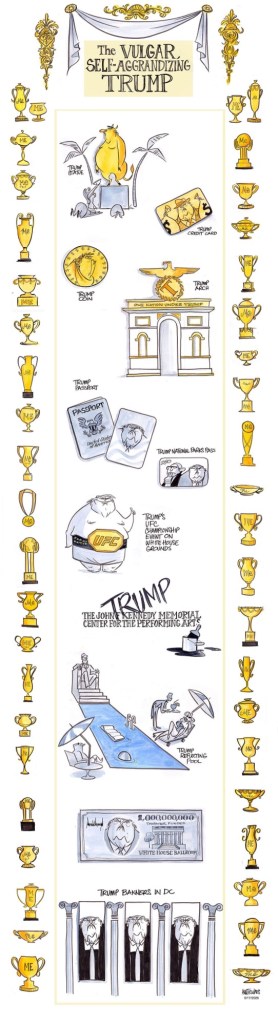
Ann Telnaes is a Pulitzer-Prize winning editorial cartoonist. She worked for The Washington Post for years but left when one of her cartoons was spiked (censored). The cartoon showed several billionaires bowing down to Trump; one of them was Jeff Bezos, owner of The Post. That cartoon won the Pulitzer Prize for 2026.

This one appears on her blog “Open Windows”:

Anna Gomez, the sole Democratic member of the board of the Federal Comminications Commission (FCC) took the unusual step of writing a letter to the CEO of ABC to warn him about the federal government’s goal of censoring the media. Early on in the second Trump administration, Trump sued ABC because one of its hosts, George Stephanopolous, asked Trump about “rape” charges in the E. Jean Carroll case, when Trump denied the charge and even denied the charge of defaming her, of which he was convicted. ABC paid Trump $16 million to persuade him to drop the lawsuit.

But the payoff did not buy peace. The FCC has now opened an investigation of ABC because of its talk show “The View,” which it accuses of bias.

The Wall Street Journal has the story:

ABC has been a victim of a “sustained, coordinated campaign of censorship and control” by the Trump administration, Federal Communications Commissioner Anna Gomez told Josh D’Amaro, chief executive of Disney , the network’s parent company.

The FCC under Republican Chairman Brendan Carr has been weaponized to pressure “a free and independent press and all media into submission,” Gomez wrote in a letter sent to D’Amaro on Monday and viewed by The Wall Street Journal.

The lone Democratic commissioner, Gomez has been an outspoken critic of many of Carr’s actions, which she has alleged are aimed at pressuring broadcasters for political purposes. 

The letter to D’Amaro comes in the wake of several investigations into Disney and ABC initiated by Carr’s FCC, including whether the talk show “The View” should continue to be granted certain exemptions as a news program…

Gomez told D’Amaro that these investigations and incidents, along with an FCC decision to reinstate a complaint into ABC’s moderating of a 2024 debate between then-candidate Donald Trump and opponent Kamala Harris, are “not a series of coincidental regulatory actions….”

The FCC is also investigating whether Disney has engaged in diversity, equity and inclusion initiatives that run afoul of the agency’s equal-employment-opportunity rules….

Gomez said the administration’s attacks on the network began in earnest with a defamation lawsuit against the network and “Good Morning America” anchor George Stephanopoulos that ABC settled for $16 million, including legal fees.

“That settlement did not buy you peace,” Gomez wrote, adding “you cannot buy this Administration’s favor. For the right price, you can only borrow it. And the price always goes up.”

In her letter, Gomez pledged to use “every tool available to me as a Commissioner to shine a light on what this FCC is doing to curtail press freedom and to hold this process to account at every step.”

While Gomez is a frequent critic of Carr, it is highly unusual for a government regulator to tell a company under investigation that the probe is without merit.

The investigations, Gomez said, are unlikely to succeed but that is not the point.

“The threat is the point. As sitting Supreme Court Justice Neil Gorsuch recently reminded us by invoking Justice Thurgood Marshall: ‘The value of a sword of Damocles is that it hangs, not that it drops,’” she wrote.

William Becker is a prominent environmental activist. He is also a veteran and at one point during his service, he wrote for “Stars and Stripes.”

It’s hard to keep track of the latest Trump administration outraged, but one of the latest is that Secretary of DEFENSE Pete Hegseth is taking control of “Stars and Stripes” so it will be an outlet for Pentagon propaganda and Hegseth’s brand of Christian nationalism and straight white male supremacy.

Becker wrote about this travesty at The Hill, a widely read D.C. publication:

One of the classic sounds of the Vietnam War was the voice that famously boomed,  “GOOOOD MORNING, VIET-NAM”  over Armed Forces Radio each day. 

The Army’s daily newspaper was an equally important fixture. Stars and Stripes was founded by Union soldiers during the Civil War. It was unique: a military publication independent from the brass, delivered to the troops along “the world’s most dangerous paper routes.”

During World War II, the paper shifted from a weekly to a daily publication, serving up national and international news along with stories from the theaters in Europe, Asia and, most recently, the Middle East. The paper had always been independent of military control. In the late 1980s, Congress required it.

Now, the Pentagon appears ready to make it a mouthpiece for Pete Hegseth, President Trump’s carefully coiffed secretary of Defense with battle-hungry biceps. We can expect the storied newspaper to acquire all the dignity of a British tabloid, becoming the manosphere’s daily drumbeat against “stupid rules of engagement” and “tepid legalities” like international law and the Geneva Conventions.

I have a dog in this fight. I was an Army sergeant who served as a combat correspondent for Stars and Stripes in Vietnam during 1966 and 1967. There were just a few of us. We didn’t wear rank or military uniforms. We traveled throughout South Vietnam, embedding ourselves in combat operations to give the soldiers’ perspectives on the war. At age 19, I competed hour by hour with veteran broadcast and newspaper reporters, the best in the business.

It wasn’t always about battle and bloodshed. We also wrote and photographed the military’s efforts to “win the hearts and minds” of the Vietnamese people. Based on Hegseth’s podium performances, “woke” coverage like that won’t appear in the paper. We can’t expect stories about the U.S. military as peacekeepers and rescuers during global disasters. We won’t read about the quiet ethos of professional soldiers. We’ll be bombarded with saturation coverage of how young men “intimidate, demoralize, hunt, and kill our enemies.”

Until last week, the newspaper’s independence was defended by an ombudsman, most recently Jacqueline Smith. She has been fired by the Pentagon. A spokesman explained that the department is taking over control of the paper to “modernize its operations, refocus its content away from woke distractions that siphon morale, and adapt it to serve a new generation of service members.”

In other words, Stars and Stripes is being swept up in the conservative tide taking over the news and entertainment media in the U.S. But as former Secretary of Labor Robert Reich notes, “Acquisition of a media company should be treated differently than the acquisition of, say, a company developing self-driving cars or one developing small nuclear reactors, because of the media’s central role in our democracy.” 

In 1966, Stars and Stripes featured my photos of the Philippine army, one of America’s allies in the war, handing out rice to villagers from the back of a truck. Now, we can anticipate that it won’t waste ink on such wokeness; it will report how God wants maximum lethality with minimum morality to “kill people and break things,” and deliver divine retribution with “overwhelming and punishing violence against the enemy.

One of the problems with the Pentagon’s effort to “intimidate, demoralize, hunt, and kill our enemies” is that President Trump and Hegseth are working overtime to make enemies out of friends. Hegseth’s chief policy adviser suggests punishing NATO for not joining the U.S. in Trump’s war against Iran. Trump accuses NATO of being a “paper tiger” for not helping to open the Strait of Hormuz. 

Yet neither man apparently consulted with or advised NATO before launching the Iran war. NATO nations are understandably reluctant to join Trump in the international crimes he threatens. 

Trump has hardly been a good ally. He has soured relations with Europe with his threats to take Greenland by force and his punitive trade tariffs. In 2018, he called the hard-fought nuclear weapons agreement with Iran “decaying and rotten” and pulled out of it, leaving co-signers France, Germany and the United Kingdom in the lurch. 

He has insulted allies by failing to acknowledge their support after 9/11. He accused NATO of avoiding the front lines in the Afghanistan war, even though 1,000 servicemembers from European countries died in the conflict. He even suggested that he would encourage Russia to “do whatever the hell they want” to any NATO country that doesn’t pay enough for its own defense.

Hegseth and Trump have poisoned our relationship with allies. Will they now try to poison the views of the rank-and-file military? Stars and Stripes currently reaches 1.4 million people and gets 26 million page views on its digital edition. It may take a boycott by the rank-and-file or a crackdown by Congress to save it. 

William S. Becker is co-editor of and a contributor to “Democracy Unchained: How to Rebuild Government for the People,” and a contributor to Democracy in a Hotter Time, named by the journal Nature as one of 2023’s five best science books. He previously served as a senior official in the Wisconsin Department of Justice. He is currently executive director of the Presidential Climate Action Project.

In what appears to be a historic turnout, voters in Hungary ousted Viktor Orban!

This is great news for NATO and bad news for Trump and Putin, who lauded Orban as the future of Europe. MAGA loved Orban, who claimed to have created an “illiberal democracy.”

Orban was a European version of Trump, censoring or closing down anyone who disagreed with him. He harmed freedom of the press, universities, and the judiciary. He stridently opposed LGBT rights.

The victory of Peter Magyar, who seems to have won more than 2/3 of the seats in Parliament, means a new day for Hungary, NATO, and the European Union.

JD Vance traveled to Hungary last week to help right-wing leader Viktor Orban, whose Presidency is being decided today by the voters.

Orban is the hero of the MAGA cult, because he has cracked down on universities, free speech, the judiciary, and the LGBT community. Hard-right conservatives in the U.S. admire Orban because of his success in curbing people and institutions who disagree with him. He is the successful template for curbing freedom and democracy. Orban has a close relationship with Putin and has strongly opposed aid to Ukraine in repelling the Russian invasion.

Today, his party is being challenged by a new party formed by Peter Magyar, a former ally of Orban. The polls predict that Magyar’s party, Tisza, is likely to beat Orban’s party, Fidesz.

Opponents of Orban’s authoritarianism fear that he will rig the election, or like Trump, refuse to accept a loss.

JD Vance arrived last week and spent a few days boosting Orban’s campaign and endorsing his anti/democratic accomplishments. Vance did not mention the hundreds of thousands of Hungarians who have left the country or the country’s low economic growth.

Vance denounced interference in the Hungarian election by EU nations and Ukraine. This foreign interference, he said, was deplorable.

Did it occur to Vance that his vigorous campaigning for Orban was precisely the foreign interference of which he accused other nations? Imagine how Americans would feel if top officials from other nations showed up in the closing days of a major election to campaign for their favored candidate? Not good, I suspect.

It’s odd to see Trump and Putin coalescing behind the same candidate. And ominous. It will be a healthy sign if Hungarian voters toss out this authoritarian bully, this champion of censorship and repression.

A good way to start off April Fool’s Day is by listening to this song by a group of young people in Colorado. The lyrics were written by Kevin Welner and are posted at the website of the National Education Policy Center.

The Trump regime says clearly “We believe in local control.” Except when they don’t.

Trump has issued executive orders about what may or may not be taught. Trump’s executive order #14253, signed on March 27, 2025, was titled “Restoring Truth and Sanity to American History.” What it meant in practice was to censor any teaching or displays that showed the shameful aspects of American history, and to focus instead on “patriotic history.”

Trump has launched a campaign to oust diversity, equity, and inclusion, as well as gender studies, African-American studies, and studies of other groups.

Trump has tried to seize control of institutions of higher education institutions by falsely accusing them of anti-Semitism. He has sought to control the admission of students, the curriculum, and the hiring of faculty.

Trump has taken institutions of higher education hostage by withholding or cancelling billions of dollars for research into medicine and science unless they turned control over to the federal government.

But, as the song says, “We believe in local control!”

This is a very important interview, a thoughtful discussion between two remarkable people.

Two historians talk about Trump tyranny, the rule of oligarchs, and the power of the fossil fuel industry.

Snyder reminds us of the importance of the November elections. It’s our chance to put limits on the oligarchs and authoritarians.

The Department of Political Science at the University of Gothenburg in Gothenburg, Sweden, publishes an annual report on the state of democracy around the world. In the recently published report, the authors made clear that democracy in the world is in retreat. Nowhere has it declined as dramatically as in the United States.

A special section of the report is focused on the United States. Under Trump, democracy in the USA is under attack. The President has centralized power in his office. The Republican-dominated Congress has ceded almost all of its Constitutional powers to Trump. The word “almost” may be an overstatement, as it’s difficult to remember an issue when Congress said no to a Presidential power grab.

The V-DEM report begins its special section about the “autocratization” of power in the United States:

*Under Trump’s presidency, the level of democracy in the USA has fallen back to the same level as in 1965.

Yet the situation is fundamentally different than during the Civil Rights era. In 2025, the derailment of democracy is marked by executive overreach undermining the rule of law, along with far-reaching suppression and intimidation of media and dissenting voices.

*The speed with which American democracy is currently dismantled is unprecedented in modern history.

*Legislative Constraints – the worst affected aspect of democracy – is losing one-third of its value in 2025 and reaching its lowest point in over 100 years.

*Civil Rights and Equality before the Law are also rapidly declining, falling to late 1960s levels.

*Freedom of Expression is now at its lowest level since the end of WWII.

*Electoral components of democracy remain stable. Election-specific indicators are re-assessed only in electoral years, and the 2025 scores are based on the quality of the 2024 elections.

The scale and speed of autocratization under the Trump administration are unprecedented in modern times. Within one year, the USA’s LDI score has declined by 24%; its world rank dropped from 20th to 51st place out of 179 nations. The level of democracy on the LDI is dwindling to 1965 level – the year that most regard as the start of a real, modern democracy in the USA.

Yet the deficiencies of American democracy today are fundamentally different from that of the Civil Rights era. As the V-Dem data and other evidence below show, the autocratization now is marked by executive overreach, alongside attacks on the press, academia, civilliberties, and dissenting voices.

The Most Dramatic Decline in American History

In 2023, the USA scored 0.79 on the LDI – shortly before the 2024 election year when first deteriorations were registered. The scores plummeted to 0.57 in 2025 (Figure 22). With such a sharp drop on the LDI, the level of democracy at the end of 2025 is back to the 1965 level. Symbolically, that is the year that most analysts consider the USA began its transition to a real democracy.

Democracy in the USA is now at its worst in 60 years. We are not alone in this assessment. Professor Steven Levitsky at Harvard University says the regime in the USA is now some type of authoritarianism. The Century Foundation argues that “American democracy is already collapsing…”

By magnitude of decline on the LDI, the 2025 plunge is the largest one-year drop in American history going back to 1789 – that is, in the entire period covered by V-Dem data. Only Trump 1.0 compares, when the LDI in the USA fell from 0.85 to 0.73 in four years, bringing the country back to its 1976 level and far below the regional average (Figure 22). American democracy survived Trump 1.0 but did not recover fully.

One notable shift is the transformation of the Republican Party to endorsing a far-right, nationalist, and anti-pluralist agenda. Nationalist, anti-liberal, far-right parties and leaders have largely driven the “third waveof autocratization.” Yet the USA stands out as the only case where such movement seized control over one party in a rigid two-party system.

Please open the link and read the report to review the sources and to understand how dramatically democracy has been undercut during the first year of Trump’s second term.

The Founding Fathers thought they had written a Constitution that would prevent the rise of tyranny. They were wrong.

Azar Nafisi is a celebrated Iranian-American writer. Years ago, I read her best-selling book Reading Lolita in Tehran. I loved it. So did many other people; it was a bestselling book here (117 weeks on the New York Times‘ bestseller list) and in other countries. She became a professor of English literature in Iran after earning her degree at the University of Oklahoma. She came to the U. S. in 1997 and became an American citizen in 2008.

Because I have always loved her writing, I invited her to lecture at Wellesley College in my annual lecture series. We have become close friends, and I admire her and love her.

She wrote the following essay for TIME in early February, when many people were protesting the regime in the streets, before the American-Israeli war on Iran.

She wrote:

When a friend asked Henry James how he endured the devastation of World War I, the writer replied, “Feel, feel, feel all you can.” His exhortation contains the essence of what it means to remain human. Totalitarian regimes try to dismantle our capacity to feel, render us numb, confiscate our humanity, the way censors black out passages in books.

When I think of Iran, I think of light. I think of the play of light on leaves, on water, on mountains. I was born in Tehran, and when I looked out of the window of my living room, I would look at Mount Damavand, our tallest mountain peak, covered with a halo of snow. I think of that. And I think of our poetry nights in Tehran. I think of the writer and editor Houshang Golshiri teaching us classical Iranian poets during our poetry nights. I think of reading Ferdowsi and Nizami in our living room and the living rooms of my friends.


In December, the Iranians rose up in protest. The Islamic Republic spoke its only language: violence. And again the morgues and graveyards of Iran received fathers and sons, mothers and daughters. For me, as for millions of Iranians, this struggle is not political. It is existential. The first thing the Islamic Republic did, like any totalitarian system, was take away our right to live. They did it by literally killing people. And they did it by trying to reshape the citizens, turn us into figments of their imagination, to create a new Iranian.

I was teaching in Tehran during the revolution in 1979. I didn’t know myself at the time.

The Islamic Republic made me understand a lot of things by taking them away. They were confiscating my history and my identity as a human being. They were depriving us of contact with the world, making us believe that nobody cared about us. I felt the isolation they imposed upon us was a trap we could only escape by feeling, living, and resisting. 

When I was leaving Tehran, my mother followed me around the apartment. “Tell them,” she kept saying, “tell them.” Tell the world what is happening to us. I had to write, as Primo Levi put it, “in order to rejoin the community of mankind.” 

Last night I could not sleep. I kept thinking of three people. The only way I can repay my debt to them is to keep them alive through their stories. So I will tell you of Dr. Farrokhru Parsa. She was the principal of my high school in Tehran. She was very strict. She would stand at our high school door, checking the length of our uniforms. We would make poems and stories about her. She became, along with my mother, one of the first six women to be elected to the Iranian parliament in 1964. She became the minister of education, changed the representation of women in school textbooks, and significantly advanced the education of girls and women in Iran.

The Islamic Republic came for her. They charged her with crimes from “propagating corruption andprostitution” to “violating Islamic morality.” A revolutionary tribunal in Tehran declared her a “corruptor on earth” and sentenced her to death in May 1980. The legend is that they put her in a sack because you are not supposed to touch a woman and killed her by shooting at the sack. Some say they just hanged her or stoned her. It was a time when I felt immense despair. Many Iranians quote, what is believed to be Dr. Parsa’s last message from her prison cell to her children: “I am not going to bow to those who expect me to express regret for fifty years of my efforts for equality between men and women. I am not prepared to wear the chador and step back in history.”

I stayed in Iran. And that brings to me my second story, my second person. He was my student at Allameh Tabatabai University in Tehran, where I was teaching English literature during the war with Iraq. He had fought in the war and was very active in the Muslim Students Association, which worked as an instrument of ideological conformity and state control on campuses. He had the power to throw me out of the university. Or worse!

One day, as I was teaching Henry James, we heard this noise in the hall outside. Two students rushed in with the news: this young man had brought two cans of petrol with him, doused himself, and set himself on fire. “They have betrayed us,” he shouted. “They have betrayed us.” Some of my students made jokes when his body was being carried out. It made me very unhappy. I scolded them. “You don’t know what he has done,” a student retorted.

I realized there is another kind of death. The regime shapes us into its likeness, hardens the heart. I tried to convey that to my students through the teaching of the novel. A great novel is multi vocal and speaks on behalf of many. The novel threatens the lies of a totalitarian regime like the Islamic Republic. The novel nurtures curiosity and empathy.

My third story is about Razieh. I only remember her first name. In 1979, I was teaching contemporary American fiction at a small girls college in Tehran. Razieh was my student.

She was a practicing Muslim. Her mother was a cleaning lady. Her father was dead. She was a thin, small girl, with her veil framing her face. She was serious. I can see her face. Razieh would walk with me to the university gates and we would talk about Henry James and Jane Austen. She fell in love with Henry James. She loved the independent women in his stories. These women sacrificed their happiness but they did the right thing, she would say.

Razieh was curious. Curiosity, the desire to know another, is “insubordination in its purest form,” as Vladimir Nabokov said. You don’t accept just what is but seek what could be or should be. After that term, I moved to Tehran University. I saw Razieh once on the street. She gave me a sign not to talk to her. It was the year after the revolution, and the repression had started. Some years later, Mahtab, another former student of mine, came to see me at Allameh Tabataba’i University, where I was teaching at the time. She had been in jail but had been released for good behavior. She had met Razieh in jail.

Razieh and Mahtab had forged a bond in prison over their love of literature. Razieh would talk about Henry James; Mahtab would talk about F. Scott Fitzgerald. At a certain point in her telling, Mahtab paused. “You know, Razieh was executed.” I can still see her. Even in prison, even while waiting for her execution, Razieh chose life. She reached far beyond her prison cell through literature. Her bond with the novels and stories of Henry James transcended death and reaffirmed life.

When I lived in Iran my father would tell me that this country is very ancient and was invaded many times. What gives us identity and continuity, he would say, is our poetry stretching back hundreds of years to Ferdowsi, Hafiz, Jami, and Saadi. When this regime came to power, they did more than arrest and kill poets and writers.

They tried to erase our cultural memory. They tried to destroy the statue of Ferdowsi, our epic poet, and rename the street honoring Omar Khayyam, our poet, astronomer, and philosopher. But Iranian women stood in front of that street sign and would not let them change it. It was one small victory among countless defeats. The regime would call our cultural traditions pagan, but Iranians still make pilgrimages to the shrines of our poets.

The Islamic Republic of Iran is the Soviet Union of the Muslim World—a modern theocracy with imperialist ambition—and it is an ideology, a system that has failed. When I look at the younger generation in Iran, I see hope. The protests are both new and rooted in our history. Women have been fighting for freedoms, gaining ground despite oppression. What gives me hope is seeing women and men, the merchants and the retirees, all sections of Iranian society come together in the recent protests.

I have been thinking of Vaclav Havel, who wrote, “Hope is definitely not the same thing as optimism. It is not the conviction that something will turn out well, but the certainty that something makes sense, regardless of how it turns out.” The protesters in Iran show us that freedom is an ordeal, and you even pay for it with your life. As told to Basharat Peer