Count on America’s bard Bruce Springsteen to rise to the occasion with a new song:
Archives for category: Art
Trump’s brazen appropriation of the John F. Kennedy Center for the Performing Arts was shocking. Its board has been bipartisan since its opening more than fifty years ago. Trump fired the board members named by Biden, replaced them with his loyal allies, named himself chairman of the board, then was shocked, shocked, when the board decided to put his name on the Center, now the Donald J. Trump & John F. Kennedy Center for the Performing Arts. The logo was designed before the vote.
The name-change was disrespectful of President Kennedy and typically self-aggrandizing for Trump.
The Center was first conceived as a “national cultural center” in 1955 during the Presidency of Dwight D. Eisenhower. In 1964, Congress named the Center as a living tribute to the assassinated President Kennedy, who was a lover of the arts and who helped raise money for the new Center. Only Congress can change its name.
It opened on September 9, 1971, with Leonard Bernstein’s controversial MASS, commissioned by Jacqueline Kennedy Onassis. Read its history here. The MASS was both anti-war and anti-establishment and was a mixture of styles and genres.
In Trump’s many years as a resident of New York City, he never showed any interest in the arts.
Two performers who were scheduled to appear at the Kennedy Center recently canceled their appearances. (Many others had previously canceled after Trump’s takeover, including the blockbuster show HAMILTON, which was supposed to run from March 3 to April 26, 2026.)
One was Chuck Redd, a musician, who had been host of the Center’s annual Christmas Eve Jazz Concert for nearly two decades. Redd objected to the name change and canceled his appearance, which canceled the event as well.
Richard Grennell, Trump’s choice to be president of the Center, sent a letter to Redd informing him that the Center would be suing him for $1 million.
Adele M. Stan wrote in The New Republic:
The grounds for the suit aren’t entirely clear. The thing is, the Kennedy Center lost zero dollars due to Redd’s cancellation; it was a free concert. The only people who lost money due to vibrophonist’s protest were Redd and likely the musicians who were scheduled to perform with him. And, of course, one could argue that Redd’s move actually saved the Kennedy Center money, on staff and heating and the like.
But that didn’t stop Kennedy Center president Richard Grenell from either lying about that or displaying ignorance in his letter threatening Redd: “Your dismal ticket sales and lack of donor support, combined with your last-minute cancellation has cost us considerably,” Grenell wrote to Redd in an undated letter released on December 26. “This is your official notice that we will seek $1 million in damages from you for this political stunt.”
How one has “dismal ticket sales” for a free concert is never explained. However, the Washington Post reports that sales for tickets that cost actual money, such as those for the National Symphony Orchestra or the ballet, have plummeted since Grenell took over the Kennedy Center, reaching their lowest levels since the pandemic.
A second performer who took umbrage at the politicization of the Kennedy Center was a country singer from Mobile, Alabama, named Kristy Lee.
You may or may not have heard of her (count me among the not), but she sure nailed it.
The Daily Beast reported:
The artist who pulled out of a performance at the Kennedy Center after Donald Trump slapped his name on the storied arts institution is being lauded by fans for her decision.
Kristy Lee, a folk singer from Mobile, Alabama, told fans in a statement that she couldn’t “sleep at night” if she went through with her performance at the former John F. Kennedy Memorial Center for the Performing Arts, which was scheduled for Jan. 14.
“When American history starts getting treated like something you can ban, erase, rename, or rebrand for somebody else’s ego, I can’t stand on that stage and sleep right at night,” Lee shared with her 42,000 Facebook followers on Monday.
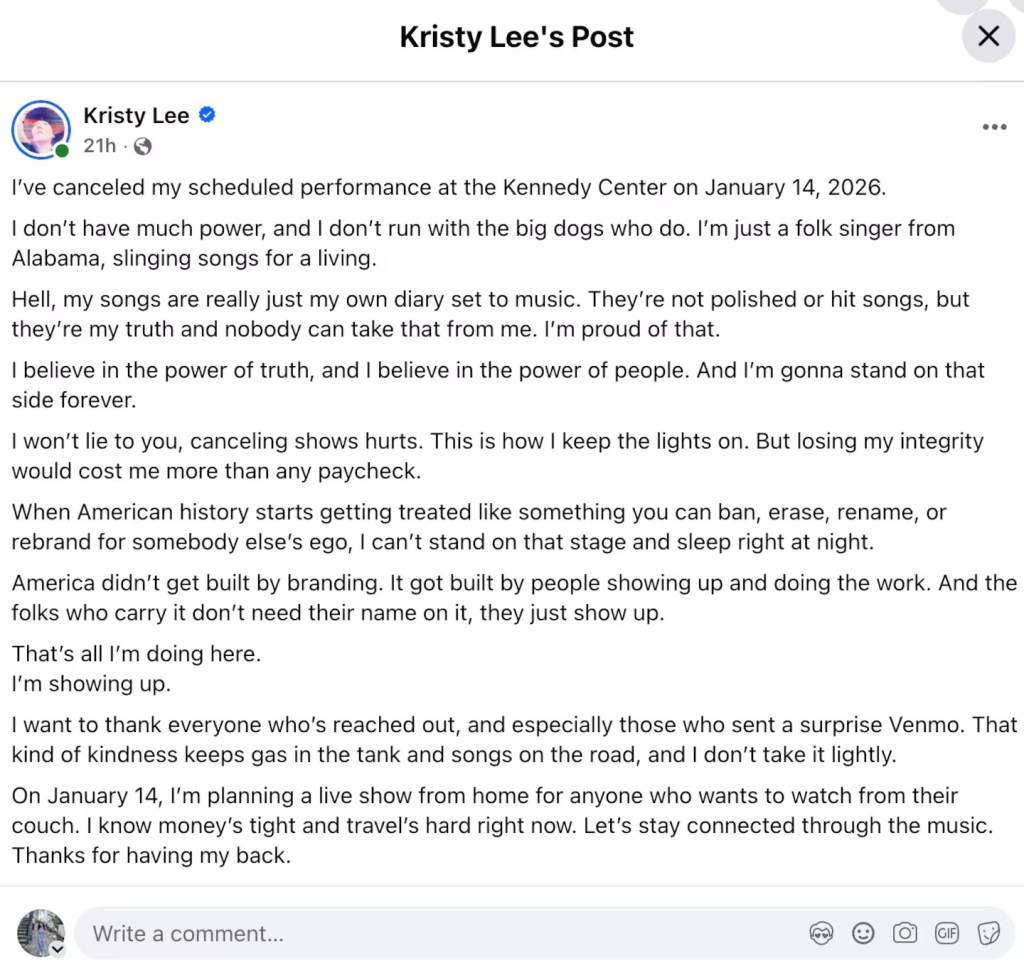
As of publication, the independent folk singer received nearly 300,000 likes on her Facebook post, compared to her 42,000 followers.
Her cancellation came after the White House announced Thursday that the John F. Kennedy Memorial Center for the Performing Arts would be renamed to include Trump’s name following a vote by the venue’s board, which is now stacked with MAGA loyalists.
“I won’t lie to you, canceling shows hurts. This is how I keep the lights on,” the independent artist wrote. “But losing my integrity would cost me more than any paycheck.”
After Lee made headlines for pulling out of the show, she said she was flooded with messages of support—and even monetary donations. The singer later announced she would perform a live show from home in response to the outpouring of love.”I believe in the power of truth, and I believe in the power of people,” Lee wrote on Facebook. Chad Edwards/Courtesy of Kristy Lee/Chad Edwards
“I want to thank everyone who’s reached out, and especially those who sent a surprise Venmo,” she wrote. “That kind of kindness keeps gas in the tank and songs on the road, and I don’t take it lightly.”
A spokesperson for Lee told The Daily Beast that the singer cited “institutional integrity” as her primary reason for canceling her performance at the venue, where ticket sales have reportedly plummeted since Trump’s takeover.
“As an artist, Kristy believes publicly funded cultural spaces must remain free from political capture, self-promotion, or ideological pressure,” the spokesperson said, adding that her decision was not directed at any patrons, staff, or artists at the Center.
“Performing under these circumstances would conflict with the values of artistic freedom, public trust, and constitutional principles that the Kennedy Center was created to uphold.”
Trump set his sights on the Center months ago and has repeatedly suggested, both in speeches and on social media, that it be renamed the Trump-Kennedy Center. The board now includes White House Chief of Staff Susie Wiles, Attorney General Pam Bondi, second lady Usha Vance, Deputy White House Chief of Staff Dan Scavino, and Allison Lutnick, the wife of Commerce Secretary Howard Lutnick.
A source told CNN that Trump phoned into Thursday’s board meeting ahead of the vote. A day later, the president’s name was swiftly and conspicuously added to the building, which now reads: “The Donald J. Trump and The John F. Kennedy Memorial Center for the Performing Arts.”
The Daily Beast has reached out to the Kennedy Center for comment.
Redd and Lee are the latest to cancel. Ticket sales have plummeted since Trump took control of the Kennedy Center in February.
In the weeks after the February board changes, at least 20 productions were canceled or postponed, with names such as comedian and actor Issa Rae pulling out of planned performances at the center, and musical artist Ben Folds and opera singer Renée Fleming saying they were stepping down as artistic advisers.
Descendants of the celebrated painter Norman Rockwell wrote an article in USA Today protesting the Trump administration’s selective use of his work to portray an all-white America. The Department of Homeland Security has issued propaganda that includes Rockwell paintings to illustrate that the U.S. has no racial diversity. Whites only.
His children, grandchildren and great-grandchildren wrote this article.
If Norman Rockwell were alive today, he would be devastated to see that his own work has been marshalled for the cause of persecution toward immigrant communities and people of color.
The Rockwell family
A group of mostly White Americans stands beneath a billowing national flag, right hands to their hearts. Construction workers crawl ant-like over a close-up of the upraised torch in the hand of the Statue of Liberty. A craggy Daniel Boone in raccoon-skin cap gazes off into the distance against a purple background, cradling his rifle.
These are three Norman Rockwell paintings that recently appeared without authorization in social media posts by the U.S. Department of Homeland Security. They bore these labels: “Protect our American way of life,” “Manifest Heroism” and a quote from Calvin Coolidge, “Those who do not want to be partakers of the American spirit ought not to settle in America.”
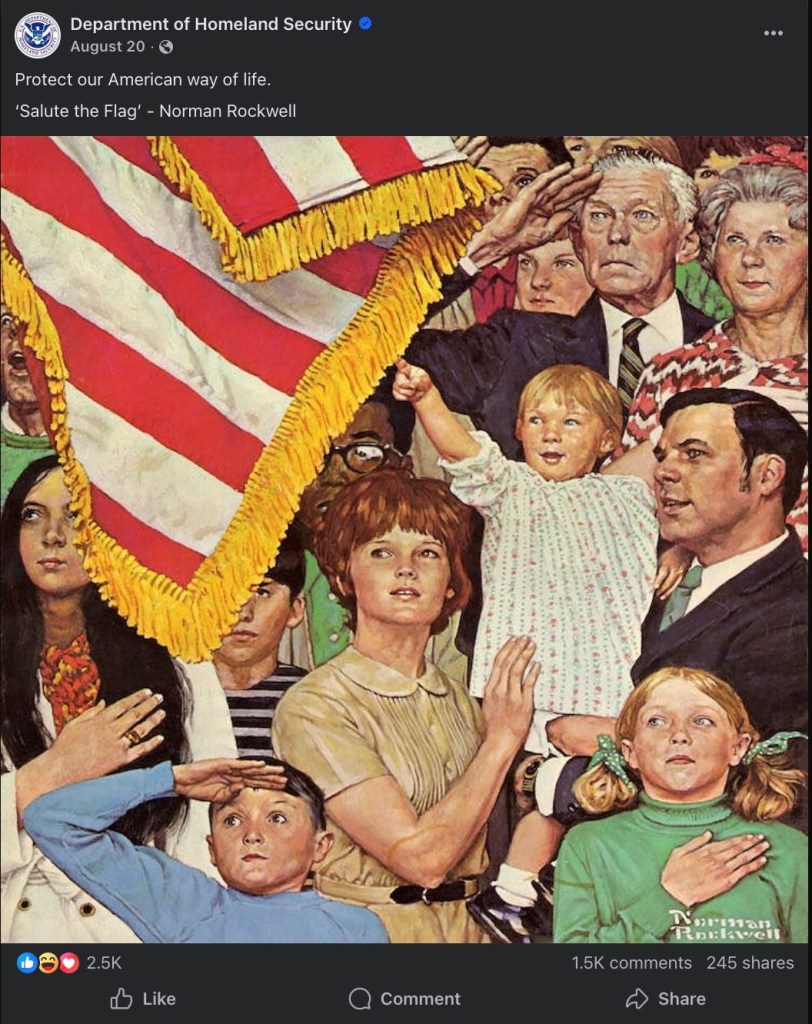
Norman Rockwell – our father, grandfather and great-grandfather – painted more than 4,000 works during his career, many of them depicting what are considered classic scenes from 20th century American life: Boy Scouts, doctor visits, squabbling couples, soda shops, soldiers returning from war, linemen and so much more.
From 1916 to 1963, he regularly painted covers for the Saturday Evening Post, which by and large depicted only White people. The scarcity of people of color in Rockwell’s paintings has led those who are not familiar with his entire oeuvre to draw the conclusion that his vision was of a White America, free of immigrants and people of color. But nothing could have been further from the truth.
Norman Rockwell used art to confront racism, injustice in America
Rockwell was profoundly shaken by the injusticestoward Black Americans that were brought to the forefront during the Civil Rights Movement. He felt an urgent need to raise his voice against the racism and injustice he witnessed all around him.Need a news break? Check out the all new PLAY hub with puzzles, games and more!
In January of 1964, just one month shy of his 70th birthday, his iconic painting “The Problem We All Live With” appeared in Look magazine. The painting was inspired by the experiences of Ruby Bridges, a 6-year-old girl who had been escorted by U.S. Marshals to desegregate her New Orleans school in 1960.
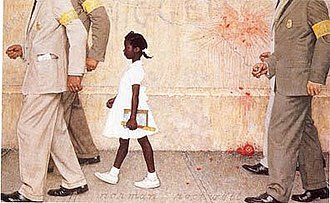
The painting focuses on a young Black girl in a white dress walking to school surrounded by unmistakable signs of racism and violence. A horrifying epithet scrawled across a wall dotted by rotten tomatoes recently hurled and the burly bodies of the four U.S. Marshalls accompanying her all point to the horrifying historical moment depicted in the scene. But perhaps most haunting of all is that title: “The Problem We All Live With,” an eternal present tense, inviting us to engage with the ravages of racism in our society, to open our eyes to the injustice and violence.
“I was born a White Protestant with some prejudices that I am continuously trying to eradicate,” Rockwell said in an interview in 1962. “I am angry at unjust prejudices, in other people and in myself.”
His efforts to eradicate prejudices both within himself and others led him to explore issues of racism, violence and segregation well into his 70s: “Golden Rule” (1961), “Murder in Mississippi” (1965) and “New Kids in the Neighborhood (Negro in the Suburbs)” (1967) all demonstrate his deep commitment to equality and anti-racism.
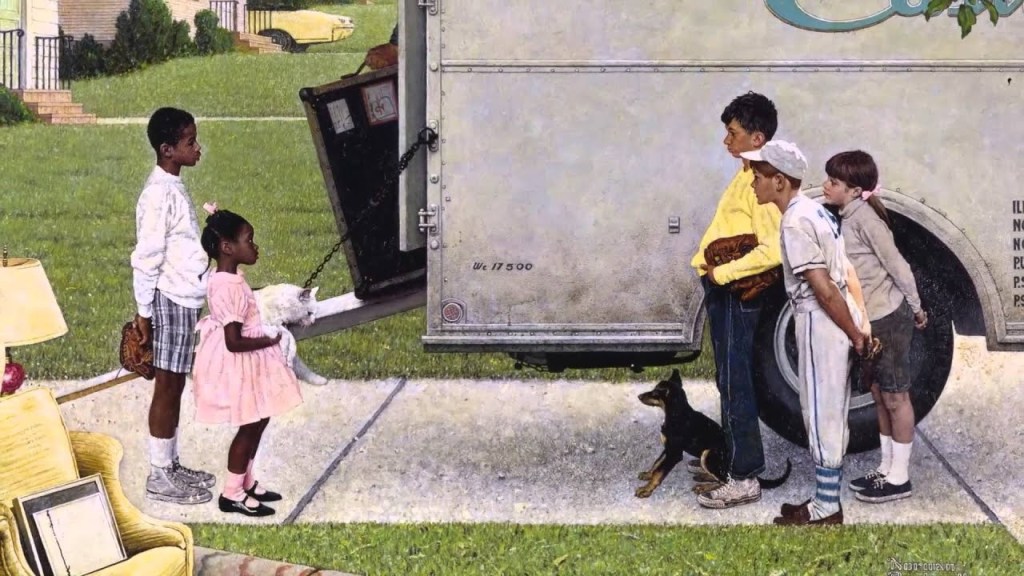
If Norman Rockwell were alive today, he would be devastated to see that not only does the problem Ruby Bridges confronted 65 years ago still plague us as a society, but that his own work has been marshalled for the cause of persecution toward immigrant communities and people of color.
We ‒ as his eldest son, grandchildren and great-grandchildren ‒ believe that now is the time to follow in his footsteps and stand for the values he truly wished to share with us and all Americans: compassion, inclusiveness and justice for all.
***********************************
In addition to the contested use of Rockwell’s paintings, the Trump administration’s Department of Labor has used the retro images below as part of its recruitment/branding campaign (slogans like “Make America Skilled Again,” “Build America’s Future,” “American Workers First,” “Your Nation Needs You”). The DOL ran them on social media (USDOL posts on X/Twitter, Facebook and Instagram). The posters present America as an all-white nation of male workers. No diversity. Broad shoulders. Blonde hair. Open-collar. He-men. Red-blooded white American men. No Rosie the Riveter.

Glenn Kessler, recently retired as the Washington Post’s fact checker, has his own blog at Substack. He now dedicates his time to fact-checking Trump’s lies. That’s a full-time job.
He writes about a forgotten episode in Trump’s past that foreshadows his demolition of the East Wing of the White House and his demolition of foreign aid and entire departments:
Donald Trump’s dismantling of parts of the White House’s East Wing to make way for a gargantuan $250 million ballroom — without any forethought or architectural approvals — has been cited by critics as a metaphor for what he is doing to American democracy.
To me, Trump’s second-term approach to governing has its roots in a similarly shocking display of developer hubris — his destruction, 45 years ago, of the Bonwit Teller limestone bas-relief sculptures of two nearly naked women to make way for Trump Tower.
After Trump, 33 at the time, purchased the bankrupt retailer’s 11-story building, he promised to donate the 15-foot-high Art Deco sculptures to the Metropolitan Museum of Art. He also agreed to donate a six-by-nine-meter, geometric-patterned bronze latticework that hung over the entrance.
But then one day, he woke up and decided he would break his promise.
He ordered crews to separate the architectural treasures from the walls with jackhammers and break them off with crowbars. The friezes, located near the top of the building, were thrown down by workers, shattering them to bits. The latticework was removed with blow torches and mysteriously went missing.
By the time New Yorkers realized what was happening, the deed was done — and that was that.
I couldn’t stop thinking about the Bonwit Teller friezes when the U.S. Agency for International Development — a lifeline for many countries in the Global South — was dismantled earlier this year in the blink of an eye.
Trump knew that by the time the lawsuits wended their way through the courts, it would be too late to rebuild USAID, Voice of America and so many other agencies that he’s destroyed.
They’ve been broken down into a million pieces, just like the Bonwit Teller sculptures.
In 1980, The New York Times put the news of Trump’s betrayal on the front page, under the headline: “Developer Scraps Bonwit Sculptures.” (Trump was not yet famous.)
The story has all the earmarks of a classic Trump tale.
First, the shock: “The destruction of the Art Deco panels stunned some art appraisers and elicited expressions of surprise and disappointment from officials of the Met, where they were to have been installed by the department of 20th-century art. One appraiser placed their value at several hundred thousand dollars.”
Then the spin: “John Baron, a vice president of the Trump Organization, said after the demolition yesterday that the company had decided not to preserve the sculptures because ‘the merit of these stones was not great enough to justify the effort to save them.’ Mr. Baron said the company had got three independent appraisals of the sculptures. These, he said, had found them to be ‘without artistic merit’ and worth less than $9,000 in ‘resale value.’ He said it would have cost $32,000 to remove them carefully and would have delayed demolition work by a week and a half and perhaps longer because of the need for cranes and municipal permits.”
We now know that “Baron” was none other than Trump himself — and that the numbers and appraisals were entirely fabricated.
Next, the shock at the spin: Ashton Hawkins, vice president and secretary of the Met’s board of trustees, was flabbergasted by the claims. “Can you imagine the museum accepting them if they were not of artistic merit?” he asked.
Preservation News reported that Robert Miller, an art dealer with a gallery across from Bonwit Teller, estimated the sculptures were worth $200,000 —or $800,000 in today’s dollars — and that “they could have been safely removed in little time.”
Finally, the Trump double-down: After days of controversy, Trump stopped hiding behind his faux spokesman and offered reporters an even more ridiculous figure. He asserted removal of the sculptures would have cost more than $500,000 in taxes, demolition delays and other expenses. The figure, conveniently, was higher than the reported valuation of the sculptures in news reports.
On top of that, Trump claimed he was motivated by his concern for “the safety of people on the street below…If one of those stones had slipped, people could have been killed. To me, it would not have been worth that kind of risk.”
Somehow, that concern didn’t apply when workers were ordered to hurl the frieze fragments down from the eleventh floor.
Almost half a century has passed. We’re still watching the same movie.
Here is a Sunday special by one of my favorite writers, Greg Olear.
Please open and read to the end. He takes the topic and relates it to the present moment, when many of us fear that our republic is in mortal danger, as fascism swirls around us.
He writes:
Dear Reader,
A Shropshire Lad is a collection of 63 short poems, written in London by a classics scholar who had never once been to Shropshire, involving young men living, working, drinking, wooing, ruing, philosophizing, and dying in the British countryside. The narrator of most of the poems, the titular “lad of Shropshire,” is called Terence, who sometimes is, and sometimes is not, a stand-in for the actual author, A.E. Housman.
The book was published in 1896, when Housman was 37 years old, and did not exactly fly off the shelves. But many of the poems touch on the theme of mortality—particularly, of young men dying before their time—and therefore sales picked up during the Boer War and, especially, the Great War.
A number of the Shropshire poems have been set to music; there are almost 50 different songs that use “Loveliest of Trees, the Cherry Now” for lyrics.
Between their simple earnestness, melancholy bent, and wide literary renown, the poems lend themselves well to parody. You can get the gist of the entire collection from a few of the short spoofs. Pre-fascist Ezra Pound wrote a nice one, in 1911:
O woe, woe,
People are born and die,
We also shall be dead pretty soon.
Therefore let us act as if we were
dead already.
Hugh Kingsmill trod this same ground in 1920:
What, still alive at twenty-two,
A clean upstanding chap like you?
I cannot track down the full text, but “Loveliest of cheese, the Cheddar now,” by the pseudonymous Terence Beersay, made me chortle. Even Dorothy Parker, no comic slouch, took a whack at Housman:
I never see that prettiest thing—
A cherry bough gone white with Spring—
But what I think, “How gay t’would be
To hang me from a flowering tree.”
Housman claimed not to find any of the Shropshire parodies funny, which seems to me unlikely—although, being an academic who devoted most of his intellectual energy to Latin poetical scholarship, he wasn’t exactly Robin Williams with the jokes. From what I can gather, he was something of a fusspot.
But he was able to laugh at himself, or at least to recognize the prevailing darkness of his signature work. The penultimate poem in A Shropshire Lad, “Terence, This is Stupid Stuff,” attacks this head-on—as if Housman knows what the critics would say, and hits them with a preemptive strike. The text is a dialogue between Terence, who writes the depressing poems, and one of his friends, who is forced to read the depressing poems. Housman never tells us where they are when this exchange takes place, but I imagine them sitting at a pub, when, after a few pints of liquid courage, the friend offers some brutally honest criticism:
‘Terence, this is stupid stuff:
You eat your victuals fast enough;
There can’t be much amiss, ‘tis clear,
To see the rate you drink your beer.
But oh, good Lord, the verse you make,
It gives a chap the belly-ache.
The cow, the old cow, she is dead;
It sleeps well, the horned head:
We poor lads, ‘tis our turn now
To hear such tunes as killed the cow.
Pretty friendship ‘tis to rhyme
Your friends to death before their time
Moping melancholy mad:
Come, pipe a tune to dance to, lad.’
(The bit about the cow is a reference to lyrics of a song popular in Housman’s day, and thus made more sense in 1896. )
His buddy is saying, basically, “Dude, why so pouty? No one wants to read this depressing shit. I know you’re not really this much of a downer, because I see how you knock down the pints of ale. Maybe try writing something upbeat, that we can dance to.”
And Terence replies:
Why, if ‘tis dancing you would be,
There’s brisker pipes than poetry.
Say, for what were hop-yards meant,
Or why was Burton built on Trent?
Burton-on-Trent is the brewing capital of Britain—like referencing Milwaukee or Latrobe, PA or Anheuser-Busch, St. Louis, Missouri. The “peers” he refers to next include, according to the footnote at The Housman Society, “Michael Arthur Bass, baron (1886) and Edward Cecil Guiness, baron (1891):”
Oh many a peer of England brews
Livelier liquor than the Muse,
And this alliterative couplet, comparing one of the greatest of British poets to beer, is chef’s kiss:
And malt does more than Milton can
To justify God’s ways to man.
But for all the magical powers of alcohol to improve our mood, drunkenness does not make the pain go away—not really:
Ale, man, ale’s the stuff to drink
For fellows whom it hurts to think:
Look into the pewter pot
To see the world as the world’s not.
And faith, ‘tis pleasant till ‘tis past:
The mischief is that ‘twill not last.
Oh I have been to Ludlow fair
And left my necktie God knows where,
And carried half way home, or near,
Pints and quarts of Ludlow beer:
Then the world seemed none so bad,
And I myself a sterling lad;
And down in lovely muck I’ve lain,
Happy till I woke again.
Then I saw the morning sky:
Heigho, the tale was all a lie;
The world, it was the old world yet,
I was I, my things were wet,
And nothing now remained to do
But begin the game anew.
The world is full of woe and rue, you see, and we are wise to prepare ourselves for the bad stuff that’s coming down the pike, not ignore it or pretend it doesn’t exist. Poetry helps accomplish this more effectively than pints of Bass or Guiness:
Therefore, since the world has still
Much good, but much less good than ill,
And while the sun and moon endure
Luck’s a chance, but trouble’s sure,
I’d face it as a wise man would,
And train for ill and not for good.
‘Tis true, the stuff I bring for sale
Is not so brisk a brew as ale:
Out of a stem that scored the hand
I wrung it in a weary land.
But take it: if the smack is sour,
The better for the embittered hour;
It should do good to heart and head
When your soul is in my soul’s stead;
And I will friend you, if I may,
In the dark and cloudy day….
In the fall of 2025—which, at the rate we’re going, might also wind up being the fall of the Republic—this strikes me as sound advice. Too many Americans are sleepwalking through the Trump horrors, and while this “antiwokeness” might keep them docile, it will not protect them from what’s coming. The newsfeed, meanwhile, is so toxic that we risk succumbing to its fascist poison. We must make like Mithradates and take it all in small doses….
Do read it all.
Governor Ron DeSantis wants the world to know that he’s a tough guy. He may wear white boots in heavy rain, but he is very, very tough. To demonstrate how tough he is, he’s made a very big deal out of cracking down on street art. It may be pretty, but it WON’T be tolerated!
So, he had the Florida State Department of Transportation paint over the rainbow-colored stripes on the crosswalks in front of the Pulse nightclub, where 49 people were massacred in 2016. The Pulse is a gay nightclub, and the stripes were intended as a memorial to those who died.
Nine years later, DeSantis had the memorial painted over and restored the original black and white stripes. To prove that he wasn’t picking on gays, he had the Department paint over other street art.
Some admirers of the Pulse memorial were nonetheless outraged, and a few of them restored the rainbow colors with chalk. They were arrested for criminal activity. Their lawyer said the charges were extreme because the rain washed the chalk away. No evidence, no crime. The state wants the makefactors to pay $1562 for the “damage” they inflicted on the street.
If you live in Florida, don’t let your children use chalk to create hopscotch games. It’s dangerous to them, to your pocketbook and to DeSantis’ peace of mind.
The Orlando Sentinel reported:
Gov. Ron DeSantis defended Tuesday the arrest of protesters accused of using chalk to color a crosswalk near the Pulse memorial in defiance of the state’s crackdown on street art.
“You don’t have a First Amendment right to commandeer someone else’s property,” DeSantis said at an Orlando event. “You have a First Amendment right to paint your own property. Knock yourself out if that’s what you want to do. But when you have a state crosswalk or a state road, the law in the state of Florida is now that there’s not markings.”
Tensions have reached a boiling point over the state’s decision to remove a pro-LGBTQ rainbow crosswalk near the former gay nightclub where 49 people were shot and killed in 2016. Four people were arrested over the Labor Day weekend and accused of interfering with a traffic control device.
The Florida Highway Patrol has been stationed near the crosswalk for days. Troopers were sent there after protesters used colored chalk to return the crosswalk back to its rainbow pattern. A back-and-forth battle emerged with protesters coloring the crosswalk and then state crews restoring it to its standard black-and-white pattern.
Late last week, the state put signs at the intersection instructing visitors that defacing the roadway or sidewalk was prohibited
State Attorney Monique Worrell’s office did not immediately comment Tuesday on whether she will prosecute the cases against those arrested over the weekend.
Asked about the arrests, DeSantis said state transportation officials have a duty to ensure the “roads remain clean.”
“Hang up a flag,” he said. “Do what you want on your building, your house, however you want to do it. We’re not going to be doing that on our state roadways.”
Blake Simons, an attorney representing the protesters, said the markings didn’t damage the crosswalks. He argues chalk drawings on a crosswalk are protected by the First Amendment.
“The chalk washes away,” he said. “It is not graffiti.”
Maryjane East, 25, Donavon Short, 26, and Zane Aparicio, 39, were arrested and booked by Florida Highway Patrol on Sunday night outside the Pulse memorial. The trio is accused of applying “unauthorized chalk markings to the crosswalk,” according to arrest affidavits.
The Florida Department of Transportation estimated it cost $1,562 to return the crosswalk to its “original state,” according to police records.
Simons called the state’s cost estimate to wash away water-soluble chalk an exaggeration.
Those arrests came after Orestes Sebastian Suarez was arrested Friday night by FHP on the same charge. Suarez was also released shortly after he was booked after the judge found no probable cause that he committed a crime. He was accused of putting chalk on his shoes to make markings on the crosswalk.
The Florida Department of Transportation approved the Pulse crosswalk in 2017. But earlier this summer, it launched a crackdown on street art, painting over the Pulse crosswalk late Aug. 20.
Since then, the state has removed everything from checkered-flag crosswalks near the Daytona International Speedway to swan-patterned crossings near Lake Eola Park in Orlando. It also has ordered other cities, including Delray Beach and Fort Lauderdale, to remove rainbow street art and said colorful bike lanes designed by school children as part of state-sponsored contests need to go too.
The removals came in the wake of a July 1 directive from Sean Duffy, President Donald Trump’s transportation secretary, introducing a “safety initiative” seeking consistent markings on roads.
Opponents of colorful crosswalks argue they could pose a safety hazard. But an Orlando Sentinel analysis of city traffic data shows the opposite. City data shows that decorative crosswalks and murals, such as the one near Pulse, helped reduce crashes with pedestrians despite increased foot traffic.
Simons said he views the removal of the Pulse crosswalk an attack on the LGBTQ community, and he is representing the protesters at no charge.
“I am not going to stand for our civil rights to be trampled upon,” he said.
Joe Heim of The Washington Post wrote this story about the arrival of a new and temporary sculpture on the National Mall. It has approval to remain until June 22.
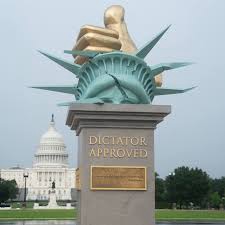
An anti-Trump statue has popped up on the National Mall in Washington. (Maxine Wallace/The Washington Post)
Remember the poop statue? The curly-swirly pile of doo that sat atop a replica of former House speaker Nancy Pelosi’s (D-California) desk? The work of protest art placed on the National Mall last October in mock tribute to the Jan. 6 rioters who stormed the U.S. Capitol in an attempt to overturn the 2020 election?
Well, the artists responsible for the political poo plop appear to have struck again. This time with a work called “Dictator Approved,” an 8-foot-tall sculpture showing a gold-painted hand with a distinctive thumbs-up quashing the sea foam green crown of the Statue of Liberty. It sits at the same location on the Mall near Third Street NW as the poop statue did last fall.
The artwork’s creators intended “Dictator Approved” as a rejoinder to the June 14 military parade and authoritarianism, according to a permit issued by the National Park Service. The parade, the creators wrote in the application, “Will feature imagery similar to autocratic, oppressive regime, i.e. N. Korea, Russia, and China, marching through DC.” The purpose of the statue, they continued, is to call attention to “the praising these types of oppressive leaders have given Donald Trump.”
Plaques on the four sides of the artwork’s base include quotes from world leaders including Russian President Vladimir Putin (“President Trump is a very bright and talented man.”), Hungarian Prime Minister Viktor Orban (“The most respected, the most feared person is Donald Trump.”), former Brazilian president Jair Bolsonaro (“We do have a great deal of shared values. I admire President Trump.”) and North Korea’s Kim Jong Un (“Your Excellency.” A “special” relationship. “The extraordinary courage of President Trump.”).
“If these Democrat activists were living in a dictatorship, their eye-sore of a sculpture wouldn’t be sitting on the National Mall right now,” Abigail Jackson, a White House spokeswoman, wrote in an emailed statement. “In the United States of America you have the freedom to display your so-called ‘art,’ no matter how ugly it is.”
Mary Harris is listed as the applicant for the permit but no contact information for her was provided. The permit allows the statue to be in place from 7 a.m. June 16 until 5 p.m. June 22.
The “Dictator Approved” statue is very similar in style and materials to the poop statue and several protest artworks placed in the District, Philadelphia and Portland, Oregon, last fall.
However, no individual or group has publicly claimed responsibility for those pieces. An unidentified caller and emailer told a Washington Post reporter last year that he was part of the group that worked on the sculptures and provided information about them that only someone who had installed the projects would know, such as when the statues would appear.
His identity remains a mystery. On Wednesday he replied to a Washington Post email asking if he was involved with the new statue. “I have heard about it but not me,” he wrote. He did not respond to additional questions or a request to meet in an Arlington parking garage.
Some of the tourists and locals who stopped by the statue between downpours Wednesday afternoon expressed surprise that it was allowed to be placed where it was. And they expressed reservations about weighing in on it publicly.
“I’m amazed that whoever dreamed this up could put this here,” said Kuresa, an 80-year-old from Australia who declined to give his last name because he said as an international visitor he didn’t feel comfortable expressing his views. “It reminds me of ‘Animal Farm.’”
Plaques on the sculpture’s base include quotes from Russian President Vladimir Putin, Hungarian Prime Minister Viktor Orban, former Brazilian president Jair Bolsonaro and North Korea’s Kim Jong Un. (Maxine Wallace/The Washington Post)
District resident and retired federal employee Yvette Hatfield stopped by with her dog Max, wearing an adorable raincoat and rain hat, to get a selfie of both of them in front of the statue. Asked why she wanted a photo, Hatfield laughed. “Because of my political views and that’s all I’m going to say.”
“I actually love it,” said another District resident. He declined to give his name because he said his parents and grandparents often told him “Fools’ names, like their faces, are always seen in public places.” He wished the reporter good luck with the story.
Francesca Carlo, 20, and Abigail Martin, 21, visiting from Cleveland, happened on the statue just before it started to pour.
“At first I was confused,” Martin said, “but then I figured it out. I think it’s beautiful.”
Carlo agreed. She thought the quotes on the plaques could send a message.
“If all these authoritarian politicians approve of our president then maybe people will see a pattern recognition and see where democracy is headed,” she said.
The Daily Beast wrote with amusement that the Trump-branded Kennedy Center in D.C. has listed its coming attractions, and several of them feature drag performers. This, despite Trump denouncing the previous management for permitting anything that included drag actors.
Some shows that were originally scheduled cancel to protest the Trump takeover, including “Hamilton” and the Alvin Ailey Dance Theater.
The new schedule includes one of Trump’s favorite shows, “Les Miserables.” You have to wonder whether he knows what the show is about.
But others have men playing women! Does he know?
The Daily Beast reported:
The Kennedy Center has announced its upcoming season lineup. For a theater that has supposedly banned performers wearing drag, its shows include an awful lot of men dressed as women.
When President Donald Trump purged the Kennedy Center’s bipartisan board of directors in February and took over as chairman of the new board, he announced an immediate ban on events featuring performers in drag.
“Just last year, the Kennedy Center featured Drag Shows specifically targeting our youth — THIS WILL STOP,” he wrote in a Truth Social post announcing a return to a “Golden Age in Arts and Culture” for the storied theater.
And yet the 2025-26 season announced Monday will include Chicago, Moulin Rouge! Mrs. Doubtfire, and Monty Python’s Spamalot, all of which typically feature performers in drag, The New York Times reported.

The entire plot of Mrs. Doubtfire revolves around a man dressing as an elderly woman in order to pose as a nanny and spend time with his children after he and his wife divorce.

Spamalot pokes fun at the medieval practice of male actors playing female parts with a number of drag bits.
In Chicago, a character named Mary Sunshine is typically a male soprano in drag whose wig is dramatically removed to emphasize a character’s assertion that things are “not always as they appear to be.”
And Moulin Rouge! features a literal drag queen named Baby Doll who is one of the courtesans performing alongside Satine at the Moulin Rouge cabaret.
Moulin Rouge and Chicago are sexually charged.
Trump said the new program would feature “family-friendly” shows. Hahahaha. I have seen all of these shows. Some of them are definitely NOT for children.
The American Academy of Arts and Sciences is the most distinguished scholarly organization in the nation. It is dedicated to the advancement of the arts and sciences. It is decidedly nonpartisan. I was elected to membership many years ago. AAAS rarely issues a statement. Its board did so in April because of unprecedented attacks on higher education, scholarly independence, and the rule of law.
A statement from the Board of Directors of the American Academy of Arts & Sciences.
Approved April 2025.
Since its founding in 1780, the AmericanAcademy of Arts and Sciences has sought “to cultivate every art and science which may tend to advance the interest, honor, dignity, and happiness of a free, independent, and virtuouspeople.” We do this by celebrating excellence in every field of human endeavor and by supporting the unfettered pursuit of knowledge and its application to the common good.
The Academy fosters nonpartisan, deliberative discourse on pressing issues facing our communities in the United States and the world.Our founders were also the founders of our nation. From them, we inherit a deep commitment to the practice of democratic self-governance. Our constitutional democracy has been imperfect, but almost 250 years since its inception, it remains an inspiration to peoplenear and far. Ours is a great nation because ofour system of checks and balances, separation of powers, individual rights, and an independent judiciary — as the Academy’s founder JohnAdams put it, “a government of laws, not of men.” And we are a great nation because we haveinvested in the arts and sciences while protecting the freedom that enables them to flourish.
These values are under serious threat today.Every president of the United States has the prerogative to set new priorities and agendas; nopublic or private institution is above criticism or calls for reform; and no reasoned arguments, from the left or the right, should be silenced. But current developments, in their pace, scale, and hostility toward institutions dedicated to knowledge and the pursuit of truth, have little precedent in our modern history.
We oppose reckless funding cuts and restrictions that imperil the research enterprise of our universities, hospitals, and laboratories, which contribute enormously to our prosperity, health, and national security. We condemn efforts to censor our scholarly and cultural institutions, to curtail freedom of the press, and to purge inquiry or ideas that challenge prevailing policies. We vigorously support the independence of the judiciary and the legal profession, and opposeactions and threats intended to erode thatindependence and, in turn, the rule of law.
In this time of challenge, we cherish theseprinciples and stand resilient against efforts to undermine them. The Academy will continue to urge public support for the arts and sciences, and also work to safeguard the conditions of freedom necessary for novel discoveries, creative expression, and truth-seeking in all its forms. We join a rising chorus of organizations and individuals determined to invigorate the democratic ideals of our republic and its constitutional values, and prevent our nation from sliding toward autocracy.
In the coming months and years, the Academy will rededicate itself to studying, building, and amplifying the practices of constitutional democracy in their local and national forms, with particular focus on its pillars of freedom of expression and the rule of law. We call on all citizens to help fortify a civic culture unwavering in its commitment to our founding principles.
Happy Easter!
Please open and listen. You will be astonished by these four young men, singing in a stairwell.
The group is called King’s Return.
For many readers, this is a holy day.
Reflect. Rest.
Think about how to take seriously Jesus’s teachings about kindness, mercy, love, compassion. Feed the hungry, comfort the afflicted, welcome the stranger.

 Diane Ravitch's blog