Archives for category: Accountability

Steve Hinnefeld writes on his blog School Matters that Republican legislators in Indiana want property taxes to pay for charter schools. This will mean budget cuts for public schools or higher property taxes.

Taxpayers in Indiana should be irate that their property taxes will bolster the bank accounts of for-profit charter chains like National Heritage Academies and Accel.

I remember when the idea of charter schools was first discussed in the 1980s. The promise of charter advocates (and I was one at the time) was that they would be more accountable than public schools; that they would cost less than public schools; and they would have higher test scores than public schools. In the more than three decades since the first charter schools opened, the public has learned that none of those promises came true.

Charter schools on average do not produce higher test scores than public schools, unless they choose their students with care. Many charter schools—in states like Ohio—perform far worse than public schools. They are less accountable than public schools because they have private boards that answer to no one. Their finances are usually opaque since they are not subject to the same budgetary oversight as public schools. And now we know that they do not cost less than public schools; they want the same funding as public schools, and many are subsidized by outside philanthropists. And, unlike public schools, charter schools close with high frequency and little warning. They destabilize communities. And that is why I no longer support charter schools.

Steve Hinnefeld writes:

Indiana legislators are considering a significant change in Indiana school finance that would, for the first, time, require public school districts to share local property tax revenue with charter schools.

Senate Bill 398 is set for a hearing Tuesday in the Tax and Fiscal Policy Committee. A similar bill in the House hasn’t yet been scheduled for a hearing, but probably will be. House Bill 1607 goes further than SB 398 by also requiring school districts to share referendum funding with charter schools.

SB 398, authored by Sen. Linda Rogers, R-Granger, would require school districts to share revenue from their property tax-supported operations funds with charter schools. The money would be allocated according to the number of students who live in the school district and attend charter schools.

The measures follow a public advocacy campaign that may have pushed the issue of charter school funding onto lawmakers’ agendas. The campaign, which included TV and social media ads, focused on differences in funding between Indianapolis Public Schools and charter schools.

The bill would also make districts share property taxes with nearby public school districts to which their students transfer.

Under Indiana’s current school finance system, the state provides comparable per-pupil funding to district and charter schools. But districts can also levy local property taxes to pay off debt and for their operations funds, which pay for facility construction and maintenance and for transportation. The state gives charter schools an extra $1,250 per pupil to compensate for their lack of property taxes.

A Legislative Services Agency analysis says SB 398 would shift nearly $70 million a year from school districts to charter schools after a three-year phase-in. The biggest impact would be in Indianapolis and Gary, where more students attend charters or transfer than attend district schools.

Advocates for charter schools argue their students deserve the same funding as students who attend district schools. However, charter schools aren’t subject to the same requirements as district schools and aren’t overseen by elected school boards. It’s rare in Indiana for voters to have no local election mechanism to influence how their property taxes are spent.

The campaign for more charter school funding highlighted the difference in per-pupil funding between IPS schools and Indy charter schools that aren’t affiliated with the district. The ads were “endorsed” by the Indiana Student Funding Alliance, whose website has no contact information or details about who or what it is.

According to Facebook’s ad library, the ads on the platform were paid for by the Institute for Quality Education, an Indianapolis nonprofit that advocates for charter schools and private school vouchers. The group’s political action committee, Hoosiers for Quality Education, is a major donor to Republican politicians. In 2022, it gave $22,500 to Behning’s campaign and $5,500 to Rogers’ campaign.

Open the link and finish reading.
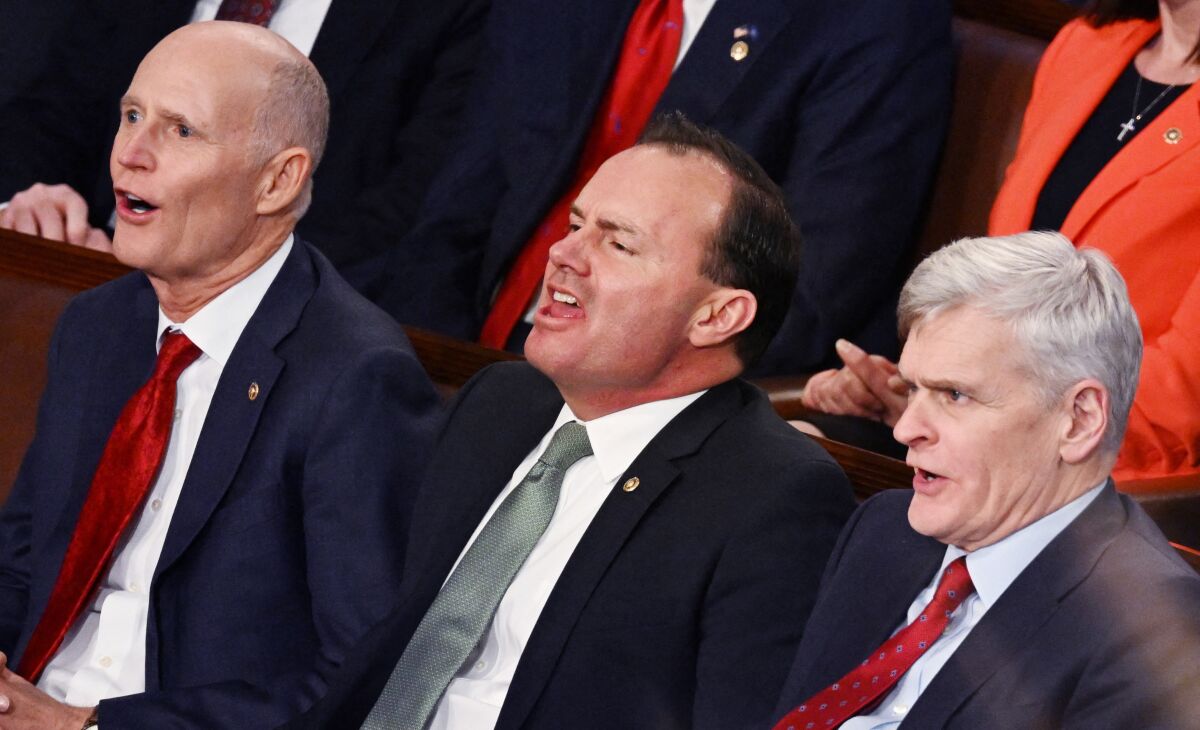
During President Biden’s State of the Union address, he said that Republicans want to cut Social Security and Medicare, and the Republican side of the chamber erupted in jeers and shouts of “liar!” Two of those loudly jeering—Senators Rick Scott of Florida and Mike Lee of Utah—had explicitly made those proposals. Biden then masterfully got the Republican caucuses in both Houses to declare their support for both big entitlement programs.

Michael Hiltzik, business columnist for the Los Angeles, sets the record straight about the Republican stance on Social Security.

From left, U.S. Sens. Rick Scott and Mike Lee jeer.

From left, GOP Sens. Rick Scott of Florida and Mike Lee of Utah jeer during the State of the Union address when President Biden accused Republicans of wanting to cut Social Security. Both senators have proposed exactly that.

(Andrew Caballero-Reynolds / AFP/Getty Images)

Hiltzik writes:

President Biden has congressional Republicans all asquirm as he conducts a post-State of the Union speech national tour.

Why? Because Biden has doubled down — or as Fox News has it, “tripled down” — on his assertion during the speech that the GOP has been planning to cut Social Security.

Not so, they say. Never happened. Sens. Mike Lee (R-Utah) and Rick Scott (R-Fla.) were even caught on camera during the speech wearing “Who, me?” expressions of injured innocence.

It will be my objective to phase out Social Security, to pull it out by the roots.

— Sen. Mike Lee (R-Utah), during his 2010 campaign for the Senate

Unfortunately for them, we have the evidence, as does Biden. Cutting Social Security along with Medicare has been part of the Republican platform for decades.

As I’ve reported before, they often hide their intentions behind a scrim of impenetrable jargon, plainly hoping that Americans won’t do the necessary math to penetrate their subterfuge.

Let’s take a jaunt through the GOP approach to Social Security and Medicare.

Start with their description of these programs as “entitlements,” which they’ve tried to turn into a dirty word. The truth is that they are entitlements, in the sense that most Americans have been paying into these programs for all their working lives, mostly through the payroll tax. So, yes, they’re “entitled” to receive benefits in return.

Republicans, including former Senate Majority Leader Mitch McConnell (R-Ky.), have consistently blamed the federal debt on “entitlements” — never mind that their 2017 tax cut for the wealthy has blown a multitrillion-dollar hole in the budget.

They know they’re on thin ice with the public when they talk about benefit cuts, which is why Sen. Joni Ernst (R-Iowa) once recommended discussing their ideas only “behind closed doors.”

Now we can turn to the specifics of Lee’s and Scott’s plans. In widely circulated videos from Lee’s first successful Senate campaign in 2010 he can be seen and heard stating as follows: “It will be my objective to phase out Social Security, to pull it out by the roots.” He said that was why he was running for the Senate, and added, “Medicare and Medicaid are of the same sort. They need to be pulled up.”

As for Scott, his 12-point “Rescue America” plan, issued last year, included a proposal to sunset all federal legislation after five years. “If a law is worth keeping, Congress can pass it again.” The implications for Social Security and Medicare, which were created by federal legislation, were unmistakable — so much so that the proposal made Republican officeholders’ skin crawl.

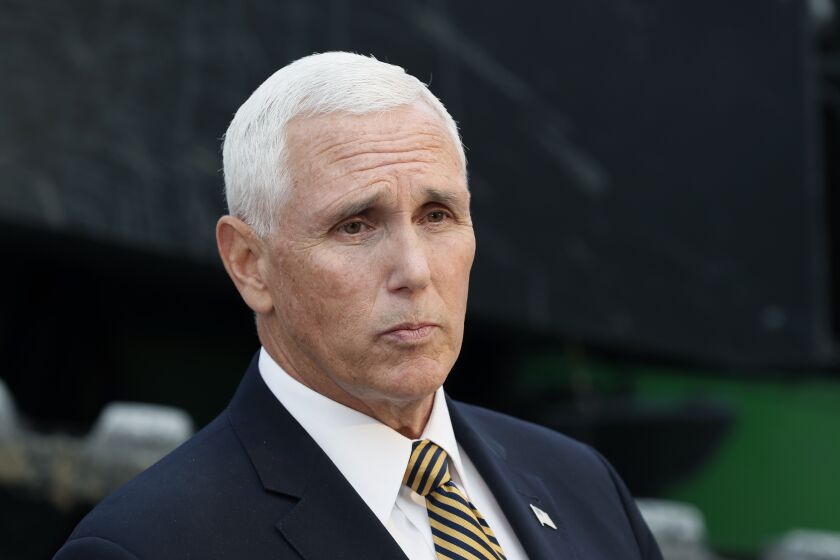
Vice President Mike Pence speaks to reporters during a visit to the Manning Farms, Wednesday, Oct. 9, 2019, in Waukee, Iowa. (AP Photo/Charlie Neibergall)

Column: Mike Pence, would-be president, has a plan to kill Social Security. It will cost you

McConnell disavowed the proposal on the spot and has continued to do so, telling a home-state radio host after the Biden speech that the sunset provision is “not a Republican plan.That was the Rick Scott plan.”

That said, it’s a priceless foil for Biden. When Republicans brayed during his speech that he was lying about it, he offered to make Scott’s manifesto available to anyone who called his office for it. At one of his subsequent appearances, a copy of Scott’s plan was placed on every seat.

The GOP can’t easily wriggle away from its intentions. Let’s examine the fiscal 2023 budget proposal issued by the Republican Study Committee, a key policy body, last June under the title “Blueprint to Save America.”

This plan would increase the Social Security full retirement age, which today is 66 or 67 (depending on one’s year of birth), to 70 by 2040. According to Kathleen Romig, the Social Security expert at the Center on Budget and Policy Priorities, this would translate into a 20% cut in lifetime benefits compared with current law.

As I’ve reported before, raising the full retirement age is a Trojan horse that would affect all retirees across the board, but harm Black workers, lower-income workers and those in physically demanding jobs the most.

It would create particular hardships for those choosing to retire early and collect their benefits prior to their full retirement age.

Doing so exacts a lifetime reduction in monthly benefits, based on a formula aimed at equalizing the lifetime benefit among those who retire early, those who wait until their full retirement age, and those who defer collecting until that age (they receive a bump-up in benefits for every year they delay, topping out at age 70).

Raising the full retirement age to 70, Romig calculates, would mean that retirees who start collecting at the minimum age of 62 would receive only 57% of their full benefit….

The Republican Study Committee also would make it harder for disabled workers to qualify for benefits, and would lengthen the period before those who are disabled and younger than 65 qualify for Medicare to five years from two. This falls into the category of balancing the budget on the backs of the most vulnerable members of society.


As for Medicare, the Republican Study Committee proposes raising the eligibility age, currently 65, so it matches the Social Security retirement age. It also would transfer many more Medicare accounts to private insurance. The committee claims this would save money.

The rest of his incisive analysis is behind a paywall, unfortunately. He demonstrates beyond doubt that Republicans have wanted for years to put these big programs on the chopping block, which are lifelines for senior citizens. They have no objections, however, to cutting the taxes of the wealthiest. That was Trump’s biggest accomplishment: tax cuts for those with the most.

The Texas Observer published a warning to the Texas legislature: Take a close look at the Arizona voucher programs. Don’t go there. Vouchers subsidize private school students while defunding the public schools that still enroll the vast majority of the state’s students.

Like many other typical teenagers, James’ favorite periods in school are P.E. and lunch. During our phone call, he turned the tables on me, politely asking about my children and work. A 15-year-old student who was born with a tumor and has autism, James actively seeks engagement with others, especially his peers. But for two years, he learned at home in isolation. Arizona’s voucher educational savings account program, called the Empowerment Scholarship Account (ESA), granted him $40,000 of public funds to pay private school tuition. But even with that money, private school after private school denied him admission.

“They first demanded all his files, his IEPs [Individualized Education Plan for students with special needs], but before they would grant an interview, they would give some excuse why his needs could not be met there,” James’ mom Pamela Lang said. “Some gave interviews and tours, and James would get excited. But then they would decline admittance saying they could not accommodate him.”

After every single Phoenix, Arizona Catholic school and a slew of secular private schools rejected James, Lang was finally able to find a school to address his needs. But now, she fears there won’t be enough state funds in the future to afford its costly tuition.

What started in Arizona in 2011 as a $2.5 million state voucher program for students with special needs has now ballooned to a universal voucher program for all of the state’s students, public or private.

“The state said the voucher was for kids with disabilities but it was just a way in to open the door,” Lang said. “Every single year since the state got the ESA, they just kept expanding it to more and more people, and now, it’s for everybody. We’re just hoping kids with disabilities aren’t going to have nothing left for them.”

In the first quarter of this school year, Arizona already blew through $300 million, awarding 80 percent of the funds predominantly to wealthy students already enrolled in private schools. This will leave a projected $4 million debt in the state’s education budget at the end of the 2022-2023 school year, a debt that public school advocates fear will deplete public school funds further.

Critics say Arizona used vouchers for special needs students as a trojan horse for school privateers to divest, divert, and dismantle the state’s public education system, which now ranks in the bottom three among all U.S. states for per-pupil spending, teacher retention, and teacher pay.

Texas lawmakers are now poised to follow Arizona’s lead. But parents in Arizona are warning Texans to take heed. Their stories are a cautionary tale for our state, which plans during this legislative session to use special needs students to usher in multiple voucher programs.

Arizona’s voucher programs—and the Texas proposals—include both a universal education savings account and a tax-credit scholarship program, both of which would divert public education money from state coffers to enrich private schools, corporations, and wealthy families.

DIVEST

The country’s first public school education savings account started in Arizona in 2011. The ESA directly appropriates public education money and deposits it into an individual savings account or debit card for parents to use for private school tuition, tutoring, homeschooling, or therapy.

In its first year, $2.5 million of Arizona’s ESA money was directed toward students with special needs. But in subsequent years, expenditures and eligibility for the ESA program expanded to include children attending public schools that received a D or F rating, children in military families, in foster care, and on Native American reservations. Then in 2017, legislators attempted to pass universal vouchers for all students. The proposal was beaten back twice by public school advocates but passed in 2022.

Since its inception, Arizona’s ESA program has stripped more than $963 million from public school funds.

Texas House Bill 557, filed by Representative Cody Vasut, is a universal voucher program from the get-go. It would enable an unlimited number of students to receive reimbursements for up to $10,000 in private school tuition, the full per-pupil allotment in Texas. If all 309,000 private school students in Texas decided to apply for a voucher under this bill, public schools could lose $3 billion in state funding after one year alone. The impact could bankrupt a system in Texas which already ranks in the bottom 10 states in per-pupil funding.

Beth Lewis, director of Save our Schools Arizona, warns Texans that such a voucher program never gives back as much as it robs from public education.

“They sell it under the guise that the money’s following the child,” Lewis said. “But if you were already in a private school or a homeschool situation, that money’s not following you. It’s never been allocated to you. So in reality, it’s a subtraction from a student in the public school. Then, you’re never going to have an equitable system where every kid can access quality education.”

Besides the education savings account program, Arizona has a second type of voucher program that directly funnels public money to private schools—the tax credit scholarship program.

Open the link and read the rest of this important article. Vouchers are a reverse Robin Hood program: they take from everyone to pay the tuition of students already enrolled in private schools. As Professor Josh Cowennof Michigan State University has shown, kids who leave public schools to use vouchers fall behind their peers who remained in public school.

Heather Cox Richardson’s post includes a story that has been under-reported about the train derailment in East Palestine, Ohio, that released massive toxic fumes. The Trump administration repealed an Obama regulation that imposed braking rules on trains carrying toxic materials. The trail industry lobbied to kill the regulation.

She writes:

President Joe Biden hit the road today to continue the push to highlight the successes of his administration’s investment in the economy. In Lanham, Maryland, at the International Brotherhood of Electrical Workers (IBEW) Local 26, he celebrated the economic plan that “grows the economy from the bottom up and the middle out, not the top down.”

He praised union labor and said that the nation’s investment in green energy would mean “good-paying jobs for electricians, plumbers, pipefitters, laborers, carpenters, cement masons, ironworkers, and so much more. And these good jobs you can raise a family on.” “It’s a stark contrast to our Republican friends, who are doubling down on the same failed politics of the past. Top-down, trickle-down economics is not much trickle down…to most kitchen tables in America,” he said.

He reiterated that he would lay out his budget on March 9 and that he expected the Republicans to lay out theirs, so people can compare the two. Biden maintains that his policy of investing in infrastructure and putting money in the hands of ordinary Americans will nurture the economy and reduce the deficit as growth brings in more tax dollars. Meanwhile, he said, the Republican tax cut of 2017 has already added $2 trillion to the federal deficit.

Good economic news is putting wind under Biden’s wings. The economy continues to perform better than expected in 2023. Retail buying increased 3% in January, and the job market remains strong. The administration today highlighted another series of large private sector investments in American manufacturing: Boeing announced that Air India has contracted to buy more than 200 aircraft; Ford announced it will build a $3.5 billion factory in Marshall, Michigan, to make advanced batteries for electric vehicles; and Texas Instruments announced it will build an $11 billion semiconductor plant in Lehi, Utah.

Biden emphasized that these investments would provide “good-paying jobs that [Americans] can raise a family on, the revitalization of entire communities that have often been left behind, and America leading the world again in the industries that drive the future.”

Biden accused the Republicans of proposing measures that would raise the deficit, which is already rising again. The Congressional Budget Office today projected a much higher deficit for 2023 than it did in May 2022 because of new laws, mandatory spending for Social Security and Medicare, and higher interest rates in place to combat inflation. The CBO notes that “spending substantially exceeds revenues in our projections even though pandemic-related spending lessens. In addition, rising interest rates drive up the cost of borrowing. The resulting deficits steadily increase the government’s debt. Over the long term, our projections suggest that changes in fiscal policy must be made to address the rising costs of interest and mitigate other adverse consequences of high and rising debt.”

This is precisely what Republicans have been complaining about with regard to the Democrats’ recent laws to rebuild infrastructure and invest in the economy, while ignoring that their own tax cuts have also added mightily to the deficit. Republicans want to address the rising deficit with spending cuts; Biden, with taxes on wealthy Americans and corporations.

Biden appears to be trying to turn the nation to a modern version of the era before Reagan, when the government provided a basic social safety net, protected civil rights, promoted infrastructure, and regulated business. Since the 1980s, the Republicans have advocated deregulation with the argument that government interference in the way a company does business interrupts the market economy.

But the derailment of fifty Norfolk Southern train cars, eleven of which carried hazardous chemicals, near East Palestine, Ohio, near the northeastern border of the state on February 3 has powerfully illustrated the downsides of deregulation. The accident released highly toxic chemicals into the air, water, and ground, causing a massive fire and forcing about 5,000 nearby residents in Ohio and Pennsylvania to evacuate. On February 6, when it appeared some of the rail cars would explode, officials allowed the company to release and burn the toxic vinyl chloride stored in it. The controlled burn sent highly toxic phosgene, used as a weapon in World War I, into the air.

Republican Ohio governor Mike DeWine has refused federal assistance from President Biden, who, he said, called to offer “anything you need.” DeWine said he had not called back to take him up on the offer. “We will not hesitate to do that if we’re seeing a problem or anything, but I’m not seeing it,” he said.

Just over the border, Pennsylvania governor Josh Shapiro, a Democrat, said that Norfolk Southern had botched its response to the accident. “Norfolk Southern has repeatedly assured us of the safety of their rail cars—in fact, leading Norfolk Southern personnel described them to me as ‘the Cadillac of rail cars’—yet despite these assertions, these were the same cars that Norfolk Southern personnel rushed to vent and burn without gathering input from state and local leaders. Norfolk Southern’s well known opposition to modern regulations [requires] further scrutiny and investigation to limit the devastating effects of future accidents on people’s lives, property, businesses, and the environment.”

Shapiro was likely referring to the fact that in 2017, after donors from the railroad industry poured more than $6 million into Republican political campaigns, the Trump administration got rid of a rule imposed by the Obama administration that required better braking systems on rail cars that carried hazardous flammable materials.

According to David Sirota, Julia Rock, Rebecca Burns, and Matthew Cunningham-Cook, writing in the investigative journal The Lever, Norfolk Southern supported the repeal, telling regulators new electronically controlled pneumatic brakes on high-hazard flammable trains (HHFT) would “impose tremendous costs without providing offsetting safety benefits.” Railroads also lobbied to limit the definition of HFFT to cover primarily trains that carry oil, not industrial chemicals. The train that derailed in Ohio was not classified as an HHFT.

Nonetheless, Ohio’s new far-right Republican senator J. D. Vance went on the Fox News Channel show of personality Tucker Carlson to blame the Biden administration for the accident. He said there was no excuse for failing infrastructure after the passage last year of the Bipartisan Infrastructure Bill, and said that the administration is too focused on “environmental racism and other ridiculous things.” We are, he said, “ruled by unserious people.”

He also issued a statement saying that “my office will continue to work with FEMA” over the issue, although FEMA, the Federal Emergency Management Agency, has not been mobilized because Ohio governor DeWine has not requested a federal disaster declaration.

—

Notes:

https://www.whitehouse.gov/briefing-room/speeches-remarks/2023/02/15/remarks-by-president-biden-on-the-economy-7/

https://www.cnn.com/2023/02/15/politics/biden-maryland-economy-speech/index.html

https://www.bloomberg.com/news/articles/2023-02-15/us-economy-keeps-charging-ahead-adding-pressure-on-fed-to-hike

https://www.whitehouse.gov/briefing-room/statements-releases/2023/02/15/icymi-biden-boom-continues-another-week-of-massive-private-sector-investments-in-american-manufacturing/

https://www.cbo.gov/publication/58940

https://www.washingtonpost.com/nation/2023/02/04/east-palestine-ohio-train-derailment/

https://www.washingtonpost.com/climate-environment/2023/02/15/ohio-train-derailment-toxic-chemicals/

https://apnews.com/article/biden-politics-district-of-columbia-us-republican-party-kevin-mccarthy-744d501534e43e8823fee135faf6d46e

https://www.nbcnews.com/politics/2024-election/biden-escalates-fight-social-security-medicare-frustrating-republicans-rcna70104

https://www.foxnews.com/us/ohio-skyline-lit-up-fireball-black-plumes-smoke-toxic-chemicals-released-derailed-train

https://www.levernews.com/rail-companies-blocked-safety-rules-before-ohio-derailment/

https://www.newsweek.com/donald-trump-blame-ohio-train-derailment-1781163

https://www.theguardian.com/us-news/2023/feb/11/ohio-train-derailment-wake-up-call

https://www.marketwatch.com/story/ohios-dewine-says-he-has-not-taken-up-biden-on-offer-of-anything-you-need-in-wake-of-train-derailment-disaster-adf4c949

https://www.cleveland.com/news/2023/02/sen-sherrod-brown-blasts-trump-administration-for-rail-safety-cuts-after-ohio-derailment.html

https://www.axios.com/2023/02/15/cbo-deficit-debt-ceiling-2023


Mimi Swartz, a writer for the Texas Monthly, explored the background, the funders, and the consequences of the well-coordinated campaign to privatize public schools—by defaming them and discrediting those who run for local school board seats. She focuses on the travails of one dedicated school board member, Joanna Day in Dripping Springs, Texas, who contended with insults and threats in her life.

The following is a small part of a long article, which I encourage you to read in full:

The motivations for these attacks are myriad and sometimes opaque, but many opponents of public education share a common goal: privatizing public schools, in the same way activists have pushed, with varying results, for privatization of public utilities and the prison system. Proponents of school privatization now speak of public schools as “dropout factories” and insist that “school choice” should be available to all. They profess a deep faith in vouchers, which would allow parents to send their children not just to the public schools of their choice but to religious and other private schools, at taxpayers’ expense.

But if privatizing public education is today cloaked in talk of expanded liberty, entrepreneurial competition, and improved schools for those who need them most, its history tells a different story. In 1956, two years after the U.S. Supreme Court handed down its landmark Brown v. Board of Education decision, a group of segregationist legislators in Texas, with support from retiring governor Allan Shivers, began concocting work-arounds for parents appalled by the prospect of racial integration of public schools. One idea: state-subsidized tuition at private schools. That never came to pass, but it was Texas’s first flirtation with vouchers.

Privatization proponents have since switched up their rhetoric, pitching vouchers as an opportunity for poor urban families to save their children from underperforming neighborhood schools. That hasn’t worked out either. In various experiments across the nation, funding for vouchers hasn’t come close to covering tuition costs at high-quality private schools, and many kids, deprived of the most basic tools, haven’t been able to meet the standards for admission.

School funding in Texas is based largely on attendance—as the saying goes, the money follows the child. Considerable evidence suggests that vouchers would siphon money from underfunded public schools and subsidize well-to-do parents who can already afford private tuition. Critics frequently cite a program in Milwaukee, where four out of ten private schools created for voucher students from 1991 to 2015 failed.

“I don’t think that vouchers serve any useful purpose at all,” said Scott McClelland, a retired president of H-E-B who now chairs Good Reason Houston, an education nonprofit. Ninety-one percent of Texas students attend public schools. “There isn’t enough capacity in the private school network to make a meaningful difference in their ability to serve economically disadvantaged students in any meaningful numbers, and it will divert funding away from public schools.”

In Texas, an unusual alliance of Democratic and rural Republican leaders has for decades held firm against voucher campaigns. The latter, of course, are all too aware that private schools aren’t available for most in their communities and that public schools employ many of their constituents. But the spread of far-right politics and the disruption of public schools during the pandemic created an opening for activists to sow discontent and, worse, chaos. “If they can make the public afraid of their public school, they will be more likely to support privatizing initiatives. Then that puts us back to where we used to be with segregation of public schools,” says former Granbury school board member Chris Tackett, who, with his wife Mendi, has become an outspoken advocate for public education and a relentless investigator of the attempts to undermine it.

They have their work cut out for them. In the past, just a few right-wing legislators pushed for privatization and were routinely ignored. After all, the state constitution spelled out “the duty of the Legislature of the State to establish and make suitable provision for the support and maintenance of an efficient system of public free schools.” But as times have changed, so has the interpretation of that guarantee.

Betsy DeVos, President Donald Trump’s former Education Secretary, set up shop in Dallas with her American Federation for Children to push against “government schools” in favor of “school choice.” Political PACs such as Patriot Mobile Action, an arm of a Christian wireless provider in North Texas, continue pouring millions into school board races and book bans to promote more religious education. Patriot has joined other recently formed PACs with inspirational names such as Defend Texas Liberty and Texans for Excellent Education, all of which supposedly support better public schools but are actually part of the privatization push. But by far the most powerful opponents of public schools in the state are West Texas oil billionaires Tim Dunn and the brothers Farris and Dan Wilks. Their vast political donations have made them the de facto owners of many Republican members of the Texas Legislature through organizations such as the now dissolved Empower Texans and the more recent Defend Texas Liberty, which the trio uses to promote restrictions on reproductive rights, voter access, and same-sex marriage. Almost as influential is the Texas Public Policy Foundation, where Dunn is vice board chair.

A November 2021 TPPF fund-raising letter, sent to supporters in advance of the Eighty-eighth Legislature convening, argued that “public education is GROUND ZERO” in the fight for freedom. “The policy team and board of the Texas Public Policy Foundation (TPPF) believe it is now or never,” it read, signaling that the long-standing and robust alliance against vouchers was unusually vulnerable. “The time is ripe to set Texas children free from enforced indoctrination and Big Government cronyism in our public schools.” The letter went on to herald a $1.2 million “Set the Captives Free” campaign to lobby legislators to save Texas schoolchildren from “Marxist and sexual indoctrination” funded by “far-Left elites for decades.”

Lieutenant Governor Dan Patrick, generously backed by Dunn, the Wilks brothers, and their organizations, has long been a proponent of privatizing public education (and of starving it through reductions in property taxes). He has made vouchers a primary legislative goal of the current session. Mayes Middleton, of Wallisville, a Republican state senator and former chair of the TPPF-aligned Texas House Freedom Caucus, filed a bill to create the “Texas Parental Empowerment Program,” proposing education savings accounts that are essentially a form of vouchers. Representative Matt Shaheen, of Plano, who is a member of the Texas Freedom Caucus, has introduced a measure that would guarantee state tax credits for those who donate to school-assistance programs—such as scholarships for kids wishing to go to private schools.

Governor Greg Abbott, knowing all too well the political headwinds that vouchers have faced, has long been wary of publicly supporting them, so he has undermined public schools in other ways. While campaigning early last year, he promised to amend the Texas constitution with a “parental bill of rights,” even though most, if not all, of those rights already existed. By then, “parental rights” had become a dog whistle to animate opponents of public education. (As the Texas Tribune put it: “Gov. Greg Abbott taps into parent anger to fuel reelection campaign.”)

During the recent intensifying crisis on the border, Abbott publicly floated a challenge to the state’s constitutional obligation to give all Texas children, including undocumented ones, a publicly funded education—a step his Republican predecessor, Rick Perry, had denounced years earlier as heartless. Then last spring, Abbott made headlines with his first full-throated public endorsement of a voucher program.

So here we are, with distrust in public schools advancing as fast as the latest COVID-19 variant. The forces behind the spread of this vitriol are no mystery. Those who would destroy public schools have learned to apply three simple stratagems: destabilize, divide, and, if that doesn’t work, open the floodgates of fear

In 2009, the Atlanta Journal-Constitution scrutinized test score gains in the city’s public schools and discovered a number of schools where the gains seemed improbable. The story triggered intense scrutiny by the Georgia Bureau of Investigation. Eventually nearly three dozed educators were charged with changing answers on the standardized tests from wrong to right in hopes of winning a bonus and pleasing their superintendent Dr. Beverly Hall, who put pressure on all teachers to raise scores or be humiliated.

During Beverly Hall’s tenure, the Atlanta district was celebrated for its miraculous test score gains, and she won recognition as Superintendent of the Year. She was the poster educator supposedly proving the “success” of No Child Left Behind. What she actually proved was that NCLB created perverse incentives and ruined education.

The facade of success came tumbling down with the cheating scandal.

After the investigation, Beverly Hall was indicted, along with 34 teachers, principals, and others. All but one of those charged is black. Many pleaded guilty. Ultimately, 12 went to trial. One was declared innocent, and the other 11 were convicted of racketeering and other charges. Beverly Hall died before her case went to trial.

The case was promoted by then-Governor Sonny Perdue. Ironically, the rise in Atlanta’s test scores was used by the state of Georgia to win a $400 million Race to the Top award.

One of those who was punished for maintaining her innocence was Shani Robinson, who was a first-grade teacher. She is the co-author with journalist Anna Simonton of None of The Above: The Untold Story of the Atlanta Public Schools Cheating Scandal, Corporate Greed, and the Criminalization of Educators.

I reviewed their book on the blog. While reading her book, I became convinced that Shani was innocent. As a first-grade teacher, she was not eligible for a bonus. Her students took practice tests, and their scores did not affect the school’s rating. Yet she was convicted under the federal racketeering statute for corrupt activities intended to produce financial gain. The Racketeer Influenced and Corrupt Organizations Act (RICO), was written to prosecute gangsters, not school teachers. Her conviction was a travesty.

Investigators offered Shani and other educators a deal: Plead guilty and you can go free. Or, accuse another teacher and you can go free. She refused to do either. She maintained that she was innocent and refused to accuse anyone else. Shani was accused by a teacher who won immunity. Despite the lack of any evidence that she changed scores, she was convicted.

Two Atlanta lawyers wrote a blog post in 2020 describing the Atlanta cheating trial as a legal outage:

The Atlanta Public Schools (APS) “cheating” scandal is a textbook example of overcriminalization and prosecutorial discretion gone amok, compounded by an unjust sentence of first-time offenders to serve years in prison. It is a glaring illustration of a scorched-earth prosecutorial mindset that has sparked a movement of reform-minded prosecutors nationwide — one which has yet to be embraced in Atlanta.

Just this past week, the six remaining educators who have insisted on their innocence went before the same judge who found them guilty. Their public defender asked to be excused from the case because he thought it was a conflict of interest to represent all six defendants. The original prosecutor, Fani Willis, continues to believe the six educators should be imprisoned. Willis is now prosecuting the case of whether former President Trump interfered in Georgia’s election in 2020.

The six educators who insist they are innocent have lived in a state of suspended animation for more than a decade. They have not gone to prison, yet. They have lost their reputations, their jobs, their teaching licenses.

They hoped that Judge Baxter might use the hearing to dismiss their case. Shani asked me to write a letter supporting her. I did.

It didn’t matter. Judge Baxter decided that the defendants should get a new public defender and return for another hearing. The case has already cost millions of dollars and is the longest-running trial in the history of the state.

The judge ordered them to return to court with their new lawyers or public defenders on March 16. At that time, the entire appeals process might start again and take years to conclude.

I contacted my friend Edward Johnson in Atlanta to ask him what he thought. Ed is a systems thinker and a sharp critic of the Atlanta Public Schools‘ leadership, which is controlled by corporate reformers who make the same mistakes again and again instead of learning from them.

Ed wrote me:

Prosecuting teachers and administers was morally wrong to begin with. Continuing to prosecute any of them is doubly morally wrong. Teachers and administers were the real victims of Beverly Hall. So prosecuting them means being willfully blind to ever wanting to learn truths about anything that would help Atlanta avoid doing a Beverly Hall all over again.

I agree.

Ron DeSantis didn’t like the College Board claiming that Florida was putting political pressure on the testing company to revise the AP African American Course. He didn’t like their lame attempt to stand up to his bullying. So he let it be known in public that Florida was thinking of replacing the College Board with other vendors.

Normally, the anti-testing organizations would have cheered his stance against the tests. But he made clear that he was looking for other tests.

Tens of thousands of Florida high school students take Advanced Placement courses every year to have a competitive edge heading into college.

Now, Gov. Ron DeSantis says he wants to reevaluate the state’s relationship with the private company that administers those courses and the SAT exam.

The move comes after the College Board accused DeSantis’ administration of playing politics when it rejected an Advanced Placement African American Studies course.

“This College Board, like, nobody elected them to anything,” DeSantis said at a news conference Monday in Naples. “They are just kind of there, and they provide a service and so you can either utilize those services or not.”

While DeSantis acknowledged the College Board has long had a relationship with the state, he said “there are probably other vendors who may be able to do that job as good or maybe even a lot better.”

Florida has long had a strong connection with the College Board. The state pays for students to take Advanced Placement exams, and provides bonuses to teachers whose students perform well.

In 2021, nearly 200,000 Florida teens sat for more than 366,000 tests, for which they can earn college credit. It had the fifth-highest rate of tests taken per 1,000 students in the nation.

The College Board also administers the SAT exam, which students may use to help them complete graduation testing requirements, earn entry into universities and become eligible for Bright Futures scholarships.

If the state were to move away from the College Board, other options exist. Students seeking advanced courses leading to college credits have International Baccalaureate, Cambridge Programme and dual enrollment classes available.

They also can take the ACT exam instead of the SAT.

DeSantis has not provided details as to exactly how the College Board’s relationship with the state could be impacted but said he has started talking to House Speaker Paul Renner about the matter. “I’ve already talked to Paul, and I think the Legislature is going to look to evaluate how Florida is doing that,” DeSantis said.

“Of course, our universities can or can’t accept College Board courses for credit, maybe they’ll do others. And then also just whether our universities do the SAT versus the ACT. I think they do both but we are going to evaluate how the process goes.”

No one from the College Board was immediately available for comment.

What tests do students take if they are not Christian?

Read more at: https://www.miamiherald.com/news/local/education/article272474953.html#storylink=cpy

Carol Burris is the executive director for of the Network for Public Education. in this post, which she wrote exclusively for the blog, she reveals the details of Arkansas Governor Sarah Huckabee Sanders’ plan to defund and destroy the public schools in her state.

Burris writes:

Sarah Huckabee Sanders, the daughter of Baptist minister and former Governor Mike Huckabee, missed learning the 9th commandment that prohibits telling a lie. As press secretary to Donald Trump, her distortions of the truth resulted in the editor of Forbes warning corporations against hiring Sanders and other Trump “propagandists,” writing, “Forbes will assume that everything your company or firm talks about is a lie.”


Now she is the Governor of Arkansas. On her first day in office and in her response to Biden’s State of the Union, she parroted the old “education is the civil rights issue of our time” line that has been used to justify horrible policies from school closures to charter schools and vouchers. However, the disconnect between what she says and what she does quickly became apparent. On her first day in office, she issued an executive order prohibiting “indoctrination and critical race theory in schools” and another banning the term “Latinx” from being used in state documents. State authorities are investigating AP African American Studies at Little Rock Central High School, where the majority of students are Black.

If we need further proof that this self-proclaimed champion of Civil Rights is more aptly described as a champion of Civil Wrongs, look at her recently leaked ed reform plan.

Here are its features:


The Privatization of Public Education:

· Her voucher plan is a universal ESA—the plan now favored by the far-right. These plans have few rules and no family eligibility requirements. They have become Entitlement Spending Accounts–cash going into the pockets of private school families regardless of income. The leaked plan does not say how taxpayers will pay for it. But everyone will be eligible by 2025. It includes Voucher funding for homeschools. The only restrictions will apply to vendors, so those who enroll their children in those recently uncovered Neo-Nazi homeschools can find ways to cash in.

· Increased tax credits for contributions to an existing voucher program.

· Local School Boards can contract with an open-enrollment charter school or private company to run a school campus at risk of state takeover due to low performance—and if they do, they get a financial incentive.

· Establishment of a charter-school construction fund for new charters and expansion.

· Elimination of the cap on charters.

· Charter school applications no longer need to be reviewed and approved by the local school district board of directors.

· All students attending a public school can take courses and earn credit for classes not offered in their school. By the beginning of the 2025-2026 school year, students attending a public school that receives a letter grade of “C”, “D”, or “P” from the Arkansas School and District Accountability System may take their required courses (i.e. math, English, etc.) through the course choice program. Bet your bottom dollar that these courses will be online, with vendors like Stride K12 making a fortune.

Censoring and Controlling Curriculum

· K-3 literacy evaluation will be aligned with the “science of reading.”

· Before grade 5, teachers cannot provide classroom instruction on the following topics: sexually explicit materials, sexual reproduction, sexual intercourse, gender identity, and sexual orientation.

· School districts must implement an age-appropriate child sexual prevention program for grades K-12, allowing parents to preview materials and exempt their children from instruction. (I have no idea what a child sexual prevention program even is.)

· The Secretary of Education will review the Department of Education regulations, policies, materials, and communications to ensure they do not indoctrinate students with ideologies that conflict with the principle of equal protection under the law.

· No school employee or student must attend training on prohibited indoctrination or Critical Race Theory.


Harmful Policies for Students

· 3rd-grade retention based on deficits in reading proficiency.

· An accountability system for pre-school education that includes student data.

· Literacy testing three times a year for all students in K-3.

· Curriculum tracking in Grade 8.

· Community service requirements, which may, for some students, be challenging to meet.

· Mandated cops on campus.

· Career-ready pathways in partnership with local business and industry leaders” translate workforce training programs to track students into low-paying and middle-wage jobs.

Punitive Policies for Teachers


· Elimination of due process in dismissals.

· Base salaries will no longer increase by years of experience or for Master’s degrees.

· Bonuses based on VAM.

There are a few likable initiatives in her plan, such as paid maternity leave for teachers, but if she makes districts fund them even as she drains their funding with charter schools and voucher expansion, a good initiative will be one more financial pressure on already underfunded schools.

Sarah Huckabee Sanders’ education plan is a hodgepodge of all the awful and ineffective ideas proposed since No Child Left Behind. The fingerprints of JEB! and the Walton family are over the leaked legislation.

Despite its hodgepodge nature, one thing is clear—its ultimate intent is to destroy public education in the state by slamming a fist down on students, public schools, and their teachers while propping up a wild and largely unaccountable privatized system.


Linda Lyon, former president of the Arizona School Boards Association, writes in her blog “Restore Reason” about the newly elected State Superintendent of Public Instruction Tom Horne, who held the same office from 2003 to 2013.

He intends, she says, to stop “critical race theory” and “social-emotional learning.” He seems to think that “diversity, equity, and inclusion” are nothing more than left wing propganda. He’s a get-tough guy who will crack down on students and teachers.

She writes:

You’ve heard it said that an old dog can’t learn new tricks. AZ Superintendent of Public Instruction Tom Horne is the living embodiment of this saying. His campaign gave us a preview that he was not going to change his ways. After all, he didn’t tout plans to improve our public schools (he was vying for the position overseeing “public” instruction after all), but rather, posted countless campaign signs shouting, “STOP CRITICAL RACE THEORY”. Never mind that actual CRT, (which rests on the premise that racial bias – intentional or not – is baked into U.S. laws and institutions), is not taught in elementary or secondary schools, but at the university level, most often in law schools. For Republicans, however, the term became synonymous with being “woke” and their focus on “owning the libs” carried Horne back to his old office.

This isn’t a new fight for Horne. After his recent election, MSNBC called him,

a pioneer in the right-wing crusade against school teachings centered on nonwhite people and social inequality.

As evidence, MSNBC cited his fight against “ethnic studies” which led to a ban on such instruction in Arizona schools in 2010. He also banned bilingual education services that same year which the Justice Department found illegal. The ban on ethnic studies held until 2017, when a federal judge overturned it, finding that it had an,

invidious discriminatory racial purpose, and a politically partisan purpose.

At 77, it is no surprise Horne hasn’t changed his spots. After all, it mostly works for him as evidenced by his previous elections to serve as State Superintendent from 2003 to 2011, as well as his election to a term as AZ Attorney General. Now, he’s swept into office on his STOP CRT broom, promising to,

eradicate teaching on diversity and equity and eliminate the use of social emotional learning in Arizona schools.

He’s off to a running start, canceling previously approved diversity presentations at the education conference hosted by his department and wrapping up today. Michaela Rose Classen, an education consultant originally scheduled to speak, expressed worry to the AZ Daily Star about excising social-emotional learning from schools saying,

When students enter the classroom, I think the assumption by some folks is that they just enter ready to learn. But there are different levels of experiences and often trauma that students are bringing into the classroom with them,’ Claussen said. ‘And they’re not quite developed yet emotionally, like we are as adults, to leave it at the door. So we have to really be cautious about how are we paying attention to student needs.

Horne doesn’t believe this type of learning has any place in the classroom. A 2022 Pew Research Poll, however, showed that about two-thirds of parents believe it is important their children’s school teaches social-emotional skills. These skills, in a nutshell, are:

  • Self-Management – managing emotions and behaviors to achieve one’s goals
  • Self-Awareness – recognizing one’s emotions and values as well as one’s strengths and challenges
  • Responsible Decision Making – making ethical, constructive choices about personal and social behavior
  • Relationship Skills – forming positive relationships, working in teams, dealing effectively with conflict
  • Social Awareness – Showing understanding and empathy

As a school board member in my 11th year of service, I can unequivocally say that many of our students need help with social-emotional skills. Should parents and communities teach these skills? YES, ABSOLUTELY!! But, in many cases, this isn’t happening and the global pandemic exacerbated difficulties with students trying to learn and interact with friends remotely. In fact, I’m guessing most would agree that our society in general needs help with these skills more than ever.

Horne, no doubt, thinks our kids just need to “man up” and stick to learning “readin’, writin’, and ‘rithmatic” with his stated focus on improving academics and increasing test scores. Unfortunately, the narrowing of curriculum and “teaching to the test” are making our students less prepared for the real world. And speaking of that, I noted he allowed presentations on suicide prevention at the education conference. Does he not understand the relationship social-emotional learning has on student mental health relating to not only suicide prevention but also the mass shootings plaguing our schools?

Another of Horne’s first acts was to eliminate the Diversity, Equity, and Inclusion Department at ADE, stating that in the context of CRT “equity has come to mean equal outcomes by racial groups”. That may be how sees it, but Google’s Dictionary defines equity as “the quality of being fair and impartial”. Doesn’t this mean we recognize not every child is born with the same opportunities to succeed and we should do what we can to make the opportunities available for those who are willing to apply themselves?

There will no doubt be many battles to fight with Horne, (with his “politically partisan purpose”), leading Arizona’s public schools. The inefficiency of jerking our teachers and students around with policy reversals is frustrating. But it is the potential for setting back another generation of our students that really worries me. As the slogan for the United Negro College Fund states, “A mind is a terrible thing to waste.”

The College Board released this letter last night. It seeks to demonstrate that it did not cave in to Florida’s demands. It does not explain why all of Florida’s targeted names and topics were deleted.

Our commitment to AP African American Studies, the scholars, and the field

COLLEGE BOARD COMMUNICATIONSFebruary 11, 2023

Our commitment to AP African American Studies is unwavering. This will be the most rigorous, cohesive immersion that high school students have ever had in this discipline. Many more students than ever before will go on to deepen their knowledge in African American Studies programs in college. 

Teachers and students piloting this course are everywhere voicing their enthusiasm for the discoveries they are making. They are thriving in the openness and respect of the classroom environments they have built.

There is always debate about the content of a new AP course. That is good and healthy; these courses matter. But the dialogue surrounding AP African American Studies has moved from healthy debate to misinformation. 

We are proud of this course. But we have made mistakes in the rollout that are being exploited.

We need to clear the air and set the record straight.

  1. We deeply regret not immediately denouncing the Florida Department of Education’s slander, magnified by the DeSantis administration’s subsequent comments, that African American Studies “lacks educational value.” Our failure to raise our voice betrayed Black scholars everywhere and those who have long toiled to build this remarkable field.
  2. We should have made clear that the framework is only the outline of the course, still to be populated by the scholarly articles, video lectures, and practice questions that we assemble and make available to all AP teachers in the summer for free and easy assignment to their students. This error triggered a conversation about erasing or eliminating Black thinkers. The vitriol aimed at these scholars is repulsive and must stop.

    Rather, scholars are essential to this course, and each AP teacher must select works by scholars to include in the syllabus they submit for AP course authorization, as they do in a range of other AP courses that require secondary sources in the syllabus. We are requesting copyright permission to include works on our AP Classroom digital platform by every author mentioned in any iteration of the framework, bringing these readings to students worldwide by enabling AP teachers to assign them with one click.
  3. We should have made clear that contemporary events like the Black Lives Matter movement, reparations, and mass incarceration were optional topics in the pilot course. Our lack of clarity allowed the narrative to arise that political forces had “downgraded” the role of these contemporary movements and debates in the AP class. The actual pilot course materials teachers used were completed on April 29, 2022—far prior to any pushback. In these pilot materials, teachers were told to pick only one such topic. This topic could be assigned after the exam since it didn’t count and would have no impact on the student’s AP score.

    The official framework is a significant improvement, rather than a watering down: three weeks are now dedicated to a research project of the student’s choice, which counts as 20% of the student’s AP Exam score for college credit. This model better aligns with the flexibility colleges themselves often provide students to do an extended paper on a topic of their choice. We encourage students to focus their projects on contemporary issues and debates to ensure their application of knowledge to the present.
  4. We have not succeeded in focusing the conversation on the remarkable work and flexibility of the pilot teachers in different states. The fact is that pilot teachers everywhere are introducing the core concepts of this discipline with skill and care. Sadly, in some states teachers have more room to maneuver than others. We recognize that in some states teachers and students will be able to draw more widely on Black Studies scholarship than in others. But we must resist the narrative that teachers in states with restrictions are not doing exceptional work with their students, introducing them to so much and preparing them for so much more.

    By filling the course with concrete examples of the foundational concepts in this discipline, we have given teachers the flexibility to teach the essential content without putting their livelihoods at risk. The committee will continue to evaluate this approach, making further changes to the framework if they decide to do so.
  5. While it has been claimed that the College Board was in frequent dialogue with Florida about the content of AP African American Studies, this is a false and politically motivated charge. Our exchanges with them are actually transactional emails about the filing of paperwork to request a pilot course code and our response to their request that the College Board explain why we believe the course is not in violation of Florida laws.

    We had no negotiations about the content of this course with Florida or any other state, nor did we receive any requests, suggestions, or feedback.

    We were naive not to announce Florida’s rejection of the course when FDOE first notified us on September 23, 2022, in a letter entitled “CB Letter AP Africain [sic] Studies.” This letter, like all written communications we received from Florida, contained no explanation of the rejection. Instead, Florida invited us to call them if we had any questions.

    We made those calls, as we would to any state that says they have unstated concerns about an AP course. These phone calls with FDOE were absent of substance, despite the audacious claims of influence FDOE is now making. In the discussion, they did not offer feedback but instead asked vague, uninformed questions like, “What does the word ‘intersectionality’ mean?” and “Does the course promote Black Panther thinking?” FDOE did not bring any African American Studies scholars or teachers to their call with us, despite the presence in their state of so many renowned experts in this discipline.

    Since FDOE did not make any requests or suggestions during the calls, we asked them if they could share specific concerns in writing. They said they had to check with their supervisors and get permission. They never sent us any feedback, but instead sent a second letter to us on January 12, 2023, as a PR stunt which repeated the same rejection but now with inflated rhetoric and posturing, saying the course lacked “educational value.”

    On the day after Florida sent us that second letter, the AP executive overseeing the process of developing this course—the only AP leader who participated in the telephone calls with FDOE—followed up with the College Board’s FDOE liaison to ask whether we should ever expect any actual feedback from Florida. This is the response:

    “I don’t think they [FDOE] intend to provide any notes. My guess is that [the FDOE staff member] shared his notes with leadership (as he told us he would) and they shut it down. He might have even been instructed not to share notes.”
    We have made the mistake of treating FDOE with the courtesy we always accord to an education agency, but they have instead exploited this courtesy for their political agenda. After each written or verbal exchange with them, as a matter of professional protocol, we politely thanked them for their feedback and contributions, although they had given none.

    In Florida’s effort to engineer a political win, they have claimed credit for the specific changes we made to the official framework. In their February 7, 2023, letter to us, which they leaked to the media within hours of sending, Florida expresses gratitude for the removal of 19 topics, none of which they ever asked us to remove, and most of which remain in the official framework.

    They also claimed that we removed terms like “systemic marginalization” and “intersectionality” at their behest. This is not true. The notion that we needed Florida to enlighten us that these terms are politicized in several states is ridiculous. We took a hard look at these terms because they often are misunderstood, misrepresented, and co-opted as political weapons. Instead we focused throughout the framework on providing concrete examples of these important concepts. Florida is attempting to claim a political victory by taking credit retroactively for changes we ourselves made but that they never suggested to us.

    FDOE’s most recent letter continues to deride the field of African American Studies by describing key topics as “historically fictional.” We have asked them what they meant by that accusation, and they have failed to answer. The College Board condemns this uninformed caricature of African American Studies and the harm it does to scholars and students.

This new AP course can be historic—what makes history are the lived experiences of millions of African Americans, and the long work of scholars who have built this field. We hope our future efforts will unmistakably and unequivocally honor their work.

APTag

Contact

All Accessallaccess@collegeboard.org

The College Board respects your privacy, and we are committed to protecting it. Access our Data Privacy Principles, Privacy Statement, and Program-Specific Privacy Policies here.