Archives for category: Academic Freedom

Robert Reich has been a champion of democracy throughout the Trump era. An economist, he knows that we are crippled as a nation by escalating income inequality. He describes here how Viktor Orban provided a model for Trumpism and what we should do to resist our headlong plunge into oligarchy, authoritarians, and ultimately full-blown fascism. h/t to Retired Teacher, who called my attention to this article.

Reich writes:

Friends,

A few days ago I had breakfast with my old friend John Shattuck, who, as president of Central European University in Budapest, saw firsthand how Viktor Orbán took over Hungary’s democracy and turned it into an authoritarian state. 

When Trump was elected in 2016, Trump endorsed Orbán, and Orbán started attacking universities — forcing the Central European University out of Hungary. 

John believes Trump is emulating Orbán’s playbook. (Steve Bannon once declared that “Orbán was Trump before there was Trump.”)

Orbân’s playbook has 10 parts, according to John: 

One: Take over your party and enforce internal party discipline by using political threats and intimidation to stamp out all party dissent. 

Two: Build your base by appealing to fear and hate, branding immigrants and cultural minorities as dangers to society, and demonizing your opponents as enemies of the people.

Three: Use disinformation and lies to justify what you’re doing.

Four: Use your election victory to claim a sweeping mandate — especially if you don’t win a majority.

Five: Centralize your power by destroying the civil service.

Six: Redefine the rule of law as rule by executive decree. Weaponize the state against all democratic opponents. Demonize anyone who doesn’t support the leader as an “enemy of the people.” 

Seven: Eliminate checks and balances and separation of powers by taking over the legislature, the courts, the media, and civil society. Target opponents with regulatory penalties like tax audits, educational penalties such as denials of accreditation, political penalties like harassment investigations, physical penalties like withdrawing police protection, and criminal penalties like prosecution. 

Eight: Rely on your oligarchs — hugely wealthy business and financial leaders — to supervise the economy and reward them with special access to state resources, tax cuts, and subsidies. 

Nine: Ally yourself with other authoritarians like Vladimir Putin and support his effort to undermine European democracies and attack sovereign countries like Ukraine.

Ten: Get the public to believe that all this is necessary, and that resistance is futile.

John noted that Orbán’s influence now reaches across Europe.

In Austria, a political party founded by former Nazis will be part of a new coalition government this year headed by a leader who has close ties to Russia and opposes European support for Ukraine. A similar nationalist far-right government has taken over next door in Slovakia.

Europe’s three biggest countries, Italy, France and Germany, have all swung toward the far-right, but so far they remain democracies.

Italy has a nationalist government headed by Prime Minister Giorgia Meloni, who’s followed parts of the Orbán playbook but has been pushed toward the center and has softened her position on immigration and Ukraine.

In France, the far-right party of Marine Le Pen won last year’s parliamentary elections, but a coalition of opposition parties, prodded by Emmanuel Macron, united to deny her party a parliamentary majority. Their resistance will be tested by new elections in June.

In Germany, the center-left government headed by Olaf Scholz fell at the end of last year. In late February, parliamentary elections took place that determined whether the far-right Alternative for Germany (AfD) party would become part of a new government. Viktor Orbán, Elon Musk, and JD Vance all endorsed the AfD before the elections, but it came in second with just under 20 percent of the vote, and polls show that 71 percent of Germans believe that the AfD is a threat to democracy because of its overt connections to the Nazi past.

Poland, the biggest new democracy in Eastern Europe, at first adopted but is now resisting the Orbán model. A far-right government elected in 2015 almost destroyed the independence of the Polish judiciary, but opposition parties united to defend the courts and defeated the government in 2023, replacing it with a centrist regime headed by Donald Tusk, with a strong commitment to restore Polish democracy.

What lessons can be drawn from all this?

John believes that the best way to respond to Orbán’s right-wing populism is by building coalitions for economic populism based on health care, education, taxes, and public spending. 

He points to historical examples of this, like the American Farmer-Labor coalition that brought together urban workers, white farmers, and Black sharecroppers and led to the Progressive Movement and the New Deal in the 20th century. Today there’s an urgent need for a new populist movement to attack economic inequality.

John says that defending democracy should itself be a populist cause. In the Orbán playbook, the national flag was hijacked by the authoritarian leader. John believes that the flag of American democracy must be reclaimed as a symbol of the rule of law, a society built on human rights and freedoms, and international alliances and humanitarian values. 

When these soft-power democratic assets are destroyed, a huge void opens up — to be filled by authoritarians like Xi Jinping and Vladimir Putin, who are the ultimate political models for Viktor Orbán and Donald Trump.

John urges that we pro-democracy anti-Trumpers move quickly with protests, lawsuits, and loud resistance. He says that those who believe Democrats should just play dead and wait for the 2026 midterm elections are profoundly wrong. Speed is essential. 

I was struck by John’s optimism. He believes that the U.S. is better situated than Hungary to resist authoritarianism. We are 30 times bigger and infinitely more diverse, and our diversity is the source of our economic and cultural strength. The U.S. has an enormous and active civil society, a judiciary that remains mostly independent, a free and open if partially captured and manipulated media, and a constitution that guarantees the rights of the people to challenge and change their government. 

Trump won less than 50 percent of the vote in last fall’s election, and his approval rating is well below that in recent polls.

National polls show that 70 percent of Americans today see democracy as a core American value.Resistance to the assault on democracy is not only possible, John says, but it’s essential — and it can work, as shown by the growing number of successful lawsuits that have been brought against Trump’s flood of executive decrees and the rising tide of grassroots mobilization by civil society groups across the country who are organizing demonstrations and lobbying legislators to stand up for democracy.

For two and a half centuries, Americans have fought to expand the right to vote, to achieve equal protection, to oppose intolerance and political violence, to gain freedom of speech and religion, to guarantee due process of law. 

These goals may now seem to be blocked by Trump, but the U.S. is not Germany in the 1930s nor Hungary in 2025. Americans across the country are beginning to resist. John believes American democracy will emerge stronger for our efforts.

Jill Underly was recently te-elected as State Superintendent of Schools in Wisconsin. She is an active member of the Netwotk for Public Education and attended its last two meetings. She released the following statement after two courts hacked away at Trump’s threat to withhold funds from schools that taught diversity, equity, and inclusion

MADISON, Wis. (WISCONSIN DEPARTMENT OF PUBLIC INSTRUCTION PRESS RELEASE) – State Superintendent Dr. Jill Underly today issued a statement following two federal court rulings that limit the Trump administration’s ability to withhold critical school funding over an unclear certification form and process.

“Our top priority in Wisconsin is our kids and making sure every student has the support they need to succeed. The past few weeks, school leaders have been scrambling to understand what the impact of the U.S. Department of Education’s order could be for their federal funds, forcing them to take their eye off what matters most.

“Today, two separate courts reached a similar conclusion: the USDE’s new certification process is likely unlawful and unconstitutionally vague. That is a welcome development for our schools and communities who, working in partnership with parents and families, are best positioned to make decisions for their communities – not Washington, D.C.

“We are closely reviewing today’s rulings and will continue to stand up for Wisconsin schools, and most importantly, our kids.”

The Trump administration claims that it wants to reduce federal intervention into the nation’s public and private institutions. But it intervenes forcefully in both public and private sectors to punish anyone with different views. It has threatened to withhold federal funding for research from universities unless the targeted universities allow the federal government to supervise its curriculum, its hiring policies, and its admissions policies. And he threatened to stop the funding of any K12 school that continues DEI programs.

The Trump regime has created a nanny state.

From Day 1, Trump made clear that he would ban practices and policies intended to diversity, equity, and inclusion. He threatened to withhold federal funding of schools that ignored his order to eliminate DEI. He has taken complete control of the Kennedy Center, so as to block DEI programming, and he has appointed a woman with no credentials to remove DEI from the Smithsonian museums.

Who knows how the African American Museum will survive Trump’s DEI purge.

ABC News reported that a federal district judge has halted the DEI ban, at least in schools associated with one of the lawsuit’s plaintiffs, the NEA.

ABC News reported:

The Trump administration’s attempt to make federal funding to schools conditional on them eliminating any DEI policies erodes the “foundational principles” that separates the United States from totalitarian regimes, a federal judge said on Thursday.

In an 82-page order, U.S. District Judge Landya McCafferty partially blocked the Department of Education from enforcing a memo issued earlier this year that directed any institution that receives federal funding to end discrimination on the basis of race or face funding cuts.

“Ours is a nation deeply committed to safeguarding academic freedom, which is of transcendent value to all of us and not merely to the teachers concerned,” Judge McCafferty wrote, adding the “right to speak freely and to promote diversity of ideas and programs is…one of the chief distinctions that sets us apart from totalitarian regimes.”

“In this case, the court reviews action by the executive branch that threatens to erode these foundational principles,” she wrote.

The judge stopped short of issuing the nationwide injunction, instead limiting the relief to any entity that employs or contacts with the groups that filed the lawsuit, including the National Education Association and the Center for Black Educator Development.

More than 100 universities joined forces to oppose the Trump administration’s efforts to control their curriculum, their hiring policies, and their admissions policies. The initial statement was released this morning and almost another 100 universities signed on.

The Trump administration’s threat to academic freedom by suspending federal funding and threatening the universities’ tax-exempt status alarmed the universities and spurred them to resist the administration’s unprecedented effort to stifle academic freedom.

CBS News reported:

Washington — More than 100 U.S. universities and colleges, including Harvard, Princeton, Penn, Brown, MIT, Cornell and Tufts issued a joint letter Tuesday condemning President Trump’s “political interference” in the nation’s education system. 

The move comes a day after Harvard University sued the Trump administration, which announced an initial funding freeze of $2.2 billion and later signaled its intention to suspend an additional $1 billion in grants. The moves came after weeks of escalation between the administration and Harvard, which had rejected the administration’s demands to change many of the school’s policies and leadership, including auditing the student body and faculty for “viewpoint diversity.”

“We speak with one voice against the unprecedented government overreach and political interference now endangering American higher education,” Tuesday’s letter read. 

“We are open to constructive reform and do not oppose legitimate government oversight. However, we must oppose undue government intrusion,” it said, adding: “We must reject the coercive use of public research funding.” 

Mr. Trump has sought to bring several prestigious universities to heel over claims they tolerated campus antisemitism, threatening their budgets and tax-exempt status and the enrollment of foreign students.

The letter said the universities and colleges were committed to serving as centers where “faculty, students, and staff are free to exchange ideas and opinions across a full range of viewpoints without fear of retribution, censorship, or deportation.”

“Most fundamentally,” the letter reads, “America’s colleges and universities prepare an educated citizenry to sustain our democracy.

“The price of abridging the defining freedoms of American higher education will be paid by our students and our society. On behalf of our current and future students, and all who work at and benefit from our institutions, we call for constructive engagement that improves our institutions and serves our republic.”

Reuters reported that other higher education institutions added their names to the statement, which now has nearly 200 signatories.

The New York Times reported today that some of Harvard’s major donors were urging it to settle with the administration. Eventually, the government’s threats to take control of the university made a settlement impossible.

Jason Garcia is an investigative reporter in Florida who has had plenty to investigate during the regime of Ron DeSantis. His blog is called “Seeking Rents.” This is a post you should not miss.

The governor acts like a dictator, and the Republican-dominated legislature doesn’t stop him. Remember the takeover of New College? It was the only innovative, free-thinking public institution of higher education in the state. It was tiny, only 700 students. But DeSantis took control of the college’s board, hired a new president (a crony) and set about destroying everything that made it unique. He issued one executive order after another for the entire state to crush DEI and assure the only permissible thought mirrored his own. He attacked drag queens and threatened to punish bars and hotels that allowed them to perform. He created a private army, subject only to his control. He selected politicians to run major universities. He imposed thought control on the state. Fascism thrives in Florida.

Thus far, he has gotten away with his gambits. But Garcia doesn’t think he will get away with this one.

He writes:

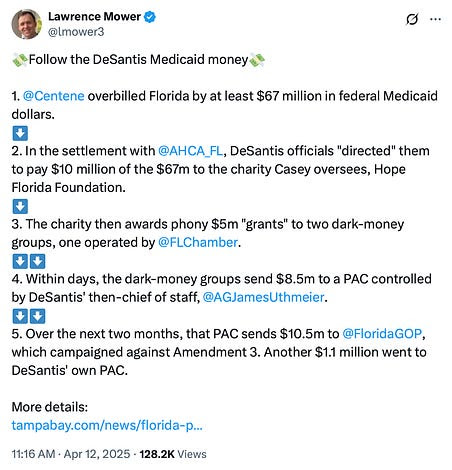
A simmering scandal erupted Friday afternoon when the Tampa Bay TimesMiami Herald and Politico Florida revealed that the administration of Gov. Ron DeSantis orchestrated a $10 million payment last fall to a charity founded by the governor’s wife — which then turned around and gave the money to groups that helped finance the governor’s campaign against a proposed constitutional amendment to legalize marijuana in Florida.

In a nutshell: The DeSantis administration pressured a major state contractor to make a $10 million donation to the Hope Florida Foundation, the controversial charity spearheaded by First Lady Casey DeSantis. It was part of a settlement negotiated with Centene Corp., after the state’s largest Medicaid contractor overbilled the state by at least $67 million.

Days later, Hope Florida transferred that $10 million to a pair of dark-money nonprofits. The state-backed charity gave $5 million each to “Save Our Society From Drugs,” an anti-marijuana group founded by a late Republican megadonor, and “Secure Florida’s Future,” a political vehicle controlled by executives at the Florida Chamber of Commerce, the Big Business lobbying group.

And days after that, Save Our Society From Drugs and Secure Florida’s Future gave a combined $8.5 million to “Keep Florida Clean,” a political committee — chaired by Ron DeSantis’ then-chief of staff — created to oppose Amendment 3, the amendment on last year’s ballot that would have allowed Floridians to use marijuana recreationally rather than solely for medicinal reasons.

It’s a daisy chain that may have transformed $10 million of public money — money meant to pay for health insurance for poor, elderly and disabled Floridians — into funding for anti-marijuana campaign ads.

DeSantis, of course, has repeatedly insisted that he did nothing wrong while also lashing out in increasingly vitriolic ways at everyone from the Republican speaker of the state House to the newspaper reporters digging into the story.

But at least one prominent GOP lawmaker — Rep. Alex Andrade, a Pensacola Republican who has been presiding over hearings into Hope Florida — told the Times and Herald that the transaction chain “looks like criminal fraud by some of those involved.”

Clearly, this looks very bad. But it is also by no means an isolated incident. 

In fact, this is part of a larger pattern of potential abuses that Ron DeSantis committed last fall when he chose to turn the power of state government against two citizen-led constitutional amendments that appeared on the November ballot: Amendment 3 and Amendment 4, which would have ended Florida’s statewide abortion ban.

Consider what we already know about how DeSantis financed his campaigns against the two amendments using public money taken from taxpayers — and private money taken from donors who got public favors from the governor.

  • Five state agencies directly funded television commercials meant to weaken support for the marijuana and abortion-rights ballot measures. We still don’t know the full extent of their spending, although Seeking Rents has estimated the total taxpayer tab at nearly $20 million. We also know that the DeSantis administration commandeered money for anti-marijuana advertising from Florida’s share of a nationwide legal settlement with the opioid industry — money that was supposed to be spent combatting the opioid addiction crisis.
  • At the same time, another nonprofit funded by Florida taxpayers poured at least $5 million into television ads attempting to soften Florida’s image on women’s healthcare at a time when Florida’s near-total abortion was under intense attack. It was the Florida Pregnancy Care Networks’ first-ever TV ad campaign. And its commercials, which were overseen by DeSantis administration staffers, complemented the state agency ads against the abortion-rights amendment — right down to using the same slogan.
  • Last June, after DeSantis vetoed legislation that would have strictly regulated the state’s hemp industry, CBS News Miami revealedthat industry executives and lobbyists promised to raise $5 million in exchange for the veto for the governor to spend on his campaign against Amendment 3. “Our lobby team made promises to rally some serious funding to stand with him on this,” a hemp industry representative wrote in one message that included a bank routing number for the Republican Party of Florida. “We have to pay $5 million to keep our end of the veto,” a hemp executive wrote in another message.
  • In the closing weeks of the campaign, records show that the Big Tobacco giant Philip Morris International gave $500,000 to DeSantis’ personal political committee — which was also chaired by the governor’s then-chief of staff and which DeSantis was using to campaign against both Amendment 3 and Amendment 4. Shortly after the election, the DeSantis administration handed Philip Morris a lucrative tax break, ruling that the company could sell a new line of electronically heated tobacco sticks free of state tobacco taxes.

There were other abuses of power, too. DeSantis and his team threatened to criminally prosecute television stations that aired ads supporting Amendment 4. They sent state police to the homes of Florida voters who signed Amendment 4 petitions. And they hijacked the ballot-writing process for Amendment 4.

There’s a reason why the DeSantis administration made sure to extract a promise of legal immunityfrom the organization that sponsored Amendment 4 as part of a legal settlement negotiated after the election.

DeSantis’ tactics worked. Though Amendments 3 and 4 each won majority support from Florida voters — 55.9 percent for recreational marijuana, 57.2 percent for abortion rights — both fell short of the 60 percent support needed to amend the state constitution.

But, suddenly, it looks like this may not be over — at least not for Ron DeSantis.

House Republicans are seeking troves of records from the DeSantis administration, including text messages and emails related to Hope Florida. The chamber has also scheduled another hearing on the Casey DeSantis charity next week.

What’s more, the House also unveiled a sweeping ethics reform package last week that would, among other things, explicitly expose senior government officials to criminal penalties if they interfere with elections.

That particular legislation would also prohibit state employees from soliciting money for political campaigns — an idea that emerged after DeSantis aides got caught squeezing lobbyistsfor more donations to their boss’ political committee ahead of a possible Casey DeSantis campaign for governor….

Ron DeSantis bet his political future on beating the marijuana and abortion-rights amendments. And he won both of those battles.

But it may turn out that he ultimately lost the war.

Wishful thinking? I hope not.

To give you an idea of how far/right the legislature is, Garcia lists some of the bills that are currently moving through the legislative process:

  • House Bill 549: Requires all new public school textbooks to refer to the Gulf of Mexico as the “Gulf of America.” Passed the Senate by a 28-9 vote. (See votes) Previously passed the House of Representatives by a 78-29 vote. (See votes) Goes to the governor.
  • House Bill 575: Replaces Gulf of Mexico with “Gulf of America” in state law. Passed the Senate by a 28-9 vote. (See votes) Previously passed the House of Representatives by a 78-27 vote. (See votes) Goes to the governor….
  • House Bill 1517: Allows someone to file a wrongful death lawsuit seeking lost wages on behalf of an embryo or fetus. Passed the House of Representatives by a 79-32 vote. (See votes)…
  • House Bill 7031: Cuts the state sales tax rate from 6 percent to 5.25 percent. Passed the House of Representatives by a 112-0 vote. (See votes)
  • House Bill 123: Allows a traditional public school to be converted into a charter school without the consent of the teachers who work at the school. Passed the House Education & Employment Committee by an 11-4 vote. (See votes)

CNN reports that Kristi Noem sent a stern letter to Harvard, demanding the disciplinary records of all international students or lose the right to enroll any international students.

Trump is turning all his dogs loose on Harvard. He can’t believe Harvard is standing up to his threats, and he is determined to crush the nation’s most prestigious research university.

Whatever happened to small government? Republicans used to believe that the federal government should leave the private sector alone. Trump believes in big government, big enough to interfere in every institution, even into private medical decisions. He wants to be the emperor.

Clearly, he never read the U.S. Constitution. He knows nothing about checks and balances. Nor did he read Dr. Seuss’s Yertle the Turtle; Yertle wanted to be the master of all he could see. Read it to see what happened to him.

CNN reports:

Department of Homeland Security Secretary Kristi Noem is threatening to strip Harvard University of its ability to enroll international students if it doesn’t turn over records on international students’ “illegal and violent activities,” the agency said Wednesday.

Noem “wrote a scathing letter demanding detailed records on Harvard’s foreign student visa holders’ illegal and violent activities by April 30, 2025, or face immediate loss of Student and Exchange Visitor Program (SEVP) certification,” DHS said in a news release.

The certification allows universities to issue forms to admitted international students that they can then use to apply for visas to enter the United States, according to DHS.

CNN has reached out to DHS for additional information.

A Harvard spokesperson said in a statement that the university is aware of the letter, but they stand by their previous statement that they “will not surrender its independence or relinquish its constitutional rights.”

Alan M. Garber, President of Harvard University, wrote a brilliant letter defending the independence of higher education–and Harvard in particular– from government control.

Of course, the racist, homophobic, xenophobic Trump administration threatened to cut off Harvard’s federal research grants if they didn’t do more to combat anti-Semitism, a phony issue. Trump demanded an apology from Harvard for “egregious anti-Semitism.” Garber, the President of Harvard, is Jewish.

The administration also demanded that Harvard abolish all programs to promote diversity, equity, and inclusion. But then it demanded that Harvard hire new professors to guarantee “diversity” of viewpoint. Is Trump for or against diversity?

Garber wrote:

For three-quarters of a century, the federal government has awarded grants and contracts to Harvard and other universities to help pay for work that, along with investments by the universities themselves, has led to groundbreaking innovations across a wide range of medical, engineering, and scientific fields. These innovations have made countless people in our country and throughout the world healthier and safer. In recent weeks, the federal government has threatened its partnerships with several universities, including Harvard, over accusations of antisemitism on our campuses. These partnerships are among the most productive and beneficial in American history. New frontiers beckon us with the prospect of life-changing advances—from treatments for diseases such as Alzheimer’s, Parkinson’s, and diabetes, to breakthroughs in artificial intelligence, quantum science and engineering, and numerous other areas of possibility. For the government to retreat from these partnerships now risks not only the health and well-being of millions of individuals but also the economic security and vitality of our nation.

Certainly, Garber wrote, Harvard would fight anti-Semitism, but it would not sacrifice its independence.

The administration’s prescription goes beyond the power of the federal government. It violates Harvard’s First Amendment rights and exceeds the statutory limits of the government’s authority under Title VI. And it threatens our values as a private institution devoted to the pursuit, production, and dissemination of knowledge. No government—regardless of which party is in power—should dictate what private universities can teach, whom they can admit and hire, and which areas of study and inquiry they can pursue.

Garner made clear that Harvard would not allow the government to control teaching and learning at Harvard.

Yesterday, Trump threatened to strip Harvard’s tax-exempt status. Doing so is literally illegal but law never gets in Trump’s way.

This is tyranny and a blatant attack on academic freedom.

The ignorant, self-centered Trump wants to wipe out academic freedom from any institution that does not kneel to his wishes.

Be it noted that Elise Stefanik, a graduate of Harvard, cheered on Trump’s attack on her alma mater. She wrote on Twitter: “Harvard University has rightfully earned its place as the epitome of the moral and academic rot in higher education,” she posted on X, and said that Harvard should lose its tax exemption. She obviously was not brainwashed at Harvard. She should return her diploma.

Happily, Harvard has the resources to fight Trump. He picked on the wrong target.

Trump has been waging war against the nation’s top universities, demanding that they accept his orders to stamp out DEI or lose their federal grants. Trump uses the phony claim that he is combatting anti-Semitism, but the reality is that he is silencing academic freedom and free speech. For the record, Trump has accepted the support of American Nazis, so his concern for Jews cannot be taken seriously.

The first campus to receive Trump’s demands was Columbia University. Trump threatened to withhold $400 million if Columbia did not put several departments (Middle Eastern Studies, African American Studies, and South Asian Studies) into receivership. Sadly, Columbia complied.

Harvard was threatened with the loss of $9 billion in research grants. Harvard said NO. Harvard will not bend the knee to Trump as he seeks to trample academic freedom of faculty and students.

Mike Damiano of The Boston Globe reported:

Lawyers for Harvard University said Monday the school will not comply with a new list of demands sent by the Trump administration on Friday, as part of the government’s purported crackdown on antisemitism and alleged civil rights violations at elite universities.

The new demands expand on a previous list sent to Harvard’s leaders on April 3, which ordered Harvard to close diversity offices and cooperate with federal immigration authorities, among other directives.

In a message to the campus community Monday, Harvard president Alan Garber vowed that the university will not yield to the government’s pressure campaign. “The University will not surrender its independence or relinquish its constitutional rights,” Garber said.

Harvard’s stance is the most forceful pushback yet against the Trump administration’s crackdown on elite universities. It is a sharp contrast to the approach taken by Columbia University’s leaders who acquiesced to a list of demands from the Trump administration last month. Columbia promised to change student disciplinary procedures and place a Middle East studies department under new oversight, among other measures.

The Harvard demands went further. Two weeks ago, the Trump administration’s antisemitism task force placed $9 billion in federal funding under review and followed up with its first list of demands.

Then, last Friday, the government sent Harvard a much more detailed explanation of its demands, which Harvard released Monday afternoon. Harvard’s lawyers said the university “is not prepared to agree to demands that go beyond the lawful authority of this or any administration.”

Petula Dvorak of the Washington Post wrote about the efforts by the Trump administration to rewrite American history. Trump wants “patriotic history,” in which evil things never happened and non-white people and women were seldom noticed. In other words, he wants to control historical memory, sanitize it, and restore history as it was taught when he was in school about 65 years ago (1960), before the civil rights movement, the women’s movement, and other actions that changed what historians know and teach.

Dvorak writes:

A section of Arlington National Cemetery’s website highlighting African American military heroes is gone.

Maj. Lisa Jaster was the first woman to graduate from Army Ranger school. But that fact has been scrubbed from the U.S. Army Reserve [usar.army.mil] and Department of Defense websites. [search.usa.gov]

The participation of transgender and queer protesters during the LGBTQ+ uprising at New York’s Stonewall Inn was deleted from the National Park Service’s website [nps.gov] about the federal monument.

And the Smithsonian museum in Washington, which attracts millions of visitors who enter free each year, will be instructed by Vice President JD Vance to remove “improper ideology.”

In a series of executive orders, President Donald Trump is reshaping the way America’s history is presented in places that people around the world visit.

In one order, he declared that diversity, equity and inclusion efforts “undermine our national unity,” and more pointedly, that highlighting the country’s most difficult chapters diminishes pride in America and produces “a sense of national shame.”

The president’s orders have left historians scrambling to collect and preserve aspects of the public record, as stories of Black, Brown, female or LGBTQ+ Americans are blanched from some public spaces. In some cases, the historical mentions initially removed have been replaced, but are more difficult to find online.

That rationale has galvanized historians to rebuke the idea that glossing over the nation’s traumas — instead of grappling with them — will foster pride, rather than shame.

Focusing on the shame, they say, misses a key point: Contending with the uglier parts of U.S. history is necessary for an honest and inclusive telling of the American story. Americans can feel pride in the nation’s accomplishments while acknowledging that some of the shameful actions in the past reverberate today.

“The past has no duty to our feelings,” said Chandra Manning, a history professor at Georgetown University.

“History does not exist to sing us lullabies or shower us with accolades. The past has no obligations to us at all,” Manning said. “We, however, do have an obligation to the past, and that is to strive to understand it in all its complexity, as experienced by all who lived through it, not just a select few.”

That is not to say that the uncomfortable weight of difficult truths isn’t a valid emotion.

Postwar Germans were so crushed by the burden of their people’s past, from the horrors of the Nazi regime to the protection of war criminals in the decades after the war, that they have a lengthy word for processing it: vergangenheitsbewältigung, which means the “work of coping with the past.” It has informed huge swaths of German literature and film and has shaped the physical way European cities create memorials and museums.

America’s version of vergangenheitsbewältigung can be found across the cultural landscape. From films to books to classrooms and museums, Americans are learning more details about slavery in the South, the way racism has affected everything from baseball to health care, and how sexism shaped the military.

Trump, however, looks at the U.S. version of vergangenheitsbewältigung differently.
“Over the past decade, Americans have witnessed a concerted and widespread effort to rewrite our Nation’s history, replacing objective facts with a distorted narrative driven by ideology rather than truth,” said the executive order targeting museums, called “Restoring Truth and Sanity to American History.”

That is what “fosters a sense of national shame,” he says in his order.

Historians take exception to that. “I would argue that it’s actually weird to feel shame about what people in the past did,” Georgetown history professor Katherine Benton-Cohen said.
“As I like to tell my students, ‘I’m not talking about you. We will not use ‘we’ when we refer to Americans in the past, because it wasn’t us and we don’t have to feel responsible for their actions. You can divest yourself of this feeling,’” she said.

Germans also have a phrase for enabling a critical look at their nation’s past: die Gnade der spät-geborenen, “the grace of being born too late” to be held responsible for the horror of the Nazi years.

Benton-Cohen said she honed her approach to this during her first teaching job in the Deep South in 2003, when she emphasized the generational gap between her students and the history they were studying.

“They could speak freely of the past — even the recent past, like the 1950s and 1960s, because they weren’t there,” she said. “They were free to make their own conclusions. It was exciting, and it worked. Many told me it was the first time they had learned the history of the 1960s because their high schools — both public and private — had skipped it to avoid controversy. We did fine.”

Trump hasn’t limited his attempt to control how history is presented in museums or memorials. Among the first executive orders he issued was “Ending Radical Indoctrination in K-12 Schooling.” Another one sought to eliminate diversity, equity and inclusion in the nation’s workplaces, classrooms and museums. His version of American history tracks with how it was taught decades ago, before academics began bringing more diverse voices and viewpoints into their scholarship.

Maurice Jackson, a history professor at Georgetown University who specializes in jazz and Black history, said Black Americans have fought hard to tell their full story.

Black history was first published as “The Journal of Negro History” in 1916, in a townhouse in Washington when academic Carter G. Woodson began searching for the full story of his roots. A decade later, he introduced “Negro History Week” to schools across the United States, a history lesson that was widely cheered by White teachers and students alongside Black Americans who finally felt seen.

“Black history is America’s history,” Jackson said. And leaving the specifics of the Black experience out because it makes some people ashamed gives an incomplete picture of our nation, he said.

After Trump issued his executive orders, federal workers scrambled to interpret and obey them, which in some cases led to historical milestones being removed, or covered up and then replaced.

Federal workers removed a commemoration of the Tuskegee Airmen from the Pentagon website, then restored it. They taped butcher paper over the National Cryptologic Museum’s display honoring women and people of color, then uncovered the display.

Mentions of Harriet Tubman in a National Park Service display about the Underground Railroad were removed, then put back. The story of legendary baseball player Jackie Robinson’s military career was deleted from the Department of Defense website, then restored several days later.

Women known as WASPs risked their lives in military service — training and test pilots during World War II for a nation that didn’t allow them to open a bank account — is no longer a prominent part of the Pentagon’s digital story.

George Washington University historian Angela Zimmerman calls all the activity. which happened with a few keystrokes and in a matter of days, the digital equivalent of “Nazi book burnings.”

In response, historians — some professional, some amateur — are scrambling to preserve information before it is erased and forgotten.

The Organization of American Historians created the Records at Risk Data Collection Initiative, which is a callout for content that is in danger of being obliterated

This joins the decades-long work of preserving information by the Internet Archive, a California nonprofit started in 1996 that also runs the Wayback Machine, which stores digital records.

Craig Campbell, a digital map specialist in Seattle, replicated and stored the U.S. Geological Service’s entire historical catalogue. His work was crowdfunded by supporters.

“Historical maps are critical for a huge range of industries ranging from environmental science, conservation, real estate, urban planning, and even oil and gas exploration,” said Campbell, whose mapping company is called Pastmaps. “Losing access to the data and these maps not only destroys our ability to access and learn from history, but limits our ability to build upon it in so many ways as a country.”

After astronomer Rose Ferreira’s profile was scrubbed from, then returned, to NASA’s website, she posted about it on social media. In response, an online reader created a blog, Women in STEM, to preserve stories such as Ferreira’s.

“Programs that memorialize painful truths help ensure past wrongs are never revived to harm again,” Rep. Steven Horsford (D-Nevada), said on X, noting that presidents are elected to “run our government — not rewrite our history.”

Authoritarian leaders have long made the whitewashing of history a tool in their regimes. Joseph Stalin expunged rivals from historic photographs. Adolf Hitler purged museums of modernist art and works created by Jewish artists, which he labeled “degenerate.” Museums in Mao Zedong’s China glorified his ideology.

While this may be unfamiliar to Americans, Georgetown University history professor Adam Rothman says that in the scope of human history, “these are precedented times.”

It’s not yet clear what the real-world effect of Trump’s Smithsonian order will be or exactly how it will be carried out. Who will determine what exhibits cause shame and need to be removed? What will the criteria be? Will exhibits that discuss slavery, for instance, be eliminated or altered?

“Our nation is an ongoing experiment,” says Manning, the Georgetown history professor, who has written books about the Civil War. “And what helps us do that now in 2024 compared to 1776 is that we do have a shared past.

“Every single human culture depends upon, grows out of, and is shaped by its past,” she said. “It is the past that has shaped all of us, it is our past that contains the bonds that can really hold us together.”

It’s what makes the study — and threat to — American history unique among nations. Benton-Cohen said that is what she sees happen with her students.

“The American striving to realize the democratic faith and all the difficulties it entailed and challenges overcome should inspire pride, not shame,” she said. “If you feel shame, as the kids would say, that’s a ‘you’ problem. That’s why I still fly the flag at my house; I’m not afraid of the American past, I’m alive with the possibilities — of finding common cause, of fighting for equality, of appreciating our shared humanity, of upholding our freedoms.”

Jennifer Berkshire has been writing insightfully about the rightwing attacks on public schools and on education for many years. She has written for national magazines and collaborated with education historian Jack Schneider to create a podcast “Have You Heard?”) and to write two excellent books: A Wolf at the Schoolhouse Door and The Education Wars (which is also the title of her blog).

This post is the first of two that “connects the dots.” I am posting them together as they provide an excellent critique of the logic of today’s education policy changes. She explains the Republican animus towards public schools and education and their desire to eliminate the U.S. Departnent of Education.

She writes:

If you read the coverage regarding this week’s ‘bloodbath’ at the Deparment of Education, there is little sense to be made of the savage layoffs and shuttering of whole units. In reports like this one, this one, and this particularly half-baked take, the general tone is a sort of ‘how could this be happening?’ bafflement. But there is a brutal logic to rendering much of the Department inoperable. Since Trump’s first term, the intellectual architects of Trumpism have been laying the groundwork for what is essentially a roll-back of the modern civil rights era. In other words, we don’t have to speculate wildly about what these folks are up to because they’ve been telling us non-stop for the past six years. We need to pay attention.

They’re kneecapping the knowledge agencies

If it feels like DOGE is devoting a disproportionate amount of effort to dismantling agencies and departments that create, distribute, and legitimize knowledge, that’s because it’s true. A fascinating new analysis of DOGE layoffs finds that so-called knowledge agencies have borne the brunt of the chainsaw. This has nothing to do with ‘efficiency’ but instead reflects the belief of influential thinkers in the Trump-o-sphere that these are precisely the agencies and departments that have been captured by the woke mind virus and require elimination.

If you’ve managed to make it this far without encountering the ‘insights’ of Curtis Yarvin aka Mencious Moldbug, congratulations. But Yarvin’s argument that democracy is over, and that we’d be better served by a technocratic monarch, has found favor with the likes of JD Vance; its Yarvin’s case for demolishing ‘the cathedral,’ the knowledge institutions at the heart of modern life, that we’re living through right now.

The goal is to send fewer kids to college.

The AP posted a panicked story this week about the student loan website crashing in the wake of the ED layoffs. Make it too onerous for students to access information about paying for college, the story implied, and they just might give up and stay home. To which some high-profile Trump ‘intellectuals’ might respond: ‘good!’ In an interview with the Wall Street Journal last year, activist Christopher Rufo stated that his goal is reduce the number of students who attend college by half. Scott Yenor, an influential advisor to Ron DeSantis, wants to see the number reduced to less than 10 percent, and has argued repeatedly that too many women attend college. Various GOP proposals, meanwhile, could reduce the volume of student loans by one third.
The idea that we’d make it harder and more expensive for kids to attend college after a few decades of ‘college for all’ thinking may be hard to wrap your head around. But the likes of Rufo and Yenor view this experiment as a collosal failure. In their view, college campuses are filled with students who don’t belong there, representing the sort of social engineering that they’re now determined to unwind. The anti-DEI purges currently remaking campuses reflect the general sentiment on the right these days that colleges, entirely captured by the ‘woke,’ are indoctrinating youngsters. But at the heart of these efforts is an even more retrograde cause: making college elite again.

They believe in natural hierarchies and race science.

The creepiest story I read this week had nothing to do with education but with the effort to rebuild the US semiconductor industry known as the CHIPS program. Employees in the CHIPS program office have been undergoing a now-familiar ritual: demonstrating their intellectual worth and abilities to Trump officials.

In late February, Michael Grimes, a senior official at the Department of Commerce and former investment banker at Morgan Stanley, conducted brief interviews with employees of the CHIPS Program Office, which oversees the grants.

In interactions some described as “demeaning,” Mr. Grimes asked employees to justify their intellect by providing test results from the SAT or an IQ test, said four people familiar with the evaluations. Some were asked to do math problems, like calculate the value of four to the fourth power or long division.

What does demanding IQ or SAT test results from engineers have to do with the dismantling of the Departmet of Education? Everything. If you start from the assumption that IQ is, not just fixed, but genetically determined, as many Trump intellectuals do, there is little case to be made for public schools that try to equalize outcomes—it can’t be done. Far better to shovel cash at the would-be ‘cognitive elite’ (an apt description of vouchers for the well-to-do, when you think about it) than to redistribute resources to the ‘lessers.’ It’s a bleak and brutal view of the world and one that holds increasing sway on the right.

They believe that race-based data powers the ‘civil rights regime’

In his fantastic new book, Dangerous Learning: the South’s Long War on Black Literacy, legal scholar Derek Black argues that a vision of racial equality is woven through education policy. Writes Black: “Education bureaucracy disaggregates every aspect of education by race–from basic attendance, test scores, and graduation rates to suspensions, expulsions, advanced placement opportunities, access to qualified teachers, and more.” But this is precisely why the data collectors have borne the brunt of the DOGE-ing of the Department of Education. 

Read the likes of Richard Hanania, whose argument that ‘woke’ is essentially just civil rights law, inspired Trump’s early executive order rolling back affirmative action in federal hiring, and you get a much clearer picture of what’s happening right now. As Hanania argues, “[g]overnment should not be into the race, sex, and LGBT bean counting business.” His colleague, the afforementioned Scott Yenor, goes even farther. Yenor wants to see states criminalize the collection of data on the basis of race or sex as a challenge to what he describes as “the country’s corrupting ‘civil rights’ regime.” 

So while federally-funded education research may have just been decimated, at least the researchers themselves aren’t being rounded up—yet.

They’re rolling back civil rights

At the heart of the Trumpist intellectual project is a relatively straight-forward argument. The civil rights revolution in this country went too far and it’s time to start rolling it back. As Jack Schneider and I argue in our recent book, The Education Wars, the role that public schools have historically played in advancing civil rights makes them particuarly vulnerable in this moment of intense backlash. It’s why the administration has moved with such ferocity against the most recent effort to extend civil rights through the schools—to transgender students. And it’s why the cuts to the Department of Education have fallen so heavily on its civil rights enforcement role. Of the agency’s civil rights offices across the country, only five are still open.

The OCR is one of the federal government’s largest enforcers of the Civil Rights Act of 1964, investigating thousands of allegations of discrimination each year. That includes discrimination based on disability, race and gender.

Not anymore…