Archives for the month of: April, 2025

The Trump administration claims that it wants to reduce federal intervention into the nation’s public and private institutions. But it intervenes forcefully in both public and private sectors to punish anyone with different views. It has threatened to withhold federal funding for research from universities unless the targeted universities allow the federal government to supervise its curriculum, its hiring policies, and its admissions policies. And he threatened to stop the funding of any K12 school that continues DEI programs.

The Trump regime has created a nanny state.

From Day 1, Trump made clear that he would ban practices and policies intended to diversity, equity, and inclusion. He threatened to withhold federal funding of schools that ignored his order to eliminate DEI. He has taken complete control of the Kennedy Center, so as to block DEI programming, and he has appointed a woman with no credentials to remove DEI from the Smithsonian museums.

Who knows how the African American Museum will survive Trump’s DEI purge.

ABC News reported that a federal district judge has halted the DEI ban, at least in schools associated with one of the lawsuit’s plaintiffs, the NEA.

ABC News reported:

The Trump administration’s attempt to make federal funding to schools conditional on them eliminating any DEI policies erodes the “foundational principles” that separates the United States from totalitarian regimes, a federal judge said on Thursday.

In an 82-page order, U.S. District Judge Landya McCafferty partially blocked the Department of Education from enforcing a memo issued earlier this year that directed any institution that receives federal funding to end discrimination on the basis of race or face funding cuts.

“Ours is a nation deeply committed to safeguarding academic freedom, which is of transcendent value to all of us and not merely to the teachers concerned,” Judge McCafferty wrote, adding the “right to speak freely and to promote diversity of ideas and programs is…one of the chief distinctions that sets us apart from totalitarian regimes.”

“In this case, the court reviews action by the executive branch that threatens to erode these foundational principles,” she wrote.

The judge stopped short of issuing the nationwide injunction, instead limiting the relief to any entity that employs or contacts with the groups that filed the lawsuit, including the National Education Association and the Center for Black Educator Development.

We have a president who does not believe in climate change. Trump appointed Lee Zeldin to destroy the Environmental Protection Agency, which was created by President Richard Nixon. His mega-donors in the fossil fuel industry are very happy with his policies of climate change denial.

But climate change is real.

CNN reports:

Coral reefs

Warming oceans have caused the worst coral reef bleaching event in recorded history. According to a new report, harmful bleaching has grown to include 84% of the ocean’s reefs — and it’s not clear when the crisis will end. Last year was Earth’s hottest year on record and most of that heat went into the oceans. Such high temperatures are deadly to corals, which protect coastlines from erosion and storms. Coral reefs are also known as the “rainforests of the sea” because they support high levels of biodiversity. “We’re looking at something that’s completely changing the face of our planet and the ability of our oceans to sustain lives and livelihoods,” Mark Eakin, corresponding secretary for the International Coral Reef Society, said. Although efforts are underway to conserve and restore coral, scientists say it’s essential that we reduce emissions from burning the fossil fuels that are warming the planet. 

Carol Burris is the executive director of the Network for Public Education. She was a high school teacher and principal in New York State, where she was honored by the state principal’s association as principal of the year. She is a tireless advocate of public schools and an equally tireless opponent of privatization.

She writes:

On April 30, the U.S. Supreme Court will hear a pivotal case concerning whether a charter school can teach a religious curriculum. The Oklahoma Statewide Virtual Charter School Board v. Drummond addresses Oklahoma’s St. Isidore of Seville Catholic Virtual School’s attempt to become the nation’s first publicly funded religious charter school. 

This case was always intended to go to the Supreme Court, testing the limits of the separation of Church and State. What is surprising, however, is who has entered the fight against St. Isadore. The National Alliance for Public Charter Schools (NAPCS), which has never met a charter school it did not like, has filed an amicus brief against its existence. This is unexpected from an organization that has supported charter schools run by for-profit corporations, virtual schools with poor outcomes, and even micro-schools, claiming that different models provide needed choice and innovation. When public money is allocated to religious private schools via vouchers, the charter lobby is either supportive or silent in the name of “choice.”

The reason for their present opposition is self-interest. According to the National Alliance for Public Charter Schools, “a decision to allow religious charter schools will throw charter laws into chaos nationwide, resulting in significant financial and operational uncertainties.”  Nina Rees, the former long-time CEO of the organization, lamented that a ruling in favor of St. Isadore “could also jeopardize the myriad federal and state funding streams they [charters] currently qualify for—funding that the sector has fought hard to secure and continues to fight for on the premise that students attending public charter schools are entitled to the same funds they would receive in district schools.”

On what basis, then, will SCOTUS make its decision? At the heart of the case is whether charter schools are state actors or state contractors providing educational services. The Oklahoma State Virtual Charter Board argues that merely because the state legislature declares a charter school “public,” it does not transform it into a public school. Furthermore, even if charter schools are state actors for some functions, they might not be state actors for purposes of the First Amendment, specifically regarding curriculum matters.

There is precedent for their argument.

In 2010, both a federal court and the U.S. Court of Appeals for the 9th Circuit, in San Francisco, determined, in an employment case, that an Arizona charter school was not a “state actor” and thus a wrongful termination lawsuit could not be brought forth by a former teacher.  “This case presents the special situation of a private nonprofit corporation running a charter school that is defined as a ‘public school’ by state law,” the three-judge appeals court panel said in its unanimous Jan. 4 decision in Caviness v. Horizon Community Learning Center. The court concluded that the corporation running the charter school (private non-profit or for-profit corporations run most charter schools) was not a state actor but a contractor providing a service.

In some states, where districts are the only authorizers of charter schools, charter schools likely fully meet the “state actor” test. That was the original intent of the charter movement—schools within a district free of some restraints to try innovative practices. However, only a few states still embrace that model, thanks to the relentless pressure from organizations like NAPCS, which have provided St. Isadore with more than enough fodder for its arguments. Over the years, charter trade organizations have successfully lobbied for looser charter laws, expanded charter management organizations, and vigorously defended for-profit corporations like Academica and Charter Schools USA, which use nonprofit schools as a façade. In short, they have made charter schools as “private” and profitable as possible. 

Remember how charter schools could secure Paycheck Protection Program (PPP) funds during COVID-19 when public schools could not? Charter trade organizations, including NAPCS, encouraged charter schools to leverage their corporate status, resulting in the sector securing billions of dollars. Some even provided talking points for justification.

The truth is that charter schools have used their private status when it is in their interest, even as they secure an advantage from the public label. And that is why they have only themselves to blame if the chicken comes home to roost and the sector is thrown into chaos. If that results in a shake-up of the charter industry and a return to truly public charter schools in most states, that may not be a terrible outcome. 

Trump has long demonstrated his admiration for Putin. No one can say exactly why Trump admires Russia’s ruthless dictator. But Trump insists that Ukraine is responsible for Putin’s invasion of Ukraine in 2022. His lame efforts to broker an end to Russia’s war on Ukraine have robustly echoed Putin’s demands.

Heather Cox Richardson analyzes how Trump has changed American policy towards the Russian war on Ukraine. Trump’s “peace plan” gives Russia everything Putin wants:

She writes:

After previously suggesting that the U.S. would not involve European representatives in negotiations to end Russia’s war against Ukraine, Secretary of State Marco Rubio and presidential envoy Steve Witkoff met in Paris last week for talks with Ukrainian and European officials. The U.S. presented what it called “the outlines of a durable and lasting peace,” even as Russia continued to attack Ukrainian civilian areas.

A senior European official told Illia Novikov, Aamer Madhani, and Jill Lawless of the Associated Press that the Americans presented their plan as “just ideas” that could be changed. But Barak Ravid of Axios reported on Friday that Trump was frustrated that the negotiations weren’t productive and said he wanted a quick solution.

Talks were scheduled to resume today, in London, but yesterday Rubio pulled out of them. The U.S. plan is now “a final offer,” Ravid reported, and if the Ukrainians don’t accept it, the U.S. will “walk away.”

On a bipartisan basis, since 2014 the United States has supported Ukraine’s fight to push back Russia’s invasions. But Trump and his administration have rejected this position in favor of supporting Russia. This shift has been clear in the negotiations for a solution: Trump required repeated concessions from Ukraine even as Russia continued bombing Ukraine. Axios’s Ravid saw the proposed “final offer,” and it fits this pattern.

The plan would recognize Russia’s occupation of Ukraine’s Crimea and its occupation of almost all of Luhansk oblast and the portions of Donetsk, Kherson, and Zaporizhzhia oblasts Russia has occupied. This would essentially freeze the boundary of Ukraine at the battlefront.

Ukraine would promise not to join the North Atlantic Treaty Organization (NATO), the post–World War II defensive alliance that first stood against the aggression of the Soviet Union and now stands against the aggression of Russia.

Sanctions imposed against Russia after its 2014 and 2022 invasions of Ukraine would be lifted, and the United States, in particular its energy and industrial sectors, will cooperate with Russia.

In essence, this gives Russian president Vladimir Putin everything he wanted.

What the Ukrainians get out of this deal is significantly weaker. They get “a robust security guarantee,” but Ravid notes the document is vague and does not say the U.S. will participate. We have been here before. After the Soviet Union crumbled in 1991, Ukraine had the third-largest stockpile of nuclear weapons in the world. In exchange for Ukraine’s giving up those weapons, the United States, the United Kingdom, and Russia agreed to secure Ukraine’s borders. In the 1994 Budapest Memorandum on Security Assurances, they agreed they would not use military force or economic coercion against Ukraine.

Russia violated that agreement with its 2014 and 2022 invasions, making it unlikely that Ukraine will trust any new promises of security.

Under the new plan, Ukraine would also get back a small part of Kharkiv oblast Russia has occupied. It would be able to use the Dnieper River. And it would get help and funds for rebuilding, although as Ravid notes, the document doesn’t say where the money will come from.

There is something else in the plan. The largest nuclear power plant in Europe is Ukrainian: the Zaporizhzhia plant. It will be considered Ukrainian territory, but the United States will operate it and supply the electricity it produces to both Ukraine and Russia, although the agreement apparently doesn’t say anything about how payments would work. The plan also refers to a deal between the U.S. and Ukraine for minerals, with Ukraine essentially repaying the U.S. for its past support.

Ravid notes that the U.S. drafted the plan after envoy Steve Witkoff met for more than four hours last week with Putin. But the plan has deeper roots.

This U.S.-backed plan echoes almost entirely the plan Russian operatives presented to Trump’s 2016 campaign manager Paul Manafort in exchange for helping Trump win the White House. Russia had invaded Ukraine in 2014 and was looking for a way to grab the land it wanted without continuing to fight.

Special Counsel Robert Mueller’s 2019 report on Russian interference in the 2016 presidential election explained that Manafort in summer 2016 “discussed a plan to resolve the ongoing political problems in Ukraine by creating an autonomous republic in its more industrialized eastern region of Donbas, and having [Russian-backed Viktor] Yanukovych, the Ukrainian President ousted in 2014, elected to head that republic.”

The Mueller Report continued: “That plan, Manafort later acknowledged, constituted a ‘backdoor’ means for Russia to control eastern Ukraine.” The region that Putin wanted was the country’s industrial heartland. He was offering a “peace” plan that carved off much of Ukraine and made it subservient to him. This was the dead opposite of U.S. policy for a free and united Ukraine, and there was no chance that former secretary of state Hillary Clinton, who was running for the presidency against Trump, would stand for it. But if Trump were elected, the equation changed.

According to the Republican-dominated Senate Intelligence Committee, Manafort’s partner and Russian operative Konstantin Kilimnik wrote: “[a]ll that is required to start the process is a very minor ‘wink’ (or slight push) from D[onald] T[rump] saying ‘he wants peace in Ukraine and Donbass back in Ukraine’ and a decision to be a ‘special representative’ and manage this process.” Following that, Kilimnik suggested that Manafort ‘could start the process and within 10 days visit Russia ([Yanukovych] guarantees your reception at the very top level, cutting through all the bullsh*t and getting down to business), Ukraine, and key EU capitals.’ The email also suggested that once then–Ukrainian President Petro Poroshenko understood this ‘message’ from the United States, the process ‘will go very fast and DT could have peace in Ukraine basically within a few months after inauguration.’”

According to the Senate Intelligence Committee, the men continued to work on what they called the “Mariupol Plan” at least until 2018.

After Russia invaded Ukraine again in 2022, Jim Rutenberg published a terrific and thorough review of this history in the New York Times Magazine. Once his troops were in Ukraine, Putin claimed he had annexed Donetsk, Luhansk, Zaporizhzhia, and Kherson, two of which were specifically named in the Mariupol Plan, and instituted martial law in them, claiming that the people there had voted to join Russia.

On June 14, 2024, as he was wrongly imprisoning American journalist Evan Gershkovich, Putin made a “peace proposal” to Ukraine that sounded much like the Mariupol Plan. He offered a ceasefire if Ukraine would give up Donetsk, Luhansk, Zaporizhzhia, and Kherson, including far more territory than Putin’s troops occupy, and abandon plans to join NATO. “If Kyiv and the Western capitals refuse it, as before,” Putin said, “then in the end, that’s their…political and moral responsibility for the continuation of bloodshed.”

On June 27, 2024, in a debate during which he insisted that he and he alone could get Gershkovich released, and then talked about Putin’s 2022 invasion of Ukraine, Trump seemed to indicate he knew about the Mariupol Plan: “Putin saw that, he said, you know what, I think we’re going to go in and maybe take my—this was his dream. I talked to him about it, his dream.”

Now that plan is back on the table as official U.S. policy.

Ukraine president Volodymyr Zelensky has said that his country will not recognize the Russian occupation of Crimea. In this determination, he speaks for the global rules-based order the U.S. helped to create after World War II. Recognition of the right of a country to invade another and seize its territory undermines a key article of the United Nations, which says that members won’t threaten or attack any country’s “territorial integrity or political independence.” French president Emmanuel Macron and other European leaders are standing behind those principles, saying today in a statement from Macron’s office that they reject Russian territorial gains under the U.S. plan. “Ukraine’s territorial integrity and European aspirations are very strong requirements for Europeans,” the statement said.

But Trump himself seems eager to rewrite the world order. In addition to his own threats against Greenland, Canada, and Panama, in a post today on his social media site he echoed Putin’s 2024 statement blaming Ukraine for Russia’s bloody war because it would not agree to Putin’s terms. Today, Trump said Zelensky’s refusal to recognize the Russian occupation of Crimea was “inflammatory,” and he pressured Zelensky to accept the deal.

Curiously, he felt obliged to write that “I have nothing to do with Russia…”.

If your memory is good, you may recall Arne Duncan’s Race to the Top, which had $5 billion of unrestricted funds with which to spur education reform. Duncan had a contest in which states competed for a piece of that big pie. To be eligible to compete, states had to pass a law authorizing charter schools, and almost every state did. They had to agree to adopt national standards, which meant the unfinished, untried Common Core State Standards, as well as the tests based on the standards. They had to agree to evaluate individual teachers based on the rise or fall of the test scores of their students.

Eighteen states “won.”

The biggest winner was Tennessee, which won $500 million. Tennessee’s biggest new program was the creation of its so-called Achievement School District. The ASD would gather the lowest performing schools in the state into a non-contiguous district and turn them into charter schoools.

The ASD hired Chris Barbic, leader of Houston’s YES Prep charter chain, to run the ASD. Barbic pledged that he would raise the state’s lowest-performing schools into top-performing schools in five years.

He failed. The state’s lowest performing schools continued to have low scores. In 2015, he resigned, saying he needed to focus on his health and family.

The ASD limped along for another decade, without success. Nonetheless, some other states–including Nevada and North Carolina–copied the model, creating their own all-charter districts. They also failed.

The Tennessee Legislature voted this week to shut down the ASD.

The ASD removed low-performing schools from local control and placed them under a state-run district, with the goal to push Tennessee’s bottom 5% of schools to the top 25%. Many of the schools were turned over to charter operators to run under 10-year contracts.

Research showed the ASD led to high teacher turnover, and did not generate long-term improvements for students. The district also faced community backlash for taking over schools in districts that served mostly low-income communities and predominantly Black student populations. The ASD cost taxpayers over $1 billion. Only three schools remain in the ASD.

Every other part of Race to the Top failed. Evaluating teachers by test scores was a disaster: it rewarded teachers in affluent districts and schools while penalizing those who taught the neediest students. Charter schools did not have higher scores than public schools unless they chose their students carefully, excluding the neediest. The Common Core standards, with which tests, textbooks and teacher education were aligned, had no impact on test scores. The U.S. Department of Education evaluated Race to the Top and declared it a failure., in a report quietly released on the last day of the Obama administration.

On to vouchers! Since voucher students don’t take state tests, no one will know that this is a boondoggle that benefits those already in private and religious schools.

The search for miracles and panaceas goes on.

Trump’s answer. Parents know best.

Next time you get surgery, make sure the surgeon is not licensed. Next time you take a flight, be sure to fly with an unlicensed pilot.

Randi Weingarten is president of the American Federation of Teachers. She is my friend.

Randi wrote:

President Donald Trump has declared war on America’s colleges and universities, demanding they bow to his demands on what they can teach and whom they can admit or hire. Trump’s illegal and autocratic actions are tantamount to a war on knowledge intended to force schools to bend the knee to his ideology and chill free speech and academic pursuit.

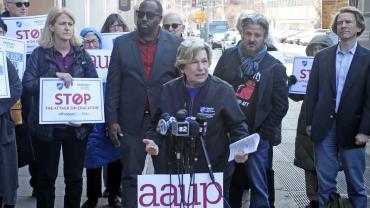
Weingarten announcing a lawsuit to stop the federal funding cuts at Columbia University.
Weingarten announcing a lawsuit to stop the federal funding cuts at Columbia University. CREDIT: AFT

Trump says much of his attack on higher education is in response to antisemitism on campuses. Without a doubt, there was antisemitism before the heinous actions by Hamas on Oct. 7 and the ensuing war, and it has grown since. We need to address antisemitism on campus and ensure Jewish students, and all students, feel safe. But Trump is weaponizing antisemitism investigations to attack disfavored speech and stoke culture wars, distrust and division, and to undermine higher education as a bulwark of democracy and an engine of our economy. It’s wrong, antidemocratic and unconstitutional. The administration is using Jews as an excuse to disappear students who are here legally, with immigration officials arresting and attempting to deport students who have committed no crimes—without due process, a linchpin of American democracy.

This may help Trump’s aim to divide Americans, but it won’t make campuses safer for Jewish students or answer the real issues around antisemitism. That’s one reason that a coalition of Jewish organizations released a statement saying that Trump’s actions make Jewish students and the Jewish community less safe.

Trump has launched investigations into dozens of colleges and universities and stripped billions in research grants from schools. The administration has issued demands ranging from direct government oversight of academic programs—or in the case of Columbia University, oversight of the whole institution—to dictating disciplinary policies and controlling hiring decisions. It is targeting students for exercising their First Amendment rights, and revoking visas for faculty and staff. The administration’s intent is to remake America’s higher education system in its image through blunt force.

The freedom to pursue knowledge, the freedom of expression and the freedom of speech are fundamental American rights that are foundational to a functioning democracy. America’s public schools, colleges and universities cultivate the exploration of knowledge and free expression and empower students to become engaged citizens. One of their hallmarks is that they are a marketplace of ideas where free and open discussion and disagreement is encouraged. That is enabled by ensuring our education institutions are independent from government control or coercion. When a government asserts control over what can be taught, thought or said, democracy itself is at risk.

The free pursuit of knowledge empowers Americans.

Stripping research and innovation funding to force compliance will hurt America’s competitiveness and help our adversaries outpace us in technological and other advancements. America’s university research and innovation centers have long been the envy of the world. The federal government, through federal agencies and grants, is a fundamental powerhouse and supporter of health, scientific, technology and other research. The U.S. is the world leader in this research—research that the private sector cannot and will not do on its own and that leads to discoveries, innovations, cures and advances that benefit the common good and move our society forward. Colleges and universities are also anchors of their local communities, supporting local jobs and small businesses, providing community gathering spaces, and growing industries tied to university research and innovation. 

This war on knowledge and expression must be opposed in the courts, on the streets, and by our colleges and universities.

As the largest union of higher education staff and faculty, the AFT joined our affiliate, the American Association of University Professors, to sue the Trump administration on behalf of our members for unlawfully cutting millions in federal funding for public health research at Columbia.

Last week, Harvard University boldly rejected Trump’s unlawful and unprecedented demands for government control over it. Harvard’s president wrote that “no government … should dictate what private universities can teach, whom they can admit and hire, and which areas of study and inquiry they can pursue.”

Americans have also taken to the streets to oppose this war on knowledge and freedoms. The attacks on higher education were a major focus of the April 5 Hands Off actions that mobilized tens of thousands of Americans across the country to reject Trump’s chaotic and cruel agenda.

The free pursuit and availability of knowledge empowers Americans, strengthens our economy and democracy, and is foundational for opportunity. That’s why we all must take a stand against this war on knowledge.

Under the misguided policies of Trump and Hegseth, censorship and book banning have been widespread, especially by the Defense Department. Hegseth is eager to please Trump and has stripped recognition from anyone of distinction who is female and/or non-white. Even a photograph of the Enola Gay, the plane that dropped the first atomic bomb, was taken down–because of its name. The Navajo Code Talkers were put into storage. The first women to achieve military feats and honors were mothballed. The U.S. Naval Academy removed almost 400 books from its library because of DEI (diversity, equity, inclusion) themes.

Ryan Holiday was invited to lecture at the Naval Academy a few weeks ago, as he had in the past. Shortly before he was to speak, he was asked not to mention the books that had been removed from the Academy’s library. When he refused, his speech was canceled.

Question: if the men and women of the U.S. Navy are brave enough to risk their lives, aren’t they brave enough to read a book about race and gender?

Holiday wrote in The New York Times:

For the past four years, I have been delivering a series of lectures on the virtues of Stoicism to midshipmen at the U.S. Naval Academy in Annapolis, Md., and I was supposed to continue this on April 14 to the entire sophomore class on the theme of wisdom.

Roughly an hour before my talk was to begin, I received a call: Would I refrain from any mention in my remarks of the recent removal of 381 supposedly controversial books from the Nimitz library on campus? My slides had been sent up the chain of command at the school, which was now, as it was explained to me, extremely worried about reprisals if my talk appeared to flout Executive Order 14151(“Ending Radical and Wasteful Government D.E.I. Programs and Preferencing”).

When I declined, my lecture — as well as a planned speech before the Navy football team, with which my books on Stoicism are popular — was canceled. (The academy “made a schedule change that aligns with its mission of preparing midshipmen for careers of service,” a Navy spokesperson told Times Opinion. “The Naval Academy is an apolitical institution.”)

Had I been allowed to go ahead, this is the story I was going to tell the class:

In the fall of 1961, a young naval officer named James Stockdale, a graduate of the Naval Academy and future Medal of Honor recipient who went on to be a vice admiral, began a course at Stanford he had eagerly anticipated on Marxist theory. “We read no criticisms of Marxism,” he recounted later, “only primary sources. All year we read the works of Marx and Lenin.”

It might seem unusual that the Navy would send Stockdale, then a 36-year-old fighter pilot, to get a master’s degree in the social sciences, but he knew why he was there. Writing home to his parents that year, he reminded them of a lesson they had instilled in him, “You really can’t do well competing against something you don’t understand as well as something you can.”

At the time, Marxism was not just an abstract academic subject, but the ideological foundation of America’s greatest geopolitical enemy. The stakes were high. The Soviets were pushing a vision of global Communism and the conflict in Vietnam was flashing hot, the North Vietnamese fueled by a ruthless mix of dogma and revolutionary zeal. “Marxism” was, like today, also a culture war boogeyman used by politicians and demagogues.

Just a few short years after completing his studies, in September 1965, Stockdale was shot down over Thanh Hoa in North Vietnam, and as he parachuted into what he knew would be imprisonment and possibly death, his mind turned to the philosophy of Epictetus, which he had been introduced to by a professor at Stanford.

He would spend the next seven years in various states of solitary confinement and enduring brutal torture. His captors, sensing perhaps his knowledge as a pilot of the “Gulf of Tonkin incident,” a manufactured confrontation with North Vietnamese forces that led to greater U.S. involvement in Vietnam, sought desperately to break him. Stockdale drew on the Stoicism of Epictetus, but he also leveraged his knowledge of the practices and the mind-set of his oppressors.

“In Hanoi, I understood more about Marxist theory than my interrogator did,” Stockdale explained. “I was able to say to that interrogator, ‘That’s not what Lenin said; you’re a deviationist.’”

In his writings and speeches after his return from the prison known as the Hanoi Hilton, Stockdale often referred to what he called “extortion environments,” which he used to describe his experience as a captive. He and his fellow P.O.W.s were asked to answer simple questions or perform seemingly innocuous tasks, like appear in videos, and if they declined, there would be consequences.

No one at the Naval Academy intimated any consequences for me, of course, but it felt extortionary all the same. I had to choose between my message or my continued welcome at an institution it has been one of the honors of my life to speak at.

As an author, I believe deeply in the power of books. As a bookstore owner in Texas, I have spoken up about book banning many timesalready. More important was the topic of my address: the virtue of wisdom.

As I explained repeatedly to my hosts, I had no interest in embarrassing anyone or discussing politics directly. I understand the immense pressures they are under, especially the military employees, and I did not want to cause them trouble. I did, however, feel it was essential to make the point that the pursuit of wisdom is impossible without engaging with (and challenging) uncomfortable ideas.

Seneca, the Stoic philosopher, used a military metaphor to make this very argument. We ought to read, he said, “like a spy in the enemy’s camp.” This is what Stockdale was doing when he studied Marxism on the Navy’s dime. It is what Seneca was doing when he read and liberally quoted from Epicurus, the head of a rival philosophical school.

The current administration is by no means unique in its desire to suppress ideas it doesn’t like or thinks dangerous. As I intended to explain to the midshipmen, there was considerable political pressure in the 1950s over what books were carried in the libraries of federal installations. Asked if he would ban communist books from American embassies, Eisenhower resisted.

“Generally speaking,” he told a reporter from The New York Herald Tribune at a news conference shortly after his inauguration, “my idea is that censorship and hiding solves nothing.” He explained that he wished more Americans had read Hitler and Stalin in the previous years, because it might have helped anticipate the oncoming threats. He concluded, “Let’s educate ourselves if we are going to run a free government.”

ADVERTISEMENT

SKIP ADVERTISEMENT

The men and women at the Naval Academy will go on to lead combat missions, to command aircraft carriers, to pilot nuclear-armed submarines and run enormous organizations. We will soon entrust them with incredible responsibilities and power. But we fear they’ll be hoodwinked or brainwashed by certain books?

Hitler’s “Mein Kampf” was not one of the books removed from the Naval Academy library, and as heinous as that book is, it should be accessible to scholars and students of history. However, this makes the removal of Maya Angelou’s “I Know Why the Caged Bird Sings” inexplicable. Whatever one thinks of D.E.I., we are not talking about the writings of external enemies here, but in many cases, art, serious scholarship and legitimate criticism of America’s past. One of the removed books is about Black soldiers in World War II, another is about how women killed in the Holocaust are portrayed, another is a reimagining of Kafka called “The Last White Man.” No one at any public institution should have to fear losing their job for pushing back on such an obvious overreach, let alone those tasked with defending our freedom. Yet here we are.

The decision by the academy’s leaders to not protest the original order — which I believe flies in the face of basic academic freedoms and common sense — has put them in the now even stickier position of trying to suppress criticism of that decision. “Compromises pile up when you’re in a pressure situation in the hands of a skilled extortionist,” Stockdale reminds us. I felt I could not, in good conscience, lecture these future leaders and warriors on the virtue of courage and doing the right thing, as I did in 2023 and 2024, and fold when asked not to mention such an egregious and fundamentally anti-wisdom course of action.

In many moments, many understandable moments, Stockdale had an opportunity to do the expedient thing as a P.O.W. He could have compromised. He could have obeyed. It would have saved him considerable pain, prevented the injuries that deprived him of full use of his leg for the rest of his life and perhaps even returned him home sooner to his family. He chose not to do that. He rejected the extortionary choice and stood on principle.

Thomas Friedman is not an alarmist. He has been writing about foreign policy for The New York Times for many years. He has written about crisis after crisis. But now we are an unprecedented point in our history. An unhinged ignorant man is President. Probably he is being manipulated by others. And at times, he acts on whims and grievances.

On any day, he comes up with some dangerous idea. He is ruining most people’s life savings. Eliminating or disabling federal agencies. Attacking academic freedom; extorting major law firms and universities. Trampling on the rule of law and the Constitutuon. There is no rationale or ending to his madness.

Friedman admits he is fearful for the future of our country. So am I. Trump is demolishing all established relationships, antagonizing allies, aligning us with Putin’s goals, and breaking whatever he can. Why? Either he is crazy or stupid or acting on Putin’s behalf. I believe it’s all of the above.

Friedman writes:

So much crazy happens with the Trump administration every day that some downright weird but incredibly telling stuff gets lost in the noise. A recent example was the scene on April 8 at the White House where, in the middle of his raging trade war, our president decided it was the perfect time to sign an executive order to bolster coal mining.

“We’re bringing back an industry that was abandoned,” said President Trump, surrounded by coal miners in hard hats, members of a work force that has declined to about 40,000 from 70,000 over the last decade, according to Reuters. “We’re going to put the miners back to work.” For good measure, Trump added about these miners: “You could give them a penthouse on Fifth Avenue and a different kind of a job and they’d be unhappy. They want to mine coal; that’s what they love to do.”

It’s commendable that the president honors men and women who work with their hands. But when he singles out coal miners for praise while he tries to zero out development of clean-tech jobs from his budget — in 2023, the U.S. wind energy industry employed approximately 130,000 workers, while the solar industry employed 280,000 — it suggests that Trump is trapped in a right-wing woke ideology that doesn’t recognize green manufacturing jobs as “real” jobs. How is that going to make us stronger?

This whole Trump II administration is a cruel farce. Trump ran for another term not because he had any clue how to transform America for the 21st century. He ran in order to stay out of jail and to get revenge on those who, with real evidence, had tried to hold him accountable to the law. I doubt he has ever spent five minutes studying the work force of the future.

He then returned to the White House, his head still filled with ideas out of the 1970s. There he launched a trade war with no allies and no serious preparation — which is why he changes his tariffs almost every day and no understanding of how much the global economy is now a complex ecosystem in which products are assembled from components from multiple countries. And then he has this war carried out by a commerce secretary who thinks millions of Americans are dying to replace Chinese workers “screwing in little screws to make iPhones.”

But this farce is about to touch every American. By attacking our closest allies — Canada, Mexico, Japan, South Korea and the European Union — and our biggest rival, China, at the same time he makes clear he favors Russia over Ukraine and prefers climate-destroying energy industries over future-oriented ones, the planet be damned. Trump is triggering a serious loss of global confidence in America.

The world is now seeing Trump’s America for exactly what it is becoming: a rogue state led by an impulsive strongman disconnected from the rule of law and other constitutional American principles and values.

And do you know what our democratic allies do with rogue states? Let’s connect some dots.

First, they don’t buy Treasury bills as much as they used to. So America has to offer them higher rates of interest to do so — which will ripple through our entire economy, from car payments to home mortgages to the cost of servicing our national debt at the expense of everything else.

“Are President Trump’s herky-jerky decision-making and border taxes causing the world’s investors to shy away from the dollar and U.S. Treasuries?” asked The Wall Street Journal’s editorial page on Sunday under the headline, “Is There a New U.S. Risk Premium?” Too soon to say, but not too soon to ask, as bond yields keep spiking and the dollar keeps weakening — classic signs of a loss of confidence that does not have to be large to have a large impact on our whole economy.

The second thing is that our allies lose faith in our institutions. The Financial Times reported Monday that the European Union’s governing “commission is issuing burner phones and basic laptops to some U.S.-bound staff to avoid the risk of espionage, a measure traditionally reserved for trips to China.” It doesn’t trust the rule of law in America anymore.

The third thing people overseas do is tell themselves and their children — and I heard this repeatedly in China a few weeks ago — that maybe it’s not a good idea any longer to study in America. The reason: They don’t know when their kids might be arbitrarily arrested, when their family members might get deported to Salvadoran prisons.

Is this irreversible? All I know for sure today is that somewhere out there, as you read this, is someone like Steve Jobs’s Syrian birth father, who came to our shores in the 1950s to get a Ph.D. at the University of Wisconsin, someone who was planning to study in America but is now looking to go to Canada or Europe instead.

You shrink all those things — our ability to attract the world’s most energetic and entrepreneurial immigrants, which allowed us to be the world’s center for innovation; our power to draw in a disproportionate share of the world’s savings, which allowed us to live beyond our means for decades; and our reputation for upholding the rule of law — and over time you end up with an America that will be less prosperous, less respected and increasingly isolated.

Wait, wait, you say, but isn’t China also still digging coal? Yes, it is, but with a long-term plan to phase it out and to use robots to do the dangerous and health-sapping work of miners.

And that’s the point. While Trump is doing his “weave” — rambling about whatever strikes him at the moment as good policy — China is weaving long-term plans.

In 2015, a year before Trump became president, China’s prime minister at the time, Li Keqiang, unveiled a forward-looking growth plan called “Made in China 2025.” It began by asking, what will be the growth engine for the 21st century? Beijing then made huge investments in the elements of that engine’s components so Chinese companies could dominate them at home and abroad. We’re talking clean energy, batteries, electric vehicles and autonomous cars, robots, new materials, machine tools, drones, quantum computing and artificial intelligence.

The most recent Nature Index shows that China has become “the leading country globally for research output in the database in chemistry, earth and environmental sciences and physical sciences, and is second for biological sciences and health sciences.”

Does that mean China will leave us in the dust? No. Beijing is making a huge mistake if it thinks the rest of the world is going to let China indefinitely suppress its domestic demand for goods and services so the government can go on subsidizing export industries and try to make everything for everyone, leaving other countries hollowed out and dependent. Beijing needs to rebalance its economy, and Trump is right to pressure it to do so.

But Trump’s constant bluster and his wild on-and-off imposition of tariffs are not a strategy — not when you are taking on China on the 10th anniversary of Made in China 2025. If Treasury Secretary Scott Bessent really believes what he foolishly said, that Beijing is just “playing with a pair of twos,” then somebody please let me know when it’s poker night at the White House, because I want to buy in. China has built an economic engine that gives it options.

The question for Beijing — and the rest of the world — is: How will China use all the surpluses it has generated? Will it invest them in making a more menacing military? Will it invest them in more high-speed rail lines and six-lane highways to cities that don’t need them? Or will it invest in more domestic consumption and services while offering to build the next generation of Chinese factories and supply lines in America and Europe with 50-50 ownership structures? We need to encourage China to make the right choices. But at least China has choices.

Compare that with the choices Trump is making. He is undermining our sacred rule of law, he is tossing away our allies, he is undermining the value of the dollar and he is shredding any hope of national unity. He’s even got Canadians now boycotting Las Vegas because they don’t like to be told we will soon own them.

So, you tell me who’s playing with a pair of twos.

If Trump doesn’t stop his rogue behavior, he’s going to destroy all the things that made America strong, respected and prosperous.

I have never been more afraid for America’s future in my life.

More than 100 universities joined forces to oppose the Trump administration’s efforts to control their curriculum, their hiring policies, and their admissions policies. The initial statement was released this morning and almost another 100 universities signed on.

The Trump administration’s threat to academic freedom by suspending federal funding and threatening the universities’ tax-exempt status alarmed the universities and spurred them to resist the administration’s unprecedented effort to stifle academic freedom.

CBS News reported:

Washington — More than 100 U.S. universities and colleges, including Harvard, Princeton, Penn, Brown, MIT, Cornell and Tufts issued a joint letter Tuesday condemning President Trump’s “political interference” in the nation’s education system. 

The move comes a day after Harvard University sued the Trump administration, which announced an initial funding freeze of $2.2 billion and later signaled its intention to suspend an additional $1 billion in grants. The moves came after weeks of escalation between the administration and Harvard, which had rejected the administration’s demands to change many of the school’s policies and leadership, including auditing the student body and faculty for “viewpoint diversity.”

“We speak with one voice against the unprecedented government overreach and political interference now endangering American higher education,” Tuesday’s letter read. 

“We are open to constructive reform and do not oppose legitimate government oversight. However, we must oppose undue government intrusion,” it said, adding: “We must reject the coercive use of public research funding.” 

Mr. Trump has sought to bring several prestigious universities to heel over claims they tolerated campus antisemitism, threatening their budgets and tax-exempt status and the enrollment of foreign students.

The letter said the universities and colleges were committed to serving as centers where “faculty, students, and staff are free to exchange ideas and opinions across a full range of viewpoints without fear of retribution, censorship, or deportation.”

“Most fundamentally,” the letter reads, “America’s colleges and universities prepare an educated citizenry to sustain our democracy.

“The price of abridging the defining freedoms of American higher education will be paid by our students and our society. On behalf of our current and future students, and all who work at and benefit from our institutions, we call for constructive engagement that improves our institutions and serves our republic.”

Reuters reported that other higher education institutions added their names to the statement, which now has nearly 200 signatories.

The New York Times reported today that some of Harvard’s major donors were urging it to settle with the administration. Eventually, the government’s threats to take control of the university made a settlement impossible.

Jason Garcia is an investigative reporter in Florida who has had plenty to investigate during the regime of Ron DeSantis. His blog is called “Seeking Rents.” This is a post you should not miss.

The governor acts like a dictator, and the Republican-dominated legislature doesn’t stop him. Remember the takeover of New College? It was the only innovative, free-thinking public institution of higher education in the state. It was tiny, only 700 students. But DeSantis took control of the college’s board, hired a new president (a crony) and set about destroying everything that made it unique. He issued one executive order after another for the entire state to crush DEI and assure the only permissible thought mirrored his own. He attacked drag queens and threatened to punish bars and hotels that allowed them to perform. He created a private army, subject only to his control. He selected politicians to run major universities. He imposed thought control on the state. Fascism thrives in Florida.

Thus far, he has gotten away with his gambits. But Garcia doesn’t think he will get away with this one.

He writes:

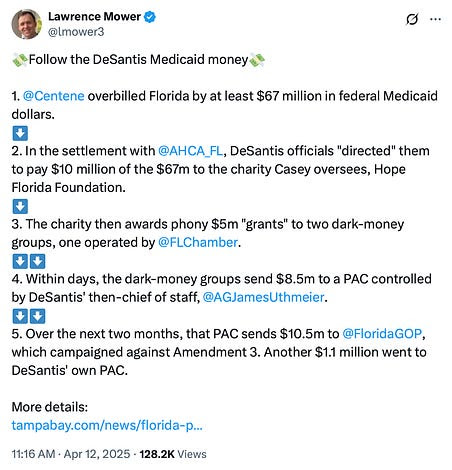
A simmering scandal erupted Friday afternoon when the Tampa Bay TimesMiami Herald and Politico Florida revealed that the administration of Gov. Ron DeSantis orchestrated a $10 million payment last fall to a charity founded by the governor’s wife — which then turned around and gave the money to groups that helped finance the governor’s campaign against a proposed constitutional amendment to legalize marijuana in Florida.

In a nutshell: The DeSantis administration pressured a major state contractor to make a $10 million donation to the Hope Florida Foundation, the controversial charity spearheaded by First Lady Casey DeSantis. It was part of a settlement negotiated with Centene Corp., after the state’s largest Medicaid contractor overbilled the state by at least $67 million.

Days later, Hope Florida transferred that $10 million to a pair of dark-money nonprofits. The state-backed charity gave $5 million each to “Save Our Society From Drugs,” an anti-marijuana group founded by a late Republican megadonor, and “Secure Florida’s Future,” a political vehicle controlled by executives at the Florida Chamber of Commerce, the Big Business lobbying group.

And days after that, Save Our Society From Drugs and Secure Florida’s Future gave a combined $8.5 million to “Keep Florida Clean,” a political committee — chaired by Ron DeSantis’ then-chief of staff — created to oppose Amendment 3, the amendment on last year’s ballot that would have allowed Floridians to use marijuana recreationally rather than solely for medicinal reasons.

It’s a daisy chain that may have transformed $10 million of public money — money meant to pay for health insurance for poor, elderly and disabled Floridians — into funding for anti-marijuana campaign ads.

DeSantis, of course, has repeatedly insisted that he did nothing wrong while also lashing out in increasingly vitriolic ways at everyone from the Republican speaker of the state House to the newspaper reporters digging into the story.

But at least one prominent GOP lawmaker — Rep. Alex Andrade, a Pensacola Republican who has been presiding over hearings into Hope Florida — told the Times and Herald that the transaction chain “looks like criminal fraud by some of those involved.”

Clearly, this looks very bad. But it is also by no means an isolated incident. 

In fact, this is part of a larger pattern of potential abuses that Ron DeSantis committed last fall when he chose to turn the power of state government against two citizen-led constitutional amendments that appeared on the November ballot: Amendment 3 and Amendment 4, which would have ended Florida’s statewide abortion ban.

Consider what we already know about how DeSantis financed his campaigns against the two amendments using public money taken from taxpayers — and private money taken from donors who got public favors from the governor.

  • Five state agencies directly funded television commercials meant to weaken support for the marijuana and abortion-rights ballot measures. We still don’t know the full extent of their spending, although Seeking Rents has estimated the total taxpayer tab at nearly $20 million. We also know that the DeSantis administration commandeered money for anti-marijuana advertising from Florida’s share of a nationwide legal settlement with the opioid industry — money that was supposed to be spent combatting the opioid addiction crisis.
  • At the same time, another nonprofit funded by Florida taxpayers poured at least $5 million into television ads attempting to soften Florida’s image on women’s healthcare at a time when Florida’s near-total abortion was under intense attack. It was the Florida Pregnancy Care Networks’ first-ever TV ad campaign. And its commercials, which were overseen by DeSantis administration staffers, complemented the state agency ads against the abortion-rights amendment — right down to using the same slogan.
  • Last June, after DeSantis vetoed legislation that would have strictly regulated the state’s hemp industry, CBS News Miami revealedthat industry executives and lobbyists promised to raise $5 million in exchange for the veto for the governor to spend on his campaign against Amendment 3. “Our lobby team made promises to rally some serious funding to stand with him on this,” a hemp industry representative wrote in one message that included a bank routing number for the Republican Party of Florida. “We have to pay $5 million to keep our end of the veto,” a hemp executive wrote in another message.
  • In the closing weeks of the campaign, records show that the Big Tobacco giant Philip Morris International gave $500,000 to DeSantis’ personal political committee — which was also chaired by the governor’s then-chief of staff and which DeSantis was using to campaign against both Amendment 3 and Amendment 4. Shortly after the election, the DeSantis administration handed Philip Morris a lucrative tax break, ruling that the company could sell a new line of electronically heated tobacco sticks free of state tobacco taxes.

There were other abuses of power, too. DeSantis and his team threatened to criminally prosecute television stations that aired ads supporting Amendment 4. They sent state police to the homes of Florida voters who signed Amendment 4 petitions. And they hijacked the ballot-writing process for Amendment 4.

There’s a reason why the DeSantis administration made sure to extract a promise of legal immunityfrom the organization that sponsored Amendment 4 as part of a legal settlement negotiated after the election.

DeSantis’ tactics worked. Though Amendments 3 and 4 each won majority support from Florida voters — 55.9 percent for recreational marijuana, 57.2 percent for abortion rights — both fell short of the 60 percent support needed to amend the state constitution.

But, suddenly, it looks like this may not be over — at least not for Ron DeSantis.

House Republicans are seeking troves of records from the DeSantis administration, including text messages and emails related to Hope Florida. The chamber has also scheduled another hearing on the Casey DeSantis charity next week.

What’s more, the House also unveiled a sweeping ethics reform package last week that would, among other things, explicitly expose senior government officials to criminal penalties if they interfere with elections.

That particular legislation would also prohibit state employees from soliciting money for political campaigns — an idea that emerged after DeSantis aides got caught squeezing lobbyistsfor more donations to their boss’ political committee ahead of a possible Casey DeSantis campaign for governor….

Ron DeSantis bet his political future on beating the marijuana and abortion-rights amendments. And he won both of those battles.

But it may turn out that he ultimately lost the war.

Wishful thinking? I hope not.

To give you an idea of how far/right the legislature is, Garcia lists some of the bills that are currently moving through the legislative process:

  • House Bill 549: Requires all new public school textbooks to refer to the Gulf of Mexico as the “Gulf of America.” Passed the Senate by a 28-9 vote. (See votes) Previously passed the House of Representatives by a 78-29 vote. (See votes) Goes to the governor.
  • House Bill 575: Replaces Gulf of Mexico with “Gulf of America” in state law. Passed the Senate by a 28-9 vote. (See votes) Previously passed the House of Representatives by a 78-27 vote. (See votes) Goes to the governor….
  • House Bill 1517: Allows someone to file a wrongful death lawsuit seeking lost wages on behalf of an embryo or fetus. Passed the House of Representatives by a 79-32 vote. (See votes)…
  • House Bill 7031: Cuts the state sales tax rate from 6 percent to 5.25 percent. Passed the House of Representatives by a 112-0 vote. (See votes)
  • House Bill 123: Allows a traditional public school to be converted into a charter school without the consent of the teachers who work at the school. Passed the House Education & Employment Committee by an 11-4 vote. (See votes)