Archives for the month of: August, 2024

Veteran journalist Garry Rayno wrote a passionate editorial about the destructive voucher program in New Hampshire, promoted by out-of-state billionaires. Ninety percent of the students in the state attend public schools, but Republicans have diverted taxpayer dollars to private and religious schools. Their goal is a universal voucher program, where every student in the state is eligible for a voucher, with no income limits.

Rayno wrote at InDepthNH.org:

America’s traditional institutions, the foundation for the greatest political experiment in history, are under attack from the social safety net to food regulations, and from the court system to environmental protection.

The drive to create doubt and even rejection of these long-standing pillars of our society is to eventually destroy the underpinnings of government to create a new order where the rich will flourish even more with all the advantages, while everyone else will fight over the crumbs of the plutocrats.

The current large target in this fight to turn democracy into an oligarchy is the public school system.

The first blow to the public school system in New Hampshire was the push for charter schools, which are still public schools but without the regulations and requirements traditional public schools must meet.

Charter schools have had to ask the state for more and more per pupil money to stay afloat, about double the per pupil adequacy grant amount for traditional schools.

The charter schools that found a niche have been successful, but many have fallen by the wayside over the years even with federal grant money approved during the Trump administration for start-ups and expansions.

And until recently, they have not strayed into the Christian Nationalist area that has been widely promoted by Hinsdale College in Michigan and adopted by some states.

Then came the voucher push sold as a way of helping low-income families find a more suitable education environment for students who do not do well in the public-school setting.

After several unsuccessful attempts, proponents, who include Education Commissioner Frank Edelblut and State School Board Chairman Drew Cline, lawmakers successfully approved the Education Freedom Account program as a rider to the 2022-2023 biennial operating budget after it failed to pass the House and was retained.

Since then attempts to expand the eligibility of parents by raising the income cap passed two sessions ago, but failed in the recently completed session.

Instead of helping the low-income families with educational options the program has largely been a subsidy program for parents with children who were already in religious or private schools and homeschooling. 

Only about 10 to 15 percent of the increasingly expensive draw on the Education Trust Fund have left public schools for alternative education programs.

What proponents ultimately seek is a “universal program” which would be open to any New Hampshire student regardless of his or her parents’ income, although a similar program has nearly bankrupted Arizona and put public education at risk in Ohio, where it is being litigated.

New Hampshire is not alone in the push to do away with public education as we know it.

A letter from many national figures seeking to privatize education like Betsy DeVos and Edward Bennett; the CEOs of organizations pushing for privatization; former federal and state governors; sitting governors from almost all southern states; two state education commissioners including Edelblut, and state elected officials most from Republican controlled states was sent to Republican Congressional leaders saying, “The task before the next Congress is clear and unambiguous: bring education freedom to millions of students across America who desperately need it!”

The letter also touts the GOP’s platform approved at its recent national convention “to cultivate great K-12 schools, ensure safe learning environments free from political meddling, and restore Parental Rights. We commit to an Education System that empowers students, supports families, and promotes American Values… Republicans believe families should be empowered to choose the best Education for their children. We support Universal School Choice in every State in America.”

The political meddling the platform contends is that “Lessons about American values have been displaced by political or cultural trends of the day,” without noting several states have recently required the Bible be taught in public schools. 

Children whose faith is Muslim or Buddhism or are Native Americans may believe those state’s Biblical requirement is political meddling.

What the proponents of universal vouchers seek is to have Congress do what some state legislators, including Texas, have failed to do and that is approve universal private or religious education on the public’s dime.

This push to do away with public education has attempted to tarnish what has always been the great equalizer, by saying schools are failing, teachers are indoctrinating students and withholding information from parents. 

You would think public schools are a far-reaching conspiracy to destroy family values, while ignoring the fact that 90 percent of students are in public schools and many are very successful.

New Hampshire public schools ranked sixth in the nation this year, down from the number two spots five years ago.

The number ranking was before the push to privatize education became successful with the help of Gov. Chris Sununu who put both Edelblut and Cline where they are, in charge of the public education system in the state, although both seek to diminish its reach.

Edelblut focuses on the learning disparity between well to do school districts and the poorly performing ones that lack the property values to support schools in the same way property wealthy communities do as the reason to seek alternatives.

Yet when the state education funding system is raised as a possible culprit for the disparity, Edelblut is quick to dismiss that as a different issue when it isn’t.

One of the major concerns about the Education Freedom Program, the Business Tax Scholarship Program and charter schools, is the lack of accountability.

How do taxpayers know their money is being used wisely if there is no way to determine those students are receiving “an adequate education,” as the state Supreme Court ruled?
Attempts to bring more accountability have failed in the Republican controlled legislature.

At the same time, Cline this week in his column “The Broadside” touts the state as doing pretty well for educational entrepreneurs according to a recent ranking.

“There’s more that can be done to make New Hampshire a freer state for education entrepreneurs looking to start small, decentralized, and unconventional educational environments, but so far the state is doing better than most,” according to Cline.

He cites the Education Entrepreneur Freedom Index released by the yes.every kid.foundation for the ranking.

It shouldn’t be surprising that according to Wikipedia,  “Yes. every kid. (YEK) is a 501(c)(4) advocacy group that is a part of the Koch Network. Launched by the Charles Koch-funded Stand Together in June of 2019, YEK supports the privatization of education. The organization is a proponent of the school choice movement, advocating for subsidized private school vouchers and charter schools.”
The Koch Foundation has long advocated for ending public education and installing a private education system where you pay for what you get. Not exactly the great equalizer.

Cline argues New Hampshire should be looking to encourage more private education.

“States with more relaxed homeschool and nonpublic school laws/regulations score higher, as entrepreneurs have an easier time getting started in these states,” he notes.

Cline and the Koch organization suggest relaxing state requirements for non-public schools and also zoning regulations to make it easier to locate educational facilities including child care businesses by allowing education in all zoning districts in a municipality.

“Though New Hampshire lost a point for rules requiring state approval for non-public schools, the state could become much more friendly to education entrepreneurs, the study’s authors conclude, primarily by relaxing some child-care rules and local regulations,” Cline writes.

Supporters of Education Freedom Accounts are fond of saying the best accountability is if parents are satisfied with the education their children receive, which you would hope is the case or why would you leave your child in an unsatisfactory educational environment?

But that is not what the state Supreme Court said in its Claremont I decision. It said the state has a responsibility to provide an adequate education to every student in the state and to pay for it. Parents have choices but the state defines an adequate education.

The state legislature has yet to live up to its responsibility and allowing a bypass through religious and private schools and homeschooling is not constitutionally fair to those children.

If you believe public education is failing in this state, you should begin looking at the top: the governor, the commissioner and to the state board of education chair.

Their priority is not public education.

Garry Rayno may be reached at garry.rayno@yahoo.com.

Blogger Robert Hubbell was an enthusiastic supporter of Joe Biden and now he is enthusiastic supporter of Kamala Harris. Like me, he wants to stop Trump and his anarchist pals from retaking the White House and wreaking havoc on our society.

He knows that the media is currently amazed by the enthusiasm that Harris’s campaign unleashed. But he warns about what will happen next as journalists get bored and seek to burst the bubble of excitement she has generated:

We must shape the media narrative

By its nature, the political media is contrarian. It has been impossible for the media to ignore the outpouring of enthusiasm for Kamala Harris. Still, we should expect the media to turn on Kamala Harris and Democrats. It is just a question of when. Media outlets will begin featuring stories with random voters—likely young, diverse, female—who support Trump or are doubtful about Kamala. Such random interviews are worse than meaningless. They are efforts to distort reality and mislead readers about the true nature of the race.

When such stories begin to appear, recognize them for what they are: lazy reporting by journalists who can’t be bothered with the hard work of reporting the truth. Instead, they will default to the “Just asking questions” brand of false reporting. (“Is Kamala in trouble?” “Can she sustain the enthusiasm?”) I saw an article today from someone who wanted Biden to withdraw, asking, “Was Kamala the right choice?” Thankfully, he was being overwhelmed by negative comments from readers.

One way to fight the contrarian news cycle is to spread the good news of Kamala’s candidacy and the incredible energy of the Democratic base. For now, we have the upper hand; we are controlling the narrative and should be “flooding the zone” with positive messaging for Kamala Harris.

But this cannot be said enough: The election will be won on the ground in fifty states by ensuring a historic turnout of voters. That effort will take hundreds of thousands of volunteers. Be one of those volunteers. If you haven’t joined a grassroots group already, do so ASAP. If you already belong, recruit new volunteers and mentor new members. We have less than 100 days left to get this done, but we have every reason to be hopeful—and no reason to be complacent.

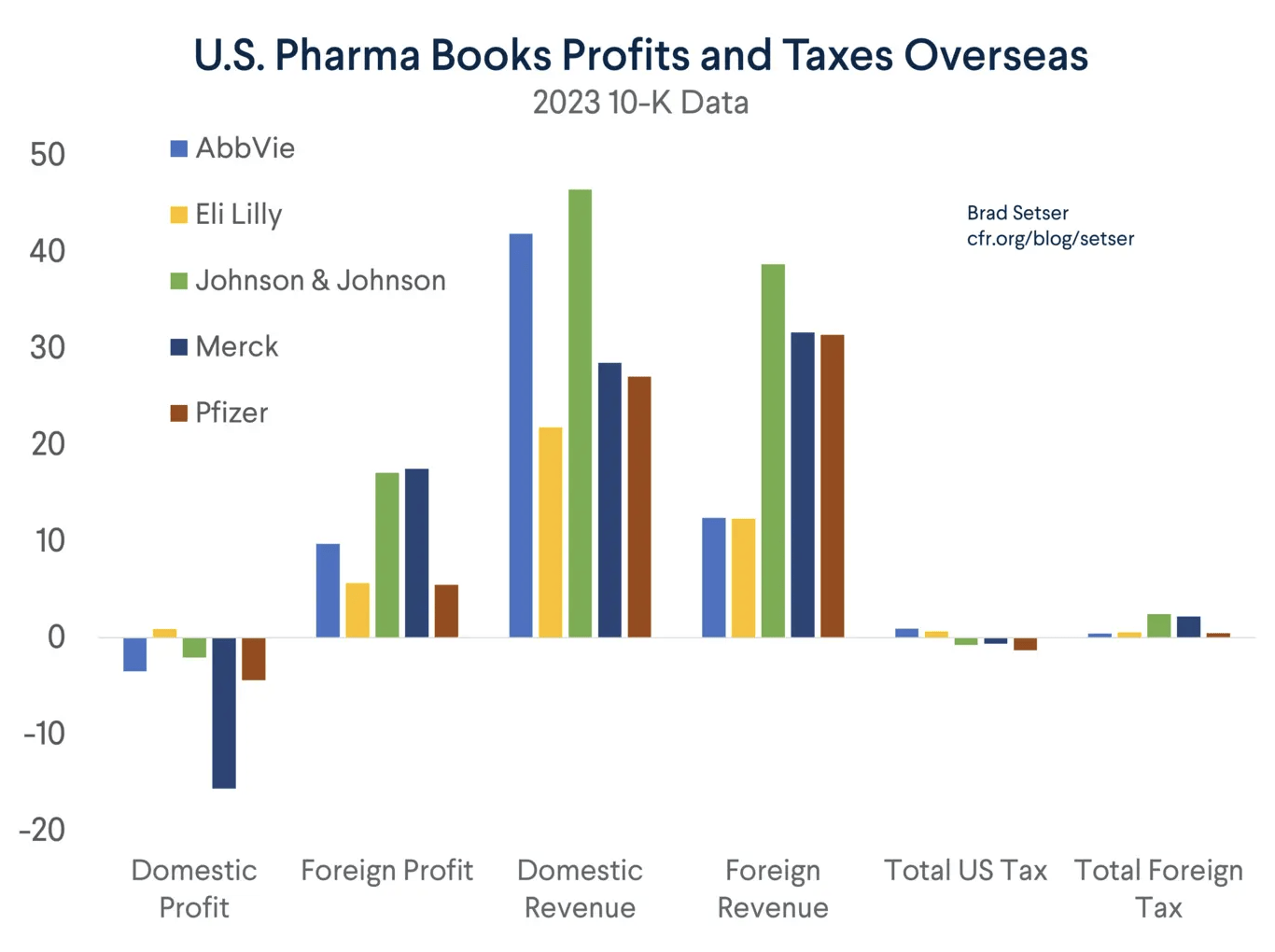
Big Pharma makes big profits in the U.S., but has mastered the accounting trick of paying little or no taxes. Thanks to Trump’s big corporate tax cut in 2017, most of these corporations are able to transfer their profits to other countries where the tax rates are lower.

Although they receive the bulk of revenue from sales in the U.S. and report large overall profits, most large U.S.-based pharmaceutical companies don’t pay any taxes in the country.

A new analysis of corporate taxes paid by the largest U.S. pharma companies by the Council on Foreign Relations found that in 2023, the top seven based on revenue had a combined U.S. tax obligation of (-)$250M.

The duo also noted that, based on 10-K filings, many pharmas reported losses in the U.S. in 2023. Among them: Pfizer, $4.4B; AbbVie, $3.5B; Merck, $15.6B; and Johnson & Johnson $2B.

However, Setser and Weilandt estimated that Eli Lilly (LLY) reported a $0.9B U.S. profit.

Gilead Sciences (GILD) is an outlier among large biopharmas. It is the eighth largest U.S. biopharma by revenue, yet reported paying $3B in U.S. taxes in 2023.

Setser and Weilandt explain how pharmas can book U.S. profits overseas to save on paying U.S. taxes. The first reason is the Tax Cuts and Jobs Act of 2017, which the pair say provided for lower taxes on foreign profits than U.S. profits, providing an incentive for companies to book more profits overseas.

Second, since many drugs sold in the U.S. market are actually made abroad, pharma companies decide to book those profits in the country of manufacture.

Finally, many pharmas have moved their intellectual property to wholly owned subsidiaries in locations with more favorable tax rates than the U.S.

Open the link to read the rest of the article.

Scholars at Brown University and Stanford University recently released a study concluding that spending more on schools reduces child mortality.

The paper is titled “Priceless Benefits: Effects of School Spending on Child Mortality.”

The authors are: Emily Rauscher of Brown University; Greer Mellon, Postdoctoral Research Associate, Brown University; Susanna Loeb, Stanford University.

The authors’ summary:


The academic and economic benefits of school spending are well-established, but focusing on these outcomes may underestimate the full social benefits of school spending. Recent increases in U.S. child mortality are driven by injuries and raise questions about what types of social investments could reduce child deaths. We use
close school district tax elections and negative binomial regression models to estimate effects of a quasi-random increase in school spending on county child mortality. We find consistent evidence that increased school spending from passing a tax election reduces child mortality.

Districts that narrowly passed a proposed tax increase spent an additional $243 per pupil, mostly on instruction and salaries, and had 4% lower child mortality after spending increased (6-10 years after the election). This increased spending also reduced child deaths of despair (due to drugs, alcohol, or suicide) by 5% and child deaths due to accidents or motor vehicle accidents by 7%. Estimates predicting potential mechanisms suggest that lower child mortality could partly reflect increases in the number of teachers and counselors, higher teacher salaries, and improved student engagement.

Suggested citation: Rauscher, Emily, Greer Mellon, and Susanna Loeb. (2024). Priceless Benefits: Effects of School Spending on
Child Mortality. (EdWorkingPaper: 24-1008). Retrieved from Annenberg Institute at Brown University:
https://doi.org/10.26300/s7t7-j992

Emily Rauscher
Professor of Sociology
Brown University
Box 1916
Providence, RI 02912
emily_rauscher@brown.edu


Greer Mellon
Postdoctoral Research Associate
Population Studies and Training Center and Annenberg Institute
Brown University
greer_mellon@brown.edu


Susanna Loeb
Professor of Education
Stanford University
482 Galvez Mall
Stanford, CA 94305
sloeb@stanford.edu

Blogger Steve Ruis notes that evangelical Christians are once again rallying behind Trump. He points out that Trump is not at all religious, in contrast to Kamala, who chose Christianity and practices her faith.

Open the link to see a great meme.

Jim Hightower is a Texas Democrat who spent some time in state government, back in the days when Democrats had a shot at winning statewide offices in Texas. He warns here about the real purpose of Project 2025: to turn our country into a white Christian nation. The Founders never said that. In fact, the only things they said in the Constiturion was that there should be no religious test for office. And the First Amendment barred any establishment of any religion and guaranteed freedom of religion. So what these extremists are doing is a blatant violation of the Constitution.

Hightower writes:

We’ve seen a ton of social media posts and emails in the last week or so about Project 2025, and although we’re still working on a fuller analysis to give you the lowdown on what it means to you, as well as tools to fight it, we felt it was urgent to get some solid info into Lowdowner’s hands as soon as we could. Y’all are quite the army of activists (we see the results when you take action!) and we know that if we offer up the goods, you can take them and run with them.

Here’s our brief primer on what this mess is, what’s at stake, and what you can start to do.

What is it?

If you don’t know what Project 2025 is, or would like a brief summary to use to alert others about it, here you go:

It’s a painstakingly detailed, 922-page step-by-step plan to impose an American dictatorship of moneyed authoritarians and Christian nationalists, removing your and my democratic rights. Yes, this is an actual coup.

It sounds insane, yet there it is—a document written and being loudly promoted by a power-mad cluster of Trump bosses, Putin-esque despots, Reagan-loving economists and Ayn Rand-ian academics, moneyed corporate donors, and general far-right quacks and media blowhards. It’s innocuously coded “Project 2025” because the intent is to launch their full assault on the democratic fabric and structure of our national government next January, on Day 1 of another Trump presidency.

This scheme has been devised by The Heritage Foundation, a DC think tank set up in 1973 to promote the elitist economic and cultural doctrines of its über-rich founding funders, Joseph Coors (yes, that Coors) and Richard Mellon Scaife (yes, that Mellon). In recent years, Heritage has gone from merely being right-wing zealots to off-the-charts Trumpists… and now they’re going deep into the distant extremist cosmos. Thus, the head cosmonaut, Kevin Roberts, has megalomaniacally exulted that Project 2025 is “the second American revolution.” Unfortunately, it’s a dangerous devolution, with little tin-hat Kevin acting out what he pretends is a heroic coup.

This would be silly and inconsequential, except the Trump Party has become alarmingly treacherous. Ominously referencing the January 6th violent assault on democratic rule, Kevin said that his coup “will remain bloodless if the left allows it to be.” Of course, “the left”—i.e., sane democracy fighters like you and me—do not acquiesce to tyrannical wannabes.

But his ace is that The Donald, despite his denials, has hailed Heritage’s authoritarian agenda as his own and has cheered its plan to fire thousands of public employees on Day 1, replacing them with a lockstep army of enforcers that Heritage and others say they’ve already recruited to seize and Trump-ize every federal agency. This, combined with Trump’s own pledge to use the US military to enforce his political will, is where Project 2025’s subversive coup gets real. 

Here are just a few of the steps we’ve learned so far that Heritage autocrats intend to implement: 

  • Nearly eliminating abortion access altogether at the national level.
  • Cutting Social Security benefits.
  • Giving ever-more tax breaks to corporations and gabillionaires. 
  • Selling off national parklands, wetlands, wildlife sanctuaries and other public properties
  • Eliminating the Corporation for Public Broadcasting (NPR, PBS).
  • Imposing a “biblically-based” definition of marriage and families.
  • Eliminating the Department of Education.
  • Preventing LGBTQ+ couples from adopting children.
  • Eliminating the food stamp program (SNAP) and the free school lunch program.
  • Putting the Department of Justice and other independent agencies under the direct political control of the President.
  • Eliminating organic food promotion, conservation programs, and most climate policies of the Agriculture Department

For more in depth reading, check out this series from the Center for American Progress.

Why is this different from previous right-wing agendas?

One, they were piecemeal proposals, like Bush the Second’s failed attack on Social Security, or they were just sloganeering war whoops, like Grover Norquist’s empty call to make government small enough to drown it in a bathtub. 

Two, Project 2025 is a comprehensive, all-in-one blueprint for a radical plutocratic and theocratic takeover of our government, surreptitiously advanced by many of the same anti-democracy corporate supremacists and billionaires who’ve already seized control of the judicial branch.

Three, the Republican Party is perfectly willing to submit to and grovel at the feet of moneyed extremists, media demagoguery, and political thuggery—even in support of stupid, poisonous policies the American people overwhelmingly reject.

Four: Donald.

What can I do?

Right now, the most important thing you can do is to tell your friends and family about this terrifying agenda. Right-wingers are currently attacking the media reporting on this, calling progressives and even moderates who oppose the coup “Chicken Little”-types, trying to minimize this elitist assault on America itself. We cannot let them.

The most important people to share it with are not your super conservative relatives that drive you nuts, but rather people who may be feeling ambiguous about voting for a Democrat (whoever that is ends up being) for President. You’re not going to change the people who’ve already gone over to the crazies, but you have a chance at inspiring more undecided voters to at least vote against an explicitly un-American, Christian Nationalist, fascist ideology.

Davey Winder, senior contributor to Forbes, writes about how to keep your passwords safe.

With just a few dollars, a little time, and a smart brute-force guessing algorithm, most passwords can be cracked in much less time than you might imagine. According to a new analysis from the experts at Kaspersky, 59% of 193 million actual passwords were cracked in less than 60 minutes, and 45% were cracked in less than 60 seconds.

The basis of a brute-force attack is where the perpetrator iterates all possible combinations in order to find a match for the password in question. However, Antonov explained, “smart guessing algorithms are trained on a passwords data-set to calculate the frequency of various character combinations and make selections first from the most common combinations and down to the rarest ones.”

Brute Force And Smart-Guessing Combine To Quickly Crack Passwords

Although very popular due to the point-and-fire simplicity of a brute-force attack, it remains suboptimal as far as password-cracking algorithms are concerned. When you consider that the vast majority of passwords in daily use contain similar characteristics involving the combination of dates, names, dictionary words and keyboard sequences, adding these to the guessing-game mix speeds things up considerably.

The Kaspersky study revealed that when it comes to the percentage of passwords crackable in any timeframe using each method, while 10% of the password list analyzed was broken in under a minute by brute force, that increased to 45% when smart-guessing was added to the algorithm. Allowing for between a minute and an hour, the difference was 20% compared to 59%.

The Smart-Guessing Algorithm Advantage Explained

Because humans are creatures of habit, we make for very poor password creators. The truth is that the passwords we choose for ourselves are rarely, if ever, truly random. We rely upon all the things that smart-guessing algorithms are designed to detect: common names and phrases, important dates both personal and historical, and patterns, lots of patterns. To give you an idea of how predictable we are, one YouTube channel took a sample of more than 200,000 people and asked them to choose a ‘random’ number between 1 and 100. Most people gravitated towards the same relatively small set: 7, 37, 42, 69, 73, and 77. Even when trying to be random with character strings, we fail as most people will favor the center of the keyboard for their selection, according to Kaspersky.

“Smart algorithms make short work of most passwords that contain dictionary sequences,” Antonov said, “and they even catch character substitutions.” In other words, using p@ssw0rd instead of password won’t slow the algorithm down that much at all.

How To Strengthen Your Accounts Against Smart-Guessing Algorithm Attack

Kaspersky recommends the following password usage strategy:

Generate strong and truly random passwords using a password manager.

Don’t reuse passwords across sites and services or hacking one basket will enable access to many more eggs.

If you don’t, or won’t, use a password manager, then use mnemonic passphrases rather than dictionary words and numeric combinations.

Don’t save passwords in web browsers.

Use a password manager protected by a strong master password.

Use two-factor authentication for all accounts that support it.

The Atlantic contains a lovely article by contributing writer Stephanie H. Murray about a growing movement to close streets to cars so that children can play without adult direction.

She begins:

In the summer of 2009, Amy Rose and Alice Ferguson, two mothers living on Greville Road in Bristol, a midsize city in southwest England, found themselves in a strange predicament: They saw entirely too much of their kids. “We were going, like, Why are they here?” Rose told me. “Why aren’t they outside?” The friends decided to run an experiment. They applied to shut their quarter-mile road to traffic for two hours after school on a June afternoon—not for a party or an event but just to let the children who lived there play. Intentionally, they didn’t prepare games or activities, Rose told me, as it would have defeated the purpose of the inquiry: “With time, space, and permission, what happens?”

The results were breathtaking. The dozens of kids who showed up had no problem finding things to do. One little girl cycled up and down the street “3,000 times,” Rose recalled. “She was totally blissed out.” Suddenly, the modern approach to children’s play, in which parents shuttle their kids to playgrounds or other structured activities, seemed both needlessly extravagant and wholly insufficient. Kids didn’t need special equipment or lessons; they just needed to be less reliant on their time-strapped parents to get outside.

The experiment also produced some unexpected results. As children poured into the street, some ran into classmates, only just then realizing that they were neighbors. Soon it became clear to everyone present that far more children were living on Greville Road than anyone had known. That session, and the many more it prompted, also became the means by which adult residents got to know one another, which led to another revelation for Ferguson and Rose: In numerous ways, a world built for cars has made life so much harder for adults.

The dominance of cars has turned children’s play into work for parents, who are left coordinating and supervising their children’s time and ferrying kids to playgrounds and play dates. But it has also deprived adults of something more profound. Over the years, as Rose and Ferguson have expanded their experiment to other parts of the United Kingdom, neighborhoods across the country have discovered that allowing kids to play out in the open has helped residents reclaim something they didn’t know they were missing: the ability to connect with the people living closest to them.

Modern folks tend to think that streets serve largely mobile purposes—getting cars from one place to another in swift, orderly fashion. But “prior to the automobile, streets had a ton of stationary functions,” Marcel Moran, a faculty fellow at New York University’s Center for Urban Science and Progress, told me. Streets were where people sold wares and socialized. And particularly after the United States and Europe began to industrialize, streets were the primary location for the rising number of urban-dwelling children to play, according to Jon Winder, a historian and the author of Designed for Play: Children’s Playgrounds and the Politics of Urban Space, 1840–2010. This remained the case in the U.K. and the U.S. even after playgrounds became widespread in the early 20th century. Only when cars hit the streets in larger numbers did things begin to change. Society, Winder told me, began prioritizing “the movement and storage of motor vehicles over children and their playful behavior…”

Rose and Ferguson’s project on Greville Road is of course not the first or only effort to reclaim the streets for children. In the U.K., play streets emerged roughly a century ago as a sort of compromise in the process of booting kids off the street. But after peaking in the 1960s, they largely dwindled out, to be revived only in the late 2000s. New York has had a play-streets program since 1914, and Philadelphia for more than half a century—and recently, the idea has been taken up in other U.S. cities. Chicago launched a play-streets program in 2012, followed by Los Angeles in 2015; an initiative in Portland, Oregon, hosted its first events in 2023.

In the U.K., Rose, Ferguson, and their friend Ingrid Skeels expanded their experiment in 2011 by founding Playing Out, an organization that has helped residents on more than 1,000 streets in dozens of cities across the country set up their own play sessions. These typically last for two hours and occur weekly, biweekly, or monthly.

Open the link to read the rest of the article. It’s an inspiring idea that is great for children and parents alike. Plus, it introduces neighbors to each other.

Simone Biles posted a tweet mocking Trump’s claim that immigrants are taking away “Black jobs.” This story was published by the New York Daily News.

Gymnast Simone Biles dinged former President Trump on Friday by tweeting “I love my Black job” after her latest Olympic gold medal win.

Taking a victory lap after her winning performance at the Paris Games, Biles trolled Trump for his controversial claims that undocumented immigrants are taking so-called “Black jobs” from Americans.

The world champion was amplifying a post by singer/songwriter Ricky Davila that praised Biles as the greatest of all time.

“Iconic photo of the GOAT mastering her black job and collecting gold medals,” Davila tweeted.

Biles won the all-around gold medal on Thursday, her second of the Paris Games. It raised her career haul to nine gold medals, and she could add even more honors with three more finals looming in coming days.

The wins amount to a remarkable comeback after Biles withdrew from the last Olympics to focus on her mental health.

Her tweet amounts to a rebuke of Trump who has refused to back down from controversial remarks about “Black jobs” at his recent debate with President Biden.

Trump doubled down on the comment Wednesday during a forum with reporters at the National Association of Black Journalists in which he also falsely claimed that Vice President Kamala Harris only recently “became Black.”

“A Black job is anybody that has a job,” Trump said at the NABJ event, drawing derisive groans from the crowd.

The spat with Trump isn’t the first tangle between Biles and his right-wing supporters.

Biles’ 2021 decision to withdraw from competition sparked an unusual backlash from Trump’s MAGA allies who suggested she should suck it up and compete regardless of her health concerns.

One of them was Trump’s vice presidential running mate JD Vance, who denounced Americans for supporting Biles’ difficult decision at the time.

“I think it reflects pretty poorly on our … society that we try to praise people, not for moments of strength, not for moments of heroism, but for their weakest moments,” said Vance, who was launching an ultimately successful run for U.S. Senate.

Democrats seized on the remarks this week to take shots at Vance, who has stumbled badly in his debut on the national stage with comments deriding Americans who don’t have children.

“The audacity of JD Vance to go after the GOAT @Simone_Biles as if he isn’t the most unpopular V.P. pick in decades,” tweeted Aida Ross, a spokeswoman for the Democratic National Committee.

Donald Trump is incredulous that Kamala Harris is both Indian and black. He ridiculed before an audience of black journalists for “turning black,” presumably to advance her career. The claim is false and bigoted. It says more about Trump than it does about Kamala. JD Vance endorsed Trump’s insulting statement, saying that Kamala is a “chameleon.” This is rich coming from a man who is married to an Indian woman and whose children are biracial.

Anand Girihadaras, a brilliant journalist, wrote about the dilemmas of biracial people on his blog, The Ink:

Today Donald Trump sought to question Vice President Kamala Harris’s racial identity, much as he rose to political prominence doubting Barack Obama’s origins.

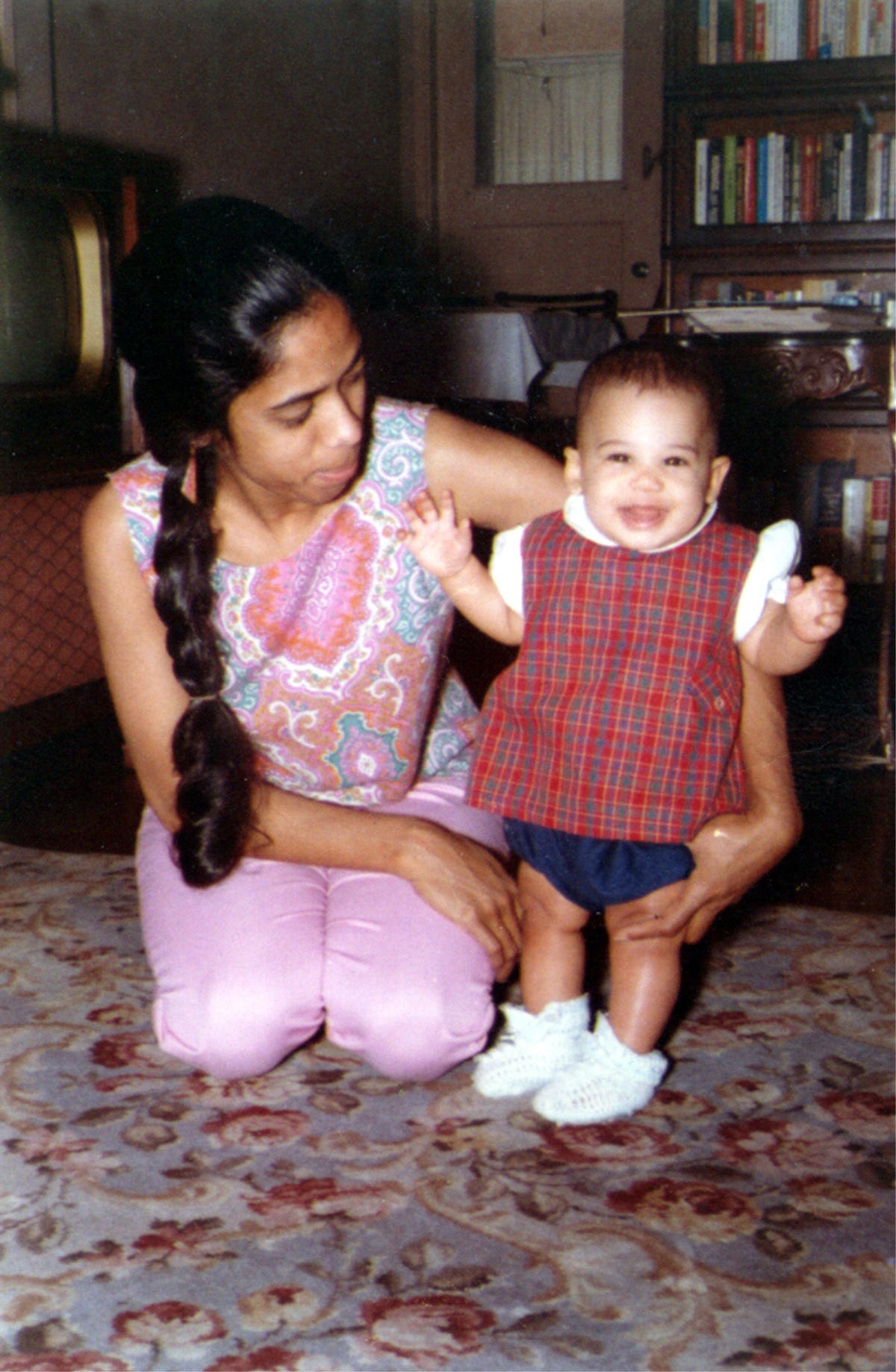
He mused that she had always cast herself as Indian, until one day, suddenly, magically, she turned Black. Well, this is false, first of all. And dumb. Harris went to Howard University, an historically Black college, and has identified as both Indian and Black all her life. She had the unusual childhood situation of being raised by an Indian mother who, having divorced Harris’s Black father, nevertheless invested great effort and intention in exposing Harris and her sister, Maya, to the Black community and Black tradition and thought, as Harris writes in her memoir, The Truths We Hold.

Since Trump, who is of German and Scottish heritage, cannot seem to hold in his head the notion of people with more than one heritage, we’re offering this primer. It’s an essay from our archives, from 2020, on Vice President Harris’s layers of identity, viewed through the lens of caste — of the divisions and hierarchies that have haunted both the Black and Indian sides of her lineage.

The many layers of Kamala Harris’ identity

Kamala Harris is the first woman of color on a major-party presidential ticket. She is, in fact, you might say, a woman of two colors: Black, owing to her Jamaican father; and brown, owing to her Indian mother. And each of those lineages comes with its own histories and complications and inheritances related to caste.

Harris almost certainly wouldn’t exist if her maternal grandfather had not been an improbably progressive upper-caste Indian, a defier of caste. A Brahmin civil servant in newly independent India, P.V. Gopalan might have been expected, as The Los Angeles Times notes, to hew to the convention that “destined Brahmin offspring for arranged marriages and comfortable careers in academia, government service or the priesthood — if they were men. Women were not expected to work at all.” Instead, all four of his children traveled untraditional roads. His son married a Mexican woman. A daughter became a doctor and never married. Another daughter became an information scientist and didn’t have children. And Shyamala, the senator’s late mother, pulled off a caste-defiance hat trick of Things a Well-Born Indian Woman is Not Supposed To Do: leaving the country alone as a 19-year-old woman; pursuing a master’s degree as said woman; and not only failing to marry an Indian man but marrying a Black man — a brave act given anti-Black racism among Indians.

So Harris descends from privilege in the Indian system of caste, but only came to be born because of the rejection of the rules of that privilege. And her father’s background implicates other systems of — and questions about — caste. Donald Harris was Black and Jamaican. He and Shyamala met during their work for the civil rights movement. So it was the battle against the American caste regime that brought them together. Yet because of her father’s foreign provenance, Harris has long been met with (rather unfair) questions about the authenticity of her Blackness. “What does it mean to call Kamala Harris ‘black’ in an American context?” the writer Thomas Chatterton Williams has tweeted. “People keep saying, ‘Well, she looks black.’ Always good to keep in mind that ‘race’ has never strictly been about how someone looks. My blue eyed children would qualify for reparations and Harris would not.” His ground for this latter claim is that Harris cannot trace an ancestor back to American slavery. (There have also been unsubstantiated suggestions that Harris’ ancestors include an enslaver — suggestions that are intended to cast her bona fides as a survivor of the American caste system into doubt, suggestions that seem utterly unfamiliar with hemispheric history.) But whether or not Kamala Harris’ future critics would recognize her and her sister as Black, their mother had no doubt. As Harris writes in her memoir, Shyamala “understood very well she was raising two black daughters. She knew that her adopted homeland would see Maya and me as black girls, and she was determined to make sure we would grow into confident black women.”

At that, Shyamala couldn’t be accused of failing. And as Harris grew into a trailblazing public official and a political superstar, the ghost of caste hovered. At every step of her career, she defied America’s racial caste system and other hierarchies, accumulating a pile of firsts: first woman elected district attorney of San Francisco; first woman, first African-American, and first person of South Asian origin elected as attorney general of California; first United States senator of South Asian descent (and only the second African-American woman). But, like Barack Obama’s ascent to power, Harris’ successes also illustrated the limitations of singular defiers of caste regimes. As the writer Casey Gerald has said of his own transcendence of caste, rising to great heights from a hard-up African-American community in Dallas, “The American dream relies on stories like mine…to distract from the American reality: There is a conveyor belt that sends most young people, especially from neighborhoods like mine, from nothing to nowhere, while the chosen few are randomly picked off and celebrated.”

There is also the issue of what is expected of those from disfavored castes in exchange for the chance to defy caste systems. A lot of us would have wanted an angrier Barack Obama when it came to the abuses that led to the 2008 financial crisis, but, given how many white Americans react to Black anger, that man would probably have remained a professor in Chicago. Those of disfavored castes permitted to rise within caste systems must often navigate an extra expectation to prove that they will not rock the caste boat. Which is hardly to excuse Senator Harris’ controversial record as a prosecutor — a record that, for certain progressives, puts her beyond the pale. She did what prosecutors do — put people in jail — and she did it within the caste regime that is, in Michelle Alexander’s phrase, “the new Jim Crow.”For many of Harris’ critics, it is especially disheartening that a pioneering woman of color — of those two colors — rose to power through, among other things, jailing Black and brown people. It is a reminder that representation matters, and that structure matters as well, and advances in representation can bring about advances in structure or can crowd them out and stave them off. It is progressive to diversify the rooms where it happens, but diversifying those rooms doesn’t necessarily, on its own, make them progressive.

Please open the link to read the article in full.