Archives for the month of: November, 2023

For the first time ever, a state voucher program was canceled. The Illinois Legislature failed to renew “Invest in Kids,” which puts an end to vouchers in that state. Retired teacher Fred Klonsky explains in this post why Illinois had a voucher program and who was behind it.

He wrote on his blog:

The veto session of the Illinois General Assembly ended yesterday and in spite of a full court press by the state’s Republicans, the right-wing Illinois Policy Institute and the Catholic Church, the state’s million dollar tax credit voucher program was allowed to die.

Good riddance.

The original idea emerged during the administration of Illinois’ last Republican governor, Bruce Rauner.

The law allowed up to $75 million in tax revenue to be diverted to private schools each year. More than 250 million oof state dollars have now been siphoned off to private schools in our state.

Invest in Kids was only supposed to last five years. It was extended an extra year and voucher supporters wanted to extend it again and make it permanent.

Democratic governor JP Pritzker said that if the General Assembly passed an extension he would sign it.

Instead, the General Assembly adjourned taking no action and so it is done.

In 2017, when Invest in Kids was being considered, the schools in the Archdiocese of Chicago was losing money as Catholic school enrollment was declining.

What to do?

Cupich met with Chicago’s mayor Rahm Emanuel and Illinois governor Bruce Rauner and asked for a life-line.

Of course, the U.S. Constitution’s separation clause prohibits direct government support for religious schools.

But Cardinal Cupich, Bruce Rauner and with behind the scenes support by then-mayor Rahm Emanuel, created the idea of Invest in Kids tax credit as a workaround to the Constitutional prohibition.

Forbes:

Illinois’s program funded a considerable amount of discrimination with taxpayer money. Illinois Families for Public School found at least 85 schools in the Invest in Kids program, nearly 1 in 5, have anti-LGBTQ+ policies.

Only 13% of private schools in the Invest in Kids program last year reported to the Illinois State Board of Education that they served any special education students. The majority of schools in the program are Catholic schools, and four of six Catholic dioceses in Illinois have policies that say schools may refuse to accommodate students with disabilities.

Policies that discriminate against pregnant and parenting students, students who have had an abortion, English-language learners, students with disabilities, undocumented students, and more are widespread in Illinois voucher schools as well.

More specific examples include Yeshivas Tiferes Tzvi Academy of Chicago, which reserves the right to expel any student whose family listens to secular music. Westlake Christian Academy of Greyslake will not admit students if they or their custodial parents maintain a “lifestyle” that violates biblical principles; this would include “promiscuity, homosexual behavior, or other violations of the unique God-give roles of male and female.” In fact, Westlake only accepts students from families in which one parent is “a born-again Christian.”

Defeating the attempt to extend Invest in Kids represents a major defeat for vouchers and school privatization.

**********

A letter to the blog by reader Martin Gartzman described the small number of unfunded activists who fought against the renewal of the Illinois voucher program. The Illinois Families for Public Schools never lost hope. A true David beats Goliath story.

Illinois Families for Public Schools is a small group. It basically is 3-5 people at any given time, spearheaded by political activist Cassie Cresswell and retired educator Diane Horowitz. They have very little funding. They have no full-time employees and perhaps a couple of part-timers. Cassie is not an educator; she got involved in this work as a parent-activist. But there is zero doubt that without their advocacy and incredible organizing, we’d still have a school voucher program in Illinois. This little group was the engine behind the effort to end Invest in Kids. They got over 60 organizations to support the sunset of the voucher program! They provided the mechanism for other education and political activists to get involved. And they organized the two main teachers unions to make the Invest in Kids sunset a priority (while supplying the unions with much of the data and other “ammunition”).

This isn’t the first time they made the improbable happen. About two years ago, an amazingly ill-conceived proposal for the State testing system was sailing through the Illinois State Board of Education. It was the pet project of the then State Superintendent of Schools and was being pushed hard by a major testing company that was likely to get the ten-year contract to develop and administer the test. The skids were greased for its passage until Illinois Families for Public Schools got involved. The “sure thing” boondoggle turned out to be derailed by relentless opposition that was organized by Illinois Families for Public Schools. Again, there is zero doubt that without those efforts, Illinois K-12 students would be languishing today under a disastrous state assessment system.

We owe a great debt of gratitude to this small group of activists.

Pennsylvania has long awarded generous fees to cybercharters, despite the fact that prominent cybercharter founders have been convicted of massive frauds. In this article, Lawrence Feinberg and Rob Gleason call for a change in the funding formula, which unfairly benefits the cybercharters.

Lawrence Feinberg is the director of the Keystone Center for Charter Change and a member of the Haverford School Board in Delaware County. Rob Gleason is former chairman of the Pennsylvania Republican Party and is president of the Westmont Hilltop School Board in Cambria County.

They write:

School boards in 466 of Pennsylvania’s 500 school districts have passed resolutions calling for common-sense reforms to the state’s 26-year-old charter school law, such as those included in House Bill 1422.

That’s several thousand locally elected, volunteer school directors – Republicans and Democrats – responsible for levying taxes on their neighbors in order to fund public education.

In July, the state House of Representatives, in a bipartisan vote that saw 20 GOP members join with Democrats, agreed with those school directors and voted for HB 1422, which makes comprehensive and long-overdue reforms to the way cyber charter schools are funded and governed.

Most importantly, HB 1422 establishes a statewide tuition rate of $8,000 per non-special education student and a tiered tuition rate for special education students that more accurately reflects the lower cost of providing a virtual education and that provides resources based on a student’s special education needs.

The cyber charter community has come out strong against HB 1422, alleging that the reduction in tuition rates will close schools and eliminate school choice. However, that’s simply not true and is based on a desperate desire to hang on to the status quo, in which cyber charter schools are benefiting by hundreds of millions of taxpayer dollars in profit.

Think that’s an exaggeration? In the annual audit for the 2021-22 school year, the state’s largest cyber charter school reported total revenues of $397.5 million while only incurring $275 million in expenses, for a profit of $122.5 million. Statewide, the reforms included in HB 1422 could save school districts – and taxpayers – more than $400 million.

That’s serious money for the public school districts that pay those bills and the taxpayers who have taken the brunt of the local property tax increases required to pay them.

Since its introduction, HB 1422 has been the subject of numerous attacks that paint the bill in a false light. But what the attacks fail to mention is that the bill contains a number of provisions that will help cyber charters make and save money. Under the bill:

Like any large, profitable business, the cyber charter community is looking to protect its profits.

• Cyber charters will be able to sell their courses and programs to other schools.

• School districts will be required to transport special education students who choose to attend a cyber charter school.

• Other public schools will be required to provide space for cyber charter school students to take state tests.

• Intermediate units will be required to provide ser- vices and supports to cyber charter school students who need them.

This is not a Republican or Democratic issue. This is not a school choice issue. This is simply about the most efficient and effective way to use limited resources to provide public education.

When you sit on a school board as we do and you see how much money is going to cyber charter schools, you start to take issue with those ubiquitous (and expensive) ads that say cyber charter schools are “free” when you know that you’re going to have to raise taxes on your friends and neighbors or cut programs and services to kids in your school district to pay those costs.

We hope you’ll join us in supporting HB 1422 and calling on the state Senate to act on the bill and get it to Gov. Josh Shapiro’s desk.

Thom Hartmann is a remarkably well-informed journalist and blogger. In this article, he traces the history of the Republican war on one of our nation’s most important democratic institutions: its public schools.

He writes:

I remember when the USSR launched Sputnik, the first satellite to orbit the Earth. It was the fall of 1957, I was six years old, and my dad and I watched it arc over our house from our back yard one clear October night. My best friend’s father, a ham radio operator, let us listen on his shortwave radio to the “beep beep beep” it was emitting when it was over North America. I’d never seen my dad so rattled.

That dramatic technological achievement lit a major fire under the Eisenhower administration and Congress. In his January 27, 1958 State of the Union address, Republican President Eisenhower pointed to Sputnik and demanded Congress fund a dramatic transformation of America’s educational system:

“With this kind of all-inclusive campaign, I have no doubt that we can create the intellectual capital we need for the years ahead, invest it in the right places–and do all this, not as regimented pawns, but as free men and women!”

In less than a year Congress wrote and passed the National Defense Education Act that poured piles of money into our schools and rolled out programs for gifted kids.

I was lucky enough to be enrolled in one of those in 1959: by the time I left elementary school I was functioning at high school and college levels in math, science, and English. I’d had two years of foreign language and two years of experimental music instruction. IQ tests were all the rage: mine was 141 and my best friend, Terry, was 142, something he never let me forget.

Most all of those programs died over the following decades as a result of Reagan’s war on public schools, which began with his bringing private religious school moguls like Jerry Falwell and bigots like Bill Bennett into the White House.

Repudiating Eisenhower’s embrace of public education, Reagan put Bennett in charge of the Department of Education, which Reagan had campaigned on shutting down altogether. Bennett is probably best known for defending his proclamation that:

“If you wanted to reduce crime you could, if that were your sole purpose, you could abort every Black baby in this country, and your crime rate would go down.”

Much like Bennett back in the day, the catch phrase among white supremacists and their fellow travelers today is that “Western Civilization” is either under attack or at risk because we teach history, tolerance, and critical thinking skills in our public schools, which are often racially integrated. The answer, Republicans will tell you, is to defund our public schools.

When Reagan was elected in 1980, the federal share of total education spending in America was 12 percent; when he left office in disgrace in 1989 amid “Iran/Contra” rumors he’d cut a deal with the Iranians to keep the American hostages to screw Jimmy Carter, that share had collapsed to a mere 6 percent. (It’s 3 percent today.)

Reagan also wanted to amend the Constitution to allow mandatory school prayer, and unsuccessfully proposed a national tax credit — a sort of tax-system-based national voucher system — that parents could use to send their kids to religious schools like Falwell’s.

Ever since Reagan’s presidency, the core of Republican positions on public education have been five-fold:

1. Let white students attend schools that are islands of white privilege where they don’t have to confront the true racial history of America,
2. Use public money to support private, for-profit, and religious schools that can accomplish this (and cycle some of that money back to Republican politicians),
3. Destroy public schools’ teachers’ unions,
4. End the teaching of science, critical thinking, evolution, and sex ed, and,
5. Bring fundamentalist Christianity into the classroom.

Earlier this year, Republican Senator Marco Rubio called America’s public school system a “cesspool of Marxist indoctrination.”

“Dangerous academic constructs like critical race theory and radical gender theory are being forced on elementary school children,” Rubio wrote for the American Conservative magazine, adding, “We need to ensure no federal funding is ever used to promote these radical ideas in schools.”

There is no more powerful urge humans can experience than to protect and defend our children. For most people it beats hunger, sex, and money. So if you’re a politician looking for an issue to motivate voters, just tell them their children are under attack. It’s cynical, but effective.

In an interview for Semafor, Trump’s Secretary of State Mike Pompeo laid it out:

“I tell the story often — I get asked ‘Who’s the most dangerous person in the world? Is it Chairman Kim, is it Xi Jinping?’ The most dangerous person in the world is [American Federation of Teachers President] Randi Weingarten. It’s not a close call. If you ask, ‘Who’s the most likely to take this republic down?’ It would be the teacher’s unions, and the filth that they’re teaching our kids…”

Just a few months ago, Donald Trump laid out his plan to deal with the “major problem” America is facing: “[W]e have ‘pink-haired communists teaching our kids.’”

Turning the Constitution upside down and arguing the Founders intended to protect teaching schoolchildren religion, Trump elaborated, arguing that mixing religion, politics, and education was the intention of that document:

“The Marxism being preached in our schools is also totally hostile to Judeo-Christian teachings, and in many ways it’s resembling an established new religion. We can’t let that happen. For this reason, my administration will aggressively pursue intentional violations to the establishment clause and the free exercise clause of the Constitution.”

As Jonathan Chait wrote for New York magazine:

“More ominously, at every level of government, Republicans have begun to act on these beliefs. Over the past three years, legislators in 28 states have passed at least 71 bills controlling what teachers and students can say and do at school. A wave of library purges, subject-matter restrictions, and potential legal threats against educators has followed.”

This isn’t the first time elected officials have used public education as a political weapon. In 1844, 25 people died and over 100 were severely injured in riots in Philadelphia over whether there should be daily Bible readings in that city’s schools. Two churches and several city blocks of homes were burned to the ground.

The Scopes Monkey Trial of 1925 didn’t provoke riots, but was a major event in the history of public education. Tennessee high school teacher John Scopes was charged and convicted of the crime of teaching evolution. Mississippi and Arkansas joined Tennessee in passing laws making such instruction a crime that stood until the 1967 repeal of the Butler Act.

While Republican Glen Youngkin successfully rode a wave of white outrage about Critical Race Theory to the governor’s office in Virginia, polls suggest the issue is really only meaningful to a fragment of the American electorate: a subset of Republican voters. 

The annual PRRI American Values Survey found:

“Americans overwhelmingly favor teaching children history that includes both the good and bad aspects of our history so that they can learn from the past, versus refraining from teaching aspects of history that could make them feel uncomfortable or guilty about what their ancestors did in the past (92% vs. 5%).

“There are no substantial partisan differences, though Republicans favor excluding aspects of history slightly more (7%) than Democrats and Independents (both 4%). There are few differences across religious traditions or demographics. This consensus holds up across different levels of exposure to critical race theory: 92% of those who have heard a lot about critical race theory, 94% of those who have heard a little, and 93% of those who have heard nothing about it state that we should teach children the good and bad of history.”

Nonetheless, they note:

“[A] majority of Republicans (54%), compared with 27% of independents and only 7% of Democrats, believe that teachers and librarians are indoctrinating children.”

America spent $794.7 billion on primary education last year. For-profit private schools and churches that run schools look at that pile of money and drool. Republicans are committed to delivering as much of it to them as possible, regardless of the damage it does to our nation’s schoolchildren.

Their strategy for privatizing our public schools is pretty straightforward, and echoes the plan of action Republicans are using right now to replace real Medicare with the privatized Medicare Advantage scam.

First, they falsely claim that they’ll deliver a better product at a lower cost. In the education realm, we see this with Florida and several other Red states now offering vouchers that can be used at private or religious schools to every student in the state.

(Nearly 2,300 private schools in Florida accept vouchers, but “69 percent are unaccredited, 58 percent are religious, and nearly one-third are for-profit.”)

As more and more students use the vouchers to flee public schools, the public schools sink into deeper and deeper financial troubles. Those cut the quality of teaching and upkeep of the school buildings, causing even more students to use the vouchers.

Because the vouchers never cover the full cost of private school tuition (typically they pay for half to two-thirds), the truly poor can’t use them: the result is the public school system becomes ghettoized, leading to even more flight by middle- and upper-class (white) people.  

Once the public schools are dead and the state has transitioned entirely to private schools, the state will claim budget problems and begin to dial back the amounts available for vouchers. (The same will happen with Medicare Advantage once real Medicare is dead.)

This will widen the relationship between the educational and wealth divides; the racial and class cleavage will become so great that the state will have effectively gone back to a “separate but equal” educational system. Which, of course, is the GOP’s goal.

Republicans are generally convinced that when people have a good, well-rounded education they will vote for Democrats, who explicitly value science and egalitarian social values. Thus, keeping our kids ignorant and destroying one of America’s largest unions, all while helping their education and religion industry friends get rich, is a complete win-win.

As conservative commentator Benjamin Weingarten writes:

“Red states are increasingly engaging in a broad push to purge public institutions of a Wokeness antithetical to the values and principles of their constituents…

“Yet at root, it is the schools — where our children spend much of their waking hours — that have disproportionate influence over American society, seeding every other institution that has succumbed to left-wing ideological capture. …

“It is incumbent on lawmakers and their appointees to use every lever of power they can, within every educational institution under their purview, to combat the divisiveness and forcible conformity engendered by DEI, CRT, and the like and to replace it with a system rooted in the values and principles on which Western civilization is based.”

Much of this battle is playing out in state houses around the country, but there’s a huge and well-funded effort to take control of local school boards as well. David Pepper has a great post in his Pepperspectives Substack newsletter about how to spot the extremists and GOP shills at election time.

Bottom line: the Republican war on public education is real, and if we want to stop it we must get involved. 

Lobby your state legislators and either run for your local school board or support good people who are. 

Our children’s and grandchildren’s futures are literally at stake.
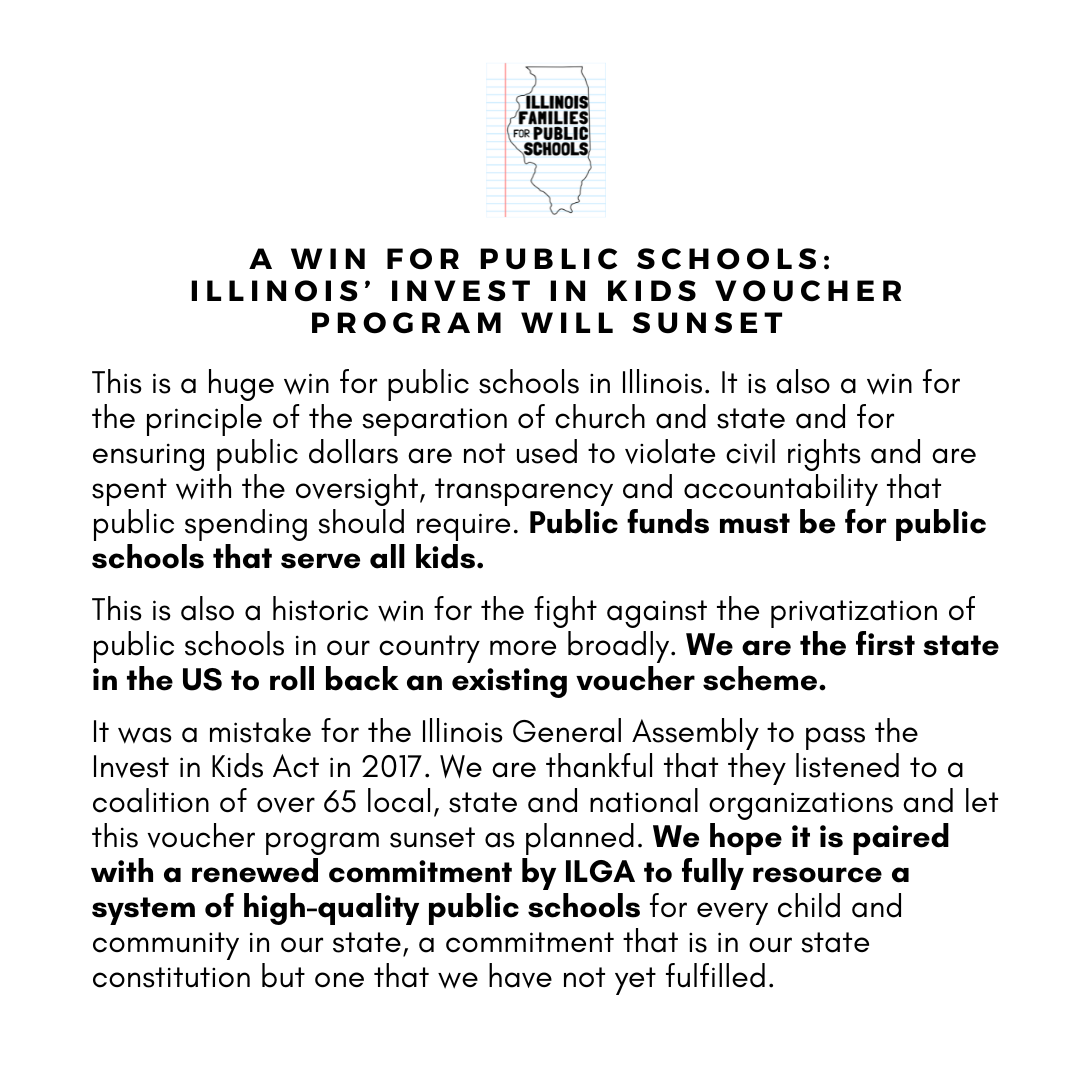
Public school advocates across Illinois were thrilled yesterday when the state Legislature adjourned without renewing the Illinois voucher program, called the Invest in Kids Act. No state has ever eliminated a voucher program; once enacted, they grow a constituency and a lobby. But in Illinois, the program was not large enough to build a political force to keep it going.

To learn more about the voucher program that will sunset, thanks to the legislature, read this article by Cassie Cresswell, executive director of Illinois Families for Public Schools, and by Diane Horowitz, a board member of ILPS and a retired educator.

Congratulations to Illinois Families for Public Schools and every parent and teacher group who notched a win for the common good.

Today, the Illinois House adjourned until January 16, 2024 without passing an extension to the Invest in Kids Act. The provisions of the Act begin expiring on January 1, 2024.

Statement from Illinois Families for Public Schools:

This is a huge win for public schools in Illinois. It is also a win for the principle of the separation of church and state and for ensuring public dollars are not used to violate civil rights and are spent with the oversight, transparency and accountability that public spending should require. Public funds must be for public schools that serve all kids.

This is also a historic win for the fight against the privatization of public schools in our country more broadly. We are the first state in the US to roll back an existing voucher scheme.

It was a mistake for the Illinois General Assembly to pass the Invest in Kids Act in 2017. We are thankful that they listened to a coalition of over 65 local, state and national organizations and let this voucher program sunset as planned. We hope it is paired with a renewed commitment by ILGA to fully resource a system of high-quality public schools for every child and community in our state, a commitment that is in our state constitution but one that we have not yet fulfilled.

Image of statement text in black on white background with IL-FPS
logo

We’ll share more in the coming days. An as ever, thank YOU for your advocacy

The collective action of public school supporters all across our state and beyond made this incredible win for the public good happen!

— Team IL-FPS Illinois Families for Public Schools


332 S Michigan Ave Ste 121-i252
Chicago IL 60604
info@ilfps.org, 773-916-7794

As a buildup to his Presidentisl campaign, Florida Governor Ron DeSantis launched legal stacks in “woke,” which meant banning programs to study or promote diversity, equity, and inclusion.

The Board of Governors of the University of Florida met to enact the new directives, and UF students showed up to protest the state’s efforts to quash DEI, as well as “social and political activism.” They rightly saw these restrictions as interference with their right to speak freely.

Annie Martin of the Orlando Sentinel wrote:

Dozens of students and others attended a meeting of the board that governs the state university system on Thursday in Orlando, hoping to speak against proposals that would ban funding for diversity, equity and inclusion programs, as well as “political or social activism.”


The crowd at the meeting of the Florida Board of Governors, which oversees the state university system, spilled out of the chambers into a hallway and overflow room at the University of Central Florida.


Many were there to speak on proposed rule changes prompted by a new state law prohibiting universities from funding diversity, equity and inclusion programs.


But the panel set a 15-minute time limit for public comment, which Chair Brian Lamb said was customary. About a dozen people spoke before the allotted time expired. After the board cut off the public comment period, people waiting outside the meeting room started chanting, “Let us speak!”

The board granted initial approval to the proposal, which is expected to come back for a final vote at the board’s next meeting in January.


DeSantis described diversity, equity and inclusion initiatives as “an attempt to impose orthodoxy on the university,” during a signing ceremony for the bill earlier this year.


“This has basically been used as a veneer to impose an ideological agenda, and that is wrong,” he said.
The law was part of a broader push by Gov. Ron DeSantis to overhaul higher education in Florida.

The most sweeping changes have taken place at New College of Florida, the state’s small liberal arts college, where DeSantis replaced trustees with conservative activists, who appointed former House Speaker Richard Corcoran as president and have sought to transform the campus into a conservative stronghold.

At the same meeting, the Board of Governors appointed a new trustee for the board of New College:

The Board of Governors for Florida’s state university system on Thursday appointed Don Patterson to the New College Board of Trustees.

Patterson, a Sarasota resident, was the co-founder and chief operating officer of Ascend Wireless Networks and is a graduate of Liberty University, a private evangelical Christian college in Virginia.

DeSantis tightens his grip on the once progressive New College.

John Oliver is a brilliant, intelligent comedian who is known for his sharp commentaries on current events. From 2006 to 2013, he was a writer for Jon Stewart’s The Daily Show.

His analysis of the charter school industry was viewed by millions of people.

This new take on homeschooling is worth your time.

The Washington Post published an article asserting that home schooling is the fastest growing sector on American education. I’m leery of the dramatic statistics, however, because a small number can grow by 70% and still be a small number. In the example on the article page, the D.C. home-schooling numbers are offered: “Washington, D.C.’s school district saw a 108% increase in home-school enrollment since the 2017-18 school year. There were 88,626 students enrolled districtwide in the 2021-22 school year.” But the number of home-schoolers declined from 1,126 in 21-22 to 977 in 22-23. That’s a very small percentage of students enrolled in the District. It would have been interesting to post the number in privately-managed charter schools (far larger than those home schooled) and the number who use vouchers.

My home district in Brooklyn enrolls nearly 20,000 students. The number of home schoolers grew by a whopping 216% since 2017. Sounds impressive, no? From 89 to 281. In the last year, the number of homeschooled students grew by 11. A little more than 1% of the students in this urban district are homeschooled. Not so impressive.

You will have to open the link to see the data in the article because I was unable to copy the numbers. Most are in the opening, not behind a paywall.

Home schooling is illegal in most countries in the world. Where it is permitted, there are often conditions, such as oversight by authorities.

For what it’s worth, I oppose home schooling. I believe it is important for students to be taught by a well-qualified teacher. Few parents are equipped to teach the full range of school subjects. I believe there is value in learning alongside students from different backgrounds and being exposed to different points of view. In this country, people have the right to home school, but I think they should entrust their children to professionals. They should get medical care from doctors. They should seek legal advice from lawyers. They should fly in airplanes with certified pilots.

The article in The Washington Post begins:

Home schooling has become — by a wide margin — America’s fastest-growing form of education, as families from Upper Manhattan to Eastern Kentucky embrace a largely unregulated practice once confined to the ideological fringe, a Washington Post analysis shows.

The analysis — based on data The Post collected for thousands of school districts across the country — reveals that a dramatic rise in home schooling at the onset of the pandemic has largely sustained itself through the 2022-23 academic year, defying predictions that most families would return to schools that have dispensed with mask mandates and other covid-19 restrictions….

The growth demonstrates home schooling’s arrival as a mainstay of the American educational system, with its impact — on society, on public schools and, above all, on hundreds of thousands of children now learning outside a conventional academic setting — only beginning to be felt…

The Post acknowledged how hard it is to get accurate data. “In 11 states, including Texas, Michigan, Connecticut and Illinois, officials do not require notification when families decide to educate their children at home or monitor how those students are faring. Seven additional states have unreliable tallies of home-schooled kids, The Post found.

But it did collect data for 32 states and D.C.

Examination of the data reveals:

  • In states with comparable enrollment figures, the number of home-schooled students increased 51 percent over the past six school years, far outpacing the 7 percent growth in private school enrollment. Public school enrollment dropped 4 percent in those states over the same period, a decline partly attributable to home schooling.
  • Home schooling’s surging popularity crosses every measurable line of politics, geography and demographics. The number of home-schooled kids has increased 373 percent over the past six years in the small city of Anderson, S.C.; it also increased 358 percent in a school district in the Bronx.
  • In 390 districts included in The Post’s analysis, there was at least one home-schooled child for every 10 in public schools during the 2021-2022 academic year, the most recent for which district-level federal enrollment data are available. That’s roughly quadruple the number of districts that had rates that high in 2017-2018, signifying a sea change in how many communities educate their children and an urgent challenge for a public education system that faced dwindling enrollment even before the pandemic.
  • Despite claims that the home-schooling boom is a result of failing public schools, The Post found no correlation between school district quality, as measured by standardized test scores, and home-schooling growth. In fact, high-scoring districts had some of the biggest spikes in home schooling early in the pandemic, though by the fall of 2022 increases were similar regardless of school performance.

Because they do not cover every state, the figures cannot provide a total count of the country’s home-schooled children. The National Center for Education Statistics reported that in 2019 — before home schooling’s dramatic expansion there were 1.5 million kids being home-schooled in the United States, the last official federal estimate.

Based on that figure and the growth since then in states that track home schooling, The Post estimates that there are now between 1.9 million and 2.7 million home-schooled children in the United States, depending on the rate of increase in areas without reliable data.

By comparison, there are fewer than 1.7 million in Catholic schools, according to the National Catholic Educational Association. About 3.7 million students attended charter schools in the fall of 2021, according to the most recent federal data.

It is a remarkable expansion for a form of instruction that 40 years ago was still considered illegal in much of the country.

Over the past three years, American interest in home schooling has soared. In this series, The Washington Post explores how that rise is transforming the nation’s educational landscape — and the lives of hundreds of thousands of children who now learn at home rather than at a traditional school.

Many parents say home education empowers them to withdraw from schools that fail their children or to provide instruction that better reflects their personal values. But there is little to no regulation of home schooling in much of the country, with no guarantees that kids are learning skills and subjects to prepare them for adulthood — or, for that matter, learning anything at all.

Home-schooled children have attended Ivy League schools and won national spelling bees. They have also been the victims of child abuse and severe neglect. Some are taught using the classics of ancient Greece, others with Nazi propaganda. What all share is the near-absolute control their parents wield over the ideas they encounter.

“This is a fundamental change of life, and it’s astonishing that it’s so persistent,” said Nat Malkus, a senior fellow and deputy director of education policy at the American Enterprise Institute, a conservative-leaning think tank.

The rise of home schooling is all the more remarkable, he added, given the immense logistical challenges many parents must overcome to directly supervise their kids’ education.

“The personal costs to home schooling are more than just tuition,” Malkus said. “They are a restructuring of the way your family works.”

In most states examined by The Post, home schooling has fallen slightly from its peak, while remaining at highs unmatched before the 2020-2021 school year. In only two, Georgia and Maryland, has it returned to pre-pandemic levels. And in four — Florida, South Carolina, Louisiana and South Dakota — home schooling has continued to expand.

Celebrated by home education advocates, the rise has also led critics of weak regulation to sound alarms. Home-schooled kids don’t have to submit to any form of testing for academic progress in most states, and even states that require assessments often offer loopholes, according to the Coalition for Responsible Home Education, which urges greater oversight.

Many of America’s new home-schooled children have entered a world where no government official will ever check on what, or how well, they are being taught.

“Policymakers should think, ‘Wow — this is a lot of kids,’” said Elizabeth Bartholet, an emeritus professor at Harvard Law School and child welfare advocate. “We should worry about whether they’re learning anything.”

If there is a capital of American home schooling, it may be Hillsborough County, Fla.

The Gulf Coast county of 1.5 million — including Tampa and its orbit of palmetto-studded suburbs — is famous as a barometer of the nation’s political mood. Its vote results have predicted the winner in 22 of the last 24 presidential elections. Now it is a harbinger of a different trend: the widespread adoption and acceptance of home schooling.

There were 10,680 children being home-schooled at the beginning of the 2022 academic year within Hillsborough County’s school district, the biggest total in The Post’s home-schooling database. The county’s home-schoolers outnumber the entire public enrollment of thousands of other school districts across the country, and their ranks have grown 74 percent since 2017. Over the same period, public school enrollment grew 3.4 percent, to 224,538 students.

Just as remarkable is the infrastructure that has grown up to support home-schoolers.

Their instruction still happened at home much of the time when Corey McKeown began teaching her kids 14 years ago in Carrollwood, a Tampa suburb. Once or twice a week, parent-run co-ops offered a chance to mingle with what was still a small community of home educators.

Today, Hillsborough home-schoolers inhabit a scholastic and extracurricular ecosystem that is in many ways indistinguishable from that of a public or private school. Home-schooled kids play competitive sports. They put on full-scale productions of “Mary Poppins” and “Les Miserables.” They have high school graduation ceremonies, as well as a prom and homecoming dance.

The Christian home-schooling co-op that had about 40 kids in 2011 when McKeown joined it — a co-op she would go on to direct — has grown to nearly 600 students.

“Home-schoolers in Hillsborough County do not lack for anything,” she said. “We have come such a long way.”

Of the 10 districts with the most home-schooled kids in The Post database, nine are in Florida. That’s partly because of the state’s large school districts, but also because its elected officials have grown friendlier to home education as they saddle public schools with politically charged restrictions on what can be taught about race and gender.

Home-schooled kids in Florida aren’t required to sit through the same standardized tests as their public-school peers. But they are allowed to join the same high school sports teams, and are eligible for the same scholarships at public universities.

“It’s a tremendous imbalance,” said Hillsborough County School Board member Lynn Gray. After decades as a public and parochial school teacher, Gray taught history part-time for several years at a Catholic home schooling co-op. She said that experience left her worried about many home-schooled kids’ academic preparation and lack of exposure to diverse points of view, and she is convinced home education should not be most families’ first choice.

“I can tell you right now: Many of these parents don’t have any understanding of education,” she said. “The price will be very big to us, and to society. But that won’t show up for a few years.”

Some of home schooling’s immediate costs to society will soon be more directly measurable in Florida. Earlier this year, Gov. Ron DeSantis (R), following the lead of policymakers in other conservative states, expanded the state’s educational voucher program. Children who learn at home are now eligible if their parents submit instructional plans and they take an annual standardized test.

As a result, families in Hillsborough County may be getting their most powerful incentive yet to home-school: up to $8,000 per child in annual taxpayer funding.

Open the link to conclude the article.

For the past few years, Virginia was a hotbed of dissension over “parental rights.” Governor Youngkin won office by attacking public schools, teachers, trans kids, and libraries. On Tuesday, Virginia’s parents took back most school boards from MAGA extremists.

Pundits cast Virginia’s Tuesday general elections as a referendum on abortion rights. It was more than that. Further down the ballot those votes also sent a strong message to those trying to disrupt public education: listen to parents. Parents who came out to vote in Fairfax, Loudoun and even Spotsylvania, the epicenters of vitriol and fantasy, voted with a resounding “no” to candidates who focused on anti-CRT, book bans and transphobia. Parents overwhelmingly voted for moderate candidates campaigning on safe schools, feeding hungry kids and supporting our teachers.

After almost four years of vile accusations of racism, pedophilia, incompetence and more, voters in Fairfax rejected the lies and returned Rachna Sizemore Heizer, Melanie Meren, Ricardy Anderson and Karl Frish to the School Board, along with a sweep of all pro-public education newcomers. Rachna Sizemore Heizer said “Today, Fairfax County resoundingly rejected the GOP’s divisive politics and relentless attacks on our schools, students and staff, and stood strong in support of public education. It has been a tough four years on the school board, but we’ve stood strong knowing the majority of Fairfax County shared our values of an excellent education in a welcoming and inclusive environment. Now on to work making our great schools even better for every child.”

Spotsylvania County, with one of the most “toxic” school boards in the Commonwealth, flipped from MAGA extremist to centrist, teacher-focused sanity. Carol Medowar, a newcomer to politics, and part of the wave that flipped the Spotsylvania school board, stated “I’m just so happy for the students, families, and educators who really get to breathe a sigh of relief for this race. It’s a huge flip on the Spotsy school board.”

In Loudoun County, the genesis of the politization of public education education, pro-public school supporters held their ground in a clear referendum on Youngkin’s plan to dismantle public schools, drive out teachers and humiliate trans-kids. The acrimony and chaos of the last four years drove every member of the prior school board out of the race. However, the new board, with all new members, will maintain a strong pro-public school majority, despite Youngkin’s concerted, last minute attempt to influence the race. According to Loudoun public school advocate Andrew Pihonek, “a brand new school board will be a breath of fresh air for many in Loudoun.”

Albermarle-Charlottesville followed the same trend as Loudoun, Fairfax and Spotsylvania, rejecting candidates who tried to re-write our history and ban books.

If Glenn Youngkin and his minions truly want to listen to parents, now is their chance. Parents across the Commonwealth, in their first opportunity since his election to send a clear message, have rejected fear-mongering, white-washing, transphobia, sabotage and lack of civility. The question is no longer will we listen to parents, but will he? As Carol Medowar, successful Spotsylvania candidate, pleaded a few weeks ago, “Let’s make school board meetings boring again.”

Peter Greene warns that the people who want to ban books will never be satisfied.

He writes:

At the heart of the raging controversy about reading restrictions, there are books about which reasonable adults can disagree, even books that the most ardent free speecher might not want their younger children to read. This is why one tactic of the reading restriction crowd is to shove the most extreme excerpts and pictures in front of audiences. If you aspire to being a reasonable person in these debates, you probably accept the premise that there are some books that do not belong in the middle school library.

But no matter how reasonable you want to be, you have to remember one thing.

The book banners, reading restrictors, censors, ultra-conservative crowd, whatever you want to call them–the people out in front of this drive– are never going to be satisfied.

Greene reviews the list of books that the censors want to purge in Collier County, Florida. It’s an astonishing list, because it contains books that have been taught for decades without incident. One must wonder how many students are actually reading the books that are considered offensive.

So what books did Collier County find as dangerous as guns and drugs? The list is long, but PEN America is sharing it; here are some highlights.

Some of the usuals are here– Steven King, Ellen Hopkins, Toni Morrison. But Ernest Hemmingway? Three are on the list, including The Sun Also Rises which I taught for years and while, yes, sex is obliquely (really obliquely) an idea in the book, digging out sexual content would be a hopeless quest.

Dune Chronicles? Steve Martin’s novel Shopgirl? One Flew Over The Cuckoo’s Nest? 2001: A Space Odyssey– I mean, seriously, Clarke is one of the most asexual authors in all of SF.

Many Waters??!! The Madeline L’Engle second sequel to Wrinkle in Time is, like the rest of the series, soaked hard in religious ideas, but Many Waters has for sexual content some heavy flirting. Flowers for Algernon, also regularly taught and unsexy. The Once and Future King, T. H. Whites four-book Arthurian doorstop that is the basis for both Disney’s Sword in the Stone and the musical Camelot and, again, not very sexy.

Man in the Iron Mask, the final of Dumas’s three Three Musketeers novels published in the mid-nineteenth century, when no literary characters ever had sex at all. This is one of several items on the list that lead me to suspect that, in the time honored tradition of non-readers, the compilers of the list skipped the book and watched a movie version instead.

And, believe it or not, both Atlas Shrugged and The Fountainhead, the two Ayn Rand cornerstones. Granted, I agree that nobody ever needs to read Atlas Shrugged ever, but if you feel so compelled, go ahead. Both books, other than presenting Rand’s bizarro notions about romance and some very ungraphic depictions of what appears to be angry sex, these are not ban-worthy books. I mean, I deeply dislike them for their blundering prose and teenaged sociopathic egoism promotion, but I wouldn’t ban them.

Do they want students to read anything?

As Greene notes, PEN America made the list of banned books available. It also pointed out that Collier County “responded to growing restrictions from the state by requiring parents to grant permission for their students to access school libraries. District administration also requires parental permission slips to use nicknames for students.”

Moms for Liberty faced big setbacks in school board races in Pennsylvania, reports Peter Greene in Forbes.

He writes:

When he talked to the Moms for Liberty convention back in July, Jordan Adams explained how new conservative board members could use their first 100 days to hit hard, flooding the zone with a kind of shock and awe. The conservatives of Pennridge School District board, Adams’ single client for his fledgling consulting business, may be rethinking his advice this morning as they contemplate their defeat in Tuesday’s elections.

Pennridge is in Bucks County, near Philadelphia, a county that has been ground zero for the Moms for Liberty style installation of far right policies in school boards. Since acquiring a majority, Pennridge has pursued a host of right wing policies. They had trouble telling creationism from science. They banned Banned Books Week. They tried to clamp down on student expression. And they removed DEI policies).

Pennridge’s conservative board also hired Adams, with close ties to conservative Christian Hillsdale College, to scour through their curriculum and remove all things woke. This was a new business model, a proof of concept for retooling a school’s curriculum along more conservative lines. He was, he told the Moms for Liberty crowd, the “fox in the henhouse.

Now the henhouse is under new management. As of this morning, it appears that all five open seats on the board were won by candidates who ran on opposition to culture wars, secret agreements, poor policies, and the adoption of the curriculum recommended by Adams.

The backlash was also felt in Central Bucks district school board race.

Central Bucks has drawn national attention for implementing a wave of conservative policies. They instituted a book banning policy, aided by the Independence Law Firm, the legal arm of the Pennsylvania Family Institute (“Our goal is for Pennsylvania to be a place where God is honored, religious freedom flourishes, families thrive, and life is cherished.”) They banned pride flags. They suspended a teacher who defended LGBTQ students. They implemented a policy that required the school to out LGBTQ students with a “gender identification procedure”. No student name changes allowed without a note from home.

The conservative shift drew enough attention that Penncrest school board on the other side of the statetreated Central Bucks as a model.

The race drew spectacular amounts of money, particularly from Paul Martino, a venture capitalist who had put half a million in 2021 Pennsylvania board races. This year he chipped in $279,000 (out of a total $600,000 for bother sides) in support of his wife’s campaign for a board seat.

The campaign was brutal and, if one followed it on social media, mean. But the Philadelphia Inquirer reported this morning that the Democratic candidates swept the election, including the defeat of Martino’s wife and Dana Hunter, incumbent board president.

Open the link to finish the article.