Archives for the month of: June, 2023

Nora de la Cour writes in Jacobin about the damage done to children by our politicians’ obsession with high-stakes standardized testing. They do not test what was taught; they encourage teaching to the tests; the results come back too late to be helpful; they distort teaching and learning.

Nora de la Cour writes:

When I taught at an alternative public school for kids with exceptional social-emotional, behavioral, and learning needs, one of my students — I’ll call him Dante — got As in every class he took. School staff would frequently elevate Dante’s extraordinary focus and commitment as an example for his peers.

In the spring of Dante’s senior year, his counselor informed him he’d earned the status of valedictorian. His beaming smile of pride after hearing the news affirmed everything I love about public education. When his mother found out, she burst into tears of joy.

Then, abruptly, we were informed that there had been a mistake. Because Dante’s exceptional learning needs made it impossible for him to pass the Massachusetts Comprehensive Assessment System (MCAS) — the standardized tests that Massachusetts requires high school students to pass prior to graduation — he would not receive a diploma. Without a diploma, he couldn’t be valedictorian — even though, according to his grades and the unanimous judgment of his teachers, he clearly deserved the honor. A wave of incredulity rippled through the staff as we tried to resign ourselves to this obviously cruel, unfair reality. For Dante, the news was devastating.

Even before the “giant federal wrecking ball” (to borrow leading education policy analyst Diane Ravitch’s phrasing) known as education reform, evidence from diverse fields had demonstrated a scientific concept known as Campbell’s Law: the more we base social decision-making on a specific quantitative measure, the more likely it is that that measure will become distorted, ultimately corrupting the processes it’s intended to monitor.

Just so, in the two decades since Congress reauthorized the 1965 Elementary and Secondary Education Act (ESEA) as George W. Bush’s No Child Left Behind Act (NCLB), researchers have collected a mountain of data showing that in the long run, attaching high-stakes, or punishments, to student standardized test scores does not improve educational outcomes. Instead, it results in a host ofperverse consequences, with poor, minority, and disabled kids like Dante experiencing the greatest harms. This last point makes a lot of sense when you consider that standardized testing was first developed by eugenicists looking to organize people into racist taxonomies based on perceived ability.

But despite these serious problems — and the persistent, bipartisan unpopularity of the high-stakes testing regime inaugurated by NCLB — our current, Obama-era iteration of the ESEA (the Every Student Succeeds Act or ESSA) still requires states to impose inappropriate test-based accountability on students and school communities.

When we sort children into “proficient” and “failing” categories based on test scores, we’re not solving the opportunity gaps that show up in public education; we’re creating new ones. No one is helped, and many people are hurt, when we give students, teachers, and schools an impossible assignment and then sanction them for failing to complete it. Looking forward to the ESEA’s now overdue reauthorization, it’s high time we built accountability systems that nurture the humanity and potential of all kids — rather than placing artificial roadblocks in their way.

Please open the link and read the article in full. FYI, in addition to referring to NCLB as a “giant wrecking ball,” I have also called it the “Death Star of American education.” If left without modifications, it would have caused the closure of almost every school in the nation. No national legisislature ever passed such a dumb law.

Historian Heather Cox Richardson brilliantly contrasts the views of Republicans and Democrats on the role of government. Republicans want it to be as minimal as possible. Democrats want it to use its powers and resources to improve people’s lives. Understanding this difference helps illuminate why Republicans want to get rid of public schools and why billionaires like Charles Koch and Betsy DeVos support vouchers and libertarianism in a society where everyone is on their own.

Yesterday, the Republican Study Committee, a 175-member group of far-right House members, released their 2024 “Blueprint to Save America” budget plan. It calls for slashing the federal budget by raising the age at which retirees can start claiming Social Security benefits from 67 to 69, privatizing Medicare, and enacting dramatic tax cuts that will starve the federal government.

I’m actually not going to rehash the 122-page plan. Let’s take a look at the larger picture.

This budget dismisses the plans of “President Joe Biden and the left” as a “march toward socialism.” It says that “[t]he left’s calls to increase taxes to close the deficit would be…catastrophic for our nation.” Asserting that “the path to prosperity does not come from the Democrats’ approach of expanding government,” it claims that “[o]ver the past year and a half, the American people have seen that experiment fail firsthand.”

Instead, it says, “the key to growth, innovation, and flourishing communities” is “[i]ndividuals, free from the burdens of a burdensome government.” 

It is?

Our history actually tells us how these two contrasting visions of the government play out.

Grover Norquist, one of the key architects of the Republican argument that the solution to societal ills is tax cuts, in 2010 described to Rebecca Elliott of the Harvard Crimson how he sees the role of government. “Government should enforce [the] rule of law,” he said. “It should enforce contracts, it should protect people bodily from being attacked by criminals. And when the government does those things, it is facilitating liberty. When it goes beyond those things, it becomes destructive to both human happiness and human liberty.”

Norquist vehemently opposed taxation, saying that “it’s not any of the government’s business who earns what, as long as they earn it legitimately,” and proposed cutting government spending down to 8% of gross national product, or GDP, the value of the final goods and services produced in the United States. 

The last time the level of government spending was at that 8% of GDP was 1933, before the New Deal. In that year, after years of extraordinary corporate profits, the banking system had collapsed, the unemployment rate was nearly 25%, prices and productivity were plummeting, wages were cratering, factories had shut down, farmers were losing their land to foreclosure. Children worked in the fields and factories, elderly and disabled people ate from garbage cans, unregulated banks gambled away people’s money, business owners treated their workers as they wished. Within a year the Great Plains would be blowing away as extensive deep plowing had damaged the land, making it vulnerable to drought. Republican leaders insisted the primary solution to the crisis was individual enterprise and private charity. 

When he accepted the Democratic nomination for president in July 1932, New York governor Franklin Delano Roosevelt vowed to steer between the radical extremes of fascism and communism to deliver a “New Deal” to the American people. 

The so-called alphabet soup of the New Deal gave us the regulation of banks and businesses, protections for workers, an end to child labor in factories, repair of the damage to the Great Plains, new municipal buildings and roads and airports, rural electrification, investment in painters and writers, and Social Security for workers who were injured or unemployed. Government outlays as a percentage of GDP began to rise. World War II shot them off the charts, to more than 40% of GDP, as the United States helped the world fight fascism. 

That number dropped again after the war, and in 1975, federal expenditures settled in at about 20% of GDP. Except for short-term spikes after financial crises (spending shot up to 24% after the 2008 crash, for example, and to 31% during the 2020 pandemic, a high from which it is still coming down), the spending-to-GDP ratio has remained at about that set point.

So why is there a growing debt?

Because tax revenues have plummeted. Tax cuts under the George W. Bush and Trump administrations are responsible for 57% of the increase in the ratio of the debt to the economy, 90% if you exclude the emergency expenditures of the pandemic. The United States is nowhere close to the average tax burden of the 38 other nations in the Organization of Economic Cooperation and Development (OECD), all of which are market-oriented democracies. And those cuts have gone primarily to the wealthy and corporations. 

Republicans who backed those tax cuts now insist that the only way to deal with the growing debt is to get rid of the government that regulated business, provided a basic social safety net, promoted infrastructure, and eventually promoted civil rights, all elements that stabilized the nation after the older system gave us the Depression. Indeed, the Republican Study Committee calls for making the Trump tax cuts, scheduled to expire in 2025, permanent. 

“There are two ways of viewing the government’s duty in matters affecting economic and social life,” FDR said in his acceptance speech. “The first sees to it that a favored few are helped and hopes that some of their prosperity will leak through, sift through, to labor, to the farmer, to the small businessman.” The other “is based upon the simple moral principle: the welfare and the soundness of a nation depend first upon what the great mass of the people wish and need; and second, whether or not they are getting it.”

When the Republican Study Committee calls Biden’s policies—which have led to record employment, a booming economy, and a narrowing gap between rich and poor— “leftist,” they have lost the thread of our history. The system that restored the nation after 1933 and held the nation stable until 1981 is not socialism or radicalism; it is one of the strongest parts of our American tradition.

Notes:

Tom Ultican, retired high school teacher of advanced math and physics, investigates the claims of Nicholas Kristof about a “Mississippi miracle.” In his article in the New York Times, Kristof attributed a rise in Mississippi’s test scores to “the science of reading” plus a policy of holding back third graders who don’t pass a reading test, allegedly proving that spending more money is not necessary, poverty doesn’t matter, and reducing class size is unnecessary.

He begins:

Nicholas Kristof’s opinion piece in the New York Times might not have been blatant lying but it was close. His depiction of the amazing education renaissance in Mississippi as a model for the nation is laughable. Lauding their third grade reading retention policies as enlightened, he claims their secret sauce for success is implementing the science of reading (SoR). This is based on a willful misreading of data while tightly embracing Jeb Bush’s futile education reform ideology.

Ultican then produces a graph showing that Mississippi fourth-graders ranked 20th in the nation in 2022, but its eighth graders ranked 45th.

Misusing data allows Kristof to end the paragraph indicating poverty is not an excuse for education failure. It reminds me of a statement written by education professor Kathryn Strom,

“The “no excuses” rhetoric (i.e, “poverty is not an excuse for failure”) is one that is dearly beloved by the corporate education reformers because it allows them to perpetuate (what many recognize to be) the American myth of meritocracy and continue the privatization movement under the guise of “improving schools” while avoiding addressing deeply entrenched inequities that exist in our society and are perpetuated by school structures.” (Emphasis added)

To add heft to his argument that poverty is no excuse, Kristof quotes Harvard economist David Deming from the Harvard Kennedy School and Harvard Graduate School of Education, saying “Mississippi is a huge success story and very exciting.” He adds, “You cannot use poverty as an excuse.”

It is important to note that Harvard is famous for supporting privatization of public education and promoting failed scholarship. Deming is currently doing research with Raj Chetty and John Friedman. Along with Jonah Rockoff, Chetty and Friedman published the now thoroughly debunked value added measures (VAM) paper. Their faulty research caused many teachers to lose jobs before it was exposed as a fraud. Kristof is using an economist (not an educator) from a group best known for scholastic failure as his expert.

Kristof also indicates that spending is not important. He writes, “Mississippi has achieved its gains despite ranking 46th in spending per pupil in grades K-12.” If we look up at the 8th grade rankings, it seems they are getting what they paid for.

Ultican then goes on to describe the connections between the “Mississippi miracle” and TFA and Jeb Bush and a host of other corporate reform groups.

He concludes:

In this opinion piece, Nicholas Kristof touched on and promoted almost every billionaire inspired agenda item aimed at decreasing money going to public education. He acted as a representative of elites, advancing policies undermining education quality for common people.

This was not about improvement. It was about lowering taxes.

Please open the link and read this interesting article.

Over the years, I have had many reasons to visit Los Angeles. Frequently, people would ask me if I had met Jackie Goldberg. I had not. They spoke of her with awe as a brilliant public servant who had been a teacher, a member of the City Council, a member of the State Legislature.

Finally, I did meet her a few years ago, and I was blown away by her dynamism and charisma. We met after an awards dinner, supposedly for a 15-minute chat. The 15 minutes turned into an hour and a half. Subsequently I attended a fundraiser to help when she ran for school board. Now she is president of the LAUSD school board, and the district is in excellent hands. Oh, I forgot to mention that she is openly gay and married.

At a recent board meeting, the board discussed parent protests at an elementary school. The parents had heard rumors that the school was promoting homosexual lifestyles. It was anti-gay propaganda. One book had one line referring to the fact that some families have two mommies or two daddies. That’s simply a fact.

Watch her speak passionately about the anti-gay hysteria.

Florida education officials demanded that the College Board remove questions about gender identity and LGBT content from its AP Psychology course, because state law bans teaching these subjects. The College Board refused to comply because these topics are included in college-level psychology courses.

Governor Ron DeSantis, a candidate for the Republican nomination for President in 2024, opposes any teaching about these issues. At DeSantis’ behest, the Florida legislature passed a law widely known as “Don’t Say Gay.” Originally intended for K-3, its application has been extended by the State Board of Education to apply to all grades.

Ironically, Florida has one of the nation’s most vibrant gay populations, centered in South Florida, in Miami, Key West, Fort Lauderdale, and also Orlando, which just memorialized the June 12, 2016, massacre of 49 people at a gay nightclub called The Pulse. DeSantis wants everyone to pretend that gays don’t exist.

Thought control is a feature of both fascism and Communism.

The Washington Post and many other publications reported on the controversy.

The College Board, which oversees AP nationwide, told Florida officials Thursday it stands by a sequence in the psychology course that covers gender and sexual orientation in a unit on developmental psychology.

“Please know that we will not modify our courses to accommodate restrictions on teaching essential, college-level topics,” the organization said in a letter to the state education department. “Doing so would break the fundamental promise of AP: colleges wouldn’t broadly accept that course for credit and that course wouldn’t prepare students for success in the discipline.”

The letter responded to a recent inquiry the Florida department made after the state enacted new restrictions on teaching gender identity and sexual orientation in public schools. The department told the College Board on May 19 that it is developing an “assurance document” for the College Board to indicate that its courses comply with Florida’s new rules. It also said state officials “implore” the organization to review its courses and identify those that might need to be modified.

“Some courses might contain content or topics prohibited by State Board of Education rule and Florida law,” the department’s letter said.

“[The] College Board is responsible for ensuring that their submitted materials comply with Florida law,” said Cassie Palelis, press secretary for the Florida Department of Education.

The College Board was embarrassed by its earlier efforts to placate Florida’s demands to censor the AP Black Studies course and wanted to avoid a similar debacle.

Now the College Board is taking a harder line as it defends the psychology course.


“We don’t know if the state of Florida will ban this course,” the organization said in a statement Thursday to the AP community. “To AP teachers in Florida, we are heartbroken by the possibility of Florida students being denied the opportunity to participate in this or any other AP course. To AP teachers everywhere, please know we will not modify any of the 40 AP courses — from art to history to science — in response to regulations that would censor college-level standards for credit, placement, and career readiness.”

“We have learned from our mistakes in the recent rollout of AP African American Studies and know that we must be clear from the outset where we stand,” the College Board said.

Last year, 28,600 Florida students took the AP Psychology exam, about 10% of the number who took the test nationally.

Mitchell Robinson is a professor of music education at Michigan State University who was recently elected to the Michigan State Board of Education. He shared a resolution that he introduced and that was passed by the State Board. Are there books that are not age-appropriate? Yes. Can we trust teachers and librarians to select the right books for the children in their care? The Michigan State Board of Education thinks we can. Michigan law already forbids pornography in schools.

Robinson sent the following to me:

Proud to introduce the “Freedom to Read” resolution yesterday. The State Board of Education respects the professional judgement of teachers and librarians when it comes to selecting learning materials that support the curriculum in their classrooms, and respects the rights of parents and caregivers to determine the developmental appropriateness of books and other materials for their children.

Teachers and parents are natural partners in the education of our children, and attempts to drive a wedge between schools and families by creating outrage over fabricated “crises” will simply not work.

“Board Of Ed Adopts Resolution Supporting ‘Freedom To Read'”

A resolution to support K-12 students reading whichever books they like as book bans continue to sweep the country was adopted by the State Board of Education Tuesday.

Board member Mitchell Robinson (D-Okemos) introduced the Freedom to Read Resolution. Robinson cited in the resolution that PEN America’s Index of School Book Bans listed 1,477 instances of individual books banned.

The resolution said in the first six months of 2023, 30 percent of the unique titles banned were books about race, racism, or feature characters of color and 26 percent of the unique titles banned had LGBTQ characters or themes.

On Monday, Illinois Governor J.B. Pritzker signed a law that deems Illinois public libraries ineligible for state funding if the library restricts or bans materials because of “partisan or doctrinal disapproval.”

“Closer to home, the Michigan Civil Rights Commission has asked the Attorney General for an official legal ruling on book banning as discrimination in respect to the Elliott Larsen Civil Rights Act that has expanded to include…LGBTQ+ communities,” Robinson said.

During public comment, several parents and organizations, including Moms for Liberty, spoke out against the resolution. They argued that none of their members were in favor of banning books but did not want their children to read what they deemed as inappropriate and pornographic content.

Board member Tiffany Tilley (D-West Bloomfield) introduced an amendment to the resolution supporting parents in their right to choose age appropriateness of material for their child and rights to make “critical decisions with their local schools.”

Tilley said as a child, she read several pieces of literature, including Shakespeare’s “Romeo and Juliet” that included content that some would say was “racy.”

“I got to a certain age, and I realized we were talking about a 16-year-old boy, 13-year-old girl and they both committed suicide,” Tilley said. “I’m not for banning books. My mom allowed me to read those things. I think that made my life richer, but for some parents, they may not be ready for their children to read about something.”

Tilley emphasized that her amendment would signal to parents that the state is not trying to make decisions for them, but also the state is not trying to ban certain books for everyone. If a parent reads a book and decides they do not want their child to read it, then they need to make that decision with their local school district, she added.

Superintendent of Public Instruction Michael Rice said this amendment was similar to resolutions the board supported previously. In February 2022, the Resolution on Sex Education included language that allowed for parents and legal guardians to opt-out of sex education classes without penalty.

Board member Tom McMillin (R-Oakland Township) wanted wording included that would make clear the board was stating pornography should not be allowed in schools. Board member Marshall Bullock (D-Detroit) jumped in, saying that there are already laws forbidding pornography in school. He asked McMillin how he defined pornography, saying his definition may lead to the banning of other subject matter such as the teaching of human anatomy in a biology course.

In the end, the board voted to approve the resolution 6-2, with McMillin and board member Nikki Snyder (R-Dexter) voting no.

Mehdi Hassan of MSNBC writes here about Ron DeSantis’ lies about Florida’s COVID deaths.

DeSantis is an advocate of herd immunity, although he was not at the start of the pandemic. To woo the hard-right base of the GOP, he turned Florida into a state that opposed mandates for masks and vaccines. He found a surgeon general who agreed with him. He placed the economy above the lives of Floridians.

What were the results? Open the link.

In a fascinating article, the Washington Post reported that several of Trump’s lawyers urged him to avoid an indictment by returning all the classified documents. He refused. He chose instead to take the advice of Tom Fitton, head of the conservative group Judicial Watch, who told him he could keep the documents. Fitton is not a lawyer. Early on, in 2021, one of Trump’s lawyers tried to persuade him to negotiate a return, to avoid an indictment. Trump refused.

Since the National Archives first asked for the return of presidential documents in Trump’s possession in February 2021 and until a grand jury issued its indictment this month, Trump was repeatedly stubborn and eschewed opportunities to avoid criminal charges, according to people with knowledge of the case, many of whom spoke on the condition of anonymity to reveal internal details. They note that Trump was not charged for any documents he returned voluntarily.


Interviews with seven Trump advisers with knowledge of the probe indicate he misled his own advisers, telling them the boxes contained only newspaper clippings and clothes. He repeatedly refused to give the documents back, even when some of his longest-serving advisers warned of peril and some flew to Mar-a-Lago to beg him to return them.


When Trump returned 15 boxes early last year — leaving at least 64 more at Mar-a-Lago — he told his own advisers to put out statements to the National Archives and to the public that “everything” had been returned, The Washington Post has previously reported. But he quietly kept more than 100 classified documents….

Trump time and again rejected the advice from lawyers and advisers who urged him to cooperate and instead took the advice of Tom Fitton, the head of the conservative group Judicial Watch, and a range of others who told him he could legally keep the documents and should fight the Justice Department, advisers said. Trump would often cite Fitton to others, and Fitton told some of Trump’s lawyers that Trump could keep the documents, even as they disagreed, the advisers said…

“I think what is lacking is the lawyers saying, ‘I took this to be obstruction,’” said Fitton. “Where is the conspiracy? I don’t understand any of it. I think this is a trap. They had no business asking for the records … and they’ve manufactured an obstruction charge out of that. There are core constitutional issues that the indictment avoids, and the obstruction charge seems weak to me.”


Several other Trump advisers blamed Fitton for convincing Trump that he could keep the documents and repeatedly mentioning the “Clinton socks case” — a reference to tapes Bill Clinton stored in his sock drawer of his secret interviews with historian Taylor Branch that served as the basis of Branch’s 2009 book documenting the Clinton presidency.


Judicial Watch lost a lawsuit in 2012 that demanded the audio recordings be designated as presidential records and that the National Archives take custody of the recordings. A court opinion issued at the time stated that there was no legal mechanism for the Archives to force Clinton to turn over the recordings.


For his part, Fitton said Trump’s lawyers “should have been more aggressive in fighting the subpoenas and fighting for Trump.”


Trump’s unwillingness to give the documents back did not surprise those who knew him well. Former White House chief of staff John F. Kelly said that he was particularly unlikely to heed requests from people or agencies he disliked.


“He’s incapable of admitting wrongdoing. He wanted to keep it, and he says, ‘You’re not going to tell me what to do. I’m the smartest guy in the room,’” Kelly said Tuesday…

Other advisers said the FBI and National Archives wanting the documents so badly made Trump less likely to give them back…

“It’s mine,” Trump said, explaining why he did not want to give the materials back, according to people with knowledge of his comments.

If this sounds like the behavior of a 2-year-old, well, draw your own conclusions.

Carol Burris is the Executive Director of the Network for Public Education. She was a much honored high school principal in New York State, following many years in the classroom. She earned her doctorate from Teachers College, Columbia University.

From my perspective, I think it always wise to pay attention to the funders of any study, especially when the funders have a strong point of view about the outcome. Just as we are wary when the tobacco industry releases a study that “proves” the safety of tobacco use, or the pharma industry funds a study claiming that opioids are not addictive, we should be wary of any study funded by the major sponsors of the charter school movement. “Follow the money” is a principle that should never be ignored.

Burris writes here about the new national CREDO study of charter schools, which was uncritically reviewed by Education Week and other publications, which simply quoted the press release.

She writes:

Last week the Center for Research on Education Outcomes (CREDO) released its third National Study on charter schools. The report was funded by two nonprofits that wholeheartedly support charter schools and generously fund them—the Walton Family Foundation and The City Fund. The City Fund, which was started and funded by pro-charter billionaires John Arnold and Reed Hastings, exists to turn public school districts into “portfolio” districts of charter schools and charter-like public schools. 

Commenting on the report, Margaret “Macke” Raymond, founder and director of CREDO, told Ed Week’s Libby Stanford that the results were “remarkable.” Stanford claimed that “charters have drastically improved, producing better reading and math scores than traditional public schools.”

However, neither of those claims describes the reality of what the report found, as I will explain.  

Let’s begin with what CREDO uses as its measure of achievement. In all of its reports, CREDO uses “days of learning” to attribute differences in student achievement between charter schools and district public schools. That measure creates dramatic bar graphs allowing CREDO to disguise the trivial effects on achievement those “days of learning” represent. 

The overall math state score increase that CREDO attributes to a student attending a charter school is “six days of learning.” But what does that mean in the standard measures most researchers use, such as changes in standard deviations or effect sizes?

According to CREDO, 5.78 days of learning translates to only a 0.01 standard deviation. That means that the 6.0 “days of learning” increase in math translates to about a 0.0104 increase in standard deviations. Does that sound tiny? It is. For comparison, the negative impact on math scores of receiving a voucher in Louisiana was determined to be 0.4 standard deviations – more than 36 times greater magnitude.

After CREDO released its second national charter study in 2013, the National Education Policy Center (NEPC) reviewed it. You can find that critical review here, accompanied by a publication release titled CREDO’s Significantly Insignificant Findings

As the authors of the review (Andrew Maul and Abby McClelland) note, a 0.01 difference (which the 2023 math gain only slightly exceeds) in a standard deviation means that “only a quarter of a hundredth of a percent (0.000025) of the variation” in the test scores could be explained by the type of school (charter or public) that the child attended.  

Put another way, if a student gains six days of math and they originally scored at the 50th percentile on a standardized test, they would move to the 50.4th percentile.  It’s as if they stood on a sheet of loose-leaf paper to stand taller—that’s how small the real difference is.

But what about the reported reading-score increase of 16 days? Sixteen CREDO days account for only a 0.028 standard deviation. Now we are increasing height by standing on two and a half sheets of looseleaf.

According to CREDO, those increases are statistically significant. Shouldn’t that count? As the NEPC reviewers state in their summary, “with a very large sample size, nearly any effect will be statistically significant, but in practical terms these effects are so small as to be regarded, without hyperbole, as trivial.”

To put all of this in a broader perspective, Maul and McClelland point out, “[Eric] Hanushek has described an effect size of 0.20 standard deviations for Tennessee’s class size reform as “relatively small” considering the nature of the intervention.” Hanushek is married to Macke Raymond, who found the much, much, much slighter results of her organization’s study to be “remarkable.”

Using CREDO’s conversion, in order to achieve 0.20 standard deviations of change, the difference would have to be 115.6 days of learning. 

The only place in the report where there was an over 100-day difference was in online charter school students’ results in math. Compared with the public school students included in the study, online charter school students learned 124 fewer days of math. They may have something there.

CREDO Methodology

To draw its conclusions, CREDO matches charter students with what it calls “virtual twins” from public schools. But not all public schools were included, nor were all charter schools. The only public schools included were those in 29 states (for some odd reason, CREDO also includes NYC as a state) and the District of Columbia that met their definition of “feeder schools.” CREDO refers to 31 states, which include New York City and the District of Columbia, throughout the report. 

According to page 35 of the report, in 2017-2018, there were 69,706 open public schools in their included “states,” and of those, fewer than half (34,792) were “feeder schools.” That same year, NCES Common Core of Data reports 91,326 non-charter public schools, 86,315 of which were in states that had charter schools.

From the chart, then, we can estimate that only about 38% of public schools and 94.5% of charter schools were included in the study, at least during the 2017 school year.  

What, then, is a feeder school? The report claims that it is the public school the student would have attended if she were not in the charter school. But that is an inaccurate description. In the methodology report, CREDO explains how they identify feeder schools. “We identify all students at a given charter school who were enrolled in a TPS during the previous year. We identify these TPS as “feeder schools” for each charter school. Each charter school has a unique feeder school list for each year of data.”

While I understand why researchers want to use feeder schools for comparison, it produces an inherent bias in the sample. Feeder schools are, by definition, schools where parents disrupt their child’s schooling and place them in a charter school. They are not, as the report claims, “the school the student would have attended.”  If a child starts in a charter school, her local school would not be a feeder school unless there was a parent who was so dissatisfied with the school that they were willing to pull their child out and place them in a charter, which may even be miles away in a neighborhood with very different demographics. 

Virtual Twins 

In 2013, Maul and McClelland also explained the virtual-twin method along with the problems inherent in its use. 

“The larger issue with the use of any matching-based technique is that it depends on the
premise that the matching variables account for all relevant differences between students;
that is, once students are matched on the aforementioned seven variables [gender, ethnicity, English proficiency status, eligibility for subsidized meals, special education status, grade level, and a similar score from a prior year’s standardized test (within a tenth of a standard deviation), the only] remaining meaningful difference between students is their school type. Thus, for example, one must believe that there are no remaining systematic differences in the extent to which parents are engaged with their children (despite the fact that parents of charter school
students are necessarily sufficiently engaged with their children’s education to actively
select a charter school), that eligibility for subsidized meals is a sufficient proxy for
poverty when taken together with the other background characteristics.”

In addition to the above, special education students are not a monolith. Research has consistently shown that charters not only take fewer special education students but also enroll fewer students with more challenging disabilities that impact learning than public schools. English language learners, who are at different stages of language acquisition, are not a monolith as well. A few years ago, Wagma Mommandi and Kevin Welner filled an entire book (“School’s Choice”) with illustrations of how charter schools shape their enrollment – often in ways that the virtual-twin approach would not control. Therefore, even the included categories are rough proxies. 

Virtual twinning (or “Virtual Control Record” or VCR) also results in an additional problem—large shares of charter school students going “unmatched” and therefore being excluded from the results. Again, I quote NEPC 2013.

“Even more troubling, the VCR technique found a match for only 85% of charter students.
There is evidence that the excluded 15% are, in fact, significantly different from the included
students in that their average score is 0.43 standard deviations lower than the average of
the included students; additionally, members of some demographic subgroups such as
English Language Learners were much less likely to have virtual matches.”

That was in 2013. In this new report, the problem is worse. The overall match rate dropped further to 81.2%. English-language learners had a match rate of 74.9%; multi-racial students had a rate of 58.1%; and the match rate for Native American students was only 38%. 

And in some states, match rates were terrible. In New York, only 43.9% of charter school ELL students had a match, and 51% of special education students were matched. In the three categories that are most likely to affect educational outcomes—poverty, disability, and non-proficiency in English—New York rates were well below the average match rate for each category, which might at least partially explain the state’s above-average results.  

The study itself notes, in a footnote, “Low match rates require a degree of caution in interpreting the national pooled findings as they may not fairly represent the learning of the student groups involved.”

Do Charters Cherry-Pick and Push Low-scoring Students Out?

Perhaps the most incredulous claim, however, in the study was its “proof” that charters do not cherry-pick or skim and, in fact, teach students who are lower initial achievers.

Here is the CREDO methodology on page 41 for making that claim. 

“We compare students who initially enrolled in a TPS and took at least one achievement test before transferring to a charter school to their peers who enroll in the TPS. We can observe the distribution of charter students’ test scores across deciles of achievement and do the same for students in the feeder TPS.”

That may measure something, but not whether charter schools cherry-pick. First, it ignores potential differences in the majority of charter students who never enrolled in a public school. Second, it compares the scores of students whose parents withdrew them from the public school and then compares them with a more satisfied parent population. It’s far more likely that a withdrawal will occur if a student is doing poorly rather than doing well.  

Given the CREDO dataset, it would have been relatively easy to explore the question of whether or not charter schools push lower-achieving students out, but that question was not explored. 

Findings Regarding Charter Management Organizations

Although I did not review the study’s report that compared student achievement between standalone charters and charter management organizations (CMOS), I noticed that the CMOs of four states of the thirty-one were not included, one of which is Ohio, a state in which the vast majority of charters are run by CMOs (78%), with for-profits outnumbering nonprofits by 2 to 1. 

CREDO used the same capricious definition as the National Alliance for Public Charter Schools—a CMO must control three or more schools to be included, which excludes many of the low-performing for-profit-run schools that NPE identified in our report, Chartered for Profit II. While it lists K12 online as a CMO, the equally low-performing Pearson’s Connections Academy was absent from the CMO list. 

Conclusion


My review of the study found that the issues included in NEPC’s 2013 review were unaddressed in the newly released study, and new issues have emerged.  Hopefully, those who are far more skilled in this type of regression analysis than I am will do a more comprehensive review. But given the bias introduced by the methods in matching and the additional biases created by charters’ shaping of their own enrollment, it’s easy to see how the 0.011 or 0.028 SD findings could be masking negative actual charter effects that are at least as large (in the other direction). 

Moreover, based on the trivial topline increases combined with serious methodological issues, I think it is safe to say that despite the billions of tax dollars spent on growing charter schools, overall charter student achievement is about the same as the achievement of students in CREDO’s feeder schools and no conclusions can be drawn regarding the majority of public schools. As to the billionaire funders who financed the report that no doubt cost millions to produce—they got what they paid for. And reporters covering the report have thus far failed to ask the challenging questions that their readers deserve.
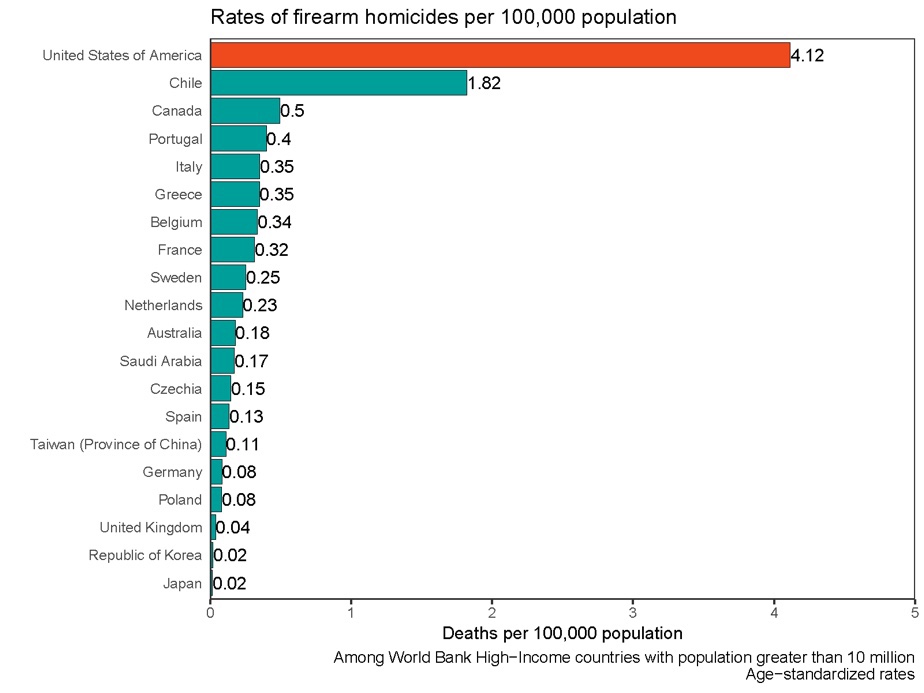
We lead the world in gun deaths. Yet GOP-dominated states like Florida, Texas, and Missouri are making it easier to get and carry a gun. The GOP fights any form of gun control.