Archives for the month of: June, 2023

The board that cast a 3-2 vote to authorize a Catholic virtual charter school in Oklahoma may have been invalid because a new appointee was not supposed to be seated until November 1 and was not eligible to cast a vote.

Monday’s national headline-making vote to give state sanctioning and Oklahoma taxpayer dollars to a Catholic school may have been invalid.

It turns out the state Attorney General’s Office believes that Oklahoma City businessman Brian Bobek is ineligible to serve on the Statewide Virtual Charter School Board until November.

But an email to that effect was not received by the board’s chairman and executive director until after Bobek cast the deciding vote Monday to approve state sponsorship for St. Isidore of Seville Catholic Virtual School.

Long-serving member Barry Beauchamp, a retired school superintendent from Lawton who had been allowed to continue serving after his term expired some months ago, was replaced abruptly on Friday by Oklahoma House Speaker Charles McCall.

Less than half an hour before Monday’s special board meeting began at noon, Deputy Attorney General Niki Batt sent an email to board Chairman Robert Franklin and Executive Director Rebecca Wilkinson saying that because Beauchamp had not vacated his seat, the law that created the Statewide Virtual Charter School Board doesn’t allow Bobek to take over the seat until November.

Franklin said that if Bobek was ineligible, his vote was invalid.

He is also concerned that a lengthy, written statement that Bobek read during Monday’s meeting, which included numerous legal citations, could have influenced the votes of other board members, including Scott Strawn, who was recently appointed to the board by Gov. Kevin Stitt.

An obscure board appointed by Oklahoma Governor Kevin Stitt voted 3-2 to approve funding a virtual charter school operated by the Archdiocese of Oklahoma City abd the Diocese of Tulsa. This violates the state constitution, as well as the First Amendment to the Constitution. Randi Weingarten, who is a lawyer, decried this action. The state will end up spending many more millions in legal fees, as it battles for its decision in the courts. If the decision is upheld, Oklahoma and other states can expect to fund yeshivas, madrassas, fundamentalist schools, even Satanic schools. We don’t need schools that indoctrinate; we need public schools that educate children to think for themselves and to respect others.

AFT’s Weingarten on Oklahoma Religious Charter School Approval
 

WASHINGTON—American Federation of Teachers President Randi Weingarten issued the following statement after Oklahoma approved a taxpayer-funded religious charter school:

“This decision not only threatens to siphon millions of dollars in public money into private hands, it strikes at the heart of our nation’s very foundations. The framers never intended to require public funding of religious institutions or religious schools.

“The combination of the Constitution’s free exercise clause and the concept of separation of church and state is what ensures religious freedom in the United States. This decision turns that idea on its head.

“It also turns on its head the concept that charter schools were supposed to be public schools run in a different way. And it vitiates the distinction between public and nonpublic religious schools in the eyes of Oklahoma.

“It is telling that a bipartisan coalition was opposed to the approval, and that only an obscure, hand-picked board of the governor’s own choosing was able to force it through.

“This ruling will no doubt end up at the Supreme Court. It is a clear and present danger, not only to ensuring public schools are open and accessible to all, but to religious liberty and freedom in our democracy writ large.”

Please join me and your many allies in D.C. on October 28-29 for our 10th anniversary conference. It promises to be our best ever!

Sign up now.

You will have a wonderful time!

And you will meet your favorite bloggers, hear great speakers, and meet people who are fighting against privatization across the nation.

Indiana blogger Steve Hinnefeld reveals a new charter scam: remote renewal of controversial charter schools. in this case, the charter is affiliated with the Christian rightwing Hillsdale College. Please open the link to finish the post.

Seven Oaks Classical School in Ellettsville received a 5-year extension to its operating charter recently. Well, not that recently. It happened in December 2022. Ellettsville and Monroe County residents may have missed it, though, because the extension was approved nearly 200 miles away.

It was approved by the three-member board of Grace Charters LLC, a nonprofit formed by Grace College and Theological Seminary to authorize charter schools, which are publicly funded and privately operated. The board met on the Grace College campus in Winona Lake, Indiana.

To meet legal requirements for public meetings, a notice was published in the local newspaper: the Warsaw Times-Union, which probably no one in Monroe County reads. One member of the public attended, according to minutes of the meeting: Seven Oaks headmaster Stephen Shipp.

The situation highlights the tension between public and private in Indiana charter schools. The Seven Oaks website says charter schools are “tuition-free, open-enrollment public schools.” But the school’s authorizer, which sets the terms of its operation and is supposed to hold it accountable, is a private, Christian college with no connection to the community where the school operates.

Seven Oaks is part of a network of charter schools aligned with Hillsdale College, a conservative and politically active private college in Michigan. The Hillsdale charter initiative once cast itself as part of a “war” to reclaim America from “100 years of progressivism” in education. Its president, Larry Arnn, led Donald Trump’s 1776 Commission and its promotion of “patriotic history.”

Grace College has also granted a charter to Valor Classical Academy, a Hillsdale-affiliated school that has stalled in its attempts to open in Hamilton or Marion County.

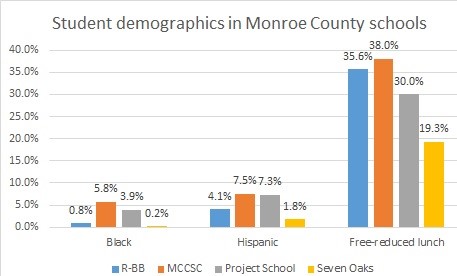
Along with the Hillsdale affiliation, there are other factors that distinguish Seven Oaks from public schools: for example, its demographic profile. Out of more than 500 students, one is Black and nine are Hispanic, according to state data. Fewer than 20% of students would qualify for free or reduced-price meals if they were provided. (The school doesn’t provide transportation or school lunches).

Bar chart showing percentage of Black, Hispanic and free-reduced lunch students in Monroe County schools.

This chart shows the percentage of students who are Black, Hispanic and eligible for free or reduced-price meals in Monroe County public school districts (Monroe County and Richland-Bean Blossom community school corporations) and charter schools (Bloomington Project School and Seven Oaks Classical School).

Nine of its 38 teachers are Hillsdale College alumni, according to profiles on the school’s website. In 2021-22, the most recent year for which a state teacher statistics report is posted, nearly 40% of its teachers had emergency licenses, compared with 4.6% in local public school districts.

The 24-page Seven Oaks charter extension reads like a standard agreement, with boilerplate language from state law and recommended practices for authorizing. It spells out the duties of each party, the expectations for the school, and the legal remedies if something goes wrong. An attached accountability plan includes out-of-date references to state assessments and, I’m told, is being revised.

The agreement says Grace College gets to keep 2.5% of the school’s state funding as an authorizer fee. That’s less than the 3% maximum that Indiana allows. In 2023-24, the college will net about $93,000.

Grace initially approved a charter for Seven Oaks in 2016 in one of Indiana’s first examples of what’s called authorizer shopping. The school’s founders applied to the Indiana Charter School Board, but it rejected their application. They reapplied but withdrew after a negative recommendation from the board’s staff. Then they took their plan to Grace College, which said yes to a 7-year charter.

At that time, private colleges could authorize charter schools in closed-door meetings with no public notice. Since 2017, they’ve had to use nonprofit authorizing agencies, such as Grace College’s Grace Charters LLC, that are subject to open-meetings and public-records laws. Even so, it can be hard to keep up. I started asking by email about the Seven Oaks charter extension in March; it took until late May to get copies of the December 2022 board minutes and the school’s extended charter agreement.

Transparency is one issue of having distant authorizers for charter schools, but there are others. The National Association Charter School Authorizers cautions against throwing the door wide open for higher education institutions, or HEIs, to authorize schools, as Indiana has done since 2011.

The respected Southern Poverty Law Center (SPLC) designated “Moms for Liberty” as an extremist group, along with a number of other astroturf anti-government organizations that popped up during the pandemic to protest masks and vaccines.

In its annual report on hate groups, SPLC named Moms for Liberty and 11 other “parent”groups as extremists who feed on racism, misogyny, homophobia, and bigotry:

Moms for Liberty joins the ranks of groups including the Oath Keepers, the Three Percenters and the United Constitutional Patriots, a self-styled militia that “patrols” the U.S.-Mexico border.

Other astroturf “parent” groups were identified as extremist by SPLC:

The 12 “parent’s rights” groups labeled by the SPLC as extremist groups: Moms for Liberty; Moms for America; Army of Parents; Courage is a Habit; Education First Alliance; Education Veritas; No Left Turn in Education; Parents Against CRT (PACT); Parents Defending Education; Parents Rights in Education; Purple for Parents Indiana and Parents Involved in Education.

Will Carless wrote in USA Today that Moms for Liberty “pitched itself as a potent grassroots movement of outraged parents, many of whom weren’t active in school politics until COVID-19 restrictions forced them to pay attention. It has sprouted local chapters in at least 40 states, claims more than 100,000 members and has the ear of the Republican establishment: Florida Gov. Ron DeSantis has championed their efforts to restrict teaching about race in schools and universities. Critics in Florida slam the group for turning schools into a political battlefield.”

Both DeSantis and Trump will address the annual conference of this two-year-old organization of hate-mongers.

Moms for Liberty and the other organizations are being designated as “anti-government extremist groups,” based on longstanding criteria, explained SPLC Intelligence Project Director Susan Corke. Corke said the grassroots conservative groups are part of a new front in the battle against inclusivity in schools, though they are drawing from ideas rooted in age-old white supremacy.

“[The movement] is primarily aimed at not wanting to include our hard history, topics of racism, and a very strong push against teaching anything having to do with LGBTQ topics in schools,” Corke said. ”We saw this as a very deliberate strategy to go to the local level…”

Despite the national profile, these organizations spread conspiracy theories and operate on the myth that educators are engaged in “Marxist indoctrination” of the nation’s children by imbuing them with dangerous ideas about equality and sexuality, the SPLC said.

While the movement may be reasonably new, it is founded on the same traditional racist, misogynist and homophobic views that brought people out to protest the desegregation of schools in the 1950s and ’60s, the SPLC argues.

Moms for Liberty does not report the names of its funders.

Lizette Alvarez, a journalist in Miami, wrote an opinion piece for The Washington Post, explaining the outrageousness of Florida’s universal voucher program.

What I find outrageous is that this story is not being covered by the Washington Post, the New York Times, or any of the other major media outlets. Nor is it reported as news by any of the network or cable stations.

Why are these stories not in the news every day?

CONSERVATIVE REPUBLICANS ARE WIPING OUT THE LONG-HONORED TRADITION OF SEPARATION OF CHURCH AND STATE!!

CONSERVATIVE REPUBLICANS IN EVERY RED STATE ARE DESTROYING THEIR PUBLIC SCHOOLS DESPITE PUBLIC OPPOSITION!!

Well, at least, the Washington Post printed an opinion piece telling of the greatest theft of the public good in our lifetimes:

Florida public schools are having an awful year. Record numbers of teachers have left their jobs, and those who remain face a minefield of ambiguous culture-war dictates about what they can say and how they teach.

And it’s about to get worse for Florida’s beleaguered public schools.

Florida Gov. Ron DeSantis (R) recently signed legislation that might radically undermine the state’s education system by making Florida’s already robust school voucher program the largest and most expensive in the country.

Beginning in July, the state will make it possible for every Florida K-12 student to receive a taxpayer-funded voucher or savings account worth $8,648. And for the first time in Florida, the vouchers will be available to children from wealthy families, even those who are home-schooled or who already attend private or religious schools. The money can go to tuition and educational expenses.

At least five other states have passed so-called universal choice programs — Arizona, Arkansas, Iowa, Utah and West Virginia — but Florida’s is, by far, the biggest. Other Republican-led states are considering similar bills.

The new policy is a revolutionary (and expensive) expansion. The original state voucher program, which began in 1999, was designed exclusively for a small number of children in F-rated, or failing, public schools and, later, special-needs students. The program grew to more than 177,000 students, from households earning up to $100,000.

About 2,300 private schools in Florida accept vouchers; 69 percent of them are unaccredited, 58 percent are religious and 30 percent are for-profit, according to the Hechinger Report.
In a state infamous as a magnet for schemers and grifters, there’s plenty of reason to worry as millions of dollars in new spending will soon pour into schools that have little accountability. When DeSantis celebrated passage of his vouchers-for-all gambit as a victory for school choice, he was no doubt being cheered on by those with no ideology other than diving into any trough freshly filled with public money.

But, as of July 1, even the child of a private-jet-flying tycoon will be eligible for a voucher. As state Rep. Marie Woodson (D) said, “This bill is an $8,000 gift card to the millionaires and billionaires who are being gifted with a state-sponsored coupon for something they can already afford.” The rich might not need it, but who passes up free money?

Estimates of the cost range from $209 million to $4 billion a year. About 2,300 private schools in Florida accept vouchers; 69 percent of them are unaccredited, 58 percent are religious and 30 percent are for-profit, according to the Hechinger Report….

In a state infamous as a magnet for schemers and grifters, there’s plenty of reason to worry as millions of dollars in new spending will soon pour into schools that have little accountability.

When DeSantis celebrated passage of his vouchers-for-all gambit as a victory for school choice, he was no doubt being cheered on by those with no ideology other than diving into any trough freshly filled with public money.

A federal judge in Florida issued a ruling blocking the state’s ban on gender-affirming care. He basically ruled that the issue was between parents, their children, and their doctors, not politicians. As in, butt out and respect parental rights.

TALLAHASSEE, Fla. — A federal judge delivered a stinging rebuke to Florida Gov. Ron DeSantis and the Republican-controlled Legislature over rules and a new state law that banned minors from receiving “puberty blockers” and other types of gender-affirming care.

U.S. District Judge Robert Hinkle on Tuesday blocked the state from applying the ban to three minors whose parents are part of an ongoing lawsuit, saying they would “suffer irreparable harm” if they were not allowed to continue access to hormones and other types of treatment.

The preliminary injunction does not apply to other minors who may wish to obtain treatment, but the ruling suggests that a key part of the law itself could get knocked down as the legal challenge proceeds. Lawmakers approved the new law in early May at the urging of Republicans, who called the treatments “evil” and “child abuse.”

Hinkle’s 44-page ruling called the decision to pursue the ban on puberty blockers and hormonal treatment a political decision and not a “legitimate state interest.” Several states — including Texas — have also recently enacted bans on gender affirming care.

“Nothing could have motivated this remarkable intrusion into parental prerogatives other than opposition to transgender status itself,” wrote Hinkle, who was appointed by former President Bill Clinton.

Hinkle also added that “the statute and the rules were an exercise in politics, not good medicine. This is a politically fraught area. There has long been, and still is, substantial bigotry directed at transgender individuals. Common experience confirms this, as does a Florida legislator’s remarkable reference to transgender witnesses at a committee hearing as ‘mutants’ and ‘demons.’ And even when not based on bigotry, there are those who incorrectly but sincerely believe that gender identity is not real but instead just a choice.”

The parents of the children expressed relief. DeSantis’ office had no comment. The sponsor of the bill responded that he would never stop fighting for children, even if their parents don’t want his help.

Alexandra Olson of AP wrote about a strike by journalists who work for Gannett newspapers. A vibrant free press is essential to democracy. Talking heads reading from a script on television are not a good substitute for local journalism that holds power to account. The death of community and local newspapers narrows our sources of information and strengthens the handful of barons who own the networks.

NEW YORK (AP) — Journalists at two dozen local newspapers across the U.S. walked off the job Monday to demand an end to painful cost-cutting measures and a change of leadership at Gannett, the country’s biggest newspaper chain.

The strike involves hundreds of journalists at newspapers in eight states, including the Arizona Republic, the Austin American-Statesman, the Bergen Record, the Rochester Democrat & Chronicle, and the Palm Beach Post, according to the NewsGuild, which represents workers at more than 50 Gannett newsrooms. Gannett has said there would be no disruption to its news coverage during the strike, which will last for two days at two of the newspapers and one day for the rest.

The walkouts coincided with Gannett’s annual shareholder meeting, during which the company’s board was duly elected despite the NewsGuild-CWA union urging shareholders to withhold their votes from CEO and board chairman Mike Reed as an expression of no confidence in his leadership. Reed has overseen the company since its 2019 merger with GateHouse Media, a tumultuous period that has included layoffs and the shuttering of newsrooms. Gannett shares have dropped more than 60% since the deal closed.

Susan DeCarava, president of the The NewsGuild of New York, called the shareholder meeting “a slap in the face to the hundreds of Gannett journalists who are on strike today.”

“Gannett CEO Mike Reed didn’t have a word to say to the scores of journalists whose livelihoods he’s destroyed, nor to the communities who have lost their primary news source thanks to his mismanagement,” DeCarava said in a statement.

In legal filing, the NewsGuild said Gannett’s leadership has gutted newsrooms and cut back on coverage to service a massive debt load. Cost-cutting has also included forced furloughs and suspension of 401-K contributions….

Among the contract demands are a base annual salary of $60,000. The median pay for Gannett employee in 2022 was $51,035, according to the company’s proxy filing. Reed’s total annual compensation was valued at nearly $3.4 million, down from $7.7 million in 2021.

At the shareholder meeting, NewsGuild-CWA President Jon Schleuss said the union proposed lowering Gannett’s median CEO-to-employee ratio from 66:1 to 20:1. But Schleuss said the meeting lasted just eight minutes and Reed didn’t address any questions. In a series of tweets, Schleuss called the meeting a “complete joke…”

Gannett, which owns USA Today and more than 200 other daily U.S. newspapers with print editions, announced last August that it would lay off newsroom staff to lower costs as it struggles with declining revenue amid a downturn in ad sales and customer subscriptions.

The newspaper industry has struggled for years with such challenges, as advertising shifts from print to digital, and readers abandon local newspapers for online sources of information and entertainment. Major newspapers such as The New York Times, The Wall Street Journal and The Washington Post have gained substantial digital audiences for coverage of broad topics, but regional and local papers have struggled to replicate that success in narrower markets…

According to the NewsGuild, Gannett’s workforce has shrunk 47% in the last three years due to layoffs and attrition. At some newspapers, the union said the headcount has fallen by as much as 90%.

The Arizona Republic, for example, has gone from 140 newsroom employees in 2018 to 89 this year, the NewsGuild said. The Austin American-Statesman’s newsroom shrunk during that period from 110 employees in 2018 to 41 this year.

Elahe Izadi of the Washington Post wrote this about the strike:

Gannett merged with the GateHouse chain in 2019, a deal that executives promised would lead to dramatic cost savings while critics warned of job cuts and leaner newsrooms. While the resulting company included 261 daily newspapers and 302 weeklies, those numbers had shrunk by the end of last year to 217 dailies and 175 weeklies, after some papers were shuttered or sold.

Rochester Democrat and Chronicle education reporter Justin Murphy said Monday’s protest represents a “desperation and fear that not only is our workplace and our employer going astray, but the consequences for our communities will be truly devastating.”

Gannett last summer froze hundreds of positions and laid off 400 employees — some of whom were the last remaining reporters at their newspapers — after a dismal financial quarter. Gannett has also offered voluntary buyouts and in December laid off 6 percent of its roughly 3,400-person news staff.

A year before he joined the paper in 2012, Murphy said the Rochester Democrat and Chronicle had a newsroom with 86 union members — a count that excludes editors and other managers — but that the number is now down to 23.

“Those of us who are left are kind of local journalism sickos who just can’t stop doing this,” he said. “As we’ve had cutbacks and cutbacks and they’ve asked us to do more and more, we’ve done it because we think it’s important that the work get done, and that’s just how we’re wired. But it’s one thing to do that when you have 86 people going to 80 or 73, but to 23? It doesn’t make sense anymore.”

Sportswriter Rob Aitken grew up reading the newspaper where he now works, the Record in northern New Jersey. “It was the best thing in the world to see your name in this paper,” he recalled. “It meant you were something.”

But now he says some high school sports are rarely written about, as staffers are stretched too thin. “You want to try to be everywhere and cover every great story. It makes you wonder how many great stories are not being told,” he said. “When we can tell a story about a kid and give them enough attention that maybe they get a college scholarship — you wonder how many kids aren’t getting that opportunity now.”

After the cutbacks, Gannett ended the year with a quarterly profit of $32.77 million, and $1.27 billion in outstanding debt.

The walkout also follows the departure of several top Gannett executives in recent months, as well as editors at some of the chain’s largest newspapers.

In a May earnings call, Reed said “2023 is off to a great start,” noting that the cuts and other “cost management initiatives” had boosted Gannett’s net income to $10.3 million, compared with a loss of $3 million during the first quarter of 2022. Digital subscriptions also grew by about 15 percent from the same time frame the previous year, totaling around 2 million paid subscribers.

Reed has also said he’s open to selling more Gannett newspapers.

“We would entertain bids on any of our markets, any of our products, that are at or above fair-market value,” he said in February. “We’re hopeful that we’ll have an opportunity this year to do that. But it’s not anything that’s in our plans.”
Jennifer Rubin is a regular columnist at the Washington Post. She was hired by the Post to be its “right” voice, but the Trump years flipped her politics. (I think she is my doppelgänger.) Before she became a columnist at WAPO, she wrote for The Weekly Standard, National Review, Commentary, and Human Events, among other conservative publications. Trump turned her into a Democrat. She has a BA and law degree from Berkeley.

She wrote here about a decision by a federal judge in Tennessee, overturning the state’s law banning drag shows. Drag is a performance. Drag queens, whether male or female, wear costumes to entertain audiences. If you don’t approve, don’t go to a drag show. If you think children should not see men pretending to be women (like “Mrs. Doubtfire” or “Tootsie,” don’t let them watch).

I have never been to a live drag show, though I enjoy seeing Tyler Perry play “Medea” in the movies and have enjoyed films like “Some Like It Hot” and “The Birdcage.” To me, drag is an age-old theatrical device, a performance intended to be humorous. If you believe in parental rights, trust parents to decide whether their children should go to a drag story hour at the local library. Once a legislature begins declaring what can be alllowed onstage, we are on a very dangerous path.

Rubin wrote:

Republicans, right-wing judges and MAGA activists have set out to trample on free speech and individual rights in the name of battling “wokeism.” If they don’t like what teachers say about history, gag them. If they don’t like certain books, ban them. If they don’t like a corporation defending LGBTQ rights, retaliate against it. Their crusade has become an expression of not only white Christian nationalism but of contempt for the Constitution and the First Amendment.


But last week, U.S. District Judge Thomas L. Parker, appointed by President Donald Trump, stood up to the thought police and the MAGA bullies in striking down the so-called drag queen ban (the Adult Entertainment Act) in Tennessee.

Parker began with an ode to the First Amendment: “Freedom of speech is not just about speech. It is also about the right to debate with fellow citizens on self-government, to discover the truth in the marketplace of ideas, to express one’s identity, and to realize self-fulfillment in a free society.” He continued, “That freedom is of first importance to many Americans such that the United States Supreme Court has relaxed procedural requirements for citizens to vindicate their right to freedom of speech, while making it harder for the government to regulate it.” And the Tennessee statute impermissibly tried to regulate free speech, he found.

Parker ruled that the law was “both unconstitutionally vague and substantially overbroad” because of the prohibition on displays “harmful to minors,” whatever that means. The law “fails to provide fair notice of what is prohibited, and it encourages discriminatory enforcement,” especially because the ban applies wherever a minor could be present.

Parker noted that the Supreme Court does not protect obscenity but certainly does protect speech that is unpopular. “Simply put, no majority of the Supreme Court has held that sexually explicit — but not obscene — speech receives less protection than political, artistic, or scientific speech. … The AEA’s regulation of ‘adult-oriented performances that are harmful to minors under § 39-17-901′ does target protected speech, despite Defendant claims to the contrary.” In a retort to Republicans seeking to rid libraries, classrooms and performance venues of anything they find offensive, Parker wrote, “Whether some of us may like it or not, the Supreme Court has interpreted the First Amenmentas protecting speech that is indecent but not obscene.”


And Parker also found the law “targets the viewpoint of gender identity — particularly those who wish to impersonate a gender that is different from the one with which they are born.” This is prohibited “content-based, viewpoint-based regulation on speech.” Republicans insist there is no such thing as gender identity other than gender determined at birth. That’s not a fact, as the MAGA censors insist; that’s a viewpoint. And it is impermissible to ban other viewpoints. That, Parker underscores, is what a free society is all about.


Simply because MAGA politicians want to write trans Americans out of existence does not make it constitutionally permissible. “The Court finds that the AEA’s text discriminates against a certain viewpoint, imposes criminal sanctions, and spans a virtually unlimited geographical area,” Parker wrote. “The AEA can criminalize — or at a minimum chill — the expressive conduct of those who wish to impersonate a gender that is different from the one with which they were born in Shelby County. Such speech is protected by the First Amendment.” He concluded, “This statute — which is barely two pages long — reeks with constitutional maladies of vagueness and overbreadth fatal to statutes that regulate First Amendment rights. The virulence of the AEA’s overbreadth chills a large amount of speech, and calls for this strong medicine.”

I hope you can open the link and read the rest of this excellent article.

Edward B. Fiske was the education editor of the New York Times and editor of the Fiske Guide to Colleges. Helen F. Ladd is a nationally prominent economist of education and professor emeritus at Duke University. They are married, a power couple of American education. This article appeared on the website of WRAL in North Carolina.

Forty years ago this spring a national commission charged with evaluating the quality of American education issued a blistering report entitled “A Nation at Risk.” It cited a “rising tide of mediocrity” in the country’s schools and declared that the country’s failure to provide high quality education “threatens our very future as a Nation and a people.”

North Carolina leaders took this warning to heart. They began investing heavily in public education and even became a model for other states in areas such as early childhood education. Significantly, the state was making progress toward fulfilling its obligation under the North Carolina Constitution to provide a sound, basic education for all students.

The situation started to change, however, in 2012 when Republicans came to power and began an assault on public education that continues to this day.

When it comes to public education, North Carolina is now “A State at Risk.”

The Republican assault has taken multiple forms, starting with inadequate funding. North Carolina now ranks 50th in the country in school funding effort and 48th in overall funding. Despite widespread teacher shortages, the Republicans have kept teacher salaries low — $12,000 below the national average – and they have failed to provide adequate funding for the additional support staff that schools need.

In addition, they have permitted significant growth in the number of charter schools. Such schools divert much-needed funds from traditional public schools and make it difficult for local boards of education to operate coherent education systems.

The Republican-controlled Legislature is currently working hard to weaken public education by politicizing the process. Pending legislation would regulate how history and racism are taught, give a commission appointed mainly by lawmakers the job of recommending standards in K-12 subjects, and transfer authority to create new charter schools from the State Board of Education to a board appointed by the General Assembly.

The problem is about to get even worse. The Legislature is now poised to expand the earlier Opportunity Scholarship program, which had provided public funds for low income children to attend private schools, into a much larger universal voucher program that would make all children eligible regardless of family income – at an estimated cost of more than $2 billion over the next 10 years.

Given that private schools are operated by private entities typically with no public oversight and no obligation to serve all children, why in the world would it ever make sense to use taxpayer dollars to support private schools?

A common argument has been that voucher systems raise achievement levels of the children who used them. While some early studies of small scale means-tested voucher programs in places like Milwaukee showed small achievement gains in some cases, recent studies of larger voucher programs in places such as Ohio, Louisiana and Indiana consistently show large declines in average achievement — often because of the low quality of the private schools that accept vouchers.

Supporters also argue that vouchers provide more schooling options for children and that having more choices is a good thing. But in the context of education policy that need not be the case. Americans support public education – and make schooling mandatory – not only for the benefits it generates for individual children but also for collective benefits such as the creation of capable workers and informed citizens. What matters is the quality of education for all the state’s children.

An expanded voucher program would lead to a substantial outflow of funds from traditional public schools to privately operated schools, with the potential for a significant loss in the quality of our public schools, and subsequent vitality in the state’s economy.

A strong public education system – from elementary and secondary schools to the nation’s first public university, the University of North Carolina – has long been pivotal to our state’s cultural, political and economic success. We must stop the current assaults on public education and reaffirm our commitment to one of North Carolina’s great strengths.

Back in 1983 when the education system of the nation was “at risk,” President Ronald Reagan – who had earlier been lukewarm in his support of public education — took the warning seriously and began touring the country to talk about the problem. His successors from both parties then took up the cause and continued to make the case that a strong public education system is essential for a vibrant economy, and importantly, to make the policy changes needed to strengthen it.

Let’s hope that our current Republican leaders in this state can muster the wisdom and courage to follow the example of President Reagan and other leaders from both parties in pushing for strong public education. In the absence of such wisdom, we will indeed continue to be “A State at Risk.”