Archives for the month of: December, 2022

Gary Rubinstein is a mathematics teacher but also a close observer of boasting about miracle schools. He watches the charter sector closely and has exposed many hoaxes. He was first to report that Tennessee’s highly praised Achievement School District never achieved any of its goals. Here, he reviews the attrition rate at Success Academy, which has attained high test scores by curating its students. Success Academy has received national acclaim for its “miraculous” scores. Rubenstein explains what is behind the curtain.

Rubenstein writes:

Success Academy is the largest charter network in New York City. With 40 schools and 20,000 students, Success Academy is known for its high 3-8 standardized test scores and their rigid rules. Success Academy also celebrates the annual 100% college acceptance rate among its graduates.

Success Academy is a K-12 program and, until recently, the only time that you could enter the school was either in kindergarten, 1st, 2nd, or 3rd grade. The size of the first graduating cohort in 2018 was 16 students. The answer to the natural question of how many students started that cohort originally was 73 which meant that approximately 25% of the students who started with Success Academy eventually graduated from there. I say ‘approximately’ because it isn’t fully accurate to just divide 16/73=22% and conclude that 78% of the cohort left the school for one reason or another. Not counted in the 16 is the students who were still in the school but had been left back one or more years. It seems that about 6 more of the students from that cohort graduated a year later so maybe the true number is 22/73=30% is more accurate. But there’s another factor that, until now, has been impossible to factor in. Some of those 22 students are students who transferred into the school after the first year so you would have to subtract those students from the 22 to get the actual attrition rate. The only way to get that kind of data is to do a FOIL request which is exactly what I did.

Success Academy had 315 Kindergarteners in 2008. The graduating class of 2021 had 110 students. Without this new data, it would seem that their persistence rate is about 35%. But this new data I received shows that only 69 of the graduating class had started with the school as kindergarteners. So a more accurate estimate is 69/315=22% which is a little lower than the 25% I had originally estimated.

It is also interesting that 41/110=37% of the graduating class were from the backfills even though the backfills were from a pool of about 100 students. So about 41% of the backfills graduated vs 22% of the original cohort. A reason for this discrepancy could be explained by the way that Success Academy manipulates their backfill students to guarantee that the backfilled students are ‘better’ than the students they replaced. As I reported previously, lower performing students applying to be backfill students are often told that they have to repeat the grade they just graduated from which surely discourages some of them from accepting their backfill offer while higher performing students are not required to repeat the grade.

Please open the link and read the post.

We saw this coming. The charter movement, widely praised in the press, opened the door to school choice and consumerism. Now, as we see in Oklahoma, the state may soon have its first Catholic school charter. When the charter movement started, it promised that charter schools would be innovative, accountable, cost less than public schools and be transparent. As we have repeatedly seen, charter schools are not innovative, avoid accountability, demand the same or greater funding than public schools, and are not transparent.

Oklahoma shows where the charter movement is heading: charter schools are becoming a pathway to vouchers.

A Catholic charter school funded by taxpayer dollars is likely coming to Oklahoma soon, based on a recent ruling of the state’s outing attorney general, with support from the re-elected governor and off newly elected state superintendent of public education.

For decades, Baptists have fought against public funding of parochial schools of all kinds, but a recent series of rulings by the United States Supreme Court appears to have opened the door to that very reality. And Oklahoma’s strongly Republican leaders appear ready to walk through that door.

John O’Connor

On Dec. 1, Attorney General John O’Connor — who is Catholic — and Solicitor General Zach West wrote a non-binding legal opinion that says a current state law blocking religious institutions and private sectarian schools from state funding of public charter school programs is unconstitutional and should not be enforced.

Already, the Roman Catholic Archdiocese of Oklahoma City “states it is willing to adhere to every jot and tittle of state law and intends to apply for a charter,” reported Andrew Spiropoulos, the Robert S. Kerr Professor of Constitutional Law at Oklahoma City University and the Milton Friedman Distinguished Fellow at the Oklahoma Council of Public Affairs.

That means for the first time, government funding for public schools could also flow to Catholic schools and other faith-based schools.

And that’s not good news to Charles Foster Johnson, who helped found the group Pastors for Oklahoma Kids.

“It’s perfectly fine for those Oklahoma charter schools to become religious schools if they no longer receive public tax dollars from the people of Oklahoma,” he said. “But the last thing the devout religious folks of Oklahoma need is for their state to entangle itself in the establishment of religion through the funding of religious schools masquerading as public charter schools. All true religion, whether in congregation or class room, is voluntary and free. It must remain unencumbered by state intrusion.”

Charles Foster Johnson

Pastors for Texas Kids has noted that Oklahoma ranks 48th in the nation for per-student spending on public education. The state’s public schools serve 703,650 students, accounting for 93% of the school-age population.

Stephen Dyer is a very insightful and reliable analyst of school issues in Ohio. He used to be a legislator. He reads bills and budgets. He keeps everyone informed about the intellectual fraud that perpetuates the diversion of public funds to failing charters and voucher schools. In this post, he dissects a recent paper by the Fordham Institute, which is an outspoken advocate of school privatization. Fordham, writes Dyer, said the quiet part out loud. A few years ago, Fordham funded a study by David Figlio on vouchers in Ohio that showed their negative effects, but they try to ignore their own study.

Dyer writes:

There’s been some news coverage today of Fordham’s latest foray into fantasy — a study they claim proves EdChoice vouchers are perfectly fine and dandy for kids and taxpayers.

However, tucked away in one of their “findings” is a kind of startling admission — that EdChoice forces local school districts to rely more on property taxes to pay for educating the students in public schools.

“Combined with the decrease in enrollments, this dynamic led to a 10-15 percent increase in local revenue per pupil.”

I’m sure the study’s author(s) had no idea what they had just done. But those of us who have been saying the same thing for years sure did. This is an admission that EdChoice means that students not taking EdChoice vouchers have to rely more on local, voter approved property taxes to pay for their educations — the exact thing that the Ohio Supreme Court ruled four different times made Ohio’s school funding system unconstitutional.

“The overreliance on local property taxes is the fatal flaw that until rectified will stand in the way of constitutional compliance,” ruled Justice Alice Robie Resnick in the 4th and final DeRolph decision in 2002.

So it was nice of Fordham to admit this. However, the report went on to spend a lot of time trying to minimize the potentially existential lawsuit Ohio’s voucher program faces, as well as mocking me and others as “Chicken Littles” (because those with a winning argument always use ad hominem attacks to strengthen their position).

The study blows minimal to zero impacts on student success into enormous justification for increasing taxpayer subsidies for private school tuitions. As Michigan State’s Josh Cowen put it: “First and most important: the study presents a ton of zero impacts and tiny effects. Mostly this is a #schoolvouchers report about statistical noise, packaged as a win.”

Exactly.

Take the information on segregation. The study compares the racial makeup of voucher students with the statewide racial makeup of Ohio students. The study’s author, Stephane Lavertu of Ohio State University (who taxpayers paid $132,968 in 2019 to educate students) was very careful to only compare the racial makeup of EdChoice recipients with public school students “statewide”.

Because he knows that EdChoice voucher students don’t come from every district. They come from majority-minority districts.

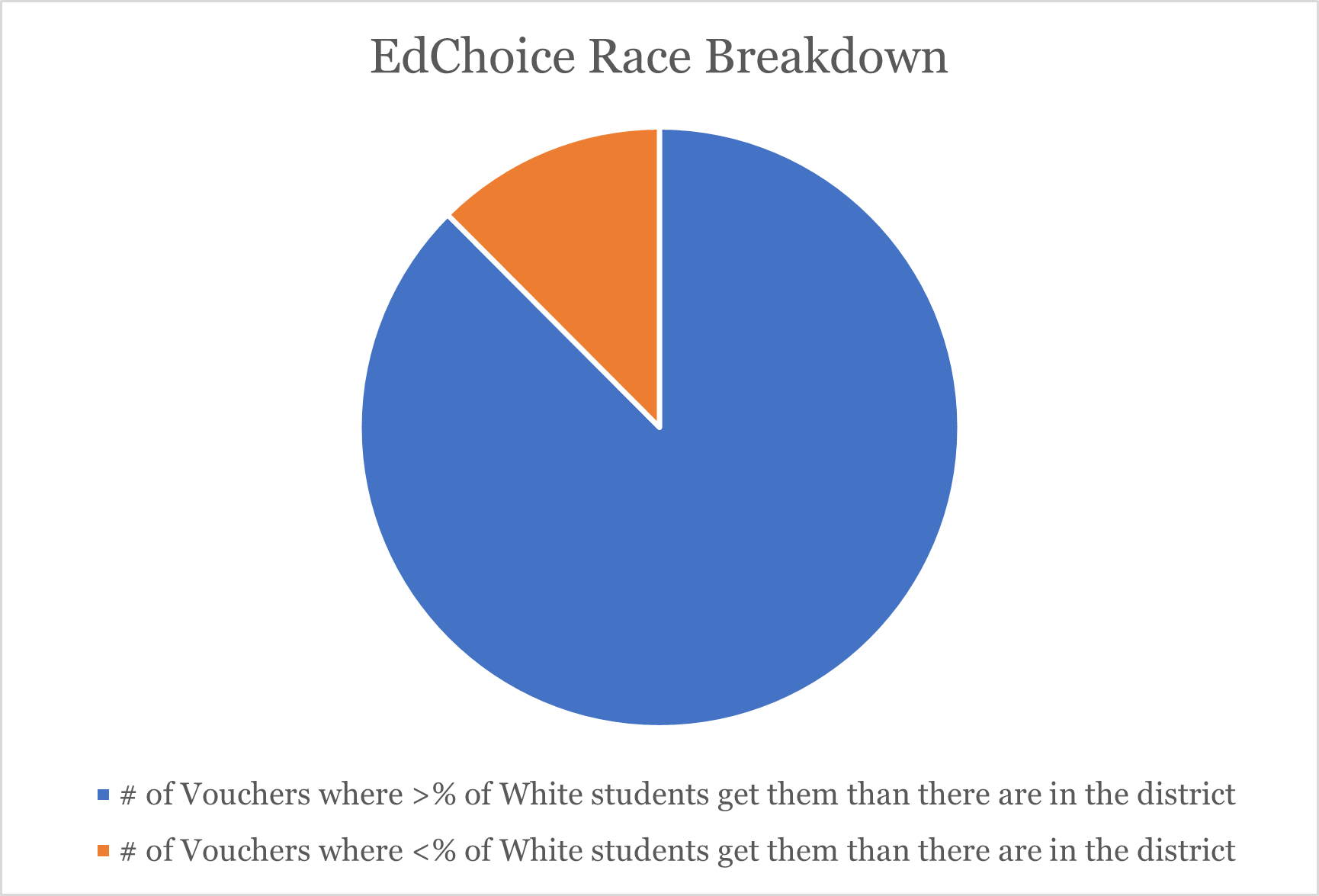
There are 95 districts that lose 10 students or more to EdChoice. In 76 of those districts, accounting for 87% of all vouchers given through the program, a higher percentage of white students take vouchers than there are in that district.

The average difference between white students taking vouchers and white students in those 76 districts was 76.2%. That means that in the districts where 87% of voucher students come from, voucher recipients are 76.2% more likely to be white than their public school counterparts.

My friends, that’s White Flight. Like, obvious White Flight.

Dear reader, do these data suggest — as Huffman wants you to think — that these segregation issues are “isolated examples”?

If 87% of voucher recipients are more likely to be white than the districts they come from, is that really “isolated”? Or is it “systemic”?

I mean in Huffman’s own district of Lima, Temple Christian takes 100% white voucher students. From a district that’s 35% white….

The vouchers worsen segregation. The students in voucher schools do worse on state tests than the public schools they left. What is more, “voucher students do worse on state tests the longer they take the voucher.”

A lose-lose, for students, for public schools, and for the state.

Nonetheless, despite failure, the state Teoublican legislature wants more vouchers and more failure!

Please open the link and keep reading this important post.

Jan Resseger, as always wise and compassionate, reviews the impact of the billionaire-funded culture wars on children and families. The particular focus on erasing the histories of children of color and demonizing LGBT families is harmful to them.

She writes:

Conversations about public schooling have been utterly sidetracked this year by fights about Critical Race Theory, “Don’t say gay!” laws, and whether somebody is “grooming” children at school? Where did these culture wars come from?

A NY Times analysis earlier this week tracks book banning in public schools as part of an epidemic of culture war disruption: “Traditionally, debates over what books are appropriate for school libraries have taken place between a concerned parent and a librarian or administrator, and resulted in a single title or a few books being re-evaluated, and either removed or returned to shelves. But recently, the issue has been supercharged by a rapidly growing and increasingly influential constellation of conservative groups. The organizations frequently describe themselves as defending parental rights. Some are new, and others are longstanding, but with a recent focus on books. Some work at the district and state level, others have national reach. And over the past two years or so, they have grown vastly more organized, interconnected, well funded — and effective. The groups have pursued their goals by becoming heavily involved in local and state politics, where Republican efforts have largely outmatched liberal organizations in many states for years.”

The reporters track research from PEN America: “(T)here are at least 50 groups across the country working to remove books they object to from libraries. Some have seen explosive growth recently: Of the 300 chapters that PEN tracked, 73 percent were formed after 2020. The growth comes, in part, from the rise of ‘parental rights’ organizations during the pandemic. Formed to fight COVID restrictions in schools, some groups adopted a broader conservative agenda focused on opposing instruction on race, gender and sexuality, and on removing books they regard as inappropriate.”

How is the culture war uproar affecting public schools? In a recent newsletter, the National Education Policy Center (NEPC) trackedresearch concluding: “Preparing students to participate in civil and respectful ways in our diverse democracy has long been a core mission of public schools.” Today, “U.S. high schools are struggling to fulfill this mission as they increasingly encounter hyper-partisan efforts. Those efforts have sought to spread misinformation, to encourage harassment of LGBTQ+ students, and to limit opportunities for productively discussing controversial topics. Such challenges are particularly pervasive in politically diverse areas where one party does not dominate.” The researchers surveyed 682 public high school principals and subsequently followed up by interviewing 32 of those principals. NEPC reports:

  1. “Public schools increasingly are targets of political conflict. Nearly half of principals (45 percent) reported that the amount of conflict in their community was higher during the 2021-2022 school year than it was pre-pandemic… Teaching about race and racism was the area where principals were most likely to report challenges from community members, followed closely by LGBTQ+ content.”
  2. “Political conflict undermines the practice of respectful dialogue. A majority of high school principals report that students have made demeaning or hateful remarks toward classmates for expressing either liberal or conservative views and that strong differences of political opinion among students have created more contentious classroom environments.”
  3. “Conflict makes it harder to address misinformation. Misinformation—much of it tied to partisan organizations and causes—makes it more challenging to encourage productive and civil dialogue. After all, it is difficult to develop a shared sense of how to move forward when different people are working from different sets of ‘facts.’ Nearly two thirds of principals (64 percent) say parents or community members have challenged information used by teachers at their schools. The share of principals saying parents or community members challenged teachers’ use of information three or more times nearly doubled between 2018 and 2022.”
  4. “Conflict leads to declines in support for teaching about race, racism, and racial and ethnic diversity. High schools increasingly struggle to teach students about the full spectrum of American experiences and histories, especially when it comes to issues related to racism and race… ‘My superintendent told me in no uncertain terms that I could not address issues of race and bias etc. with students or staff this year,’ said a principal in a red community in Minnesota. ‘We could not address the deeper learning.'”
  5. “Principals report sizable growth in harassment of LGBTQ+ youth. The survey results also suggest that schools are increasingly facing challenges related to teaching students to treat one another with dignity and respect… Fewer than half of principals said school board members or district leaders made statements or acted to promote policies and practices that protected LGBTQ+ student rights.”

“Parents’ rights” are the rallying cry for many of today’s culture warriors who want to protect the dominant culture and shield their children from uncomfortable controversy. But in a recent and very personal Washington Post column, “When Children Ask About Race and Sex, We Have No Choice But to Answer,” Danielle Allen, a political theorist and the Director of the Edmond and Lily Safra Center for Ethics at Harvard University, and an African American mother, explains the point of view of many other parents and children. Allen examines why it is so urgently important for teachers to be able to respond to children’s own observations and questions when the students themselves initiate conversation about the same fraught subjects the NEPC researchers describe organized parents trying to ban from the schools.

Allen describes a conversation her own two-year-old daughter launched about race, while the child sat in seat of the grocery store cart as they were in the midst of shopping. The child declared, “Mommy, I think it’s not good to be Black.”

Allen reflects upon what her toddler had already observed about race in America: “My daughter’s statement was a question. Its subtext went like this: ‘I’ve noticed something, Mommy. It seems like it’s not good to be Black. But can that be right? You’re Black. I love you. How can these things fit together? And what does this mean for me?'”

Allen continues: “What I can assure you of is that even before any of our kids, of any racial or ethnic background, get to school, every Black family in the United States is having to teach its children about race and the history of enslavement and stories of overcoming that have played out generation after generation. The same must be true for kids raised in LGBTQ families, with regard to the history and contemporary experience of gender and sexuality… This means that the only way you can keep knowledge and questions about these histories, experiences and perspectives out of the school curriculum in early grades is to keep Black people or members of LGBTQ families out of school.”

Or, according to NEPC’s research, many school districts are enrolling Black and Brown children and children from LGBTQ families while the school districts may be imposing policies to silence such children, to make their realities invisible to other students, and to refuse to help them answer their own hard questions.

Public schools are required by law to serve all the children whatever their race, ethnicity, religion, or sexual orientation. It is not the business of school board members, school superintendents, school principals, or teachers to cater to any one group of parents’ rights advocates, no matter how well organized or well funded is their lobby.

Here, writing for The Progressive, is retired high school teacher, Peter Greene, who understands educators’ obligation to protect the interests of all the students who fill our nation’s public school classrooms: “Schools must balance the needs and concerns of all of their many stakeholders. Parents absolutely have rights when it comes to public schools, but so do non-parents, taxpayers and other community stakeholders. It’s up to the school district to balance all of these concerns, while also depending on the professional judgment of its trained personnel. It is a tricky balance to maintain, requiring nuance and sensitivity. It is correct to argue that ‘schoolchildren are not mere creatures of the state.’ But framing the issue as parents versus school has served some folks with a very specific agenda.”

Donna Mace recently died, unexpectedly, and the public schools of the United States and Florida lost a dear friend.

Sandy Stenoff wrote this tribute to Donna, who taught elementary school students for 35 years, then became an outspoken activist for public schools and against the overuse of standardized testing. Of course, she was a BAT.

She concluded:

Donna Mace made the world a better place by being a force for good. She was a class act, approaching life’s challenges with courage, grace, humility, humor, and optimism, We all benefited from Donna’s wisdom, gained from her experience as a lifelong educator and a life well lived. She really was the best of us.

To the Mace family: Our thoughts are with you now and we send you love, gratitude, and a wish that your fondest memories will bring you peace and comfort.

I am sadened that we have lost Donna Mace. Many were inspired by her and will follow in her footsteps, never abandoning the struggle to do what is right for children. I hereby add her name to the honor roll, a list of distinguished fighters for public schools and children.

Bill Phillis, leader of the Ohio Coalition for Equity and Adequacy, reports good news in the battle against the state’s expensive and ineffective voucher program.

Private School Voucher Lawsuit Given Green Light to Go to Trial

Effort by Attorney General and Out-of-State Interest Groups to Dismiss Foiled

COLUMBUS – The lawsuit challenging the constitutionality of the harmful private school voucher program was given the green light on Friday to go to trial sometime in 2023.

Franklin County Common Pleas Judge Jaiza Page dismissed motions by Ohio Attorney General Dave Yost and out-of-state pro-private school interest groups like the Institute for Justice to dismiss the case, and instead gave the go ahead to the coalition of public schools suing the state to present their case.

“We are one step closer to proving that private school vouchers are unconstitutional, and hurt Ohio, our public school students, educators, parents, taxpayers and our communities,” said William L. Phillis, Executive Director for the Ohio Coalition for Equity & Adequacy of School Funding. “Facts matter in the court of law. The Ohio Constitution is clear. There shall be a single system of public schools, not a separate and unequal system of schools that can apply a discriminatory litmus test against students based on race, religion, income, or any disqualifying factor that strikes their fancy.”

“School board members like me owe it to our taxpayers to bring this lawsuit because my district, like so many others, has been forced to increase our property taxes with local levies to make up for the public tax dollars lost to private school vouchers. We know the vast majority of these parents are using the voucher as a refund or a rebate and they never intended to enroll their children in public schools,” said Dan Heintz, a school board member with plaintiff district Cleveland Heights-University Heights.

To read the Motion for Judgement on the Pleadings click here.

To read the Motion to Dismiss click here.

The Ohio Coalition for Equity & Adequacy of School Funding is working with Vouchers Hurt Ohio, a growing coalition of public school districts that have come together to sue the state over the unconstitutional and harmful private school voucher program.

Politico reports that there was no sweep for partisans of the culture war issues. We can expect to see more attacks on teachers, students, and school boards in the next election, based on hyped-up falsehoods about race and gender. Support from rightwing conservative foundations—the usual suspects—will keep alive the battles and the fake organizations leading them. (Expect a special report soon from the Network for Public Education on these front groups attacking school boards, written by an authority on Dark Money).

Juan Perez Jr. of Politico writes:

THE DIVIDED CLASSROOM — In case you missed it amid the advertising noise and campaign spending avalanche of November’s midterms, 2022 proved to be an incredibly busy — and contentious — year for education elections.

Fifteen states and the District of Columbia held state school board or education superintendent races this year. Roughly 1,800 local board seats across some 560 districts in 26 states were also up for grabs on Nov. 8, according to the nonpartisan nonprofit Ballotpedia.

Who came out on top? Nobody. Neither Democrats nor Republicans managed a clean sweep.

This means the state of education in the United States remains divided sharply along partisan lines — and the education wars are likely to continue unabated in 2023 and beyond.

The bitter differences between the two sides and lack of consensus between the poles of both parties — over everything from teaching about slavery and gender identity to childhood vaccinations – offer little incentive for either side to back down.

“We are stopping Critical Race Theory from being taught, stopping access to obscene pornography in our schools, and ending the tenure of radicalism and indoctrination of our kids because the left is waging a civil war in our classrooms,” newly-elected Oklahoma State Superintendent Ryan Walters recently wrote in the Daily Caller.

Candidates who supported having race and sex-related curricula or Covid-19 safety requirements in schools won about 40 percent of the roughly 1,800 local board elections tallied by Ballotpedia this year, and tended to win in counties President Joe Biden carried in the 2020 election. Candidates with opposing views won about 30 percent of their elections, often doing so in counties held by former President Donald Trump.

Nearly one-third of incumbent school board members also lost to their challengers on Nov. 8.

“People didn’t feel listened to. Parents felt they lost agency and power over their kids’ education,” Randi Weingarten, president of the American Federation of Teachers labor union, recently told Nightly. “My concern is that we can’t have two countries. This is one United States of America, and we have an obligation to help kids — regardless of whether they’re in South Carolina, Tennessee, New York or California — to learn how to critically think.”

As they turn toward 2023, Democrats take solace in battleground state victories for governor, successful education-related ballot measures and local school board races where moderate incumbents defeated far-right challengers in Louisville, Ky., the suburbs of Austin, Texas, and other places.

Sure, conservatives lost plenty of races. But they won more than enough to show their brand of culture-based education politics thrives in areas controlled by the party faithful. Trump seems to have this on his mind, too. The former president promised schools would lose their federal funding if they don’t get rid of critical race theory, and what he described as “radical civics and gender insanity,” when he announced his reelection bid.

No state school boards with elections this year flipped partisan control, according to the National Association of State Boards of Education. But majority parties did expand their influence on boards in Colorado, Kansas and Utah while conservative incumbents often lost primary challenges.

Candidates endorsed by two upstart GOP-aligned political committees also won roughly half of their midterm elections.

Candidates backed by Moms for Liberty, a group formed by a former Florida school board member to fight school Covid-19 mask requirements and controversial library books, won about half of their 2022 elections, according to the organization. The 1776 Project PAC, a group opposed to the critical race theory academic framework that examines how race and racism have become ingrained in American institutions, saw a similar win-loss ratio.

Open the link to read more.

David Berliner and Carl Hermanns edited a book about the value and importance of public schools in a democratic society. Its title is Public Education: Defending a Cornerstone of American Democracy, and it was published by Teachers College Press. I was one of the contributors, along with other well-known figures in the field.

The book would be a terrific Christmas gift for an educator.

This review will give you a good look at the contents.

Public Education is a 346-page book containing 29 chapters penned by some of America’s most eminent scholars, including Diane Ravitch, Jennie Oakes, Sonia Nieto, H. Richard Milner, Deborah Meier, Ken Zeichner, Gloria Ladson-Billings, Michael Apple, William Ayers, and of course, co-editor David Berliner. The late Mike Rose has a chapter in the book as does Edward Fiske, the longtime New York Times education reporter and author of the ubiquitous Fiske Guide to Colleges.

While the themes of the book are quite varied, all the contributors to the book seem to agree that a child’s prospects in life, the quality of America’s public schools, and the country’s future as a democracy are all intimately intertwined. The importance of high-quality public education has been covered by Berliner previously in co-authored books such as The Manufactured Crisis (with Bruce Biddle, 1996) and 50 Myths and Lies that Threaten America’s Public Schools (with Gene Glass, 2014), and in well over a hundred articles.

However, in comparison with Berliner’s earlier works, this book has a stronger sense of urgency and a more dispiriting sense of disappointment in the ways in which federal and state governments have undermined, underfunded, and underappreciated the singular accomplishments of public education. In Berliner’s chapter on charter and voucher schools, for example, he uses the word scandalous over thirty times.

The very first sentence of the book’s introduction states, “The belief in the vital importance and central role of public education in the development of our country and the sustenance of our democracy runs deep.” When discussing the history and future of American public education, the specter of Horace Mann is always difficult to ignore. Indeed, more than half of the contributors explicitly discuss Mann’s ideas concerning the importance of a free education, sometimes in great detail. Even when he goes unnamed, Mann runs like a powerful current throughout these pages.
To offer a sense of the content and variety of the chapters, citations from four contributors follow.

Mark Weber
“Reform has become the core of the resistance to meaningful and sustained investment in schools. Education reformers are providing cover for those who fear that the United States might take its obligation to fund schools more seriously—starting with raising taxes on the wealthiest of its citizens.” (p. 205)
“A 2017 meta-analysis of merit pay experiments found ‘a modest, statistically significant, positive effect on student test scores (.053 standard deviations).’ This is the equivalent of moving a student at the 50th percentile in test scores to the 52nd percentile.” (p. 207)

Gloria Ladson-Billings
“Currently most major cities do not have enough white students attending their schools to adequately desegregate them.” (p. 227)
“The number of the most intensively segregated schools—with more than 90% of low-income students and students of color—more than doubled [from 2001 to 2014].” (p. 229)
“Beyond the crudeness of the per pupil expenditure measure is also the way ‘average daily attendance’ is derived. In Wisconsin, ADA is calculated on ONE day per year–September 15.” (p. 230)


Diane Ravitch

“After the Civil War, no state was admitted to the Union without an education clause in its constitution.” (p. 21)

“For many years, the term ‘school choice’ was stigmatized because of its association with advocacy for school segregation.” (p. 23)


Carol Burris

“The term public school is generally not viewed as a pejorative, which is why those who oppose public schools are so anxious to either exclude the term from the discourse, blur the definition, or hijack it for privatized systems.” (p. 236)

“We need to mind our words, being cognizant of how language has been used to shift the perception of privatized choice. Terms like privately-run charter schools and neighborhood public schools should replace public charter and traditional.” (p. 240)

As with any edited book, one chapter may seem nondescript while another may seem absolutely indispensable. For example, James Harvey’s chapter, “Education is our only political safety,” (pp. 214–225), a clearly written, tour-de-force about how education in the U.S. is funded, would be a perfect fit for an undergraduate foundations of education course.


Some of the book’s chapters are quite short and informal; others are fully realized, in-depth academic papers, replete with conclusions and recommendations. Most authors use APA bibliographic style, but a few use Chicago, and some chapters include no list of references at all. The chapters are divided into six “interrelated” parts that are so interrelated as to be indistinguishable from one another. Sections are identified not by titles but by Roman numerals, I–VI.

The divider pages indicating a transition to a “new part” often feature historical photos and text. For example, on p. 233, the divider page for Part V shows a picture of 16 very young child- employees of an oyster plant in a small town in Mississippi located on the Gulf of Mexico. The children depicted in the photo look to be between the ages of 5 and 8, and one of the 8-year-olds is struggling to hold another child-worker who appears to be around 2. The caption reads:

Before America had child labor laws and school attendance requirements….all [these children] worked from before daybreak until 5 p.m. for extremely low wages.”

Child Labor laws in the United States were ratified less than a century ago, in 1938. When children were liberated from the chains of illiteracy and the drudgery of working long hours for near-starvation pay, public schools emerged as welcoming, empowering institutions that offered the possibility of a better life. Rather than submit to a permanent sentence of indentured servitude, an American child—every American child—was suddenly given the opportunity to be treated as an equal among peers, regardless of race, religion, wealth, or family connections.

One can argue about the extent to which America has fallen short of its promises. But, powerful forces at work in the United States today are working to obliterate public schools and debunk the idea that every child deserves a fair chance. As noted repeatedly by the contributors to Public Education, if our public schools go down, our democracy seems likely to follow.


Author Biography
LAWRENCE BAINES, Ph.D., writes on educational policy and multisensory learning. He is the author of 13 books, including What’s a Parent to Do? How to Give your Child the Best Education (2022, Rowman & Littlefield). His homepage is http://www.lawrencebaines.com.
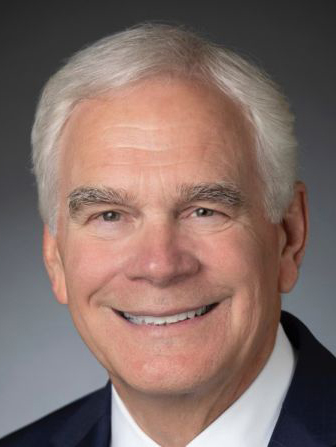
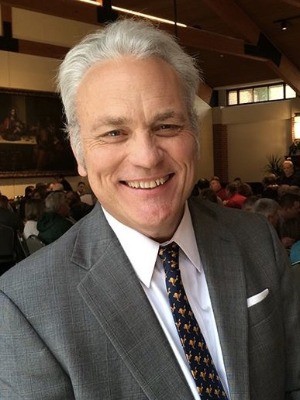
Roger Taney was the Supreme Court justice who wrote the Dred Scott decision, one of the worst decisions in the history of the Court. Its ruling upheld slavery. Taney’s bust will be replaced by a bust of Thurgood Marshall.

NPR wrote:

The House gave final passage to legislation to replace the bust of Roger Taney, the Supreme Court justice who wrote the Dred Scott decision, in the Capitol with one of Thurgood Marshall, the first Black person to serve on the high court.

The notorious 1857 Dred Scott decision upheld slavery and established that Black people were not U.S. citizens. The legislation, which passed Wednesday and now heads to President Biden’s desk, says the bust is “unsuitable for the honor of display to the many visitors to the Capitol.”

The statue of Taney sits at the entrance of the Old Supreme Court Chamber in the Capitol where the Supreme Court met from 1810 to 1860. Taney, the fifth chief justice, led the court from 1836 to 1864.

“While the removal of Chief Justice Roger Brooke Taney’s bust from the Capitol does not relieve the Congress of the historical wrongs it committed to protect the institution of slavery, it expresses Congress’s recognition of one of the most notorious wrongs to have ever taken place in one of its rooms, that of Chief Justice Roger Brooke Taney’s Dred Scott v. Sandford decision,” the legislation says.

“Taney’s ruling denied Black Americans citizenship, upheld slavery, and contributed, frankly, to the outbreak of the Civil War,” Rep. Steny Hoyer, D-Md., said on the U.S. House floor on Wednesday. “That’s why I and so many others advocated for his statue’s removal from the Maryland State House.”

Josh Cowen of Michigan State University reviewed a report by the rightwing Thomas B. Fordham Institute about for-profit charter schools in Ohio. It was published by the National Education Policy Center.

The summary:

The Thomas B. Fordham Institute recently published For-Profit Charter Schools: An Eval- uation of their Spending and Outcomes. The report examines academic outcomes in Ohio’s nonprofit and for-profit charter schools; in addition, it explores whether differences in contracted services in for-profits appear to correlate with differences in their outcomes. Although the report finds that charters generally have higher academic outcomes relative to traditional public schools, for-profit schools perform slightly lower academically than their nonprofit counterparts, and they perform worse than traditional schools in some areas as well. In addition, the report finds that for-profits typically contract for either staffing or other services and that those contracting for staffing perform especially poorly. Based on these findings, the report includes cautions about overregulation of for-profit charters but also raises concerns about virtual and charter schools that contract out for nearly all services. Contrary to the report’s enthusiastic Foreword, written by Fordham executives Amber Northern and Michael Petrilli and containing implications that somewhat vary from those in the report’s body, there is little in the report to remove skepticism from the debate over for-profit status. Rather, the report includes negative findings such as fewer students in for-profit charters earning diplomas, and it reinforces concerns about for-profit schools— particularly those that contract out for staff. In addition, the report is limited in its focus on only Ohio, which has substantially more transparency than many states require for school choice options. As a result, the report offers little to inform policy and practice in dissimilar or nationwide contexts.
http://nepc.colorado.edu/thinktank/for-profit-charters