Archives for the month of: January, 2022

You may recall that a Texas state legislator named Matt Krause released a list of some 850 books that he thought should be removed from school libraries. Even public libraries are under pressure to clear their shelves of the books that Krause identified. The books are about race, racism, sex education, anything related to LGBT, student legal rights, and gender.

This link includes the full list of books that Krause wants to ban.

Yesterday, Christopher Tackett (@cjtackett) tweeted that the book purge has begun in his district.

He wrote:

Today in Granbury ISD, at the High School library, they came with a hand cart and carried away multiple boxes of books tagged with “Krause’s List”.

They can do this because the board voted 7-0 on Monday to change district policy allowing books to be removed prior to a review.

He wrote that students, parents, and teachers protested to the school board but their voices were ignored. The superintendent pushed for the purge and ridiculed the opponents as “gaslighters and radicals.”

Some excellent comments from outside Texas. This one from Hugh G. Merriman:

The parallels are chilling…

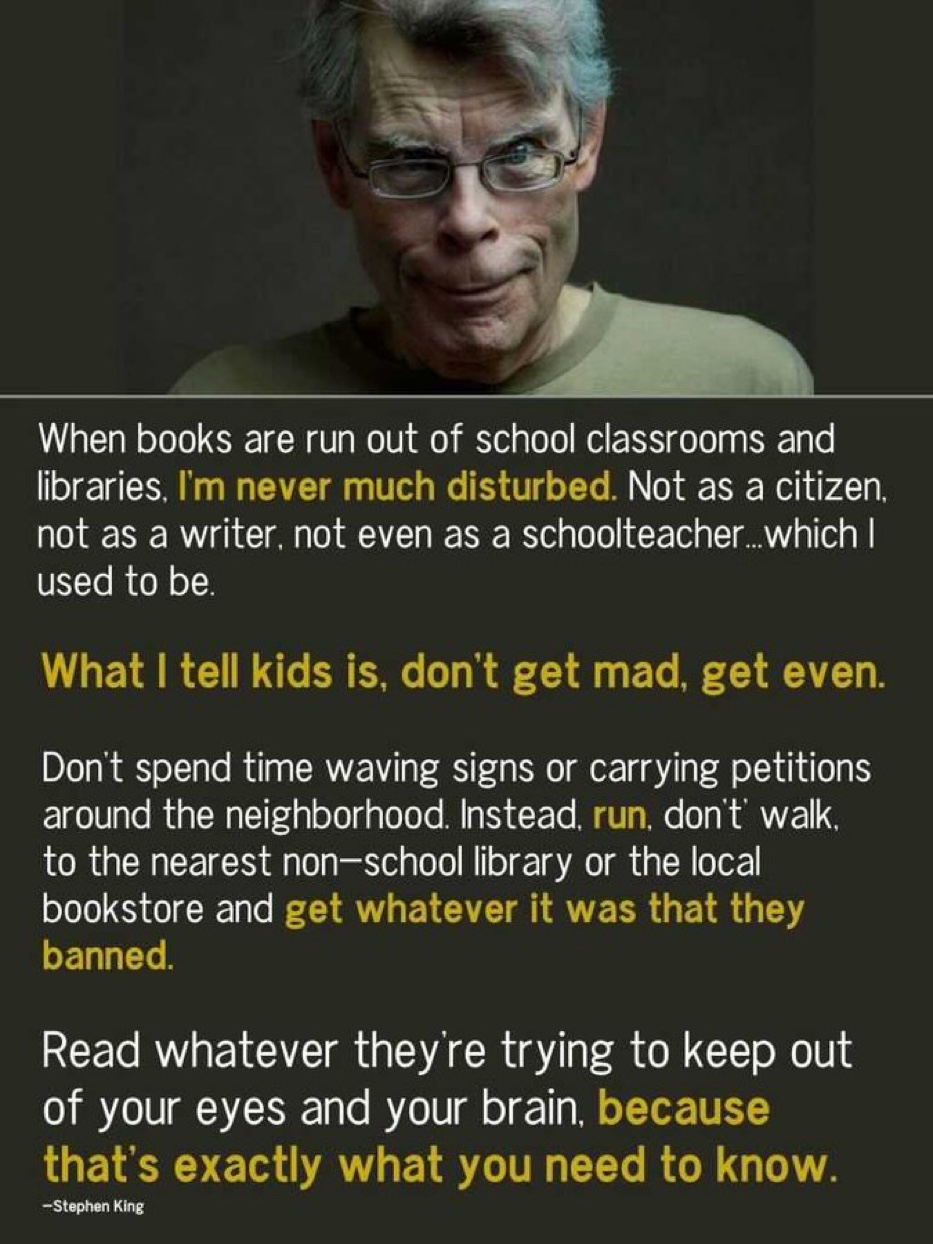
And this advice, quoted from Stephen King:

I disagree with the opening line in the King quote. I am very much disturbed when books are banned from schools and school libraries. Next, they will pull them from the public library, and not many students can afford to buy the banned books. Protest, wave signs, speak up. Be loud. Make noise.

The school board in McMinn County, Tennessee, voted 10-0 to ban the Pulitzer-Prize winning graphic novel Maus from its schools. Board members complained about unacceptable language (“God damn”) and nudity (nude mice). The book by Art Spiegelman is about his father’s brutal experiences during the Holocaust. Presumably, the board wants the story of genocide told in a pleasant, inoffensive way.

Teachers in the district testified on behalf of the book.

The members of the school board heard from English language arts instructional supervisors about why the book was being used in the curriculum, the meeting minutes show.

Board member Tony Allman took issue with how the content would be redacted, and added, “We don’t need to enable or somewhat promote this stuff. It shows people hanging, it shows them killing kids, why does the educational system promote this kind of stuff? It is not wise or healthy,” according to the meeting minutes.

In response, instructional supervisor Julie Goodin countered, “I was a history teacher, and there is nothing pretty about the Holocaust, and, for me, this was a great way to depict a horrific time in history,” the meeting minutes say.

“Mr. Spiegelman did his very best to depict his mother passing away, and we are almost 80 years away. It’s hard for this generation. These kids don’t even know 9/11. They were not even born. For me, this was his way to convey the message,” Goodin continued.Black parents say movement to ban critical race theory is ruining their children’s education

Melasawn Knight, another instructional supervisor, echoed Goodin’s stance that the graphic novel depicts history as it happened, the meeting minutes indicate.

“People did hang from trees, people did commit suicide and people were killed, over six million were murdered,” Knight said.

“I think the author is portraying that because it is a true story about his father that lived through that. He is trying to portray that the best he can with the language that he chooses that would relate to that time, maybe to help people who haven’t been in that aspect in time to actually relate to the horrors of it.

“Is the language objectionable? Sure. I think that is how he uses that language to portray that,” Knight said.

It is not possible to teach the history of the Holocaust without acknowledging organize brutality, savagery, mass murder, and sadism. Teaching the history honestly is no doubt offensive to Nazis, but one imagines they are not a significant bloc in McMinn County. If the school board wants to protect students against the reality of the Holocaust, what are teachers allowed to say about slavery, Jim Crow, lynchings, and the KKK?

The Holocaust is personal to me. My mother and grandmother left Balti, Bessarabia, and arrived in the United States in 1917. My grandfather came before the war. Most of the family stayed in Europe. My father’s parents came in the 19th century from Lomza, Poland. Most of their family stayed in Poland.

Not one member of my family survived the war. All perished in the Holocaust.

Inappropriate comparisons to the Holocaust are common and undermine its significance. Just today, Robert F. Kennedy, Jr., apologized on Twitter for comparing the effort to vaccinate people to the Holocaust. An incredibly vicious comparison since vaccines save lives; no one’s family is being burned in a furnace because of getting vaccinated.

A message from the Anti-Defamation League.

Soon after the reunification of Germany, ADL organized a leadership mission to a united Germany. One of our most significant meetings was with Dr. Rita Süssmuth, then-head of the Bundestag (Germany’s House of Representatives). One member of our group asked her about teaching young Germans about the Holocaust.

Her answer is even more relevant today than it was then.

She said that one can’t talk about that horror in the same way to the young generation as speaking to their parents or grandparents. They are too far removed from the events of World War II. What is necessary, she reasoned, are creative approaches to make the history relevant and visceral.

Süssmuth’s comment comes to mind as we observe International Holocaust Remembrance Day on Jan. 27, which is also the anniversary of the liberation of the Nazi concentration camp Auschwitz-Birkenau. There is no doubt that more than 80 years after World War II, a variety of factors are coming together posing challenges to Holocaust memory, but all the news in this arena is not bad. It’s a good time to take stock.

The negatives are abundant. First, as is often discussed, a major instrument for educating young people — the living testimony of survivors — is diminishing rapidly as most survivors are gone. One hears over and over again that a survivor speaking about his or her experience before a classroom or school assembly has awakened the students as to what the Holocaust was all about and why they should care about it.

Second, the statistics on the lack of knowledge about even the basics of the Holocaust are concerning. A Pew survey revealed that more than 80 percent of Americans know that it was an attempt at the annihilation of Jews, but far fewer have any idea as to how Hitler came to power and how the horrors came to pass.

The Claims Conference surveyed younger Americans and found that 63 percent of millennials and Gen X-ers did not know that six million Jews had been murdered in the Holocaust.

And ADL’s Global 100 Survey several years ago found that only 54 percent of people worldwide had ever heard of the Holocaust and 32 percent thought it was greatly exaggerated or a myth.

Third, the meaning of the Holocaust is undermined seemingly every day by its trivialization through inappropriate analogies. In the hyper-political and polarized world we live in, exacerbated by social media, it seems that everything one doesn’t like is compared to the Nazis or the Holocaust.

And, of course, one of the most egregious comparisons — often meant to undermine the significance of Holocaust memory — is equating Israeli treatment of the Palestinians to the Nazi treatment of Jews. In other words, so the warped logic goes: The world had its Holocaust, now “the Jews have their own.”

Fourth, Holocaust denial continues to have a life of its own and has found a particular lifeline as extreme right groups look for respectability. There is no doubt that historically the association of the murder of six million Jews with Nazism and fascism has been the major obstacle for decades for such groups to gain legitimacy in political circles. Denying or at least diminishing the Holocaust can open a pathway for revival for extreme right groups who until now have been largely excluded from a role in democratic societies.

This is a powerful combination of factors. There is, however, the other side, where a good deal of progress has been made in Holocaust awareness and acknowledgement.

In the early days, it was Jews and Israelis who were the leaders in educating about the Holocaust. Israel, as a home for the largest number of survivors, invested in the matter with Yad Vashem, Yom HaShoah and the Eichmann trial. Over the last few decades, however, we have seen growing involvement of other governments and broader societies in this project. This is a good development.

So, the U.N., often seen as hostile to the Jewish people because of its many anti-Israel stances, has incorporated two important Holocaust-related elements into its programming and policies. The first is that of today, International Holocaust Remembrance Day, which produces annual programs, statements and recollections and keeps the attention of the international community on this genocide for one day.

The second is a resolution passed just recently which denounces Holocaust denial as against U.N. values.

Another cross-country effort, initiated by Sweden, is the International Holocaust Remembrance Alliance, which, in effect, builds on the U.N. initiative to implement educational processes about the Holocaust in participating countries. Recently, its participants met in Malmo, Sweden to discuss practical ways to move forward on Holocaust education and combatting antisemitism. And, of course, many Holocaust museums have cropped up across the U.S. and Europe, the most important the U.S. Holocaust Memorial Museum, which attracts large numbers of visitors, most of whom are not Jewish.

And then there are the many efforts by non-governmental organizations, two of particular significance being the Shoah Foundation’s vital interview project of survivors and ADL’s Echoes and Reflections public school education curriculum and program on the Holocaust.

These and many others try to live up to Süssmuth’s plea for creativity in connecting young people to the Holocaust. Holocaust knowledge and awareness are clearly more important than ever because of the passage of time, the surge of antisemitism, the loss of shame about antisemitism as the Holocaust is more distant, and the rise in extremism of all kinds and the efforts to legitimize fascism.

Examples are the use of artifacts, photographs and testimony to encourage students to present their own questions about those events; real time questions and responses from Holocaust survivors using hours of pre-recorded video footage; and the use of local U.S. news sources during the period of Nazi rule and how events were seen from an American perspective. Holocaust awareness and acknowledgement are clearly more important today than ever.

Kenneth Jacobson, ADL

Michael Hiltzik of the Los Angeles Times explains why American copyright law benefits major corporations, not the creators of original works.

In 2022, he says, there will be a bumper crop of well-known titles that will enter the public domain, including Winnie the Pooh, Ernest Hemingway’s The Sun Also Rises, poetry collections by Dorothy Parker and Langston Hughes, and first novels by William Faulkner and Agatha Christie. A number of sound recordings, including ones by Al Jolson and Enrico Caruso will no longer be copyrighted.

Hiltzik writes:

As it happens, however, this massive release isn’t something entirely worth celebrating. Instead, it’s a pointer to the sheer absurdity of American copyright law, which long ago came under the thumb of the entertainment industry and distant heirs of artists determined to preserve what is essentially a windfall.

It’s proper to keep in mind that copyright law was not designed originally to keep cash flow running for future generations of a creator’s family. The idea was always to preserve an incentive for creators to create, by guaranteeing that they would be able to enjoy the fruits of their own labor for a set period.

The first U.S. copyright law, passed in 1790, established a limit of 14 years, and allowed the original creator, if still living, to renew the copyright for another 14 years.

Eventually, the term was extended to 28 years, plus a single renewal option of another 28. (The vast majority of copyrights were never renewed.) The 1976 Copyright Act extended the term to 50 years from the date of an author’s death, and the 1998 Sonny Bono Act increased it to 70 years after the death of the author, and to 95 years after publication for corporate works-for-hire.

The Walt Disney corporation and the families of George Gershwin and Oscar Hammerstein, among others, have lobbied effectively to keep their copyrights intact. Disney wants to protect its rights to Mickey Mouse as long as possible. Even though A.A. Milne’s book Winnie the Pooh will no longer be copyrighted, Disney owns and defends the animated forms of Winnie, as well as the trademark of ”Winnie the Pooh.” The Disney copyright on Mickey Mouse is scheduled to expire January 1, 1924, but Hiltzik bets that Disney will lobby for another extension of the law to protect its property.

A notable feature of all this maneuvering over copyright terms is that it hasn’t done much to straighten out the mazes of copyright claims afflicting some of our culture’s most important and popular creative legacies.

Emily Dickinson, for instance: The Belle of Amherst died in 1886 with the vast majority of her poems unpublished (indeed, unknown). That was 136 years ago, but most of her works are still subject to a copyright claimed by Harvard University, which maintains that “all applications to quote or reprint Emily Dickinson material should go through the Harvard University Press Permissions Department.”

Harvard zealously defends its control of Emily Dickenson’s works.

Otto Frank, the father of Anne Frank, holds the copyright to her diary until the 2040s, even though she died in 1945 at age 15 in a concentration camp.

The family of Dr. Martin Luther King holds the copyright to everything he wrote, including his speeches.

Hiltzik writes: As I reported in 2015, the King family stringently controlled broadcasting of King’s seminal “I Have a Dream” speech without royalty payments, even as the 50th anniversary of its Aug. 28, 1963 delivery on the National Mall approached in 2013.

When I compiled an antholgy of great Americans speeches, poems, and songs called The American Reader in 1990, I had to pay the family royalties to include not only the ”I Have a Dream” speech, but his important ”Letter from a Birmingham City Jail.” They are significant historical documents, and I wrongly assumed they were in the public domain.

Extending the copyright of original works for a century does not encourage creativity, especially when the creator of that work has died. The descendants should have a reasonable time to enjoy the fruitsof their relatives’ labors. But that too should be limited to a generation, not monetized through multiple generations. It is even harder to justify the century-long copyright eagerly sought and won by corporations.

Hiltzik concludes:

A return to the fundamental principles on which copyright law was originally based would point to a reduction in copyright terms, not the persistent efforts to lengthen them. That’s especially so in the digital age. As the Duke scholars [at Duke’s Center for the Study of the Public Domain], argue, “the public domain is being impoverished just as its opportunities for creativity, innovation, democratic participation, and knowledge advancement are transformed.”

Knowing the power of the corporate lobbyists, he is doubtful that the terms of copyright will be reducedn more likely, they will be extended yet again. You know, Mickey Mouse.

Governor Youngkin invited parents to report the names of teachers who are violating the state’s vague and ill-defined law banning the teaching of “divisive concepts,” critical race theory, and anything else any parents object to.

Peter Greene describes the creative responses of respondents. Responses to an email address can come from anywhere, not just Virginia. You too can write to Youngkin’s Stasi.

Anyone can send their reports to the tip line email:

helpeducation@governor.virginia.gov

Greene writes:

But of course you know what else happened next. The tip line has apparently been hit with a variety of reports, like a complaint that Albus Dumbledor “was teaching that full blooded wizards discriminated against mudbloods.” Some of this has been goaded on Twitter by folks like human rights lawyer Qasim Rasgid. And John Legend correctly pointed out that under the guidelines of the decree, Black parents could legitimately complain about Black history being silenced (because, as sometimes escapes the notice of anti-CRT warriors, some parents are Black). Ditto for LGBTQ parents.

Greene also includes a useful list of questions to answer if you write the Governor: like, “who was your favorite teacher and what did they teach?”

Glenn Youngkin’s campaign for Governor of Virginia was fueled in large part by attacks on public schools. Youngkin said that the state’s public schools were indoctrinating students with critical race theory. He pledged to put an end to it. After he took office, he continued his rant against CRT; he even set up an email site where parents can complain about teachers. And to add to his rightwing cred, he banned mask mandates. A number of school districts are suing him to preserve their mask mandates.

Dana Milbank wrote about the elite private schools where Youngkin sent his own children. They very explicitly teach critical race theory. Youngkin knew what was going on: he was a member of the board.

Milbank wrote:

Not only is Virginia’s new Republican Gov. Glenn Youngkin banning the fictional menace of critical race theory from public schools, but he’s also turning the commonwealth into a little Stasi State. He’s setting up a tip line so parents can report to the government any school official they consider to be teaching something “divisive.”

“We’re asking for folks to send us reports,” he told a conservative radio host Monday, The Post reported. “We’re going to make sure we catalogue it all,” he added, “to make sure we’re rooting it out.”

The state’s deputizing of residents to act as informants will have the obvious effect of deterring even mentions of slavery or race, which means Youngkin has imposed a de facto “memory law” whitewashing Virginia’s, and the country’s, deep and ongoing history of white supremacy…

The public schools of Virginia do not teach critical race theory.

But do you know which schools do teach “divisive” concepts, including something resembling critical race theory? The private D.C. schools Youngkin had his children attend. And you know who was on the board of governors of one of those schools while it was beefing up its anti-racism policies? Glenn Youngkin.

Youngkin, a professed fan of public school parents’ rights, exercised his own parental rights not to send his children to Virginia public schools but rather to National Cathedral School and St. Albans School, twin private all-girl and all-boy schools in D.C. under the auspices of the Episcopal Church.
National Cathedral’s website listed Youngkin as a member of its governing board from 2016 through 2019, and he was chair of its finance committee. To their credit, both National Cathedral and St. Albans were, during that time, leaders in developing anti-racism teachings, even before the murder of George Floyd heightened national awareness of systemic racism. Youngkin’s spokeswoman, Macaulay Porter, said that Youngkin “stepped off the board after 2019” and that both schools “changed a lot over the years.”

DEI — Diversity, Equity and Inclusion — has been a priority at National Cathedral for many years. The school has an extensive staff devoted to the initiative, as well as programming that includes affinity groups such as diversity forums, an equity board, an intersectionality council and a student diversity leadership conference. A National Cathedral strategic plan approved by the board in 2018 — during Youngkin’s tenure — “includes the mandate to ‘Advance an Inclusive Educational Environment,’ ” which involved “integrating related action steps into the fabric of everything we are and do as a school community.”

Among the other things National Cathedral has done: made time in the school schedule for “critical conversations around topics of race, anti-racism, social justice, and inclusion”; added courses such as “Black Lives in Literature” and “Courageous Dialogues”; developed new hiring protocols “as a result of our anti-bias work” and required diversity training for all staff members; and included in the school’s summer reading list books such as Robin DiAngelo’s “White Fragility: Why It’s So Hard For White People To Talk About Racism….”

St. Albans has undertaken similar anti-racism initiatives. Among the books promoted on the school’s website are “White Fragility,” “Critical Race Theory: An Introduction,” Henry Louis Gates Jr.’s “Stony the Road: Reconstruction, White Supremacy and the Rise of Jim Crow,” and Ibram X. Kendi’s “Stamped from the Beginning: The Definitive History of Racist Ideas in America.”
St. Albans also directed faculty to read Kendi’s “How to Be an Antiracist.” Fox News and other conservative outlets this past fall blasted a St. Albans’s “anti-bias” policy draft.

Youngkin’s own children were lucky to have attended schools that make its students grapple with uncomfortable and, yes, “divisive” issues. So why is he now using the powers of the state to intimidate teachers who would give Virginia’s public school students the same advantage?

Due to the the Omicron surge of COVID, the Network for Public Education and NPE Action has again rescheduled our in-person conference. It will now be April 30-May 1.

Still in Philadelphia. Still a star-studded roster of parents, educators, and friends of public schools.

Certainties: Great speakers. Terrific panels. Ample time to discuss your concerns. Wonderful opportunity to meet your favorite bloggers. Guaranteed: excitement about joining with old and new friends to learn from one another and to plan for the future.

Please register now. All the details are here.

Gary Rubinstein has followed the progress of the much-lauded Success Academy charter chain, supposedly the most successful in the nation. He has noted that SA graduates only a small fraction of those it admits. He estimates that about 75% are gone before graduation.

Success Academy has argued that a 75% attrition rate isn’t so bad because it is about a 11% attrition per year, compounded, which, they say, is what happens in public schools too. But I don’t think this is a valid argument. Getting into Success Academy is supposed to be like winning the lottery. The attrition rate should be miniscule if Success Academy is as good as they claim. You don’t just give away a winning lottery ticket.

When I was writing The Death and Life of the Great American School System: How Testing and Choice Are Undermining Education (2010), I researched the history of merit pay. I learned that it has been tried again and again for a century, and it has always failed. Business-minded people think that the lure of a bonus will force teachers to work harder and get better results. But merit pay doesn’t work. Its main effect is to demoralize teachers. Michael Bloomberg tried it in NYC, and it failed. It was tried in Tennessee from 2007-2010 with a fat bonus of $15,000. It failed there too. Wherever it was tried, it failed. The theory is wrong, and as the great W. Edwards Deming argued, it doesn’t work in business either.

In 2010, I was invited to meet with the Domestic Policy leadership at the Obama White Housek (Melody Barnes, head of the Domestic Policy Council; Rahm Emanuel, President Obama’s chief of staff; and Roberto Rodriguez, the President’s education advisor). They asked me what I thought of the Common Core standards. I suggested that they give it a trial in two or three states and see how it works before rolling it out nationally. They dismissed the thought. They said national standards had to be in place by 2012, before the election. Then they asked what I thought of merit pay, and I said what I wrote here in the first paragraph. They told me that they were releasing $1 billion for a Teacher Incentive Fund. Waste of my time. Probably a waste of theirs too.

I recently ran across this story from Charleston, South Carolina, that appeared in The Post and Courier, the local newspaper, in 2016. It is an obituary for the city’s federal Teacher Incentive Fund grant.

Paul Bowers wrote:

Three years and $11.7 million later, the Charleston County School District doesn’t have much to show for its controversial program that linked teacher pay to student performance.

The Bridge program, devised during previous Superintendent Nancy McGinley’s administration and funded by a $23.7 million Teacher Incentive Fund grant, was supposed to encourage and retain quality teachers by rewarding them financially for good performance. Instead, teacher turnover increased at most of the program’s pilot schools, and internal polls showed that teachers weren’t motivated by the sometimes-paltry payouts.

The district has spent more than half of the grant so far, with only $614,900 going to teacher bonuses since 2013. The bulk has gone to pay consultants and a top-heavy bureaucracy of teacher coaches and evaluators to keep the program running.

The school board voted in February to pay one last round of teacher bonuses this fall and let the federal government keep the remainder of the funds. After that, Bridge will die a quiet death.

Well, quiet for some. For Drayton Hall Elementary teacher Patrick Hayes, the founder of the advocacy group EdFirstSC who has railed against the plan since the district won the grantin 2012, it’s hard not to say “I told you so.”

“It’s absolutely eroded trust and morale. There’s a universal sense that people don’t believe we’re doing our jobs,” Hayes said.

While Hayes said most teachers are comfortable with a principal observing them in class, they were often nervous waiting for the next surprise visit from an evaluator hired by the district office.

“When you get people focused on external rewards, they’re so anxious about those rewards, they focus on that instead of the job you want them to do,” Hayes said. “Overall, the notion that we need the adults to feel more nervous so that the kids will do better is flawed.”

McGinley declined to comment for this story.

Bridge started as a pilot program in 13 high-poverty, high-turnover schools, including North Charleston High and Burns Elementary. Using a formula based on student test score improvements, classroom observations and state evaluations, the district started doling out yearly bonuses of $1,000 to $4,000 for high-performing teachers and school administrators at those schools.

According to the timetable for the federal grant, the district was supposed to start evaluating all of its teachers on the Bridge measures this school year and roll out the raises to every school starting in 2016-17. District Superintendent Gerrita Postlewait estimated in February that the rollout would put a $5 million dent in the district’s already-tight budget next year alone. And once the five-year grant runs out, the district would be on the hook to fund the program without federal support.

School board Chairwoman Cindy Bohn Coats said she didn’t vote to end Bridge because it was an abject failure but because it wasn’t a big enough success to justify the expense.

“With these grants, you have to show such a success that when the grant ends, you’re willing to forgo something you’re doing in favor of that, or find a way to continue paying for it,” Coats said.

Long before Postlewait and the board nixed Bridge, teachers were railing against the program. An October report from the Charleston Teacher Alliance recommended returning the grant money to federal coffers, citing a survey that found just 16 percent of teachers in Bridge pilot schools thought the program was working.

“We are paid for our service, not for its outcome,” said Charleston Teacher Alliance Director Jody Stallings, a Moultrie Middle teacher. “The same is true of soldiers, police officers and doctors, for very good reason. The factors that go into our success depend on so much more than individual effort.”

Stallings said his group tried to convince both the McGinley administration and interim Superintendent Michael Bobby that the Bridge plan was “flawed, wasteful and doomed.” But it wasn’t until after Postlewait took office in July that the tide started to turn against the plan.

Despite Bridge’s many outspoken detractors, a district spokesman wrote that the program “received favorable feedback” when federal Teacher Incentive Fund workers paid a visit in spring 2015. And it did have local supporters, even toward the end.

In November, shortly after taking over responsibility for Bridge from previous district leaders, Project Director Anita Huggins wrote in an email to Postlewait that a panel of five school principals unanimously supported accepting another year’s worth of grant money. Listing some of the principals’ comments, she wrote that returning the funds during an $18 million budget crisis “could be a significant PR challenge” and “could exacerbate CCSD’s culture of ‘not finishing’ anything.”

“Regardless of whether we admit it,” she quoted one principal as saying, “the grant has resulted in an increased awareness of student achievement data.”

By that time, Bridge was already hobbled. In October, the district office had reassigned 10 TIF grant-funded professional development coordinators to school-level positions paid by the General Operating Fund, moving them out of the Bridge program. Postlewait had also begun putting a wide array of district projects under the microscope, from reading interventions to behavior management programs, looking for a “return on investment” to justify their continued existence.

Bridge wasn’t a total loss. The district was able to collect classroom observation and student growth data for “nearly all teachers” this school year, according to a district spokesman, and the program put the district ahead of the curve when the state started requiring all teachers to complete student learning objective paperwork.

Coats said she hopes conversations like the one that brought about Bridge’s demise will become a regular occurrence as the district moves toward a zero-based budgeting system that takes no expense for granted.

“I don’t think Charleston County School District will ever be a truly successful district until we are willing to do that on an annual basis,” Coats said. “Look at programs. Are they working? Should we expand them? Should they continue?”

In 2014, Russia invaded Ukraine and took control of the Crimean Peninsula, which was then absorbed into Russia. Presently, Putin has stationed at least 100,000 troops on Ukrainian borders, and leaders in the West are fearful that he intends to invade and seize control of all Ukraine. Ukraine has a long and terrible history under Russian control. In the late 1920s and 1930s, Stalin collectivized Ukrainian agriculture and sent troops to export Ukrainian crops to Russia. Millions of Ukrainians were killed or starved to death in the ensuing famine. Historian Robert Conquest wrote a history of these events callled Harvest of Sorrow. It is a terrifying history. Today, it appears that Vladimir Putin wants to reassemble the Soviet Union. He once called its dissolution the worst geopolitical tragedy of the 20th century.

Here are the views of Britain’s Secretary of Defence.

Secretary of State for Defence Ben Wallace discusses NATO, Ukraine and Russia.

Defence Secretary in Olsztyn, Poland.

Defence Secretary in Olsztyn, Poland.

I have lost count of how many times recently I have to had to explain the meaning of the English term “straw man” to my European allies. That is because the best living, breathing “straw man” at the moment is the Kremlin’s claim to be under threat from NATO. In recent weeks the Russian Defence Minister’s comment that the US is “preparing a provocation with chemical components in eastern Ukraine” has made that “straw man” even bigger.

It is obviously the Kremlin’s desire that we all engage with this bogus allegation, instead of challenging the real agenda of the President of the Russian Federation. An examination of the facts rapidly puts a match to the allegations against NATO.

First, NATO is, to its core, defensive in nature. At the heart of the organisation is Article 5 that obliges all members to come to the aid of a fellow member if it is under attack. No ifs and no buts. Mutual self-defence is NATO’s cornerstone. This obligation protects us all. Allies from as far apart as Turkey and Norway; or as close as Latvia and Poland all benefit from the pact and are obliged to respond. It is a truly defensive alliance.

Second, former Soviet states have not been expanded ‘into’ by NATO, but joined at their own request. The Kremlin attempts to present NATO as a Western plot to encroach upon its territory, but in reality the growth in Alliance membership is the natural response of those states to its own malign activities and threats.

Third, the allegation that NATO is seeking to encircle the Russian Federation is without foundation. Only five of the thirty allies neighbour Russia, with just 1/16th of its borders abutted by NATO. If the definition of being surrounded is 6% of your perimeter being blocked then no doubt the brave men who fought at Arnhem or Leningrad in the Second World War would have something strong to say about it.

It is not the disposition of NATO forces but the appeal of its values that actually threatens the Kremlin. Just as we know that its actions are really about what President Putin’s interpretation of history is and his unfinished ambitions for Ukraine.

We know that because last summer he published, via the official Government website, his own article “On the Historical Unity of Russians and Ukrainians”. I urge you to read it, if you have time, because while it is comprehensive on his arguments it is short on accuracy and long on contradictions.

We should all worry because what flows from the pen of President Putin himself is a seven-thousand-word essay that puts ethnonationalism at the heart of his ambitions. Not the narrative now being peddled. Not the straw man of NATO encroachment. It provides the skewed and selective reasoning to justify, at best, the subjugation of Ukraine and at worse the forced unification of that sovereign country.

President Putin’s article completely ignores the wishes of the citizens of Ukraine, while evoking that same type of ethnonationalism which played out across Europe for centuries and still has the potential to awaken the same destructive forces of ancient hatred. Readers will not only be shocked at the tone of the article but they will also be surprised at how little NATO is mentioned. After all, is NATO ‘expansionism’ not the fountain of all the Kremlin’s concerns? In fact, just a single paragraph is devoted to NATO.

The essay makes in it three claims. One: that the West seeks to use division to “rule” Russia. Two: that anything other than a single nation of Great Russia, Little Russia and White Russia (Velikorussians, Malorussians, Belorussians) in the image advanced in the 17th Century is an artificial construct and defies the desires of a single people, with a single language and church. Third, that anyone who disagrees does so out of a hatred or phobia of Russia.

We can dispense with the first allegation. No one wants to rule Russia. It is stating the obvious that just like any other state it is for the citizens of a country to determine their own future. Russia’s own lessons from such conflicts as Chechnya must surely be that ethnic and sectarian conflicts cost thousands of innocent lives with the protagonists getting bogged down in decades of strife.

As for Ukraine, Russia itself recognised the sovereignty of it as an independent country and guaranteed its territorial integrity, not just by signing the Budapest Memorandum in 1994 but also its Friendship Treaty with Ukraine itself in 1997. Yet it is the Kremlin not the West that set about magnifying divisions in that country and several others in the Europe. It has been well documented the numerous efforts of the GRU and other Russian agencies to interfere in democratic elections and domestic disputes is well documented. The divide and rule cap sits prettiest on Moscow’s head not NATO’s.

Probably the most important and strongly believed claim that Ukraine is Russia and Russia is Ukraine is not quite as presented. Ukraine has been separate from Russia for far longer in its history than it was ever united. Secondly the charge that all peoples in Belarus, Russia and Ukraine are descendants of the ‘Ancient Rus’ and are therefore somehow all Russians. But in reality, according to historian Professor Andrew Wilson in his excellent essay for RUSI entitled “Russia and Ukraine: ‘One People’ as Putin Claims?” they are at best “kin but not the same people”. In the same way Britain around 900AD consisted of Mercia, Wessex, York, Strathclyde and other pre-modern kingdoms, but it was a civic nation of many peoples, origins and ethnicities that eventually formed the United Kingdom.

If you start and stop your view of Russian history between 1654 and 1917 then you can fabricate a case for a more expansive Russia, perhaps along the lines of the motto of the Russian Tsar before the Russian Empire “Sovereign of all of Rus: the Great, the Little, and the White” – Russia, Ukraine and Belarus respectively. And crucially you must also forget the before and after in history. You must ignore the existence of the Soviet Union, breaking of the Russian-Ukrainian Friendship Treaty, and the occupation of Crimea. Far more than footnotes in history, I am sure you will agree.

Ironically, President Putin himself admits in his essay that “things change: countries and communities are no exception. Of course, some part of a people in the process of its development, influenced by a number of reasons and historical circumstances, can become aware of itself as a separate nation at a certain moment. How should we treat that? There is only one answer: with respect!” However, he then goes on to discard some of those “historical circumstances” to fit his own claims.

Dubious to say the least, and not in anyway a perspective that justifies both the occupation of Crimea (in the same way Russia occupied Crimea in 1783 in defiance of the Russo-Turkish Treaty of Kuchuk-Kainarji in 1774) or any further invasion of modern Ukraine, as an independent sovereign country.

The last charge against the West by many in the Russian Government is that those who disagree with the Kremlin are somehow Russophobes. Leaving aside that GRU officers deployed nerve agents on British streets or that cyber hacking and targeted assassinations emanate from the Russian state, nothing could be further than the truth.

Russia and the UK share a deep and often mutually beneficial history. Our allegiances helped to finally defeat Napoleon and later Hitler. Outside of conflict, across the centuries we shared technology, medicine and culture. During the 18th Century Russia and Britain were deeply tied. Between 1704 to 1854, from age of Peter the Great through Catherine the Great and well into the 19th Century the British were to be found as admirals, generals, surgeons, and architects at the highest level of the Russian Court. The father of the Russian Navy – one Samuel Greig – was born in Inverkeithing in Fife.

That shared admiration is still true today. The British Government is not in dispute with Russia and the Russian people – far from it – but it does take issue with the malign activity of the Kremlin.

So, if one cold January or February night Russian Military forces once more cross into sovereign Ukraine, ignore the ‘straw man’ narratives and ‘false flag’ stories of NATO aggression and remember the President of Russia’s own words in that essay from last summer. Remember it and ask yourself what it means, not just for Ukraine, but for all of us in Europe. What it means the next time…