
As the controversy over Trump’s relationship to notorious pedophile Jeffrey Epstein turned into a media frenzy, members of Trump’s team threw distractions into the mix. One of them came from Director of National Intelligence Tulsi Gabbard. She released a report calling for prosecution of high-level Obama-era officials for what she called “treasonous conspiracy” about Russian interference in the 2016 campaign. She ignored a three-year investigation by a Republican-led Senate Committee, which concluded that Russia did try to influence the 2016 election in Trump’s favor.
Politico posted:
Director of National Intelligence Tulsi Gabbard called for several Obama administration officials to face criminal prosecution for participating in a “treasonous conspiracy” surrounding the 2016 election on Friday afternoon, the latest example of the Trump administration targeting critics of the president.
In a newly declassified report, Gabbard on Friday alleged the officials “manipulated and withheld” key intelligence from the public related to the possibility of Russian interference in the election.
In a Friday afternoon statement, Gabbard said she would provide all related documents to the Justice Department “to deliver the accountability that President [Donald] Trump, his family, and the American people deserve.”
“No matter how powerful, every person involved in this conspiracy must be investigated and prosecuted to the fullest extent of the law, to ensure nothing like this ever happens again,” Gabbard said in the statement.
The DOJ declined to comment on Gabbard’s comments.
The ODNI’s memo names former DNI James Clapper, former CIA Director John Brennan and former FBI Director James Comey, among others allegedly involved in the White House’s review of possible Russian meddling in the election.
The administration has routinely targeted critics of the president and has sought to relitigate the 2016 and 2020 presidential elections. The president has repeatedly criticized former intelligence officials for their efforts to probe the Kremlin’s possible attempts to interfere in American politics, with Trump accusing Comey of leading a “corrupt and vicious witch hunt” against him.
The New York Times reported this afternoon that the Trump administration has put the Environmental Protection Agency into reverse gear. Its leader, Lee Zeldin, was previously a Congressman representing the East End of Long Island, one of the most ecologically fragile places in the U.S.
The Environmental Protection Agency said on Friday that it would eliminate its scientific research arm and begin firing hundreds of chemists, biologists, toxicologists and other scientists, after denying for months that it intended to do so.
The move underscores how the Trump administration is forging ahead with efforts to slash the federal work force and dismantle federal agencies after the Supreme Court allowed these plans to proceed while legal challenges unfold. Government scientists have been particular targets of the administration’s large-scale layoffs.
The decision to dismantle the E.P.A.’s Office of Research and Development had been widely expected since March, when a leaked document that called for eliminating the office was first reported by The New York Times. But until Friday, the Trump administration maintained that no final decisions had been made.
The E.P.A.’s science office provides the independent research that underpins nearly all of the agency’s policies and regulations. It has analyzed the risks of hazardous chemicals, the impact of wildfire smoke on public health and the contamination of drinking water by hydraulic fracturing, or fracking. Its research has often justified stricter environmental rules, prompting pushback from chemical manufacturers and other industries.
Last night, I read the story in the Wall Street Journal that was breaking news. The WSJ, owned by Rupert Murdoch, had somehow obtained a leather-bound book presented to Jeffrey Epstein for his 50th birthday. In it was a “bawdy” note from Donald Trump that hinted at their common interests.
Brian Stelter, CNN’s media expert, wrote about the reaction in the media. Most commentators jumped on the story. FOX News hosts were silent.
Stelter wrote:
At a time when other media outlets are hesitating and capitulating, Rupert Murdoch and the Wall Street Journal just stood up to President Trumpand scooped one of the biggest political stories of the summer. The print headline on Page One today reads “Trump’s Bawdy Letter to Epstein Was in 50th Birthday Album.” It is, of course, the most-read article on the Journal’s website.
And yet… Murdoch’s Fox News has not mentioned the story once. So let me take a stab at answering all the questions I’m getting about the media mogul and his role.
Murdoch, age 94, wants to have it both ways. He wants to be a newsman (that’s how he sees himself) but also needs to be a businessman. He wants a muscular Journal breaking big stories but he also needs Fox News to keep printing money for his family and other shareholders.
It’s been readily apparent for years that Fox succeeds when it is The Trump Show. So Fox does what it does, ignores what it ignores. But Murdoch, who has always cared most of all about old-fashioned newspapers, derives satisfaction and a sense of power from the Journal.
We wrote all about the operatic relationship between Murdoch and Trump in this CNN.com story overnight. I think this quote is quite telling: “Rupert loves to poke the president in the eye once in a while,” an executive who has worked with him closely told me.
Trump: I’m going to ‘sue his ass off’
Trump is, of course, taking this very personally. “I told Rupert Murdoch it was a Scam, that he shouldn’t print this Fake Story. But he did, and now I’m going to sue his ass off, and that of his third rate newspaper,” he wrote on Truth Social.
Trump’s post confirmed rumors that had been swirling in political and media circles for two days: namely, that the White House was trying to kill a damaging WSJ story. Trump said he personally spoke with both Murdoch and WSJ editor Emma Tucker.
As for a lawsuit, well… we’ll see, but no suit will take this story off the internet. The timeline is worth revisiting here. The WSJ approached Trump for comment on Tuesday. Trump derided the Epstein scandal as a “hoax” on Wednesday.
As I said on “The Source with Kaitlan Collins” last night, his well-trodden “hoax” talking point was a direct response to his concern about the looming WSJ report. Trump uses the word “hoax” to shut down conversation and discourage critical thinking; to tell his supporters to just ignore something altogether. TBD on whether it’ll work this time.
>> Inside Dow Jones HQ: After the story landed, Journal staffers expressed pride in their colleagues and in the publication for running the report despite the president’s attempt to squash it. There’s a real sense that publishing was an act of bravery…
>> BTW, WSJ has no comment on the lawsuit threat. Trump seems empowered by his settlements with Paramount and other media companies…
****************************************
Not part of Stelter’s commentary:
The note from Donald to Jeffrey:
The typewritten note was an imaginary conversation between Donald and Jeffrey, inside the outline of a naked woman.
“Voice Over: There must be more to life than having everything,” the note began.
Donald: Yes, there is, but I won’t tell you what it is.
Jeffrey: Nor will I, since I also know what it is.
Donald: We have certain things in common, Jeffrey.
Jeffrey: Yes, we do, come to think of it.
Donald: Enigmas never age, have you noticed that?
Jeffrey: As a matter of fact, it was clear to me the last time I saw you.
Donald: A pal is a wonderful thing. Happy Birthday — and may every day be another wonderful secret.
Ellie Leonard is a journalist who posts on Substack, where her blog is called “The Panicked, Unpaid Writer.”
She took the trouble to document the long relationship between Donald Trump and Jeffrey Epstein. They were not just acquaintances. They were close friends. For years.
This is extremely awkward for MAGA World, because one of their obsessions was the failure of the Justice Department to release the Epstein files. Those files, they assumed, would contain the long list of names of powerful men who participated in Epstein’s orgies with underage girls. It would also contain the flight logs of Epstein’s private airplane(s), including the names of everyone who visited Epstein’s private island, officially named Little James Island, but unofficially called “Pedo Island.” The files might also contain the videos of prominent men taking advantage of young girls, which is a felony. Epstein had video cameras in all of his residences.
Trump would like everyone to stop talking about Epstein. On national television, he denounced the MAGA followers who want to see the Epstein files. He denounced them as “stupid” and “weaklings,” and he said he didn’t want their support anymore.
Fact is, no matter what’s in the Epstein files (assuming they have not been incinerated) won’t hurt Trump. He may lose some rabid fans. He will still be president until the election of 2028.
But the Epstein story won’t go away. MAGA was encouraged to believe that Democrats were hiding them and Trump would release them. Trump now says that the files shouldn’t be released because innocent people might be implicated. Or he says the files don’t exist. Or he says that the files were created by Obama, Hillary Clinton, James Comey, and Biden.
House Democrats offered a resolution demanding the release of the Epstein files. Republicans voted the resolution down, putting them into the awkward position of defending Attorney General Pam Bondi’s claim that the files don’t exist. but if they do exist, they should not be released.
Bondi made this claim after saying on national television that the Epstein list of clients was “on her desk.” Maybe she confused her grocery shopping list with Epstein’s list of clients.


Perry Stein of The Washington Post wrote about the arbitrary dismissals at the Justice Department, as Attorney General Pam Bondi clears out anyone suspected of disloyalty to Trump’s agenda.
Republicans complained in the past that Biden was “weaponizing” and “politicizing” the Justice Department. That was not true. But it’s happening now, and Republicans don’t care. Lawyers who worked on prosecution of January 6 insurrectionists are being terminated, as are those who worked on investigations of Trump. If Trump and Bondi succeed, only Trump loyalists will still have a job in the Justice Department. James Comey’s daughter, who was a prosecutor of Jeffrey Epstein and Ghislaine Maxwell, was fired from
Her job in the New York office of the Justice Department.
Stein writes:
The Trump administration is firing and pushing out employees across the Justice Department and FBI, often with no explanation or warning, creating rampant speculation and fear within the workforce over who might be terminated next, according to multiple people with knowledge of the removals who spoke on the condition of anonymity to avoid retribution.
Some people are simply fired, delivered a notice signed by Attorney General Pam Bondi that cites the broad powers afforded to the president in the U.S. Constitution. Others, particularly at the FBI, are told they can leave or be demoted or terminated.
The removals appear more individually targeted, and are happening in smaller numbers, than the high-profile ousters of senior Justice Department and FBI officials in the early months of President Donald Trump’s second term, when he returned to the White House vowing to clean house at the federal law enforcement agency that had brought two criminal cases against him. They are unrelated to the mass reductions-in-force and reorganizations that Trump has launched at many other federal agencies, which the Supreme Court has said may move forward for now.
Multiple people familiar with the Justice Department said scores of experienced staffers are opting to voluntarily leave the government to avoid being fired at random or asked to do things that would potentially violate their legal ethics. Their departures are worsening staff shortages in major divisions and U.S. attorney offices and have created an opening for the Trump administration to further shape the Justice Department workforce, allowing officials to fill career staff vacancies with attorneys who align ideologically with the president.
“Many, many lawyers have resigned on their own power because they saw the writing on the wall,” said Max Stier, chief executive of the Partnership for Public Service, a nonprofit organization that pushes for a strong federal workforce. “They understood if they didn’t leave on their own volition they would be subject to firing — or if they stayed they felt they couldn’t uphold their oath in a way that was consistent with their integrity.”
The lack of explanation for the firings has fueled rumors, multiple people familiar with the situation said.
One Justice Department lawyer was suspected of being fired because he used “he/him” pronouns in his email signature. People interviewed say they believe another attorney was ousted because of a message he put on social media. Others told to leave may not mesh with or may be disliked by Trump’s political appointees, the people said. And some are suspected of speaking to the media without authorization.
“Notice of Removal from Federal Service,” the subject line in the email from Bondi to one employee read. It continued: “Pursuant to Article II of the United States Constitution and the laws of the United States, you are removed from federal service effective immediately.”
Trump has an almost mystical view about tariffs. He thinks that they are a payment that a country makes to the U.S. in return for selling their products here. He thinks that the U.S. will collect so many billions in tariff payments that the government can keep cutting taxes. He doesn’t understand that the cost of tariffs is paid first by American retailers, but ultimately by consumers. Tariffs mean higher prices for everything that is imported.
He apparently never learned in high school about the Smoot-Hawley tariffs of 1930, which led to retaliation and ultimately contributed to the Great Depression.
Nobel Prize-winning economist Paul Krugman has some lessons for Trump. Given Trump’s belief in his own great intellect, it’s doubtful that he’s interested in learning anything new.
Krugman writes:
Many investors seem to have deluded themselves into believing that Trump was done disrupting world trade, and some economists, myself included, were hoping that we wouldn’t keep having to write about stupid, feckless trade policy. But here we go again.
By now we were supposed to have scores of trade deals signed. Instead… Trump began posting letters on Truth Social (diplomacy!) telling a variety of countries that they would face high tariffs on Aug. 1. The first two letters were to South Korea and Japan, both told that Trump would put a 25 percent tariff on all their exports. Some countries are facing even higher tariffs. Overall, the tariff rates announced so far look very close to the widely ridiculed Liberation Day tariffs announced on April 2.
Honestly, I’ve written so much about tariffs that it’s hard to find new things to say. But let me offer a few notes on where we seem to be now.
These tariffs are really, really high
One way to look at the newly announced tariffs is in the light of history. The infamous Smoot-Hawley tariff of 1930 pushed the average tariff rate to about 20 percent. So far every country that has received a letter will be facing rates higher than that.
Another way to look at it to ask how much we would expect these tariffs to reduce trade. The key number is the elasticity of substitution in world trade — the percent fall in imports caused by a one percent rise in import prices. The median estimate from many studies is 3.8, which implies that in the long run 25 percent tariffs will reduce trans-Pacific trade by almost 60 percent. That’s a lot.
Side note: If I were a government employee, this post would probably be flagged for DEI because I just used the word “trans.”
There were never going to be genuine trade deals
These tariffs are going to hurt South Korea and Japan, although they’ll hurt U.S. consumers even more. So why didn’t Korean and Japanese negotiators make big enough concessions to satisfy Trump?
Because there was nothing for them to concede. South Korea has had a free trade agreement with the United States since 2012, so most U.S. exports to Korea face zero tariffs. Japan, like other wealthy nations, has very low tariffs on most goods. Neither country, then, was in a position to offer big tariff reductions, because their tariffs were already minimal.
Here’s part of Trump’s letter to South Korea, alleging that the country’s “Tariff, and Non Tariff, Policies and Trade Barriers” are responsible for the bilateral trade imbalance:

Notice that Trump offered no specifics — because there aren’t any. How were the South Koreans supposed to end unfair trade practices that exist only in Trump’s imagination?
Here’s an analogy that occurred to me: Imagine that you have a belligerent neighbor who threatens to take revenge unless you stop dumping trash on his lawn. You reply, truthfully, that you aren’t dumping trash on his lawn. His response is to accuse you of being intransigent and slash your car’s tires.
The only possible out here would be a series of fake deals, in which countries pretend to have offered significant concessions and Trump claims to have won big victories. Some people still think that will happen — the new tariffs aren’t supposed to take effect until Aug. 1. But the tone of those letters and Trump’s clear obsession with tariffs make me doubt that he’ll call the tariffs off, in part because of my last observation: Attempts to mollify Trump always end up emboldening him to demand more.
Why make a deal with a man who will surely break it?
As I already mentioned, South Korea and the United States have had a free trade agreement (KORUS) since 2012. This agreement wasn’t some vague memorandum of understanding. It was the result of years of tough negotiation, followed by intense political debate in both countries before our respective legislatures passed the enabling legislation.
Yet Trump is simply ignoring that hard-won agreement. His letter to the South Koreans doesn’t even mention KORUS, let alone explain why the United States is reneging on its solemn promises.
Japan doesn’t have a free trade agreement with the United States. But it does have Most Favored Nation status, which means that under international trade law it is entitled to face tariffs no higher than those America committed to under the last major global trade agreement, the Uruguay Round that concluded in 1994. Again, these tariff commitments weren’t embodied in some casual memorandum. They were the result of years of negotiation, whose results had to be approved by Congress.
And again Trump isn’t even trying to explain why he’s going back on a longstanding U.S. commitment.
The point is that Trump doesn’t feel bound by trade deals America has made in the past. Why should anyone expect him to honor any new deals he makes, or claims to make, now?
Obviously this behavior isn’t unique to tariffs. Many domestic institutions, from law firms to universities, have discovered that attempting to appease Trump buys you at best a few weeks’ respite before he comes back for more.
It’s possible that the governments receiving Trump’s tariff letters haven’t figured that out yet. But they will. And my bet is that the TACO people — Trump always chickens out — are wrong in this case. I’ll be happy to be proved wrong, but right now it looks as if deeply destructive tariffs are really coming.
This article appeared on the website of the Society for American Baseball Research. It was written by Leslie Heaphy and published in The Babe (2019)
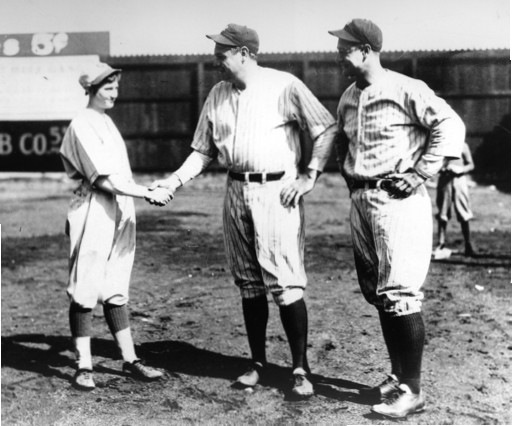
Jackie Mitchell with Babe Ruth and Lou Gehrig. (National Baseball Hall of Fame Library).
On April 2, 1931 history was made in Chattanooga, Tennessee. That same day a mystery was also born. Seventeen-year-old Jackie Mitchell took the mound against the New York Yankees, striking out Babe Ruth and Lou Gehrig before walking Tony Lazzeri. Mitchell placed her name in the record books with the strikeouts but also became part of an ongoing debate and mystery regarding the circumstances surrounding the game. Who was Jackie Mitchell? Where did she come from? Did she really strike out the Yankee stars or was it all a publicity hoax?
Born Virne Beatrice Mitchell on August 29, 1913, Mitchell grew up in Memphis, Tennessee. Her mother sold hosiery and her father was an optician. Mitchell was encouraged by her father to take part in sports. Growing up, she played basketball, tennis, and baseball, and swam. As a youngster Mitchell supposedly learned to pitch from one of the family’s neighbors, Dazzy Vance. She later told reporters that Vance taught her a drop ball, or sinker. Vance had pitched for the Dodgers, winning the National League MVP in 1924. When she was a teenager, Mitchell’s family moved to Chattanooga. Mitchell joined a local baseball school and it was here that the new president of the Chattanooga Lookouts saw her pitching.
Joe Engel signed on as the new president of the Lookouts in 1929 and in 1931 he followed a common practice of minor-league teams arranging exhibition games with major-league clubs. The New York Yankees were returning north after spring training in 1931 and Engel was able to sign a contract for two exhibition games. Shortly after setting up these games, Engel signed Mitchell to a contract, announcing that she would pitch in one of the games. And here is where the real debate begins. Did Engel sign Mitchell for real or was she just a publicity stunt? It was the heart of the Great Depression and teams everywhere were adding special events and exhibitions to make money. Signing Mitchell could certainly be seen in that light.
When Mitchell signed her contract, she became only the second woman to sign an Organized Baseball contract. The first was Lizzie Arlington, who signed to play with the Reading Coal Heavers in 1898. Female baseball players on men’s teams were not a common sight. Most women playing baseball were part of the bloomer teams that barnstormed the country from the 1910s through the 1930s. Engel would have certainly seen the opportunity to bring in fans to watch Mitchell pitch, especially against the Yankees. About 4,000 fans were reported in the stands to watch Mitchell get a chance to pitch against Babe Ruth.
Engel had a reputation for pulling off crazy stunts, so the strikeouts could have been staged. Engel raffled off a house to a fan and traded a shortstop for a turkey. He then cooked the turkey and served it to the local reporters. He later sold “stock” to fans to save the ballclub from being sold. He held an elephant hunt in the outfield before a game, offering fans the chance to hunt some papier-mache animals. Engel’s willingness to try just about anything to generate publicity has led many researchers and fans to believe the strikeouts were staged. An added fact was that the game was originally supposed to take place on April 1 but was postponed due to cold. The exhibition could have been an April Fool’s Day joke.1
So what actually took place on April 2, 1931? The Lookouts started Clyde Barfoot against the Yankees but Barfoot never got past the first two batters. He gave up a leadoff double and then a single before Engel called Mitchell in to the game. Mitchell entered the game as a 17-year-old southpaw preparing to pitch to the Sultan of Swat, Babe Ruth. Prior to the game, publicity photos were taken of Mitchell with Ruth and Gehrig. The photos showed a slight young girl in an oversized uniform with a grin on her face and Ruth and Gehrig looking more solemn. They even had her take out a mirror and powder her nose.2
After throwing a few warm-up pitches, Mitchell threw two pitches that Ruth swung at and missed. She followed that with a called third strike. Ruth threw his bat in disgust and stormed back to the dugout. Some stories at the time claimed he turned and smiled before he left the field, adding to the idea that the whole thing was staged. Next up was Lou Gehrig and Mitchell struck him out with three pitches as well. She then walked Tony Lazzeri and Engel took her out of the game in favor of bringing back Barfoot. The Lookouts went on to lose, 14-4, making the game less than memorable except for Mitchell’s pitching. A few days after the game, Mitchell’s contract was voided but she did not leave baseball. She continued to pitch for another Engel team, the Junior Lookouts. After barnstorming the rest of the 1931 season and some of 1932, Mitchell signed with the well-known bearded House of David nine. She was promoted as the famous girl pitcher. After playing with the House of David on and off for a few years, Mitchell retired from baseball in 1937 and went to work for her father. She claimed until the day she died in 1987 that the strikeouts were legitimate. Her own claims added to the debate.3
Other ideas that have been proposed to support the legitimacy of the strikeouts include her pitching itself but also Ruth and Gehrig. There were two runners on base when Ruth came up; would he have deliberately struck out to leave the runners stranded? Ruth hit a lot of home runs but he also struck out a great deal, making it believable that Mitchell could have struck him out. Add to that Gehrig’s strikeout, which many believed he would never have agreed to stage. Teammate Lefty Gomez stated in an interview that Yankee manager Joe McCarthy was too competitive to ever stage such strikeouts. Then there was Mitchell herself. She was a southpaw pitcher who had a good sinker/curveball-style pitch. She was also someone they had never faced before. Often pitchers do well the first time they face new hitters but not so much the second time around. She never faced them again since she was taken out of the game.4
Please open the link to finish reading the article.
Missouri lawmakers have banned educators from leaning on a model of reading instruction called the “three-cueing” method as part of a bipartisan education package signed by Gov. Mike Kehoe on Wednesday.
The so-called “science of reading” continues to win converts. The Missouri Legislature recently banned the use of “three cueing,” which is an essential element of Balanced Literacy. Just as “Whole Language” swept the country in the 1990s, just as “Whole Language” was replaced by “Balanced Literacy,” several state legislatures are now certain that “the science of reading” is the key to their state’s educational revival.
The law mandates that three cueing, which teaches students to read using context clues, can be used to supplement lessons, but phonics should be the majority of instruction.
State Rep. Ed Lewis, a Moberly Republican and sponsor of the legislation, told The Independent that the law builds on prior legislative efforts and work from the Missouri Department of Elementary and Secondary Education.
“We’ve come to the realization that phonics is crucial,” Lewis said. “The three cueing system, when used as the primary source, evidence shows a decrease in the amount of learning that occurs, and for that reason, we want to use it less.”
Three cueing is widely criticized for encouraging kids to make guesses when reading and doesn’t show how to sound out words, which is important for understanding complicated texts.
Missouri isn’t the only state to ban three cueing. By the end of 2024, at least 11 states had explicitly banned the method.
My own view is that legislatures are unqualified to tell teachers how to teach.
Heather Cox Richardson sums up recent chaos in the Trump administration and recognizes that its business as usual. Most egregious is the deference paid to Trump by the reactionary majority on the Supreme Court and the frightened Republicans in Congress. The members of Congress are afraid that Trump will endorse their opponent in the next Republican primary. The Justices have lifetime tenure; they have no excuse for rubber-stamping unconstitutional actions.
Richardson writes:
Without any explanation, the right-wing majority on the Supreme Court yesterday granted a stay on a lower court’s order that the Trump administration could not gut the Department of Education while the issue is in the courts. The majority thus throws the weight of the Supreme Court behind the ability of the Trump administration to get rid of departments established by Congress—a power the Supreme Court denied when President Richard M. Nixon tried it in 1973.
This is a major expansion of presidential power, permitting the president to disregard laws Congress has passed, despite the Constitution’s clear assignment of lawmaking power to Congress alone.
President Donald J. Trump has vowed to eliminate the Department of Education because he claims it pushes “woke” ideology on America’s schoolchildren and that its employees “hate our children.” Running for office, he promised to “return” education to the states. In fact, the Education Department has never set curriculum; it disburses funds for high-poverty schools and educating students with disabilities. It’s also in charge of prohibiting discrimination on the basis of race and sex in schools that get federal funding.
Trump’s secretary of education, professional wrestling promoter Linda McMahon, supports Trump’s plan to dismantle the department. In March the department announced it would lay off 1,378 employees—about half the department. Nineteen states and the District of Columbia sued to stop the layoffs, and Massachusetts federal judge Myong Joun ordered the department to reinstate the fired workers. The Supreme Court has now put that order on hold, permitting the layoffs to go forward.
Justices Ketanji Brown Jackson and Elena Kagan concurred in a dissent written by Justice Sonia Sotomayor, noting that Trump has claimed power to destroy the congressionally established department “by executive fiat” and chastising the right-wing majority for enabling him. “When the Executive publicly announces its intent to break the law, and then executes on that promise, it is the Judiciary’s duty to check that lawlessness, not expedite it,” they say.
“The President must take care that the laws are faithfully executed, not set out to dismantle them. That basic rule undergirds our Constitution’s separation of powers. Yet today, the majority rewards clear defiance of that core principle with emergency relief.”
Another Trump power grab is before Congress today as the Senate considers what are called “rescissions.” These are a request from the White House for Congress to approve $9.4 billion in cuts it has made in spending that Congress approved. By law, the president cannot decide not to spend money Congress has appropriated, although officials in the Trump administration did so as soon as they took office. Passing this rescission package would put Congress’s stamp of approval on those cuts, even though they change what Congress originally agreed to.
Those cuts include ending federal support for the Corporation for Public Broadcasting, which helps to fund National Public Radio (NPR), the Public Broadcasting Service (PBS), and local stations. The Trump administration says NPR and PBS “fuel…partisanship and left-wing propaganda.”
Congress must approve the request by Friday, or the monies will be spent as the laws originally established. The House has already passed the package, but senators are unhappy that the White House has not actually specified what will be cut. Senators will be talking to the director of the Office of Management and Budget, Russell Vought—a key architect of Project 2025—today in a closed-door session in hopes of getting more information.
In June, Vought told CNN that this package is just “the first of many rescissions bills” and that if Congress won’t pass them, the administration will hold back funds under what’s called “impoundment,” although Congress explicitly outlawed that process in the 1974 Impoundment Control Act.
“We still are lacking the level of detail that is needed to make the right decisions,” Senator Susan Collins (R-ME), the chair of the Senate Appropriations Committee, said. “It’s extremely unusual for any senator to not be able to get that kind of detailed information.”
Andrew Goudsward of Reuters reported yesterday that nearly two thirds of the lawyers in the unit of the Department of Justice whose job was to defend Trump administration policies have quit. “Many of these people came to work at Federal Programs to defend aspects of our constitutional system,” one lawyer who left the unit told Goudsward. “How could they participate in the project of tearing it down?”
As the Supreme Court strengthens the office of the presidency without explaining the constitutional basis for its decisions, who is actually running the government is a very real question.
A week ago, Jason Zengerle of the New York Times suggested that the real power in the Oval Office is deputy White House chief of staff Stephen Miller, who is driving the administration’s focus on attacking immigrants. Secretary of Homeland Security Kristi Noem defers to Miller, a Trump advisor told Zengerle. Attorney General Pam Bondi is focused on appearing on the Fox News Channel and so has essentially given Miller control over the Department of Justice. White House chief of staff Susie Wiles is “producing a reality TV show every day” and doesn’t care about policy.
On the same day Zengerle was writing about domestic policy decisions, Tom Nichols of The Atlantic was making a similar observation about international policy. He notes that Trump has only a fleeting interest in foreign policy, abandoning issues he thinks are losing ones for others to handle. Secretary of Defense Pete Hegseth keeps talking about “lethality” and trans people but doesn’t seem to know policy at all. Secretary of State Marco Rubio—who is also the national security advisor—appears to have little power in the White House.
Apparently, Nichols writes, American defense policy is in the hands of Elbridge Colby, the undersecretary of defense for policy, who made the decision to withhold weapons from Ukraine and who ordered a review of the U.S. defense pact with the United Kingdom and Australia in an attempt to put pressure on Australia to spend more on defense.
“In this administration,” Nichols writes, “the principals are either incompetent or detached from most of the policy making, and so decisions are being made at lower levels without much guidance from above.” This is a common system in authoritarian regimes, Nichols notes, “where the top levels of government tackle the one or two big things the leader wants done and everything else tumbles down to other functionaries, who can then drive certain issues according to their own preferences (which seems to be what Colby is doing), or who will do just enough to stay under the boss’s radar and out of trouble (which seems to be what most other Trump appointees are doing). In such a system, no one is really in charge except Trump—which means that on most days, and regarding many issues, no one is in charge.”
Either that chaos or deliberate evil is behind the Trump administration’s recent order to burn nearly 500 metric tons of emergency high-nutrition biscuits that could feed about 1.5 million children for a week. As Hana Kiros reported in The Atlantic, the U.S. Agency for International Development (USAID) spent about $800,000 on the food during the Biden administration for distribution to children in Afghanistan and Pakistan. It was in storage in the United Arab Emirates when the Trump administration gutted USAID. Still, Secretary of State Marco Rubio assured the House Appropriations Committee that the food would get to the children before it spoiled.
But the order to burn the biscuits had already been sent out because, the State Department said, providing food to Afghanistan might benefit terrorists (there was no stated reason for destroying food destined for Pakistan, or suggestion that the food could go to another country). Now the food has passed its safe use date and cannot even be repurposed as animal feed. Destroying it will cost the U.S. taxpayers $130,000.
What the administration does appear to be focused on is regaining control of the political narrative that has slipped away from it. Today, after news broke that inflation is creeping back up as Trump’s tariffs take effect, Trump posted on social media alleging that Senator Adam Schiff (D-CA), who managed one of the impeachment cases against Trump, had committed mortgage fraud and must be brought to justice.
But so far, nothing appears to be working to distract MAGA from the Epstein files. As David Gilbert of Wired noted today, MAGA supporters were angry over a number of things already. Former Fox News Channel host Tucker Carlson hated the bombing of Iran; others hated Trump’s accepting a luxury plane from Qatar. Podcaster Ben Shapiro objected to Trump’s tariffs, and podcaster Joe Rogan has turned against Trump over the targeting of migrants who have not been even accused of crimes. Billionaire Elon Musk turned against Trump over the debt incurred under the new budget reconciliation law Trump called the One Big, Beautiful Bill.
The Epstein files appear to be one bridge too many for MAGA to cross. The administration tried to stop discussion of Epstein, and for a while the effort seemed to catch: by noon yesterday, the Fox News Channel had mentioned Epstein zero times but had mentioned former president Joe Biden 46 times. Today all but one Republican House member voted against a Democratic measure to require the release of the Epstein files. But Chicago journalist Marc Jacob noticed this afternoon that while the Fox News website didn’t mention Epstein in its top 100 stories today, “[t]he top 3 stories on the New York Times website, the top 2 stories on the Washington Post site and the top story on the CNN site are about Jeffrey Epstein.”
And then, this afternoon, Dhruv Mehrotra of Wired noted that the video from a camera near Epstein’s prison cell that the Department of Justice released as “raw” footage had approximately 2 minutes and 53 seconds cut out of it.
Journalist Garrett M. Graff, a former editor of Politico, commented: “Okay, I am not generally a conspiracist, but c’mon DOJ, you are making it really hard to believe that you’re releasing the real full evidence on Epstein….”

 Diane Ravitch's blog