Two scholars–Kimberlé Crenshaw and Jason Stanley–explain why Trump is censoring exhibits at the Smithsonian. He has also imposed censorship of signage and exhibits at other federal sites, including national parks. He has enlisted the U.S. Department of Educatuon to organize rightwing groups to create a “patriotic” civics course.

  • Kimberlé Crenshaw is an American civil rights advocate and a scholar of critical race theory. She is a professor at the UCLA School of Law and Columbia Law School, where she specializes in race and gender issues
  • Jason Stanley is the Bissell-Heyd Chair in American Studies in the Munk School of Global Affairs & Public Policy at the University of Toronto and the author of Erasing History: How Fascists Rewrite the Past to Control the Future

Trump and his far-right cabal are l trying to revise history and memory. Unless he abolishes or rigs future elections, all this tinhorn fascist censorship will be swept away by his successors. He will rightly be judged, when that day comes, as the closest thing this country has ever seen to having a dictator. He will be portrayed in the Smithsonian and the textbooks as a buffoon and a tyrant.

This article appeared in The Guardian. Please open the link to read the entire article.

Crenshaw and Stanley write:

In a letter sent to Smithsonian secretary, Lonnie G Bunch III, on 12 August, the Trump administration announced its plan to replace all Smithsonian exhibits deemed as “divisive” or “ideological” with descriptions deemed as “historical” and “constructive”. On 21 August, just nine days later, the White House published a list of said offending fixtures – the majority of which include exhibits, programming and artwork that highlight the Black, Latino and LGBTQ+ perspectives on the American project. Included in his bill of particulars was an exhibit that rightly depicts Benjamin Franklin as an enslaver, an art installation that acknowledges race as a social construct and a display that highlights racist voter suppression measures, among others.

The assault on the Smithsonian comes wrapped, as it were, as part of a broader attack on democracy, scenes of which we see playing out every day. The federal occupation of Washington DC, the crackdown on free speech on campus, the targeting of Trump’s political opponents, the gerrymandering of democracy – these are interwoven elements of the same structural assault. So with many fires burning across the nation, concerned citizens who are answering the call to fight the destruction of democracy may regard his attack on history and memory as a mere skirmish, a distraction from the herculean struggle against fascism unfolding in the US. But this is a mistake. Trump’s attack on American museums, education and memory, along with his weaponization of racialized resentment to package his authoritarian sympathies as mere patriotism, is a critical dimension of his fascist aims. The fight for democracy cannot avoid it, nor its racial conditions of possibility.

Fascism always has a central cultural component, because it relies on the construction of a mythic past. The mythic past is central to fascism because it enables and empowers a sense of grievance by a dominant racial or ethnic group whose consent is crucial to the sustainability of the project. In Maga world, the mythic past was pure, innocent and unsullied by women or Black leaders. In this kind of politics, the nation was once great, a byproduct of the great achievements of the men in the dominant racial group. In short, the assault on the Smithsonian and, more broadly, against truthful history and critical reflection is part of the broader fascist attack on democracy.

From this vantage point, racial equality is a threat to the story of the nation’s greatness because only the men of the dominant group can be great. To represent the nation’s founding figures as flawed, as any accurate history would do, is perceived, in this politics, as a kind of treason.

The success of the fascist dismantling of democracy is predicated on the widespread systematic failure to see the larger picture. The anti-woke assault that is a key pillar of Trumpism is part of that failure, partly due to the racial blinders and enduring ambivalence of too many in positions of leadership in the media and elsewhere. Those who sign on to the attack on “wokeness” but regard themselves as opponents of the other elements of the fascist assault are under the mistaken assumption that these projects can be disaggregated. In fact, the dismantling of democracy and of racial justice are symbiotically entangled. To support one is to give cover for the others.

It is no coincidence that this ‘proper’ ideology Trump exposes is constitutive of a more well-known strand of fascism – nazism

It is clear that the Trump administration understands this relationship and fully weaponizes racist appeals as a foundational piece of its fascist agenda. And if this was once the quiet part, it is now pronounced out loud in official government documents. In an executive order issued on 27 March 2025 titled “Restoring Truth and Sanity to American History”, Trump reveals that his mandate to ban “improper ideologies” targets core commitments repudiating a scientific racism that historically naturalized racial hierarchy thereby neutralizing resistance. According to Trump, the problem with the Smithsonian American Art Museum’s exhibit The Shape of Power: Stories of Race and American Sculpture was that it promoted the idea that “race is a human invention”.

The understanding that race is a social construct as opposed to a biological fact is perhaps the most fundamental advance in repudiating enslavement, genocide and segregation. Rejecting the idea that racial inequality is natural or pre-ordained – a claim that grounded enslavement and dispossession in America – forms the cornerstone of the modern commitment to a fully inclusive democracy. Trump’s declaration that this cornerstone is “improper” is an effort to turn the clock back, upending the entire American postwar project. It is no coincidence that this “proper” ideology Trump exposes is constitutive of a more well-known strand of fascism – nazism. How else can we understand why Maya Angelou was purged from the Naval Academy library while Adolf Hitler remains?

The fight against fascism in the US must be as robust in its embrace of racial equality as Trump’s embrace of outdated ideas about race and racism. The defense of memory, of truthful history, of telling the whole American story rather than ascribing agency in history to the deeds of “great men” is vital to the American democratic project. A pro-democratic education fosters the agency of its citizens by teaching about social movements that overturned entrenched hierarchies which blocked democratic equality and imposed racial tyranny. The story of how ordinary Americans lived and struggled and remade America is essential knowledge in developing and sustaining a multiracial democracy. The Smithsonian has been a vital institution in making this knowledge accessible to the masses. The National Museum of the American Latino and the National Museum of the American Indian, for example, provide artifacts and perspectives about the nation’s westward expansion that challenge the myth of unoccupied territory and manifest destiny. The National Museum of African American History and Culture brings forward the global scale of enslavement as well as its infusion across national institutions, culture and politics.

Someday, somehow, there will be another President of the United States, and his name won’t be Trump. That future President might well be a Democrat. That President might be in a position to exercise unchecked power, thanks to the acquiescence of the current Congress and Supreme Court, which are allowing Trump to exercise the powers of a dictator. The second and third branches of our government have willingly wiped out the separation of powers and ceded their authority to the President.

Congress has voted to give its power of the purse to King Donald. The Supreme Court (the Supine Court) has stood aside and approved of whatever the King wants, regardless of precedent. Justice Thomas said recently that precedent was irrelevant; he is no longer an originalist.

Now comes what might be considered the most important question. May the President send in troops–either the state’s National Guard, the National Guard of other states, or even the regular military–to cities that he believes need to be suppressed?

A Trump-appointed federal judge ruled that he could not. Justice Karin Immergut, appointed by Trump, ruled that Trump could not send troops to Portland, because it is not “war-ravaged,” as he claimed, or in a state of rebellion. In other words, you can’t just make sh-t up to do whatever you want, even if you are the President.

Constitutional lawyer Steve Vladeck, a scholar at the Georgetown University Law Center, noted that Trump’s advisors are claiming that the President doesn’t need approval of the courts before using the troops on American soil. He explains here why the President can’t ignore the judiciary.

Welcome back to “One First,” an (increasingly frequent) newsletter that aims to make the U.S. Supreme Court more accessible to all of us. If you’re not already a subscriber, I hope you’ll consider becoming one (and, if you already are, I hope you’ll consider upgrading to a paid subscription if your circumstances permit):

I wanted to put out a quick issue this morning in light of Judge Karin Immergut’s remarkable ruling yesterday, granting a temporary restraining order against President Trump’s federalization of members of the Oregon National Guard to quell the “violence” in “war-ravaged Portland.” That ruling has prompted a slew of claims this morning from the President’s advisers and outside supporters that federal courts, in general, lack the power to halt domestic deployments of the military.

Before this claim makes it too far, it seems worth helping to educate folks about a key early precedent that, in my view, cuts entirely in the other direction—and that provides powerful evidence, to those who care about such things, that the Founding-era understanding not only tolerated a robust judicial role in such cases, but, for a time, actually required one. That’s not to say Judge Immergut’s specific analysis in this case is correct (although I’m sympathetic); it’s to say that there is nothing categorically inappropriate about federal courts reviewing—and, where necessary, halting—domestic uses of the military while they are ongoing. Indeed, it would be striking if it were otherwise.

***

The modern-day Insurrection Act traces its lineage all the way back to a statute Congress enacted on May 2, 1792—which has often been referred to as the Calling Forth Act or First Militia Act. That statute was designed to carry into effect the Constitution’s grant of power to Congress, in Article I, Section 8, Clause 15, “[t]o provide for calling forth the Militia to execute the Laws of the Union, suppress Insurrections and repel Invasions.” 

The idea was that Congress would identify the circumstances in which military power could be used domestically—and would thence delegate that power to the President. As Justice (Robert) Jackson would remind us in his concurring opinion in Youngstown, the Clause’s “limitation on the command power, written at a time when the militia rather than a standing army was contemplated as the military weapon of the Republic, underscores the Constitution’s policy that Congress, not the Executive, should control utilization of the war power as an instrument of domestic policy.”

But how, exactly, should that delegation work? This question was the subject of a rich debate in the Second Congress—one that culminated with the 1792 statute. I’ve summarized that debate elsewhere; for present purposes, the key point is that Congress’s principal concern was not with the last two circumstances in which it was to delegate power to the President (“to suppress Insurrections and repel Invasions”), but with the first circumstance (“to execute the Laws of the Union”). And the way Congress addressed its concerns was to delegate the authority to use the military, but with meaningful procedural checks. 

Here’s the full text of section 2 of the act, image first; block quote second, with the key provisions highlighted:

[W]henever the laws of the United States shall be opposed, or the execution thereof obstructed, in any state, by combinations too powerful to be suppressed by the ordinary course of judicial proceedings, or by the powers vested in the marshals by this act, the same being notified to the President of the United States, by an associate justice or the district judge, it shall be lawful for the President of the United States to call forth the militia of such state to suppress such combinations, and to cause the laws to be duly executed. And if the militia of a state, where such combinations may happen, shall refuse, or be insufficient to suppress the same, it shall be lawful for the President, if the legislature of the United States be not in session, to call forth and employ such numbers of the militia of any other state or states most convenient thereto, as may be necessary, and the use of militia, so to be called forth, may be continued, if necessary, until the expiration of thirty days after the commencement of the ensuing session.

In other words, unlike section 1 (which dealt with insurrections and invasions), section 2 imposed two procedural requirements on domestic use of the military to carry out the laws of the union: a district judge or Supreme Court justice had to make the requisite factual findings before the President could do anything;¹ and, if out-of-state militia were used, there was a baked-in sunset.

Even though the Congress that enacted the 1792 act was full of folks who were either at the Constitutional Convention (and helped to draft that document) or who were central in the ratification debates, my research found no evidence that members made constitutional objections to the judicial review that section 2 required. And President Washington, in putting down the Whiskey Rebellion two years later, followed the statute’s mandates to the letter—obtaining the requisite judicial determination from Supreme Court Justice James Wilson (one of the six people to sign both the Declaration of Independence and the Constitution) before he sent troops to Western Pennsylvania to restore order.

The 1792 act was written as a temporary experiment. Congress decided to delegate comparable authority on a permanent basis in 1795—and, alas, removed the ex ante judicial review requirement. But there was no suggestion at the time, and I’m unaware of any since, that the provision was eliminated for constitutional reasons—as opposed to Congress’s broader (if, alas, myopic) view that the checks weren’t needed in light of how responsibly President Washington had behaved during the Whiskey Rebellion.

Thus, although there are later examples of courts issuing injunctions against domestic uses of the military (Youngstown itself stands out as a fairly prominent example), the relevant point for present purposes is that there was no Founding-era aversion to a robust judicial role in these cases. The first statute Congress ever enacted on the subject required such a role, and there was no contemporaneous suggestion that the Constitution forbade it.

I am, as regular readers of this newsletter likely know, no great fan of “originalism” as a conclusive methodological approach to constitutional interpretation. Thus, the way that I tend to think about these things, the existence of the judicial review provision in the Calling Forth Act of 1792 is useful evidence of how the Constitution was understood at the time, but nothing more. Rather, the argument for judicial review being available to halt, where necessary, unlawful domestic uses of the military rests on a lot more, in my view, than what some folks believed more than 230 years ago.

But for those who ascribe to the view that we are, today, bound by how the Constitution was understood then, I do not see how one can reconcile the 1792 precedent with any claim that prospective judicial review is categorically precluded when it comes to domestic use of the military. And given current and recent events, such review, if anything, seems more important than ever—whatever its outcome.

I hope you are signed on to Instagram. This is a commentary you should hear.

And this is a TikTok you should see to understand how quickly women’s rights can disappear.

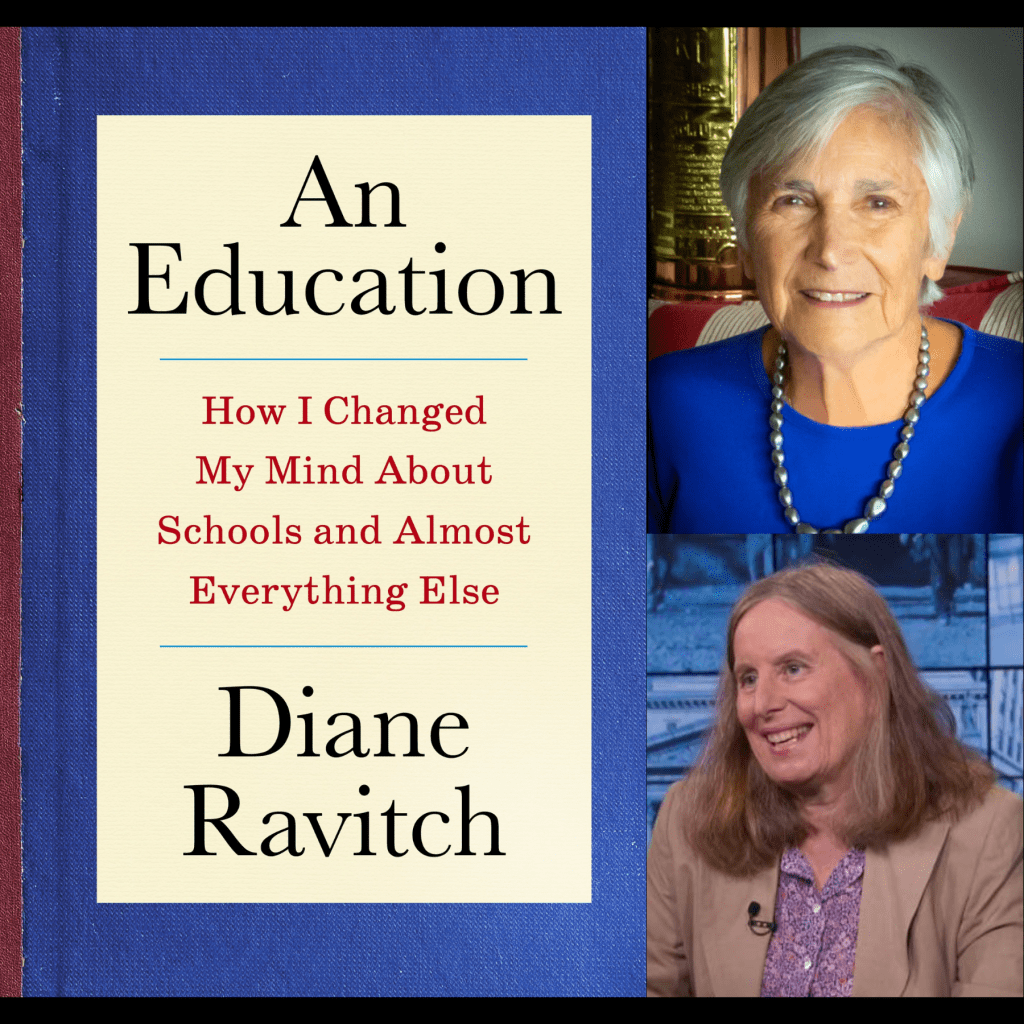
Veteran journalist Eleanor Bader published the very first review of my new book!

It’s a great review!

The official publication date is October 20, but books are now in print and available.

My first appearance to talk about the book will be in my home town: Brooklyn, New York, on October 21 at 6 pm at the Brooklyn Heights branch of the Brooklyn Public Library.

I will have a conversation with the brilliant Leonie Haimson, leader of Class Size Matters.

I’m not traveling to promote the book, but I am doing Zooms. I will be speaking to educators in North Carolina on October 22. To learn more about it, contact Yevonne Brannon of Public Schools First NC at ybrannon@gmail.com.

There were many things wrong with Pete Hegseth’s condescending speech to the nation’s military leaders. He some about fitness and facial hair.

Hegseth wants to fire members of the military who are fat. Can he fire the Commander-in-chief?

Pete spoke about fitness but he is not a great example.

Then, Hegseth said the days of facial hair are over. But currently the military has exemptions for men whose religion requires that they have beards.

Jeff Schogol of Task & Purpose reported:

Wearing beards is a core religious tenet of some faiths, which has prompted the military to grant religious accommodations to SikhMuslimChristian, and Norse Pagan service members for over a decade.

But those days may be ending.

This week’s overhaul of military grooming standards has raised fears of a coming crackdown on religious waivers for growing beards.

“Today at my direction, the era of unprofessional appearance is over,” Defense Secretary Pete Hegseth announced on Tuesday.“No more beardos. The age of rampant and ridiculous shaving profiles is done.”

Shaving and beards were central topics in a speech Hegseth gave to hundreds of generals and admirals at Quantico, Virginia on Tuesday. Along with amplifying an earlier directive that troops with medical waivers for shaving could face separation, Hegseth indicated that he may be skeptical about at least some religious waivers that service members have received to wear beards.

At the Pentagon, Hegseth has permitted evangelical Christian prayer services. The first one was led by the pastor from Hegseth’s own church in Tennessee.

Military.com noted this exceptional event authorized by Hegseth.

In a move that pushes the boundaries of Constitutional prohibition against a state religion, Defense Secretary Pete Hegseth hosted an evangelical prayer service in the middle of the day at the Pentagon in which a pastor praised President Donald Trump as “sovereignly appointed.”

A program for the event called it the “Secretary of Defense Christian Prayer and Worship Service.” It was held at the Pentagon’s auditorium and was broadcast throughout the building on its internal cable network.

The Constitution contains several phrases prohibiting state entanglement with religion but it says nothing about facial hair in the military. U.S. General Ulysses S. Grant had a large beard, as did Confederate General Robert E. Lee.

Now if only Secretary of Education would follow Hegseth’s lead and bar public funding of all religious schools.

Since almost the whole bunch of them are religious fanatics, that’s too much to hope for. Trump is an exception. He pretends to be a religious fanatic. He is merely transactional.

Nikole Hannah-Jones has had her share of controversy. Born in Iowa to a mixed-race couple, she attended desegregated public schools, graduated from Notre Dame and received a masters in journalism from the University of North Carolina. In her career as an investigative journalist, she covered education, civil rights, and healthcare. She worked at newspapers in North Carolina and Oregon, then for ProPublica. In 2015, she joined the staff of The New York Times.

In 2019, The Times published The 1619 Project, a group of essays that Hannah-Jones assembled, to commemorate the arrival of the first Blacks to the land that would later become the USA. In the lead essay, which Hannah-Jones wrote, she maintained that the arrival of that ship bringing enslaved Blacks marked the true origin of the nation. She recast the history of the U.S. from a Black perspective. Some historians criticized aspects of her thesis, others defended it.

The 1619 Project was widely celebrated and widely condemned, even banned. Trump responded by creating a 1776 Commission, whose purpose was to celebrate US history patriotically (that is, to leave out the shameful parts).

Hannah-Jones won the Pulitzer Prize for The 1619 Project in 2020.

In 2021, the UNC-Chapel Hill’s Hussman School of Journalism and Media announced that Hannah-Jones would join the Hussman faculty as Knight Chair in Race and Investigative Journalism. The faculty and administration urged the UNC Board to give her tenure, as was customary with previous holders of the chair. However, the Board of the university refused to take action on this tenure recommendation. After a public uproar, the board of trustees offered her tenure, but Hannah-Jones rejected the offer, choosing instead to accept the offer of a chair at Howard University.

She wrote in the New York Times about the mainstreaming of Charlie Kirk’s bigoted views after his tragic assassination. This is an except from her excellent commentary.

Last year, The Washington Examiner, a conservative news outlet, published a column calling the organization Kirk co-founded, Turning Point USA, “one of the most destructive forces in Republican politics.” It said that “a healthy conservative movement cannot tolerate conspiracy theorists being presented as serious political figures” and called the organization’s leadership “toxic.” But the period since Kirk’s death has revealed a deeply unsettling cultural shift. Eight months into President Trump’s second term, it is clear that Kirk’s ideas are no longer considered on the extremist periphery but are embraced by Republican leadership.

The mainstreaming of Charlie Kirk demonstrates that espousing open and explicit bigotry no longer relegates one to the fringe of political discourse.

When Representative Jasmine Crockett, Democrat of Texas, bemoaned that only two of the 58 Democrats who refused to sign the resolution honoring Kirk were white, Laura Loomer responded on X by railing against “ghetto Black bitches who hate America serving in Congress.” Loomer is not merely some right-wing provocateur. She has the ear of the president of the United States and understood that such an explicitly racist comment in 2025 America would bring no political consequence.

And while Trump has surrounded himself with people who have said racist things and maintained ties to white and Christian nationalists, the number of Democrats and esteemed American institutions that have engaged in the mainstreaming of Charlie Kirk demonstrates that espousing open and explicit bigotry no longer relegates one to the fringe of political discourse, a phenomenon we have not witnessed since the civil rights era.

In some parts of polite society, it now holds that if many of Kirk’s views were repugnant, his willingness to calmly argue about them and his insistence that people hash out their disagreements through discourse at a time of such division made him a free-speech advocate, and an exemplar of how we should engage politically across difference. But for those who were directly targeted by Kirk’s rhetoric, this thinking seems to place the civility of Kirk’s style of argument over the incivility of what he argued. Through gossamer tributes, Kirk’s cruel condemnation of transgender people and his racist throwback views about Black Americans were no longer anathema but instead are being treated as just another political view to be respectfully debated — like a position on tax rates or health care policy.

Using Kirk’s knack for vigorous argument to excuse the re-emergence of unabashed bigotry in mainstream politics feels both frightening and perilous. 

As the Trump administration wages the broadest attack on civil rights in a century, and the shared societal values of multiculturalism and tolerance recede, using Kirk’s knack for vigorous argument to excuse the re-emergence of unabashed bigotry in mainstream politics feels both frightening and perilous. Kirk certainly produced viral moments by showing up on college campuses and inviting students a decade his junior to “prove” him wrong about a range of controversial topics such as Black crime rates and the pitfalls of feminism. But his rise to fame was predicated on the organization for which he served as executive director, Turning Point USA, and its Professor Watchlist. The website invited college students not to engage in robust discussions with others with different ideologies, but to report professors who “advance leftist propaganda in the classroom.”

The site includes photos of professors, along with often highly misleading summaries of the thought crimes that landed them on the list. It provides the telephone numbers of the universities that employ them for students and parents to register their complaints. While the site claims the organization supports free speech, many professors have recounted enduring campaigns of harassment after being put on the list. (I was placed on it in 2021 because of my work on the 1619 Project, after it was announced that I would be a professor at Howard University.)

A couple of years ago, Angel Jones, now a professor at a university in Maryland whose work focuses on educational inequality, joined the hundreds of professors across the country who found themselves on the list.

Jones landed on it under the tag “racial ideology” when she published an article citing research about how distressing it is for Black people to go to work after witnessing news coverage of police killings. She told me someone had sent her a picture of a house thought to be hers, but it turned out to belong to another Angel Jones. Someone else had threatened to hang her from a tree and burn her alive. The scholar changed her classroom and removed her name plate from her office door. The university where she was working at the time installed a safety alarm button under her desk.

“I would cry. I was very fearful. I was anxious,” Jones told me. “I was afraid to go to class sometimes. I was just scared all of the time.

“I love teaching — it makes my heart go pitter patter — so to be in a space where I am afraid of my students, like that rocks me in a way I can’t even articulate,” she added.

When Jones learned of Kirk’s killing, she remembers that there was a sense of disbelief shared by many Americans who were shocked by the gruesome video. But soon, that disbelief was replaced by another feeling. In the immediate hours after his death, she watched as pundits and politicians eulogized Kirk as that rare example of someone who practiced a willingness to hear opposing ideas because he saw it as the salve for political violence. After all she’d gone through, and the stories she’d heard of other professors similarly harassed, the tributes pouring in for Kirk both infuriated and saddened her.

The next day, Jones went to the class she taught on misinformation and disinformation and showed her students a short Instagram video she had made in response. In the video, she says that while she does not celebrate Kirk’s death, she also refuses to mourn him. “I cannot have empathy for him losing his life when he put mine at risk and the lives of so many other educators just because we dared to advocate for social justice,” she says in the video, “because we dared to do our jobs.”

After she showed the video, a white male student in her class asked Jones if she thought her lack of empathy for Kirk might radicalize students. After a short, tense exchange, the student took his backpack and left. Jones said it had made her nervous. There’s a Turning Point USA chapter on her campus, and Kirk’s followers and even some politicians had been posting about revenge on social media. Jones switched her classes to virtual for the week.

The past few weeks have filled Ash Lazarus Orr with a similar sense of foreboding. Orr has been at the forefront of resisting efforts to target transgender Americans, including as a plaintiff in a federal lawsuit brought by the A.C.L.U. against a Trump administration policy that would prevent transgender people from having their chosen gender on their passports.

While Orr was never named by Kirk, they say Kirk’s rhetoric helped fuel an environment that makes transgender Americans vulnerable to violence and that has paved the way for the removal of their civil rights; in February, Iowa became the first state in the country to take away legal civil rights protections for transgender residents.

“I firmly believe that no one should be killed for their beliefs, no matter how harmful those beliefs might be,” Orr told me. “But we are watching our rights being stripped away. We are having our friends’ lives cut short, and then we are told to stay quiet while those responsible are celebrated.”

In just a few short years, Orr has watched as the momentum toward recognizing the full humanity and rights of transgender people has collapsed. Orr recently left their home state of West Virginia, finding it no longer safe after being threatened and assaulted.

Kirk’s rhetoric of “Christian white nationalism, anti-transgender, quote anti-woke culture-war framing, this isn’t on the edge anymore,” Orr told me. “It has moved into what many consider the center of Republican identity.” They said they were deeply concerned about how few people seemed willing to point out the consequences of this shift: “Who is actually fighting for us?”

Robin D.G. Kelley, a historian at U.C.L.A. whose scholarship on racial injustice also landed him on the Professor Watchlist, is struck by how rapidly our society has changed since Trump took office a second time.

Kelley pointed to the fact that Trump was widely condemned during his first term when he called the white supremacists who rallied in Charlottesville, Va., “very fine people.” Now, Democrats and political centrists were lining up to honor a man who promoted the same Great Replacement Theory that served as the rallying cry for that march. At a time when the president of the United States is using his power to go after diversity efforts and engaging in a mass deportation project, some progressives are arguing that people of color, immigrants and members of other marginalized groups who felt dehumanized by Kirk’s commentary, podcasts and debates have to find a way to locate common ground with his followers.

“There has been an extreme shift,” Kelley told me. “This treatment is authorizing the idea that white supremacy and racism is not just a conservative idea, but a legitimate one.”

Olivia Troye describes the inspiration we all should draw from the life of Jane Goodall. Olivia worked in former Vice President Pence’s office as the Homeland Security and Counterterrorism advisor and also was Vice President Pence’s lead staffer on the White House Coronavirus Task Force. She resigned in August 2020 and became an outspoken critic of Trump.

She posted today:

We are under stress right now in the middle of a government shutdown. I have friends and loved ones being impacted by it, and I know how hard it is to live with that uncertainty. At first, I thought about writing to you about the shutdown, in a sea of what will be countless takes on how people view it and their opinions. But today, I want to sit in the moment and think about Jane. My hope is that, regardless of your politics, as you read this, something in her story inspires you.

The summer after my freshman year at the University of Pennsylvania, I went back home to El Paso. I enrolled in a course at the University of Texas at El Paso (UTEP). It was an anthropology class, and that’s where I was first introduced to Jane Goodall. I saw in her a path: a woman who looked beyond boundaries, who gave us permission to ask better questions about who we are. Her story lit a spark in me, showing me that science could be about curiosity, compassion, and courage.

When she arrived at Gombe Stream National Park in 1960, she had no formal scientific training. That, in fact, was part of her gift: she observed without the rigid assumptions of academia. She named the chimpanzees she studied—David Greybeard, Flo, and Fifi—at a time when science insisted on using numbers, not names. She insisted that they were individuals, not objects of study. Her findings were revolutionary: chimpanzees were observed making and using tools, a behavior once thought to be uniquely human. She uncovered their hidden lives, hunting, eating meat, forging bonds, grieving, fighting, and reconciling. They had culture, learned traditions passed from one generation to the next. Those discoveries didn’t just change primatology. They changed how we think about ourselves. The line we had drawn between “human” and “animal” blurred.

From Scientist to Advocate

Jane could have stayed in Gombe forever, her pen and notebooks filling with discoveries. But she chose a more challenging path, the path of turning science into action.

In 1977, she founded the Jane Goodall Institute, now a global leader in wildlife protection, community-led conservation, and education. In 1991, she launched Roots & Shoots, a youth-led program that today spans more than 60 countries.

Her vision was holistic: you can’t protect chimpanzees without protecting forests, and you can’t protect forests without working with the people who live there. Through initiatives like the Lake Tanganyika Catchment Reforestation and Education (TACARE) program, she connected reforestation, sustainable agriculture, girls’ education, and microcredit for women.

Looking back, Jane Goodall’s legacy is less about any single discovery and more about the principles that animated her work:

These were not abstract ideals. They were lessons for a fractured world, lessons that matter urgently now. We need Jane Goodall’s example to guide us.

Today, politicians play shutdown games that harm federal workers and erode agencies while boasting about fiscal responsibility. Science, institutions, and truth have become bargaining chips in the hands of those insulated from the consequences. Even Jane Goodall’s Institute felt this: earlier this year, its Hope Through Action project faced funding cuts from the U.S. government under Donald Trump, despite a $29.5 million pledge over five years.

Goodall’s life reminds us that science isn’t abstract. It is human. It is moral. It is about survival. When we gut research budgets, when we dismiss climate science, when we silence federal experts, we are not saving money; we are burning the future.

She also teaches us about dialogue across divisions:

“Change happens by listening, then starting a dialogue with the people doing something you don’t believe is right.”

And she forces us to confront a deeper question: Is an animal more our best friend than our neighbor?

In Gombe, she saw chimps grieve, nurture, and protect. They were not “other.” They were kin. In a society that struggles even to see our human neighbors with compassion, her work unsettles us. What does it mean if we can empathize with animals but not with each other? Or perhaps the reverse: if we learn to extend compassion across species, might we relearn it across human divides as well?

When Jane Goodall died at 91 this week, tributes poured in from around the globe. They called her a scientist, a conservationist, a visionary. But her most important title was witness.

She bore witness to the lives of chimpanzees, the destruction of forests, the resilience of communities, and the hope of young people.

Her words echo for me now: 

What you do makes a difference, and you have to decide what kind of difference you want to make.

So yes, I do worry about government shutdowns. I worry about the erosion of science and the hollowing out of public goods. I worry about the traps laid by political operatives who thrive on chaos. The farther I step from the government, the more clearly I see this reality.

But in dark times, we can choose to be witnesses. We can choose action, compassion, and resistance. And if we do, we honor Jane Goodall’s greatest gift: the reminder that what we do matters. That choice, that courage, is her gift and her legacy to all of us.

More soon,

Olivia

Thomas Ultican, retired teacher of advanced mathematics and physics in California, has been keeping track of the privatization movement. In this post, he criticizes the Republican Party for its war on public schools. There was a time when Republicans supported their community schools. They provided strong support for bond issues and were active on local school boards. Today, however, Republicans as a party have led privatization efforts, knowing that it is intended to defund their public schools. None of the promises of privatization have panned out. Surely they know that they are destroying not only their own community’s public schools but a foundation stone in our democracy.

Privatization promotes segregation. Public schools bring people from different backgrounds together. As our society grows more polarized, we need public schools to unite us and build community.

Ultican writes:

This year, state legislators have proposed in excess of 110 laws pertaining to public education. Of those laws 85 were centered on privatizing K-12 schools. Republican lawmakers sponsored 83 of the pro-privatization laws. Which begs the question, has the Grand Old Party become the Grifting Oligarchs Party? When did they become radicals out to upend the foundation of American greatness?

The conservative party has a long history of being anti-labor and have always been a hard sell when it came to social spending. However, they historically have supported public education and especially their local schools. It seems the conservative and careful GOP is gone and been replaced by a wild bunch. It is stupefying to see them propose radical ideas like using public money to fund education savings accounts (ESA) with little oversight. Parents are allowed to use ESA funds for private schools (including religious schools), for homeschool expenses or educational experiences like horseback riding lessons.

A review of all the 2025 state education legal proposals was used to create the following table.

In this table, ESA indicates tax credit funded voucher programs. There have been 40 bills introduced to create ESA programs plus another 20 bills designed to expand existing ESA programs. Most of 2025’s proposed laws are in progress but the governors of Texas, Tennessee, Idaho and Wyoming have signed and ratified new ESA style laws. In addition, governors in Indiana, South Carolina and New Hampshire signed laws expanding ESA vouchers in their states.

None of the 16 proposals to protect public education or 3 laws to repeal an existing ESA program were signed by a governor or passed by a legislature.

Fighting in the Courts

June 13th, the Wyoming Education Association (WEA) and nine parents filed a lawsuit challenging the Steamboat Legacy Scholarship Act, Wyoming’s new voucher program. The suit charged:

“… the program violates the Wyoming Constitution in two key ways. One for directing public dollars to private enterprises, which the lawsuit says is clearly prohibited. The second for violating the constitution’s mandate that Wyoming provide ‘a complete and uniform system of education.”’

On July 15, District Court Judge Peter Froelicher granted a preliminary injunctionagainst the state’s universal voucher program. He wrote, “The Court finds and concludes Plaintiffs are, therefore, likely to succeed on the merits of their claims that the Act fails when strict scrutiny is applied.” The injunction will remain in effect until the “Plaintiffs’ claims have been fully litigated and decided by this Court.”

Laramie County Court House

Last year, The Utah Education Association sued the state, arguing that the Utah Fits All Scholarship Program violated the constitution. April 21st, District Court Judge Laura Scott ruled that Utah’s $100-million dollar voucher program is unconstitutional. At the end of June, the Utah Supreme Court agreed to hear an appeal of Scott’s ruling. However, the decision seems well founded.

The Montana Legislature, in 2023, established a statewide Education Savings Account (ESA) voucher program. It allows families of students with disabilities to use public funds deposited into personal bank accounts for private educational expenses. In April this year, Montana Quality Education Coalition and Disability Rights Montana brought suit to overturn this program. In July, the Montana Federation of Public Employees and the organization Public Funds Public Schools joined the plaintiffs in the suit. The legal action awaits its day in court.

At the end of June, the Missouri State Teachers Association sued to end the enhanced MOScholars program which began in 2021 funded by a tax credit scheme. This year in order to expand the program; the states legislature added $51-million in tax payer dollars to the scheme. The teachers’ suit claims this is unconstitutional and calls for the $51-million to be eliminated.

Milton Friedman’s EdChoice Legal Advocates joined the state in defending the MOScholars program. Their July 30thmessage said, “On behalf of Missouri families, EdChoice Legal Advocates filed a motion to intervene as defendants in the lawsuit brought by the Missouri National Education Association (MNEA) challenging the state’s expanded Empowerment Scholarship Accounts Program, known as MOScholars.” It is unlikely EdChoice Legal Advocates are representing the wishes of most Missouri families.

In South Carolina, the state Supreme Court ruled in 2024 that its Education Trust Fund Scholarship Program was unconstitutional. The lawsuit was instituted by the state teachers union, parents and the NAACP. The program resumed this year after lawmakers revised it to funnel money from the lottery system instead of the general fund. 

The South Carolina effort has been twice ruled unconstitutional for violating prohibitions against using public funds for the direct benefit of private education. Legislators are proposing funneling the money through a fund that then goes to a trustee and then to parents, who then use it for private schools. 

 Sherry East, president of the South Carolina Education Association stated:

“We just don’t agree, and we think it’s unconstitutional.”

“We’ve already been to court twice. The Supreme Court has ruled twice that it is unconstitutional. So, we don’t understand how they’re trying to do a loophole or a workaround. You know, they’re trying to work around the Constitution, and it’s just a problem.” 

The South Carolina fight seems destined to return to the courts but they have vouchers for now.

Last year in Anchorage, Alaska, Superior Court Judge Adolf Zeman concluded that there was no workable way to construe the state statues in a way that does not violate constitutional spending rules. Therefore, the relevant laws “must be stuck down in their entirety.” This was the result of a January 23, 2023 law suit alleging that correspondence program allotments were “being used to reimburse parents for thousands of dollars in private educational institution services using public funds thereby indirectly funding private education in violation … of the Alaska Constitution.” Alaska has many homeschool students in the correspondence program.

Plaintiff’s attorney Scott Kendall believes the changes will not disrupt correspondence programs. He claims:

“What is prevented here is this purchasing from outside vendors that have essentially contorted the correspondence school program into a shadow school voucher program. So that shadow school voucher program that was in violation of the Constitution, as of today, with the stroke of a pen, is dead.”

The Big Problem

GOP legislators are facing a difficult problem with state constitutions prohibiting sending public dollars to private schools. The straight forward solution would be to ask the public to ratify a constitutional amendment. However, voucher programs have never won a popular vote so getting a constitutional change to make vouchers easier to institute is not likely.

Their solutions are Rube Goldberg type laws that create 100% tax credits for contributing to a scholarship fund. A corporation or individual can contribute to these funds and reduce their tax burden by an equal amount. Legislators must pretend that since the state never got the tax dollars it is constitutional. Lawyers who practice bending the law might agree but common sense tells us this is nonsense.

The big problem for the anti-public school Republicans is voucher schools are not popular. They have never once won a public referendum.

Jennifer Berkshire writes a blog called The Education Wars, where she explains the latest attacks on public schools by entitled billionaires and their lackeys. In this one, she reviews the revival of the New Orleans “miracle,” you know, the claim that turning almost every public school in the city into a privately run charter schools produced dramatic gains. Not true.

She wrote:

Ten years ago, I wrote a piece about some of the many unintended consequences of New Orleans’ charter school experiment. Wildly at odds with the narrative of success and transformation being peddled by the education reform industry, the story was among my first real attempts to do ‘serious’ journalism, and I’m still really proud of it. (For those of you who don’t know, I got my start chronicling the excesses of education reform on a humorous blog.) I learned a lot working on that story, including that writers have no control over whatever terrible headline gets slapped on their masterpiece… But it was in New Orleans that I really began to understand something essential about education reform. If the vision of what’s on offer is narrower than what the community wants, these top-down efforts to “disrupt” public education are doomed from the start.

The twenty year mark since Hurricane Katrina has ushered in a predictable wave of celebratory accounts of the New Orleans miracle. I recommend giving them a miss and spending some time instead with an eye-opening new book by parent advocate Ashana Bigard. (Full disclosure: Ashana is one of my favorite people in the world, not to mention among the most amazing organizers I’ve ever met.) Called Beyond Resilience, Ashana’s book opens with a scene of a meeting held in the period after the hurricane erased whole neighborhoods, and claimed the lives of some 1,800 people. The purpose of these gatherings, Ashana writes, was to give local parents the opportunity to envision the sort of education future they wanted for their children. 

What they dreamed of was so much more than their children had before, and more than they themselves had had before. Having seen what was offered to children in other places, they wanted that and more for New Orleans’ children.

Among their demands: fully equipped science labs, theater programs, curriculum rich in local history, career and technical education that prepared students for jobs in the trades. The list was long. It was also grounded in the harsh reality of New Orleans’ brutal poverty. Parents asked for kids to be able to bring food home when money was tight, for washers and dryers in every school because so many laundromats had never reopened. And they wanted swim lessons in order to give their kids a fighting chance against the next hurricane.

The enormous gulf between those wishlists, compiled on flip charts and dry erase boards, and what the parents ultimately got is the subject of Beyond Resilience. “What they gave us instead was almost a cartoonish representation of the opposite of everything we had asked for,” writes Ashana. “The charter school operators and organizations that supported charter school reform efforts would listen to parents, guardians and community members, and then create schools that looked more like juvenile jail facilities than schools.”Subscribe

No excuses

I first encountered Ashana through her work as an advocate for students and parents who were caught up in the draconian discipline practices that took root during the early years of the New Orleans charter school experiment. While the rhetoric was all about preparing kids, or ‘scholars’ in charter parlance, for college, Ashana was spending more and more of her time intervening on behalf of kids who were being treated like criminals. There was the boy whose mother couldn’t afford to buy him the shoes that the uniform required, so got suspended and then expelled. There was the five year old who was repeatedly suspended for eating crackers on the bus. And there were the countless students accused of the vague yet sweeping offense known as “disruption of a school process,” who ended up, not just kicked out of school, but arrested. These children, writes Ashana, weren’t treated as human beings,

but as criminals who had already committed crimes and would most definitley commit more crimes if they weren’t guarded and watched every second of the day.

Since I’ve known Ashana, her criticism of the city’s schools has been remarkably consistent. At its core is this belief: a model of schooling centered on harsh discipline is developmentally inappropriate, especially for young kids. Early in the book, she recounts being told by Ben Kleban, a hard-charging charter school CEO who embodied the no-excuses ethos, that his K-2 elementary school was so quiet that “you could hear a pin drop.” Ashana was aghast. These were kids who should be playing, talking and singing. “[H]e went on to tell me that these kids were different.”

These children are different. That was the refrain. These Black children in New Orleans, who had lost everything, who were sleeping in abandonded buildings, grieving the loss of family members, friends, and entire neighborhoods were ‘different’ and therefore didn’t deserve the same developmental considerations as other children their age.

In recent years, Ashana has been part of an effort called Erase the Board that seeks to bring traditional public schools back to New Orleans. The group’s demands echo the ones put forth by those parents and community members so many years ago—schools that are human focused rather than test and discipline centered, music and art classes, trained teachers, and trauma informed practices. But Erase the Board is also challenging a central tenet of the New Orleans model: schools that fail to raise test scores are closed. Of the city’s 75 charter schools, 50 have been closed or reconstituted at some point. While that churn is in large part responsible for producing academic gains, it has also proven deeply unpopular with parents, who hate school closures even when said shuttering is being done for ‘the right reasons.’ 

The constant opening and closing of schools is also highly disruptive to students, Ashana argues. She tells the story of one student who attended twelve different schools: half he was pushed out of over disciplinary infractions, the other half closed. “You have schools closing, teachers moving in and out. Kids need stability and that’s the opposite of what we’ve got. All you’re showing these kids is displacement.” Among Erase the Board’s demands is that failing charter schools be reopened as traditional public schools. “We estimate that, at the rate that charter schools close, we’ll have half our city back in seven years,” says Ashana.

Selling the vision

“‘Never seen before’: How Katrina set off an education revolution,” was the title of the puffed piece that appeared in the Washington Post recently. Penned by a British scribe who used to pen speeches for former UK prime minister David Cameron, aka Baron Cameron of Chipping Norton, it’s the sort of breathless sales pitch that abounded in the first decade after the hurricane. These days, the ‘miracle’ talk is harder to find, in part because so many holes have been poked in the claims of success, as teacher and blogger Gary Rubinstein notes here. And while New Orleans may have ended up with a system ‘never seen before,’ the reality is that the same forces are coming for its charter schools that now threaten all public schools. 

For one, there aren’t enough kids, especially when you consider that the model entails constantly opening new schools. Back in 2022, New Schools for New Orleans, an architect of the all-charter model, warned “that schools citywide were nearing a tipping point in terms of enrolling enough students to pay for a full array of academics and services.” And that was before Louisiana enacted its ginormous new school voucher program. In a system that is entirely focused on test scores, the appeal of attending a private school where kids don’t take tests seems pretty obvious. 

Indeed, at a time when the GOP has largely moved on from charter schools, save for the classical variety, and gone full voucher, the New Orleans experiment—expensive, interventionist, couched in the language of civil rights—feels like a throwback. So too does one of the animating beliefs driving the experiment: that kids in one of the country’s poorest cities could overcome poverty if they all went to college. Hence the frustration in the final puffish piece I’ll mention: edupreneur Ravi Gupta’s lament for the 74: “The Inconvenient Success of New Orleans Schools.” Conservatives aren’t keen on the model’s aggressive intervention, complains Gupta, while Progressives are squeamish about the fact that New Orleans’ success required wiping out the city’s unionized teaching force, which made up much of its Black middle class. 

Gupta implores us to focus on the ‘hard numbers’ and avoid what he calls “the tyranny of the anecdote.” But Ashana Bigard and her powerful new book show exactly why that perspective is so short sighted. Why, if the model is so successful, asks Ashana, does the city require so many alternative schools and programs to catch the kids who ‘fall through the cracks’? Why are there so many ‘opportunity youth,’ kids who aren’t in school or working? Indeed, if you expand the frame beyond the metrics of academic achievement, it’s hard to make the case that life for young people in New Orleans has improved, the conclusion I reached back in 2015. “The math ain’t mathin’,” is how Ashana put it when we spoke recently.

That there’s been so little laudatory coverage of New Orleans’ education revolution “reveals something broken about our politics and media,” insists Gupta. But I think the real reason is much more simple. The reformers who drove the experiment never recovered from the scene that plays out at the start of Ashana’s book, when parents and community members, some of whom had been pushing for reform in the city’s schools long before Katrina, envisioned what education in New Orleans could be. Today, the gap between that vision of possibility for the city’s kids and what was delivered remains a chasm. 

Two decades after hurricane Katrina, Ashana is still fighting for the schools New Orleans’ children deserve. The rebuilding is still happening, she writes in the book’s conclusion.

But it’s not about getting back to what it was—it’s about creating something that never existed: a New Orleans where all of our children can thrive, where our culture is respected and our people are valued, where love and justice aren’t just words but ways of life, where the billions generated by our creativity flow back to strengthen our communities. 

An eternal optimist, Ashana ends on a hopeful note, insisting that “That New Orleans is possible. That future is within our reach.” 

I hope she’s right.

I confess. I am anti-fascist.

I have been anti-fascist for as long as I can remember.

As a young child during World War II, I remember everyone saying that we–the USA–would defeat fascism, and we did.

All my life, when people promote hatred and violence, I sense fascism. It’s in my bones.

When a bully attacks someone smaller and weaker, I sense fascism.

Fascists always need someone weaker to label as the enemy, someone to hate.

When a government kidnaps people off the streets, takes them away without a warrant, and imprisons them without a trial, that’s fascism.

I believe in freedom of speech, freedom to practice one’s religion or no religion, freedom of assembly, freedom of the press, and the right of citizens to petition their government.

When a government decides who is not allowed to speak and censors them or gets them fired for what they say, that’s fascism.

I support the Constitution of the United States.

I believe our elected officials should promote the general welfare and ensure that everyone has good, affordable healthcare and access to decent housing. No one should die because they can’t afford healthcare.

I vote against candidates who encourage hatred for the weak and minorities.

I am anti-fascist.

I have always been anti-fascist.

Prosecute me if you dare.

What the First Amendment protects — and what it doesn't ...

The First Amendment to the U.S. Constitution protects five fundamental freedoms: freedom of religion, freedom of speech, freedom of the press, freedom of assembly, and the right to petition the government