The Houston Chronicle is shining a bright light on some of the shadiest real estate deals that enrich charter school operators. What could be better than to get a charter, buy property, rent it to the charter at rates of their choosing, get the property made tax-exempt, and make a bundle using taxpayer dollars? In some charter schools, the superintendent owns the properties and pays himself rent.

Just over two years ago, Universal Academy, a Texas charter school with two campuses in the Dallas area, made a surprising move.

In November 2020, a nonprofit foundation formed to support the school bought a luxury horse ranch and equestrian center from former ExxonMobil Chairman Rex Tillerson. The 12-building complex features a show barn “designed with Normandy-style cathedral ceilings,” a 120,000 square foot climate-controlled riding arena and a viewing pavilion with kitchen and bathrooms.

The Cosmopolitan condominium building at 1600 Post Oak Blvd where Accelerated Learning Academy purchased a 1,119-square-foot condo unit, claiming they needed the space for storage, photographed Thursday, Jan. 19, 2023, in Houston.
The Cosmopolitan condominium building at 1600 Post Oak Blvd where Accelerated Learning Academy purchased a 1,119-square-foot condo unit, claiming they needed the space for storage, photographed Thursday, Jan. 19, 2023, in Houston.Jon Shapley/Staff photographer

Just over two years ago, Universal Academy, a Texas charter school with two campuses in the Dallas area, made a surprising move.

In November 2020, a nonprofit foundation formed to support the school bought a luxury horse ranch and equestrian center from former ExxonMobil Chairman Rex Tillerson. The 12-building complex features a show barn “designed with Normandy-style cathedral ceilings,” a 120,000 square foot climate-controlled riding arena and a viewing pavilion with kitchen and bathrooms.

RELATED: IDEA Public Schools signed $15M lease for luxury jet despite being under state investigation

Last summer the Texas Education Agency granted Universal Academy permission to create a new elementary campus on the horse property’s manicured grounds. It will offer students riding lessons, according to a brochure, for $9,500.

Sales prices aren’t public in Texas, but the 100-acre property had been listed for $12 million when Tillerson, who also served as secretary of state under former President Donald Trump, bought it in 2009. Because of the foundation’s nonprofit status and its plans to offer equine therapy, the parcel has been removed from the tax rolls.

School board President Janice Blackmon said Universal hopes to use the facility to start a 4H chapter and Western-style horsemanship training, among other programs that take advantage of its rural location. “We’re trying to broaden the students and connect them to their Texas roots,” she said.

Splashy purchases like the horse arena are receiving increasing public scrutiny as charter schools continue to expand aggressively across Texas. Under state law, charter schools are public schools — just owned and managed privately, unlike traditional school districts.

An analysis by Hearst Newspapers found cases in which charter schools collected valuable real estate at great cost to taxpayers but with a tenuous connection to student learning. In others, administrators own the school facilities and have collected millions from charging rent to the same schools they run.

In Houston, the superintendent and founder of Diversity, Roots and Wings Academy, or DRAW, owns or controls four facilities used by the school, allowing him to bill millions to schools he oversees. DRAW’s most recent financial report shows signed lease agreements to pay Fernando Donatti, the superintendent, and his companies more than $6.5 million through 2031.

In an email, superintendent Donetti at DRAW said the property transactions were ethical, in the best interest of DRAW’s students and properly reported to state regulators. He said his school was “lucky” he was able to purchase the property because of challenges charters can face finding proper facilities.

Also in the Houston area, at ComQuest Academy Charter High School, the superintendent and her husband also own the company to which the school pays rent.

And Accelerated Learning Academy, a charter school based in Houston, is still trying to get a tax exemption on one of the two condominiums it bought just over a decade ago in upscale neighborhoods in Houston and Dallas. The school claims it has used the condos for storage, despite a nearby 9,600 square foot facility.

The battles between school districts and charter networks have become increasingly pitched, as they are locked in a zero-sum battle for public dollars.

Last year in Houston, about 45,000 students transferred from the ISD to charter schools, resulting in a loss to the district of a minimum of $276 million. That figure includes only the basic allotment received by the districts, excluding special education funding or other allotments.

In San Antonio, the two largest school districts are Northside ISD and North East ISD. More than 12,000 Northside students transferred to charter schools in the 2021-2022 school year, as did just under 8,000 from North East ISD. That means Northside lost at least $75 million, while North East lost $50 million, using the same basic allotment figures.

Each side cries foul about the other’s perceived advantages: charters are able to operate with less government and public scrutiny, while school districts benefit from zoning boards and can lean on a local tax base for financing.

Georgina Perez, who served on the State Board of Education from 2017 until this year, noted arrangements such as these would never be permitted at traditional school districts.

“If it can’t be done in (school districts), they probably had a good reason to disallow it,” she said. “So why can it be done with privately managed charter franchises?”

Lawmaker: ‘Sunshine’ is best cure

The largest charter network in Texas was a catalyst for the increased public scrutiny of charter school spending.

IDEA Public Schools faces state investigation for its spending habits, including purchases of luxury boxes at San Antonio Spurs games, lavish travel expenditures for executives, the acquisition of a boutique hotel in Cameron County for more than $1 million, plans to buy a $15 million private jet and other allegations of irresponsible or improper use of funds. The allegations date back to 2015 and led to the departure of top executives — including CEO and founder Tom Torkelson, who received a $900,000 severance payment.

Over the years lawmakers have steadily tightened rules for charter governance. A 2013 bill included provisions to strengthen nepotism rules; a 2021 law outlawed large severance payments. That bill was sponsored by Rep. Terry Canales, a South Texas Democrat whose district has some of the highest rates of charter school enrollment in the state.

“There’s a lot of work to be done for the people of Texas when it comes to charter schools,” Canales said. “Sunshine is the best cure for corruption. And the reality is it seems to be sanctioned corruption in charter schools.”

Considering the increased scrutiny, “It’s a myth that charter schools today are unregulated,” said Joe Hoffer, a San Antonio attorney who works on behalf of many charter schools. “Every session, more and more laws get passed.” If anything, he said, charter schools often have to jump through more regulatory hoops than local schools.

Yet acquiring property remains a gray area.

Charter schools that can’t purchase their own property typically must lease it and pay taxes. A 2021 state law authored by Rep. Barbara Gervin-Hawkins, a San Antonio Democrat who operates a charter, made such arrangements tax-free. But the Texas Supreme Court later blocked parts of the law, and it has been applied differently by counties across the state.

It’s unusual for school districts to lease their facilities; typically they are publicly owned or constructed. Local school districts are governed by nonpartisan elected boards, and when the board decides to purchase real estate, it must notify the public of the contract and voters can petition the district to block it. If a project requires bonding or new taxes, it must be put on the ballot.

At charters, by comparison, the governing board is appointed, not elected, so it does not answer to local voters. The main public scrutiny comes later, when the information about the sale must be disclosed in annual required filings with the Texas Education Agency.

The state education agency has the authority to review charter real estate transactions and sometimes does. In Dallas, Golden Rule Charter School is under state investigation for a real estate deal and possible nepotism. The school declined to release details because the investigation is pending.

But such reviews are often cursory, if they happen at all.

When charters report a real estate transaction to the education agency, Hoffer said, they typically just receive a letter back saying it has been recorded, with a clause reminding the schools that state regulators have the authority to return for an audit or demand the deal be re-done.

Critics say it isn’t enough. “The problem that a lot of us have had with charters is that they are considered public schools and they are taxpayer-funded, but they don’t have taxpayer scrutiny,” said state Rep. Donna Howard, an Austin Democrat and former trustee at Eanes ISD. “It’s a real lack of accountability.”

Some deals benefit administrators

According to its website, Horizon Montessori Public School operates four campuses in the Rio Grande Valley, one on Sugar Cane Drive in Weslaco. Until recently, records show, the property and its two commercial buildings were owned by Superintendent Alim Ansari.

Hidalgo County appraisal records showAnsari also apparently lived in a 4,800-square-foot home at the back of the 2.85-acre parcel, a portion of which was granted a homestead limitation on its taxes.

In addition to serving as Ansari’s home, records from the Texas Education Agency show that between 2015 and 2020, the superintendent leased his Weslaco property to Horizon for classroom and office space, collecting $118,000 a year in rent during the period. In 2020, Ansari-the-landlord signed a new five-year contract with his school for the property, for $168,000 annually, according to education agency records.

A home can be seen on the same piece of property as the Horizon Montessori Public School on Sugarcane Drive in Weslaco on Thursday, Jan. 19, 2023. The home belonged to the superintendent of the public charter school who leased his Weslaco property to Horizon for classroom and office space, collecting $118,000 a year in rent from 2015-2020. State and local records show Ansari sold the campus and residence last June. The buyer was a nonprofit organization called South Texas Educational Technologies, which according to its tax records conducts business as Horizon Montessori. Ansari is its chairman. State and local records show the foundation purchased the property from Ansari for $1.9 million, or more than twice the $840,000 at which Hidalgo County appraised it. Records show the foundation used a private appraiser to value the parcel.
A home can be seen on the same piece of property as the Horizon Montessori Public School on Sugarcane Drive in Weslaco on Thursday, Jan. 19, 2023. The home belonged to the superintendent of the public charter school who leased his Weslaco property to Horizon for classroom and office space, collecting $118,000 a year in rent from 2015-2020. State and local records show Ansari sold the campus and residence last June. The buyer was a nonprofit organization called South Texas Educational Technologies, which according to its tax records conducts business as Horizon Montessori. Ansari is its chairman. State and local records show the foundation purchased the property from Ansari for $1.9 million, or more than twice the $840,000 at which Hidalgo County appraised it. Records show the foundation used a private appraiser to value the parcel.James Hord/Contributor

State and local records show Ansari sold the campus and residence last June. The buyer was a nonprofit organization called South Texas Educational Technologies, which conducts business as Horizon Montessori, according to its tax records. Ansari is its chairman. 

State and local records show Ansari’s foundation purchased the property from Ansari for $1.9 million — or more than twice the $840,000 at which Hidalgo County appraised it. The foundation used a private appraiser to value the parcel. 

Ansari did not respond to multiple phone and email messages. James Hayes, a CPA who sits on Horizon’s board and who also is paid $48,000 a year by the charter for accounting services, declined to comment.

Related-party arrangements are rare among modern charters, said Hoffer, the attorney who represents some of them. In some cases, he said, new schools might be forced to make such deals temporarily because they did not have the creditworthiness to borrow money to purchase facilities.

Pioneer Technology and Arts Academy, which has several campuses in the Dallas area, paid about $5 million in rent in the 2021 fiscal year to two companies, one a nonprofit and one a for-profit. Records show Superintendent Shubham Pandey has stakes in both.

Just under $3.5 million went to the nonprofit controlled by two board members of Pioneer, including Pandey. Another $1,296,418 went to Pandey’s for-profit business, PNC Partners, with more than $3 million total reported in the previous three years.

In an email, Pandey said that Pioneer’s goal all along was to transfer the school buildings from his for-profit ownership to a nonprofit. Three campuses were taken over by the nonprofit in 2019, while three others were transferred last year. Future campuses will be owned by the nonprofit, he said, and he no longer collects rent checks from the school.

But the nonprofit  did not exist when Pioneer was given its charter, and its initial application did not mention future plans to transfer assets to a nonprofit.

At ComQuest Academy Charter High School, the Houston-area charter, Superintendent Tanis Stanfield and her husband, Glenn, said they don’t earn a profit from the rent it pays their company, Peachwood Station LLC

Peachwood collected $91,000 in rent in 2021. Documents also say the company provided an additional $117,000-worth of rent for free. 

Tanis Stanfield said the couple followed the law and provided the needed space at a steep discount to the school she ran. “State charter funding for facilities was not available for the campus acquisition,” the superintendent wrote in an email.

School-owned condos?

In 2017, the Chronicle reported on Accelerated Learning Academy’s purchase of a 1,119-square-foot condo unit in the 22-story Cosmopolitan, a glassy high rise near Memorial Park, for $427,000. The school then bought a 1,340-square-foot condo in downtown Dallas’s Metropolitan Club the same year, appraisal records show. 

The school claimed both of the residential units were needed for storage space. The Dallas Appraisal District accepted that explanation, though the school already had a 9,600-square-foot, nearly empty campus in nearby Lancaster, and granted the condo a full property tax exemption. Records show Accelerated sold the condo in 2021.

The Cosmopolitan condominium building at 1600 Post Oak Blvd where Accelerated Learning Academy purchased a 1,119-square-foot condo unit, claiming they needed the space for storage, photographed Thursday, Jan. 19, 2023, in Houston.
The Cosmopolitan condominium building at 1600 Post Oak Blvd where Accelerated Learning Academy purchased a 1,119-square-foot condo unit, claiming they needed the space for storage, photographed Thursday, Jan. 19, 2023, in Houston.Jon Shapley/Staff photographer

Harris County appraisal officials have been more skeptical about the school’s use of the unit for educational purposes: “Personally, I cannot imagine that the state of Texas would allow the use of state funds to purchase this property,” the agency’s exemptions coordinator wrote in 2013, noting the Cosmopolitan’s deed restrictions prohibited condos from being used for businesses.

Accelerated has continued to seek a tax exemption. The appraisal district’s 2018 field inspection showed some plastic totes scattered throughout the unit.

“Very nice condo with granite and hardwoods,” the inspector noted. The exemption was again denied because the property did “not meet the tests prescribed by the tax code.” Records show Accelerated paid about $9,000 in property taxes on the unit last year.

Another example is the A.W. Brown Leadership Academy, which has two campuses in the Dallas area that serve about 1,000 students. Property records show it owns eight properties, several worth millions that have sat unused — even as taxpayer money has gone to repay the loans used to buy them.

Records show A.W. Brown’s real estate holdings include nearly 50,000 of commercial office space purchased with bonds in 2017. Appraised at more than $4 million, the property has been tax-free since 2018 and is vacant. Taxpayers pay for the bonds. A.W. Brown spokesman Charles Roberts said the school is still deciding how to use it.

The charter also owns a 3,400-square-foot house with an in-ground pool on 6 acres in Duncanville, identified as an office and valued at $630,000, plus 99 acres next to it, valued at more than $4 million by the appraisal district. Those were purchased more than a decade ago from professional basketball player Larry Demetric Johnson, records show.

The school has paid no taxes on either since 2014, according to appraisal records. In the fall of 2022, the school announced its plan to turn the more-than 100 acres of land into a community garden and farm for students “to learn more about agriculture and entrepreneurship,” said Roberts, the school spokesman. 

In response to questions from Hearst, Roberts said the charter would be starting “an internal audit of facility purchases.” He declined to comment further.

edward.mckinley@chron.com

eric.dexheimer@chron.com
Heather Cox Richardson wrote a wonderful post about Theodore Roosevelt and the tragedies that changed his life.

On Valentine’s Day in 1884, Theodore Roosevelt lost both his wife and his mother.

Four years before, Roosevelt could not have imagined the tragedy that would stun him in 1884. February 14, 1880, marked one of the happiest days of his life. He and the woman he had courted for more than a year, Alice Hathaway Lee, had just announced their engagement. Roosevelt was over the moon: “I can scarcely realize that I can hold her in my arms and kiss her and caress her and love her as much as I choose,” he recorded in his diary. What followed were, according to Roosevelt, “three years of happiness greater and more unalloyed than I have ever known fall to the lot of others.”

After they married in fall 1880, the Roosevelts moved into the home of Theodore’s mother, Martha Bulloch Roosevelt, in New York City. There they lived the life of wealthy young socialites, going to fancy parties and the opera and traveling to Europe. When Roosevelt was elected to the New York State Assembly in 1881, they moved to the bustling town of Albany, where the state’s political wire-pullers worked their magic. Roosevelt’s machine politician colleagues derided the rich, Harvard-educated young man as a “dude,” and they tried to ignore his irritating interest in reforming society.

In the summer of 1883, Alice discovered that she was pregnant, and that fall she moved back to New York City to live with her mother-in-law. There she awaited the birth of the child who Theodore was certain would arrive on February 14.

As headstrong as her father, Roosevelt’s daughter beat her father’s prediction by two days. On February 12, Alice gave birth to the couple’s first child, who would be named after her. Roosevelt was at work in Albany and learned the happy news by telegram. But Alice was only “fairly well,” Roosevelt noted. She soon began sliding downhill. She did not recover from the birth; she was suffering from something at the time called “Bright’s Disease,” an unspecified kidney illness.

Roosevelt rushed back to New York City, but by the time he got there at midnight on February 13, Alice was slipping into a coma. Distraught, he held her until he received word that his mother was dangerously ill downstairs. For more than a week, “Mittie” Roosevelt had been sick with typhoid. Roosevelt ran down to her room, where she died shortly after her son got to her bedside. With his mother gone, Roosevelt hurried back to Alice. Only hours later she, too, died.

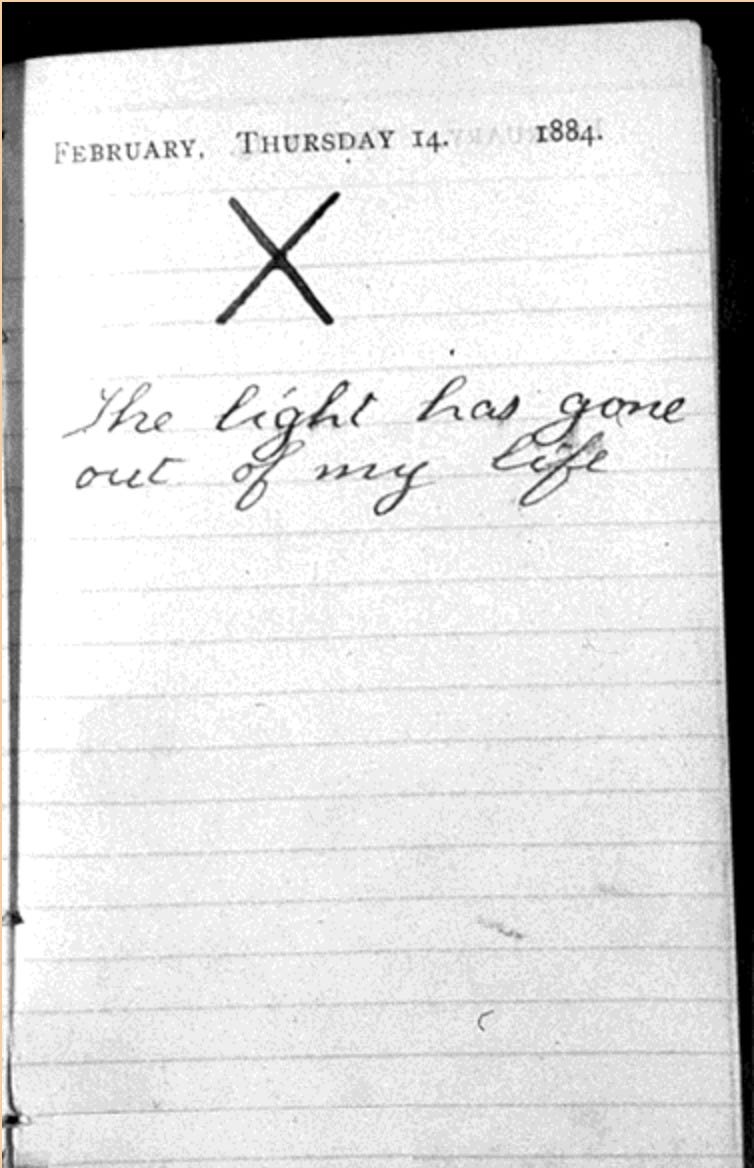
On February 14, 1884, Roosevelt slashed a heavy black X in his diary and wrote “The light has gone out of my life.” He refused ever to mention Alice again.

Roosevelt’s profound personal tragedy turned out to have national significance. The diseases that killed his wife and mother were diseases of filth and crowding—the hallmarks of the growing Gilded Age American cities. Mittie contracted typhoid from either food or water that had been contaminated by sewage, since New York City did not yet treat or manage either sewage or drinking water. Alice’s disease was probably caused by a strep infection, which incubated in the teeming city’s tenements, where immigrants, whose wages barely kept food on the table, crowded together.

Roosevelt had been interested in urban reform because he worried that incessant work and unhealthy living conditions threatened the ability of young workers to become good citizens. Now, though, it was clear that he, and other rich New Yorkers, had a personal stake in cleaning up the cities and making sure employers paid workers a living wage.

The tragedy gave him a new political identity that enabled him to do just that. Ridiculed as a “dude” in his early career, Roosevelt changed his image in the wake of the events of February 1884. Desperate to bury his feelings for Alice along with her, Roosevelt left his baby daughter with his sister and escaped to Dakota Territory, to a ranch in which he had invested the previous year. There he rode horses, roped cattle, and toyed with the idea of spending the rest of his life as a western rancher. The brutal winter of 1886–1887 changed his mind. Months of blizzards and temperatures as low as –41 degrees killed off 80% of the Dakota cattle herds. More than half of Roosevelt’s cattle died.

Roosevelt decided to go back to eastern politics, but this time, no one would be able to make fun of him as a “dude.” In an era when the independent American cowboy dominated the popular imagination, Roosevelt now had credentials as a westerner. He ran for political office as a western cowboy taking on corruption in the East. And, with that cowboy image, he overtook his eastern rivals.

Eventually, Roosevelt’s successes made establishment politicians so nervous they tried to bury him in what was then seen as the graveyard of the vice presidency. Then, in 1901, an unemployed steelworker assassinated President William McKinley and put Roosevelt—“that damned cowboy,” as one of McKinley’s advisers called him—into the White House.

Once there, he worked to clean up the cities and stop the exploitation of workers, backing the urban reforms that were the hallmark of the Progressive Era.

[Photo of Theodore Roosevelt’s diary, Library of Congress.]

Michael Podhorzer is a keen political analyst who the assistant to the president for strategic research for the AFL-CIO, a federation of 55 labor unions representing 12.5 million members. His observations in this post are well worth reading.

His insightful article begins:

When, in the Dobbs decision, Samuel Alito declared that Roe v. Wade had been “wrongly decided,” he succinctly stated the credo of a resurgent revanchist coalition that believes the Twentieth Century was wrongly decided. Over the last two decades, the Supreme Court has been instrumental in advancing this coalition’s agenda, which is to dismantle the New Deal order and reverse the civil and social rights gains made since the postwar period.

The execution of this agenda has been nothing short of a slow-motion coup against our freedoms. The Supreme Court has not only transformed itself into a democratically unaccountable lawmaking body; it has used this illegitimate power to create a one-way ratchet that makes the rest of our system less democratically accountable. Yet no matter how many times the Court tightens this ratchet, our political and opinion leaders keep asking whether the Court risks losing its legitimacy if it keeps this up – not what we should do now that legitimacy is a distant memory at best.

We hear of “conservative” judges, yet not one of the six Republican-appointed justices demonstrate fealty to any consistent set of principles beyond giving more power to the gatekeepers who put them on the Court. Instead, we must call them the Federalist Society justices. All six are current or former members of the Federalist Society, an enterprise sponsored by right wing billionaires and corporations whose intention was capture of the legal system – and capture it they did. They knew this capture would be necessary in order to implement their agenda, since they couldn’t count on the majority of Americans to vote against their own rights and freedoms.

The campaign to repeal and replace the 20th century is an extremely well-funded enterprise, organized by people who have never made any secret of their plans. None of this is happening by accident.

Yet for the most part, media coverage of SCOTUS continues to focus on the details of the individual cases on the docket: the arguments each side is putting forth, the likelihood that certain justices will find those arguments persuasive, and what a “win” for either side could look like. In the context of our current crisis, however, doing this is like narrating each segment of a bullet’s trajectory without naming the assassin or his target.

In this post, we’ll take a few steps back from that “what did the bullet do today” perspective.

  1. The Coalition Against the Twentieth Century – This section identifies the antagonists, outlines how they came together through the Southern Strategy, and shows how two historical accidents – the 2000 presidential elections and the 2010 midterms – enabled the massive power grabs that have brought us to our current crisis.
  2. The Originalist Con – This section reveals just how blatant and unprincipled the Federalist Society Majority has been in its execution of the coalition’s agenda.
  3. The Federalist Society Majority Juggernaut – This section lays out the enormous progress the Federalist Society Majority has already made to overturn the “wrongly decided” 20th century. This has included giving MAGA state legislatures new license to curtail voting rights and gerrymander themselves impregnable majorities that closely resemble the region’s one-party authoritarian rule during the Jim Crow era.
  4. No Longer Legitimate? We conclude with a look at how the Court’s “crisis of legitimacy” is actually a crisis for American democracy as a whole.

The Coalition Against the Twentieth Century

This revanchist coalition has two factions, which have come together through the Federalist Society to capture the nation’s legal system. One faction, which I call the MAGA industrial complex, is a symbiotic combination of white grievance media (e.g. Fox, Breitbart), white Evangelical churches and their political expressions dedicated to white Christian nationalism, as well as supremacist militias and the NRA.

When most of us hear “Make America Great Again,” we think of voters in their MAGA caps being stoked on by white grievance entrepreneurs like Trump and Tucker Carlson. We should instead be thinking of the elites and institutions that helped make MAGA one of America’s most successful political movementsto date. We know, for instance, that the white Christian nationalist movement was built not around a moral concern for fetal life, but around panic over the court-ordered revocation of tax-exempt status for religious schools—particularly Bob Jones University, as well as the private religious “segregation academies” that were founded in response to Brown v. Board of Education.¹

The other faction in the coalition against the 20th century consists of the plutocrats and rapacious capitalists whose efforts long predate Trump and MAGA. Their efforts were largely unsuccessful until the 1960’s. Until then, the Republican Party, which was the party of business, nonetheless acquiesced to the New Deal order. This sentiment was famously expressed by President Eisenhower:

Should any political party attempt to abolish social security, unemployment insurance, and eliminate labor laws and farm programs, you would not hear of that party again in our political history. There is a tiny splinter group, of course, that believes you can do these things. Among them are H. L. Hunt (you possibly know his background), a few other Texas oil millionaires, and an occasional politician or businessman from other areas. Their number is negligible and they are stupid.

The Southern Strategy

And then … in 1964 that “splinter” of “Texas oil millionaires” and “conservative” activists wrested the Republican presidential nomination for Barry Goldwater. Goldwater was trounced by 23 points. But rather than dispatching the Goldwater forces to the dustbin of history, this defeat simply convinced many that they would have to give ground on their ambition of electing anyone as “pure” as Goldwater. They were ready when, in 1968, Nixon reversed his position on civil rights, becoming the candidate that fused segregationists’ racist agenda with the traditional Republican business agenda. Nixon’s narrow victory in 1968 was deceptive. George Wallace siphoned off 14 percent of the most extremist voters, and combining Wallace’s and Nixon’s vote share reveals that there was a substantial majority consisting of Democrats (the backlash to the Civil and Voting Rights Acts) and traditional Republican voters. Kevin Phillips best laid out this blueprint in his book The Emerging Republican Majority.

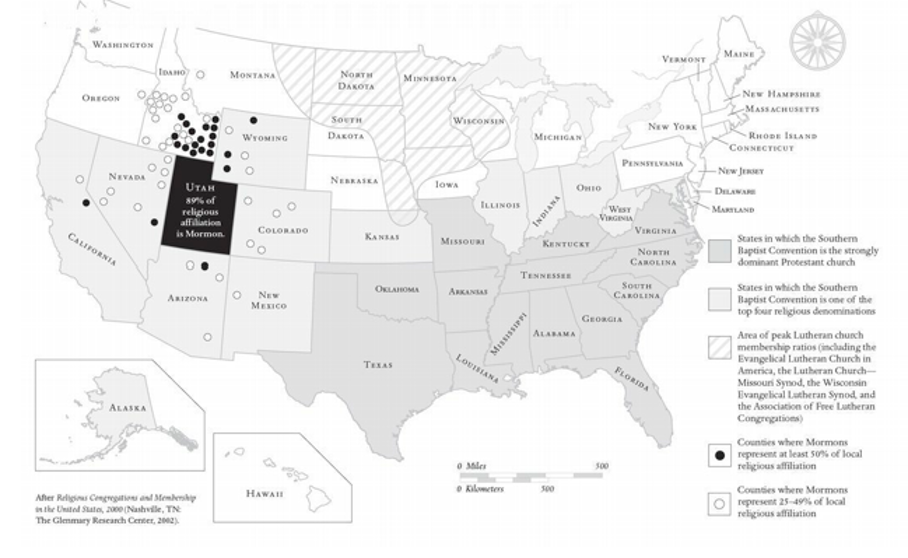
We generally think of the success of the Southern Strategy depending on the direct appeals of national Republicans to southern segregationist Democrats, with those voters changing their party affiliation without changing any of their values. The following map makes vivid something that has gone remarkably unnoticed. As Robert Jones and others have documented, from even before the Civil War, Christian churches played a critical role providing the “moral” basis for white supremacy. In this period, southern Evangelical and Fundamentalist churches continued to provide essential organizational scaffolding for preserving those attitudes and the salience of “social” issues in the region.

Map of U.S. showing regions shaded by religious denomination

Source: American Theocracy, Kevin Phillips

The Tea Party & the Takeover of the Republican Party

Until the election of Barack Obama, Republican presidential candidates and congressional leaders placated the reactionary, nativist, white Christian faction of the party by nominating right-wing judges and embracing the dog whistles and symbolism of white Christian identity, while making little or no progress reversing the civil rights gains of the 1960’s. Indeed, as late as 2006, the Voting Rights Act was reauthorized with nearly unanimous congressional support, with Bush claiming credit. This White House press releaseannouncing Bush’s signing would be unimaginable coming from any MAGA Republican now.

We very much remember the 2000 election for its razor thin margin and the Supreme Court brazenly intervening to stop the count and select Bush. But we have all but forgotten that the reason the race was as close as it was can be attributed to Bush’s consolidation of the white Evangelical establishment, and with it, Bible Belt voters that made the race that close in the first place.² While Clinton won the Bible Belt by a hair in 1996, Gore lost it by 12 points – and more consequentially, he lost the electoral votes in 7 Bible Belt states Clinton had won.³ And Kerry would lose the region by an even larger margin, 16 points. Bush stressed his own born again experience and did much for the white Christian establishment, including his “faith based” initiatives.

In response to Obama’s victory – and McCain and the Republican establishment’s immediate acceptance of his legitimacy – the nativist faction formed the Tea Party and focused on developing a political strategy to purge the Republican Party of “RINOs.” The last straw for this faction was Romney’s nomination and defeat. They revolted against the business wing’s “Autopsy” report, which in 2013 urged the GOP to moderate on immigration policies and dampen its racial rhetoric to stay competitive in an increasingly diverse electorate. Trump rushed into that political vacuum, smearing Mexicans as rapists and drug dealers. Crucially, unlike Goldwater, who faced a uniformly hostile and demeaning national media, Trump now had the advantage of the extensive right-wing media system that had since been established, which proved essential to his nomination and victory.

Please continue reading this deeply informed post about the underlying trends that have shaped the present moment in American politics.

Mimi Swartz, a writer for the Texas Monthly, explored the background, the funders, and the consequences of the well-coordinated campaign to privatize public schools—by defaming them and discrediting those who run for local school board seats. She focuses on the travails of one dedicated school board member, Joanna Day in Dripping Springs, Texas, who contended with insults and threats in her life.

The following is a small part of a long article, which I encourage you to read in full:

The motivations for these attacks are myriad and sometimes opaque, but many opponents of public education share a common goal: privatizing public schools, in the same way activists have pushed, with varying results, for privatization of public utilities and the prison system. Proponents of school privatization now speak of public schools as “dropout factories” and insist that “school choice” should be available to all. They profess a deep faith in vouchers, which would allow parents to send their children not just to the public schools of their choice but to religious and other private schools, at taxpayers’ expense.

But if privatizing public education is today cloaked in talk of expanded liberty, entrepreneurial competition, and improved schools for those who need them most, its history tells a different story. In 1956, two years after the U.S. Supreme Court handed down its landmark Brown v. Board of Education decision, a group of segregationist legislators in Texas, with support from retiring governor Allan Shivers, began concocting work-arounds for parents appalled by the prospect of racial integration of public schools. One idea: state-subsidized tuition at private schools. That never came to pass, but it was Texas’s first flirtation with vouchers.

Privatization proponents have since switched up their rhetoric, pitching vouchers as an opportunity for poor urban families to save their children from underperforming neighborhood schools. That hasn’t worked out either. In various experiments across the nation, funding for vouchers hasn’t come close to covering tuition costs at high-quality private schools, and many kids, deprived of the most basic tools, haven’t been able to meet the standards for admission.

School funding in Texas is based largely on attendance—as the saying goes, the money follows the child. Considerable evidence suggests that vouchers would siphon money from underfunded public schools and subsidize well-to-do parents who can already afford private tuition. Critics frequently cite a program in Milwaukee, where four out of ten private schools created for voucher students from 1991 to 2015 failed.

“I don’t think that vouchers serve any useful purpose at all,” said Scott McClelland, a retired president of H-E-B who now chairs Good Reason Houston, an education nonprofit. Ninety-one percent of Texas students attend public schools. “There isn’t enough capacity in the private school network to make a meaningful difference in their ability to serve economically disadvantaged students in any meaningful numbers, and it will divert funding away from public schools.”

In Texas, an unusual alliance of Democratic and rural Republican leaders has for decades held firm against voucher campaigns. The latter, of course, are all too aware that private schools aren’t available for most in their communities and that public schools employ many of their constituents. But the spread of far-right politics and the disruption of public schools during the pandemic created an opening for activists to sow discontent and, worse, chaos. “If they can make the public afraid of their public school, they will be more likely to support privatizing initiatives. Then that puts us back to where we used to be with segregation of public schools,” says former Granbury school board member Chris Tackett, who, with his wife Mendi, has become an outspoken advocate for public education and a relentless investigator of the attempts to undermine it.

They have their work cut out for them. In the past, just a few right-wing legislators pushed for privatization and were routinely ignored. After all, the state constitution spelled out “the duty of the Legislature of the State to establish and make suitable provision for the support and maintenance of an efficient system of public free schools.” But as times have changed, so has the interpretation of that guarantee.

Betsy DeVos, President Donald Trump’s former Education Secretary, set up shop in Dallas with her American Federation for Children to push against “government schools” in favor of “school choice.” Political PACs such as Patriot Mobile Action, an arm of a Christian wireless provider in North Texas, continue pouring millions into school board races and book bans to promote more religious education. Patriot has joined other recently formed PACs with inspirational names such as Defend Texas Liberty and Texans for Excellent Education, all of which supposedly support better public schools but are actually part of the privatization push. But by far the most powerful opponents of public schools in the state are West Texas oil billionaires Tim Dunn and the brothers Farris and Dan Wilks. Their vast political donations have made them the de facto owners of many Republican members of the Texas Legislature through organizations such as the now dissolved Empower Texans and the more recent Defend Texas Liberty, which the trio uses to promote restrictions on reproductive rights, voter access, and same-sex marriage. Almost as influential is the Texas Public Policy Foundation, where Dunn is vice board chair.

A November 2021 TPPF fund-raising letter, sent to supporters in advance of the Eighty-eighth Legislature convening, argued that “public education is GROUND ZERO” in the fight for freedom. “The policy team and board of the Texas Public Policy Foundation (TPPF) believe it is now or never,” it read, signaling that the long-standing and robust alliance against vouchers was unusually vulnerable. “The time is ripe to set Texas children free from enforced indoctrination and Big Government cronyism in our public schools.” The letter went on to herald a $1.2 million “Set the Captives Free” campaign to lobby legislators to save Texas schoolchildren from “Marxist and sexual indoctrination” funded by “far-Left elites for decades.”

Lieutenant Governor Dan Patrick, generously backed by Dunn, the Wilks brothers, and their organizations, has long been a proponent of privatizing public education (and of starving it through reductions in property taxes). He has made vouchers a primary legislative goal of the current session. Mayes Middleton, of Wallisville, a Republican state senator and former chair of the TPPF-aligned Texas House Freedom Caucus, filed a bill to create the “Texas Parental Empowerment Program,” proposing education savings accounts that are essentially a form of vouchers. Representative Matt Shaheen, of Plano, who is a member of the Texas Freedom Caucus, has introduced a measure that would guarantee state tax credits for those who donate to school-assistance programs—such as scholarships for kids wishing to go to private schools.

Governor Greg Abbott, knowing all too well the political headwinds that vouchers have faced, has long been wary of publicly supporting them, so he has undermined public schools in other ways. While campaigning early last year, he promised to amend the Texas constitution with a “parental bill of rights,” even though most, if not all, of those rights already existed. By then, “parental rights” had become a dog whistle to animate opponents of public education. (As the Texas Tribune put it: “Gov. Greg Abbott taps into parent anger to fuel reelection campaign.”)

During the recent intensifying crisis on the border, Abbott publicly floated a challenge to the state’s constitutional obligation to give all Texas children, including undocumented ones, a publicly funded education—a step his Republican predecessor, Rick Perry, had denounced years earlier as heartless. Then last spring, Abbott made headlines with his first full-throated public endorsement of a voucher program.

So here we are, with distrust in public schools advancing as fast as the latest COVID-19 variant. The forces behind the spread of this vitriol are no mystery. Those who would destroy public schools have learned to apply three simple stratagems: destabilize, divide, and, if that doesn’t work, open the floodgates of fear

In 2009, the Atlanta Journal-Constitution scrutinized test score gains in the city’s public schools and discovered a number of schools where the gains seemed improbable. The story triggered intense scrutiny by the Georgia Bureau of Investigation. Eventually nearly three dozed educators were charged with changing answers on the standardized tests from wrong to right in hopes of winning a bonus and pleasing their superintendent Dr. Beverly Hall, who put pressure on all teachers to raise scores or be humiliated.

During Beverly Hall’s tenure, the Atlanta district was celebrated for its miraculous test score gains, and she won recognition as Superintendent of the Year. She was the poster educator supposedly proving the “success” of No Child Left Behind. What she actually proved was that NCLB created perverse incentives and ruined education.

The facade of success came tumbling down with the cheating scandal.

After the investigation, Beverly Hall was indicted, along with 34 teachers, principals, and others. All but one of those charged is black. Many pleaded guilty. Ultimately, 12 went to trial. One was declared innocent, and the other 11 were convicted of racketeering and other charges. Beverly Hall died before her case went to trial.

The case was promoted by then-Governor Sonny Perdue. Ironically, the rise in Atlanta’s test scores was used by the state of Georgia to win a $400 million Race to the Top award.

One of those who was punished for maintaining her innocence was Shani Robinson, who was a first-grade teacher. She is the co-author with journalist Anna Simonton of None of The Above: The Untold Story of the Atlanta Public Schools Cheating Scandal, Corporate Greed, and the Criminalization of Educators.

I reviewed their book on the blog. While reading her book, I became convinced that Shani was innocent. As a first-grade teacher, she was not eligible for a bonus. Her students took practice tests, and their scores did not affect the school’s rating. Yet she was convicted under the federal racketeering statute for corrupt activities intended to produce financial gain. The Racketeer Influenced and Corrupt Organizations Act (RICO), was written to prosecute gangsters, not school teachers. Her conviction was a travesty.

Investigators offered Shani and other educators a deal: Plead guilty and you can go free. Or, accuse another teacher and you can go free. She refused to do either. She maintained that she was innocent and refused to accuse anyone else. Shani was accused by a teacher who won immunity. Despite the lack of any evidence that she changed scores, she was convicted.

Two Atlanta lawyers wrote a blog post in 2020 describing the Atlanta cheating trial as a legal outage:

The Atlanta Public Schools (APS) “cheating” scandal is a textbook example of overcriminalization and prosecutorial discretion gone amok, compounded by an unjust sentence of first-time offenders to serve years in prison. It is a glaring illustration of a scorched-earth prosecutorial mindset that has sparked a movement of reform-minded prosecutors nationwide — one which has yet to be embraced in Atlanta.

Just this past week, the six remaining educators who have insisted on their innocence went before the same judge who found them guilty. Their public defender asked to be excused from the case because he thought it was a conflict of interest to represent all six defendants. The original prosecutor, Fani Willis, continues to believe the six educators should be imprisoned. Willis is now prosecuting the case of whether former President Trump interfered in Georgia’s election in 2020.

The six educators who insist they are innocent have lived in a state of suspended animation for more than a decade. They have not gone to prison, yet. They have lost their reputations, their jobs, their teaching licenses.

They hoped that Judge Baxter might use the hearing to dismiss their case. Shani asked me to write a letter supporting her. I did.

It didn’t matter. Judge Baxter decided that the defendants should get a new public defender and return for another hearing. The case has already cost millions of dollars and is the longest-running trial in the history of the state.

The judge ordered them to return to court with their new lawyers or public defenders on March 16. At that time, the entire appeals process might start again and take years to conclude.

I contacted my friend Edward Johnson in Atlanta to ask him what he thought. Ed is a systems thinker and a sharp critic of the Atlanta Public Schools‘ leadership, which is controlled by corporate reformers who make the same mistakes again and again instead of learning from them.

Ed wrote me:

Prosecuting teachers and administers was morally wrong to begin with. Continuing to prosecute any of them is doubly morally wrong. Teachers and administers were the real victims of Beverly Hall. So prosecuting them means being willfully blind to ever wanting to learn truths about anything that would help Atlanta avoid doing a Beverly Hall all over again.

I agree.

Ron DeSantis didn’t like the College Board claiming that Florida was putting political pressure on the testing company to revise the AP African American Course. He didn’t like their lame attempt to stand up to his bullying. So he let it be known in public that Florida was thinking of replacing the College Board with other vendors.

Normally, the anti-testing organizations would have cheered his stance against the tests. But he made clear that he was looking for other tests.

Tens of thousands of Florida high school students take Advanced Placement courses every year to have a competitive edge heading into college.

Now, Gov. Ron DeSantis says he wants to reevaluate the state’s relationship with the private company that administers those courses and the SAT exam.

The move comes after the College Board accused DeSantis’ administration of playing politics when it rejected an Advanced Placement African American Studies course.

“This College Board, like, nobody elected them to anything,” DeSantis said at a news conference Monday in Naples. “They are just kind of there, and they provide a service and so you can either utilize those services or not.”

While DeSantis acknowledged the College Board has long had a relationship with the state, he said “there are probably other vendors who may be able to do that job as good or maybe even a lot better.”

Florida has long had a strong connection with the College Board. The state pays for students to take Advanced Placement exams, and provides bonuses to teachers whose students perform well.

In 2021, nearly 200,000 Florida teens sat for more than 366,000 tests, for which they can earn college credit. It had the fifth-highest rate of tests taken per 1,000 students in the nation.

The College Board also administers the SAT exam, which students may use to help them complete graduation testing requirements, earn entry into universities and become eligible for Bright Futures scholarships.

If the state were to move away from the College Board, other options exist. Students seeking advanced courses leading to college credits have International Baccalaureate, Cambridge Programme and dual enrollment classes available.

They also can take the ACT exam instead of the SAT.

DeSantis has not provided details as to exactly how the College Board’s relationship with the state could be impacted but said he has started talking to House Speaker Paul Renner about the matter. “I’ve already talked to Paul, and I think the Legislature is going to look to evaluate how Florida is doing that,” DeSantis said.

“Of course, our universities can or can’t accept College Board courses for credit, maybe they’ll do others. And then also just whether our universities do the SAT versus the ACT. I think they do both but we are going to evaluate how the process goes.”

No one from the College Board was immediately available for comment.

What tests do students take if they are not Christian?

Read more at: https://www.miamiherald.com/news/local/education/article272474953.html#storylink=cpy

Carol Burris is the executive director for of the Network for Public Education. in this post, which she wrote exclusively for the blog, she reveals the details of Arkansas Governor Sarah Huckabee Sanders’ plan to defund and destroy the public schools in her state.

Burris writes:

Sarah Huckabee Sanders, the daughter of Baptist minister and former Governor Mike Huckabee, missed learning the 9th commandment that prohibits telling a lie. As press secretary to Donald Trump, her distortions of the truth resulted in the editor of Forbes warning corporations against hiring Sanders and other Trump “propagandists,” writing, “Forbes will assume that everything your company or firm talks about is a lie.”


Now she is the Governor of Arkansas. On her first day in office and in her response to Biden’s State of the Union, she parroted the old “education is the civil rights issue of our time” line that has been used to justify horrible policies from school closures to charter schools and vouchers. However, the disconnect between what she says and what she does quickly became apparent. On her first day in office, she issued an executive order prohibiting “indoctrination and critical race theory in schools” and another banning the term “Latinx” from being used in state documents. State authorities are investigating AP African American Studies at Little Rock Central High School, where the majority of students are Black.

If we need further proof that this self-proclaimed champion of Civil Rights is more aptly described as a champion of Civil Wrongs, look at her recently leaked ed reform plan.

Here are its features:


The Privatization of Public Education:

· Her voucher plan is a universal ESA—the plan now favored by the far-right. These plans have few rules and no family eligibility requirements. They have become Entitlement Spending Accounts–cash going into the pockets of private school families regardless of income. The leaked plan does not say how taxpayers will pay for it. But everyone will be eligible by 2025. It includes Voucher funding for homeschools. The only restrictions will apply to vendors, so those who enroll their children in those recently uncovered Neo-Nazi homeschools can find ways to cash in.

· Increased tax credits for contributions to an existing voucher program.

· Local School Boards can contract with an open-enrollment charter school or private company to run a school campus at risk of state takeover due to low performance—and if they do, they get a financial incentive.

· Establishment of a charter-school construction fund for new charters and expansion.

· Elimination of the cap on charters.

· Charter school applications no longer need to be reviewed and approved by the local school district board of directors.

· All students attending a public school can take courses and earn credit for classes not offered in their school. By the beginning of the 2025-2026 school year, students attending a public school that receives a letter grade of “C”, “D”, or “P” from the Arkansas School and District Accountability System may take their required courses (i.e. math, English, etc.) through the course choice program. Bet your bottom dollar that these courses will be online, with vendors like Stride K12 making a fortune.

Censoring and Controlling Curriculum

· K-3 literacy evaluation will be aligned with the “science of reading.”

· Before grade 5, teachers cannot provide classroom instruction on the following topics: sexually explicit materials, sexual reproduction, sexual intercourse, gender identity, and sexual orientation.

· School districts must implement an age-appropriate child sexual prevention program for grades K-12, allowing parents to preview materials and exempt their children from instruction. (I have no idea what a child sexual prevention program even is.)

· The Secretary of Education will review the Department of Education regulations, policies, materials, and communications to ensure they do not indoctrinate students with ideologies that conflict with the principle of equal protection under the law.

· No school employee or student must attend training on prohibited indoctrination or Critical Race Theory.


Harmful Policies for Students

· 3rd-grade retention based on deficits in reading proficiency.

· An accountability system for pre-school education that includes student data.

· Literacy testing three times a year for all students in K-3.

· Curriculum tracking in Grade 8.

· Community service requirements, which may, for some students, be challenging to meet.

· Mandated cops on campus.

· Career-ready pathways in partnership with local business and industry leaders” translate workforce training programs to track students into low-paying and middle-wage jobs.

Punitive Policies for Teachers


· Elimination of due process in dismissals.

· Base salaries will no longer increase by years of experience or for Master’s degrees.

· Bonuses based on VAM.

There are a few likable initiatives in her plan, such as paid maternity leave for teachers, but if she makes districts fund them even as she drains their funding with charter schools and voucher expansion, a good initiative will be one more financial pressure on already underfunded schools.

Sarah Huckabee Sanders’ education plan is a hodgepodge of all the awful and ineffective ideas proposed since No Child Left Behind. The fingerprints of JEB! and the Walton family are over the leaked legislation.

Despite its hodgepodge nature, one thing is clear—its ultimate intent is to destroy public education in the state by slamming a fist down on students, public schools, and their teachers while propping up a wild and largely unaccountable privatized system.


Ron DeSantis is a dangerous ideologue and a wannabe Mussolini. He speaks of freedom but practices coercion and cancel culture. In Florida, you are free to echo his beliefs but not to disagree. He is a bully.

This frightening story by Kathryn Joyce in Vanity Fair is a MUST-READ. DeSantis engineered the right-wing takeover of New College, a small, progressive college by installing new board members and ousting the President of New College. The extremists are portraying their swift decapitation of a left wing college as a model for other red states. Their plan is to turn New College into its ideological opposite, the “Hillsdale of the South.” Public colleges and universities in other red states should be on high alert. Vanity Fair (to which I subscribe) is usually behind a paywall, but this article is a one-time freebie.

The article begins:

It took New College president Patricia Okker three attempts to deliver her farewell remarks. She kept being interrupted during last week’s board meeting in Sarasota, Florida, including once by a member of the school’s board of trustees, making a motion to terminate her without cause. Okker had been addressing the dozens of students, faculty, and parents who’d come to defend her record—and the hundreds more outside who weren’t admitted—saying she was sorry to disappoint them, but she couldn’t represent the mandate New College was being given through this “hostile takeover.” And she refused to support the claims of right-wing critics that the school had been indoctrinating its students.

In the audience, supporters hugged one another and students left in tears. The trustees moved on, voting to replace Okker with interim president Richard Corcoran, Florida’s recently departed education commissioner who, in a 2021 speech at Michigan’s right-wing Hillsdale College, came close to calling for the collapse of the public school system through student attrition and said the political war “will be won in education.” The trustees replaced the board chair too, made plans to replace the general counsel, and instructed administrators to start preparing to dismantle the college’s diversity offices. null

It was hard to imagine a starker change in leadership for New College, the small, nontraditional honors college of the Florida public university system, known for its lack of grades, individualized majors, and leftist student body, but which has also been eyed skeptically for years by Florida’s conservative-dominated legislature for its low enrollment and graduation rates. But that was exactly the transformation intended when Governor Ron DeSantis last month appointed six new trustees to the school’s 13-member board, in hopes they would remake New College into a right-leaning “classical college, more along the lines of a Hillsdale of the south,” as his education commissioner Manny Diaz put it.

After the Republican-controlled Board of Governors appointed a seventh trustee, the new majority represented a team uniquely qualified to carry out DeSantis’s scorched-earth, right-wing education wars. There was Manhattan Institute fellow and anti-critical race theory hype man Christopher Rufo, who has most recently turned his efforts to laying “siege” to diversity, equity, and inclusion programs; one of Hillsdale’s graduate school deans, Matthew Spalding, who also helped lead Donald Trump’s short-lived 1776 Commission; Charles Kesler of the right-wing Claremont Institute, which spent the Trump years retconning an intellectual platform for the MAGA movement; a senior editor at a religious right magazine; the Catholic author of a book accused of “fram[ing] LGBTQ+ identity as a mental illness”; and a private Christian school cofounder with a penchant for Covid disinformation.

Following his appointment, Rufo immediately began speaking in martial terms: that conservatives were “recapturing higher education,” mounting a “landing team” to survey the school as well as a “hostage rescue operation” to “liberate” it from “cultural hostage takers.” Another new trustee, the private Christian academy cofounder Jason “Eddie” Speir, started a Substack to chronicle the transformation, sparking further panic in late January with a post proposingthe board declare a financial emergency, firing the entire staff and rehiring only those professors aligned with the school’s new business model. (Speir also used his newsletter to propose banning USA Today affiliates from covering campus events over a reader comment suggesting people throw dog poop on the new trustees; to request the entire board be given his essay, “‘Florida, Where Woke Goes to Die’ What Does It Mean?” as “supporting material”; and to ask if any readers had a copy of Robert’s Rules of Order he could borrow.)

Students, faculty, and alumni from New College and far beyond decried the takeover as an attack on academic freedom with national implications. Multiple scholarly organizations, including the American Anthropological Association and the American Historical Association, denounced it as “an orchestrated attack on academic integrity.” The University of Florida graduate assistants’ union tweeted a message of “Solidarity with New College students, faculty, and staff as DeSantis appoints a card-carrying fascist to the presidency.” At a campus rally preceding last Tuesday’s meeting, former Democratic state representative Carlos Guillermo Smith warned, “New College is their first test, their first trial run.” Repeating a Twitter hashtag protesting students had used, Smith added, “your campus is next.”

As though to prove them right, on February 1, Florida Republican state representative Spencer Roach—who cosponsored a recent Florida law mandating ideological surveys of public university campuses to “stem the tide of Marxist indoctrination”—tweeted that Okker’s termination should be replicated “at every university of the state.” In a January essay published in the Manhattan Institute’s City Journal, Rufo touted the opportunities for emulation as well, writing that “If we are successful” in carrying out the mission of “institutional recapture,” what happens at New College “can serve as a model for other states.”

One horrified alum, Cayenne Linke, who attended New College in the 1990s, compared the takeover to a violent assault. “I feel like I’m standing at the precipice of the Fourth Reich, and I’m mostly powerless to fight back,” Linke said. “I weep for our nation if DeSantis wins a presidential bid and inevitably installs Rufo as education secretary.”

Please open the link and read the article in its entirety.

Ron DeSantis responds to critics of his campaign to stamp out “critical race theory” by saying that Florida mandates a high school course in Black history. What he doesn’t say is that the course is offered in only 11 of the state’s 67 districts.

It isn’t offered because the state has not funded the development of a curriculum and has ignored the “mandate.”

The unenforced mandate was passed in 1994 in an attempt to make amends for the atrocities that occurred in Rosewood, Florida, exactly 100 years ago.

In 1923, 200 white terrorists sacked and burned the all-black town of Rosewood, Florida. The town was burned to the ground, and some who resisted were lynched.

Mary Ellen Klas wrote in The Miami Herald:

The painful details of the unpunished lynchings and vigilante violence went from being family secrets to the foundation for legislation awarding the first reparations paid by a state in the nation’s history to survivors of racial violence. They also became the catalyst for the 1994 law requiring the teaching of Florida’s Black history in K-12 schools. The law requires that courses comprise five components: African beginnings, the passage to America, slavery, the Reconstruction period after the Civil War and the “contributions of African Americans to society.”

DeSantis and his education commissioner Manny Diaz, Jr. object to any mention of the state’s violent racist history, and they certainly don’t want people today to know that the state agreed to pay reparations to the few survivors of the Rosewood massacre. That may be why they objected vehemently to any mention of the reparations movement in the AP course. They have a guilty conscience.

As DeSantis defends against charges that he is “erasing the state’s Black history,” he cites the 1994 law as evidence that it is required to be taught, but he is confronted with contradictions:

▪ Budget records show that the implementation of the law that has been on the books for decades has been not only understaffed and barely enforced, but DeSantis and legislative leaders have rejected requests to beef up resources to expand the teaching of Black history in Florida.

▪ The word “reparation,” which is central to the Rosewood saga that spawned the Black history law, is now considered off-limits in Florida classrooms because state officials have determined that discussion of the reparation movement, which involves offering financial restitution to the descendants of enslaved people for the harms of slavery and racial discrimination, is an attempt at “indoctrination.”

“We proudly require the teaching of African American history. We do not accept woke indoctrination masquerading as education,’’ wrote Education Commissioner Manny Diaz on Twitter last month as he defended the Department of Education’s decision to reject the Advanced Placement course in African-American Studies because it “lacked educational value.”

Hypocrites. DeSantis is hoping to become President by appealing to racism and to white grievances and resentment towards Blacks. He has amplified false claims about critical race theory, which involves the study of racism. He wants to make open bigotry respectable by loudly proclaiming that anyone who wants factual history and wants to eliminate racism is “woke.”

Lincoln spoke to “the better angels of our nature.” DeSantis appeals to the worst instincts of our nature.

Read more at: https://www.miamiherald.com/news/politics-government/article271882322.html#storylink=cpy

Linda Lyon, former president of the Arizona School Boards Association, writes in her blog “Restore Reason” about the newly elected State Superintendent of Public Instruction Tom Horne, who held the same office from 2003 to 2013.

He intends, she says, to stop “critical race theory” and “social-emotional learning.” He seems to think that “diversity, equity, and inclusion” are nothing more than left wing propganda. He’s a get-tough guy who will crack down on students and teachers.

She writes:

You’ve heard it said that an old dog can’t learn new tricks. AZ Superintendent of Public Instruction Tom Horne is the living embodiment of this saying. His campaign gave us a preview that he was not going to change his ways. After all, he didn’t tout plans to improve our public schools (he was vying for the position overseeing “public” instruction after all), but rather, posted countless campaign signs shouting, “STOP CRITICAL RACE THEORY”. Never mind that actual CRT, (which rests on the premise that racial bias – intentional or not – is baked into U.S. laws and institutions), is not taught in elementary or secondary schools, but at the university level, most often in law schools. For Republicans, however, the term became synonymous with being “woke” and their focus on “owning the libs” carried Horne back to his old office.

This isn’t a new fight for Horne. After his recent election, MSNBC called him,

a pioneer in the right-wing crusade against school teachings centered on nonwhite people and social inequality.

As evidence, MSNBC cited his fight against “ethnic studies” which led to a ban on such instruction in Arizona schools in 2010. He also banned bilingual education services that same year which the Justice Department found illegal. The ban on ethnic studies held until 2017, when a federal judge overturned it, finding that it had an,

invidious discriminatory racial purpose, and a politically partisan purpose.

At 77, it is no surprise Horne hasn’t changed his spots. After all, it mostly works for him as evidenced by his previous elections to serve as State Superintendent from 2003 to 2011, as well as his election to a term as AZ Attorney General. Now, he’s swept into office on his STOP CRT broom, promising to,

eradicate teaching on diversity and equity and eliminate the use of social emotional learning in Arizona schools.

He’s off to a running start, canceling previously approved diversity presentations at the education conference hosted by his department and wrapping up today. Michaela Rose Classen, an education consultant originally scheduled to speak, expressed worry to the AZ Daily Star about excising social-emotional learning from schools saying,

When students enter the classroom, I think the assumption by some folks is that they just enter ready to learn. But there are different levels of experiences and often trauma that students are bringing into the classroom with them,’ Claussen said. ‘And they’re not quite developed yet emotionally, like we are as adults, to leave it at the door. So we have to really be cautious about how are we paying attention to student needs.

Horne doesn’t believe this type of learning has any place in the classroom. A 2022 Pew Research Poll, however, showed that about two-thirds of parents believe it is important their children’s school teaches social-emotional skills. These skills, in a nutshell, are:

  • Self-Management – managing emotions and behaviors to achieve one’s goals
  • Self-Awareness – recognizing one’s emotions and values as well as one’s strengths and challenges
  • Responsible Decision Making – making ethical, constructive choices about personal and social behavior
  • Relationship Skills – forming positive relationships, working in teams, dealing effectively with conflict
  • Social Awareness – Showing understanding and empathy

As a school board member in my 11th year of service, I can unequivocally say that many of our students need help with social-emotional skills. Should parents and communities teach these skills? YES, ABSOLUTELY!! But, in many cases, this isn’t happening and the global pandemic exacerbated difficulties with students trying to learn and interact with friends remotely. In fact, I’m guessing most would agree that our society in general needs help with these skills more than ever.

Horne, no doubt, thinks our kids just need to “man up” and stick to learning “readin’, writin’, and ‘rithmatic” with his stated focus on improving academics and increasing test scores. Unfortunately, the narrowing of curriculum and “teaching to the test” are making our students less prepared for the real world. And speaking of that, I noted he allowed presentations on suicide prevention at the education conference. Does he not understand the relationship social-emotional learning has on student mental health relating to not only suicide prevention but also the mass shootings plaguing our schools?

Another of Horne’s first acts was to eliminate the Diversity, Equity, and Inclusion Department at ADE, stating that in the context of CRT “equity has come to mean equal outcomes by racial groups”. That may be how sees it, but Google’s Dictionary defines equity as “the quality of being fair and impartial”. Doesn’t this mean we recognize not every child is born with the same opportunities to succeed and we should do what we can to make the opportunities available for those who are willing to apply themselves?

There will no doubt be many battles to fight with Horne, (with his “politically partisan purpose”), leading Arizona’s public schools. The inefficiency of jerking our teachers and students around with policy reversals is frustrating. But it is the potential for setting back another generation of our students that really worries me. As the slogan for the United Negro College Fund states, “A mind is a terrible thing to waste.”