Margaret Renkl is a contributing opinion writer in the South for the New York Times. In this article, she notices that access to civil rights increasingly depends on which state you live in. Red state legislatures exert extreme control over private decisions. Those who live in Tennessee are not free to make their own decisions about medical care.

NASHVILLE — Two weeks ago, while the rest of America was absorbed by the hunt for a doomed submersible, people in Tennessee discovered that their attorney general was conducting a witch hunt.

As part of a “run-of-the-mill” inquiry into possible billing fraud — as officials described their investigation — the attorney general’s office demanded that Vanderbilt University Medical Center hand over a vast array of documents from its clinic for gender-affirming care. According to Tennessee Lookout, a nonprofit journalism site, those documents include, among others:

  • complete medical records for an undisclosed number of patients
  • Resumes of clinic physicians
  • information about the clinic’s Trans Buddy volunteers
  • emails sent to and from a public portal for questions about L.G.B.T.Q. health
  • the names of people referred to the gender-affirming clinic for care

Tell me this isn’t a witch hunt. Tell me this isn’t an open campaign of terror against already vulnerable citizens who had every reason to believe that their medical records — their medical records! — were confidential and every reason to believe that the medical clinic of a major university hospital was a safe space.

During the Juneteenth holiday weekend, Vanderbilt notified patients whose confidential medical records were now in the possession of the state attorney general. The hospital has not detailed which documents it provided the state. When two Tennessee Lookout reporters, Sam Stockard and Anita Wadhwani, asked whether Vanderbilt had complied with every state request in connection with the investigation, a hospital spokesman said, “The short response to your question is no.”

State officials contend that they are investigating only the hospital and certain providers, not the patients they serve, and that all the data they’ve gathered will be kept private. But given the sweeping nature of the documents and the obsessive and relentless way that the Republican supermajority in this state — and in virtually every state governed by a Republican supermajority — has persecuted trans people, it’s impossible to trust such claims…

Though the courts have generally sided with transgender families when these laws have faced legal challenges, the behavior of red-state lawmakers and officials remains in lock step with intimidation campaigns conducted against transgender people by right-wing media figures like the Daily Wire’s Matt Walsh, who staged an anti-trans rally in Nashville last fall…

Increasingly, this is exactly what it’s like to live in a red state, and not just for vulnerable minorities. The age at which it is possible to marry, the testing required to drive a car, the conditions under which it is possible to carry a firearm — such matters have always varied a bit from state to state. But this is a whole new reality.

Now that Republican-appointed justices dominate the U.S. Supreme Court, we can’t count on the courts to protect us from the most extreme agendas being enacted in Republican-dominated statehouses. Essential civil liberties that citizens of other states can take for granted are no longer liberties that we in the red states enjoy.

Maybe you can count on being able to make health care decisions yourself, following the advice of your doctor. No such luck here, whether you’re seeking transgender care or the safe end to an unsafe or unwanted pregnancy.

Maybe you’re a physician, trained and board-certified in an area of expertise that exactly zero legislators in your state share. You may be under the impression that your education and experience give you the right to recommend medical treatment for your patients. Not in many places here. Even in the case of life-threatening situations, your hands are tied.

Maybe you feel relatively confident that your children are safe in their schools because you live in a state that has enacted measures to keep firearms out of the hands of dangerous people. My state has done nothing of the kind.

Maybe you are represented in Congress by an elected official whose political positions align with the political positions of a vast majority of people who live in the city they represent. In Nashville, as in other blue cities whose voting districts were determined by a Republican legislature, we don’t.

Maybe classrooms and school libraries in your community offer books and other materials that experienced teachers and librarians have chosen for their excellence and their relevance to children’s lives. In the red states, that’s not something parents can count on, for our school boards are being bullied by a minority of conservative parents, and our Republican legislators believe they know better than education professionals which books students are ready to read.

Maybe the full range of birth control options is now available to you in planning whether, or when, to have a baby. Many anti-abortion activists erroneously define birth control measures like intrauterine devices and the medication known as Plan B as abortifacients. If you live in a state where such groups have the ear of legislators, you’d better start paying attention to what’s happening in your statehouse because these folks are coming for you.

We live in two countries now: one in which basic civil and human rights are recognized and enshrined in law, and another in which ideological extremists can decide how everyone else lives.
Governor Josh Shapiro of Pennsylvania announced that he would drop his support for vouchers in order to pass a state budget. Republicans who control the State Senate want vouchers. Democrats, with a slim majority in the House, are opposed to vouchers.

HARRISBURG — Gov. Josh Shapiro says he plans to scrap his push for private school vouchers in Pennsylvania’s state budget in order to close a deal with the commonwealth’s divided legislature five days after the deadline.

The Democrat issued a statement Wednesday acknowledging that talks had deadlocked over a $100 million voucher program, which he had supported and which state Senate Republicans passed as part of their budget proposal last week. Pennsylvania House Democratic leaders oppose vouchers and had refused to act on the Senate’s bill.

Shapiro’s solution, he said, was to promise state House Democrats that if they pass the Senate’s budget, he will then line-item veto the vouchers from the $45.5 billion spending plan.

“Our Commonwealth should not be plunged into a painful, protracted budget impasse while our communities wait for the help and resources this commonsense budget will deliver,” Shapiro said in a statement.

Spotlight PA had previously reported the existence of Shapiro’s plan to cut vouchers out of the budget deal.

In his statement, Shapiro said that over the weekend, state House Democrats requested a legal memo from his administration that confirmed that any voucher program passed as part of the budget could not be implemented without separate enabling legislation — legislation that House Democrats might be able to block.

“Knowing that the two chambers will not reach consensus at this time to enact [the voucher program], and unwilling to hold up our entire budget process over this issue, I will line-item veto the full $100 million appropriation and it will not be part of this budget bill,” Shapiro said.

In a letter to state Senate Republicans viewed by Spotlight PA, House Majority Leader Matt Bradford (D., Montgomery) wrote Wednesday that his chamber plans to take Shapiro at his word.

“With the Governor’s assurance that he neither has the legal authority nor intention to move forward with [vouchers] at this time, the House will consider [the Senate budget bill] on concurrence later today,” Bradford wrote.

The voucher program would fund private school scholarships for students in low-achieving public school districts.

The deal that included it, which passed the state Senate 29-21 on Friday, included key Democratic priorities like increased education funding, universal free school breakfast, and the commonwealth’s first-ever funding for public legal defense. However, Democrats viewed the vouchers as a poison pill.

When they passed their plan last week, state Senate GOP leaders made it clear that their support was contingent on vouchers being included, with Senate President Pro Tempore Kim Ward (R., Westmoreland) telling reporters that any plan that didn’t include vouchers would have to have “a different number.”

This new maneuver from Shapiro, assuming continued support from state House Democrats, would not require the proposed plan to go back to the Senate, thus circumventing Republicans there. Republican leaders did not immediately return a request for comment.

While Bradford has said House Democrats are on board with Shapiro’s plan, members of the caucus expressed doubts throughout the day Wednesday about any plan that would require them to approve a budget with vouchers and rely on the governor to then eliminate them.

“There’s not a lot of trust amongst [Democratic] members and the administration,” one House Democrat, who requested anonymity to discuss ongoing budget negotiations, told Spotlight PA.

Steven Singer describes the budget mess in Pennsylvania. The legislature is under court order to change state funding for education to make it equitable. But the Republican-dominated State Senate inserted a voucher proposal, encouraged by the support of Democratic Governor Josh Shapiro. And the State House, with a tiny Democratic majority, opposes vouchers.

Singer writes:

How do you stop the other team from making a goal when you aren’t even sure your own team’s goalie will try to block the shot?

Pennsylvania House Democrats find themselves in that uncomfortable position as they refuse to pass a Republican supported 2023-24 budget on time.

The problem? School vouchers.

Democrats generally oppose them and Republicans love them. But in the commonwealth, new Gov. Josh Shapiro, ostensibly a Democrat, has let it be known that he likes vouchers under certain conditions.

So Republicans designed a bill exactly along those lines hoping that if they can get it through both legislative bodies, the Governor will give it his signature. (Under the previous Democratic administration, Gov. Tom Wolf blocked the worst the GOP could throw at him, stopping all kinds of horrible policies from getting through.)

A budget encrusted with voucher giveaways passed the Republican-controlled Senate on Thursday, but the House – where Democrats now hold a slim majority – refused to go along with it.

So Republicans are holding the entire budget hostage. As usual.

In a time when the state is flush with cash from inflation-juiced tax collections and federal pandemic subsidies, legislators still couldn’t pass a budget on time.

And it all comes down to our schizophrenic education policies.

Fact: the Commonwealth shortchanges public school students.

The state Supreme Court said so after an 8 year legal battle.

Now lawmakers in Harrisburg are rushing to fix the problem by tearing public schools apart and giving the pieces to private and parochial schools.

It’s called the Lifeline Scholarship Program – throw a lifeline of $100 million to failing edu-businesses and religious indoctrination centers on the excuse that that will somehow help kids from impoverished neighborhoods.

You could just increase funding at the poorest public schools – but that would make too much sense.

Better to give taxpayer money to private interests with little to no accountability or track record and just hope it works!

During the election, Shapiro admitted he liked the concept of these kinds of vouchers, but back then the only other choice was Doug Mastriano, a raving MAGA insurrectionist Republican. The Democrat could have said he had developed a taste for human flesh and he would have been the better alternative.

This means only the slim Democratic majority is left to uphold public schools over this wrongheaded policy nightmare.

House Democrats swear the bill is destined to fail.

House Majority Leader Matt Bradford, D-Montgomery, put it this way:

“There are not the votes for it. It’s not coming up, and if it comes up, it will be defeated.”

This seems to be the case. Yesterday, the House Rules Committee voted against sending the tuition voucher bill to the full House for a vote. So it is not scheduled for a vote at all.

However, now that the June 30th deadline has been blown, lawmakers probably will try to use this newest school voucher bid as a bargaining chip to get a spending plan – any spending plan – passed. This could drag on for months – it certainly has in the past.

The current voucher iteration is a taxpayer funded tuition subsidy for students attending private schools.

Under this bill, students in the lowest 15% of schools in the commonwealth (as determined by standardized test scores) would be eligible.

So what’s wrong with school vouchers?

Open the link to learn what’s wrong with vouchers and also to see links that you can use to establish that vouchers are a disastrous policy. Most will be used to subsidize kids from well-off families who never attended public schools.

Robert Hubbell shares some interesting and informative comments about our Supreme Court, which seems determined to roll back the past century of social progress. The Court is whittling away—in some cases, hacking away—at our rights. Whereas we long believed that the High Court would always defend the rights of citizens, we can no longer count on it. The Court majority seems determined to impose a far-right “Originalist” philosophy on the entire nation. Of course, if they were really Originalists, pretending that it was 1790, Amy Coney Barrett and Clarence Thomas would resign at once. The Founding Fathers never imagined that women and Blacks would vote, become lawyers and judges. Resign, Amy and Clarence.

Robert Hubbell writes:

Last week’s rulings from the Supreme Court continue to lead the news as the nation celebrates the 4th of July holiday. The Washington Post’s headline reads Biden faces renewed pressure to embrace Supreme Court overhaul. The details matter less than the fact that the notion of Supreme Court reform is the top story on a day when the Court issued no opinions. And the Supreme Court is top of mind for many readers, many of whom recommended articles and action items for other readers in yesterday’s Comment section. Chief among those recommendations was Rebecca Solnit’s exhortation in The Guardian, The US supreme court has dismantled our rights but we still believe in them. Now we must fight.

Solnit is a gifted writer who hit the mark in capturing the feelings of millions of Americans. She first addresses the feelings of anger and frustration about a Court that is out of control:

The first thing to remember about the damage done by the US supreme court this June and the June before is that each majority decision overturns a right that we had won. [¶]

Each of those victories was hard-won, often by people who began when the rights and protections they sought seemed inconceivable, then unlikely, then remote, and so goes the road of profound change almost every time. [¶]

To recognize the power of this change requires a historical memory. . . . Memory is a superpower, because memory of how these situations changed is a memory of our victories and our power. Each of these victories happened both through the specifics of campaigns to change legislation but also through changing the public imagination. The supreme court can dismantle the legislation but they cannot touch the beliefs and values.

In words that I wish I had written, Solnit urges us to action:

[H]istory shows us that when we come together with ferocious commitment to a shared goal we can be more powerful than institutions and governments. The right would like us to feel defeated and powerless. We can feel devastated and still feel powerful or find our power. This is not a time to quit. It’s a time to fight.

Other readers shared Jennifer Rubin’s op-ed in The Washington Post, Self-government is worth defending from an illegitimate Supreme Court.

On this Independence Day, we should reaffirm the twin pillars of democracy: Voters (not the mob) pick their leaders, and elected leaders (not unelected judges) make policy decisions for which they are held accountable.

On this Independence Day, we should reaffirm the twin pillars of democracy: Voters (not the mob) pick their leaders, and elected leaders (not unelected judges) make policy decisions for which they are held accountable.

Rubin identifies the many ways in which the Court has strayed from its legitimate role as a judicial body (familiar ground for readers of this newsletter) but highlights the particularly destructive role of the “Major Questions Doctrine.” That judge-made doctrine arrogates to the Court the right to overturn any decision by a federal agency with which the reactionary majority disagrees. The pseudo-rationale for the doctrine is that if Congress intends to delegate discretion to federal agencies on “major questions,” it should use a level of specificity that is to the liking of the Supreme Court.

Says who?

The doctrine was invented from whole cloth to justify judicial activism in service of an anti-government agenda. As Jennifer Rubin writes,

The mumbo-jumbo “major questions doctrine” is not the stuff of judging. No wonder the chief justice got touchy when Kagan pointed out that the court “is supposed to stick to its business — to decide only cases and controversies and to stay away from making this Nation’s policy about subjects like student-loan relief.”

Ian Millhiser explains the Major Questions Doctrine in detail in his article in Vox, entitled, The Supreme Court’s student loan decision in Biden v. Nebraska is lawless and completely partisan. Millhiser does not mince words:

Let’s not beat around the bush. The Supreme Court’s decision in Biden v. Nebraska, the one canceling President Joe Biden’s student loan forgiveness program, is complete and utter nonsense. It rewrites a federal law which explicitly authorizes the loan forgiveness program, and it relies on a fake legal doctrine known as “major questions” which has no basis in any law or any provision of the Constitution.

Roberts’s opinion in Nebraska effectively overrules the decision of both elected branches of government. It overrides Congress’s unambiguous decision to give this power to the secretary of Education. And it overrules the executive branch’s judgment about how to exercise the authority that Congress gave it. As Kagan writes in dissent, “the Secretary did only what Congress had told him he could.”

Like Rebecca Solnit, Jennifer Rubin ends her op-ed on a note of optimism and determination to right the wrongs of the Court:

On this Independence Day, which celebrates rebellion against a monarch lacking consent of the governed, it behooves us to dedicate ourselves to robust and authentic democracy: government of the people, by the people, for the people — not by arrogant right-wing justices….

Without regard to any of the present controversies surrounding the Court, substantially increasing the Court’s size is a reasonable proposition. But considering the Court’s descent into illegitimacy and usurpation of legislative power, increasing its size substantially is an easy call: We must do it to overcome the reactionary majority. We have no other choice.

Enlarging the Court requires only a majority vote in both chambers of Congress, while virtually every other structural reform would require a constitutional amendment—a 2/3rds approval in both chambers of Congress and ratification by 3/4ths of the states. That will never happen. (If you propose imposing 18-year term limits, I urge you to read the plain words of the Constitution: Article III Section 1 | U.S. Constitution.)

Urgency is required. As reader John C. posted in response to my 4th of July newsletter,

I agree that the long term looks promising, but many people cannot wait for the long term. Women who want abortions, victims of gun violence, refugees, same-sex couples who want goods or services, students who are barred from colleges, and so forth are suffering now and lack the luxury of waiting.

We can work our way out of this daunting situation in the short term at the ballot box—by retaking the House and defending the Senate in 2024. And then demand boldness from our leaders. While they have temporized and appointed commissions and fretted about the “legitimacy” of an enlarged Court, tens of millions of Americans have been injured by a rogue Court that abandoned the rule of law and adopted the agenda of religious nationalism. The solution is staring us in the face and is within our grasp. Let’s take it!

In the words of Rebecca Solnit, “This is not a time to quit. It’s a time to fight.”

And if you are looking for guidance on where and how to direct your fighting spirit, there is no better place to look than Jessica Craven’s Chop Wood Carry Water on Substack. Her post on the 4th of July is filled with action steps you can take, including word scripts for calling your elected officials in Washington, D.C., and important organizing / fundraising events, such as:

  • An event on Wednesday, July 5th at 5:30 PM Eastern with Senator Sherrod Brown and Ohio Democratic Party Chairwoman Liz Walters about how you can help get out the “NO” vote in the Ohio special election set for August 8th. Register here.
  • A Force Multiplier event with Senators John Tester and Raphael Warnock on Monday, July 10, 7:00 PM Eastern. The event will help build grass roots support for Senator Tester in what is expected to be a hard-fought campaign. Register and donate here.

While you are at it, sign up for Jessica Craven’s Chop Wood, Carry Water for the latest on daily actions you can take to help defend democracy!

Please open the link to read Robert Hubbell’s concluding thoughts.

Leslie Postal of the Orlando Sentinel reports that the Orange County school district has removed classic literature in its efforts to comply with state laws.

She writes:

The classic novels “A Room With a View” and “Madame Bovary” and the epic poem “Paradise Lost” — published in England more than 350 years ago — have been at least temporarily rejected by Orange County Public Schools for sexual content that educators fear runs afoul of a new Florida law.

Novels that in past years were frequently taught in OCPS high school classes, such as “The Color Purple,” “Catch-22,” “Brave New World,” and “The Kite Runner” have been put on the rejected lists, too, as have novels by Toni Morrison and Ayn Rand and popular, turned-into-movies books like “Into the Wild,” and “The Fault in Our Stars.”

The lists of books rejected and approved for OCPS classrooms are not finalized yet as district media specialists continue their summer work of reviewing all books in classroom libraries, said several people familiar with the process.

Some books rejected earlier this summer, among them “The Scarlet Letter” and Shakespeare’s “A Midsummer Night’s Dream,” have since been approved, according to the lists shared with the Orlando Sentinel by a district teacher and by an advocacy group that obtained a rejection list through a public records request. Other books have been approved but only for certain grades.

Four plays by William Shakespeare, including “A Midsummer Night’s Dream,” are currently listed as approved for grades 10 through 12 only, as is Truman Capote’s “In Cold Blood” and Tennessee Williams’ “A Streetcar Named Desire,” the lists show.

For many of the books, the reason for at least a temporary rejection is sex. “Depicts or describes sexual conduct (not allowed per HB 1069-2023,” reads the explanation, referencing a new state law passed by the Republican-dominated Florida Legislature and signed into law by Gov. Ron DeSantis.

The new law makes book challenges easier and, if the concern is sexual content, requires the books to be removed from the shelves within five days and remain inaccessible to students while being reviewed. Republican lawmakers said they passed it to make sure pornography and books that depict sexual activity are kept from children.

But critics say the effort has wrongly labeled many books pornographic, when state law says, in part, that books with sexual content or nudity are considered pornography only if they are “without serious literary, artistic, political, or scientific value.”

This could be a clever plot to entice teens to read forbidden books. (“Come over to my house, I have ‘Paradise Lost!’”) But Florida’s legislators and state education officials are not clever. They are narrow minded bigots.

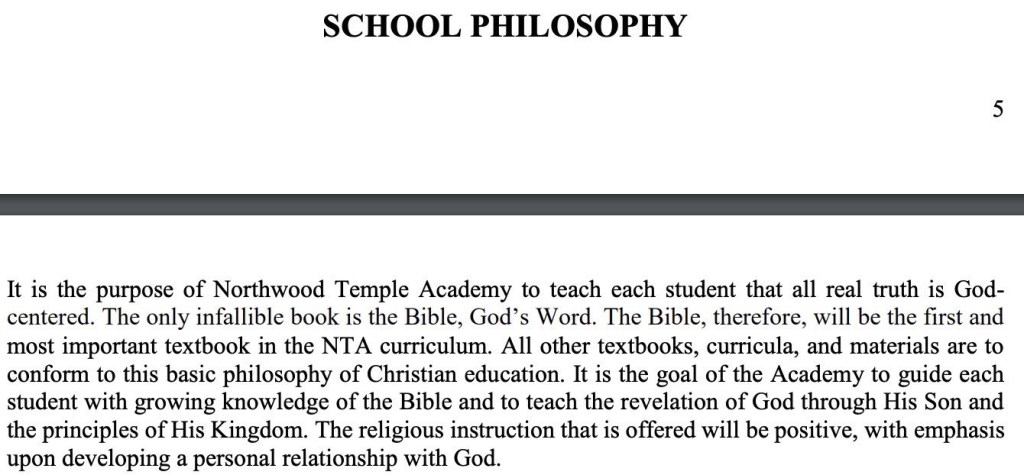
Justin Parmenter, NBCT teacher in North Carolina tweeted that the the state is funding Christian fundamentalist schools with vouchers. He identified on Christian school is not academics but devotion to the words of the Bible.

He tweeted:

Northwood Temple Academy in Fayetteville got more than $1.1 million in NC taxpayer voucher funds this year.

Their school philosophy is “The Bible, therefore, will be the first and most important textbook in the NTA curriculum.”

They should not get public $ #nced #ncga

Greg Olear is a novelist and journalist who writes a blog called PREVAIL. The following post appeared there. I post only part of it. If you want to see his complete list of Leonard Leo’s claque, open the link and continue reading. This is part one of a two-part report.

Greg Olear writes:

He’s one of the most powerful individuals in the country. His spiderweb of connections is extensive. But most Americans, including many working in Washington, have never heard of him.

Occupying the center of an intricate web of political, legal, religious, and business connections, Leonard Leo is the quintessential Man in the Middle, a veritable dark-money spider. Like a spider, he is patient, painstaking, relentless, and much more powerful that he appears. And like a spider, he prefers to stay hidden.

I first wrote about him in February 2021, in a piece called “Leo the Cancer.” Leo, who I described as “a dandier George Constanza, or if The Penguin worked at Jones Day,” has, I explained,

made himself one of the most powerful figures in the United States. He’s put five—count ‘em, five!—justices on the Supreme Court: Amy Coney Barrett, Brett Kavanaugh, Neil Gorsuch, Sam Alito, and John Roberts. A sixth, Clarence Thomas, is one of his closest friends. And, perhaps most impressively, he quietly led the 2016 crusade to deny Merrick Garland a hearing, when Barack Obama nominated the highly-regarded jurist to replace the late Antonin Scalia (another of Leo’s pals). In the lower courts, he’s been even busier. He’s installed so many judges on so many courts, it makes you wonder if he really is the instrument of God’s will he believes himself to be. I mean, there are only three branches of government. One of those three—arguably the most important one—is Leonard Leo’s domain.

When I began researching that piece, I didn’t know much about the guy beyond his silly, comic-book-villain name. I was surprised to discover that he was, like me, a middle-class product of Catholic upbringing and Italian descent who graduated from a public high school in New Jersey—not at all the well-heeled, oenophilic Master of the Universe he has become. He’s also much younger than I expected; born in 1965, he’s solidly Gen X—only seven years older than Yours Truly.

Yet Leonard Leo, somehow, is the individual most responsible for stripping away federal abortion rights. (The anniversary of the odious Dobbs decision was this past weekend.) As his admiring chum Ed Wheelan presciently wrote in 2016, “No one has been more dedicated to the enterprise of building a Supreme Court that will overturn Roe v. Wade than the Federalist Society’s Leonard Leo.”

As Politico reported—and as I outlined on these pages three months ago—Leo has been rewarded handsomely for his troubles. “I personally don’t believe that Leonard is motivated by greed,” Steven Calabresi, who founded the Federalist Society with Leo and still runs the organization, told Politico. “I think Leonard is motivated by ideology and ideas. I do think he likes to live a high-rolling lifestyle, but I don’t think he’s in the business because of the money.”

To be fair, Leo does spread that money around. He endows more organizations than I can succinctly list here. Friends like Ginni Thomas get a taste. He brings his SCOTUS cronies on lavish fishing trips with his billionaire backers. And yet Payoff Lenny—as I call him—has amassed a fortune for himself, and spends that fortune lavishly: on tailored suits, palatial vacation homes in Maine, and bottles of wine that cost more that what most Americans pay for a month’s rent.

Jesus liked wine, yes, and Jesus hung out with fishermen, sure, but I’m not sure the Son of God would approve of Leo’s stockpile of dirty loot—although his fellow Knights of Malta don’t seem to mind. Money washes away a lot of sins, as anyone familiar with the history of the Catholic Churchwell knows.

And so the rich and powerful Leonard Leo presides spider-like over Washington, moving chess pieces across the great board, raising unfathomably vast sums of money, and cultivating his extensive network, which I have attempted to map out here.

Note: Leo has so many connections that it became unwieldy to confine them to a single dispatch. In today’s installment, I will cover the judges, non-profiteers, lawyers, media members, and titled Europeans. Part Two will focus on the billionaire donors, the politicians, and the religious contacts.


Judges

Antonin Scalia (1936-2016), Clarence Thomas (b. 1948), John Roberts (b. 1955), Sam Alito (b. 1950)
Supreme Court justices

Leonard Leo worshiped at the altar of Scalia, has been close with Thomas for decades and regards him as a sort of godfather, and worked maniacally to secure the confirmations of Roberts and Alito. Thomas and Alito, in particular, he remains tight with, as recent reporting by ProPublica has made clear.

Regarding Alito, the author of the dreadful Dobbs decision: in his 2018 Daily Beast piece on Leo, Jay Michelson points out that “few people had heard of [Alito] before Leo first promoted him.” Alas, we’ve all heard of that sneeringly arrogant dickhead now.

To learn more about Leonard Leo’s circle, open the link and keep reading.

Gavin Newsom sent out July 4 greetings with a question: Where do people have true freedom?

Newsom writes:

Happy 4th of July from the Freedom State of California.

Freedom.

While Republicans cry freedom, they dictate the choices that people are allowed to make. Fanning the flames of these exhausting culture wars. Banning abortion, banning books and banning free speech in the classroom and in the boardroom.

But the truth is, true freedom means being able to love the person you love without fear or discrimination.

True freedom means you can afford to get the health care you need without going bankrupt.

True freedom means you can go to a movie, a parade, a church or an elementary school without fear of getting shot.

True freedom is a woman and her doctor making the health care decisions she needs.

True freedom means you don’t have to choose between covering the cost of your utilities or the medicine you need to live.

True freedom means living life without fear that large portions of the planet will be uninhabitable for future generations.

More than any people, in any place, California has bridged the historic expanse between freedom for some, and freedom for all.

Freedom is our essence, our brand name – the abiding idea that right here, anyone from anywhere can accomplish anything.

So with that, I want to wish you and your family a safe, happy and healthy 4th of July from the Freedom State of California.

Thank you,

Gavin Newsom

A reader called Quickwrit posted this comment about the clear intent of the Founding Fathers. Based on the Constitution, the Federalist Papers, and their own writings, the Founding Fathers left no doubt about the role of religion in the new nation. They wanted the government neither to support it or to regulate it, and they wanted everyone to practice their religion without hindrance. They most certainly did not want a “Christian nation” or government subsidy of religion. These are the conditions required for freedom of religion.

Quickwrit wrote:

Freedom from religion

Right in the very First Amendment of our Constitution, our Founding Fathers outlawed religion in American government at any level. Founding Father Thomas Jefferson, primary author of our Declaration of Independence, explained that the Establishment Clause of the First Amendment was written to create “a wall of separation” between our government and any religion. The U.S. Supreme Court holds that the Establishment Clause means that “Neither a state nor the federal government can set up a church. Neither can pass laws which aid one religion or all religions, or prefer one religion over another. Neither can force…a person to go to or to remain away from church against his will or force him to profess a belief or disbelief in any religion.”

Our Founding Fathers also wrote in Article VI of our Constitution that “no religious test shall ever be required as a qualification to any office or public trust under the United States.”

In short, our Constitution was written to remove all religion from our government at any level, while also allowing citizens to practice any religion they want. ANY religion.

Our Founding Fathers refused to even include any mention of God in our Constitution.

Why did our Founding Fathers do this?

George Washington, Thomas Jefferson, Benjamin Franklin and other Founding Fathers and colonists everywhere hated the fact that they had been forced to join the official Christian religion of the British government, the Anglican Church. The penalty for not joining was that the church-controlled British colonial governments would tax their property to the point that would bankrupt them. Our Founding Fathers knew first-hand that a religion-based government led to persecution of anyone who did not share the beliefs of the official government religion. So, they constitutionally banned religion of any kind from every corner of our federal and state governments.

America’s key Founding Fathers — such as George Washington, Thomas Jefferson, and Benjamin Franklin — were NOT CHRISTIANS. They were DEISTS who had been forced to become members of a Christian church. They almost never even used the word “God” but instead used words like “Creator” or “Providence” to refer to what Deists consider to be the Supreme Being.

Thomas Jefferson, whom we honor as the author of our Declaration of Independence, was so greatly angered by the Christian claim that Jesus was God that Benjamin Franklin had to reel him in from publishing a scathing attack on Christianity. So, instead, Jefferson — who admired the social teachings of Jesus — sat down with a New Testament and cut out all references in it to Jesus being God. Then, he published the result as his Bible and it became popular throughout America. The Jefferson non-Christian social Bible also became the official Bible of Congress and for decades was given to each newly-elected member of Congress.

A blog reader who identifies as “Democracy” argues that today’s Republican Party, which prizes individualism over the common good has abandoned the vision of the Founding Fathers.

It appears that Ron DeSantis and the entirety of the Republican Party is in direct opposition to American history and the United States Constitution.

The Founders envisioned a democratic society “in which the common good was the chief end of government.” They agreed with John Locke’s view that the main purpose of government –– the main reason people create government –– is to protect their persons through –– as historian R. Freeman Butts put it –– a social contract that placed “the public good above private desires.” The goal was “a commonwealth, a democratic corporate society in which the common good was the chief end of government.”

The Preamble – the stated purposes – of the Constitution, reads

“We the People of the United States, in Order to form a more perfect Union, establish Justice, insure domestic Tranquility, provide for the common defense, promote the general Welfare, and secure the Blessings of Liberty to ourselves and our Posterity, do ordain and establish this Constitution for the United States of America.”

In Article I, Section 8 of that document, the legislative branch is given broad, specific powers (among them taxing, borrowing money, regulating commerce, coining money and regulating its value, etc.). Indeed, Article I, Clause 1 gives Congress the power to tax for “the common defence and general Welfare of the United States.” Clause 18 of Section 8 stipulates that Congress had the power “To make all Laws which shall be necessary and proper for carrying into Execution the foregoing Powers.”

Two Supreme Court decisions early in the republic’s history –– both unanimous –– supported and cemented a broad – liberal – interpretation of the implied powers of Congress.

Republicans call them “socialism.”

In 1819 (McCullough v. Maryland) the Supreme Court reaffirmed that the U.S. government was “a Government of the people. In form and in substance, it emanates from them. Its powers are granted by them, and are to be exercised directly on them, and for their benefit.”

The Court explicitly reaffirmed that one of the critical purposes of government under the U.S. Constitution is to promote the general welfare “of the people.”

In that case, Chief Justice Marshall wrote this about the necessary and proper clause:

“the clause is placed among the powers of Congress, not among the limitations on those powers.” And he added this: “Its terms purport to enlarge, not to diminish, the powers vested in the Government. It purports to be an additional power, not a restriction.”

In Gibbons v. Ogden (1824) Chief Justice Marshall wrote this about the Congressional commerce power:

“This power, like all others vested in Congress, is complete in itself, may be exercised to its utmost extent, and acknowledges no limitations other than are prescribed in the Constitution.”

The history of the United States, and the Constitution, over time, reflect progressive changes. The American Revolution was a progressive movement inspired by the ideas of Enlightenment thinkers; conservatives opposed it. The early expansion of voting rights to those who didn’t own land was progressive, and conservatives of the day fought
against it. The purchase of the Louisiana Territory, a purchase that doubled the size of the fledgling United States, rested on a liberal interpretation of constitutional authority. U.S. government funding of roads and canals relied on a liberal perspective of Congressional commerce power. Those roads and canals were instrumental to economic growth and prosperity, not unlike federal funding of interstate highways, the Internet, medical research, and health care.

And yet, the Republican Party is filled with people who basically reject all of this in favor of sedition.

As David Blight, Yale professor of American history put it,

“Changing demographics and 15 million new voters drawn into the electorate by Obama in 2008 have scared Republicans—now largely the white people’s party—into fearing for their existence. With voter ID laws, reduced polling places and days, voter roll purges, restrictions on mail-in voting, an evisceration of the Voting Rights Act of 1965, and a constant rant about ‘voter fraud’ without evidence, Republicans have soiled our electoral system with undemocratic skullduggery…The Republican Party has become a new kind of Confederacy.

Obviously, public education has a central – critical – role to play here. Here’s how Will and Ariel Durant explained it in ‘The Lessons of History’ (1968):

“Civilization is not inherited; it has to be learned and earned by each generation anew; if the transmission should be interrupted for one century, civilization would die, and we should be savages again.”