Archives for category: Vouchers

Joshua Q. Nelson wrote a story for FOX News, saying that I was a hypocrite for sending my sons to private schools (more than 50 years ago) and ignoring the fact that I turned against school choice publicly in 2010. His source was Corey DeAngelis, who works for Betsy DeVos. He has attacked me so often on Twitter that I blocked him.

A little bit of research would have shown that I supported school choice from the late 1980s (when charters first emerged) until 2008 (when I started writing a book about my disavowal of conservative education ideology—charters, vouchers, standardized testing, merit pay, and high-stakes accountability).

My change of mind and heart was well covered, not only in The New York Times, but in The Wall Street Journal and other publications). And the book became a national bestseller.

Christina Pushaw, a close aide to Ron DeSantis, amplified the story in her Twitter account, as did the notorious Chris Rufo.

Since the story came out, I have received numerous death threats. Yesterday, I got another one, a long and garbled message with religious allusions, which ended by saying “Yes, we will be ‘slaying Goliath.’ You are Goliath.”

I think Joshua Q. Nelson should be aware that he was played by DeAngelis and correct his story.

Meanwhile, I am flattered that Ron DeSantis and Betsy DeVos and their minions read my tweets and perhaps my blog. I would like to recommend that they read my last three books, where I demonstrate the importance of public schools and the hoax of school choice, which originated as the battle cry of segregationists after the Brown decision.

In a diverse society like ours, public schools bring children from different backgrounds together. They are essential for our democracy. They are the best choice.

Of course, parents are free to make private choices but they should not expect taxpayers to pay for their choice to send their child to a private school that discriminates against others.

Meanwhile, here is a reading assignment for Corey DeAngelis, Christina Pushaw, Chris Rufo, Ron DeSantis, and Betsy DeVos:

https://www.nybooks.com/articles/2021/01/14/the-dark-history-of-school-choice/

And three books:

The Death and Life of the Great American School System: How Testing and Choice Are Undermining Education (2010)

Reign of Error: The Hoax of the Privatization Movement and the Danger to America’s Public Schools (2013)

Slaying Goliath: The Passionate Resistance to Privatization and the Fight to Save America’s Public Schools (2020)

On a personal note: I am 84. I do not fear your threats. I write what I choose. I will not be intimidated.

Over the past few days, I have received a number of hostile tweets, comments on my blog, and Instagram comments, accusing me of hypocrisy because I support public schools but sent my own sons (now ages 60 and 55) to private school. I am touched, even baffled, that anyone is upset by decisions that I made half a century ago.

It was easy to see who inspired these denunciations of me: Christina Pushaw, who is one of Ron DeSantis’ closest aides, and Chris Rufo, the man who led the phony crusade against critical race theory. They seem to think they unearthed a dark secret. That’s absurd. I’m guessing that Governor DeSantis doesn’t like what I write about him in my posts and tweets. I’m flattered.

The question of where my middle-aged sons went to schools is a nothing-burger. For the past decade, my blog bio has said that my two sons went to private school.

Pushaw and Rufo were outraged that I tweeted during “school choice week”:

“The best choice is your local public school. It welcomes everyone. It unifies community. It is the glue of democracy.”

They tweeted their “discovery” that my sons went to private school. The outrage of these two prominent right wingers generated two articles attacking me as a hypocrite.

One appeared on a news site called MEAA.com, titled:

“Who is Diane Ravitch? ‘Hypocrite’ NYU prof who sent her children to private school urges parents to pick public schools”

The article quotes Pushaw’s tweets, as well as tweets from others responding indignantly to my alleged hypocrisy.

The Daily Mail in the U.K. published an unintentionally hilarious article with this title:

“NYU education professor tells parents to send their kids to public school – before being forced to admit she send hers to private schools

It was never a secret that my sons went to private school. I was never “forced to admit” that fact.

Why did I send them to a private school?

After college, I married a New Yorker in 1960 whose family had a long tradition of attending private schools. My husband enrolled in the private Lincoln School in 1936! Like him, our sons went to private schools. When I started my career as a writer, I was conservative. I wrote articles in publications like The Wall Street Journal, Commentary, and The Public Interest. I opposed affirmative action, identity politics, and the Equal Rights Amendment. I believed, like Governor DeSantis, that the law should be colorblind.

However, I was never a racist. I was never contemptuous of public schools, because I had graduated from them and was grateful for the education and teachers I had, and the opportunities they opened for me.

In 1975, I earned a Ph.D. In the history of American Education from Columbia University. I was an adjunct professor at Teachers College from 1976 to 1991, when I left to work in the first Bush administration as Assistant Secretary of Education for Research and serve as Counselor to Secretary of Education Lamar Alexander.

After my stint in the Bush administration, I rejoined the board of the conservative Thomas B. Fordham Foundation and was invited to be a Senior Fellow at the Manhattan Institute (which now employs Chris Rufo) and at the Hoover Institution. All three are very conservative and support school choice, as did I. I even went to Albany on behalf of the Manhattan Institute and testified on behalf of charter legislation in 1998.

When I came back to New York City, Teachers College asked me not to return because of my conservative views. I was hired as an adjunct at New York University, where I was a faculty member from 1995 to 2020, when I retired.

In 2007, after a long and deep immersion in the conservative education world, I began to change my views. I began to realize, based on frank conversations within the conservative think tanks, that charters were no better and possibly worse than public schools unless they cherrypicked their students; that clever entrepreneurs and grifters were using some of them to make millions; that voucher schools were usually ineffective, had uncertified staff, and did not save poor kids; that standardized tests are not valid measures of learning; that the emphasis on tests was actually ruining education by narrowing the curriculum and encouraging teaching to the tests.

The more I reflected on the poor outcomes of conservative policies, the more I doubted the ideas I had long espoused. In 2008, I began writing a book in which I renounced my conservative views. I rejected high-stakes testing, school choice, merit pay, evaluating teachers by their students’ test scores, and the entire corporatist school “reform” agenda.

The book—The Death and Life of the Great American School System: How Testing and Choice Are Undermining Education (Basic Books)—was published in 2010, and it became a national bestseller. My change of mind and change of heart were widely reported in the national media.

Today, I am no longer a conservative. I support equal opportunity and equal justice for all Americans. I am sensitive, as I always have been, to the unjust and inhumane treatment that Black Americans have suffered. I endorse critical race theory, because it is a way of studying and evaluating why racism persists in our society and devising ways to eliminate it. Racism and other forms of hatred are a cancer in our society, and we must end them.

And so, Ms. Pushaw and Mr. Rufo, I hope I have answered your question. I enrolled my youngest child in a private school in 1965 and my second child in 1970 because I was a conservative. A lot happened to me in the years between 1965 and 2023, more than I can put into a tweet. I hope you understand why today I am a passionate advocate for public schools and an equally passionate opponent of public funding for private choices.

From my life experiences and many years as a scholar of education, I have concluded that the public school teaches democracy in a “who sits beside you” way; it teaches students to live and work with others who are different from them. The public school, I realized, is the foundation stone of our diverse society. It deserves public support and funding.

Garry Rayno of InDepthNH reports on opposition to the funding of New Hampshire’s expansive voucher plan, which has never been submitted to a public referendum. A lawsuit has been filed to block the use of public school funds for unaccountable vouchers. The voucher program, serving mostly kids who already attend students in private and religious schools, is far more expensive that its sponsor low-ball projections.

CONCORD — A bill to expand the uses for the state’s Education Trust Fund ran into opposition Friday as opponents said it would give the new Education Freedom Account program a blank check without accountability.

The prime sponsor of House Bill 440, Rep. Glenn Cordelli, R-Tuftonboro, said the bill simply “cleans up and codifies” what is in legislation elsewhere in statutes and comes at the Department of Education’s request. He noted the current trust fund statute does not address money for kindergarten or leases for charter schools.

“This bill clarifies (sections of law),” Cordelli said, “so there is a full picture of what comes out of the Education Trust Fund.”

However, those testifying in opposition at a public hearing Friday before the House Education Committee, said the bill is not a “housekeeping measure” but an attempt to divert millions of dollars to the Education Freedom Account program from public schools without sufficient accountability.

“The program was funded for two years as a pilot program and now you are giving it a blank check,” said David Trumble. “Why take a huge gamble. You built a program with no foundation for it and now you want to build a tall skyscraper on it.”

HB 440 would allow the Education Trust Fund to be used to pay for Education Freedom Account grants to parents and for phase-out grants to school districts losing students to the program.

The bill also changes the funding for the state’s portion for charter school leases from the general fund to the Education Trust Fund.

The Department of Education would be able to use 1 percent of the money in the Education Trust Fund to administer the EFA program, under the bill.

The Legislative Budget Assistant was not able to determine the cost of the changes in the bill because the department had not responded at the time of the bill’s printing, but noted the 1 percent going to the department would be $10.6 million in the current fiscal year, and $11 million in fiscal year 2024 and $11 million in fiscal year 2025.

The use of the fund for the EFA program is being challenged in court as the plaintiffs claim the program uses money earmarked for public education for private programs.

The suit challenging the funding for what has been described as the most expansive voucher program in the country, claims money raised by the Lottery Commission, and money from the Education Trust Fund may only be used for adequate education grants to school districts, citing the law creating the fund in 1999.

The suit, brought by Deb Howes as a citizen taxpayer, who is also president of AFT (American Federation of Teachers)-New Hampshire, seeks an injunction blocking the state from using any more of the Trust Fund Money to fund the EFA program.

Speaking at the public hearing, Howes reiterated her opposition to the bill, saying it is not a housekeeping measure.

“If money is coming out of (the Education Trust Fund),” she said, “does not mean it should be coming out of it.”

Public school and district tax money is not limitless, Howes said, noting it is all coming out of taxpayers pockets.

“When you run short of money,” Howes said, “you are going to shortchange the 160,000 kids in public schools.”

Please open the link to read the rest of the article.

Libby Stanford of Education Week reports on the sudden explosion of voucher legislation in Republican-controlled states. She quotes a spokesman for the Heritage Foundation, who says that school choice is expanding because of parent dissatisfaction with public schools.

But this acceleration is not a consequence of parental dissatisfaction, as the spokesman claims. It is the result of a well-organized, well-orchestrated, lavishly-funded campaign to defame public schools, led by the religious right and such organizations as the Koch network, the Heritage Foundation, The American Legislative Exchange Council, Betsy DeVos’ American Federation for Children, and the front groups they fund, such as Moms for Liberty and Parents Defending Freedom. ALEC undoubtedly prepared model legislation and handed it out to their far-right allies in state legislatures.

None of these funders or their puppet groups are mentioned in the article. It is no accident that multiple red states are debating bills to enact vouchers for private and religious groups or that 75-80% of the voucher funding in every state will end up in the bank accounts of families whose children never attended public schools. The legislation should be characterized as a handout to families whose children never attended public school.

It doesn’t take much digging to understand that the crusade against “critical race theory” (which is taught in graduate classes in law and education, not in K-12), against any mention of homosexuality, against “dangerous” books in school libraries, against fictional children who need litter boxes in the classroom because they think they are cats or dogs—is absurd propaganda designed to discredit public schools and pave the way for public funding of religious schools, which freely discriminate against students and families and openly indoctrinate their students into their dogma.

Instead of identifying the Heritage Foundation as a major player in the war to destroy public education, Stanford quotes its spokesman, who spouts the line that school choice is the result of parent dissatisfaction. What she does not mention is that voucher supporters maneuver to avoid public referenda because they know the public is opposed to vouchers. Right wingers go to great lengths to avoid the word “vouchers” and to quash referenda, because they are afraid of the voters.

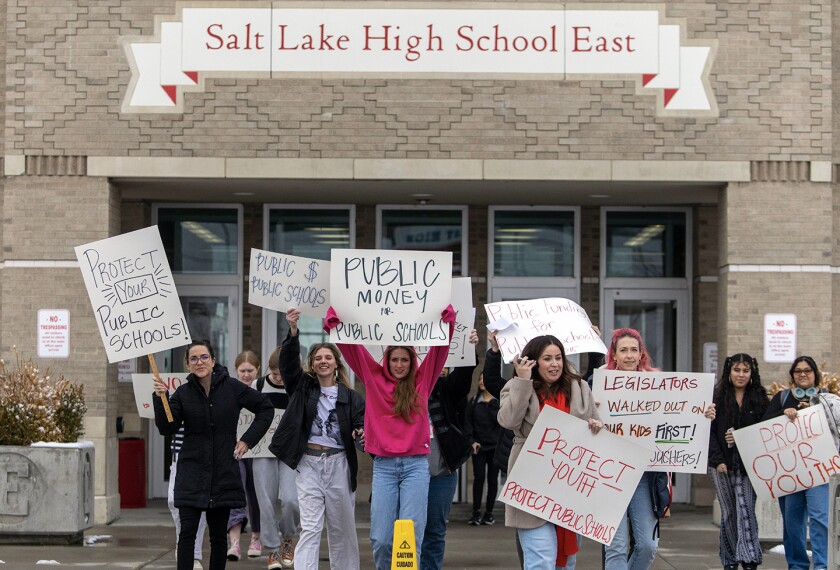
Students and teachers from East High School in Salt Lake City walk out of school to protest the HB15 voucher bill, on Wednesday, Jan. 25, 2023. Several years of pandemic restrictions and curriculum battles have emboldened longtime advocates of funneling public funds to private and religious schools in statehouses throughout the country.

Students and teachers from East High School in Salt Lake City walk out of school on Jan. 25, 2023, to protest legislation that would create private-school vouchers in the state. Several years of pandemic restrictions and curriculum battles have emboldened longtime advocates of funneling public funds to private and religious schools in statehouses throughout the country.

Rick Egan/The Salt Lake Tribune via AP

Stanford begins:

Emboldened by frustrations with pandemic-era policies and battles over what schools are teaching, conservative parents and politicians have accelerated a push for school choice policies that would funnel public funds into private schools.

Though school choice has been debated for decades, the movement is in a unique moment as advocates use parent concerns over COVID-era mask requirements; curriculum addressing race, gender, and sexuality; and library book content to bolster their argument that families should have more options outside of traditional public schools. And the school choice proposals states are considering—and, in some cases, have already passed—are more sweeping than previous iterations.

Already this year, lawmakers in at least 11 states—Idaho, Iowa, Kansas, Missouri, Nebraska, North Dakota, Oklahoma, South Carolina, Texas, Utah, and Virginia—have introduced and, in some cases, passed school choice bills. Although they vary in scope, many of the bills would establish or expand private school voucher and education savings account programs that give families public funds to pay for tuition at private schools, cover the costs of homeschooling, or pay for other schooling expenses.

The resurgence of school choice action shouldn’t come as a surprise. During the 2022 midterm election cycle, 19 Republican gubernatorial candidates advocated for school choice, mostly in the form of vouchers and education savings accounts, on campaign websites. This year, seven governors so far have talked about school choice policies in their state of the state addresses, according to the Education Commission of the States.

The policies are a result of parents’ declining satisfaction with schools following the pandemic, said Jonathan Butcher, an education policy analyst for the Heritage Foundation, a conservative think tank that advocates for school choice policies.

John Thompson, a retired teacher and historian in Oklahoma, has written frequently about events in his state for this blog. Here, he describes the political coercion that determined right-wingers are promoting in Oklahoma and calling it “choice.” From his description, some Republican legislators are worried about “liberal indoctrination,” transgender students using the “wrong” bathroom, litter boxes for children who think they are cats (this seems to be a QAnon idea), and the danger of “social-emotional learning.” Apparently students in Oklahoma have no social or emotional issues.

Ryan Walters, Oklahoma’s newly elected, extreme rightwing Secretary of Education, first says that “the state should have the ‘most comprehensive school choice in the country.’” Secondly, Walters pushes the rightwing Michigan-based Hillsdale College curriculum; he doesn’t want to allow schools to choose to retain research-based curriculums that he identifies as “liberal indoctrination.” As Clark Frailey, executive director of Pastors for Oklahoma Kids, says, Walters seems to be pushing for “Christian Dominionism,” which is “based on the philosophy that Christianity is at the core of America’s foundation and all institutions need to align with that viewpoint. If people won’t convert, then a government religion must be forced upon them.”

Two voucher programs for private schools and homeschools have been filed. The most interesting one is Sen. Shane Jett’s Oklahoma Parent Empowerment Act for Kids (PEAK). Even extremely conservative Republicans legislators worry that vouchers would undermine the finances of their rural schools. Jett seems to be offering a carrot and a stick to those vulnerable constituencies. He would impose vouchers only in counties with a population of more than 10,000 people. But, vouchers would be offered in counties with fewer than 10,000 residents if they are served by a “trigger district.”

The Oklahoman then reports:

Jett defined a “trigger district” as a public school system that allows or tolerates House Bill 1775 violations, use of school bathrooms according to gender identity, anthropomorphic behavior known as “furries,” disparagement of the oil and gas industry, lesson plans promoting social-emotional learning and animal rights activism, among other topics.

In other words, the bill would coerce schools into “choosing” to comply with the entire extremist agenda. But that begs the question about how educators would choose to deal with today’s threats to public education. Republican Sen. Adam Pugh’s newly revealed plan for school improvement was based on meetings with 200 public school superintendents; every college president in Oklahoma; and “hundreds, if not thousands” teachers and parents and advocacy groups.  Based on these listening sessions, Pugh did not propose vouchers.

Pugh’s plan would raise teacher pay so the minimum starting salary was $40,000, “with graduated raises to the minimum salary schedule based on longevity.” The estimated cost would be $241 million, which is less than the cost of Sen. Julie Daniels’ voucher bill ($275 million). They would  also create an “Oklahoma Teacher Corps” and a teacher mentoring system;  provide certain teachers at least 12 weeks of maternity leave; update the school funding formula, and pass Pugh’s seven other constructive reforms. 

As Pugh explained, “I hope this plan will demonstrate to teachers that we’re serious about the work that you do, and we appreciate how you pour your heart and your soul into educating kids, as we need you to stay in the classroom, and we need more of you.”

But, the Stillwater News Press offers an equally important response:

While that offers us a bit of a sigh of relief, Oklahomans should be aware that the push [to] move taxpayer money into private schools isn’t going anywhere. It’s a well-funded campaign and the state’s administrators and board members have been handpicked to make that a top priority.

I’m afraid I agree with the Stillwater News. Pugh’s bills raise hope. But Oklahoma Republicans will continue to coerce schools into compliance with their extremist privatization and Christian Dominionism ideologies – and call it “choice.”

On the other hand, more Republicans sound like they are getting fed up by Walters and his minions. This week, the Secretary of Education was supposed to present a budget to a legislative subcommittee for planning purposes, but a letter obtained by the Tulsa World shows that Walters seems to be prioritizing “ridding public education of ‘liberal indoctrination.’” Walters’ “spokesman” said he “has requested additional information on diversity, equity, inclusion programs (DEI) to fully understand the extent of indoctrination happening in higher education.”

The letter said:

Please provide a full outline and review of every dollar that has been spent over the last 10 years on diversity, equity, inclusion. Additionally, I want an overview of your staffing and the colleges underneath your oversight as the Chancellor of Oklahoma Higher Regents within every DEI program … and expenditures,” Walters wrote on letterhead of the Office of the Secretary of Education. “Lastly, please provide a copy of the materials that are being used in any of these programs.”

Neither has Walters followed legislative norms for presenting a public education budget. As Nondoc reported, Walters said he instituted a hiring freeze and a spending freeze for the State Department of Education when he took office and all related decisions require his approval. And, in addition to demanding vouchers, he has insisted on any teacher pay raise being performance-based. Above all, Walters said he would be bringing a completely different budget than the one his predecessor drafted. 

Republican Toni Hasenbeck (R-Elgin) responded saying, “district superintendents had expressed concern for ‘the next four years’” because of Walters’ campaign comments. Rep. Dell Kerbs, (R-Shawnee) commented, “I don’t need elevator speeches. I need details.” Subcommittee Chairman Mark McBride (R-Moore) understood the argument that performance pay could be a part of teacher pay, but he said that Walters’ plan went too far. And then he tried to get Walters back to the normative procedures which the subcommittee follows for helping craft funding priorities.

McBride “interrupted Walters,” and asked, “Are you saying the budget will totally change — you’re presenting a budget that’s not going to be the same budget, and you’re going to totally change it?”

Nondoc reported that “McBride seemed confused and paused for a moment.” When Walters tried to change the subject, [McBride] interrupted him and asked why Walters was presenting a budget that would not exist in a week. Walters again changed the subject and, as Nondoc reported, “McBride interrupted him again, asking him to stay on topic presenting monetary figures rather than discussing policy and slipping into “campaign rhetoric.” McBride said, “With all due respect, I need the performance review for last year. That’s what you’re here to present.” Then, after that interruption, Walters stopped his presentation.

 After the meeting, Matt Langston, Walters’s “spokesman” (a paid GOP consultant based in Texas) said, “Not one person in Oklahoma is surprised that Democrats are unhappy with the political theater that was orchestrated today.” According to Langston:

They do not want transparency, accountability or even basic reform because they are used to playing in the shadows. Union bosses, whining and liberal tears will not stop education reform, and the superintendent is looking forward to next week’s actual budget hearing.

Stay tuned! When Walters reveals his budget, chaos and vitriol will increase, and we’ll see whether Walters really believes he can implement his promise or “suggestion,” that “received some pushback from lawmakers in 2022,” a ten-year plan to reject all federal spending on education

For Immediate Release: For more information, contact: Carol Burris, NPE Executive Director, 718-577-3276, cburris@networkforpubliceducation.org

PRO-VOUCHER SPECIAL INTERESTS WORK TO FUNNEL PUBLIC FUNDS INTO UNACCOUNTABLE AND EXTREMIST NETWORKS

The Network for Public Education (NPE) calls for the immediate cessation of ESA voucher payments to homeschoolers and all other non-school-based “individualized” instruction programs based on the discovery of an online homeschooling network whose primary purpose is to teach young children to be Nazis. According to the report in the Huffington Post, its numbers thus far are in the thousands, but the greater threat is how its existence exposes the dangers of publicly-subsidized vouchers designed to fund extremist beliefs.  Such programs, including so-called micro-schools, operate with almost no curricular supervision or public fiscal oversight, allowing them to legally indoctrinate children with a distorted hate-filled curriculum directly supported by public funds.

NPE President Diane Ravitch stated, “Our nation fought a World War to defeat Nazism. Public funds should not be used to propagate hatred of our fellow citizens. Public education exists to foster mutual respect among all citizens. Our public dollars should be used to teach the shared values of democracy, especially the rule of law, the equality of every person, the importance of free and fair elections, and the value of education in pursuing a life of dignity and purpose.”

Seven states now fund programs solely supervised by families with no control over whether a sound academic curriculum is taught. Eight states have introduced legislation that would either start or expand such programs. 

“These ESA voucher programs, which are mislabeled as scholarships and saving accounts, have been subject to fraud and abuse,” said Dr. Carol Burris, NPE executive director. “NPE has long held concerns that funded at-home programs might teach children misinformation or a radical curriculum of hate. This Neo-Nazi homeschool network now confirms our deepest fears.”

Many ESA voucher laws do not require the parent to present evidence that the student has learned anything to receive thousands of dollars in public funds.

In states that have adopted voucher plans, the academic results for students who left public schools are “disastrous,” says Josh Cowen, a professor at Michigan State University and a veteran voucher researcher. In addition, 75-80% of voucher funding goes to students already enrolled in private or religious schools. 

NPE also calls on every state to carefully review its homeschool laws. Eleven states do not require homeschoolers to report that their child is homeschooled, making a mockery of state compulsory education laws. No states have laws that would prevent the teaching of hate curricula.

“As more states adopt laws that fund unregulated radical schooling arrangements, we must ensure that children’s emotional and physical well-being are guarded. While we cannot protect children from those parents who would fill their minds and hearts with hate, we can at least ensure that our tax dollars are not supporting such instruction,” Burris concluded.

The use of public funds to support extremist and anti-social agendas, unfortunately, has a long track record for the privatization community, especially as today’s unpopular modern school vouchers being pushed in legislatures across the country have evolved from the segregationist reaction to the Brown v Board of Education Supreme Court ruling.

The Network for Public Education (NPE) was founded in 2013 by Diane Ravitch and Anthony Cody. Its mission is to protect, preserve, promote, and strengthen public schools for current and future generations of students. We share information and research on vital issues that concern the future of public education. For more information, please visit: networkforpubliceducation.org

This post appeared on the Network for Public Education blog. It shows the common theme of vouchers in other states: They subsidize the students who are already enrolled in private schools. The legislation was signed into law by Governor Kim Reynolds.

Ed Tibbetts: Few Iowa families will have more choices with GOP ‘school choice’ plan

Ed Tibbetts substacks at Along the Mississippi. In this op-ed for the Iowa Capital Dispatch, he looks at the true cost of Kim Reynolds’ voucher plan.

He writes:

Iowa Gov. Kim Reynolds says her plan to use taxpayer money to pay for private schooling gives people a choice to educate their kids where they want.

But that’s not what her plan says. Just look at the details: Only certain families with kids in public schools will get that choice.

What this plan really does is pay people who already are sending their kids to private schools.

Like many voucher programs, this one really sticks it to rural taxpayers.

Forty-one counties in Iowa have no private schools, according to the group Common Good Iowa. Another 23 counties only have one private school.

What choice do those kids and their parents have?

Not much.

What Reynolds’ plan really does is take their tax money and send it to families who live somewhere else.

But while this program may have an impact on taxpayers, its impact on students will be meager.

Rural or urban, though, even the governor’s own proposal acknowledges relatively few people will get this money. About 33,000 Iowa kids go to private schools now, and the governor says when her plan is phased in, that number will nudge up to about 38,000.

That’s not much of a change: Just 5,000 kids.

Meanwhile, approximately 500,000 Iowa kids will remain in underfunded public schools.

Do the math: Her plan only pays for 1% of Iowa kids to go from public to private school, but the costs balloon to roughly $340 million a year when phased in – or 9% of the basic state aid going to public schools now.

And like the several voucher plans being rocketed through red state legislatures right now, the Iowa plan is being fast-tracked–quick, before the voters notice!

The plan also is being moved quickly. That’s because the governor knows the longer this lingers, the better people will be able to grasp the consequences. The longer a light is shined on it, the more people realize this plan isn’t supposed to enable them to make a choice, but to pay for people who already have made it.

In the meantime, it sucks money away from the vast majority of public-school students who will remain in classrooms where districts already struggle with rising costs while the state turns a blind eye; in schools where our state spends less per pupil than most other states in the country; in schools where teachers whose salaries lag will eventually go to places where their skills are better rewarded and they aren’t scorned in service of the culture wars.

Read the full piece here. 

You can view the post at this link : https://networkforpubliceducation.org/blog-content/ed-tibbetts-few-iowa-families-will-have-more-choices-with-gop-school-choice-plan/

In a taped conversation, a lobbyist for vouchers in Utah said what everyone suspected: “I can’t say this is a recall of public education, even though I want to destroy public education. I can’t say that. The Legislature can’t say that because they’ll be just scraped over the coals.”

She said the quiet part out loud.

She was supposed to say that vouchers would give every child a chance to get a better education.

She forgot to say that vouchers would enable EVERY child to get a great education “regardless of their zip code.”

She forgot her talking points.

She said what she and her team say when there are no reporters or recorders around. The goal is “to destroy public education.”

When the story was published, the lobbyist apologized for saying what she believed.

Now that Florida is a red state, the legislature plans to offer vouchers to every student. The legislators expect to do maximum damage to public schools, which will inexorably lose funding and students. Nothing has been said about how to pay for the proposal. Voucher schools in the state are mostly religious and are completely unregulated. Neither their principals nor their teachers need to be credentialed. They are also free to discriminate on any grounds.

The Miami Herald reports:

Florida Republican lawmakers this year will consider offering every K-12 student thousands of dollars each year for their families to spend on education.

Parents would have access to state-funded accounts and use them to pay for private school tuition plus a wide variety of school-related expenses.

The proposal, if approved, would make the state’s school voucher program bigger than ever. But one key fact about the pitch remains elusive: its cost. It could total billions of dollars.

House Speaker Paul Renner said last week he plans to make the proposal, House Bill 1, a priority during the annual legislative session, which starts March 7.

The measure is already being fast-tracked. It will have its first committee hearing Thursday morning in Tallahassee.

So far, the measure carries no financial impact statement. That’s despite the knowledge that hundreds of thousands more children would be eligible for annual payments of about $8,000 each.

The cost, according to the staff analysis, is “indeterminate.” And that “is not reasonable,” said Norín Dollard, a senior research analyst at Florida Policy Institute, a nonpartisan organization that focuses on quality of life issues for Floridians. The group issued a report on voucher funding in September.

HUNDREDS OF THOUSANDS NEW STUDENTS WOULD BE ELIGIBLE

About 266,000 Florida children attend private schools without using any current state scholarship or voucher, Dollard notes. All would be eligible for education savings accounts under the proposal. In addition, approximately 150,000 children receive home schooling.

HB 1 would provide accounts to as many as 10,000 of them in the first year, with more to come in following years. Conservative back-of-the-napkin math suggests that if just 25% of the newly eligible students participate, and those currently in the program remain, the added cost would reach $600 million, Dollard said.

As participation grows, the total could approach $4 billion or more within five years, she added. If that’s the policy decision in leadership, so be it, Dollard said. But it needs to be funded somehow.

A RECURRING FINANCIAL OBLIGATION

State Rep. Anna Eskamani, D-Orlando, focused on that issue during a hastily called Monday evening Zoom meeting to discuss the measure with public education advocates.“

“We have very, very serious concerns,” Eskamani said during an interview. “This is an annual shift of money. Where is it coming from?”

When unveiling the measure at a news briefing, Renner said it was too early to know how much money might be needed. Much depends on how many children want to avail themselves of the vouchers, he said, and where the Legislature sets per-student funding for the year.

At the same time, Renner stressed his goal is to further open school choice so “no one is left out.” The bill would eliminate most eligibility restrictions, though it would prioritize children whose family income is at or below 185% of the federal poverty level — or $55,500 for a family of four.

It also would broaden uses of the money beyond private school tuition to include education expenses such as tutoring, testing and college courses. It would allow students to bank up to $24,000 for those uses, and further permit children already attending private schools without state support to request a share of the funds.

“To effectively deliver a quality education, policy makers and education advocates must accept that every student has unique learning needs, that education dollars belong to the student and not a system, and that public school choice offers every student an opportunity to customize their own education,” Renner said Tuesday, when asked about the associated costs.

A SPIKE IN PARTICIPATION IS EXPECTED

Dollard and others said they anticipate wide interest in participation, with much of it coming from families already paying for private schools. In Arizona, which has a similar education savings account program, the state reported 80% of applicants never attended public schools.

That flips the idea of money following the student on its head, Dollard suggested, because those students never had their education covered by state money in the first place.

School district finance officers said they understood the leadership’s position that the details aren’t firm enough to know the full financial impact.

But using the state’s most recent voucher expansion plan as a guide, they had concerns that this initiative would take money away from district budgets and leave them little ability to plan.

That’s what happened the last time the state expanded vouchers in 2021 with the taxpayer-funded Family Empowerment Scholarship. Officials touted the program as adding $200 million for vouchers, allowing 61,000 more children to afford private school.

Districts saw some money go out the door, but nothing like what happened in 2022. Halfway through the 2021-22 school year, school budget officers across the state learned that three times the amount of money they had set aside to send to voucher programs would be required, based on updated attendance figures from the state.

In some counties, such as Pasco, efforts to provide employee raises were derailed as the money officials expected to use was diverted to the vouchers. All told, the cost had grown to $1 billion.

The current year has provided similar sticker shock. The Legislature approved a budget with no specific amount set for the scholarships. By the second education funding calculation in July, the price tag had increased to $1.3 billion.

That meant the Miami-Dade County school district would have to send $225 million from its budget to the voucher program, for example, and the Hillsborough County school district would send $75 million.

When the third calculation came out this week, districts learned they would be losing even more. If the state lifts the eligibility restrictions, Pinellas County Schools chief finance officer Kevin Smith predicted, it will become even more difficult to predict the financial impact.

He suggested the state should at least consider taking the money out of the public education funding program and create a separate line item.

That way, schools would know what to expect and they could budget appropriately. In recent years, the DeSantis administration has taken the position that unexpected changes in enrollment can pose a financial strain on local school districts.

Read more at: https://www.miamiherald.com/news/local/education/article271630112.html#storylink=cpy
This is one of Peter Greene’s finest posts. He explains the real reason that Republicans have fallen in love with vouchers. They want to eliminate public schools and in time shift the financial burden of schools to parents, not taxpayers. One of the loudest voucher advocates, who got his doctorate from the University of Walton….the University of Arkansas’s so-called Department of Educational Reform, where they teach the doctrine of school choice, posted a photograph of himself and a woman whom I assume was his wife at a funeral, celebrating the death of public schools. When we go high, they go low.

Greene writes:

The new wave of voucher bills being rammed through red state legislatures all demonstrate a truth about school voucher policies– vouchers are not about choice. They’re about peeling people away from the public school system in order to defund and dismantle that system.

What makes me think so? Here it is. Sometimes it’s not about what people say, but about what they don’t say.

If the concern were really and truly choice for every student, then voucher fans would be addressing some of the real obstacles to school choice.This door doesn’t lead where they told you it would.

For one, they would be addressing discriminatory and exclusionary policies. Yet when have we ever heard a voucher supporter say, “These discriminatory policies have to stop. LGBTQ+ students deserve just as much school choice as any other students.”

The closest thing we ever get is “Well, then they can start an LGBTQ-friendly school of their own.” Yet when that happens, pro-voucher politicians target that school with terms like “perversion.” And of course in some states, such a school can never happen because talking about LGBTQ students or Black history has been outlawed. And voucher laws are written to hold the private school right to discriminate as it wishes inviolable.

If someone were serious about voucher based choice, they would also address cost. Vouchers are typically far too small to pay for tuition to top schools in the state. If voucher supporters were really interested in making sure that, as Jeb Bush says, “each and every…student can access the education of their choice,” there would be a robust discussion about how to bridge the gap between meager vouchers and expensive schools.

Yet we never hear voucher advocates saying, “We need to find the way to fully fund vouchers so that they provide a real choice to students.” Choice advocates like to point at the inequity of the public system–parent choice is limited by their ability to buy an expensive house in a wealthy neighborhood. But the current crop of voucher programs doesn’t change that a bit–a voucher offers little to change the fact that how much “freedom” you get depends on how wealthy you are.

It has been done. But when Croydon, NH set up a school choice program, a voucher-like system that bore the full cost of sending a student to the school of their choice, local libertarians tried to shut it down because they wanted lower taxes.

Voucher fans love the idea of school choice; they just don’t want to actually pay for it.

If these folks were serious about school choice via vouchers, we would have calls for oversight and accountability. It would make a choice system that much more attractive for parents to know that all the available options have been vetted and screened and will be held to some standards, just like shopping in a grocery store where you can rest easy in near-certainty that whatever you pick, it’s not going to actually poison your family.

And yet not only do voucher fans not call for oversight and accountability, but they actively block it with language that hammers home that nobody can tell vendors what to do or how to do it.

Voucherphiles like to call their system child-centered, but in fact it is vendor-centered, with “protections” for the service providers written into the law, and protections for the students non-existent. Parents are left to navigate an unregulated system of asymmetrical information that favors the businesses– not the families.

Please open the link and finish the post. And while you are at it, subscribe to Peter’s wonderful blog.