Archives for category: U.S. Department of Education

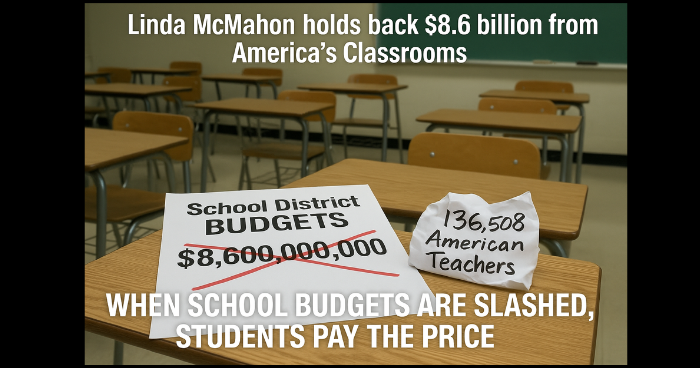
Secretary of Education Linda McMahon has frozen $8.6 billion that Congress appropriated for students this summer. The Administration is supposed to spend the money that Congress authorized and appropriated, not withhold it.

Write Secretary McMahon NOW.

The Network for Public Education urges you to take action!

Open the link and fill out the form to lodge your protest.

#RELEASEFUNDS4SCHOOLS

Just weeks before the school year begins, Secretary of Education Linda McMahon is refusing to release $8.6 billion in federal funds that Congress approved for public schools.

This is more than a funding freeze—it’s a test run for permanent cuts. And unless we act now, our schools will pay the price. Send your letter to Linda McMahon.

2. Email Congress. Even if you’ve written before, send another message.

3. Call the U.S. Department of Education: 1-800-647-8733. Press 5 to report a violation of law regarding the lack of disbursement of approved federal funds by the U.S. Department of Education.  You can leave a message. 

#ReleaseFunds4Schools

TAKE ACTION

FIRST NAME *

LAST NAME *

EMAIL *

STREET ADDRESS *

CITY *

ZIP/POSTAL CODE *

Not in US?

  • Opt in to email updates from Network for Public Education 

Network for Public Education

P.O. Box 227
New York, New York 10156

info@networkforpubliceducation.org
(646) 678-4477

We are a 501 (c)(3). Please make a tax deductible donation to the Network for Public Education.

EIN 35-2532243

Open the link and add your name!!

After the election, I confidently predicted that Trump would never be able to get rid of the U.S. Department of Education. To eliminate a Department required Congressional approval, and I was confident that Trump would never get that. He would need 60 votes, not 51, and he would never get them. There might even be Republicans voting to keep the Department.

But I was wrong. Obviously. It didn’t occur to me that Trump would fire half the staff of the Department and dismantle it without seeking Congressional approval.

Yesterday, the Supreme Court ruled 6-3 that the President could continue to lay off the employees of the Department of Education while leaving aside the legal question of his power to destroy a Department created by Congress 45 years ago. Its ruling allowed him to achieve his goal without consulting Congress or abiding by the Constitution.

Because he wanted to. And because Congress–if asked– would stop him. And because six members of the Court wanted to help him achieve his goal.

Lower courts told him to reinstate those who were fired without cause. Federal Appeals courts agreed with the lower courts. The Supreme Court reversed them and gave Trump what he wanted.

The Republicans in Congress watched supinely, conceding another of their Constitutuinal powers. They had already abandoned their power of the purse. Trump might as well abolish Congress. He doesn’t need their approval. They have disemboweled themselves, with the approval of the Supreme Court.

The Supreme Court majority are extremists. They occasionally hold up a fig leaf and claim to be “originalists” or “textualists,” interpreting the Constitution as it was written. We now see that they are originalists when it suits them, but not originalists when Trump asks them to expand his imperial powers.

The Founders thought they had created a system of checks and balances, where no single branch could control the other two. Trump is the conniving scoundrel that they warned about in the Federalist Papers.

Republicans were not always hostile to the Department of Education. Reagan wanted to abolish it right away, but instead reaped the rewards of a 1983 report called “A Nation at Risk,” which excoriated the nation’s public schools and undermined the public’s faith in them.

Reagan’s successor, his Vice-President George H.W. Bush, did not try to abolish the Department of Education. Instead, he decided to use it to burnish his credentials. After first appointing a little-known president from Texas as Secretary of Education, Lauro Cavazos, President Bush decided that he wanted to be known as “the Education President.” He appointed Tennessee Governor Lamar Alexander as Secretary and convened a gathering of the nation’s governors to set national goals. (Secretary Alexander selected me to become Assistant Secretary in charge of the Department’s research arm).

There was no talk of abolishing the U.S. Department of Education during the term of Bush 1.

When George W. Bush became President in 2000, he never sought to close down the Department. His first piece of legislation was called No Child Left Behind, and he expected the Department to help him build his claim to be “a compassionate conservative.”

Again, no talk of abolishing the Department during the eight years of Bush 2.

When Trump was elected in 2016, abolishing the Department was not on his agenda. He appointed billionaire Betsy DeVos as Secretary, and her goal was to use the Department to fund charters and vouchers. She shoveled nearly $2 billion into the creation and expansion of charters but got nowhere with a federal voucher plan.

And then came Trump’s second term, where he allied himself with the most extreme elements of the Far Right. They were there during Trump 1, but in his second term, the extremists are in charge. By extremists, I mean not only the anti-government billionaires like Peter Thiel, but the entrenched rightwing zealots of what used to be called the John Birch Society. When Trump denounces Democrats as “Communists,” “radical leftwing lunatics,” and other bile, I feel as if I’m time-traveling back to the McCarthy era, when unhinged rightwingers flung such insults at their political opponents.

With the Supreme Court’s approval, Linda MacMahon will resume firing employees of the Departnent of Education and sending its core programs to other departments.

If the Supreme Court ever gets around to deciding whether Trump has the legal authority to abolish the Department of Education, it will already be gone.

Jan Resseger reports on an unprecedented stoppage in federal funding of Congressionally authorized school programs. School districts across the nation were informed on June 30 that the funding for five important programs would be withheld on July 1 pending further review. The administration really would like to terminate the programs but since they can’t do that under current law, they decided to withhold funding for undetermined reasons for an indeterminate length of time.

She writes:

Last week, this blog reported, Chaos and Confusion at U.S. Department of Education May Threaten School Programming this Fall.”  This week the situation intensified.

“The U.S. Department of Education told states in a three-sentence memo on Monday afternoon (June 30) that when federal funding for the next school year arrived July 1, as it typically does and is supposed to under federal law, funding for five key programs would not be there.”  Education Week‘Mark Lieberman published that explanation on Tuesday, July 1, 2025, the day the federal funding failed to arrive.  Lieberman adds: “Those formula programs—worth $6.8 billion in total—are under review, the memo said, without specifying when the review would wrap up, what the review is aiming to determine, or whether the funds will go out once it’s finished.”

The problem is that the funds aren’t merely late; the Trump administration is trying to cancel the programs altogether.  The NY Times‘ Sarah Mervosh and Michael Bender explain: “The administration has suggested that it may seek to eliminate the nearly $7 billion in frozen funding. Russell Vought, the director of the White House Office of Management and Budget, said during a Senate Appropriations Committee hearing last week that the administration was considering ways to claw back the funding through a process known as rescission. The administration would formally ask lawmakers to claw back a set of funds it has targeted for cuts. Even if Congress fails to vote on the request, the president’s timing would trigger a law that freezes the money until it ultimately expires. ‘No decision has been made,’ Mr. Vought said.”

In an article published on Monday afternoon, right after states received the memo declaring that funding would not arrive as scheduled, Education Week‘s Lieberman provides some background: “(I)n an unsigned email message sent after 2 p.m. Monday… the Education Department informed states that the agency won’t be sending states any money tomorrow from the following programs:

  • “Title I-C for migrant education ($375 million),
  • “Title II-A for professional development ($2.2 billion),
  • “Title III-A for English-learner services ($890 million),
  • “Title IV-A for academic enrichment ($1.3 billion),
  • “Title IV-B for before-and after-school programs ($1.4 billion.).”

Lieberman adds: “In a separate email sent (Monday) at 4:27 p.m., the department told congressional staffers that it’s holding back funds from all the programs listed above, as well as grants for adult basic and literacy education ($729 million nationwide). Questions about the changes, the letter says, must go to the Office of Management and Budget, not the Education Department.”

The elimination of these programs had been proposed in the Trump administration’s formal FY 2026 budget proposal for next fiscal year—which, if passed by Congress, would fund public schools beginning in fall 2026. In proposing to cancel the programs this fall, the Trump administration is attempting to eliminate programs already promised under an FY 2025 continuing budget resolution. (To make things even more complicated, it’s important to remember that the “One Big Beautiful” bill is a tax and reconciliation bill and not, in fact, the current year’s FY 2025 federal budget—which remains unaddressed by Congress.)

Last week Mark Lieberman clarified the schedule by which federal public school funding is supposed to be delivered: “The federal fiscal year begins Oct. 1, but for most education programs, half the upcoming year’s allocated funding flows to states each year on July 1. Congress still hasn’t agreed on a final budget for the current fiscal year, even though it’s almost over.  Instead, lawmakers in March approved a continuing resolution bill that broadly carries over funding levels from the previous fiscal year. That means states and schools have been expecting for months that funding levels for key federal programs would closely mirror last year’s numbers. Thousands of school districts and nearly 30 states have already locked in their own budgets for the upcoming fiscal year.”

In his coverage on Monday, June 30, of the complex wrangling behind the holdup of funds for the current school year, Lieberman places responsibility not on Linda McMahon or staff at the Department of Education, but instead on Russell Vought, who was the co-author of the Heritage Foundation’s Project 2025 and who now heads the Office for Management and Budget:

“Lawsuits are likely to follow, as they have for similar funding changes the administration implemented earlier this year. Federal law prohibits the executive branch from withholding congressionally appropriated funds unless it gives federal lawmakers an opportunity to approve or reject the move within 45 days. The U.S. Constitution gives Congress, not the president, the power of the purse—but top administration official Russell Vought, whom Trump appointed to lead the Office of Management and Budget, has said he believes restrictions on impoundment are unconstitutional. On Capitol Hill last week, Vought said the administration hadn’t decided whether to ask Congress for permission to impound education funding.”

Last week, the Washington Post‘Jeff Stein, Hannah Natanson, Carolyn Johnson, and Dan Diamond predicted that Russell Vought will attempt to interfere with spending as the year continues: “Though billionaire Elon Musk’s U.S. DOGE Service drew significant attention for its speedy cuts, Russell Vought, Trump’s budget director, is expected to be key to the coming fight over spending. Vought has spearheaded the administration’s campaign to assert sweeping executive power over spending, arguing that the Impoundment Control Act, the law at issue now, is unconstitutional. The Trump administration has justified its cost-cutting measures by pointing out that the United States is $36 trillion in debt, although the type of funding that officials have targeted represents a small fraction of the overall budget.”

Although costs for federally funded 21st Century Learning Center after-school programs, federally funded professional development programs for teachers, federally funded classes for English language learners in public schools, federally funded programs for the education of the children of migrant workers, and federally funded academic enrichment programs make up only a minute percentage of the federal budget, the abrupt obliteration of these programs will cause enormous disruption right now as public school leaders are getting crucial programming for their schools in place for fall. Public schools are incredibly complex institutions. In addition to providing special services for disabled students, school boards and school leaders patch together local, state, and federal dollars for programming to serve the specific needs of their students, which differ by region, by the income level of a school district’s families, by the primary languages of the families in their communities, and by enormous inequity in states’ investment in public education.

Clearly Russell Vought neither understands nor cares how the programs he is is cutting will affect students. Clearly he fails to grasp how these cuts will interfere with hiring already underway for the upcoming school year or how the absence of these funding streams will undermine the stability of public school operations come September.

On the other hand, say I, maybe Russell Vought knew exactly what it mean to freeze funds at the last minute. Maybe his intent was to sow chaos and disruption. Maybe he wanted to send a message to Congress: we can withhold funds Congress appropriated without regard to the law. Maybe he wanted to send a message to states and school districts: If the program is important to you, pay for it yourself. Stop expecting the federal government to send you money.

Jon Valant is doing a great job as Director of the Brown Center on Education Policy at the Brookings Institution in Washington, D. C. He keeps close tabs on federal legislation. What follows is an excellent analysis of Trump’s legislation to use federal funds to underwrite the privatization of federal education funding. The potential for fraud, waste, and abuse is huge, he writes.

He writes:

  • The Educational Choice for Children Act (ECCA) would create a $5 billion federal tax-credit scholarship program through a tax shelter for wealthy individuals.
  • The bill would provide minimally regulated scholarship-granting organizations with a great deal of discretion over how federal education funds are spent.
  • A hypothetical scenario illustrates the possibility of waste, fraud, and discriminatory behaviors.

The Educational Choice for Children Act (ECCA) continues to move, quietly, towards becoming one of America’s costliest, most significant federal education programs. Now part of the One Big Beautiful Bill Act, ECCA would create a federal tax-credit scholarship program that’s unprecedented in scope and scale. It has flown under the radar, though, and remains confusing to many observers.

Recently, a colleague and I showed how ECCA is poised to redistribute funds from poor and rural communities to wealthy and non-rural communities. A study from the Urban Institute drew similar conclusions. Since those pieces were published, ECCA—then a standalone bill—has passed through the House of Representatives and now moves to the Senate. ECCA’s fate remains uncertain, which makes this as good a time as any to examine its potential implications.

How would ECCA work?

ECCA’s stealthiness is partly due to the confusing nature of tax-credit scholarship programs. These programs move money in circuitous ways to avoid the legal and political hurdles that confront vouchers. Tax-credit scholarship programs like ECCA aren’t quite private school voucher programs, but they’re first cousins.  

In a voucher program, a government gives money (a voucher) to a family, which the family can use to pay for private school tuition or other approved expenses. With a tax-credit scholarship, it’s not that simple. Governments offer tax credits to individuals and/or corporations that donate to scholarship-granting organizations (SGOs). These SGOs then distribute funds (“scholarships”) to families.

The U.S. already has 22 tax-credit scholarship programs, but they’re relatively modest, state-level programs. ECCA is different. ECCA would create a massive, federal tax-credit scholarship program, operating across all 50 states, with a current price tag of about $5 billion in the first year (down from $10 billion in the bill’s earlier draft). It offers an extremely generous tax credit. Individuals get a full, 1:1 tax credit (not just a deduction) for their contributions, which fully offsets their contributions. In other words, these “donors” don’t actually give up any money—hence the quotation marks. On top of that, ECCA allows individuals to donate marketable securities (e.g., stocks) rather than cash. This provides an avenue to treat ECCA as a tax shelter and avoid paying capital gains taxes. More on that in a moment.

Most students would be eligible for a scholarship, with the exception of those from households that earn more than three times their area’s median gross income. (More on that in a moment, too.) The list of qualified expenses covers everything from private school tuition to online educational materials.

Rather than go through all of the bill’s details, let’s take a look at a scenario that illuminates what this program could do. Remarkably, this scenario appears—to my eye, at least—fully compliant with the House bill (even if the characters are a bit overstated).

A hypothetical scenario to illustrate some of ECCA’s risks

A ‘donor’ who benefits from ECCA’s tax shelter

Let’s imagine a billionaire, Billy, who couldn’t care less about K-12 education but cares a whole lot about his own wealth. Billy hears about ECCA from an acquaintance who tells him about how much money Billy could save by “donating” to an SGO. Billy’s adjusted gross income (AGI) was $20 million last year. That means, according to ECCA, that he’s eligible to donate $2 million to an SGO this year (10% of his AGI).

Let’s walk through the math for Billy’s donation. Billy is looking to give $2 million in stock shares to an SGO. He bought these shares a few years ago for $1 million and then they doubled in value. That means that Billy’s earnings are subject to long-term capital gains tax if he sells the stock. With his AGI, that would be 23.8% in federal taxes plus another 4.7% or so in state taxes (depending on where he lives). In other words, if Billy sold the stocks today and kept the funds for himself, he’d owe about $285,000 in combined federal and state taxes on his $1 million in earnings (28.5% of $1 million).

By donating the $2 million in stock to an SGO, not only does Billy get his entire $2 million back as a tax credit; he also dodges those capital gains taxes. He’s a billionaire who is $285,000 wealthier for having made this supposed donation. (For a detailed illustration of how this works—and some nice figures—I’d recommend this piece from the Institute on Taxation and Economic Policy.)

A scholarship-granting organization with extraordinary leeway in how to direct ECCA funds

Now, let’s get back to that SGO. Billy’s acquaintance, Fred, lives in the same town as Billy, which is one of the wealthiest areas in the United States. In fact, Fred set up the SGO, looking to capture ECCA funds within their shared community—and, just maybe, for himself. Like Billy, Fred doesn’t particularly care about K-12 education. He does have a penchant for fraud, though, along with a strong distaste for Republicans.

It might seem that Fred’s SGO couldn’t distribute funds to families in their ultra-wealthy area, since ECCA has income restrictions for scholarship recipients. That’s not the case. ECCA restricts eligibility to households with an income not greater than 300% of their area’s median income. In Fred and Billy’s town, with its soaring household incomes, even multimillionaire families with $500,000 in annual income are eligible. In more modest (and rural) areas, the cutoffs aren’t nearlyso high.

So, Fred is looking to give scholarship money to some wealthy families in his hometown. Notably, ECCA doesn’t limit the amount of money that he can give to any one recipient. ECCA just requires that he provide scholarships to at least two students—who, between them, attend at least two different schools—and that he not earmark the funds for any particular student. Fred offers students $100,000 apiece for supplemental tutoring. That might seem like a lot, but, hey, this is high-end tutoring.

A vendor with little oversight or accountability

In fact, Fred stipulates that the funds must be spent at a new tutoring shop, High-End Tutoring, just created by his buddy, a former teacher. ECCA seems to allow that. ECCA also allows Fred to take a nice cut for himself for running the SGO: 10% of the SGO’s total receipts.

No one really knows the arrangement that Fred and his tutoring friend have, if they have one, because there are hardly any transparency or accountability provisions in ECCA (aside from a requirement to obtain annual financial and compliance audits). We also won’t know if High-End Tutoring provides any educational value, because that’s not part of ECCA either. ECCA’s proponents have claimed there’s accountability to the SGO donors, who want to see their generous donations being put to good use. Billy, though, is enjoying his $285,000 money grab and content to leave Fred alone until it’s time for next year’s donation.

An invitation to discriminate—and an attempt to keep local and state governments from intervening

Fred does have one requirement of his own for High-End Tutoring that he doesn’t need to hide. High-End Tutoring isn’t going to serve any children of Republican parents. All students must complete an attestation form—stating that they and their parents are progressive—before receiving any tutoring services from this publicly funded vendor. Across town, another SGO leader is formally excluding LGBTQ+ children and children of LGBTQ+ parents from their pool of scholarship recipients.

ECCA, in its current form, seems to allow all of this, as objectionable as it may seem. And it’s not just an issue with SGOs funding tutoring companies or other supplemental services. Similar issues could arise with private schools, especially in states without strong anti-discrimination protections.

From hypotheticals to reality

The scenario above might seem ridiculous or caricatured, and to some extent it probably is. But the point is, it’s allowable under the proposed legislation, and we should be realistic about how much fraud, waste, and bad behavior a program like ECCA would invite.

Should we not expect wealthy stockowners to jump at the opportunity to exploit ECCA’s tax shelter? Is it unreasonable to think that many of these wealthy donors will look to benefit their own communities through their donations? Have we not seen bad actors creep in when governments offer large checks with hardly any accountability or strings attached?

This isn’t some tiny, insignificant program either. This is a $5 billion federal program that, because of a “high-use calendar year” provision in ECCA, is almost certain to grow 5% annually. In fact, the cost is likely to be considerably higher than thatdue to the foregone capital gains tax revenue. That’s not quite the size of the behemoth federal K-12 programs—Title I ($18.4 billion in FY 2024) and IDEA ($15.5 billion)—but it’s not all that far off.

And let’s be clear about cost, because ECCA certainly isn’t paid for by the contributions of generous donors. Tax credits are would-be revenue that the IRS is no longer collecting. That money is coming from somewhere else in the budget, whether it’s cuts in education spending, cuts to Medicaid or other social services, tax hikes, or increased debt.

This bill would introduce the most significant and costliest new federal education program in decades. It has virtually no quality-control measures, transparency provisions, protections against discrimination, or evidence to suggest that it’s likely to improve educational outcomes. It’s very likely to redirect funds from poor (and rural) areas to wealthy areas.

And, in its current form, ECCA leaves a whole lot of room for waste, fraud, and abuse.

Secretary of Education Linda McMahon released her budget proposal for next year, and it’s as bad as expected.

Carol Burris, executive director of the Network for Public Education, reviewed the budget and concluded that it shows a reckless disregard for the neediest students and schools and outright hostility towards students who want to go to college.

We know that Trump “loves the uneducated.” Secretary McMahon wants more of them.

Burris sent out the following alert:

Image

Linda McMahon, handpicked by Donald Trump to lead the U.S. Department of Education, has just released the most brutal, calculated, and destructive education budget in the Department’s history.

She proposes eliminating $8.5 billion in Congressionally funded programs—28 in total—abolishing 10 outright and shoving the other 18 into a $2 billion block grant. That’s $4.5 billion less than those 18 programs received last year.

Tell Congress: Stop McMahon From Destroying Our Public Schools

And it gets worse: States are banned from using the block grant to support the following programs funded by Congress:

  • Aid for migrant children whose families move frequently for agricultural work
  • English Language Acquisition grants for emerging English learners
  • Community schools offering wraparound services
  • Grants to improve teacher effectiveness and leadership
  • Innovation and research for school improvement
  • Comprehensive Centers, including those serving students with disabilities
  • Technical assistance for desegregation
  • The Ready to Learn program for young children

These aren’t just budget cuts—they’re targeted strikes

McMahon justifies cutting support for migrant children by falsely claiming the program “encourages ineligible non-citizens to access taxpayer dollars.” That is a lie. Most migrant farmworkers are U.S. citizens or have H-2A visas. They feed this nation with their backbreaking labor.

The attack continues for opportunity for higher education:

  • Pell Grants are slashed by $1,400 on average; the maximum grant drops from $7,395 to $5,710
  • Federal Work-Study loses $1 billion—an 80% cut
  • TRIO programs, which support college-readiness and support for low-income students, veterans, and students with disabilities, are eliminated
  • Campus child care programs for student-parents are defunded

In all, $1.67 billion in student college assistance is gone—wiped out on top of individual Pell grant cuts. 

Send your letter now

And yet, McMahon increased funding for the federal Charter Schools Program to half a billion dollars for a sector that saw an increase of only eleven schools last year. Meanwhile, her allies in Congress are pushing a $5 billion private school and homeschool voucher scheme through the so-called Educational Choice for Children Act (ECCA).

And despite reducing Department staff by 50%, she only cuts the personnel budget by 10%.

This is not budgeting. It is a war on public education.

This is a blueprint for privatization, cruelty, and the systematic dismantling of opportunity for America’s children.

We cannot let it stand.

Raise your voice. Share this letter: https://networkforpubliceducation.org/tell-congress-dont-let-linda-mcmahon-slash-funding-for-children-college-students-and-veterans-to-fund-school-choice/  Call Congress.

Let Congress know that will not sit silently while they dismantle our children’s future.

Thank you for all you do,

Carol Burris

Network for Public Education Executive Director

On May 10, Dana Goldstein wrote a long article in The New York Times about how education disappeared as a national or federal issue. Why, she wondered, did the two major parties ignore education in the 2024 campaign? Kamala Harris supported public schools and welcomed the support of the two big teachers’ unions, but she did not offer a flashy new program to raise test scores. Trump campaigned on a promise to privatize public funding, promote vouchers, charter schools, religious schools, home schooling–anything but public schools, which he regularly attacked as dens of iniquity, indoctrination, and DEI.

Goldstein is the best education writer at The Times, and her reflections are worth considering.

She started:

What happened to learning as a national priority?

For decades, both Republicans and Democrats strove to be seen as champions of student achievement. Politicians believed pushing for stronger reading and math skills wasn’t just a responsibility, it was potentially a winning electoral strategy.

At the moment, though, it seems as though neither party, nor even a single major political figure, is vying to claim that mantle.

President Trump has been fixated in his second term on imposing ideological obedience on schools.

On the campaign trail, he vowed to “liberate our children from the Marxist lunatics and perverts who have infested our educational system.”Since taking office, he has pursued this goal with startling energy — assaulting higher education while adopting a strategy of neglect toward the federal government’s traditional role in primary and secondary schools. He has canceled federal exams that measure student progress, and ended efforts to share knowledge with schools about which teaching strategies lead to the best results. A spokeswoman for the administration said that low test scores justify cuts in federal spending. “What we are doing right now with education is clearly not working,” she said.

Mr. Trump has begun a bevy of investigations into how schools handle race and transgender issues, and has demanded that the curriculum be “patriotic” — a priority he does not have the power to enact, since curriculum is set by states and school districts.

Actually, federal law explicitly forbids any federal official from attempting to influence the curriculum or textbooks in schools.

Education lawyer Dan Gordon wrote about the multiple laws that prevent any federal official from trying to dictate, supervise, control or interfere with curriculum. There is no sterner prohibition in federal law than the one that keeps federal officials from trying to dictate what schools teach.

Of course, Trump never worries about the limits imposed by laws. He does what he wants and leaves the courts to decide whether he went too far.

Goldstein continued:

Democrats, for their part, often find themselves standing up for a status quo that seems to satisfy no one. Governors and congressional leaders are defending the Department of Education as Mr. Trump has threatened to abolish it. Liberal groups are suing to block funding cuts. When Kamala Harris was running for president last year, she spoke about student loan forgiveness and resisting right-wing book bans. But none of that amounts to an agenda on learning, either.

All of this is true despite the fact that reading scores are the lowest they have been in decades, after a pandemic that devastated children by shuttering their schools and sending them deeper and deeper into the realm of screens and social media. And it is no wonder Americans are increasingly cynical about higher education. Forty percent of students who start college do not graduate, often leaving with debt and few concrete skills.

“Right now, there are no education goals for the country,” said Arne Duncan, who served as President Barack Obama’s first secretary of education after running Chicago’s public school system. “There are no metrics to measure goals, there are no strategies to achieve those goals and there is no public transparency.”

I have been writing about federal education policy for almost fifty years. There are things we have learned since Congress passed the Elementary and Secondary Education Act in 1965. That law was part of President Lyndon B. Johnson’s agenda. Its purpose was to send federal funds to the schools enrolling the poorest students. Its purpose was not to raise test scores but to provide greater equity of resources.

Over time, the federal government took on an assertive role in defending the rights of students to an education: students with disabilities; students who did not speak English; and students attending illegally segregated schools.

In 1983, a commission appointed by President Reagan’s Secretary of Education Terrell Bell declared that American schools were in crisis because of low academic standards. Many states began implementing state tests and raising standards for promotion and graduation.

President George H.W. Bush convened a meeting of the nation’s governors, and they endorsed an ambitious set of “national goals” for the year 2000. E.g., the U.S. will be first in the world by the year 2000; all children will start school ready to learn by 2000. None of the goals–other than the rise of the high school graduation rate to 90%–was met.

The Clinton administration endorsed the national goals and passed legislation (“Goals 2000”) to encourages states to create their own standards and tests. President Clinton made clear, however, that he hoped for national standards and tests.

President George W. Bush came to office with a far-reaching, unprecedented plan called “No Child Left Behind” to reform education by a heavy emphasis on annual testing of reading and math. He claimed that because of his test-based policy, there had been a “Texas Miracle,” which could be replicated on a national scale. NCLB set unreachable goals, saying that every school would have 100% of their students reach proficiency by the year 2014. And if they were not on track to meet that impossible goals, the schools would face increasingly harsh punishments.

In no nation in the world have 100% of all students ever reached proficiency.

Scores rose, as did test-prep. Many untested subjects lost time in the curriculum or disappeared. Reading and math were tested every year from grades 3-8, as the law prescribed. What didn’t matter were science, history, civics, the arts, even recess.

Some schools were sanctioned or even closed for falling behind. Schools were dominated by the all-important reading and math tests. Some districts cheated. Some superintendents were jailed.

In 2001, there were scholars who warned that the “Texas Miracle” was a hoax. Congress didn’t listen. In time the nation learned that there was no Texas Miracle, never had been. But Congress clung to NCLB because they had no other ideas.

When Obama took office in 2009, educators hoped for relief from the annual testing mandates but they were soon disappointed. Obama chose Arne Duncan, who had led the Chicago schools but had never been a teacher. Duncan worked with consultants from the Gates and Broad Foundations and created a national competition for the states called Race to the Top. Duncan had a pot of $5 billion that Congress had given him for education reform.

Race to the Top offered big rewards to states that applied and won. To be eligible, states had to authorize the creation of charter schools (almost every state did); they had to agree to adopt common national standards (that meant the Common Core standards, funded wholly by the Gates Foundation and not yet completed); sign up for one of two federally funded standardized tests (PARCC or Smarter Balanced) ; and agree to evaluate their teachers by the test scores of their students. Eighteen states won huge rewards. There were other conditions but these were the most consequential.

Tennessee won $500 million. It is hard to see what, if anything, is better in Tennessee because of that audacious prize. The state put $100 million into an “Achievement School District,” which gathered the state’s lowest performing schools into a new district and turned them into charters. Chris Barbic, leader of the YES Prep charter chain in Houston was hired to run it. He pledged that within five years, the lowest-performing schools in the state would rank among the top 20% in the state. None of them did. The ASD was ultimately closed down.

Duncan had a great fondness for charter schools because they were the latest thing in Chicago; while superintendent, he had launched a program he called Renaissance 2010, in which he pledged to close 80 public schools and open 100 charter schools. Duncan viewed charters as miraculous. Ultimately Chicago’s charter sector produced numerous scandals but no miracles.

I have written a lot about Race to the Top over the years. It was layered on top of Bush’s NCLB, but it was even more punitive. It targeted teachers and blamed them if students got low scores. Its requirement that states evaluate teachers by student test scores was a dismal failure. The American Statistical Association warned against it from the outset, pointing out that students’ home life affected test scores more than their teachers.

Duncan’s Renaissance 2010 failed. It destroyed communities. Its strategy of closing neighborhood schools and dispersing students encountered growing resistance. The first schools that Duncan launched as his exemplars were eventually closed. In 2021, the Chicago Board of Education voted unanimously to end its largest “school turnaround” program, managed by a private group, and return its 31 campuses to district control. Duncan’s fervent belief in “turnaround” schools was derided as a historical relic.

Race to the Top failed. The proliferation of charter schools, aided by a hefty federal subsidy, drained students and resources from public schools. Charter schools close their doors at a rapid pace: 26% are gone in their first five years; 39% in their first ten years. In addition, due to lax accountability, charters have demonstrated egregious examples of waste, fraud, and abuse.

The Common Core was supposed to lift test scores and reduce achievement gaps, but it did neither. Conservative commentator Mike Petrilli referred to 2007-2017 as “the lost decade.” Scores stagnated and achievement gaps barely budged.

So what have we learned?

This is what I have learned: politicians are not good at telling educators how to teach. The Department of Education (which barely exists as of now) is not made up of educators. It was not in a position to lead school reform. Nor is the Secretary of Education. Nor is the President. Would you want the State legislature or Congress telling surgeons how to do their job?

The most important thing that the national government can do is to ensure that schools have the funding they need to pay their staff, reduce class sizes, and update their facilities.

The federal government should have a robust program of data collection, so we have accurate information about students, teachers, and schools.

The federal government should not replicate its past failures.

What Congress can do very effectively is to ensure that the nation’s schools have the resources they need; that children have access to nutrition and medical care; and that pregnant women get prenatal care so that their babies are born healthy.
When Trump promised to shut down the U.S. Department of Education during his campaign, he must have known that he couldn’t close down a department without Congressional approval. Everyone else knew it. He brought in wrestling entrepreneur Linda McMahon as Secretary of Education to preside over the Department’s demise. He never sought Congressional approval.

Elon Musk’s DOGS team did the dirty work, laying off half the Department’s employees, some 1300 people.

The most severely affected offices were the Federal Student Aid office, the Office for Civil Rights, and the Institute for Education Sciences (which oversees federal research and NAEP). The IES was eliminated, leaving future administrations of NAEP in doubt and disemboweling the government’s essential historic role in compiling data about education.

But today a federal judge ruled that the shuttering of ED was wrong and that everyone laid off should be rehired. Bottom line: a President can’t close a Congressionally authorized department by executive order.

WASHINGTON (AP) — A federal judge on Thursday blocked President Donald Trump’s executive order to shut down the Education Department and ordered the agency to reinstate employees who were fired in mass layoffs.

U.S. District Judge Myong Joun in Boston granted a preliminary injunction stopping the Trump administration from carrying out two plans announced in March that sought to work toward Trump’s goal to dismantle the department. It marks a setback to one of the Republican president’s campaign promises.

The injunction was requested in a lawsuit filed by the Somerville and Easthampton school districts in Massachusetts and the American Federation of Teachers, along with other education groups.

In their lawsuit, the groups said the layoffs amounted to an illegal shutdown of the Education Department. They said it left the department unable to carry out responsibilities required by Congress, including duties to support special education, distribute financial aid and enforce civil rights laws.

In his order, Joun said the plaintiffs painted a “stark picture of the irreparable harm that will result from financial uncertainty and delay, impeded access to vital knowledge on which students and educators rely, and loss of essential services for America’s most vulnerable student populations.”

Layoffs of that scale, he added, “will likely cripple the Department.”

Joun ordered the Education Department to reinstate federal workers who were terminated as part of the March 11 layoff announcement.

The Trump administration says the layoffs are aimed at efficiency, not a department shutdown. Trump has called for the closure of the agency but recognizes it must be carried out by Congress, the government said.

The administration said restructuring the agency “may impact certain services until the reorganization is finished” but it’s committed to fulfilling its statutory requirements.

Secretary of Education Linda McMahon announced an increase of $60 million to the Federal Charter Schools Program, bringing the annual total to $500 million to open new charter schools or expand existing ones.

This decision ignored research produced by the Network for Public Educatuon, showing that $1 billion had been wasted on grants to charter schools that never opened; that 26% of federally funded charter schools had closed within their first five years; and that 39% had closed by year 10.

The charter sector has been riddled with waste, fraud, and abuse.

See the following reports:

Charter failures

The Failure of the Federal Charter Schools Program:

CSP https://networkforpubliceducation.org/stillasleepatthewheel/

OIG report on CSP https://oig.ed.gov/reports/audit/effectiveness-charter-school-programs-increasing-number-charter-schools

The National Education Association analyzed Trump ‘s proposed budget and finds that it contains deep cuts and massive support for privatization by promoting vouchers and charter schools. The proposal mirrors Project 2025 by turning Titl 1 for low-income students and IDEA funding into block grants that can be converted to vouchers. The overall goal is to undermine public schools and cut funding.

FY2026 Budget Request Slashes Education Funding, Shortchanges Students

…………………………………………………………………….……….

President Trump’s FY2026 “skinny” budget request to Congress, released on May 2, cuts non-defense domestic spending by 22.6%.  The Department of Education sustains a $12 billion reduction, a cut of approximately 15.3%. 

! Since the President’s budget does not list specific funding requests for every federal program, the 46-page document is a “skinny” budget. Congress ultimately has the power of the purse, but the proposal is a clear signal of the White House’s priorities: a massive 24 percent cut to U.S. domestic spending, and, privitazing our nation’s public education system.  


 The narrative says the budget “maintains full funding for Title I,” but the numbers tell a different story. Title I and 18 unidentified programs are combined to create a single block grant, dubbed the “K-12 Simplified Funding Program,” then that block fund is cut by $4.535 billion cut.


 All seven Individuals with Disabilities Education Act (IDEA) programs are combined to create a single block grant called the “Special Education Simplified Funding Program.” The approach perpetuates the current shortfall—the federal government now covers 13% of special education costs, far short of the 40% Congress promised when the law was passed. 


 Programs slated for elimination include English Language Acquisition (Title III) and the Teacher Quality Partnership, which addresses the teacher shortage through deep clinical practice. 


 The budget shifts costs to states and institutions of higher education to reduce the federal investment in today’s students—our nation’s future leaders and workforce—as much as possible.  


 Regrouping specific, separate programs into block grants, in theory gives states more flexibility on how the money is spent. In reality, block grants usually lead to less funding and less accountability for our most vulnerable students. As the strings attached to the funding are cut, many states could maneuver block grant funds over to private school voucher programs. 


 Amidst these cuts, the proposal calls for investing $500 million, an increase of $60 million, to expand the number of charter schools across the country. Charter schools, along with private school vouchers, drain scarce resources for traditional public schools. 


May 2025

The Trump administration has declared war on Harvard University, for what is now–in the Trump era–the usual reasons: allegedly, that Harvard is not doing enough to stop anti-Semitism (a claim that is opposed by many Jews, who don’t want to be the favorite cause of a hateful, bigoted President); that Harvard engages in the policies of diversity, equity, and inclusion, which have been banned by the Trump administration; and that Harvard engages in “racism” by admitting and hiring nonwhite students and professors. The Trump administration has demanded the power to monitor Harvard’s curriculum, admissions, and hiring. Such a federal takeover is obviously unacceptable to Harvard, as it should be unacceptable to any private institution.

To Harvard and other universities, such a government intrusion would compromise academic freedom and their independence. Frankly, the best characterization of this government takeover of independent private institutions is fascist.

The Trump administration is currently withholding $2.2 billion that is dedicated to medical and scientific research. Does it make sense to punish Harvard’s alleged DEI transgressions by stopping funding for projects seeking cures for tuberculosis and ALS?

Secretary of Education Linda McMahon wrote a condescending, insulting letter to Harvard, warning that it would no longer receive any funding until it accepted Trump’s demands. She posted it on Twitter.

Page 1
Page 2
Page 3

She accused Harvard of “disastrous mismanagement,” snd she warned, “This letter is to inform you that Harvard should no longer seek grants from the federal government, since none will be provided.” Her biggest grievance appears to be that Harvard continues to practice affirmative action despite the Supreme Court banning it. The Trump administration considers any effort to admit or hire people of color to be racism. So the very presence of Black students and professors is evidence that Harvard engages in “ugly racism.”

In her letter, Secretary McMahon rants about Harvard’s abandonment of “merit” and of the excellence for which it was once known.

This stance is ironic, coming from a member of the most unqualified, incompetent Cabinet in modern American history. Was McMahon the best qualified person to be Secretary of Education? Did her experience in the world of wrestling entertainment qualify her to lecture Harvard about academic excellence? Was there no Republican State Commissioner of Education or university president available?

Was Robert F. Kennedy Jr. the best person to run the department of Health and Human Services? Did Pete Hegseth become Secretary of Defense because of his merit?

Various Twitter accounts have posted a copy of her letter with her grammatical errors marked in red pencil. They claim this was Harvard’s response, but it was not.

Harvard responded with a dignified letter to McMahon that restated their intention not to be cowed by her threats, rudeness, and bluster.

The New York Times reported,

In a statement on Monday night, a Harvard spokesperson said the letter showed the administration “doubling down on demands that would impose unprecedented and improper control over Harvard University and would have chilling implications for higher education.”

The statement suggested it would be illegal to withhold funds in the manner Ms. McMahon described.

“Harvard will continue to comply with the law, promote and encourage respect for viewpoint diversity, and combat antisemitism in our community,” the statement said. “Harvard will also continue to defend against illegal government overreach aimed at stifling research and innovation that make Americans safer and more secure.”

I’m betting on Harvard. They are fighting for academic freedom and for freedom from government control of a private institution. They will have the best legal talent. They will be represented by lawyers with sterling conservative credentials.

Harvard will be here long after the Trump administration is a memory, a very bad memory, like the McCarthy era.