Archives for category: Trump

Petula Dvorak of the Washington Post wrote about the efforts by the Trump administration to rewrite American history. Trump wants “patriotic history,” in which evil things never happened and non-white people and women were seldom noticed. In other words, he wants to control historical memory, sanitize it, and restore history as it was taught when he was in school about 65 years ago (1960), before the civil rights movement, the women’s movement, and other actions that changed what historians know and teach.

Dvorak writes:

A section of Arlington National Cemetery’s website highlighting African American military heroes is gone.

Maj. Lisa Jaster was the first woman to graduate from Army Ranger school. But that fact has been scrubbed from the U.S. Army Reserve [usar.army.mil] and Department of Defense websites. [search.usa.gov]

The participation of transgender and queer protesters during the LGBTQ+ uprising at New York’s Stonewall Inn was deleted from the National Park Service’s website [nps.gov] about the federal monument.

And the Smithsonian museum in Washington, which attracts millions of visitors who enter free each year, will be instructed by Vice President JD Vance to remove “improper ideology.”

In a series of executive orders, President Donald Trump is reshaping the way America’s history is presented in places that people around the world visit.

In one order, he declared that diversity, equity and inclusion efforts “undermine our national unity,” and more pointedly, that highlighting the country’s most difficult chapters diminishes pride in America and produces “a sense of national shame.”

The president’s orders have left historians scrambling to collect and preserve aspects of the public record, as stories of Black, Brown, female or LGBTQ+ Americans are blanched from some public spaces. In some cases, the historical mentions initially removed have been replaced, but are more difficult to find online.

That rationale has galvanized historians to rebuke the idea that glossing over the nation’s traumas — instead of grappling with them — will foster pride, rather than shame.

Focusing on the shame, they say, misses a key point: Contending with the uglier parts of U.S. history is necessary for an honest and inclusive telling of the American story. Americans can feel pride in the nation’s accomplishments while acknowledging that some of the shameful actions in the past reverberate today.

“The past has no duty to our feelings,” said Chandra Manning, a history professor at Georgetown University.

“History does not exist to sing us lullabies or shower us with accolades. The past has no obligations to us at all,” Manning said. “We, however, do have an obligation to the past, and that is to strive to understand it in all its complexity, as experienced by all who lived through it, not just a select few.”

That is not to say that the uncomfortable weight of difficult truths isn’t a valid emotion.

Postwar Germans were so crushed by the burden of their people’s past, from the horrors of the Nazi regime to the protection of war criminals in the decades after the war, that they have a lengthy word for processing it: vergangenheitsbewältigung, which means the “work of coping with the past.” It has informed huge swaths of German literature and film and has shaped the physical way European cities create memorials and museums.

America’s version of vergangenheitsbewältigung can be found across the cultural landscape. From films to books to classrooms and museums, Americans are learning more details about slavery in the South, the way racism has affected everything from baseball to health care, and how sexism shaped the military.

Trump, however, looks at the U.S. version of vergangenheitsbewältigung differently.
“Over the past decade, Americans have witnessed a concerted and widespread effort to rewrite our Nation’s history, replacing objective facts with a distorted narrative driven by ideology rather than truth,” said the executive order targeting museums, called “Restoring Truth and Sanity to American History.”

That is what “fosters a sense of national shame,” he says in his order.

Historians take exception to that. “I would argue that it’s actually weird to feel shame about what people in the past did,” Georgetown history professor Katherine Benton-Cohen said.
“As I like to tell my students, ‘I’m not talking about you. We will not use ‘we’ when we refer to Americans in the past, because it wasn’t us and we don’t have to feel responsible for their actions. You can divest yourself of this feeling,’” she said.

Germans also have a phrase for enabling a critical look at their nation’s past: die Gnade der spät-geborenen, “the grace of being born too late” to be held responsible for the horror of the Nazi years.

Benton-Cohen said she honed her approach to this during her first teaching job in the Deep South in 2003, when she emphasized the generational gap between her students and the history they were studying.

“They could speak freely of the past — even the recent past, like the 1950s and 1960s, because they weren’t there,” she said. “They were free to make their own conclusions. It was exciting, and it worked. Many told me it was the first time they had learned the history of the 1960s because their high schools — both public and private — had skipped it to avoid controversy. We did fine.”

Trump hasn’t limited his attempt to control how history is presented in museums or memorials. Among the first executive orders he issued was “Ending Radical Indoctrination in K-12 Schooling.” Another one sought to eliminate diversity, equity and inclusion in the nation’s workplaces, classrooms and museums. His version of American history tracks with how it was taught decades ago, before academics began bringing more diverse voices and viewpoints into their scholarship.

Maurice Jackson, a history professor at Georgetown University who specializes in jazz and Black history, said Black Americans have fought hard to tell their full story.

Black history was first published as “The Journal of Negro History” in 1916, in a townhouse in Washington when academic Carter G. Woodson began searching for the full story of his roots. A decade later, he introduced “Negro History Week” to schools across the United States, a history lesson that was widely cheered by White teachers and students alongside Black Americans who finally felt seen.

“Black history is America’s history,” Jackson said. And leaving the specifics of the Black experience out because it makes some people ashamed gives an incomplete picture of our nation, he said.

After Trump issued his executive orders, federal workers scrambled to interpret and obey them, which in some cases led to historical milestones being removed, or covered up and then replaced.

Federal workers removed a commemoration of the Tuskegee Airmen from the Pentagon website, then restored it. They taped butcher paper over the National Cryptologic Museum’s display honoring women and people of color, then uncovered the display.

Mentions of Harriet Tubman in a National Park Service display about the Underground Railroad were removed, then put back. The story of legendary baseball player Jackie Robinson’s military career was deleted from the Department of Defense website, then restored several days later.

Women known as WASPs risked their lives in military service — training and test pilots during World War II for a nation that didn’t allow them to open a bank account — is no longer a prominent part of the Pentagon’s digital story.

George Washington University historian Angela Zimmerman calls all the activity. which happened with a few keystrokes and in a matter of days, the digital equivalent of “Nazi book burnings.”

In response, historians — some professional, some amateur — are scrambling to preserve information before it is erased and forgotten.

The Organization of American Historians created the Records at Risk Data Collection Initiative, which is a callout for content that is in danger of being obliterated

This joins the decades-long work of preserving information by the Internet Archive, a California nonprofit started in 1996 that also runs the Wayback Machine, which stores digital records.

Craig Campbell, a digital map specialist in Seattle, replicated and stored the U.S. Geological Service’s entire historical catalogue. His work was crowdfunded by supporters.

“Historical maps are critical for a huge range of industries ranging from environmental science, conservation, real estate, urban planning, and even oil and gas exploration,” said Campbell, whose mapping company is called Pastmaps. “Losing access to the data and these maps not only destroys our ability to access and learn from history, but limits our ability to build upon it in so many ways as a country.”

After astronomer Rose Ferreira’s profile was scrubbed from, then returned, to NASA’s website, she posted about it on social media. In response, an online reader created a blog, Women in STEM, to preserve stories such as Ferreira’s.

“Programs that memorialize painful truths help ensure past wrongs are never revived to harm again,” Rep. Steven Horsford (D-Nevada), said on X, noting that presidents are elected to “run our government — not rewrite our history.”

Authoritarian leaders have long made the whitewashing of history a tool in their regimes. Joseph Stalin expunged rivals from historic photographs. Adolf Hitler purged museums of modernist art and works created by Jewish artists, which he labeled “degenerate.” Museums in Mao Zedong’s China glorified his ideology.

While this may be unfamiliar to Americans, Georgetown University history professor Adam Rothman says that in the scope of human history, “these are precedented times.”

It’s not yet clear what the real-world effect of Trump’s Smithsonian order will be or exactly how it will be carried out. Who will determine what exhibits cause shame and need to be removed? What will the criteria be? Will exhibits that discuss slavery, for instance, be eliminated or altered?

“Our nation is an ongoing experiment,” says Manning, the Georgetown history professor, who has written books about the Civil War. “And what helps us do that now in 2024 compared to 1776 is that we do have a shared past.

“Every single human culture depends upon, grows out of, and is shaped by its past,” she said. “It is the past that has shaped all of us, it is our past that contains the bonds that can really hold us together.”

It’s what makes the study — and threat to — American history unique among nations. Benton-Cohen said that is what she sees happen with her students.

“The American striving to realize the democratic faith and all the difficulties it entailed and challenges overcome should inspire pride, not shame,” she said. “If you feel shame, as the kids would say, that’s a ‘you’ problem. That’s why I still fly the flag at my house; I’m not afraid of the American past, I’m alive with the possibilities — of finding common cause, of fighting for equality, of appreciating our shared humanity, of upholding our freedoms.”
Joyce Vance was US Attorney for Northern Alabama and a steady voice of reason. She wonders in this post what it will take to awaken Republicans to Trump’s erosion of the Constitution and our rights.

She writes:

Why doesn’t any of this break through? Why do Republicans still support Trump?

The reporting in The Atlantic on the Signal chain? The voter suppression executive order Trump issued…? The foul-ups in deporting supposed gang members who turn out not to be? Why aren’t Americans out on the streets protesting in massive numbers like we have seen people in other countries doing—Israel, Georgia, Turkey, South Korea, and others? In part, it’s because a large number of people who are Trump supporters just don’t care. Their guy can do anything, and they don’t care. They’ll believe any lie, and they’ll ignore any horrible; they’re all in for Trump for reasons the rest of us still struggle to understand.

The question is, how many of the rest of us are there? By that I mean Americans who, regardless of party affiliation, still care about truth and democracy. Those words are no longer just philosophical notions to be bandied about, an elite construct. They are the reality of what we are fighting a rearguard action to try and save.

Statistics from the last election provide reason for some optimism. Donald Trump won with 49.9% of the popular vote. Although he has claimed he has a mandate for a radical transformation of government, the numbers just don’t back that up. And they don’t suggest there’s a mandate for putting out military information on a Signal chain being used on personal phones, rather than on secured government systems. If there ever truly was a mandate for Trump, the reality is, it’s evaporating day by day as egg prices stay high and people lose their jobs. And now, there’s this, a cavalier disregard for the safety of our troops, lax security with one member of the Signal group apparently in Russia while communications were ongoing, what looks like an effort to do an end run around government records retention procedures.

Will the Atlantic story break through? It should. Trump’s Vice President, his Secretary of Defense, his CIA director, his DNI, all put American pilots in harm’s way. If that’s not enough for Senate Republicans to break ranks with Trump, especially those on subcommittees that have oversight into military and intelligence community operations, it’s hard to imagine what would be.

Why use Signal in the first place when American leaders have some of the most secure communications technology in the world available to them? Is it just for convenience? If so, that’s sloppy, and they should be committing to do better, not arguing over whether the information was classified or not. (But if it looks like a duck…) 

The truth is that by going to Signal, they avoided leaving a paper trail. No annoying records that could be unearthed down the road. Remember Trump’s first impeachment? It came about in large part because after the call where he threatened Ukraine’s president with withholding security aid if he wouldn’t announce his country was investigating Joe Biden for financial misconduct, records of the call were buried inside a classified information system where they didn’t belong. That was what got the ball rolling. It was about trying to hide records of an official call that everyone knew was wrong. 

As far as we know at this point, there was nothing improper about the attack on the Houthis. So why were high-ranking members of the Trump administration communicating off the books? How pervasive is the practice, and who knows/authorizes it? We are a government of the people. Transparency isn’t optional. There are rules about public records that have to be followed, and this president who likes to operate in secret and at the margins of our laws has frequently tried to skirt them.

It’s hard to imagine that the Signal chain for the Houthi attack was just a one-off, that they only went to Signal for this moment. Is this how this new government is operating routinely—off the books, in a hidden fashion designed to avoid scrutiny and accountability? 

It may seem like a minor point with everything else that’s going on, but this is how autocrats work, not how a democracy operates. That’s the danger we are now facing, and this is another marker on the path to tyranny.

Calls are mounting for Hegseth and others to resign. Anyone who would engage in this kind of behavior and then argue that it was not improper rather than apologizing and promising to do better should leave government, whether voluntarily or not. But they should never have been confirmed in the first place. There is a cancer on the heart of the presidency, to quote from the Watergate era, and it’s infecting all of us.

We’re in this together,

Joyce

NPR reported that the Trump administration would review the social media accounts of immigrants to exclude anyone who is anti-Semitic.

As a Jew, it makes me sick to see the Trump administration use “anti-Semitism” as a reason to vilify anyone, be it a university or an immigrant.

Trump’s minions include numerous openly anti-Semitic allies. He’s gotten support from David Duke, Richard Spencer, Nick Fuentes, and Kanye West, all of whom have expressed anti-Semitic views. He should reprimand all the Nazi-loving guys who carry Nazi symbols and chant “The Jews will not replace us.”

And then there’s Elon Musk, who twice gave the Nazi salute at Trump’s inauguration Right hand on heart, then thrust straight out. Elon re-opened Twitter to expressions of anti-Senitism and racism.

I support the First Amendment and oppose efforts to limit free speech.

But I hate hypocrisy. If Trump intends to use anti-Semitism as a reason to scour social media accounts, he should deport his anti-Semitic friends.

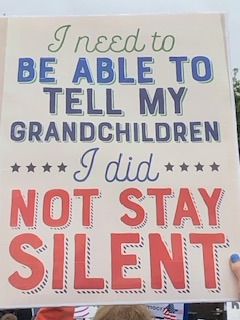
H/T to Erich Martel, former history teacher in D.C. This sign carried in April 5 rally in D.C.

Trump is a performer who plays the part of a businessman. In New York City, he was known for his high-flying lifestyle, his frequent appearances at nightclubs, and his escapades with beautiful women. A businessman? He declared bankruptcy six times. His credit rating was so poor that no American bank would lend him money.

MAD magazine published this Trump cartoon in 1992:

ICE swept up a Maryland man and deported him to the infamous prison in El Salvador for terrorists and hardened criminals. But Abrego Garcia was not a terrorist or a gang member. The Trump administration admitted that his arrest and detention was an “administrative error” but claimed that he could not be returned because he was no longer in U.S. jurisdiction. The lower federal courts ordered the administration to bring him back. The Trump administration objected–unwilling to bring home an innocent victim of their error–and the case went to the Supreme Court. The Supreme Court released a unanimous ruling that seemed to favor the return of Abrego Garcia.

Allison Gill took a close look at the decision and finds many opportunities in its decision to keep Mr. Garcia imprisoned.

She wrote:

It appears to be a victory – that the Supreme Court “unanimously” agrees that the government must “facilitate” the return of Abrego Garcia – the Maryland father that was disappeared to the CECOT torture prison in El Salvador on a government-admitted “administrative error.” 

But the Supreme Court did the wrong thing here by even bothering to weigh in.

The Breakdown is a reader-supported publication. To receive new posts and support my work, consider becoming a free or paid subscriber.

Do you remember in the immunity ruling, when the Supreme Court sent the case back down to Judge Chutkan after they made their “rule for the ages?” They shoved their robes where they didn’t belong because they should have just denied Trump’s application. Remanding it back to the District Court left the door open for Judge Chutkan’s clarification on official acts to be appealed again – all the way back up to the Supreme Court if necessary – so that the supremes could once again have final say over what the lower court had decided. It also had the added bonus of tacking at least another year of delay onto the case – provided the Supreme Court would have let the case live after the second go-round.

In the Abrego Garcia case, the liberal justices say they would have denied Trump’s application outright, leaving the lower court order in place:

Because every factor governing requests for equitable relief manifestly weighs against the Government, Nken v. Holder, 556 U. S. 418, 426 (2009), I would have declined to intervene in this litigation and denied the application in full. (Statement of Justice Sotomayor, with whom Justice Kagan and Justice Jackson join.)

Technically, the ruling is unanimous because the three liberal justices ultimately agree with the court’s ruling, but by intervening instead of denying the application outright, the Supreme Court is asking the District Court to clarify it’s ruling “with due regard” to Trump: 

The rest of the District Court’s order remains in effect but requires clarification on remand.The order properly requires the Government to “facilitate” Abrego Garcia’s release from custody in El Salvador and to ensure that his case is handled as it would have been had he not been improperly sent to El Salvador. The intended scope of the term “effectuate” in the District Court’s order is, however, unclear, and may exceed the District Court’s authority. The District Court should clarify its directive, with due regard for the deference owed to the Executive Branch in the conduct of foreign affairs.

The District Court should clarify its directive, with due regard for the deference owed to the Executive Branch in the conduct of foreign affairsI mean, you could park a truck in that sentence. It might as well say “Hey District Court, go ahead and give it a shot but don’t cross the blurry lines we aren’t going to draw and don’t break the secret rules which we aren’t going to tell you about. See you in a month!” 

Share

They were super vague on their instructions to the lower court in the immunity ruling, too: virtually guaranteeing the case would come before them again. Remember Footnote 3? It was about as clear as mud:

“[a] prosecutor may point to the public record to show the fact that the President performed the official act. And the prosecutor may admit evidence of what the President allegedly demanded, received, accepted, or agreed to receive or accept in return for being influenced in the performance of the act. … What the prosecutor may not do, however, is admit testimony or private records of the President or his advisers probing the official act itself. Allowing that sort of evidence would invite the jury to inspect the President’s motivations for his official actions and to second-guess their propriety. As we have explained, such inspection would be “highly intrusive” and would “ ‘seriously cripple’ ” the President’s exercise of his official duties. … And such second-guessing would threaten the independence or effectiveness of the Executive.”

And just as with the immunity ruling, the Supreme Court will likely get another review of whatever the court orders the Trump administration to do to return Abrego Garcia. Because I’m pretty sure that the government isn’t going to want to do what the lower court tells it to, nor will it be forthcoming with the steps it’s taking to comply with court orders. The Trump administration will say “The Supreme Court told you to have deference for how we conduct foreign affairs. You’re not deferencing enough.”

So yes, it’s awesome that the Supreme Court didn’t outright abandon Abrego Garcia, but now we’re going to potentially drag out the remedy – while a man is wrongfully imprisoned in a gulag – and give the Supremes another at-bat when things don’t go smoothly. The high court should have outright denied the application, just as they should have done in the immunity case. 

Just my two cents. 

~AG

Wisconsin Public Radio reported that State Superintendent Jill Underly has announced that the state will not comply with a letter from U.S. Secretary of Education Linda McMahon in which she directed states to agree with the Trump administration about stamping out diversity, equity, and inclusion. Trump wants to eliminate DEI, which would involve reversing compliance with existing civil rights law. In addition, although McMahon may not know it, she is violating federal law by attempting to influence curriculum and instruction in the schools.

Thank you, Superintendent Underly!

WPR reported:

Wisconsin school districts won’t comply with a directive from the Trump administration to eliminate diversity, equity and inclusion programs until districts have more information.

On Wednesday, state Superintendent Jill Underly asked the U.S. Department of Education for clarification on both the intent and legality of an April 3 directive that schools sign a letter acknowledging they’re following the government’s interpretation of civil rights laws.

Schools were given 10 days to do so, or be at risk of losing Title I funding. The federal government later extended the deadline to April 24. 

This school year, Wisconsin received about $216 million in Title I funds. About $82 million of that money went to Milwaukee Public Schools.

Underly said the request from the Department of Education potentially violates required procedural steps, is unnecessarily redundant and appears designed to intimidate school districts by threatening to withhold critical education funding.

“We cannot stand by while the current administration threatens our schools with unnecessary and potentially unlawful mandates based on political beliefs,” Underly said in a statement. “Our responsibility is to ensure Wisconsin students receive the best education possible, and that means allowing schools to make local decisions based on what is best for their kids and their communities.”

On Feb. 14, the U.S. Department of Education sent a “Dear Colleague” letter giving educational institutions 14 days to eliminate diversity initiatives or risk losing federal funding.

At that time, the state DPI issued guidance to school districts encouraging a “measured and thoughtful approach, rather than immediate or reactionary responses to the federal government’s concerns.”

Secretary of Education Linda McMahon has not clearly defined what the administration considers a violation of civil rights law. The February letter said institutions must “cease using race preferences and stereotypes as a factor in their admissions, hiring, promotion, scholarship.”

In a related document addressing frequently asked questions about how the administration would interpret Title VI of the Civil Rights Act of 1964, the agency said: “Many schools have advanced discriminatory policies and practices under the banner of ‘DEI’ initiatives.” 

The document went on to say that schools could engage in historical observances like Black History Month, “so long as they do not engage in racial exclusion or discrimination.”

Trump is following through on his frequent threats to punish anyone who crossed him in the past. He recently ordered his compliant Attorney General to investigate two men who were critical of him during his first term. Elie Honig, a former federal prosecutor, wrote about the tyrannical nature of this action and about Pam Bondi’s willingness to do whatever he wants.

Honig writes at the website Cafe, a hub for legal experts:

Donald Trump’s presidential payback tour rages on, and now it’s personal. It’s one thing to target multi-billion dollar law firmsuniversities, and media outlets for organizational retribution; those efforts, aimed at stifling and punishing any criticism or dissent, are reprehensible in their own right. But now Trump is going after individual private citizens, using the might of the Executive Branch to potentially throw his detractors in prison.

In a pair of official proclamations – rendered no less unhinged by the use of official fonts and White House letterhead – Trump identifies two targets who worked in the federal government during his first tenure and dared to speak out publicly against him. First: Chris Krebs, who led the Cybersecurity and Infrastructure Security Agency from 2018 to 2020 and made headlines when he publicly contradicted Trump’s false claim that the 2020 presidential election was stolen. For this act of heretical truth-telling, Trump labels Krebs “a significant bad-faith actor” – whatever the hell that means – who poses grave “risks” to the American public. 

And then there’s Miles Taylor, a former Department of Homeland Security official who publicly criticized the President in an anonymous book and various media appearances. Taylor, like Krebs, purportedly poses “risks” to the United States, is a “bad-faith actor” (though apparently not a significant one like Krebs) and “stoked dissension” with his public commentary. 

Are you scared? Don’t you fear the “risks” posed by these two monsters?

 True to the form he has displayed when going after disfavored law firms, Trump hits below the belt. The President orders security clearances stripped not only from Krebs and Taylor but also from everyone who works with them (Krebs at a private cybersecurity firm, Taylor at the University of Pennsylvania). He’s punishing his targets – plus their employers and colleagues, First Amendment freedom of association be darned. 

It gets worse. In a separate set of orders, Trump directed the Attorney General to open criminal investigations of Krebs and Taylor. Notably absent from the orders is any plausible notion that either might have committed a federal crime. This hardly needs to be said, but it’s not a federal crime to be a “bad-faith actor,” to “stoke dissension,” or even to be a “wise guy,” as Trump called Krebs from the Oval Office.

The next move is Pam Bondi’s – and we know how this will go. 

Any reasonable, ethical attorney general would follow the bedrock principle that a prosecutor must have “predication” – some kernel of fact on which to believe a crime might have been committed – to open a criminal investigation. The bar is low, but it serves the vital purpose of preventing precisely the baseless retributive inquests that Trump has now ordered up. In observance of this foundational precept, even Bill Barr – the subject of sharp criticism in my first book, Hatchet Man – generally ignored Trump’s public pleas for the arrests of Barack Obama, Joe Biden, and others. Like the exhausted parent of an unruly toddler, Barr would mostly sit back and let the tantrum pass. 

Don’t count on Bondi taking the same course of passive resistance to the President. She has already shown her true colors, and they’re whatever shade Trump pleases. For example, despite the distinct possibility of criminality by top administration officials around the Signal scandal, the AG refused even to investigate. Instead, she decreed – after zero inquiry, with zero evidence – that information about military attack plans was somehow not classified, and that nobody had acted recklessly. Case closed, no inquiry needed. 

Bondi no longer deserves the benefit of the doubt. She’s in the bag for Trump. The question now is whether she’ll cross the line that even Barr, her crooked predecessor, would not, and use the Justice Department’s staggering investigative power as an offensive weapon. 

Even if DOJ investigates but concludes it cannot bring a criminal charge, the threat to Krebs and Taylor is real. Any criminal inquiry takes an enormous toll on its subject; subpoenas fly, friends and colleagues get pulled into the grand jury, phones get seized and searched, legal costs mount, professional reputations suffer, personal ties fray. Ask anyone who has been investigated by the Justice Department but not indicted. They’ll tell you it’s a nightmare. 

If Bondi does somehow convince a grand jury to indict somebody for something, Trump has unwittingly handed both Krebs and Taylor a potent defense: selective prosecution, which applies where an individual has been singled out for improper purposes. Exhibit A (for the defense): Trump’s own grand proclamations, which openly confess to his personal and political motives for ordering a Justice Department inquiry. Selective prosecution defenses rarely succeed, often because prosecutors typically don’t commit their improper motives to paper. But this would be the rare case where the evidence is so plain – it’s on White House letterhead, signed by the President – that a judge could hardly overlook it.

Trump has long made a habit of threatening his opponents with criminal prosecution through social media posts and by spontaneous outbursts from the lectern. Until now, it was mostly bluster, a public form of scream therapy for the capricious commander-in-chief. But now it’s in writing, from the president to the attorney general, who typically jumps to attention to serve whatever suits the boss, prosecutorial standards be darned. Trump’s dark fantasies are coming to life. 

Elie Honig served as an Assistant U.S. Attorney in the Southern District of New York for 8.5 years and as the Director of the Division of Criminal Justice at the Office of Attorney General for the State of New Jersey for 5.5 years. He is currently a legal Analyst for CNN and Executive Director at Rutgers Institute for Secure Communities

David Sanger wrote an article in the New York Times about Trump’s “Experiment in Recklessness.” His plan is no plan at all. His approach is no more than “burn-it-down-first,” figure what to do later. His article appeared on Wednesday, before Trump announced a 90-day pause in his incomprehensible plan to tax every nation–even uninhabited islands–but exempt Russia, Belarus, North Korea, and Cuba. Even desperately impoverished Lesotho–where the average pay is $5 a day–was subject to Trump’s tariffs.

Our government is run by a cabal of people who are either evil or stupid or both. Probably both. People will die and are dying now because of their actions. Government agencies are being ripped apart. A generation of scientists has been ousted from important jobs in the government and in universities, where their federal grants have been terminated. All federal efforts to address climate change have been cancelled.

Where Trump goes, chaos , destruction and death go with him.

Sanger writes:

As the breadth of the Trump revolution has spread across Washington in recent weeks, its most defining feature is a burn-it-down-first, figure-out-the-consequences-later recklessness. The costs of that approach are now becoming clear.

Administration officials knew the markets would dive and other nations would retaliate when President Trump announced his long-promised “reciprocal” tariffs. But when pressed, several senior officials conceded that they had spent only a few days considering how the economic earthquake might have second-order effects.

And officials have yet to describe the strategy for managing a global system of astounding complexity after the initial shock wears off, other than endless threats and negotiations between the leader of the world’s largest economy and everyone else.

Take the seemingly unmanaged escalation with China, the world’s second largest economy, and the only superpower capable of challenging the United States economically, technologically and militarily. By American and Chinese accounts, there was no substantive conversation between Mr. Trump and China’s top leader, Xi Jinping, or engagement among their senior aides, before the countries plunged toward a trade war.

Last Wednesday, Mr. Trump’s hastily devised formula for figuring out country-by-country tariffs came up with a 34 percent tax on all Chinese goods, everything from car parts to iPhones to much of what is on the shelves at Walmart and on Amazon’s app.

When Mr. Xi, predictably, matched that figure, Mr. Trump issued an ultimatum for him to reverse the decision in 24 hours — waving a red flag in front of a leader who would never want to appear to be backing down to Washington. On Wednesday, the tariff went to 104 percent, with no visible strategy for de-escalation.

If Mr. Trump does get into a trade war with China, he shouldn’t look for much help from America’s traditional allies — Japan, South Korea or the European Union — who together with the United States account for nearly half of the world economy. All of them were equally shocked, and while each is negotiating with Mr. Trump, they seem in no mood to help him manage China.

“Donald Trump has launched a global economic war without any allies,” the economist Josh Lipsky of the Atlantic Council wrote on Tuesday. “That is why — unlike previous economic crises in this century — there is no one coming to save the global economy if the situation starts to unravel.”

The global trading system is only one example of the Trump administration tearing something apart, only to reveal it has no plan for how to replace it.

State Department officials knew that eliminating the U.S. Agency for International Development, the nation’s premier aid agency, would inevitably cost lives. But when a devastating earthquake struck central Myanmar late last month and took down buildings as far away as Bangkok, officials scrambled to provide even a modicum of help — only to discover that the network of positioned aid, and the people and aircraft to distribute it, had been dismantled.

Having dismantled a system that had responded to major calamities before, they settled on sending a survey team of three employees to examine the wreckage and make recommendations. All three were terminated from their jobs even while they stood amid the ruins in the ancient city of Mandalay, Myanmar, trying to revive an American capability that the Department of Government Efficiency — really no department at all — had crippled.

Secretary of State Marco Rubio was unapologetic about the paltry American response when he talked to reporters on Friday: “There are a lot of other rich countries, they should also pitch in and help,” he said. “We’re going to continue to do our part, but it’s going to be balanced with all of the other interests we have as a country.”

Similarly, there was no plan for retrieving a Maryland man who was wrongfully deported to a notoriously dangerous Salvadoran prison, a move a judge called “wholly lawless” and an issue the Supreme Court is expected to take up in the next few days. A Justice Department lawyer in the case was placed on administrative leave, apparently for conceding that the man never should have been sent to the prison.

Mr. Trump has appeared mostly unmoved as the knock-on effects of his policies take shape. He has shrugged off the loss of $5 trillion in the value of the American markets in recent days. Aboard Air Force One on Sunday night, he said: “Sometimes you have to take medicine to fix something.”

To finish reading the article, click here. It should be a gift article.

Friends, we are in a whole lot of trouble. Trump is not a businessman. He played one on TV. He is a performer. He is in way over his head. He called Elon Musk a “genius.” Musk called Trump’s trade advisor Peter Navarro “a moron.” Trump allowed Musk to tear almost every federal agency apart, destroying vital programs and firing essential personnel.

We have to push back as hard as we can. Trump and his minions have retreated on some of their stupid actions (like purging Harriet Tubman and the Jnderground Railroad of its role in helping slaves escape). Little victories like this should encourage wider protests against the chaos that Trump has unleashed. Is he doing it for Putin’s benefit? Does he suffer from dementia?

RESIST! PROTEST! STAND UP AND BE COUNTED!

Trump signed an executive order declaring all state laws that address climate change to be null and void. He claims that efforts to protect the environment are a hindrance to energy production. So ignoring climate change is important to national security because we need oil and gas more than we need clean air and water.

Remember when Trump said he was eliminating the Departnent of Education because states should manage their own schools and the federal government should get out of the way? Why can’t states make decisions about clean air, clean water, and auto efficiency?