Archives for category: Trump

The American Bar Association has filed a lawsuit to stop the Trump administration’s policy of intimidating lawyers and law firms. The article was written by Mimi Rocah, former District Attorney, former prosecutor, and currently law professor. It was posted at Cafe, a blog for legal issues.

She wrote:

Last week, the American Bar Association (“ABA”) filed what can fairly be described as  a bombshell lawsuit in federal court in Washington, D.C. The suit asks the court to declare unconstitutional and stop the Trump administration’s “ongoing unlawful policy of intimidation against lawyers and law firms.” The ABA, a non-partisan non-profit organization founded in 1878, is the nation’s largest voluntary association of legal professionals. It is represented in this case by powerhouse law firm Sussman Godfrey (one of the firms targeted by an executive orderearlier this year). This isn’t just any lawsuit. The complaint names the Office of the President and—in light of the Trump administration’s proclivity to dodge the “who’s responsible” question—every high level government department, along with every cabinet official (the caption goes on for eight pages). The normally staid organization has found its voice on this issue over the past few months, issuing several statements and launching a rule of law initiative, and it does not mince words in this lawsuit, stating, “Today,…the American legal profession faces a challenge that is different from all that has come before. It is unprecedented and uniquely dangerous to the rule of law.”

The complaint explains the administration’s strategy to essentially weaken the legal profession that it sees as a threat to its agenda: “Since taking office earlier this year, President Trump has used the vast powers of the Executive Branch to coerce lawyers and law firms to abandon clients, causes, and policy positions the President does not like.” It has done so “through a series of materially identical executive orders designed to severely damage particular law firms and intimidate other firms and lawyers…; a series of similar ‘deals’ or ‘settlements’ between the Administration and certain law firms in order to avoid such Orders or have them rescinded; other related executive orders, letters, and memoranda. . . and public statements by the President and his Administration publicizing the objectives of the Law Firm Intimidation Policy.” The “attacks on law firms…are thus not isolated events, but one component of a broader, deliberate policy designed to intimidate and coerce law firms and lawyers to refrain from challenging the President or his Administration in court, or from even speaking publicly in support of policies or causes that the President does not like.” Finally, the ABA explains that despite four different district court judges finding the orders blatantly unconstitutional and illegal, the administration’s strategy is ongoing. It cites reporting as recent as June 1st indicating Trump and White House deputy chief of staff Stephen Miller’s interest in keeping threats of more “executive orders on the table because they think it dissuades the best lawyers from representing critics of the administration.” 

Why is the “Law Firm Intimidation Policy” (as dubbed in the lawsuit) so insidious? In a nutshell, it “is uniquely destructive because of the critical role that its targets—lawyers—fulfill in our constitutional system. Without skilled lawyers to bring and argue cases—and to do so by advancing the interests of their clients without fear of reprisal from the government—the judiciary cannot function as a meaningful check on executive overreach.” Even worse, the ABA documents the administration’s strategy having the desired impact. “Even as federal judges have ruled over and over that the Law Firm Orders are plainly unconstitutional, law firms that once proudly contributed thousands of hours of pro bono work to a host of causes—including causes championed by the ABA—have withdrawn from such work because it is disfavored by the Administration, particularly work that would require law firms to litigate against the federal government.” Many law firms are laying low, and “organizations (including the ABA) that have historically relied heavily on top law firms to bring pro bono cases—particularly against the federal government to challenge unlawful executive action—face serious and sometimes existential crises, as those same law firms are declining to represent these organizations.” The complaint cites examples of such instances from particular law firms and, chillingly, does so anonymously in ways reminiscent of a prosecutor’s charging documents against mob families out of real fear of retaliation. As the complaint states, “This threat has a deliberately powerful chilling effect. Already, many firms are declining to take on cases that challenge the administration’s policies. That’s not a side effect of the crackdown. It was the purpose all along.”

The federal judiciary, especially at the district court level, has been the sand in the gears to this administration’s unlawful orders and unconstitutional agenda, which has cast aside due process and the First Amendment in ways never seen before. In May alone, the White House lost 96 percent of its cases before federal district courts, with appointees of both Democrat and Republican presidents curbing the excesses of the Trump regime. As one expert explained, that the “rulings are coming from a stunningly broad array of jurists and many aren’t even being challenged on appeal” is an indication of both the continued need for these legal challenges and also the flimsy legal ground on which the administration stands. But courts cannot adjudicate cases that aren’t brought—and that requires lawyers willing to challenge a retributive and vengeful administration. Our legal system, and the rights of so many individuals and perhaps even our democracy, depend on it. If lawyers are afraid of what will happen to them if they stand up and oppose the government, then the whole system collapses. As the ABA emphasizes in its lawsuit, the judiciary needs to be strong and independent referees, but it needs lawyers willing to play the field.

We will see how this important lawsuit plays out. The case is assigned to Judge Amir Hatem Mahdy Ali who has already drawn the ire of Trump loyalists for daring to rule against the executive order cutting funding for foreign assistance programs administered by the U.S. Agency for International Development. Inevitably, this will likely end up before the Supreme Court. Chief Justice Roberts has talked a good game about judicial independence. Hopefully he and the other justices recognize that such an ideal cannot exist without lawyers able to act free from coercive intimidation by the full force of the presidency. 

Stay Informed, 

Mimi
 

CAFE Contributor Mimi Rocah is the former District Attorney for Westchester County, and previously served as an Assistant U.S. Attorney and Division Chief for the Southern District of New York. She is currently an adjunct professor at Fordham School of Law.
In 2017, when Trump passed his first budget bill, his allies inserted into it an unprecedented tax on institutions of higher education that have large endowments. The tax was 1.4%. But that 1.4%, though it seemed small, was money that would not be available for low-income students at expensive colleges and universities. The next logical step–once the government starts taxing nonprofits– would have been to tax megachurches but that didn’t happen.

This year, the Trump administration has included in its “One Big Ugly Budget Bill” a dramatic increase in the tax on higher education endowments.

Instead of 1.4%, the highest rate would climb to 21%.

This onerous tax would limit colleges’ ability to cover the tuition of students who are fully qualified but lack the financial resources to pay. The inevitable result of this tax will be to restrict the number and size of scholarships.

I received this letter from President Paula A. Johnson of Wellesley College, my alma mater. Dr. Johnson grew up in Brooklyn, where she graduated from a large public high school (Samuel J. Tilden), then to Radcliffe and to Harvard Medical School. She was a cardiologist before she was chosen as Wellesley’s president almost a decade ago. She is dedicated to providing scholarships for students who need them.

She wrote to all alumnae:

It is hard to overstate the importance of this moment for higher education. We are being threatened in previously unimaginable ways that cut to the core of our values and endanger a large proportion of our students. At Wellesley, we are deeply concerned about changes that could affect academic freedom, our need-blind status, and our ability to build a diverse community, one made richer by our international students.  

One of the most significant threats comes from the likelihood of a major increase to the tax on college endowments. Last month, the U.S. House of Representatives passed a budget bill that would raise the tax from 1.4% to as much as 21%. Under this proposal, Wellesley would be taxed at 14%, which means our liability under the tax would increase from $3 million, where it is currently, to $30 million per year—an amount equal to fully funding financial aid for 325 students. 

When you consider that more than two-thirds of the $82 million Wellesley spent last year to support financial aid came from our endowment, the disastrous impact of this tax becomes clear. This is a punitive tax on students and families who need financial aid.

The tax would also have a disproportionate impact on small colleges like Wellesley that, without other revenue streams such as graduate programs or large research budgets, rely on endowments to support their mission.

At Wellesley, 43% of our operating budget comes from the endowment, making it our largest source of revenue. A tax increase would have a severe impact on our academic program and our ability to meet students’ financial needs. In addition, the tax would override the intent of generations of alumnae who have given to the endowment to support financial aid and our academic mission. 

That is why Wellesley has joined a coalition of more than two dozen small colleges and universities from 17 states across the country that together serve more than 50,000 students. The coalition’s core argument, which we are sharing with members of Congress, is that endowments are not a luxury for small colleges; they are essential to continuing our commitments to access, opportunity, and educational excellence for students. 

If this totally unwarranted tax is passed, the number of meritorious students from low-income, even middle-income families would shrink dramatically.

This is wrong.

Raise taxes on corporations and billionaires.

Tax megachurches.

Raise the taxes and tariffs on super yachts.

Don’t tax the endowments of institutions of higher education.

Matt Barnum and Richard Rubin of The Wall Street Journal describe the harm that Trump’s One Big Ugly Budget Bill will do to public schools.

They wrote:

Republicans’ tax-and-spending megabill would give the school-choice movement a major, long-sought victory—and deliver an unusually generous tax break to wealthy taxpayers.

The bill includes a new way for taxpayers—whether they are parents or not—to direct tax dollars to private-school scholarships instead of the Treasury. There is an extra twist: It could deliver virtually risk-free profits to some savvy investors.

The proposal has excited school-choice advocates, infuriated public school leaders and stunned tax experts.

“Overnight, this would give millions of students access to the school of their choice,” said Tommy Schultz, CEO of the American Federation for Children, an advocacy group pushing the provision. “This is a revolution within the tax code.”

The American Federation for Children is the far-right wing group created by Betsy DeVos to promote charter schools and vouchers.

The incentive is structured as a dollar-for-dollar federal tax credit. Give to a charity known as a scholarship-granting organization and you would get the same amount subtracted from your federal tax bill. 

It is equivalent to redirecting your taxes to a scholarship-granting organization (SGO), with the benefit capped at 10% of adjusted gross income or $5,000, whichever is greater. That is a far better deal than what is offered by normal charitable donations, which generally just reduce your taxable income and only if you itemize deductions….

For people with appreciated stock, the proposal could be even more attractive than a dollar-for-dollar credit, potentially creating net profits. 

Consider someone who bought a stock for $100 that is now worth $1,100. Selling that stock would trigger capital-gains taxes of up to $238. But under the bill, he could donate the $1,100 stock to an SGO. The government would give $1,100 back and he wouldn’t pay capital-gains taxes. 

He could then buy the same $1,100 stock on the open market. The result? He’s better off than when he started, spending nothing to erase a potential capital-gains tax liability. 

“In terms of something that is deeply offensive to basic tax logic, it’s hard to beat this,” said Lawrence Zelenak, a law professor at Duke University who expects donors to line up every Jan. 1 to take advantage. “Unless you actively hate the charity, you would want to do it…”

A federal program would expand private-school tuition subsidies into states such as New York and California that have resisted school choice programs….

The House bill caps credits at $5 billion annually, which would climb by 5% in subsequent years if the program is heavily used. That bill would run from 2026 through 2029. The Senate version released Monday includes $4 billion annually, starting in 2027 but without an expiration date. 

The credit would mark a significant injection of resources to private education as the Trump administration separately seeks to cut federal grants for public schools. Still, it would pale in comparison to funding for public schools, which receive several hundred billion dollars annually, mostly from state and local governments. 

Democrats hope the breadth of the policy changes will prompt the Senate parliamentarian to determine that it’s out of bounds for the budgetary fast-track process Republicans are using.

Public school advocates say the program would benefit better-off families at religious private schools. “The federal government needs to fund the neighborhood school that serves children from every walk of life,” said Sasha Pudelski, a lobbyist with the school superintendents’ association.

Opponents also say the idea has been rejected by voters. In November, three states voted down school-choice ballot measures.

Note: not only were vouchers defeated in three states last November, voters have rejected vouchers in every state referendum since 1967.

The new tax credit could become a model for Congress to direct money to other causes through the tax code, said Carl Davis, research director at the Institute on Taxation and Economic Policy, a progressive group that criticizes the plan.

Civil rights laws prohibit certain forms of discrimination in schools that receive federal funding, but it isn’t likely this would apply to private schools that benefit from the proposed tax credit, said Kevin Welner, a research professor at the University of Colorado Boulder. The House bill includes a provision barring discrimination against students with disabilities in school admissions; the Senate version doesn’t. 

State voucher plans do not bar discrimination in voucher-receiving schools. They can and do discriminate at will. Some require that families are members of their faith. Some bar LGBT students and families. Some bar students with disabilities. Some bar students with low test scores.

Trump’s funding of school choice is the fever dream of Christian nationalists. With one blow, they eliminate the separation of church and state, they get funding for religious schools, and they gut civil rights laws that barred discrimination.

It also permits the revival of school segregation, under the once-discredited banner of school choice. White Southerners who don’t like “race mixing” have dreamed of this day since May 17, 1954.

Political cartoonist Ann Telnaes recently won the Pulitzer Prize, specifically for a cartoon that depicted plutocrats prostrating themselves at the feet of Trump. One of them was Jeff Bezos, owner of The Washington Post, who was her boss. Her editor refused to post her cartoon, and she resigned.

open.substack.com/pub/anntelnaes/p/most-deserving

This is her latest.

Voice of America is known worldwide for its straightforward, unbiased presentation of world news. Trump placed MAGA enthusiast Keri Lake in charge. At his behest, she just laid off most of the VOA staff. Remember when America was great? We thought we had a message for the world and that the truth would set us free.

But Trump doesn’t want to “Make America great Again.” He wants to make America a land of bitter divisions, where the rich get richer, and the poor get poorer and sicker, unable to get health insurance, medical care, good schools, or any opportunity to rise into the middle class. For that, you need unions and good jobs.

The New York Times just reported:

The Trump administration sent layoff notices on Friday to more than 600 employees at Voice of America, a federally funded news organization that provides independent reporting to countries with limited press freedom.

The layoffs, known as reductions in force, will shrink the staff count at the news organization to less than 200, around one-seventh of its head count at the beginning of 2025. They put Voice of America journalists and support staff on paid leave until they are let go on Sept. 1.

The termination notices are the latest round of the Trump administration’s attack on federally funded news networks, including Voice of America.

In March, President Trump accused the news group of spreading “anti-American” and partisan “propaganda,” calling it “the voice of radical America.” He then signed an executive order that effectively called for dismantling of the news agency and put nearly all Voice of America reporters on paid leave, ceasing its news operations for the first time since its founding in 1942.

Kari Lake, a fierce Trump ally and a senior adviser at the news organization’s oversight agency, U.S. Agency for Global Media, notified Congress earlier this month that her agency intended to eliminate most positions at Voice of America. Her letter identified fewer than 20 employees who must remain at the media organization, according to laws passed by Congress to establish and fund it. Friday’s termination notices leave around 200 employees.

Ms. Lake’s decision “spells the death of 83 years of independent journalism that upholds U.S. ideals of democracy and freedom around the world,” Patsy Widakuswara, a former Voice of America White House bureau chief who was placed on leave and is leading a lawsuit against Ms. Lake and the U.S. Agency for Global Media, said in a statement.

She encouraged Congress to intervene and to signal support for Voice of America, which was founded to combat Nazi propaganda and reported in countries that suppress independent reporting and free speech.

“Moscow, Beijing, Tehran and extremist groups are flooding the global information space with anti-America propaganda,” Ms. Widakuswara said. “Do not cede this ground by silencing America’s voice.”

Joe Heim of The Washington Post wrote this story about the arrival of a new and temporary sculpture on the National Mall. It has approval to remain until June 22.

An anti-Trump statue has popped up on the National Mall in Washington. (Maxine Wallace/The Washington Post)


Remember the poop statue? The curly-swirly pile of doo that sat atop a replica of former House speaker Nancy Pelosi’s (D-California) desk? The work of protest art placed on the National Mall last October in mock tribute to the Jan. 6 rioters who stormed the U.S. Capitol in an attempt to overturn the 2020 election?

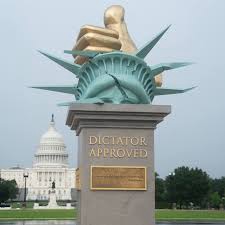
Well, the artists responsible for the political poo plop appear to have struck again. This time with a work called “Dictator Approved,” an 8-foot-tall sculpture showing a gold-painted hand with a distinctive thumbs-up quashing the sea foam green crown of the Statue of Liberty. It sits at the same location on the Mall near Third Street NW as the poop statue did last fall.

The artwork’s creators intended “Dictator Approved” as a rejoinder to the June 14 military parade and authoritarianism, according to a permit issued by the National Park Service. The parade, the creators wrote in the application, “Will feature imagery similar to autocratic, oppressive regime, i.e. N. Korea, Russia, and China, marching through DC.” The purpose of the statue, they continued, is to call attention to “the praising these types of oppressive leaders have given Donald Trump.”

Plaques on the four sides of the artwork’s base include quotes from world leaders including Russian President Vladimir Putin (“President Trump is a very bright and talented man.”), Hungarian Prime Minister Viktor Orban (“The most respected, the most feared person is Donald Trump.”), former Brazilian president Jair Bolsonaro (“We do have a great deal of shared values. I admire President Trump.”) and North Korea’s Kim Jong Un (“Your Excellency.” A “special” relationship. “The extraordinary courage of President Trump.”).

“If these Democrat activists were living in a dictatorship, their eye-sore of a sculpture wouldn’t be sitting on the National Mall right now,” Abigail Jackson, a White House spokeswoman, wrote in an emailed statement. “In the United States of America you have the freedom to display your so-called ‘art,’ no matter how ugly it is.”

Mary Harris is listed as the applicant for the permit but no contact information for her was provided. The permit allows the statue to be in place from 7 a.m. June 16 until 5 p.m. June 22.
The “Dictator Approved” statue is very similar in style and materials to the poop statue and several protest artworks placed in the District, Philadelphia and Portland, Oregon, last fall.

However, no individual or group has publicly claimed responsibility for those pieces. An unidentified caller and emailer told a Washington Post reporter last year that he was part of the group that worked on the sculptures and provided information about them that only someone who had installed the projects would know, such as when the statues would appear.

His identity remains a mystery. On Wednesday he replied to a Washington Post email asking if he was involved with the new statue. “I have heard about it but not me,” he wrote. He did not respond to additional questions or a request to meet in an Arlington parking garage.

Some of the tourists and locals who stopped by the statue between downpours Wednesday afternoon expressed surprise that it was allowed to be placed where it was. And they expressed reservations about weighing in on it publicly.

“I’m amazed that whoever dreamed this up could put this here,” said Kuresa, an 80-year-old from Australia who declined to give his last name because he said as an international visitor he didn’t feel comfortable expressing his views. “It reminds me of ‘Animal Farm.’”

Plaques on the sculpture’s base include quotes from Russian President Vladimir Putin, Hungarian Prime Minister Viktor Orban, former Brazilian president Jair Bolsonaro and North Korea’s Kim Jong Un. (Maxine Wallace/The Washington Post)


District resident and retired federal employee Yvette Hatfield stopped by with her dog Max, wearing an adorable raincoat and rain hat, to get a selfie of both of them in front of the statue. Asked why she wanted a photo, Hatfield laughed. “Because of my political views and that’s all I’m going to say.”


“I actually love it,” said another District resident. He declined to give his name because he said his parents and grandparents often told him “Fools’ names, like their faces, are always seen in public places.” He wished the reporter good luck with the story.


Francesca Carlo, 20, and Abigail Martin, 21, visiting from Cleveland, happened on the statue just before it started to pour.


“At first I was confused,” Martin said, “but then I figured it out. I think it’s beautiful.”


Carlo agreed. She thought the quotes on the plaques could send a message.


“If all these authoritarian politicians approve of our president then maybe people will see a pattern recognition and see where democracy is headed,” she said.

We don’t yet know the rewards and risks of artificial intelligence or its uses in the schools. Yet Trump’s “Big Ugly Budget Bill” creates a special status for AI in the schools and beyond, fending off regulation by states. Lobbyists at work.

There are many damaging aspects of the U.S. House budget bill just passed, but one that has received inadequate attention is a provision imposing a 10-year ban on states or localities from limiting or regulating the use of the artificial intelligence in the classroom and beyond. 

This provision is a naked giveaway to the tech billionaires who want unfettered control and even higher profits for their products. According to some reports, the Senate has now tweaked the language of the House bill, but still proposes punishing any state that attempts to control the use of AI by cutting its funding

The unregulated use of AI in the classroom is a profound threat to student privacy, as these programs collect and commercialize students’ personal data. It is also a threat to the personal connection, feedback and engagement central to a quality education. AI is one of the few technologies whose inventors have warned that it poses a serious risk to humanity itself, including Nobel Prize winner Geoffrey Hinton, often called the godfather of AI.

In a joint letter, more than 200 state legislators expressed their “strong opposition” to any ban on regulating AI, joining a bipartisan coalition of state attorneys general who expressed similar concerns

Please write to your U.S. Senators today, to demand that they eliminate any language from the budget bill that would prevent or dissuade states and localities from passing laws on AI to protect the safety, education and the well-being of our children.  And please share this email with others who care.  Thank you!

Leonie Haimson & Cassie Creswell, co-chairs
Parent Coalition for Student Privacy
124 Waverly Pl.
New York, NY 10011
info@studentprivacymatters.org
www.studentprivacymatters.org
Follow @parents4privacy
Subscribe to Parent Coalition for Student Privacy newsletter at https://www.studentprivacymatters.org/join-us

Trump’s tax cuts for the wealthiest will be funded in large part by draconian cuts to Medicare, which provides insurance to poor people. The massive cuts to Medicaid will lead to closure of many rural hospitals, which rely on Medicaid payments. The Senate knows this, and so-called “moderates” are working on adding a fund for rural hospitals. The bill, which Trump insists must pass by July 4, will add trillions to the nation’s debt.

So for all the cuts and firings imposed by Elon Musk and his DOGS, the federal deficit will grow under Trump.

David Dayen of The American Prospect reports:

As we at the Prospect have reported, while the Senate’s version of the Republican budget reconciliation bill was widely expected to be more moderate than the House one, when it comes to health care it is more extreme. This came as a surprise to many Republicans, some of whom now want changes. And they all are highlighting the same area of concern. It would be “potentially really bad for rural hospitals,” Sen. Josh Hawley (R-MO) told The Wall Street Journal. It’s “going to hurt our rural hospitals and hurt them in a big way,” said Sen. Jim Justice (R-WV). Sen. Susan Collins (R-ME) expressed “concerns about the effect on rural hospitals in her state.”

This is all certainly true. Senate cuts to the provider tax, a way for states to get more federal funding for their Medicaid programs, along with the House cuts that have been analyzed as leading to at least 11 million fewer people on the Medicaid rolls, will deeply harm the 700-plus rural hospitals already at risk of closure.

But that’s too narrow a frame. The entire health care provider network would come under heavy strain, and possibly collapse.

That’s because each node of the system is interdependent. If the 190 rural hospitals estimated in a recent Center for American Progress report as collateral damage of the Republican cuts close, all of their patients must find treatment at the remaining health care providers. Many of these new-arrival patients are likely to be uninsured (many thrown off Medicaid or Obamacare by Republicans), crushing hospital finances and potentially adding more closures on top.

This means overcrowded hospitals and overburdened staff, in addition to the serious hardships for patients traveling long distances for care. “The Republican Senate budget accelerates the rural hospital collapse that is under way, like jet fuel on a fire,” said Alex Lawson of Social Security Works, who works directly on health care issues in Washington. “Hospitals that don’t close will be the ones people drive four hours to access. The quality of everybody’s health care in this country will plummet.”

HOSPITALS HAVE LURCHED FROM ONE CRISIS to the next for years. Between the 2020 COVID pandemic and 2024, 36 rural hospitals closed, on the heels of 136 closures in the previous decade. Another 16 have closed this year, suggesting an acceleration of the trend, and hundreds more are at risk.

If the entire hospital doesn’t close, unprofitable business lines are often shuttered first. “I’ve talked to a lot of hospitals worried about having to close maternity wards,” said Chiquita Brooks-LaSure, who ran the Centers for Medicare & Medicaid Services (CMS) in the Biden administration. In California alone, 56 hospitals have ended maternity care since 2012, and the crisis of maternity deserts is acute.

The situation is worse, Brooks-LaSure said, in states that haven’t expanded Medicaid, suggesting that the program is a lifeline for hospitals, supplying a steady stream of paid claims for insured patients. Indeed, Medicaid is often the biggest line item in the accounts receivable budgets for nursing homes, rural hospitals, and maternity wards, as Families USA’s Anthony Wright pointed out to The Bulwark. A letter to the Republican leadership citing data from the Sheps Center for Health Services Research at the University of North Carolina notes that 213 rural hospitals serve a disproportionately high share of Medicaid patients.

While hospitals sometimes complain about low Medicaid reimbursement rates, the government has in the past compensated for that with “state-directed payment” arrangements that boost levels to what commercial insurance pays. That is being attacked in the Senate Finance Committee version of the bill, cutting those reimbursement top-ups to Medicare levels.

Hospitals are legally required to take care of patients in an emergency, regardless of their ability to pay. And more emergencies occur when more people are uninsured and put off care until they absolutely need it, which are made worse still if patients have to travel for hours to get care. Uncompensated care builds up in states with larger proportions of their populations who are uninsured, severely damaging hospital budgets.

Taking nearly $1 trillion out of the health system will magnify that problem across the country. And Medicaid cuts that create more uninsured patients, along with the creation of potentially millions of uninsured through Affordable Care Act changes, are terrible for hospitals. According to the Robert Wood Johnson Foundation, uncompensated care would increase by $204 billion over the next decade if the House version of the bill passed; remember, the Senate bill is even worse. Much of that burden would be thrown onto already shaky hospitals.

To those who argue that the cuts are really to state Medicaid programs and not hospitals, the ways states will deal with those cuts is not likely to be through simply providing more money that they don’t have. They will either change enrollment rules, so fewer people stay on the program, or cut reimbursement payments to hospitals and other providers. Both of these options would directly harm hospital finances.

“These cuts will strain emergency departments as they become the family doctor to millions of newly uninsured people,” said Rick Pollack, president and CEO of the American Hospital Association, in a statement, adding that “the proposal will force hospitals to reconsider services or potentially close, particularly in rural areas.”

Please open the link to see the full scope of the threat this Big Ugly Bill poses to rural Americans, most of whom voted for Trump.

Heather Cox Richardson describes the legal corruption that is now out in the open.

Yesterday at the meeting of the leaders of the Group of Seven (G7), a forum of democracies with advanced economies, President Donald Trump told reporters: “The UK is very well protected. You know why? Because I like them, that’s why. That’s the ultimate protection.”

Commenters often note that Trump talks like a mob boss, but rarely has his organized-crime style of governance been clearer than in yesterday’s statement.

Also yesterday, Ana Swanson and Lauren Hirsch of the New York Times reported that Trump has taken unprecedented control over U.S. Steel. Japan’s Nippon Steel has been trying to take over U.S. Steel since 2023, but the Biden administration blocked the deal for security reasons. In order to move it forward, Commerce Secretary Howard Lutnick demanded an agreement that gives to the president and his successors, or a person the president designates, a single share of preferred stock, known as class G, or “gold.” The deal gives the president permanent veto power over nearly a dozen actions the company might want to take, as well as power over its board of directors.

Swanson and Hirsch note that the U.S. government historically takes a stake in companies only when they are in financial trouble or when they play a significant role in the economy. “We have a golden share, which I control, or the president controls,” Mr. Trump told reporters on Thursday. “Now I’m a little concerned whoever the president might be, but that gives you total control.”

This kind of deal echoes those of the authoritarians Trump appears to admire. His ongoing support for Russian president Vladimir Putin was on display at the G7, when he echoed Russian talking points that blamed European countries and the United States for Putin’s war against Ukraine, rather than acknowledging that it was Russia that attacked Ukraine after giving assurances that it would respect Ukrainian sovereignty in exchange for Ukraine’s giving up the Soviet nuclear weapons stored there.

Also yesterday, Rene Marsh and Ella Nilsen of CNN reported that officials from the Environmental Protection Agency under Trump have been telling staff in the Midwest—which the authors note has a legacy of industrial pollution—to “stop enforcing violations against fossil fuel companies.” At the same time, the Department of Justice has cut its environmental division significantly, leaving “no one to do the work.”

Trump vowed that if he were reelected he would slash the oil and gas regulations he claims are “burdensome.” Now, one EPA enforcement staffer told Marsh and Nilsen, “The companies are scoffing at the cops. EPA enforcement doesn’t have the leverage they once had.”

Also yesterday, outdoor journalist Wes Siler reported in Wes Siler’s Newsletter that while language inserted in the Republicans’ budget reconciliation bill requires the sale of up to 3.3 million acres of publicly owned land, an amendment authorizes the sale of 258 million acres more over the next five years. The amendment comes from the Senate Energy and Natural Resources Committee and was written by Senators Mike Lee (R-UT) and Steve Daines (R-MT).

It includes Bureau of Land Management and U.S. Forest Service lands in 11 states: Alaska, Arizona, California, Colorado, Idaho, New Mexico, Nevada, Oregon, Utah, Washington, and Wyoming. As Siler notes, while the measure does not currently include national monument lands, the Department of Justice under Trump is arguing that the president can revoke national monument protections. If it did so, that would make another 13.5 million acres available for purchase.

Siler notes the process for selling those lands calls for an enormous rush on sales, “all without hearings, debate, or public input opportunities.”

Today, Eliot Brown of the Wall Street Journal reported that Mukesh Ambani, the richest man in India, is now one of the many wealthy foreign real estate developers “pouring money” into the Trump Organization. Brown noted that the Trump family is aggressively developing its businesses while Trump is in the White House, reaching past real estate into cryptocurrency and other sectors.

The growing power of international oligarchs to use the resources of the government for their own benefit recalls a speech Robert Mueller, then director of the Federal Bureau of Investigation, gave in New York City in 2011. In it, he explained that globalization and modern technology had changed the nature of organized crime. No longer regional networks with a clear structure, he said, organized crime had become international, fluid, and sophisticated, with multibillion-dollar stakes. Its operators were cross-pollinating across countries, religions, and political affiliations, sharing only their greed. They did not care about ideology; they cared about money. They would do anything for a price.

These criminals “may be former members of nation-state governments, security services, or the military,” he said. “They are capitalists and entrepreneurs. But they are also master criminals who move easily between the licit and illicit worlds. And in some cases, these organizations are as forward-leaning as Fortune 500 companies.”

These criminal enterprises, he noted, were working to corner the market on oil, gas, and precious metals. And to do so, Mueller explained, they “may infiltrate our businesses. They may provide logistical support to hostile foreign powers. They may try to manipulate those at the highest levels of government. Indeed, these so-called ‘iron triangles’ of organized criminals, corrupt government officials, and business leaders pose a significant national security threat.”

The FBI’s increasing focus on organized crime and national security is what prompted its interest in the connections between the Trump campaign and Russia in 2016.

The willingness of Republicans to enable Trump’s behavior is especially striking today, since June 17 is the anniversary of the 1972 Watergate break-in. On that day, operatives associated with President Richard M. Nixon’s team tried to tap the headquarters of the Democratic National Committee in Washington’s Watergate complex. Early in the morning of June 17, 1972, Frank Wills, a 24-year-old security guard, noticed that a door lock had been taped open. He ripped off the tape and closed the door, but on his next round, he found the door taped open again. He called the police, who found five burglars in the Democratic National Committee headquarters located in the building.

The story played out over the next two years with Nixon insisting he was not involved in the affair, but in early August 1974 a tape recorded just days after the break-in revealed Nixon and an aide plotting to invoke national security to protect the president. Republican senators who had not wanted to convict their president of the charges of impeachment being considered in the House knew the game was over. A delegation of them went to the White House to tell Nixon they would vote to convict him.

On August 9, 1974, Nixon became the first president in U.S. history to resign.

Chris Geidner of LawDork notes that despite the lawmakers in our own era who are unwilling to stop Trump, “the pushback…is very real.” Geidner notes not just the No Kings Day protests of the weekend, but also a lawsuit by the American Bar Association (ABA) suing Trump for his attacks on law firms and lawyers, calling Trump’s actions “unprecedented and uniquely dangerous to the rule of law.”

Geidner also notes that lower court judges are upholding the Constitution, and he points especially to U.S. District Judge William Young, an appointee of Republican president Ronald Reagan. In a hearing yesterday, Young insisted on holding the government accountable “for both Trump’s actions and the follow-up actions from those Trump has empowered to act.”

Young called cuts to funding for National Institutes of Health research grants “illegal” and “void” and ordered the NIH to restore the funds immediately. “I am hesitant to draw this conclusion—but I have an unflinching obligation to draw it—that this represents racial discrimination and discrimination against America’s LGBTQ community. That’s what this is. I would be blind not to call it out. My duty is to call it out.”

“I’ve never seen a record where racial discrimination was so palpable,” Young said during the hearing. “I’ve sat on this bench now for 40 years. I’ve never seen government racial discrimination like this.” He added: “You are bearing down on people of color because of their color. The Constitution will not permit that.… Have we fallen so low? Have we no shame?”

I have always thought there was something fishy about Trump’s win last November. When Elon Musk broke up with Trump, he said boldly that Trump would have not won the election without his help, and the Democrats would now control the House. What kind of help did he refer to? I wondered if this was an unintended admission. Of course, he can’t say more because it’s illegal to interfere to change the outcome of an election.

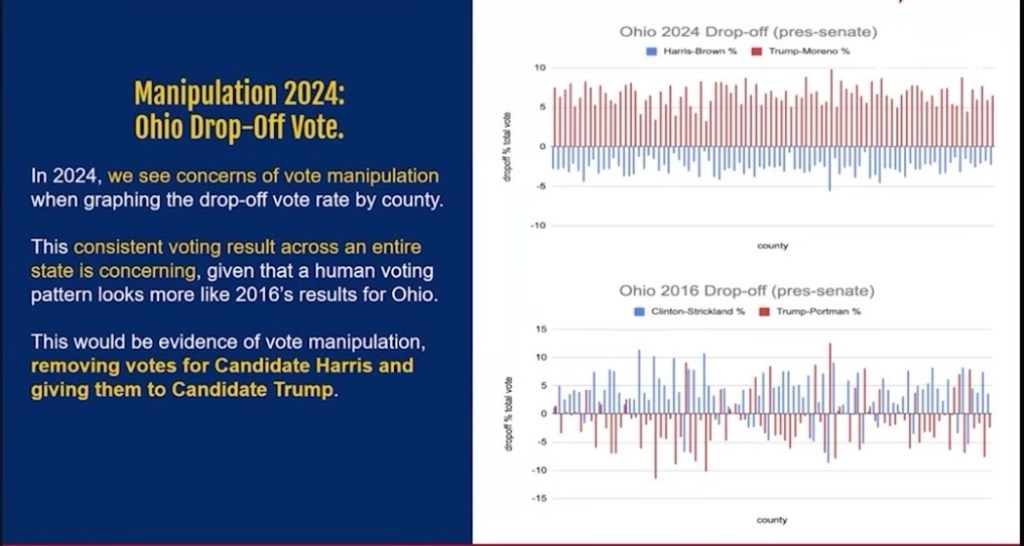
But then I read this analysis on Substack, and it opened up the issue. There’s a lawsuit right now in Rockland County, New York, based on claims by voters that their votes were not counted. How do we know? In some districts, hundreds of votes were counted for Democratic Senator Kirsten Gillibrand, but zero votes for Kamala Harris. To call this a statistical anomaly is an understatement.

Snopes reviewed the case and came down on the side of more evidence is needed. Maybe there were districts where no one voted for Harris, because they were orthodox Jewish districts and everyone followed their rabbi’s endorsement. Maybe not, because there were districts that were not Hasidic where she got zero votes.

Please open the link to read additional stories tied to this one. Also, look up the meaning of the term “Dark Enlightenment.” It refers to the reactionary ideology of Curtis Yarvin, whose admirers include billionaire Peter Thiel and his protege JD Vance.

The Dark Enlightenment Coup

The missing votes uncovered in Smart Elections’ legal case in Rockland County, New York, are just the tip of the iceberg—an iceberg that extends across the swing states and into Texas.

On Monday, an investigator’s story finally hit the news cycle: Pro V&V, one of only two federally accredited testing labs, approved sweeping last-minute updates to ES&S voting machines in the months leading up to the 2024 election—without independent testing, public disclosure, or full certification review.

These changes were labeled “de minimis”—a term meant for trivial tweaks. But they touched ballot scanners, altered reporting software, and modified audit files—yet were all rubber-stamped with no oversight.

That revelation is a shock to the public.
But for those who’ve been digging into the bizarre election data since November, this isn’t the headline—it’s the final piece to the puzzle. While Pro V&V was quietly updating equipment in plain sight, a parallel operation was unfolding behind the curtain—between tech giants and Donald Trump.

And it started with a long forgotten sale.

A Power Cord Becomes a Backdoor

In March 2021, Leonard Leo—the judicial kingmaker behind the modern conservative legal machine—sold a quiet Chicago company by the name of Tripp Lite for $1.65 billion. The buyer: Eaton Corporation, a global power infrastructure conglomerate that just happened to have a partnership with Peter Thiel’s Palantir.

To most, Tripp Lite was just a hardware brand—battery backups, surge protectors, power strips. But in America’s elections, Tripp Lite devices were something else entirely.

They are physically connected to ES&S central tabulators and Electionware servers, and Dominion tabulators and central servers across the country. And they aren’t dumb devices. They are smart UPS units—programmable, updatable, and capable of communicating directly with the election system via USB, serial port, or Ethernet.

ES&S systems, including central tabulators and Electionware servers, rely on Tripp Lite UPS devices. ES&S’s Electionware suite runs on Windows OS, which automatically trusts connected UPS hardware.

If Eaton pushed an update to those UPS units, it could have gained root-level access to the host tabulation environment—without ever modifying certified election software.

In Dominion’s Democracy Suite 5.17, the drivers for these UPS units are listed as “optional”—meaning they can be updated remotely without triggering certification requirements or oversight. Optional means unregulated. Unregulated means invisible. And invisible means perfect for infiltration.

A New Purpose for the Partnership

After the Tripp Lite acquisition, Eaton stayed under the radar. But in May 2024, it resurfaced with an announcement that escaped most headlines: Eaton was deepening its partnership with Palantir Technologies.

Let’s be clear, Palantir wasn’t brought in for customer service. It was brought in to do what it does best: manage, shape, and secure vast streams of data—quietly. According to Eaton’s own release, Palantir’s role would include:

  • AI-driven oversight of connected infrastructure
  • Automated analysis of large datasets
  • And—most critically—“secure erasure of digital footprints”

The Digital Janitor: also known as forensic sanitization, it was now being embedded into Eaton-managed hardware connected directly to voting systems. Palantir didn’t change the votes. It helped ensure you’d never prove it if someone else did.

BallotProof: The Front-End for Scrubbing Democracy

Enter the ballot scrubbing platform BallotProof. Co-created by Ethan Shaotran, a longtime employee of Elon Musk and current DOGE employee, BallotProof was pitched as a transparency solution—an app to “verify” scanned ballot images and support election integrity.

With Palantir’s AI controlling the backend, and BallotProof cleaning the front, only one thing was missing: the signal to go live.

September 2024: Eaton and Musk Make It Official

Then came the final public breadcrumb:
In September 2024, Eaton formally partnered with Elon Musk.

The stated purpose? A vague, forward-looking collaboration focused on “grid resilience” and “next-generation communications.”

But buried in the partnership documents was this line:

“Exploring integration with Starlink’s emerging low-orbit DTC infrastructure for secure operational continuity.”

The Activation: Starlink Goes Direct-to-Cell

That signal came on October 30, 2024—just days before the election, Musk activated 265 brand new low Earth orbit (LEO) V2 Mini satellites, each equipped with Direct-to-Cell (DTC) technology capable of processing, routing, and manipulating real-time data, including voting data, through his satellite network.

DTC doesn’t require routers, towers, or a traditional SIM. It connects directly from satellite to any compatible device—including embedded modems in “air-gapped” voting systems, smart UPS units, or unsecured auxiliary hardware.

From that moment on:

  • Commands could be sent from orbit
  • Patch delivery became invisible to domestic monitors
  • Compromised devices could be triggered remotely
  • This groundbreaking project that should have taken two-plus years to build, was completed in just under ten months.
    Elon Musk boasts endlessly about everything he’s launching, building, buying—or even just thinking about—whether it’s real or not. But he pulls off one of the largest and fastest technological feats in modern day history… and says nothing? One might think that was kind of… “weird.”

Lasers From Space

According to New York Times reporting, on October 5—just before Starlink’s DTC activation—Musk texted a confidant:

“I’m feeling more optimistic after tonight. Tomorrow we unleash the anomaly in the matrix.”
Then, an hour later:

“This isn’t something on the chessboard, so they’ll be quite surprised. ‘Lasers’ from space.”

It read like a riddle. In hindsight, it was a blueprint.

Let’s review what was in place:

This wasn’t a theory. It was a full-scale operation. A systemic digital occupation—clean, credentialed, and remote-controlled.

The Outcome

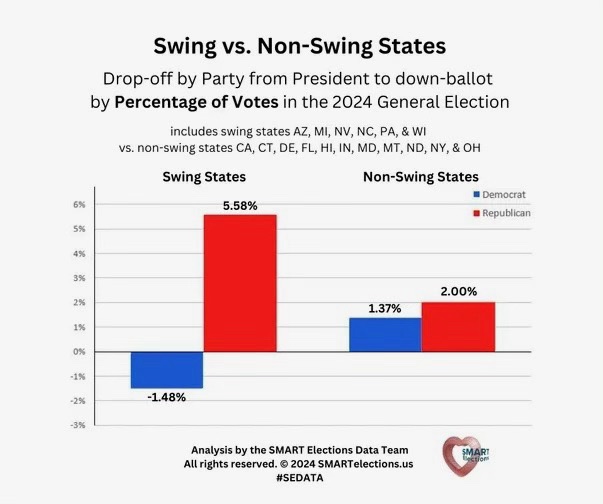
Data that makes no statistical sense. A clean sweep in all seven swing states.

The fall of the Blue Wall. Eighty-eight counties flipped red—not one flipped blue.

Every victory landed just under the threshold that would trigger an automatic recount. Donald Trump outperformed expectations in down-ballot races with margins never before seen—while Kamala Harris simultaneously underperformed in those exact same areas.

If one were to accept these results at face value—Donald Trump, a 34-count convicted felon, supposedly outperformed Ronald Reagan. According to the co-founder of the Election Truth Alliance:

“These anomalies didn’t happen nationwide. They didn’t even happen across all voting methods—this just doesn’t reflect human voting behavior.”

They were concentrated.

Targeted.

Specific to swing states and Texas—and specific to Election Day voting.

And the supposed explanation? “Her policies were unpopular.”

Let’s think this through logically. We’re supposed to believe that in all the battleground states, Democratic voters were so disillusioned by Vice President Harris’s platform that they voted blue down ballot—but flipped to Trump at the top of the ticket?

Not in early voting.

Not by mail.

With exception to Nevada, only on Election Day.

And only after a certain threshold of ballots had been cast—where VP Harris’s numbers begin to diverge from her own party, and Trump’s suddenly begin to surge. As President Biden would say, “C’mon, man.”

In the world of election data analysis, there’s a term for that: vote-flipping algorithm.

Billionaires and Tech Giants Pulled Off the Crime of the Century

Why? There wasn’t just one reason—there were many.

Elon Musk himself hinted at the stakes: he faced the real possibility of a prison sentence if Trump lost. He launched his bid for Twitter—at $20 billion over market value—just 49 days after Putin invaded Ukraine. That alone should have raised every red flag. But when the ROI is $15 trillion in mineral rights tied to Ukraine losing the war and geopolitical deals Trump could green light, it wasn’t a loss—it was leverage.

It’s no secret Musk was in communication with Putin for over two years. He even granted Starlink access to Russian forces. That’s not just profiteering. That’s treason.

Then there’s Peter Thiel and the so-called “broligarchs”—tech billionaires who worship at the altar of shower-avoidant blogger Curtis Yarvin. They casually joke about “humane genocide for non-producers” and have long viewed democracy as a nuisance—an obstacle to their vision of hypercapitalism and themselves as the permanent ruling elite.

Well, what is the elimination of Medicaid if not “humane genocide”—and does anyone really wonder why his 40-year-old protégé and political rookie, JD Vance, is Vice President? With this technology in place, if the third-term legislation were to pass, it would hand Vance a minimum of twelve years at the helm of Thiel’s regime.

And of course, Donald Trump himself:
He spent a year telling his followers he didn’t need their votes—at one point stating,

“…in four years, you don’t have to vote again. We’ll have it fixed so good, you’re not gonna have to vote.”

Trump was facing eighty-eight felony indictments—he was desperate to avoid conviction and locked in a decades-long alliance with Vladimir Putin. An alliance that’s now impossible to ignore—look no further than his policy trail.

He froze aid to Ukraine and has threatened to place sanctions on them, while planning to lift sanctions off Russia. He openly campaigned for anti-EU candidates, and sided with Russia in multiple key United Nations votes related to the Ukraine conflict.

Let’s be clear:

Donald Trump pledges allegiance to a red, white, and blue flag—
It’s just not the American one.

What Happens Now?

We don’t need permission to enforce the Constitution. We need courage. While state attorneys general begin their investigations, it only takes one U.S. senator to initiate the disqualification proceedings against the unelected and unfit occupant of the Oval Office.
State Attorneys General and Investigators:

  • Conduct independent audits of UPS firmware on Dominion and ES&S machines
  • Subpoena communications between Eaton, Palantir, Starlink employees, and Pro V&V
  • Audit Starlink satellite logs for the week of the election
  • Freeze uncertified infrastructure updates
  • Recount physical ballots—by hand
    Now they’re rolling out the same technological toolkit abroad—forcing countries into Starlink contracts in exchange for tariff relief.
    The U.S. election wasn’t their endgame. It was their litmus test.

Want the truth they’re not telling you? For fearless reporting and expert-backed research, read The Common Coalition Report. And if you believe in funding real, independent work—support our all volunteer team here.